Critical Capabilities for Finance and Accounting Business Process Outsourcing
25 June 2026 - ID G00839372 - 28 min read
By Emily Connelly, Jan Ambergen
CFOs use finance and accounting business process outsourcing providers to access AI capabilities, improve processes and reduce costs. CFOs should take advantage of BPO providers’ maturing AI offerings and use outcome-based contracting to incentivize continued innovation with their selected partner.
Overview
Key Findings
- All providers offer at least some AI capabilities in their process technology and services suites. Gaps emerge based on whether providers offer AI capabilities in all three major processes (P2P, O2C, and R2R) as well as the number of capabilities within each process. For example, P2P sees the most mature AI-based offerings, while R2R has the fewest.
- Most providers have integrated performance platforms (IPPs) that provide visibility across all activities from a single interface. The quality of IPPs varies based on the comprehensiveness of information provided and user-friendliness. High-quality IPPs make it easier for clients to understand the efficiency and quality of processes supported, help pinpoint opportunities for improvement, and track workforce engagement.
- Providers are increasing their service delivery flexibility by shifting geographic coverage to comply with increasing data sovereignty and privacy requirements, provide nearshore resources upon request, and hedge against natural disasters and geopolitical conflicts. While providers will always need to meet data sovereignty requirements and provide business continuity plans, delivery center locations will likely become less important as more work shifts from humans to technology.
Recommendations
- Require live demonstration of AI capabilities during vendor evaluation and ask questions about: training AI on your data; AI explainability and confidence levels; controls, compliance, and audit implications with the use of AI; and how constantly evolving AI capabilities are incorporated into contracts and any additional fees. Understanding AI and its uses increases the likelihood of full adoption and greater ROI.
- Contact at least two current clients as references. When possible, choose at least one in the same industry and one of a similar size. Ask current clients about their transition experience, efficiency gains, AI capabilities, and overall satisfaction with the vendor.
- Only engage with providers that offer outcome-based pricing models to create a mutually beneficial relationship and incentivize your business process outsourcing (BPO) partner to continue investing in AI capabilities.
- Use the Critical Capabilities customization feature to adjust weighting percentages, aligning them with your organization’s needs.
What You Need to Know
All providers featured in this Critical Capabilities report deliver technology and services that support procure-to-pay (P2P), order-to-cash (O2C), and record-to-report (R2R). However, providers’ capabilities vary in maturity, and the biggest differences are in three areas:
- AI products and capabilities: There is variation in the number and sophistication of AI technologies offered by BPO providers, as well as whether they are proprietary or offered via partnerships. These factors impact the share of work done by technology versus BPO staff and can elevate provider lock-in risks when relying exclusively on proprietary technology.
- End-to-end process offerings: Many BPO providers offer products and services for all activities within P2P, O2C, and R2R, but clients may only outsource portions of the process. For example, in O2C, cash application is more frequently outsourced than credit management. Because BPO providers cannot optimize what they do not execute, clients should outsource as much of the end-to-end process as possible to harmonize improvement efforts and minimize handoffs.
- Industry-specific solutions: Some BPO providers offer a wide variety of industry-specific solutions and expertise, while others have a limited selection. Organizations should decide which, if any, aspects of their P2P, O2C, and R2R processes require industry-specific solutions and request demonstration of those industry-specific capabilities during provider evaluation to pressure-test performance.
Gartner differentiates providers based on three use cases that represent the primary buyer segments in the finance and accounting (F&A) BPO market:
- Low complexity: Buyers establishing a contract with a third-party outsourcing provider for F&A processing services across P2P, O2C, and/or R2R, including the use of basic automation tools.
- Process optimization: Buyers that require the use of a BPO for technology and processing services across P2P, O2C, and/or R2R to scale and optimize those processes.
- Global and high complexity: Buyers with global operations and complex processing requirements across P2P, O2C, and/or R2R processes that require intelligent workflows to reduce human dependencies.
The ratings for each critical capability are based on evaluations by Gartner analysts, provider demonstrations, responses to questionnaires, insights from client interactions, and Gartner’s Peer Insights platform.
CFOs can use this Critical Capabilities report with the Magic Quadrant for Finance and Accounting Business Process Outsourcing. The Magic Quadrant assesses vendors’ vision and execution, while this report provides a detailed evaluation of product and service capabilities. Using both resources will help identify providers that best fit your requirements.
This research provides a snapshot of the market as of March 2026. As providers continue to innovate, CFOs should revisit both reports to ensure ongoing alignment with evolving business requirements.
Analysis
Critical Capabilities Use-Case Graphics
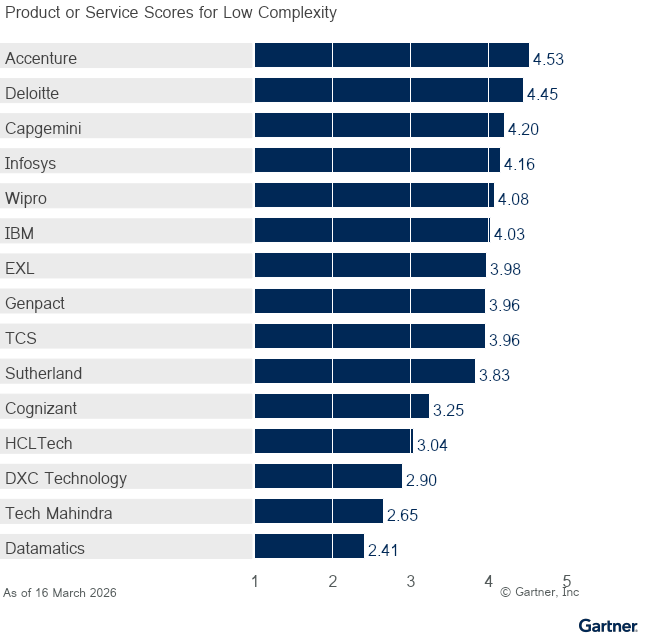
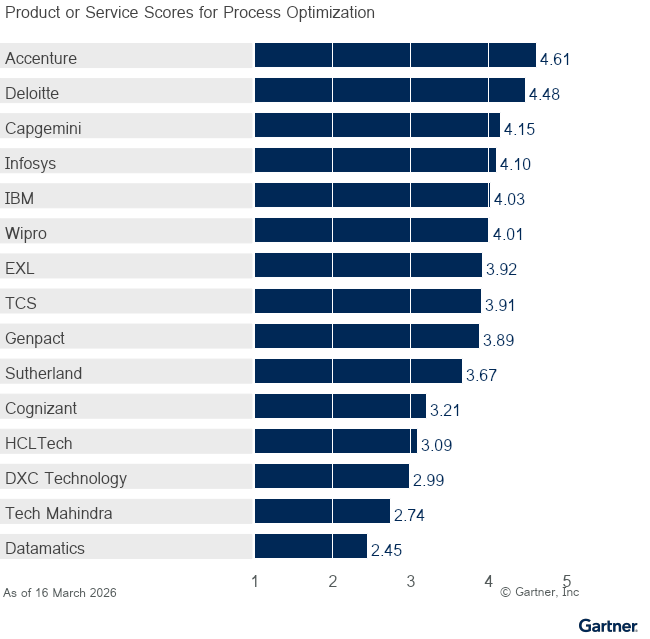
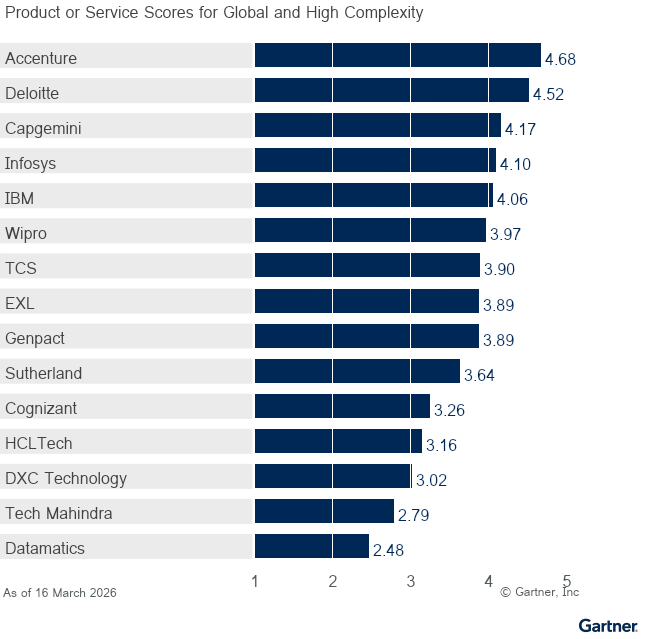
Vendors
Accenture
Accenture’s F&A BPO service offering is centered around its “reinvention” approach to transforming client operations. Accenture’s products and services are bolstered by its agentic capabilities across P2P, O2C, and R2R.
Accenture’s biggest opportunity for improvement across its critical capabilities is service delivery flexibility. Depending on their nature, some change requests go to a formal governance committee for approval, with client feedback indicating a tendency toward strictness when addressing service delivery customization requests.
Accenture’s strongest capability is its integrated performance platform, SynOps. Its features include, but are not limited to, SynOps Delivery Engine for persona-based views of performance and analytics, SynOps Value Meter for realized benefits tracking and improvement opportunity identification, and SynOps Frontdoor for visibility into KPIs, trends, and predictive alerts across all executed processes.
A key differentiator is its SynOps Digital Brain, which gives clients access to Accenture’s learnings from its 400+ F&A clients, combined with client-specific contextual knowledge. This enables clients to benefit from their peers’ experience as well as Accenture’s expertise.
Capgemini
Capgemini’s F&A BPO service offering expanded its scale following the company’s acquisition of WNS. The acquisition expands Capgemini’s finance and accounting capabilities through the addition of WNS’s domain expertise and technology assets, including the TRAC ONE-F platform with agentic AI capabilities.
Capgemini’s biggest opportunity for improvement across its critical capabilities is service delivery flexibility. Capgemini has a formal process to evaluate client change requests with turnaround times longer than some of its peers.
Capgemini’s strongest capability is its process technology and services suite. Capgemini’s agentic capabilities deliver efficiencies for clients, incorporate domain-specific expertise, and enable less reliance on BPO staff executing manual work. Its AI capabilities are supported by generative AI (GenAI) centers of excellence with horizontal- and vertical-specific use cases, an AI Futures Lab, and Applied Innovation Exchange, which brings together customers, Capgemini experts, tech startups, partner organizations, academics, and industry sector experts.
A key differentiator is Cagemini’s DGEM platform, which provides clients access to a range of resources including, but not limited to, benchmarking, process mapping, and its AI-powered assistant for transformation recommendations.
Cognizant
Cognizant’s F&A BPO service offering is supported by its LiveInsights CFO Dashboard platform to track performance across P2P, O2C, and R2R. Its offerings include the Bluebolt innovation program and a library of global process designs, metrics, and best practices, giving clients visibility into performance improvement and transformation resources.
Cognizant’s biggest opportunity for improvement across its critical capabilities is service delivery flexibility. Cognizant has fewer EMEA and North American locations than most of its peers. In the near term, this could be a drawback for clients for whom nearshore delivery options remain important.
Cognizant’s strongest capability is its process technology and services suite. Cognizant’s core AI offerings include agentic accounts payable (AP) invoice extraction, agentic cash application, and GenAI-powered reconciliations. Its AI & Analytics Hub gives customers access to more than 20 reusable models for intelligent audit, cash flow, fraud analytics, manual journals recommendation, and audit control for fast deployment.
A key differentiator is Cognizant’s augmented and virtual reality for employee learning and upskilling, which is likely to boost knowledge retention and skills acquisition, making it easier to transition work to the BPO.
Datamatics
Datamatics’ F&A BPO service offering leverages its FINATO platform to offer CFOs visibility on process-level service performance across P2P, O2C, and R2R. It enables CFOs to monitor progress against improvement targets in real time.
Datamatics’ biggest opportunity for improvement across its critical capabilities is service delivery flexibility. Datamatics’ delivery model is heavily skewed to Asia/Pacific locations, potentially making nearshore delivery requests challenging.
Datamatics’ strongest capability is its integrated performance platform, FINATO. This unified platform incorporates Datamatics’ suite of proprietary technologies, including TruAI, TruBI, TruBOT, and TruCap+, which enable CFOs to reduce manual effort through capabilities such as intelligent document processing and data visualization to help clients better understand performance insights.
A key differentiator for Datamatics is that FINATO can be licensed on a stand-alone basis, reducing vendor lock-in concerns and facilitating easier build-operate-transfer arrangements.
Deloitte
Deloitte’s F&A BPO service offering is anchored in its proprietary technology, Deloitte Ascend and Zora AI. Deloitte cites over 150 partnerships and alliances, increasing the likelihood that it has experience with its customers’ chosen technology partners and vendors.
Deloitte’s biggest opportunity for improvement across its critical capabilities is service delivery flexibility. Deloitte has a formal process to evaluate client change requests that lacks standard timelines for change execution.
Deloitte’s strongest capability is its process technology and services suite. In addition to Deloitte Ascend and Zora AI, clients have access to an array of tools and technologies, including ProfileIQ for benchmarking and Process Biotics + Process Assessment Tool for identifying process inefficiencies. Additional tools include Organizational Digital Twin for modeling improvements and Workforce Analyzer for quantifying AI’s impact on human roles.
A key differentiator is Deloitte’s proprietary ECON Data Library platform, which includes more than 20,000 benchmarks, 5,000 KPIs, and 2,500 business process maps related to its scope of F&A BPO service offerings, which clients can apply to measure and determine improvement opportunities across distinct processes.
DXC Technology
DXC Technology’s F&A BPO service offering uses its Autoflow Performance Management Platform with process, workflow, knowledge, and workforce management capabilities. It provides visibility into performance, reports service levels, tracks employee productivity, and maintains a knowledge repository.
DXC Technology’s biggest opportunity for improvement across its critical capabilities is knowledge transfer. DXC’s knowledge transfer process relies primarily on SME knowledge and involvement, whereas other providers often use process mining during knowledge planning. This results in a lift- and-shift approach with missed improvement opportunities.
DXC’s strongest capability is governance. DXC’s tiered governance structure ensures comprehensive governance via subcommittees, including executive steering and strategy, service management, operational service delivery, process and continuous improvement, and innovation. The innovation committee manages a rolling 24-month innovation plan and provides recommendations to the executive steering and strategy committee, ensuring that process innovation opportunities are captured and executed throughout the contract term.
A key differentiator is DXC’s cross-account Ideation Hub, which gives clients access to process improvement and automation solutions used by others for potential implementation at their organization.
EXL
EXL’s F&A BPO service offering is supported by its Digital Finance Suite (DFS) to manage service delivery and performance. DFS gives clients visibility into performance, workflows, and operations with embedded AI and analytics capabilities.
EXL’s biggest opportunity for improvement across its critical capabilities is workforce capabilities. EXL has higher attrition rates than some of its peers. Clients should inquire about the portion of their work done manually by BPO staff and the knowledge management practices applied to the work done by BPO staff to mitigate the effects of attrition.
EXL’s strongest capability is knowledge transfer. EXL uses its SMART X methodology to manage transitions with four checkpoints to ensure a comprehensive transfer. A checklist of 128 parameters must be met before moving to business-as-usual status, giving clients confidence in the comprehensiveness of knowledge transfer.
A key differentiator is EXL’s “AI/ML-based cognitive nudges” built into NerveHub, designed to drive behavior change and improve performance.
Genpact
Genpact’s F&A BPO service offering is managed through its Enterprise360 platform, which provides visibility and intelligence across processes and operations. Genpact’s service delivery model is supported by its large and dispersed geographic presence across 91 delivery centers, making a range of service delivery requests, such as nearshore and hybrid models, easier to accommodate.
Genpact’s biggest opportunity for improvement across its critical capabilities is service delivery flexibility. Change requests outside the original statement of work or service-level agreement are reviewed by the operational committee but lack predefined evaluation and implementation timelines.
Genpact’s strongest capability is knowledge transfer. Genpact has a five-stage knowledge transfer process, supported by an agentic knowledge management hub. It uses a range of integrated tools, including Epiplex500, for GenAI-generated standard operating procedures to enable faster and higher quality documentation of client processes.
A key differentiator is Genpact’s Agentic Operations Readiness Accelerator (AORA) framework, which accelerates its operating model evolution toward machine execution, with human validation, by preparing its workforce to best work alongside AI agents.
HCLTech
HCLTech’s F&A BPO service offering uses its Operations Command Center (OCC) and AI Force platform, which give clients visibility into process execution and performance. These are complemented by EXACTO for intelligent document processing and Toscana for workflow management.
HCLTech’s biggest opportunity for improvement across its critical capabilities is governance. HCLTech provides a standard governance framework that uses less advanced technology than its peers. Clients should inquire about how HCLTech incorporates advanced technologies into governance activities.
HCLTech’s strongest capability is its process technology and services suite. HCLTech invests in partnerships to advance its AI capabilities and provides an “Agentic AI Farm” of over 100 service and reusable AI agents across P2P, O2C, and R2R. Agents include, but are not limited to, anomaly detection, three-way exception, close orchestration, journal entry, reconciliation, compliance, credit assessment, collections, and cash forecasting.
A key differentiator is HCLTech’s Business AI Lab, staffed with DeepMind experts, machine learning PhDs, and risk and governance specialists.
IBM
IBM’s F&A BPO service offering leverages its AI platform, IBM Consulting Advantage, which includes agentic capabilities in P2P, O2C, and R2R.
IBM’s biggest opportunity for improvement across its offering is workforce capabilities. IBM has higher attrition than some of its peers. Clients should inquire about the portion of their work done manually by BPO staff and the knowledge management practices applied to work performed by BPO employees to mitigate the effect of attrition.
IBM’s strongest capability is digital process transformation. IBM has a comprehensive transformation playbook supported by proprietary and partnered technologies. Assets and tools include, but are not limited to, IBM’s CBM.AI, Garage Value Orchestration, and Blueworks Live, which maps processes and creates documentation.
A key differentiator is IBM’s Transition Accelerator Kit, supported by its watsonx generative AI capabilities, which can reduce manual effort to speed up the transition process.
Infosys
Infosys’ F&A BPO service offering is underpinned by its proprietary Infosys Topaz AI platform and uses its proprietary Finance Excellence Model (FEM 2.0) to benchmark client maturity and design the most appropriate solution at the outset of engagements.
Infosys’ biggest opportunity for improvement across its critical capabilities is workforce capabilities. Infosys has higher attrition than its peers. Clients should inquire about the portion of their work done manually by BPO staff and the knowledge management practices applied to work performed by BPO employees to mitigate the effect of attrition.
Infosys’ strongest capability is its process technology and services suite. Infosys has a suite of more than 50 AI agents across P2P, O2C, and R2R. Example capabilities include, but are not limited to, GenAI-drafted notes for quarterly and annual financial reporting packages in compliance with U.S. GAAP and IFRS, and a Customer Collector for autonomous emailing and call dialing to reduce manual work in O2C.
A key differentiator is Infosys Topaz’s ability to support over 160 languages, making implementation easier for global organizations.
Sutherland
Sutherland’s F&A BPO service offering uses a framework that distinguishes “running better” for cost savings and improved performance, and “running different” for adoption and scaling of AI capabilities, which can help CFOs distinguish between foundational process improvements and future ways of working.
Sutherland’s biggest opportunity for improvement across its critical capabilities is integrated performance platforms. Sutherland’s integrated performance platform has a simple interface relative to other platforms available in the market, with some modules redirecting to Power BI rather than embedded tools.
Sutherland’s strongest capability is knowledge transfer. Sutherland’s four-stage knowledge transfer is supported by technologies such as epiplex.ai and Sutherland Translate AI, which supports over 150 languages, enabling faster and easier transition from multiple geographies.
A key differentiator is Sutherland’s creation of ERP centers of excellence (COEs) to provide software-specific expertise and guidance to clients, as well as GenAI and agentic AI COEs with dedicated AI engineers for continued use case and product development.
TCS
TCS’s F&A BPO service offering is rooted in Cognix, which gives CFOs visibility into performance across P2P, O2C, and R2R. Cognix includes agentic AI capabilities and embedded analytics to enable real-time performance tracking.
TCS’s biggest opportunity for improvement across its critical capabilities is digital process transformation. TCS has a standard transformation playbook. Clients in complex industries or with unique transformation goals should request examples of how TCS has customized transformation strategies for other clients.
TCS’s strongest capability is its process technology and services suite. TCS offers agentic AI capabilities across P2P, O2C, and R2R. In addition to TCS’s standard AI agent offerings, customers can augment with custom agents and agents built to work across platforms, tailoring AI to their unique needs and technology stacks.
A key differentiator is TCS’s “Elastic W-Force” model, which supports client volume surges by blending core teams with flexible talent pools to respond during periods of heightened service demand.
Tech Mahindra
Tech Mahindra’s F&A BPO service offering is underpinned by its TechM Orion platform, which includes both prebuilt and configurable AI agents across P2P, O2C, and R2R, appealing to clients that want AI agents tailored to their unique needs.
Tech Mahindra’s biggest opportunity for improvement across its critical capabilities is knowledge transfer. Tech Mahindra uses a standard knowledge transfer process, and clients should request examples of how Tech Mahindra transfers complex and organization-specific knowledge.
Tech Mahindra’s strongest capability is its integrated performance platform, AceFin. AceFin provides visibility across P2P, O2C, and R2R for performance management, governance, and continuous improvement. It includes role-based dashboards, predictive alerts, configurable analytics, and customizable visualizations.
A key differentiator is Tech Mahindra’s ability to crowdsource and use AI talent via its in-house Populii gig workforce to create additional capacity for new AI capability development.
Wipro
Wipro’s F&A BPO service offering is supported by Wipro Intelligence, its suite of AI solutions. Wipro maintains a “periodic table” of AI agents, assistants, and partner tools available to its customers, organized by capability category to simplify understanding and implementation. Solutions span capabilities such as workflow generation, data testing, and intelligent dashboarding.
Wipro’s biggest opportunity for improvement across its critical capabilities is integrated performance platforms. Wipro uses multiple technology solutions to deliver process execution and performance insights, while other providers can capture process orchestration, analytics, and benchmarking insights from one user interface. This can yield a potentially fragmented experience when clients have to access multiple systems.
Wipro’s strongest capability is service delivery flexibility. Wipro offers a Fusion Global Capability Center model where Wipro and client organizations share ownership and service delivery through flexible partnerships such as joint ventures and build-operate-transfer models.
A key differentiator is Wipro’s Pay-i capability to quantify and track GenAI ROI. Pay-i uses telemetry and GenAI usage data to quantify and track costs and performance.
Context
This research evaluates 15 providers based on seven critical capabilities. When reviewing each provider’s suitability for your organization, use the scores given for each capability as a starting point.
This Critical Capabilities report differentiates each provider’s solution based on three common use cases in the F&A BPO market. Each use case represents a different type of client based on its process maturity and business complexity.
Although we have provided these use cases, organizations can adjust the weightings of each critical capability to conduct a custom analysis of the providers. Select the use case relevant for your company and use the “Customize” function in the interactive version of this report to adjust the weighting of each critical capability based on your business mandates, performance requirements, and future ambitions.
Market Definition
Gartner defines finance and accounting (F&A) business process outsourcing (BPO) as the use of third-party outsourcing service providers to execute transactional finance processes, including purchase-to-pay (P2P), order-to-cash (O2C), and record-to-report (R2R). BPO service providers remotely connect to clients’ systems to carry out these operations. They can also offer proprietary or partnered process automation solutions to enhance transactional processing efficiency. F&A BPO services are typically delivered from global delivery centers.
F&A BPO providers deliver transaction processing services for P2P, O2C and R2R, leveraging advanced automation technologies. In addition to running these services, providers also offer innovative solutions and transformation expertise to enhance process efficiency and support the ongoing maturation of finance operations.
At a minimum, an F&A BPO provider processes finance activities via a remote connection to its customers’ existing systems. Providers employ the required staff, often located in global delivery centers, to deliver these services. Cost savings and efficiency gains are passed on to the buyer in the form of labor arbitrage.
Enhanced F&A BPO offerings that meet finance’s need for more automated transactional processing focus on providing process transformation expertise, often combined with proprietary or partnered process automation technologies, including the use of AI and machine learning (ML). Through agreements with F&A BPO providers, buyers can streamline finance processes, adopt automation technologies that reduce manual intervention, and reduce processing costs through both operational excellence and ongoing innovation.
Mandatory Features
The mandatory features for this market are:
- Connectivity solutions for providers to access clients’ existing systems.
- Offerings that cover two of the following three processes, including all associated subprocesses:
- Purchase-to-pay, including supplier or vendor master data management, purchase orders processing, invoice processing, payment selection, and accounts payable query support.
- Order-to-cash, including customer order management, customer master data management, billing invoice processing, credit and collection management, dispute resolution, cash allocation, and accounts receivable query support.
- Record-to-report, including financial journal entry management, period close management, statement processing, controls and compliance, and transaction analysis.
Optional Features
The optional features for this market include:
- Finance process automation technology solutions, either proprietary or partnered, for P2P, O2C, and R2R, which include workflows that embed the use of AI and ML capabilities.
- Finance process automation services, which involve the provider offering transformation expertise to manage transformation programs across P2P, O2C, and R2R.
- Predictive forecasting and reporting through advanced analytics, AI, and ML to deliver real-time insights, scenario modeling, and forward-looking financial analysis.
- Compliance and controls frameworks to ensure regulatory adherence, risk mitigation, and operational integrity across core finance functions.
Product/Service Trends
The F&A BPO market is racing ahead in the development and deployment of AI capabilities. All providers now offer at least some AI capabilities in P2P, O2C, and/or R2R. P2P sees the most mature AI-based offerings, while R2R has the fewest.
Technical capability is not what holds back AI deployment — client willingness to adopt is. For example, many BPO providers have AI capabilities for collections, but clients are hesitant to unleash AI on this process due to the sensitive nature of customer relationships. AI can analyze customer sentiment and draft a response, but a human must still review and send it to the customer. Clients that deploy new technologies and train AI on their data will see the largest process and quality improvements over time, further reducing the need for manual work.
As AI capabilities become mainstream and market solutions all deliver similar levels of efficiency and accuracy, the future of the market will be defined by BPO providers that can build the most tailored and differentiated AI capabilities to suit clients’ distinct industries, operating complexities, and process transformation objectives.
Critical Capabilities Definition
Integrated Performance Platforms
This capability focuses on delivering comprehensive analytical insights on process, contract, and service fee performance through integrated platforms.
This capability should enable comparative advantage benchmarking on service performance and predictive reporting of transformation opportunities to support decision making and process improvement.
Governance
This capability focuses on providers’ commitment to and effectiveness in managing buyer data, process issues, and risks related to controls and compliance.
The capability should demonstrate providers’ operational transparency through ongoing engagement mechanisms and robust data and process controls that meet complex financial compliance requirements.
Process Technology & Services Suite
This capability encompasses the breadth and depth of providers’ current process technology and service offerings, including proprietary solutions and partnerships.
The capability evaluates how a provider’s suite of process-specific technologies and services support client needs, delivers quality outcomes, and differentiates the provider in the market.
Knowledge Transfer
This capability focuses on providers’ ability to apply a transfer-of-work methodology when transitioning operations to a BPO delivery environment via knowledge capture and migration planning, including the use of appropriate technologies and frameworks.
Service Delivery Flexibility
This capability highlights providers’ ability to adapt service delivery models to meet evolving customer needs in complex finance and accounting environments.
A key aspect is the provider’s agility in scaling operations by rapidly increasing or decreasing resources and services as requirements change. The provider should be able to customize solutions and respond effectively to shifts in the scope of specific customer demands.
Digital Process Transformation
This capability focuses on providers’ ability to design, implement, and manage a roadmap of finance innovation initiatives across client processes and technologies, leveraging best practice methodologies and advanced technologies to optimize process performance and enhance operational maturity.
Workforce Capabilities
This capability focuses on providers’ ability to maximize the value of their workforce for the client, enabled via investments in process skills, digital education, and industry-specific expertise.
The capability should reflect the maturity of workforce management practices, the availability of specialized talent, and the provider’s commitment to continuous workforce improvement.
Use Cases
Low Complexity
Use case is for buyers establishing contracts with third-party outsourcing providers for F&A processing services across P2P, O2C, and/or R2R, including basic automation tools.
Process Optimization
Use case for buyers requiring the use of a BPO for technology and processing services across P2P, O2C, and/or R2R to scale and optimize those processes.
Global and High Complexity
Use case for buyers with global operations and complex processing requirements across P2P/O2C/R2R processes that require intelligent workflows to reduce human dependencies.
Vendors Added and Dropped
We review and adjust our inclusion criteria for Critical Capabilities as markets change. As a result of these adjustments, the mix of vendors in any Critical Capability may change over time. A vendor’s appearance in a Critical Capability one year and not the next does not necessarily indicate that we have changed our opinion of that vendor. It may be a reflection of a change in the market and, therefore, changed inclusion criteria, or of a change of focus by that vendor.
Added
- DXC Technology
Dropped
- Conduent
- PwC was dropped from this Critical Capabilities research due to a lack of publicly available information about its offerings and capabilities.
- WNS
Inclusion Criteria
In addition to Gartner client relevance, as determined by analyst expertise and opinion, providers needed to meet the following criteria to qualify for inclusion.
The provider is required to meet one of the following (in USD constant currency):
- Have attained a minimum revenue of $200 million (or the equivalent in another currency) from F&A BPO services in the last 12 months ending 30 September 2025, or
- A minimum annual revenue of $25 million from F&A BPO services and an average annual growth rate of 10% over the last two years ending 30 September 2025.
And the provider is required to meet all of the following:
- The product or service meets the mandatory features set forth in the Market Definition section.
- Have F&A BPO delivery centers in at least three of the following four regions:
- Asia/Pacific
- EMEA
- Latin America
- North America
- Offer F&A BPO services to a minimum of five clients in at least five of the following major industries:
- Financial services
- Telecommunication
- Education
- Energy and utilities
- Government
- Healthcare
- Life sciences
- Manufacturing
- Media and entertainment
- Professional services
- Retail
- Information technology
- Transportation and logistics
Weighting for Critical Capabilities in Use Cases
| Critical Capabilities | Low Complexity | Process Optimization | Global and High Complexity |
|---|---|---|---|
Integrated Performance Platforms | 15% | 20% | 20% |
Governance | 10% | 5% | 5% |
Process Technology & Services Suite | 15% | 15% | 20% |
Knowledge Transfer | 25% | 10% | 5% |
Service Delivery Flexibility | 15% | 15% | 10% |
Digital Process Transformation | 10% | 20% | 25% |
Workforce Capabilities | 10% | 15% | 15% |
As of March 16, 2026 | |||
Source: Gartner (June 2026)
This methodology requires analysts to identify the critical capabilities for a class of products/services. Each capability is then weighted in terms of its relative importance for specific product/service use cases.
Critical Capabilities Rating
Each of the products/services that meet our inclusion criteria has been evaluated on the critical capabilities on a scale from 1.0 to 5.0.
Products/Services Rating on Critical Capabilities
| Critical Capabilities | Accenture | Capgemini | Cognizant | Datamatics | Deloitte | DXC Technology | EXL | Genpact | HCLTech | IBM | Infosys | Sutherland | TCS | Tech Mahindra | Wipro |
|---|---|---|---|---|---|---|---|---|---|---|---|---|---|---|---|
Integrated Performance Platforms | 5.0 | 4.3 | 3.3 | 3.0 | 4.5 | 3.3 | 4.0 | 4.0 | 3.0 | 4.0 | 4.0 | 3.0 | 4.0 | 3.5 | 3.5 |
Governance | 4.5 | 4.3 | 3.5 | 2.5 | 4.5 | 3.5 | 3.8 | 4.0 | 2.7 | 4.0 | 4.3 | 4.0 | 3.8 | 2.5 | 4.0 |
Process Technology & Services Suite | 4.8 | 4.5 | 3.8 | 2.5 | 4.8 | 3.0 | 3.8 | 4.0 | 4.0 | 4.3 | 4.8 | 4.0 | 4.3 | 3.3 | 4.0 |
Knowledge Transfer | 4.3 | 4.3 | 3.3 | 2.3 | 4.3 | 2.3 | 4.3 | 4.3 | 2.8 | 4.0 | 4.0 | 4.3 | 4.0 | 2.1 | 4.3 |
Service Delivery Flexibility | 4.0 | 3.8 | 2.5 | 2.0 | 4.2 | 3.0 | 4.0 | 3.5 | 2.8 | 4.0 | 4.5 | 3.8 | 4.0 | 2.5 | 4.5 |
Digital Process Transformation | 4.8 | 4.0 | 3.0 | 2.5 | 4.5 | 3.0 | 4.0 | 3.8 | 3.0 | 4.3 | 3.8 | 3.5 | 3.5 | 2.3 | 4.0 |
Workforce Capabilities | 4.5 | 4.0 | 3.3 | 2.1 | 4.5 | 2.8 | 3.5 | 3.8 | 3.0 | 3.5 | 3.5 | 3.8 | 3.8 | 2.5 | 4.0 |
As of March 16, 2026 | |||||||||||||||
Source: Gartner (June 2026)
Table 3 shows the products/services scores for each use case. The scores, which are generated by multiplying the use-case weightings by the product/service ratings, summarize how well the critical capabilities are met for each use case.
Products/Services Score in Use Cases
| Use Cases | Accenture | Capgemini | Cognizant | Datamatics | Deloitte | DXC Technology | EXL | Genpact | HCLTech | IBM | Infosys | Sutherland | TCS | Tech Mahindra | Wipro |
|---|---|---|---|---|---|---|---|---|---|---|---|---|---|---|---|
Low Complexity | 4.53 | 4.20 | 3.25 | 2.41 | 4.45 | 2.90 | 3.98 | 3.96 | 3.04 | 4.03 | 4.16 | 3.83 | 3.96 | 2.65 | 4.08 |
Process Optimization | 4.61 | 4.15 | 3.21 | 2.45 | 4.48 | 2.99 | 3.92 | 3.89 | 3.09 | 4.03 | 4.10 | 3.67 | 3.91 | 2.74 | 4.01 |
Global and High Complexity | 4.68 | 4.17 | 3.26 | 2.48 | 4.52 | 3.02 | 3.89 | 3.89 | 3.16 | 4.06 | 4.10 | 3.64 | 3.90 | 2.79 | 3.97 |
As of March 16, 2026 | |||||||||||||||
Source: Gartner (June 2026)
To determine an overall score for each product/service in the use cases, multiply the ratings in Table 2 by the weightings shown in Table 1.
Critical Capabilities Methodology
This methodology requires analysts to identify the critical capabilities for a class of products or services. Each capability is then weighted in terms of its relative importance for specific product or service use cases. Next, products/services are rated in terms of how well they achieve each of the critical capabilities. A score that summarizes how well they meet the critical capabilities for each use case is then calculated for each product/service.
"Critical capabilities" are attributes that differentiate products/services in a class in terms of their quality and performance. Gartner recommends that users consider the set of critical capabilities as some of the most important criteria for acquisition decisions.
In defining the product/service category for evaluation, the analyst first identifies the leading uses for the products/services in this market. What needs are end-users looking to fulfill, when considering products/services in this market? Use cases should match common client deployment scenarios. These distinct client scenarios define the Use Cases.
The analyst then identifies the critical capabilities. These capabilities are generalized groups of features commonly required by this class of products/services. Each capability is assigned a level of importance in fulfilling that particular need; some sets of features are more important than others, depending on the use case being evaluated.
Each vendor’s product or service is evaluated in terms of how well it delivers each capability, on a five-point scale. These ratings are displayed side-by-side for all vendors, allowing easy comparisons between the different sets of features.
Ratings and summary scores range from 1.0 to 5.0:
1 = Poor or Absent: most or all defined requirements for a capability are not achieved
2 = Fair: some requirements are not achieved
3 = Good: meets requirements
4 = Excellent: meets or exceeds some requirements
5 = Outstanding: significantly exceeds requirements
To determine an overall score for each product in the use cases, the product ratings are multiplied by the weightings to come up with the product score in use cases.
The critical capabilities Gartner has selected do not represent all capabilities for any product; therefore, may not represent those most important for a specific use situation or business objective. Clients should use a critical capabilities analysis as one of several sources of input about a product before making a product/service decision.