Emerging Market Quadrant for Narrative Intelligence — Startup Vendors
26 June 2026 - ID G00850107 - 15 min read
By Alfredo Ramirez IV, Apeksha Kaushik, and 3 more
AI-driven disinformation is eroding trust, requiring narrative intelligence to counter sophisticated attacks. Cybersecurity, communications and marketing leaders can use this research to evaluate startup vendors for proactive disinformation sensing and content monitoring.
Summary Market Definition
Gartner defines narrative intelligence tools as those that help organizations preemptively detect and monitor narratives using a broad range of data from various sources (such as social media, news media, the dark web, internal communications channels, and other digital content). Narrative intelligence tools analyze the evolution of narratives, adversarial intent, and influence operations. These tools enable organizations to detect early signals and track the spread of disinformation over time with deep context to safeguard their organization’s brand and reputation. For more, see the Detailed Market Definition section below.
Key Emerging Market Trends for Startup Vendors
Generative AI (GenAI) is increasingly less expensive and easy to use for malicious purposes, requiring narrative intelligence to evolve into both an operating discipline and a discrete technology layer. This Emerging Market Quadrant highlights how startup vendors are positioning themselves and where future consolidation and leadership are most likely to emerge based on their Potential for Market Disruption and Potential to Execute.
The narrative intelligence market addresses a critical gap in enterprise security: the weaponization of GenAI to exploit human cognitive biases through industrialized influence operations. Unlike traditional cybersecurity, which protects technical infrastructure, narrative intelligence helps protect corporate reputation, executive decision integrity and commercial market stability from sophisticated cognitive hacking and coordinated inauthentic behavior.
- The market solves the structural failure of legacy social media listening and media monitoring tools, which rely on reactive keyword tracking and volume metrics, rendering them easily blinded by coordinated bot farms and cross-platform information obfuscation.
- Gartner predicts that 45% of chief communications officers (CCOs) will adopt narrative intelligence technologies by 2029 to support reputation monitoring amid an intensifying disinformation landscape. Due to the multisurface nature of these threats, narrative intelligence is of primary concern for CCOs and increasingly also for chief marketing officers (CMOs), chief information security officers (CISOs) and CIOs.
- To counter these threats, a new wave of startup vendors is introducing advanced, AI-native tools capable of proactive “narrative sensing.” Instead of merely counting brand mentions, these tools use semantic radars, agentic AI and multimodal analysis to map adversarial intent, track contagion across fringe and mainstream channels, and identify the synthetic origins of malicious campaigns.
- Vendors in this space are categorizing their approaches to solve these issues. Some are building massive-scale, cross-platform cognitive security networks; others are deploying highly targeted actor intelligence and bot detection for specific domains; and Pioneers are using agentic AI to provide early-warning situational awareness and automated counternarrative “antidotes.”
Looking toward to the future, the narrative intelligence market will rapidly transition from providing passive, retrospective analysis to delivering autonomous management and remediation options. Organizations will increasingly mandate that the data and capabilities be integrated directly into their security operations centers (SOCs), broader crisis management workflows and reputation management capabilities, treating cognitive attacks with the same urgency as cyberbreaches.
Emerging Market Quadrant Analysis
Gartner’s Emerging Market Quadrant is designed to help clients understand the dynamics of relatively new and fast-moving market capabilities and form shortlists of technology providers to explore when making tech buying, partnering, acquisition and investment decisions. For more information on the underlying methodology, see How Markets and Vendors Are Evaluated in Gartner Emerging Market Quadrants.
An Emerging Market Quadrant is not an exhaustive analysis of every tech provider in an emerging market. It is a focused analysis of the providers Gartner analysts believe are most indicative of the market and most relevant for Gartner’s technology buyer clients who are exploring engaging in the emerging market.
Market Shapers: Shifting From Localized, Keyword-Based Scanning Tools to Foundational Enterprise Narrative Intelligence Platforms
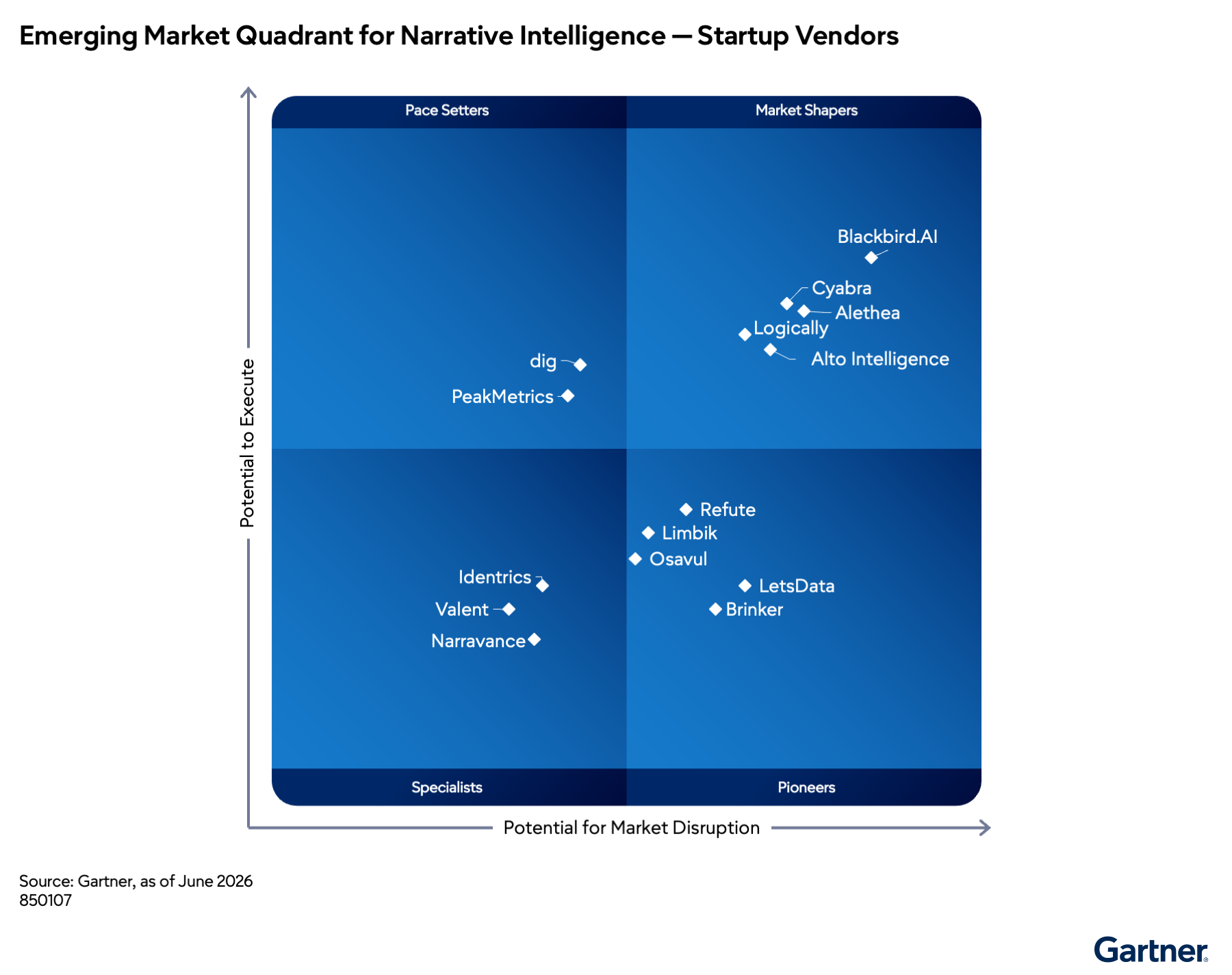
The assessment of this quadrant is based on Gartner’s opinion of the collective characteristics of its featured vendors: Alethea, Alto Intelligence, Blackbird.AI, Cyabra and Logically.
Analysis of Disruptive Potential
The primary Market Shaper disruption involves a shift from localized, keyword-based scanning tools to foundational enterprise threat intelligence platforms. Vendors here are disrupting traditional security and marketing architectures by transforming the connections between corporate risk management, crisis management, legal and cybersecurity. They achieve this by deploying robust collection systems processing vast streams of unstructured social and fringe web data in real time, moving past legacy listening tools that are easily fooled by coordinated bot farms, fake special interest campaigns and cross-platform information obfuscation.
A key driver of this disruption is their ability to provide cross-platform scoring to track if contagion is growing or shrinking, and multimodal tracking to include text and media, graph relationship mapping and both bad actor and target attribution. Available management actions go beyond simple takedown requests to provide automated remediation, next steps suggestions and counternarrative guidance directly to end users.
Case Example: Neutralizing Coordinated Cross-Platform Disinformation
Goal: Reduce the combined potential of negative reputational impact, physical security risk and cybersecurity exposure before significant damage occurs.
Situation: A sophisticated threat actor launches an industrialized narrative campaign targeting a global enterprise or an entire market such as pharma or telecom or food industry. It uses automated network amplification and astroturfing across multiple fringe and mainstream platforms to manipulate stock prices or bolster competitors.
Implication: Legacy social listening tools are tuned to assess sentiment rather than source, motive and veracity of narrative content. Without true narrative intelligence, the organizational risk level remains elevated, exposing it to severe commercial and potentially executive safety vulnerabilities.
Resolution: Focus on an integrated narrative intelligence platform that processes the unstructured data in real time using semantic clustering, attribution of those driving the narrative and predictive threat intelligence, ensuring clients can distinguish between manipulated narratives and genuine human perspectives. The vendor isolates inauthentic manipulation from organic discourse, automatically assessing the risk level and delivering precise counternarrative guidance to the communications and crisis management team.
Analysis of Potential to Execute
Market Shaper potential to execute is defined by substantial horizontal scaling, strong financial backing and deep ecosystem integration. These providers leverage reliable, scalable cloud platforms that can support more complex, global, multistakeholder deployments. They enjoy a deeper customer base, significant employee experience and more robust ecosystem partnerships. By operationalizing the workflow from early signal detection to board-level reporting, they have successfully demonstrated how narrative intelligence can evolve from basic sentiment scoring into a foundational and integrated layer of corporate security.
Recommended Actions, Risks and Cautions
- Implement these comprehensive platforms to establish an integrated layer of corporate threat intelligence that bridges physical, cyber, financial and reputational risk management.
- Continuously assess the efficacy of these broad solutions as it is continuously challenged by rapidly changing disinformation tactics, sophisticated threat actors and emerging GenAI capabilities.
- Ensure cross-organizational buy-in from communications, marketing, cybersecurity, compliance and legal teams, as a lack of understanding regarding the scope of industrialized disinformation campaigns can paralyze effective deployment.
Pace Setters: Advancing Digital Trust Through Highly Specialized, Precision-Engineered Narrative Validation
The assessment of this quadrant is based on Gartner’s opinion of the collective characteristics of its featured vendors: dig and PeakMetrics.
Analysis of Disruptive Potential
The defining disruption trend among Pace Setters is advancing digital trust through highly specialized narrative validation within targeted modalities or functions. These vendors have the opportunity to disrupt the market by executing exceptionally well in particular aspects of narrative intelligence, such as advanced bot detection, localized threat intelligence or tracking campaigns involving specific media such as video. They overcome the limitations of traditional sentiment analysis by deploying nuanced analysis of coordinated campaigns, utilizing AI prompt interfaces as copilots to democratize usage, fine-tune alerting and rapidly generate localized risk scoring.
Case Example: Targeted Neutralization of Synthetic Video Campaigns
Goal: Detect and neutralize coordinated disinformation campaigns that use specific, highly complex media modalities such as video.
Situation: Malicious actors propagate harmful narratives through targeted synthetic video campaigns that easily evade generalized, text-based sentiment analysis tools.
Implication: The fake and inflammatory narrative attack permeates audience newsfeeds as though it originated organically, effectively manipulating public discourse and severely damaging organizational credibility.
Resolution: A specialized AI prompt interface acts as a copilot for analysts, fine-tuning the detection algorithms to specifically isolate the video propagation vectors and correlating across other modalities such as text, significantly reducing manual effort and expediting risk scoring. This could also serve as a key input to a crisis communications response.
Analysis of Potential to Execute
Pace Setters’ Potential to Execute is characterized by highly disciplined, domain-specific delivery models. These vendors have amassed a combination of strong financial backing, proven depth in their targeted customer base and strategic ecosystem partners. They demonstrate a strong ability to execute reliably within their directed focus areas, establishing credible, production-ready benchmarks.
Recommended Actions, Risks and Cautions
- Deploy these solutions when your organization requires specialized, highly proven capabilities, such as advanced bot network detection or targeted analysis of specific media modalities.
- Carefully plan integration roadmaps; ensure these directed capabilities can seamlessly integrate within a wider ecosystem of technology partners to avoid creating silos due to isolated data.
- Be cautious while building the response plan as realistically effective countermeasures in this emerging market likely require an ensemble of solutions tailored to each organization’s circumstances and appetite for cost and integration.
Pioneers: Characterized by Differentiated Approaches and Localized Disruption
The assessment of this quadrant is based on Gartner’s opinion of the collective characteristics of its featured vendors: Brinker, LetsData, Limbik, Osavul and Refute.
Analysis of Disruptive Potential
The clear disruption trend with Pioneers is challenging conventional monitoring paradigms by introducing highly innovative, forward-looking architectures designed to push defense mechanisms to the absolute edge of early-warning detection. Early warning in this context generally means activity surfaced that has not been reported by traditional threat intelligence providers and that has no prior public reporting.
These vendors disrupt through differing innovations such as multilingual intelligence, responses based on behavioral psychology, security indicators and the deployment of agentic AI for analysis. By natively ingesting multimodal signals (text, image, audio, video), they detect influence emergence and narrative evolution and flag anomalous clusters of problematic activity at their inception. Solutions in this quadrant offer ingestible intelligence for security teams and leverage AI to autonomously generate briefings and automated risk assessment triggers.
Case Example: Early-Warning Detection via Agentic Behavioral Analysis
Goal: Provide rapid early warning and automated risk assessment for nascent disinformation campaigns to drastically reduce manual analyst effort.
Situation: A coordinated information operation leverages specific behavioral psychology triggers to launch a multilingual, multimodal narrative attack against a private organization.
Implication: Traditional tools lack the semantic context and security indicators to flag dangerous behavior, allowing the campaign to either gain broad viral momentum or succeed against a targeted audience depending on the goal, before security teams are alerted.
Resolution: AI agent analysts dynamically ingest the multimodal signals, immediately identifying the behavioral manipulation and automatically generating a clear executive briefing and risk assessment trigger for preemptive action.
Analysis of Potential to Execute
Execution trends in the Pioneers quadrant highlight strong technical agility balanced with structural resource constraints. These vendors are well-positioned to gain market share by leveraging their strong technology base, with some rapidly deploying agentic AI to significantly reduce manual effort. While they are still progressing toward the execution abilities of Market Shapers, their execution velocity is currently financially constrained. In some cases this is due to circumstance, and in other cases a legitimate choice. The fact remains that forgoing outside financial backing can slow customer base growth, partner ecosystems expansion and overall company size relative to the Market Shapers.
Recommended Actions, Risks and Cautions
- Pilot these highly innovative, agentic solutions to secure early-warning intelligence and predictive situational awareness, bypassing the manual latency of traditional human analysts.
- The long-term execution of these vendors carries some risk; they face the threat of losing out to larger players capturing key market segments before these startups can achieve necessary scale.
- Carefully evaluate their product roadmaps; organizations must ensure these vendors can continue adding innovative capabilities to build out a broader platform that satisfies evolving, long-term narrative intelligence requirements.
Specialists: Combining Specialized AI Capabilities Backed by Robust Human Research
The assessment of this quadrant is based on Gartner’s opinion of the collective characteristics of featured vendors: Identrics, Narravance and Valent.
Analysis of Disruptive Potential
The Specialists disruption trend defining the quadrant is the delivery of deep, intelligence-led components targeting particular aspects of the narrative intelligence life cycle. Rather than offering broad, generalized platforms, these vendors offer actionable context by focusing heavily on specific data streams, such as social text feeds and highly specialized news story analysis. Their disruptive edge lies in combining specialized AI capabilities backed by robust human research and deep threat intelligence. They provide targeted sectors with more exact, vertical-specific intelligence required to navigate complex media environments without the overhead of large, generalized suites.
Case Example: Deep Threat Intelligence for Specific Vertical Media
Goal: Gain highly accurate, deeply researched insights into narrative threats emerging from specific, text-based social and media channels.
Situation: An organization requires granular threat intelligence regarding a localized narrative attack propagating exclusively through specialized news outlets and text feeds.
Implication: Broad monitoring platforms may generate excessive noise and false positives, lacking the nuanced human context required to understand the specific vertical threat.
Resolution: Tightly focused text-based detection capabilities back AI analysis with specialized human research to deliver precise, actionable insights tailored specifically to the organization’s vertical.
Analysis of Potential to Execute
Specialists’ ability to execute is confined to dominating narrowly defined intelligence workflows. These vendors have demonstrated a strong ability to build highly capable technologies with a directed focus. They execute as critical components for more targeted initiatives that are additive to broader solutions for customers. Their execution potential is often constrained by a lack of broader technology breadth, depth of agentic AI integration and the overall market reach exhibited by vendors in other quadrants. To survive and scale, these vendors must increasingly rely on forging critical partnerships with adjacent vendors to add value in solutions such as deepfake detection and impersonation prevention.
Recommended Actions, Risks and Cautions
- Use these vendors for high-stakes edge cases where deep threat intelligence, human-backed research and highly specialized text-based media analysis are strict requirements.
- As the broader security market rapidly shifts toward consolidated platforms, the total addressable market and long-term viability for highly specialized, stand-alone players may be severely limited.
- Actively assess these vendors’ partnership ecosystems; ensure they are successfully forging alliances with adjacent vendors to add value potentially in deepfake detection and impersonation prevention to guarantee lasting value to adopters.
Detailed Market Definition
Gartner defines narrative intelligence tools as those that help organizations preemptively detect and monitor narratives using a broad range of data from various sources (such as social media, news media, the dark web, internal communications channels, and other digital content). Narrative intelligence tools analyze the evolution of narratives, adversarial intent, and influence operations. These tools enable organizations to detect early signals and track the spread of disinformation over time with deep context to safeguard their organization’s brand and reputation.
Narrative intelligence tools are primarily used to address the business problem posed by the rapid proliferation of AI-amplified malicious narratives, which threaten an organization’s reputation and executive integrity. Organizations face an accelerating spread of misinformation and disinformation, which the World Economic Forum ranks as one of the top global risks. Traditional monitoring tools (such as social and media monitoring) are often inadequate to guard against these threats because they miss early warning signs of damaging narratives and are not equipped to help organizations proactively protect against modern AI-driven attacks. These AI-driven attacks exploit cognitive biases and emotional triggers among real human audiences, rather than an organization’s technical vulnerabilities, and therefore are currently outside the purview of cybersecurity.
Narrative intelligence not only enables organizations to develop a preemptive defense strategy, but can also be used offensively. Offensive use cases include tracking competitor narratives, monitoring positive brand and industry trends, and identifying influential actors propagating positive narratives. In both defensive and offensive cases, by evolving beyond current and retrospective metrics (such as the volume of brand mentions and message pull-through) to embrace predictive insights provided by narrative intelligence tools, C-level leaders can avoid costly reactive measures and gain a competitive edge. These tools help various functions (such as communications or marketing, which may be responsible for their organization’s public-facing narrative), to identify and classify disinformation attacks by understanding adversarial intent, narrative origin, bot-based amplification, geographical spread, contagion across platforms, and perception vulnerabilities. Leveraging these tools enables organizations to anticipate emerging threats, provide context to develop agile counternarratives, and proactively protect their brand. Gartner predicts that 45% of chief communications officers (CCOs) will adopt narrative intelligence technologies by 2029 to support reputation monitoring amid an intensifying disinformation landscape. Due to the multisurface nature of these threats, narrative intelligence is of primary concern for CCOs and increasingly also for chief marketing officers (CMOs), chief information security officers (CISOs), and CIOs.
Mandatory Features
The mandatory features for this market include:
- Detection and analysis of growing and fading narratives propagating on external attack surfaces (for example, social media, news, the dark web, and online channels)
- The ability to examine the evolution of a given narrative and its information flows
- Analysis of adversarial intent to help organizations identify and classify disinformation attacks
- Telemetry and mapping features for tracking the spread and identifying the propagators of narratives
Optional Features
- The ability to unify new monitoring data with existing insights to provide a comprehensive view of narrative dynamics
- Asynchronous deepfake detection capabilities to analyze images, videos, and other content posted online to ascertain veracity
- Actor intelligence to identify and map the most influential actors, their networks, and motives
- Detection of sophisticated bot networks and anomalous bot-based amplification used in dissemination campaigns
- Analysis of the “human element of influence” to identify audience psychological and cultural vulnerabilities that narratives exploit
- Support for content provenance standards (such as the Coalition for Content Provenance and Authenticity, or C2PA) to securely attach tamper-evident metadata to official organization communications
- Impact intelligence to predict the influence of ongoing harmful activity and measure the success of mitigative efforts
- Specific narrative intelligence capabilities tailored for executive protection services to mitigate leadership-targeted disinformation
- Integration with existing cybersecurity and digital risk protection tools
- Features that provide insights into cohort communities and how online tribes interact with key narratives
Note
These are representative startup vendors and do not imply an exhaustive list. Please note for the purpose of this research, we have included the startup vendors only. Beyond the scope of this research, there are other established players too in this market.