Navigating Security Posture Management: Selecting Cloud Security Tools That Truly Fit Your Needs
6 April 2026 - ID G00846923 - 14 min read
By Dale Koeppen, Charlie Winckless
Most cloud incidents stem from user configuration and identity errors. Cybersecurity leaders must select security posture management tools that prioritize critical weaknesses and integrate with existing controls, enabling secure cloud environments through informed human intervention.
Insights at a Glance
Adoption of cloud platform services and applications has driven demand for specialized posture management tools in order to maintain acceptable levels of security hygiene.
- Rapid cloud adoption has created significant challenges for cybersecurity leaders, increasing complexity in managing security across diverse environments and services. This complexity has led to knowledge gaps and difficulties in maintaining an effective security posture, prompting the need for specialized posture management tools from industry vendors.
- Security posture management (SPM) platforms provide a risk-centric view of security posture for distinct security domains with cloud platforms and specific services within these environments.
- Cybersecurity leaders must clearly articulate the primary security domain their organization aims to address, whether it’s IaaS/PaaS security, SaaS security, data security, Kubernetes security, or application security including AI workload protection. The choice of posture management solutions should align with the specific segment of the cloud ecosystem relevant to your organizational requirements.
- Cybersecurity leaders must assess the current landscape of cloud security tools already deployed within their environment, because many xSPM point solutions have evolved into comprehensive platforms. Confirm that the desired security outcomes are not already being delivered by existing vendors to avoid unnecessary overlap and minimize technical debt.
Impact Brief
The rapid adoption of diverse cloud platforms, applications, and specialized services has intensified the demands on cybersecurity leaders, requiring them to quickly master a wide array of complex environments. It is unrealistic to expect security leaders to possess in-depth knowledge of every security baseline across all cloud assets within their organizations. Recognizing this challenge, the industry has responded with targeted and specialized posture management tools to address these specific gaps.
What Is Security Posture Management?
Security posture management (xSPM — where x is prefixed to represent the different types of SPM products) equips security leaders with a unified, detection-driven, risk-centric perspective of their organization’s security posture. By consolidating and aggregating signals across disparate security environments, including cloud platforms, SaaS applications, data assets, identities, workloads including private applications and AI models, and underlying infrastructure, xSPM enables comprehensive visibility and risk management across multiple security domains.
These solutions go beyond isolated alerting by correlating misconfigurations, vulnerabilities, and access controls to illustrate potential attack paths to critical assets. This holistic approach enables CISOs to strategically prioritize investments and remediation efforts where they will have the greatest impact on risk reduction. Ultimately, xSPM delivers enhanced accountability, defensible prioritization, and quantifiable risk mitigation, translating complex technical data into actionable business insights that inform security decisions and facilitate executive- and board-level reporting.
Why Do We Need Posture Management?
Cloud providers and services, such as IaaS/PaaS/SaaS, implement and configure their security features uniquely. This variability introduces complexity that often exceeds an enterprise’s capacity to fully understand and manage associated risks. While recent incidents have highlighted vulnerabilities even among leading cloud providers, the majority of security issues still stem from administrative misconfigurations and improper cloud usage.
Security posture management controls deliver a wide range of essential capabilities across the entire cloud ecosystem for the following reasons:
- Comprehensive inventory of cloud infrastructure, cloud services and related assets, including identity and service accounts.
- Auditing, normalizing, correlating, and prioritizing configuration errors and critical risks across cloud platforms, service integrations, and application environments, taking into account connectivity, data sensitivity, network exposure, AI model exposure, and application dependencies.
- Deep visibility into user and service access, permissions, and entitlements for both human and nonhuman identities across cloud, data repositories, and application layers.
- Contextual enrichment of configuration and security data, drawing insights from cloud environments, workloads, data stores, networks, AI services and application components.
- Remediation guidance and optional, low-risk remediation automation, tailored to the specific security domain, infrastructure, data, networks, workloads, and applications.
- Support for compliance assessments, addressing requirements for cloud platforms, data governance, AI ethics, and application security standards.
- Detection of configuration drift and security posture changes across cloud infrastructure, networks, data repositories, AI services, and deployed applications.
This approach emphasizes that security posture management is not limited to the cloud platform itself, but extends to the extended services of data, networks, AI workloads and applications operating within the cloud environment.
Actions
Cybersecurity leaders must select security posture management tools that prioritize critical weaknesses and integrate with the existing controls, enabling secure cloud environments through informed human intervention:
- Align xSPM platform capabilities with business risk, ensuring the solution addresses your most critical risk domains.
- Validate integration with the existing security stack, confirming seamless interoperability with current tools and operational workflows.
- Assess depth and breadth of coverage, scrutinizing the platform’s ability to provide comprehensive visibility across relevant assets, not just surface-level integrations.
- Evaluate automation, prioritizing platforms that offer robust, customizable automation for detection, alerting and effective actionable communication to organizational stakeholders.
- Review vendor maturity and roadmap, investigating the vendor’s track record, support responsiveness and strategic vision for platform convergence.
How to Execute
Select the xSPM Tool That Truly Fits Your Needs
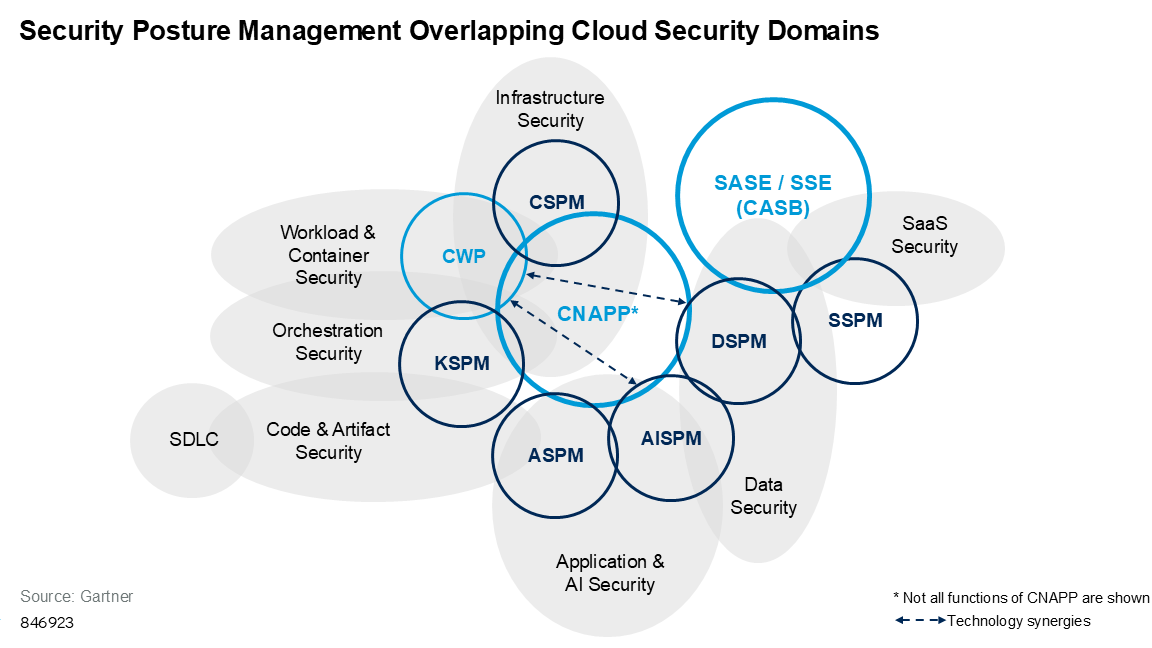
Although security posture management (xSPM) solutions are available for cloud, application, data network and other specialised use cases, this research will concentrate on the leading xSPM products currently prevalent in the market. The xSPM solutions available today have vastly different applications, but often have overlapping views of risk.
A significant trend among the xSPM products highlighted in this research is the ongoing consolidation of multiple xSPM solutions into unified, mainstream larger platforms within each major security domain that these xSPM products operate in. This integration enables organizations to centralize risk management by aggregating overlapping signals, streamlining visibility, and reducing operational complexity as shown in Figure 1.
CSPM — Cloud Security Posture Management
Cloud security posture management (CSPM) provides visibility and control over cloud infrastructure security risks and misconfigurations across multicloud environments (see Table 1).
Primary Focus: Cloud Infrastructure (AWS, Azure, GCP, Others)
| Evaluation Area | What the xSPM Covers | Considerations and Cautions |
|---|---|---|
Coverage | Cloud infrastructure configurations across AWS, Azure, GCP, others (IAM, network, storage, compute, services). | Confirm true multicloud support (not just on “roadmapped”). Check the depth of coverage per cloud service, not just checkbox claims. |
Integration points | Cloud provider APIs, CI/CD pipelines, SIEM/SOAR, ticketing systems (Jira, ServiceNow), IaC tools. | Prefer native integration over custom connectors. Assess integration ease and ongoing maintenance. |
Automation and remediation | Automated detection of misconfigurations; optional autoremediation; guided playbooks. | Autofix can be risky; ensure guardrails and approval workflows. Confirm alignment with change management processes. |
Compliance support | Mapping cloud to CIS, NIST, ISO, PCI DSS, SOC2; continuous compliance monitoring. | Compliance mapping does not equal audit readiness. Ask how evidence is generated and maintained over time. |
Scalability and performance | Agentless scanning via cloud APIs; supports large, multiaccount environments. | API rate limits can impact scan frequency and depth. Ask how scale is handled without performance loss. |
User experience | Dashboards for posture, risk prioritization, trends, alerts and reporting. | Poor prioritization leads to alert fatigue. Evaluate risk scoring logic and the ability to tune alerts. |
Vendor reputation and support | Offered by large platform vendors and cloud-native startups; varying maturity. | Assess roadmap stability, support SLAs, and customer references at your scale. |
Market convergence and future readiness | Integration with broader platforms (e.g., CNAPP, KSPM, CWP, CIEM, DSPM, AISPM, ASPM). | Evaluate vendor vision and roadmap for convergence, unified risk management, and maturity of integrated capabilities. |
Source: Gartner (April 2026)
KSPM — Kubernetes Security Posture Management
Kubernetes security posture management (KSPM) delivers comprehensive oversight and governance of security settings and policies within Kubernetes clusters (see Table 2).
Primary Focus: Kubernetes Orchestration Security (EKS, AKS, GKE, Others)
| Evaluation Area | What the xSPM Covers | Considerations and Cautions |
|---|---|---|
Coverage | Kubernetes cluster configurations, control plane settings, RBAC, network policies, namespaces, pod security. | Validate coverage depth for managed services (EKS, AKS, GKE, etc). Some tools may only address control plane, not workloads. Others will provide on-prem Kubernetes integration. |
Integration points | Kubernetes APIs, CI/CD pipelines, container registries, cloud provider services, SIEM, SOAR. | Prefer native integrations; strong CI/CD integration is essential for embedding security into DevOps workflows. |
Automation and remediation | Misconfiguration detection; policy enforcement at deployment; limited autoremediation. | Autofix in Kubernetes can be disruptive. Ensure support for approval workflows and rollback mechanisms. |
Compliance support | CIS Kubernetes Benchmark, NSA/CISA hardening guidance. | KSPM is operationally focused. Don’t expect broad regulatory compliance (e.g., PCI, SOC2). |
Scalability and performance | Scales by clusters and nodes; agent-based or agentless deployments. | Agents can impact cluster performance. Assess resource overhead and upgrade management. |
User experience | Cluster-level dashboard, misconfiguration findings, policy views for workloads and namespaces. | UX often assumes Kubernetes expertise. Nonsecurity teams may need enhanced visualization and context. |
Vendor reputation and support | Offered by CNAPP platforms and Kubernetes-focused security vendors. | Evaluate Kubernetes expertise, release cadence, and support during cluster incidents. |
Market convergence and future readiness | Integration with broader platforms (e.g., CNAPP, CWP, CIEM, DSPM, AISPM, ASPM). | Assess vendor roadmap for platform convergence, unified risk management, and maturity of integrated capabilities. |
Source: Gartner (April 2026)
DSPM — Data Security Posture Management
Data security posture management (DSPM) enables discovery, classification, and risk management of sensitive data across cloud, SaaS, and on-premises environments (see Table 3).
Primary Focus: Sensitive Data Discovery and Classification
| Evaluation Area | What the xSPM Covers | Considerations and Cautions |
|---|---|---|
Coverage | Discovery and classification of sensitive data across cloud storage, databases, data warehouses, SaaS apps, and on-prem systems. | Validate breadth and depth of coverage. Some tools excel in cloud storage, but lack robust support for databases or SaaS. DSPM will not cover all your DLP needs. |
Integration points | Cloud provider APIs, databases, data lakes, SaaS APIs, IAM systems, SIEM/SOAR, DLP tools. | Ensure integrations don’t require excessive privileges. Check how identity context and access rights are correlated to data exposure. |
Automation and remediation | Automated data discovery and classification; alerts on exposure; guided remediation (access reduction, encryption, policy enforcement). | Most DSPM tools provide advisory rather than enforceable remediation. Confirm approval processes for changes. |
Compliance support | Mapping to NIST, ISO, CIS, COBIT, GDPR, HIPAA, PCI DSS, CCPA, CCM, data residency and privacy requirements. | Compliance reporting varies. Ask how evidence, lineage, and ownership are documented and maintained. |
Scalability and performance | Scales across large data estates using API-based scanning and sampling; support continuous discovery. | Full scans can be resource-intensive. Assess performance, scan frequency, and cost at scale. |
User experience | Data maps, risk dashboards, exposure views tied to sensitivity and access paths. | Poor prioritization will overwhelm users. Strong visualization and risk context are essential for adoption. |
Vendor reputation and support | Offered by both startups and established vendors; rapid category growth. | Vendor maturity, classification accuracy, roadmap stability, and support during scans are critical. DSPM does not replace DLP. |
Market convergence and future readiness | Integration with broader platforms (e.g., CNAPP, CWP, CIEM, CSPM, SSPM, AISPM). | Assess vendors roadmap for platform convergence, unified risk management, and maturity of integrated capabilities. |
Source: Gartner (April 2026)
ASPM — Application Security Posture Management
Application security posture management (ASPM) aggregates and prioritizes application security risks across the software development life cycle and production environments (see Table 4).
Primary Focus: Centralized Visibility and Management of Application Security Risk Across the SDLC
| Evaluation Area | What the xSPM Covers | Considerations and Cautions |
|---|---|---|
Coverage | Aggregates risk signals from application security tools, SAST, DAST, SCA, IaC scanning, secrets detection, and sometimes runtime findings. | Validate which tools and SDLC stages are truly covered. Many ASPMs offer limited integration depth. |
Integration points | CI/CD pipelines, source code repositories, ticketing systems, cloud platforms, vulnerability scanners and developer tools. | Prefer native integrations; depth of context (repo, branch, owner, pipeline stages) is more valuable than sheer quantity. |
Automation and remediation | Risk correlation, deduplication, prioritization, ticket creation, and workflow orchestration. | ASPM typically orchestrates rather than directly remediates. Ensure workflows align with developer practices. |
Compliance support | Map application risks to OWASP, NIST, ISO and internal SDLC controls. | Compliance mappings are often high-level. Ask how evidence is generated and if it reflects real developer actions. |
Scalability and performance | Scales across large numbers of repositories, pipelines, applications with continuous ingestion of findings. | High-volume environments can overwhelm dashboards. Robust normalization and prioritization are essential at scale. |
User experience | Unified risk views via application-centric dashboards, developer and security friendly workflows. | Poor UX leads to low adoption. Actionable insights are key, avoid dashboards that simply aggregate raw findings. |
Vendor reputation and support | Offered by startups and established platforms, expanding into ASPM. | Category maturity varies. Assess roadmap clarity, long-term viability, and support for complex SDLC environments. |
Market convergence and future readiness | Integration with broad platforms (e.g., CNAPP, CSPM, KSPM, DSPM, CIEM, AISPM). | Evaluate vendor roadmap for platform convergence, unified risk management, and maturity of integrated capabilities. |
Source: Gartner (April 2026)
AISPM — AI Security Posture Management
AI security posture management (AISPM) provides visibility, governance, and risk management for AI/ML applications, models, data, and pipelines throughout their life cycle (see Table 5).
Primary Focus: AI/ML Asset Risk Visibility and Governance
| Evaluation Area | What the xSPM Covers | Considerations and Cautions |
|---|---|---|
Coverage | Visibility into AI/ML assets, models, training data, prompts, pipelines, inference endpoints, and AI-enabled applications (custom and third party) | Coverage varies wildly; some tools focus only on GenAI APIs, others on model governance. Validate scope upfront. |
Integration points | Cloud AI services (AWS, Azure, GCP, others) model registries, MLOps pipelines, GenAI APIs, data stores, IAM, CI/CD, and logging platforms. | Look for deep integration with AI workflows, not just API inventory. Shallow integration limits governance and enforcement. |
Automation and remediation | Detection of risky models, insecure configuration, prompt abuse, data leakage, and policy violations; guided or automated controls. | Most remediation is policy-driven, not automatic. Confirm what can be enforced versus what is advisory. |
Compliance support | Alignment to AI governance frameworks (NIST AI RMF, ISO 23894, EU AI Act Readiness), privacy and data protection controls. | Compliance standards are evolving. Ensure mappings are adaptable, not hard-coded to current regulations. |
Scalability and performance | Scales across multiple teams, models, and environments; continuous monitoring of AI usage and risk signals. | High-volume inference and prompt analysis can be resource intensive. Assess performance impact and data retention models. |
User experience | Model-centric dashboards, risk scoring by use case, lineage views across data, model, and deployment stages. | Overly technical views alienate risk and legal teams. Effective AISPM tools balance security, governance, and business context. |
Vendor reputation and support | Very early-stage market with startups with some large platforms extending into AI security. | Vendor maturity and roadmap credibility are more important than feature count. Expect rapid evolution in capabilities. |
Market convergence and future readiness | Integration with broader platforms (e.g., CNAPP, CSPM, KSPM, DSPM, ASPM, CIEM and SSPM). | Evaluate vendor roadmap for platform convergence, unified risk management, and maturity of integrated capabilities. |
Source: Gartner (April 2026)
SSPM — SaaS Security Posture Management
Of all the xSPM, SSPM is unique as they are designed specifically for the SaaS application market only, see Table 6 below. (See Use Your Cloud Operating Model to Inform Security Control Decisions).
Primary Focus: SaaS Application Configuration Risk Visibility and Management
| Evaluation Area | What the xSPM Covers | Considerations and Cautions |
|---|---|---|
Coverage | Security configurations and posture across SaaS applications (e.g., M365, Google Workspace, Salesforce, ServiceNow, Slack, Workday, GitHub). | Depth of coverage varies per SaaS app. Verify which settings are monitored and how frequently evaluations occur. |
Integration points | SaaS APIs, IAM/IdP Platforms, CASB (SSE), SIEM/SOAR, ticketing systems and compliance tooling. | API rate limits and permission scopes matter. Ensure integrations don’t require excessive admin access. |
Automation and remediation | Detection of misconfigurations, risky permissions, exposed data, and policy violations; autofix or guided remediation. | Autoremediation can break business workflows. Look for approval workflows, rollback, and exception handling. |
Compliance support | Mapping to frameworks (CIS, ISO, SOC2, GDPR, HIPAA), and internal SaaS security baselines. | Compliance mappings are often configuration-focused and may miss process or usage risks. Validate evidence quality. |
Scalability and performance | Scales across many SaaS apps using API-based assessment with minimal user impact. | Coverage drops off rapidly beyond the most common SaaS apps. Ask how new apps are added and supported. |
User experience | App-centric dashboards, posture scores, misconfiguration views, and risk prioritization by business impact. | Alert fatigue is common. Strong prioritization and business context are essential for adoption. |
Vendor reputation and support | Established category with startups and broader security platforms offering SSPM modules (e.g., SSE or SASE). | Vendor responsiveness and SaaS roadmap alignment are critical due to frequent SaaS API changes. Stand-alone vendors typically demonstrate greater maturity compared to broader, integrated security platforms. |
Market convergence and future readiness | Integration with broader platforms (SSE, SASE, ITDR, SIEM/SOAR). | Evaluate vendor roadmap for platform convergence, unified risk management, and maturity of integrated capabilities. |
Source: Gartner (April 2026)
Success Measures
- Reduce material risk exposure: Achieve a measurable decrease in the volume of critical and high-severity security alerts across cloud, data, application, and SaaS environments.
- Accelerate remediation timelines: Shorten the average time to detect, prioritize, and resolve security posture issues across all integrated domains, ensuring rapid risk mitigation.
- Strengthen compliance readiness: Increase the production of audit-ready evidence and automate compliance checks to proactively address regulatory and industry requirements.
- Streamline security operations: Consolidate security tools and workflows by eliminating redundant point solutions and manual processes, driving operational efficiency and cost savings.
- Minimize alert fatigue: Reduce the number of nonactionable alerts and false positives while enhancing risk prioritization and contextualization, enabling security teams to focus on what matters most.
- Demonstrate tangible business impact: Quantify reductions in potential financial losses, reputational harm, and regulatory penalties attributable to improved security posture management.
- Enable executive and board-level reporting: Deliver clear, business-relevant metrics and risk dashboards to executive leadership and the board, supporting informed decision making and accountability.