Hype Cycle for HR Technology, 2026
26 June 2026 - ID G00846322 - 137 min read
By Ranadip Chandra
A robust set of foundational HR technology innovations approach mainstream productivity, but agentic and generative AI are emerging as key differentiators for CHROs and their HR technology teams. Use this Hype Cycle to gain insights into HR technology innovation maturity, impact and risks.
Strategic Planning Assumptions
By 2028, 70% of AI agents deployed in HR will be hybrid agents built on enterprise AI platforms that interoperate and coexist with specialist, task-specific agents from HR vendors, enabling better execution and coordination between HR and enterprise technologies.
By 2028, 75% of organizations that focus on AI-native applications for HR will outperform those that layer AI onto existing HR SaaS infrastructure.
Analysis
What You Need to Know
AI is now a core component in HR technology, accounting for over 13% of HR functional budgets in 2025, with 82% of HR leaders planning to further increase AI investment in 2026.1 While the initial adoption of AI in HR focused largely on driving efficiency, the next phase centers on transforming the talent strategy and unlocking new sources of competitive advantage. However, full-scale execution continues to lag — only about 19% of organizations pursuing AI for HR have achieved full deployment across different use cases, reflecting persistent operational and integration challenges.1 Data quality and security threats remain the primary barriers to broader adoption.
HR technology innovation hype in 2026 coalesces around three major themes:
- Process-driven innovations elevated by technology — The need to improve HR processes sparked the development of many emerging technologies and innovations. Examples include integrated HR service management (IHRSM), people analytics and unified multicountry payroll. These solutions are increasingly absorbed into broader human capital management (HCM) suites.
- AI-enhanced HR foundations — Vendors have embedded traditional AI advancements in HR processes, which drive innovations like labor market intelligence and immersive learning. HR leverages machine learning to advance beyond descriptive analytics toward predictive and prescriptive insights. However, challenges persist — particularly in areas such as trust, data fragmentation and effective model management.
- AI-native and agentic innovations — Agentic AI has driven vendors to reengineer solutions for HR or organizations to adopt solutions directly from enterprise or personal AI portfolios. Enterprisewide AI solutions like Google's Gemini, Anthropic's Claude Cowork or Microsoft's Copilot are poised to disrupt the HR technology landscape, potentially outpacing or operating alongside HCM suite megavendors and HR specialists solutions.
To balance hype with practical reality, CHROs with their HR technology leaders should:
- Evaluate AI investments through the lens of enterprise alignment — prioritizing HR use cases within broader enterprise AI initiatives, particularly agentic AI pilots where feasible. This approach reduces the risk of falling behind while waiting for incumbent HR technology solutions to mature.
- Establish clear governance and risk management protocols to mitigate the use of unsanctioned AI tools and safeguard sensitive HR data.
- Focus initial digital HR transformation efforts on innovations positioned in the latter half of the Hype Cycle. Prioritize technologies that closely align with your industry’s unique needs; for example, next-generation workforce management (WFM) or frontline worker EXTech may deliver greater value for organizations with a large frontline workforce.
The Hype Cycle
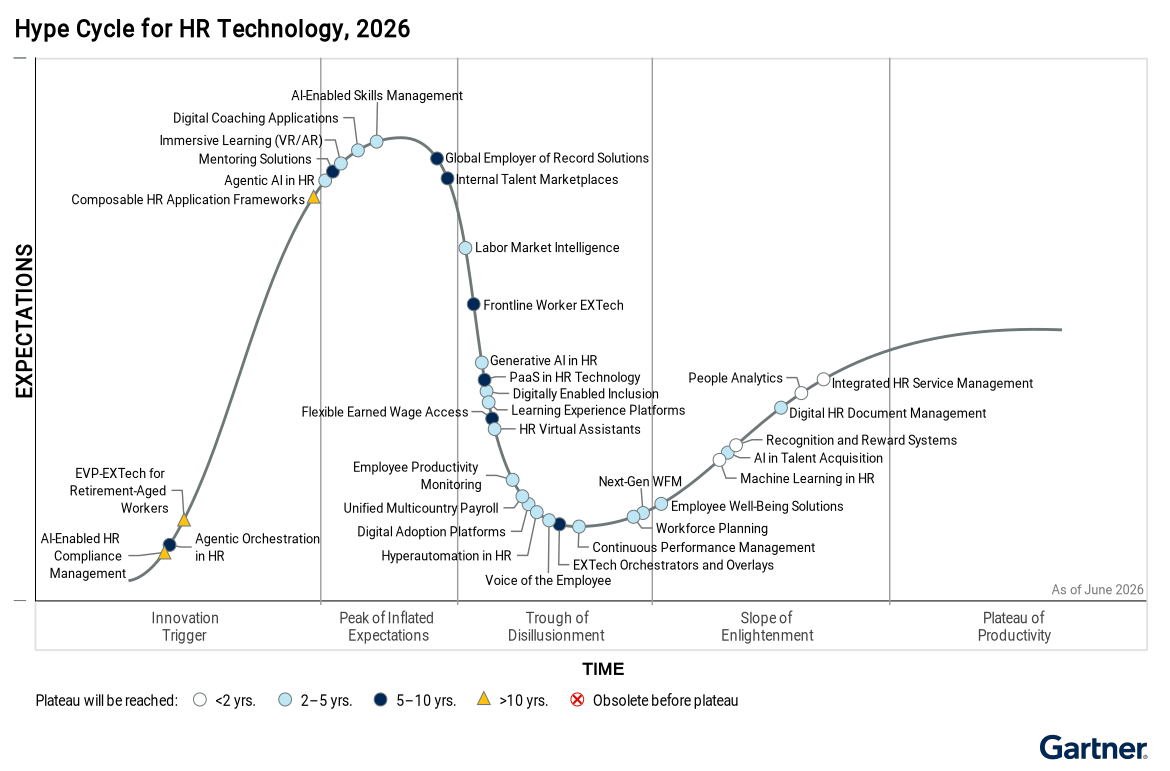
The proliferation of enterprise and personal AI solutions is reshaping HR technology adoption and employee experience.
This Hype Cycle is more crowded in its latter half with maturing innovations, but each year continues to see new entries at the Innovation Trigger. Many of these innovations progress rapidly along the curve, yet their transition to mainstream productivity often slows as they encounter final-stage challenges and operational hurdles.
New Hype
Agentic orchestration in HR emerges at the Innovation Trigger, fueled by the proliferation of AI agents and the growing need for organizations to establish greater control and governance over agentic AI. Additionally, AI-enabled compliance management shows promise, demonstrating that AI innovation can transform even the most traditional, operationally intensive HR functions.
Peak Hype
Organizations increasingly prioritize the integration and scalability of enterprisewide AI agent capabilities over niche, HR-specific offerings. In some low-complexity scenarios, such as interview scheduling or drafting employee service letters, employees, managers and HRBPs often turn to personal AI tools for convenience, familiarity and efficiency, despite the inherent security and data confidentiality risks.
Fast Movers
Labor market intelligence, digital adoption platforms and global employer of record (EOR) solutions climbed the maturity curve. The first two are propelled by HR’s imperative to prioritize employee experience and adopt a skills-based approach, while global EOR solutions are increasingly in demand as organizations embrace borderless recruiting in response to global talent market shifts and persistent skills shortages.
Value Drivers
A significant number of innovations benefited from years of development and adaptation, positioning them to reach the Plateau of Productivity within the next two years. However, some barriers remain. For example, integrated HR service management (IHRSM) and people analytics — two of the most mature innovations — face challenges with non-HR data integration and market confusion across solution categories. Nevertheless, these solutions continue to deliver proven value for HR leaders.
Lingering Technologies
Conversely, some technologies have stalled on the curve. Immersive learning AR/VR and composable HR application frameworks are at risk of obsolescence, hindered by limited vendor interest and a lack of compatible infrastructure and hardware within enterprise environments. Without renewed investment or market momentum, these innovations may ultimately be replaced by more suitable alternatives.
The Priority Matrix
The Priority Matrix offers a strategic lens for evaluating HR innovations, enabling CHROs and their HR technology leaders to make informed, future-focused decisions by clarifying the trade-offs between high-impact, long-term investments and immediate opportunities. Organizations should leverage this matrix to guide strategic technology investments and adoption planning.
A handful of innovations on this Hype Cycle are at the Innovation Trigger or Peak of Inflated Expectations, but a number of technologies are sliding into the Trough of Disillusionment as organizations confront the realities of scaling from proof of concept to production. Encouragingly, there is also a substantial group of innovations that have reached the Slope of Enlightenment. This movement reflects the current state of the HR technology market — mature, with room for innovation.
Long-Term Investments — Emerging Technologies
Agentic AI stands as one of the most potentially transformative technologies, with relevance that extends well beyond HR. CHROs and HR technology leaders should not overlook the critical orchestration layer required to maximize value from agentic AI — agentic AI orchestration in HR. AI-enabled skills management and digital coaching are also highly transformational, supported by a more established vendor landscape and proven pilot successes. Adopting these technologies early can confer significant competitive advantage and time-to-market benefits. However, most of these innovations are five to 10 years away from mainstream adoption.
Safe Investments — Postpeak Opportunities
CHROs and HR technology leaders should resist the temptation to fast-track emerging AI and agent technologies in isolation. Without a corresponding investment in more mature, foundational capabilities, organizations risk accelerating AI adoption without a robust base. Notable opportunities include voice of the employee, learning experience platforms and continuous performance management. Additionally, organizations that haven’t deployed HR virtual assistants should consider this investment, as these solutions are rapidly becoming the primary interface for GenAI and agentic capabilities in HR.
Immediate Wins — Slope of Enlightenment
A set of innovations are nearing mainstream adoption within the next two years, providing CHROs and their teams with opportunities for immediate wins. Investing in these solutions can help balance the uncertainty and hype of emerging technologies with more predictable returns. Innovations such as IHRSM, people analytics and workforce planning have demonstrated years of successful execution and a strong track record of value delivery.
Priority Matrix for HR Technology, 2026
| Benefit | Years to Mainstream Adoption | |||
|---|---|---|---|---|
| Less Than 2 Years | 2 to 5 Years | 5 to 10 Years | More Than 10 Years | |
Transformational | ||||
High | ||||
Moderate | ||||
Low | ||||
Source: Gartner (June 2025)
Off the Hype Cycle
The following innovations were removed from the Hype Cycle this year:
- AI in HR has manifested across a wide range of innovations, making it too expansive and multifaceted to be addressed within a single, generic profile. Instead, its influence is reflected across multiple innovations, each capturing distinct applications, maturity levels and value drivers.
- Nudgetech aligns more closely with digital employee experience tools. This innovation features in other Hype Cycles this year, including the Hype Cycle for Digital Workplace Applications, 2026.
The following innovations were renamed this year:
- Continuous employee performance management was renamed to continuous performance management.
- Digitally enabled diversity, equity and inclusion was simplified to digitally enabled inclusion.
On the Rise
Agentic Orchestration in HR
Analysis By: Ranadip Chandra, Eser Rizaoglu
Benefit Rating: High
Market Penetration: Less than 1% of target audience
Maturity: Embryonic
Definition:
Agentic orchestration in HR is the control layer that enables AI agents to scale from isolated pilots to governed execution, improving speed and lowering costs. Central orchestration frameworks enable the configuration of AI-driven workflows in which AI agents communicate across multiple HR solutions. These layers manage collaboration and integration with external databases, allowing agents to make decisions, take actions and coordinate tasks across the workflows with minimal human intervention.
Why This Is Important
Agentic orchestration is crucial as it enables networks of task-specific HR agents to collaborate, adapt and optimize execution for complex, enterprise-scale tasks. Many HR workflows span multiple systems; without orchestration, HR teams can’t execute these workflows effectively. By coordinating multiple AI agents across different systems, organizations can achieve scalable and robust HR workflow execution, unlocking greater value and efficiency while bridging the gap between specialized agents and holistic enterprise adoption.
Business Impact
Agentic orchestration transforms business impact by enabling coordinated, outcome-driven AI across the enterprise. It bridges gaps between siloed systems (talent, WFM, HR service management), ensures compliance and delivers transparency in automation, cost and performance. This orchestration unlocks scalable, reliable and interoperable solutions, allowing organizations to achieve measurable outcomes and maximize the value of agentic AI investments at scale.
Drivers
- Orchestration to manage multiagent systems (MAS): As enterprises deploy specialized agents across departments, a central control plane is needed to coordinate collaboration, manage workflows and optimize performance across diverse HR functions. Since most agents do not communicate with each other by default, orchestration is essential. This approach enables dynamic collaboration to address complex challenges.
- Technological advancement: Agentic orchestration marks the next evolutionary step in agentic AI, enabling networks of specialized agents to dynamically solve complex problems, adapt to changing environments and continuously optimize collective output. This requires a control plane for workflow generation, an execution layer and a governance engine for accuracy, drift monitoring, SLA and policy enforcement.
- Standards and protocols: An orchestration layer enables HR users to monitor whether all the agents are adhering to common AI governance standards and protocols.
- Agentic AI industry standards: The adherence to industry standards such as NIST RMF is crucial for gaining trust. A consistent approach across AI agents from different providers will enable seamless collaboration and interoperability among agents.
- Agent communication protocols: The emergence of agent-to-agent communication standards is enhancing interoperability among agents from different platforms.
- Guardrails and policy: Agentic orchestration detects and filters harmful content, blocks PII, reduces hallucinations and protects against prompt attacks like jailbreaks.
- Cost and latency trade-offs: With limited budgets, teams must balance cost, latency and accuracy for each use case. Agentic orchestration supports this with flexible inference options, such as on-demand routing (priority, standard, flexible), reserved capacity and batch inference.
Obstacles
- Monitoring and governing multiple agents: Coordinating and collaborating across agents is challenging. Effective oversight requires careful monitoring, governance and a shared grounding to ensure the system behaves as intended.
- Agent washing: Most products currently on the market are AI assistants, not true AI agents. Unlike AI agents, assistants typically don’t perform self-directed actions, so agentic orchestration isn’t necessary, limiting market demand for true AI agents.
- Integration limitations: While AI agents offer out-of-the-box integrations, these may not always be compatible with an organization’s HR technology or legacy systems, leading to integration challenges.
- Inefficient workflows: Poorly designed workflows with numerous API calls can result in ineffective agent execution and increased costs, as agents are invoked inefficiently.
User Recommendations
- Ensure your corporate data is structured and accessible for agentic orchestration platforms. Implement mechanisms for human approval on high-stakes actions or model updates.
- Distinguish between AI assistants and true AI agents; agentic orchestration is only necessary for self-directed agents. Gradually shift to platforms that verify outcomes end-to-end with transparency in performance, compliance and cost.
- Assess vendor orchestration capabilities and integration potential. Use it for complex, multistep tasks, breaking workflows into modular components.
- Invest in technologies that enable agent collaboration and establish clear legal, ethical and security guardrails as you adopt agentic orchestration, recognizing this is an emerging area with evolving risks and benefits.
Sample Vendors
Amazon Web Services; Enterprise Management Associates (EMA); IBM; Oracle; SAP; ServiceNow; Workday
Gartner Recommended Reading
AI-Enabled HR Compliance Management
Analysis By: Sam Grinter
Benefit Rating: High
Market Penetration: Less than 1% of target audience
Maturity: Emerging
Definition:
AI-enabled HR compliance management tools use generative AI (GenAI) to audit internal HR policies against legislation, regulations and collective bargaining agreements, flagging potential noncompliance. Additional features may include a compliance calendar for legislative updates and a virtual assistant to support HR administrators.
Why This Is Important
HR leaders face the daunting challenge of ensuring legal operations across diverse territories. Noncompliance risks significant fines and reputational damage. This is particularly critical for large, decentralized global firms that have expanded through acquisitions and must manage complex, localized regulatory requirements.
Business Impact
AI-enabled HR compliance management tools provide transparency and assurance regarding an organization’s compliance status. They enable proactive auditing and preparation for legislative changes by establishing whether or not the employer is already compliant with new legislation and where noncompliance issues exist. This reduces the risk of financial penalties, reputational harm and even potential loss of operating license, while automating tasks that previously required manual oversight or external consultants.
Drivers
- Technological advancement: GenAI is the primary mechanism behind these tools. Future developments in AI agents may allow systems to not only detect issues, but also recommend specific remediation steps. Additionally, as organizations introduce AI into the flow of HR work, this may prompt a reexamination of HR processes, including an audit to ensure compliance.
- Legislative volatility: While the frequency of changes may be stable, the complexity of staying current remains a challenge. New tools for detection and planning will likely accelerate organizational adoption, especially as preparation for major legislation changes.
- Regulatory oversight: As authorities adopt AI for auditing, the likelihood of detecting longstanding noncompliance will increase. Any regulatory shift toward AI is expected to drive significant employer investment in defensive AI compliance tools.
Obstacles
- Geographic limitations: No truly global solution currently exists. Most available tools are limited to specific regions (e.g., the EU and U.K.) or single countries (e.g., Australia), which fails to meet the needs of multinational enterprises.
- Inertia and SME reliance: Many organizations rely on existing subject matter expertise and may not prioritize investment until prompted by a negative consequence such as a fine, major legislative shift or loss of key personnel.
User Recommendations
- Use AI-enabled HR compliance tools to audit existing risks and forecast legislative impacts.
- Prioritize AI-enabled HR compliance management investments in decentralized, multinational organizations or those with a history of noncompliance.
- Adopt a modular, phased approach, because current solutions lack comprehensive global coverage across all HR domains.
- Distinguish capabilities between policy and operational compliance to determine when, where and how these AI-powered tools fall short of fully compliant execution or HR team action.
Sample Vendors
Corbey; Payroll Standard
EVP-EXTech for Retirement-Aged Workers
Analysis By: Sam Grinter
Benefit Rating: Moderate
Market Penetration: Less than 1% of target audience
Maturity: Embryonic
Definition:
Participation in the workforce is increasing among certain groups of retirement-aged workers. HR leaders must deploy technology to attract and retain this growing cohort of highly skilled and experienced workers, who have unique work needs, motivations and expectations.
Why This Is Important
Increasing life expectancy, rising inflation, a shortage of skilled workers and new-quality-of-life aspirations are convincing some employees to stay in the workforce longer, past retirement age. While the youngest generation in the workforce has unique needs, expectations and motivations, the same is true for their older colleagues. HR leaders must cultivate a unique employee value proposition (EVP) to attract and retain older workers, and leverage technology to deliver this strategy.
Business Impact
Employers that are successful in attracting and retaining retirement-aged workers will have a competitive advantage through the increased expertise, depth of knowledge and diversity of their workforce. Employee experience technology (EXTech) specifically configured and deployed to cater to the requirements of older workers will become the key tool in delivering a successful EVP at scale for this emerging cohort of workers.
Drivers
- Persistently low unemployment rates are highlighting the importance of highly experienced and skilled older workers for both doing work themselves and serving as managers, supervisors and mentors.
- A period of high inflation has reduced the value of pensions, which means employees may need to work longer to ensure they have the savings necessary to support themselves and their families in later life. Many retirement-aged workers are also choosing to stay engaged in the workforce longer, because they find meaning and enjoyment in the work, especially if they are able to shift to reduced hours or a flexible schedule.
- Retirement-aged workers have unique needs. They are more likely to look for flexible working options, including shifting to contingent work rather than permanent employment. They have specific concerns and priorities related to their life stage, such as medical support for menopause or financial planning for retirement, that differ significantly from younger workers. The rate of disability also increases in retirement-aged workers, but often individuals experiencing these changes experience them so gradually they may not notice or request accommodation.
Obstacles
- A contextualized version of EXTech that delivers an EVP for retirement-aged workers is only just emerging. There are few vendors specifically targeting this market, so end users must make do with the tools at their disposal until such a time as a dedicated market emerges.
- Working for longer in later life isn’t an option for everyone. Declining health may stop people who otherwise would financially benefit from working. As such, the trend of retirement-aged workers is not universal for all or for all types of work.
- There are practical considerations for employers when hiring retirement-aged workers. They may require flexibility in terms of working hours, have higher salary expectations, and may incur higher medical/benefits contributions from the employer. These factors will reduce the total demand for retirement-aged workers.
User Recommendations
- Evaluate the current age demographic of the workforce and the extent to which retirement-aged workers can positively affect the organization’s hiring and retention strategy.
- Conduct market research and focus groups to understand the specific needs, motivations and expectations of retirement-aged workers both within your workforce and in your broader labor market. Identify barriers that prevent retirement-aged workers from wanting to work for your organization as they age.
- Develop an EVP specifically tailored to the requirements and motivations of retirement-aged workers, including but not limited to differentiated job boards, pension contributions, health insurance, flexible working, provision for training and upskilling, and leadership/mentoring opportunities. This may also be expanded to workers nearing retirement age if there is a high attrition rate of workers taking early retirement.
- Configure existing EXTech or purchase and implement new EXTech to deliver on the EVP.
Sample Vendors
Akumina; Applaud; DaysToHappy; Flip; LumApps; Perkbox; YOOBIC
Gartner Recommended Reading
Composable HR Application Frameworks
Analysis By: Sam Grinter
Benefit Rating: High
Market Penetration: 1% to 5% of target audience
Maturity: Emerging
Definition:
A composable HR application framework (CHAF) is an architectural approach that enables quick and effective deployment of new employee experiences based on underlying packaged business capabilities (PBCs). This includes application PBCs dedicated to specific talent or administrative HR domains, data PBCs and analytics PBCs, which include reusable analytical and AI models. These components are surfaced through an application composition platform to deliver composed application experiences.
Why This Is Important
CHAFs are still nascent, but HR technology leaders should begin shaping their HR technology strategies around this concept. Gartner expects that CHAFs ultimately will become the dominant approach for deploying and managing human capital management (HCM) solutions, where they deliver compelling advantages over HCM suites.
Business Impact
CHAF advantages include:
- User experience orchestration — CHAFs support the improved ability to deliver employee and manager experiences across multiple underlying systems or PBCs.
- Personalization — Shared data and AI assets allow for the delivery of personalized experiences across HR process domains. This includes decision support.
- Extensibility/customization — This architectural approach enables flexibility, lower reliance on single vendors for their innovation roadmap and a higher degree of responsiveness to business transformation.
Drivers
HCM suites are the result of a more than 20-year journey by vendors from discrete functionality to a broad consolidation of HR functionality in a single integrated suite. Functional gaps, however, remain a challenge.
- HCM suites generally do not support the most cutting-edge HR processes or universal coverage of local compliance needs.
- HCM suites cannot respond quickly to new challenges because it takes time for vendors to develop new capabilities. Purchasing a solution from a third-party vendor may be a faster route to new capabilities, but this option introduces the issue of integration with the HCM suite and wider HR systems. Many HR and IT leaders learned the need for flexibility and agility from the challenges they faced during the COVID-19 pandemic and subsequent talent crunch and return-to-office mandates. Organizations and employees affected by geopolitical conflict have experienced similar needs from their HR technology systems.
- Emerging integration platform vendors that leverage AI to build integrations are improving the integration capabilities of HCM suites. This trend nudges the market for HCM suites closer to CHAF.
- Investment in HR system integration to support the deployment of AI agents to serve as conversational user experiences will act as a catalyst in bringing current HR technology ecosystems closer toward CHAF.
Obstacles
- HCM suites are still the dominant deployment approach with the initial intention at deployment of serving a client for 10 to 20 years or more. The appetite to rip out and replace an HCM suite with a CHAF is low for most organizations. Instead, these organizations are much more inclined to augment the capabilities of the HCM suite vendor through investment in procuring and integrating multiple third-party vendors.
- A key barrier influencing the potential adoption of CHAF is how long the “augmented HCM suite” approach satisfies clients. Most organizations yet to deploy an HCM suite would still likely be better served by it, rather than a CHAF, due to the comparable difference in market maturity.
- There aren’t many off-the-shelf CHAF products on the market today. Therefore, to deploy a CHAF over the short term, an organization would have to self-build it.
- Lack of clarity about CHAF definition in the market may lead clients to misidentify CHAF as an augmented HCM suite, or even an on-premises HR information system loosely integrated with a talent management suite and a portal.
User Recommendations
- Evaluate the composability of the application portfolio by rating how easily HR and technology teams can compose employee experiences, using functional components from different applications along with shared data and AI models.
- Include composability readiness when evaluating HCM suite offerings, if such a solution is not yet in place. Include questions asking for the provision and type of integration technology and partnerships with integration platform vendors.
- Introduce application composition platforms into the HCM technology roadmap to increase composability and improve the employee experience. This applies to mature and well-executed HCM suite deployments.
- Partner with other IT leaders to build out components of the CHAF by prioritizing a set of employee experiences and leveraging general-purpose application and data composition solutions. Start this work internally while vendor offerings mature.
Sample Vendors
ClayHR; Prismatic; StackOne
Gartner Recommended Reading
At the Peak
Agentic AI in HR
Analysis By: Anand Chouksey, Stephanie Clement, Eser Rizaoglu, Harsh Kundulli
Benefit Rating: Transformational
Market Penetration: 5% to 20% of target audience
Maturity: Emerging
Definition:
Agentic AI is an approach to building AI solutions based on the use of one or multiple software entities that are classified, completely or at least partially, as AI agents. AI agents are autonomous or semiautonomous software entities that use AI techniques to perceive, make decisions, take actions and achieve goals in their digital or physical environments. Agentic AI in HR will automate and optimize HR processes, improving employee and candidate experiences and driving organizational outcomes.
Why This Is Important
Agentic AI in HR, now advancing beyond pilots into early production, is set to transform HR processes by streamlining workflows, boosting efficiency and enhancing decision making. Initially impacting talent acquisition, workforce management, compliance and payroll, agentic AI reduces human error and improves employee experience. As adoption accelerates, its transformative potential will drive greater effectiveness and deliver meaningful employee experience and strategic value across all HR functions.
Business Impact
Agentic AI in HR, primarily semi or fully autonomous, streamlines self-service tasks and workflows with augmentation, boosting efficiency for employees, managers and HR administrators. This leads to higher satisfaction and allows HR teams to focus on strategic, value-added activities. By automating complex tasks and orchestrating information seamlessly, organizations realize significant cost savings, enhanced productivity and greater business value, positioning HR as a key driver of organizational performance and innovation.
Drivers
- Executive leadership influence: Aspirational investments in agentic AI will primarily be driven by executive expectations for AI outcomes. The 2026 Gartner CEO and Senior Business Executive Survey reveals that 76% of CEOs foresee AI significantly impacting their industries within the next three years, with 25% expecting increased human capital effectiveness as the primary AI-enabled outcome. This top-down pressure highlights the strategic necessity of adopting AI to shape future business landscapes. (See CEO Watch 2Q26: The Autonomous Business Imperative to learn more.)
- Transformative potential of agentic AI: Agentic AI holds the promise of transforming HR processes and service delivery by increasing efficiency, augmentation and automating of routine tasks, leading to cost savings and enhancing the employee experience. While real-world results are still emerging, the potential for significant improvements in work processes and decision making continues to drive interest and investment in AI technologies.
- Vendor marketing and hype: Vendors are promoting agentic AI capabilities in the form of AI agents, generating significant hype around agentic AI’s potential in HR. This marketing surge raises awareness but can also inflate expectations, causing organizations to anticipate immediate benefits that may not match the current maturity of AI solutions.
Obstacles
- Maturity: Agentic AI is advancing beyond pilots into selective production, but remains at an early stage for fully autonomous HR decision making. Most applications are semiautonomous or human-in-the-loop, not fully unsupervised.
- Data: Its effectiveness depends on accurate, complete data; inconsistent or incomplete data impairs performance and decision quality.
- Integration: Legacy and fragmented HR systems make integration difficult, limiting AI’s impact and ROI without unified data sources.
- Total cost of ownership (TCO): Clear TCO assessment for data readiness and token usage over multiple years is critical for business case development.
- Regulation: Ongoing compliance with privacy, security and employment laws, as well as evolving AI regulations, requires continuous oversight.
- Trust/adoption: Concerns about human centricity and transparency affect trust and adoption. Gaps between expected and actual outcomes, and resistance to workflow changes, present additional challenges.
- Skill gaps: The shift to agentic AI will redefine HR roles and require new skills, particularly AI literacy in HR and IT, as employees transition from executing tasks to building and maintaining AI solutions.
User Recommendations
- Drive business outcomes: Identify productivity zones enhanced by agentic AI and expand focus to address broader needs using an AI portfolio for enterprisewide benefits.
- Ensure interoperability: Work with IT and HR tech vendors to connect applications and data across systems, enabling agentic AI to deliver solutions across workflows, not just in isolated tasks.
- Optimize automation: Identify areas where agentic AI adds value and determine processes requiring human intervention to ensure automation complements human skills.
- Develop a multiyear strategy: Create a long-term agentic AI strategy focused on AI-driven interactions. Implement user-centric features to boost satisfaction and perceived value.
- Enhance user experience: Orchestrate multiple agentic AI solutions with a unified interface for improved user experience, facilitating secure information access and efficient task completion.
- Foster a culture of innovation: Encourage innovation by developing change management plans for roles affected by AI. Introduce human behavioral experts to support the human-machine partnership.
Gartner Recommended Reading
Mentoring Solutions
Analysis By: Rebecca Burton
Benefit Rating: Low
Market Penetration: 5% to 20% of target audience
Maturity: Emerging
Definition:
Mentoring technology solutions support mentoring programs and range from matching mentors and mentees to providing insights and direction on the outcomes of mentoring engagements. These solutions can support scalable expansion of mentoring programs beyond the high-touch use cases that require extensive HR intervention to facilitate matches and structure.
Why This Is Important
Mentoring applications improve mentoring program effectiveness by supporting the scaling of various types of mentoring (e.g., peer, 1:1 and group mentoring), thereby enhancing the realization of mentoring benefits like employee engagement, inclusion and skill growth. Automated mentor matching replaces an otherwise laborious application, selection and pairing process. It also supports the ongoing management and tracking of programs, helping articulate the business value of mentoring programs.
Business Impact
Organizations are leveraging mentoring technology to provide greater accessibility to existing mentoring programs and ease the administrative burden. The optimization of mentoring programs through technology provides a key way to develop workforce capabilities and build bench strengths. HR oversight is key to facilitating feedback loops to ensure that mentor-mentee relationships are working well and that the mentoring program is fulfilling its purpose.
Drivers
- Intelligent automated matching: Mentoring programs are common across talent development. However, organizations struggle to (and invest a lot of time in) matching mentors and mentees. Mentoring solutions can automate this process, helping organizations save time and resources. Matches are increasingly being optimized with the use of AI and skills ontologies.
- Personalized development opportunities: Employees increasingly expect more personalized, targeted development. Mentoring solutions are able to identify matches at scale beyond top talent without too much effort and potentially optimize costs.
- Improved reporting: Platform providers have started to optimize their reporting capabilities, which will make it easier for organizations to track some key components of their mentoring program’s success.
- Variety of mentoring types: Organizations have different purposes for mentoring; it could be upskilling, career development, engagement, or linked to inclusion and belonging initiatives. Some platforms provide this level of differentiation in their mentoring solutions.
- Facilitated mentoring for higher impact: A key element of a successful mentor program is to equip participants with the right tools that enable them to have a successful mentor-mentee relationship. Some platforms provide support elements, such as conversation guides, which help save time during initial stages.
Obstacles
- While most vendors support matching mentors and mentees, expectations for necessary capabilities beyond this are not uniform. This leads to variability in the market.
- Relatively few solutions provide robust program tracking, and fully automated program management is not a standard capability.
- Technology can support an HR team’s ability to scale mentoring to larger employee groups, but it cannot eliminate the need for resources allocated to program management.
- While reporting and analytics capabilities are improving, many tools do not collect data enabling HR to make decisions to continue, suspend or expand mentoring programs.
- While human capital management (HCM) suites may include mentoring capabilities, they typically support mentor matching only. Without clear evidence of business value at scale, HR leaders struggle to justify the added cost and complexity of a separate solution.
User Recommendations
- Assess whether mentoring technology, which only provides matching capabilities, will deliver enough value to warrant the cost. If not, build the case for investment on either a limited-scope program or additional resources to manually manage the program.
- Establish whether individual vendor solutions can be quickly scaled to meet evolving business needs, given that mentoring programs can quickly expand, especially in large organizations.
- Identify outcome and impact measures for your mentoring program. Evaluate mentoring solution vendors on their ability to gather and share the data needed to demonstrate program impact.
Sample Vendors
Chronus; Eightfold AI; Gloat; MentorcliQ; Phenom; PushFar; Qooper; SAP; Together; Workday
Gartner Recommended Reading
Immersive Learning (VR/AR)
Analysis By: Travis Wickesberg
Benefit Rating: Moderate
Market Penetration: 5% to 20% of target audience
Maturity: Adolescent
Definition:
Virtual reality (VR) and augmented reality (AR) are different, yet related technologies that support immersive learning. VR provides a computer-generated 3D environment (supporting both computer graphics and 360-degree video) that surrounds a user and responds to the learner’s actions in a natural way, either through head-mounted displays (HMDs), computing devices or room-based systems. AR technologies use HMDs to overlay digital information on the physical world to enhance it and guide action.
Why This Is Important
Most VR and AR use cases have shown promising results that exhibit higher levels of engagement and accelerated time to proficiency. This, in turn, translates to reduced training costs and long-term behavior changes that drive business outcomes.
Business Impact
In corporate learning, VR and AR can:
- Enable learners to practice complex tasks or experience realistic scenarios in a controlled and safe environment that’s free of consequence.
- Drive higher retention and engagement of relevant information through interactive advanced graphical visualization and simulations.
- Reduce training time and cost by quickly replicating an environment without the need to rebuild physical props, recreate high-risk situations or schedule equipment downtime.
Drivers
- Readily available off-the-shelf content makes implementation faster and more cost-effective.
- The emergence of low-code/no-code GenAI tools is making it easier and faster to develop personalized content and create more engaging interactions.
- VR is well-aligned to support complex scenarios in the military, healthcare (surgeries), aviation (flight simulations) and various safety training environments.
- Organizations have adopted VR and AR for sales training, customer service, product and a variety of soft skills topics.
Obstacles
- VR and AR tools are still in the early adoption phase in corporate learning.
- Hardware, software and infrastructure investments to support AR/VR can be barriers for organizations on a strict or small budget.
- Learning and development buyer adoption have been slow due to a combination of technical maturity and pressure on budgets.
- Only a few vendors have invested in simple learning management system (LMS) integrations, but complete integration is still a challenge and often requires administration of multiple platforms.
User Recommendations
- Evaluate immersive learning as an emerging, effective and often less risky option to replace face-to-face training in selective circumstances where such training is resource-intensive, but not providing it presents increased risk.
- Leverage full-service vendors that have prebuilt, out-of-the-box, high-quality content and HMD packages.
- Run experiments and pilots based on performance challenges. Determine whether the product, platform and hardware are a good fit that provide additional value beyond traditional corporate training methods.
- Evaluate compatibility with existing learning and talent technologies to ensure integration and continuity across platforms.
Sample Vendors
Bodyswaps; Cornerstone; IMMERSE; Mursion; PIXO VR; PTC; Roundtable Learning; Saritasa; Strivr; VR Vision
Gartner Recommended Reading
Digital Coaching Applications
Analysis By: Rebecca Burton
Benefit Rating: High
Market Penetration: 20% to 50% of target audience
Maturity: Adolescent
Definition:
Digital coaching applications enhance corporate coaching programs through human and AI-enabled platforms. They support coaches, learners and HR by connecting users for live coaching sessions and increasingly offer AI coaches that mimic elements of the coaching experience. While not a replacement for human coaches, these fit-for-purpose AI coaches deliver personalized, continuous developmental support at scale.
Why This Is Important
Digital coaching applications enable coaching to be more effectively scaled and administered across an organization. AI coaching, as part of these platforms, brings new opportunities for HR to provide a cost- effective way to scale coaching and meet historic demand. AI coaches deliver real-time support that overcomes the traditional cost and availability constraints of human-only models.
Business Impact
Coaching, especially at the leadership level, is an integral part of personalizing development. Due to the fast evolution of technology, these programs are becoming more accessible for the entire workforce. While human coaches are still more versatile, AI coaches can bring opportunities when identified for a clear need at scale. As adoption of AI coaches increases alongside targeted human coaching, the ability of coaching programs to change behavior and improve performance will also increase.
Drivers
- Coaching programs are common at the leadership level, yet evolving workforce expectations see coaching as part of the career journey at all levels, and the broader workforce is open to working with AI coaches.
- AI coaches can augment human coaches to increase their capacity, or they can expand coaching programs to previously excluded audiences, such as early career talent.
- Digital coaching applications can provide access to a diverse network of coaches. Where traditional virtual coaches tend to struggle with regional or language coverage, the evolution of AI capabilities makes some platforms more versatile in this regard.
- HR needs better metrics that display the connection between the time and cost invested, and the impact of these coaching arrangements and the overall program, without compromising confidentiality of coaching sessions. Many platforms optimize their reporting capabilities to support this need.
Obstacles
- Most vendors are offering AI coaches with a very specific scope, which does not always cover all the needs of the enterprise.
- Overreliance on AI or unclear data privacy policies can erode the trust and psychological safety that effective coaching depends upon, risking employee self-censorship or disengagement.
- For some coaching applications, the quality of coaching services and effectiveness of the corresponding vetting process still lack transparency for both external human coaches and the AI models providing guidance. Reporting and analytics are improving across the market. However, many tools still do not enable HR to make decisions to continue, suspend or expand coaching programs.
User Recommendations
- Evaluate the scalability of vendor solutions by understanding enterprise coaching needs; ascertain how flexible the vendor’s AI and human solutions will be as talent needs quickly evolve.
- Assess the content and advice offered by the vendor to drive quick program adoption, particularly for programs related to a specific topic (e.g., inclusive leadership and group coaching). This includes evaluation of AI-enabled recommendations and insights.
- Apply AI coaching where the need for scale and repetition outweighs the need for interpersonal nuance, reserving human coaches for situations requiring deep emotional intelligence or complex ambiguity.
- Ensure that vendors have a multistage vetting process for hiring coaches and robust privacy and bias checks for their AI models. Get insights into their quality control process (including user ratings), to determine coaching quality, and make program adjustment and retention decisions.
Sample Vendors
BetterUp; CoachHub; EZRA; Perceptyx; Tenor; Valence
Gartner Recommended Reading
AI-Enabled Skills Management
Analysis By: Cian O Morain, Travis Wickesberg
Benefit Rating: High
Market Penetration: 5% to 20% of target audience
Maturity: Adolescent
Definition:
AI-enabled skills management is used to automate skills inference for people, content, work tasks, career paths and jobs. It applies natural language processing (NLP), knowledge graphs and other AI techniques to build a dynamic representation of skills data.
Why This Is Important
Dynamic skills data, driven by AI-enabled skills management, transforms how organizations manage their workforce and support talent processes. High-quality automated skills detection and assessment facilitate significantly greater organizational agility. In times of uncertainty, or when competition is fierce, organizations with better skills data can adapt more quickly and be more dynamic in acquiring and deploying talent.
Business Impact
Properly architected and deployed AI-enabled skills management improves:
- Productivity and capacity utilization by prioritizing and distributing work assignments
- Hire quality and internal mobility by matching candidates to roles
- Strategy execution by enabling continuous workforce planning
- Talent management by providing personalized learning and career path recommendations to support upskilling, performance and motivation
Drivers
- Skills-based talent management: HR leaders are increasingly interested in applying skills data across talent processes. Skills data can be used to automatically tag and recommend learning content, connect experts with teams/critical projects more easily, dynamically propose career development options, match talent to job opportunities, improve precision of hiring assessments, and propose compensation aligned with employee skills and contributions.
- AI-driven work and job redesign: Organizations are investing heavily in augmenting and reengineering their workflows with AI. Up-to-date skills profiles can be used to drive quicker/more accurate job redesigns, and to identify relevant adjacencies for talent redeployment.
- Pace of change: Planning and responding effectively to rapid changes in technology and other disruptions drive the need for greater visibility into skills. Skill footprints are changing in many professions, with AI and automation causing further uncertainty about the type of skills and roles that will be needed in the future.
- Technology improvements: Graph techniques and technologies have improved in terms of availability and maturity. Increased capabilities in NLP techniques help to automatically detect and infer skills data in unstructured text, in multiple languages, within not only HR but also operational systems. In addition, more vendors are now employing a variety of AI-enabled skills management capabilities in their platforms.
Obstacles
- Dated enterprise job architecture impacts the accuracy of AI recommendations for learning and work.
- Insufficient access to data about what work is done hinders better codification of skills. Data from HR systems is often low in detail. Internal data is often difficult to access and inconsistent.
- The standards and languages to describe the same skill vary across contexts.
- Too many skills approaches from too many providers are available, and there are difficulties in sharing data and models across systems.
- Variance in vendor use of skills metadata impacts the accuracy of AI inference.
- Trust in skills inference is low, with a desire to more tightly control the validation and assessment of skills.
User Recommendations
- Add critical skills to jobs in your job architecture before using AI-enabled skills management technology (updating and/or simplifying the job architecture as needed).
- Identify data sources that can be used to enhance skills detection and inference.
- Check your current vendor roadmaps for inclusion of skills data in their platforms across HR domains, and their use of AI. Evaluate their ability to both send and receive data from other systems.
- Adopt a “minimally viable” mindset when deciding where you will use AI to identify, infer and track skills.
- Map how employees will interact with skills data, and evaluate the impact to talent management processes.
- Leverage labor market analytics with in-depth skills analysis and forecasts to enhance workforce planning efforts. Benchmark internal skills forecasts against broader market trends.
- Evaluate providers’ ability to show users where skills inferences come from, and how skills data factors into various matching and recommendation algorithms.
Sample Vendors
Cornerstone (SkyHive); Draup; Eightfold AI; Gloat; Lightcast; Phenom; Reejig; TechWolf; Visier
Gartner Recommended Reading
Global Employer of Record Solutions
Analysis By: Nicole Paripurana
Benefit Rating: Moderate
Market Penetration: 5% to 20% of target audience
Maturity: Emerging
Definition:
Global employer of record solutions help organizations hire, manage and remove workers in a new geography without having to set up a legal entity in each country. The EOR provider is the full legal employer of these workers and assumes all employer-related responsibilities and tasks on behalf of its customers.
Why This Is Important
Global employer of record (EOR) solutions are attractive when organizations seek to quickly expand in new markets without the burden of variables such as the upfront cost and time spent setting up a legal entity, the compliance risks or the challenge to hire core roles in lesser-known territories. Pressure to reduce costs, talent shortage around specific skills and broader adoption of remote work are driving organizations to expand their talent reach beyond existing or planned operations and associated legal entities.
Business Impact
With global EOR solutions, organizations can effectively outsource the process and the responsibilities of the employee life cycle to a third party. Their expanded outreach for talent also helps to quickly acquire critical skills globally and enhance diversity, often at a lower cost. Through EOR solutions, organizations can offer more flexible work locations for employees when the nature of the job allows, increasing employee engagement, retention and market share.
Drivers
- Borderless talent: Organizations increasingly embrace borderless recruiting in response to the changes in the global market for talent and the continuing skills shortages in the market. Many executives express interest in working with a borderless workforce, with several having implemented such a model to some extent. In recent years, organizations have continued the practice of borderless hiring, especially to acquire talent with niche skills (e.g., software developers in technology).
- Agile business strategies: Accommodations offered by EOR solutions can more quickly aid the decision to withdraw from or downsize presence in specific markets, which otherwise can incur significant costs due to existing legal and administrative setup when an entity is owned.
- Expansion in use cases: Several EOR vendors have expanded their offerings for services that touch subject matter areas such as global payroll solutions, benefit partnerships, global mobility efforts and guidance on transitioning to a client-owned entity or even consolidating locations without attrition for seamless operations. Transitions can be from the EOR supplier or a professional employer organization (PEO) vendor to an owned entity, or vice versa.
- Vendor solution collaborations: Large-scale EOR vendors are gaining more presence and partnerships with mature HCM vendors, combining areas that reduce integration risk and facilitate one another’s technology and strategies. AI-powered intelligence and native solutions are helping EOR providers strengthen compliance and expand their portfolios with more robust offerings and technology capabilities for client organizations.
Obstacles
- Geopolitical tensions and economic sanctions that bring trade wars or tariffs can cause increased business costs to offset supply chain disruptions and large-sector direct job losses.
- EOR vendors are not a direct inheritance of company culture. Failure to create the same conditions for employee experience, inclusion and belonging as those of direct employees impacts the engagement and retention of the EOR-managed workers, the brand and the local talent pools in the new market presence.
- Beyond legal compliance and administrative aspects, not all global EORs support extended capabilities in recruitment, onboarding, compensation or other aspects of employment.
- If EOR in-country partners, such as payroll services, are not seamlessly integrated or are disparately subcontracted, suboptimal service and employee experience can occur.
- Fragmentation of current employer solution integrations versus global EOR-proprietary platforms can create the risk of inconsistent HR support and gaps in related workforce and talent insights.
User Recommendations
- Definitive workforce needs and specific talent scarcity are commonly underestimated upon planning. Tightly connect business planning and workforce planning to better consider global EOR uses early to avoid rush integrations.
- Consider global EOR’s temporary use and its gradual transition to or from an established legal entity. Most often, global EOR providers are considered costly until a specific employee threshold (25 to 40 or more) is reached to set up a local legal entity. Identify important checkpoints in the roadmap and the contractual process with providers, such as minimum scope or contracts’ early termination clauses. Clearly indicate the use case(s) needed for EOR and risk mitigation of entity ownership to justify EOR supplier costs.
- Define service priorities that map to provider offerings with clarity in the scope of services that matter most (such as payroll compliance versus recruitment) to make the global EOR selection and ongoing partnership more harmonious and seamless.
Sample Vendors
Atlas HXM; Deel; Globalization Partners; Globalli; Mercans; Neeyamo; Omnipresent; Oyster HR; Papaya Global; Velocity Global
Gartner Recommended Reading
Internal Talent Marketplaces
Analysis By: Emi Chiba
Benefit Rating: High
Market Penetration: 20% to 50% of target audience
Maturity: Adolescent
Definition:
Internal talent marketplaces (ITMs) are intelligent platforms that match workers to experiential development opportunities, thereby democratizing access to development and mobility. They provide personalized recommendations aligned with workers’ unique skills and experiences. Opportunities include gigs, projects, stretch assignments, mentoring or full-time roles. ITMs also offer career exploration and skills gap information to inform workers’ development activities.
Why This Is Important
As organizations adopt skills-based talent management and infuse skills into many of their talent decisions, ITMs provide a path to skills transformation driven by the need for upskilling and reskilling due to work transformation amid AI adoption. ITMs provide valuable insight into skills present in the organization and provide workers with equitable insight into available growth opportunities. They are key to enabling adaptability, resilience and experiential learning.
Business Impact
Internal talent marketplaces help organizations:
- Improve internal mobility by providing workers with curated recommendations for new skills and opportunities.
- Understand workforces through a new lens focused on the skills needed, rather than on the role.
- Gather skills data and support talent through experiential learning and hands-on opportunities.
- Encourage and track employee skill development.
- Address rapidly changing business priorities by redeploying or reskilling employees.
Drivers
- Skills-based talent management: The desire for deeper insight into more varied skills via AI has led many organizations to adopt ITMs as an entry point into AI-enabled skills management. This is because it provides a tangible outcome of what to do with skills data.
- AI driven work transformation: AI adoption across work requires more flexible deployment of workers across projects, products and other initiatives. Organizations need people with learning agility to adapt to changing skills demands. They also need to be able to align a highly networked workforce to the work that needs to get done in a dynamic way.
- Talent visibility: HR and other organizational leaders benefit from the data and insights from ITMs to support workforce planning and other talent processes. The team, project and product leaders of organizations benefit from more flexible staffing and improved visibility into talent.
- Worker demand for growth opportunities: Deployed correctly, ITMs provide employees and contingent workers with better visibility into work and growth opportunities. They can stretch and build their skills and experiences to grow their portfolio of work and careers.
- Technology availability: The market for ITMs includes human capital management (HCM) suite providers, talent acquisition vendors and specialist point solutions. Maturity in applying AI to detect, infer and map relationships among skills has increased, as has the use of AI techniques to automatically match talent to work opportunities.
Obstacles
Organizational challenges impeding adoption include:
- Lack of clarity in true measurable outcomes and long term ROI relative to technology investment required.
- Lack of cultural readiness for dynamic organizational models and project- or gig-based work.
- Talent hoarding. Managers may discourage team members from seeking outside opportunities, as they only see their team talent engaging in work for other teams and not their own.
- Poor user adoption and unclear value to workers.
- Limited readiness for skills-based talent management due to outdated job architecture that does not align skills to roles.
Data challenges include:
- Limited data sources regarding knowledge, skills and worker experiences. HR data alone does not yield rich insights.
- Lack of metadata or variance in its use that can lead to poor fit matches and recommendations.
- Lack of organization- or industry-specific granular skills for better matching.
User Recommendations
- Pilot ITMs within business units that use adaptive or agile organization models.
- Assess organizational maturity and implementation readiness by investigating foundational cultural values and behaviors that support talent mobility and development. Identify existing development programming to align the ITM with organizational strengths and prioritize these areas in implementation.
- Make an inventory of the current skills ecosystem and data sources to decide what may feed into matches and recommendations in the ITM prior to vendor evaluation.
- Evaluate vendors by assessing UX, ability to incorporate diverse sources of data and skills ontologies. When evaluating vendors with similar capabilities, prioritize vendors that integrate with other skills technologies to avoid skills living in a silo.
Sample Vendors
Cornerstone; Eightfold AI; Fuel50; Gloat; Neobrain; Oracle; ProFinda; SAP; Whoz; Workday
Gartner Recommended Reading
Sliding into the Trough
Labor Market Intelligence
Analysis By: Emi Chiba
Benefit Rating: High
Market Penetration: 5% to 20% of target audience
Maturity: Adolescent
Definition:
Labor market intelligence (LMI) solutions offer external data on labor markets to support organizations doing strategic workforce planning and making informed planning, hiring and skilling decisions. Using job postings, publicly available resumes or talent profiles, census data or dynamic skills taxonomies, they provide insight on labor trends (compensation, unemployment, available workforce size/composition) and skills trends (supply, demand, availability by location, receding/emerging skills).
Why This Is Important
In volatile market conditions, organizations rely on strategic workforce planning to align strategy and workforce initiatives. This agile alignment ensures the right mix of talent, technologies, and employment models. Labor market intelligence is essential to making strategic, data-informed workforce planning decisions at scale. LMI provides a more complete picture of the relative gaps between talent supply and demand, both inside and outside the organization.
Business Impact
LMI platforms help organizations make smarter build, buy, or borrow talent investments and enable resiliency and adaptability. They are valuable for organizations introducing new products or expanding to new markets, as they make workforce considerations (e.g., skills availability and cost) an active part of strategy planning.
Drivers
- Skills-based talent management: Organizations continue to place skills at the center of their talent management decisions. LMI solutions strengthen a skills-based approach by providing valuable insight into external skills availability.
- A need for diverse, external data sources: LMI platforms use a variety of external data sources to provide insights. These insights include skills availability based on location or industry, pay and titles associated with certain skills, competitor or industry trends for skills supply, and competition or difficulty in recruiting for certain skills.
- Strategic workforce planning initiatives: Labor market insights are vital to strategic workforce planning. Because of strategic workforce planning solutions’ high entry barrier, many organizations supplement their existing operational workforce planning solutions with LMI platforms.
- Competitive labor market: To support hiring in competitive or tight labor markets, many organizations are moving from location-based hiring to skills-based hiring, regardless of geography.
- Tailored, relevant insights: Improvements in machine learning and natural language processing enable these platforms to take large amounts of unstructured data and automatically detect and contextualize skills across geographies, providing relevant insights unavailable from labor market or economic data alone.
Obstacles
- Limited utility in isolation: LMI alone will not fully address workforce planning questions, although it can provide a more complete picture of skills and labor availability. LMI solutions should be considered part of a larger orchestration of people, process and technology coming together to support a recurring, monthly/quarterly/semiannual discipline.
- Lack of relevant data: Not all jobs or industries may be represented in publicly available data. Therefore, some can be difficult to track.
- Limited support for APIs for diverse data sources: Some LMI vendors lack APIs to transfer and combine internal data with external insights.
- Limited language support: Language support outside of English may be limited, or the terminology used to describe skills may vary widely.
- Inconsistent AI adoption for dynamic skills: Not all providers use AI for dynamic and emerging skills sensing, instead relying on fixed skills taxonomies.
User Recommendations
- Identify the required scope and type of workforce planning activities by engaging with business leaders and executives to review their priorities. Decide whether strategic workforce planning, and thus labor market insights, are necessary.
- Focus on data sources, skills ontologies, languages, and data privacy when evaluating labor market insight platforms.
- Pair labor market analytics with in-depth skills analysis and forecasts to enhance and improve strategic workforce planning efforts. Use this data to benchmark internal skills forecasts against broader market trends.
Sample Vendors
Coresignal; Draup; Horsefly; Lightcast; LinkedIn; People Data Labs; Revelio Labs; TalentNeuron; Wilson
Gartner Recommended Reading
Frontline Worker EXTech
Analysis By: Ranadip Chandra, Sam Grinter
Benefit Rating: Moderate
Market Penetration: 5% to 20% of target audience
Maturity: Adolescent
Definition:
Frontline worker employee experience technology (EXTech) delivers distinctive experiences to frontline workers by unifying a collection of applications that promote workforce engagement and a sense of community. Applications typically include administrative support, recognition, well-being, internal communications, and personal development processes. These apps are primarily designed for use via mobile devices and occasionally include AI-enabled agent-assist solutions.
Why This Is Important
Frontline workers far outnumber desk-based workers in sectors like retail, healthcare, manufacturing and logistics. Yet, employee experience technology initiatives largely focus on desk-based workers. Tools that offer a targeted experience for frontline workers and help boost their productivity enable operations and HR leaders to reduce high attrition rates while enhancing overall efficiency.
Business Impact
- Frontline jobs face extreme stress and burnout. Improving daily business application experiences could reduce stress and improve retention. Frontline worker EXTech enables employers to monitor frontline worker fatigue and burnout, and proactively intervene as needed.
- Frontline worker EXTech could integrate over 10 different daily applications, minimizing digital friction by consolidating employee tasks and communications into a single platform, and calling attention to information that frontline employees truly need or want.
Drivers
- Scheduling flexibility: Frontline workers’ desire for flexibility and control in scheduling continues to drive development of core workforce management apps. Examples include self-scheduling that allows employees to select shifts based on their availability and personal preferences, and accrue additional paid time off (PTO) hours for use when needed.
- Benefits and recognition delivery: These applications enable frontline workers to receive rewards that are easily redeemable while someone is on the road and facilitate immediate acknowledgments of co-workers across teams.
- Well-being/experience for frontline workers: These applications track health through wearables or offer stress reduction for employees dealing with a high volume of customers directly.
- Intranet packaged solutions (IPS): These applications include internal communication channels for organizational communications and are often better designed to meet the needs of frontline workers than mainstream consumer-based communication platforms. These channels also integrate with schedules and include the ability to create communities based on common interests or work.
- Generative AI (GenAI)-powered synthesis: Traditionally, workforce management (WFM) or learning applications have had to skim full-length documents, then synthesize relevant pieces into a concise answer. AI assistants not only retrieve information, but also synthesize it into useful outputs. Frontline workers in retail, healthcare, and hospitality use dedicated learning channels to access job-specific learning modules. In healthcare, for instance, GenAI aids physicians by generating timely medical notes from patient conversations and integrating them into clinical staff task applications. This reduces the administrative burden and streamlines patient handoffs, thereby mitigating potential safety risks.
- Embedded knowledge retrieval in AI assistant workflows: Traditionally, frontline workers have had to leave the interaction workflow to navigate to an organization’s knowledge repositories. AI assistants make content available where frontline agents already are.
Obstacles
- The frontline worker experience initiative often lacks ownership at executive levels. Some initial projects are maturing from the early adoption stage, but most are stand-alone deployments by department heads.
- For safety, some industries prohibit frontline workers from using mobile applications throughout their shifts.
- Providing a compelling frontline worker experience involves combining applications from different markets and/or often vertical-specific products, making it difficult to navigate the market.
- Many industry-specific applications are crucial for the frontline worker in the short term, but usage decreases over time due to lack of improvements.
- Many frontline worker applications highlight notifications for open shifts or immediate tasks that require attention. However, they often fail to identify avenues for long-term career growth, which are proactively offered to desk-based employees. This lack of support does not contribute to reducing attrition rates.
User Recommendations
- Evaluate solutions based on their ability to work uninterruptedly for hours in the background and provide significant value in little interaction time. Many frontline workers would only access the application between time-consuming tasks.
- Establish a criterion for minimal clicks or time spent to complete a transaction when evaluating vendors, such as: “The process should not exceed two minutes or require more than five clicks/form parameters for moderately complex use cases.”
- Explore how frontline worker EXTech can coexist with applications that meet more stringent needs, such as clinical collaboration or purpose-built tools for certain operational work.
- Deploy frontline AI assistants that can retrieve unstructured data from multiple sources and deliver it within frontline agents’ workflows.
- Work with your information security and compliance teams to prevent information leakage or overexposure to frontline workers.
- Amid the cost-of-living crisis, use frontline worker EXTech as a tool for fostering positive employee engagement during this challenging time — for example, by enabling employees to easily pick up extra shifts.
Sample Vendors
Blink; Flip; FYLD; LumApps; OnTheJob (Argenbright Innovation Lab); SparkPlug; WorkJam; Workstream; Wyzetalk; YOOBIC
Gartner Recommended Reading
Generative AI in HR
Analysis By: Jackie Watrous, Hiten Sheth, David Bobo
Benefit Rating: Transformational
Market Penetration: More than 50% of target audience
Maturity: Early mainstream
Definition:
Generative AI (GenAI) technologies can generate new derived versions of content, strategies, designs and methods by learning from large repositories of original source content. GenAI has profound business impacts, including on content discovery, creation, authenticity and regulations; automation of human work; and customer and employee experiences.
Why This Is Important
GenAI is reshaping HR by streamlining content creation — generating text, images, videos and sound for HR documents and communications. GenAI-powered virtual assistants add value by automating routine HR inquiries and enhancing employee support. As HR leaders integrate these tools, GenAI is set to transform how work is managed and experienced across the HR function.
Business Impact
GenAI in HR is widely used for text generation, supporting job descriptions, recruitment marketing, communications, onboarding content, HR policies, performance reviews and coaching recommendations. “Humanlike” HR virtual assistants use conversational AI to automate tasks and enhance interactions. Some HR subfunctions, such as learning and development, further extend GenAI to generate speech, images and video, enriching training, engagement and content delivery.
Drivers
- HR leaders are leveraging GenAI to boost productivity and enhance employee experiences, particularly in HR service delivery, recruitment and learning and development.
- GenAI enables advanced analytics, powers virtual assistants and delivers creative solutions, fostering innovation and informed decision making. It personalizes communications, job recommendations and learning content for candidates and employees.
- Enterprisewide GenAI solutions, such as Microsoft Copilot and ChatGPT, are expanding HR’s access to advanced capabilities beyond those offered by traditional HR technology vendors.
- Deploying GenAI through virtual assistants is streamlining HR processes and simplifying employee interactions, making HR services more efficient and accessible.
Obstacles
- GenAI in HR remains a developing solution, with best practices still emerging. Challenges such as implementation barriers, solution accuracy, employee adoption and regulatory uncertainties persist.
- Integrating GenAI-powered virtual assistants into HR processes can significantly increase impact by automating tasks and improving employee interactions. However, organizations should be mindful of the potential complexity that comes with deploying multiple virtual assistants, because this can cause confusion and reduce efficiency. As the integration of GenAI and virtual assistants continues to evolve, best practices are still being developed. Therefore, careful planning is essential to maximize the benefits while minimizing potential challenges.
- GenAI may generate inaccurate or misleading outputs (“hallucinations”), making customization, robust governance and critical thinking essential. Users should validate GenAI outputs to ensure accuracy and responsible use.
User Recommendations
- Define a clear vision for how GenAI can add value to your HR function. Identify initial use cases, such as enhanced text generation or GenAI-powered virtual assistants, and develop a comprehensive plan for communication and training to ensure HR staff understand and effectively use these tools.
- Keep employees informed about how GenAI is being used in HR, addressing concerns related to privacy, fairness and job impact to build trust and foster adoption.
- Empower HR team members to experiment with GenAI by providing dedicated time and resources for learning prompt engineering and optimizing its capabilities.
- Partner with IT to ringfence and manage data used for AI, ensuring data quality, security and accuracy for reliable GenAI outcomes.
- Collaborate with legal and compliance teams to implement clear governance frameworks and ongoing monitoring to assess GenAI’s performance, manage risks and ensure ethical, unbiased outcomes.
Gartner Recommended Reading
Digitally Enabled Inclusion
Analysis By: CV Viverito
Benefit Rating: High
Market Penetration: 5% to 20% of target audience
Maturity: Adolescent
Definition:
Digitally enabled inclusion includes a range of technology solutions for driving inclusive organizational outcomes. These solutions aim to maximize data-driven decision making and specific value drivers — such as transparency, accountability and bias mitigation — across people, processes and daily work.
Why This Is Important
Inclusion practices face continued increased scrutiny and pressure in 2026, particularly in the U.S. But inclusion and bias mitigation remain critical levers for achieving top CHRO priorities, such as leader and manager development, culture, and strategic workforce planning. Digitally enabled inclusion solutions ensure that high-performing and high-potential talent is hired and recognized, employees experience healthy cultures, and crucial employee journey moments are inclusive for all.
Business Impact
Inclusion tools can be used to mitigate bias and establish more human-centric talent processes by:
- Sourcing and matching candidates to jobs based on skills
- Identifying and mitigating bias in job descriptions, performance feedback and employee recognition
- Suggesting inclusive language to support fair talent practices, reduce bias and strengthen inclusion initiatives
- Providing actionable feedback and developmental nudges, thus enabling managers to provide more tailored performance management
Drivers
- Organizations are transforming their operations with AI advancements, and — when used responsibly and with strong data — AI can help identify and mitigate bias in talent processes and practices, including for the HR function.
- The increasingly digital world has compelled HR functions to reassess their employee value proposition (EVP) while factoring in the unique needs and desires of a wide variety of talent segments.
- Building inclusive cultures remains a critical priority, as respect is a top attrition driver in aggregate across all employees.
- Increasing pay equity and pay transparency laws around the world, such as the EU Pay Transparency Directive, are driving efforts towards greater inclusion and equity. Key priorities in recruiting today are to reach a broader pool of qualified candidates and to make data-driven selection decisions.
- HR must find new ways to meet both employees’ expectations for an inclusive workplace and shifting legal and compliance realities. HR leaders agree that inclusion is a vulnerable HR workstream, partially due to legal scrutiny (especially in the U.S.) and partially due to employees’ lack of understanding about the organization’s inclusion strategy. At the same time, they also report that a top employee concern is well-being and psychological safety.
- Digitally enabled inclusion helps address several key business and HR needs, such as strong people analytics capabilities, mitigating bias from critical talent processes like identifying high performance and high potential, broadening the funnel of potential qualified candidates, and promoting bias recognition to promote responsible AI usage.
Obstacles
- Bias amplification in AI: Without a human-in-the-loop to recognize and audit for bias, AI tools may amplify existing biases.
- Poor data quality: HR data is often too fragmented or not AI-ready, which means that poor data quality leads to agents making bad decisions and/or hallucinating, which harms user trust.
- Disconnects between global and local ownership: Conflicts in prioritization between the global team and local operations lead to local purchases that need consolidation at a later stage.
- Siloed solutions: Organizations often focus on a single aspect of diversity (gender or ethnicity) or on compliance needs as opposed to broader business impacts.
- Lack of integration between technology tools: Narrow vendor vision or insufficient ability to execute an integration roadmap limits visibility of impact of biased upstream data sets.
User Recommendations
- Conduct AI bias audits: Conduct regular AI bias audits and require vendors to demonstrate data norming and bias mitigation practices. Conduct compliance audits to ensure employee data is protected.
- Improve data practices: Invest in cleaning and contextualizing data to create “AI-ready” datasets, and implement mandatory “human-in-the-loop” checkpoints for all high-stakes actions.
- “Glocalize” inclusive HR strategies: Partner with local HR and operations leaders to adapt inclusive HR strategies to regional objectives and cultures, enabling both global alignment and local relevance and impact.
- Leverage existing HCM suite capabilities: Before acquiring a new point solution, assess current HCM suite tools for their inclusive features; this avoids more siloed solutions and maximizes scalability.
- Embed bias mitigation: Partner with inclusion teams to train end users on recognizing, flagging and mitigating biased AI outputs.
Sample Vendors
Diversio; MentorcliQ; SeekOut; Syndio; Textio; Visier
Gartner Recommended Reading
Learning Experience Platforms
Analysis By: Jeff Freyermuth
Benefit Rating: Moderate
Market Penetration: 20% to 50% of target audience
Maturity: Early mainstream
Definition:
A learning experience platform (LXP) is the front-end layer that typically sits on top of a learning management system (LMS). LXPs are used to enhance an individual learner’s interactions and engagement via greater personalization, content curation and expanded breadth of content.
Why This Is Important
Organizations prefer open-learning platforms that offer greater personalization. LMSs have traditionally focused capabilities on the scheduling, registering, and tracking of a learner’s activities. LXPs go a step further by personalizing learning experiences through AI, hoping to deliver more relevant learning paths, channels, content, and collections based on learner preferences, interests, profiles, skills, system activity, and collaborative interactions.
Business Impact
LXPs enable companies to improve the learners’ experience and engagement by providing them with a more open, interactive and effective way to access learning resources. Organizations in which learning and development opportunities are adopted at a higher rate often witness increased employee engagement, which then translates to less voluntary attrition and greater productivity.
Drivers
- Employees expect better learning experiences with personalized and relevant learning resources.
- Employees seek a wider range of resources and upskilling options beyond their traditional, role-focused development. Development and growth opportunities are increasingly seen as must-haves, thus becoming key elements of an organization’s employer brand, and critical for talent mobility and retention.
- Learners do not want their access to content to be limited, as they increasingly demand access to a wider range of publicly available (and subscription-based) content sources.
Obstacles
- Over time, AI innovations will likely reduce organizational dependencies or needs for an extra LXP layer.
- The provider landscape for LXPs is in transition. Recent (and potential future) consolidation in the market adds a layer of uncertainty and risk. A growing number of LMS vendors are building in LXP functionality, as customers don’t want to have to buy an LMS from one vendor and an LXP from another. This changing landscape is causing customers to reconsider, adding competitive pressures to specialist solutions.
- Return on investment (and value-add) can be challenging to quantify. Driving stronger learner adoption and engagement can be tracked and measured; however, alignment with business initiatives or specific business outcomes is critical.
User Recommendations
- Ensure strategy alignment, conduct proper change management communications, and make these investments prior to LXP deployment.
- Consider LXP compatibility with existing human capital management, workplace solutions, and LMS technologies to ensure integration and continuity across platforms.
- Continuously work with various business leaders to focus on use cases and optimize learning pathways over time.
- Continuously measure and align the LXP with learning and business outcomes across learning stakeholders and teams to support further optimization, integration, and a broader enterprise rollout.
Sample Vendors
360Learning; Absorb Software; Cornerstone (OnDemand); Degreed; Disprz; Fuse Universal; Microsoft; Skillsoft; Workday
Gartner Recommended Reading
PaaS in HR Technology
Analysis By: Chris Pang
Benefit Rating: Moderate
Market Penetration: 5% to 20% of target audience
Maturity: Adolescent
Definition:
Platform as a service (PaaS) provides integration and extensibility capabilities for HR technology solutions. PaaS allows customers to integrate with other products and gain customer-specific functionality using tools provided by their HR technology vendor.
Why This Is Important
PaaS provides customers with more streamlined and robust bidirectional integration from HR technology to third-party and in-house-built systems. It allows customers to construct upgrade friendly tailored workflows and functionality using their vendor’s tooling.
Business Impact
PaaS in HR technology helps end customers get a more complete solution that integrates with other applications and/or delivers extended functionality. Using vendor provided tools, customers benefit from simplified integration and implementation while inheriting the security model and look and feel of their HR solution.
Drivers
- PaaS can be more economical than purchasing and integrating a third-party point solution.
- PaaS offerings are increasingly embedding AI capabilities (including GenAI), which increases the functional potential of PaaS extensions.
- PaaS provides support for organization-specific process journeys.
- Implementation partners are increasingly offering more PaaS services and starter applications.
- HCM vendors are investing to expand the developer communities around their PaaS technology.
Obstacles
- AI regulations, such as the EU AI Act, require end user organizations to evaluate and mitigate any risks of using AI in their HCM processes, and thus may hinder adoption.
- Agentic AI offerings which customer may use instead of PaaS to connect application and accomplish tasks.
- Limited end-customer understanding and internal resources to manage PaaS capabilities.
- Ongoing cost of PaaS — most PaaS extensions involve additional subscription fees.
- Potential additional cost of using AI and/or GenAI services when developing PaaS extensions.
- Functional limitations — most HCM PaaS offerings are deliberately constrained to prevent “runaway” customization.
User Recommendations
- Check whether your vendor’s PaaS adheres to any organizational data processing and security requirements, especially when leveraging AI services that consume, process and return actions or data.
- Use PaaS to support processes that are not possible from configuring your SaaS application and/or when a third-party point solution is not ideal.
- Plan for ongoing regression testing and evolution. Budget for ongoing training and certification of internal resources.
- Determine whether using PaaS will be temporary (one to three years) or ongoing (more than three years) by comparing your needs with the vendor’s roadmap. Annually review each use case to determine whether it should be maintained, evolved or retired.
- When using an implementation partner, ensure sufficient proficiency with any resources used. This is because most vendors have separate certifications for their PaaS offerings.
Sample Vendors
Cegid; Cornerstone; Darwinbox; Dayforce; Oracle; SAP; ServiceNow; UKG; Workday
Gartner Recommended Reading
Flexible Earned Wage Access
Analysis By: Ron Hanscome
Benefit Rating: Moderate
Market Penetration: 20% to 50% of target audience
Maturity: Adolescent
Definition:
Flexible earned wage access (FEWA) enables workers to receive a portion of their earned income in advance of their employer’s actual payday. Providers market this capability to employers, who deploy it as an optional benefit. The cost the employer subsidizes (usually a monthly, per-employee subscription) can vary by customer. The employer’s ability to specify available wage ratios varies by provider, as does the range of disbursement options (such as pay card, bank account or digital wallet).
Why This Is Important
Ongoing economic uncertainties due to tariffs, supply chain disruptions, war and other geopolitical events continue to affect employees globally. Thus, many hourly paid workers have little financial reserve and cope with unforeseen expenses by resorting to various expensive, short-term borrowing options. FEWA continues to serve as a cost-effective alternative that helps employees meet urgent, unexpected needs and, thus, reduce their financial stress.
Business Impact
Early adopters primarily saw FEWA as a benefit, expecting workers to view it as evidence of care. Avoiding usurious payday loans may improve productivity by reducing “presenteeism” and sharpening focus on job tasks. Retention may also improve, as workers are less likely to leave for another employer without FEWA. Deploying FEWA as part of a broader financial well-being solution may also improve usage of savings plans due to employees building their future discretionary income base.
Drivers
- Three main provider categories drive FEWA market adoption:
- Point solutions serve as an overlay to customers’ existing payroll and WFM technologies, and facilitate the FEWA transaction from request to disbursement. Many of these partner with existing payroll solution providers and are part of their “marketplace” of ancillary offerings that leverage standard APIs for integration.
- Some North American midmarket HCM suites and mainstream payroll providers are delivering FEWA as an optional product feature.
- Providers of financial well-being solutions are providing FEWA as the “borrowing” component of a holistic educational and coaching approach.
- Most vendors initially targeted U.S. employers with predominantly hourly workers, but these offerings have been shown to also pertain to low- and midlevel salaried staff dealing with unplanned expenditures.
- Customer adoption is manifesting in several EMEA countries, with the U.K. leading the way. FEWA may be especially attractive in Europe, where monthly pay cycles are common. This increases employee appetite for more flexibility in accessing earned wages.
- Adoption is also increasing modestly in APAC, led by Australia and New Zealand (ANZ). Some variations of FEWA coexist with digital wallets in emerging APAC countries such as Indonesia and Malaysia.
- Some providers are reducing the cost to employees by including a certain number of weekly or monthly FEWA transactions. Others reduce cost to both employer and employees by taking a percentage of the paycard transaction fees charged to merchants.
- FEWA is providing more saving and spending options to unbanked employees, usually via an integrated pay card.
- Some industries are using FEWA during new employee onboarding to enable a smoother job transition.
- Some point solutions are expanding beyond FEWA to support other areas such as payment reimbursement or retirement savings contributions.
Obstacles
- The current solution provider landscape is extremely country-specific. Adoption is primarily in the U.S. and U.K. markets, along with some uptake in ANZ. This limits applicability if an employer has hourly workers in multiple countries and wants to make this capability available to all.
- Growing availability of simple microfinance mobile apps with minimal collateral requirements in APAC and EMEA has somewhat offset the need for FEWA in those regions.
- Legal, compliance and processing requirements for FEWA vary substantially by country, and even by state or jurisdiction in complex countries such as the U.S.
- Functional maturity of FEWA varies, particularly where it has been recently deployed as part of an HCM suite’s payroll module.
- FEWA administration often requires some form of reconciliation to the standard pay run, which may result in additional burden on payroll staff. This depends on the robustness of the solution; at worst, it may cause staff resistance or require additional resources.
User Recommendations
- Work with HR and operational leaders to assess the potential positive impacts of FEWA implementation on employee experience, productivity and retention.
- Determine which of the three vendor approaches is most suitable for your organization, as one size doesn’t fit all.
- Scrutinize the relative maturity of solutions, especially when considering the North American midmarket HCM suites where this capability is either being planned or is in early adoption.
- Vet how each provider ensures ongoing compliance with sometimes volatile country wage laws (and, in the U.S., state and local regulatory requirements as well).
- Confirm that the provider’s approach matches your internal legal risk tolerance and requirements.
- Evaluate FEWA’s impact on current time approval processes, which could shift from pay-period-based approvals to a daily frequency.
- Determine how FEWA will affect existing payroll processes and staffing requirements.
Sample Vendors
ADP; DailyPay; Dayforce; FinFit; FlexWage; ; Instant Financial; OnePay; Payactiv; Stream, Zellis (Hastee)
Gartner Recommended Reading
HR Virtual Assistants
Analysis By: Ranadip Chandra, Eser Rizaoglu
Benefit Rating: High
Market Penetration: 20% to 50% of target audience
Maturity: Early mainstream
Definition:
HR virtual assistants (HRVAs) are software applications (either integrated with other HCM applications or provided natively) that work with multimodal human prompts (usually text and/or voice) through a conversational user interface. HRVAs assist employees and HR staff members in completing HR tasks or requests. They continue to gain popularity as the preferred UI for HR transactions.
Why This Is Important
HRVAs help employees access information and complete transactions via conversational queries. This results in enhanced HR process efficiency and an employee experience by increasing the value of interactions and reducing the time it takes to get support. HRVAs have also gained generative AI (GenAI) capabilities, enhancing their performance and frequently serving as the primary point for triggering agentic AI workflows. This has intensified competition, compelling vendors to develop unique capabilities and focus more clearly on specific use cases.
Business Impact
Virtual assistants (VAs) are an important layer for HR functions — particularly for achieving maturity in recruiting, HR service management, benefits enrollment, onboarding, learning and HR functional insights (e.g., talent analytics insights). HRVAs can initiate communication with the workforce in response to event-triggered conditions. This facilitates a timely response to changing business conditions by removing the need for employees to initiate transactions, thus improving the employee experience.
Drivers
- HRVAs are one of the primary interfaces for triggering AI agents in the background to execute multiple related transactions — in order to solve complex tasks based on user commands.
- Leveraging contextual data through techniques like prompt engineering via retrieval-augmented generation (RAG) has led to new methods for developing GenAI-native HRVAs. Generally, these new solutions are considered more effective for supporting employee assistant use cases in intelligent document processing — such as extracting information, summarizing documents, and using insight engines for conversational search and information retrieval.
- Some HRVAs in the broader market are progressively refining their sophistication. These VA platforms can now initiate transactions of moderate complexity in administrative HR and other modules in response to natural language user commands. This includes delivering more sophisticated and easier-to-consume talent analytics insights.
- Cloud-based HCM suites vendors have built comprehensive HRVAs. Many of these VAs can also be deployed as a wrapper or as the underlying model in an orchestration framework, thus opening up possibilities to coexist with other VAs.
- HR tasks can be time consuming and confusing for employees, managers and new HR team members. HR continues to build their own VAs to achieve anticipated productivity gains and reduce the demand on HR for delivering self-service options. HRVAs can significantly reduce the time it takes to get support, information and complete HR tasks. HRVAs are effective tools for promoting the value of HR and talent processes in supporting individual, team and organizational success.
Obstacles
- HRVAs currently lag behind the broader market in supporting advanced use cases, such as automation and advanced AI. The inherent complexity of HR tasks makes them more challenging than tasks in other domains.
- High perceived value by users is achievable only with HRVAs that require significant implementation effort and orchestration of automation tools to execute user requests.
- Successful deployment of VAs requires equal maturity in three areas — natural language query processing, an HR knowledge base that connects commands to relevant information and the ability to integrate with systems, often with limited integration capabilities (e.g., payroll, timekeeping). Many solutions only address the first area and lack training in domain-specific semantics and integration elements.
- Hundreds of vendors populate the chatbot and VA market landscape, with many smaller, niche vendors often overpromising capabilities. This can leave users frustrated if the VA cannot understand the user’s intent behind the interaction.
User Recommendations
- Establish which VA approach is suitable for your organization — a centralized approach of deploying an enterprisewide conversational AI or an HCM-contextualized VA approach. A centralized, platform-based approach provides consistency in chatbot operations and conversational management. HCM-contextualized VAs will offer a deeper understanding of HR processes.
- Determine the HRVA use cases (for example, shift reminder, learning content suggestion) that will result in maximum benefit to employees.
- Assess HRVA solutions on their ability to self-train based on the historical records of employee transactions. Additionally, any solution’s ability to resolve a query based on variations of phrases, misspellings and keywords of the same question should be a “litmus test” for its effectiveness.
Sample Vendors
Acuvate; SoundHound AI; Espressive; Leena AI; ServiceNow; Simpplr (Socrates.ai); The Bot Platform
Gartner Recommended Reading
Employee Productivity Monitoring
Analysis By: Helen Poitevin
Benefit Rating: Moderate
Market Penetration: 5% to 20% of target audience
Maturity: Adolescent
Definition:
Employee productivity monitoring technologies use automated data collection and analytics to report on employees’ activities, timespend, work locations and work patterns. They contribute to measuring and improving workforce productivity, well-being and experience but may cause workforce anxiety.
Why This Is Important
Employee productivity monitoring technologies provide insights into when, where, what and how much time employees spend on work activities. Some organizations avoid deployment due to organizational culture risks, perceived lack of trust and potential negative press for intrusive data collection. However, interest persists in certain market segments where monitoring is widely accepted, concerns about worker inactivity are prevalent and expectations around AI-driven productivity improvements are high.
Business Impact
Used well, insights from employee productivity monitoring can support efforts to improve organizational effectiveness, employee experience, worker well-being and working-time compliance. Used poorly, monitoring tools can present substantial employer brand risks, high costs due to erosion of trust, reduced employee engagement from worker backlash and a toxic work culture. They are best suited for roles where a large number of employees have similar and relatively routine tasks and activities.
Drivers
- Driven by hype, vendor marketing and early time-savings research, many executives expect productivity improvements through the use of AI. Employee productivity monitoring tools may be considered to analyze impact because they collect activity data. Some vendors provide means to integrate outcome and output metrics to enrich analysis.
- Flexible work arrangements have driven many organizations around the globe to operate with a significant portion of their workforce working remotely. Where this persists, there is strong interest in monitoring employee activities and analyzing work patterns.
- In some cases, interest in employee productivity monitoring is driven by a desire to ensure employee compliance and limit the amount of time spent on nonwork activities. CEOs or other business leaders may be the ones demanding these solutions, and it is more frequent in organizations with low-trust and risk-averse cultures.
- Talent analytics teams and HR leaders have shown increased interest in analyzing data from outside of HR systems to understand worker behaviors. The intent, in general, is to increase worker well-being, identify burnout rates or improve employee experience. In some cases, the intent is to establish control over working-time compliance, especially in jobs or roles eligible for overtime pay.
- To limit survey fatigue, IT and HR are interested in combining behavioral data with existing sentiment data to understand and improve employee experience.
- Some investments in employee productivity monitoring aim to improve how teams work by identifying workload imbalances within teams and focusing on workforce optimization. They may also seek to improve productivity by advising leaders on how to communicate or better organize work.
Obstacles
- Many monitoring tools offer only basic categorization of activities (including applications, browser URLs or other activities) as either work or nonwork-related. However, this data can be of limited value.
- Organizations must weigh the potential organizational and cultural costs of monitoring employees against the value of the data collected and the insights generated. Employees may feel a lack of trust or perceive that time and volume of activities matter more than outcomes or impact.
- Labor regulations in a number of countries will limit the ability to use these tools or require negotiations with workers’ councils to put them in place.
- Public opinion around privacy, in addition to privacy regulations, means that investments in employee productivity monitoring must be done with great care. Reasons for monitoring must be clearly aligned with employees’ performance development, with specific controls implemented to limit access to insights generated from the data and to define their purpose.
User Recommendations
- Inform your investment decisions through careful inquiry about data sources, user interface design, reporting features and the intended value you aim to get from the collected data.
- Ensure that the technology is implemented ethically by testing it against a key set of human-centric design principles. Mitigate risks through a carefully planned communication strategy and collaboration with legal and HR peers.
- Use a checklist to ensure that the purpose and scope of data collection are in line with its intended use and to help employees understand how this will make them more productive.
- Minimize legal risk by complying with applicable privacy and personally identifiable information regulations and laws.
- Mitigate risk by ensuring that managers are fully trained on appropriate usage before they get access.
- Consider process and task mining technologies as an alternative because they focus on how work gets done rather than solely on how employees spend their time.
Sample Vendors
ActiveOps; ActivTrak; Hubstaff; Insightful; Prodoscore; ProHance; Sapience Analytics; Teramind; Time Doctor; WorkMeter
Gartner Recommended Reading
Digital Adoption Platforms
Analysis By: Melissa Hilbert, Stephen Emmott
Benefit Rating: High
Market Penetration: 5% to 20% of target audience
Maturity: Adolescent
Definition:
A digital adoption platform (DAP) provides in- and cross-application guidance for employee- and customer-facing applications. It drives adoption, proficiency and engagement of AI and applications. It supports digital transformation by streamlining and accelerating how employees or customers learn and engage with technologies as well as AI upskilling. DAP analytics provide actionable insights to improve experience and adoption/utilization, improving the ROI of AI and applications.
Why This Is Important
DAPs improve user proficiency by reducing digital friction and increasing user engagement with applications. Key employee use cases are in sales, ERP, HR and digital workplace, but this technology applies to all functional areas in an organization. For external use cases, where your company offers a portal, app or AI assistant, embedding a DAP can accelerate proficiency to support retention and growth. Use cases include onboarding, technology adoption, change management, and process efficiency.
Business Impact
DAPs provide high ROI for organizations looking to improve application adoption for employees and customers, including:
- Reducing employee and customer onboarding and training costs
- Speeding new-hire time to productivity and customer time-to-value
- Eliminating change-management-related training
- Reducing support tickets
- Improving user engagement, proficiency and efficiency
- Enabling continuous improvement via usage analytics and insights
- Improving customer sentiment and satisfaction (CSAT, NPS, etc.)
Drivers
- DAPs are relevant for any organization in any vertical and for the entire tech stack.
- They are relevant for “external” use cases (for vendors who sell AI applications and assistants to enable end users) in which user adoption and usage are critical to customer value realization, renewals and revenue expansion.
- The solutions in the market include platform capabilities, such as automation and the use of partner ecosystems for prebuilt starter content and integration with third-party AI assistants.
- The need for cross-application guidance and analytics is critical to digital transformation and improved employee experience.
- DAPs address the need for multiple device types such as mobile, desktop, hybrid, web and on-premises-hosted applications.
- DAPs drive actionable insights to improve the user experience and maximize ROI from application investments.
- AI agents may be employed to create content, guides and workflow automation for end users, and analyze usage to recommend next best actions to drive adoption.
- DAPs offer their own AI assistants or integration with third-party AI assistants in combination with agents to execute end user workflows.
Obstacles
- Application and AI cost must be tied to ROI, and some vendors utilize a per application model (including varying pricing for application complexity) and per user pricing model, which significantly increase costs when deploying by business unit.
- On-premises applications behind firewalls are more difficult for vendors to connect to; analytics will be lost and will be more costly to deploy. Mobile application support is weak from many vendors; some do not offer it at all.
- Governance and DAP roles for content creation and maintenance are required, further increasing costs, especially as DAP scales to function or enterprise. Organizations that do not develop a partnership between stakeholders — including a dedicated DAP team, enterprise application leaders, product and customer success — struggle to scale.
- Contextual guidance with computer vision must be sure to not retain or remember any personal information about what is on the screen to avoid any sharing of data outside of what is permitted for a user.
User Recommendations
Use DAPs to improve employee and customer technology adoption, especially for difficult, infrequent, high-impact tasks, or processes with frequent changes and new features. If low customer adoption affects renewals, consider a DAP. To evaluate DAPs:
- Prioritize a functional rollout, focusing on high-impact applications (e.g., CRM, ERP, HCM, digital workplace or client-facing tools) and AI assistants.
- For employees, assess high-impact apps and AI tools in their work hub.
- For external use, align DAPs with top user roles, customer use cases and critical internal workflows that your solutions impact.
- Design a governance plan with business analyst or reallocated L&D/SME roles for content support and organization-wide rollout.
Sample Vendors
Apty; Guidde; Lemon Learning; myMeta; Nexthink; Pendo; SAP (WalkMe); tts; Userlane; Whatfix
Gartner Recommended Reading
Hyperautomation in HR
Analysis By: Lydia Wu
Benefit Rating: Moderate
Market Penetration: 20% to 50% of target audience
Maturity: Early mainstream
Definition:
Hyperautomation in HR involves a convergence of technologies used in coordination, including robotic process automation (RPA), intelligent document processing (IDP), business process automation (BPA), process mining, low-code application platforms (LCAPs), integration platforms as a service (iPaaS) and test automation. Hyperautomation in HR is a step toward autonomous HR and is often built into AI solutions for HR.
Why This Is Important
Hyperautomation in HR improves workflow efficiency and reliability. It is a readily applicable solution for standardized, high-volume and low-context workflows that are subject to manual data entry errors or resource-related delays. It can traverse multiple systems such as payroll, workforce management, recruitment and service operations. When used strategically, hyperautomation can accelerate organizational performance, reduce operational costs and yield quick wins for HR’s AI ROI.
Business Impact
Hyperautomation in HR positively impacts service delivery effectiveness by reducing error rates and expediting execution of repeatable tasks with clear rules. Positive effects on business operations include increased efficiency, scalability and reliability. HR technology teams are increasingly leveraging business metrics enhanced by hyperautomation, including straight-through processing (STP), increased transaction volumes and reduced errors, to elevate executive-level visibility.
Drivers
- Hyperautomation in HR interests high-volume activities and has rapidly changed from being optional to vital due to the relentless demand in delivery speed and consistency.
- Hyperautomation expedites HR processes while providing HR teams with greater control over system-generated outcomes, which enables organizations to operate and scale in an environment with high volatility, uncertainty, complexity and ambiguity (VUCA).
- Human capital management technology megavendors have invested in an end-to-end process automation platform that comprises a growing set of hyperautomation-enabling technologies. They have also built strong partnerships with major consultancies, system integrators and business process outsourcing providers that can add hyperautomation use cases.
- Many service management systems (such as Salesforce and ServiceNow) are focusing on improving HR workflow hyperautomation capabilities within their platforms to address employee and manager demands.
- RPA in payroll is driving some payroll processing alerts, along with data migration utilizing RPA to speed up data validation and implementation.
- Hyperautomation is increasingly becoming the foundational approach for building HR virtual assistants (HRVAs) and AI agents, with a strong focus on their development. Consequently, there is a greater emphasis on utilizing hyperautomation in the background.
- Enterprise AI tools (e.g., Microsoft Copilot or Google Gemini) with low-/no-code agent builders are giving individual users the capability to create hyperautomation workflows and use cases.
Obstacles
- HR has a fragmented HR technology stack with unstandardized processes and data. This prevents scalable hyperautomation, leading to siloed tools used at task level and resulting in reduced productivity.
- Many HR processes operate in a high-context and interdependent environment, while hyperautomation excels in low-context and low-friction environments. This makes it challenging to select use cases for hyperautomation in HR.
- There is no technology capable of independently enabling a hyperautomation initiative. The highly fragmented and overlapping technology markets have led to complex architectures and a lack of enterprise orchestration.
- HR teams’ limited expertise with combined integration, business process management, RPA and other tools will be one of the biggest barriers to effective hyperautomation.
- When hyperautomation projects aim to achieve a quick reduction in operational expenditure, they often face challenges in scaling and building a broad narrative of continuous business value.
User Recommendations
- Architect and map multiple HR technology initiatives rather than stand-alone administrative task automation to maximize hyperautomation success.
- Focus on HR data consistency, system integrations and the utilization of an orchestration platform across the HR technology stack so that the right hyperautomation tools are used in a coordinated manner.
- Map HR workflows and processes end to end to determine best use cases for hyperautomation.
- Provide automation tool guidance (for example, RPA vs. iPaaS vs. LCAP) to engage citizen developers. Well-governed citizen development is more popular as a method to alleviate automation pipeline bottlenecks and empower business innovation.
- Engage experts from other parts of the organization and build multidisciplinary fusion teams to maximize use of best-of-breed tools. HR’s adoption of enterprise architecture principles and cross-functional partnerships will enhance value beyond short-term cost-cutting initiatives.
Sample Vendors
Anthropic; Automation Anywhere; Celonis; Google; IBM; Microsoft; OpenAI; Pega; SS&C Blue Prism; UiPath
Gartner Recommended Reading
Unified Multicountry Payroll
Analysis By: David Bobo
Benefit Rating: Moderate
Market Penetration: 20% to 50% of target audience
Maturity: Early mainstream
Definition:
Unified multicountry payroll (MCP) is an approach to deploying an integrated solution by an organization present in a minimum of two countries to manage the payroll function’s data, processes and operations. The strategy can be to keep it “in-house,” using software with sufficient localization for calculations, and/or “outsourced,” where a business process outsourcing (BPO) service provider or aggregator takes responsibility for processing payroll across multiple countries.
Why This Is Important
A unified MCP strategy will improve vendor management efforts, as it removes the complexities of managing multiple versions of service-level agreement (SLA) adherence, governance, maintenance and issue resolution processes. It will also pave the way for improved integration, consistency in compliance and fewer errors in calculation, and should better support organizations with (increasingly) global teams.
Business Impact
A unified MCP strategy removes process efficiency bottlenecks and gives an opportunity to add uniformity to service metrics. A unified data reporting layer ensures visibility into payroll costs, such as overtime allocation and compliance breach settlements, helping with cost allocation and workforce planning. A unified MCP also enables improved business continuity planning through secondary processing units and infrastructure in “nearshore” countries managed by the same provider.
Drivers
- Maintaining integrations with multiple country-level payroll systems is cumbersome, and makes real-time reporting and analysis difficult and slow. Most mainstream cloud HCM suites have partnerships with large MCP solutions with standardized integrations. There is strategic value in unified payroll, data reporting and analytics.
- Unified payroll, data reporting and analytics can provide insights into labor costs, which organizations can then use when planning to increase or decrease headcount based on the average cost of employment by country.
- Many MCP solutions have launched an updated centralized compliance library to help customers set up operations in a new country or keep pace with changes in country-specific regulations for existing locations.
- Easier vendor maintenance through consolidation results in opportunities for cost savings and improved service/product quality.
- The support of secondary data sites for failover processing, multiple delivery centers with similar setups and recovery time objective metrics improves significantly under a unified operation versus a combination of disparate systems.
- Some regional providers have matured in their service and advanced technology capabilities, enabling organizations to create regional centers of excellence to consolidate payroll operations.
- Payroll service providers have incrementally deployed automation and AI-driven process optimization initiatives. These technological advancements have enabled multicountry payroll vendors to articulate a compelling value proposition, effectively addressing the concerns of stakeholders who historically had adopted a reactive stance — intervening only when payroll operations experienced critical failures.
Obstacles
- Mainstream HCM suites are adding new localizations at a relatively slow rate, thus making it difficult for organizations to unify HR administration with payroll using just suite functionality.
- Certain countries have made their data residency and reporting regulations difficult to comply with for global payroll outsourcing providers without overly relying on last-mile subcontractors, posing a risk for data handling and possible breach.
- Government mandates on payment transactions with neobanks, digital wallets and alternative modes of payments remain a compliance challenge for MCP providers, despite increasing interest from end users.
- Organizations operating in a decentralized, localized fashion often see reduced benefits from a unified MCP strategy due to the variance in business processes and leadership reluctance to force a consolidated approach.
User Recommendations
- Develop a payroll transformation strategy that is suitable for your organization. Prioritize execution based on your geographic footprint of providers, volume of workers and existing/planned HR application investments.
- Evaluate vendors to expand localization. If your organization has plans to expand its geographical footprint in the next five years, think ahead and evaluate suitable providers that can support this journey.
- Prioritize experience across your geographic footprint when selecting vendors, and demand transparency in terms of how they deliver payroll functionality in each country.
- Consolidate global payroll solutions and data to improve reporting, auditing and planning capabilities. This will enable easier vendor management and integration between payroll and other HR/finance applications, and improve internal payroll operations’ efficiency.
Sample Vendors
ADP; CloudPay; Deel; EY; Mercans, Neeyamo; Papaya Global; Ramco Systems; SD Worx; Strada
Gartner Recommended Reading
EXTech Orchestrators and Overlays
Analysis By: Ron Hanscome, Harsh Kundulli
Benefit Rating: High
Market Penetration: 20% to 50% of target audience
Maturity: Adolescent
Definition:
Employee experience technology (EXTech) orchestrators and overlays streamline, unify and orchestrate the primarily HR-related digital aspects of EX, generally across a fragmented solutions landscape. Their scope spans worker interactions with HR, managers, teams and communities. They typically include low-code/no-code tools and applied AI techniques that enable trained end users to build and iterate employee “journeys” to address key “moments that matter” throughout the employment life cycle.
Why This Is Important
Most organizations realize that an optimized employee experience (EX) is the primary driver of employee engagement and retention. Unfortunately, EX is often hampered by the disparate user experiences that employees encounter as they navigate their enterprise’s fragmented apps portfolio, even when an HCM suite is in use. The drive to present a more streamlined EX via an “employee digital front door” while also supporting ongoing hybrid and remote work has driven continued strong interest in EXTech orchestrators and overlays in 2025.
Business Impact
Worker motivation and engagement are key in work environments that demand ever-increasing levels of innovation, creativity and collaboration across teams. These solutions can improve EX outcomes such as employee productivity, motivation and engagement, thus aiding business outcomes while supporting increased workforce agility. They can also help to improve the overall employment value proposition over time by better matching EX with the organization’s values, culture and objectives.
Drivers
Continued significant interest in EXTech orchestrators and overlays represents the strong majority of Gartner client inquiries on the overall EXTech topic. These come from five main client types:
- Organizations with a mix of on-premises core HR and payroll solutions, augmented by cloud talent management tools, often minimally integrated. These clients want to deliver a modern, consistent and improved UX overlay to give them time to swap out their on-premises components as time and resources permit.
- Those early in their HCM suite journey who have realized that the HCM suite’s UX won’t completely address their business requirements, leaving them with an “HCM suite plus” portfolio that still suffers from integration and disparate UX issues.
- Mature HCM suite users who understand the limitations of their suite, and have completed their initial augmentations. They are evaluating whether to deploy their suite’s EXTech capabilities versus using various IT tools to internally build their own solutions.
- Leading-edge organizations (less than 5% of the market) that are taking a holistic approach to EX, looking to build journeys that cut across traditional enterprise process silos (e.g., HR, finance, operations) via agile fusion teams.
- Early adopters who are exploring initial vendor AI agent offerings as an orchestrator to deliver employee experiences in a more conversational, loosely coupled, “headless” form.
The following needs will also influence selection over the next two to three years, regardless of client type:
- Mitigating employee anxiety by enabling ongoing connection to address concerns about organization strategies and tactics amid macro-level uncertainties.
- Supporting a more agile organization and increasingly fluid work environments, including the splitting of jobs or roles into groupings of tasks requiring similar skill sets.
- Improving EX predominantly for desk workers in remote or hybrid environments by rendering HR processes and tasks within work hubs (such as Microsoft 365, Google Workspace, Salesforce Slack) thus increasing the connection of employees to others.
Obstacles
- There is still no comprehensive EX “platform” that meets the needs of all worker types and work patterns in the major industries across all employee size segments and geographies. Despite robust development (and marketing) efforts by many providers, one is not likely to emerge in the next four years (if ever), so enterprises will have to deploy (and often integrate) multiple EX solutions to meet their requirements.
- EX usually has multiple stakeholders, with HR, corporate communications, digital workplace leaders and operations all wanting to drive (or at least influence) solution design and deployment. This can cause difficulties in gaining consensus on the issues and outcomes, especially if the focus of EXTech is on discrete HR tasks instead of broader employee or manager needs.
- The market is crowded, with digital workplace, HCM suite, HR service management, frontline communications, modern intranet, enterprise AI assistant and specialist vendors all positioning their offerings as meeting EXTech needs. This has resulted in continued market confusion as to which solution is best fit for a given use case.
User Recommendations
- Use Gartner’s four work modes framework to prioritize EX needs. See The 4 Work Modes Framework to Enhance the Digital Employee Experience.
- Assess each solution’s philosophy and design approach to determine its cultural and contextual fit, using Gartner’s digital workplace framework to identify its relationship to existing “work hubs.” Also evaluate your incumbent HCM suite and HR service management solution (if deployed) as they continue their EXTech investments.
- If an “agentic digital front door” — a natural-language entry point for HR or enterprise experiences — is a priority, assess interoperability and reliability. Ask vendors whether their AI agents can work across platforms and deliver reliable actions and outputs over time.
- Conduct agile pilots. As EXTech solutions are emerging, features vary and relative impact differs across worker types and industries. Focus on employee value-add and time to benefit.
- Use leading design practices such as personas and employee journey mapping to ensure that the delivered solution actually improves interaction quality.
Sample Vendors
Applaud; Firstup; LumApps; Microsoft; Nintex; Oracle; SAP; ServiceNow; Unily; Workday
Gartner Recommended Reading
Voice of the Employee
Analysis By: Ron Hanscome
Benefit Rating: High
Market Penetration: 20% to 50% of target audience
Maturity: Early mainstream
Definition:
Voice of the employee (VoE) solutions collect, infer and analyze worker sentiment, opinions and perceptions using direct surveys, feedback tools and other data sources. They deliver insights with actionable guidance to help improve employee engagement, experience, productivity and performance. VoE can become a key component of an organization’s sense-and-respond feedback loop when connected with other HR and digital workplace technologies.
Why This Is Important
Many organizations still primarily rely on large annual surveys to gather employee and manager feedback, which hinders the timely collection of this crucial data. However, many augment these annual surveys with periodic, short “pulse” surveys to capture more frequent changes in perception as their workforce reacts to organizational changes, work-life conflicts and market events. VoE solutions include direct surveys and other feedback tools to better capture employee perceptions, feelings, opinions and ideas.
Business Impact
More robust collection and AI-enabled analysis of employee feedback with action plans and accountability results in:
- Early problem spotting and quicker response due to faster data collection and direct delivery of insights to managers.
- Deeper feedback for managers on team perceptions and performance, often with improvement recommendations and action plans.
- Better data for longitudinal analysis to show the impact of changes made to address issues over time.
- Improved employee engagement, learning, development and retention to help drive better business outcomes.
- Efficient idea management.
- Enhanced employee experience (EX), employee value proposition (EVP), worker performance and productivity.
Drivers
- Organizations are facing ongoing workforce shifts, ranging from continuing talent shortages in some industries to AI-fueled layoffs in others. In response, they are trying to better understand employee perceptions, enable managers, drive digital workplace adoption and improve EX. Continuous listening remains a critical element to maintaining a connection to workers, even with the uneven adoption of hybrid work environments and RTO mandates.
- Many HR teams use a shortened annual instrument as a feedback baseline but have added pulse surveys to increase the frequency of feedback and reduce lag between feedback, analysis and action.
- Organizations are also interested in how providers are applying GenAI, HR virtual assistants (HRVAs) and agentic AI to more efficiently and accurately summarize sentiment themes, deliver actionable recommendations and power conversational means of data collection.
- HR and C-suite leaders now want to go beyond merely gathering engagement-related data and expand use of VoE to communicate care, listen to a broader set of employee concerns, prioritize investments and quickly take action where necessary. They are also using VoE to measure the effectiveness of EX initiatives and to drive further improvements to the employee experience.
- Some providers are responding to customer demand by blending VoE with other HR processes such as performance, recognition, learning and leadership actions. Others are exploring the intersection of VoE and EX insight management. Regardless, these combinations are attempting to build an ongoing sense-and-respond capability that crosses traditional application boundaries.
Obstacles
- No VoE solution fully supports all types of VoE listening and analytical methods, so integrating multiple providers will be a common outcome. Internal stakeholders may not agree on which types of listening to use and how best to consider the outputs from each type.
- Organizations often struggle to take timely action in response to VoE results, commonly due to lack of leader accountability for actions, limited delivery of manager insights and difficulties identifying solutions to the issues surfaced by VoE.
- HR teams with longstanding, internally built surveys may find it hard to transition to VoE solutions that require adherence to the vendor’s structured methodologies.
- Adoption of indirect or “passive” data sources has slowed over the last 12-18 months due to concerns around data privacy and the uncertain impact of emerging legislation, which limits where in-depth employee sentiment analysis is permissible.
- Providers acquiring VoE technology typically need several years to fully integrate it into their existing solution and organization. Clients implementing during that time frame will likely face integration challenges, user interface disparities and disparate analytical/AI tools.
User Recommendations
- Adjust VoE strategy to support faster decision timelines, including choice of metrics and measurement intervals.
- Determine what types of VoE listening are needed and how much weight to give to each type.
- Define the degree to which managers will participate in VoE, and assess enterprise readiness to tightly link VoE to other talent or work processes. Results of these two tasks will help drive tool selection.
- Select the right data sources, collection and measurement methods, and technology. Assess how well the provider applies a range of AI techniques, including GenAI, HRVAs, agents and event-triggered listening.
- Scrutinize provider integration roadmaps if all or part of VoE functionality results from an acquisition in the past 18 months.
- Implement selected technologies on a pilot basis, then iterate based on early feedback from employees and managers.
- Make VoE initiatives actionable by equipping stakeholders to respond quickly to anonymized, aggregated insights coming from VoE data.
Sample Vendors
Culture Amp; Effectory; Medallia; Microsoft; Perceptyx; Qualtrics; Quantum Workplace; UKG; Workday; WTW
Gartner Recommended Reading
Continuous Performance Management
Analysis By: Grace Lee
Benefit Rating: Moderate
Market Penetration: More than 50% of target audience
Maturity: Mature mainstream
Definition:
Continuous performance management (PM) is an ongoing iterative process that enables managers and employees to track and update goals, and capture ongoing informal and evaluative feedback throughout the year. It leverages regular interactions (check-ins, midyear reviews, formal or informal feedback) to shape employee behavior and align priorities with organizational needs. AI now supports continuous PM by helping align goals and summarizing both check-ins and peer feedback across the year.
Why This Is Important
Continuous PM can lead to improved engagement, employee productivity and manager effectiveness. PM technology that enables and documents regular feedback helps ensure that workers focus on the right things to drive business results, while giving the organization visibility into work progress. It also helps to avoid surprises during annual performance reviews when employees and managers have engaged in ongoing conversations.
Business Impact
Adapting performance feedback processes to match the pace of business is a vital step for leaders of HR transformation initiatives. Continuous PM supports the cycle of expectation setting, feedback and evaluation. Leveraging technology to give and receive feedback improves adoption and signals the importance of feedback in the organizational culture. Establishing this culture of feedback improves employee performance, while supporting growth and development.
Drivers
- Many organizations are subject to regulatory requirements that demand documentation of a formal performance evaluation process.
- Organizations face fast-paced business changes, technological advancements and evolving customer expectations resulting in a need for more rapid feedback and goal adjustments.
- Growing pressure to maximize productivity with fewer resources and identify high performing talent increases the demand for PM that supports differentiation, reward decisions and retention of high performers.
- Organizations view continuous PM as foundational to developing skills, enabling internal mobility and embedding development into talent strategy.
- Skill needs are rapidly changing and continuous PM allows for quicker shifts to refocus on developing skills that are becoming more critical.
- Frequent check-ins allow for more timely adjustments to goals to ensure they are still aligned to organizational strategy, improving overall performance and accountability.
- AI enables managers to streamline the collection and summarization of feedback. Employees and leaders expect ongoing, actionable feedback and continuous engagement as part of the employee experience.
Obstacles
- Change management practices are required to shift time and effort by employees and managers from high effort compressed at the end of the year, to more frequent light interactions throughout the year that are captured within PM technology (e.g., goal updates, check-ins, feedback).
- A strong feedback culture is needed to support the ongoing feedback that includes asking for and receiving feedback, and more frequent documentation. AI summarization still requires manager review, especially when additional critical context is needed, to make feedback applicable and fair.
- Continuous PM often needs to be supported by multiple processes (e.g., feedback, performance evaluation, compensation planning, employee development) as part of a broader talent management function.
- While many platforms include the ability to update goals, add check-ins or ways to capture 1-1s, and feedback mechanisms, complex organizations often need a more customizable solution with a more intuitive user experience (UX).
- Frontline populations may have difficulty with continuous PM due to large spans of control for supervisors, shift schedules and limited access to technology.
User Recommendations
- Assess whether solutions can meet key continuous PM needs (continuous, periodic, structured and unstructured feedback to and from managers and peers) and support the right cadence for the organization and culture.
- Evaluate whether new processes and tools are practical for employees and managers, as well as their potential compliance risks.
- Consider integration requirements with adjacent processes, such as compensation planning and learning management systems, to streamline talent data structures.
- Evaluate the potential risks and benefits of AI in PM by considering technology and regulatory requirements, value measures, and employee sentiment.
- Invest in robust change management practices (e.g., phased in feedback functionality, upskilling on feedback giving and receiving, building psychological safety) to ensure the adoption and impact of selected technologies that support continuous PM.
Sample Vendors
15Five; Betterworks; Cornerstone; Culture Amp; Lattice; Oracle; Quantum Workplace; SAP; Workday
Gartner Recommended Reading
Next-Gen WFM
Analysis By: Josie Xing, Ron Hanscome, Kelsie Marian, Sam Grinter
Benefit Rating: High
Market Penetration: 20% to 50% of target audience
Maturity: Mature mainstream
Definition:
Workforce management is a set of functions designed to help manage hourly paid workers. Core functions include management of time and attendance, workforce scheduling, and absences and tasks. Maturing and transformative WFM capabilities are AI-enabled scheduling optimization and skills management. Next-gen WFM is the result of several trends affecting the market: skills management, process automation, employee experience, generative AI and AI agents, and emergence of flexible workforces.
Why This Is Important
Many organizations regard WFM as merely an administrative system. Furthermore, WFM applications often lack a clear business owner, resulting in underinvestment in a technology solution with untapped value for supporting key business outcomes. These include worker effectiveness, employee value proposition and cost optimization. As such, WFM, particularly next-generation (next-gen) WFM, presents a compelling opportunity to deliver business transformation.
Business Impact
Next-gen WFM can augment and transform hourly and frontline worker business processes. The benefits of next-gen WFM include more effective resource scheduling, real-time data, reduced compliance risks, improved employee experience, reduced manager time spent on administrative tasks, reduced training cost, and easier management of employees and contingent workers.
Drivers
- WFM is increasingly embedded within broader digital transformation initiatives, including digital workplace, employee experience, and HCM and payroll modernization programs.
- Rising regulatory complexity is driving adoption of advanced WFM solutions to ensure compliance, auditability and workforce security.
- Labor and skills shortages — particularly among frontline workers — are pushing organizations to modernize WFM to enable more flexible, efficient workforce deployment.
- Advances in technology, including AI and automation, are accelerating WFM upgrades as organizations seek to improve efficiency, forecasting and decision-making capabilities.
Obstacles
- Unclear ownership across HR, IT, operations and finance often delays decision making and investment in WFM modernization.
- Many organizations — particularly those in industries with complex, specialized requirements (e.g., aviation, retail) — still view WFM as an administrative tool rather than a strategic transformation platform, limiting adoption of next-gen capabilities.
- A fragmented vendor landscape and integration challenges complicate alignment with broader HR technology ecosystems, creating friction in consolidation efforts.
- Employee and manager resistance — driven by familiarity with existing processes and concerns about increased monitoring — can hinder adoption and change efforts.
User Recommendations
- Establish clear executive ownership and accountability to drive prioritization and oversight of WFM investments.
- Align stakeholders across HR, operations, finance and procurement to define holistic WFM requirements that reflect the needs of the employees, the managers and the business.
- Expand the strategic use of WFM capabilities, such as skills, qualifications and certifications, to unlock broader workforce planning and deployment value.
- Prioritize mobile-first, user-centric experiences to improve adoption and enable real-time access for employees and managers.
- Identify the potential of emerging capabilities, such as AI-enabled scheduling optimization and skills management in WFM. Develop a business case for a pilot deployment to quantify the ROI and justify the wider rollout.
Sample Vendors
ADP (WorkForce Software); ATOSS Software; Dayforce; Infor; Jitjatjo; Legion WFM; Quinyx; Symagic; UKG; Worklinq
Gartner Recommended Reading
Workforce Planning
Analysis By: Harsh Kundulli
Benefit Rating: High
Market Penetration: 20% to 50% of target audience
Maturity: Early mainstream
Definition:
Workforce planning enables CHROs to plan and monitor the evolution of their organization by aligning talent supply and demand to various business scenarios, such as transformation, growth, rationalization or divestiture. Functions can include organization visualization and modeling, restructuring support, headcount management, headcount budgeting and forecasting, and strategic workforce planning.
Why This Is Important
It is important for HR, finance and business leaders to be well-equipped to support agile and continuous workforce planning activities because of economic and geopolitical turbulence, continuing shortages of critical skills, and AI-driven work redesign. Also, technology solutions supporting workforce planning continue to improve HR’s ability to connect tactical and strategic scenario-based workforce planning activities.
Business Impact
Workforce planning brings together business, HR and finance leaders, offering a shared view of the current workforce and necessary changes to meet strategic and operational goals. It supports short- and long-term objectives, addressing economic uncertainty, talent agility, location strategy, AI productivity, growth, mergers, acquisitions or divestitures.
Drivers
- Interest in workforce planning tends to be cyclical, increasing in times of uncertainty and decreasing in times of stability. Economic uncertainty, regulatory and geopolitical shifts, demographic changes, and AI investments have created an environment for rising interest in workforce planning.
- Organizational modeling and transformation require timely communication, rapid change impact assessment, and system updates, which is an administrative burden in large organizations. Hence, organization modeling technology solutions that can help assess scenarios and automate the execution of these tasks are being increasingly adopted.
- Skills data is increasingly critical to managing talent, and AI-enabled skills management and labor market insights are now enabling skills-based workforce planning. Besides skills, organizations are also looking for visibility into tasks so that they can redesign work and determine AI augmentation levels.
- Workforce optimization, including capacity utilization optimization, automated work distribution and specific resource planning, remains industry-specific. Interest in this form of workforce planning has increased due to the introduction of automation and hybrid work arrangements.
- Organizations are modernizing processes for both operational workforce planning (headcount management, budgets and forecasts) and strategic workforce planning (scenarios and strategic investment decision support). Increased process maturity and improved governance typically lead to more technology investments.
- Interest in extended planning and analysis (xP&A) is rising due to its ability to provide business transparency and holistic planning capabilities. xP&A integrates financial planning with other enterprise functions like supply chain, operations, IT, sales and workforce planning. Effective xP&A tools for HR’s workforce planning improve alignment with financial planning, boosting tool adoption.
Obstacles
- Leaders across business, finance and HR have disparate perspectives on what workforce planning is and how it should be done.
- Organizations exhibit varying degrees of maturity in employee data management, which in turn affects access to employee data for headcount reporting and other kinds of workforce planning.
- Lack of access to quality data on the contingent workforce makes total workforce planning challenging.
- HR is not always in a leadership position for workforce planning, which limits the application of more strategic workforce planning.
- Multinationals face challenges in detailed personnel cost planning due to varied compensation structures, wage types and leave policies across regions, compounded by the difficulty of accessing payroll data from disparate and sometimes outdated systems.
- No one workforce planning technology solution can support all forms of workforce planning.
- There could be challenges integrating workforce planning solutions with existing HR, payroll, finance or other business systems.
User Recommendations
- Prioritize: Engage in conversations with business leaders and executives to prioritize the workforce questions you need to answer. This will help you decide which types of workforce planning and associated technologies you need.
- Start small: Prioritize certain workforce segments for workforce planning rather than starting with the whole workforce. For example, choose hard-to-resource workforce segments.
- Explore new technology: Explore using AI-based techniques to confront the challenges in workforce planning, such as obtaining reliable skill, task, and talent data, scalability, and the ability to include more data sources.
- Create a portfolio: Invest in a portfolio of technologies to support the most critical workforce planning activities in order to increase workforce planning maturity.
- Integrate: Connect workforce planning to financial planning and analysis through xP&A.
Sample Vendors
Albert; Anaplan; eQ8; Nakisa; Oracle; Orgvue; SAP; Vemo; Visier; Workday
Gartner Recommended Reading
Climbing the Slope
Employee Well-Being Solutions
Analysis By: CV Viverito
Benefit Rating: Moderate
Market Penetration: 20% to 50% of target audience
Maturity: Early mainstream
Definition:
Employee well-being solutions refer to the set of technologies covering physical, mental/emotional, career, financial and community wellness and support. Components of employee well-being include mobile apps, wearable devices, dashboards to track status, on-demand motivational and instructional content, organized events and rewards. Additional components include communities and social networking capabilities and gamification services, such as leaderboards and challenges.
Why This Is Important
Symptoms of modern-day work life include stress, burnout, and financial and physical health concerns. In response, well-being solutions are a top HR technology investment for 2026, especially for improving performance management, retention and improving leader and manager effectiveness. To achieve meaningful well-being outcomes, employers must address low employee participation, reactive approaches, lack of root cause analysis of poor well-being, and measurable impact to justify continued spend.
Business Impact
While traditionally, well-being programs were focused on reducing employer healthcare costs, the focus and goals of these programs have grown. Employees highly satisfied with workplace wellness are significantly more engaged, exert higher discretionary effort and deliver greater enterprise contribution. This also correlates to business outcomes, since, for example, employees with poor mental, emotional, physical and/or financial well-being are less likely to achieve high productivity.
Drivers
- Rates of employee fatigue are steadily rising. Organizations are becoming increasingly aware of the impact of holistic well-being (e.g., mental, financial, physical, etc.) on talent and business outcomes, in particular productivity and retention. These factors together generate more demand for proactive well-being offerings.
- AI-powered personalization capabilities in well-being technology solutions provide employers with more tailored interventions that are more engaging for a wide range of employees.
- Compliance with Environmental, Social, Governance (ESG) standards, certifications, and evolving regulatory requirements increasingly mandate that organizations demonstrate measurable commitment to employee well-being, requiring transparent reporting that is enabled by well-being tech solutions.
- Competition for talent in tight labor markets motivates employers to differentiate their employee value proposition (EVP) through holistic well-being solutions to attract and retain top performers.
- Hybrid work models continue to blur work-life boundaries, increasing burnout and attrition, thus making real-time well-being monitoring critical for avoiding talent risks.
Obstacles
- Difficulty in quantifying the business value: Especially with low participation rates, quantifying business value is a challenge. Organizations struggle to draw the link between participation and outcomes (e.g., improved mental health).
- Reactive mindset: Although this is slowly shifting, many organizations still implement well-being solutions only after issues arise, rather than proactively preventing them. Organizations often fail to maximize value by not first identifying root causes of poor well-being nor regularly gathering employee feedback to improve and tailor solutions.
- Employee data privacy and security concerns: Employees often feel apprehensive about how sensitive health and well-being data is collected, stored, and used, which limits adoption.
- Fragmentation: Despite recent mergers and acquisitions, the vendor landscape remains fragmented, posing challenges in providing a seamless user experience and data analytics across point solutions and core HR platforms.
User Recommendations
- Set clear, outcome-based goals and gather metrics that go beyond participation to measure actual improvements in employee well-being and impact on talent and business outcomes.
- Question vendors about compliance, data security and privacy, and AI bias concerns. Communicate transparently to employees about how their data is protected, stored and used.
- Evaluate the capabilities of current providers before adding new solutions and prioritize those that integrate data, workflows and analytics with core HR systems. Employee well-being can be delivered via point solutions, employee experience tech and human capital management (HCM) suites.
- Routinely gather and act on employee feedback to create solutions that remain relevant, engaging, and impactful.
Sample Vendors
Benevity; BetterUp; FinFit; Personify Health; TELUS Health; Thrive Global; Unmind; WebMD Health Services; Wellable
Gartner Recommended Reading
AI in Talent Acquisition
Analysis By: Jackie Watrous
Benefit Rating: High
Market Penetration: 20% to 50% of target audience
Maturity: Early mainstream
Definition:
AI in talent acquisition refers to the application of AI technologies — such as machine learning, natural language processing and generative AI (GenAI) — to automate, augment and optimize recruitment outcomes. AI in recruitment delivers insights, recommendations and data analysis to complete manual workflow tasks, personalize the candidate experience, support decision making and drive quality staffing outcomes.
Why This Is Important
AI is revolutionizing recruiting by automating tasks, improving decision making, and delivering personalized candidate experiences, which are considered as key advantages in a competitive labor market. AI-driven sourcing and screening boost hiring speed and quality, while virtual assistants streamline scheduling and minimize manual work. As AI solutions advance and vendors emphasize ethics, organizations are accelerating their AI recruitment strategies.
Business Impact
AI solutions can improve the productivity of recruiters and hiring teams, and positively impact candidate engagement. They help elevate recruiting team capabilities throughout the recruitment life cycle. Investments in AI can drive key business outcomes, such as diversified candidate pools, candidate experience and quality of hire (e.g., through candidate prioritization and skills identification), cost per hire, time to hire and process efficiency.
Drivers
- Evolving AI and impact on recruitment: The capabilities of AI are diverse and rapidly advancing. While AI has been integrated into recruitment solutions for some time, the emergence of GenAI has significantly accelerated progress. This momentum continues with the development of AI agents capable of being semi or fully autonomous in completing tasks. Human capital management and talent acquisition platforms have incorporated AI features into their core offerings, complemented by specialized solutions that enhance functionality.
- Growing demand for AI-driven sourcing: Organizations increasingly seek AI-enabled candidate sourcing to efficiently curate leads for open positions, utilizing both existing talent pools and externally sourced public data. This approach has the potential to optimize spending in the sourcing domain, ensuring identification of necessary talent.
- Enhancing transparency and efficiency in screening: AI applications in candidate matching, prioritization and assessments have matured, with vendors emphasizing responsible and transparent AI practices. These solutions now provide recruiters with insights into why candidates receive specific rankings or scores. As organizations face high volumes of applicants per role, there is a heightened risk of overlooking those with the right skill matches, prompting a search for more efficient and effective screening methods.
- Improving candidate experience and recruiter efficiency: Organizations are keen to eliminate manual processes and enhance the candidate experience. AI has driven significant improvements in areas like scheduling and data collection. Emerging features, such as interview intelligence, offer capabilities for generating interview summaries and collecting defensible feedback, further streamlining recruitment processes.
Obstacles
- Complex vendor selection: The AI market is rapidly growing, with new vendors and existing ones enhancing their offerings. Some provide comprehensive capabilities, while others may not. For example, not all interview-scheduling solutions offer full automation. Thorough evaluation is crucial to ensure all requirements are met.
- Process risks: Implementation risks include AI automating too much of the process. While AI excels at automating routine tasks, its role in evaluating candidates should be carefully managed. Teams must set clear guidelines for AI use, ensuring it supports — not replaces — human judgment. Clearly documenting recruiter responsibilities and areas where AI assists is vital for transparency and accountability.
- Ethics and compliance requirements: AI faces scrutiny from legal, compliance and data privacy teams. Discussing how vendors ensure transparency and mitigate bias is vital. Regulations in some countries are emerging to guide AI management, promoting fair outcomes.
User Recommendations
- Prioritize key drivers such as improving candidate engagement, enhancing recruiter capabilities, implementing automation or reducing costs. Define clear requirements and metrics to assess AI’s impact on efficiency, cost and quality of hire.
- Align AI capabilities with recruitment types; complex roles with low candidate volume benefit from AI-enabled sourcing and marketing, while early career roles benefit from AI automation.
- Consider full automation with tools like virtual assistants for high-volume recruitment to minimize candidate drop-off and time to fill.
- Engage organizational governing bodies when selecting vendors and planning implementation. Some capabilities, like interview scheduling, pose low risk, while others, like candidate matching, need thorough review. Ensure vendors provide explainable AI via user interfaces and analytics that demonstrate fairness in selection outcomes.
Sample Vendors
Beamery; Eightfold AI; Gem; hireEZ; Phenom; SeekOut; Sense
Gartner Recommended Reading
Machine Learning in HR
Analysis By: Sam Grinter, Stephanie Clement
Benefit Rating: High
Market Penetration: 20% to 50% of target audience
Maturity: Early mainstream
Definition:
Machine learning (ML) is an AI discipline that solves business problems by using statistical models to extract knowledge and patterns from data. ML techniques, when applied to HR, translate most frequently into data-driven recommendations and predictive insights in domains such as recruiting, learning, employee engagement, compensation, benefits, HR service management, and career development.
Why This Is Important
ML is essential in improving the accuracy of other AI-based solutions, such as generative AI (GenAI) and AI agents. As organizations increasingly deploy GenAI and AI agents in HR, the use of ML will grow. Additionally, ML enables HR leaders to move beyond descriptive analytics to pattern detection and improved decision making. ML aids in strategic investment decisions, guiding HR leaders in selecting impactful talent programs and providing data-driven support for hiring, learning, compensation, and engagement strategies.
Business Impact
- Improving the accuracy of GenAI and AI agents is vital in ensuring these technologies deliver business value for HR.
- Data-driven insights ensure that HR and organizational leaders make the right investments in talent for the future. Flight risk analysis identifies drivers influencing employee churn. HR teams can take strategic action to decrease the cost of attrition and increase engagement.
- Through personalization and prescriptive advice to employees and managers, HR can have a greater impact on employee experience, organizational culture, reskilling and upskilling efforts, and overall organizational health.
Drivers
- As investments into broader AI capabilities and solutions increase, so too does the use of ML. The key reason is that ML is critical for increasing the accuracy of GenAI and AI agent solutions by reducing errors, such as identifying and removing hallucinations in conjunction with feedback loops from end users. For example, a video-interviewing application creates a summary of an interview using GenAI, and the interviewer is then asked to rate the quality of the summary and provide commentary to support the rating. ML is used to improve accuracy of GenAI based on this feedback.
- Embedded and vendor-provided capabilities such as risk analysis, recommendation engines, or matching algorithms within a broad set of HR applications are driving increasing adoption of ML in HR. Examples include employee flight risk analysis, sentiment analysis, candidate-ranking algorithms, learning recommendations, and augmented and segmentation analysis across many talent metrics.
- Homegrown or consulting-service-provider-developed algorithms support one-off talent analytics projects or custom applications. These cover the same scope as above, but may also aim to connect talent data with business operations data to uncover areas of improvement with clear business impact.
- An additional hype driver is the need for HR teams to go beyond descriptive analytics to more predictive and prescriptive insights. ML can improve the accuracy of these insights.
Obstacles
- HR teams have limited awareness that some of the vendor solutions they already have in place support ML technology.
- Some HR technology providers have struggled to introduce ML into their solutions. Organizations leveraging aging HR solutions will often find that such systems do not incorporate ML.
- HR teams don’t always trust the models delivered by HR technology providers; many are proprietary and not openly shared with customers. Heightened scrutiny and new regulations around bias in ML- and AI-driven HR processes (e.g., hiring, promotion, compensation) require organizations to actively monitor and mitigate bias in their models to ensure fairness and legal compliance. Doing so may put organizations off from using ML.
- HR teams face difficulties in accessing relevant data to support meaningful predictions or models. Data can often be fragmented across multiple applications.
- There is a lack of discipline in model management, including drift, infrequent updates, and lack of adaptation to new data or data management practices.
- HR teams lack resources or prioritization within IT to develop, build, and deploy models to support the use of ML in HR.
User Recommendations
- Evaluate your existing application portfolio for availability of ML techniques, and check vendor roadmaps.
- Hire or nurture staff that can understand ML and advanced statistics, and foster close partnership with IT teams in order to articulate the benefits and limitations of the associated techniques.
- Evaluate solutions based on the relevance and accuracy of the output of the models, the ability to modify or build the models, the presence of clear data lineage, and the nature of the data being used.
- Regularly audit ML models for bias and fairness, especially in hiring, promotion, and compensation use cases. Additionally, work with your legal department to identify any current or future legislation governing the use of AI in HR.
- Ensure alignment with digital ethics principles since ML in HR involves workers’ personal data.
- Explore use cases where data from HR systems and other business or operational systems is combined to answer strategic and business-critical talent-related questions.
Sample Vendors
Deloitte; Draup; One Model; Oracle; Panalyt; Qlearsite; SAP; TechWolf; UKG; Visier; Workday
Gartner Recommended Reading
Recognition and Reward Systems
Analysis By: Rania Stewart
Benefit Rating: Moderate
Market Penetration: More than 50% of target audience
Maturity: Mature mainstream
Definition:
Recognition and reward systems enable employees, managers and business leaders to express gratitude for achievements and behaviors aligned with organizational goals and values. Modern solutions use AI and analytics for personalized, timely recognition — often integrated with collaboration tools and accessible via mobile devices.
Why This Is Important
Recognition and rewards technology is vital for engaging and retaining talent, especially in hybrid and remote environments. It supports inclusion and well-being initiatives, provides real-time feedback, and helps maintain a positive culture by making gratitude visible and accessible to all employees. Technology in this area can be both applied at an organizational-culture level, as well as to targeted, mission-specific goals.
Business Impact
Recognition and reward systems boost morale, motivation and retention, which can reduce turnover and increase productivity. They support initiatives like value-reinforcement campaigns, business objectives, technology adoption, job candidate referrals and company well-being initiatives. This technology transitions organizations from a past-focused assessment culture to a more agile, ongoing growth-based learning culture (e.g., “AI-enabled work culture”).
Drivers
- Delivering personalized, AI-driven insights to help tailor recognition to individual preferences.
- Simplifying in-the-flow-of-work recognition through integrations with collaboration tools like Microsoft Teams and Slack.
- Consolidating to a single, efficient rewards and recognition technology to replace multiple, homegrown tools.
- Upgrading to a feature-rich point solution when lightweight alternatives are insufficient.
- Improving talent retention, engagement and attraction and understanding of recognized in-demand skills.
- Indirectly enhancing customer experience by boosting employee engagement through internal and external (e.g., customer) recognition.
- Providing motivation beyond merit and bonus plans, which typically occur only once or twice a year.
- Empowering individuals to recognize exceptional work on a one-on-one or a one-to-many basis.
- Enabling leaders to track progress on initiatives such as ESG and other efforts outside of revenue targets.
Obstacles
- Unclear or wavering management sponsorship coupled with insufficient perceived business value realization for recognition and reward programs ahead of other initiatives.
- Difficulty measuring ROI beyond engagement scores; tying to specific business outcomes and data ingestion to support the measurement of that progress is key.
- Risk of “recognition fatigue” or perceived inauthenticity when AI gets overly applied to gratitude expression.
- Limited budget for monetary awards; both for the technology and per employee/per year spend allocation.
- Misunderstanding of the category as merely a gifting tool or employee “perk.”
- Lack of ongoing change management and commitment to evolve the recognition and reward program through thoughtful campaign management (minimum partial dedicated resource).
- Perception of recognition and reward as a tactical compensation and benefits project, as opposed to a key, ongoing component of a world-class total compensation strategy.
- Concerns about system misuse and governance.
- Market differentiation confusion due to overlapping offerings from various providers.
User Recommendations
- Pilot advanced features such as AI-powered recognition or social feeds with select teams to gather feedback. Look for capabilities around recognition, milestones, incentives and nominations.
- Regularly review analytics to ensure equitable recognition, and involve employees in shaping program criteria for greater relevance and impact. Many vendors now embed chat-enabled reporting.
- Invest in solution design and internal marketing to boost awareness and engagement.
- Make it easy to give and “see” recognition and encourage leadership to regularly promote the program.
- Ensure ease of access within digital work tools (e.g., embedded in Microsoft Teams).
- Consider technology that supports a mix of monetary rewards and nonmonetary rewards, including paid-time-off days, charitable donations and volunteer service time.
- Consider the impact potential of the allocated per employee/per year budget for rewards and how well that aligns with your strategy (e.g., milestone award “perk” vs. total compensation package strategic lever).
- Explore integrating recognition systems with performance management and voice of employee systems for a comprehensive employee view.
Sample Vendors
Achievers; Awardco; BI WORLDWIDE; Edenred (Reward Gateway); Guusto; Kudos; Motivosity, Quantum Workplace (Assembly); Vantage Circle; Workhuman
Gartner Recommended Reading
Digital HR Document Management
Analysis By: Ron Hanscome
Benefit Rating: Moderate
Market Penetration: 20% to 50% of target audience
Maturity: Early mainstream
Definition:
Digital HR document management tools enable enterprises to store, access and manage HR documents, while complying with multijurisdictional regulatory requirements for security and retention. Common functions include multilevel security; document tagging to enable search, notification and approval; digital signature support; and robust auditing and traceability. These solutions typically integrate with administrative HR systems but they may also link to other HR and identity management solutions.
Why This Is Important
Many enterprises struggle with how to best manage HR documents needed for regulatory and corporate policy compliance. Organizations have stored paper files in HR offices or warehouses for decades, but this approach is costly and lacks the security and quick access/search capabilities needed for legal discovery or compliance audit requests. Also, paper records cannot be analyzed for missing data or expirations, nor can they be easily purged. Automation and digitalization are needed to address these issues.
Business Impact
Digitalizing HR documents can result in productivity savings due to:
- Time saved searching for information
- Reduced physical document storage costs
- Delivery of secured access to data for HR staff process support
- Mitigation of risk of using dated or incorrect legal forms
- Avoidance of regulatory fines and potential legal costs
Enterprises with a complex HR technology portfolio can benefit from using a digital HR document management solution to combine transactional and unstructured data with documents to form a unified HR hub.
Drivers
- While many firms have partly digitized basic HR documents, several factors have added to this function’s complexity. These include:
- Increased globalization, which raises the number of workers operating in multiple locations. Document volume, and storage, security and retention requirements vary by country.
- The sheer volume and rate of increase of regional and country-specific regulations, including General Data Protection Regulation (GDPR), digital format mandates and regulations driven by distributed work environments.
- The impact of mergers, acquisitions and divestitures, which generate even more documentation.
- The need for easy employee, manager and HR admin access. This became particularly acute with the ongoing use of fully remote and hybrid workers, as these roles are typically unable to access physical documents “at the office.” Recent RTO mandates by some firms have not significantly reduced this driver in the overall market.
- Difficulty in determining how best to grant and manage the right level of access to the appropriate users across HR and operational functions.
- Many firms desire solutions that enable a holistic approach to managing HR documents in their distributed environment, including more robust document uploading, searching, tagging and summarization capabilities fueled by GenAI.
- Several HR document management vendors have added integrated HR service management (IHRSM) functionality. Conversely, many IHRSM solutions and HCM suites have added HR document management, as have several enterprise document management solutions. These providers continue to enhance their offerings to meet more use cases.
The result is a continued slight decline in the use of point solutions and steady market progression, with adoption slated to steadily increase (particularly among midmarket enterprises) over the next three years.
Obstacles
Picking the right solution can be challenging, as market entrants come from:
- Traditional records management providers that have developed software combined with services to help clients convert paper records to digital.
- Enterprise document management systems that have enhanced their solution to comply with HR’s stringent security and confidentiality needs.
- HR software providers that have either built or acquired a point solution.
- IHRSM vendors that have added a document management module via either native development or acquisition.
- Point solutions that may cover multiple countries and deliver granular security models, including the ability to specify where digital documents are physically stored. This is particularly relevant to clients with EU operations due to GDPR.
Additional challenges include:
- Justifying the investment if the enterprise hasn’t experienced litigation or penalties due to prior noncompliance.
- Ensuring sufficient change management to increase adoption, especially in lagging businesses.
User Recommendations
- Determine needs based on business growth strategies and whether they include new locations in countries with differing regulations. Evaluate the persistence of remote and hybrid work, as this will increase demand for digitalization. Collaborate with legal department staff to ensure alignment with the organization’s regulatory compliance philosophy.
- Develop a strategy around HR document governance, which may include addressing any existing paper document backlogs.
- Determine whether the organization is ready to meld it into a broader IHRSM initiative, as this will reduce the vendor pool to those meeting both requirements.
- Evaluate the current enterprise document management strategy and solution along with other alternatives.
- Scrutinize the provider’s ability to handle complex requirements like customer-configurable workflows and notifications, quick document tagging and search, document summarization and compliance with multijurisdictional records retention policies and regulations. Evaluate the solution’s interoperability with the organization’s enterprise agentic workflows, since many will manage documents.
- Paper digitization is a well-developed market. Explore outsourcing versus building this capability in-house, even though internal document scanning and uploading has become easier and more cost-effective with applied AI.
Sample Vendors
Access; Blue Ribbon Technologies (DynaFile); D2Xchange; Hyland; Iron Mountain; Keensight Capital (aconso); OpenText; ServiceNow; Sopra Steria (Neocase); UKG
Gartner Recommended Reading
People Analytics
Analysis By: Tim Pasto
Benefit Rating: High
Market Penetration: 20% to 50% of target audience
Maturity: Early mainstream
Definition:
People analytics is an HR discipline that applies the collection, analysis and interpretation of employee data to guide strategic HR decisions like talent management, workforce planning, acquisition, development and retention. By leveraging data-informed insights, people analytics enables organizations to better understand workforce trends, identify opportunities for improvement and align people strategies with overall business objectives.
Why This Is Important
During times of increasingly rapid change, business leaders are under pressure to make informed, data-backed strategic decisions related to their workforce. To do so, they need to successfully translate the skyrocketing volume of data at their disposal about employees and their work into objective insights. Enterprises equipped with accessible people data and insights for strategic decision making will better meet the fast-paced demands of the business and an ever-evolving workplace.
Business Impact
People analytics provides visibility into headcount, employee demographics and other people data. Many organizations leverage people-analytics-developed insights to improve key employee outcomes, such as employee experience, engagement and productivity. Advanced people analytics teams combine talent data with other business data to explore the impact of talent decisions on business outcomes. Those that leverage advanced analytics and AI are able to detect patterns in the data and build programs to act on drivers of key outcomes.
Drivers
- Excitement around the impact of generative AI (GenAI) and AI broadly has heightened interest in AI-enabled analysis, while AI-powered tools embedded in analytics workflows enable the automation of time-consuming analysis tasks and speed the time from data collection to insight generation.
- Increased training of citizen data scientists and the development of low-code/no-code data science tools allow teams to produce advanced analysis.
- Increased push to be more data-driven within the HR function drives ever-increasing pressure to build out people analytics teams that can move beyond descriptive reporting.
- Demand from organizational leaders to deliver insights at speed that keeps up with the constant shifts and changes in both the workplace and the external environment.
- The sophistication of people analytics technology platforms continues to grow, with multiple ways for organizations to invest.
- A greater understanding of common use cases for people analytics allows for the standardization of common dashboards, metrics and more advanced analysis, lowering the barrier to entry to the market.
- Organizations seek to combine complex quantitative and qualitative data, including behavioral, workstyle, operational, customer service, labor market and financial information, to generate more comprehensive insights.
- Adoption of people analytics in midmarket and smaller organizations (with less than 2,500 employees) is growing, giving vendors the opportunity to extend and meet this need. This will continue to accelerate as the application of advanced AI models allows for greater efficiency with data modeling and visualization.
Obstacles
- Organizations often have difficulty integrating data from both HR and non-HR systems.
- HR functions encounter challenges in setting up and maintaining sufficient data governance that enables them to have reliable data.
- GenAI tools may surface insights or patterns that are either not meaningful or inaccurate. The lack of analytics skills on the team may result in these insights being passed off without proper vetting.
- Metrics can appear stable at the highest level but show great variability across meaningful segments. These meaningful segments can be difficult to detect and act upon without technology-assisted insights.
- The poor data literacy skills of leaders in both HR and business leads to low rates of adoption of people analytics products. This leads some people analytics teams to constantly rebuild and adjust reports and dashboards.
- HR functions often struggle to attract and retain the talent needed to take on more advanced analytics. This keeps HR from taking on more strategic impact projects and analyses.
- Organizations struggle to structure people analytics teams to meet the ever-growing demands from business users with limited staff, leaving them unable to break out of a cycle of low-value, high-volume service requests.
User Recommendations
- Align people analytics investments to the HR strategy as well as the AI and enterprise analytics strategies.
- When selecting technology solutions, consider the size of your people analytics team, their capabilities, operating model, any budgetary constraints and your own analytical aspirations.
- Establish robust data governance for the most critical data points that support baseline data fields, such as headcount, worker, job or functional categories, location and department that support further analytics.
- Productize your people analytics processes through scalable and repeatable analytics products that enable the function to more effectively manage unsustainable high-volume, low-impact work.
- Invest in technologies that automate the ingestion of multiple data sources — both from within and outside of HR — as well as the design and delivery of standard dashboards, metrics, reports and insight generation.
- Identify technologies that contain AI-enabled and augmented analytics features that can drive adoption across HR roles and business management, and free up people analytics resources to focus on more strategic projects.
Sample Vendors
Crunchr; HRBench; One Model; Orgvue; Praisidio; SplashBI; Vemo; Visier; ZeroedIn
Gartner Recommended Reading
Integrated HR Service Management
Analysis By: Ranadip Chandra, Nicole Paripurana
Benefit Rating: High
Market Penetration: More than 50% of target audience
Maturity: Early mainstream
Definition:
Integrated HR service management (IHRSM) tools provide a holistic platform to manage HR shared services operations and employee experience. Core functionality includes HR case management (ticketing or routing), knowledge base, content delivery via channels such as portals and virtual assistants, service-level agreement (SLA) monitoring and single sign-on into HR administrative applications. Additional functionality may include digital document management and transition management.
Why This Is Important
IHRSM solutions standardize and give organizations robust control over the processes required to manage HR services. Employees engage with HR to seek clarification regarding work policies, organizational benefits and administrative processes through the IHRSM portal or help desk, making it a comprehensive platform for employee service experiences. Personalized workflows for work or life transitions have also become an important part of the employee experience narrative.
Business Impact
Improved HR administration can drive HR service efficiency and improve the overall perception of HR. The effective deployment of IHRSM tools will significantly reduce HR shared services costs. Mature IHRSMs include early detection and accurate handling of employee relations cases with the correct actions and documents. These include investigation questionnaires and court-ready templates, which improve the process for employees while saving legal fees and maintaining compliance.
Drivers
Organizations primarily seek IHRSM tools to streamline HR administration, increase compliance, improve risk mitigation and enhance the employee service experience. Additional drivers include:
- Providing comprehensive employee service experiences throughout the enterprise. Most IHRSM vendors now offer natively built conversational platforms, in addition to common access options such as portal, mobile device, and online chat for a unified “front-door” approach.
- Expanding the scope of configurable workflows (often branded as “journeys”) for assisting employee life cycle events such as parental leave, academic sabbaticals, and work events such as onboarding, role change, or relocation.
- Automating the resolution of repetitive employee queries around common policies and company updates. Resolving employee questions before they are logged in as tickets helps to reduce the manual workload of HR shared services resources. Additionally, some advanced tools help automatically create categories by grouping similar cases, highlighting common HR technology challenges.
- Managing sensitivities relating to HR issues and data, which requires specialized functionality above that of IT or CRM service management applications. For example, legislative requirements for union-governed cases, health and safety cases, and long-term disability cases are often too complex for incumbent generic ticketing systems.
- Rapidly advancing generative AI (GenAI) capabilities generate comprehensive case summaries for HR experts and specific brief responses to complex queries from employees by analyzing multiple policy documents.
- HR service management is one of the most common use cases for early agentic AI capabilities in the HR technology market.
Obstacles
- Solutions in the market vary in the robustness of case management capabilities as well as the depth of HR domain expertise or other subject matter expertise required for judgment-based decisions, such as employee relations, grievances, and disciplinary actions.
- Vendors’ focus on workflows has often come at the expense of improving other core functionalities such as employee relations or document management. As a result, many organizations need a hybrid portfolio of IHRSM solutions, rather than one all-inclusive system, to satisfy different use cases.
- Many IHRSM solutions lack support for survey questions and form templates that are helpful to analyze the voice of the employee (VoE), streamline intake and prioritization, and integrate services among subfunctions or centers of excellence.
- The low-code/no-code platforms within IHRSM systems are at varying levels of maturity. While some systems empower citizen users to configure workflows, many are constrained by limited flexibility for customization.
- While IHRSM capabilities are becoming mainstream, stand-alone IHRSM deployments have declined. In the future, this technology may be absorbed by enterprise service management or human capital management (HCM) suites, leaving only employee relations solutions with a niche market share.
User Recommendations
- Evaluate IHRSM solutions based on their ability to support different functional components covered under HR service management. Generally, the solutions are stronger in the module of their origin and weaker in other extended use cases. (For example, IT service management origin solutions offer comprehensive case management and a high automated resolution rate, but they offer relatively less mature employee relations support.)
- Avoid selection bias by balancing the evaluation of overly hyped employee experience features with less visible but essential capabilities such as employee relations or insight analytics.
- Assess the level of complexity in integrating the IHRSM solution with the core HR application; preferably, pick a solution that offers out-of-the-box integration with your current HCM suite to avoid costly customizations for common use.
Sample Vendors
Applaud; BMC; Dovetail Software; Ivanti; Leena AI; Neocase; Salesforce; ServiceNow; UKG; WTW; Zendesk
Gartner Recommended Reading
Appendixes
See the previous Hype Cycle: Hype Cycle for HR Technology, 2025
Hype Cycle Phases, Benefit Ratings and Maturity Levels
Hype Cycle Phases
Phase | Definition |
Innovation Trigger | A breakthrough, public demonstration, product launch or other event generates significant media and industry interest. |
Peak of Inflated Expectations | During this phase of overenthusiasm and unrealistic projections, a flurry of well-publicized activity by technology leaders results in some successes, but more failures, as the innovation is pushed to its limits. The only enterprises making money are conference organizers and content publishers. |
Trough of Disillusionment | Because the innovation does not live up to its overinflated expectations, it rapidly becomes unfashionable. Media interest wanes, except for a few cautionary tales. |
Slope of Enlightenment | Focused experimentation and solid hard work by an increasingly diverse range of organizations lead to a true understanding of the innovation’s applicability, risks and benefits. Commercial off-the-shelf methodologies and tools ease the development process. |
Plateau of Productivity | The real-world benefits of the innovation are demonstrated and accepted. Tools and methodologies are increasingly stable as they enter their second and third generations. Growing numbers of organizations feel comfortable with the reduced level of risk; the rapid growth phase of adoption begins. Approximately 20% of the technology’s target audience has adopted or is adopting the technology as it enters this phase. |
Years to Mainstream Adoption | The time required for the innovation to reach the Plateau of Productivity. |
Source: Gartner
Benefit Ratings
Benefit Rating | Definition |
Transformational | Enables new ways of doing business across industries that will result in major shifts in industry dynamics |
High | Enables new ways of performing horizontal or vertical processes that will result in significantly increased revenue or cost savings for an enterprise |
Moderate | Provides incremental improvements to established processes that will result in increased revenue or cost savings for an enterprise |
Low | Slightly improves processes (for example, improved user experience) that will be difficult to translate into increased revenue or cost savings |
Source: Gartner
Maturity Levels
Maturity Levels | Status | Products/Vendors |
Embryonic | In labs | None |
Emerging | Commercialization by vendors Pilots and deployments by industry leaders | First generation High price Much customization |
Adolescent | Maturing technology capabilities and process understanding Uptake beyond early adopters | Second generation Less customization |
Early mainstream | Proven technology Vendors, technology and adoption rapidly evolving | Third generation More out-of-box methodologies |
Mature mainstream | Robust technology Not much evolution in vendors or technology | Several dominant vendors |
Legacy | Not appropriate for new developments Cost of migration constrains replacement | Maintenance revenue focus |
Obsolete | Rarely used | Used/resale market only |
Source: Gartner
1 2026 Gartner C-Suite AI Survey. This survey was conducted to understand how enterprises are approaching AI, including budget allocations, current state of implementation and impact, AI strategy, and use cases across key business functions. The functions covered in the survey include finance, HR, procurement, supply chain, marketing, sales, customer service, legal/compliance, IT, and product management. The research was conducted online from January through April 2026 among 1,303 respondents across various industries and regions, including North America (n = 671), EMEA (n = 425), Asia/Pacific (n = 141), LATAM (n = 65), and others (n = 1). Qualifying organizations reported enterprisewide annual revenue of at least $50 million (or equivalent) in fiscal year 2025. Participants were required to be either the most senior leader or one level below the most senior leader within their respective function, and have familiarity with AI strategy, implementation, and budget for that function. Disclaimer: The results of this survey do not represent global findings or the market as a whole, but reflect the sentiments of the respondents and companies surveyed.