Magic Quadrant for IT Service Management Platforms
27 July 2026 - ID G00841605 - 47 min read
By Rich Doheny, Jen Lichucki
ITSM platforms play a critical role in providing a system of record for I&O leaders to deliver integrated IT services by capturing ITSM events and activities. Use this Magic Quadrant to navigate the evolving ITSM platforms market and its representative vendors.
Strategic Planning Assumption
By 2029, I&O organizations that fail to rightsize their IT service management (ITSM) platform purchase will overspend by more than 50%.
Market Definition/Description
Gartner defines IT service management (ITSM) platforms as software that offers workflow management and automation for organizations to deliver, operate, improve and govern IT-enabled services. ITSM platforms provide a system of record for ITSM practices, including request, incident, problem, change, knowledge, service level and configuration management. Typically offered as SaaS, some ITSM platforms are also available for on-premises deployments as per organizational needs.
Heads of infrastructure and operations (I&O) use ITSM platforms to continually improve the services they deliver. ITSM platforms address the problems of uncoordinated and inconsistent handling of technology-related tasks, helping to reduce operational risks, eliminate inefficiencies, and prevent business disruptions. By capturing, tracking, and reporting on service-related activities across the technology estate, the platform serves as a unified system of record for ITSM actions, enabling teams to establish clear ownership and ensure that decisions and outcomes are fully traceable.
ITSM platforms boost teams’ efficiency by automating processes, streamlining decision making and providing seamless integration with third-party applications. These platforms enhance the end-user experience and help IT services remain agile and aligned with business goals. Heads of I&O increasingly rely on these products to support digital business transformation beyond IT.
Mandatory Features
Support for the following ITSM practices with out-of-the-box forms, workflows and reports:
- Incident management
- Problem management
- Service request management
- Change management
- Knowledge management
These practices are augmented by:
- An integrated configuration management system
- The ability to define and monitor service levels
Optional Features
Optional features for this market include:
- Multichannel engagement of users — e.g., email integration, self-service portals, mobile, virtual support agents, live chat, walk-up and collaborative support hubs
- Workflow, automation and integration among IT operations management (ITOM) tools, development tool chain and service providers
- Integrated AI for automated and assisted insight
- Case management to facilitate simple ticketing and workflow for business units adjacent to IT
- A graphical process designer to visually create and manage workflows
- Discovery and dependency mapping to create a service asset inventory and service configuration baseline
- Connectors and APIs for third-party products, systems and platforms
- Dedicated major incident management support
Magic Quadrant
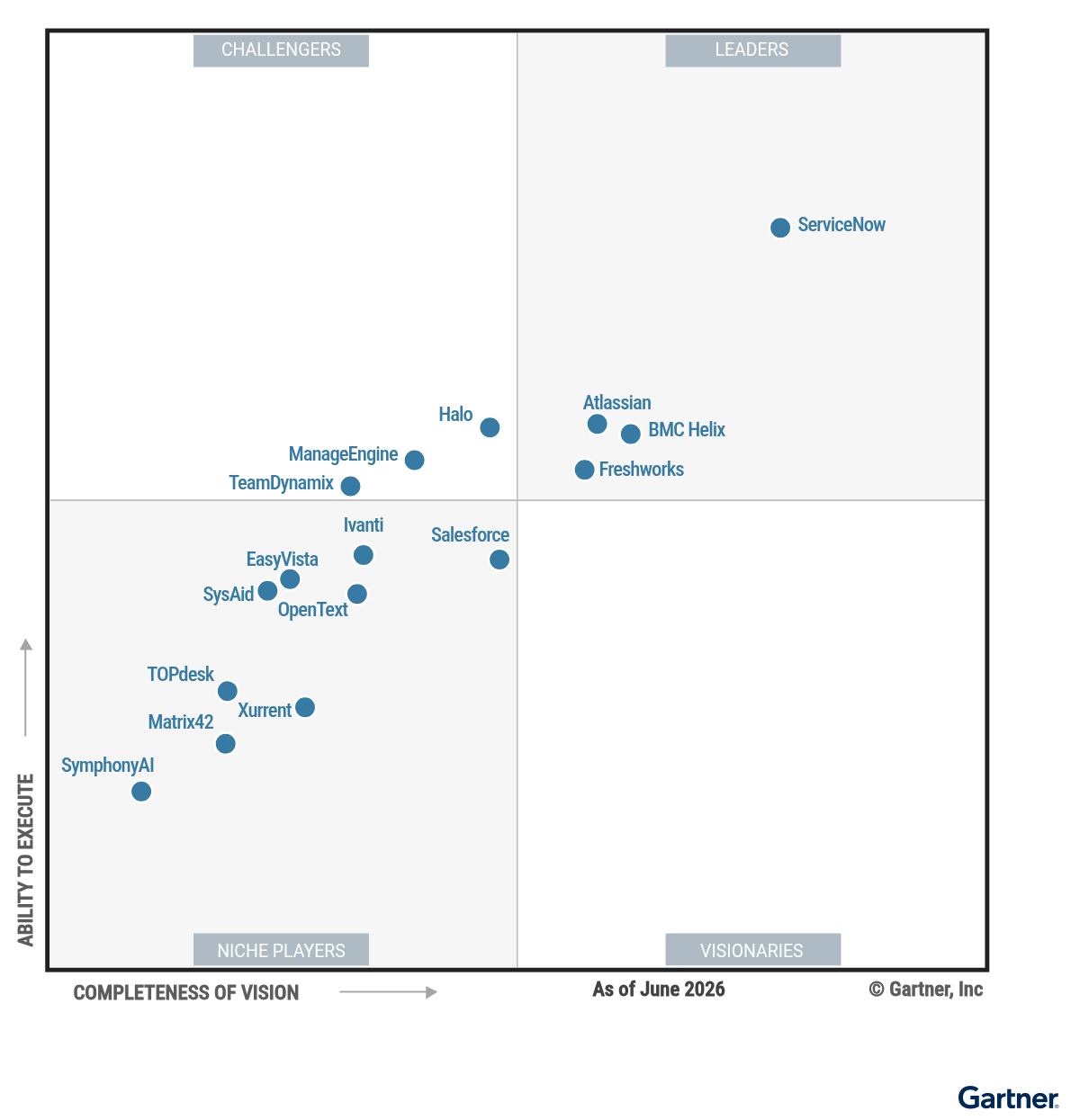
Vendor Strengths and Cautions
Atlassian
Atlassian is a Leader in this Magic Quadrant. Founded in 2002, it is a public company headquartered in Sydney, Australia. Its operations are in North America, Europe and Asia/Pacific. It targets organizations of all sizes and ITSM maturities for its ITSM offering, Jira Service Management. Atlassian’s strategy aims to provide a single platform that connects development, I&O and business teams across the entire life cycle of digital products and services.
Recent product enhancements include the addition of portal-based live chat support through its virtual agent, native bundled event intelligence features and AI-generated playbooks. Product-development plans include enhancing workforce optimization with AI-driven routing and forecasting, expanding automation and orchestration for more autonomous support, and improving analytics (including natural language insights).
- Product investment: Atlassian invests a large percentage of its revenue into R&D and is able to protect its intellectual property (IP) in this market through its broad set of patents. This enables the vendor to rapidly deliver new ITSM features such as its AI agents.
- Broad product recognition: Atlassian uses a wide variety of marketing channels and effectively leverages product-led growth across its development solutions, resulting in strong product awareness. This ensures Atlassian’s solutions are widely recognized, making it easier to adopt, integrate, and gain organizational buy-in for its tools.
- Market differentiation: Atlassian effectively communicates features like its Rovo AI, Teamwork Graph, and unified DevOps-ITSM platform to showcase its differentiated vision of the ITSM platforms market. This vision is driven by its development experience and focus on product-centric thinking, federated ITSM models, and cross-team collaboration.
- Licensing disruption: Atlassian has made a number of shifts to its licensing models, including end of sale for its Data Center offerings and the introduction of consumption-based pricing for AI and assets. This, along with annual pricing increases, can cause budgeting issues for customers who are unfamiliar with its pricing model.
- Account management: Atlassian’s account management efforts are focused on larger, more strategic accounts. Several smaller customers have raised concerns about the quality and availability of account management, direct implementation services and direct customer success support.
- Customization needs: Atlassian’s emphasis on emerging technologies such as AI within their ITSM product has outpaced expanding core usability and out-of-the-box features, which does not align with ITSM buyers’ preference for more simple, ready-to-use solutions.
BMC Helix
BMC Helix is a Leader in this Magic Quadrant. Founded in 1980 and divested from BMC in 2025, it is a privately held company headquartered in Houston, Texas, U.S. Its operations are global, and it targets larger customers with intermediate-to-high ITSM maturities for its ITSM offering, BMC Helix Service Management. BMC Helix’s strategy is aimed at unifying operations and service management with a common underlying data platform, integrated interfaces and AI.
Recent product enhancements include configuration item (CI) data integrity monitoring rules, enhanced swarming support over Teams, rule-based automated change impact analysis, and AI-generated knowledge articles, summaries and email replies. Product-development plans include AI-driven automation for change management, predictive analytics, and enhanced configuration management database (CMDB) management. In June 2026, Montagu Private Equity announced its intention to acquire a majority stake in BMC Helix.
- Balanced roadmap: BMC Helix’s product roadmap prioritizes differentiated enhancements in change, problem and configuration management, positioning it to address the needs of more regulated and complex customers, in contrast to competitors focused primarily on service desk support.
- Global presence: BMC Helix serves a geographically distributed customer base. It is supported by a broad set of local offices, partners in each major region, and worldwide hosting choices on Amazon Web Services (AWS, including FedRAMP), Azure, and BMC Helix Cloud, which has data centers in North America, Latin America, Europe, the Middle East, and Asia/Pacific.
- Advanced ITSM capabilities: BMC Helix ITSM supports the needs of highly mature I&O organizations, with strong ITSM process support, BMC Helix Operations Management integration for monitoring and observability, robust configuration management and AI-driven features.
- Product complexity: Customers find that the product requires significant time to prepare for and deploy major releases of its ITSM platform. As a result, additional resources are required to support the platform, potentially slowing the enablement of new features.
- Churn risk: By focusing on enterprise customers over the midmarket, BMC Helix faces longer sales cycles and a higher risk of revenue loss from renewal challenges. Smaller customers may find it difficult working directly with BMC.
- Reliance on technology partners: BMC Helix relies on third-party technology providers for some features. (e.g., large language model, BMC Helix iPaaS and BMC Helix Dashboards, as well as some enterprise service management capabilities), rather than acquiring or building this technology directly. The nonproprietary nature of these features makes it harder for BMC Helix to differentiate its product from its competitors in these areas.
EasyVista
EasyVista is a Niche Player in this Magic Quadrant. Founded in 1988, it is a privately held company headquartered in Paris, France. Its operations are in North America and Europe. It targets midsize and larger customers with low-to-intermediate ITSM maturity for its ITSM offering, EV Platform. EasyVista’s strategy is aimed at providing a cost-effective and simple-to-set-up ITSM platform with a feature set that suits customers at various stages of their ITSM maturity journey.
Recent product enhancements include an updated knowledge management system, additional Teams integration features and new AI features. Product-development plans include additional recurring and major incident detection features, AI-generated reports and improved data sharing between its CMDB and monitoring solution. In Q2 2026, EasyVista acquired Konverso for broader native AI support.
- Portfolio integration: EasyVista’s investment in integrating its portfolio of products, including remote support and monitoring, enhances its ITSM product with additional insights and actions such as automatically logging remote support interactions in a ticket or exposing CI performance and availability within the CMDB.
- Bundled IT operations management (ITOM) licensing: EasyVista’s concurrent licensing as well as bundling of remote control, monitoring and discovery features into higher license tiers provides a cost-effective option for midmarket buyers looking for a single provider to support their broader ITOM needs.
- Overall viability: EasyVista has experienced consistent double-digit percentage revenue growth year-over-year and is expanding intraregional market reach and product breadth via acquisitions. This reduces risk for customers and partners relying on its products.
- Unfocused roadmap: EasyVista’s planned investments in AI and broader platform integration may divert attention from essential ITSM feature enhancements needed for optimized process execution, such as UI and change calendar improvements.
- Unclear value proposition: EasyVista’s messaging frequently emphasizes generic AI themes and extended features beyond ITSM, lacking clear demonstration of ITSM platform differentiation and value delivery. Potential customers may struggle to understand how EasyVista’s solution addresses their unique ITSM needs, making it harder to justify its fit and value for their organization.
- Limited global presence: EasyVista’s market presence, new customer acquisitions and partner network are weak outside its target regions of Western Europe and North America.
Freshworks
Freshworks is a Leader in this Magic Quadrant. Founded in 2010, it is a public company headquartered in San Mateo, California, U.S. Its operations are global and it targets midsize organizations from all ITSM maturities for its ITSM offering, Freshservice. Freshworks’ strategy is aimed at providing an AI-enabled ITSM platform focused on quick configuration and ease of use.
Recent product enhancements include integration of its virtual support agent (VSA) into its self-service portal, knowledge gap identification and a new ITAM interface through integration with its Device42 acquisition. Product-development plans include AI-driven change risk scoring, intelligent ticket routing, enhanced asset and service monitoring, and executive dashboards. In 2026, Freshworks acquired FireHydrant to extend responsive incident management to DevOps and SRE teams.
- Strategic platform investments: Freshworks’ acquisitions of Device42 and FireHydrant strengthen Freshworks’ core platform with deeper discovery and dependency mapping (DDM) and incident-response capabilities.
- High brand visibility: Freshworks maintains strong awareness among ITSM platform buyers and frequently shows up on Gartner client shortlists. The company’s multichannel marketing efforts, including roadshows, events and social media, make it easier for potential buyers to access information, engage with the brand and evaluate its offerings.
- Product enhancements: Freshworks employs a broad reach of channels to capture a high number of customer suggestions for enhancements and regularly incorporates these into its monthly updates.
- Potential cost overruns: To achieve fully extended functionality from the solution, customers will need to purchase additional add-ons for some AI, CMDB and integration features. That, in addition to limiting support for sandbox environments and audit logs to its highest licensing tier, will push Freshservice outside the budget for some buyers.
- Misaligned buyer messaging: Freshworks’ ServiceOps-oriented messaging for its ITSM platform is less effective in reaching its target buyers. Lower maturity customers will find it more difficult to align its value proposition.
- No standard support SLAs: Freshworks doesn’t offer guaranteed response and resolution times for its standard support tier SLAs, instead requiring customers to purchase premium support packages.
Halo
Halo is a Challenger in this Magic Quadrant. Founded in 1994, it is a privately held company headquartered in Suffolk, U.K. Its operations are in the U.S., Australia, the UAE and the U.K. It targets organizations of all sizes and ITSM maturities with its ITSM offering, HaloITSM. Halo’s strategy is aimed at providing a scalable platform to modernize service management needs, along with providing a partnership-style relationship with its customers.
Recent product enhancements include searchable configuration settings and self-service portal improvements including UI updates and integration into Azure AI translator. It also added the ability to forecast ticket volumes based on historical trends in its reporting module. Product-development plans include modernizing its self-service portal, Gantt chart and change management UIs; and adding alert management features and line-of-business modules.
- Cost predictability: Halo has a single, all-inclusive SKU for its ITSM product that includes extended features including AI, automations, and connectors. This approach makes it easy for customers to grow on its platform without the risk of exceeding their budget.
- Increased vendor awareness: Halo’s active marketing campaigns have gained the vendor strong mind share as it regularly appears on Gartner clients’ ITSM platform shortlists. Its active marketing makes it easier for potential buyers to access information, engage with the brand, and evaluate its offerings.
- Diverse sales channels: Halo employs a good mix of direct and indirect sales to support its nearly double year-over-year revenue growth over the past three years.
- Limited innovation capacity: Halo has a small R&D team, which constrains its ability to advance or differentiate ITSM platform capabilities in this evolving market.
- Low feature differentiation: Halo’s marketing does not strongly highlight unique ITSM platform features, focusing instead on general benefits. This lack of feature differentiation will make Halo less appealing to organizations with advanced or specialized requirements.
- Minimal customer success resources: Halo’s customer success offerings are mainly focused on operational support, such as support and managed configuration, with limited emphasis on business value realization, benchmarking or advanced tools to guide customers’ ITSM maturity growth.
Ivanti
Ivanti is a Niche Player in this Magic Quadrant. Founded in 2017, it is a private company headquartered in South Jordan, Utah, U.S. Its operations are global, and it targets midsize and enterprise organizations of all ITSM maturities for its ITSM offering, Ivanti Neurons for ITSM. Ivanti’s strategy is to enable comprehensive digital employee experiences by uniting its portfolio of security, endpoint management and digital employee experience management (DEX) solutions.
Recent product enhancements include a proprietary VSA for self-service, improved incident correlation, UI modernization and GenAI features such as translation and write-assist. Product-development plans include AI-driven problem management, strengthening discovery normalization and reconciliation within its CMDB, and enhanced service health reporting.
- Mature product: Ivanti’s ITSM product demonstrates good understanding of core ITSM practices. Integration of adjacent Ivanti solutions such as endpoint management and bundled DEX enables more proactive end-user support.
- Customer engagement: Ivanti actively involves customers in its development process through advisory programs, pilot testing and user groups, enabling early feedback, hands-on validation and direct collaboration with product teams.
- Global footprint: Ivanti’s customers are geographically distributed, supported by a broad number of partners in each major region and hosting choices in North America (including a FedRAMP option), Europe, Middle East and APAC.
- New feature lag: Ivanti’s product roadmap lags many of its competitors in the pace of bringing new features to market, with most major enhancements not planned until 2027.
- Customer retention challenges: Due in part to the end of life for its Cherwell product (scheduled for December 2026), Ivanti’s customer renewal rates are lower than competitors in this market evaluation. Outside of Cherwell replacement scenarios, Gartner sees Ivanti on few client shortlists.
- Revenue loss: Despite the market’s overall double-digit growth, Gartner estimates Ivanti’s IT service management platform revenue to have declined by 8.29% in 2025. As a result, clients considering Ivanti should conduct additional financial due diligence.
ManageEngine
ManageEngine is a Challenger in this Magic Quadrant. Founded in 2002, it is a division of Zoho Corporation, and is a privately held company headquartered in Del Valle, Texas, U.S. Its operations are global, and it targets organizations of all sizes and ITSM maturities for its ITSM offering, ServiceDesk Plus. ManageEngine’s strategy is aimed at providing highly customizable, value-oriented ITSM as part of a portfolio of integrated IT and business management products.
Recent product enhancements include Zia Agents, AI for problem detection; AI-driven text-to-workflow and new tools for maintaining CMDB data quality. Product-development plans include a centralized change advisory board workbench, a graph-based CMDB, and enhanced mobile and collaboration tools.
- Low price: ManageEngine is one of the most affordable ITSM offerings evaluated in this research, with AI included in its standard pricing and several pricing tiers. This lowers the cost of entry and enables customers to grow. The affordable pricing aligns well with the needs of ManageEngine’s target midmarket customers, as well as larger, value-oriented customers.
- Emerging market presence: ManageEngine has a broad global presence, with local support and extensive partner support in emerging markets (e.g., LATAM, Middle East and North Africa). It also provides different regional hosting and on-premises options to address data sovereignty concerns.
- High growth: With effective positioning in the SMB and midmarket spaces, ManageEngine was among the top vendors within our evaluation for both revenue growth percentage and new customer growth in 2025.
- Limited ITSM differentiation: Much of ManageEngine’s messaging around differentiation focuses on broader platform extensibility and integration rather than distinctive ITSM features. This may limit its appeal for those not wanting to buy a broader ecosystem of products.
- Customer feedback gaps: ManageEngine relies on a very small subset of larger customers in its customer advisory board and indirect channels such as user forums and engagement at events to drive its product strategy. This may limit its ability to respond to critical customer needs in its product roadmap.
- Lagging product innovation: While ManageEngine’s roadmap addresses several common market needs and foundational gaps, the features it’s adding are largely to help it catch up with the competition rather than differentiate itself, and it lacks clear prioritization or uniqueness.
Matrix42
Matrix42 is a Niche Player in this Magic Quadrant. Founded in 1992, it is a privately held company headquartered in Frankfurt, Germany. Its operations are primarily in Europe, and it targets midsize organizations of medium to high ITSM maturity for its ITSM offering, Matrix42 Service Management. Matrix42’s strategy is aimed at providing a broad suite of integrated ITSM, IT operations management and security products as part of an easy-to-configure platform.
Recent product enhancements include adding a VSA, an updated low-code workflow designer, UI enhancements and dedicated major incident management support. Product-development plans include additional embedded CMDB data quality monitoring, CIO dashboards and expanded support for ESM workflows.
- Broad product portfolio: Matrix42 offers a broad portfolio of adjacent capabilities, including endpoint management, hardware and software asset management, and security-focused products. This enables strong cross-sell opportunities across its customer base.
- Targeted market focus: Matrix42 demonstrates a solid understanding of its target European midmarket buyers, allowing it to effectively focus resources and tailor messaging to this segment.
- Overall viability: Matrix42’s ITSM business is profitable, and recent acquisitions are expanding its regional presence while adding SaaS management integration to its ITSM platform. Its ongoing investment in this market raises confidence for customers and partners who rely on its products.
- Limited functional depth: Matrix42’s ITSM product may require additional enhancements in usability, ITSM practice enablement, and platform-native connectors to fully meet the needs of more complex or mature organizations.
- Limited ITSM differentiation: Matrix42 does not consistently highlight clear ITSM differentiation in its marketing. By focusing on commonplace themes such as deployment flexibility and rapid implementation in its marketing, the vendor will fail to communicate its value proposition to potential customers.
- Product roadmap gaps: Matrix42’s focus on emerging areas, including AI and ESM within its ITSM platform, may limit its ability to address improvements to core ITSM functionality.
OpenText
OpenText is a Niche Player in this Magic Quadrant. Founded in 1992, it is a public company headquartered in Waterloo, Canada. Its operations are global. It targets midsize-to-large enterprises with intermediate-to-high ITSM maturity for its ITSM offering, OpenText Service Management. OpenText’s strategy is aimed at ease of use and quick implementation through a low-code service management platform connected to its broader ITOM, automation and line-of-business solutions.
Recent product enhancements include adding context awareness into its OA and VSA, additional out-of-the-box (OOTB) integrations, and enhanced CMDB discovery. Product-development plans include AI-based service modeling, business value dashboards and a dedicated incident prevention/major incident workspace with embedded root cause analysis (RCA) tools.
- Licensing flexibility: OpenText enables its Service Management customers to switch between named and concurrent licensing midcontract with a flexible, unit-based model. It also offers a limited number of its OpenText Service Management Aviator GenAI product transactions across both its licensing tiers at no additional cost.
- Broad global presence: OpenText supports its geographically distributed customers with a broad set of local offices, partners in each major region, and worldwide hosting choices (including global AWS options and FedRAMP).
- Strong customer feedback integration: OpenText captures and incorporates customer feedback from a broad range of users through multiple channels — including regular customer advisory board meetings — to inform its product strategy and respond to critical customer needs.
- Unclear value differentiation: OpenText does not consistently highlight clear ITSM differentiation in its marketing. By focusing on commonplace themes such as low-code development, generic AI themes and deployment flexibility in its marketing, the vendor struggles to communicate its value proposition to more mature buyers in this market.
- Reduced market presence: ITSM makes up a small overall portion of OpenText’s revenue and, despite the market’s overall double-digit growth, Gartner estimates OpenText’s ITSM platforms revenue to have declined by 1.3% in 2025.
- Product roadmap gaps: OpenText’s focus on emerging and adjacent areas, including AI and ESM, within its ITSM platform may limit its ability to address improvements to its core ITSM product.
Salesforce
Salesforce is a Niche Player in this Magic Quadrant. Founded in 1999, it is a public company headquartered in San Francisco, California, U.S. Its operations are global. It targets organizations of all sizes and ITSM maturities with its ITSM offering, Agentforce IT Service, which it launched in 2025. Salesforce’s ITSM strategy is aimed at delivering a unified, AI-native platform for proactive support and rapid time to value for organizations.
Recent product enhancements include OOTB service catalog templates with dedicated service request records, virtual support agent enhancements and AI-driven proactive RCA recommendations. Product-development plans include integration of observability data into its CMDB, enhanced dashboards and hardware asset management.
- Platform-driven growth: Salesforce has effectively utilized its agentic platform including Agentforce (AI), Mulesoft (iPaaS), Slack (collaboration) and Tableau (analytics) to enhance its ITSM offering and create opportunities for competitive differentiation.
- Rapid customer expansion: Growing to over 180 customers within its first four months of availability, Salesforce targets its large base of customers to cross-sell into ITSM. This provides a growing user community for customers to engage with.
- Proprietary platform control: Salesforce does not require third-party partnerships to deliver its ITSM platform, including CMDB and discovery components, and is able to protect its intellectual property (IP) in this market through its broad set of patents. This provides it an established proprietary foundation to innovate on.
- Limited implementation track record: While Salesforce has had several other partner-driven attempts at this market, its first fully direct investment in the ITSM platforms market was launched in October 2025. As a result, while early product adopters include several large or complex organizations, there is limited evidence yet of multiyear, at-scale implementations.
- High cost: Salesforce offers SaaS subscription and consumption-based options, but the combination of IT user-based licensing, end-user-based licensing for the self-service virtual agent and CI-based CMDB licenses puts its list pricing on the higher end of vendors in this Magic Quadrant. Clients should carefully evaluate the value of included capabilities against current and future needs and budget.
- Limited market understanding: The way that Salesforce communicates its understanding of this market frequently focuses on AI themes and platform-level investments rather than focused ITSM practice execution. This demonstrates a limited awareness of ITSM platform competitors and broader service management trends.
ServiceNow
ServiceNow is a Leader in this Magic Quadrant. Founded in 2004, it is a public company headquartered in Santa Clara, California, U.S. Its operations are global, and it targets midsize-to-large organizations of all ITSM maturities for its ITSM offering, ServiceNow IT Service Management. ServiceNow’s ITSM strategy is aimed at positioning itself as an AI-driven platform to enable orchestration across ITSM, ITOM, and employee workflows.
Recent product enhancements include on-call scheduling improvements, broad AI enhancements, including AI-driven incident triage and categorization, change risk explanation, voice integration and a new service desk virtual support agent. Product-development plans include simplified portal experiences, dedicated service mapping and data quality AI agents for its CMDB, improved voice support and deeper change-management support.
- Advanced ITSM platform: ServiceNow’s advanced ITSM platform is well-suited for complex, highly mature organizations, offering a unified data model and advanced CMDB, broad AI enablement, granular governance and flexible automation across service management.
- Significant market presence: ServiceNow effectively leverages a wide variety of channels, including its global conference series to convey its messaging. It has high relevance to enterprise ITSM customers and maintains a large community of partners, users and advocates.
- New product enhancements: Through a combination of platform-focused acquisitions and native development, ServiceNow maintains a number of advanced product differentiations, such as AI agent management, native DEX, process mining and workforce optimization, and has a clear 18-month product roadmap.
- Higher potential costs: ServiceNow introduced a new pricing model for ITSM in April 2026, which may increase costs for new customers. The new structure adds varying levels of GenAI support to each tier, but the entry-level option, ITSM Foundation, does not include change and problem management support and is unlikely to meet the functional requirements of most buyers.
- Add-on requirements: Customers need to budget for the necessary add-ons and product upgrades or risk incurring additional costs when looking to add additional platform capabilities such as ITOM features that enable a successful CMDB, GenAI consumption credits, or additional workflow approvers.
- Value realization challenges: While it offers some free self-service resources, many of its customer success functions are sold as part of a premium offering. Gartner has received regular inquiries from ServiceNow customers who are struggling to realize and articulate platform value.
SymphonyAI
SymphonyAI is a Niche Player in this Magic Quadrant. Founded in 2017, it is a privately held company headquartered in Palo Alto, California, U.S. Its operations are global. It targets midsize and enterprise organizations of low-to-intermediate ITSM maturities for its ITSM offering, SymphonyAI Apex Aspen. SymphonyAI’s strategy is aimed at providing AI-powered IT and enterprise workflows on a no-code/low-code platform.
Recent product enhancements include automated email processing, business rules for service requests, AI-driven incident clustering and UI enhancements. Product-development plans include support for additional business rules, support for forecasting within its reporting, a new data model to unify IT asset and CMDB data, and extending mobile support for its VSA.
- Cross-selling: SymphonyAI’s broader vertically aligned products provide it a wider set of customers to whom to cross-sell its ITSM solution, with a well-balanced mix of direct and indirect sales.
- Customer success support: SymphonyAI provides a number of customer enablement services, including a dedicated customer success program, structured onboarding and regular business reviews. These services help customers rapidly implement and ensure their evolving needs are addressed.
- Flexible licensing: SymphonyAI supports multiple licensing options, including named, concurrent, self-hosted and enterprise agreement type plans. This flexibility allows customers to choose the model that best fits their organizational structure and usage patterns.
- Limited functional depth: Limitations of SymphonyAI’s ITSM product may require additional enhancements in areas such as change management, configuration management and reporting to fully meet the needs of more complex or mature organizations.
- Weak product differentiation: SymphonyAI’s marketing often relies on generic AI claims and broad ROI statements, without clearly demonstrating how its ITSM platform stands out. As a result, Gartner sees limited mind share for SymphonyAI among its clients in this market.
- No long-term product strategy: SymphonyAI lacks a long-term strategy for its product, instead focusing on a six-month rolling plan (the shortest in this evaluation). This lack of strategic planning around transformative features will limit the provider’s ability to drive meaningful innovation for its customers.
SysAid
SysAid is a Niche Player in this Magic Quadrant. Founded in 2002, it is a privately held company headquartered in Tel Aviv, Israel. Its operations are global and it targets midsize and small enterprise organizations of all ITSM maturities for its SysAid AI-powered ITSM platform. SysAid’s strategy is to deliver AI-powered service management with low-code/no-code simplicity, streamlining workflows and enabling intelligent support.
Recent product enhancements include additional OOTB AI agents for ITSM, a native mobile app, Workato integration and broader ESM support. Product-development plans include enhanced intelligent automation, AI agents for CMDB support, role-tailored analytics and conversational platform administration.
- Midmarket focus: SysAid targets the midmarket by leveraging its low overhead, easy configuration and extended features such as bundled AI licensing to position itself effectively for these customers.
- Customer relationships: SysAid’s customer success program provides structured guidance and tools, including maturity models, joint success plans and automated usage analysis, to help customers steadily improve ITSM practices and platform adoption. Many customers are entitled to these additional services at no extra cost.
- Frequent release cadence: SysAid supports a continuous release cadence with monthly major releases shaped by customer input and competitive intelligence. This approach will allow it to respond rapidly to customer needs and evolving industry trends.
- Product roadmap gaps: By prioritizing AI expansion in its product roadmap, SysAid risks neglecting foundational improvements in change management, knowledge management, configuration management and reporting, which could cause it to fall behind in these key functions.
- Diluted ITSM positioning: SysAid’s marketing strategy relies heavily on AI messaging and lacks clear differentiation of its broader ITSM platform. This approach dilutes the vendor’s ITSM presence and may fail to resonate with organizations seeking a more balanced and mature ITSM platform solution.
- Resource allocation risk: SysAid has one of the lowest company revenues among vendors in this Magic Quadrant, and its revenue growth trails behind several other midmarket-focused competitors. Its recent introduction of its platform-agnostic AI agent solution, DEX, may risk reallocation of resources away from its core ITSM team.
TeamDynamix
TeamDynamix is a Challenger in this Magic Quadrant. Founded in 2001, it is a privately held company headquartered in Columbus, Ohio, U.S. Its operations are in the U.S. and Canada. It targets midsize and enterprise organizations with intermediate-to-high ITSM maturities for its ITSM offering, TeamDynamix IT Service Management. TeamDynamix’s strategy is aimed at providing a low-code ITSM tool that is integrated with its project portfolio management (PPM) and iPaaS products.
Recent product enhancements include UI updates, expanded integrations, and new AI features including AI assistants, ticket triage and knowledge creation. Product-development plans include deeper integrations with observability tools, natural language reporting capabilities and an AI agent orchestration.
- Close customer relationships: TeamDynamix fosters strong customer connections by engaging a large portion of its clients in its active customer advisory board and directly overseeing implementation and support for most customers.
- Outcome-focused selling: TeamDynamix’s sales approach is built around developing a deep understanding of its individual buyers, enabling it to position its platform to fit real customer needs and demonstrate tangible outcomes. The vendor has one of the highest win-rate percentages in this research.
- Flexible licensing: TeamDynamix offers several licensing options, including site, bundled, named seat, endpoint and department-based licenses, which allow customers to choose pricing models that fit their needs, with site licenses offering predictable costs that support growth without penalty.
- Innovation lag: TeamDynamix has relatively fewer R&D staff members than many of its competitors in this space and has lagged the market in integrating AI into its product. It has not been granted any patents around proprietary IP in this market.
- Limited global presence: TeamDynamix’s market presence and new customer acquisitions are mostly limited to North America. It lacks any direct support resources or hosting capabilities outside the U.S. and Canada.
- Scalability concerns: TeamDynamix is smaller in staff and revenue than many vendors in this report and has only started this year to partner with third-party service providers for its ITSM platform. This may cause concern among larger enterprises about the vendor’s ability to scale to accommodate their needs.
TOPdesk
TOPdesk is a Niche Player in this Magic Quadrant. Founded in 1997, it is a privately held company headquartered in Delft, the Netherlands. Its operations are in Europe, the U.S., and Latin America, and it targets organizations of all ITSM maturities for its ITSM offering, TOPdesk. TOPdesk’s strategy is aimed at ease of use and quick implementation for its ITSM platform, while offering support for other non-IT workflows.
Recent product enhancements include a revamped knowledge base, a task board interface for managing work, an AI writing assistant for knowledge articles, and AI-driven incident summarization and categorization. Product-development plans include a low-code workflow designer, improved reporting, and a virtual support agent.
- Midmarket focus: TOPdesk has established a good market presence among European SMB and midmarket customers by addressing overhead, configuration ease and strong local presence (including on-premises and multiple country-specific hosting options) in its sales discussions.
- Overall viability: TOPdesk maintained consistent growth over the past three years and is focused exclusively on its ITSM platform. This raises confidence around TOPdesk’s continued ITSM platform support for customers and partners relying on its products.
- Continuous release cadence: TOPdesk supports a continuous release cadence with daily updates and quarterly releases that bundle common features. This will help the vendor drive its roadmap.
- Limited functional depth: Limitations of TOPdesk’s ITSM product may require additional enhancements in areas such as change management, configuration management and orchestration with external systems to fully meet the needs of more complex or mature organizations.
- Limited global presence: TOPdesk’s market presence, new customer acquisitions and partner network are weaker outside its target region of Western Europe. Its current approach of direct rather than partner-driven sales may limit its ability to expand outside its primary region without significant direct investment.
- Low innovation spend: TOPdesk invests a relatively lower percentage of its overall revenue into R&D compared with its peers in the market and relies on technology partners to address customer needs for discovery and virtual support agents. This may limit its ability to innovate in important areas for its customers.
Xurrent
Xurrent is a Niche Player in this Magic Quadrant. Founded in 2010, it is a privately held company headquartered in Austin, Texas, U.S. Its operations are in Australia and New Zealand, North America, Europe, and India. It targets midsize to enterprise organizations with intermediate ITSM maturity for its ITSM product, Xurrent ITSM. Xurrent’s strategy is aimed at driving more effective collaboration by combining its low-code ITSM platform with native incident response and service visibility features.
Recent product enhancements include integration between its ITSM and its acquired companies, Zenduty and StatusCast, for incident detection and response, AI for ticket automation and the release of a native iPaaS. Product-development plans include an improved UX for change and knowledge management, iPaaS enhancements, native asset discovery and AI agents for ticket pattern detection.
- Proprietary platform control: Xurrent invests a high percentage of its revenue into R&D and does not require third-party partnerships to deliver its ITSM platform. Its recently developed proprietary iPaaS gives it a platform to rapidly expand a library of purpose-built integrations.
- Frequent release cadence: Xurrent operates on a continuous delivery model with weekly production releases that are nonintrusive and automatically applied to all customers simultaneously. This approach will allow it to respond to rapidly changing customer needs and evolving industry trends.
- Customer enablement: Xurrent offers a comprehensive, tiered customer success program that includes dedicated CSM support, best practice reviews, service improvement workshops, unlimited training and an active customer community at no extra cost.
- Low brand awareness: Xurrent’s marketing strategy lacks clear differentiation and relies on generic messaging, while attempts to create a new market category risk confusing potential customers rather than highlighting unique ITSM value. Gartner observes low frequency of shortlisting for Xurrent’s product in client inquiries.
- Limited functional depth: Xurrent’s product shows limitations around incident life cycle governance, knowledge management, change governance and CMDB capabilities, which may hinder effective ITSM operations and scalability for more complex environments.
- Small vendor: Xurrent has one of the lowest company revenues and product-focused employee counts among vendors in this Magic Quadrant. This may cause concern among larger enterprises about the company’s ability to scale to accommodate their needs.
Inclusion and Exclusion Criteria
Magic Quadrants and Critical Capabilities identify and analyze the most relevant providers and their
products in a market. The inclusion criteria are the specific attributes that a provider must have to be
included in this research.
In addition to Gartner client relevance, as determined by analyst expertise and opinion, providers need to meet the following criteria to qualify for inclusion:
Product availability:
- The provider must provide an ITSM platform with all the following features generally available as of 1 January 2026:
- The product must provide support for the following ITSM practices with out-of-the-box forms, workflows and reports: incident management, problem management, service request management, change management and knowledge management.
- In addition, the provider must offer an integrated configuration management system (CMDB) with the ability to visually display dependencies between CIs, the ability to define and monitor service levels, and the ability to coordinate and manage ITSM processes using built-in AI and automated workflows.
Ongoing development:
- The provider must have demonstrated ongoing development of the product, with at least one major update or release in 2025. Examples of major updates include the addition of new functionality or UI overhauls. This does not include security updates and minor feature updates.
- At least one-third of customers must be using versions of software across the ITSM product portfolio that are less than 12 months old.
Actively marketed:
- The provider must have run at least one marketing campaign for the product in 2025. The marketing campaign must have defined objectives, target audience, content and channels.
Customers:
- At least 100 unique end-user organization customers (excluding managed service providers [MSPs]) must have purchased and deployed the provider’s ITSM platform in a production environment since the product’s initial general availability.
- The product must have at least 24 new logo paid end-user customers added during 2025, with at least six of them with over 300 active named IT agent user licenses or 100 active concurrent IT agent user licenses for ITSM.
Honorable Mentions
The providers that are most relevant to our clients were selected for evaluation in this Magic Quadrant. However, the decision not to evaluate a provider does not mean that the provider lacks viability. The following are noteworthy providers not included in the formal analysis. These providers could be appropriate for clients, contingent on their requirements.
InvGate: InvGate has a growing customer base in North America and EMEA, but has an established presence in Latin America, a region where most other providers lack significant market share. It provides a card-style UI to navigate work as well as integrated AI capabilities included in its standard licensing tiers. In addition, it offers agent productivity features including time tracking and gamification as well as an ITAM product to complement its ITSM offering.
SolarWinds: SolarWinds complements its portfolio of ITOM and security tools with its ITSM product, SolarWinds Service Desk. Its integration into the SolarWinds Observability product automates converting alerts to incidents, updating alerts from incidents, mapping CI dependencies and connecting CI data into tickets. Extended features include AI and ITAM.
Evaluation Criteria
We evaluate vendors and product(s) in the IT service management platforms market based on two categories of criteria: Completeness of Vision and Ability to Execute. In the tables below, we assign a weight to each of the following criteria based on our view of its relative importance in the market.
Ability to Execute
Product/Service refers to the capabilities, features and overall quality of the core goods and services that compete in and/or serve the defined market. This part of the evaluation primarily examines the provider’s ability to meet the critical capabilities of ITSM platforms. Also evaluated is the ability of the product to meet a range of operational, organizational and compliance certifications.
Overall Viability refers to the organization’s overall financial health, as well as the financial and practical success of the relevant business unit. This includes the likelihood that the organization can continue to offer and invest in the product, as well as the product’s position in the organization’s portfolio. Criteria evaluated include the importance of ITSM in the overall product portfolio, recent acquisitions and their strategic rationale as they relate to this market, product revenue and other funding to support the growth and continued investment in this market, and the scale and allocation of its workforce to invest in the ITSM product.
Sales Execution/Pricing focuses on the organization’s capabilities in all presales activities and the structures that support these activities. This includes deal management, pricing and negotiation, presales support and the overall effectiveness of the sales channel. Criteria evaluated include the sales techniques used, sales success rates, contract term distribution and deal sizes. Highly weighted is the comparative cost of the product against comparable offerings from competitors and how this is perceived by customers.
Market Responsiveness and Track Record evaluates the ability to respond, change direction, be flexible and achieve competitive success as opportunities develop, competitors act, customer needs evolve and market dynamics change. This includes the provider’s history of responsiveness to changing market demands. Criteria evaluated include the cadence of new feature releases, the effectiveness in detecting and responding to market changes, and the track record in addressing customer suggestions and enhancement requests through the provider’s product roadmap and recent releases.
Marketing Execution concerns the ability to deliver clear, high-quality, creative and effective messaging via publicity, promotional activity, thought leadership, social media, referrals and sales activities. This includes the organization’s ability to influence the market, promote the brand, increase awareness of products and establish a positive reputation among customers. Criteria evaluated include the impact of product marketing campaigns over a variety of channels and their relevance to customer needs. Also evaluated are the impact of event sponsorships and exhibitions, measurable outcomes achieved, and the quality and influence of thought leadership content published across digital channels.
Customer Experience evaluates the degree to which a vendor’s products, services and programs enable customers to achieve their desired results. This includes the quality of supplier/buyer interactions, technical support or account support, as well as ancillary tools, customer support programs, availability of user groups and service-level agreements. Criteria evaluated include the provider’s support response and resolution practices, the quality and accessibility of customer success tools and services, engagement through
advisory boards, the effort required to support the product, and the vendor’s handling of significant customer experience issues. Direct customer input from Gartner Peer Insights and other sources is also considered.
Operations focuses on the organization’s ability to meet its goals and commitments. This includes the quality of its organizational structure, skills, experiences, programs and systems that enable the organization to operate effectively and efficiently. We do not evaluate this criterion as part of this research.
Ability to Execute
Ability to Execute Evaluation Criteria
| Evaluation Criteria | Weighting |
|---|---|
Product or Service | High |
Overall Viability | Medium |
Sales Execution/Pricing | High |
Market Responsiveness/Record | Low |
Marketing Execution | High |
Customer Experience | Medium |
Operations | NotRated |
Source: Gartner (July 2026)
Completeness of Vision
Market Understanding is the ability to understand customer needs and translate that understanding into products and services. Vendors with a clear vision of the market listen to and understand customer demands, and they can shape or enhance market changes with their vision. Criteria evaluated include the ability to demonstrate awareness of transformative trends and market disruptors that challenge traditional service management practices, recognize top competitors, and identify which customers they need to target to be most successful with their product.
Marketing Strategy focuses on the ability to clearly communicate differentiated messaging, both internally and externally, through social media, advertising, customer programs and positioning statements. Criteria evaluated include how effectively providers can market differentiated ITSM platform features, tailor messaging to targeted buyer personas, and execute strategic campaigns.
Sales Strategy evaluates the ability to create a sound strategy for selling that uses the appropriate networks, including direct and indirect sales, marketing, service and communication. This includes partnerships that extend the scope and depth of a provider’s market reach, expertise, technologies, services and their customer base. Criteria evaluated include the methods used for identifying future business opportunities, tailoring approaches for different ideal customer profiles, sales distribution across channels and partners, and plans for evolving licensing or pricing models.
Offering (Product) Strategy focuses on the ability to approach product development and delivery in a
way that meets current and future requirements, with an emphasis on market differentiation, functionality, methodology and features. Criteria evaluated include the breadth and forward-looking scope of the product roadmap, the balance of enhancements to address core and emerging buyer needs, incorporation of customer feedback, and the rigor of the process for making strategic decisions, ensuring the roadmap meets customer selection criteria, keeps pace with competitors, and delivers unique value.
Business Model evaluates the design, logic and execution of the organization’s business proposition. We do not evaluate this criterion as part of this research.
Vertical/Industry Strategy focuses on the ability to strategically direct resources (sales, product, development), skills and products to meet the specific needs of verticals and market segments. We do not evaluate this criterion as part of this research.
Innovation evaluates the vendor’s marshaling of resources, expertise or capital for competitive
advantage, investment, consolidation or defense against acquisition. Criteria evaluated include investment and allocation of R&D resources across key areas to drive internal innovation, including patents to protect native IP, versus partnering with other tech providers.
Geographic Strategy focuses on the ability to direct resources, skills and offerings to meet the specific needs of regions outside the provider’s home region, either directly or through partners, channels and subsidiaries. Criteria evaluated include the distribution of resellers, implementation partners, and support associates to support a global footprint, the availability and partnerships for local data centers, and the flexibility for customers to select data center locations to meet local compliance requirements.
Completeness of Vision
Completeness of Vision Evaluation Criteria
| Evaluation Criteria | Weighting |
|---|---|
Market Understanding | High |
Marketing Strategy | High |
Sales Strategy | Medium |
Offering (Product) Strategy | High |
Business Model | NotRated |
Vertical/Industry Strategy | NotRated |
Innovation | Medium |
Geographic Strategy | Low |
Source: Gartner (July 2026)
Quadrant Descriptions
Leaders
Leaders have demonstrated strong execution, broad market reach, and high customer awareness, as reflected in Gartner client interactions, growth, and market presence. These vendors present a clear vision that addresses key challenges facing I&O teams, such as the influence of product teams, support for agile and DevOps environments, delivering impactful employee experiences, and enabling more proactive and responsive ITSM practices in a highly integrated environment. These vendors demonstrate a good understanding of the role both human and AI agents play in this space and address both in their strategies and messaging. They possess the product, marketing, and sales capabilities necessary to drive market acceptance.
Challengers
Challengers have executed well, growing market revenue, retaining good customer awareness, and improving their ITSM product and overall viability levels enough to participate in the general-purpose market with competitive products. In general, however, Challengers are not seen as driving the market as strongly as Leaders or Visionaries.
Visionaries
There are no Visionaries in this Magic Quadrant. Visionaries offer innovative approaches that address emerging opportunities and disrupt traditional IT operations, such as breaking down team silos or accelerating autonomous execution through AI. However, they have not executed as effectively as Challengers or Leaders. Visionaries stand out with differentiated messaging, sales, and product strategies that align with buyers’ evolving needs.
Niche Players
Niche Players often excel in specific areas of ITSM and provide strong solutions for particular use cases, but typically have not invested enough to demonstrate both high levels of Completeness of Vision and Ability to Execute. In this Magic Quadrant, Niche Players either focus on a narrow market segment, are ramping up their go-to-market efforts, or are scaling down by retiring products. They may serve a small number of large enterprises or many small and midsize businesses. While Niche Players may struggle to keep pace with the market’s broader demands, they can often deliver the best solutions for the specific needs of certain I&O organizations, especially when considering the price-to-value ratio of their offerings.
Context
The ITSM Platforms Magic Quadrant is being reintroduced this year, driven by evolving market conditions and the needs of heads of I&O to respond to evolving pressures and transformative changes, and to rightsize their ITSM platform purchases.
The goal of any Magic Quadrant is to provide a level view of comparable products (size, capability and corporate structure) to address the demands of a wide variety of buyers. Not every company’s requirements are identical. We encourage clients to review the accompanying Critical Capabilities research to review use case and functionality requirements, and this research to align vision, technology and cost requirements to the right vendor, regardless of the vendor’s quadrant.
Use this in conjunction with Gartner’s A Roadmap to Rightsize Your Next ITSM Platform Purchase and Toolkit: RFP Template for ITSM Platforms research to optimize and expedite your next ITSM platform selection.
Understanding the Two ITSM-aligned Magic Quadrants
Gartner introduced a separate Magic Quadrant for Artificial Intelligence Applications in ITSM in 2024, reflecting a structural shift in how the market is evaluated, to focus on tools that specifically augment ITSM workflows with specialized AI capabilities. ITSM platforms remain the system of record for the execution of ITSM practices. Many heads of I&O seek the benefits of AI to maximize the value of their ITSM investment but are not replacing ITSM platforms to obtain AI capabilities. Instead, they choose between incumbent platform capabilities and third-party, specialist AI solutions. Gartner considers AI capabilities as both integrated components within ITSM platforms and available as a distinct market because buyers are now assessing artificial intelligence separately from core ITSM platform functionality (see Infographic: Choose an AI Solution for ITSM).
Market Overview
The ITSM platforms market reached nearly $9 billion in 2025, growing 13.74% year over year1 and remains the largest segment of the IT operations value management market. The vendor landscape for the ITSM platforms market is stable. While there has been some limited consolidation over the past several years, more recent market acquisitions within the ITSM platforms space have focused on adding extended functionality such as AI, monitoring and observability.
Many core capabilities, such as the ability to manage and report on service desk tickets, no longer drive meaningful differentiation. As these core ITSM capabilities have become standardized, several providers are positioning themselves as value options with a focus on low cost and administrative ease. While this addresses a common customer pain point, it is not highly differentiated and places them at greater risk of disruption.
This market has had a number of new entrants, many of which fall into two categories:
- Providers offering adjacent workflow solutions looking to add employee-facing workflows to their portfolios. These often offer mature ticketing solutions and have an accelerated path toward service desk enablement in practices like incident, request and knowledge management. However, they will take time to build out deeper feature parity with market leaders in areas such as change, configuration and problem management, as well as advanced capabilities in service operations or DevOps enablement.
- Self-described AI-native startups. These providers often offer less mature ticketing and advanced ITSM practice support, but offer broad and quickly evolving libraries of AI agents to provide more AI-driven automation. Extending this category, a new market is emerging that will challenge the basic ITSM product offerings by offering limited ticketing capabilities along with a focus on digital workplace orchestration (see Innovation Insight for Digital Workplace Operations Automation Platforms).
AI is the most common theme among ITSM platform providers in 2026. Evolving from traditional machine learning and natural language understanding to generative and agentic AI, ITSM platform vendors are forging a path toward autonomous ITSM and smarter decision making. All vendors in this evaluation have embedded some AI within their products, albeit with highly variable levels of sophistication. For some, however, strategic focus on AI risks stagnation of their ITSM platforms as the race to build more AI agents distracts from critical enhancements to the underlying system of record.
While AI is a key area of focus for both heads of I&O and ITSM platform vendors, other emerging trends are creating new opportunities in the market:
- Centralized ITSM models are being challenged by product-based teams, DevOps and DevSecOps, surfacing the misalignment between traditional ITSM practices and newer operating models. This shift is increasing demand for federated governance, flexible workflow design and collaboration across distributed teams.
- Employee engagement remains a focus for heads of I&O to drive employee productivity and satisfaction through modern and intuitive interfaces across multiple channels.
- Asset visibility has evolved toward a unified data fabric that connects ITSM, asset and operational data, becoming a prerequisite for effective automation and AI-driven decision making.
- Heads of I&O are under increasing pressure to clearly demonstrate value and ROI to maintain their budgets. As a result, value articulation must become more sophisticated, with a growing emphasis on leveraging platform-provided value metrics that align with business priorities, supporting organizational maturity and growth.
This Gartner Magic Quadrant for IT Service Management Platforms replaces the Market Guide for IT Service Management Platforms.
Ability to Execute
Product/Service: Core goods and services offered by the vendor for the defined market. This includes current product/service capabilities, quality, feature sets, skills and so on, whether offered natively or through OEM agreements/partnerships as defined in the market definition and detailed in the subcriteria.
Overall Viability: Viability includes an assessment of the overall organization's financial health, the financial and practical success of the business unit, and the likelihood that the individual business unit will continue investing in the product, will continue offering the product and will advance the state of the art within the organization's portfolio of products.
Sales Execution/Pricing: The vendor's capabilities in all presales activities and the structure that supports them. This includes deal management, pricing and negotiation, presales support, and the overall effectiveness of the sales channel.
Market Responsiveness/Record: Ability to respond, change direction, be flexible and achieve competitive success as opportunities develop, competitors act, customer needs evolve and market dynamics change. This criterion also considers the vendor's history of responsiveness.
Marketing Execution: The clarity, quality, creativity and efficacy of programs designed to deliver the organization's message to influence the market, promote the brand and business, increase awareness of the products, and establish a positive identification with the product/brand and organization in the minds of buyers. This "mind share" can be driven by a combination of publicity, promotional initiatives, thought leadership, word of mouth and sales activities.
Customer Experience: Relationships, products and services/programs that enable clients to be successful with the products evaluated. Specifically, this includes the ways customers receive technical support or account support. This can also include ancillary tools, customer support programs (and the quality thereof), availability of user groups, service-level agreements and so on.
Operations: The ability of the organization to meet its goals and commitments. Factors include the quality of the organizational structure, including skills, experiences, programs, systems and other vehicles that enable the organization to operate effectively and efficiently on an ongoing basis.
Completeness of Vision
Market Understanding: Ability of the vendor to understand buyers' wants and needs and to translate those into products and services. Vendors that show the highest degree of vision listen to and understand buyers' wants and needs, and can shape or enhance those with their added vision.
Marketing Strategy: A clear, differentiated set of messages consistently communicated throughout the organization and externalized through the website, advertising, customer programs and positioning statements.
Sales Strategy: The strategy for selling products that uses the appropriate network of direct and indirect sales, marketing, service, and communication affiliates that extend the scope and depth of market reach, skills, expertise, technologies, services and the customer base.
Offering (Product) Strategy: The vendor's approach to product development and delivery that emphasizes differentiation, functionality, methodology and feature sets as they map to current and future requirements.
Business Model: The soundness and logic of the vendor's underlying business proposition.
Vertical/Industry Strategy: The vendor's strategy to direct resources, skills and offerings to meet the specific needs of individual market segments, including vertical markets.
Innovation: Direct, related, complementary and synergistic layouts of resources, expertise or capital for investment, consolidation, defensive or pre-emptive purposes.
Geographic Strategy: The vendor's strategy to direct resources, skills and offerings to meet the specific needs of geographies outside the "home" or native geography, either directly or through partners, channels and subsidiaries as appropriate for that geography and market.