Market Guide for Global Trade Management
12 August 2025 - ID G00813756 - 37 min read
By Oscar Sanchez Duran, Brian Day, and 1 more
As the volatile, uncertain, complex and ambiguous environment accelerates, remaining in compliance and leveraging cost optimization strategies for global trade are paramount for supply chains. Supply chain technology leaders can use this research to assess GTM applications to navigate a VUCA environment.
Overview
Key Findings
- Global trade is changing rapidly. Supply chain disruptions from economic, geopolitical, technological, social and regulatory changes have driven organizations to accelerate the adoption of global trade management (GTM) technology to combat increasing global trade complexity.
- Tariff changes spurred by the U.S. administration have caused enormous uncertainty for many organizations, as they have to adjust in record time to new customs requirements, sourcing changes and costs.
- Organizations are increasingly pursuing cost optimization, scenario planning and customs special procedures, such as foreign trade zones (FTZs), to reduce costs related to import duties and taxes. Specialized knowledge and specific software applications or capabilities in this area are sought during GTM vendor evaluation.
- The increased application of different AI techniques in GTM software is expanding the number of use cases for automation and optimization in compliance activities.
- GTM vendors continue to add more capabilities focused on analysis and near-real-time insights using trade content and data, helping organizations optimize their trade flows, while finding opportunities to reduce costs and reimagine supply chains strategically.
Recommendations
- Determine needs, risks and priorities when selecting GTM solutions by assessing the gaps, risk exposure and unrealized opportunities in your global trade operations.
- Identify the solutions most suitable for your business requirements by examining your global and local requirements, and strategic demands in the different geographies where you operate.
- Assess the automation and AI capabilities of GTM solutions. When evaluating GTM solutions, inquire about current access to near-real-time insights on trade content and data, the supported AI use cases and capabilities, and the confirmed roadmap for implementing AI capabilities.
- Evaluate GTM solutions in the overall context of your supply chain technology strategy, architecture and portfolio by determining how solutions integrate with existing technologies and applications across logistics and other functions.
Market Definition
Global trade management supports the complex and unique compliance, regulatory and financial aspects of the import and export processes associated with international trade. Software applications can also be supported by a B2B network, trade content services and the ability to directly file customs documents.
GTM solutions are utilized in international trade for managing the execution of transportation operations, ensuring compliance during the operation or supporting the financial aspect of the operation, depending on the scope of the solution. And while GTM solutions are mostly related to the compliance and regulatory aspects of international trade, the operational and financial capabilities of these solutions still remain relevant.
The outcomes GTM applications provide are dependent on the purpose and focus of the solution:
- GTM applications focused on international operations are excellent at providing transportation sourcing, planning and execution management. Therefore, end users can execute their shipments considering the connotations of a cross-border environment (considering Incoterms, multiple stakeholders, multiple transportation legs, currencies, etc.).
- GTM applications focused on compliance provide the tools to ensure companies remain in compliance when performing an international operation. This includes checking that the stakeholders involved in the operation are not included in any embargo/restricted party list, as well as helping in the correct classification of goods for customs declarations, and duties and taxes calculations.
- GTM applications focused on international finance help organizations streamline their trade-related finances or find new monetary sources to finance their global trade operations.
Standard Capabilities
The standard capabilities for the GTM market could be very broad, depending on the focus of the software vendor and the company’s requirements. These capabilities are typically presented under three major categories or “pillars” targeting the management of international logistics operations, trade compliance and trade finance.
Vendors should have capabilities for GTM focused in the following areas of international logistics:
- Sourcing of international transportation; including freight procurement, transportation sourcing and shipment allocation.
- International transportation planning, including carrier booking, multileg shipment planning and load planning (consolidation).
- Execution of international transportation providing shipment visibility, transportation orchestration and management of global trade related documentation, such as airway bills, ocean bill of ladings and others.
Vendors should have capabilities for GTM applications focused in the following areas of international trade compliance:
- Export controls
- License management
- Denied party screening
- Product classification
- Duty and tax management
- Rules of origin
Vendors should have capabilities for GTM applications focused in the following areas of global trade finance:
- Trade financing and access to financial institutions
- E-bill of lading
- Settlement and reconciliation of global trade operations
- Insurance management
Mandatory Features
Optional Capabilities
The optional capabilities for this market include:
- Workflow management
- Access to a trade partner network
- Free trade agreement and preferential agreements management
- Access to global trade data content
- Foreign trade zone and bonded warehouse management
- Connectivity to customs authorities for customs filing
Market Description
While considered a mature market, the GTM software market has changed over the years to respond to the ever-increasing complexities of global trade operations. This market has been characterized by a relatively small number of dominant players in different areas pertaining to global trade, especially related to regulatory compliance and connectivity between the different stakeholders involved in international operations.
In the GTM market, we find various types of solutions that address one or multiple use cases associated with the management of international logistics operations, trade compliance and trade finance (see Figure 1). However, it is the technical capabilities and vendor expertise in the area of global trade compliance that are mainly associated with GTM solutions, relegating capabilities focused on logistics and financial management to a second plane, as these areas are also often associated with other software markets (see International Context: Magic Quadrant for Transportation Management Systems).
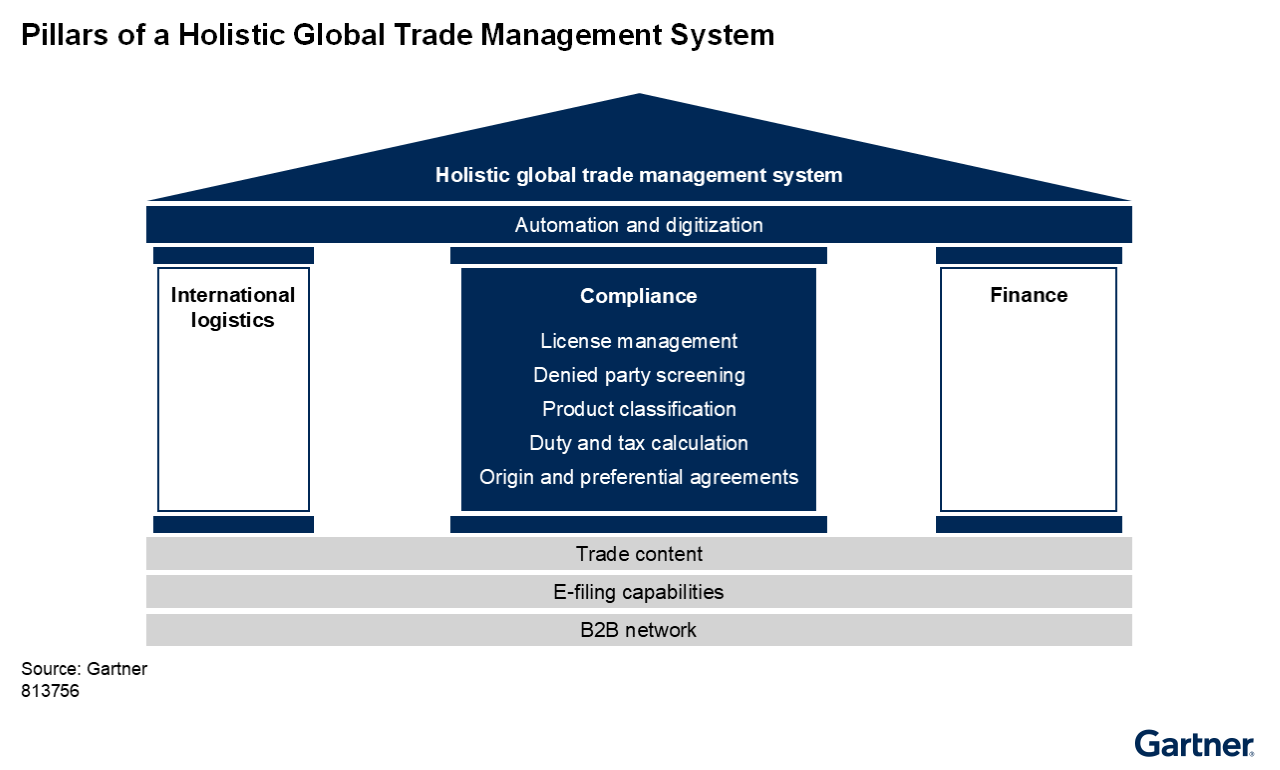
GTM vendors often deliver capabilities in a modular fashion — through different products, or partnership with a third party underpinned by a holistic platform, and in some cases, included in a broader supply chain suite offering.
While GTM applications are typically offered and used independently to support siloed processes in a tactical manner, this is starting to change. Integration of GTM solutions with core systems — such as ERP systems, CRM systems and even multienterprise collaboration networks (MCNs) — has become a must. Additionally, GTM solutions are offering more connectivity to external providers that can augment solution capabilities by leveraging specific sets of data for reporting and analysis, or by outsourcing certain capabilities to a third-party solution.
GTM solutions, first and foremost, are selected based on their trade compliance technical capabilities, as there are other competing technologies for logistics execution and financing, such as transportation management system (TMS) applications. Without those capabilities, organizations cannot comply with important aspects of global trade, like customs regulations or the avoidance of business with sanctioned parties.
Market Direction
Current global events have made GTM solutions more important than ever before, emphasizing the need for a very robust set of compliance capabilities above all else in this type of software solution. The extreme volatility in trade tariffs and changes to regulations have generated new, favorable scenarios for GTM vendors.
Organizations that never had to worry about tariffs, due to static values or exemptions, must now understand the real-time impact of these tariff changes to their bottom line and how to comply with new regulatory changes. Others need to reevaluate their global trade strategies, reassessing their trade flows, partner networks, and the way they leverage (or don’t leverage) special customs procedures and trade agreements.
According to the 2025 Gartner Business Buyer Survey, 23% of buyers of software applications from the supply chain function consider GTM as the most significant product investment anticipated for 2025.1 Of these results, 74% of buyers indicated that they will invest in a GTM solution either as a net new (40%) or as a replacement (34%) software (see Figure 2).
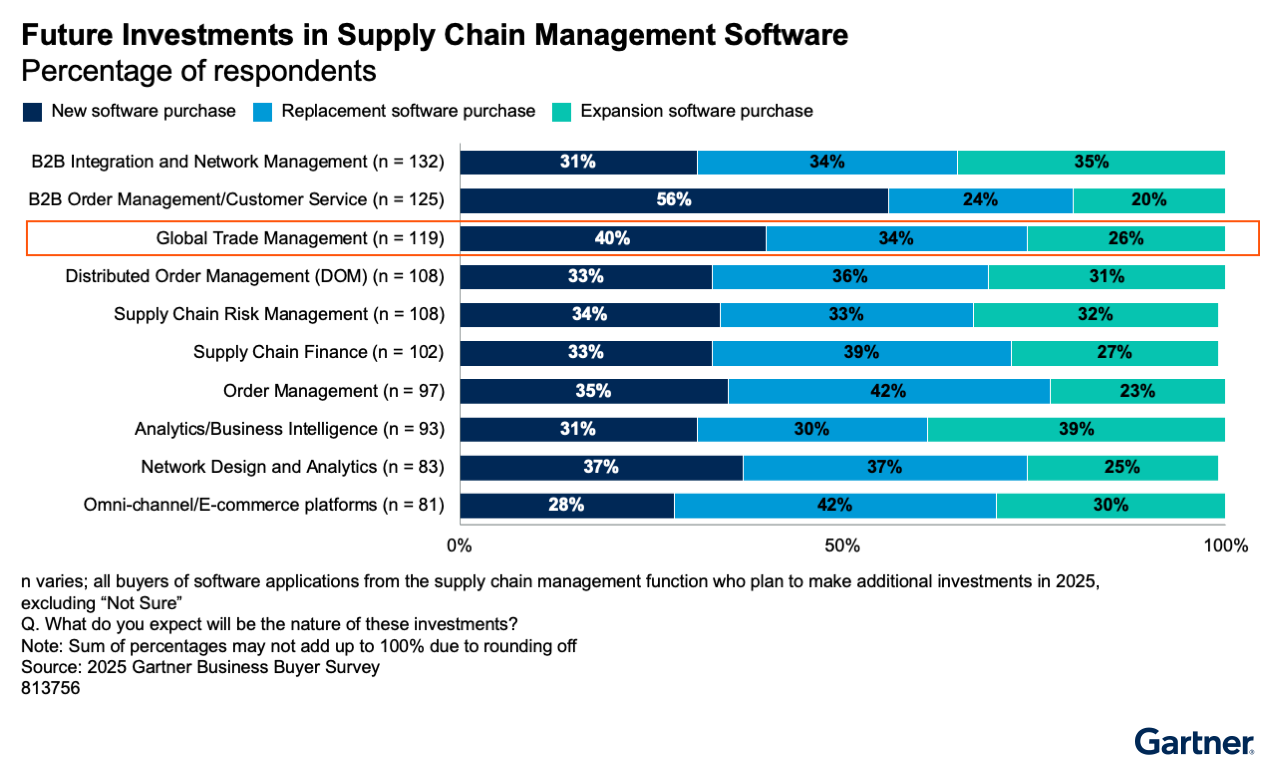
Keeping track of ongoing changes in regulations is one of the hardest challenges faced by organizations. It requires them to use GTM technology to automate tasks and improve visibility in areas such as tariff changes, product composition, forced labor and raw material supply. GTM vendors continue to expand their product capabilities to support organizations to reduce costs and facilitate the use of special customs procedures or trade agreements to tap in unexploited cost-saving opportunities.
Further innovations in technologies such as AI and optical character recognition (OCR) are bringing new levels of automation to GTM applications. Some GTM vendors have blended these technologies to facilitate the extraction of unstructured data from different documents, technical product drawings and images to automate and simplify lengthy manual extraction processes.
Most GTM vendors have already incorporated GenAI into their products, mostly used in areas such as product classification, analytics and chatbots, equipping their solutions with capabilities that engage end users and increase productivity and efficiency. GTM vendor roadmaps and pilots also show an increase in plans to incorporate AI agents in tasks related to global trade compliance applications, aiming to enhance cross-functional collaboration, data sharing and decision making.
Market Analysis
Global Trade Compliance Earns a Seat at the Table
The resilience of global supply chains is, once again, put to the test. New conflicts arising in the Middle East and the multiple changes in tariffs established by the U.S. administration during the beginning of 2025 have exacerbated the almost-perennial VUCA environment in which global trade functions operate.
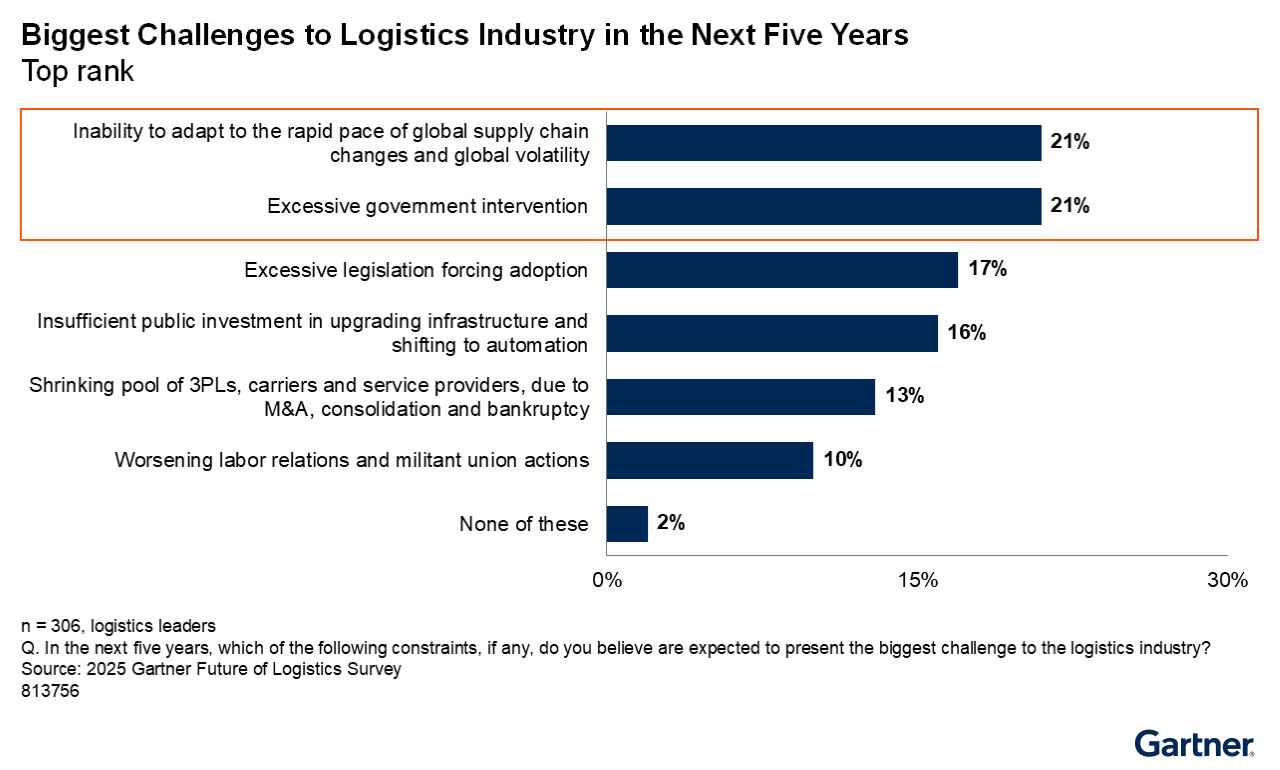
Prior to tariff changes, logistics leaders in the 2025 Gartner Future of Logistics Survey ranked inability to adapt to the rapid pace of changes and excessive government interventions as the biggest challenges to the logistics industry in the next five years2 (see Figure 3).
Additionally, logistics leaders expect to gain responsibility for global trade management the most in the next five years. Among respondents who do not currently manage global trade, 13% ranked it as their top choice for future responsibility, and 27% included it among their top three choices.2
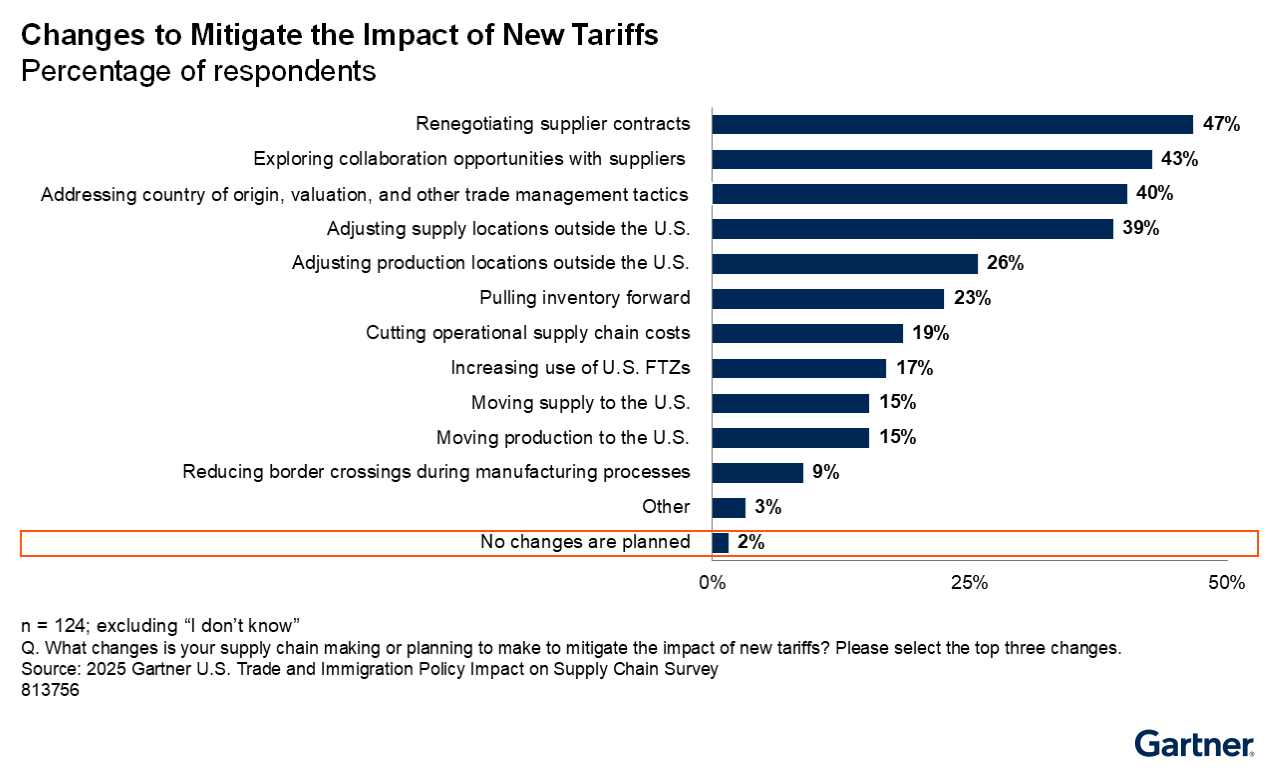
However, the new geopolitical scenario has caused 98% of supply chain leaders to make or plan to make changes to their supply chain strategy as a result of new U.S. tariffs, according to the 2025 Gartner U.S. Trade and Immigration Policy Impact on Supply Chain Survey3 (see Figure 4).
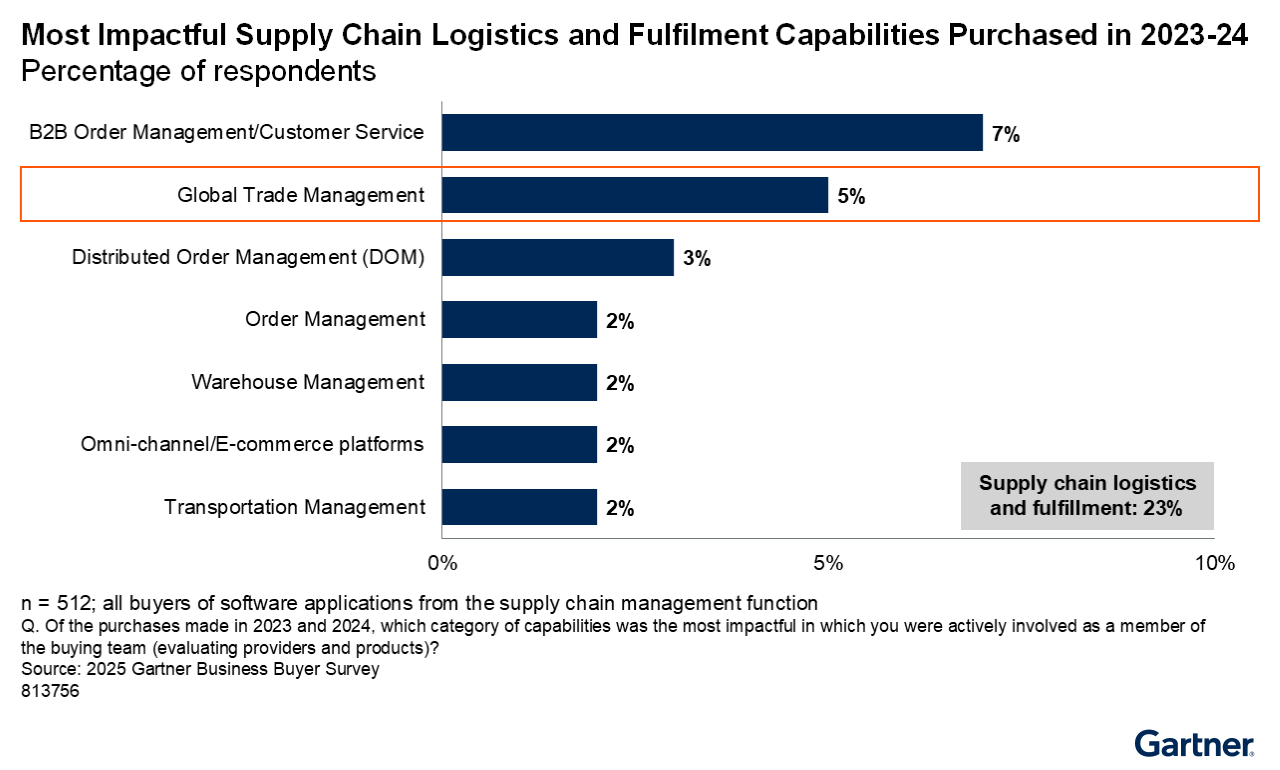
With regard to technology, the 2025 Gartner Business Buyer Survey shows that within the supply chain logistics and fulfillment category, global trade capabilities were considered the second most impactful capabilities purchased by respondents, after B2B order management/customer service capabilities1 (see Figure 5).
With tightening regulations and increasing penalties for noncompliance, maintaining adherence to complex international trade laws has become a key business priority, and noncompliance can significantly hurt brand reputation and revenue. These events are elevating the role of global trade compliance, from being a “necessary evil” to becoming a strategic business function within supply chains.
GTM Market Size and Drivers for GTM Adoption
Gartner estimates the forecast annual spend on GTM software to grow at a compound annual growth rate (CAGR) of 16.7% from 2024 through 2029. The GTM market continues to grow, with the North American region representing the largest share, followed by Europe and Asia/Pacific.
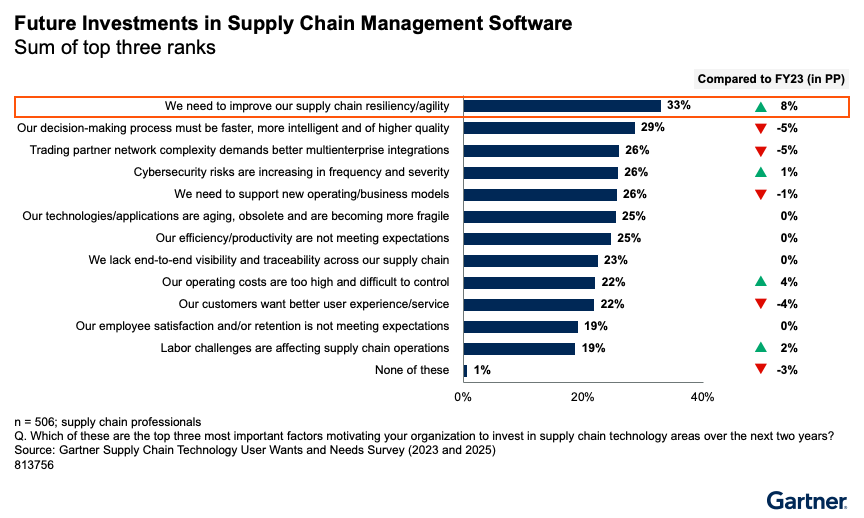
Resilience, or becoming more resilient, has become one of the key drivers for adopting supply chain technology in general, and GTM solutions in particular. The 2025 Gartner Supply Chain Technology User Wants and Needs Survey shows that organizations now place 8% more importance on becoming more resilient/agile, compared to the 2023 survey, making resiliency/agility the top factor motivating organizations to invest in supply chain technology4 (see Figure 6).
However, becoming more resilient is not the only driver contributing to the increased interest in GTM applications. Other key drivers contributing to the adoption of GTM technology can be segregated into three categories — strategic technology drivers, market dynamics and investment timing considerations.
Strategic Technology Drivers
- Increased use of AI in global trade: The incorporation of AI, and variants such as GenAI and AI agents, in global trade use cases is a significant development. These technologies automate complex activities, increase accuracy, deliver real-time information and enhance predictive analysis, driving significant productivity gains for global trade organizations.
GenAI capabilities, in particular, help end users with system interactions as well as in the summarization and the consumption of essential data elements from various document sources, enabling faster decision making, which is a key priority for supply chain professionals toward technology investments.
Additionally, while most vendors initially implemented AI capabilities for product classification, they are now applying AI in a growing number of use cases. Pilots and live AI applications now include capturing and processing of unstructured data, SKU traceability compliance, multicountry HS code mapping, free trade agreement (FTA) qualifications or even answering questions to predict outcomes pertaining to future regulatory changes.
- GTM technology modernization: Cloud-based solutions are now the market standard, with some vendors discontinuing their on-premises offerings. GTM vendors are also betting heavily on a platformlike approach with modular design, allowing end users to select different modules depending on their needs. The integration between those modules is key to offering a seamless experience to end users and consolidating data within the one solution. Microservices connected through APIs are becoming today’s standard, while vendors continue to make strides toward a composable solution architecture.
- Modernization of customs systems: Customs authorities around the world continue with the replacement of their legacy solutions to digitize and further automate their customs processes. Many countries, such as those in the EU, Australia, the U.K. and Canada, are changing their systems responsible for customs declarations, duties, and tax assessment and collection.5 These changes impact how information is shared between the software solutions used by shipping organizations and customs authorities. Organizations using legacy solutions risk not being able to cope with the new requirements.
Market Dynamics Drivers
- Increased regulation complexity: New multitier regulatory requirements such as the EU Deforestation Regulation (EUDR), derivative tariffs and forced labor regulations are increasing the complexity in global trade, and hence, remaining in compliance is becoming more and more difficult. There is an increased demand for comprehensive compliance tools within TMS to help businesses navigate ever-changing international trade regulations and avoid penalties. Predictive analysis, scenario modeling and restricted party screening have become essential features.
- Onshoring and nearshoring acceleration: These options are becoming more prevalent as organizations seek to increase the resilience of their supply chains. Increasing reliance on cross-border efficiency and transactions is vital to avoiding the impact of disruptive events, and so is GTM technology.
- Sustainability initiatives: Sustainability initiatives remain a trend in global trade and continue to impact the global trade software market at different levels. Organizations are pressured not only by regulatory requirements but also by customers to ensure the use of more ethical sources and reduce carbon footprint.
Investment Timing Considerations
- Tariff simulation: Rapid changes in tariffs have caused serious problems for organizations, making it difficult to track the tariff changes affecting their products and assess the financial impacts. While GTM solutions offer landed cost calculation capabilities, many vendors have launched some lite solutions with tariff scenario modeling. Some of these solutions include duty optimization strategies, exploring cost-saving opportunities through the potential use of FTAs and duty deferral programs.
- Network design: The frequency at which organizations review their supply chain network design has increased due to the constant shifts in markets and consumer behavior and the increasing number of disruptions. As organizations plan and assess new sourcing options and negotiate potential with new suppliers, minimizing compliance risks and understanding the potential implications in trade-related costs and opportunities are crucial for estimating the potential success of the network.
AI-Assisted Vendors Emerging in a More Consolidated GTM Market
The GTM market is still relatively fragmented, with a few large global vendors and many small to midsize vendors that are either regional or industry-focused. Vendors differ based on geographic presence, industry coverage or functionality offering, with functionality being the main driver for certain notable acquisitions.
Over the past few years, the market has become more consolidated, with many vendors in the global trade software market acquiring other direct and indirect competitors to expand their capabilities and geographical footprints. While confirmed (and ongoing) acquisitions are few, they are significant:
- Livingston International: The vendor was acquired by Purolator in February 2025, expanding their capabilities in global trade and customs brokerage expertise.6
- Thomson Reuters: In February 2024, Thomson Reuters acquired Pagero — a provider of e-invoicing and indirect tax solutions with a vast business network — for $800 million.7
- WiseTech Global: In August 2025, WiseTech Global confirmed its acquisition of e2open for $2.1 billion, expanding WiseTech’s total addressable market (TAM), increasing customer base and enhancing its product offerings in global trade and logistics.8
While market consolidation continues, regional players still serve the market due to the complex financial, operational and regulatory regimes in local markets, such as Brazil, Russia and China. Complex financial and customs regulations often require organizations to rely on local solutions that were either built at the same time as the regulations or certified by the government to support their processes.
Despite current consolidation trends, AI technology is becoming a new foundation on which some startups are starting to build their applications. “AI-assisted” or “AI-powered” solutions are starting to emerge in the GTM market, providing a new set of automation capabilities. Both point solutions focusing on specific use cases such as product classification, and broader solutions with a stronger focus on the optimization and automation of tasks, are bringing a new flavor and more fragmentation to an already mature market.
GTM Vendor Segmentation by Solution, Functionality and Services
Vendors in the GTM software space provide several major categories of functionality and services (see more in Selection Guidance for Global Trade Management Applications). Many vendors started in just one category, but have branched out through either acquisition or internal development to cover more areas of GTM.
Functional domains include:
- International logistics: Refers to the sourcing, booking, auditing, execution, carrier management and visibility of the international movement of goods. Some vendors specialize by mode of transportation (for example, ocean, air and land).
- Trade compliance: Refers to the functionality supporting the import/export of goods, including product classification, duties and taxes, import/export document creation, license requirement tracking, Customs Trade Partnership Against Terrorism (CTPAT) certification, and support for FTAs and regional trade agreements.
- Finance: Refers to the functionality that supports the financial aspect of the international movement of goods, including creation and management of letters of credit, open accounts, trade financing, insurance, and settlement and reconciliation. It does not refer to the auditing and payment of freight contracts, which is covered by the logistics functionality.
Enabling technology and services include:
- Trade content: Refers to the collection, maintenance and dissemination of the rules created and governed by different legislative authorities. Some GTM software vendors have content professionals on staff to collect this information and provide it to customers through a content subscription service. Other vendors consume the content from a third party or specialized content providers. Content includes product classification codes, restricted party lists, global regulations, regional trade agreements and more.
- Direct filing: Refers to the ability to interface directly with customs through certified electronic connections for filing import or export documentation.
- Cloud-based B2B network: A cloud-based network of previously onboarded suppliers, 3PL providers and logistics partners all connected to the cloud platform to share supply chain data in a multitenant architecture.
- Other supply chain management solutions: Although these are technically not part of GTM, we’re finding increasing convergence with other areas of supply chain management. GTM software vendors have been acquiring or developing in-house applications in complementary areas, including warehouse management, transportation management, supplier collaboration, purchase order management and product life cycle management.
Representative Vendors
The vendors listed in this Market Guide do not imply an exhaustive list. This section is intended to provide more understanding of the market and its offerings.
Vendor Selection
This research provides information on the GTM vendors surveyed that are relevant in the market, based on revenue, number of clients, and end-user interest and feedback (see Table 1). The selected vendors’ solutions provide functionality for global trade operations, emphasizing capabilities on global trade compliance. These vendors provided detailed information to Gartner via vendor surveys and vendor briefings, which are the basis for the companion research to this Market Guide — Tool: Vendor Identification for Global Trade Management Solutions. Some vendors who were deemed relevant, and were therefore invited to participate in this research, declined to participate or failed to provide fact-based information.
Representative Vendors in Global Trade Management
Vendor | Headquarters |
AEB | Stuttgart, Germany |
CrimsonLogic | Singapore |
Descartes | Waterloo, Ontario, Canada |
e2open | Addison, Texas, U.S. |
KYG Trade | Newport Beach, California, U.S. |
Livingston International | Chicago, Illinois, U.S. |
MIC | Linz, Austria |
MyTower | Paris, France |
Oracle | Austin, Texas, U.S. |
QAD | Santa Barbara, California, U.S. |
SAP | Walldorf, Germany |
Thomson Reuters | Toronto, Ontario, Canada |
Tradelink | Hong Kong, China |
Source: Gartner (August 2025)
Vendor Profiles
AEB
AEB, established in 1979 and headquartered in Stuttgart, Germany, is a leading provider of global trade management (GTM) software and services. With over 45 years of experience, AEB’s core solutions encompass Customs Management and Trade Compliance Management, supporting export/import filing, customs broker integration, product classification, compliance screening, export controls, license management, and origin and preference management. These solutions include robust prebuilt integrations for SAP and Salesforce, and open APIs for connectivity with any other ERP systems.
AEB’s software is developed entirely in-house, distinguishing it from vendors with portfolios built through acquisitions. Strategic content partnerships with Dow Jones Risk and Compliance, Mendel Verlag, and Reguvis enhance regulatory and compliance capabilities. The customer base primarily includes shippers with revenue between $100 million and $10 billion, as well as parcel delivery and e-commerce providers across sectors such as automotive, high-tech and logistics, with a strong European focus.
Recent advancements include the acquisitions of Asal GmbH (2023) and Portorium (2024), the expansion of AEB’s network of integrated customs brokers, and investment in AI-driven automation and managed services. AEB’s independence and long-term strategic vision are notable differentiators in the GTM landscape.
CrimsonLogic
CrimsonLogic, headquartered in Singapore, is a provider of global trade software solutions and services and part of PSA International (PSA). The vendor offers trade facilitation solutions and global trade management solutions to government authorities and businesses. The CrimsonLogic Trade Facilitation Platform (TFP) focuses on government-to-government digitization and enablement of trade facilitation processes, targeting mostly developing countries. This solution includes core modules such as single window for international trade, customs management systems, free trade zones, permits and licenses, and other add-on modules such as e-maritime single window, risk management, cross-border e-commerce and trade visualization.
CrimsonLogic’s business-to-business solution is called Trade Management Platform (TMP); it aims to simplify trade and customs management processes, and to provide insights into global regulatory changes. The solution offers different capabilities that can be consumed as SaaS, enterprise or managed services. It includes modules such as North America customs filings, TradeWeb (a front-end to submit permit declarations in Singapore), Harmonized System (HS) classification, trade advisory for the U.S. e-commerce import program and others.
The vendor has links to 61 customs nodes worldwide, connecting with the customs authorities in all regions and globally facilitating global trade operations. CrimsonLogic primarily operates in Asia, but also has customers in North America, Europe, South America and other parts of the world.
Descartes
Descartes is a supply chain software vendor founded in 1981 and headquartered in Waterloo, Ontario, Canada. Its solution portfolio includes solutions related to global trade, transportation, customs brokerage, transportation visibility, vehicle routing and scheduling. Descartes’ GTM solutions include capabilities such as export license, document management, denied party screening, FTZ, and workflow and collaboration tools to ensure visibility and traceability into decisions made and actions taken on all trade compliance activities.
Descartes also offers the Descartes Global Trade Intelligence platform, a solution comprising multiple modules that can be deployed as stand-alone solutions or via integration with ERP, CRM, e-commerce and other business systems. Descartes is one of the largest offerings of connected customs authorities for direct filing and is a provider of global trade content for other GTM applications, like SAP Global Trade Services (SAP GTS) or Oracle Fusion Cloud Global Trade Management (Oracle GTM).
Descartes acquired OCR in March 2024, which specializes in solutions and content for export compliance and controlled commodities. OCR provides capabilities to check on country-specific regulations, track and manage transaction-specific export licenses, agreements and status, and other capabilities. This acquisition expanded Descartes’ global trade content library.
Descartes did not respond to requests for supplemental information or to review the draft contents of this document. Gartner’s analysis, therefore, is based on other credible sources.
e2open
e2open, headquartered in Addison, Texas, is a provider of supply chain management software and services. Its GTM application is provided via a native cloud-based suite, available in single-tenant and multitenant SaaS models. The e2open Global Trade suite covers import/export management, duty management, global product master, due diligence screening, bonded warehouse/FTZ and customs filing.
A key differentiator is its proprietary Global Knowledge database, which spans over 230 countries and territories, supports 30+ languages, and is updated daily through an ISO-certified process. e2open provides comprehensive due diligence screening against 900+ restricted party lists, and collaborates with content partners like Kharon, Dun & Bradstreet, Dow Jones and Moody’s (Bureau van Dijk) for regulatory data.
The vendor is investing in AI-powered capabilities, including automated HS classification, unstructured text screening and document processing, with ongoing exploration of multimodal AI. Standard integrations are available for leading ERP systems such as SAP, Oracle and QAD. e2open primarily serves large enterprises and SMBs in automotive, high-tech, consumer goods, retail, apparel and logistics, and is well-positioned in manufacturing and supply chain markets. e2open was recently acquired by WiseTech Global.8
KYG Trade (Know your Goods)
KYG Trade was founded in 2020 and is headquartered in Newport Beach, California. Despite its size and recent incorporation, KYG Trade provides an innovative approach to global trade compliance. Its product, the KYG Trade Attestation Platform and Marketplace, offers an open platform that orchestrates the collection of product data and trade regulations, connecting, leveraging or augmenting the capabilities of other best-of-breed technology solutions providing global trade compliance and risk management capabilities. The solution involves several AI-assisted capabilities to collect and interpret trade, tariffs and ESG data, summarize all related regulations applicable to a specific product, and generate the regulatory requirements reportable to customs authorities. Areas such as product classification, determination of export jurisdiction, FTA and origin qualifications, vendor document solicitation, and trade data processing leverage native AI capabilities.
The vendor’s AI assistant, Kay, is trained on the worldwide global trade compliance tariff schedules, dual use lists, regulations and rulings. While it can generate output, KYG Trade enables a human-in-the-loop workflow, allowing human experts to review and approve critical decisions and actions generated by its AI assistant.
KYG Trade serves SMBs and large shipper enterprises primarily based in North America, across industries such as industrial manufacturing, retail, medical devices and electronics.
Livingston International
Livingston International, based in Toronto, Canada, is a provider of customs brokerage, compliance services and GTM software solutions. Acquired by Purolator in February 2025,6 Livingston’s portfolio includes TradeSphere and SmartBorder, web-based platforms designed for shippers and organizations navigating complex international trade regulations. TradeSphere offers modules supporting export/import management, product classification, denied party screening, license determination and robust audit trails.
Livingston’s solutions are tailored for regulatory programs such as ACE, PGA, USMCA, Annex 24/31 and Canada’s Single Window Initiative, with SaaS deployment and standard integrations for Oracle and SAP ERP. Strategic partnerships with Descartes, Kharon and Dow Jones provide comprehensive trade content and restricted party list screening. Livingston serves shippers, importers and exporters with revenue from $200 million to over $50 billion, primarily in North America, with a growing presence in Asia and Europe.
Recent innovations include AI-enabled OCR, generative AI assistants and advanced analytics, with pilots underway for AI-driven HS classification automation in the U.S. and Canada. An attribute-based AI classification tool is anticipated in 2026.
MIC
MIC, established in 1988 and based in Linz, Austria, is a provider of customs and trade compliance software. Its Global Trade Management (GTM) solution is delivered as a cloud-based SaaS platform, integrating with all major ERP systems via API, and holding official certification for SAP S/4HANA. The platform is built around four main modules: Central Classification System, Customs Filing, Origin Calculation System and Export Control Management, all of which are linked to MIC’s Global Trade Content Service.
MIC’s software offers advanced features for customs management and special customs regimes, supporting duty deferral programs such as inward and outward processing relief, bonded warehouses, customs control, FTZs, duty drawbacks, special economic zones and automotive fiscal deposits. Latest product developments include transition to Microsoft Azure Kubernetes, an AI-based product classifier leveraging natural language processing and computer vision, and AI-assisted trade document scanning leveraging AI and OCR technologies to extract unstructured data.
MIC’s solution connects with customs authorities in over 45 countries across six continents and accommodates various customs filing message formats. MIC serves industries like automotive, high-tech, chemical, textile, retail, e-commerce, consumer goods and industrial machinery. MIC’s customer base is split almost evenly between Europe and other global regions, including North America, Asia and South America.
MyTower
Founded in 2018, MyTower is a software provider of TMS and GTS solutions, headquartered in Paris, France. Its GTM solution is offered as a cloud deployment (multitentant or single instance), with nine modules focused on global trade compliance: Classification, Origin Management, Customs Management, Customs Broker Management, Trade Compliance Portal, Trade Compliance Tracker, Sanctioned Parties Screening, Transaction Screening and License Management.
MyTower GTM offers a modern software architecture, ease of integration and a user-friendly interface. It provides comprehensive support for product classification, manages global trade content, performs compliance screening, handles import/export functionalities and supports customs special procedures. Recent key capabilities include a collaboration feature to interact with suppliers to share trade data and documents without login requirements and integration of EUDR compliance in customs flows. MyTower is actively developing AI use cases for product classification, customs declaration control and regulatory watch, including AI agents.
MyTower targets shippers with complex GTM processes (revenue typically above $500 million) and international manufacturing companies. Major industry verticals served include consumer products and automotive. Geographically, MyTower is primarily focused on European markets, which account for 75% of its customers, with a smaller presence via partners in Asia, North America and South America.
Oracle
Oracle, headquartered in Austin, Texas, delivers enterprise software solutions, including Oracle Fusion Cloud Global Trade Management (GTM), with targets ranging from simpler small to midsize companies to large multinational organizations with complex supply chains and stringent regulatory requirements. Oracle GTM provides comprehensive functionality, including product classification, restricted party screening, trade control determination, license and document management, customs management, trade agreement qualification, supplier solicitation, reporting, analytics, and support for trade incentive programs. Advanced features include inward/outward processing, FTZ management and duty/tax/fee tracking.
Recent updates incorporate machine learning for product classification, enhancing automation and compliance efficiency. Oracle GTM is deployed as a dedicated public cloud (single-instance) environment, offering automated provisioning, regular upgrades and robust security, including encryption. The solution is built using the same platform as Oracle’s TMS (Oracle OTM) and integrates natively with Oracle E-Business Suite, Oracle Cloud ERP and Oracle SCM, and supports open standards-based APIs for broader ERP integration.
Partnerships with Descartes, Dow Jones and Thomson Reuters provide regulatory content and restricted party screening, while Pincvision supports Intrastat filing. Oracle’s customer base spans high-tech, industrial manufacturing, life sciences, consumer goods and more, with its largest market in North America, followed by EMEA, LATAM and APAC.
QAD
QAD, headquartered in Santa Barbara, California, specializes in enterprise software for global trade management, serving complex organizations worldwide. Its flagship solution, Global Trade and Transportation Execution (GTTE), delivers comprehensive compliance capabilities, including import/export management, product classification, FTA qualification, FTZ establishment and management, restricted party screening, duty and tax modeling, automated regulatory checks, document generation, and licensing management.
GTTE features Champion, an AI-driven tool to improve product classification accuracy and efficiency. Managed services are available for FTZ customers, supporting tariff reduction and compliance screening. GTTE is primarily offered as a cloud/SaaS solution built on a Spring Cloud microservices architecture on Amazon Web Services (AWS), with on-premises deployment options.
The platform integrates with major ERPs such as Oracle, SAP and QAD’s own Adaptive ERP, and leverages global trade content from partners like Dow Jones and Loqate. QAD’s dedicated content team ensures regulatory coverage across 177 countries. Recent developments include integrating AI expertise and ongoing machine learning enhancements to further advance trade management capabilities.
SAP
SAP is a global application provider headquartered in Walldorf, Germany. It offers a portfolio of global trade compliance capabilities. Some are lightweight, like the ones embedded in its ERP applications — Foreign Trade in SAP ERP Central Component (SAP ECC) and International Trade in SAP S/4HANA — and its SaaS screening solution SAP Watch List Screening.
More comprehensive capabilities are delivered by its stand-alone flagship solution for global trade, SAP Global Trade Services (SAP GTS). SAP GTS operates leveraging the SAP HANA database and SAP Fiori UI. Key features include product classification, compliance management (such as denied party screening), customs management (including import/export declarations), risk management and preference management. It also supports customs special procedures like duty drawback, bonded warehouses and Intrastat filing.
Recent updates to SAP GTS include improved management of preference data for product identifiers, improved analytics and enhanced management of blocked documents and partners. SAP product roadmap includes different AI use cases for GTM, such as an AI assistant for product classification as well as the integration to Joule to enable a better end-user experience, with agentic AI identified as a future focus. SAP GTS is targeted at medium to large enterprise shippers with multicountry operations, especially those with annual revenue above $500 million. Key industries served include aerospace, automotive, high-tech, pharmaceuticals, oil and gas, and retail, with strong adoption in Europe and North America.
Thomson Reuters
Thomson Reuters is a service and software provider headquartered in Toronto, Ontario, Canada. The vendor offers specialized solutions and tools in the areas of global trade, legal, tax, accounting, compliance, risk and global news services. Its GTM solution, ONESOURCE Global Trade, is a single-instance cloud solution that includes a comprehensive portfolio of 25 products covering global trade management, including import/export management, product classification, denied party screening, FTAs, FTZs and customs special procedures. It provides deep and broad global trade content for more than 220 territories.
ONESOURCE Global Trade’s latest developments include significant investments in AI, such as a GenAI assistant being piloted to aid legal, tax and trade professionals with product classification and serve as an intelligent assistant. There are also plans to extend its capabilities in areas such as trade research. There is also a focus on platform and user experience modernization, and partner enablement capabilities targeted to service providers and system integrators.
Thomson Reuters targets medium to large enterprises with complex global trade operations. Key industry verticals include high-tech, consumer electronics, retail, automotive and life sciences. Thomson Reuters has a strong presence in North and South America, but also has customers in Europe and Asia.
Tradelink
Tradelink has provided Government Electronic Trading Services (GETS) for processing official trade-related documents in Hong Kong since 1997. Tradelink’s Trade Compliance Services include nine different modules providing capabilities for import and export trade declarations, certificates of origin, creation of electronic cargo manifests and other international shipping documents. The solution provides direct filing and connection to customs authorities in Hong Kong, China, Japan (Advance Filing Rules) and the U.S. (Automated Manifest System and Importer Security Filing).
Additionally, Tradelink’s Trade Compliance Services offer other value-added services, including capabilities for freight forwarders that can be customized to suit customers’ trade compliance requirements, as well as digitization of paper documents into electronic formats for government submission. The vendor also offers other logistics solutions, such as Warehouse Management System (WMS) and Transportation Management System (TMS), that integrate with its GTM solution.
Tradelink remains focused on its local market in Hong Kong and China. Its customers include logistics service providers and those in the industrial and construction machinery, mill products, and food services industries. In 2022, Tradelink joined Hong Kong’s Monetary Authority’s Commercial Data Interchange (CDI) initiative as a data provider, facilitating trade financing for banks in Hong Kong.
Tradelink did not respond to requests for supplemental information or to review the draft contents of this document. Gartner’s analysis, therefore, is based on other credible sources.
Market Recommendations
When evaluating GTM vendors, consider the following — in addition to basic IT procurement best practices — to increase the chances of a good fit:
- Define your business strategy, plan and timeline to ensure vendors can grow with your changing business needs, including those related to functional and geographic coverage.
- Define the functional areas to be included (for example, logistics, compliance and finance), and whether additional execution capabilities or complementary technology areas are required, including:
- Compliance capabilities
- Direct-filing capabilities
- Specialized services for specific customs regimes (FTZs, bonded warehouse, duty drawback, etc.)
- Global trade content
- Purchase order management
- Transportation management
- Warehouse management
- Start with vendors that address your industry and geography. This will increase the possibility of finding a good functional match, meeting local requirements, and connecting with suppliers and logistics providers that are in your supply chain network.
- Determine your company’s preference for SaaS and cloud, versus an on-premises solution, because many vendors have only one or the other. Make sure to involve IT in these discussions throughout the vendor selection process.
- Evaluate the vendor’s ability to provide integration to other applications, such as ERP solutions, as well as their future roadmap capabilities and investment commitments.
- Assess the capacity of the vendor to offer consulting and implementation services that go beyond the software capabilities of the product.
- Explore the potential benefits AI can bring to your global trade organization, taking into account your risk tolerance, the cost-benefit balance, and the potential consequences of automating tasks and deskilling staff.
Acronym Key and Glossary Terms
| FTA | free trade agreement |
| FTZ | foreign trade zone |
1 2025 Gartner Business Buyer Survey. This survey sought to understand how functional business units (customer service, finance, human resources, marketing, sales and supply chain management) within organizations approach large-scale software purchases to support their business function. The survey was conducted online from October through December 2024 among 3,068 respondents from organizations with annual revenue of at least $50 million or equivalent from North America (36%), Western Europe (32%), Asia/Pacific (19%) and Southern Europe (13%). Industries surveyed include education providers, energy, financial services, government, healthcare, health payer, technology, telecom, insurance, manufacturing, natural resources, retail, transportation and utilities. Qualified respondents were at manager level or higher, and had been actively involved in the purchasing process for the most impactful software capabilities for their respective functional business units during 2023 or 2024. Software purchases were either new, replacement or expansion purchases. Disclaimer: The results of this survey do not represent global findings or the market as a whole, but reflect the sentiments of the respondents and companies surveyed.
2 2025 Gartner Future of Logistics Survey. This survey aimed to understand the current state and readiness of the future of the logistics function and to understand how this function influences business strategy. It was conducted online from early November through mid-December 2024. In total, 307 respondents were surveyed across North America (n = 102), Europe (n = 101), Asia/Pacific (n = 85) and Latin America (n = 19). Qualifying organizations reported enterprisewide annual revenue of at least $250 million for fiscal 2024, with 78% of the respondents coming from organizations with $1 billion or more in annual revenue. The respondents came from a variety of industries: manufacturing (n = 191), retail (n = 46), healthcare providers (n = 42) and wholesale trade (n = 28). All the respondents were required to be senior decision makers in their organization’s strategy for logistics, with 65% of them holding sole responsibility for the same in their organization. Disclaimer: The results of this survey do not represent global findings or the market as a whole, but reflect the sentiments of the respondents and companies surveyed.
3 2025 Gartner U.S. Trade and Immigration Policy Impact on Supply Chain Survey. This survey aimed to understand the potential impacts of the U.S. trade policies and the actions being planned to mitigate the impact of the policies. It was conducted online from 17 March through 7 April 2025. In total, 126 respondents were surveyed across North America (n = 95); Europe, the Middle East and Africa (n = 29); and Asia/Pacific (n = 2). Qualifying organizations reported enterprisewide annual revenue of at least $50 million for fiscal year 2024, with 83% of the respondents coming from organizations with $1 billion or more in annual revenue. The respondents came from a variety of industries, including manufacturing (n = 73), healthcare and life sciences (n = 29), technology and telecom products (n = 14), retail (n = 6), energy and utilities (n = 3), and transportation and logistics (n = 1). The average percentage of revenue from U.S.-based demand was 54%, and 94% (n = 119) indicated that their company had a U.S.-based workforce. Disclaimer: The results of this survey do not represent global findings or the market as a whole, but reflect the sentiments of the respondents and companies surveyed.
4 2025 Gartner Supply Chain Technology User Wants and Needs Survey. This survey aimed to investigate the roles of digital and technology in supply chains. It also aimed to assist supply chain technology leaders in their efforts to modernize legacy application landscapes and create credible business cases for their digital transformations. Additionally, it examined how supply chain organizations are structuring themselves to support digital initiatives and their evolving perspectives on effectively leveraging emerging technologies within their supply chain organizations. The survey was conducted online from 16 October through 6 December 2024 among 506 respondents from North America (n = 153), Western Europe (n = 162), Asia/Pacific (n = 111) and Latin America (n = 80). Respondents were from organizations with $250 million or more in 2023 enterprisewide annual revenue. Industries surveyed included manufacturing (consumer products, industrial, high-tech, life sciences and healthcare), retail, transportation and logistics, and wholesale trade. Qualifying respondents had job roles tied to supply chain function and were involved in decision making regarding supply chain management processes or operations.
Disclaimer: The results of this survey do not represent global findings or the market as a whole, but reflect the sentiments of the respondents and companies surveyed.
5 Import Control System 2 (ICS2), European Commission.
6 Purolator Acquires Livingston International, Purolator.
7 Thomson Reuters Successful Acquisition of Pagero Paves the Way for Significant Growth Opportunities, Thomson Reuters.
8 WiseTech Global Completes Strategic Acquisition of e2open, WiseTech Global.