Implement Microsegmentation to Mitigate Advanced Threats
26 June 2026 - ID G00858128 - 9 min read
By Rajpreet Kaur, Charanpal Bhogal
Cybersecurity leaders must adopt microsegmentation to reduce exposure caused by open lateral network access and advanced threats. Successful implementations follow a six-step framework: plan, discover, automate, document, simulate and enforce.
Insights at a Glance
Cybersecurity leaders must adopt microsegmentation to reduce exposure caused by open lateral network access and advanced threats.
When strategically planned and executed, microsegmentation delivers immediate and measurable risk reduction by:
- Containing lateral movement
- Enabling ransomware containment
- Improving east‑west traffic visibility
- Enforcing zero-trust and application ring fencing
- Extending protection to operational technology (OT), Internet of Things (IoT), and legacy systems
To successfully adopt microsegmentation, cybersecurity leaders must follow six steps:
- Plan: Define a clear use case, ownership, scope, and cross‑functional alignment across the enterprise.
- Discover: Build a complete and accurate view of assets, workloads, and communication patterns.
- Automate: Leverage AI‑driven tools to continuously map, label, and monitor dynamic traffic and workload interactions in real time.
- Document: Translate discovery insights into structured labels, validated policies, and governance frameworks.
- Simulate: Test and validate policies in a nonenforcement mode to ensure business continuity and operational readiness before rollout.
- Enforce: Gradually activate policies in production with continuous monitoring and rapid response to sustain secure, stable operations.
Impact
When executed strategically, microsegmentation shifts from being perceived as a complex, high‑risk initiative to a high‑impact security capability that delivers both immediate and sustained value. While historically deprioritized due to cost and implementation concerns, the accelerating threat landscape and growth in east‑west traffic have made microsegmentation a critical control for modern enterprises.
A successful implementation delivers measurable risk reduction in the near term by addressing multiple security use cases through a unified, policy‑driven approach. By enforcing least‑privilege communication, it effectively limits lateral movement, containing potential breaches to a single workload or a minimal blast radius rather than allowing widespread propagation.
Beyond traditional IT environments, microsegmentation extends protection to OT, IoT, and legacy systems that are difficult to modernize, enabling organizations to reduce risk without disrupting critical operations. This broad applicability enhances overall resilience while preserving business continuity.
Actions
Cybersecurity leaders must follow six steps for a successful microsegmentation implementation:
- Plan: Identify use cases, project ownership and cross-functional team members who will support both technical and nontechnical aspects.
- Discover: Establish a comprehensive understanding of assets, applications, and traffic flows. Gain deep visibility to design accurate labeling schemas and segmentation frameworks without disrupting services.
- Automate: Leverage AI-driven capabilities to continuously map connections, auto-label assets, and analyze communication patterns. Integrate with tools like configuration management database (CMDB), network detection and response (NDR), endpoint detection and response (EDR), and vulnerability scanners to enhance contextual visibility and risk-based mapping.
- Document: Use discovery insights to assign consistent labels and define segmentation policies based on validated traffic patterns. Maintain detailed documentation for traceability, auditability, and safe progression to enforcement.
- Simulate: Test policies in simulation or observe-only mode with application owners. Validate business traffic, resolve risks, ensure operational readiness, and train teams. AI-based simulation helps reduce risk and accelerate iteration.
- Enforce: Transition to active enforcement once validated. Ensure clear communication, defined escalation paths, and readiness to respond to issues. Continuously monitor, adapt policies, and collaborate with DevOps to sustain long-term operations.
How to Execute
A phased, step-by-step approach to microsegmentation helps organizations understand dependencies, refine policies, reduce risk, and maintain continuity. Cybersecurity leaders should follow six key steps for effective deployment (see Figure 1):
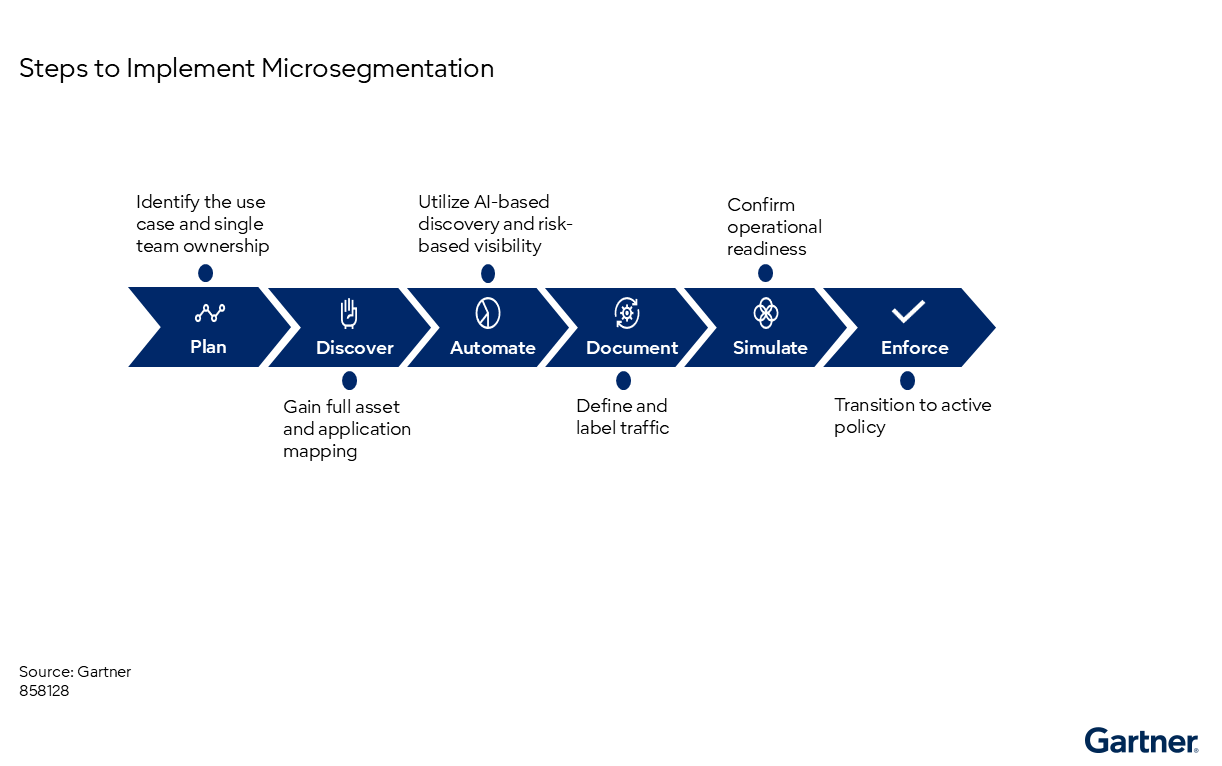
Plan
This is the most critical step as it lays the foundation for the rest of the microsegmentation initiative. Identify the use case, ownership and the appropriate cross-functional team members.
Identify the use case: Unclear purpose hampers microsegmentation, as it impacts both the selection and evaluation criteria, as well as the entire strategy. The following use cases are strong selections for microsegmentation:
- Lateral movement containment/threat containment
- Privacy/compliance
- East-west visibility
- OT/IoT/legacy applications segmentation
- Application ring fencing
- Zero-trust
Designate project ownership and cross-functional team: Define clear ownership early to ensure accountability and avoid fragmented or duplicative efforts. Adopt a single‑team ownership model based on the primary use case:
- For threat reduction, risk management, and zero-trust initiatives, ownership resides with cybersecurity, given its enterprisewide mandate and governance responsibilities.
- For application ring fencing or workload‑specific isolation, ownership resides with the relevant application or platform teams, who best understand application behavior and dependencies.
Beyond ownership, success in microsegmentation depends on recognizing its enterprise impact. A common gap is underestimating the breadth of stakeholders required to design, validate, and operationalize segmentation without disrupting the business. All impacted teams must be identified, engaged, and aligned from the outset.
Establish a cross-functional team: Identify individuals who bring together technical expertise, operational insight, and business context. While composition varies by organization, core participants typically include:
- Network/infrastructure — Ensures alignment with underlying connectivity, routing, and architecture
- Cybersecurity — Drives policy intent, risk prioritization, and governance
- Application development — Provides deep knowledge of application flows, dependencies, and change cycles
- Server/compute teams — Manage host-level configurations and workload life cycle
- Platform/cloud teams — Oversee orchestration environments and cloud-native architectures
- Operational technology — Participates where industrial or specialized systems are in scope
Determine the scope: Determine the scope of the microsegmentation initiative by identifying where enforcement controls will be required, based on the organization’s technology landscape and target use cases. This step establishes both the coverage and the appropriate enforcement mechanisms needed to implement segmentation effectively across diverse environments.
Microsegmentation scope typically spans the following domains:
- Servers (physical and virtual): Traditional data center workloads
- Multi‑cloud environments: Workloads distributed across multiple cloud providers
- Hybrid architectures (on-premises + cloud): Integrated environments requiring consistent policy enforcement
- Containers and Kubernetes workloads: Highly dynamic, orchestrated platforms
- Cyber‑physical systems (CPS): Environments with strict operational and availability constraints
- Legacy applications: Systems requiring careful handling due to limited flexibility and visibility
The defined scope directly influences the type of enforcement model required. There is no “one‑size‑fits‑all” approach — organizations adopt a combination of enforcement methods to address different environments and constraints. Common enforcement models include:
- Agent‑based\host‑based\EDR integrated enforcement: Fine‑grained control at the workload level
- API‑based or container network interface (CNI) enforcement: Native integration with cloud and container platforms
- Network overlay‑based enforcement: Segmentation through abstracted network layers
- Hypervisor‑based enforcement: Controls enforced at the virtualization layer
A well‑defined scope ensures that enforcement mechanisms are aligned to the underlying infrastructure, enabling scalable and consistent policy application across heterogeneous environments.
Discover
The objective of this step is to establish a complete, accurate understanding of assets, applications, and communication patterns across the environment. Gain insights into real application dependencies and east‑west traffic with business context so teams can design a labeling schema and move to enforcement without disrupting critical services.
Take time during this step to gain full clarity of the environment before moving to the next step. Discovery and visibility represent the foundational capability of a microsegmentation program, providing the intelligence needed to design effective and sustainable segmentation strategies. Key visibility dimensions include:
- Asset and workload visibility
- Traffic flow and dependency visibility
- Contextual and metadata‑driven visibility
- Process, port, and protocol‑level visibility
- Contextual and configuration visibility
Automate
Utilize AI-based context-rich visibility offered by microsegmentation vendors. AI automates real‑time mapping of connections, auto tagging/labeling and communication patterns between workloads, containers, devices, and applications, giving continuous visibility into east‑west traffic as environments change. Cybersecurity leaders must leverage AI-based contextual visibility and risk-based mapping by integrating risk and detection-based technologies in the ecosystem, such as CMDB, NDR, EDR and vulnerability scanners.
Document
Integrate insights from discovery and automated visibility utilizing traffic analytics, orchestration tools, configuration inventories, and system logs to provide a comprehensive and traceable record. This ensures auditability, supports governance requirements, and enables a controlled, evidence‑based transition from visibility to full enforcement.
Establish a strategic labeling framework that assigns consistent, reusable metadata tags to every application and its associated physical servers and virtual workloads. These labels should reflect business context (e.g., application tier, environment, criticality, data sensitivity) and serve as the foundation for scalable, policy‑driven segmentation.
Leverage this labeling model to design segmentation policies that are abstracted from infrastructure specifics and instead aligned to application intent. Begin by defining application‑level policies grounded in validated traffic flows, ensuring they accurately reflect legitimate communication patterns and dependencies. Adopt a risk‑based refinement approach by progressively introducing more granular controls for high‑value or critical systems. This allows the organization to prioritize protection where it matters most while maintaining operational stability.
Simulate
Cybersecurity teams must work with application and asset owners by simulating modeled policies under real application conditions in test, simulation, or observe‑only mode. The teams must validate that all required business traffic is correctly allowed and that any denied or at‑risk flows are understood and addressed before moving forward. Confirm operational readiness by ensuring security and operations teams receive the necessary dashboards, reports, and alerts to monitor policy behavior effectively. This step includes targeted operational training for help desk and response teams so issues are quickly identified, escalated, and resolved once enforcement begins.
A new vendor feature is AI-based simulation that allows enterprises to model and test the impact of policies before enforcement, reducing operational risk while enabling faster iteration. When evaluating vendors, consider AI-based simulation a key criteria feature.
Enforce
The final step enforces controlled transition from simulation to active policy enforcement, following successful validation and operational readiness. This step requires clear communication of enforcement timing, well‑defined escalation paths, and readiness to quickly remediate or pause enforcement if issues arise.
Once enforced, teams must continuously review application communication patterns, engage with DevOps as new applications are introduced, and maintain a rapid‑response capability to address communication issues for sustained safe, long‑term microsegmentation operations.
Success Measures
Define microsegmentation in the context of the enterprise’s own business objectives and risk priorities. Success must be measured at each stage of the journey, ensuring progress is both tangible and aligned to outcomes. The program should be executed as an iterative, phased initiative, delivering value through smaller, controlled deployments rather than a single large transformation.
Use success measures at each step of the microsegmentation journey:
Success Measures
| Step | Success measure |
|---|---|
Plan |
|
Discover |
|
Automate |
|
Document |
|
Simulate |
|
Enforce |
|
Source: Gartner (June 2026)