Hype Cycle for IoT, 2026
22 June 2026 - ID G00853778 - 131 min read
By Kameron Chao, Scot Kim, and 3 more
This Hype Cycle evaluates innovations and trends impacting Internet of Things leaders. This research will help CTIOs integrate IoT platforms into AI/digital business initiatives and identify key technologies for developing value-added IoT applications and alliances.
Analysis
What You Need to Know
As digital transformation enters an AI-first phase, chief technology and information officers (CTIOs) are confronting a more urgent and complex version of a longstanding challenge: integrating fragmented, largely on-premises data across heterogeneous environments, such as ERP, operational systems, and Internet of Things (IoT) estates. This challenge is evolving, as organizations shift away from stand-alone, horizontal IoT platforms toward AI-enabled, industry-specific applications that integrate device data, analytics, and decision intelligence directly into business processes.
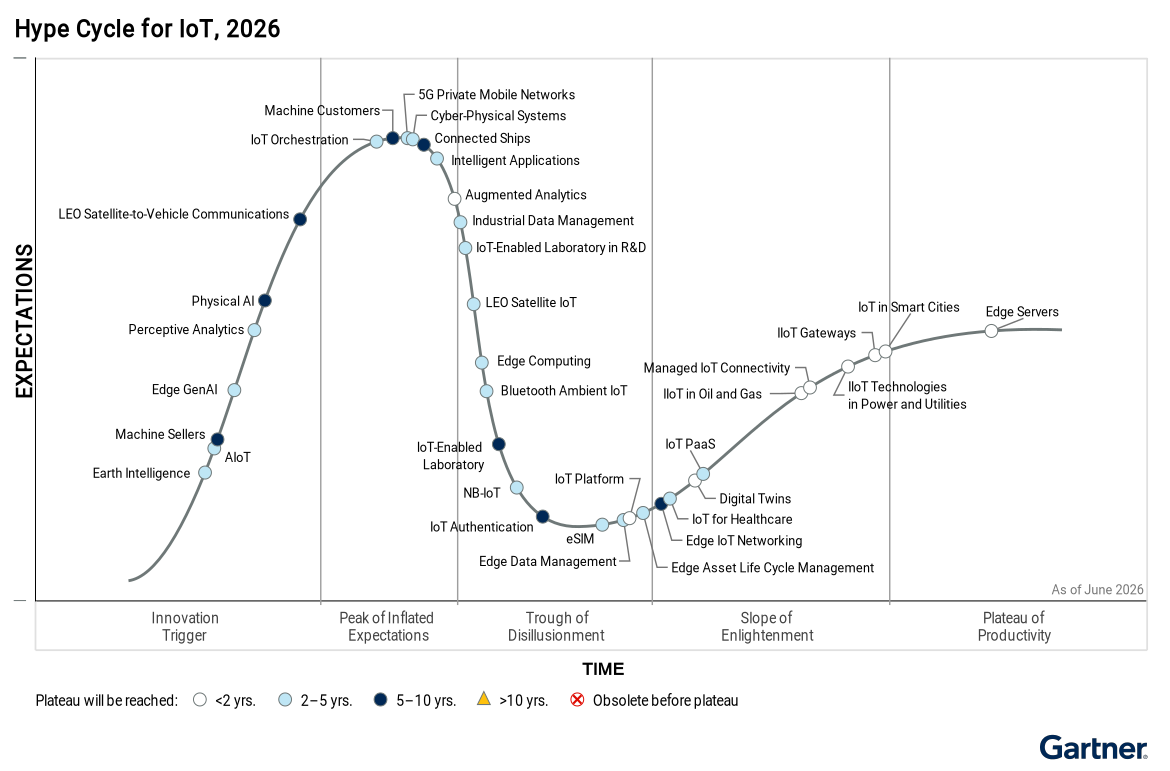
This year’s Hype Cycle, spanning 36 innovations, reflects a growing convergence of IoT, edge computing, and AI capabilities advancing along the innovation curve. The persistent “gravity” of data generated by connected assets is accelerating the need to move compute, analytics, and AI-driven decision making closer to the source. As a result, IoT platforms are increasingly rearchitected around edge intelligence and real-time AI inference. A broad wave of AI innovations is approaching the Peak of Inflated Expectations, while IoT-enabled capabilities, such as digital twins, now more tightly coupled with AI, are on track to reach mainstream adoption within the next 24 months.
To drive differentiation and establish an intelligent, enterprisewide data foundation, CTIOs must act decisively. This resolve requires prioritizing investments that unify IoT data with enterprise systems through edge-based processing, real-time data pipelines, and configurable, AI-enabled applications aligned to industry needs. Success will depend on breaking down persistent data silos across IT and operational technology environments, scaling AI across distributed IoT ecosystems, and embedding intelligence into connected operations to deliver measurable business outcomes.
The Hype Cycle
This Hype Cycle examines the innovations, technologies, and trends shaping IoT strategy and execution. The market is in the midst of a structural shift, moving away from broad, horizontal platforms toward more targeted, IoT-enabled applications that deliver measurable business outcomes through packaged capabilities tailored to specific verticals or industries. This evolution enables CTOs and CIOs to accelerate time-to-value by adopting off-the-shelf or configurable solutions infused with AI and machine learning, frequently aligned to specific industry subsegments to support differentiated use cases. At the same time, the growing concentration of data is driving processing closer to where it is generated, reinforcing the role of the edge in providing a cohesive, single-platform view of distributed on-premises data.
From a maturity perspective, early-stage innovations, such as earth intelligence, artificial intelligence of things (AIoT), physical AI, and edge GenAI, are beginning to attract initial market interest and early adoption. By contrast, high-visibility technologies, including cyber-physical systems, private 5G networks, and machine customers, are at the Peak of Inflated Expectations, benefiting from significant attention and industry momentum.
Further along the curve, a concentration of edge computing capabilities and vertically oriented applications, such as industrial data management, are progressing through early challenges and into more focused experimentation. As organizations sharpen their understanding of business value and deployment models, solutions such as managed IoT connectivity and digital twins are advancing toward broader adoption. Edge servers, in particular, have demonstrated clear and repeatable value and are now entering a more mature, mainstream phase.
The Priority Matrix
The Priority Matrix provides a comparative evaluation of innovations, mapping their benefit rating against their projected time to mainstream adoption.
CTIOs can accelerate value realization and secure near-term competitive advantage by prioritizing high-impact, transformational technologies poised to mature within the next 24 months.
Key insights from this Priority Matrix include:
- Strategic market realignment: Shifting IoT initiatives away from broad, platform-centric deployments toward specialized, IoT-enabled packaged applications aligned to industry use cases, such as healthcare, oil and gas, and industrial data management. To realize full value, CTIOs must explicitly anchor these initiatives anchored to core business outcomes rather than execute them as isolated technology projects. This approach enables organizations to operationalize preconfigured, domain-specific solutions that directly support measurable performance improvements within discrete market subsegments.
- Elevated emphasis on edge processing: The need to process data closer to where it is generated continues to grow, driven by CTIO priorities for a more unified and consistent view of on-premises data across environments. Innovations such as edge computing, edge AI, and edge IoT networking are gaining traction and are expected to reach mainstream adoption within the next two to five years as organizations seek greater responsiveness, efficiency, and data control.
- Opportunities for competitive differentiation: CTIOs can use IoT platforms as a foundation for digital business by deploying value-added applications and building strategic technology partnerships. To maximize impact, organizations should focus on high-value, transformational innovations with a near-term path to maturity. In particular, digital twins, edge servers, and managed IoT connectivity have a strong potential to deliver measurable business outcomes in the short term.
Priority Matrix for IoT, 2026
| Benefit | Years to Mainstream Adoption | |||
|---|---|---|---|---|
| Less Than 2 Years | 2 to 5 Years | 5 to 10 Years | More Than 10 Years | |
Transformational | ||||
High | ||||
Moderate | ||||
Low | ||||
Source: Gartner (June 2026)
On the Rise
Earth Intelligence
Analysis By: Kimberly Harris-Ferrante
Benefit Rating: High
Market Penetration: 5% to 20% of target audience
Maturity: Emerging
Definition:
Earth intelligence is the application of AI to Earth observation data to deliver solutions specific to industries and business functions. It encompasses gathering and providing Earth observation data, transforming it to be fit-for-purpose, and then using it to produce actionable insights with domain-specific AI models, tools and applications.
Why This Is Important
The use of Earth intelligence gives property insurers including those offering commercial, personal home, and agriculture/farm insurance, the data and tools to enable risk intelligence which is then applied to operations, such as underwriting and claims. Earth intelligence systems leverage large datasets (including aerial imagery, satellite and third-party) and apply industry models to provide insight to insurers and predict outcomes to support tasks, such as issuing new policies, fraud investigation or claims identification.
Business Impact
Insurers can use Earth intelligence to help deliver operational efficiency and accuracy to insurance professionals to help support business outcomes, such as underwriting profitability, fraud loss reduction and customer satisfaction through claims processes. It offers greater precision and efficiency through the incorporation of AI capabilities and can be applied to individual and portfolio risk management, as well as support new business models, such as proactive risk management.
Drivers
- The explosion of new Earth data and the desire of insurers to leverage this data to improve underwriting profitability through improved decision making and predictability.
- The need for real-time data to support decisions, especially around weather events or catastrophes.
- A focus on larger-scale data analysis around the Earth rather than individual risk or location.
- The need to provide new tools to risk managers, underwriting and claims teams to help them perform their job better, especially in improved decision making and risk predictability, which improve outcomes more than traditional GIS and location intelligence solutions.
- The need for improved risk management around climate change and natural disasters to help avoid taking on too much risk, enable risk transfer or implement effective reinsurance programs.
- Rising levels of fraud, for which insurers are seeking new tools to improve fraud detection.
- Greater losses from natural disasters and catastrophes which are driving insurers to focus on better risk selection to improve underwriting profitability.
- A new focus among insurers in markets, such as farm and agriculture, that need improved tools to assess individualized risks and support product innovation, such as parametric insurance.
- Advances in AI tools such as computer vision that enable improved Earth intelligence.
- The shift in strategy among insurers from risk management to proactive risk assessment, which demands new tools for visualization of risk using different parameters, including location.
- Many siloed solutions for property risks are emerging; however, they offer narrow views of risk and do not allow them to be looked at holistically.
Obstacles
- Data availability varies by country and region and many emerging countries will lack data to fuel these models.
- Limited resources inside the insurance company have a background on Earth intelligence or geospatial analysis.
- Earth intelligence is not the top AI priority for most insurers today, who are focusing more on the operational side of claims and underwriting.
- There is a reliance on older, less advanced tools, such as GIS solutions that lack the advanced AI capabilities which Earth intelligence and risk intelligence solutions offer, with no vision or budget to upgrade to more modern AI-enabled tools.
- The market is siloed with a range of solutions to support Earth intelligence, with no single vendor offering a holistic platform.
- Few vendors have the in-depth expertise in insurance applications and models to exploit Earth intelligence data.
- Ethical concerns surround how physical Earth data can be used by insurers and consumers alike.
User Recommendations
Insurance CIOs should:
- Work with business leaders in claims, fraud and underwriting to determine the need for Earth intelligence over existing risk management and geospatial modeling capabilities. Build the business case for enhancing these operational areas through improved tools and the support of new business strategies, such as proactive loss prevention, and look for vendors that have industry models to support insurance needs.
- Engage with data science teams on what models are being used today and how Earth intelligence could provide additive value, especially for decision efficiency and portfolio management.
- Assess the infrastructure needed to support Earth intelligence, including cloud strategy and the ability to support large-volume data streams coming in from data providers.
- Ensure data privacy and protection by assessing governance policies and ensuring ethical use of data that is highly sensitive and could be used to negatively impact customers.
Sample Vendors
Bellwether; BigGeo; CyStellar; Descartes Labs; Ecopia AI; Esri; ICEYE; LexisNexis Risk Solutions; Nearmap; Opterrix
Gartner Recommended Reading
AIoT
Analysis By: Scot Kim
Benefit Rating: Transformational
Market Penetration: More than 50% of target audience
Maturity: Emerging
Definition:
Artificial intelligence of things (AIoT) integrates AI capabilities into the IoT technology stack to transform connected data into real-time, actionable intelligence. By enabling analytics and decision making at or near the source of data, AIoT powers autonomous systems that learn, adapt and act by driving prescriptive insights, automated decisions, personalization, enhanced security and edge intelligence at scale.
Why This Is Important
AIoT is important to enterprises because it represents a strategic shift from passive, data-collecting IoT systems to intelligent, autonomous platforms that drive real business outcomes. By enabling agentic AI at scale, AIoT allows enterprises to orchestrate edge intelligence, AI‑driven automation and scenario‑based decision making directly where data is created, thus improving speed, resilience and operational efficiency.
Business Impact
AIoT is transforming industries by delivering process optimization and decision making intelligence in manufacturing, healthcare, energy and retail through AI‑enhanced IoT sensors, digital twins and advanced analytics. These capabilities improve optimal resource utilization and investment value, enhance customer experiences and strengthen decision making across sectors through automated insights, dynamic resource management and intelligent supply‑chain coordination.
Drivers
- AIoT adoption is shaped by the growing need for higher bandwidth and ultra-low latency, positioning 5G as a key enabler for next-generation IoT deployments.
- Edge computing enables real‑time processing closer to the data source; as AIoT applications scale, they must be supported by low‑latency performance and improved responsiveness to meet mission‑critical requirements.
- Cloud‑native platforms enable AIoT development by improving scalability, resilience and continuous integration of AI functionality across distributed environments.
- IT/OT convergence enhances operational efficiency, supporting data sharing and enabling innovative business models through unified architectures.
- GenAI and agentic AI shift IoT from insight generation to autonomous, outcome‑driven decision making at the edge, reducing latency, manual intervention and operational cost while enabling new intelligent operating models.
- Data quality governance is critical for operational assets to be AI‑ready, ensuring AIoT systems can be trusted for mission-critical decisions and scaled confidently across the enterprise.
Obstacles
- Organizations pursuing AIoT must overcome integration challenges, particularly when modern AI systems interact with legacy operational technologies that require substantial middleware and investments.
- Data quality issues pose a major risk, as inconsistent or poor‑quality inputs can undermine AI models and lead to flawed decisions or failed deployments.
- Enterprises must bridge long‑standing silos between IT and OT teams by fostering fusion teams in developing unified architectures to fully realize AIoT’s potential.
- Organizations face market and investment challenges, including high upfront costs for infrastructure upgrades that can render solutions obsolete without agile planning and strategic investment management.
- Technical debt of augmenting and adding to existing infrastructure poses difficulty in implementing AIoT to the asset-intensive infrastructure.
- Immature culture and skillsets to quickly adapt AIoT to the overall architecture.
User Recommendations
- Adopt hybrid edge computing as a core AIoT strategy to operationalize intelligence at scale. Doing so will enable faster, more resilient decision making and accelerate operational excellence across distributed assets and environments.
- Focus on breaking down silos between IT and OT departments. Facilitate IT/OT convergence by creating consensus on key AIoT goals that both departments can capitalize on.
- Develop and deploy robust cybersecurity frameworks that encompass AI-based preemptive threat remediation and blockchain-enabled firmware updates.
- Leverage AIoT to enable flexible, opex‑based funding models that improve capital efficiency while scaling intelligent operations.
- Empower frontline operations with real-time, AI-driven analytics that support faster, context-aware decision making. Emphasize continuous monitoring through digital twins and edge computing to enhance operational insights.
Sample Vendors
Aritium; Cumulocity; EaseMyAI; Latent AI; Microsoft; NVIDIA; Powerfleet; Siemens; SymphonyAI; ZEDEDA
Gartner Recommended Reading
Machine Sellers
Analysis By: Luke Tipping, Daniel Hawkyard
Benefit Rating: High
Market Penetration: 1% to 5% of target audience
Maturity: Emerging
Definition:
Machine sellers (or sellerbots) are persona-based AI agents that automate end-to-end sales workflows for simple transactions or complete specific deal activities on behalf of human sellers during more complex sales processes. Currently, they predominantly facilitate routine, predictable transactions. This includes selling to and serving human customers, or interacting directly with AI agents acting on behalf of human customers to purchase goods and services (machine customers or custobots).
Why This Is Important
Sales organizations can achieve scale using machine sellers to automate deal workflows that would require significant human resources to complete. These AI agents unburden human sellers from low-value activities, enabling a focus on high-value tasks. Furthermore, machine sellers provide the vast datasets, interfaces, and instant response times that machine customers (custobots) expect, ensuring an optimal, frictionless buying experience that drives faster deal conversions.
Business Impact
Sales organizations deploying machine sellers will gain a competitive advantage, locking in recurring revenue by satisfying buyer preferences for seamless purchases. Machine sellers enable organizations to meet the expectations of machine customers at scale and unlock seller productivity by unburdening them from involvement in nonstrategic purchases and low-value activities. Organizations that do not adopt machine sellers risk wasting resources, decreasing efficiency, and missing revenue goals.
Drivers
- Machine sellers present an opportunity for sales organizations to drive recurring revenue and shorten sales cycle times by automating repurchases. They provide revenue and margin enhancement opportunities by surfacing buyer needs that may not be immediately obvious to sellers or buyers, and product recommendations optimized for conversion rate or improved profit margins.
- Buyers increasingly expect suppliers to deliver an effortless and frictionless customer experience. According to the 2025 Gartner B2B Buyer Survey, 67% of B2B buyers state that they prefer rep-free sales experiences. Machines are better equipped than humans to make instant, data-driven decisions that meet buyer demands for streamlined purchasing processes, cost-efficiencies, and productivity gains.
- Deployment of machine sellers will be critical for delivering CEO strategies for engaging with machine customers and AI agents. According to the 2026 Gartner CEO and Senior Business Executive Survey, CEOs anticipate 20% of their revenue to be generated by AI agents or machines acting as customers by 2030. With the increasing level of sophistication and autonomy of agentic AI, machine sellers and machine customers will interact with each other to make complex purchase decisions and transact among themselves.
- Continued advancement of agentic technology will expand and improve the capabilities of machine sellers for supporting increasingly sophisticated tasks. This trend will also see buying groups increasingly adopt machine customers, forcing sales organizations to deploy machine sellers in response.
- Machine sellers offer productivity gains to sales organizations by unburdening sellers from overseeing routine, nonstrategic transactions, and automating more complex deal activities, enabling sellers to focus on high-value tasks.
Obstacles
- Machine sellers are an emerging technology and do not represent a single market. Instead, sales organizations leverage automation and agentic capabilities within existing software, or technology embedded within connected products to support specific tasks or outcomes for customers, such as automated reordering or subscriptions.
- AI agents must be connected to a central, integrated data platform to successfully execute their assigned tasks, consolidating data from disparate sales systems.
- Organizations must establish trust in machine sellers across internal and external stakeholders. Sales leaders must build confidence that tasks executed by the technology are understandable and deliver optimal outcomes.
- Impact of machine sellers will vary by industry, geography, business model and use case. Complex industries are less likely to adopt machine sellers in the short term as buyers prefer to receive guidance from humans. In these cases, machine sellers will autonomously execute specific deal activities such as call scheduling, automated follow-ups, and contract negotiations.
User Recommendations
- Incorporate machine sellers into your go-to-market strategy roadmap within the next one to two years, particularly if you’re in a market that predominantly consists of highly routine, predictable transactions. However, regardless of your industry or solutions, buying organizations will increasingly expect suppliers to offer efficient, frictionless purchase experiences.
- Establish a cross-functional team to explore the business potential of launching your own machine sellers to drive revenue and customer retention. Evaluate your offerings and customer segments to identify those most suited to routine, predictable transactions that can be serviced by a machine seller through autonomous replenishment.
- Conduct an assessment of complex deal processes, identifying the most burdensome activities for sellers and buyers, to surface opportunities to automate these tasks via machine sellers.
- Pilot machine sellers to facilitate tasks, such as solution building, quote creation, and contract writing, to determine productivity and effectiveness gains compared to human-seller-led processes.
Gartner Recommended Reading
Edge GenAI
Analysis By: Chirag Dekate, Danielle Casey, Eric Goodness, Thomas Bittman
Benefit Rating: High
Market Penetration: 1% to 5% of target audience
Maturity: Emerging
Definition:
Edge generative AI (GenAI) runs GenAI models at or near where data is created. It spans phones, PCs, IoT devices, robots and edge servers, using compact models, specialized silicon and local orchestration to support real-time and resilient AI experiences and agentic workflows.
Why This Is Important
On-device inference reduces latency and bandwidth use. It improves privacy because less data leaves the device. It keeps features working offline or with weak networks. Mature neural processing units (NPUs) and small models make this practical on many devices today.
Business Impact
Edge GenAI improves responsiveness, privacy and service quality while enabling context-aware decisions across consumer devices, factories, stores, hospitals, vehicles and field operations. It can improve worker productivity, customer experience and physical AI use cases such as robotics and extended reality (XR).
Drivers
- Real-time analytics needs low latency and strong privacy. These goals favor on-device processing.
- NPUs became a baseline in PCs. A 40+ TOPS class NPU powers key Windows features and enables sustained local inference.
- Small models are now edge-ready. Open families include lightweight 1B to 3B options suited to phones and embedded devices.
- Mobile stacks expose on-device GenAI APIs. Android ships Gemini Nano access for summarization, rewriting and image descriptions on-device.
- Standards have moved forward. Web Neural Network (WebNN) enables hardware-accelerated inference in the browser. ONNX Runtime provides a portable runtime across CPUs, GPUs and NPUs.
- Edge silicon targets generative loads. New modules and cards add multimodal and small language model (SLM) support with better performance per watt.
- Regulated sectors need local processing and audit trails. The EU AI Act phases in obligations through 2026 and 2027.
- Benchmarks and risk guidance have improved. MLPerf Tiny advances tinyML testing. NIST’s GenAI Profile guides risk controls for deployment.
Obstacles
- Limited value: Some pilots fail to beat baselines and stall momentum.
- Cost: Multimodal, low-latency and concurrent use cases can raise device and integration costs.
- Rapid GenAI evolution: Models, runtimes and NPUs evolve quickly and can strand early designs.
- Lack of skills: Few teams combine model, systems and safety expertise at the edge.
- Compliance load: New rules require documentation, testing and monitoring at the edge.
User Recommendations
- Map potential use cases for edge GenAI and weigh them against measurable business value metrics, such as cost savings, top-line growth, customer satisfaction scores and improved physical safety or security, with a clear timeline for these goals.
- Audit your edge and IoT environments. Task your core team to identify gaps and risks and mitigate them before rolling out edge GenAI use cases.
- Track emerging developments in GenAI to ensure continuous improvement and progress of your edge GenAI strategy. Provide frequent feedback to your suppliers to ensure that they meet your evolving needs.
Sample Vendors
Amazon Web Services; AMD; Apple; Google; Hailo; Intel; Microsoft; Numenta; NVIDIA; Phison; Qualcomm
Gartner Recommended Reading
Perceptive Analytics
Analysis By: Deepak Seth, Afraz Jaffri
Benefit Rating: Transformational
Market Penetration: 5% to 20% of target audience
Maturity: Adolescent
Definition:
Perceptive analytics leverages AI technologies, including AI agents, to deliver context-aware strategic insights and executable recommendations that continuously adapt to business conditions by monitoring and responding to analysis of structured, unstructured and multimodal data, business goals and user needs. It empowers organizations with deep situational awareness that proactively optimizes outcomes through autonomous or collaborative planning, action and feedback.
Why This Is Important
Existing analytics and insights are often reactive and backward-looking, struggling to keep up with modern business dynamics. Relying on predefined metrics and human interpretation causes delays in identifying crucial shifts, missed proactive opportunities and limited understanding of value drivers. As a result, businesses frequently make decisions using outdated information, react slowly to threats or opportunities, and lack the agility needed to succeed in volatile environments.
Business Impact
Perceptive analytics is transformative, enabling organizations to move from reactive to proactive decision making that grants significant competitive advantages. By anticipating future trends and adapting strategies autonomously, businesses can optimize resource allocation, enhance customer experiences, mitigate risks more effectively and identify new growth opportunities with greater speed and accuracy.
Drivers
- Advances in AI, particularly generative AI, give rise to large language models (LLMs) that possess a substantial underlying representation of business processes, industry trends and strategic foresight. This knowledge is crucial for decision making in environments with rapidly changing conditions.
- Progress in creating autonomous and semiautonomous AI agents moves them beyond passive analysis. It allows orchestration of LLMs and other analytical tools to proactively monitor data, identify anomalies, trigger analyses and even execute actions based on perceived insights.
- Cloud platforms’ scalability and cost-effectiveness enable them to provide the necessary infrastructure to store and process the massive datasets required for training and deploying LLMs and running complex AI agent systems that underpin perceptive analytics.
- Advancements in real-time data processing enable perceptive analytics to detect new patterns and adjust immediately, meeting the urgent need for rapid, adaptive decisions amid the global business environment’s growing volatility and complexity.
- Advances in predictive modeling, natural language processing, knowledge graphs and reinforcement learning provide a strong foundation of tools and methodologies to integrate with LLMs and AI agent frameworks to create comprehensive perceptive analytics solutions.
Obstacles
- Few vendors offer mature perceptive analytics capabilities, and organizations must decide between building in-house solutions or waiting to procure off-the-shelf solutions.
- Perceptive analytics requires creation and management of trusted, context-rich data to deliver actionable insights. Ensuring this level of AI-ready data quality and semantics is difficult.
- Many advanced LLMs and complex AI agent systems have a black-box nature that conceals the reasoning behind their recommendations. Building trust and ensuring transparency in how these systems arrive at conclusions are crucial for widespread adoption, especially in critical business applications.
- Current shortages of experienced data scientists, AI engineers and domain experts who possess the interdisciplinary skills required to effectively build, deploy and maintain perceptive analytics pose a challenge. New types of roles will be required to create and maintain these systems.
User Recommendations
- Identify the top three to five business decisions where proactive, context‑aware perceptive analytics can materially shift revenue, cost or risk outcomes, and build a 12- to 18-month roadmap that ties each use case to measurable business value.
- Implement a composite semantic layer and knowledge graphs to abstract business rules from underlying data stores. This ensures AI agents interpret critical metrics consistently across the enterprise. Treat metadata as an active control plane to track data lineage and enforce access policies.
- Form cross-functional fusion teams comprising domain experts, data engineers, AI architects and risk partners to design agentic workflows within specific business contexts.
Gartner Recommended Reading
Physical AI
Analysis By: Sushovan Mukhopadhyay, Chirag Dekate
Benefit Rating: Transformational
Market Penetration: 1% to 5% of target audience
Maturity: Emerging
Definition:
Physical AI refers to AI systems embodied in physical form factors, such as robots, drones, autonomous vehicles and smart devices, that use AI to sense, interact with the real world. By combining sensors, actuators and AI models, these systems connect digital intelligence to physical action, enabling them to manipulate objects, move through space and autonomously respond to dynamic environments.
Why This Is Important
Physical AI-powered systems interact with and take action in the physical world, enabling automation, precision, adaptability in a dynamic environment. This integration unlocks new efficiencies by facilitating real-time interactions with devices like robotics, IoT, edge devices, autonomous vehicles, allowing them to operate in unstructured environments. It harnesses insights from sensors to perceive the environment in which it is operating to dynamically interact with the physical objects around it, delivering practical, real-world solutions across domains like manufacturing, logistics, retail, healthcare.
Business Impact
Physical AI can perceive its environment, enabling machines, devices and vehicles to deliver advanced automation. This leads to cost reductions, improved operational efficiency, intelligent decision making, improved safety, and minimized human error and risks, while addressing persistent labor shortages by automating repetitive, hazardous or hard-to-staff tasks. Businesses can benefit from enhanced productivity, streamlined supply chains and innovative service offerings, spurring competitive advantage and opening new revenue streams.
Drivers
Business drivers:
- Real-world impact with real-time AI processing: Physical AI systems, when mature, could be integrated into environments requiring complex, unstructured, unpredictable decisions. There is an increasing demand for intelligent, adaptive physical systems in domains like robotics, logistics, healthcare, transportation.
- Increasing demand for automation: Physical AI can streamline operations, reduce human error and lower long-term costs by automating repetitive or dangerous tasks. Sectors like warehousing, security and transportation benefit from AI systems that can perform repetitive tasks with accuracy and operate continuously without fatigue.
Technical drivers:
- Advancements in sensor, actuator, connectivity technologies: Improvements in hardware (sensors and actuators) enable AI systems to sense, adapt and interact more accurately and efficiently with the physical world. Sensor fusion combines data from complementary modalities (vision, lidar, radar and tactile sensing) to increase precision, robustness and situational awareness.
- Edge AI advancements: The rise of edge computing allows AI systems to process data locally, reducing latency and improving responsiveness. This is crucial for applications requiring real-time decision making, like autonomous vehicles and smart manufacturing. More compute capacity per node at the similar power envelope enables new use cases for battery-powered physical AI solutions.
- Innovations in world models: These models serve as the cognitive backbone for physical AI, interpreting sensory data and predicting outcomes. By integrating intuitive physics-based simulations and AI-generated synthetic data, they create hyperrealistic digital twins and synthetic environments for training these AI models.
- GenAI perception models: Innovations in vision language and vision language action models connect images, language and actions for scene understanding and control. Selective state space models improve temporal reasoning with fast, memory efficient inference on edge devices.
Obstacles
- Perception and interaction challenges: The physical world is unpredictable, requiring AI to handle edge scenarios in real time. Operating safely around humans and in unstructured environments requires near-perfect perception and control, which are still developing and models trained in simulation often fail to fully generalize to real-world conditions (the sim-to-real gap).
- Hardware limitations: It requires advanced sensors and precise actuators, which are expensive and fragile. Battery limits reduce runtime and performance for untethered systems. Telemetry is constrained by power, bandwidth and terrain, reducing command-center visibility into device status, location, interoperability.
- Commercial viability challenges: High initial investments with uncertain long-term ROI slow adoption in commercial settings. Expensive hardware, specialized manufacturing and maintenance raise entry barriers.
- Ethical, legal, social issues: Ambiguity around responsibility for physical AI errors hinders adoption. Concerns over job displacement, surveillance, and varying regional regulations complicate deployment.
User Recommendations
- Start with pilot projects in controlled environments to test and refine physical AI systems, focusing on repetitive or low-risk use cases that require both adaptivity and efficiency. Use feedback from these implementations to enhance system design, functionality, and infrastructure readiness before full-scale deployment.
- Build strategic partnerships to collaborate with technology providers, research institutions and industry experts to stay informed about the latest advancements and best practices.
- Develop clear guidelines and accountability frameworks for AI errors and decision-making processes while engaging with regulatory bodies to ensure compliance with regional laws and standards.
- Provision greenfield environments for physical AI by designing the physical space to support adoption. This includes adequate gangway width, access paths, mounting points, power and network availability, and integration interfaces for future automation.
Sample Vendors
ABB; AGIBOT; Agility Robotics; AMD; Boston Dynamics; Diligent Robotics; Fourier; Google DeepMind; Intel; KUKA; Liquid AI; NVIDIA; UBTECH Robotics; Unitree Robotics
Gartner Recommended Reading
LEO Satellite-to-Vehicle Communications
Analysis By: Pedro Pacheco
Benefit Rating: High
Market Penetration: 1% to 5% of target audience
Maturity: Emerging
Definition:
Satellites in low-Earth orbit (LEO) may be used to provide high-bandwidth, low-latency communications to moving vehicles. Antennas, built into a vehicle’s roof, can deliver line-of-sight communications to orbit, sidestepping terrestrial networks to provide a direct link from the vehicle vendor to the end user.
Why This Is Important
The LEO satellite-to-vehicle communications technology enables ubiquitous connectivity that allows an uninterrupted infotainment experience, more reliance on connectivity for safety-critical systems and the ability to perform SOS or roadside-assist calls from anywhere. It also allows fleets to track commercial vehicles in real time, from any location. In contrast, cellular networks have limited coverage, and moving between countries can raise complications associated with roaming costs.
Business Impact
Satellites in LEO will eventually allow OEMs to get vehicle connectivity from a single provider, which simplifies costs and removes intermediaries’ markups. It will also allow OEMs to adopt an intermediary, hybrid solution by using satellites to complement cellular in each vehicle.
Drivers
- LEO satellite connectivity is being adopted by a growing number of OEMs in China. For instance, the Maextro S800, an ultra-luxury sedan co-developed by JAC and Huawei, actively promoted LEO satellite connectivity as a solution that allows drivers to ask for roadside assistance from any location in China. Satellite connectivity is still seen in China as a feature for premium cars, but the growing adoption means it will eventually cascade to lower segments.
- The rumors about Tesla’s imminent deployment of LEO in-car satellite connectivity persist. The company registered a patent in 2025 that allows for discreet installation of a Starlink antenna in the roof of its vehicles, supposedly at a lower cost. The antenna cost is one of the key bottlenecks for OEMs, but new solutions for this problem are starting to emerge.
- The overall cost of satellite data exchange continues to drop as the bandwidth improves. For instance, in 1Q26 Starlink launched a residential service plan in Germany that provides 100 Mbps for €29/month. This rate comes very close to plans offered by major telecom providers, showing just how far the technology has come in terms of pricing.
Obstacles
- It costs billions of dollars to build and maintain a LEO satellite constellation. As a result, some market consolidation is likely as the industry matures, leading to potential risks in terms of price increases.
- Satellite-provided data services are, for now, more expensive than the same services delivered by terrestrial networks because satellite operators must recover the high capital cost of building a constellation.
- The cost of ground equipment (the antenna that must be fitted to every car) remains high, when looking at solutions currently on the market.
- Connectivity will still be limited to line of sight, so vehicles in tunnels will be cut off. Coverage in urban canyons (between skyscrapers) will depend on the number of satellites deployed, with only the largest megaconstellations able to provide ubiquitous urban coverage.
- Aftermarket accessories, such as roof racks or metallic paint, could interfere with the satellite connection.
User Recommendations
- Explore cooperative or partnership arrangements to provide competitive services against companies that can leverage sibling relationships (such as Tesla/Starlink and Geely).
- Look for partnerships with constellations that aren’t owned by companies with an interest in automotive, such as Amazon Leo or Omnispace.
- Evaluate hybrid services, using terrestrial networks where possible and switching to satellite where necessary. This also includes the satellite-to-cell approach, where a device can use satellite connectivity but through the conventional SIM card and normal cellular antenna.
- Conduct a cost-benefit analysis to determine at what price it would make sense to integrate a phased-array antenna into the roof of every vehicle.
Sample Vendors
Omnispace; SpaceX; Zhejiang Geely Holding Group
Gartner Recommended Reading
At the Peak
IoT Orchestration
Analysis By: Pablo Arriandiaga
Benefit Rating: High
Market Penetration: 5% to 20% of target audience
Maturity: Adolescent
Definition:
IoT orchestration uses centralized platforms to integrate, automate and manage complex global IoT connectivity deployments across multiple vendors and countries. By aggregating eSIM and APIs, these solutions offer a unified interface that simplifies multivendor connectivity. Key features include dynamic over-the-air eSIM management (SGP.32/.22/.02), multi-IMSI support, bring-your-own-connectivity (BYOC) integration, automated life cycle governance, and AI-driven self-healing and operations.
Why This Is Important
As global IoT deployments scale, enterprises face challenges in managing fragmented carrier relationships, regulatory compliance and roaming restrictions. IoT orchestration simplifies technical and financial complexities in multivendor environments. It overcomes single-carrier lock-in by enabling dynamic over-the-air profile switching, supporting data sovereignty compliance, and providing centralized management across cellular network, low-power wide-area network (LPWAN) and satellite network.
Business Impact
Multinational enterprises, device OEMs and industrial operators benefit from IoT orchestration. A single operational interface reduces the total cost of ownership and administrative overhead associated with managing millions of devices. Key advantages include automatic failover, seamless public-to-private network handovers, TCO reduction through profile localization, supply chain simplification with a global eSIM SKU and reduced downtime through AI-driven remediation.
Drivers
- The GSMA SGP.32 IoT eSIM standard streamlines international device deployment and national failover by enabling OEMs to remotely provision and manage connectivity profiles. This approach gives enterprises greater control and flexibility, allowing manufacturers to produce a single-SKU strategy and, through secure over-the-air updates, adapt each device’s connectivity settings to meet specific regulatory and carrier requirements in different markets. This flexibility reduces the need for region-specific hardware and simplifies global supply chains.
- Increasing enforcement of stringent data sovereignty regulations and permanent roaming bans in countries such as Brazil and Türkiye compels enterprises to adopt platforms that seamlessly orchestrate localized carrier profiles.
- Enterprises increasingly demand BYOC models to avoid vendor lock-in, integrating existing localized carrier agreements into a primary management platform through API aggregation or eSIM. BYOC adoption also reflects the need for localized connectivity to avoid roaming charges in high‑data‑volume scenarios and to enable broader ICT negotiations with local carriers for improved pricing across multiple service lines.
- The integration of public cellular, private 5G, satellite (NTN) and LPWAN networks requires unified, single-pane-of-glass (SPoG) management platform control to ensure ubiquitous coverage and resilient IoT operations.
- Enterprises can retain consistent API integrations with their internal IT/OT systems, regardless of changes in local connectivity providers. This approach eliminates the need to rework interfaces, safeguards previous integration investments and reduces the risk of API-level vendor lock-in.
- The integration of generative and agentic AI capabilities shifts management from reactive dashboards and evolves operations from basic automation to proactive, self-healing networks capable of automated anomaly resolution, intelligent routing and life cycle management.
Obstacles
- The commercial rollout of the SGP.32 standard is delayed because many tier-1 mobile network operators (MNOs) and IoT mobile virtual network operators (MVNOs) lack fully compliant profiles, forcing reliance on transitional or proprietary solutions. Gartner expects full production by 2026, although some vendors already accept preorders.
- The fragmented landscape of proprietary connectivity management platform (CMP) APIs complicates seamless federation and single-pane-of-glass aggregation at scale, as not all local CMP API features integrate fully, resulting in fragmented life cycle management that depends on the connected CMP.
- Enterprises hesitate financially and operationally when they migrate legacy IoT fleets from traditional physical SIMs to modern, orchestrated environments due to deployment complexities and replacement costs.
- Security vulnerabilities persist because current platforms struggle to deliver comprehensive protection across diverse connectivity interfaces.
User Recommendations
- For enterprises:
- Evaluate connectivity providers based on their verifiable roadmaps and readiness for the GSMA SGP.32 standard to ensure future‑proof, dynamic, over‑the‑air profile localization.
- Prioritize vendors that offer advanced, single‑pane‑of‑glass platforms capable of federating third‑party networks through standardized API aggregation to support BYOC models alongside eSIM.
- Ensure the selected orchestration platform natively supports hybrid, multi‑bearer environments that bridge cellular, LPWAN, private 5G, and satellite networks.
- For service providers:
- Implement robust security for remote SIM provisioning, firmware updates, and cloud management; conduct regular vulnerability audits; ensure regulatory compliance; engage with standards bodies; and align supply chain partners to eSIM security standards.
- Adopt platforms that leverage machine learning and agentic AI to enable predictive analytics, zero‑touch provisioning, and proactive, self‑healing network resolution, thereby reducing operational overhead.
Sample Vendors
Aeris; AT&T; Cubic3; Eseye; IoTM Solutions; Simetric; Thales; Telefónica; Telenor Group; Wireless Logic
Gartner Recommended Reading
Machine Customers
Analysis By: Don Scheibenreif
Benefit Rating: High
Market Penetration: 1% to 5% of target audience
Maturity: Emerging
Definition:
Machine customers are nonhuman economic actors that obtain goods or services in exchange for payment. Examples of machine customers include AI agents, generative AI chatbots, smart appliances, connected cars and Internet of Things (IoT)-enabled factory equipment. Machine customers act on behalf of a human customer or an organization.
Why This Is Important
Gartner estimates 5 billion B2B and B2C internet-connected machines can act as customers today, growing to 12 billion by 2030. These machine customers will have varying degrees of autonomy. AI assistants (or chatbots) will also reach into the billions. Machines are increasingly capable of buying, selling and requesting services. Moreover, machine customers are evolving from simple informers to advisors and decision-makers.
Business Impact
Over time, trillions of dollars are expected to be in control of nonhuman customers. This will result in new opportunities for revenue, efficiencies and managing customer relationships. Leaders seeking new growth must reimagine their operating and business models to take advantage of this emerging market of tens of billions of machine customers. Organizations that miss this opportunity will be marginalized, just like those retailers who missed the digital commerce wave.
Drivers
- In the coming years, machine customers are set to become major players in industrial, retail, and consumer sectors. Billions of connected products, powered by advanced technologies, will soon act as autonomous customers, shopping for services and supplies for themselves and their owners. According to Gartner’s CEO and Senior Business Executive Surveys, 29% of CEOs are developing strategies to engage with machine customers and AI agents, with half expected to have a strategy by the end of 2026. By 2030, 19.5% of revenue is projected to come from machine customers.
- Currently, machines inform, recommend, and perform routine tasks but are evolving into sophisticated customers. Examples include Amazon’s Dash Replenishment Service, HP Instant Ink, Tesla’s self-ordering of spare parts, and Fastenal’s auto-replenishing vending machines. More advanced tasks are handled by Waymo’s autonomous taxis and Agility Robotics’ Digit.
- AI platforms and agents are accelerating this trend. Services like Amazon Alexa+, Google Gemini, and OpenAI’s Instant Checkout enable 24/7 inquiries, product recommendations, streamlined check-out, and support for human agents. In B2B, AI-based contract negotiation systems like Pactum AI, used by Walmart and Maersk, generate fair contracts, while supplier discovery and data platforms are shaping machine customer interactions.
- Payment solutions — such as Mastercard’s Agent Pay and Google’s Universal Commerce Protocol — will further empower AI agents to execute digital transactions. Overall, machine customers represent new revenue streams, increased productivity, enhanced health and security, and benefits for both sellers and buyers.
Obstacles
- Operating model changes: Serving machine customers will disrupt existing models. Companies must create separate experiences for machines and humans, scaling operations to meet real-time machine demands or risk losing them.
- Lack of trust: Humans may distrust machine customer technology over privacy and accuracy, while machines may distrust suppliers.
- Fear of machines: Some fear delegating purchasing to machines and AI. Customers and organizations must assess governance for ethical, legal, fraud, and risk standards.
- Security and governance: Increased AI use may lack security, leading to misinformation and reputational damage.
- Cost: Implementing and maintaining these systems is complex and costly. Adapting to changing needs requires significant investment in technology, software, and support.
User Recommendations
- Identify use cases where your products and services can be extended to machine customers. Collaborate with digital, data, strategy, sales, and customer officers to explore the potential.
- Assess B2B customers’ tech purchase intent data to spot machine customer capabilities and use cases.
- Pilot ideas to understand required technologies, processes, and skills. Build digital commerce and AI capabilities — starting with generative and agentic AI.
- Use APIs and bots for low-complexity transactions, then expand to complex purchases.
- Monitor competitor adoption of AI agents as machine customers. Follow examples from Amazon, Google, HP, iProd, NEC, OpenAI, and Tesla for evidence of capabilities and business-model impact.
Sample Vendors
Amazon; Anthropic; Google; HP Inc.; iProd; NEC; OpenAI; Pactum; Perplexity; Tesla
Gartner Recommended Reading
5G Private Mobile Networks
Analysis By: Sylvain Fabre
Benefit Rating: High
Market Penetration: 1% to 5% of target audience
Maturity: Adolescent
Definition:
5G private mobile networks (PMNs) provide mobile services specifically and exclusively to an enterprise or public organization and are based on the 3rd Generation Partnership Project (3GPP) R15 or above. A PMN is used to provide unified connectivity, optimized services and security to interconnect people and things for an enterprise. Deployments can be local or linked to a public network.
Why This Is Important
The importance of 5G private mobile networks lies in giving organizations direct control over wireless performance, security and economics where shared public networks or Wi-Fi cannot reliably meet operational requirements. It can also optimize connectivity costs for large areas; 5G requires far fewer radio nodes than Wi-Fi, which drastically reduces the expense of hardware and cabling.
Business Impact
5G PMN enables transformational use cases (e.g., factory digital twins, edge AI, and computer vision). Unlike 4G, 5G delivers strict deterministic connectivity, guaranteeing sub-20ms latency and massive uplink throughput for critical OT. It offers improved reliability, security and independence, supporting high-density endpoint connections with absolute performance guarantees to drive efficiency gains in automated industrial environments. 5G PMN is the enterprise’s own infrastructure, with limited outside dependency. In practice, the business impact of 5G PMNs is highest in asset-intensive and mission-critical environments, and significantly lower where connectivity requirements can already be met with simpler alternatives.
Drivers
- Practical applications and vertical-specific integration are increasing. Beyond 3GPP, other bodies are now contributing, such as 5G Alliance for Connected Industries and Automation and 5G Automotive Association.
- Liberalization of the radio spectrum has opened up standard radio bands, often around 3.5 GHz, for use by 5G PMN networks.
- The requirement for full, reliable network coverage for machines, sensors and equipment, including indoor, outdoor, office and large industrial areas, at a lower cost than Wi-Fi, is a driver.
- Bridge to edge computing: 5G’s deterministic high-bandwidth and low-latency profile supports embedding edge AI and compute for demanding industrial use cases.
- Shift to NaaS and OpEx: Vendors and SIs now offer flexible, OpEx-based network-as-a-service models, drastically lowering upfront CapEx barriers.
- Some enterprises in specific verticals or those adopting specific use cases deploy private networks because they want to run their network more independently, as their own infrastructure, with limited outside dependency, such as long-term commitment from public network operators.
- Data sovereignty: Strict physical and logical isolation ensures sensitive data remains on-premises, giving defense and regulated clients absolute control.
- Network slicing for strict SLAs: Slicing allows enterprises to secure guaranteed sub-20ms latency for critical OT traffic over shared networks.
Obstacles
- Unclear ROI against alternatives: Cautious enterprises struggle to justify 5G investments, perceiving that mature 4G, Wi-Fi or low-power alternatives sufficiently service most of their current industrial use cases with lower risk.
- 3GPP Release 16 maturity: Buyers perceive that the true value of 5G relies on advanced Release 16 capabilities (such as dynamic network slicing), whose commercial maturity and broad availability are still a work in progress.
- Deployment and integration complexity: Global multisite scaling is hindered by highly fragmented regional spectrum regulations and the technical friction of unifying private 5G with legacy enterprise Wi-Fi and existing OT frameworks.
- Device availability and hardware costs: There remains a limited ecosystem and high cost for ruggedized industrial devices natively designed to operate on the dedicated radio bands available for private network use.
User Recommendations
- Mitigate deployment complexity and internal engineering skill gaps by adopting private 5G through OPEX-based network-as-a-service (NaaS) offerings, thereby transferring operational responsibilities to managed service providers that leverage zero-touch provisioning and unified management dashboards to streamline IT operations.
- Address specialized use cases in conjunction with Wi-Fi by deploying private 5G networks specifically for operational scenarios that demand extensive coverage and stringent, deterministic application performance, rather than positioning private 5G as a wholesale replacement for enterprisewide wireless LAN.
- Enable advanced industrial AI and edge computing applications by aligning critical requirements, such as low inference latency, high-capacity uplink throughput, and data sovereignty mandates, with the unique capabilities of 5G technology prior to finalizing network architecture decisions.
Sample Vendors
AT&T; Celona; China Mobile; Ericsson; Hewlett Packard Enterprise; Huawei; Nokia; T-Mobile; Verizon; Vodafone
Gartner Recommended Reading
Cyber-Physical Systems
Analysis By: Katell Thielemann
Benefit Rating: Transformational
Market Penetration: More than 50% of target audience
Maturity: Early mainstream
Definition:
Cyber-physical systems (CPS) are engineered systems that orchestrate sensing, computation, control, networking and analytics to interact with the physical world (including humans). They are production and mission-critical assets in manufacturing, facilities, transportation and critical infrastructure-related industries.
Why This Is Important
Cyber-physical systems are managed digitally but interact with the physical world. They can also be referred to as:
- Building management systems (BMS)
- Engineering technology (ET)
- Industrial control systems (ICS)
- Internet of Things (IoT)/ Industrial IoT (IIoT)
- Operational technology (OT)
- Polyfunctional robots
- Supervisory control and data acquisition (SCADA)
As physical AI ambitions grow, they will only become a reality if embedded into a “host” body, which will be a cyber-physical system.
Business Impact
CPS orchestrate data flows and physical processes between previously disconnected systems, automate unstructured processes, shorten cycle times and improve product and service quality. In industrial environments, CPS replace stand-alone production process control and automation, materials handling systems and transactional workflow systems to process real-time information. They improve productivity, reduce costs and enable value creation for all asset-intensive industries.
Drivers
- Customer or citizen demand for faster, cheaper, better and more products/services.
- New digital business models demanding more automation and robotics in production environments; business-driven digital transformation initiatives.
- Productivity and maintenance improvements.
- Labor cost-reduction made possible by automation provided by robotic CPS.
- CPS-enabled operational excellence and enhanced operational data gathering.
- Improved situational awareness in operations or mission-critical environments.
- Regulatory and resilience mandates for critical infrastructure and safety-critical operations.
- Improved safety by implementing near-real-time actions to system errors or malfunctions.
Obstacles
- Deployment-related obstacles include scale, complex architectural requirements and design approaches from many disciplines involved, sense and control loops that must be designed to evolve with business needs, the need for significant computational resources and a variety of sensory input/output devices.
- Variety of stakeholders involved (corporate CIO, plant managers, CISO etc.) makes adoption and ongoing ownership challenging.
- Concerns over physical perimeter breaches, jamming, hacking, spoofing, tampering or command intrusion must be addressed in addition to cybersecurity and remote access considerations.
- Many organizations increasingly have a mix of legacy and new systems with proprietary protocols, which creates interoperability challenges. While end users have been seeking better interoperability, common standards are still under development in many industries.
- Because CPS are usually highly automated, new skills are needed for operations, security and maintenance. Skills shortages are an acute issue.
- There’s a general lack of awareness by CIOs and CISOs of what CPS exist across the organization and visibility into their operational and security posture.
User Recommendations
- Determine the business value of CPS deployment by weighing benefits against cost, complexity and security.
- Promote the use of standards and interoperability recommendations to manage complexity, enable scalability and extensibility, and ensure focus on security and safety imperatives.
- Define latency, jitter and control-loop requirements early and place CPS workloads optimally as a result.
- Make sure that any deployment is negotiated with CPS OEMs to ensure upgrades can be easily incorporated. Emerging technologies, such as AI, cloud computing and 5G, will greatly impact these systems.
- Deploy a CPS protection platform to get real time visibility of CPS inventory and the risk they may pose to the organization.
Gartner Recommended Reading
Connected Ships
Analysis By: Jonathan Davenport
Benefit Rating: High
Market Penetration: 1% to 5% of target audience
Maturity: Emerging
Definition:
Connected ships enable the collection of Internet of Things (IoT) data from a vessel at sea, often over satellite connectivity. Data pulled from vessels is stored in cloud-based IoT platforms to enable near-real-time vessel data analysis, providing a command and control platform. AI and analytics can be used to optimize operations, improve crew and cargo safety, maximize fuel efficiency, deliver predictive maintenance and provide increased situational awareness.
Why This Is Important
In the past, beyond location, ship operators had limited operational data about their fleets while they were at sea. With the advent of low Earth orbit (LEO) satellites, vessels can have high-bandwidth connections, enabling the collection of high-frequency data. By sourcing data produced by multiple, previously siloed ship systems, operational teams enjoy heightened levels of situational awareness, which can be used to optimize vessel and voyage operations.
Business Impact
Connected vessel initiatives lay the groundwork for a fundamental shift in the marine sector, leading to increased efficiency, lower operational costs and cleaner vessel operations. The data that vessels generate is of interest to a range of stakeholders, including ship operators, shipyards and equipment suppliers. The breadth of companies interested in the data creates opportunities for data monetization and the ability to create new digital services.
Drivers
- A wide variety of vessel data points can be collected from systems such as radar, cameras, electronic chart display and information system (ECDIS), automatic identification system (AIS), and other onboard systems.
- The rise of LEO satellites enables the cost-effective, high-frequency acquisition of operational data from ships for the first time.
- Ship operators are increasingly leveraging data analytics and AI-powered voyage optimization to improve route planning, reduce fuel consumption, and minimize emissions — enhancing efficiency and sustainability without major capital investment in vessel hardware.
- Digital twins that use advanced AI analytics support data-driven decisions in vessel optimization, such as scheduling maintenance activities like antifouling. These technologies empower operators to accelerate decarbonization initiatives.
- The integration of IoT platforms allows shipbuilders to share operational insights and collaborate across the maritime ecosystem, shifting their role from traditional shipbuilding to maritime service provision.
- Access to operational data enables shipbuilders to refine vessel design and deliver proactive maintenance services.
- Manufacturers of critical systems, including engines and generators, increasingly seek telematics data to enhance efficiency and support emerging business models, such as “engine as a service,” while supporting impro.
- Real-time crew location data, combined with local weather conditions, helps ship operators fulfill duty-of-care responsibilities, improve safety protocols, and ensure compliance with corporate policies.
- Cargo owners expect in-transit monitoring of factors like temperature and vibration, which can be offered as a value-added service. End-to-end traceability ensures that conditions are tracked and recorded throughout the transition from production to customer.
- With the rise of autonomous vessels, remote mission planning systems are becoming essential for delivering new routes and operational instructions.
Obstacles
- Delivery of connected vessels requires connecting a range of on-vessel software and hardware, as well as investing in cybersecurity systems and connectivity contracts.
- Cloud storage and IoT platforms that incorporate fleet management solutions are needed to store the data. These platforms also require integration into back-end enterprise and third-party systems. Incorporation of edge compute will also be important to enable the selection of relevant data to offload.
- Data sent via satellite communication is expensive; however, connectivity costs are dropping fast and can be further reduced by compressing and batching data over cellular as the vessel approaches the shore.
- The true benefits to ship operators come when all their vessels are connected, but vessels have a long operational life. Retrofitting and connecting sensors to a central gateway onboard the vessel is not an insignificant task, both financially and technically. This affects the scalability of fleetwide deployments.
User Recommendations
- Enhance operational efficiency by integrating AI-driven analytics platforms that aggregate and analyze data from multiple onboard systems in near real time.
- Reduce connectivity costs by implementing data compression, batching data that isn’t required in real time, and leveraging cellular networks when vessels are near shore to minimize satellite transmission expenses.
- Strengthen cybersecurity by deploying robust security protocols and continuous monitoring solutions across vessel networks, IoT devices, and cloud platforms.
- Accelerate fleetwide digital transformation by prioritizing scalable retrofit programs that connect legacy sensors and systems to centralized gateways, enabling unified data collection and management.
- Expand value-added services by collaborating with shipyards, equipment suppliers, and cargo owners to monetize operational data and deliver new digital offerings, such as predictive maintenance and in-transit cargo monitoring.
Sample Vendors
ABB; Accenture; JRCS; Key Technologies; Kongsberg Maritime; SeaOwl Technology Solutions; Siemens; Synectics; Tata Consultancy Services; Wärtsilä
Gartner Recommended Reading
Intelligent Applications
Analysis By: Tad Travis, Stephen Emmott, Justin Tung
Benefit Rating: Transformational
Market Penetration: 20% to 50% of target audience
Maturity: Adolescent
Definition:
Intelligent applications are the next generation of enterprise applications. Unlike traditional applications that typically follow strict rules and conditional logic, intelligent applications use generative AI and other advanced techniques to adapt, learn, and apply themselves to process automation, insight generation, and knowledge distribution. This technology enables the augmentation and automation of work across diverse scenarios and use cases.
Why This Is Important
Agentic AI is the most important technological enhancement within enterprise applications in the last 20 years. Many technology providers now enable AI in their products via built-in, added, proxied, or custom capabilities. Recent developments in AI continue to enable applications to work autonomously across a wider range of scenarios with elevated quality and productivity. Integrated intelligence and machine learning can also support decision-making processes alongside transactional processes.
Business Impact
- Process augmentation and automation: Increased automated workflow reduces the cost and unreliability of human intervention.
- Insight generation: The speed and quality of dynamic decision making, based on context and knowledge graphs, improves.
- Knowledge contextualization: Applications can synthesize information from diverse, different systems to create new knowledge repositories. Applications can also adapt to the context of the user or process, creating personalized or adaptive experiences.
Drivers
- The continued hype wave for generative AI and large language models (LLMs) will drive enterprise application modernization. Gartner has identified five drivers in particular: AI assistants, AI agents, no-code development, prompt engineering, and fluid knowledge (i.e., the changing information landscape). Gartner sometimes refers to these drivers as the Adaptive Intelligence Continuum, which is the process of evolving intelligent applications. Features such as recommendations, insights, and personalization are more easily accessible via natural language prompts. Looking ahead, wider incorporation of conversational interfaces will blur the line between interface and intelligence in an easily composable manner.
- AI capabilities and features, such as AI agents, are increasingly being integrated into ERP, CRM, digital workplaces, supply chains, and knowledge management software within enterprise application suites. Embedded generative AI (as with LLMs) and composite AI capabilities (such as predictive analytics) help organizations derive more insights from data in such applications.
- Organizations are demanding more functionality from applications, whether built or bought, expecting them to enhance current processes for transactions and decision making, with recommendations and insights. The trend toward composable application architectures highlights the possibilities for delivering advanced and flexible capabilities to support, augment, and automate decisions, which have traditionally required an underlying data fabric and packaged capabilities to build. However, the increased adoption of LLMs can be potentially used as a composable interface layer, kick-starting the ability to deliver on the composable architecture.
Obstacles
- Lack of AI-ready data: Intelligent applications require data and context from many systems. Plus, providing an individually tailored adaptive experience could require collecting user data.
- Added complexity in operations: Models and agents have to be trained and maintained.
- Trust in system-generated insights: It takes time for business users to see the benefits and to trust AI-powered insights.
- Trust in enterprise application providers: Gartner clients, and survey results, confirm there is low trust in vendors’ AI-embedded capabilities.
- Overwhelming array of options: The number of applications and application vendors selling and marketing their intelligent application features is causing confusion for those seeking to streamline their AI portfolio.
- Introduction of new AI-based technologies: New developments have created greater uncertainty and exaggerated claims around the true capabilities of intelligent applications.
User Recommendations
- Maintain a flexible implementation approach for the next one to two years. Design and implementation best practices are still emerging. For the next year, plan on a buy-first strategy, adopting AI capabilities from your incumbent vendors. But at the same time, test build-first capabilities for small or highly innovative use cases.
- Evaluate your providers’ architecture by considering that the best-in-class intelligent applications are built from the ground up, constantly collecting data from other systems, with a solid data layer in the form of a data fabric.
- Prioritize investments in specialized and domain-specific intelligent applications delivered as point solutions.
- Bring AI components into your composable enterprise applications, for faster and safer innovation, to reduce costs by building reusability and to lay the foundation for business-IT partnerships. Be aware of what makes AI different, particularly how to refresh ML models to avert implementation and usage challenges.
Gartner Recommended Reading
Augmented Analytics
Analysis By: Anirudh Ganeshan, David Pidsley, Edgar Macari
Benefit Rating: Moderate
Market Penetration: More than 50% of target audience
Maturity: Mature mainstream
Definition:
Augmented analytics is the use of enabling technologies such as machine learning and AI to assist with data preparation, insight generation and insight explanation to augment how people explore and analyze data in analytics and business intelligence platforms. It increasingly relies on semantic layers to provide consistent business contextualization across data sources so automated insights are interpreted within a shared context.
Why This Is Important
Many activities associated with data, including preparation, pattern identification, transformation, model development and insight sharing, remain highly manual. This friction limits the user adoption and business impact of analytics.
Business Impact
Augmented analytics is transforming how users interact with analytics content. Features such as key driver analysis and automated clustering are making analytics more accessible, explainable and expedient. Once confined to experts only, insights from advanced analytics are now in the hands of business analysts, decision makers and operational workers across the enterprise. This is leading to the evolution of traditional consumers of analytics content to become creators.
Drivers
- Organizations increasingly want to analyze more complex datasets, business logic and other decision-making parameters, combining diverse data from both internal and external sources. With an increasing number of variables to explore in order to harmonize data, it is practically impossible for users to analyze every pattern combination. It is even more difficult for users to determine whether their findings are the most relevant, significant and actionable. Expanding the use of augmented analytics will reduce the time users spend on exploring data while giving them more time to act on the most relevant insights.
- Agentic analytics has accelerated market interest in dynamic data stories and other combinations of augmented analytics features that automate insights. Agentic analytics builds on augmented analytics by applying AI agents, large language models (LLMs) and generative AI to automate more of the analytics workflow. Augmented analytics introduced capabilities such as natural language query, natural language generation and anomaly detection. Agentic analytics extends these capabilities by using autonomous agents to interpret intent, coordinate tasks and produce dynamic data stories. This shift moves users beyond predefined dashboards and increases the use of automated, context‑aware insights.
- Vendor technology innovation is pushing augmented analytics forward. With rapid growth in agentic analytics, augmented analytics is receiving heightened attention. Analytics and business intelligence (ABI) platforms are now integrating LLMs, allowing users to generate, debug and convert code, create data stories and aid in data preparation. This integration has also enabled newer users to emerge, fueling analytics adoption. In the next wave of generative analytics experiences, agentic analytics (AI agents for data analysis) users may see the entire workflow become AI-driven.
Obstacles
- Lack of semantic layers: Many organizations have not established a shared semantic layer, which leads to inconsistent business definitions, fragmented logic across analytics tools and limited reliability of autogenerated insights. This gap makes it harder for augmented and agentic analytics features to produce consistent, interpretable outcomes.
- Need for training and rapidly evolving skills: The demand for data and AI skills continues to evolve, and organizations must provide ongoing training across multiple personas. This includes not only technical and literacy skills but also stronger business context and domain knowledge so teams can apply these technologies to create meaningful value.
- Multiple ABI platforms: Most organizations leverage multiple ABI platforms, causing exponential proliferation of analytics content. Coupled with a lack of governance, this proliferation often leads to duplication of reports and dashboards, cost-inefficiencies and an overall decline of trust in data.
User Recommendations
- Identify and prioritize the personas and use cases in your organization that will benefit most from augmented analytics capabilities.
- Ensure users can get value from new augmented analytics features by providing targeted and context-specific training. Invest in data literacy to ensure responsible adoption.
- Encourage teams to govern and standardize shared business definitions, measures and relationships through a semantic layer. This supports more consistent automated insights, reduces interpretation gaps across tools, and strengthens trust in augmented and agentic analytics outputs.
- Review how platform roadmaps address semantic alignment, automated insight generation, agentic workflows, explainability and governance needs. Prioritize vendors whose planned capabilities align with your organization’s expected maturity, use cases and long-term architectural direction.
Sample Vendors
Aible; AnswerRocket; iGenius; Oracle; Pyramid Analytics; Qlik; Sisense; Tellius; ThoughtSpot; WisdomAI
Gartner Recommended Reading
Sliding into the Trough
Industrial Data Management
Analysis By: Scot Kim, Kentaro Shikanai
Benefit Rating: Transformational
Market Penetration: 20% to 50% of target audience
Maturity: Early mainstream
Definition:
IDM is the practice of organizing industrial data by tagging, classifying, normalizing, contextualizing, and transforming raw OT datasets into meaningful semantic data objects. It blends large volumes of IT and OT data to ensure consistency, interoperability, and AI readiness for asset-intensive industries such as manufacturing, energy and utilities, and logistics.
Why This Is Important
Industrial data management (IDM) is important because industrial data is complex, unstructured, and highly abstract for AI models and visualization to gain insights. IDM refines and structures operational technology (OT) data so it can be reliably visualized, analyzed, and used to train AI models without errors or hallucinations. This foundation enables asset-intensive enterprises to modernize operations and unlock future opportunities from advanced and agentic AI.
Business Impact
IDM turns industrial data into a strategic business asset that powers the modernization of asset-intensive enterprises. By enabling intelligent operations and AI-native, autonomous industrial operations, it supports smart manufacturing and operational excellence. A robust IDM framework allows organizations to derive actionable business insights from trusted, curated, and highly contextualized industrial data, driving efficiency, performance, and competitive advantage.
Drivers
- Focus on gaining insights from data and/or digital business transformations, and, more pragmatically, improving productivity, efficiency, and costs.
- Requirement for quality training data as a prerequisite for diverse AI use-case implementations.
- Persistent operational inefficiencies and suboptimal decisions caused by poor data quality, availability, and contextualization.
- Requirement for IT, OT, and emerging technology (ET) integration to consolidate and contextualize data.
- Need for enterprisewide scalability of AIoT initiatives to unlock value across diverse use cases
- Demand for domain-specific, industry-aligned applications that depend on standardized, semantic industrial data.
- Increasing need for distributed, low-latency decision making at the edge, requiring consistent data models and contextualization across edge and cloud.
- Increased availability of citizen developers and AI agents, rapidly exposing data quality, context, and governance gaps.
- Lessons learned from failed or nonscalable POCs revealing the need for interoperable, semantic industrial data.
- Growing challenges grounding GenAI systems due to unstructured, fragmented industrial data, driving the need for standardized, contextualized data foundations.
Obstacles
- Lack of data dexterity and literacy among the asset-intensive enterprises that do not see value in creating an industrial data management framework.
- Investment priorities focused on the tooling (visualization) and automated (AI and GenAI models) aspects of the industrial data and not on refinements and curation.
- Dilemma of buy-versus-build direction — the vendor landscape is fragmented and not mature enough to determine which solution is the best fit to provide an end-to-end solution.
- High integration complexity at the asset level, where multiple heterogeneous data producers (sensors, controls, edge systems) must be connected and contextualized—often becoming the first and most significant implementation barrier.
- Lack of universally adopted data hierarchies and semantic standards, with competing or partial approaches (e.g., UNS, OPC, proprietary, or ad hoc models) increasing complexity, fragmentation, and inconsistency when implementing an IDM framework.
User Recommendations
- Establish data stewards and trustees to create a data dictionary and catalog of industrial data that will prioritize the contextualization and categorization of raw industrial data into common data objects.
- Define each data object — like quality, production, and yield — in the data dictionary to establish a common equational definition for all plants to subscribe and adhere to.
- Create semantic common data objects that are contextualized, mapped, and reusable for analytics and AI.
- Build a robust data catalog within the data schema that data governance can be applied for plantwide adoption and distribution.
- Map different data flows that organize the data to improve its usability for all key subject matter experts.
- Stage industrial data where visualization tools can consume and extract meaningful insights to make business decisions.
- Utilize an automated closed-feedback loop to enable the industrial asset to operate without any human interaction by ingesting AI-generated machine computations derived from industrial data objects.
Sample Vendors
Amazon Web Services; Cognite; Databricks; FORCAM ENISCO; HighByte; Litmus; Microsoft; Schneider Electric (AVEVA); Sight Machine; Snowflake; SymphonyAI; WolkAbout
Gartner Recommended Reading
LEO Satellite IoT
Analysis By: Peter Kjeldsen
Benefit Rating: Moderate
Market Penetration: 5% to 20% of target audience
Maturity: Adolescent
Definition:
Low Earth orbit (LEO) satellites offer low-power communications with a global footprint to collect data from Internet of Things (IoT) endpoints for tracking or sensing. Data is generally in the form of short messages made available through a cloud service. Low power consumption may allow battery life of five or more years.
Why This Is Important
Global IoT connectivity using cellular services typically involves complex roaming arrangements and cannot provide coverage everywhere. IoT communication using LEO satellites can provide affordable global coverage for low-bandwidth, message-oriented communications used in applications such as tracking and sensing.
Business Impact
Being able to track and communicate with IoT devices anywhere creates a wide range of opportunities. This eliminates blind spots in global supply chains, reducing insurance premiums and operational losses. Data from remote sites allows for predictive maintenance, preventing costly equipment failures. Applications include supply chain management and visibility, monitoring sensors in remote locations, global connectivity to vehicles, and smart agriculture.
Drivers
- Enterprises need global visibility into supply chains and operations, and suitable communications often aren’t available from terrestrial cellular networks or require backup and/or redundancy options.
- The industrialization and privatization of space have reduced the cost of satellite development, deployment and operations.
- Reduced technical and commercial entry barriers have encouraged new providers and business models.
- Hardware developers can create a single product version that can operate globally without the complexity of supporting many cellular frequency bands.
- 3GPP has standardized some 5G communications with nonterrestrial networks (NTN) and will add further standards in the future to benefit organizations that prefer to avoid proprietary solutions.
- Terrestrial LPWA protocols such as LoRa and Bluetooth have been repurposed for satellite operations, reducing cost, complexity and risk.
- Modern LEO satellites can now process data in orbit with edge computing rather than just sending everything back to Earth. This allows for immediate filtering of IoT data, sending only critical alerts to the ground, saving time, bandwidth and cost.
Obstacles
- The technology is typically limited to outdoor use cases as satellite services usually require line of sight and struggle to penetrate buildings.
- Communications may be one-way only — collecting data from IoT endpoints but with no ability to update firmware or make changes remotely.
- In-building use cases sometimes require an external antenna that may not be practical in all locations.
- There are many new vendors entering this domain; not all will survive.
- Competitive pressure is driving down the cost of terrestrial IoT connectivity, making satellite service comparatively more expensive (if still affordable).
- Not all services are truly global, with regulatory licensing of radio spectrum access still proving a barrier to some services.
- LEO satellite services typically support short messages with high latency (e.g., from trackers and sensors) and are unsuitable for large messages or high data rates (e.g., for video or firmware updates).
- Many systems use nonstandard protocols and don’t support Internet Protocol (IP) connectivity.
User Recommendations
- Complement IoT connectivity services by including satellite communication as a global network option in IoT deployments where terrestrial communication options are limited or unavailable.
- Consider hybrid solutions where standards such as LoRa and/or NB-IoT may enable roaming between satellites and terrestrial communication services.
- Identify projects where gateway solutions may provide an additional option using a satellite-connected hub to backhaul local endpoints equipped with LPWA network technologies.
Sample Vendors
Astrocast; Lacuna Space; Myriota; ORBCOMM; SAT4M2M
Gartner Recommended Reading
Edge Computing
Analysis By: Thomas Bittman
Benefit Rating: Transformational
Market Penetration: 5% to 20% of target audience
Maturity: Adolescent
Definition:
Edge computing is a distributed computing topology that places data storage and processing in locations optimized for where data is created and used. This approach prioritizes low latency, efficient bandwidth usage, operational autonomy, and regulatory and security requirements. Edge computing deployments span a continuum from the far edge (where physical sensors and digital systems converge) to the core (which includes centralized data centers and cloud environments).
Why This Is Important
Edge computing serves as a decentralized complement to the largely centralized public cloud. It addresses many pressing issues, such as data sovereignty, low-latency requirements and low-bandwidth constraints, given the massive increase in data produced at the edge. Edge computing also creates new business opportunities as digital transformation extends to the edge of enterprises, especially with the growth of Internet of Things (IoT) and AI (such as physical AI) at the edge.
Business Impact
- Improve efficiency, safety and resilience
- Create new business interactions and growth opportunities
- Accelerate business decision making
Edge computing expands digital transformation from back-end data centers to the locations where businesses operate. Enterprises with distributed locations, assets or customer interactions can apply edge computing to drive both top-line growth and bottom-line efficiency as part of broader digital transformation initiatives.
Drivers
- Growth of hyperscale cloud adoption has exposed the limits of extreme centralization. Latency, bandwidth constraints, autonomy requirements, and data sovereignty or location mandates frequently require placing data processing closer to the edge, rather than centralizing workloads exclusively in hyperscale data centers.
- Enterprises pursuing digital transformation initiatives, such as IndustryIndustrie 4.0, must modernize or augment existing operational technology (OT) and digitalize systems across factories, stores and other operational environments, while maintaining safety and reliability.
- IoT is evolving from basic data reporting toward the use of edge AI to act on data locally, enabling near-real-time closed-loop systems, faster responses to critical events, predictive actions based on known patterns and generative responses supported by multiple models.
- Data growth from IoT, interactive applications and systems at the edge often cannot be economically funneled into the cloud.
- Applications that support customer engagement and analytics increasingly favor local processing, which improves responsiveness, enables operational autonomy and enhances resilience during network disruptions.
Obstacles
- The diversity of industry requirements, devices, software controls and use cases significantly increases overall complexity.
- Edge computing must address divergent cultures, skills, technologies and operational requirements, particularly across IT and OT domains.
- Innovations in edge computing platforms, distributed edge data management, edge AI, edge security and edge application architectures continue to mature, but progress remains uneven due to the diversity of edge environments.
- Enterprises often adopt edge computing through narrowly defined, use-case-driven initiatives rather than through a holistic architectural approach, which slows deployment progress and limits scalability.
- The lack of widely accepted standards further slows development and deployment cycles, while increasing concerns about vendor lock-in among enterprise users.
User Recommendations
- Build trust and collaboration between IT and OT teams to support edge computing plans, for example through fusion teaming models.
- Define and execute an enterprise edge strategy that prioritizes business value and holistic systems, rather than focusing narrowly on technical solutions or products for individual use cases.
- Position edge computing as an ongoing, enterprisewide digital transformation journey, not a collection of isolated projects.
- Establish a modular, extensible and secure edge architecture by adopting emerging edge computing platforms.
- Accelerate time to value and reduce technical risk by engaging vertically aligned system integrators and independent software vendors that can implement and manage end-to-end orchestration stacks.
Gartner Recommended Reading
Bluetooth Ambient IoT
Analysis By: Kosei Takiishi
Benefit Rating: High
Market Penetration: 1% to 5% of target audience
Maturity: Emerging
Definition:
Bluetooth ambient Internet of Things (IoT) refers to a class of connected devices, often battery-free or ultra-low-power, that harvest energy from ambient sources such as radio waves, light or motion. Using Bluetooth low energy (BLE), these tags and sensors enable large-scale tracking and sensing by transmitting small data volumes to nearby gateways or mobile devices. As of 2026, it remains an emerging approach with evolving standards and some proprietary implementations.
Why This Is Important
Many enterprise processes lack real-time visibility into the location and condition of physical objects. Bluetooth ambient IoT enables low-cost, scalable tagging and sensing by eliminating or reducing battery requirements, helping to illuminate “information shadows.” Its importance lies in enabling large-scale deployments that were previously impractical due to cost, maintenance or power constraints.
Business Impact
- Mass-scale asset visibility: Enables tracking of large volumes of low-value items that were previously uneconomical to monitor.
- Battery-free operations: Reduces maintenance costs and operational overhead associated with battery replacement.
- Enhanced sensing capabilities: Supports additional context data such as temperature, movement or usage conditions.
- Emerging ecosystem models: Potential for multiparty data sharing across supply chains and product life cycles.
Drivers
- Need to illuminate information shadows: Organizations increasingly require visibility into the location, status and usage of physical assets across supply chains and operations.
- Declining cost of tagging technologies: Ultra-low-cost ambient tags enable tracking at scales that were previously impractical with battery-powered devices.
- Energy harvesting advancements: Improvements in energy harvesting technologies enable battery-free or near-battery-free operation for simple sensing and tracking tasks.
- Synergy with existing BLE ecosystems: Ambient IoT can leverage existing Bluetooth infrastructure, including smartphones and gateways, reducing deployment barriers.
- Potential for new multistakeholder ecosystems: Tags embedded in products can be accessed across supply chains, retail environments and end-user contexts, creating shared data value.
- Standardization progress (longer term): Future Bluetooth standards may improve interoperability, although current solutions remain largely proprietary.
Obstacles
- Proprietary solutions and limited interoperability: Current implementations are vendor-specific, limiting ecosystem scalability.
- Infrastructure requirements: Limited transmission range increases dependency on dense gateway deployments.
- Power constraints and performance limits: Energy harvesting restricts data transmission frequency, range and sensing capabilities.
- Economic viability uncertainty: Realizing value depends on achieving sufficient scale and integration across processes.
User Recommendations
- Pilot Bluetooth ambient IoT in use cases involving high volumes of low-value assets where traditional battery-powered tracking is not economically viable.
- Focus on applications where both location and sensing data provides measurable business value.
- Evaluate infrastructure requirements carefully, particularly gateway density and integration with existing BLE environments.
- Monitor standardization developments and vendor ecosystems before scaling deployments across multiple stakeholders.
Sample Vendors
Atmosic Technologies; Nexite; Wiliot
Gartner Recommended Reading
IoT-Enabled Laboratory
Analysis By: Michael Shanler
Benefit Rating: High
Market Penetration: 5% to 20% of target audience
Maturity: Early mainstream
Definition:
Internet of Things (IoT)-enabled laboratories leverage sensors, beacons and systems — such as instruments, informatics systems and smart consumables — to communicate information between lab entities. By leveraging analytics across the portfolio of IoT-enabled capabilities and connecting previously disconnected data elements generated from the existing instrumentation, users can monitor performance and generate new insights. IoT enablement is foundational for the laboratory of the future (LoF).
Why This Is Important
IoT has found its way into the lab asset space. Connecting laboratory entities help in contextualized data exchanges and enhanced evaluation of test results and analysis. Many organizations are exploring how to connect laboratory entities (such as lab equipment, lab informatics and smart consumables) to enterprise assets (such as RFID badges, ERP and environmental, health and safety). At the same time, a small number of organizations have gone into full production.
Business Impact
IoT-enabled laboratories and connecting labs help CIOs and IT leaders enable:
- Smart lab and LoF strategies, driving autonomous processes based on algorithms and machine learning that leverage IoT data.
- Reduction of downtime for lab assets.
- Improvements to equipment asset utilization and overall lab process efficiencies.
- Organizations to converge their virtual and physical work and create digital twins for lab processes to improve innovation, efficiency, quality and compliance.
Drivers
- Foundational AI-driven strategies related to LoF — such as digital lab, laboratory 4.0 and Internet of Lab Things (IoLT) — have taken root. They have evolved into more advanced strategies involving self-driving labs and lab-in-the-loop that make more prolific use of IoT and real-time reporting systems that combine laboratory informatics, lab automation and dynamic scheduling. Both PRISME Forum and Pistoia Alliance have included LoF as a topic at annual meetings over the last few years.
- Several instrument vendors are offering cloud-based IoT platforms. However, these are initially designed for remote field service and asset tracking and monitoring.
- The demand for data-lake-based instrument data management has increased, as clients want to divorce the lab connectivity components from traditional lab informatics packages, such as electronic laboratory notebook (ELN) and laboratory information management system (LIMS) software.
Obstacles
- Life science organizations with laboratories already have high capital spending. Incremental spending with unclear ROI is hard to justify. We expect smaller proofs of concept for IoT before typical users undertake any extensive approaches to modernize laboratory environments.
- Setup and configuration processes require specialized knowledge and expertise. This is a barrier for some organizations, particularly smaller ones that lack lab IT staff.
- Incremental technology investments are required to make sense of the data and leverage analytics for insights.
- Most lab staff are now realizing that larger consulting service firms have limited knowledge of laboratory processes. Additionally, lab IT consultants aren’t as familiar with IoT best practices, and the traditional laboratory informatics and automation software vendors have challenges with data management and regulatory compliance.
Thus, this technology is sliding deeper into the Trough of Disillusionment.
User Recommendations
- Outline the business benefits your organization can achieve by digitalizing laboratory processes. Focus on how people, systems and devices on equal footing will create new possibilities to improve quality, accelerate innovation and improve operational effectiveness.
- Identify opportunities for LoF efforts by focusing on where IoT analytics can lead to innovation, quality, operational efficiencies and improved safety or risk monitoring.
- Define digital business moments and model examples for laboratories that will have direct impact on creating new value by identifying outcomes such as faster time to data lock, improvements in instrument operations and higher compliance.
Sample Vendors
Apprentice; Connected Labs; Elemental Machines; MachineQ; Monnit; Scitara; Service Insight; Simplifier; WattIQ; Xavo (Laboperator)
Gartner Recommended Reading
NB-IoT
Analysis By: Ankita Khilare
Benefit Rating: High
Market Penetration: 20% to 50% of target audience
Maturity: Early mainstream
Definition:
Narrowband Internet of Things (NB-IoT) is a low-power wide-area network within the 4G standards for cellular wireless communication. It enables a wide range of Internet of Things (IoT) devices and services for long-distance data transmission while improving system capacity and network efficiency and minimizing power consumption.
Why This Is Important
NB-IoT offers narrow-band low-power wireless performance for IoT applications. Extended, long range and deep penetration make it ideal to use for indoor and underground connectivity. For example, it can be used in underground building floors, tunnels or sewage areas. It is easily deployed and integrated into cellular systems and thus carries benefits from all the security and privacy features of mobile networks.
Business Impact
NB-IoT has many advantages and the potential to improve the efficiency of companies by offering new use cases and services. Considering its scalability and penetration capability, NB-IoT is effectively used in various applications such as smart metering, smart parking, precision agriculture and industrial IoT solutions. It supports applications with low data rates where radio conditions might be challenging.
Drivers
- As a cellular technology, NB-IoT offers broader coverage — nationwide in many places. Today it surpasses 1 million global cellular IoT connections.
- The standard is enthusiastically endorsed by the Chinese government (as it contains intellectual property owned by Chinese companies), which is rapidly driving economies of scale.
- NB-IoT’s reach is extended by the latest 3rd Generation Partnership Project (3GPP) release that aims to integrate it with nonterrestrial networks. There is now a 3GPP standard technology for low-bandwidth satellite communications for organizations that prefer not to use proprietary vendor-specific wireless systems.
- NB-IoT offers excellent penetration for indoor IoT and smart meter applications.
- It can support narrow bandwidth and works well with low data rate applications.
- It enables long battery life of up to 10 years due to low power consumption.
- NB-IoT is more cost-efficient than other cellular data connections like long-term evolution (LTE).
- Rising demand for the internet and advancements of IoT solutions with smart connectivity like smart grid and agriculture monitoring will drive NB-IoT market segment growth.
Obstacles
- NB-IoT is not yet supported by all networks across the globe and it remains China-centric.
- Currently, NB-IoT does not have support for SMS used for embedded SIM provisioning.
- NB-IoT has fewer roaming agreements than LTE for machines (LTE-M).
- There are limitations for moving device connectivity; they are best suited for stationary devices.
- NB-IoT only supports low-bandwidth data with no support for voice or continuous data connections.
- Inconsistent frequencies used by different communication service providers (CSPs) require endpoints to support a range of bands or the use of region-specific equipment.
User Recommendations
- Identify business requirements that can match NB-IoT capabilities and supported use cases.
- Deploy NB-IoT for suitable applications such as smart meters, utilities and industrial IoT solutions, which are managed by large-scale service providers.
Sample Vendors
AT&T; China Telecom; Deutsche Telekom; Qualcomm; Quectel; Verizon
Gartner Recommended Reading
IoT Authentication
Analysis By: Michael Kelley
Benefit Rating: High
Market Penetration: 5% to 20% of target audience
Maturity: Adolescent
Definition:
Internet of Things (IoT) authentication is the mechanism of establishing trust in the identity of a device interacting with other entities, such as devices, applications, cloud services or gateways. Authentication in IoT takes into account potential resource constraints of IoT devices, the bandwidth limitations of networks they operate within and the automated nature of interaction among various IoT entities.
Why This Is Important
IoT is expanding as a market, spanning automotive, smart homes, buildings, consumer devices, industrial and cyber-physical systems, autonomous robots, and Internet of Medical Things (IoMT). These connected devices can bridge cyber and physical worlds, and open up entirely new threat vectors. Among other requirements like encryption, sound IoT security requires a strong identity for IoT devices coupled with strong IoT authentication.
Business Impact
IoT authentication is foundational for protection of newer mechanisms in the market, including IoT applications and agentic AI components. IoT authentication can mitigate:
- Privacy issues that directly impact liability and brand reputation for consumer devices.
- Attacks against connected devices that could lead to disruption in product or service offerings.
- Attacks against industrial devices that lead to operational impacts and, potentially, catastrophic events in safety-critical production areas.
Drivers
- The growth of IoT and Industrial Internet of Things (IIoT) is creating connectivity between humans and machines, and machines to machines, in an unprecedented way.
- IoMT, solving obstacles for legacy hospital and device integrations, poor security and sensitive data are driving hype.
- Long-term spending growth is expected to be led by automotive, insurance, transportation and manufacturing. Organizations are investing in IoT technologies to drive cost optimization and operational efficiency (see Forecast: Internet of Things, Endpoints and Communications, Worldwide, 2023-2032, 1Q26).
- Ongoing work for defining secure credential storage and rotation approaches for IoT authentication is helping to drive the market.
- Many use cases stemming from IoT are changing traditional business models, such as continued developments in telehealth.
- Identifying devices in a reliable way is driving the IoT market and the popularity of public-key infrastructure (PKI) as an identification approach. Certificates continue to be the primary way devices are identified and authenticated.
- Poor visibility of IoT devices and poor adoption of Industry standards like NIST SP 800-213, and the Open Worldwide Application Security Project (OWASP) IoT Security Verification Standard will continue to introduce vulnerabilities and drive proprietary approaches toward cybersecurity (see Emerging Tech: Top Security Concerns for IoT).
Obstacles
- The IoT landscape is complex, including determining the right people, processes and technology to employ due to a fragmented market, with highly industry-specific requirements and difficulties productizing due to inconsistent device types and operating environments.
- The fragility of many IIoT environments, including the potential for abuse and catastrophic impact, will drive the continuation of proprietary and isolated approaches for authentication in cyber-physical environments.
- Some authentication methods are not good candidates due to certain IoT devices that are resource- or feature-constrained with low computing power and limited secure storage capacity.
- Support of authentication methods via IoT platforms is immature or incomplete. Use-case areas, such as IIoT, have protocols that are not interoperable with each other and often not operable with standards like TCP/IP, creating ongoing challenges for authentication approaches.
User Recommendations
- Catalog and establish IAM capabilities for each category of device in its IoT network.
- Evaluate and adopt authentication frameworks that support the range of device types across the IoT realms in operation.
- Ensure that policy and process for authentication in IIoT environments continue to prioritize safety over interoperability, including traffic isolation.
- Use trusted computing techniques, such as hardware root of trust, that help to protect against physical attacks on devices and sensors, and against external software attacks. Educate leadership on the regulatory and privacy risks associated with IoT. Identify use cases where the high cost of people or processes in existing approaches would justify investment in IoT solutions to secure funding for tools.
- Use cross-functional working groups to manage the disparate technical and regulatory requirements of IoT projects and implementations (see Launching Fusion Product Teams: Key Decisions That Define Success).
Sample Vendors
CyberArk (Venafi); Device Authority; DigiCert; IN Groupe (Nexus); Keyfactor; Microsoft; Phosphorus; Sectigo; ServiceNow (Armis); Xage Security
Gartner Recommended Reading
eSIM
Analysis By: Pablo Arriandiaga
Benefit Rating: Transformational
Market Penetration: 20% to 50% of target audience
Maturity: Adolescent
Definition:
The embedded SIM (also called eSIM or eUICC) is a programmable subscriber identity module (SIM) that is physically embedded into a mobile or IoT device. If embedded into an SoC, it becomes an iSIM. It is designed to remotely manage multiple CSPs’ profiles and be compliant with GSMA specifications. An eSIM is provisioned over the air (OTA) with operator credentials, giving users the ability to change providers. Dominant applications include international roaming and IoT connectivity.
Why This Is Important
eSIM standardizes global mobile and IoT connectivity, enabling organizations to scale efficiently while reducing operational costs. As leading smartphone and wearable OEMs expand eSIM support, consumer adoption is accelerating. In the IoT domain, eSIM eliminates the need for physical SIM logistics, facilitates remote provisioning, and ensures devices are ready for use out of the box — a process now significantly accelerated and simplified by the transition to the new GSMA SGP.31/32 IoT standard.
Business Impact
- Consumer devices: Enables users to seamlessly switch operators over the air, allowing wearables to function as independent, connected devices.
- Enterprise and travel: Facilitates local-rate global connectivity, reduces roaming costs by up to 90%, and centralizes cellular expense management.
- IoT: Streamlines global deployments with a single SKU, simplifying logistics, remote activation, and supply chain management.
- Security and compliance: Reduces SIM theft, cloning risks and supports compliance with local KYC and data rules.
Drivers
- The eSIM shipments in 2025 were 605 million reflecting an 18% year over year (YoY) increase according to the Trusted Connectivity Alliance (TCA), maintaining the double-digit growth seen in the previous year. Consumer adoption grew 43% YoY.
- Leading device manufacturers — including Apple and Samsung — now offer eSIM support across their latest smartphones and wearables. Over the past year, Chinese brands such as Xiaomi, Vivo, Huawei, HONOR, and Oppo have continued to expand their portfolios of eSIM-compatible devices. Notably, U.S. versions of Apple’s iPhone 14 and later, as well as the Google Pixel 10 series, have eliminated the physical SIM slot and rely exclusively on eSIM technology, positioning North America as the region with the strongest eSIM adoption.
- Travel and roaming: Enterprises and consumers use eSIMs based on the SGP.22 standard to easily access local connectivity abroad, avoiding high roaming fees and permanent roaming restrictions. Vendors are launching enterprise-grade eSIM solutions that include integration with unified endpoint management (UEM) platforms, enhancing control and security for corporate travelers.
- New B2B2C Channels: Industries like banking, retail, and travel are embedding eSIM connectivity via APIs to enhance loyalty and offer branded digital services.
- In IoT, the estimated adoption of eSIM among vendors participating in the Magic Quadrant for Managed IoT Connectivity Services, Worldwide is approximately 22% of their installed base. Automotive leads eSIM adoption, while uptake in utilities and logistics has lagged. SGP.32 launch in 2026 is expected to drive broader adoption across more industry verticals. The SGP.32 eSIM standard for IoT streamlines remote provisioning, giving enterprises greater control and paving the way for large-scale IoT deployments.
- Government mandates (EU, India) and regulatory pressure to lower roaming costs and enforce local connectivity laws are accelerating eSIM adoption for greater choice, security, and interoperability.
Obstacles
- Standardization confusion: The shift from legacy M2M standards (SGP.02) to SGP.32 is creating uncertainty around interoperability, security, and hardware compatibility. Delays in the standard’s launch, originally expected last year, have also created uncertainty among organizations.
- Integration complexity: Integration complexity in eSIM and IoT orchestration creates major challenges for MNOs, MVNOs, and consumers, with device OS changes, multivendor management, and secure remote profile updates adding supply-chain risks and operational overhead.
- Security concerns: The shift to eSIM expands the attack surface, exposing organizations to risks such as foreign hardware, cloud-based threats, firmware vulnerabilities, and supply-chain compromises.
- Market awareness: Many consumers and enterprises lack awareness of eSIM benefits outside of travel, as most MNOs are not actively promoting the technology in these segments.
- Regulatory changes: Regulatory changes may delay operator rollouts or require costly eSIM solution adjustments.
User Recommendations
- Enterprises: Assess CSP and MVNO offerings based on global coverage, supported standards (such as SGP.32 readiness), NB-IoT compatibility, and interoperability with unified endpoint management and connectivity platforms.
- OEMs: Integrate eSIM into devices that benefit from frequent carrier switching or remote provisioning, and collaborate with GSMA and CSPs to ensure seamless out-of-the-box connectivity.
- CSPs: Leverage eSIM flexibility to develop innovative service bundles — such as combining mobile plans with wearables or travel connectivity — to attract frequent travelers and improve customer retention.
- MVNEs: Use API-driven eSIM platforms to deliver “MVNO-in-a-box” solutions, enabling non-telco brands like Fintech and travel to embed mobile connectivity and generate new revenue.
- IoT providers: Accelerate SGP.32 testing to enable simplified remote provisioning, and integrate eSIM orchestration into unified platforms to ensure resilient global coverage and prevent vendor lock-in.
Sample Vendors
1GLOBAL; Aeris Communications; Amdocs; Eseye; eSIM Go; Gigs; IDEMIA; Kigen; Thales; Wireless Logic
Gartner Recommended Reading
Edge Data Management
Analysis By: Aaron Rosenbaum
Benefit Rating: High
Market Penetration: 20% to 50% of target audience
Maturity: Adolescent
Definition:
Edge data management comprises the capabilities and practices required to capture, organize, store, integrate, and govern data outside of traditional data centers and public clouds. It enables organizations to manage the shift from raw IoT sensor data to high-velocity, multimodal data types (video, audio, etc.) required for edge AI. It ensures data residency, sovereignty, and real-time availability for decentralized workloads and autonomous decision making.
Why This Is Important
Data gravity is shifting to the edge as organizations deploy real-time AI and agentic systems. Edge data management is no longer just about simple aggregation; it is the foundation for edge AI, enabling local model inferencing and federated learning while minimizing latency and bandwidth costs. Furthermore, as “sovereign edge” concerns rise, managing data locally becomes a legal and strategic necessity to meet jurisdictional residency requirements and protect intellectual property.
Business Impact
Edge data management drives value by:
- Enabling edge AI: Provides low-latency data pipelines for predictive maintenance, real-time video analytics, and autonomous operations.
- Ensuring compliance: Maintains data residency by keeping sensitive data local to meet regulations (e.g., GDPR, HIPAA).
- Optimizing costs: Reduces expensive data backhaul by filtering and processing high-volume multimodal data (video/lidar) at the source.
- Improving resilience: Supports semiautonomous operations in disconnected or low-bandwidth environments through local persistence and synchronization.
Drivers
- Rise of multimodal AI: The transition from simple telemetry to data-intensive AI (video/audio) requires sophisticated local data handling and normalization.
- Sovereign data mandates: Increasing regulatory pressure and geopolitical risks are forcing enterprises to govern data within specific national or regional boundaries.
- Data gravity shifts: The sheer volume of data generated by modern IoT/OT assets makes centralized processing cost-prohibitive and technically impractical.
- Agentic AI trends: The move toward autonomous “agentic” states requires a local “data landing zone” where AI agents can access real-time context without cloud round trips.
Obstacles
- Architectural complexity: Designing distributed data pipelines that maintain consistency across hybrid cloud-to-edge environments is technically demanding.
- Governance gaps: Extending centralized data governance, security policies, and metadata catalogs to thousands of remote edge nodes is difficult to scale.
- Skills shortage: There is a significant lack of IT/OT professionals who understand specialized edge data stores (e.g., time-series, lightweight vector databases for AI), as well as a lack of domain knowledge necessary for particular use cases.
- Security risks: Distributed data is physically and logically exposed, requiring robust encryption at rest and hardware-based identity.
User Recommendations
- Prioritize use cases: Identify workloads where latency, data gravity, or sovereignty are critical (e.g., healthcare, defense, real-time industrial control).
- Adopt specialized data stores: Use lightweight, purpose-built databases (time-series for IoT, vector for AI, or embedded SQL) that fit within constrained edge resources or open table formats and object storage for larger edge deployments.
- Extend governance to the edge: Implement a unified metadata strategy to track data lineage and residency, ensuring compliance even when real-time connectivity is lost.
- Design for multimodality: Plan infrastructure to handle unstructured data types like video and audio, which will increasingly drive AI-driven business outcomes.
- Collaborate via DEFT: Form a “digital edge fusion team” (DEFT) to bridge the gap between IT data architects and OT engineers to ensure end-to-end data integrity.
Sample Vendors
Couchbase; DuckDB; EDB; EMQ; InfluxData; Microsoft; Oracle; Schneider Electric (AVEVA); Starburst; TDengine
Gartner Recommended Reading
IoT Platform
Analysis By: Scot Kim, Milly Xiang
Benefit Rating: Transformational
Market Penetration: More than 50% of target audience
Maturity: Mature mainstream
Definition:
An Internet of Things (IoT) platform is an integrated software ecosystem that unifies disparate endpoints — such as consumer gadgets and industrial sensors — by providing a unified framework for data acquisition, processing, and secure connectivity, thereby driving operational efficiency and business outcomes across consumer, commercial and industrial instances.
Why This Is Important
An IoT platform serves as the critical “operating system” for digital transformation by integrating enterprise devices with a device management solution to create a unified, real-time data foundation. It contextualizes massive volumes of raw data, transforming it into actionable insights that power advanced applications like predictive maintenance, digital twins, fleet management, product servitization and generative AI to drive operational efficiency and reduce any corrupt device data ingestion.
Business Impact
- Secure, high-performance data transmission supports asset utilization, cost optimization and improved maintenance
- Optimizing output by coordinating asset health with process health
- Opportunities to sell new services and data products or adopt new business models
- Providing low latency by aggregating or preprocessing data before sending to an upstream cloud application
- Optimization and monetization of asset data for AI insights and operational improvement decisions
Drivers
- Asset-intensive (e.g., oil and gas, manufacturing) and asset-light (e.g., healthcare, insurance) industries require IoT to monitor assets. This meets financial, operational and business objectives, including regulatory compliance and sustainability.
- IoT platforms help enterprises accelerate time to market for additional and future services for their smart products while optimizing the consolidation and structuring of the data in the long run.
- OEM equipment and consumer products now often include IoT platforms, enabling enterprises to cut operating costs, minimize waste, lower carbon footprints, prevent unplanned downtime and enhance worker safety.
Obstacles
- IoT platforms still require extensive customization to achieve business outcomes for large-scale deployments, driving up cost and extending schedules.
- IoT platforms continue to require improved capabilities to manage the diversity of data types and protocols, opening opportunities in data interoperability for analytics and applications.
- Many enterprises approach IoT projects as technology projects instead of business projects that use IoT platforms to achieve business outcomes.
- Many enterprises operate in a siloed fashion, adopting different IoT platforms for each use case, limiting their ability to scale and adding complexity.
- Gaps in enterprise IT and operational skills to address IoT technical needs and complexity often create project delays.
- Technology providers have yet to clearly demonstrate they can deploy and support their platforms at a large scale on a global basis due to the maturity of IT/OT integration.
User Recommendations
- Create a data strategy. Address data output of IoT in three steps:
- Monitor assets.
- Predict failure.
- Prescribe the next best action.
- Treat initial IoT platform projects as small IT and business programs to learn, identify challenges and opportunities, and verify alignment with business use cases.
- Design a cross-company IoT platform budget and management plan, anticipating a transition of budget and management to IT.
- Build a roadmap for the IT team based on IoT skills gaps such as integration or digital twin development or security.
- Evaluate technology providers across criteria such as vertical market expertise, proof-of-value projects, ability to scale up, technology portfolio and partners.
- Assess third-party consulting and system integration for IoT platform customization and change management, utilizing reference architecture and standards to scope, monitor and govern IoT initiatives.
Sample Vendors
Amazon Web Services; Cisco; Cumulocity; Inductive Automation; IoT.nxt; iROOTCLOUD; Microsoft; Siemens; Thingsboard; Zetta
Gartner Recommended Reading
Edge Asset Life Cycle Management
Analysis By: Avinash Dev Nagumanthri
Benefit Rating: High
Market Penetration: 20% to 50% of target audience
Maturity: Adolescent
Definition:
Edge asset life cycle management (LCM) is the discipline of managing physical, virtual and software assets deployed at the edge at scale. Assets include IoT devices, gateways, edge compute systems and edge-resident software, such as agents and runtimes. Edge asset LCM provides centralized, automated control of identity, configuration, connectivity, and firmware or software updates across the full asset life cycle, from onboarding through operation to retirement.
Why This Is Important
Edge asset LCM helps organizations orchestrate visibility and control across hardware and software assets deployed in diverse edge environments. It provides a central view and supports monitoring, policy enforcement and performance tracking with minimal manual effort. As edge environments grow in scale and diversity, manual life cycle processes become hard to sustain. LCM automates these tasks to reduce operational risk and support secure, scalable, low-touch fleet management.
Business Impact
Edge asset LCM reduces capital and operational costs by replacing manual life cycle management with centralized, policy-driven automation. This improves efficiency by minimizing downtime, enabling remote operations and reducing mean time to repair. Automated updates for firmware and security policies support faster deployments and scale while enforcing access controls and maintaining alignment with regulatory and compliance requirements across the fleet.
Drivers
- Assets in edge environments are increasingly deployed at scale across distributed sites, often spanning multiple geographies. However, these environments are often managed using traditional server-centric monitoring tools that are not designed for the distributed, application-centric and resource-constrained nature of edge assets.
- As the number of edge deployments increases, organizations face growing pressure to control operational costs. Manual intervention and asset-level management struggle to keep pace with scale, making large-scale edge operations difficult to sustain.
- In parallel, the adoption of edge analytics and AI workloads is increasing reliance on edge infrastructure, making continuous visibility into asset health, state and performance critical for maintaining operational efficiency and resilience.
- This operational strain is driving demand for centralized edge asset life cycle management platforms that can manage devices consistently across locations and environments.
- Despite this reliance, key system management capabilities, including monitoring, configuration and security, remain immature across many edge environments and are often delivered through hardware-specific SaaS tools with limited interoperability.
- These challenges are further complicated by constrained telemetry and limited data availability at the edge, where collecting additional diagnostic or application data is often impractical or cost-prohibitive.
- As the number of connected edge assets increases, overall exposure grows, expanding the potential attack surface and driving the need for continuous patching, certificate-based authentication and policy-driven security controls throughout the asset life cycle.
- In response, cloud providers and emerging vendors are delivering edge LCM solutions built on hybrid cloud edge architectures, offering centralized access control, continuous monitoring, encryption, compliance enforcement and secure end-of-life asset handling.
Obstacles
- Edge life cycle management requires alignment between IT teams and line-of-business-led operational teams that own and manage edge assets, including budget, security and update decisions, which often conflict due to differing priorities and operating models.
- Many edge assets are resource and power constrained and rely on low-bandwidth connectivity, which complicates over-the-air updates.
- Update and patching activities are further limited by maintenance windows, especially for assets supporting critical infrastructure, and by vendor-specific dependencies that increase integration complexity.
- Edge environments are highly heterogeneous, spanning greenfield and brownfield systems with diverse architectures and protocols, making standardization an obstacle.
- Managing these assets at scale in a distributed environment and consolidating them onto a common platform introduces operational risk, including potential outages and increased troubleshooting effort.
User Recommendations
- Adopt a unified edge life cycle management platform with clear asset ownership across operations and IT teams.
- Establish a standardized sandbox test environment using hardware simulation to validate updates against CPU, memory and connectivity constraints.
- Favor a single operational interface to manage asset life cycle; avoid complex custom integrations for nonintegrated assets that increase cost and effort.
- Align updates with approved maintenance windows and enforce device-level controls to prevent changes during critical operational states.
- Evaluate LCM platforms for scale, maturity and legacy integration while balancing cost, internal expertise and vendor lock-in.
Sample Vendors
Amazon Web Services; balena; Microsoft; Netskope; SECO; Siemens
Gartner Recommended Reading
Climbing the Slope
Edge IoT Networking
Analysis By: Tim Zimmerman, Mike Leibovitz, Bill Ray
Benefit Rating: High
Market Penetration: 5% to 20% of target audience
Maturity: Adolescent
Definition:
Edge Internet of Things (IoT) networking represents a diverse set of communication technologies that connect devices and sensors to edge computing platforms or to the cloud. For WAN-connected devices, this includes cellular (public and private), low-power wide-area (LPWA) and satellite technologies. For on-premises environments, connectivity includes Ethernet and Wi-Fi, as well as more than 40 industrial and building automation protocols for wired and wireless infrastructures.
Why This Is Important
Edge IoT networking is traditionally siloed because data must be transported to different application platforms — on-premises, edge or cloud. Sensors operate in diverse and often remote environments, requiring multiple communication methods to ensure data is securely and reliably delivered to applications.
Business Impact
As IoT devices connect to enterprise networks, visibility for security risk management and asset discovery becomes mandatory for IT strategies. As responsibility converges toward IT, edge IoT networking can simplify deployment and operations while reinforcing security best practices. Longer term, hardware commoditization and broader connectivity options will pressure pricing across verticals, particularly where high performance is not required to achieve business outcomes.
Drivers
- Standardization of technology — These include advancements in cellular, Wi-Fi and Bluetooth low energy (BLE). Both 5G and Wi-Fi 7 (802.11be) allow the technology to meet performance requirements and offer coverage and low-latency wireless connectivity.
- Convergence between standards — Emerging initiatives out of smart home applications, such as the Matter standard, hope to unify networking systems to provide common addressing and management, reducing the complexity of edge IoT networking.
- Convergence of operations — As more technologies converge onto a single IT infrastructure, a growing number of operational technology (OT) teams continue to merge into IT.
- Security — Historically, siloed connectivity technologies provided security by obscurity, while newer, standards-based options provide authentication and data encryption options to address use-case requirements.
- Pricing — The ability for the market to focus on a discrete set of solutions will drive pricing for overall connectivity down.
Obstacles
- Refresh rates of devices — Edge IoT business solution refresh rates are very slow (often 10 years or longer), which means the opportunity window to update them to standardized technologies is drawn out.
- Proprietary protocols — Many communication protocols at the edge are proprietary, and the move to IP-based protocols is slow and not always practical.
- Slow deployment of connectivity options — The ability for newer connectivity options to be deployed is also drawn out. The adoption of satellite has become prevalent because the rollout of 5G, cellular IoT (LTE-M) and narrowband IoT (NB-IoT) to reach nonmetropolitan/rural areas continues to drag on.
- Limited migration capabilities — Unfortunately, moving from LPWA or WirelessHART means replacing the entire infrastructure with newer technologies. This will affect deployment time frames for end users that need to use the existing assets to address business case ROI requirements.
User Recommendations
- Document any organization changes to ensure that the information about legacy OT networks or any inherited network and associated assets is well-known.
- Beware that WAN, LPWA and WLAN/LAN solutions today require different and separate communication infrastructures.
- Evaluate satellite communications if the solution attributes for throughput, latency and device density are required by your applications. If warranted, invest in satellite communications, public (5G, LTE-M, NB-IoT), if available, or private cellular technology for large, open environments that could be indoor (utilities or manufacturing plants) or outdoor.
- Assure support for OpenRoaming to allow federated authentication of devices and the migration of applications connectivity from cellular to WLAN infrastructures and upgradability to any new standards that provide Wi-Fi.
- Choose vendors that provide IoT platform connectivity — such as IoT ports or multiple radio options — to address edge solution requirements.
Sample Vendors
AT&T; Belden (Hirschmann); Cisco; Extreme Networks; HPE; Semtech (Sierra Wireless); Siemens; Verizon Communications; Vodafone Group
Gartner Recommended Reading
IoT for Healthcare
Analysis By: Gregg Pessin
Benefit Rating: Transformational
Market Penetration: More than 50% of target audience
Maturity: Early mainstream
Definition:
The Internet of Things for healthcare (IoTH) refers to a network of interconnected medical devices, applications, equipment, appliances and facility systems that communicate and operate seamlessly according to industry standards. By enabling continuous data exchange and interoperability across this ecosystem of smart technologies, IoTH underpins true real-time patient monitoring, diagnostics and treatment.
Why This Is Important
IoTH is a cornerstone of today’s digital healthcare ecosystem. By capturing and digitizing every event and activity within a care setting, IoTH delivers real-time situational awareness and paves the way for automated, intelligent care environments. This connectivity empowers providers to accomplish more with fewer resources — streamlining workflows, reducing costs and optimizing asset utilization. In turn, these “smart” devices not only drive new revenue opportunities but also enhance overall operational efficiency, enabling faster, more effective patient care.
Business Impact
IoTH is a core enabler of digital transformation that supports:
- Improved operations, productivity, efficiency, logistics and coordination
- Optimized asset utilization, reliability, predictive maintenance and performance management
- Increased engagement among patients and employees, including caregivers
- Improved care delivery and self-care for improved patient wellness, longevity and quality of life
- Enhanced security for physical assets and patient safety
Drivers
IoT is the primary automated data supplier to systems that address the core needs of the healthcare industry:
- Technological improvements are lowering the cost of IoT devices while improving the accuracy of the generated data, such as vitals monitors, infusion pumps and ventilators.
- New types of IoT devices are introduced regularly to enable new kinds of data collection for an ever-increasing number of use cases. Examples include smart inpatient beds and automatic item dispensing machines.
- Improved bandwidth delivery through wired/wireless technologies, such as Bluetooth and private 5G, supports the widespread implementation of IoT across care delivery campuses.
- New analytic methodologies, such as agentic AI and GenAI, are creating new demand for large volumes of accurate AI-ready data as input, driving increasing interest in IoT.
Obstacles
- The lack of security and privacy measures built into IoT devices creates an additional workload for IT departments and exposes healthcare providers to new cyberthreat vectors.
- IoT populations can’t typically be centrally governed through device policies as can other IT devices, such as endpoint computers and mobile devices. This complicates the operational load for the IT and operational technology (OT) departments.
- Internet of Medical Things (IoMT)/cyber-physical system (CPS) selection oversight is not always an IT function during the clinical device acquisition process. This leaves critical decisions that affect IT to functional departments that may be unable to assess security, privacy and IT operational impacts.
- The lack of IoT data standards slows innovation and value delivery. Combining data sourced from multiple IoT vendors’ devices requires custom integration.
- Older architectures in many hospitals create challenges to providing the required connectivity for the IoT.
User Recommendations
- Evaluate your organization’s IoT program readiness by performing a comprehensive review of network bandwidth delivery capability to support your use cases.
- Engage affected stakeholders in solution development. Use prototypes and proofs of concept (POCs) to explore impacts and opportunities. IoTH can enhance or replace manual data collection processes and workflows.
- Look for new collaborative opportunities within your enterprise, including the application of governance principles to IoTH, when the daily operation of the IoTH is outside IT. Operationally, IoTH will cross the boundary between IT and OT technology stacks.
- Include prepurchase reviews for architecture, technology and security in your IoTH technology acquisition process.
- Invest in skills and technology to support healthcare-specific IoT platforms and IoT software integration, D&A, and managed security solutions.
- Ensure end-to-end compliance of IoTH solutions with local health information protection rules and regulations.
Gartner Recommended Reading
Digital Twins
Analysis By: Evan Brown, Marc Halpern, Scot Kim
Benefit Rating: Transformational
Market Penetration: 5% to 20% of target audience
Maturity: Adolescent
Definition:
A digital twin is a software‑based representation of the state of a physical or digital entity, such as an asset, person, process or organization, used to generate insight into operations and outcomes. Digital twin elements include models, data and enabling technologies that support one‑to‑one associations and near‑real‑time monitoring. Digital twins ingest data from telemetry and application state changes and serve as the foundation for simulation twins and agentic solutions.
Why This Is Important
Enterprises use digital twins to improve operations by embedding business logic into software design patterns and templates. Digital twins also act as the “building blocks” for machine learning and generative AI foundation models, driving a growing convergence between simulation and digital twin technologies and accelerating the development of simulation twins. Their importance is reflected in enterprise gains in efficiency, cost savings, operational visibility and new revenue models.
Business Impact
- Optimize planning and decision making by increasing visibility into assets, equipment, customers and processes.
- Improve patient outcomes and employee safety by maintaining one‑to‑one digital representations with real‑time alerts.
- Enable new data monetization models and product‑as‑a‑service business approaches by leveraging emerging technologies.
- Create and refine custom generative AI foundation models.
- Assess and optimize the development of new, innovative solutions.
Drivers
- Enterprises seek to improve business outcomes, often starting with cost reduction, by using digital twins to gain deeper insight into equipment and processes, improving asset uptime and process health.
- OEMs are driving product differentiation by consolidating data silos into centralized visualizations that improve employee and customer decision making.
- The growing need to optimize business processes, including product development, supply chain and operations, is accelerating digital twin adoption across industries such as oil and gas, manufacturing, and building operations.
- In parallel, the pursuit of new revenue opportunities and long‑term annuity streams is prompting OEMs to develop digital twin strategies for smart products.
- Leading enterprises are also adopting digital twins to continuously improve processes and reduce costs by modeling book‑to‑bill status, foreign exchange risk and supply chain performance.
- Technology providers aim to drive scalable revenue by embedding domain‑specific business process logic into digital twins, shortening customer time to value.
- Contributions from standards organizations, including IEEE, the Eclipse Foundation, the International Telecommunication Union and the Digital Twin Consortium, are establishing common standards and increasing the visibility and usability of digital twins.
- Advances in IT infrastructure have now caught up with the technical requirements of digital twin implementations.
- Service providers increasingly view digital twins as foundational initiatives for driving revenue growth.
Obstacles
- Many enterprises struggle to fully understand the value of digital‑twin‑based initiatives and how to embed them into existing IT infrastructure and business culture, limiting business impact and creating adoption and usage challenges.
- Few enterprises have cross‑functional teams spanning business, finance, operations and IT that can move beyond isolated use cases to deliver sustained business outcomes with digital twins.
- The combined operational and information technology capabilities required to build and maintain digital twins create significant cost and deployment challenges for some organizations.
- Pricing remains immature, with many vendors emphasizing technology differentiation even as customers increasingly seek clear business‑value outcomes from digital twin investments.
- The lack of cohesive standards across key technical areas, including data‑source integration, model interoperability and metadata management, continues to constrain digital twin scalability and adoption.
User Recommendations
- Co‑create the digital twin strategy with a business unit to identify, prioritize and sequence high‑value opportunities.
- Avoid digital twin initiatives without an active business sponsor who defines objectives and KPIs, sets use cases, allocates resources and embeds digital twins into business processes.
- Build a fusion team combining IT and business expertise, accountable for funding, governance and a roadmap that starts small and scales.
- Identify technology, governance, and skills gaps, and develop a plan to address them.
- Protect enterprise intellectual property (IP) by working with procurement to ensure digital twin data and custom models are contractually protected.
- Develop an architectural framework to manage and govern large numbers of discrete and composite digital twins.
- Select technology vendors and service providers based on the strength of their IP and domain‑specific business process logic, demonstrated through libraries of prebuilt digital twin models.
Sample Vendors
Akselos; AVEVA; Cosmo Tech; DataMesh; edgeTI; Esri; iGrafx; Siemens, TwinThread; visCo
Gartner Recommended Reading
IoT PaaS
Analysis By: Avinash Dev Nagumanthri, Scot Kim
Benefit Rating: High
Market Penetration: 5% to 20% of target audience
Maturity: Adolescent
Definition:
An Internet of Things (IoT) platform as a service (PaaS) acts as middleware between IoT devices and the tools used to build and manage applications. The platform enables secure data exchange, IoT device life cycle management, diverse communication protocol integration, and web/cloud connectivity. Enterprises use this service to optimize IoT device operations, perform data analytics, and enable business models such as product as a service, which can be applied to support verticalized solutions.
Why This Is Important
Enterprises leverage cloud-based IoT PaaS to manage device fleets, collect data, and scale operations by ingesting data from various sources. IoT PaaS supports application development, integration of device data with enterprise workflows, and AI models for analytics and automation. This enhances process visibility, asset performance, and web service interoperability, enabling product servitization to drive vertical-specific computational processes.
Business Impact
- IoT PaaS boosts asset visibility, planning, and scalability for digital use cases by integrating device data with existing enterprise applications, driving greater value.
- Enterprises, service providers, and integrators use IoT PaaS to deliver vertical solutions such as equipment monitoring, predictive maintenance, and fleet tracking, enabling optimized asset uptime, resource allocation, and response times.
- IoT PaaS enables smart products, data services, and servitization while reducing time to market costs with a pay-as-you-go model.
Drivers
- Industries — from asset-intensive sectors such as oil exploration and manufacturing to service industries — require vertical-specific IoT capabilities to monitor assets, “things,” or customers. These capabilities help organizations in those industries meet financial, operational, business, regulatory compliance, and sustainability objectives.
- IoT PaaS enables enterprises to scale operations in response to real-time demand by allocating resources based on current workload.
- Enterprises minimize initial capital costs by adopting a pay-for-use model. This model, combined with integration to cloud services and product ecosystems, supports product updates and new service deployment, enabling informed AI-driven decisions.
- New IoT-ready equipment supports various platforms, aiding OEMs in faster integration, improving overall equipment effectiveness, reducing waste, minimizing power consumption and carbon footprint, preventing unplanned downtime, and enhancing worker safety.
- More and more IoT PaaS platforms are supporting edge computing, enabling data processing closer to the source and facilitating AI/ML use cases.
- As connected asset fleets expand, IoT PaaS simplifies device firmware updates, manages data telemetry costs, and introduces innovations such as automated security certificate management, ensuring streamlined operations and enhanced safety.
- Platform support for interoperability across various devices and systems facilitates integration with diverse IoT ecosystems.
- Technology providers deliver IoT PaaS platforms that connect device data to business processes, enabling outcomes such as reduced waste and increased asset uptime. Enterprises achieve measurable value only when they align IoT project execution with operational workflows and adopt change management practices. This integration and adoption are best supported by investments in technology, ecosystem, and channel partners.
- Enterprise service providers aim to offer managed IoT services via IoT PaaS to minimize operational costs.
Obstacles
- Enterprises and system integrators must customize IoT PaaS platforms and integrate additional web services to connect device data with applications, leading to increased cost and timeline delays.
- Large-scale deployments need automated management services, adding complexity and costs.
- Managing diverse data types and protocols requires enhanced capabilities, offering interoperability opportunities. Middleware can bridge protocol gaps, but creating a unified data taxonomy is costly.
- Diverse IoT standards in data management, security, and integration lead to interoperability issues, security risks, and vendor lock-in, slowing innovation.
- Many enterprises see IoT projects as tech initiatives rather than business programs, neglecting process change, culture shift, and training, leading to underperformance.
- Enterprise teams, especially in small and midsize businesses, often lack the skills for complex IoT PaaS initiatives, and technology providers often prioritize technology over business value.
User Recommendations
- Start small with IoT PaaS projects as business initiatives to build a roadmap for enhancing IT capabilities, focusing on business unit alignment, integration, and security.
- Assess IoT PaaS architecture for compliance with regulatory and privacy requirements.
- Align IoT PaaS data strategy with enterprise objectives by establishing a unified data taxonomy, bridging silos and enhancing interoperability between IoT systems and relevant enterprise applications. Standardize data protocols for seamless integration, enabling data-driven decisions and optimizing asset performance.
- Form fusion teams blending operations and IT skills to manage IoT PaaS budget and strategy execution.
- Develop an IoT skills roadmap for IT and business teams, addressing gaps in integration and security.
- Evaluate tech providers based on vertical market expertise, proof-of-value projects, scalability, technology portfolio, and partnerships with consulting and system integration firms.
Sample Vendors
ABB; Alibaba Cloud; Amazon Web Services; Microsoft; NEC; Servitly; Toshiba; Vodafone
Gartner Recommended Reading
IIoT in Oil and Gas
Analysis By: Nicole Foust
Benefit Rating: High
Market Penetration: More than 50% of target audience
Maturity: Mature mainstream
Definition:
Industrial Internet of Things (IIoT) is the network of physical objects with embedded and edge technology to communicate and sense/interact internally and/or with the external environment via the internet. IIoT comprises an ecosystem of assets and products, communication protocols, applications and data and analytics. In oil and gas (O&G), IIoT enables intelligent operations and is used to optimize cost, operations and assets, and conserve resources.
Why This Is Important
IIoT is a key enabler of digital business transformation, intelligent operations and composable business initiatives as O&G companies navigate market volatility, geopolitical uncertainty and energy transition. O&G investments in IIoT favor a business-operations-centric approach. IIoT is expanding across the value chain, including in upstream production operations, remote operations, production surveillance, logistics and refinery operations.
Business Impact
With more things connected, the information that IIoT provides can transform O&G operations across the value chain to:
- Optimize operations: Improve productivity and efficiency, optimize logistics
- Optimize costs: Reduce maintenance, prevent deferred production, reduce energy consumption
- Optimize assets: Improve asset availability, reliability and maintenance efficiency
- Increase engagement: Improve customer and partner experience
- Enhance sustainability: Improve energy efficiency and reduce environmental impact (e.g., flaring)
Drivers
- Increased investment: In Gartner’s 2026 CIO Agenda for Oil and Gas: Technology Priorities and IT Strategy Shifts, 37% of oil and gas respondents indicate increasing investment in IIoT.
- Streamlined IIoT platforms: Many oil and gas companies are pursuing leaner, or more unified, computing environments to simplify IIoT platforms, data islands and silos across:
- IT
- Operational technology (OT)
- Engineering technology (ET)
- Ecosystems that they may be participating in
- Combinatorial approach: Increased benefits are possible from IIoT investments when combined with other enabling technologies such as AI, IIoT platforms, unified computing environments and event-driven/namespace-type architectures.
- Cost-effective deployment: Falling technology costs, the large number of vendors and relative ease of deployment for new use cases and experimentation, are factors that are accelerating IIoT adoption.
- Diverse use cases: Many organizations have ongoing IIoT-enabled initiatives for various use cases, ranging from incremental benefits (e.g., asset optimization) to transformative benefits (e.g., dynamic automated remote operations).
- Advanced IIoT devices: Improved IoT devices, diverse value propositions and experimentation ease contribute to expanding adoption in O&G.
- Integrated OT opportunities: General-purpose IIoT technologies are already established, creating additional opportunities in O&G. Additionally, traditional OT vendors have incorporated IIoT into their products and roadmaps, and new opportunities for tactical use of stand-alone IIoT (such as drones, augmented reality/virtual reality and wearables) are adolescent and in the early mainstream.
- Digital twins usage: IIoT enables the proliferation of digital twins and intelligent operations, and we expect this to continue driving the technology further along the Hype Cycle.
Obstacles
- Unclear executive mandate: Executives may not realize the support needed for IIoT projects, requiring engagement across business units for cultural changes.
- Missing cross-functional center of excellence (COE): Absence of a centralized center inhibits IT-OT alignment and resource allocation for IIoT projects.
- IIoT technical complexity: Challenges include security, integration and alignment with business outcomes, hindering scalability.
- Legacy system integration: High reliability and safety requirements in legacy systems can offset IIoT benefits.
- Proprietary technology limitations: Expensive and noninteroperable proprietary technologies hinder IIoT scalability and security.
- Technology-centric approach: Treating IIoT projects solely as technological endeavors, rather than business transformations, limits their effectiveness.
- Legacy OT technical debt: Previous OT infrastructure investments may increase costs and complexities in IIoT integration.
User Recommendations
- Forge IIoT COEs across business units and stakeholders for business transformation. Invest in culture change to foster collaboration and alignment around IIoT-enabled outcomes. Use COEs to drive best practices and objectives.
- Ensure that teams focus on addressing technology complexity, security and integration challenges. Develop roadmaps for long-term deployments.
- Evaluate existing operations for IIoT opportunities (e.g., drones for inspection, wearables for safety).
- Assess IIoT initiatives based on KPIs and business objectives alignment. Monitor Open Process Automation Forum.
- Develop IIoT skills such as fast prototyping and cloud-based data management.
Sample Vendors
C3 AI; Cognite; Detechtion Technologies; GE Vernova; Generac Power Systems (Blue Pillar); Microsoft; Schneider Electric (AVEVA); Siemens; SLB
Gartner Recommended Reading
Managed IoT Connectivity
Analysis By: Pablo Arriandiaga
Benefit Rating: High
Market Penetration: More than 50% of target audience
Maturity: Mature mainstream
Definition:
Managed Internet of Things (IoT) connectivity services enable device and connectivity, data collection and analysis services necessary for connected solutions. For large organizations, managed IoT connectivity services are normally delivered fully managed, including dedicated help desk, and project and service management capabilities. For midsize and small organizations, they are frequently delivered as a self-service provided through a management portal, including Level-2 and Level-3 support.
Why This Is Important
The IoT market has shifted from basic connectivity to advanced, AI-driven life cycle management. Enterprises deploying millions of devices globally face rising cyberthreats, complex data regulations and roaming bans. Managed IoT connectivity services are essential, embedding proactive security, seamless IoT orchestration (cellular, satellite, low-power wide-area networks [LPWAN]), autonomous operations, and integration of eSIM SGP.32, 5G RedCap and private 5G.
Business Impact
From SMBs to large enterprises, organizations leverage managed IoT connectivity services to offload network complexity to a single accountable provider. While IoT platforms offer tools like orchestration and AI copilots for API integration, managed services deliver guaranteed SLAs, global hardware logistics and continuous life cycle support. This shifts operational risk, reduces total cost of ownership and ensures regulatory compliance, empowering enterprises to focus on their core business.
Drivers
- Exploding Fleet Scale and Complexity: IoT has become mission-critical for enterprises, fueling double-digit market growth year over year. The average year-over-year growth of connections among all participants in the Magic Quadrant for Managed IoT Connectivity Services is over 16%. To manage this scale, enterprises rely on managed services to handle operational complexity, global logistics and 24/7 monitoring of large device fleets.
- Demand for Flexible and Hybrid Management Models: Enterprises are moving away from rigid outsourcing toward hybrid models tailored to internal IT capabilities. Providers offer options from self-service portals to co-managed and fully managed operations, enabling enterprises to control SIM life cycle management while outsourcing global logistics and 24/7 fault resolution.
- AI-Driven Life Cycle and Workflow Automation: Managed service providers use agentic AI, generative AI (GenAI) copilots and no-code tools to increasingly automate life cycle management. This shifts the administrative burden from the enterprise, enabling proactive anomaly resolution and stricter SLA adherence with minimal enterprise IT involvement.
- Outsourced Global Logistics and IoT Orchestration: The eSIM SGP.32 standard enables a “single global SKU” logistics model. With API-driven bring your own connectivity (BYOC), providers serve as a single point of accountability — navigating permanent roaming bans, protecting enterprises from excessive tariffs and ensuring regulatory compliance worldwide.
- Security by Design and Regulatory Compliance: Mandates like the EU Cyber Resilience Act (CRA) and NIS2 Directive force enterprises to outsource risk. Providers offer managed zero trust network access (ZTNA), agentless firewalls and IoT SAFE to assume these compliance and monitoring burdens.
- Single-Provider Hybrid Network Federation: Demand for resilient coverage drives convergence of cellular, LPWAN, private 5G and satellite networks that are managed via unified contracts and support.
Obstacles
- Inconsistent Global Service Delivery and Support: While providers market unified global services, many providers still rely on local partner networks outside their core footprint. This leads to persistent disparities for IoT technologies, sourcing and logistics. Multinational enterprises often encounter inconsistent availability, fragmented management tools and variable technical support across regions.
- Technology Fragmentation and Uneven Availability: Despite efforts for unified global connectivity, commercial rollout of next-gen capabilities — like 5G SA, 5G RedCap and LEO satellites — remains fragmented. Enterprises encounter disparities in feature sets, regulatory compliance and governance, as access varies by geography, carrier maturity and provider integration.
- Security Standardization Gaps: The heterogeneity of IoT edge devices, hardware protocols and multibearer connections makes adoption of standardized, end-to-end security frameworks highly challenging across the ecosystem.
User Recommendations
- Mitigate inconsistent global delivery by requiring providers to demonstrate uniform service capabilities across all target regions. Request evidence of feature parity, equivalent local support and SLAs to prevent operational fragmentation when providers rely on local partners outside their core footprint.
- Prioritize vendors embedding agentic AI, machine learning, GenAI for predictive analytics, zero-touch provisioning and self-healing networks to reduce operational overhead.
- Evaluate vendors based on their IoT orchestration roadmap and readiness for global deployments and dynamic profile localization.
- Ensure security by demanding network-layer protections like ZTNA and device-level cryptography such as IoT SAFE and meeting evolving regulatory standards like CRA,NIS2 and sector-specific mandates.
- Consolidate hybrid network complexity by choosing providers that unify cellular, LPWAN, private 5G and satellite (NTN) under a single managed contract with centralized IT/OT support.
Sample Vendors
AT&T; Deutsche Telekom; KORE; NTT DATA Group; Orange Business; Soracom; Telefónica; Verizon; Vodafone; Wireless Logic
Gartner Recommended Reading
IIoT Technologies in Power and Utilities
Analysis By: Nicole Foust
Benefit Rating: Transformational
Market Penetration: More than 50% of target audience
Maturity: Mature mainstream
Definition:
Industrial Internet of Things (IIoT) technologies in power and utilities refer to networks of connected physical devices embedded with sensors, software and edge computing capabilities that collect, exchange and act on data. In power and utilities, IoT underpins use cases, such as advanced metering infrastructure (AMI), grid sensors and connected operational technologies (including SCADA), enabling real-time visibility, automation and data-driven operations.
Why This Is Important
IIoT is critical to digital transformation and intelligent operations in power and utilities, providing real-time visibility, control and data across the value chain. It enables key use cases, such as advanced metering, grid and asset monitoring, renewable energy integration, and customer technologies, supporting reliability, efficiency, automation and data-driven decision making.
Business Impact
IIoT delivers business value in power and utilities by integrating OT, IT, consumer and energy technologies into a connected operating environment. It improves asset utilization and maintenance, increases operational productivity, enhances customer experiences, and supports energy efficiency and emissions reduction through real-time monitoring, automation and data-driven decision making.
Drivers
- Lower-cost observability and sensing: IIoT technologies provide a more cost-effective way to extend observability compared with traditional OT.
- Shift toward intelligent utility operations: IIoT is foundational to utilities’ transition toward intelligent, data-driven operations, supporting automation, optimization and real-time decision making.
- Increased investment and expanding use cases: Utility investment in IoT continues to rise, with organizations deploying IoT for incremental improvements as well as transformational use cases, including dynamic management of renewable and distributed assets (see 2026 CIO Agenda for Power and Utilities: Technology Priorities and IT Strategy Shifts).
- Extension of SCADA and industrial data platforms: IIoT increasingly complements and extends SCADA by providing additional data paths into industrial data and IIoT platforms. This enables richer analytics, improved asset performance, and better alignment with enterprise and asset management strategies (see Strategic Roadmap for Industrial Asset Management).
- System-of-systems integration: IIoT supports a system-of-systems approach by integrating and coordinating across information, operational, engineering and consumer technology environments.
- Technology maturity and ease of deployment: Falling technology costs, a broad vendor ecosystem, and faster deployment cycles are accelerating IIoT adoption.
- Alignment with industry requirements: IIoT reference architectures increasingly align with utility needs for remote measurement, monitoring and control. Improvements in price/performance are increasing interest in open IoT solutions alongside traditional utility-specific systems.
- Energy transition and prosumer integration: The energy transition is driving tighter integration of consumers, prosumers, DERs, and smart energy technologies, increasing demand for IoT to connect, monitor, and manage distributed resources.
- Growth of adjacent IoT technologies: Adoption of drones, wearables, and AR/VR creates complementary data sources and operational opportunities, further expanding the utility IIoT landscape.
Obstacles
- Organizational change and political complexity: Utilities often underestimate the cultural, governance and political effort needed to align stakeholders and sustain adoption.
- Weak IT/OT governance and coordination: The absence of a formal, cross-functional IIoT or digital center of excellence slows architectural decisions, weakens IT/OT alignment and results in fragmented or duplicative deployments.
- Vendor hype and solution complexity: A crowded vendor landscape with overlapping claims obscures true business value. Integration complexity and unclear ownership of outcomes frequently delay decisions or limit realized benefits.
- Legacy infrastructure and cybersecurity risk: Heavy reliance on legacy OT systems, including SCADA, creates technical debt and integration challenges. Increased connectivity expands the attack surface, heightening cybersecurity concerns and slowing scale out.
- Lack of a unifying platform: Without a common IIoT platform, utilities struggle to scale use cases, share data and operationalize analytics, limiting enterprise-level benefits and long-term value realization.
User Recommendations
- Establish cross-functional IIoT governance: Create an IIoT center of excellence that brings together IT, OT, engineering, security and business leaders to align strategy, architecture and execution.
- Drive cultural and process change: Incentivize collaboration across silos and adapt operating processes to use IIoT insights effectively, recognizing that technology alone will not deliver value.
- Prioritize secure, scalable architecture: Design IT and operational architectures upfront to address integration complexity, interoperability and cybersecurity risks before scaling IIoT deployments.
- Evaluate IoT use cases strategically: Assess IoT initiatives across a spectrum — from tactical improvements (monitoring and compliance) to strategic enablement (automation and dynamic operations) — and prioritize based on business impact.
- Leverage adjacent IoT technologies: Explore drones, wearables, and other edge technologies to improve safety and field productivity, while planning how OT processes and workflows will evolve to consume IIoT data.
Sample Vendors
ABB; Accruent; GE Vernova; Itron; Landis+Gyr; Oracle; Schneider Electric (AVEVA); Siemens; Vodafone
Gartner Recommended Reading
IIoT Gateways
Analysis By: Tim Zimmerman, Mike Leibovitz
Benefit Rating: Moderate
Market Penetration: More than 50% of target audience
Maturity: Mature mainstream
Definition:
An industrial Internet of Things (IIoT) gateway is an architectural tool that bridges a field network or IoT platform to the IT network. IIoT gateways provide translation capabilities as well as data aggregation or preprocessing points for field devices or wireless networks. They provide local storage and compute capabilities, as well as user interfaces for data processing and system management.
Why This Is Important
IIoT gateways provide protocol transmission, translation and optimization, as well as data normalization, which is critical for brownfield projects and IT/OT convergence. These gateways enable efficient transmission of industrial data from endpoints, or translation to standard protocols, which significantly reduces bandwidth costs by normalizing and filtering most data at the edge.
Business Impact
IIoT gateways are a critical component of any IIoT project that aggregate, translate, filter and forward data that can provide faster integration, near-real-time insights and improved visibility. Manufacturing, automotive and utility sectors are increasingly deploying IIoT gateways as part of initiatives to migrate OT architectures into IT, since they help translate industrial protocols to enterprise IP. IIoT gateways also play a critical role in building management and smart city initiatives.
Drivers
- The growth of IoT devices and data production at the edge requires gateways for connectivity and data processing — especially where low latency is a requirement.
- The various data formats and connectivity methods require normalization and protocol translation and conversion.
- While more general-purpose edge servers will take on deeper analysis and inference roles, the larger demand for light data processing and local aggregation of IoT interactions is best handled by gateways.
Obstacles
- Most industrial gateway vendors offer in-house-developed gateway management applications, with limited integration to Tier 1 IoT platforms, thus complicating deployment, change management and scalability.
- A myriad of edge network protocols and rapidly evolving cellular network technology warrants a modular gateway architecture. However, most IIoT gateways do not offer this, demanding frequent reinvestment and system redesign.
- Gateways in industrial settings are deployed in physically challenging and mission-critical environments and need to meet stringent safety and security requirements.
- Users face challenges when technically integrating with existing programmable logic controllers and other legacy equipment, as well as organizational, cultural and process challenges working across the traditional IT/OT/ET divide.
User Recommendations
- Create a roadmap for the current and future role of gateways in the IoT architecture and invest in a combination of low-end IIoT gateways and intelligent IoT gateways to address various use cases.
- Standardize on gateways that can be managed and programmed by preferred IoT platforms and can provide software development kits for custom integration and management.
- Extend the usable life of IIoT gateways and reduce the need for new investments by choosing gateways that are modular and can accommodate new peripherals.
- Select IIoT gateways that are certified for international, as well as country- and industry-specific safety standards, and provide an adequate level of overall system security.
Sample Vendors
Advantech; Aspen Technology; Cisco; ClearBlade; Dell Technologies; Eurotech; Hewlett Packard Enterprise; Lantronix
Gartner Recommended Reading
IoT in Smart Cities
Analysis By: Milly Xiang
Benefit Rating: Transformational
Market Penetration: 20% to 50% of target audience
Maturity: Mature mainstream
Definition:
The Internet of Things (IoT) is the distributed nervous system of smart cities, integrating high-density sensing and connectivity to enable autonomy. It transforms static infrastructure into a dynamic, programmable ecosystem by autonomously optimizing energy grids, multimodal transit and emergency response. IoT’s real-time telemetry powers urban digital twins and supports data-driven governance that recommends and automates policy decisions for better urban management.
Why This Is Important
IoT in smart cities has evolved from improving safety, traffic and citizen experiences to now enabling sustainability. By digitizing assets, IoT shifts urban management from reactive to prescriptive, supporting demand-responsive services and reducing resource waste. This new focus provides the visibility needed to manage renewables and optimize transit, making city operations transparent and data-driven.
Business Impact
IoT infrastructure creates a programmable city revenue model. Municipalities can monetize high-fidelity sensor streams for the logistics, insurance and retail sectors via secure data trusts. Operationally, it reduces cost-to-serve by automating labor-intensive inspections. Furthermore, IoT-driven compliance with International and China Sustainability Standards is now a prerequisite for cities seeking to access green bond markets and international climate funding.
Drivers
- Hyper-urbanization & scalability: Rapid population shifts, particularly in China, necessitate IoT-native solutions to manage density without infrastructure collapse.
- 5G-advanced & RedCap: The 2025-2026 rollout of RedCap 5G has lowered the cost and power barriers for mid-tier sensors (e.g., smart cameras, industrial meters), enabling mass-scale deployment.
- Governmental policy shift: A move from infrastructure-first to data-sovereignty-first policies encourages the integration of siloed departmental data into unified urban operating systems.
- Innovative financing: The rise of Energy Management Contracts (EMC) and Public-Private Partnerships (PPP) allows cities to bypass capital expenditure (capex) hurdles by sharing the savings generated from IoT-enabled lighting and waste management.
- Citizen-centric demand: The evolving expectations of citizens for greater safety, health, mobility, and quality of life and the environmental imperatives now expect real-time, responsive services and seamless urban experiences, pushing cities to prioritize technologies and policies that directly address these needs.
Obstacles
- High upfront costs for IoT infrastructure — devices, networks, and platforms — create financial hurdles, especially with fluctuating budgets and fragmented funding, complicating integration and scaling.
- Cities generate vast amounts of raw data, but without mature edge orchestration, the expense of transmitting and storing this data outweighs the benefits, undermining ROI.
- IoT introduces new security risks, extending beyond cybersecurity to physical asset safety. The absence of advanced safeguards like hardware root of trust (HRoT) leaves cities vulnerable, increasing operational risk and cost.
- There is a critical talent gap; few professionals can bridge civil engineering and AIoT data science, delaying project delivery and value realization.
User Recommendations
- Identify high-impact use cases such as improving emergency response, optimizing energy grids, enhancing mobility, and streamlining waste management to ensure investments deliver real value for citizens, businesses, and city operations.
- Adopt an edge-first architecture by prioritizing local processing to reduce latency and transit costs, ensuring that only insight-rich data reaches the cloud.
- Implement zero trust for physical assets by moving beyond traditional firewalls to a zero trust architecture (ZTA) at the hardware level to protect critical urban actuators from kinetic cyberattacks.
- Formalize data trust frameworks by establishing clear legal and ethical protocols for the secondary monetization of sensor data to ensure citizen privacy while capturing new revenue.
- Invest in cross-disciplinary training by developing internal programs that upskill urban planners in data literacy and AIoT auditing to mitigate the current talent bottleneck.
Sample Vendors
Alibaba Cloud; Baidu; H3C; Hikvision; Huawei; Tencent Cloud; Terminus Technologies; Tuya Smart; Unicom Digital Technology
Gartner Recommended Reading
Entering the Plateau
Edge Servers
Analysis By: Tony Harvey
Benefit Rating: High
Market Penetration: 20% to 50% of target audience
Maturity: Early mainstream
Definition:
Edge servers are used to run software that collects and delivers data as well as performs analytics and inference close to data producers (e.g., sensors and cameras) and data consumers (e.g., people and IoT actuators). The hardware is designed for low power and deployment outside of data centers and has broader and more general capabilities than gateway servers but is less powerful than micro data centers.
Why This Is Important
As data produced by things grows at the edge, and as varied use cases at the edge increase, computing power is needed to aggregate and correlate this data and turn many connected things into smart systems. Edge servers that can deliver AI processing and handle harsh environmental conditions and power limitations with zero-touch remote management will fill that requirement.
Business Impact
Edge servers improve the bottom line through increased automation of operations, predictive maintenance, better efficiency and quality control. They improve the top line by enabling faster decision making for opportunities, more business interactions and better customer experiences. Whether owned by enterprises or acquired as a service, edge servers are becoming an important part of most enterprises’ infrastructure topologies and digital business strategies.
Drivers
- Growing requirement for computing in locations where responses must be low-latency or in real time, or must continue in the event of an internet failure, or be offline periodically
- Increasing data production at the edge (e.g., video, sensors) and the relative low cost of computing versus bandwidth
- Increasing number of near-real-time digital interactions between people and things at the edge
- Growing variety of AI and ML use cases at the edge
- Need for AI inferencing at edge locations
- Edge computing platforms for management starting to mature
Obstacles
- The costs of procurement and deployment at large scale are significant.
- Existing operational technology (OT) requirements, practices, ownership and culture can limit edge usage.
- Large numbers of servers, widely geographically dispersed in remote locations, can cause physical deployment and maintenance issues.
User Recommendations
- Choose edge servers that can be deployed rapidly and are easily flexible and extensible to match changing requirements.
- Evaluate edge servers for zero-touch remote management and integration into a variety of software ecosystems that cover the breadth of edge use cases.
- Avoid hardware lock-in where possible, putting focus on applications, software platforms and management frameworks.
- Make security an upfront design requirement in any edge server deployment.
- Consider as-a-service options rather than acquiring hardware and software to reduce capital expenses and enable payment based on usage.
Sample Vendors
ADLINK Technology; Cisco; Dell Technologies; Eurotech; Hewlett Packard Enterprise; Lenovo; SNUC Systems
Gartner Recommended Reading
Appendixes
Hype Cycle Phases, Benefit Ratings and Maturity Levels
Hype Cycle Phases
Phase | Definition |
Innovation Trigger | A breakthrough, public demonstration, product launch or other event generates significant media and industry interest. |
Peak of Inflated Expectations | During this phase of overenthusiasm and unrealistic projections, a flurry of well-publicized activity by technology leaders results in some successes, but more failures, as the innovation is pushed to its limits. The only enterprises making money are conference organizers and content publishers. |
Trough of Disillusionment | Because the innovation does not live up to its overinflated expectations, it rapidly becomes unfashionable. Media interest wanes, except for a few cautionary tales. |
Slope of Enlightenment | Focused experimentation and solid hard work by an increasingly diverse range of organizations lead to a true understanding of the innovation’s applicability, risks and benefits. Commercial off-the-shelf methodologies and tools ease the development process. |
Plateau of Productivity | The real-world benefits of the innovation are demonstrated and accepted. Tools and methodologies are increasingly stable as they enter their second and third generations. Growing numbers of organizations feel comfortable with the reduced level of risk; the rapid growth phase of adoption begins. Approximately 20% of the technology’s target audience has adopted or is adopting the technology as it enters this phase. |
Years to Mainstream Adoption | The time required for the innovation to reach the Plateau of Productivity. |
Source: Gartner
Benefit Ratings
Benefit Rating | Definition |
Transformational | Enables new ways of doing business across industries that will result in major shifts in industry dynamics |
High | Enables new ways of performing horizontal or vertical processes that will result in significantly increased revenue or cost savings for an enterprise |
Moderate | Provides incremental improvements to established processes that will result in increased revenue or cost savings for an enterprise |
Low | Slightly improves processes (for example, improved user experience) that will be difficult to translate into increased revenue or cost savings |
Source: Gartner
Maturity Levels
Maturity Levels | Status | Products/Vendors |
Embryonic | In labs | None |
Emerging | Commercialization by vendors Pilots and deployments by industry leaders | First generation High price Much customization |
Adolescent | Maturing technology capabilities and process understanding Uptake beyond early adopters | Second generation Less customization |
Early mainstream | Proven technology Vendors, technology and adoption rapidly evolving | Third generation More out-of-box methodologies |
Mature mainstream | Robust technology Not much evolution in vendors or technology | Several dominant vendors |
Legacy | Not appropriate for new developments Cost of migration constrains replacement | Maintenance revenue focus |
Obsolete | Rarely used | Used/resale market only |
Source: Gartner