4 Actions to Establish Effective Data Governance Roles
2 February 2026 - ID G00844660 - 11 min read
By Sarah Turkaly
Data and analytics leaders fail to establish effective data stewardship and governance because they assign roles without changing incentives, habits, or ownership models. This research outlines four behavior-change tactics D&A leaders can use to drive sustained stewardship and governance adoption.
Insights at a Glance
While organizations generally agree that effective data governance is critical to achieve their goals, less than half report success in their stewardship discipline reflecting a gap between stated priorities and execution. To close this gap, D&A leaders must proactively plan for and implement behavior-change techniques for people as part of their governance programs.
Recommendations for D&A leaders:
- Start with the status quo: Document and make visible governance-related activities that are already being done, positioning governance roles as formal recognition of existing work rather than a fully new set of work.
- Solidify understanding of governance with analogies: Use simple, familiar comparisons to articulate roles and their responsibilities in language the audience connects with to reduce misunderstandings about scope and accountability.
- Appeal to key motivators through clear and varied incentives: Implement incentives such as credentials, formal recognition, or performance review integration at all organizational levels.
- Sustain effective behaviors by co-creating a script for those behaviors: Co-create tools like RACI matrices to set expectations, build consensus and proactively address predictable bottlenecks.
Impact Brief
Effective data governance is essential for enabling business and technology innovation. The urgency for robust data governance is compounded by the widespread focus on AI, as effective stewardship and governance is a fundamental prerequisite for achieving AI-ready data. However, many efforts fail, with only 43% of stewardship initiatives reported as completely or mostly successful.1 This failure often stems from treating governance as a technology project. The key business opportunity is to redefine governance as a behavior change initiative. By leading the effort with a people-focused approach — requiring changes to mindsets, processes, and habits — D&A leaders can overcome historical challenges and successfully build a trusted data foundation.
Actions and Cautions
Since data governance is a behavior-change initiative requiring people to shift mindsets, processes and habits, D&A leaders must employ change management tactics to overcome the challenges of engaging business partners and achieving success. Implement the following steps, focusing on behavior change, to establish successful governance and stewardship.
Actions
- Assess the current state: Engage stakeholders to understand existing attitudes and recognize those already acting as informal governance contributors to gauge the scope of change needed.
- Clarify roles with analogies: Use simple analogies to make governance roles relatable and address common misconceptions.
- Incentivize behavior change: Implement targeted incentives such as credentialing or formal recognition in performance reviews, or by business leadership to drive desired behaviors.
- Co-create behavioral expectations: Develop tools such as a RACI matrix with stakeholders to clarify roles, build consensus, and address predictable challenges.
Cautions
- Treating governance as a technology project: This approach often leads to failure because governance is fundamentally a people and behavior change initiative that requires shifts in mindsets and habits.
- Assigning roles without consent or hiring dedicated stewards: These approaches stall adoption by avoiding the work of securing active business participation.
- Overlooking status quo bias: Failing to recognize the human tendency to keep things as they are results in stakeholders resisting change, even when that change is in their best interest.
How to Execute
Start With Understanding the Status Quo
To drive any behavioral change, D&A leaders must start with an understanding of what is taking place today, and why. Engage with the people who you think would make good data governance participants in your organization, such as those who are already effective partners to your team. Avoid pitching governance to them as a new concept or net new set of responsibilities. Instead, lead discussions to highlight the work they are already doing, and explicitly recognize how their current behavior and tasks are contributing to good data governance practice. Then, identify one to two areas where formalizing or expanding their existing behavior will have the greatest impact. This helps to focus on the highest value tasks rather than leaving your audience with a long list of things to do. This also provides positive recognition of work they have already been doing informally.
By doing this, you are recognizing the power of status quo bias, or the reality that humans tend to keep things the way they are, even if making a change would be personally beneficial. This is true in both our personal lives (e.g., decisions on what foods we eat and physical activity levels) and the workplace (e.g., procrastinating on projects we know are critical).
Case in Point: Don’t Create D&A Stewards; Find Them (Exact Sciences)

Exact Sciences, a company in the healthcare industry, effectively engaged employees to take on the data steward role by first acknowledging that stewards often already exist. The company found that suitable candidates for the role were often already doing 80% of the work, but those tasks were not called “stewardship” or recognized as part of a formal governance effort.
After recognizing the status quo — that employees were already performing the steward’s work — the associate director of data governance shadowed activities of business subject matter experts (SMEs). The leader was then equipped to visualize the specific data steward tasks each SME already performed as part of their daily workflow. Additionally, they captured a list of data steward tasks that could be accomplished without spending additional effort or time considering how similar they were to the current activities.
Benefits of this approach:
- The data team could recognize business SMEs formally for their contributions to the governance effort.
- It provided an insight into activities that may be redundant or conflicting across existing business silos.
- It ensured those targeted for the steward role were best suited for it. If an SME’s existing activities did not have much overlap with those of a steward, the data team could use that information as a signal to identify a different individual better suited to the tasks.
Solidify Understanding of Data Governance With Analogies
D&A leaders struggle to clearly define and communicate each role’s scope and purpose within the larger governance program. The people who should be fulfilling governance roles may perceive that the role comes with a lot of personal risk due to misperceptions of governance and stewardship.
It is easier for people to understand difficult concepts using knowledge they already have through analogies, which have supported problem solving in disciplines ranging from biology to finance. For example, Johannes Kepler relied on analogies such as how boats move in rivers and broom sweeping motions to establish the laws of planetary motion, which he did before there was even a concept of gravity or momentum. Take inspiration from innovators of the past and use comparisons to a well-known sport like soccer (football) to explain governance roles (see Figure 1).
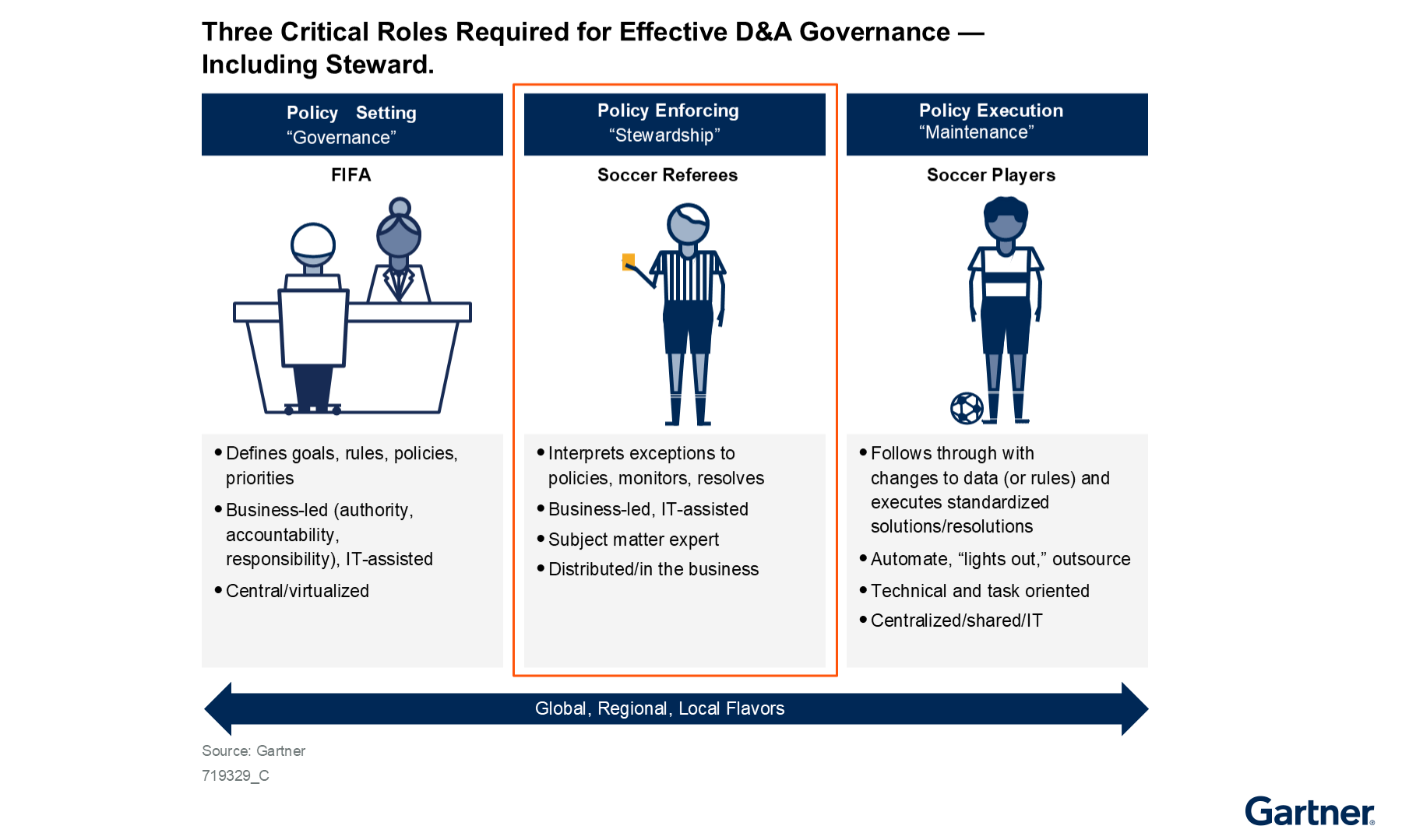
FIFA, the global policy-setting body for soccer/football, establishes the policies and rules for how the game should be played. On the other side, are the players who are actively playing the game. These two groups have very different altitudes of experience with the game, and we need to bridge that gap. That’s where our referees come in. The referees translate, in real time, the policies set for the game into the context of how the players are playing. They interpret the rules and ensure the game is being played safely and as expected. That is the data steward’s role. The stewards are responsible for understanding and applying data governance policies to those responsible for maintaining data.
While each of these roles has its own purpose and value, they do not overtake the role of another. For example, you would not see a FIFA member jumping into the game to show a player how to play. The same concept applies for data governance, stewardship and maintenance, wherein everyone should be respectful of the other role’s responsibilities and boundaries. By sharing an analogy like this one, D&A leaders can clarify any misperceptions and solidify understanding of the roles and their interactions.
Appeal to Top Motivators Through Clear and Varied Incentives
Even if people clearly understand their role in the greater context of governance, they may still need an incentive to drive them to action. Start by gaining an understanding of which modes of recognition are most successful at motivating desired behaviors in your workplace today. Consider adopting incentives like those shown in Table 1, which other organizations have implemented.
Drive Change Through Incentives
| Incentive | Benefit |
|---|---|
Relating the work of good data hygiene to business impact | Work will be seen to directly impact what the manager cares about |
Formal credentials or internal badges for the role | Beneficial for career advancement by acknowledging distinct skills required for success in the role |
Adding stewardship activities to team or individual performance metrics | Recognition of the work and the way it contributes to team/individual goals |
Extra days of paid time off | Getting personal time back for dedicating time to this effort |
Small financial benefits, such as gift cards, for accomplishments | Small financial recognition of a job well done |
Recognition from executive leaders | Increased influence and visibility across teams or functions |
Steward of the month [or quarter] program | Formal celebration of those who have gone above and beyond in role |
Source: Gartner (February 2026)
While individual-level incentives are an effective starting point, sustained stewardship requires complementary incentives at the team and organizational levels.
Case in Point: Business Must Drive Data Stewardship (Ovintiv)

Ovintiv, a company in the energy industry, began their governance effort by identifying problem solvers in various business domains, and educated them on the value and purpose of formal data stewardship. Then, to make the work of stewardship more practical, Ovintiv outlined three areas of work for stewards to target: quick wins, influence and practice base.
- Quick wins include codifying “workarounds” done in business processes, managing exceptions and preempting escalations to other governance groups through proactive issue resolution.
- Influence involves stewards using their own networks to find sponsors for governance tasks.
- Establishing a practice base involves encouraging stewards to go beyond improvement to existing processes and lead the way in designing solutions for the needs of the future.
Ovintiv also captured the steward’s impact beyond their immediate domain team. Examples of broader impact included: communicating solutions, ideas and proposals between governance and business teams and developing and monitoring pilots to test steward ideas at scale. By targeting the three unique pathways and capturing the stewards’ impact beyond their domain, Ovintiv successfully created a culture of stewardship and improved its collaboration throughout the organization.
Some of these incentives will take more coordination and time to implement than others. For best results, consider which incentives will be most effective in your context, and implement them on a small scale so you can rapidly iterate if they aren’t resulting in the behavior change you expect.
Sustain Effective Behaviors by Co-Creating a Script
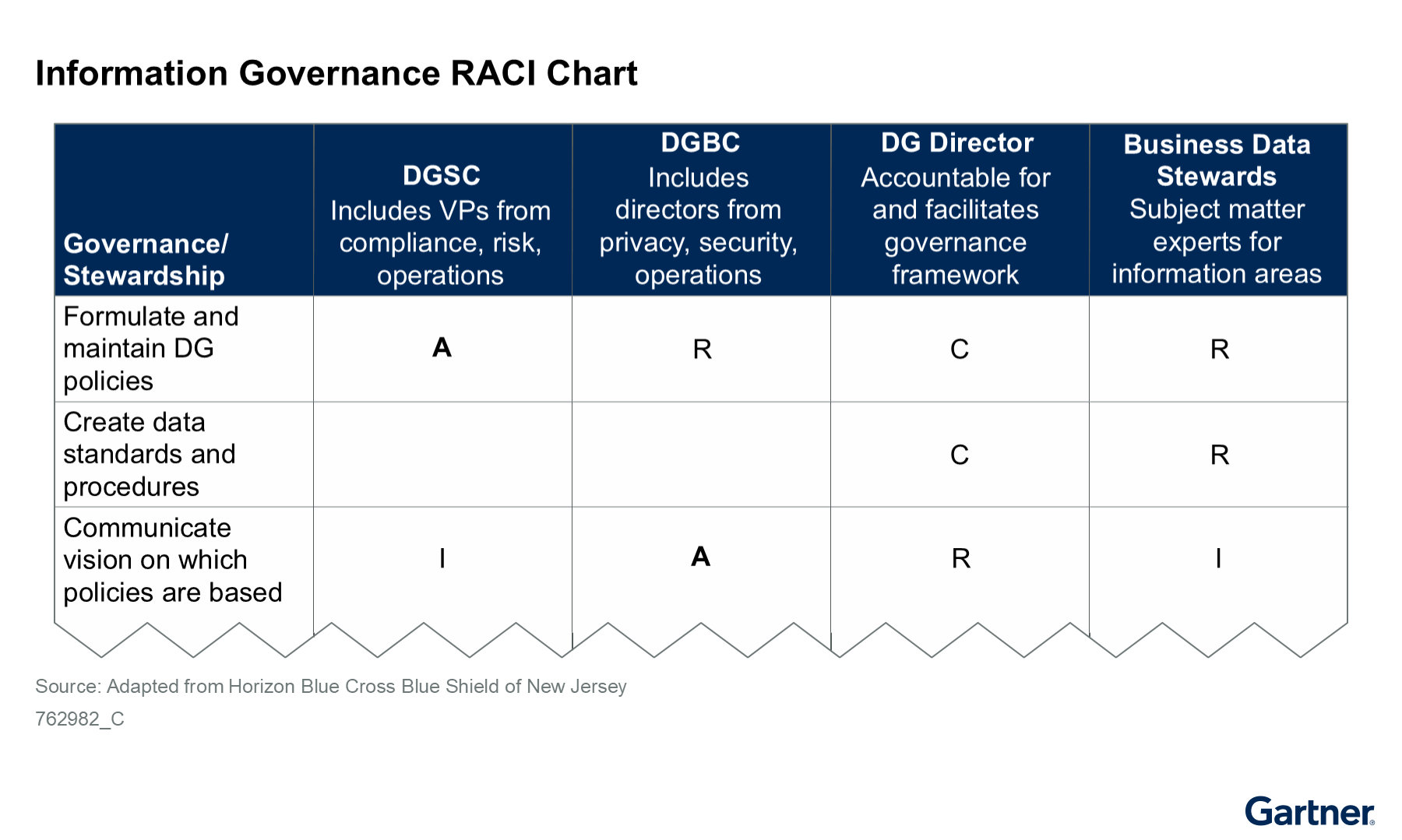
You must set up your governance roles for long-term success by continuously reducing the friction of change and minimizing the distractions that will inevitably arise in their workdays. This is critical in maintaining the changes you have driven so far. One tactic to ensure effective operations is scripting. Like in a movie, play or TV show, a script defines roles, responsibilities and actions people should take within a given situation. The script enables psychological safety and provides clarity on expectations and the final outcome. A common scripting tool for the workplace is the RACI (responsible, accountable, consulted and informed) matrix.
To use the RACI effectively, start with a list of activities to be accomplished in the first column and list all potential collaborators in the first row (see Figure 2). Then, bring the blank template to a discussion with the listed collaborators. Taking one row at a time, discuss among the group who should be accountable for the task’s completion, which might be a different group than the role responsible for carrying out the task. Consider who should be consulted in decision making and informed of each activity’s final output. You can leverage the template Toolkit: Create a RACI Matrix for Your Data and Analytics Governance Program for this approach.
Benefits of this conversational approach:
- Provides a low stakes environment where individuals feel free to share their perspective before the work actually begins.
- Co-creates the RACI matrix, rather than providing assignments.
- Highlights potential bottlenecks, including areas of disagreement and activities where no clear party is best for accountability or responsibility. It can provide an early signal into a role that might need more alignment with others, as well as advance warning of situations without clear authority for a task.
Be sure to clarify that the initial RACI exercise is not necessarily the final version. It will need to be tested to determine if it will work long term. It is critical to start somewhere to predict potential issues and setting a script like a RACI enables co-creation of the starting point.
Success Measures
Effective governance requires deliberate behavior change, not just role assignment or technology solutions. The following checklist defines success measures to assess whether change management tactics are driving expected behaviors.
Change Management Techniques to Drive Effective Governance
| Tactic | Success Criteria |
|---|---|
Start with the status quo | You can clearly articulate existing data stewardship and governance behaviors, including informal activities already performed by stakeholders. |
You understand stakeholder attitudes, motivations, and concerns related to governance responsibilities. | |
Use analogies to clarify roles | People from both business and technology teams can explain the purpose and boundaries of their role and how it interacts with other data governance roles. |
Establish incentives for behavior change | You have spoken to people managers and other leaders to determine which types of incentives are most meaningful to your audience. |
You have created a shortlist of incentives across individual, team and enterprise levels that you can test over time. | |
Co-create a script | You have defined specific governance activities and roles and co-created assignments using a RACI or similar tool. |
All participating roles understand the purpose of scripting and recognize that responsibilities will be refined iteratively as governance matures. | |
Source: Gartner (February 2026)
1 Data Stewardship: Trajectories of Success, Gartner Peer Community One-Minute Insights.