Optimize PC Procurement Costs Amid AI-Driven Price Increases and Supply Chain Disruption
17 June 2026 - ID G00855119 - 10 min read
By Erin Pierre, Katja Ruud, and 2 more
Increased costs and supply chain fragility have caused organizations to reevaluate their PC procurement and deployment strategies. Heads of I&O can use this research to select the best device procurement strategy for better cost optimization.
Insights at a Glance
Optimizing PC Procurement Strategies Amid Market Challenges
Increased costs and supply chain fragility are prompting organizations to reassess their PC procurement and deployment strategies. Leaders must analyze the benefits and potential risks of each PC procurement strategy to determine which one might help them optimize their costs effectively, especially as PC pricing continues to rise.
Device Procurement Strategies
- Purchasing PCs: Offers budget flexibility and extendable refresh cycles without penalty but requires internal capacity for management and capital availability. It provides autonomy over device life cycles and potential cost recovery through IT asset disposition (ITAD).
- Leasing PCs: Provides predictable monthly costs and is suitable for organizations with budget constraints. However, it may be more costly long term, and it involves strict return conditions.
- Managed device life cycle services (MDLS): Combines purchasing or leasing with outsourced management services, reducing operational burdens but increasing upfront costs. It aligns with modern device provisioning approaches and enhances device performance.
Recommendations
- Evaluate procurement models: Align procurement strategies with organizational priorities to optimize costs and operational efficiency.
- Leverage MDLS for efficiency: Use MDLS to outsource transactional services and improve asset management, especially for remote and hybrid work environments.
- Monitor AI PC developments: Collaborate with PC OEMs to assess the impact of neural processing units (NPUs) in AI PCs and increased component costs on residual values and adjust strategies accordingly.
- Minimize out-of-support and legacy devices: Maintain and adhere to a disciplined refresh cycle process to enhance security and sustainability while avoiding unnecessary costs.
- Optimize device management: Utilize digital employee experience (DEX) management tools to continuously improve device performance and reliability; potentially move to performance-based refresh cycles.
Strategic Planning Assumption
By 2030, it is anticipated that 75% of organizations will adopt some form of MDLS, a significant increase from less than 35% in 2025.
Impact
The expected future impact of AI PCs, component shortages, and budgetary pressures have led heads of I&O to question their existing PC procurement and provisioning practices. While devices have made up a relatively small portion of IT budgets over the past decade, the next era of the AI PC demands higher computing power to run endpoint workloads efficiently, thus increasing the cost of hardware through configuration upgrades. Price increases only compound with component shortage, which will increase pricing for the next two years. With the cost of hardware increasing, heads of I&O need to reevaluate their PC procurement strategy. Selecting the wrong procurement model can exacerbate key operational challenges and result in significant overspending, duplicated management efforts and wasted resources.
Heads of I&O need to determine the benefits and risks of each procurement model and align them with key organizational priorities to identify the right approach.
Actions
- Elect to purchase PCs for greater budget flexibility and the ability to extend refresh cycles to five or more years without added costs or penalties. Confirm your organization has both the internal capacity to effectively manage the device fleet and the capital available each year for purchasing.
- Adopt PC lease financing when there are budget constraints and benefit from the predictability of monthly financing when you desire shorter three- or four-year refresh cycles.
- Select MDLS with either purchasing or leasing to improve insufficient asset management capabilities for better asset utilization and security. However, understand that there may be a higher cost to outsourcing PC management processes.
How to Execute
Gartner tip: Regardless of the PC procurement model adopted, maintaining rigorous asset management practices is essential to minimize the accumulation of underutilized devices within various business units.
Purchase PCs to Increase Budget Flexibility and Extend Refresh Cycles
The majority of companies continue to purchase PCs outright, driven primarily by the desire to have greater autonomy over their PC fleet. Purchasing devices gives organizations the freedom to set their own depreciation and life cycle terms. To ensure efficient purchasing schedules, Gartner suggests leveraging DEX insights to make targeted life cycle decisions (see Optimize Device Life Cycle Management Using DEX Insights).
Purchasing PCs, coupled with a targeted life cycle approach, offers several benefits, including:
- Increased environment flexibility and simplified support tasks, as they are accomplished iteratively on a smaller scale instead of in massive, one-time rollouts
- Improved reliability by establishing easily tracked refresh cycles that avoid mistakenly extending devices beyond their useful operation
- Improved security through risk-driven refresh decisions
- Optimized sustainability, as device life cycles can be extended, avoiding unnecessary e-waste and upstream emissions
Furthermore, purchasing enables organizations to leverage trusted and personally vetted ITAD providers to ensure safe data disposal. It also enables organizations to potentially recover any residual value left on end-of-life hardware. Organizations should consult with PC OEMs to evaluate how residual values have been affected by the ongoing component shortages and the emergence of AI PCs and determine if these values have increased.
However, there are also key challenges associated with owning your devices:
- If organizations are not strict about their refreshment cycles and carry a large amount of legacy equipment, purchasing adds the risk of ad hoc hardware maintenance or replacement costs and introduces more variation in hardware models to support. To mitigate these unpredictable expenses, Gartner recommends utilizing endpoint analytics and DEX tools to quantify device performance. These technologies enable organizations to proactively remediate or replace hardware before technical issues escalate.
- Succumbing to the financial temptation of extending the useful life of PC assets (e.g., to five or more years) can incur rising maintenance costs and risk significant reliability issues that can severely impact employee productivity and experience.
PC purchasing is best for organizations that desire control over prescriptive, timed refresh cycles (e.g., four to five or more years), have budget flexibility and want to maintain full control over their device portfolio.
Choose PC Lease Financing for Its Predictability
Leasing PCs allows for a no-upfront-cost financial model that spreads hardware costs across the life of a device. Leasing offers a fixed monthly expenditure, based on a total present value cost that is less than the asset’s purchase price, typically 85% to 90% for a three-year lease.
However, despite the relative ease of financial management, PC leasing usually ends up being more costly for organizations in the long run as extending device life cycles is more expensive with a PC lease. There are also constricting requirements on equipment returns that make leasing less attractive. For example, there is a requirement that the organization must return all machines back at the end of the term in good condition; otherwise, it could incur penalties.
Those who choose to lease their PC assets should anticipate some modifications to the lease (term extension, asset upgrade or buyout) and negotiate upfront protections, such as rate caps, purchase price limits and end-of-term fees for such modifications.
Leasing should not be viewed as an option for reducing the overall cost of a device, but rather for improving the immediate cash flow and helping with budget restrictions.
PC leases become less financially attractive when terms extend beyond three years, as the lessor’s residual value (RV) equity investment in the lease declines. At three years, a PC typically has about a 10% to 15% RV, and at four years, that RV often declines to 5% or less. As a result, Gartner does not recommend leasing PCs beyond four years, because longer life cycles change the economics of the model.
However, with the rise of AI PCs and potentially more expensive devices, RV percentages have the potential to change and even increase. Organizations should partner with their leasing providers to evaluate the potential impact of AI PCs on their device RV. Specifically, organizations should determine if devices with higher neural processing unit (NPU) tera ops per second (TOPS) will have a higher residual value than those with lower NPU TOPS.
Leasing is also beneficial for organizations that want to refresh their devices more frequently for high-performance users or for a better DEX. However, organizations should note that shortening the life span of their PCs can increase their total cost of ownership (TCO) (see Three Strategies to Reduce End-User Services Total Cost of Ownership).
The risks associated with leasing include:
- In scenarios such as supply shortages, organizations must often hold onto their technologies well past their designated life span policies. Therefore, a reduced value and an increased cost are associated with leasing for those who need to leverage their technologies longer than planned.
- Higher interest rates have increasingly factored into the decline of leasing, causing companies to pay equal to, if not more than, the cost of purchasing the device outright.
- Unpredictable end-of-lease charges can increase the TCO of devices and create unforeseen costs for an organization.
- As the cost of devices increases, the associated leasing costs may also rise as well. It is critical that organizations receive full clarity on the interest rate and the residual value they are receiving for their lease agreement.
PC leasing is best for organizations with a three-year refresh cycle that want monthly financing and cost predictability, desire to provide their employees with the newest technology, and do not want to be constrained with a large capital expenditure., However, hidden end-of-lease fees and higher interest rates can drive up the TCO of devices.
Use MDLS to Deliver Transactional Services and Asset Management Capabilities
MDLS refers to the service model in which customers pay to have their PCs configured and supported throughout the life cycle. MDLS can be used with devices that are either purchased or leased, and it provides the ability to outsource some services that are generally transactional activities: for example, device readiness and end-of-life services (Figure 1). This compares to full-outsourcing models that combine commodity and value-added services, for example, application life cycle management or walk-up support centers.
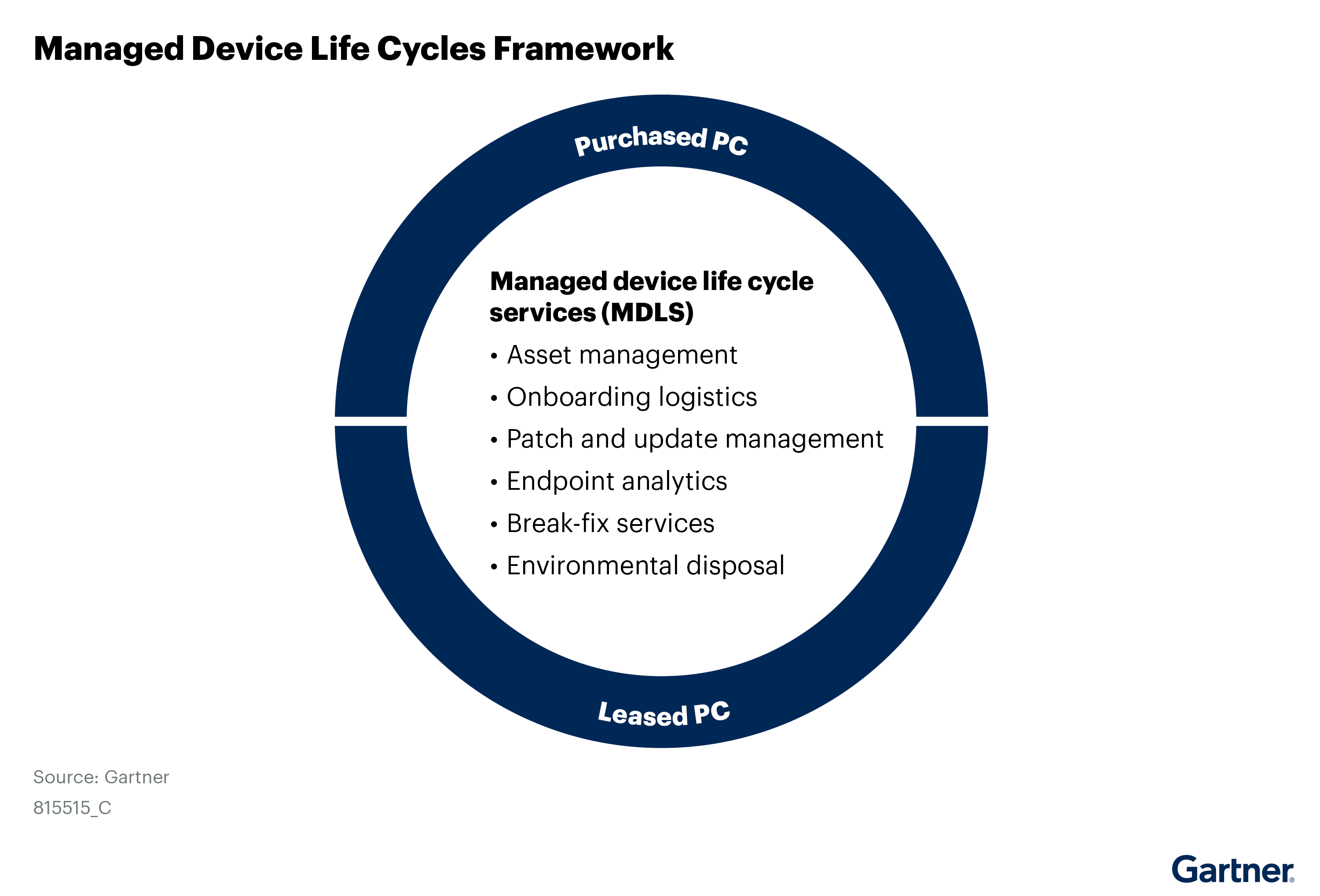
MDLS is an evolution of PC as a service (PCaaS), which grew in popularity prior to the pandemic. PCaaS combined the device, the financing and the services into an offering that clients found too restrictive and costly. MDLS takes the services elements from PCaaS and applies those alongside both leasing and purchasing. The services available are designed to help clients reduce their need to manage device life cycle and device management processes.
The benefits of MDLS include:
- Improved device performance and reliability with automatic device enrollment and DEX tools
- Reduced operational burden by outsourcing device management processes associated with widespread remote and hybrid work and outsourcing international teams
- Increased business value by enabling operational resources formerly devoted to life cycle management to shift to higher-value outcomes, such as measuring and improving the DEX
- Reduced time to deliver on services, coverage areas and hours of operation by outsourcing
MDLS is a growing market where OEMs and resellers continue to refine and expand offerings. The challenges of MDLS include:
- MDLS does not usually result in reduced expenses.
- You can’t reduce IT complexity or improve process maturity simply by outsourcing. The IT organization must have standards and well-established processes to get the full benefit of the MDLS.
- The primary business ambition of most MDLS providers is to increase margins by offering a highly efficient service that minimizes operational costs. This may conflict with an organization’s desire to offer the best overall user experience and innovate with new approaches and technologies. Avoid conflicts by establishing clear SLAs and RACI charts for services.
MDLS is an evolution of PCaaS but gives organizations the option to purchase or lease. It is best for organizations that have a clear scope and goals for what services they need, have established processes and standards, and are not evaluating this model as a potential cost-saving opportunity.
Success Measures
- Device TCO
- Support for cost per device
- Refresh cycle adherence
- Employee sentiment scores
- Reduction of ghost devices (those that are procured but not active on management tools)
The observations and assertions around market trends and consumer sentiments are a product of more than 1,000 inquiry discussions with end users, resellers, outsourcers and OEMs in the PC market since January 2025.