Buyer’s Guide for Data Security Posture Management
29 May 2026 - ID G00851461 - 12 min read
By Jaimie Anderson
DSPM tools discover, classify, and secure data across environments and use cases, but inconsistent vendor capabilities and complex compliance requirements complicate the selection process. Cybersecurity leaders should use this Buyer’s Guide to choose the right solution and avoid costly missteps.
Insights at a Glance
In today’s landscape of expanding data assets, the use of AI, and evolving data breach threats, data security posture management (DSPM) tools are in high demand. While they promise to easily help organizations classify, manage and secure their data more effectively, and identify potential risks, such as those linked to data residency, unauthorized access or excessive privileges, these tools can be costly and labor-intensive to operate.
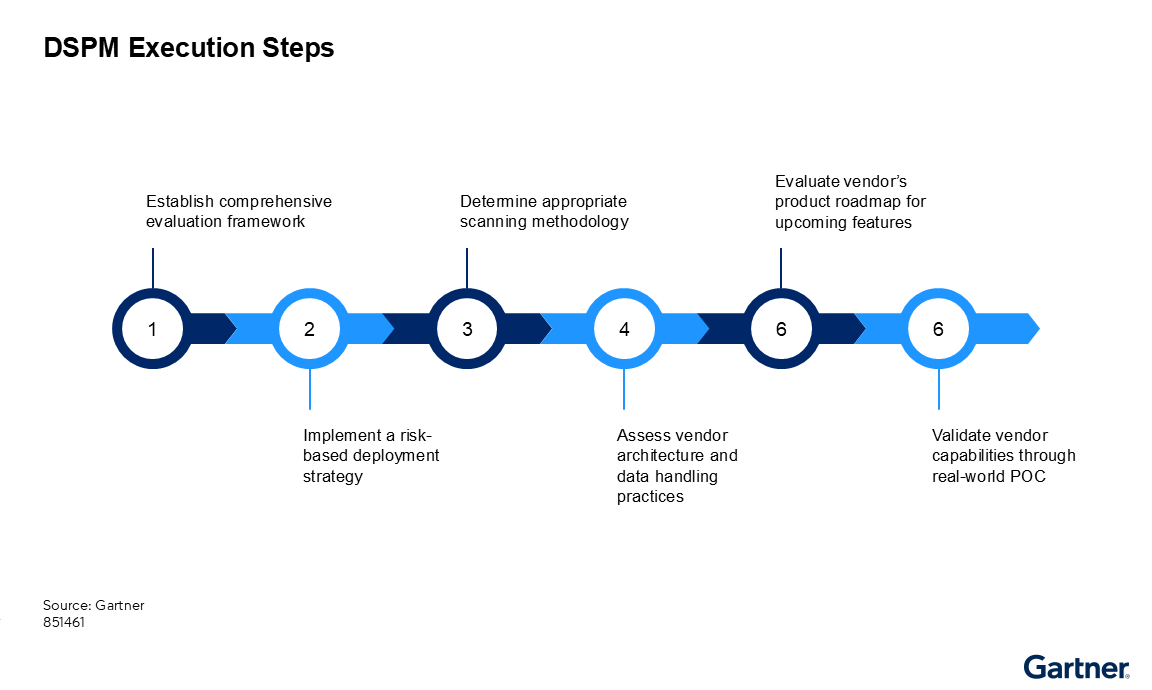
Selecting the right DSPM tool to meet the needs of today and the future requires a six-step strategic approach involving multiple stakeholders:
- Establish a comprehensive evaluation framework
- Implement a risk-based deployment strategy
- Determine the appropriate scanning methodology
- Assess vendor architecture and data handling practices
- Evaluate the vendor’s product roadmap for upcoming features
- Validate vendor capabilities through real-world POC
Best Practices and Cautions:
- Full data scans can be resource-intensive.
- DSPM complements, but does not replace, DLP or IAM solutions.
- Prioritize vendors that offer automated remediation capabilities, as this reduces manual intervention and minimizes the risk of alert fatigue among security teams.
- Proactive planning and stakeholder alignment are key.
Why It Matters:
The rapid growth of AI and evolving regulations make DSPM adoption urgent and complex. A disciplined, risk-based approach ensures resilient, scalable, and future-proof data security.
Impact
With the average cost of a data breach at $4.44 million globally (more than $10 million in the U.S.), robust data security posture management (DSPM) is critical. However, the rapid proliferation of DSPM solutions, driven largely by the accelerating sophistication of AI-driven data security requirements, has significantly increased market complexity. As a result, cybersecurity and risk management leaders face heightened challenges in evaluating and selecting vendors. This expanding array of DSPM offerings complicates the process of aligning solutions with an organization’s risk appetite, regulatory mandates (such as GDPR, CCPA, and HIPAA), and operational requirements.
Moreover, the capital expenditure associated with comprehensive data discovery and classification initiatives, particularly within hybrid and multicloud architectures, poses a significant barrier to adoption. Many organizations encounter financial and operational hesitancy from the executive suite, as the initial investment can be prohibitive and the return on investment (ROI) difficult to quantify in the short term. This reluctance to invest in foundational DSPM capabilities can lead to delayed implementation, thereby increasing residual risk exposure and leaving sensitive data assets vulnerable to advanced persistent threats (shadow data exfiltration, privilege abuse, and insider threats) and regulatory penalties.
Establishing a framework, implementing a risk-based approach, determining appropriate scanning methods, assessing vendor architecture and understanding future investments with DSPM are key in selecting the vendor that works best for your organization.
Actions
The successful selection of a DSPM product requires a six-step process:
- Establish a comprehensive evaluation framework: Define and prioritize cross-functional requirements and detailed use cases to guide the selection of a DSPM solution, ensuring alignment across security, IT, and business stakeholders.
- Implement a risk-based deployment strategy: Develop a phased roadmap for connecting data sources to DSPM, prioritizing the highest-risk data assets to ensure immediate and critical security uplift.
- Determine the appropriate scanning methodology: Assess your organization’s critical and high-risk data to identify the most suitable scanning techniques (e.g., metadata scanning, full data scanning or sample data scanning). Selecting the appropriate approach to data scanning will provide greater accuracy in estimating time to value and project timelines, and ensure alignment with your data security objectives.
- Assess vendor architecture and data handling practices: Evaluate if the vendor deploys scanning agents and how discovered data is stored and processed. Determine whether the solution supports deployment within your organization’s private cloud or on-premises environments, or if scanning is restricted to the vendor’s cloud environment. Clarify the types of agents utilized (e.g., server-based agents, serverless), any requirements for direct installation on your infrastructure, and associated operational or licensing costs. Ensure the vendor’s approach aligns with your organization’s data residency, privacy, and security requirements.
- Evaluate the vendor’s product roadmap for upcoming features: Proactively request the vendor’s product roadmap to gain insight into planned future capabilities and advancements. As you are making a financial investment in this vendor, it is essential to understand its strategic direction and how its forthcoming enhancements will support the advancement of your DSPM solution for robust data protection.
- Validate vendor capabilities through real-world POC: Conduct focused proof-of-concept (POC) engagements with shortlisted vendors to evaluate their solution’s performance and efficacy within your live enterprise environment.
Cautions
Key Cautions When Implementing DSPM Solutions:
- Full data scans can be time-consuming: When opting for comprehensive data scans across large repositories, be aware that the process may take several days to weeks to complete, potentially impacting project timelines and resource allocation.
- DSPM is not a replacement for DLP or IAM: DSPM solutions are designed to complement, not replace, existing data loss prevention (DLP) and privileged access management (PAM) tools. A layered security approach remains essential.
- Alert fatigue is a real concern: The high volume of alerts generated after DSPM deployment can overwhelm security teams. Prioritize vendors that offer automated risk scoring, remediation and robust continuous monitoring to streamline incident response and reduce operational overhead.
- Cost considerations and executive buy-in: DSPM solutions often require a significant upfront investment. It is critical to set clear expectations with executive leadership regarding initial costs, while emphasizing the long-term value in risk reduction and potential savings in data storage and compliance costs.
How to Execute
Step 1: Establish a Comprehensive Evaluation Framework
To initiate a comprehensive evaluation of DSPM solutions, first conduct a structured requirements-gathering process involving all relevant stakeholders, including representatives from security, compliance, risk management, IT operations, and data governance. Each requirement should then be systematically assessed and categorized based on risk prioritization (using a framework such as critical, high, medium, or low risk) to ensure alignment with the organization’s risk appetite and regulatory obligations (see Table 1).
During the vendor selection process, engage each prospective DSPM provider in a rigorous evaluation, mapping its capabilities and responses directly to your prioritized requirements. For each criterion, apply a standardized scoring methodology (e.g., a one-to-five scale) to objectively measure the vendor’s ability to address your organization’s unique needs. This approach enables a defensible, data-driven selection process, ensuring that the chosen DSPM solution delivers maximum value in terms of risk reduction, compliance, and operational efficiency.
Example of Capability Requirements
Requirement (Starter and sample requirements) | Priority (Select based on organizational requirements) | Vendor capability score |
Does the solution support multiple deployment models | Low/Med/High | 1 to 5 |
Does the solution integrate seamlessly with SIEM | Low/Med/High | 1 to 5 |
Does the solution use regex or AI for auto classification | Low/Med/High | 1 to 5 |
Does the solution support metadata or full data scanning | Low/Med/High | 1 to 5 |
Does the solution provide data lineage | Low/Med/High | 1 to 5 |
Does the solution provide user behavior analytics | Low/Med/High | 1 to 5 |
Does the solution provide for automated remediation of alerts | Low/Med/High | 1 to 5 |
What compliance frameworks does the solution have built in | Low/Med/High | 1 to 5 |
Source: Gartner (May 2026)
For each of your highest-priority requirements, develop comprehensive use cases that vendors must address in detail. Each use case should articulate clear expectations and desired outcomes, and should include an overview, objectives, scenario, and anticipated benefits. These use cases are intended to be shared with vendors to ensure they understand precisely what is required to demonstrate their solution’s capabilities. Focus on the top risk-driven requirements and leverage these use cases as an additional evaluation tool during vendor outreach and product demonstrations.
Step 2: Implement a Risk-Based Deployment Strategy
In parallel, conduct a comprehensive assessment of your organization’s data architecture as a foundational step prior to DSPM implementation. Develop and maintain a robust inventory of all data assets, spanning on-premises infrastructure, cloud environments, and SaaS platforms, to ensure full visibility into the data landscape. This inventory should include asset ownership, data source type, and the potential sensitivity or criticality of the data, leveraging internal data classification policies where possible.
While it may not be necessary to definitively identify the sensitivity level of every data source at this stage, it is prudent to provisionally tag data repositories suspected of containing highly sensitive or business-critical information so that the most impactful areas are addressed early in the deployment process.
Organizations can leverage DSPM to automatically build and maintain this inventory for data residing in the cloud. Once connected to the cloud account, DSPM utilizes API calls and scan logs to comprehensively identify and map the locations of sensitive data across the entire cloud environment.
Step 3: Determine the Appropriate Scanning Methodology
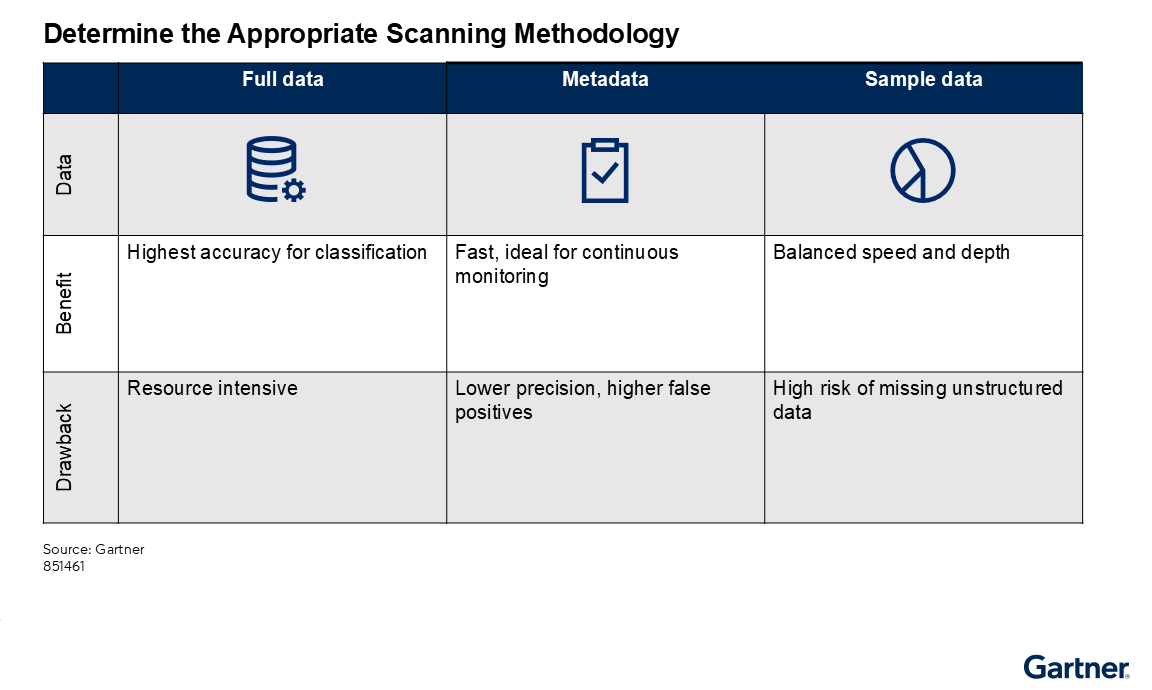
Another critical factor in vendor assessment is understanding the methods used for data scanning. There are three primary approaches: full data scanning, metadata scanning, and partial (sample) scanning.
- Full data scanning: This method involves reading the actual contents of each file, delivering the most comprehensive information for data classification and risk assessment. Outputs typically include file creation, modification, and access dates, the number of file copies, and their locations across the environment. The primary drawback is performance; full scans are resource-intensive and can take days or even weeks to complete in large-scale data repositories.
- Metadata scanning: This method analyzes only file attributes such as type, size, and access permissions, without examining the file’s content. This approach is significantly faster than full data scanning and is well-suited for continuous monitoring. However, it may result in higher false positives and less precise data classification compared to full content scans.
- Partial (sample) scanning: This method, often used with structured data, examines only a subset or sample of the data within repositories. This method offers a balance between speed and depth, making it more efficient than full scans. However, it is generally not recommended for unstructured data, as it may miss sensitive information not included in the sample.
Step 4: Assess Vendor Architecture and Data Handling Practices
Understanding the deployment architecture of a DSPM solution is critical, especially for organizations with stringent compliance requirements. For some, the DSPM platform must be deployed entirely on-premises to ensure data sovereignty and regulatory compliance. Not all vendors can accommodate these needs or have a roadmap to do so, making it essential to evaluate which solutions meet your organization’s architectural and compliance criteria.
Deployment Options:
- Self-hosted: Ideal for highly regulated environments requiring full control over data and compliance. Scanning and classification are performed within the organization’s on-premises, VPC, or private cloud infrastructure, ensuring data never leaves the network perimeter.
- SaaS-hosted: Suitable for organizations with less stringent regulatory requirements. The DSPM platform is managed in the vendor’s cloud, with scanning performed through API integrations to the organization’s data repositories.
Scanning Options:
- Agent-based: Involves deploying software agents on servers or endpoints. While requiring more maintenance, agents enable deep scanning, runtime protection, and can operate even when disconnected from the enterprise network.
- Agentless: Modern DSPM solutions increasingly use agentless scanning for faster deployment and minimal performance impact. This approach leverages API integrations to remotely assess systems and data flows without installing software on target hosts.
- Dynamic: Some solutions offer dynamic scanning capabilities, adapting to changes in the environment to ensure continuous data discovery and classification.
Carefully evaluate each vendor’s deployment and scanning models to ensure alignment with your organization’s security, compliance, and operational requirements.
Step 5: Evaluate the Vendor’s Product Roadmap for Upcoming Features
You should not hesitate to inquire with the vendor about its solution roadmap. While it may not currently offer a feature or capability that meets one of your requirements, it could be planned for an upcoming release. Proactively asking these questions can help you avoid significant investments in a product that may not align with your organization’s evolving data security needs. For example, if your organization is rapidly expanding into the artificial intelligence space, confirm that the vendor can support scanning and securing data leveraged for AI. If this capability is not yet available, ensure that it is scheduled for release within your contract life cycle.
Step 6: Validate Vendor Capabilities Through Real-World POC
Once all the preparatory steps have been completed, you are ready to proceed with a proof of concept (POC) involving your top DSPM vendors. In most cases, the DSPM vendor will request access to your M365 or a similar environment, as these platforms typically contain the unstructured data where DSPM solutions provide the greatest value. Additionally, you may choose to connect the DSPM solution to a database to evaluate its capabilities around structured data.
Ensure that you assess each DSPM platform against your defined requirements and use cases. Pay close attention to the responsiveness and expertise of the vendor’s support team, as well as the quality and extent of training provided to your data security personnel.
Success Measures
Success is evaluated based on the tool’s demonstrable impact on risk reduction, data life cycle management, and enhanced visibility into data usage. The following key performance indicators (KPIs) are tracked to measure DSPM effectiveness:
Sensitive data coverage
- Definition: The percentage of the organization’s data landscape that has been successfully. discovered, mapped, classified, and continuously monitored by DSPM.
- Example metric: The percentage of total data assets inventoried and monitored for sensitivity.
Risk reduction
- Definition: The quantifiable decrease in the number of high-risk data assets — such as sensitive data stores lacking encryption, proper access controls, or exhibiting misconfigurations — identified and remediated over time.
- Example metric: The percentage reduction in critical data risks within a defined period (e.g., six months).
Expired data reduction
- Definition: The volume or percentage of expired, orphaned, or redundant data identified and remediated (archived or deleted) through DSPM, which directly contributes to ROI by reducing unnecessary storage costs and minimizing data exposure.
- Example metric: GB/TB of stale data removed per quarter.
Compliance posture improvement
- Definition: Measurable improvement in compliance audit scores or reduction in compliance gaps (e.g., GDPR, CCPA) attributable to DSPM-driven data discovery, classification, and policy enforcement. Ensures compliance teams have granular visibility into the location and status of regulated data types (PII, PHI, financial data) across all environments.
- Example metric: The percent reduction in compliance gaps identified during audits and the percent increase in audit pass rates year-over-year.
Access and permission management
- Definition: Ongoing reduction of excessive or unnecessary data access privileges, with timely remediation of overprivileged accounts to enforce least-privilege principles and reduce insider risk.
- Example metric: The percent decrease in users with excessive data access privileges. Average time to remediate overprivileged access incidents.