Magic Quadrant for Digital Twin of an Organization Platforms
27 July 2026 - ID G00843099 - 62 min read
By Marc Kerremans, David Sugden, and 1 more
A digital twin of an organization is a dynamic model to help enterprises plan, monitor, and scale complex initiatives that have a lot of interdependencies, such as autonomous business transformations. DTO platforms help heads of enterprise architecture build and manage these models.
Market Definition/Description
A digital twin of an organization (DTO) is a dynamic software model that relies on operational and contextual data to understand how an organization operationalizes its business model, connects with its current state, responds to changes, deploys resources, simulates future states and delivers customer value. A DTO platform is a technology platform that supports the creation, management and operationalization of a DTO.
The market for DTO platforms covers multiple use cases that can be bundled into four major use cases: digital twin for business operations (including supply chain, process intelligence, operational excellence, BPO), digital twin for customer excellence, digital twin for governance, risk and compliance (including risk, auditing, compliance, quality), and digital twin for strategy realization (including digital optimization and transformation, enterprise cost optimization). Each of these use cases has its own stakeholders, roles, objectives and related product features and functionality.
All vendors active in the DTO platform market provide features and functionality for most of these use cases. However, the focus, breadth and depth of these features and functionality vary depending on the predominant use case that the vendors market and implement.
Mandatory Features
Business Operations Model Capabilities
- Models of processes and tasks: Modeling and analysis of business operations, business processes and the decomposition of these process models according to a business process hierarchy (subprocesses, activities, tasks).
- Models of capabilities and resources: Modeling of resources (such as machines, IT systems, people, agents, time and finance) that perform the operations.
- Models of deliverables and components: Modeling of offerings (products, services and information) and their composition, delivering value to internal and external clients.
- Models of client, supplier and external stakeholders: Modeling of customer, supplier and external stakeholder interactions and journeys, allowing for segmentation.
- Orchestration repository: A repository that supports the modeling and analysis of business operations in a larger (business) operating model context, indicating how capabilities and other resources are deployed to deliver value to the stakeholders of the organization.
Business Performance Capabilities
- Performances measurement schemes: Multiple measurement schemes (such as operational performance indicators, financial models, quality schemes, SLAs) and how they work together or interact within the context of a business operating model.
- Advanced analysis techniques: Root cause analysis, cost-value analysis, scenario testing, predictive and prescriptive analytics based on the business operations model, and analysis based upon externally provided measurements such as temperature, air pollution and noise.
- Risk management and monitoring: Identification of risks, risk controls and risk measurements within the context of a business operating model.
Business Operational Intelligence Capabilities
- Event processing: Filtering incoming event data and detecting simple patterns that represent threats and opportunities (including exceptions or anomalies).
- Data connectivity: Adapters or connectors to receive and send data, and extract, transform, load (ETL) capabilities. Some platforms also have adapters for web services, packaged applications, or for sensor data in event streams or historical databases.
- AI capabilities: Enhancing understanding and explainability, data preprocessing and discovery, real-time monitoring and optimization, and cross-domain usage.
- Real-time intelligence: Real-time monitoring, connected to real-time dashboards that continuously refresh and are typically updated every second, every few seconds or every few minutes, and can initiate alerts and actions.
Optional Features
Additional, commonly provided features are:
- Process mining capabilities: Discovering, monitoring and improving actual processes (i.e., not assumed processes) by extracting knowledge from event logs readily available in today’s information systems.
- Support for, or embedding, process automation: Helping to unlock opportunities for automation and prepare the automation of tasks, processes and business operations.
- Graphical capabilities: Graphical overlays of items, constructions, workplaces, and areas to enhance visibility and clarify interdependencies.
- Simulation capabilities: An experimentation with a simplified imitation (on a computer) of a business operation as it progresses through time, to better understand or improve that business operation.
Magic Quadrant
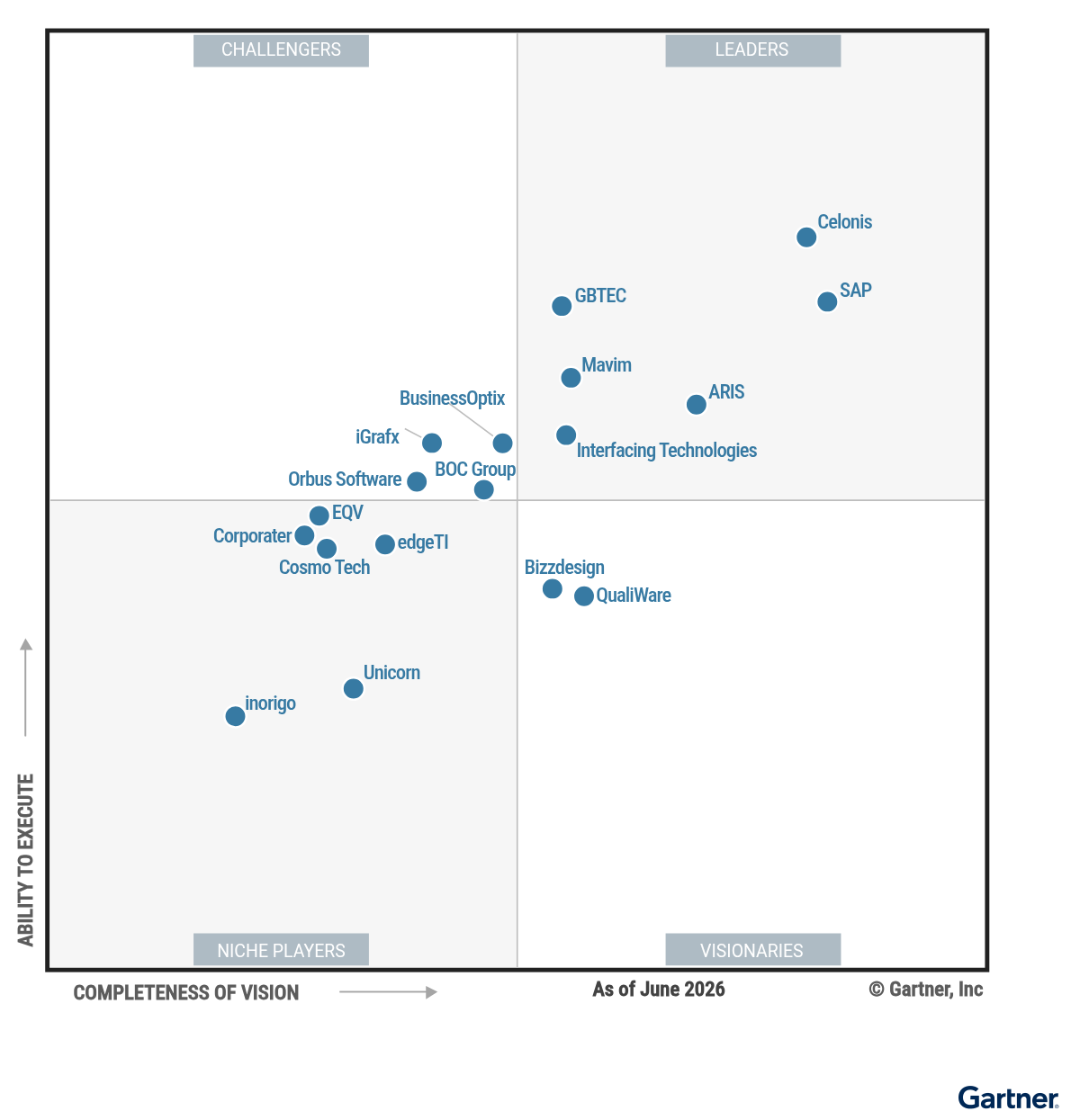
Vendor Strengths and Cautions
ARIS
ARIS is a Leader in this Magic Quadrant. Its ARIS Process Intelligence platform broadly focuses on providing a unified, repository-centric digital twin that natively combines process modeling, process mining, resource modeling, simulation, workflow orchestration, and governance, risk, and compliance (GRC). Its clients tend to be large enterprises and highly regulated organizations across sectors like banking, financial services, manufacturing, supply chain, and retail.
ARIS prioritizes rapid time-to-value through prebuilt blueprints and accelerators while preserving
deployment flexibility across SaaS, private cloud, and on-premises for regulated environments.
ARIS’ future investments focus heavily on agentic AI, the ARIS AI Companion, and native object-centric process mining (OCPM), which will act as an essential, governed control room for enterprise adoption of autonomous AI agents.
- Market understanding: ARIS demonstrates domain knowledge and proof points across industries through case studies, long product heritage, and active co-innovation with strategic customers and academia. It offers industry-relevant patterns and accelerators that potentially shorten deployment time and leverage proven practices in regulated environments.
- Innovation: ARIS demonstrates commitment to product innovation through investments in agentic AI, conversational AI modeling, and OCPM. The vendor has increased R&D intensity and moved to a monthly public cloud release model that provides shorter delivery compared with a traditional semiannual release model.
- Unified platform and GRC integration: ARIS combines native process mining, simulation, prescriptive analytics, and workflow orchestration via ARIS Flows to create a closed loop from discovery to action. This allows it to convert mining insights into governed follow-up actions that accelerate automation readiness and continuous improvement.
- Sales strategy: ARIS’ pricing model includes several complex elements, like tenant/server capacity metrics, AI credit consumption weighted by outcome, and modular add-ons. Clients not familiar with this complexity will need careful contract design and should plan for bespoke commercial discussions that could extend contracting timelines.
- Customer experience: Advanced capabilities like validated quality management, complex governance, and task mining integration often require professional services or OEM partnerships. Buyers should plan for service effort, privacy/legal reviews, and change management to avoid slower adoption or implementation delays.
- Geographic concentration: ARIS’ operations and customer base are heavily regionalized in EMEA, with significantly smaller direct presences in North America and APAC. For clients outside of EMEA, this increases dependency on partner capabilities for localization, compliance, and implementations.
Bizzdesign
Bizzdesign is a Visionary in this Magic Quadrant. It positions its Hopex platform as a single, integrated SaaS offering that combines enterprise architecture, business process management (BPM), GRC, and strategic portfolio management (SPM) in a unified, metamodel-driven repository. This provides a single source of truth for strategy-to-execution traceability, reducing integration overhead, and enabling faster impact analysis and governance.
Bizzdesign’s global footprint is broad, with both internal offices and an extensive partner network across North America, Latin America, EMEA and Asia/Pacific. It serves multivertical delivery across the banking, transport, manufacturing, and consumer sectors.
Bizzdesign’s roadmap focuses on enhancing the AI-driven process modeling, deepening the partnership with mpmX (process intelligence), enabling tighter integration between modeling and execution insights, and strengthening collaborative modeling capabilities.
- Market understanding: Bizzdesign articulates a clear, AI-native DTO vision and multiyear roadmap centered on AI-augmented modeling, AI-agent life cycle design, expanded real-time connectivity, collaborative decision intelligence, and democratized access. This trajectory aligns to emerging market expectations and provides a path for capability evolution.
- Business model: Bizzdesign demonstrates growth through its merger with MEGA International (BPM, EA) and Alfabet (EA, SPM), a global delivery footprint, and a partner ecosystem, all while maintaining an independent, customer-focused posture and sustained operational profitability.
- Geographic strategy: Bizzdesign’s multilanguage support and 24/7 support model provides local language support, regional contacts, and continuous coverage for incident response and enablement for customers with globally distributed operations.
- Product/service: A third-party partner (mpmX) provides process mining and detailed runtime process intelligence, rather than Bizzdesign itself. Buyers seeking a single-vendor native stack for mining, modeling, and simulation should expect additional contractual, integration, and licensing coordination, and should validate integration depth and SLAs.
- Sales execution: Postmerger accounting, rather than clearly demonstrated organic growth trends, drove Bizzdesign’s large projected FY25 revenue increase. Customers and procurement teams should treat headline revenue and growth metrics cautiously and verify that reference pricing, support capacity, and service levels reflect sustainable, ongoing operations, rather than one-off consolidation effects.
- Marketing execution: Given its current marketing resourcing, Bizzdesign’s planned expansion beyond traditional EA audiences risks execution gaps. The vendor has explicit priority to move into broader business buyers, especially in this DTO platform market, so customers should further evaluate the vendor’s ability to drive rapid commercial traction outside established EA channels.
BOC Group
BOC Group (BOC) is a Challenger in this Magic Quadrant. BOC delivers its DTO through the Enterprise Intelligence Platform (EIP), which natively integrates business process management (ADONIS), enterprise architecture (ADOIT), and GRC (ADOGRC) in an underlying unified platform called ADOxx. The platform features a central semantic repository and object-centric metamodel.
BOC’s operations concentrate in EMEA, and its 60+ boutique partners are driving expansion in North America, Latin America and Asia/Pacific. Its clients span highly regulated sectors like energy, life sciences, banking, and financial services.
BOC invests in Linux-based, containerized environments and Kubernetes for scalability and security. Its SaaS and on-premises options address data residency needs, while a microservices architecture enables modular scaling and faster releases.
BOC’s roadmap includes expanded AI assistant capabilities, improved UX and GRC automation, and workspace-driven analysis. Future plans focus on natural language search, agentic AI, graphical excellence, and semiautonomous operations.
- Unified platform & native integration: Unlike competitors who rely on integrating acquired products via APIs, BOC’s suite shares a unified, object-centric metamodel and native repository, ensuring consistent data and end-to-end traceability.
- Sales strategy & cost efficiency: BOC leverages total cost of ownership (TCO) as a primary sales differentiator, reducing commercial and integration complexity. The platform’s cost structure, modular licensing, and OS/database flexibility (including Linux and cost-effective databases) enable competitive pricing and scalability.
- Customer experience: BOC offers a unified UX and strong support for its DTO platform. Its proprietary modeling environment reduces fragmentation and complexity, supporting self-service access via web browser, and offering free training materials.
- Geographic strategy: BOC’s operations and customer base remain heavily concentrated in EMEA. The vendor’s physical presence in North America, Latin America, and Asia/Pacific relies on partner networks rather than internal offices. For clients outside of EMEA, this increases dependency on partner capabilities for localization, compliance, and implementations.
- Marketing execution: BOC is evolving its positioning from BPM and EA toward a broader Enterprise Intelligence Platform strategy, while continuing to leverage its established BPM and EA market presence. Reliance on partners for go-to-market may slow responsiveness.
- Innovation: While BOC does not position itself as a real-time event processing platform, the platform integrates with operational systems and analytics solutions to provide near-real-time decision support where required. Clients searching for these capabilities should expect third-party integrations.
BusinessOptix
BusinessOptix is a Challenger in this Magic Quadrant. Its DTO offering, also named BusinessOptix, is a SaaS-based, process-first, end-to-end DTO platform that natively combines BPMN-based modeling, hierarchical decomposition, resource and journey modeling, GRC, simulation, and a centralized repository. BusinessOptix has a strong presence in EMEA and North America, and is expanding its reach in Asia/Pacific and Latin America through partners.
BusinessOptix is widely deployed in heavily regulated and complex environments. Its go-to-market emphasizes financial services and BPO, where it has large, verifiable deployments and co-innovation partnerships (notably with Capgemini and WNS) to validate delivery at scale.
BusinessOptix has embedded OCPM into its DTO. This allows the platform to create a live, contextual model of the organization by connecting mined objects to capabilities, applications, and value streams, unifying execution data with enterprise architecture. BusinessOptix’s roadmap features deeper AI-driven discovery and creation, expanding capabilities like Discovery Agent and Knowledge Agent to automate the ingestion of process knowledge, expanded real-time integration, and automated compliance monitoring.
- Product/service: BusinessOptix couples object-centric process mining with process modeling, native, simulation, scenario testing, and KPI-linked analytics inside a single repository. This enables organizations to move seamlessly from design to decision making, run what-if scenarios, and quantify trade-offs across cost, capacity, quality, and SLAs.
- Business model: BusinessOptix leverages co-innovation and channel relationships, research collaboration with a large client, and R&D reinvestment to drive product evolution. Customers benefit from a platform under active development and validated in large, real-world transformation programs, reducing solution risk for complex enterprise use cases.
- Sales strategy: BusinessOptix is investing to scale GTM and enablement. This signals improved postsale support, onboarding, and adoption capabilities that can accelerate time-to-value for customers.
- Vertical/industry strategy: High revenue and reference concentration in financial services and BPO reflects the vendor’s go-to-market focus. Organizations outside those core industries may encounter fewer sector-specific accelerators and packaged vertical content, which increases implementation and value delivery time.
- Operations/geography: BusinessOptix’s regional delivery footprint is uneven and the vendor itself cites a lack of local presence and limited brand awareness as lost-deal factors. This creates higher implementation and support risk for customers in regions without local teams and may increase dependency on partner capabilities for localization, compliance and ongoing operations.
- Real-time strategy: BusinessOptix explicitly defers subsecond, generalized event correlation to third-party platforms. Customers needing ultra-low-latency streaming analytics or sophisticated complex-event processing (CEP) must deploy and integrate external stream processing technology, adding architectural complexity and integration effort.
Celonis
Celonis is a Leader in this Magic Quadrant. Its Celonis Platform is cloud-native. Its core components include Data Core for ETL and integration, and the Process Intelligence (PI) Graph as the foundational operational and system-agnostic object-centric living DTO layer. Other core components include a Context Model that turns that foundation into operational context that AI agents can reason on and act with, and a marketplace with more than 800 apps. Celonis is offered as an annual or multiyear SaaS subscription. Operations are primarily concentrated in EMEA and North America, with clients ranging from midmarket to large global enterprises in sectors such as life sciences, consumer packaged goods, banking, manufacturing, and automotive.
Celonis’ roadmap emphasizes evolving the PI Graph with richer semantic process ontology (Celonis Context Model) and an Agentic Application Framework for orchestrating AI agents. Its upcoming innovations include Apollo, an AI consultant leveraging knowledge from thousands of implementations, and expanded support for unstructured data and task-level details. Native support for some languages, such as Arabic, remains on the roadmap.
- Product strategy: Celonis is driving the convergence of process design, monitoring, and execution. Its PI Graph enables organizations to move from insight to action in real time. The platform’s evolution toward supporting autonomous enterprise operations, where AI agents can sense and execute, sets a clear direction for the DTO market.
- Data Core & integration: The Data Core delivers scale and speed, processing billions of records with subsecond latency. Zero-copy, bidirectional integrations with organizations like Databricks and Microsoft Fabric eliminate data duplication and reduce operational friction. Celonis’ prebuilt connectors and GenAI ETL assistants accelerate onboarding and democratize data integration.
- Industry/vertical strategy: Celonis delivers prebuilt solutions and process catalogs for major industries, including tailored offerings like Celonis for Defense & Security and deep supply chain capabilities. The platform sees adoption in complex, regulated sectors.
- Pricing: Celonis’ process-based subscription with fair-use caps creates scoping ambiguity, as customers must align their process definitions with the Celonis Process Catalog. While core features allow unlimited users, Task Mining and Process Management are seat-based add-ons. This often causes confusion over feature entitlements and unexpected costs.
- Sales execution: Celonis’ primary go-to-market actions target large enterprises, often requiring lengthy sales cycles and significant presales investment. SMBs are primarily served through partners, limiting direct engagement and slowing adoption in this segment. The platform’s marketing relies on high-profile customer success stories, which may set unrealistic expectations for less-mature organizations and risk alienating potential customers.
- Modeling of processes, capabilities, and deliverables: Celonis’ modeling and simulation capabilities within Celonis Process Management (CPM) lag those of other Leaders, with Gartner clients frequently reporting limited advanced design features. Modelers may find the CPM suite restrictive when designing and simulating complex operational changes.
Corporater
Corporater is a Niche Player in this Magic Quadrant. It offers an integrated DTO platform purpose-built for governance, performance, risk, and compliance (GPRC), combining relational and proprietary in-memory databases for real-time, complex object interlinking.
The vast majority of Corporater’s revenue and customer base concentrates in EMEA. Most of its projected revenue comes from financial services, manufacturing, and government. Its go-to-market focuses on GRC, quality management, operational excellence, and strategy realization, targeting organizations consolidating fragmented solutions.
The organization’s roadmap centers on AI-native and ecosystem-connected DTO transformation. Planned innovations include an AI integration framework, Object Model Factory for no-code extensibility, Model Content Exchange, and more.
- Unified, single-code platform: Corporater’s platform combines a relational database with a proprietary graph-like, in-memory database to deliver a unified experience across domains. This ensures native interoperability between its capabilities and supports the real-time, complex interlinking of any organizational object.
- Flexible configuration and deployment: Corporater’s platform natively supports SaaS, on-premises, and hybrid deployments. Customers can configure their DTO to match unique business requirements using low-code/no-code configuration to reduce time-to-value.
- GRC coverage: Corporater’s platform is purpose-built for business-integrated GPRC. It supports integrated governance frameworks, centralized risk management, and multiframework compliance with automated obligation mapping. Integrating control frameworks and risk analytics into a single model allows Corporater to connect risk and compliance directly to strategic objectives and performance outcomes.
- Marketing and brand awareness: Market awareness for Corporater lags behind larger enterprise vendors. While efforts are underway to change this, its overall marketing reach remains constrained.
- Sales execution: Corporater’s commercial model can be complex and is currently being revised; it uses a base platform price combined with use-case/domain-specific modules, user tiers, and integration add-ons. Corporater’s sales and service model relies heavily on partners for market responsiveness and coverage, especially outside EMEA.
- Niche focus and customer concentration: The platform’s success is concentrated both vertically and geographically. Because its model focuses on GRC and strategy execution, customers seeking alternative use cases and vertical support should confirm if support comes directly from Corporater or from its partners.
Cosmo Tech
Cosmo Tech is a Niche Player in this Magic Quadrant. Cosmo Tech positions its AI-Simulation Platform as an enterprise decision backbone that embeds simulation-driven decision intelligence across planning, operations, and investments.
Cosmo Tech is mainly active in Europe, with a growing presence in North America, where it focuses on direct enterprise sales supported by strategic system integration and technology partners. It tends to serve clients in regulated, capital-intensive industries where defensible, auditable decisions matter.
The company’s main investments focus on its proprietary Complex System Modeling language (CoSML), enabling scenario-driven simulations that capture cascading risks, quantify trade-offs, and optimize enterprisewide decisions. Its roadmap priorities emphasize deeper AI integration, improved usability for business users, and simplified integration so partners and customers can autonomously build and operate its Prescriptive Simulation Twins.
- Marketing strategy: Cosmo Tech’s go-to-market and messaging focus on high-value use cases and personas. It uses maturity models, sector/tier segmentation, executive briefing packages, and tailored campaigns so prospects see messages and sales aligned to their specific decision problems.
- Business model: Cosmo Tech provides verticalized, packaged solutions (notably Asset Investment Planning) and cites verifiable customer outcomes (like inventory and transport cost reductions and large utility deployments). These domain-focused offerings reduce custom build effort and help customers justify investment with faster time-to-value and defensible ROI metrics.
- Viability: Cosmo Tech demonstrates accelerating commercial traction, with DTO software revenue growing consistently, and with new customer logos increasing year over year. This revenue and customer growth indicate early market validation and expanding references that support continued product investment and credibility for prospective customers.
- Product/service: Complex system modeling still largely depends on Cosmo Tech’s expert modelers and professional services, rather than full self-service. Customers should expect significant services effort, required specialist skills, and longer time-to-value for enterprise-scale models until roadmap democratization features mature.
- Market understanding: Cosmo Tech doesn’t natively support several adjacent capabilities that buyers usually expect, like native process mining, comprehensive CEP/stream analytics support, social-style external-content features, and AI-agent operational management. This requires customers to integrate third-party tools or rely on partners for those functions, increasing integration complexity, cost, and operational dependencies.
- Vertical strategy: Over half of Cosmo Tech’s revenue and most of its customer references focus on energy/utilities and supply chain. Its direct support and active deployments in many other industries remain limited. Buyers outside these core verticals should expect fewer off-the-shelf solutions and may need larger customization effort to reach parity with sector-focused customers.
edgeTI
Edge Total Intelligence (edgeTI) is a Niche Player in this Magic Quadrant. Its edgeCore platform broadly focuses on real-time decision intelligence, continuous data fusion, and closed-loop orchestration, using a federated, data-in-place architecture. Its operations have historically focused on North America and its clients tend to be large enterprises and government agencies within the defense, manufacturing, and infrastructure sectors.
Over the next 12 to 36 months, edgeTI is investing heavily in agentic AI orchestration, an AI Notebook, and context-aware AI to evolve the platform into a fully AI-enabled enterprise operating layer. edgeTI has deepened its domain capabilities in defense maritime and aviation planning and sustainment, which are extensible to asset-heavy industries, through the January 2026 acquisition of Austal’s digital engineering team.
- Market understanding: edgeTI demonstrates domain knowledge and a go-to-market focus supported by vertical case studies, strategic partners, and targeted channel motions (defense, maritime, manufacturing, supply chain). Customers benefit from industry-specific patterns, partner delivery options, and referenceable deployments.
- Product strategy: edgeTI provides a differentiated, federated, data-in-place architecture combined with real-time decision intelligence. This approach reduces data movement, preserves data sovereignty, and supports low-latency, edge-native operational use cases for regulated and mission-critical deployments.
- Sales strategy: edgeTI demonstrates strong vertical and government credibility, citing authorizations to operate (ATOs) that include NIPRNet, SIPRNet, JWICS, DOE, VA, DREN, defense-sector deployments, and documented renewals and case studies. This reduces procurement friction and reassures regulated buyers about security, compliance, and operational readiness.
- Operations: The vendor is a relatively small organization (37 total FTEs) and acknowledges its limited large-enterprise footprint and an emerging go-to-market scale. Customers with large, 24/7 operational requirements should expect dependence on partners or limited internal capacity, which could increase risk for high-availability, global rollouts.
- Market responsiveness: Partners or external tools deliver several advanced capabilities (like process mining, some advanced analytics, and CEP capabilities). A formal SaaS offering is also not generally available yet. Customers seeking an out-of-the-box, fully managed SaaS experience or native advanced-event/streaming engines will face extra integration work, and additional services costs.
- Geographic strategy: Customer and resource concentration heavily skews to North America (approximately 74% of customers), with partners primarily leading support for EMEA. Customers outside North America should expect dependencies on partners for implementation.
EQV
EQV is a Niche Player in this Magic Quadrant. EQV’s SPHERAes platform provides a unified metamodel for process modeling, risk management, controls, and governance, enabling auditable and explainable digital twins of operations.
EQV’s operations concentrate in EMEA, with selective North American expansion via partners. The organization serves a small, highly engaged client base in regulated sectors like banking, insurance, and public administration.
EQV’s relationship-driven go-to-market strategy emphasizes deep enablement and continuous customer interaction, allowing for rapid needs identification and agile roadmap updates. SPHERAes is offered via subscription or perpetual license, with flexible on-premises and cloud deployment options.
EQV’s roadmap priorities center on expanding AI-assisted analytics, event-driven responsiveness, interoperability, and low-code democratization while preserving governance, explainability, and historicization.
- Unified offering: SPHERAes is built on a single, native metamodel that connects processes, risks, controls, resources, indicators, and governance in one repository. This avoids fragmentation and ensures DTO execution is auditable and aligned with compliance requirements.
- Market track record: EQV has an operational track record in regulated, large-scale environments and flexible deployment options with selectable data residency. This provides evidence of practical, real-world applicability to risk-averse organizations searching for governance, audit, and compliance use cases.
- Customer experience: EQV prioritizes customer success through tailored workshops, role-based materials, and continuous interaction. Customers benefit from direct access to product and domain experts, ensuring clear value communication, contextualized support, and long-term adoption.
- Sales strategy: A meaningful portion of EQV’s deals require custom pricing and significant professional services effort (customers commonly underestimate data alignment and integration scope). This can increase procurement friction, extend time-to-value, and raise the likelihood of scope creep for prospective customers.
- Geographic strategy: EQV has a limited global footprint and partner-dependent expansion outside EMEA, and support is provided via extended-hours EMEA teams with partner escalation. Global customers should expect greater reliance on partners and potential delays for local implementations or support cycles.
- Operations and scale: EQV’s microscale FTE operations, limited global customer base, and focus on banking and government give it a narrow scope for some clients. Prospects should determine the extent to which EQV can support their use cases and verticals.
GBTEC
GBTEC is a Leader in this Magic Quadrant. Its GBTEC Platform broadly focuses on providing a unified, repository-based environment that combines BPM, enterprise architecture management (EAM), GRC, and execution. Its operations mostly focus in EMEA, and its clients tend to be midmarket organizations to large global enterprises across the manufacturing, banking, financial services, insurance, healthcare, and energy sectors.
GBTEC emphasizes modular licensing or platform subscriptions, so customers can start small on priority use cases and scale within the same platform to reduce fragmentation.
GBTEC’s investment roadmap focuses on expanding its embedded AI capabilities (such as the Arty AI Assistant), integrating the recently acquired process mining specialist Inverbis to provide native process intelligence capabilities, and scaling its partner and ecosystem network for broader international growth.
- Unified platform architecture: The GBTEC Platform natively integrates BPM, EAM, GRC, and execution within a single, governed and open metamodel repository. This repository provides a single source of truth that reduces tool fragmentation and improves traceability from design to runtime.
- Commercial stability and enterprise scale: GBTEC demonstrates scalability and flexible deployment options with large production customers (Siemens Energy, AstraZeneca and other organizations with more than 100,000 users). Prospects can expect support for large user populations, elastic scaling, and enterprise-grade resilience for global rollouts.
- Market responsiveness: VOC channels (like Customer Days, Customer Advisory Board, partner feedback and support signals) drive roadmap decisions, and GBTEC has reprioritized development in response to customer demand. This improves the likelihood that delivered functionality addresses operational priorities.
- Direct-heavy go-to-market model: GBTEC relies heavily on direct sales and delivery, which can constrain localized delivery capacity and rapid partner-led scaling in regions outside its core European markets. Customers in regions that require strong local SI support or fast partner-led delivery should validate local partner availability.
- Integration of native process Intelligence: GBTEC is integrating the recently acquired process mining specialist Inverbis into its platform. Organizations planning process intelligence initiatives should validate the availability and maturity of the integrated capabilities against their deployment timelines.
- Limited high-throughput stream analytics: GBTEC’s platform isn’t designed as a native CEP or ultra-low-latency stream-analytics engine. Organizations with demanding real-time event-correlation needs will require integration with external specialized systems.
iGrafx
iGrafx is a Challenger in this Magic Quadrant. Its iGrafx Process360 Live offering delivers a unified DTO platform for process modeling, mining, simulation, and analytics. The platform sees wide adoption in regulated industries, with strong presence in EMEA and North America, and expanding reach in Asia/Pacific and Latin America through partners.
iGrafx combines direct enterprise sales with partner-led engagements, supporting both departmental and enterprise-scale deployments. A model-aware repository integrates GRC, performance management, and digital twin capabilities.
The organization’s planned innovations include agent-driven insights and reporting for automated executive summaries and repository-level analysis, natural-language-driven scenario simulations that allow business users to configure and run simulations via plain-text prompts, and AI-assisted process conformance checking to continuously validate models against regulatory policies and internal controls.
- Vertical/industry strategy: iGrafx’s Process360 Live platform is designed for regulated industries. The platform’s model-aware repository enables organizations to link processes, risks, controls, and performance measures, supporting complex transformation and operational resilience use cases.
- Market responsiveness/record: iGrafx delivers updates on a fixed, monthly schedule. Each release incorporates feedback gathered through customer and partner review sessions and analyst briefings. This input directly informs iGrafx’s product roadmap, helping potentially prioritize enhancements that meet market needs and support enterprise deployment goals.
- Geographic strategy: iGrafx has a strong presence in EMEA and North America, with expanding reach in Asia/Pacific and Latin America through partner-led delivery. The hybrid sales and delivery model enables localized support, faster time-to-value, and industry-specific solutions that leverage both direct and partner resources.
- Product/service: iGrafx does not directly offer implementation services, and it relies on partners for implementation at scale and some advanced functionality (like task mining). Clients should expect additional professional services effort and coordinated vendor-partner project management.
- Innovation: While iGrafx invests in R&D and co-innovation (a 2026 agentic-AI-based process orchestration initiative with NTT DATA INTRAMART is in progress), the platform is not a dedicated stream analytics engine and lacks native maturity in CEP. iGrafx explicitly positions real-time alerting as a roadmap item, so customers that need subminute monitoring must integrate external platforms and accept added complexity.
- Operations: iGrafx’s runtime operations and support headcount reported are limited and vendor dependence on partner follow-the-sun support is emphasized. Customers requiring extensive vendor-managed, hands-on operational support or rapid escalation may need to budget for partner services.
inorigo
inorigo is a Niche Player in this Magic Quadrant. The organization positions itself as a model-first, semantic DTO offered as a single, integrated platform under an annual subscription. It prioritizes governed, semantic-meaning definitions, relationships, constraints, and ownership to enable cross-system execution, analytics, and real-time monitoring, aiming to make semantics a reusable control layer for downstream systems, analytics, and AI.
inorigo is predominantly present in EMEA. It focuses on industry and operational domains like manufacturing, life sciences, supply chain, governance, and operational excellence, and uses partner-led delivery to scale implementations.
inorigo built a metagraph model, as well as its own metamodel (really a metamodel of a metamodel), which differentiates it from other DTO providers. inorigo’s metamodeling capability enables both defining new models and also the ingestion, refining and operationalization of existing customer models, taxonomies, ontologies, and business structures as part of the customer’s own DTO. Its roadmap priorities emphasize lowering adoption barriers (guided modeling and templates), stronger interoperability, AI-assisted modeling, and operationalizing DTO structures as schemas for consuming systems.
- Offering/product strategy: inorigo’s semantic-first, metagraph architecture and native centralized repository are core to its product strategy. This results in a neutral, enterprisewide semantic control plane that enables consistent definitions, traceability, and explainable AI integration across many downstream systems.
- Sales execution: inorigo’s sales execution includes a structured proof-of-value path (a discounted three- to six-month development license and scoped pilots), plus partner-enabled delivery and fixed-price installation options. Prospective customers can use these offerings to evaluate the platform’s value before full commitment, reducing initial deployment risk.
- Market understanding: inorigo focuses on a well-understood market segment where customers seek a governable, explainable semantic foundation for data platforms, along with AI, as foundations for DTOs. Its validated production use cases and ability to adapt priorities based on real customer signals demonstrate its understanding of the space.
- Business model: inorigo operates at a relatively small commercial scale (in terms of platform revenue, FTEs, and a modest customer base), which impacts vendor stability and capacity risk for large, long-running enterprise DTO programs. Customers requiring extensive, global delivery should weigh the risk that resource constraints could affect responsiveness or feature delivery timelines.
- Geographic strategy: inorigo has limited direct presence outside Europe. Global customers or prospects requiring native local teams, rapid regional escalation, or extensive on-the-ground support may face slower response and increased reliance on third-party partners.
- Product: inorigo intentionally omits or lacks advanced analytics capabilities, process mining, CEP/stream analytics, and a multitenant SaaS offering. Customers requiring a DTO with real-time monitoring, advanced analytics, or SaaS consumption will need additional tools and integrators, increasing project scope, cost, and integration complexity.
Interfacing Technologies
Interfacing Technologies Corporation (Interfacing) is a Leader in this Magic Quadrant. Interfacing positions itself as a purpose-built DTO provider for heavily regulated industries. It emphasizes an AI-first, graph-based architecture that unifies process, governance, risk, quality, and operational data, along with a unified repository and model-driven approach to replace fragmented toolchains and to democratize companywide interactions for nontechnical business users.
Interfacing has a global presence across North America, Latin America, EMEA and Asia/Pacific. It targets regulated verticals (life sciences, financial services, energy, aerospace) and large-scale enterprise rollouts where auditability and computer system validation are essential.
Interfacing’s roadmap focuses on enhancement of autonomous AI agents, minimization of human intervention, and simulation and real-time optimization of organizations.
- Offering strategy: Interfacing includes a native AI agent ecosystem together with built-in process mining and low-code automation capabilities that support predictive, prescriptive, and executional scenarios. This enables customers to operationalize insights by automating discovery, recommending improvements, and executing workflows.
- Innovation: Interfacing demonstrates substantial R&D commitment and fast delivery cadence; it has instituted two-week sprints, and quarter-scale GA timelines for enhancements. It delivers a well-resourced, agile development approach that increases the likelihood of regular feature delivery and faster time-to-value.
- Geography: Interfacing’s global presence, partner coverage, verifiable customers, and case studies provide local market knowledge and case-based evidence to clients that are planning multicountry rollouts.
- Product execution: Although the product holds ISO/IEC 27001 certification and asserts computer system validation for regulated use, Interfacing indicates that its SOC 2 controls have not been independently audited and its FedRAMP/IRAP certifications are not yet completed. Buyers in highly regulated or federal environments should verify independent audit evidence or negotiate additional contractual security and compliance commitments.
- Operations: Interfacing’s highly ambitious roadmap centers on autonomous, agentic AI and multiple major features with GA dates into 2026, which may delay access to promised autonomous capabilities. Customers should factor roadmap timing into their plans and require delivery SLAs, pilot validation, and clear rollback/mitigation approaches before committing to production use of future agentic functionality.
- Sales execution: Interfacing’s partner and channel coverage are secondary to a direct-sales model (80% direct/20% indirect), and partners are primarily used for niche industry expertise or clearance needs. Organizations that prefer partner-led procurement or need broad local SI ecosystems should validate partner capability and postsales support commitments before purchase.
Mavim
Mavim is a Leader in this Magic Quadrant. Its Mavim Intelligent Transformation Platform mainly focuses on serving as a transformation control tower that intersects BPM, process mining, EA and GRC into a single unified framework built entirely on the Microsoft stack. Its operations mostly focus in EMEA, which accounts for 72% of its customer base, and its clients tend to be large multinational enterprises within manufacturing, retail, life sciences, and utilities.
Mavim’s architecture is API-first and multitenant on Microsoft Azure, with a long product lineage from early SaaS in 2014 through an Azure replatforming and a 2025 API Management rework.
Mavim’s roadmap prioritizes its evolution from descriptive modeling to prescriptive transformation by investing heavily in advanced simulation, prescriptive AI, and GenAI-powered insights to enable autonomous decision making and real-time failure prevention.
- Unified, Microsoft-native platform: Mavim’s platform is built on Microsoft Azure, with deep integrations into Visio, Dynamics 365, Power BI, Foundry and Copilot. It offers a highly familiar user experience that lowers the learning curve and accelerates onboarding.
- Proven enterprise scale and enablement: Mavim demonstrates enterprise-scale SaaS delivery backed by a large library of over 1,000 prebuilt industry reference models, a continuous delivery cadence, and strong global blue-chip references. It pairs this with formalized adoption programs, such as the Mavim Academy, to support measurable customer success and expansion.
- Business model: Mavim’s broad partner ecosystem (global SIs and Microsoft channel partners) delivers most of its implementations and embeds large industry reference models. Customers benefit from rapid time-to-value and industry expertise through partner-led delivery and prebuilt assets that accelerate rollouts.
- Microsoft bundling risk: The platform’s strong dependency on Microsoft introduces a significant strategic risk, as Microsoft could bundle similar DTO capabilities into its own products, potentially impacting vendor differentiation and customer negotiating power. To mitigate potential disruption, buyers should carefully evaluate their need for vendor neutrality or multicloud strategies.
- Heavy partner and geography dependence: Mavim’s reliance on partners for over 90% of implementations, and its limited direct regional staffing, can lead to variable implementation quality, governance, and escalation, especially outside its core EMEA market. Buyers in North America and Asia/Pacific should beware of potential gaps in regional localization, and local-market services due to Mavim’s smaller presence in these regions.
- Advanced capabilities still in development: Several of the highest-impact features requested by customers, like prescriptive analytics, advanced simulation, and fully autonomous or agentic operations, are scheduled for release between 2026 and 2028. Customers seeking immediate prescriptive or autonomous capabilities should plan for phased delivery.
Orbus Software
Orbus Software (Orbus) is a Challenger in this Magic Quadrant. Its OrbusInfinity offering is a modular, cloud-native platform for DTO, business architecture, and process modeling, with a growing focus on AI-driven insights and integration. Orbus has a strong global presence, and leverages a flexible sales strategy that combines direct sales with an extensive partner network.
The platform is SaaS-only, built on Azure, and is FedRAMP-certified, making it attractive for government and highly regulated sectors.
Orbus’s roadmap centers on positioning the DTO as the core data platform for AI-driven operational strategy, enabling proactive and semiautonomous course correction based on continuous performance feedback. Planned innovations include enhanced simulation and scenario generation, Flow MCP, and generative agents.
- Sales strategy: OrbusInfinity’s pricing and packaging allow for flexible solution alignment, rapid quoting, and tailored deployments for both SMEs and large enterprises. The company offers extensive volume discounts, unlimited free viewers, and a clear separation between platform, solution, and integration pricing, supporting scalable adoption and reseller velocity.
- Geographic strategy: Orbus maintains a strong international footprint, with direct and partner sales supporting customers in over 50 countries. The company’s recent achievement of FedRAMP Moderate Authorized status in the U.S. and IRAP PROTECTED assessment in Australia makes it highly competitive in the government sector and regulated industries.
- Customer experience: Orbus emphasizes customer success through role-based enablement and cross-sell initiatives. The company mobilizes customer success relationships to drive adoption of differentiated DTO capabilities, and its modular approach allows customers to expand usage across business architecture, process management, and IT portfolio management as their needs evolve.
- Market understanding: While Orbus recognizes major trends, it lacks deep native, advanced capabilities in the execution layer, like a native process mining engine. The platform also doesn’t have native stream analytics or CEP capabilities, requiring customers to utilize external platforms for high-throughput or spatial pattern detection.
- Innovation: Orbus has accelerated AI integration and object-centric modeling, but many advanced features, like generative agents (generating models/drawings, data visualizations, and personalized and role-specific UX and user journeys), autonomous orchestration, and real-time intelligence, are on the roadmap for early 2026 or later. The platform’s in-app Copilot and AI features leverage Microsoft Foundry, but native capabilities for AI agent governance and continuous event processing remain limited.
- Marketing strategy: Orbus’ marketing strategy lags behind competitors in launching new modules and raising awareness of its differentiated DTO capabilities. Customers must often purchase additional solutions and integrations separately, which may complicate adoption and total cost of ownership.
QualiWare
QualiWare is a Visionary in this Magic Quadrant. The company has extended its long-standing EA pedigree into GRC, process management, and operational governance, and it now presents itself as a SaaS-first DTO with a unified, ontology-driven repository and role-based desktops.
QualiWare operates worldwide, with both internal offices and an extensive partner network across EMEA, North America, and Asia/Pacific. It focuses on safety-critical, highly regulated organizations that require strict governance mapping to complex frameworks, like defense, industrial manufacturing, and multinational operations. Strategically, the company identifies geopolitical technology dependency as a major enterprise risk, positioning its infrastructure to appeal to sovereign entities.
QualiWare’s roadmap priorities include agentic AI, retrieval-augmented generation (RAG) and Model Context Protocol (MCP) conversational access, process intelligence, and digital sovereignty. These investments indicate a deliberate move from descriptive modeling toward governed, prescriptive automation, while retaining enterprise controls.
- Innovation: QualiWare natively provides an ontology-driven repository that maps complex military frameworks (DoDAF, NAF) and embeds heavy GRC controls (DORA, NIS2) directly into the operating model. QualiWare pushes the digital twin to the physical edge, using its QualiWare GO augmented reality app to allow deskless factory workers to scan live environments and instantly surface architecture compliance data.
- AI offering: QualiWare enables auditable, governed AI, mitigating unmanaged agent risk. It delivers governed AI agents with a strict KnowledgeScope template and a Response Ontology, minimizing hallucination and data leakage risks. Its AI tools automate mapping of messy data like Excel sheets, reducing manual entry.
- Business model: QualiWare offers multiple deployment options, including a sovereign, open-source trusted, automated, and privacy-friendly platform as a service (TAPPaaS) path, as well as native GRC capabilities. Customers in defense, government, and regulated industries can meet strict data residency and compliance requirements without stitching multiple vendors together.
- Advanced product capabilities: QualiWare lacks native process mining and CEP engines, meaning its vision of a real-time DTO is entirely reliant on external third-party execution tools to supply live operational telemetry. It specifically uses third-party provider CBP Software to perform parametric simulation of business operations over time. Clients requiring these capabilities can expect additional contractual, integration, and licensing coordination.
- Customer support: QualiWare’s Denmark-centered support model with partner augmentation and portal-driven 24/7 escalation constrains its global support and customer experience scale. This can lead to uneven responsiveness and longer resolution times for large, geographically dispersed customers.
- DTO traction: Despite a broad overall customer base, QualiWare’s commercial momentum for its DTO appears limited outside of legacy EA accounts. The vendor reports very few new DTO logos and acknowledges low brand visibility outside Europe. Customers should consider QualiWare’s DTO go-to-market traction and availability of local references in their region.
SAP
SAP is a Leader in this Magic Quadrant. SAP positions its offering as an integrated, AI-powered DTO that spans processes, people, applications and data. The platform bundles SAP Signavio (process), SAP LeanIX (enterprise architecture), WalkMe (digital adoption) and SAP Business Technology Platform/Business Data Cloud capabilities into a closed-loop stack. These modular products are licensable individually.
SAP has a worldwide presence and serves multivertical delivery across consumer products in healthcare and pharma, manufacturing, retail, utilities, and regulated industries like banking and financial services.
Adopting Joule as the unified engagement layer allows the platform to co-drive Joule as SAP’s main agentic interface integrated with SAP BTP AI Foundation, democratizing different phases of DTO.
SAP’s roadmap focuses on multiagent systems (Process Consulting Agent), the expansion of agentic capabilities, and the introduction of Process Atoms, a new process artifact that captures process behavior with its business context, across modeling and mining without any data or information loss.
- Product strategy: SAP offers a business transformation management solution (part of SAP Business AI Platform) designed to deliver a closed-loop digital twin from insight to action. This provides a single, enterprise-scale approach that links discovery, modeling, execution, and value tracking.
- Innovation: SAP has an AI-centric roadmap with planned GA dates for advanced features and explicit investment priorities. This provides a predictable path to agent governance, automated root-cause analysis and simulation capabilities that can scale AI-driven transformation.
- Business model: SAP has a broad partner ecosystem and partner-first motions for mid-market and regional coverage, backed by certified resellers and global consultancies. This provides delivery scale and localized industry expertise where direct coverage is limited.
- Offering execution: Several strategic, AI-centric advanced capabilities remain in beta or have GA targets in mid-2026 or later. Customers that require those advanced features today may face capability gaps, which can slow time-to-value.
- Market responsiveness: SAP Signavio had gaps in OCPM, with fixes released in the first half of 2026. Customers that require advanced OCPM today should verify with SAP whether these capabilities are available and demand for peer experience.
- Sales execution: SAP’s pricing uses multiple scaling metrics alongside AI consumption tokens, and the platform often requires professional services or partner delivery to realize capabilities. Customers should plan for potential billing complexity and professional services costs, and monitor AI consumption for some AI capabilities to avoid unexpected increases in total cost of ownership.
Unicorn
Unicorn is a Niche Player in this Magic Quadrant. Unicorn delivers its DTO platform through its proprietary Unicorn Universe (uu) ecosystem, which fuses design-time architecture and runtime execution into a single, unified workspace. It maps macrolevel business objectives (uuBusinessTerritory) directly to an individual employee’s day-to-day workflow (uuMyTerritory) using structural building blocks.
Unicorn focuses intensely on highly regulated European sectors, functioning as a primary IT architecture partner for energy utilities (transmission system operators), banking, and manufacturing.
Strategically, Unicorn focuses on treating the digital twin as a living, executable environment where human employees, AI agents, and external customer touchpoints share the exact same structural governance.
Unicorn’s roadmap priorities in agentic assistants, AI-composed interfaces, and architecture revisions for machine-composable UI between 2026 and 2027 reflect clear AI-centricity, while preserving on-premises and sovereign-cloud deployment parity.
- Unified platform: Unicorn’s platform is purpose-built for DTO. It unifies design-time models and runtime state in a single repository and enforces organization-structure-aware authorization that treats human and AI actors equivalently. This delivers end-to-end traceability and automatic permission propagation during reorganizations, which lowers compliance risk and operational friction.
- Engineering capacity: Unicorn demonstrates operational scale and delivery capacity with dedicated teams and production experience. Customers benefit from substantial in-house delivery, support resources, and proven production resilience when implementing enterprise DTOs.
- Proven track record: Unicorn shows proven delivery in regulated, large-scale environments: references and a largest-production example; plus, industry customers in energy, research and higher education (Statnett, CERN, ČEPS) show its real-world operational track record. This demonstrates that the platform can run at scale and meet audit/traceability needs.
- Limited partner network: The partner/channel ecosystem is materially underdeveloped (95% direct versus 5% indirect), limiting local delivery capacity and regional market reach. Customers may therefore face slower local onboarding, higher professional services dependency, and reduced availability of certified regional integrators outside the vendor’s core markets.
- EMEA focus: All of Unicorn’s customers and revenue are concentrated in EMEA, with no presence in North America, Latin America, or Asia/Pacific. The organization employs 24 support FTEs globally, an operational vulnerability that limits 24/7 global support. Global customers could expect potential delays for local implementations or support cycles.
- Proprietary architecture: Unicorn’s architecture is seemingly too rigid for frictionless self-service; nearly 50% of its entire DTO workforce are locked into professional services to handle deployments. The organization’s lack of productized, out-of-the-box connectors to undisputed enterprise backbones like SAP, Salesforce, and ServiceNow requires companies to rely on custom, code-first JavaScript.
Inclusion and Exclusion Criteria
To qualify for inclusion in this Magic Quadrant, each vendor has to meet the following criteria:
- Meet the DTO platform market definition.
- Have a named platform offering DTO platform capabilities that can be directly sold to customers.
- Demonstrate a clear and active go-to-market and sales strategy, primarily for DTO platforms, as demonstrated by their website, reviews on Gartner’s Peer Insights forum, social media communications, and direct or indirect marketing materials that explicitly mention digital twin of an organization, or a comparable term, such as enterprise management platform or business operating system, with the same semantic meaning as a DTO platform.
- Offer a commercially supported enterprise offering — in other words, vendors must not offer their platforms as open-source software only.
- Be recognized in the DTO platform market, as evidenced by regular appearances on client shortlists, by appearances at tradeshows, and by references as a competitor by other vendors for at least 24 months.
- Offer a clear vision of their product. Provide thought leadership in the DTO platform market through webinars, market-related white papers, blog articles, and user communities.
- In addition, vendors have to satisfy one of the following criteria:
- Have a minimum of 15 paying customers from distinctly different companies with a DTO platform in use in production.
Or
- Have gained more than five new logos within the prior calendar year.
- Support all mandatory capabilities natively within their DTO platform.
- General availability: Evaluated products should be generally available to all clients by 1 December 2025. Please note, GA is defined as something clients have in a production environment, rather than something they are testing or evaluating. Betas with limited distribution (e.g., invite-only, limited user numbers) or finite duration (like expiry date for use) are not generally available and will be excluded from evaluation.
Honorable Mentions
The providers that are most relevant to our clients were selected for evaluation in this Magic Quadrant. However, the decision not to evaluate a provider does not mean that the provider lacks viability. The following are noteworthy providers not included in the formal analysis. These providers could be appropriate for clients, contingent on their requirements:
Ardoq — Ardoq positions DTO as the evolution of its EA offering, moving from static documentation to decision-ready enterprise intelligence. Its current DTO capabilities are accelerated through the ShiftX acquisition for AI-powered process modeling and a strategic integration with Celonis to link process mining data with architectural context.
Arrayworks — Arrayworks offers a low-code intelligent process automation platform to improve workflows, unify data, and optimize the most complex processes. It has great capabilities for this DTO market, but is continuing to scale its go-to-market plan and delivery organization.
Avathon — Avathon offers software for physical AI that powers a synthetic workforce of autonomous agents, transforming the planning, orchestration, and management of global operations. It is currently extending its nonphysical capabilities.
Dassault Systèmes — Dassault, known for industrial engineering and automation, makes a distinction between digital twins of an organization and virtual twins of an organization.1
IBM — Besides many of the required capabilities, IBM has limited capabilities for deliverable modeling, and has capabilities for resource modeling (IBM Apptio) and agentic resource modeling (IBM watsonx), but these are not part of the current DTO offering under construction.
QPR Software — QPR Software is a process intelligence vendor that has created a conceptual digital twin of an organization, but has not yet translated this into a commercial offering.
Evaluation Criteria
Ability to Execute
We evaluated the vendors’ Ability to Execute in the DTO platforms market by using the following dimensions and criteria.
Product or Service: We assessed current capabilities, quality, and feature sets, as defined in the Market Definition/Description section. Vendors may offer these capabilities natively or through agreements/partnerships with OEMs. Our product assessments explore how well the products meet the core and advanced capabilities and support the use cases.
Overall Viability: We assessed the organization’s overall financial health and the business unit’s financial and practical success. We also assessed the likelihood that the organization would continue to offer and invest in the product, as well as advance the product’s position within the organizational product portfolio. We considered multiple forms of growth, including organic growth, as well as acquisitions and the securing of additional funding. We valued organic growth more highly than other types of growth.
Sales Execution/Pricing: We assessed the vendor’s sales execution, including presales activities and the structure that supports them. We included responsiveness in sales engagement, deal size and management, pricing and negotiation, presales support, scalability, and the overall effectiveness of the sales channel. We also assessed the clarity of the vendor’s pricing.
Market Responsiveness and Track Record: We considered the vendor’s history of responsiveness to customer requests and changing market needs, including its overall track record in the field. We gave high scores to vendors that were able to respond quickly and change development and/or company direction to meet the needs of an evolving marketplace.
Marketing Execution: We assessed the vendor’s programs, campaigns, and events designed to deliver its message to influence the market, promote the brand and business, increase product awareness, and establish in customers’ minds a positive identification with the product/brand and organization. We assessed these programs for their clarity, quality, creativity, and efficacy.
Customer Experience: We sought evidence of how products and services enabled customers to achieve anticipated results. We gave high marks for an excellent track record of successful implementations. We looked for clearly articulated mechanisms for ensuring customer success and support for customers, and at what cost. We examined organizational responsiveness, the availability of user groups, and service-level agreements. We also factored in customers’ experiences doing business with the vendor and their perceptions of the organization.
Operations: We evaluated the vendor’s ability to meet its goals and commitments. We considered the quality of the organizational structure (such as skills, experiences, programs, systems, applicable standards, the underlying infrastructure, and other vehicles that enable effective and efficient operations).
Ability to Execute Evaluation Criteria
| Evaluation Criteria | Weighting |
|---|---|
Product or Service | High |
Overall Viability | High |
Sales Execution/Pricing | Medium |
Market Responsiveness/Record | Medium |
Marketing Execution | Medium |
Customer Experience | High |
Operations | Low |
Source: Gartner (July 2026)
Completeness of Vision
We evaluated the vendors’ Completeness of Vision in the DTO platforms market by using the following dimensions and criteria:
Market Understanding: We evaluated each vendor’s understanding of customer needs and how it translated that into products and services. We looked for vendors to demonstrate a clear vision of their market. We also assessed how they listened for and understood their customers’ underlying needs, and how they used that understanding to shape or enhance the market.
Marketing Strategy: We sought clear, differentiated messaging that the vendor consistently communicated internally and externally through its website, social media, advertising, customer programs, and positioning statements. We considered differentiating strategy based on regions, specific countries and buyer personas, and ways to measure and adapt the strategy.
Sales Strategy: We wanted to understand the vendor’s sales strategy and how it used direct and indirect sales, marketing, service, and communication. We also examined the vendor’s use of, and reliance on, partners to extend its scope and reach, focusing on the levels of expertise and technology required, as well as the partners’ services and customer base. We also included target customer personas and sales strategies differentiated for the vendor’s context, size, level of maturity, and geographic locations.
Offering (Product) Strategy: We explored the vendor’s approach to developing a compelling product and service vision, with an emphasis on market differentiation, functionality, methodology, and features as they mapped to current and future requirements.
Business Model: We assessed the design, logic, and execution of the vendor’s business proposition to achieve continued success. We explored support for customers in different deployment modes, the vendor’s business capabilities, its overall value propositions, related profit models, and the resources at its disposal.
Vertical/Industry Strategy: We assessed the vendor’s strategy to direct resources (sales, product, and development), skills, and offerings to meet the specific needs of individual industry segments. We examined any focus on particular industry verticals and associated standards, as well as revenue performance in the vendor’s top sectors.
Innovation: We explored the vendor’s innovation vision, examining its resources, expertise, and capital for investment. We looked for a strong product vision that pushed the market forward, while considering the disruptive and opportunistic forces of digital on businesses. We also considered the vendor’s ideas for innovation and market development.
Geographic Strategy: We examined the vendor’s strategy to direct resources, skills, and offerings to meet the specific needs of geographies outside its “home” geography, either directly or through partners, channels, and subsidiaries, as appropriate for that geography and market.
Completeness of Vision Evaluation Criteria
| Evaluation Criteria | Weighting |
|---|---|
Market Understanding | High |
Marketing Strategy | Medium |
Sales Strategy | Medium |
Offering (Product) Strategy | High |
Business Model | Medium |
Vertical/Industry Strategy | Low |
Innovation | High |
Geographic Strategy | Low |
Source: Gartner (July 2026)
Quadrant Descriptions
Leaders
Leaders have a deep understanding of market realities, a track record of success, and the ability to influence the market’s direction, as well as attract and keep a growing customer base.
In the DTO platform market, Leaders understand, facilitate, and support diverse use cases. Leaders also add other functionality, products, and services to core DTO platform offerings.
Leaders demonstrate a market-leading vision, but also the Ability to Execute on that vision.
A Leader is not always the best vendor choice. A focused, smaller vendor can provide excellent support and commitment to suit individual needs. Other vendors may provide a certain capability — such as a focus on a particular industry, a better cost-performance ratio, a specific use case, or a commitment to specific features or functions — that is important to an organization. This more-focused type of vendor would not appear as a Leader in the overall DTO platform market. However, within a specific market segment or for a particular use case, it may well function as one.
Challengers
Challengers excel in their ability to attract a large user following, but this ability is limited to a subset or segment of the market. For their target audience, Challengers are effectively Leaders, but that specificity presents a barrier to adoption for those outside that subsegment. For instance, in this market, a Challenger may have a strong, proven presence or following in the enterprise business process analysis (EBPA) segment. However, this focus may limit sophistication in evolving use cases or advanced functionality for other use cases in this market.
Alternatively, a Challenger might understand all use cases well and achieve a strong following in certain segments, but still struggle to deliver the same levels of success in other verticals.
Although Challengers are typically of significant size with significant financial resources, they may lack elements of the vision we expect, innovative ideas and plans, or an overall understanding of market needs. In some cases, Challengers may offer products that dominate a large, but shrinking, segment of the market. Challengers can become Leaders if their vision develops. Large companies may move between the Challengers and Leaders quadrants as their product cycles and market needs shift.
Visionaries
Visionaries are innovators that drive the market forward by responding to emerging, leading-edge customer demands and offering new opportunities to excel. Typically, these vendors appeal to leading-edge customers and may have minimal mainstream presence or name recognition in the market. Their ability to deliver sustained, dependable execution in the mainstream enterprise market is not sufficiently tested or has not yet reached the required level of awareness.
Visionaries may evolve into Leaders. Alternatively, they may narrow their target markets to focus on core competencies, core technologies, or existing customers, or excel in a new market and become Niche Players in the process intelligence market. They could also develop their specialties to advance in execution and become Challengers
Niche Players
Niche Players operate in a market subsegment or have a limited ability to innovate or outperform other vendors in the wider market. These limitations may result from a focus on a particular area of functionality, vertical industry, or region, or because they are new entrants. Alternatively, Niche Players may struggle to remain relevant in a market that is moving away from their offerings.
Niche Players may have broad functionality but limited implementation, support capabilities, and customer bases. Niche Players can often represent the best choice for a specific category of buyer or for a particular use case. They typically offer specialized expertise, focused support practices, flexible terms and conditions, lower costs, and greater dedication to a particular market segment and its customers.
Some Niche Players are poised to improve their Ability to Execute and enterprise features, enabling them to evolve into Challengers. Others will discover innovative solutions that attract interest beyond their niche segments, emerging as Visionaries. Some will strive to strengthen and broaden their businesses to challenge the Leaders. In this fast-evolving market, opportunities exist for all.
Context
Multiple business transformation initiatives have made business users more aware of the benefits of analyzing and understanding these initiatives within a broader enterprise context. A model to map your journey will guide your plan for executing the chosen business strategy, and this model will ensure that the targeted business outcomes are achieved.
An organization has multiple customer interactions, operations, products, services, channels, roles, systems, applications, processes, and resources. These all act together in a network of business operations. Existing methodologies struggle to provide insight into this business operations network. They don’t show how these resources add value, both individually and collectively, to offerings (products, services and information), markets, channels, and customer segments. Furthermore, scaling or industrializing business or digital optimization and transformation is not only about new technological innovation and capabilities. It also has an organizational and management component based on modeling and monitoring the operationalization of these technological capabilities. This implies that, on the organizational level, a DTO is needed to connect all the organization’s objectives with its business operations. This provides the relevant guidance and monitoring that, in turn, enable your organization to adapt to the continuously changing environment.
Today, it is clear that organizations will not face one single business transformation or optimization initiative. These initiatives occur in many places within the organization and more than once, depending on the organization’s ambition and the level of disruption in different industries. In many cases, the initiatives may take place independent of one another, especially in companies with multiple business units.
Even in one single business transformation initiative, the destination and objectives can often change during the initiative. The dynamic characteristics inherited from an Internet of Things (IoT) digital twin (event-driven, always connected, networked data by design) and applied to a DTO will assist guiding, steering, monitoring, communicating and adapting these initiatives, as well as aligning them.
Earlier research has defined a digital twin as “a digital representation of a physical object.” It is imperative to understand that a digital twin is a design pattern. This digital twin design pattern is implemented through an encapsulated software object that mirrors the characteristics of a unique physical object or collection of physical objects. The minimum elements of a digital twin, or this design pattern, include:
- The model of the physical object
- Data from the object
- A unique one-to-one correspondence to the object
- The ability to monitor the object
A DTO differs from a digital twin of a device in that it includes the modeling of both human and nonhuman (AI, automated activities) behavior in business operations. It reflects what humans actually do instead of what they are supposed or expected to do, based on business process activities and workflows.
If we investigate the vendor community that provides DTO platforms, we notice that vendors come from different software categories:
- Enterprise business process analysis
- Enterprise or strategic corporate performance management
- Enterprise architecture
- Continuous intelligence
- Process intelligence
Furthermore, it is essential for this vendor assessment to understand that some of the vendors come from a specific industry or sector and focus on a particular area of functionality (such as manufacturing operations optimization or GRC).
Actions for clients:
- A DTO should be created by organizations that devise digital or autonomous business transformation strategies and related operational excellence and customer experience initiatives, and that are struggling to represent, prioritize, guide and monitor these initiatives. A DTO forms a proven design pattern for the operationalization of an enterprise operating model. It provides visibility, delivers situational awareness and supports improved enterprise decisions. A DTO also provides data scientists with a structured model that connects all relevant data.
- Connect the DTO platform to the execution stage of initiatives, as it is not a passive modeling exercise. A digital twin is the contextualization, planning, and continuous monitoring of decisions that lead to action. After all, it does not itself execute the organizational actions, as a digital twin of an engine doesn’t execute the other real-life part of the twin, or ultimately the plane it represents.
- Combine operational, architecture and governance disciplines to create the roadmap and vision for the use of a DTO. Partner with business leaders to build understanding of the concept of a DTO and the business case. This requires an outside-in view of internal operations, leadership, and, above all, vision and courage.
- Be cognizant that all vendors active in the DTO technology market provide features and functionality for most of the use cases. However, because this is an emerging market, the focus, breadth, and depth of these features and functionality will vary greatly, depending on the predominant use case marketed and implemented by different vendors.
Implementation recommendations include:
- Assess the gaps between corporate cultural maturity and what is necessary to enable digital twin success. Think about corporate attributes such as trust, collaboration, transparency, empowerment, and governance.
- Start with a limited market/channel/process combination or organization, such as a department or business unit, and build from there.
- Create a DTO to support the discovery of cost optimization opportunities that deliver the most value and that do not negatively impact other entities in the organization.
- Use a DTO to help close the strategy-to-execution loop by connecting the business operating model with real-life data to make this model dynamic, and to create situational awareness for business cost optimization efforts.
- Explore emerging technologies that support a DTO, such as process intelligence; these technologies provide a first step to discover optimization opportunities in a very fast manner, and to prepare for the next level of maturity expanding further into the organization.
Market Overview
- Early adoption and platform centralization: The digital twin of an organization (DTO) market is currently experiencing a significant shift toward early adoption. Businesses are increasingly recognizing the immense value of these platforms as they evolve into centralized repositories. This evolution allows organizations to seamlessly integrate critical, disparate organizational elements — such as processes, resources, applications, and risks — into a single, comprehensive operational view. This robust level of integration empowers businesses to achieve end-to-end traceability, allowing them to effectively assess and manage the complex interdependencies that exist within their operational frameworks.
- Evolving buyer priorities: In today’s market environment, buyers are prioritizing DTO solutions that offer comprehensive capabilities uniquely tailored to promote operational efficiency and agile responsiveness. Organizations are exhibiting a strong readiness to adopt these solutions to drive continuous improvement across a wide array of use cases, ranging from supply chain operations to complex customer engagement strategies.
- Governance, risk, and compliance (GRC): There is a discernible and growing shift toward addressing stringent GRC needs. Buyers are actively seeking DTO solutions equipped with real-time monitoring capabilities and automated risk assessments. This demand reflects a broader market acknowledgment of how vital structured governance and compliance controls are for maintaining operational accountability in an increasingly complex and evolving regulatory landscape.
- Advanced analytics and AI demands: Integrated analytics are paramount for modern buyers. Organizations need advanced analytical techniques — such as scenario testing and root-cause analysis — to fortify their decision-making frameworks. Furthermore, expectations surrounding AI are rapidly evolving; buyers want prescriptive, predictive, and AI-driven features that can optimize operational workflows and significantly enhance process intelligence.
- Vendor responses and existing gaps: In response to these shifting buyer demands, DTO vendors are actively evolving their product offerings. The majority of providers are heavily focusing on integrating AI-driven features and advanced analytics into their platforms. To meet GRC demands, vendors are refining their modules and introducing automated functionalities that streamline risk management. The competitive landscape highlights an innovative push toward incorporating machine learning and natural language processing (NLP) capabilities, which serve to enhance the overall user experience and process optimization. However, despite these technological advancements, notable gaps remain: Many vendors still struggle to detail how they govern these new AI features and ensure full compliance with emerging regulatory standards, pointing to a critical need for improved transparency and accountability.
Drivers
- Process intelligence and object-centric process mining (OCPM): The adoption of DTOs is heavily driven by the emergence of process intelligence, which creates a digital representation of actual business operations by extracting knowledge directly from event logs found in existing information systems. While traditional process mining aims to discover and monitor assumed processes, the second generation — known as OCPM — shifts the scope to a broader organizational level. OCPM provides near-real-time visibility and deep understanding of interdependent processes within a complete business operating model. This allows organizations to link granular operational insights to massive strategic initiatives, such as digital transformation, and helps end users identify immediate opportunities for agentic process automation and operational improvement.
- Business orchestration: Leading organizations are pushing the boundaries of DTOs by engaging in active business orchestration. This complex practice involves blending process-related models and past performance data with advanced decision models and current situational context. This powerful combination allows businesses to control and optimize the execution of work in real time directly on a digital business platform. Ultimately, this design can be fully automated by emerging concepts like business orchestration and automation technologies (BOAT), delivering a comprehensive, closed-loop business operating system.
- The shift toward autonomous business: By adding intelligent execution and automation capabilities to designed business operations, DTOs are paving the way for autonomous business operations resilience. This means the three distinct stages of resilience — seek, model, and adapt — can be intimately connected and performed autonomously, requiring minimal or absolutely no human intervention or supervision. These autonomous operations serve as foundational building blocks for what Gartner terms “autonomous business,” representing the next major technology-enabled strategic growth curve for pioneer enterprises.
- The revival of contextualization: There is a renewed market focus on the concept of “context,” utilizing tools like context graphs, semantic layers, and metadata. DTO platforms have fundamentally always been about contextualizing various operational elements — such as tasks, resources, and work objects — within their broader subprocesses, overall business operations, and organizational frameworks (like client, channel, or product-service).
- AI and generative AI (GenAI): The deep integration of AI and GenAI is a massive driver for future DTO capabilities, radically impacting data discovery and ingestion, real-time monitoring and optimization, explainability, and mastering interdependencies.
- AI agents: Today, if the feedback mechanisms through the (near) real-time integrations require the DTO to structurally change or adapt, then these insights, even in a DTO, involve skilled business analysts to validate or operationalize these changes. With the current evolution of AI agents, in a distant future these agents will be able to recommend, support, and gradually take over the actual redesign or reengineering tasks.
1 Virtual Twins, Digital Twins and the Metaverse, Dassault Systèmes.
Ability to Execute
Product/Service: Core goods and services offered by the vendor for the defined market. This includes current product/service capabilities, quality, feature sets, skills and so on, whether offered natively or through OEM agreements/partnerships as defined in the market definition and detailed in the subcriteria.
Overall Viability: Viability includes an assessment of the overall organization's financial health, the financial and practical success of the business unit, and the likelihood that the individual business unit will continue investing in the product, will continue offering the product and will advance the state of the art within the organization's portfolio of products.
Sales Execution/Pricing: The vendor's capabilities in all presales activities and the structure that supports them. This includes deal management, pricing and negotiation, presales support, and the overall effectiveness of the sales channel.
Market Responsiveness/Record: Ability to respond, change direction, be flexible and achieve competitive success as opportunities develop, competitors act, customer needs evolve and market dynamics change. This criterion also considers the vendor's history of responsiveness.
Marketing Execution: The clarity, quality, creativity and efficacy of programs designed to deliver the organization's message to influence the market, promote the brand and business, increase awareness of the products, and establish a positive identification with the product/brand and organization in the minds of buyers. This "mind share" can be driven by a combination of publicity, promotional initiatives, thought leadership, word of mouth and sales activities.
Customer Experience: Relationships, products and services/programs that enable clients to be successful with the products evaluated. Specifically, this includes the ways customers receive technical support or account support. This can also include ancillary tools, customer support programs (and the quality thereof), availability of user groups, service-level agreements and so on.
Operations: The ability of the organization to meet its goals and commitments. Factors include the quality of the organizational structure, including skills, experiences, programs, systems and other vehicles that enable the organization to operate effectively and efficiently on an ongoing basis.
Completeness of Vision
Market Understanding: Ability of the vendor to understand buyers' wants and needs and to translate those into products and services. Vendors that show the highest degree of vision listen to and understand buyers' wants and needs, and can shape or enhance those with their added vision.
Marketing Strategy: A clear, differentiated set of messages consistently communicated throughout the organization and externalized through the website, advertising, customer programs and positioning statements.
Sales Strategy: The strategy for selling products that uses the appropriate network of direct and indirect sales, marketing, service, and communication affiliates that extend the scope and depth of market reach, skills, expertise, technologies, services and the customer base.
Offering (Product) Strategy: The vendor's approach to product development and delivery that emphasizes differentiation, functionality, methodology and feature sets as they map to current and future requirements.
Business Model: The soundness and logic of the vendor's underlying business proposition.
Vertical/Industry Strategy: The vendor's strategy to direct resources, skills and offerings to meet the specific needs of individual market segments, including vertical markets.
Innovation: Direct, related, complementary and synergistic layouts of resources, expertise or capital for investment, consolidation, defensive or pre-emptive purposes.
Geographic Strategy: The vendor's strategy to direct resources, skills and offerings to meet the specific needs of geographies outside the "home" or native geography, either directly or through partners, channels and subsidiaries as appropriate for that geography and market.