Hype Cycle for U.S. Healthcare Payers, 2026
4 June 2026 - ID G00846808 - 85 min read
By Connie Salgy, Austynn Eubank, and 2 more
Compliance deadlines, rising medical costs and rapid AI advancements have created a dynamic and complex landscape for U.S. healthcare payers. CIOs should use this Hype Cycle as a strategic tool to identify and capitalize on innovations to help secure a competitive advantage.
Analysis
What You Need to Know
U.S. healthcare payers continue to face challenges including compliance deadlines, such as the CMS-0057 final rule in 2027, and the rapid pace of technology innovation. Also, they continue to grapple with persistent and record-high medical loss ratios (MLRs) — 91% in Medicaid and 90% in Medicare Advantage — signaling reduced insurer profitability. A PwC survey reported that healthcare total cost of care (TCoC) remains high, with the 2026 trends projected at 8.5% for commercial groups and 7.5% for individual markets.1
Healthcare payers are aggressively addressing these threats by investing in promising innovations such as AI service assistants, no-code agent builders and domain-specific language models (DSLMs) to deliver meaningful and measurable outcomes to strengthen their organizations’ financial health (see Improving Total Cost of Care: IT Strategies for U.S. Payer CIOs).
This Hype Cycle helps payer CIOs successfully plan and deploy solutions that help meet compliance deadlines, surpass member and purchaser experience expectations, foster strong relationships with ecosystem partners and, ultimately, drive improved financial results and health outcomes.
The Hype Cycle
The 2026 U.S. Healthcare Payer Hype Cycle surfaces multiple interconnected themes. These themes collectively highlight how the health insurance industry has swiftly embraced advanced AI and agentic AI technologies to reshape its business and IT operating models:
- Strategies that move beyond compliance and modernization to build a technology foundation for AI-enabled innovation.
- Platform solutions that create greater autonomy and empowerment for IT and business users.
- Tools like payer-focused AI service assistants, DSLMs and technologies that will broaden healthcare payer workflow innovation and advance personalization.
This year’s Hype Cycle highlights several new technology and platform innovations:
- AI service assistants for payers: AI-powered digital solutions that streamline service interactions with healthcare providers, members and purchasers.
- Digitally enabled scenario planning for payers: These tools leverage AI to enhance the development and analysis of potential scenarios such as regulation or utilization for payers.
- Domain-specific language models in HCLS: Models that are trained or fine-tuned on specialized language and terminology used in medical and scientific fields, and are purpose-built for HCLS use cases.
- Healthcare agent platform gateways: These technologies aggregate data from various sources, providing a healthcare-focused technology platform that allows payers and providers to develop and coordinate AI agents and automation.
- No-code agent builders for payers: Solutions that offer an integrated design and runtime environment to build, publish and manage AI-powered payer-specific agents without exposing any code to the builder.
- Payer agent orchestrators: A healthcare-specific central management platform that is used to coordinate multiple AI agents within payer workflows and facilitates seamless handoffs to human workers when expert intervention is required.
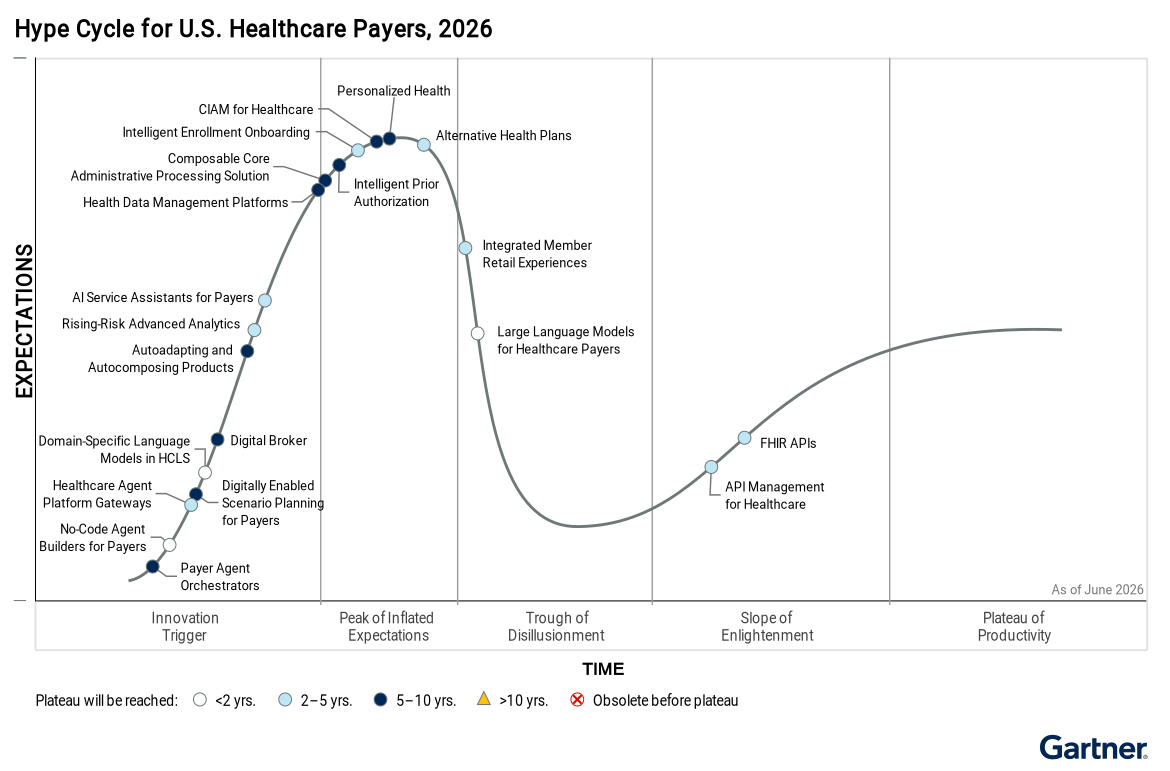
The Priority Matrix
The Priority Matrix is a summary companion to the Hype Cycle figure. The matrix uses data from the benefit rating and time-to-plateau values for each technology, which plot the answers to two key questions:
- How much value could your organization expect to realize from the effective implementation of a particular technology?
- When will the technology be mature enough to help deliver that value?
Rapidly maturing transformational technologies are positioned in the top-left corner of the Priority Matrix. Directly below them are technologies that, while still significant, offer a more limited scope of potential impact. On the right side of the matrix are emerging technologies with high potential that are not yet close to full maturity. Technologies that have lower benefit ratings and require longer to realize value are located in the lower-right section of the Priority Matrix.
Most technologies featured in this Hype Cycle are either transformational or offer significant benefits. The analysis indicates that many of these are projected to reach mainstream productivity within five to 10 years. However, it is important to underscore how quickly innovation can move from concept to widespread adoption.
While the Priority Matrix provides healthcare payer CIOs with a framework for budgeting and long-term planning, it is also important to explore immediate opportunities for pilots or point-of-service solutions for value realization. These include AI service assistants, intelligent prior authorization and intelligent enrollment onboarding. At the same time, CIOs should prioritize investments in foundational capabilities that will support the scalable adoption of AI. This includes areas such as healthcare agent platform gateways, digitally enabled scenario planning for payers, domain-specific language models in HCLS, no-code agent builders for payers and payer agent orchestrators.
Priority Matrix for U.S. Healthcare Payers, 2026
| Benefit | Years to Mainstream Adoption | |||
|---|---|---|---|---|
| Less Than 2 Years | 2 to 5 Years | 5 to 10 Years | More Than 10 Years | |
Transformational | ||||
High | ||||
Moderate | ||||
Low | ||||
Source: Gartner (June 2026)
Off the Hype Cycle
We have revised the innovations included in this year’s Hype Cycle based on the increased interest in AI tools such as DSLMs in HCLS, AI service assistants and platforms that build and orchestrate AI agents.
While these solutions are still relevant, the quickly changing needs of the healthcare payer market have necessitated the introduction of new innovations and the removal of the following:
- AI-enabled fraud detection
- Health navigation solutions
- Hyperautomation for healthcare payers
- Industry cloud platform for payers
Other changes within this Hype Cycle include:
- Agentic AI in HCLS: Removed and replaced with the new more defined IPs.
- Provider data management: Absorbed within the health data management platform.
- Consumer-centric health products: Name has changed to “alternative health plans” due to evolving market needs.
On the Rise
Payer Agent Orchestrators
Analysis By: Robert Potts, Connie Salgy
Benefit Rating: Transformational
Market Penetration: Less than 1% of target audience
Maturity: Embryonic
Definition:
A payer agent orchestrator is a central management platform used to coordinate multiple AI agents within healthcare payer workflows. It intelligently directs administrative workflows — like claims and prior authorizations — to specialized AI models, ensures strict regulatory compliance, and facilitates seamless handoffs to human workers when expert intervention is required.
Why This Is Important
The current model of deploying isolated agents is an operational bottleneck that imposes a significant integration drag on administrative efficiency. Payers are shifting toward universal orchestrators to bypass disjointed multiagent execution, a vulnerability in today’s high-velocity AI market. This transition allows payers to reclaim margin by moving from static systems of record to dynamic systems of action, scaling automation securely without proportional increases in technical debt.
Business Impact
Orchestrators enable payers to reclaim margins by removing friction between disconnected agents, lowering administrative costs per decision. Decoupling execution logic from AI models provides architectural flexibility, allowing for vendor swaps without system rewrites. Centralized governance ensures a secure, scalable fleet of models with predictable outcomes and unified compliance across the enterprise.
Drivers
- Margin compression: Payers are under immense pressure to untether their administrative execution from human headcount. Orchestrators replace messy, manual handoffs with straight-through processing, which structurally drives down the cost per decision.
- Integration debt: The rapid spread of disconnected robotic process automation (RPA) and specialized AI models is creating an unsustainable IT burden. Orchestrators serve as an interoperable control plane so payers can swap models without rewriting legacy systems, such as core administration processing systems.
- Governance-led innovation: Orchestration transforms compliance from a hurdle into a strategic advantage. By automating immutable audit trails and decision transparency, they enable payers to scale AI for claims adjudication while natively satisfying regional mandates through governance by design.
- The shift to action: Enterprise value is moving away from static data storage toward dynamic execution. Payers need an architectural layer that actively routes and governs complex, multistep workflows across different systems.
- “Shadow AI” risks: Siloed agents operating without shared context are a major security liability. A universal orchestration layer enforces centralized governance, consistent identity propagation, and global confidence thresholds.
Obstacles
- Legacy fragmentation: Fragmented claims and clinical data trapped in on-premises and SaaS silos present a massive obstacle. Feeding real-time context to agents requires high-cost, complex point-to-point API and system integration.
- The trust deficit: Healthcare demands extreme auditability, yet autonomous agents often lack deterministic transparency. Unless the orchestrator enforces strict step-level lineage and explainable logic, risk-averse payers will stall deployments to avoid compliance breaches.
- Organizational friction: Implementing a universal control plane requires unifying isolated automation, integration, and AI teams, which frequently leads to turf wars over platform ownership.
- Category immaturity: The market itself remains immature. Vendors are aggressively relabeling basic automation tools as agentic platforms — a practice known as “agent washing” that obscures true capabilities and delays procurement while buyers struggle to identify legitimate orchestrators.
User Recommendations
- Avoid “agent washing”: Distinguish orchestration from repackaged RPA. Prioritize multistep reasoning and dynamic tasking over rigid scripts to ensure the platform can manage complex logic chains.
- Target high-volume return on investment: Target bottlenecks, such as claims routing. Use “fusion teams” to set confidence thresholds for moving from manual review to safe straight-through processing.
- Demand observability: Require immutable audit trails and “guardian agents.” The platform must hand off low-confidence tasks to human experts to ensure compliance.
- Avoid vendor lock-in: Use API-first architectures that decouple execution logic from models. This prevents lock-in and provides flexibility to swap tools as the market evolves.
- Prioritize interoperability: Success requires bidirectional integration with the core administrative processing system (CAPS). Without real-time connectivity, the platform is a passive tool, not a dynamic system of action.
Sample Vendors
Emids; Glean; Inovaare; Kamiwaza; Kore.ai; Microsoft; Oracle; Pega; Salesforce
Gartner Recommended Reading
Digital Broker
Analysis By: Robert Potts
Benefit Rating: Moderate
Market Penetration: Less than 1% of target audience
Maturity: Emerging
Definition:
A digital broker is a solution that replaces commissioned sales agents. It helps acquire members and facilitates plan enrollment by collecting census and demographic information, providing plan advice and answering questions. This allows payers to sell plans directly to employer groups and individuals at scale.
Why This Is Important
The traditional brokerage model is an analog bottleneck that imposes a significant commission drag on net premium income. As customer acquisition costs increase, payers are shifting toward digital brokers to bypass human-mediated distribution, which is increasingly viewed as a vulnerability in a high-velocity market. This transition allows payers to reclaim margin by eliminating variable sales commissions and aligning members with products that offer better benefit-to-risk parity.
Business Impact
Digital brokers drive margin expansion by replacing variable commissions with fixed infrastructure costs. They optimize benefit-to-risk parity by prioritizing actuarial alignment over ease-of-sale, stabilizing loss ratios and improving profitability. This transforms distribution into a high-leverage software function, decoupling membership growth from administrative overhead to scale without proportional increases in sales or support headcount.
Drivers
- Autonomous agent orchestration: The evolution of AI from passive chatbots to active autonomous agents allows digital brokers to execute complex, multistep financial and legal workflows. These agents can navigate disparate payer silos to facilitate real-time enrollment and plan changes without human intervention.
- Seamless access: A generational shift in buyer behavior is accelerating the demand for self-service and immediate access. Younger consumers, specifically Gen Z and millennials, are increasingly prone to switching providers to find better accessibility. This creates a market where any human-intermediated process is viewed as a structural delay, driving payers toward digital brokers that can provide instant, unassisted resolution.
- Retail-first consumerism and personalization: The convergence of health tech and e-commerce, especially demonstrated in the ICHRA market, has normalized the expectation for deeply personalized journeys. Healthcare consumers now expect providers to understand their specific needs as effectively as digital giants do. This trend, coupled with a growing willingness to share medical data in exchange for tailored experiences and cost savings, positions digital brokers as essential tools for delivering the high-touch, customized selection process that modern buyers demand (see Consumer Insights to Inform Healthcare Provider AI and Technology Strategy).
- Operational efficiency and margin pressure: Payers face rising customer acquisition costs and administrative overhead. Digital brokers allow payers to decouple membership growth from headcount, transforming distribution into a scalable software function that reduces reliance on variable sales commissions.
- Market consolidation gaps: Mergers among traditional brokerage firms often lead to service gaps in underserved regional or midmarket segments. Digital platforms are filling these voids by providing consistent, high-quality plan advice and enrollment capabilities regardless of geography.
Obstacles
- Agentic security: Autonomous agents increase bot attack surfaces across payer silos. To maintain secure enrollment, payers must implement zero-trust models for high-speed data access to mitigate “shadow agent” risks.
- Trust barriers: Caution around health decisions slows GenAI adoption. “Black box” autonomous reasoning creates auditability debt; without transparent explanations for recommendations, payers face heavy regulatory scrutiny.
- Broker resistance: Traditional brokers hold significant market power and may resist digital shifts by rerouting sales volume. Payers must balance long-term margin gains against the risk of alienating their primary sales force.
- Algorithmic bias: Payers must monitor autonomous logic in real-time to ensure fair-marketing compliance. As brokers become agentic, they face the same fiduciary and antidiscrimination scrutiny as human agents.
User Recommendations
- Prioritize access for retention: Deploy digital brokers to eliminate friction for Gen Z and millennial members, who prioritize accessibility and unassisted resolution. Offer real-time resolution for routine tasks to meet modern expectations and reduce provider switching.
- Bridge trust with explainable AI: Provide human-interpretable justifications for automated plan recommendations. This overcomes the skepticism toward AI-driven financial decisions while ensuring compliance with auditability standards.
- Manage channel conflict: Shift low-complexity, high-volume segments to digital brokers and incentivize human brokers toward high-touch consultative roles. Segmentation reduces competition and mitigates broker-led sales attrition.
- Transition staff to oversight: Pivot human resources from processing transactions to high-touch exception management and advisory. Monitor autonomous logic in real-time to prevent bias and ensure alignment with the organization’s risk appetite.
Sample Vendors
Applied Systems; AVIZVA; HealthCare.gov; mPulse; NTT DATA; PRSONAS; Ushur; Vertafore
Gartner Recommended Reading
No-Code Agent Builders for Payers
Analysis By: Connie Salgy, Amanda Dall'Occhio
Benefit Rating: Transformational
Market Penetration: Less than 1% of target audience
Maturity: Embryonic
Definition:
No-code agent builder (NCAB) tools offer an integrated design and runtime environment to build, publish and manage AI-powered agents without exposing any code to the builder. These AI agents are autonomous or semiautonomous software entities that use AI techniques to perceive, make decisions, take actions and achieve goals in their digital or physical environments.
Why This Is Important
Payers are experiencing tight margins and high medical loss ratios, which are fueling significant interest and investment in AI technologies, such as NCABs. These tools create value for both IT and business teams by offering a unified platform that enables users to easily build, deploy and manage agents without the need for coding. For example, nontechnical business teams can easily create and manage AI agents with minimal IT support using intuitive visual or conversational interfaces.
Business Impact
NCABs offer IT platform and business advantages, allowing U.S. healthcare payers to automate and streamline diverse processes. This leads to quicker deployment timelines, improved workflows and better experiences for employees, members and providers.
Common payer examples include:
- Business process automation within clinical, administrative and service workflows
- Fast agentic AI prototyping and a safe platform for innovation for IT and business users
Drivers
- The 2025 Gartner Business Outcomes of Technology Survey indicates that all payer respondents have either implemented or intend to deploy agentic AI solutions by 2028 to create efficiencies in multiple payer administrative and service workflows.
- NCABs make it easy for IT and nontechnical business teams to design, build and manage AI agents — creating value for both stakeholders. For example, provider and member service teams can easily create and manage AI agents with minimal IT support using intuitive visual or conversational interfaces.
- When properly implemented and governed, NCABs speed up the development life cycle — shifting ideas to live solutions more rapidly and decreasing burden on understaffed IT teams. This allows payer IT and business teams to quickly create AI agents to improve multiple routine processes. For example, these agents can transform legacy modernization documentation, member enrollment, prior authorizations and provider directory management.
- NCABs transform employee roles by automating routine tasks allowing for workforce upskilling, increased efficiency and provide the opportunity for teams to focus on strategic initiatives such as innovation.
Obstacles
- The use of AI, particularly with proprietary domain data, presents considerable risks of data breaches, unauthorized access, lack of governance controls and regulatory noncompliance (e.g., HIPAA, PHI) if not carefully managed.
- AI broadly holds substantial promise for revolutionizing payer workflows. However, the availability of clean, well-structured data remains a challenge.
- Payer employees are risk averse to protect the sensitive data that is available. However, this culture makes adopting new technologies challenging. Additionally, AI literacy and specific time for AI training are not prioritized — decreasing the business users’ benefits.
- Pressured to deliver ROI with AI investments and vendor hype, payer organizations may be tempted to rush into developing agents through NCAB platforms while there may be other alternatives available, such as rule-based automation or prebuilt agents.
User Recommendations
- Engage with Gartner analysts to help cut through “agent washing,” vendor hype and ambiguous terminology. This will enable you to make informed agentic AI decisions and develop strategies that maximize ROI with the right AI solution.
- Evaluate AI readiness before exploring NCAB tools and collaborate with business stakeholders to implement flexible governance that supports rapid transformation while maintaining enterprise security. Additionally, ensure AI literacy and replace strict approval processes with clear guardrails that enable controlled experimentation.
- Create a “safe sandbox” with predefined rules — such as personally identifiable information (PII) masking, API limits and restricted data scopes — so teams can test agents before moving to production.
- Be a champion of change management as NCABs can transform employee roles by automating routine tasks. This will help reduce employee concerns and foster a smoother transition.
Sample Vendors
Cognizant; Glean; Kore.AI; Microsoft; NiCE; Pega; Salesforce; Thunk.AI; UiPath; Ushur
Gartner Recommended Reading
Digitally Enabled Scenario Planning for Payers
Analysis By: Mandi Bishop
Benefit Rating: High
Market Penetration: 1% to 5% of target audience
Maturity: Embryonic
Definition:
Digitally enabled scenario planning is a strategic process that leverages artificial intelligence and other technologies to enhance the development and analysis of potential future scenarios such as regulation or utilization for payers. This approach integrates AI, data collection, integration and management technologies, and other digital technology capabilities in data analysis, pattern recognition, and predictive modeling to improve scenarios' accuracy, efficiency, and depth.
Why This Is Important
U.S. healthcare payers face compounding uncertainty from frequent regulatory change, tightening compliance scrutiny, and volatile utilization patterns. Emerging AI-driven processes like regulatory enforcement, medical necessity determination, and coding optimization accelerate change and create nonlinear risk. Traditional, static planning cannot keep pace. Digitally enabled scenario planning improves speed, breadth, and confidence when navigating this environment.
Business Impact
For healthcare payers, digitally enabled scenario planning improves resilience under regulatory and utilization volatility, especially as AI‑enabled actors on all sides increase the pace and complexity of change. Benefits include:
- Robust IT strategy and roadmap inputs
- Reduced downside financial surprise
- Proactive modeling and faster response to CMS and state policy changes
- Improved confidence in margin and utilization forecasts
- Better alignment between regulatory, financial and operational decisions
Drivers
- Regulatory change is frequent and increasingly midcycle. Medicare Advantage, ACA and Medicaid policies, audit standards, and regulatory interpretations shift often enough to undermine annual planning cycles, increasing compliance exposure and financial downside. Growing conflicts between federal and state mandates further complicate these changes, as scenarios must accommodate dual compliance strategies and judicial actions.
- Utilization volatility pressures margins and bids. Benefit design changes, utilization management policies, provider behavior, and regulatory incentives drive rapid utilization shifts. These factors frequently emerge faster than traditional monitoring, affecting pricing accuracy and medical loss ratios.
- Decision timelines continue to compress. Margin pressure and regulatory scrutiny have reduced tolerance for forecast error, requiring faster insight into downside and upside exposure to inform pricing, utilization, and investment decisions before uncertainty resolves.
- AI amplifies existing uncertainty. AI‑driven regulatory enforcement, medical necessity determination, coding optimization, and consumer engagement accelerate regulatory and utilization dynamics, increasing the interaction and rate of change of plausible futures rather than replacing traditional drivers.
- Data and analytics maturity is advancing, although unevenly. Payers are investing in data integration, analytics, and AI to support more sophisticated modeling, but readiness varies widely. In a recent Gartner healthcare payer agentic AI survey, nearly two thirds of respondents reported data integration and analysis capabilities deployed or planned within 12 months.
- Boards and executives emphasize resilience and preparedness. Scenario planning is shifting from a periodic strategy exercise toward continuous risk management and decision support, driving interest in digitally enabled approaches that adapt as conditions change.
- IT strategy and investments must enable organizational agility while meeting cost reduction and value demands. Executive expectations for short-term AI-driven business benefits exacerbate the perennial problem of IT budgets that lag enterprise ambition. Technology solutions that address current-state business capability needs may not be able to accommodate all (or any multiple) future scenarios, and those investments could become throwaway sunk costs.
Obstacles
- Fragmented data limits scenario credibility. Effective scenario planning requires integrating clinical, utilization, regulatory and financial data. Many payers still rely on siloed architectures, with almost three quarters of respondents to a recent AI maturity survey indicating that they lack data management solutions that enable fluid, enterprisewide data exchange and use.
- Linear models miss compounding effects. Manually curated static scenarios struggle to reflect interacting regulatory and utilization forces, particularly as faster response cycles increase feedback effects.
- Cross‑functional ownership is immature. Effective scenario planning spans strategy, clinical, administrative, operational, and IT teams, yet shared accountability, aligned assumptions and consistent operating models remain limited.
- Governance requirements constrain speed. Explainability, auditability, and regulatory defensibility expectations can slow adoption of digitally enabled scenario planning or restrict it to narrow use cases.
- Planning cultures remain episodic. Annual bid and budget cycles still dominate decision making, limiting adoption of continuous, scenario‑driven approaches despite rising volatility.
Analyst notes: Digitally enabled scenario planning signals a shift from episodic forecasting to continuous decision exploration. Although enabling technologies are viable today, the approach challenges entrenched planning processes, decision rights and governance norms, demanding a level of organizational agility that remains rare. As a result, we are introducing this innovation very early in the Hype Cycle despite there being strong demand. We expect this to take up to 10 years to reach the Plateau, with mainstream use constrained to supervised and bounded applications.
User Recommendations
- Prioritize applying this approach to scenario planning where forecast error is most costly (such as pricing, utilization controls, and regulatory response planning) before expanding scope.
- Move beyond single‑factor scenarios by testing how regulatory shifts and utilization responses compound financial risk under different conditions.
- Enhance actuarial, financial, and compliance planning models with faster data refresh, broader scenario exploration, and automation, rather than rebuilding them from scratch.
- Formalize joint ownership of scenario planning across strategy, actuarial, and compliance teams to reduce fragmentation and improve decision confidence.
- Embed digitally enabled scenario planning into recurring decision points like regulatory updates or utilization policy reviews to increase responsiveness without overwhelming teams.
Innovation in Practice:
While this innovation is nascent for health insurers, other heavily regulated industries are adopting this approach in applicable business areas:
- Swiss Re has transitioned its FP&A processes to IBM Planning Analytics to model and simulate multiple financial and risk scenarios across business units, including capital adequacy and stress‑testing scenarios. This enables faster iteration and groupwide visibility while keeping scenario interpretation and execution under formal human governance within its regulated insurance operating model.
- U.S. government agencies apply Palantir Foundry scenarios to model operational readiness, logistics disruptions and supply shortfall scenarios by chaining scenario outputs across an ontology of operational systems, allowing planners to evaluate cascading impacts and recommended responses while retaining human authorization over downstream actions.
Sample Vendors
Amazon; Anaplan; Databricks; Google; IBM; Microsoft; Oracle; Palantir; SAS
Gartner Recommended Reading
Healthcare Agent Platform Gateways
Analysis By: Connie Salgy
Benefit Rating: High
Market Penetration: 1% to 5% of target audience
Maturity: Embryonic
Definition:
Healthcare agent platform gateways aggregate data from various sources, providing a healthcare-focused technology platform that allows payers and providers to develop and coordinate AI agents and automation.
Why This Is Important
AI agents enhance payer and provider workflows by enabling intelligent, real-time interactions across different systems to address complex, multistep tasks. Achieving this requires either an open-source platform, a unified consistent protocol (e.g., MCP, A2A) or reimplementation of agents within each ecosystem. Healthcare agent platform gateways aggregate data from various health ecosystem sources, providing a healthcare-focused technology platform that allows payers and providers to develop and coordinate AI agents.
Business Impact
Healthcare agent platform gateways:
- Address critical healthcare data interoperability challenges and serves as a data bridge between legacy systems and modern platforms.
- Interpret legacy formats and synchronizes with newer systems without needing a “rip-and-replace” strategy.
- Create an environment where AI agents can interact across healthcare systems, addressing multiple payer-provider workflows and enabling intelligent, real-time processes to improve efficiency for healthcare organizations.
Drivers
- Healthcare organizations are facing narrow profit margins and persistently high medical loss ratios, driving strong interest and investment in AI technologies. As a result, payers and providers have begun by adopting AI agent solutions targeted at specific capabilities. However, over the long term, they seek a unified technology platform that enables them to develop and manage agents more effectively, reducing challenges related to governance, ongoing maintenance, and system integration.
- The White House and the U.S. Centers for Medicare & Medicaid Services (CMS) secured commitments from 60 healthcare technology organizations and multiple payer and provider organizations. The Health Tech Ecosystem commitment aims to improve CMS’ interoperability framework to create a “standards-based digital health environment.” This collaboration is an early indication of making AI and agentic AI more feasible within multiple payer-provider clinical and administrative workflows with AI agent usage.
- 2025 Gartner Business Outcomes of Technology Survey responses indicate that 45% of payer respondents have already deployed agentic AI systems, and the remainder plan to deploy them before 2028. Although the type of agent systems is not mentioned in the survey, the usage of healthcare agent platform connectors will be critical to many of the payer and provider workflows that the agents will help solve.
- A healthcare agent platform gateway can link front-end user interfaces with back-end processing systems, reducing administrative burdens, improving decision accuracy, and enhancing operational quality and efficiency for payers and providers.
- Payer and provider data and technology are frequently siloed, and they limit AI and agentic AI automation. Healthcare agent platform connectors help overcome this challenge by using translation layers or mediators that convert messages and actions between various protocols or across an open-source platform.
Obstacles
- Challenges remain — particularly in data quality, regulatory adherence and managing nondeterministic outcomes — but the strategic potential of a healthcare agent platform gateway to revolutionize payer-provider workflows is clear.
- The complexity of data management is amplified by the intricacies of interoperability and demonstrated by the frequency and multiple formats. The number of disparate data pathways required to be interoperable with healthcare ecosystem pathways introduces inaccurate data, inefficiencies and even higher IT costs.
- Rapid growth in the agentic AI market — fueled by vendor hype, inconsistent terminology and agent-washing — makes it challenging for healthcare organizations, IT and business leaders to fully understand available solutions. This complexity hinders effective strategy assessment and planning for optimal ROI.
User Recommendations
- Identify all data assets and channel volumes from your ecosystem partners. Since data channels and formats vary across healthcare payers and providers, this step will help consolidate the data into a unified platform.
- Ensure AI data readiness before building or procuring and engage your chief information security officer early in the process to address any privacy concerns. These actions will help build trust and ensure a responsible, successful technology deployment.
- Implement a governance framework that supports rapid transformation while maintaining enterprise security.
- Establish a structured evaluation framework for agentic AI solutions. This framework should include clear definitions, standardized assessment criteria and cross-functional input from business and IT stakeholders.
- Engage with Gartner analysts to help cut through vendor hype and ambiguous terminology, enabling organizations to make informed decisions and develop strategies that maximize ROI.
Sample Vendors
Availity; Cognizant; Elait Health; Epic; InterSystems; Innovaccer; Optum; Oracle
Gartner Recommended Reading
Domain-Specific Language Models in HCLS
Analysis By: Austynn Eubank, Allison Dennis, Jeff Smith
Benefit Rating: Moderate
Market Penetration: 1% to 5% of target audience
Maturity: Embryonic
Definition:
Healthcare and life science (HCLS) domain-specific language models (DSLMs) are language models trained or fine-tuned on specialized language and terminology used in medical and scientific fields. While general-purpose models struggle with medical terms, DSLMs are purpose built for HCLS use cases, delivering the precision and compliance required for sensitive workflows while keeping hallucination rates low.
Why This Is Important
General-purpose LLMs often fail in HCLS use cases because they lack focused training on complex terminology used in business processes such as prior authorization, medical coding, claims adjudication and care management. This creates unpredictable outputs and high error rates. DSLMs solve this by enabling higher-quality outputs with lower variability in a more tightly focused information domain. This higher output predictability can support stricter accuracy standards across the HCLS ecosystem.
Business Impact
DSLMs allow HCLS organizations to:
- Introduce AI safely into highly regulated environments.
- Manage population health, value-based care and claims processing.
- Reduce compute cost and hallucinations by using small language models (SLMs).
- Analyze complex medical records, unstructured clinical notes and member data to reduce administrative friction, and improve patient outcomes more efficiently and at higher quality.
Drivers
- The massive operational burden of prior authorizations, claims processing and medical coding drives the need for AI that understands complex clinical guidelines and payer policies with lower hallucination rates.
- Shifting from fee-for-service to value-based care requires processing massive amounts of unstructured patient data to identify risk gaps and coordinate care, a task uniquely suited for DSLMs.
- Any AI deployed in healthcare must navigate complex frameworks like HIPAA and CMS guidelines. DSLMs can provide the auditability and precise guardrails needed to satisfy these non-negotiable regulations.
- Domain-specific language models can also include SLMs. Processing millions of member records through massive models drains budgets quickly. Smaller, hyperfocused DSLMs optimize compute resources and drastically cut token costs for high-volume tasks.
- Protecting sensitive protected health information (PHI) leads many HCLS leaders to express concerns about leveraging general-purpose LLMs in use cases involving patient or member data. Payers and hospitals increasingly favor private, vendor-managed or internally hosted models to ensure data sovereignty.
- DSLMs and SLMs may eventually lead to tighter control over output variability and quality, and provide a path to model validation, opening up AI-driven automation scenarios in high-compliance areas within HCLS.
- The need to bridge the gap between siloed payer and provider datasets is driving adoption of models pretrained to standardize and interpret messy electronic health record (EHR) and claims data formats.
Obstacles
- HCLS data is fragmented across different EHRs, payer systems and life science organizations. It often resides in IP-protected data stores and is unavailable in large enough quantities for DSLM development. Training or fine-tuning a model requires clean, AI-ready unified domain data that most organizations lack.
- In coverage decisions or clinical support, there is immense business and medical risk. Concerns about liability and legal risk when an LLM-augmented solution incorrectly denies a claim or misses a diagnosis slows enterprise adoption of AI.
- Building an in-house DSLM demands elite data science talent, heavy compute power and copious amounts of training data on a robust data science architecture, making it unreasonable for most HCLS organizations.
- Models experience quality drift and can perpetuate historical biases in care if not monitored closely. HCLS companies or vendors that do not have the needed MLOps resources and expertise will be unable to manage and maintain DSLM quality.
User Recommendations
- Run pilot tests with DSLMs in high-volume administrative areas — like revenue cycle management or prior authorization — where standard LLMs repeatedly fail your quality benchmarks. (See Emerging Tech: Top Use Cases in Domain-Specific Language Models).
- Buy before you build, when available. Look for vendors that explicitly provide built-in observability, explainability, compliance and deidentification tools. (See Emerging Tech: AI Vendor Race: The Key Defining Characteristics of a Domain-Specific Language Model).
- Set up continuous output auditing and validation frameworks to catch model drift early and ensure ongoing compliance with evolving regulations.
- Calculate the actual “cost of quality.” Compare the daily operating costs and accuracy of a payer-specific DSLM against a standard LLM using advanced prompt engineering.
Sample Vendors
Amazon; EXL; Google; Hippocratic AI; John Snow Labs; Microsoft; Persistent Systems; RegASK; SOGLIA
Gartner Recommended Reading
Rising-Risk Advanced Analytics
Analysis By: Amanda Dall'Occhio
Benefit Rating: High
Market Penetration: 5% to 20% of target audience
Maturity: Emerging
Definition:
Rising-risk advanced analytics is a strategy to identify, engage and manage payers’ “rising-risk” population — that is, members who are likely to become high-cost claimants or progress to a chronic disease state soon. These analytics use self-reported data as well as data available in claims, clinical data, social determinants of health (SDOH) and digital wearables to improve outcomes and save costs.
Why This Is Important
Traditional payer care management models focus largely on high-risk members. However, early identification of rising-risk individuals (those prechronic members with existing lifestyle and other risks) offers a transformative opportunity to reduce medical loss ratios, improve member health trajectories and optimize resource allocation. Rising-risk analytics is key to shifting from reactive care management to proactive population health strategies.
Business Impact
Rising-risk analytics help payers:
- Identify, stratify and target prechronic, rising-risk members before the condition worsens, thereby improving quality of care and business outcomes.
- Engage members in proactive outreach, navigation support and hyperpersonalized interventions. This not only prevents health decline and future high cost but also helps comply with regulatory goals and enhances member loyalty and experience.
Drivers
- CDC reports that 90% of the nation’s $4.5 trillion in annual healthcare expenditures are for people with chronic and mental health conditions. Rising-risk analytics not only shifts the care from reactive to preventive but also improves the quality of care toward chronic condition avoidance.
- Payers are under more pressure than ever to reduce claims costs, and traditional strategies are only taking organizations so far. Rising-risk analytics provide cost avoidance with the prevention of chronic disease through early intervention, monitoring and support.
- Many vendor solutions are available to help with rising-risk strategies. These tools include risk identification and stratification stand-alone solutions and models. Additionally, tools that are integrated into a care management workflow application or population health management analytics solution. Some large payers have already begun implementing and piloting solutions, creating an opportunity for competitive differentiation.
- There is an increasing need for hyperpersonalization in healthcare, as members expect the same level of personalization that they experience in other daily interactions with technology.
Obstacles
- Data quality is generally poor and the data is highly siloed within payer organizations and fragmented data across systems (e.g., claims, clinical, behavioral health) and ecosystem partners impairing model completeness and accuracy.
- Despite the robust insights that advanced risk analytics offer, there can be difficulty in translating risk scores and associated data into actionable clinical workflows.
- As with any health data modeling, rising-risk models are at risk for bias and can inadvertently reinforce disparities if SDOH data is unavailable or mishandled.
- Achieving member engagement and maintaining compliance can be difficult without a hyperpersonalized, targeted strategy.
- Care management teams may distrust or underutilize new model outputs or risk scores without early engagement, strong change management, including AI literacy and clear communication.
Analyst notes: Although rising-risk analytics is not a new concept, using them for prechronic condition strategy is not common. We are beginning to see early adopter pilots showing success and positive results. However, widespread operational integration is still evolving. As such, the IP is positioned above midway up the Innovation Trigger, and we anticipate this moving fairly quickly through the Hype Cycle.
User Recommendations
- Achieving success requires unified member profiles that combine information from claims, SDOH, clinical sources, user input, wearable devices and broader ecosystem data.
- Select models with transparency. Choose vendors carefully and prioritize vendors that offer explainable AI outputs, customization and communication over “black box” scores or insights.
- Embed risk signals into workflows. Embed data, profiles, insights and alerts directly within care management workflow applications and CRM platforms, rather than using separate dashboards, to maximize adoption, usage and value.
- Before scaling, consider piloting rising-risk analytics narrowly first to allow for evaluation of accuracy, fairness and clinical relevance. Start with targeted cohorts (e.g., rising risk for diabetes) before scaling enterprisewide to take a controlled approach, refine intervention strategies and build stakeholder trust.
Sample Vendors
Arcadia; Clarify Health; Health Catalyst; Innovaccer; KKR (Cotiviti); Lightbeam; Lightbeam Health Solutions (Jvion); MedeAnalytics
Gartner Recommended Reading
AI Service Assistants for Payers
Analysis By: Faith Adams, Amanda Dall'Occhio
Benefit Rating: High
Market Penetration: 5% to 20% of target audience
Maturity: Emerging
Definition:
AI service assistants for healthcare payers are AI-powered digital solutions that streamline service interactions with members, healthcare providers and purchasers. These solutions empower service agents with real-time, in-interaction guidance and support, next best action recommendations, and interaction summaries. In addition, they can automate simple interactions, reducing the reliance on human agents.
Why This Is Important
AI service assistants deliver value for healthcare payers by increasing efficiency, reducing manual tasks and providing real-time guidance and support. These solutions assist agents in delivering high-quality service interactions, minimizing errors and improving operational metrics. They also contribute to HCLS total experience by improving the agent’s employee experience and that of the member and provider.
Business Impact
- Increased productivity: AI guidance reduces manual searches, improving metrics like average handle time and first-call resolution.
- Enhanced accuracy: Reduces manual entry and errors, ensuring accurate, consistent, compliant information.
- Better agent experience: Real-time coaching and guidance. Less administrative burden.
- Improved consumer experience: Agents can deliver more personalized, trust-building experiences.
Drivers
- Adoption of AI service agents can help overcome a number of pain points:
- Payer contact centers struggle with challenges like staff shortages, high staff turnover and operational inefficiencies, continuing the perception of being a cost center.
- To improve operational efficiencies and reduce costs, payers are under constant pressure to optimize operations, automate tasks and reduce overhead.
- Continued advancements in AI technologies is actively driving payer CIOs to recognize AI’s potential to enhance contact center operations and productivity, automate repetitive tasks, and impact the bottom line.
- Beyond supporting agents, AI service assistants can also reduce wait times and automate repetitive tasks by reducing the reliance on human agents by providing answers to simple questions about topics like eligibility and benefits, freeing up human agents to work with other members, providers or purchasers.
- AI service assistants help minimize errors and ensure agents provide consistent, compliant information, reducing risks associated with manual entry.
- Healthcare consumers are concerned about the erosion of customer support and the digital burden being placed on them. Payers that effectively balance AI and human agent experiences minimize this risk.
- AI service assistants enable human agents to deliver more personalized, timely and relevant interactions, improving member, provider and purchaser experience.
- While baby boomers may not desire better digital experiences, younger consumers have higher expectations when it comes to both consumer and digital experience, prompting payers to make investments to meet these evolving needs.
Obstacles
- Balancing IT and business governance can be a challenge for payer AI implementations.
- Integration with payer workflows and other solutions is a concern for some payers who still have legacy, fragmented systems.
- Data privacy and security remain top of mind. Ensuring that AI systems protect member and provider data is critical to driving adoption of these technologies.
- Payer CIOs worry about the accuracy and reliability of member-facing solutions in particular.
- While these solutions are expected to increase efficiency and automation, concerns remain about the ability to deliver meaningful ROI as upfront investment, and ongoing maintenance costs are often perceived as high.
- Change management is critical but continues to be an area of underinvestment for healthcare payers.
User Recommendations
- Leverage fusion teams and partner with operations, CX, legal and compliance. Start with the outcomes that you want to achieve to guide vendor selection. Common outcomes are reducing wait and handle times, improving experience, or reducing cost per call. This will ensure that your objectives are prioritized and that you can measure the impact.
- Require vendors to prove robust data protection practices and compliance with HIPAA, PIPEDA and other regulations to ensure that sensitive information is safeguarded.
- Minimize disruption and maximize value by assessing vendors based on integration capabilities with your current systems.
- Consider the human agent user experience. Involve human agents in the process early and leverage their feedback to ensure the solution and agents are set up for success.
- Prioritize change management and communication about solution benefits.
- Track performance of the anticipated outcomes and measure the ROI to show impact and value.
Sample Vendors
Five9; Hyro; Infinitus; Kore AI; NiCE Cognigy; SuperDial; Talkdesk; Ushur
Gartner Recommended Reading
Autoadapting and Autocomposing Products
Analysis By: Mandi Bishop
Benefit Rating: Transformational
Market Penetration: Less than 1% of target audience
Maturity: Embryonic
Definition:
Autoadapting products alter their structure, pricing, distribution and function within existing product configurations in response to external variables. Autocomposing products react to situational data to construct or compose new products, potentially across industries, to address specific customer needs. Autocomposing products will autonomously combine based on a series of predefined rules, leveraging subproduct components or services from multiple ecosystems on a real-time basis.
Why This Is Important
Health insurance products need reinvention. Generative AI (GenAI)’s ubiquity, the advancement of agentic AI and the expansion of ecosystemwide interoperable data will influence how individuals, businesses and machines consume products. These technological advances will enable autonomously configured personalized products — sourced and configured from industry and cross-industry ecosystems — that sense and respond to their environments along with the context and situation in which they are consumed.
Business Impact
Autoadapting products will:
- Enable payers to parlay analytics and AI investments into differentiating member autonomy to iteratively tailor their own plans.
- Improve member experience and reduce churn as products adapt to individual needs and context at the center of that adaptation.
Autocomposing products will:
- Shift power into the hands of the purchaser and away from the payer.
Drivers
- Autoadapting products can increase member relevance. They represent an opportunity to invoke a substantive shift from point-in-time, payer-defined product centricity to real-time, purchaser-defined service and customer centricity in enterprise thinking.
- Increasingly popular plans like Individual Coverage Health Reimbursement Arrangements (ICHRAs) could provide an entry into cross-industry product orchestration, as consumers decide how to spend their leftover “allowance” from their employers after purchasing the required health insurance.
- The rise in composable architecture and thinking within enterprises is aligned with the increased role for ecosystem partner-driven business models to support diversified product adaptation and fulfillment.
- Digital products offer the potential for high levels of real-time adaptation and composition, providing new products and services to meet life events, desires and needs of customers that could drive revenue opportunities.
- Consumer technology’s expansion and acceptance into healthcare processes increases the data and insights available from touchpoints and real-time interaction opportunities that will shape new autoadapting product and service offerings. Recent consumer health-focused product offerings like OpenAI’s ChatGPT Health and Anthropic’s Claude for Healthcare will accelerate this trend.
- Popular consumer-facing GenAI and AI agent capabilities will enable real-time cross-industry product discovery that would make autonomous sophisticated product creation and orchestration possible. Agentic AI will enable autonomous product shopping and enrollment or acquisition. Payers are prioritizing investments in data and analytics (D&A) and AI that underpin these capabilities.
- Rising interest in non-ACA-compliant alternative health plans that are more customizable is a strong signal that health plans are recognizing member pressure to adapt.
Obstacles
- Insurance benefit contracts are currently rigidly controlled in the U.S., with midyear covered benefits changes only allowed after experiencing a qualifying life event such as the birth of a child. The lines of business where this approach to products is most likely to surface in the medium term are ICHRAs and self-funded commercial plans, which have fewer restrictions than government programs and fully insured group plans.
- Autoadapting and autocomposing products will require creative approaches to care management and wellness-focused benefit structures that meet regulatory requirements, which are changing quickly.
- Monolithic payer architecture, inflexible adjudication platforms and poor data quality are significant barriers to achieving the composable architectural foundations to externalize products, processes, algorithms and rules.
- Payers are reluctant to relinquish control over products that have been tightly bound by the way actuaries price benefits. Autoadapting and autocomposing products will have to be positioned as program investments that save money over time.
- Privacy and security concerns could inhibit widespread adoption, although consumers’ perception of data sharing for healthcare and health insurance purposes is rapidly evolving.
- Members do not trust their health insurance companies to make decisions in the individual’s best interest, let alone to invoke changes on the purchaser’s behalf.
- New governance models and methods need to be developed to permit autoadapting and autocomposing within acceptable guardrails.
Analyst Notes: This approach to products has transformative value potential, but the magnitude of the entrenched business model challenges means market acceptance will be slow. However, AI’s explosive growth and maturation has accelerated the feasibility of these types of products. This innovation is beginning its ascent from Innovation Trigger toward the Peak of Inflated Expectations. We expect that these products will take five to 10 years to achieve mainstream adoption.
User Recommendations
- Host visioning workshops with executive colleagues to determine the enterprise’s appetite for involvement in autoadapting and autocomposing product innovation.
- Partner with an innovative self-funded employer that has flexibility in its benefits offerings to develop and pilot an autoadapting product for its members, such as automatically processing a specialist referral to a practitioner in a new geography when a member moves.
- Focus technology strategy on composability and invest in capabilities such as ecosystem integration, AI or machine learning (ML) to support new types and forms of partnerships, data, and business and operating models.
- Accelerate the shift to data-led, intelligent and real-time decision making that such products will require by implementing real-time integration and analytics capabilities.
- Adopt adaptive D&A and AI governance to enable context-appropriate styles and mechanisms that address the diversity in time sensitivity, risk and complexity of use cases.
- Explore GenAI large language model tools to advance actuary, underwriting and benefits composition.
Gartner Recommended Reading
At the Peak
Composable Core Administrative Processing Solution
Analysis By: Austynn Eubank, Connie Salgy
Benefit Rating: Moderate
Market Penetration: 1% to 5% of target audience
Maturity: Emerging
Definition:
A composable core administrative processing solution (CAPS) is a cloud-native platform with low-code/no-code configuration and real-time processing. CAPS features packaged business capabilities (PBCs) — such as benefit configuration and fee schedule matching — that can be recomposed into experiences such as product personalization and pricing. Standards-based APIs integrate ecosystems of healthcare organizations, community services, regulatory agencies and business partners.
Why This Is Important
Composability is an architectural approach that enables payers to adapt their business and operating models quickly. Previous generations of CAPS have been monolithic and challenging to integrate. Composable CAPS are architected for the cloud. They allow payers to reuse common application functions, like claims intake and data standardization, via PBCs, low-code environments and standards-based APIs. This enables adaptability and speed to value.
Business Impact
Composable CAPS will:
- Enable personalized benefits configuration and consumer-centric products.
- Accelerate new product and benefit deployment.
- Support diversified business lines such as disability, hospital indemnity and accident insurance.
- Power ecosystemwide real-time, automated and interoperable data and workflows through the usage of AI and ML to structure data.
- Expose PBCs via APIs to support initiatives such as price transparency and real-time payment.
Drivers
- Members, employer groups, business partners, regulators and providers are demanding self-service access to real-time information, such as claims status and plain-language explanations for denial reasons.
- Payers have started decoupling functions like provider data management, enrollment and premium billing from claim adjudication. While these capabilities are being replaced with new SaaS platforms rather than PBCs, this still signifies a shift from monolithic or end-to-end processing to a modularized approach to core administration. This also derisks core replacement because the workload managed by the composable core platform is smaller and confined to adjudication.
- Vendors are building new solutions as modules rather than end-to-end solutions — furthering the composable ecosystem.
- Due to their desire to advance internal AI capabilities, payer organizations have invested heavily in data management solutions that connect their previously fragmented data across applications. They have also invested in data normalization, data labeling and data structuring, which increases the usability of unstructured data. These advancements toward an enterprise data strategy reduce integration challenges associated with a composable architecture.
- Employer groups and purchasers demand flexible benefits as well as cost-efficient and effective administration.
- Payers are purchasing low-code/no-code solutions to optimize workflows and promote efficiencies gained by empowering business technologists to make decisions (see Innovation Insight: No-Code Agent Builders Improve Efficiency for U.S. Healthcare Payers).
- GenAI and agentic AI have the potential to replace many functions that provide inputs to traditional CAPS, such as extrapolating benefits and provider fee schedules from contracts. Composable CAPS promises easier integration with algorithms and third-party software, such as payment integrity, to fully leverage this new technology’s power.
Obstacles
- The composable CAPS vendor market is nascent, and early entrants do not yet have a presence in comprehensive medical insurance at scale. Despite these vendors having infrastructure that theoretically can support massive scale, payer organizations remain timid about selecting a nontraditional vendor.
- Most payers are still struggling with CAPS modernization using a traditional architecture approach and entrenched vendors. Large national payers, especially, are choosing to retain some of their legacy systems to avoid rewriting their adjudication rules.
- Vendors use modularity and composability interchangeably, though they are usually offering contractual modularity — allowing health plans to purchase their desired components rather than architectural composability. The lack of clarity in the market inhibits true composable approaches to flourish.
User Recommendations
- Identify areas of opportunity to shift product development and procurement to support differentiation in core administration capabilities. For example, using generative AI in product configuration or advanced data management techniques in enrollment processes.
- Track the progression of new tools such as AI coding agents for its potential to reduce core administration modernization barriers. Also consider the role that agentic AI could play within application modernization as it changes the platform landscape (see First Take: Anthropic Claude Code Playbook Is No Silver Bullet for Mainframe Modernization). Evaluate your current CAPS offering and product roadmap to determine whether and when they will move to microservices-based architecture and which commercial cloud service provider platforms they will support.
- Consider emerging composable CAPS vendors for new ventures that typically require a new CAPS, such as spinoff companies or diversified business expansion.
Sample Vendors
CoverGo; Google; Infosys; nirvanaHealth; VBA; Vitech
Gartner Recommended Reading
Health Data Management Platforms
Analysis By: Laura Craft, Gregg Pessin
Benefit Rating: Transformational
Market Penetration: 1% to 5% of target audience
Maturity: Adolescent
Definition:
A health data management platform (HDMP) provides a collection of data services and capabilities designed for the healthcare industry to enable fluid, agile, real-time exchange and use of health data and information. HDMPs support broad use cases across healthcare and are a significant accelerator for industry modernization.
Why This Is Important
Many healthcare organizations globally have a digital strategy and ambition to leverage technology advances to reinvent healthcare, from drug discovery to care delivery. Connecting data to create ubiquitous fabrics of insight is essential to realizing industry visions around ethical, equitable, precise and interoperable healthcare. HDMPs are designed to address the technology requirements across integration, data and analytics, in addition to the need for persistent and ubiquitous data access.
Business Impact
The emergence of HDMPs signals significant movement in resolving historical constraints around data integration and interoperability by capitalizing on the agility of cloud, implementing data fabric concepts and adhering to industry standards. HDMP vendors are creating a sea change in how we can orchestrate and choreograph health data. For example:
- Advancing interoperability and data sharing
- Executing AI at scale
- Connecting data ubiquitously
- Delivering a complete consumer experience
Drivers
- Industry transformation: Digitalization of health data is driving the demand for more pervasive data pipelines. Connecting data and creating accurate, informed and pervasive streams of insight are essential in realizing industry visions around precision, unbound, global and AI-enabled health. Data-driven insight with actionable intelligence is the currency of new healthcare business models and the foundation to thrive in a new health economy.
- Scaling AI and advanced analytics: Deploying AI at scale requires significantly more sophisticated engineering and data management capabilities than available on traditional D&A platforms. For example, the compute power and ability to enable fluid, agile real-time data pipelines needed for many AI models.
- Data management: The advancement of GenAI, agentic AI and most AI techniques (such as ML and NLP) has driven an acute need for better data management and governance capabilities to ensure enterprise consistency, accuracy and quality.
- D&A cloud migration: Renewed evaluation of existing D&A infrastructure, tools and processes is being driven by D&A migrations to the cloud. Factors such as innovation agility, ease of scaling and infrastructure and operational cost reduction are key drivers influencing cloud migration.
- Adoption of data fabric principles: Data fabrics help solve interoperability challenges by modernizing legacy integration techniques. Adopting data fabrics enables the HDMP by both opportunistically and intentionally automating data integration design and delivery, often using AI.
- Convergence around standards: The industry is converging on FHIR as the global standard for healthcare data exchange, revolutionizing and simplifying challenges historically associated with the exchange of health data. Health data management platforms reengineer the integration layer of the data environment, leveraging FHIR standards (along with other standard industry formats) to create fluid and agile interoperable data pipelines.
Analyst Notes: The HDMP market is gaining significant traction across HCLS companies and thus rapidly moving up the Hype Cycle. It is entering the Peak of Inflated Expectations as the market continues to advance. We expect HDMPs to reach the Plateau of Productivity on the shorter side of five to 10 years as they become the core fabric for digital transformation.
Obstacles
- Resistance to additional D&A investment: Reengineering and migrating existing D&A assets and data processes are often met with funding resistance, given the maturity of and investment in existing environments and the promise of incumbent vendors to deliver these same capabilities.
- Lack of required skills: New data and AI engineering and FHIR skills are needed to optimize and manage the integrity of the HDMP environment. These skills are hard to find, exacerbating existing labor market challenges.
- Immaturity of interoperability standards: Using FHIR as an industry standard is still evolving and ongoing FHIR standards development is needed to refine the ability to easily integrate the full spectrum of health data types and sources.
- Market sustainability: HDMPs are new and while they have to overcome challenges as the market settles, they are essential to executing next-generation healthcare.
User Recommendations
- Ensure requirements for an HDMP are clearly articulated. This should include:
- Alignment with your digital transformation initiatives;
- Explicitly mapped out data relationships with ecosystem stakeholders and partners.
- New use cases around data sharing, agentic AI, and modernization of reports and dashboards.
- Meet with your data architects, engineers and integration specialists to understand gaps in delivering the requirements. Collectively develop new thinking around how a modern data infrastructure should be configured to create agile, ubiquitous pipelines of data.
- Become “FHIR-first” by reengineering the data integration layer of your analytics architecture to a FHIR-based data platform.
- Collaborate with your HR partner to conduct a skills assessment and look for existing staff who have the talent and interest in learning new capabilities. Consider pathways for upskilling existing D&A resources and upgrading job descriptions.
Sample Vendors
1upHealth; Databricks; Gaine; Google; Health Chain; Innovaccer; InterSystems; Microsoft; Smile Digital Health; Snowflake
Gartner Recommended Reading
Intelligent Prior Authorization
Analysis By: Connie Salgy
Benefit Rating: Transformational
Market Penetration: 20% to 50% of target audience
Maturity: Adolescent
Definition:
Intelligent prior authorizations (iPAs) leverage APIs, NLP, and AI to automate and streamline medical service approvals between providers and payers, keeping consumers updated. This includes automating decision making, API-enabled data exchange, and workflows, and reducing administrative workload through workflow automation such as treatment notifications, predictive payer approvals, and AI-driven medical necessity determinations.
Why This Is Important
Prior authorizations (PAs) are often manual and rarely transparent, resulting in communication and efficiency challenges for payers, providers, and their consumers. iPA applies natural language processing (NLP), machine learning (ML), and AI to the PA process, and uses API-enabled workflow automation with clinical data exchanges to request and verify service authorization for point-of-service approval. iPAs also utilize GenAI capabilities to support medical necessity determination. These tools reduce reliance on fax and phone calls, help with timely submissions, and improve the consumer and provider experience.
Business Impact
iPA tools and workflows:
- Improve clinical and financial outcomes significantly by transforming one of healthcare’s most manual processes.
- Increase administrative efficiency for both payers and providers while providing a frictionless experience for consumers.
- Help payers and providers earn consumers’ trust and decrease the risk of adverse conditions or worsening illness.
Drivers
- U.S., state, and federal mandates target PAs. For example, the Centers for Medicare and Medicaid Services (CMS) Interoperability and Prior Authorization Final Rule, CMS-0057-F, emphasizes the need to improve health information exchange between consumers (patients and members), healthcare providers, and payers. The final rule focuses on PA transparency and processes and technology improvement, ensuring consumers remain at the center of their own care.
- Physicians and staff report spending almost two full business days per week managing PAs. These conditions have contributed to clinician burnout, affecting network adequacy, timeliness to schedule care, and the provision of care for payers’ purchasers and members.
- One of the biggest challenges in providing timely care to patients and members is PAs. The American Medical Association found that 88% of practicing physicians described the administrative burden associated with PA as “high or extremely high,” and surveyed physicians said that the burden has gone up in the last five years. As the burden of PAs continues to increase, so does the need to manage the increasing challenges in delivering care.
- Emerging and rapidly expanding AI capabilities — such as large language models (LLMs) and agentic AI — are driving hyperautomation and advancing real-time PAs. For example, medical policies and benefit plans are quickly summarized to streamline the approval process between payers and providers. Agentic AI further enhances these solutions by identifying, requesting, retrieving, and correcting missing or inaccurate PA submission data. Additionally, these agents can present pertinent clinical evidence as needed and generate draft documentation.
- AI and agent technologies are becoming more prevalent in the iPA market. However, strategic initiatives driven by government, healthcare organizations, and technology partners are accelerating iPA adoption. These collaborations enable outcomes that go beyond what technology can achieve on its own.
Obstacles
- The lack of payer and provider electronic health records and core system technology connectivity hinders iPA progress. Real-time and predictive iPAs require joint payer and provider collaboration on clinical and administrative rules, data sharing, and care management workflows.
- Minimal clinical data integration and technology silos within PA, care management, claims, benefits, and network management capabilities limit iPA processes for payers.
- Payers’ varying approval requirements and complex benefits designs — and incomplete information from providers, commonly delivered by phone or fax — thwart PA workflow and AI automation efforts.
- Payers and providers each use IT systems to fix the problem, and industrywide transmission standards exist. However, CIOs have not optimized, integrated, or fully used technology solutions to streamline PA processes.
Analyst notes: Due to regulatory uncertainty, undefined CMS-0057 rules and advancements in AI, iPAs continue to be a focal point for Gartner CIO interactions. Even though we have seen positive traction with these tools, full development and deployment of iPAs is still in the early stages. As such, it has moved from the Innovation Trigger into the Peak of Inflated Expectations.
User Recommendations
- Organize iPA automation development efforts through a conceptual open architecture care delivery model. Begin by journey mapping and focusing on the top mutual key capabilities between payers and providers.
- Ensure clean, well-structured data before scaling iPA solutions. Consider using health data management platforms to enable real-time data pipelines. These solutions apply NLP and ML in payer-provider workflows and deliver API-enabled workflows.
- Deploy GenAI capabilities to advance timely approval, such as benefit summarizations and clinical attachments converted to text for easy searching and presented in a reviewer-friendly format. Additionally, explore how agentic AI can help further advance iPA decision making and approvals.
- Build partnerships and engage in industry alliances to enhance value and remain at the leading edge of technological advancements, as well as state and federal requirements.
Sample Vendors
Anterior; Availity; basys.ai; Cohere Health; enGen; GenHealth.ai; Itiliti Health; Optum; Waystar; ZeOmega
Gartner Recommended Reading
Intelligent Enrollment Onboarding
Analysis By: Austynn Eubank, Connie Salgy
Benefit Rating: Moderate
Market Penetration: 5% to 20% of target audience
Maturity: Emerging
Definition:
Intelligent enrollment onboarding is an AI-driven process for payers to enroll new members. These tools help purchasers understand their benefit options before purchase, and once enrolled, how to use their healthcare benefits effectively. Intelligent onboarding solutions combine automation, personalization and data-driven insights to create a seamless enrollment experience. They also ensure members are informed, empowered and supported from preenrollment and postenrollment within a health plan.
Why This Is Important
Health plan enrollment and onboarding processes are often fragmented and confusing for members to navigate, resulting in a subpar experience. Given the maturity of member onboarding, contact centers and enrollment workflows, accelerating these processes with AI investments maximizes experience and optimization. Assistants with generative and agentic capabilities can automate tasks such as benefit summarization, member outreaches and enrollment data structuring and annotating.
Business Impact
Intelligent enrollment onboarding solutions:
- Increase growth: Impacts member acquisition and retention through seamless onboarding.
- Reduce costs: Decreases duplicate outreaches, shortens calls and shifts some calls to AI agents which decreases costs.
- Personalize member experience: Empathy and education are core facets of the AI agent during the benefit selection process.
- Drive trust: By creating a consistent experience and increasing accuracy of member data by automatically populating responses.
Drivers
- Payer CIOs have successfully deployed automation in contact center and member experience workflows, increasing their appetite for more advanced techniques such as generative AI and agentic AI (see AI Agents: Use-Case Examples for Health Insurers).
- Agentic AI is well-suited for contact center workflows, which are well-documented and a primary cost containment opportunity. Additionally, reducing the manual keying involved in enrollment processes and adding data structuring and labeling allows this data to be used in downstream personalized outreaches — providing new opportunities to create trust with members.
- Enrollment and new-member onboarding are some of the first experiences a member has with their health insurance company, highlighting the importance of these outreaches. Most organizations observe a decrease in both the duration a member spends with a voice agent and the occurrence of data errors resulting from manual entry or miscommunications.
- The ROI from using intelligent enrollment onboarding solutions is straightforward to calculate. Agentic AI allows payer organizations to reduce their call center staff, and can lead to higher member satisfaction caused by reduced wait times and consistent information.
Obstacles
- Security vulnerabilities and a lack of insurance literacy temper some excitement around reducing human call center outreaches. Members that are less familiar with insurance processes and terminology often prefer to speak with a human agent to ensure they are communicating their questions accurately.
- Some members, often Medicaid or other at-risk populations, do not have consistent contact information and may change their address and phone number frequently, making these members difficult to reach. Optimizing the current outreach process does not improve a plan’s ability to reach these members.
- Enrollment data is shared in numerous formats, ranging from employer-group-specific formats to state-specific formats, leaving payer organizations with a massive data management project to standardize, verify and store this data.
User Recommendations
- Align your use of intelligent enrollment onboarding capabilities with your member strategy by hosting a customer journey mapping workshop with your member services leadership team.
- Analyze voice of the customer (VoC) insights to determine where your members prefer to interact with generative AI throughout their interactions. For example, straightforward benefit questions, cost about service and process questions are usually good candidates for automation.
- Assess your enrollment vendor’s security posture, including their model governance, model monitoring, data governance and threat detection capabilities, to protect your member’s personal information.
Sample Vendors
Coforge; Hippocratic AI; Infinitus; Kore.ai; Sagility; Salesforce; Ushur; Yellow.ai
Gartner Recommended Reading
CIAM for Healthcare
Analysis By: Roger Benn
Benefit Rating: High
Market Penetration: 20% to 50% of target audience
Maturity: Mature mainstream
Definition:
Healthcare customer identity and access management (CIAM) manages consumer access to digital assets, covering identification, authentication, authorization, consent and fine-grained data access. These solutions are built for high scalability to manage millions of sporadic interactions securely and frictionlessly. Implementing CIAM is crucial to enhance digital patient experiences, robust security/compliance and business efficiency, forming the foundation of secure healthcare digital platforms.
Why This Is Important
CIAM helps secure sensitive data and supports regulatory compliance by managing member identities across digital platforms. It is vital in protecting public-facing applications while addressing global and state-level data privacy laws (e.g., GDPR, CCPA variants) and enabling interoperability mandates. CIAM is essential for ensuring secure health data exchange, which builds trust and enables a seamless, highly secure customer experience while reducing institutional risk.
Business Impact
- Ensures secure identity management and access control to enable compliance with health data sharing regulatory requirements.
- Reduces overall risk exposure and associated costs by real-time monitoring and auditing capabilities, enabling rapid detection and remediation of suspicious activities.
- Leads to measurable improvements in IT operations and cost savings, using self-service administration, reduced downtime and enhanced data governance.
- Improves stakeholder trust and retention by improving consumer trust in digital health experiences.
Drivers
- Cloud adoption and scalability increase demands for convenient and safe engagement with service consumers who are not formally enrolled in the healthcare IAM infrastructure.
- The ubiquity of virtual care, ambient clinical intelligence (ACI) and digital front door solutions necessitates context-aware continuous authentication across a growing number of consumer channels to support digital transformation.
- CIAM helps manage all digital identities (e.g., consumers, members, patients, employees and affiliates) to personalize individual preferences and experiences in response to increased patient experience demands.
- The push for verifiable privacy-preserving patient identity driven by requirements for patient data ownership and exchange.
- Healthcare organizations require integrated defense mechanisms, increasingly leveraging AI/ML for real-time risk-based authentication (RBA) to protect sensitive consumer and employee data, ensuring alignment with cybersecurity and compliance regulations.
- Market consolidation via mergers and acquisitions is accelerating, demanding robust CIAM for rapidly integrating and managing disparate, high-volume patient identity stores.
Obstacles
- Leadership and stakeholders within healthcare organizations do not fully appreciate or comprehend the value proposition of CIAM.
- CIOs face significant technical and organizational complexity in migrating patient identity stores from legacy IAM/EHR systems to incompatible modern unified CIAM platforms.
- Traditional IGA/IAM systems, even those meeting CIAM needs, remain siloed. As IAM vendors integrate CIAM functionality, CIOs are increasingly hesitant to invest in new, dedicated identity platforms, delaying or preventing such investments.
- CIOs are slow to align with their respective healthcare marketing leaders to address IAM systems’ poor integration of social media and the management of profiles and privacy to effectively support enhanced analytics.
- The challenge of selecting CIAM vendors capable of managing multijurisdictional compliance (e.g., GDPR, state-level privacy laws) and complex data residency requirements for a globally mobile patient base.
User Recommendations
- Develop a CIAM strategy and generate interest in CIAM by identifying compelling use cases that benefit customer experience (CX).
- Deploy fusion teams and align stakeholders to identify common CX use cases that CIAM can support, prioritizing the establishment of a unified governance framework for managing patient consent across the enterprise.
- Gain the support of your CISO and compliance team by mutually exploring how CIAM can become part of the enterprise’s IAM ecosystem.
- Test the CIAM value proposition by establishing a limited-scope pilot with clear expectations and success criteria, prioritize integration and interoperability while including measurable ROI metrics such as fraud reduction rates and cost-to-serve improvements (e.g., such as reduced call center volume for password resets).
- Future-proof by including decentralized identity (DID) and verifiable credential solutions to enhance consumer trust, privacy and control over their healthcare identity.
Sample Vendors
CyberArk; IBM; Imprivata; LoginRadius; Microsoft; Okta; OpenText; Ping Identity; Thales; Transmit Security
Gartner Recommended Reading
Personalized Health
Analysis By: Amanda Dall'Occhio
Benefit Rating: Transformational
Market Penetration: 5% to 20% of target audience
Maturity: Emerging
Definition:
Personalized health improves an individual’s health by predicting the likelihood of future illness and recommending actions or interventions to promote health and disease prevention. It analyzes a wide range of data, including clinical data, genetics, lifestyle, behaviors, biometrics, genomics, and social determinants of health. Personalized health employs technological advances in “omics” medicine and consumer data capture to identify optimal health pathways for individuals.
Why This Is Important
Research has demonstrated personalized health’s potential for revolutionizing the health industry by identifying consumer-specific health risks early on, leading to disease prevention. The ultimate aim of personalized health is to transform healthcare — from a reactive, illness-focused system to a proactive, wellness-oriented one — by enabling the detection of illness or disease and preventing its progression through personalized treatment options.
Business Impact
Personalized health breakthroughs will operationally and technologically disrupt the healthcare ecosystem and organizations’ business models. The shift from curative to preventive care with personalized health interventions will become the new gold standard in medicine. The aim will be to prevent illnesses before they happen through wellness and prevention efforts, and ultimately increase lifespans, decrease cost of care, decrease the incidence of lifestyle diseases, and reduce chronic illness.
Drivers
- Healthcare organizations’ current business model, which relies on repair care episodes, needs to transform to reduce the skyrocketing care cost and revenue risk of relying on ill patients.
- Advancement in personalized health promises to shift care delivery from curative to preventive care by monitoring individuals’ health, identifying risks, and performing wellness and preventive interventions, thus radically changing primary and secondary care.
- For all providers, but especially those participating in value-based care models, personalized health can support in identifying as many (some otherwise hidden) opportunities as possible to hone the course of care and, ultimately, improve health outcomes.
- With advancements in AI, such as ML and NLP capabilities, personalized health can assemble and provide an aggregated view of consumers’ health. This shift includes all relevant clinical and social determinants of health data points that will enable more extensive risk identification, with greater precision, much sooner than before.
Obstacles
- Although progress is accelerating, it takes time to build a foundation to develop the technologies required and capture personalized health data elements. Additionally, standardizing recordings to ensure quality and create evidence-based health pathways at scale is difficult to achieve.
- Concerns regarding data privacy and subpar data quality can deter adoption and success.
- AI-enabled data insights from each person are required, and although the tools are rapidly evolving, widespread adoption is still lower than needed for true impact.
- While advances in interoperability enable more collaborative approaches, current innovation networks are siloed, and there is insufficient collaboration for personalized medicine to succeed.
- Buy-in for the value proposition with these tools is slow; creating public policy and developing reimbursement models linking the value of preventive interventions to successfully eliminate a condition that may develop over 50 years later.
- Although techniques for increasing engagement and garnering behavior change are advancing, personalized health hinges on significant member behavioral changes. This can be difficult to achieve without highly effective, highly targeted engagement strategies and/or incentivization.
- Behavioral changes and the value of personalized health can be difficult to measure. Much of this data is found in traditional claims or clinical data feeds and would require tracking and self-reported data points.
Analyst Notes: Personalized health continues to advance past the Innovation Trigger toward the Peak of Inflated Expectations. However, we project it to be at least five years from reaching the Plateau of Productivity. The technology will largely be ready and able sooner; however, due to the complexity of the data and interoperability needs, as well as the lack of willingness to readily invest in tools for far future savings, adoption will take time.
User Recommendations
- Track the leading adoption indicators for personalized health, such as decreases in the cost of sequencing and companion testing and increases in the rates of reimbursement for treatment.
- Seek solutions that are rooted in behavioral science for personalization to drive engagement and improve both business and health outcomes.
- Find opportunities to develop organizational competence in responding to genomic and biomarker analysis, as well as consumer engagement, to build the data and analytics capabilities required for personalized health initiatives.
- Keep personalized health concepts on your growth strategy and roadmap as they advance population health management. Invest in precision medicine platforms.
- Take the long view in capturing more data than less, assuring the data is AI-ready, to position your organization for its use in research and AI-driven initiatives and capture personalized health business opportunities.
Sample Vendors
2bPrecise; DNAnexus; Molecular You; Orion Health; Philips; Precision Digital Health; Syapse
Gartner Recommended Reading
Alternative Health Plans
Analysis By: Connie Salgy
Benefit Rating: High
Market Penetration: 20% to 50% of target audience
Maturity: Early mainstream
Definition:
Alternative health plans are consumer-centric products that focus on members’ health improvement and provide choice and flexibility through personalized benefit plans and holistic health. These solutions connect members to the broader healthcare ecosystem and encourage early and ongoing health and wellness engagement. They also include care delivery options that resonate most with the member within the benefit design — whether digital, in person or at home.
Why This Is Important
Individual, employer and government purchasers increasingly hold payers responsible for delivering true member health improvement. The goal is a preemptive, comprehensive and relevant set of member services, coverage benefits and supporting care programs that are linked and personalized at the member level. These create connections between lifestyle and health, promoting well-being opportunities and encouraging proactive health and wellness engagement.
Business Impact
Alternative health plans (AHPs) transform the traditional business models of today’s payers into something more valued by purchasers and members — and more profitable too. AHPs help earn member trust and loyalty, driving engagement, enhancing retention and contributing to improved health costs.
Drivers
- AHPs generate purchaser interest and allow payers to remain competitive. For example, these products provide personalized coverage, innovative cost-sharing approaches and digital member engagement tools. These plans aim to address the shortcomings of traditional systems by emphasizing member choice, cost transparency and efficient provider networks.
- Healthcare purchasers are demanding consumer-centric innovations, products and benefit designs to better control costs and allow for a meaningful member experience. AHPs allow individual purchasers to personalize products and enable employer groups to easily adjust their benefit packages based on their current employment population, prior-year medical spend and projected employee well-being needs. These products also allow for easy integration into direct-to-consumer health solutions. This approach helps with care and wellness engagement.
- The introduction of generative AI (GenAI) and agentic AI tools has advanced product and benefit personalization capabilities. AHPs improve the speed and ease of deploying personalized benefits that emphasize whole-person health. These products also improve health ecosystem partner integrations with complementary dental, vision, and health and wellness benefits.
- Younger “aging in” healthcare purchasers, especially within the millennial and Gen Z cohorts, desire a digital-first and personalized healthcare coverage and experience, which consumer-centric health plans offer.
Obstacles
- Hard-coded legacy IT technology lacks the agility to upgrade services to develop and deploy unconventional new products and benefit plan combinations.
- Common core system capabilities and workflows (e.g., eligibility, care management and benefits administration) are siloed and disconnected from health and wellness solutions.
- Poor data quality limits GenAI and agentic AI tool accuracy, creating significant barriers to digital-first engagement, personalization and rapid composition of AHP products.
- Interoperable, API-enabled data that is needed to curate consumer-centric personalized benefits across ecosystem partners is not commonly supported within payer IT systems. This inhibits payers from creating and achieving optimal results that provide health value to purchasers and members with benefit personalization.
- Federal and state regulations may limit flexibility in benefit design and product deployment, especially if fully insured.
Analyst Notes: Consumer-centric products have quickly matured, with a variety of products, solutions and tools now available within the market. Consequently, to properly represent the IP, AHPs have replaced the previous consumer-centric products innovation and have moved beyond the Peak of Inflated Expectations.
User Recommendations
- Ignite purchaser interest by engineering a more digitalized, adaptive and open approach to product innovation. This ensures quick product development and deployment as well as management of multiple benefits, products and provider compositions.
- Update legacy systems to support APIs and unstructured data ingestions. This enables data fluidity within ecosystem partnership workflows and core administration technology (e.g., eligibility, care management, claims, benefit and wellness products).
- Collaborate with other organizations in the health ecosystem to allow for personalization. Examples include ingesting self-reported member health data and integrating virtual and digital care.
- Focus technology strategy on ecosystem integration. Invest in capabilities that support new types of partnerships, data, and business and operating models.
- Explore agentic AI and LLM tools to advance actuary underwriting, benefit composition development and rapid personalized benefit deployment.
Sample Vendors
Angle Health; Cambia Health Solutions; Coupe Health; UnitedHealthcare (Surest)
Gartner Recommended Reading
Sliding into the Trough
Integrated Member Retail Experiences
Analysis By: Faith Adams
Benefit Rating: High
Market Penetration: 20% to 50% of target audience
Maturity: Emerging
Definition:
An integrated member retail experience is a payer strategy that leverages technology, services, and partners to deliver more connected, personalized interactions. These experiences provide members with health and wellness services, retail products, health advice, and in some cases member service. Integrated retail experiences aim to drive engagement and improve member relationships while also building trust and loyalty.
Why This Is Important
Healthcare continues to move beyond traditional care settings and services toward more fragmented and specialized care delivery, consumer-friendly health technologies, personalized medicines, and community-based preventive health resources. Retail and virtual care — delivered through retail partnerships or payer-owned community resources — can help members achieve better health outcomes and experience greater value.
Business Impact
Retail experiences will be one of the many tools at your disposal to activate members and improve quality by:
- Meeting members when and where they need services the most, personalizing interactions and empowering them to choose the physician, retail, virtual, or phone services that are right for them. This, in turn, can help build member trust.
- Coordinating with in-person, virtual care and remote care management to provide members with services in the touchpoints and settings they prefer, in order to remain competitive.
Drivers
- Customer experience remains a priority for payer CIOs, but investments often fall short of expected engagement and ROI because they fail to fully meet member expectations. Integrated retail can help bridge this gap and strengthen experience-driven outcomes.
- Rising care costs continue to pressure payers to rethink their end-to-end member engagement strategies, with greater emphasis on proactive outreach and addressing healthcare barriers that have a direct impact on both outcomes and financial performance.
- Retail health efforts continue to have mixed outcomes. While some have given up and shuttered, Amazon/One Medical opened new locations and expanded partnerships in 2025 and 2026. In 2026, CVS is expanding its focus on preventive care and repositioning their pharmacies as hubs for health. CVS also introduced its first pharmacy-only, apothecary-style store in Chicago, intended to support underserved communities, with plans to expand to more locations.
- Creating hybrid, digitally unified experiences is becoming more critical for payers. Expanding touchpoints beyond mail, calls, portals, and apps — through integrated in-person and digital engagement — can help increase member adoption of digital tools and advance both the healthcare life sciences (HCLS) total experience and digital unity goals.
- To execute on Gartner’s vision of intelligent health, a more connected ecosystem, ubiquitous data, and interoperability are required, regardless of the channel or setting. Interoperability platforms are also making it more realistic for payers to connect members to more services across different channels and settings.
Obstacles
- As payers work to advance member engagement, competitors and disruptors launch consumer-friendly offerings built around convenience, cost, and experience. Unlike payers, these other players are unencumbered by the same legacy systems and processes that hamper experience for many payers; they also aren’t hamstrung by the same business model constraints.
- An expanding range of direct-to-consumer (D2C) offerings is giving healthcare consumers more choice and control — threatening to box out traditional payers and providers.
- Most payers still struggle to execute integrated retail experience strategies, combining tech tools across platforms and effectively connecting members to other community resources.
Analyst notes: Integrated member retail experience is both a strategy and technology. We did not advance this profile along the Hype Cycle curve in 2026. With continued competitive threats, like consumer-friendly, D2C solutions, payers must seek ways to better meet members where they are or run the risk of creating more consumer disengagement.
User Recommendations
- Track retail technology and trends. Retail experiences can transform payers’ value proposition to members. Consider convenience, which can help engage less engaged Gen Z and millennial members.
- Brainstorm about, assess, and choose potential partners strategically; prioritize financially stable partners with strong community presence and those that complement current capabilities.
- Consider the end-to-end customer experience (CX) and design around convenience and trust. Successful retail health models should focus on building relationships before members are sick. For example, implement preventive screening and health or wellness education events and programs that meet members where they live or shop, rather than replicating the same sick-care model in a different setting.
- Propose a pilot program with established success criteria that sparks the next step toward full deployment.
- Invest in technologies to support member-centric experience orchestration, data integration, and quality across multiple entities operating in the broader healthcare ecosystem.
Sample Vendors
Amazon/One Medical; Costco; CVS Health; DispatchHealth; Kroger Health; OnMed
Gartner Recommended Reading
Large Language Models for Healthcare Payers
Analysis By: Austynn Eubank, Connie Salgy, Mandi Bishop
Benefit Rating: Transformational
Market Penetration: 20% to 50% of target audience
Maturity: Adolescent
Definition:
Large language models (LLMs) for healthcare payers are generative AI algorithms trained on large volumes of unlabeled textual data. Applications can use LLMs to accomplish many tasks — such as generating member- or provider-facing content, summarizing regulatory changes, structuring enrollment and provider data for use, and acting as a knowledge repository.
Why This Is Important
LLMs have numerous use cases that align with payer priorities, such as improving member experience, increasing operational efficiency and modernizing technology. Payer organizations are using LLMs to generate content with a human reviewer. In limited cases, they are automating tasks such as querying databases. Examples include:
- Fraud, waste and abuse case summarization
- Provider service chat
- Medical records summarization
- Benefits configuration, standardization and summarization
Business Impact
- Health plans can use LLMs to actualize autocomposing products, which meet changing member expectations for flexible benefits.
- LLMs reduce manual review tasks in multiple payer administrative and clinical workflows, such as claim adjudication, provider fee scheduling loading and utilization management.
- Business leaders can make data-driven decisions informed by LLM-enabled data structuring.
- LLMs create new communication channels through member and provider chat functionality.
Drivers
- Healthcare organizations have massive amounts of data they can use to train models and drive operational and experiential improvements.
- Payer organizations have invested heavily in data management tools for provider data management and clinical data integration. Some advanced organizations have also started creating a data fabric that allows them to use activated metadata — a key part of creating AI-ready data.
- The risk of security breaches, hallucinations and other negative outcomes that plagued early pilots has been reduced through CIO-lead control of deployment models and design of LLMs.
- Initial generative AI investments in member and provider processes have shown promising results. For example, GenHealth.ai has fine-tuned its LLM to predict healthcare costs more accurately than other available products — an incredibly important task for risk pooling, underwriting and care management. (See Introducing the Large Medical Model: State-of-the-Art Healthcare Cost and Risk Prediction With Transformers Trained on Patient Event Sequences on Cornell University’s arXiv distribution service.)
- Health plans have achieved early results with agentic AI solutions, further supporting their investment in LLMs, as demonstrated in AI Agents: Use-Case Examples for Health Insurers.
- Initiatives focused on improving data literacy, analytics self-service and data-driven decision making will drive interest and investment in chat-based interfaces with business intelligence and analytics platforms. For example, natural language queries for employer groups are a valuable option for LLM placement.
Obstacles
- Regulations limit payer organizations’ ability to entirely automate claim and prior authorization denials. Clinical reviewers are some of the highest-paid resources, meaning that the shift from administrative workers provides an ROI, but is limited.
- While payer chief data and analytics officers (CDAOs) are in the midst of implementing robust data management strategies, most organizations are still far from producing AI-ready data.
- Siloed application and organization structure limit scalability and transformational use cases that reimagine current workflows.
- While initial investments have increased efficiency and reduced costs indirectly, the outcomes have not warranted reducing headcount. Health plans are anxious to find opportunities that can meet executive promises of doing more with less.
User Recommendations
- Partner with your CDAO to ensure your organization’s data strategy is aligned with AI-ready data practices so it can be used to train and inform your models.
- Engage member populations directly by convening sessions with member advisory groups to understand current utilization of ChatGPT-like applications. Ascertain perceptions of the technology, observe first usage (where possible) and run trial messaging for safe member usage.
- Make LLMs a regular point of discussion in vendor partnerships to ensure they are positioning their products and services to maximize the value and manage the risk presented by LLMs.
- Advance your governance strategy by adopting adaptive governance that encourages business-led IT initiatives and the proliferation of safe LLM usage (see 3 Steps to Operationalize an Agentic AI Code of Conduct for Healthcare CIOs).
Sample Vendors
Basys.ai; enGen; Forum Systems; GenHealth.ai; HiLabs; Inovaare; Machinify; Pega; Ushur
Gartner Recommended Reading
Climbing the Slope
API Management for Healthcare
Analysis By: Roger Benn
Benefit Rating: High
Market Penetration: 20% to 50% of target audience
Maturity: Mature mainstream
Definition:
API management for healthcare includes IT tools and platforms for creating, provisioning, monitoring, securing, and governing APIs. Comprehensive API management encompasses the entire API life cycle. The increased adoption of HL7 FHIR and the emergence of interoperable application ecosystems have made API management an increasingly important IT-capability indicator of real-time health system maturity.
Why This Is Important
The critical need for secure, governed data liquidity to enable AI/ML models, advanced analytics, and integrated digital care experiences, along with cybersecurity threats and adoption of modern web architectures and the Internet of Things (IoT) has positioned API management as an essential interoperability component of any digital strategy. Successful APIs have many active consumers and must be secured, monitored, maintained and managed throughout their life cycle.
Business Impact
- Accelerates healthcare providers’ ability to respond to external data-sharing demands and innovate through integrations with new technologies safely and efficiently.
- Improves access to data from disparate and external sources, streamlining care coordination and enhancing clinical decision making.
- Ensures the secure and efficient exchange of data through bidirectional APIs with external stakeholders, such as payers, pharmaceutical and medical-device suppliers, and patient-facing solutions.
Drivers
- Integration and interoperability technologies, including API management, are top investment priorities for healthcare providers.
- Adoption of API management has followed the uptake of APIs in healthcare that has increased exponentially in recent years, particularly for data sharing with external partners, third-party vendors and consumers or patients.
- FHIR introduced a universal standard for healthcare data exchange, enabling healthcare systems to communicate and share data more efficiently and effectively. API-management tools have helped streamline the process and standardized data sharing.
- In the U.S., the Office of the National Coordinator for Health Information Technology and Centers for Medicare & Medicaid Services codified patient access and interoperability rules, which drive API-management adoption. These rules require open APIs for healthcare data access and exchange.
- Healthcare organizations leverage API-management tools to ensure that proprietary and open APIs from their vendor community can be safely consumed and orchestrated to support evolving data requirements, workflows and business capabilities.
- API management for healthcare accelerates progress toward more composable application architecture, as highlighted in the digital health platform (DHP) approach. This evolution toward the DHP will enable greater business and IT agility and the democratization of IT.
Obstacles
- Vendors lacking healthcare experience are marketing API-management solutions to the healthcare industry. These solutions may not easily accommodate traditional healthcare workflows, use cases and information exchange patterns.
- Some API management solutions are cloud-only, which can be restrictive for healthcare organizations. Managing healthcare APIs requires adherence to data sovereignty regulations and standards, such as those covered by the U.S. Health Insurance Portability and Accountability Act, EU General Data Protection Regulation, Singapore’s Personal Data Protection Act and France’s HDS certification. These ensure secure data exchange and access controls. Cloud-only solutions may not meet these needs, necessitating hybrid or on-premises options to comply with regulatory mandates.
- Pricing and subscription models of the various API-management platform vendors can be at odds with the high data-transaction volumes of typical healthcare data integration and data exchange workflows. Developing, maintaining and securing healthcare APIs require ongoing investment.
User Recommendations
- Implement a program for API management for healthcare to streamline the delivery of new business capabilities, extend existing applications and systems such as the electronic health record, and enable mobile and other multichannel clients.
- Leverage FHIR API opportunities within the data integration ecosystems to efficiently expose data and functionality through API-managed protocol.
- Utilize API-management technologies to help build, consume, operate, secure and manage self-developed APIs and FHIR resources. Use API-management platforms to centralize authentication and authorization for the APIs.
- Source your API management for healthcare capabilities from purpose-built API-management and clinical-data-interchange platforms and the existing interfacing and integration platform.
Sample Vendors
Axway; Boomi; Google Cloud; IBM; Kong; Microsoft; Salesforce; WSO2
Gartner Recommended Reading
FHIR APIs
Analysis By: Roger Benn
Benefit Rating: High
Market Penetration: 5% to 20% of target audience
Maturity: Adolescent
Definition:
The Health Level 7 (HL7) FHIR APIs represent a modern standard for health data exchange between ecosystem participants such as payers, providers, life sciences companies, regulatory agencies, social services providers and patients. FHIR enables data sharing for domains including administrative, clinical and social determinants. FHIR is open source and based on widely adopted internet standards such as REST and JSON.
Why This Is Important
Health data interoperability has been elusive for decades, with proprietary standards dominating core systems and reporting requirements. FHIR APIs provide an open common standard for secure data exchange between health ecosystem participants such as providers, payers and life sciences organizations (collectively known as HCLS) as well as society stakeholders. FHIR undergoes continuous development and refinement by the global HL7 community, so it is extensible and adaptable.
Business Impact
- Provide a common global standard for health-related data exchange.
- Accelerate solution development and implementation through web standards, such as REST, XML, JSON, HTTP and OAuth.
- Establish standards-based information usage (such as clinical practice implementation guidelines) that improves collaboration and workflow integration.
- Decrease time to provide value for data-sharing initiatives.
- Are now supported by API management, low-code and integration platforms.
Drivers
- Government interest in and support for health data standards are increasing in several global regions. Ninety-three percent of respondents to a September 2025 global survey from HL7 (representing 52 unique countries) expect FHIR adoption to increase in the coming years. Over half expect a strong increase in FHIR adoption.
- Value-based care arrangements that span HCLS sectors are gaining traction. These arrangements require expansive data sharing, such as pharmaceutical manufacturers participating in chronic condition management and bearing risk for clinical outcomes.
- Open standards-based APIs will eventually reduce the complexity and cost of data exchange for healthcare administration by limiting laborious data translation needed between the proprietary standards of each entity to authorize services, review clinical documentation or pay claims.
- A thriving FHIR server and data platform solution market exists that includes open-source applications, every major cloud service provider and niche solution vendors. In addition to the FHIR servers, many vendors are FHIR-enabling solutions such as EHRs, claims engines, care management systems and population health analytics platforms.
- High-value substitutable medical applications and reusable technologies (SMART) app use cases — collectively referred to as “SMART on FHIR” apps — are increasingly available in leading EHRs. These use cases include prior authorization, care gap identification and risk adjustment coding. This adds impetus to FHIR itself.
Obstacles
- HCLS core clinical and administrative systems innovation happens slowly or not at all. Substantial market or regulatory pressure is needed for vendors (particularly mature vendors with large market share) to support FHIR APIs before they achieve widespread adoption.
- HCLS organizations typically have sprawling data environments that would require heavy financial and resource investment to adopt a new way of encoding health data.
- Technical challenges currently limit FHIR adoption at national scale. Intermediaries can interrupt rather than facilitate data exchange. Patient identity matching across stakeholders is unreliable.
- Authentication and authorization approaches vary, threatening privacy. The lack of a consistent zero-trust identity model for API access across the ecosystem introduces significant risk.
- Health data is a rich target for hackers. API security varies from system to system. EHRs are typically secure environments, whereas mobile apps may store API keys and tokens in clear text.
- FHIR standards are constantly evolving, creating a moving target for implementation and maintenance.
User Recommendations
- Participate in FHIR workgroups that are defining use-case-specific logical models and profiles as well as tackling technical challenges for scaling. These include:
- The Da Vinci Project (for administrative use cases)
- The Gravity Project (for social determinants of health)
- Project Vulcan (for clinical and translational research)
- X-eHealth Project (for EU cross-border interoperability)
- The FHIR at Scale Taskforce (FAST) (for resolving technical challenges)
- Evaluate existing core system and data platform vendors for their FHIR API support capabilities and roadmap plans.
- Incorporate FHIR APIs into your API management strategy.
- Collaborate with regional HCLS partners to identify high-value FHIR API use-case opportunities. Pilot (or expand, if existing) connections to establish baseline costs, your implementation time frame and initial performance goals.
- Adopt a zero-trust architecture for all FHIR API integrations to ensure granular, context-aware authorization and prevent lateral movement of threats across your data environment.
Sample Vendors
Amazon Web Services; Edenlab; Firely; Google; Infor; InterSystems; Microsoft; Rhapsody; Salesforce; Smile Digital Health
Gartner Recommended Reading
Appendixes
See the previous Hype Cycle: Hype Cycle for U.S. Healthcare Payers, 2025
Hype Cycle Phases, Benefit Ratings and Maturity Levels
Hype Cycle Phases
Phase | Definition |
Innovation Trigger | A breakthrough, public demonstration, product launch or other event generates significant media and industry interest. |
Peak of Inflated Expectations | During this phase of overenthusiasm and unrealistic projections, a flurry of well-publicized activity by technology leaders results in some successes but more failures as innovation is pushed to its limits. The only enterprises making money are conference organizers and content publishers. |
Trough of Disillusionment | Because the innovation does not live up to its overinflated expectations, it rapidly becomes unfashionable. Media interest wanes, except for a few cautionary tales. |
Slope of Enlightenment | Focused experimentation and solid hard work by an increasingly diverse range of organizations lead to a true understanding of the innovation’s applicability, risks and benefits. Commercial off-the-shelf methodologies and tools ease the development process. |
Plateau of Productivity | The innovation’s real-world benefits are demonstrated and accepted. Tools and methodologies are increasingly stable as they enter their second and third generations. Growing numbers of organizations feel comfortable with the reduced level of risk; the rapid growth phase of adoption begins. Approximately 20% of the technology’s target audience has adopted or is adopting the technology as it enters this phase. |
Years to Mainstream Adoption | The time required for the innovation to reach the Plateau of Productivity. |
Source: Gartner
Benefit Ratings
Benefit Rating | Definition |
Transformational | Enables new ways of doing business across industries that will result in major shifts in industry dynamics |
High | Enables new ways of performing horizontal or vertical processes that will result in significantly increased revenue or cost savings for an enterprise |
Moderate | Provides incremental improvements to established processes that will result in increased revenue or cost savings for an enterprise |
Low | Slightly improves processes (for example, improved user experience) that will be difficult to translate into increased revenue or cost savings |
Source: Gartner
Maturity Levels
Maturity Levels | Status | Products/Vendors |
Embryonic | In labs | None |
Emerging | Commercialization by vendors Pilots and deployments by industry leaders | First generation High price Much customization |
Adolescent | Maturing technology capabilities and process understanding Uptake beyond early adopters | Second generation Less customization |
Early mainstream | Proven technology Vendors, technology and adoption are rapidly evolving | Third generation More out-of-box methodologies |
Mature mainstream | Robust technology Not much evolution in vendors or technology | Several dominant vendors |
Legacy | Not appropriate for new developments The cost of migration constraints replacement | Maintenance revenue focus |
Obsolete | Rarely used | Used/resale market only |
Source: Gartner