Magic Quadrant for Unified Communications as a Service
28 July 2026 - ID G00844845 - 43 min read
By Pankil Sheth, Megan Fernandez, and 1 more
UCaaS solutions remain dominated by collaboration-driven services, primarily offering telephony, meetings, messaging, and contact centers. AI, contact center, and CPaaS offerings are key differentiators. This research guides heads of I&O in choosing providers aligned with organizational needs.
Strategic Planning Assumptions
- By 2028, 70% of organizations will use their existing cloud office or collaboration platforms instead of specialized telephony platforms for enterprise telephony, which is a major increase from 30% in 2025.
- By 2029, enterprises will reduce spending on traditional telephony entitlements by 40% compared to 2026 levels.
- By 2029, organizations will increase investment in AI-driven and consumption-based UCaaS capabilities, representing 30% of overall UCaaS spend, up from just 5% in 2026.
Market Definition/Description
Gartner defines unified communications as a service (UCaaS) as a multitenant, cloud-delivered subscription service offering business telephony, PSTN connectivity for inbound and outbound calling, and collaboration capabilities, such as messaging and meetings. UCaaS increasingly integrates midgrade contact center capabilities and AI to optimize productivity and elevate customer-facing interactions. UCaaS also supports mobility by enabling seamless communication and collaboration across devices, including desk phones, smart phones and desktop clients, as well as across locations.
UCaaS enables organizations to communicate and collaborate both internally and externally. It includes telephony, contact center (self-developed or through integration with a contact center as a service [CCaaS] OEM), messaging and meetings. UCaaS providers offer varying levels of functionality across these core communication modes. Gartner’s definition of meetings within the UCaaS market focuses on internal collaboration use cases, including work-from-home scenarios, internal town halls, and similar company events, as well as external meetings and presentation use cases.
Enterprises continue to migrate to cloud-based UCaaS to address evolving workplace requirements and rapid technology advances. Advanced AI capabilities within UCaaS platforms, largely absent from premises-based UC systems, act as a key secondary migration driver, improving productivity and user experience. Declining R&D investment by premises-based vendors, rising software maintenance, licensing and support costs, and the exit of many on-premises providers from the market further accelerate the shift away from on-premises offerings. However, geopolitical tensions and heightened data sovereignty requirements, particularly in Canada, Europe and the APAC region, have slowed UCaaS adoption in some regulated markets and government sectors, especially among large enterprises.
As UCaaS becomes increasingly commoditized, vendors expand their portfolios into adjacent markets to differentiate. One area of expansion includes midtier CCaaS offerings that provide voice and basic digital channels, often supplemented with limited quality management (QM) and AI capabilities, either bundled with UCaaS or sold separately. A second expansion area is communications platform as a service (CPaaS), which allows organizations to embed communication capabilities directly into business applications. In parallel, most UCaaS vendors now emphasize AI capabilities across telephony, messaging and meetings, with AI already normalized in meeting and collaboration features and gaining traction in telephony, particularly for customer-facing use cases. These strategies reflect vendor efforts to compete in a highly commoditized market, with AI playing a growing, though not universal, role in improving user experience and operational efficiency.
Mandatory Features
Enterprise telephony functionality: This functionality must be supported through physical IP phones, physical analog phones, analog devices (e.g., fax machines and fire alarm panels), desktop apps, web apps or mobile apps. The minimum required capabilities include:
- Emergency calling services with notifications and public switched telephone network (PSTN) connectivity
- Internal person-to-person calling and external PSTN calling via PSTN
- Call hold/retrieve
- Call park
- Call waiting
- Call forwarding
- Call transfer
- Shared-line call appearances
- Voicemail
- Call detail reporting
- Call recording
- VoIP call encryption
- Hunt groups
- Queues with announcements
- Attendant consoles for receptionists
- Delegation for administrative assistants
- Auto attendants
- Interactive voice response (IVR)
- Hot desking
Meeting features: These features must be accessible through desktop app, mobile app, web app or meeting room systems. The minimum required capabilities include:
- Multiparty audio conferencing/videoconferencing with content sharing (screen and application sharing)
- In-meeting messaging
- File sharing
- Customizable layouts
- Closed captioning and transcription
- AI-generated meeting summaries
- Recording
- Virtual backgrounds
- Reactions and other social engagement features
Messaging features: The minimum required messaging capabilities include:
- Richly formatted instant messages (IMs) that support emojis, images, file attachments and links in real time.
- Personal messaging for one-on-one communication (also known as “chat”), as well as team messaging for groups.
- Presence and status indicators that allows users to view the availability and status of other users and organizational resources.
Optional Features
Software apps: Software apps provide access to all communication modalities and collaboration capabilities through a consistent user experience across endpoints. UCaaS providers offer desktop, web and mobile applications for smartphones and tablets, as well as extensions or plug-ins that integrate with business applications, such as calendars, email and CRM systems.
Contact center: UCaaS vendors typically support contact center capabilities through two primary models:
- Native, integrated contact center offerings, which the UCaaS provider develops and delivers on the same platform as its UCaaS telephony services. These offerings are generally lower in cost but provide fewer advanced capabilities.
- Partner-based contact center offerings, in which UCaaS vendors partner with leading third-party contact center providers to deliver best-in-class services under a single commercial agreement, while relying on the partner’s technology stack. These offerings are typically higher in cost due to their advanced functionality.
Quality of service (QoS) monitoring: Buyers expect UCaaS platforms to include, at a minimum, basic QoS monitoring and reporting capabilities, typically delivered through dashboards that provide:
- Insight into the performance of the underlying data networks used to deliver UCaaS services
- Trend reports with threshold-based alerts
- Root cause analysis and troubleshooting capabilities
APIs: UCaaS providers offer APIs, along with SDKs and supporting documentation, to enable the customization, development and integration of discrete UC capabilities, including voice, video, meetings, messaging, administration, reporting and analytics. Common integration options include:
- Contact center platforms
- Marketplaces
- Collaboration and workstream collaboration applications
- Plug-ins or extensions for leading cloud business applications
- CPaaS for embedding communications into digital business applications
- Integration with business analytics and AI capabilities
AI-enabled features: Significant market attention on recent advances in generative AI has driven organizations to explore both traditional and generative AI features within UCaaS platforms. Common optional capabilities include:
- Conversation transcription and summarization for PSTN, internal calls and meetings
- AI-powered receptionists and interactive voice response (IVR)
- AI agents that automate administrative and maintenance tasks within the UCaaS platform
- Recommendations for next best actions based on conversation context
- Automatic follow-up reminders derived from conversation content
- Alerting and summarization based on voicemail transcripts
Additional enterprise telephony features:
- Survivability
- Account codes
Additional meeting functionality:
- Breakout session support
Magic Quadrant
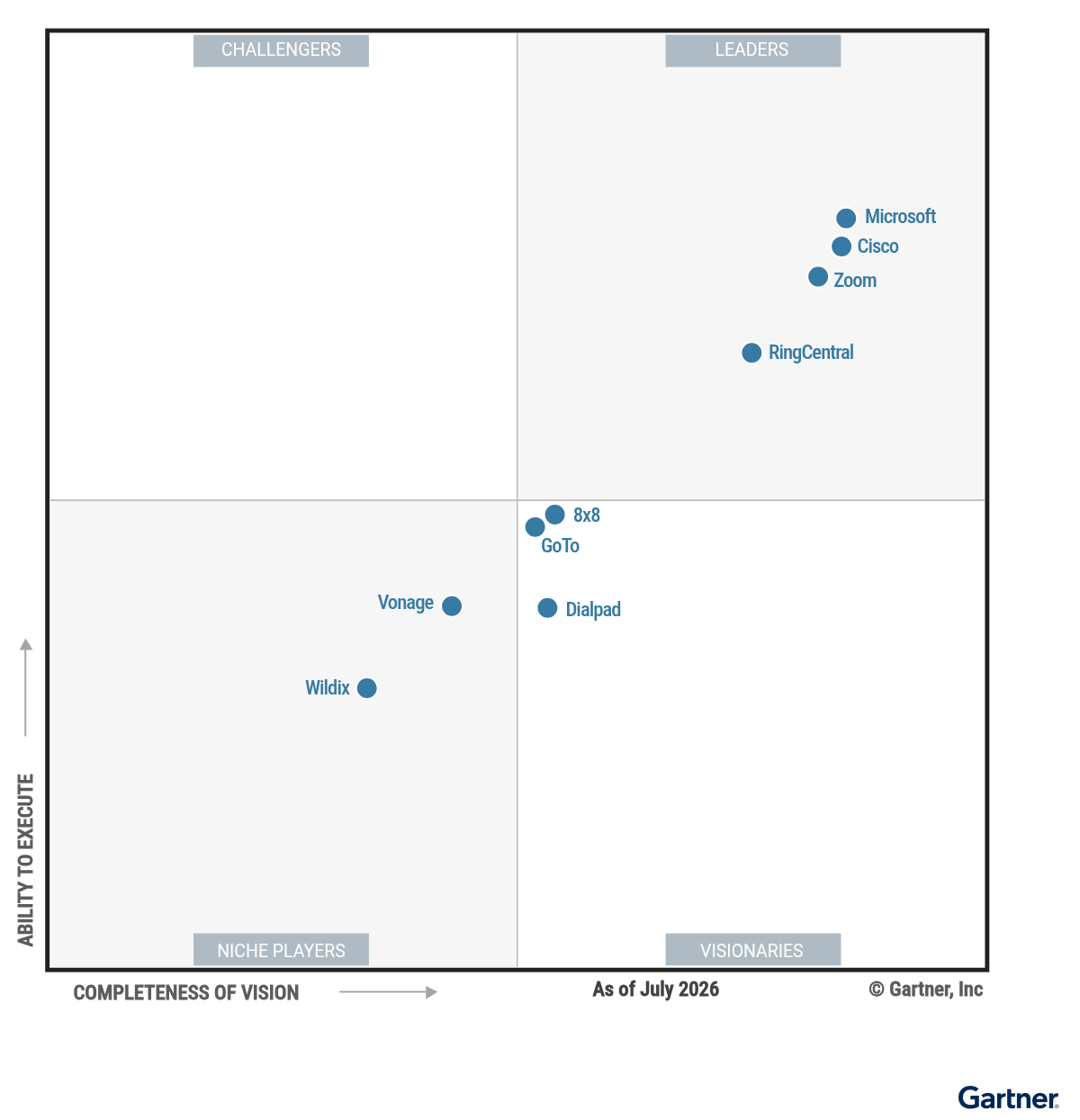
Vendor Strengths and Cautions
8x8
8x8 is a Visionary in this Magic Quadrant. It offers 8x8 Work (for telephony, collaboration, and conferencing services), 8x8 Engage for Frontline customer engagement, 8x8 Contact Center, and 8x8 CPaaS capabilities. It is preferred mostly by small and midsize enterprises looking for advanced telephony bundled with CCaaS functionality. Its customers are primarily concentrated in North America and Europe.
Over the past 12 months, 8x8 has launched 8x8 AI Studio, an agentic AI for voice and digital channels; introduced a purpose-built managed retail app for Zebra devices with MDM provisioning; expanded messaging capabilities by adding SMS for the Australian market; and enabled support for Mitel 6900 series phones. Additionally, 8x8 acquired Sipsynergy to further strengthen its Microsoft Teams integration.
- 8x8 delivers a unified platform integrating UCaaS, CCaaS, and CPaaS, allowing organizations to streamline communications management and minimize vendor complexity. Its emphasis on flexible contracts and simplified deployment makes 8x8 particularly attractive to small and midsize enterprises seeking operational efficiency and rapid adoption.
- 8x8 offers robust, fully managed Microsoft Teams integrations, including Direct Routing as a Service and Operator Connect, enabling organizations to deliver advanced telephony and customer service capabilities natively within Teams, without the need for additional SIP trunks or SBC infrastructure. This streamlines end-user workflows by allowing seamless calling and contact center functionality inside the Teams interface, reduces IT complexity, and ensures high availability and reliability for mission-critical communications.
- 8x8 is praised for its ease of use, intuitive design, and simple setup, making it accessible for both technical and nontechnical users. Users consistently highlight reliable performance and seamless integration with other tools and platforms, including Microsoft Teams.
- Despite achieving positive revenue growth after nearly three years of decline, 8x8 continues to face challenges with its UCaaS + CCaaS bundled offering, evidenced by a decrease in its UCaaS and CCaaS user base in 2026. Prospective customers should carefully evaluate 8x8’s recent performance trends and scrutinize its contact center strategies for customer retention and growth when considering a bundled UCaaS and CCaaS solution.
- 8x8’s progress in developing and deploying AI-powered collaboration tools and services remains behind key competitors, which may limit its appeal for organizations seeking advanced, integrated collaboration experiences.
- 8x8 continues to struggle to scale in the APAC, LATAM and Middle East markets despite offering calling plans in 50+ countries. Organizations with wider geographical reach are advised to evaluate its regional sales and support ecosystem to ensure that it aligns well with their objectives.
Cisco
Cisco is a Leader in this Magic Quadrant. Its product, Webex by Cisco, offers telephony, messaging, collaboration, meetings, devices, and contact center. The company maintains a strong emphasis on security and industry-specific compliance, while providing these features at a competitive price point. Cisco is a preferred provider for multinational enterprises with advanced telephony and stringent security requirements, serving a diverse customer base across regions and industries.
Over the past 12 months, Webex expanded its AI capabilities by introducing specialized agentic AI such as Notetaker, Scheduler, Polling, Task, Receptionist, and Translator agents, deepening integrations with third-party platforms like Microsoft Copilot, Glean, Salesforce, Gemini, Claude, Codex, and Cisco’s Cloud Control for troubleshooting.
- Cisco stands out for offering flexible deployment options (on-premises, hybrid, cloud) and secure, sovereign Cisco AI PODs for collaboration, supporting strong data sovereignty for multinational and regulated organizations. Its advanced telephony, legacy integration, and FedRAMP-certified, air-gapped solutions make it a top choice for healthcare, manufacturing, and government clients with stringent compliance needs.
- Cisco’s unified communications ecosystem, supported by centralized admin tools for UCaaS and CCaaS, streamlines management and optimizes operational efficiency. This approach delivers significant value for enterprises invested in Cisco solutions by simplifying workflows and enhancing overall communications infrastructure.
- Cisco’s extensive global partner network and wide PSTN partner coverage enable large multinational enterprises across diverse regions. This makes Cisco a strong choice for organizations requiring unified communications with consistent global support and connectivity.
- Webex faces strong competition from collaboration-centric vendors like Microsoft, with many enterprises using Webex for telephony while relying on other cloud office platforms for collaboration and conferencing. This trend may limit broader adoption of Cisco’s UC suite and also pose a future risk of organizations replacing Cisco’s telephony with integrated cloud office solutions.
- While Cisco continues to support legacy versions, some Gartner clients report an unintuitive user experience and gaps in reporting and analytics with Webex, identified through client interactions and Peer Insights. As a result, Cisco is often viewed as an IT-admin-preferred solution rather than a user-driven choice, which negatively impacts adoption decisions and leads to resistance from end users, especially in the SMB market.
- Although Cisco commits to high-availability targets for Webex Calling, the financial remedies for service disruptions are limited. Service credits are capped at 5% of the monthly service fee, which may be insufficient for large enterprises that require robust, high-stakes reliability assurances.
Dialpad
Dialpad is a Visionary in this Magic Quadrant. Its portfolio includes telephony, meetings, messaging, and customer support capabilities delivered through the Dialpad Connect, Dialpad Support, Dialpad Sell, and Dialpad AI Agents service bundles. It supports a range of organizations but is particularly strong among SMBs seeking integrated UCaaS and CCaaS-lite capabilities. It operates primarily in North America and Asia.
Dialpad’s latest enhancements include the addition of call queue failover, support for automated language translation during live meetings, the addition of breakout rooms, and enhancements with meeting chat (availability of private 1:1 chats and group video chats).
- Dialpad delivers the capabilities most SMBs desire to support efficient internal and customer-facing communications layered with high-value analytics and business insights.
- Dialpad’s solution is well-suited for organizations seeking intuitive, AI-infused UCaaS and lite CCaaS capabilities. The AI transcription and summarization capabilities are available across channels and deliver actionable insights that are easy to digest and share.
- Dialpad receives positive feedback for its customer support, with Gartner clients and Peer Insights reviewers frequently noting rapid and reliable issue resolution.
- Dialpad’s support for integration with adjacent best-in-class applications is limited compared with other providers evaluated in this Magic Quadrant. Dialpad meetings do not support cloud video integration with Cisco Webex, Microsoft Teams, or Zoom Meetings, and Dialpad does not offer native APIs to support third-party contact center integrations.
- Dialpad does not currently offer an AI Receptionist solution to support after-hours agentic call routing, basic query resolution, and appointment management.
- Dialpad’s international coverage remains limited. Businesses looking for coverage outside of the Americas and Japan should confirm requirements can be met.
GoTo
GoTo is a Visionary in this Magic Quadrant. Its product, GoTo Connect, provides telephony, meeting, messaging, and contact center capabilities. It is particularly well-suited for cost-conscious small or midsize businesses and distributed enterprises seeking streamlined front- and back-office communications flows. It operates primarily in North America, with an expanding footprint in Latin America.
Recent product developments include enhancements to GoTo’s AI Receptionist solution with new scheduling capabilities, the addition of multilingual support, knowledge ingestion improvements, postcall CSAT surveys, built-in SMS messaging, and transcript search capabilities.
- GoTo’s streamlined UCaaS and light customer service features are well-suited for businesses with limited IT resources that need integrated front- and back-office communications workflows.
- GoTo differentiates by delivering generally intuitive user interfaces, features, and straightforward system management.
- GoTo Connect offers a strong value proposition for automotive and small healthcare businesses where industry-aligned features and prebuilt integrations deliver out-of-the-box functionality.
- GoTo may not meet the requirements of large enterprises due to its limited geographic coverage and simplified feature set.
- GoTo has a relatively limited application marketplace and partner ecosystem. Its solution may be less suitable for organizations with extensive customization needs, particularly those outside of its core verticals of automotive, education, and healthcare.
- While GoTo is frequently recognized for ease of initial system configuration setup, Gartner clients and Gartner Peer Insights reviews indicate postsales support can be inconsistent.
Microsoft
Microsoft is a Leader in this Magic Quadrant. Its product, Microsoft Teams, offers telephony, messaging, and meetings. Teams remains the preferred solution for collaboration-focused organizations with minimal telephony needs. With industrywide declines in telephony usage, Teams is widely adopted as an internal collaboration tool across geographies and business sizes. Teams continues to lack full-fledged, native in-app contact center functionality.
The vendor’s latest enhancements include unified Copilot Chat along with Work IQ, and specialized AI agents like Facilitator and Interpreter to automate everyday workflows; and Teams Phone Unify integration allows seamless telephony connectivity between Teams, Dynamics 365 Contact Center, and third-party partner solutions.
- Teams’ robust collaboration capabilities position Microsoft well as organizations shift away from traditional telephony due to evolving communication culture and increased mobility. This enables customers to consolidate collaboration needs within a single platform, maximizing value even as telephony requirements decrease.
- Microsoft Teams offers a lower total cost of ownership (TCO) by leveraging baseline UCaaS capabilities included in most Microsoft cloud office licenses and a unified client experience. Its robust integration with third-party telephony specialists is highly valued by Gartner clients, enabling organizations to adopt best-of-breed telephony solutions while benefiting from a consolidated collaboration platform.
- Microsoft’s flexibility in offering Direct Routing and Operator Connect in over 60 countries through comprehensive carrier partnerships makes Teams a preferred choice for multinational organizations, particularly in regulated markets such as APAC and the Middle East. Additionally, bring your own carrier (BYOC) options in North America and Europe provide organizations with opportunities to reduce overall PSTN costs.
- Microsoft’s AI capabilities within UCaaS are primarily delivered through Copilot, which requires additional licensing beyond the standard UCaaS entitlement. Organizations requiring advanced AI capabilities should note that, unlike some competitors offering more comprehensive AI features as part of their core UCaaS packages, Microsoft’s Copilot offering could be an expensive toll.
- Despite supporting legacy device integrations theoretically, Teams telephony may be less suitable for organizations with advanced enterprise telephony requirements and extensive endpoint deployments (handsets, room systems, analog phones). Its admin capabilities and endpoint management still rely heavily on PowerShell and third-party tools, limiting streamlined management within UCaaS environments.
- Feedback regarding Microsoft’s support for Teams telephony, along with concerns about high resource consumption on PCs and mobile devices, continues to pose challenges for organizations seeking to scale Teams for telephony. These issues are frequently cited in both Gartner end-user client interactions and Peer Insights, and should be carefully considered when evaluating Teams as a UCaaS telephony solution, particularly for large-scale or resource-constrained deployments.
RingCentral
RingCentral is a Leader in this Magic Quadrant, offering RingEX and RingCX for integrated telephony, messaging, meetings, and contact center capabilities. Its suite includes AI receptionist (AIR), AI virtual assistant (AVA) for meetings, chats, and calls, and AI conversation analytics and insights (ACE). It serves organizations of all sizes, with strengths in advanced telephony and integrated UCaaS or light CCaaS. RingCentral has a strong presence in North America, Europe, and APAC, but limited reach in LATAM and the Middle East.
RingCentral’s latest enhancements include the release of AIR Pro, its agentic AI solution enabling task execution across voice and digital channels; Customer Engagement Bundle (CEB), an offering for RingEX customers with shared SMS inbox and advanced call queuing; and RingCentral Operator Connect to support a more seamless Teams integration experience.
- RingCentral’s open platform approach and extensive application marketplace (featuring nearly 600 prebuilt integrations) align well with organizations with complex customization requirements for telephony and customer-facing roles.
- The RingEX solution is often noted by Gartner clients and Peer Insights reviewers for its intuitive setup and ease of use. While it provides comprehensive back-end capabilities, the platform features an intuitive interface that enables both users and administrators to operate it effectively without requiring extensive technical expertise.
- RingCentral’s capabilities are uniquely aligned for both small businesses and large enterprises. Its CEB, AI Receptionist (AIR), and AIR Pro align well with small business requirements, while RingCentral’s expansive telephony feature set supports large enterprise requirements.
- RingCentral’s pricing for midlevel knowledge workers, particularly cost-conscious small businesses, is above the market average with many advanced capabilities as a premium offering often requiring additional add-ons.
- While RingCentral continues to evolve its contact center offerings, limitations exist in supporting enterprise-class support requirements. Seamless transitions across AI self-service and human-assisted journeys are not yet enabled and digital support capabilities remain limited.
- Based on Gartner Peer Insights and client feedback, RingCentral’s service and support are inconsistent; some organizations, especially in the SMB market, report customer care requires a higher effort, while others report not having prompt issue resolution.
Vonage
Vonage is a Niche Player in this Magic Quadrant. It offers Vonage Business Communications for telephony, SMS, messaging, and video, alongside Vonage Contact Center with AI capabilities. Its customer base is primarily the SMB market and mostly skewed toward North America. Vonage maintains a limited presence in Europe, the U.K., and select Asia/Pacific regions.
In the past 12 months, Vonage has advanced its UCaaS portfolio emphasizing native mobility, and ecosystem integration. It launched VBC Mobile Connect for the U.K. as a fixed-mobile convergence (FMC) offering into Vonage Business Communications using eSIM technology; enhanced AI transcription, summarization, postmeeting follow-up, and live caption support for VBC meetings.
- Vonage addresses both UCaaS and CCaaS needs and offers this as an integrated solution. This offering reduces multivendor management complexity mainly for SMBs.
- Vonage’s introduction of VBC Lite for Teams enables direct VBC calling natively within Microsoft Teams without the need for an additional Microsoft Phone license. This innovation enhances Teams integration and cost-efficiency.
- Vonage is consistently recognized by end users for its ease of use and intuitive setup, enabling rapid adoption and minimizing onboarding complexity.
- Vonage’s predominantly North American customer base may present limitations for multinational enterprises headquartered outside of North America seeking comprehensive global coverage and localized support capabilities.
- Gartner clients generally do not view Vonage as a collaboration-centric UCaaS vendor, citing deficiencies in advanced meeting features and limited cloud video interoperability with leading providers. This may restrict Vonage’s suitability for organizations seeking robust and comprehensive collaboration capabilities within their UCaaS environment.
- Vonage’s current portfolio does not yet offer advanced AI capabilities, including agentic AI within telephony and collaboration. As AI-driven innovation emerges as a key differentiator in the UCaaS market, this may affect Vonage’s ability to remain competitive and meet evolving customer expectations over the long term.
Wildix
Wildix is a Niche Player in this Magic Quadrant. Its product, x-bees, offers telephony, meetings, chat, and CCaaS services. Sales are mostly indirect and channel-driven, which sometimes leads to an increase in partner dependency. It is suitable for organizations with telephony-centric requirements such as heavy frontline-worker and customer-facing roles.
In the past year, Wildix implemented AI enhancements across its platform, including automated scoring of all interactions for quality assurance and embedding Wilma AI as a business intelligence interface. The partner program was updated with dedicated sales engineers, direct support, and Wilma AI handling first-level support for partners.
- Wildix offers a unified platform that combines UCaaS and light CCaaS capabilities with advanced integrated AI features. The solution is especially effective for customer-facing and frontline-worker roles, streamlining communications and support within a single, cohesive system.
- Wildix demonstrates consistent growth in its UCaaS business across Europe and has expanded its presence into North America and the Asia/Pacific region, enhancing its geographic reach and market diversity.
- Wildix stands out as one of the few UC vendors with over half of its customers on month-to-month contracts. This flexible approach minimizes vendor lock-in, providing customers with greater agility and control over their communications solutions.
- Despite adding some collaboration capabilities in the last couple of years, Wildix is still largely perceived as a telephony-centric solution. This focus may limit its appeal among organizations that prioritize advanced collaboration features, particularly outside industries where basic collaboration is sufficient.
- Gartner Peer Insights reviews show some challenges around initial usability and interface design, especially with the mobile app, setup, and feature consistency, which may require extra onboarding and support for new users.
- Wildix’s customer base is primarily concentrated among small and medium businesses, with limited presence in large enterprise deployments. Large organizations evaluating Wildix should carefully assess the experience and capabilities of regional partners to ensure they can effectively support complex, large-scale global implementations.
Zoom
Zoom is a Leader in this Magic Quadrant. Its offering includes telephony, meetings, messaging, and contact center. Zoom is deployed across all market segments, but is preferred by large multinationals operating in telecom-regulated regions such as India and the Middle East. It is one of the few providers with a direct license to sell cloud UC products with integrated calling plans in India.
Zoom’s latest enhancements include a customizable AI Companion, agentic AI capabilities that automate tasks and expanded functionality within platforms such as Microsoft Teams. It has also released a unified workspace for the full conversation-to-completion journey and new purpose-built vertical solutions for various industries.
- Zoom demonstrates strong capabilities in supporting multinational organizations, particularly in challenging locations such as India. Enterprises with operations in these regions should consider Zoom for its proven ability to deliver compliant and reliable UCaaS solutions in complex regulatory environments.
- Zoom’s expanding CCaaS capabilities, combined with its bundled UCaaS offerings, enhance its value proposition and appeal to organizations of all sizes seeking integrated communications and contact center solutions.
- Zoom offers robust AI capabilities, including the introduction of ZoomMate, an AI-powered workspace built into Zoom that acts like a virtual teammate. It turns conversations into completed work, uses AI to summarize, generate content, and execute tasks across tools, and delivers other agentic features spanning its portfolio of telephony, meetings, and contact center, further strengthening its position as an innovative UCaaS provider.
- Zoom’s licensing and bundling strategy has changed more frequently than the industry average, often resulting in price increases and licensing complexities. Renewing customers face ongoing uncertainty as new Zoom Workplace bundles may include more entitlements, but also higher costs and features that may not align with their needs.
- Zoom has expanded to add Zoom AI Productivity solutions as part of its Workplace bundling strategy. As a relatively new entrant in these adjacent markets, it may not yet be competitive against established vendors, and the level of investment in these new offerings may affect its overall financial performance.
- While Zoom’s user experience is effective for those using its full suite of features, Gartner clients and Peer Insights reviewers report that the addition of new functionalities and AI capabilities can present a more complex user interface and inconsistent AI experience.
Vendors Added and Dropped
We review and adjust our inclusion criteria for Magic Quadrants as markets change. As a result of these adjustments, the mix of vendors in any Magic Quadrant may change over time. A vendor's appearance in a Magic Quadrant one year and not the next does not necessarily indicate that we have changed our opinion of that vendor. It may be a reflection of a change in the market and, therefore, changed evaluation criteria, or of a change of focus by that vendor.
Dropped
- Google
- Sangoma
Inclusion and Exclusion Criteria
To qualify for inclusion in this Magic Quadrant, providers must meet the following criteria:
Self-developed unified communications as a service (UCaaS) core software:
- A UCaaS provider must self-develop the core software for:
- Calling and telephony
- Desktop apps, mobile apps, and web clients (All three must be self-developed and generally available for use)
- Meetings (audioconferencing, videoconferencing, web conferencing).
- Messaging
- Administrative portals
- At least voice/telephony channel and basic reporting for contact center solutions. Contact center solutions offered with the help of a technology partner for voice/telephony channels and basic reporting cannot be considered for inclusion criteria for this Magic Quadrant.
- A UCaaS provider must offer a bundled contact center that is seamlessly integrated into the UCaaS solution.
- A UCaaS provider must offer QoS monitoring that is seamlessly integrated into the UCaaS solution.
- Quality of service (QoS) monitoring may be self-developed or may be sourced from a technology partner.
Provider-operated core:
- A UCaaS provider must operate (manage, monitor, support, upgrade) the core UCaaS software platform for calling and telephony, messaging, meetings, and administrative portal.
- The contact center platform must also be operated by the UCaaS provider.
- QoS monitoring may be operated by the UCaaS provider, or by a technology partner.
- Compute, storage, and networking infrastructure for back-end UCaaS services can be operated and managed either by the UCaaS provider or by a technology partner (e.g., IaaS partner, telecom partner, etc.).
User base:
- A UCaaS provider must have a total user base of at least 1 million paying users with telephony entitlements and domestic calling plans.
- Twenty or more current customers must each have 2,500 or more paying users with enterprise telephony feature entitlements and calling plans for domestic public switched telephone network (PSTN) calling.
Revenue:
- A UCaaS provider must have a minimum of $110 million yearly in UCaaS recurring revenue as of 31 December 2025. UCaaS recurring revenue is revenue that is directly connected to monthly or yearly recurring charges for UCaaS licenses or seats, and excludes one-time charges (OTCs) for consulting services, implementation services for new customers, hardware, etc.
Geographic serving area and user base split:
- Definition of regions:
- Region 1 — North America: U.S. and Canada
- Region 2 — Europe: the U.K., Ireland, Iceland, and Western continental Europe (Andorra, Austria, Belgium, France, Germany, Liechtenstein, Luxembourg, Monaco, Netherlands, Portugal, Spain, Switzerland, Italy), Scandinavia (Denmark, Norway, Sweden)
- Region 3 — Asia/Pacific: Must include three of the following: Australia, New Zealand, India, Hong Kong, Singapore, Japan, China
- Region 4 — Latin America: Mexico, Central America and South America
- UCaaS provider must have 30,000 or more paying users with telephony entitlements and domestic PSTN calling plans in two or more of the above-defined regions; for example, more than 30,000 users in Region 1, and more than 30,000 users in Region 2.
- UCaaS provider must have 1,000 or more paying users with telephony entitlements and domestic PSTN calling plans in one-third (a different region than the previous criterion) of the above-defined regions; for example, 1,000+ users in Region 3.
Sales and support:
- UCaaS provider must have 75 or more directly employed sales and support staff in two (or more) of the above-defined regions. For example, more than 75 directly employed staff in Region 1 and more than 75 directly employed staff in Region 2.
Evaluation Criteria
Ability to Execute
Gartner analysts evaluate providers on the quality and efficacy of their processes, systems, methods, and procedures. These factors enable their performance to be competitive, efficient, and effective. They positively affect revenue, retention and reputation, in relation to Gartner’s view of the market.
Product or Service
The capabilities, features and overall quality of the core goods and services that compete in and/or serve
the defined market.
Key components include voice services/telephony, personal and team messaging, meetings, contact centers, mobility services, desktop, and mobile apps.
Overall Viability
The organization’s overall financial health, as well as the financial and practical success of the relevant business unit. This includes the likelihood that the organization can continue to offer and invest in the product, as well as the product’s position in the organization’s portfolio.
Key components include corporate financial health, corporate commitment to UCaaS, recurring revenue trends, retention of existing customers, new adoption, and customer base trends.
Sales Execution and Pricing
The organization’s capabilities in all presales activities and the structures that support these activities. This
includes deal management, pricing and negotiation, presales support and the overall effectiveness of the
sales channel.
Key components include conversion rates for sales of full-spectrum unified communications (UC), conversion rates for sales of partial UC services (telephony only, for example), direct sales, and indirect sales via channel partners.
Market Responsiveness and Track Record
The ability to respond, change direction, be flexible and achieve competitive success as opportunities develop, competitors act, customer needs evolve and market dynamics change. This includes the provider’s history of responsiveness to changing market demands.
Key components include innovations based on client requirements, pricing elasticity, and user churn.
Marketing Execution
The ability to deliver clear, high-quality, creative and effective messaging via publicity, promotional activity, thought leadership, social media, referrals and sales activities. This includes the organization’s ability to
influence the market, promote the brand, increase awareness of products and establish a positive reputation among customers.
Key components include key marketing initiatives, social media presence and updates, and Gartner client inquiry responses.
Customer Experience
The degree to which a vendor’s products, services and programs enable customers to achieve their desired results. This includes the quality of supplier and buyer interactions, technical support or account support, as well as ancillary tools, customer support programs, availability of user groups, and service-level agreements.
Key components include procurement experience and ease, customer administrative portal experience, account management, technical assistance tools, and customer support experience.
Operations
The ability of the organization to meet its goals and commitments. This includes the quality of its
organizational structure, skills, experience, programs and systems that enable the organization to operate effectively and efficiently.
Key components include the number of sales and support centers, customer experience centers, and geographical spread.
Ability to Execute Evaluation Criteria
| Evaluation Criteria | Weighting |
|---|---|
Product or Service | High |
Overall Viability | Medium |
Sales Execution/Pricing | High |
Market Responsiveness/Record | Medium |
Marketing Execution | Medium |
Customer Experience | High |
Operations | Low |
Source: Gartner (July 2026)
Completeness of Vision
Gartner analysts evaluate providers on their ability to convincingly articulate logical statements about the market’s current and future direction, innovation, customer needs, and competitive forces, in light of Gartner’s view of the market.
Market Understanding
The ability to understand customer needs and translate that understanding into products and services. Vendors with a clear vision of the market listen to and understand customer demands, and they can shape or enhance market changes with their vision.
Key components include completeness of UCaaS offering across the main pillars: calling, meeting, messaging, contact center; complementary professional support, life cycle and change management, and managed services; track record of UCaaS functionality and service offerings; roadmap to evolve the above to anticipate the market’s future needs; and adaptiveness to the changes in the market and customer demand.
Marketing Strategy
The ability to clearly communicate differentiated messaging, both internally and externally, through social
media, advertising, customer programs, and positioning statements.
Key components include specialized vertical-focused marketing strategy, branding and marketing campaign strategy, and unique marketing strategy.
Sales Strategy
The ability to create a sound strategy for selling that uses the appropriate networks, including direct and
indirect sales, marketing, service, and communication. This includes partnerships that extend the scope and depth of a provider’s market reach, expertise, technologies, services, and customer base.
Key components include vertical-specific sales strategy:
- Incentive programs for specific vertical or segment of the market, innovative sales strategy to target any new market/vertical, pricing visibility and transparency, and conversion rate.
Offering (Product) Strategy
The ability to approach product development and delivery in a way that meets current and future
requirements, with an emphasis on market differentiation, functionality, methodology, and features.
Key components include the ability to serve different market segments/sizes, provide flexibility in contract tenure and SLAs; offer and manage UCaaS endpoints/accessories on a rental basis with a wide range of OEM partnerships; and ensure the availability and resiliency of data centers in different geographies.
Business Model
The design, logic and execution of the organization’s business proposition.
Key components include overall business model, retention rate, and adaptiveness to the requirements of clients.
Vertical and Industry Strategy
The ability to strategically direct resources (sales, product, development), skills and products to meet the
specific needs of verticals and market segments.
Key components include the ability to serve different vertical/market segments and to serve an industry-specific solution, as well as industry-specific compliance.
Innovation
Marshaling of resources, expertise or capital for competitive advantage, investment, consolidation, or
defense against acquisition.
Key components include the ability to innovate and differentiate in a highly commoditized UCaaS market, an effective roadmap to win against the competition, and adoption of generative AI (GenAI) capabilities.
Geographic Strategy
The ability to direct resources, skills, and offerings to meet the specific needs of regions outside the provider’s home region, either directly or through partners, channels, and subsidiaries.
Key components include the number of countries where the UCaaS provider can provide phone numbers and UCaaS services, the ability to provide sales and support to multiple geographies, geographical penetration for selling UCaaS services, and growth outside the core regions for UCaaS vendors.
Completeness of Vision Evaluation Criteria
| Evaluation Criteria | Weighting |
|---|---|
Market Understanding | High |
Marketing Strategy | Medium |
Sales Strategy | High |
Offering (Product) Strategy | High |
Business Model | Low |
Vertical/Industry Strategy | Medium |
Innovation | High |
Geographic Strategy | High |
Source: Gartner (July 2026)
Quadrant Descriptions
Leaders
Leaders have mature UCaaS portfolios. They have comprehensive and integrated UCaaS solutions that address the full range of market needs, have a proven ability to serve large organizations, and have a commitment to three or more geographical markets. They have defined migration and evolution plans for their products in core UCaaS areas, and are using their solutions to acquire new customers, expand their geographical footprint, and innovate in new functional areas.
Challengers
Challengers have the ability to deliver UCaaS to large organizations. They have yet to become Leaders because their UCaaS solutions lack some elements. Their customer support is still evolving, they do not offer differentiated services, or most of their users deploy only certain aspects of UC.
Visionaries
Visionaries have an ambitious vision of the future and are making significant investments to develop unique technologies. Their services are still emerging, and they have many capabilities in development that are not yet generally available. Although Visionaries may have many customers, they might not yet serve a broad range of use cases well.
Visionaries are close to delivering — or are already delivering — differentiated UC functionality or services, but have not yet established themselves in the enterprise market. This may be due to an inability to support multiple large customers, a lack of proven ability to support panregional UCaaS deployments, or limited brand-name recognition. Some providers may be Visionaries because of only one or two shortcomings, such as inconsistent customer service.
Niche Players
Providers may be Niche Players for a variety of reasons. For some, it may be because of limited brand recognition or because they lack a robust marketing ability to sell beyond their home region. For others, it may be because their customers are using only a limited amount of UC functionality, their feature set may be weak in certain areas, or their customer service may be inconsistent.
Context
Cloud-based UC services have become the standard in most regions, except in certain telecom-regulated markets such as the Middle East, Africa, and some less-developed parts of the world. This widespread adoption is driven by the functional and commercial advantages that cloud UC offers over traditional, premises-based solutions. Leading UC vendors have developed distributed, resilient, multitenant solutions delivered via the cloud. Meanwhile, most vendors with existing on-premises UC customer bases continue to support these legacy products.
However, many on-premises legacy vendors like Panasonic and NEC have exited the market, whereas vendors like Cisco have shown commitments to adding more innovation mostly around AI and mobility into their existing on-premises platforms. The overall demand for on-premises UC solutions continues to decline, but there are markets and segments of the industry where enterprises are willing to continue with their existing on-premises solution. New purchases for on-premises solutions are extremely low.
Additionally, concerns around digital sovereignty and strict data residency regulations in regions such as Europe, Canada, and parts of APAC are compelling many enterprises to maintain on-premises UC deployments, due to the recent global geopolitical tensions and the use of global cloud platforms for sensitive communications data.
UCaaS offers superior desktop and mobile user experiences, enhanced mobile capabilities, improved performance and analytics dashboards, advanced collaboration features, and more robust management portals compared to legacy on-premises solutions.
Additionally, cloud UC solutions require significantly less effort, time, and expertise from customer administrators. While premises-based UC demands engineering-level skills to manage, UCaaS is much simpler. As a result, heads of infrastructure and operations (I&O) almost always prefer UCaaS.
SMBs
With few exceptions, UCaaS has long been the preferred UC deployment model for organizations with fewer than 1,000 employees, which were among the earliest adopters. Exceptions typically include organizations with 500 to 999 employees that:
- Do not anticipate a need for modernizing business communications or collaboration within the next three years
- Possess the expertise to manage on-premises infrastructure
- Maintain such infrastructure at a TCO that is lower than prevailing UCaaS market rates
- Operate in regions with local telecom regulations and requirements that restrict the use of global UCaaS providers
However, Gartner continues to see an increase in pricing for software maintenance licenses upon renewal from many vendors, making the lower TCO benefit with existing on-premises solutions increasingly rare among Gartner clients.
All small and midsize businesses (SMBs) should consider cloud solutions, as the market has become highly competitive, the TCO is generally lower than alternatives, and the cost of maintaining on-premises systems continues to rise each year. Innovation in cloud UC is robust, and few organizations wish to continue self-managing legacy infrastructure.
Large Enterprises
Large enterprises, with 1,000 to 5,000 users, are well-suited to UCaaS. Many UCaaS providers that operate in a single global region (and are, therefore, not featured in this research) can also be good options, assuming the buyer only operates in the same region.
Some large enterprises may operate in a hybrid model of vendors for different architectures. Gartner has seen these types of enterprises start deploying collaboration-centric platforms, such as Teams, for a majority of their users, and use a telephony specialist vendor such as RingCentral, 8x8 and Dialpad for a small number of users who need more advanced telephony features. Some of these organizations may migrate the majority of employees to the cloud, but use premises-based infrastructure in countries with restrictive regulatory requirements or unsuitable data network connections.
Very Large Enterprises
During the past few years, the adoption of UCaaS among the largest segment of more than 5,000 users has gained traction. However, there are still a lot of bottlenecks around customized integration requirements, lower TCO for managing on-premises platforms, and existing skill sets to manage the platform to reduce the overhead administrative cost compared to those within the SMB market.
Very large enterprises that continue to invest in premises-based UC (including ongoing maintenance and support agreements, upgrades, and patching) should be aware that vendors are allocating minimal R&D budgets to this technology. If organizations buy a new system today, they are unlikely to see significant innovation or enhancements during a typical five- to eight-year product life cycle. Most future enhancements (such as AI, mobility, analytics, and advanced user experience [UX]) will only be available on UCaaS platforms. Nonetheless, premises-based deployments will persist for reasons of regulation and the unavailability or unsuitability of UCaaS in specific regions.
Market Overview
Gartner’s perspective on the market is shaped by transformational technologies and evolving approaches to addressing future end-user requirements, rather than focusing solely on current market demands. Gartner has observed a sustained decline in the traditional use of enterprise telephony services, with organizations actively rightsizing their telephony footprint, typically reducing it across approximately 10% to 50% of their user base to drive cost-efficiencies, improve digital employee experience, and eliminate overlapping functionality across UC platforms. In parallel, renewals with telephony-centric specialist vendors are increasingly being challenged, as enterprises shift toward collaboration-led platform decisions.
UCaaS providers continue to prioritize the integration of AI capabilities, with a primary focus on enhancing collaboration-centric use cases such as meetings, conferencing, and team messaging. While vendors are also extending AI into selected customer-facing telephony scenarios, there remains a widening gap between the breadth of AI capabilities delivered by providers and enterprise readiness and appetite to adopt them. As a result, AI is not yet a primary decision driver for most end users, except in targeted customer-facing roles. However, Gartner expects demand for AI-enabled meeting experiences to increase as the technology matures and tangible benefits become clearer.
More recently, vendors have begun introducing AI agents as an emerging capability within UCaaS platforms, signaling the next phase of innovation. This is expected to drive greater enterprise focus on preparedness, governance, and operating models for AI adoption. In this context, heads of I&O must also evaluate AI tokenomics and cost implications as part of their UCaaS strategy.
Beyond core collaboration capabilities, UCaaS providers are expanding into adjacent domains, including integrated contact center and CPaaS offerings, positioning themselves as broader communication and customer engagement platforms. Most UCaaS vendors listed in this report have shown strong commitments and growth for their contact center offerings, though primarily targeted to the SMB market as of now.
Team Messaging and SMS
UCaaS providers have extended the capabilities of team messaging and workstream collaboration services by adding generative AI for drafting messages or replies and chat summarization, integrating business applications, integrating file-sharing services, adding bot frameworks, and providing connectivity to mobile SMS messaging services from desktops, web clients, and mobile apps.
Meetings
UCaaS platforms are rapidly evolving with embedded generative AI features such as real-time transcription, translation, meeting summarization, and sentiment analysis, significantly enhancing meeting productivity and reducing administrative workload. AI assistants are streamlining scheduling and postmeeting tasks, while platform convergence integrates UCaaS with contact center as a service (CCaaS) and communications platform as a service (CPaaS). Infrastructure upgrades, including 5G adoption and faster platform architectures, are delivering improved performance and reliability, especially for mobile and large-scale meetings.
Looking ahead, meeting technologies are poised to become even more intelligent and immersive. Advancements in AI will enable real-time coaching, automated follow-ups, and predictive insights that anticipate participant needs and optimize collaboration.
APIs, CPaaS and App Marketplaces
A capability that has seen increasing market demand is the integration of UC capabilities with business applications that make workflows more efficient. Examples of such integration include CRM applications, workforce management applications, contact center applications, workgroup applications, IT service management applications, and line-of-business applications. Some UCaaS providers have extended their offerings to include CPaaS. This enables the consumption of “atomized” UC capabilities (for example, the ability to send an SMS or initiate a call) by other applications that are enhanced by integrating and enabling communications services.
Reporting and Analytics Dashboards
UCaaS offerings provide administrative tools that visualize availability, failures, performance, diagnostics, usage, user adoption, and other key performance indicators. Dashboard reporting can be measured and displayed on multiple levels, such as call, user, business unit, and location.
UCaaS offerings share key characteristics with other cloud services, such as shared infrastructure and management tools, per-user/per-month pricing, and scalable capacity without hardware procurement. Leading providers use multitenant, microservices-based architectures, often leveraging public cloud platforms (e.g., Amazon Web Services, Microsoft Azure, Google Cloud Platform, Oracle) or their own data centers. UCaaS applications are distributed across regional or global service nodes, with some workloads processed in traditional data centers to optimize performance and user experience. Providers manage development, operation, and updates of these platforms directly.
Modern UCaaS platforms have greatly improved administrative capabilities by offering centralized dashboards for managing users, devices, licenses, and security policies from a single interface. Automation in provisioning, onboarding, and device configuration streamlines operations, reducing errors and speeding up service delivery. Enhanced security and compliance features, including AI-driven protocols and real-time monitoring, are especially beneficial for organizations in regulated industries, while cloud-native flexibility allows IT teams to scale services easily for hybrid and remote workforces.
For end users, UCaaS platforms now deliver a unified experience by integrating messaging, voice, video, and collaboration tools within one interface, minimizing the need to switch between apps and boosting productivity. AI-powered features such as live call sentiment analysis, postcall summaries, and predictive analytics further enhance user engagement and support proactive communication. The emphasis on mobile-first design ensures that users have full access to platform functionalities on smartphones and tablets, while customizable interfaces and feedback loops continuously improve usability.
These advancements are driven by broader technology trends, including the pervasive use of AI and automation for intelligent routing and quality scoring, the adoption of 5G for high-quality real-time collaboration (including augmented reality/virtual reality [AR/VR] tools), and seamless integration with business applications like CRM and project management systems. Together, these trends are transforming UCaaS platforms into comprehensive, intelligent hubs for modern workplace communication and collaboration.
The widespread shift to hybrid and remote work across all industries has driven sustained demand for UCaaS. UCaaS enables seamless communication and collaboration on desktop and mobile apps, offering experiences and features comparable to desk phones but with added convenience and no extra cost. The market has become increasingly collaboration-focused, reflecting users’ growing preference for meetings and messaging tools over traditional telephony. Over the past five years, communication culture has evolved, with users favoring mobile devices and collaboration apps for both internal and external interactions, rather than relying on UCaaS telephony features.
However, certain user roles continue to require traditional telephony features and functionality, and UCaaS telephony has become increasingly focused on serving these specific needs. The telephony market has largely plateaued in terms of feature innovation, while users are rapidly embracing advancements on the collaboration front. Notable enhancements include automatic meeting summarization, recommendations for next best actions, in-meeting language translation, advanced sound suppression, and improved quality of experience over unmanaged networks.
Although CCaaS is not the core focus of this research, strong links exist between UCaaS and CCaaS, because SMB organizations often purchase them together. A separate market exists for stand-alone CCaaS offerings aimed at larger (typically with more than 250 agents), higher-volume and more complex contact centers. These include those, for example, with requirements around workforce engagement and management capabilities, interaction analytics, more intricate and deeper integrations with CRMs, and line-of-business applications, and more advanced features.
Ability to Execute
Product/Service: Core goods and services offered by the vendor for the defined market. This includes current product/service capabilities, quality, feature sets, skills and so on, whether offered natively or through OEM agreements/partnerships as defined in the market definition and detailed in the subcriteria.
Overall Viability: Viability includes an assessment of the overall organization's financial health, the financial and practical success of the business unit, and the likelihood that the individual business unit will continue investing in the product, will continue offering the product and will advance the state of the art within the organization's portfolio of products.
Sales Execution/Pricing: The vendor's capabilities in all presales activities and the structure that supports them. This includes deal management, pricing and negotiation, presales support, and the overall effectiveness of the sales channel.
Market Responsiveness/Record: Ability to respond, change direction, be flexible and achieve competitive success as opportunities develop, competitors act, customer needs evolve and market dynamics change. This criterion also considers the vendor's history of responsiveness.
Marketing Execution: The clarity, quality, creativity and efficacy of programs designed to deliver the organization's message to influence the market, promote the brand and business, increase awareness of the products, and establish a positive identification with the product/brand and organization in the minds of buyers. This "mind share" can be driven by a combination of publicity, promotional initiatives, thought leadership, word of mouth and sales activities.
Customer Experience: Relationships, products and services/programs that enable clients to be successful with the products evaluated. Specifically, this includes the ways customers receive technical support or account support. This can also include ancillary tools, customer support programs (and the quality thereof), availability of user groups, service-level agreements and so on.
Operations: The ability of the organization to meet its goals and commitments. Factors include the quality of the organizational structure, including skills, experiences, programs, systems and other vehicles that enable the organization to operate effectively and efficiently on an ongoing basis.
Completeness of Vision
Market Understanding: Ability of the vendor to understand buyers' wants and needs and to translate those into products and services. Vendors that show the highest degree of vision listen to and understand buyers' wants and needs, and can shape or enhance those with their added vision.
Marketing Strategy: A clear, differentiated set of messages consistently communicated throughout the organization and externalized through the website, advertising, customer programs and positioning statements.
Sales Strategy: The strategy for selling products that uses the appropriate network of direct and indirect sales, marketing, service, and communication affiliates that extend the scope and depth of market reach, skills, expertise, technologies, services and the customer base.
Offering (Product) Strategy: The vendor's approach to product development and delivery that emphasizes differentiation, functionality, methodology and feature sets as they map to current and future requirements.
Business Model: The soundness and logic of the vendor's underlying business proposition.
Vertical/Industry Strategy: The vendor's strategy to direct resources, skills and offerings to meet the specific needs of individual market segments, including vertical markets.
Innovation: Direct, related, complementary and synergistic layouts of resources, expertise or capital for investment, consolidation, defensive or pre-emptive purposes.
Geographic Strategy: The vendor's strategy to direct resources, skills and offerings to meet the specific needs of geographies outside the "home" or native geography, either directly or through partners, channels and subsidiaries as appropriate for that geography and market.