Magic Quadrant for Cloud-Native Application Platforms
3 August 2026 - ID G00840891 - 42 min read
By Mukul Saha, Alex Coqueiro, and 2 more
Cloud-native application platforms remove infrastructure management complexity and enable product teams to deliver cloud-native applications and AI agents. This research helps software engineering leaders evaluate cloud-native application platform vendors and find the best fit for their organization.
Market Definition/Description
Gartner defines cloud-native application platforms as those that provide managed application runtime environments for applications and integrated capabilities to manage the life cycle of an application or application component in the cloud environment. They typically enable distributed application deployments and support cloud-native operations — such as elasticity, multitenancy and self-service — without requiring the development team to provision infrastructure or manage containers.
Cloud-native application platforms are designed to facilitate the deployment, runtime execution and management of modern cloud-native or cloud-optimized applications without the need to manage any underlying infrastructure.
Cloud-native application platforms provide an opinionated and structured execution environment that abstracts the complexities of underlying infrastructure and computing resources. These platforms supply vendor-supported runtimes and frameworks for commonly used languages (such as Java, .NET, Node.js, PHP, Python, Go and Ruby), reducing variability and operational overhead. By enforcing preferred configurations, automating infrastructure management and standardizing runtime environments, cloud-native application platforms help product teams deliver customer value faster and with greater consistency.
The cloud-native application platforms market reflects the consolidation of technologies across deployment, scalability, security and application observability to streamline software delivery. They are intended to be more than just a platform for running applications; they are essential for businesses aiming to achieve excellence in software engineering, productivity and market responsiveness.
Typical cloud-native application platform benefits include:
- Operational excellence: Cloud‑native application platforms remove infrastructure management complexities and enforce governance and guardrails through curated, preferred configurations. This reduces decision fatigue, strengthens security and assurance, and allows teams to focus on innovation and core business goals.
- Easier to scale: Cloud-native application platforms ensure applications can scale dynamically to meet demand with minimal manual intervention by using automation and providing seamless performance, even during peak loads, thus enhancing reliability and user experience.
Mandatory Features
The mandatory features for this market include:
- Application runtime services (including language runtime support) for multiple application types including web applications, mobile back ends, microservices, AI/ML models and analytics applications without requiring infrastructure provisioning or creating and maintaining custom container images.
- Automated deployment of cloud-native applications (e.g., integration with DevOps).
- Autoscaling (load balancing, scalability and running of multiple instances).
- Application monitoring and observability — Support for monitoring and observability to improve service-level objectives; gathering production telemetry (logs, metrics, events, traces).
- Fully managed service — Vendor (service provider) handles the maintaining, monitoring, updating and troubleshooting of the cloud-native application platform and the supported language runtimes and frameworks. This includes support, security, backups, performance optimization and infrastructure automation. It allows users to focus only on the application that can be deployed on cloud-native application platforms.
Optional Features
The optional features for this market include:
- Ability to deploy, manage, configure and operate containers at scale.
- Financial management capabilities for effective cost control and optimization.
- AI-assisted runtime environment, which includes intelligent configuration and orchestration of services, along with efficient resource distribution across workloads.
- IDE extensions and development tools to support software engineering teams in building applications for cloud-native application platforms.
- Serverless computing, which eliminates the need to manage application or service instances and their allocated compute resource, automatically scales with application demand and charges based on compute time used, enhancing efficiency and cost-effectiveness. Serverless computing encompasses various models, including functions as a service (FaaS) and serverless container orchestration.
- Automatic updates and security patches to keep cloud-native application platforms up to date and secure without service disruption, reducing vulnerability risks and maintenance effort.
- Polyglot deployment supports multiple programming languages and frameworks.
- Ability to easily integrate with external services such as DBMS, event brokers and caches through standard APIs.
- AI capabilities such as running AI workloads, including agentic and inference frameworks.
- Sovereign AI support, enabling organizations to run AI models, data pipelines and inference workloads within jurisdictionally compliant environments to meet national sovereignty, privacy and regulatory requirements.
- High availability and disaster recovery, which ensures high availability by automatically spinning off or switching to another application instance or switching to another compute region if the native host region goes down. This includes, but is not limited to, data backup and automatic failover, enhancing application reliability and continuity.
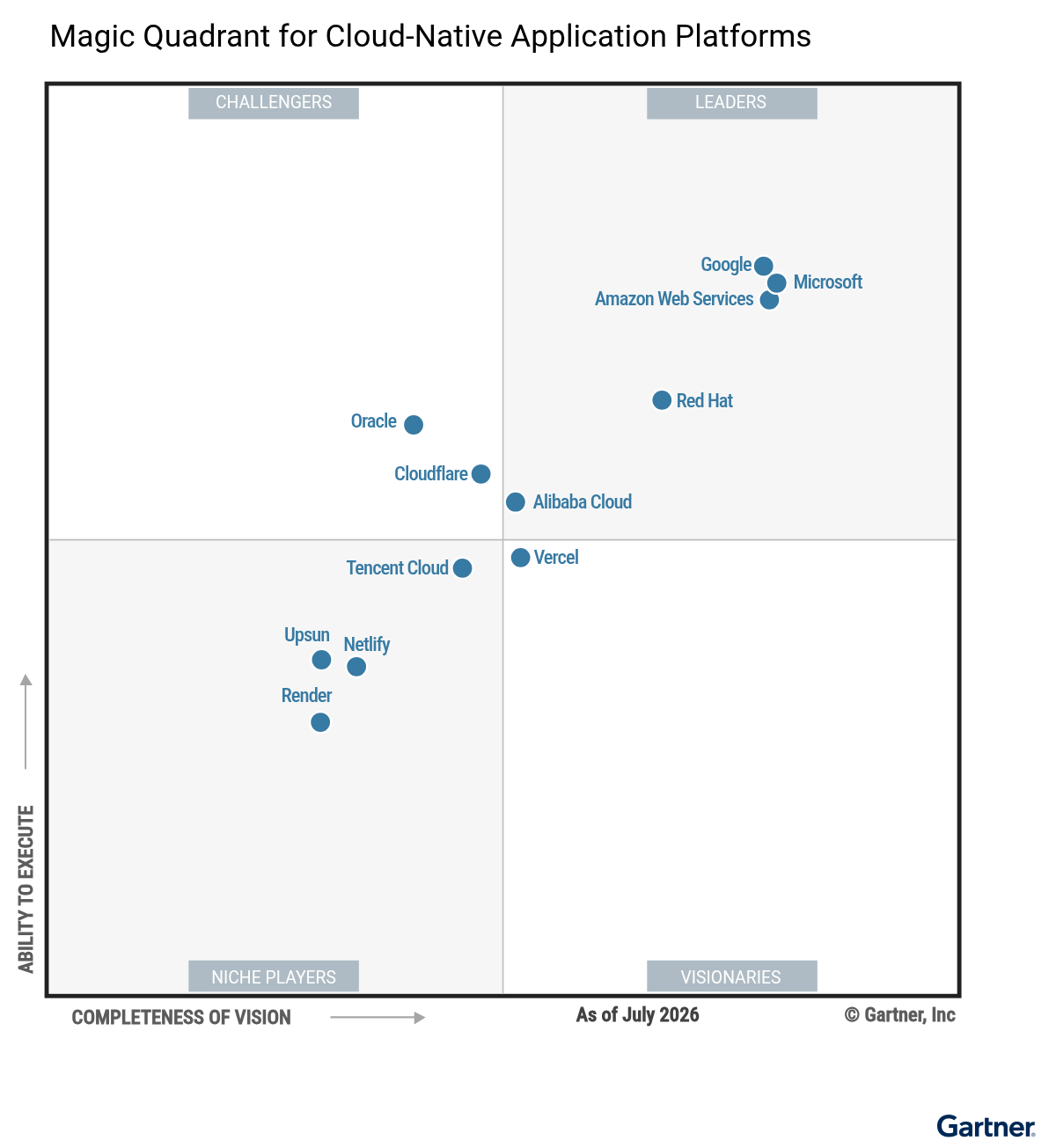
Magic Quadrant
Vendor Strengths and Cautions
Alibaba Cloud
Alibaba Cloud is a Leader in this Magic Quadrant. Alibaba Cloud’s portfolio comprises Container Compute Service, Serverless App Engine, and Function Compute. Alibaba addressed the shift toward agentic cloud architectures by introducing the Qwen model family and the JVS Agent Suite.
Alibaba Cloud’s operations are strongest in China and Asia/Pacific, with an expanding international presence, including Latin America. The company serves customers across industries and is investing in AI capabilities, Model Studio, AI developer tools and compute optimization within the Alibaba Cloud ecosystem.
Alibaba Cloud declined requests for supplemental information or to review the draft contents of this document. Gartner’s analysis is therefore based on other credible sources.
- Business Model: Alibaba Cloud’s consumption-based model enables customers to start with core infrastructure or application platform services and expand into adjacent cloud services over time. Its broad ecosystem supports cross-service adoption across compute, data, middleware and AI services, improving procurement simplicity and account expansion opportunities.
- Offering (Product) Strategy: Alibaba Cloud’s platform spans infrastructure, Kubernetes, serverless application platforms and AI development services. Alibaba Cloud Container Service for Kubernetes (ACK) supports container orchestration and life cycle management, Serverless Application Environment (SAE) supports application deployment without infrastructure management, and Model Studio provides the platform for building and operating AI-enabled applications.
- Operations: Alibaba Cloud can run massive workloads at hyperscale, leveraging services such as Elastic Compute Service (ECS) and ACK to deliver high availability, elasticity, and production-grade reliability across large environments. This operational maturity — validated in large-scale, high-demand scenarios — enables consistent performance and efficient resource management for enterprise-grade deployments.
- Product or Services: Alibaba Cloud’s higher-level middleware, API and AI services are optimized for use within the Alibaba Cloud ecosystem, which can create portability considerations for customers pursuing multicloud or cloud-agnostic strategies. As with other hyperscale clouds, buyers should assess integration dependencies and replatforming effort before building deeply on provider-specific services.
- Geographic Strategy: Alibaba Cloud continues to expand internationally, but its market presence, partner ecosystem and service maturity are not as strong outside China. Customers outside China should validate regional availability, support depth and CNAP service parity before standardizing on Alibaba Cloud.
- Market Understanding: Alibaba Cloud’s global developer reach and community mind share remain less mature than those of the largest global hyperscale cloud providers. Customers outside of China have less access to experienced talent, third-party integrations, reusable assets and community-driven best practices.
Amazon Web Services
Amazon Web Services (AWS) is a Leader in this Magic Quadrant. AWS’s platform spans AWS Lambda for serverless functions, AWS Fargate for serverless containers, AWS Elastic Beanstalk for managed application deployment, and AI features. Recent innovations — such as Lambda Managed Instances for cost-efficient, steady-state workloads and Lambda Durable Functions for resilient, stateful AI orchestration — enhance flexibility across execution patterns. AWS has also deepened integration of generative and agentic AI through agentic developer tooling, Amazon Bedrock AgentCore, and AI-driven observability in CloudWatch.
AWS’s operations are geographically diversified, and it serves customers of all sizes across sectors. The company continues to reduce operational complexity across containers, serverless and infrastructure-as-code workflows with capabilities such as Amazon EKS Auto Mode and AWS Infrastructure Composer.
- Business Model: AWS’s portfolio covers a broad range of use cases, enabling it to serve diverse customer needs across infrastructure, platform, and AI layers. AWS effectively captures demand across multiple consumption models, driving scalable revenue growth, strong cross-sell opportunities, partner value, and high customer lifetime value.
- Offering (Product) Strategy: AWS has proven its readiness for mission-critical workloads, with a portfolio that spans availability zones, resilient services, and enterprise-grade operational tooling. It consistently supports high-scale, fault-tolerant applications across serverless, containers, and AI services, positioning AWS as a reliable platform for business-critical systems.
- Product or Service: AWS delivers services that are technically robust and operationally relevant across vertical use cases. By tailoring core platform services to specific industry requirements, AWS enables customers to accelerate deployment, reduce integration complexity, and operationalize solutions within domain-specific contexts.
- Customer Experience: AWS customers may face postadoption complexity when standardizing cloud-native application platform patterns across teams, services and environments. Although AWS provides simplification capabilities such as Amazon EKS Auto Mode and AWS Infrastructure Composer, customers may still need governance and architecture guidance to manage service dependencies, cost visibility and consistent platform usage as adoption scales.
- Sales Strategy: Buyers seeking simpler, more prescriptive cloud-native application platform entry points may find AWS’s extensive portfolio, granular service options and configurable pricing models harder to evaluate without guided sales and architecture support. This can add evaluation effort for some customers, even though AWS’s broad direct sales reach, partner channels and solution-architecture engagement continue to support strong revenue growth, cross-sell opportunities and long-term customer expansion.
- Marketing Execution: Newer AWS customers may need clearer messaging that maps AWS cloud-native application platform services to common modernization patterns and business outcomes. Although AWS’s technical marketing reflects the depth of its portfolio and resonates with advanced buyers, its portfolio breadth can still make service discovery and positioning more complex for some customers.
Cloudflare
Cloudflare is a Challenger in this Magic Quadrant. Cloudflare expanded its Workers platform in 2026 with Cloudflare Containers and the Agents SDK, broadening its serverless model beyond lightweight edge functions. Containers support resource-intensive workloads, custom runtimes and existing container images, while the Agents SDK adds stateful AI-agent capabilities. Cloudflare also introduced CPU-time billing (paying only for active CPU cycles, not idle wall-clock time) to eliminate the costs for agents waiting on large language model (LLM) responses. Additionally, Cloudflare R2 eliminates data egress costs, enabling organizations to access and retrieve datasets from any cloud provider. These releases, along with the Cloudflare Data Localization Suite, address shifting client requirements for data sovereignty and the need for rapid, agentic AI application deployment.
Cloudflare’s operations are geographically diversified, and it serves customers across sectors requiring secure, low-latency application delivery. The company is expanding its platform capabilities to support serverless functions, containerized workloads and stateful AI agents.
- Market Responsiveness: Cloudflare delivers a unified Connectivity Cloud platform on a shared global network, enabling customers to consume a broad set of capabilities through a single, integrated architecture. Cloudflare has responded to enterprise demand for simplicity, integration, and rapid deployment.
- Overall Viability: Cloudflare positions its platform as a neutral, multicloud overlay that helps enterprises operate across heterogeneous cloud environments without depending on a single hyperscaler. This positioning benefits customers seeking consistent application delivery, security and edge execution across distributed architectures.
- Offering (Product) Strategy: Cloudflare aligns its offerings to industry-specific use cases, supported by vertical packaging (e.g., gaming, media, education) and backed by referenceable customer deployments. Cloudflare translates its Connectivity Cloud architecture into targeted outcomes across diverse industries.
- Operations: Cloudflare’s application delivery, security and runtime functions depend on a single control plane and global network, raising concerns about the blast radius of operational failures. Customers should also assess data movement patterns, egress costs and integration latency for architectures that require frequent exchange of application data between Cloudflare and third-party back-end cloud services.
- Product or Service: Cloudflare’s platform is less suited to complex enterprise architectures that require deep back-end control, traditional application migration paths or highly customized runtime topologies. Customers should validate observability, debugging and operational control requirements before using Cloudflare for complex enterprise application modernization.
- Sales Strategy: Cloudflare’s sales motion may require additional buyer education for those evaluating it as a broader cloud-native application platform rather than as an edge, security or CDN provider. Customers may need clearer guidance on when to use Cloudflare as a primary platform versus as a complementary layer.
Google is a Leader in this Magic Quadrant. Its offering includes Cloud Run, Firebase and Gemini Enterprise Agent Platform, including Agent Runtime, which together provide serverless, containerized and agentic deployment options supported by scaling, integration and AI-driven capabilities. It also includes Application Design Center, a platform engineering component that helps teams design, standardize and deploy template-driven applications on Google Cloud.
Google’s operations are geographically diversified, and it caters to customers of all sizes across all sectors. The company is strengthening its developer tools and optimizing compute performance within its ecosystem.
- Market Responsiveness: Google has sustained its open-source-first strategy, aligning its cloud offerings with widely adopted community-driven technologies such as Kubernetes, TensorFlow, and Knative. By contributing to foundational open-source projects and integrating them natively into Google Cloud, Google has responded to customer demand to innovate on industry-standard platforms.
- Business Model: Google’s partner-led, ecosystem-centric approach connects customers with global system integrators and partners who deliver industry expertise, implementation, and ongoing operations, while Google focuses on platform innovation. Google also offers flexible pricing models — consumption-based, subscription-based (e.g., Gemini), and outcome-based pricing — that expand its revenue streams and align with customer value realization.
- Offering (Product) Strategy: Google makes it easy for developers and enterprises to quickly experiment with and adopt Google Cloud services using fully managed offerings such as Cloud Run and Firebase. This accessible, developer-centric approach accelerates onboarding, supports rapid prototyping, and encourages incremental adoption.
- Customer Experience: In Gartner client interactions, some Google customers have cited inconsistent experiences and low responsiveness from frontline enterprise support and account teams. This may reduce satisfaction for large enterprise clients requiring high-touch support and proactive account management.
- Marketing Execution: Google’s cloud-native and AI application platform messaging can be difficult for buyers to navigate because related capabilities span Cloud Run, Firebase, Gemini Enterprise Agent Platform and Google AI Studio. Although Google positions Gemini Enterprise Agent Platform for enterprise-scale agent development and Google AI Studio for experimentation and prototyping, customers may still need clearer guidance on how these services work together for cloud-native, web and agentic application delivery.
- Geographic Strategy: Google Cloud does not operate a Chinese mainland cloud region, a limitation that is common for U.S.-based cloud providers. Customers with China-specific deployment, data residency or latency requirements should assess local-cloud or partner-based alternatives for those workloads before standardizing on Google Cloud.
Microsoft
Microsoft is a Leader in this Magic Quadrant. It offers Microsoft Azure, a platform anchored in Azure Container Apps (ACA), Azure App Service, Azure Static Web Apps, and Azure Functions, with integrated services spanning API management, AI, identity, observability, and data. Recent updates include Azure SRE Agent, confidential computing with trusted execution environments (TEEs), microVM-based ACA sandboxes, and AI-driven DevOps via GitHub Copilot and Azure API Management’s AI gateway.
Microsoft’s operations are globally distributed, serving customers across industries and regions. The company is advancing AI-first platform capabilities, focusing on inference optimization, agentic developer experiences, and improved compute efficiency and scalability for cloud-native workloads.
- Business Model: Microsoft has a large installed base in enterprises worldwide. This broad enterprise footprint gives Microsoft strong cross-sell and expansion opportunities for cloud-native application platform services, including Azure Container Apps, Azure Functions, Azure Kubernetes Service, App Service and related DevOps, observability and AI services.
- Offering (Product) Strategy: Microsoft’s platform supports customers across a broad range of cloud maturity levels, from organizations with limited technical capabilities to those operating advanced cloud-native environments. Its layered portfolio spans low-code tools, managed platform services, and container and AI capabilities, enabling customers to scale and evolve within the Microsoft ecosystem with reduced replatforming effort.
- Product or Service: Microsoft uses AI extensively across Azure observability to reduce operational burden for application teams. Azure Copilot Observability Agent investigates alerts and supports guided incident analysis, Application Insights smart detection uses machine learning to identify anomalies, and AIOps capabilities within Azure Monitor help reduce alert fatigue. Azure SRE Agent further supports operational workflows by investigating issues, diagnosing root causes, proposing mitigations and automating selected response actions.
- Market Responsiveness: As with other global hyperscalers, availability of AI-optimized and high-demand compute resources may vary by region. Microsoft continues to expand capacity through data center growth and a diversified infrastructure strategy, but buyers with AI-intensive, high-scaling or latency-sensitive workloads should validate regional capacity, quota availability and expansion timelines before deploying to specific Azure regions.
- Customer Experience: Microsoft Azure’s broad portfolio can make service discovery and planning complex. Customers may need additional guidance to select the right mix of services, particularly when balancing ease of use, operational control, scaling requirements and integration with existing Microsoft environments.
- Operations: Microsoft Azure’s deeply integrated service portfolio can create operational dependence on Azure-specific services, APIs, identity, observability, deployment and AI capabilities. Customers pursuing hybrid or multicloud portability should assess support models, operating procedures and architecture governance needed to manage platform dependencies.
Netlify
Netlify is a Niche Player in this Magic Quadrant. Netlify delivers an AI-native cloud application platform built on a globally distributed edge network, with recent additions such as Agent Runners, a managed AI Gateway, and a serverless database to support modern AI-driven workloads. Its streamlined DevOps workflow — featuring database branching, Deploy Previews, and integrated observability within Git — simplifies development and accelerates delivery for modern web applications.
Netlify’s operations are globally distributed, with a customer base spanning technology, retail, financial services, media and consumer brands. The company is investing in its composable web platform to support AI-generated and vibe-coded applications, with capabilities for rapid deployment, observability, API integration, edge/serverless execution and enterprise controls.
- Business Model: Netlify monetizes through subscription tiers and usage-based dimensions such as bandwidth, build capacity, seats, security features and enterprise support, allowing customers to expand adoption as usage and team size increase. This model connects self-service developer adoption with larger enterprise opportunities.
- Customer Experience: Netlify provides a streamlined development experience by minimizing configuration, abstracting infrastructure management and integrating build, deploy, preview and rollback workflows. This reduces DevOps complexity, accelerates onboarding and enables front-end teams to focus more on application logic and user experience.
- Product or Service: Netlify’s platform provides a zero-configuration continuous integration and continuous deployment (CI/CD) and deployment pipeline. This tightly integrated automation reduces setup effort, shortens release cycles, and ensures consistent, reliable delivery, making it particularly attractive for small, autonomous development teams.
- Offering (Product) Strategy: Compared with broader cloud-native application platforms, Netlify is less well-suited to enterprise workloads that require Kubernetes-centric portability or deep infrastructure customization.
- Sales Execution/Pricing: Netlify’s credit-based pricing consolidates usage across services into a single credit unit and provides spending caps, usage limits and threshold alerts. Nonetheless, high-traffic, build-heavy or function-intensive customers should consider active governance to optimize spend and to compare pricing with alternative platforms.
- Operations: Netlify’s platform has limited flexibility for organizations that require fine-grained control over networking, back-end architecture and deployment topology.
Oracle
Oracle is a Challenger in this Magic Quadrant. Oracle’s offering combines Oracle Cloud Infrastructure (OCI) Kubernetes Engine (OKE), OCI serverless functions, OCI DevOps pipelines, OCI API Gateway and Oracle Integration Cloud, with OCI Generative AI and Oracle Code Assist. Oracle’s distributed cloud strategy extends OCI services across public, sovereign, government and dedicated cloud deployments, and it supports multicloud integration through Oracle Database services on other hyperscalers. This provides customers with a consistent operating model for regulated, sovereign and dedicated deployment needs.
Oracle’s operations are globally distributed, serving customers across industries and regions. The company’s platform is positioned to support enterprise modernization by enabling scalable, secure and resilient application development across hybrid and multicloud environments.
- Sales Strategy: Oracle’s platform is especially appealing to existing Oracle Database customers, as the company provides a natural expansion path for its cloud-native platform with colocated Autonomous AI Database, OCI Streaming, and Oracle Integration Cloud. Application services can be consolidated in a single portfolio spanning integration, API management, and AI inference without the complexity of procuring a new platform.
- Geographic Strategy: Oracle’s sovereign and dedicated cloud regions extend OKE, serverless compute, and API Gateway to regulated industries and public-sector customers with strict data residency requirements. Regulated organizations gain a consistent application platform without a separate cloud strategy for compliant workloads.
- Marketing Strategy: Oracle positions generative AI inference, vector search, GPU compute, and agent orchestration on the same OKE and serverless infrastructure as transactional workloads. Organizations can run inference, vector search, and agent orchestration on OCI without provisioning a parallel AI platform.
- Market Understanding: Compared to the Leaders, Oracle has not generated as much awareness of its cloud-native platform among engineering teams. Existing OCI customers may still default to treating OCI primarily as infrastructure rather than as a broader application platform. This can limit adoption of Oracle’s cloud-native capabilities beyond database-adjacent, performance-sensitive or cost-sensitive workloads.
- Product or services: Oracle has improved the developer abstraction with OCI Container Instances, a serverless container service that manages infrastructure provisioning, life cycle operations, patching and upgrades. But it still remains less differentiated than the leading competitors for developer productivity. Buyers evaluating OCI for rapid innovation may need to invest in platform engineering before developers can focus on application delivery.
- Vertical/Industry Strategy: Oracle offers fewer industry-specific CNAP templates, reference architectures and reusable accelerators for custom application development compared to the Leaders. Organizations in regulated industries may still need additional architecture, integration and compliance work when using OCI cloud-native services beyond Oracle application-adjacent use cases.
Red Hat
Red Hat is a Leader in this Magic Quadrant. It offers Red Hat OpenShift with different hyperscalers: Red Hat OpenShift Service on AWS (ROSA); Microsoft Azure Red Hat OpenShift (ARO); Red Hat OpenShift Dedicated on Google Cloud; and Red Hat OpenShift on IBM Cloud. It also can be deployed as self-managed software on-premises or in the cloud.
Red Hat recently introduced intent-driven scaling via Karpenter and hosted control planes to optimize compute costs and resource allocation. The company also added GPU instance management options across hyperscalers, and expanded OpenShift’s regional presence and governance controls.
Red Hat’s operations are geographically diversified, and it caters to customers of all sizes and across all sectors. The company is investing in expanding support for AI workloads, optimizing costs with features like hosted control planes and OpenShift AI with llm-d and vLLM.
- Offering (Product) Strategy: Red Hat OpenShift provides consistent application portability for mission-critical workloads across hybrid and multicloud environments. This flexibility enables organizations to move workloads while maintaining operational consistency, aligning with enterprise requirements for resilience, compliance, and long-term platform neutrality.
- Overall Viability: Red Hat is supported by IBM’s financial scale, enterprise reach and continued investment in hybrid cloud. OpenShift remains central to IBM’s hybrid cloud strategy, with reported double-digit growth in OpenShift and Ansible contributing to Red Hat’s hybrid cloud revenue growth. Red Hat also benefits from strong enterprise adoption in regulated and hybrid environments, where customers value OpenShift’s portability and Kubernetes foundation.
- Business Model: Red Hat positions itself as an end-to-end solution provider, particularly in environments leveraging infrastructure as code with tools such as Ansible. This integrated approach enables Red Hat to capture value across the application life cycle — from provisioning and configuration to deployment and operations — and drive consistent customer engagement.
- Customer Experience: Red Hat customers have raised concerns in inquiries about the maturity of OpenShift Virtualization for some enterprise virtualization use cases, including migration complexity, skills requirements and operational readiness.
- Product or Service: While managed OpenShift services reduce much of the cluster provisioning and operational overhead, hybrid customers deploying self-managed OpenShift on-premises may still face complex setup and configuration requirements. This upfront lift can create adoption barriers for organizations without mature platform engineering practices or Kubernetes expertise.
- Sales Execution/Pricing: In Gartner client interactions, Red Hat OpenShift customers have reported high initial subscription costs, renewal increases and additional support requirements. These commercial dynamics can make OpenShift costlier to scale across clusters, environments and business units.
Render
Render is a Niche Player in this Magic Quadrant. Render’s platform provides compute, managed databases, and automated Git-based deployments. Recent releases include Render Workflows for durable task orchestration suitable for agent runtimes and an MCP server for AI-agent infrastructure management. To better model the costs of AI agent workloads, Render transitioned from per-seat to flat platform fees. It also added persistent compute and sandboxed execution to meet stateful AI application requirements.
Render’s operations are global, with service regions in North America, Europe and Asia, and its clients tend to be small and midsize businesses across various sectors. The company is investing in expanding its compliance certifications, geographic coverage and developer experience.
- Business Model: Render packages its core cloud services — including compute, databases, networking and deployment workflows — into a single platform aimed at developers and lean engineering teams. This enables Render to compete as an integrated alternative to hyperscalers, expanding revenue opportunities across multiple workload types while reducing procurement complexity for customers.
- Customer Experience: Render provides a streamlined developer experience across the application life cycle, from onboarding and deployment to scaling and day-to-day operations. Its opinionated workflows, automation and simplified interface help teams move applications into production faster and reduce operational friction.
- Offering (Product) Strategy: Render’s platform supports both static front ends and long-running back-end services, enabling developers to build and operate full-stack applications within a single environment without stitching together multiple services. The addition of Render Workflows addresses a prerequisite for agent runtimes.
- Product or Service: Render’s product portfolio is less comprehensive than platforms with broader enterprise cloud-native and application delivery capabilities. While Render supports static sites on a global CDN and edge caching for static assets on paid web services, its differentiation is narrower in areas such as advanced edge application delivery, granular traffic-management controls, deeper AIOps-enabled operations, and complex hybrid, multicloud or Kubernetes-centric deployment models.
- Operations: Render’s free-tier web services spin down after periods of inactivity, which can introduce cold-start latency when traffic resumes. Paid services run continuously and do not incur this free-tier spin-down behavior, but buyers should still validate scaling behavior and latency requirements for production workloads.
- Innovation: Render has been slower than most competitors in this evaluation to expand beyond its core simplified deployment and hosting experience into more advanced cloud-native platform capabilities. Key gaps include broader integration ecosystems, advanced built-in observability such as distributed tracing and APM, AIOps capabilities, platform engineering controls, and support for complex Kubernetes, multicloud and hybrid operating models.
Tencent Cloud
Tencent Cloud is a Niche Player in this Magic Quadrant. It offers CloudBase, a cloud-native development platform that supports back-end services, serverless application development, static website hosting and application operations, with Tencent Kubernetes Engine supporting container-based deployment needs. Tencent Cloud has also added AI-oriented capabilities, including an AI gateway, MCP server and AI Builder, alongside open-source initiatives such as Cube Sandbox and OpenVibeCoding.
Tencent CloudBase’s operations are primarily concentrated in China and Asia/Pacific, and its clients tend to be regional enterprises, digital-native businesses and organizations with strong China-market requirements. The company is positioned to support cloud-native application modernization through an integrated platform that combines application development, operations and observability capabilities, with Tencent Cloud Observability Platform (TCOP) supporting monitoring, alerting, intelligent analysis and root-cause analysis use cases.
- Product or Service: Tencent CloudBase provides customers with enterprise-grade scalability and aligns with upstream Kubernetes and CNCF ecosystems, enabling compatibility with industry-standard tools while supporting large-scale production workloads.
- Operations: Tencent CloudBase delivers strong operational capabilities with built-in autoscaling and resilience, allowing applications to handle traffic spikes and failovers elastically. The TCOP AI Workbench offers multiple AIOps scenarios for simplified customer operations, including intelligent alerting, anomaly detection and root-cause analysis.
- Offering (Product) Strategy: Tencent CloudBase tightly integrates with the WeChat ecosystem and broader super app architectures. This integration enables developers to build and deploy applications that directly leverage large-scale user platforms and distribution channels.
- Geographic Strategy: Tencent CloudBase’s ability to handle sensitive data and meet compliance requirements varies based on where workloads are hosted. This creates barriers to adoption for multinational enterprises and organizations in highly regulated industries.
- Customer Experience: Outside of China and Asia/Pacific, it can be difficult for potential Tencent buyers to find skilled engineers who are familiar with Tencent Cloud. This limited talent pool may constrain implementation, support, and long-term platform adoption outside its core markets.
- Supporting Resource Readiness: Tencent’s documentation and developer resources are not as comprehensive as those of its competitors and are harder to navigate for global audiences. This reduced accessibility of resources can delay onboarding for developers outside of Asia/Pacific.
Upsun
Upsun is a Niche Player in this Magic Quadrant. Its platform is designed to modernize the software development life cycle (SDLC) through a Git-centric, infrastructure-as-code approach that supports containerized application delivery, automated environment management, built-in observability and multicloud portability. The platform also supports scalability through automated horizontal and vertical scaling. Recent releases add AI-assisted capabilities, including the Upsun Model Context Protocol (MCP) Server for infrastructure operations and generative configuration tools.
Upsun’s operations are mainly in North America, Europe and Asia/Pacific. Its clients are typically midsize web agencies and line-of-business departments within large enterprises across a wide range of sectors. The company is investing in financial incentives for deploying projects in low-carbon-emission regions.
Formerly known as Platform.sh, Upsun rebranded itself in September 2025.
- Offering (Product) Strategy: Upsun’s platform delivers built-in automation, simplifying application deployment and life cycle management while reducing operational overhead for development teams. Its Git-centric, infrastructure-as-code approach provides a stable, high-performance foundation that supports consistent and reliable application delivery across environments.
- Customer Experience: Upsun provides an intuitive, developer-oriented experience through Git-based, on-demand environments that allow teams to create preview or nonproduction environments tied to branches and pull requests. This supports faster feedback cycles, safer testing of application and infrastructure changes, and more consistent collaboration across development and operations teams before changes are promoted to production.
- Business Model: Upsun’s cloud-agnostic approach enables customers to deploy applications across multiple cloud providers without infrastructure lock-in, supporting flexibility and long-term strategic portability.
- Product or Service: Upsun has added AI-assisted capabilities such as its MCP Server, generative configuration tools, and Performance Agent for identifying performance bottlenecks and generating actionable recommendations. However, customers seeking fully autonomous remediation, closed-loop optimization or enterprise AIOps workflows should validate whether Upsun’s current capabilities meet those requirements at production scale.
- Operations: Upsun provides limited flexibility for advanced use cases that require fine-grained controls, as customers cannot easily adjust certain configurations — such as networking, regional placement, and low-level tuning.
- Market Understanding: Upsun’s Git- and configuration-driven model may be harder for teams that are not used to managing environments through code, templates and pull-request workflows. Customers should assess whether its AI-assisted configuration tools sufficiently reduce the learning curve for broader adoption and ongoing operations.
Vercel
Vercel is a Visionary in this Magic Quadrant. Its platform supports the building, deployment and hosting of cloud-native web applications, with particular depth in Next.js, broad front-end framework support, CDN-backed delivery, Git-driven deployments, preview environments and edge runtime capabilities. Vercel is also expanding into AI and agentic application infrastructure through AI Gateway, Vercel Workflows, Vercel Sandbox and related services.
Vercel serves a global customer base across sectors. The company is extending its platform toward agentic infrastructure, adding AI Gateway, sandboxed execution, workflows and observability for AI-enabled application development.
Vercel did not respond to requests for supplemental information. Gartner’s analysis is therefore based on other credible sources.
- Customer Experience: Gartner Peer Insights survey respondents consistently praise Vercel’s ease of use, reliability and performance. Customers have responded positively to Vercel’s repositioning as an agentic infrastructure platform.
- Innovation: Vercel is extending its deployment platform with AI-oriented infrastructure and developer tooling, including AI Gateway, AI SDK, durable workflows and sandboxed compute for agentic workloads. Its AI SDK, agent-focused documentation and integrations with AI coding tools help developers build AI-enabled applications and agents with less custom integration effort, strengthening Vercel’s positioning beyond front-end deployment.
- Marketing Strategy: Vercel has built clear market visibility through a developer-led strategy centered on the modern front-end ecosystem, particularly Next.js. Its positioning around high-velocity web delivery, full-stack JavaScript development and emerging AI-enabled application workflows gives it a clear entry point with development teams.
- Product or Service: Vercel has expanded support for back-end and containerized workloads through Vercel Services, internal service communication, native database integrations and Dockerfile-based container deployment. However, these capabilities are newer and may be less proven for large-scale migration of established enterprise Java and .NET estates, deeply customized infrastructure patterns or organizations requiring mature container-platform operations comparable to Kubernetes-centric platforms. Buyers with complex back-end investments should validate fit for production scale, operational control and migration requirements.
- Vertical/Industry Strategy: Vercel is expanding its enterprise governance and security capabilities for high-velocity application delivery, including AI-generated and agentic applications. However, regulated-industry buyers should validate whether its controls for identity, access, secrets management, observability, auditability and operational segregation meet their requirements at scale. Vercel’s 2026 third-party AI OAuth incident, and its subsequent move toward short-lived, scoped runtime tokens through Vercel Connect, underscore both the importance of these controls and the need for customer validation in regulated environments.
- Marketing Execution: Vercel has not overcome the entrenched belief among infrastructure-focused organizations that powerful platforms must be hand-built with low-level tools. Concerns about migration risk, workflow disruption, and retraining costs remain significant barriers, and Vercel’s go-to-market approach has yet to address these concerns.
Vendors Added and Dropped
We review and adjust our inclusion criteria for Magic Quadrants as markets change. As a result of these adjustments, the mix of vendors in any Magic Quadrant may change over time. A vendor's appearance in a Magic Quadrant one year and not the next does not necessarily indicate that we have changed our opinion of that vendor. It may be a reflection of a change in the market and, therefore, changed evaluation criteria, or of a change of focus by that vendor.
Added
- Oracle
- Tencent Cloud
Dropped
- Huawei
- Salesforce (Heroku)
Inclusion and Exclusion Criteria
In addition to Gartner client relevance, as determined by analyst expertise and opinion, providers need to meet the following criteria to qualify for inclusion.
Market Participation Inclusion Criteria:
- Meet the market definition of cloud-native application platforms.
- All features applicable to this inclusion criteria and evaluated in this research must have been generally available as of 1 April 2026 to all customers and fully documented. Custom development for specific customers did not qualify. General availability means the product or service is available on a public-facing price sheet/card for purchase directly by clients. Providers must be able to furnish the link to a pricing page for their cloud-native application platforms.
- Sell the solution directly to paying customers without requiring them to engage professional services. The vendor must provide at least first-line support for these capabilities, including the use of bundled open-source and closed-source software.
- Demonstrate an active product roadmap, and go-to-market and selling strategy for the solution.
- Have phone, email and/or web customer support. They must offer a contract, console/portal, technical documentation and customer support in English (either as the product’s default language or as an optional localization).
Platform Capabilities Inclusion Criteria
Cloud-native application platforms must provide cloud-based managed application runtime environments for applications, integrated capabilities to manage the life cycle of an application or application component, and typically enable distributed application deployments and support cloud-style operations — such as elasticity, multitenancy, and self-service — without requiring infrastructure provisioning or container management. Cloud-native application platforms must be enterprise-grade and aimed at enterprise-class projects by providing high availability and disaster recovery technical support to customers.
The selected platform must support modern full-stack frameworks using their native runtime environments, without requiring custom wrappers and compatibility layers.
Performance Inclusion Criteria
Size: The vendor must have, as of 1 April 2026, fulfilled one of the following size requirement combinations:
- Platform license and/or subscription revenue of at least $45 million for the cloud-native application platform over the last 12 months, and at least 100 paying enterprise customer organizations (of
at least 1,000 employees) for its cloud-native application platform offering, excluding other related product offerings.
OR
- Platform license and/or subscription revenue of at least $18 million for cloud-native application platform over the last 12 months and compound annual growth rate (CAGR) of at least 50% in revenue and/or customer base for its cloud-native application platform offering, excluding other related product offerings.
The vendor must have direct customers (i.e., not through resellers) within three or more of the following geographies:
- North America
- South America
- Europe
- Middle East and Africa
- Asia/Pacific
We excluded vendors from the analysis if:
- The primary use case for the cloud-native application platform is hosting no-code or low-code applications, packaged business applications or SaaS-based applications (i.e., developing, extending, configuring or customizing applications such as Salesforce, Dynamics 365, Oracle, SAP or ServiceNow). The market needs and expected platform capabilities for these use cases differ from the market definition.
- The platform or access to platform is only sold as part of custom software development or professional services engagements (e.g., professional services providers using a custom solution for their clients).
- The platform is provided as non-cloud-based (on-premises) and/or nonmanaged service.
Honorable Mentions
Akamai: The Akamai Cloud platform enables users to build, deploy and operate Kubernetes-based applications across Akamai’s distributed cloud infrastructure. In addition to its application platform capabilities, Akamai offers related cloud services including cloud computing, content delivery, application security, edge security and observability. Akamai Cloud packages common Kubernetes tools and workflows, aiming to simplify application deployment, platform operations and developer self-service. These services support containerized cloud-native applications and are positioned for organizations seeking to run workloads closer to users while using Akamai’s broader edge and cloud portfolio.
Broadcom: Broadcom offers VMware Tanzu Platform, which clients can operate on-premises (air gapped) or on the cloud infrastructure of their choice. Tanzu Platform abstracts infrastructure complexity and enables developers to build applications and AI agents by providing brokered public and private service bindings, including models, MCP servers, enterprise APIs and included vector database, caching, streaming and messaging services. Tanzu Platform natively supports multiple languages, including Go, Java, JavaScript, .NET, PHP, Python and Ruby. It provides buildpack tooling and deployment automation to create and configure containers for deployment into an elastic application runtime.
Clever Cloud: Clever Cloud’s platform natively supports and operates more than 15 programming environments, including JavaScript, PHP, .NET, Java, Python and Rust, as well as autoscaling containers. Clever Cloud provides a managed services marketplace for databases, message queues, storage, identity management, AI services, alongside built-in support for continuous delivery, monitoring and cloud migration. These services support native code, containers and cloud migration use cases.
Fastly: Fastly’s Edge Cloud Platform enables users to run and secure application logic at the edge using serverless compute and content delivery capabilities. In addition to compute, Fastly offers related cloud services including CDN, application security, edge data storage and observability. These services support programmable edge workloads and serverless functions, making Fastly most relevant for latency-sensitive applications that benefit from executing logic closer to end users.
Harper: Harper offers a distributed application platform that combines database, caching, application hosting and messaging capabilities into a single back-end runtime. The platform is designed to reduce latency and architectural complexity by minimizing the need to coordinate separate application servers, caches, databases and messaging layers. Harper is best-suited for data-intensive, latency-sensitive and globally distributed applications, with Harper Fabric providing deployment across regions with platform-managed replication, routing and failover.
Mia-Platform: Mia-Platform provides a developer platform for enterprises standardizing cloud-native application development and operations. It supports internal developer platform and platform engineering use cases by abstracting infrastructure complexity, enabling self-service workflows, and applying governance, security and compliance controls across delivery pipelines. Its AI capabilities use a governed context catalog to manage how agents and AI-assisted workflows access software components, APIs, infrastructure resources and data, helping organizations apply guardrails to agentic engineering.
Evaluation Criteria
Ability to Execute
We evaluated the following criteria to assess the vendor’s Ability to Execute. Below is a description of what we specifically looked for in each criterion.
Product/Service: Runtime environment, frameworks and deployment options, support of AI agent development, strong serverless capabilities, scalability and availability, monitoring and observability, cost management and optimization, platform engineering support, and governance.
Overall Viability: Company financials, revenue growth, and customer growth and retention.
Sales Execution/Pricing: Capacity of sales organization, direct sales programs and indirect sales programs.
Market Responsiveness and Track Record: Community engagement and contribution, customer interactions and responsiveness, and product customization and innovation.
Marketing Execution: Product positioning and developer appeal, marketing strategy and budget, and market presence and competition.
Customer Experience: Training, onboarding, and certification programs; customer support; and customer success and retention.
Operations: Customer operations structure, service-level agreements and support, and certifications and quality standards.
Ability to Execute Evaluation Criteria
| Evaluation Criteria | Weighting |
|---|---|
Product or Service | High |
Overall Viability | Medium |
Sales Execution/Pricing | High |
Market Responsiveness/Record | High |
Marketing Execution | Low |
Customer Experience | Medium |
Operations | Medium |
Source: Gartner (August 2026)
Completeness of Vision
We evaluated the following criteria to assess the vendor’s Completeness of Vision. Below is a description of what we specifically looked for in each criterion.
Market Understanding: Alignment with customer needs and use case, understanding of strengths and weaknesses, and market positioning.
Marketing Strategy: Overall marketing strategy, marketing activities, and partnerships.
Sales Strategy: Sales growth strategies, sales activities, and product pricing and licensing models.
Offering (Product) Strategy: Product roadmaps, customer contribution to product evolution, and differentiating capabilities.
Business Model: Business model canvas, ecosystem and partnerships, and operating expenses.
Vertical/Industry Strategy: Partnerships, customer and market presence, and overall vertical/industry strategy.
Innovation: Current and planned innovative capabilities, and trends awareness.
Geographic Strategy: Regional presence and capacity, product localization, and regional partnerships.
Completeness of Vision Evaluation Criteria
| Evaluation Criteria | Weighting |
|---|---|
Market Understanding | High |
Marketing Strategy | Medium |
Sales Strategy | Medium |
Offering (Product) Strategy | High |
Business Model | Medium |
Vertical/Industry Strategy | Low |
Innovation | High |
Geographic Strategy | Medium |
Source: Gartner (August 2026)
Quadrant Descriptions
Leaders
Leaders distinguish themselves by offering a platform suitable for strategic adoption and having a clear roadmap. They can serve a broad range of use cases, although they do not excel in all areas, may not necessarily be the best providers for a specific need and may not serve some use cases at all. Leaders in this market have appreciable market share and many referenceable customers.
Challengers
Challengers are well-positioned to serve some current market needs. They deliver a good platform that is targeted at a particular set of use cases, and they have a track record of successful delivery. However, they are not yet adapting to market challenges quickly enough and may lack a broad scope of ambition.
Visionaries
Visionaries have a clear vision of the future and are making significant investments in the development of unique technologies. Their platforms are still emerging, and they have many capabilities in development that are not yet generally available. Although they may have many customers, they might not yet serve a broad range of use cases well, or they may have a limited geographic scope.
Niche Players
The Niche Players in the market for cloud-native application platforms may be excellent providers for particular use cases or in regions in which they operate, but they should ultimately be viewed as specialist providers. They often do not serve a broad range of use cases well or have a broadly ambitious roadmap. Some may have solid leadership positions in markets adjacent to this market, but have developed only limited capabilities in this market.
Context
For software engineering leaders, the primary objective of using cloud-native application platforms is to streamline software development by leveraging the platforms’ capabilities and automation features. These include structured execution environments for applications that effectively conceal the complexities of underlying infrastructure and computing resources.
The core capability of a cloud-native application platform is to provide a cloud-native, runtime environment for application code. The vendors in this Magic Quadrant were assessed based on this core capability. Additional capabilities, such as serverless functions, containers deployment on abstracted infrastructure, AI inference support, integration with AI application development platforms, integration with databases, event brokers, CDNs, edge infrastructure, API gateways, content management services, ERP systems and developer tools were also considered.
Software engineering leaders and their teams should recognize the rapid growth and potential of the cloud-native application platform market and consider investing in these platforms to leverage their benefits for software development and deployment. Furthermore, given the distinct separation between web front-end-focused solutions and comprehensive back-end platforms in the market, adopting a multiplatform strategy can leverage the unique strengths of each platform.
Market Overview
Cloud-native application platforms are no longer just environments for running applications from native code. They are evolving into opinionated, integrated platforms that combine infrastructure abstraction with standardized runtimes, curated configurations, governance guardrails, and built-in operational controls.
Modern cloud-native application platforms have long helped organizations manage containers, Kubernetes environments and application runtimes while supporting consistency, compliance and operational control. What is changing is that these platforms are increasingly enabling a broader set of builders, including front-end developers, product teams and AI-assisted development workflows, to deploy applications faster with less infrastructure expertise. The market is shifting toward models that balance developer speed, broader builder participation and enterprise governance.
The value proposition of cloud-native application platforms has extended beyond simplicity and productivity to include platform discipline, cost visibility, secure deployment and reduced operational variability. These platforms provide embedded guardrails, preferred configurations, policy controls and high-volume observability that help buyers reduce fragmentation, limit unnecessary choice, and enable more repeatable and scalable modernization paths. This allows software engineering teams to focus on delivering business value while improving consistency, scalability and security across application environments.
Cloud-native application platforms support developers in use cases such as:
- High-volume transactional applications — Developers use cloud-native application platforms to create and run applications that require high performance, scalability and resilience.
- API-first shared services — Developers use cloud-native application platforms to create API-first services, enabling support for microservices architectures.
- Decoupled web UI/UX — Developers use cloud-native application platforms to create modern, interactive and responsive user experiences, progressive web apps, or embedded mobile components.
- Cloud migration — Developers use cloud-native application platforms to migrate legacy stack applications into the cloud without the need to immediately rebuild.
- AI agents and applications — Developers use cloud-native application platforms to build AI agents and applications, the autonomous or semiautonomous software entities that use AI to perceive, make decisions, take actions and achieve goals in their digital or physical environments.
While some buyers explore multiprovider strategies to avoid vendor lock-in, this approach remains challenging in practice due to differences in platform abstractions, governance models, and operational tooling. Increasingly, enterprises prioritize consistency, control, and end-to-end accountability over maximum portability, often standardizing on fewer platforms with stronger built-in governance.
As a software engineering leader, use this evaluation to understand how vendors are evolving beyond infrastructure abstraction toward more integrated, governed and AI-ready platforms. Focus on identifying providers that align not only with your current modernization priorities, but also with longer-term needs around AI enablement, cost discipline, secure operations and regulatory compliance.
Use the companion Critical Capabilities for Cloud-Native Application Platforms to determine which products offer the specific capabilities that your organization needs.
Acronym Key and Glossary Terms
| CAGR | Compound annual growth rate |
| CDN | Content delivery network |
| GPU | Graphic processing unit |
| LXC | Linux containers |
| MCP | Model Context Protocol |
| SDK | Software development kit |
| WAF | Web application firewall |
In formulating its vendor evaluations in this Magic Quadrant, Gartner has drawn on a wide variety of sources. These include hands-on product usage, vendor product documentation, vendor survey data, the Gartner Critical Capabilities for Cloud-Native Application Platforms and other published Gartner reports, customer survey data, Gartner Peer Insights, secondary market research and many other materials, in addition to the judgment and expertise of the Magic Quadrant authors.
Ability to Execute
Product/Service: Core goods and services offered by the vendor for the defined market. This includes current product/service capabilities, quality, feature sets, skills and so on, whether offered natively or through OEM agreements/partnerships as defined in the market definition and detailed in the subcriteria.
Overall Viability: Viability includes an assessment of the overall organization's financial health, the financial and practical success of the business unit, and the likelihood that the individual business unit will continue investing in the product, will continue offering the product and will advance the state of the art within the organization's portfolio of products.
Sales Execution/Pricing: The vendor's capabilities in all presales activities and the structure that supports them. This includes deal management, pricing and negotiation, presales support, and the overall effectiveness of the sales channel.
Market Responsiveness/Record: Ability to respond, change direction, be flexible and achieve competitive success as opportunities develop, competitors act, customer needs evolve and market dynamics change. This criterion also considers the vendor's history of responsiveness.
Marketing Execution: The clarity, quality, creativity and efficacy of programs designed to deliver the organization's message to influence the market, promote the brand and business, increase awareness of the products, and establish a positive identification with the product/brand and organization in the minds of buyers. This "mind share" can be driven by a combination of publicity, promotional initiatives, thought leadership, word of mouth and sales activities.
Customer Experience: Relationships, products and services/programs that enable clients to be successful with the products evaluated. Specifically, this includes the ways customers receive technical support or account support. This can also include ancillary tools, customer support programs (and the quality thereof), availability of user groups, service-level agreements and so on.
Operations: The ability of the organization to meet its goals and commitments. Factors include the quality of the organizational structure, including skills, experiences, programs, systems and other vehicles that enable the organization to operate effectively and efficiently on an ongoing basis.
Completeness of Vision
Market Understanding: Ability of the vendor to understand buyers' wants and needs and to translate those into products and services. Vendors that show the highest degree of vision listen to and understand buyers' wants and needs, and can shape or enhance those with their added vision.
Marketing Strategy: A clear, differentiated set of messages consistently communicated throughout the organization and externalized through the website, advertising, customer programs and positioning statements.
Sales Strategy: The strategy for selling products that uses the appropriate network of direct and indirect sales, marketing, service, and communication affiliates that extend the scope and depth of market reach, skills, expertise, technologies, services and the customer base.
Offering (Product) Strategy: The vendor's approach to product development and delivery that emphasizes differentiation, functionality, methodology and feature sets as they map to current and future requirements.
Business Model: The soundness and logic of the vendor's underlying business proposition.
Vertical/Industry Strategy: The vendor's strategy to direct resources, skills and offerings to meet the specific needs of individual market segments, including vertical markets.
Innovation: Direct, related, complementary and synergistic layouts of resources, expertise or capital for investment, consolidation, defensive or pre-emptive purposes.
Geographic Strategy: The vendor's strategy to direct resources, skills and offerings to meet the specific needs of geographies outside the "home" or native geography, either directly or through partners, channels and subsidiaries as appropriate for that geography and market.