Magic Quadrant for AI-Augmented Code Modernization Tools
3 August 2026 - ID G00844795 - 36 min read
By Prasanna Lakshmi Narasimha, Deacon D.K Wan, and 2 more
AI-augmented code modernization tools help software engineering leaders deliver large-scale, continuous modernization by using AI to assist with documentation, testing, and code transformation. Use this evaluation to identify vendors that align with your modernization strategy.
Strategic Planning Assumption(s)
- By 2029, organizations will complete 90% of software modernization using AI-augmented tools, a significant increase from less than 10% today.
- By 2029, GenAI will reduce human modernization labor costs by 60% compared with 2026 levels.
Market Definition/Description
Gartner defines AI-augmented code modernization tools as software solutions that use specialized AI agents, generative AI and deterministic analysis to accelerate the transformation of legacy systems. These tools automate and enhance a broad spectrum of modernization activities, including deep code and architecture analysis, software documentation, dependency mapping, risk assessment, migration planning, and refactoring. By supporting end-to-end modernization workflows, they significantly expedite the adoption of modern software architectures.
AI-augmented code modernization tools analyze and understand legacy codebases and architectures, identify opportunities for modernization, and recommend optimal design patterns. Utilizing advanced AI capabilities, these tools facilitate intelligent decision making throughout the modernization life cycle, from initial assessment and design to automated code transformation, testing, verification and deployment. By automating various tasks and providing intelligent insights, these tools aim to enhance the modernization process’s efficiency, quality and speed.
Mandatory Features
The mandatory features for this market include:
- Automated analysis and discovery of source code structure and dependencies
- Transformation of legacy code into modern, maintainable languages and frameworks
- Integration of generative AI, agentic AI, LLMs or machine learning models into the solution workflow
- Support for core modernization patterns, such as refactoring, replatforming or monolith decomposition
- Capability to maintain code privacy and security for proprietary enterprise code
Optional Features
The optional features for this market include:
- Extraction and documentation of business rules, business logic, data flows and system architecture
- Generation of business and technical documentation, code summaries or design artifacts
- Tools for visualization and architectural observability (digital twin)
- Human in the loop
- Mechanisms for ensuring functional equivalence or correctness of transformed code (e.g., validation, test generation)
- Specialized support for migrating or transforming critical legacy systems (e.g., mainframe/COBOL, Windows .NET, VMware)
- Functionality for migrating legacy data or modernizing databases
- Generation of infrastructure as code (IaC) or cloud provisioning scripts such as Terraform and Ansible
- Code quality checks, vulnerability detection and security scanning of generated code
- Provision of intellectual property (IP) indemnification for AI-generated code outputs
- Autonomous AI agents capable of planning and executing multistep modernization tasks (agentic AI)
- Use of retrieval-augmented generation (RAG) techniques for enhanced contextual accuracy
- Support for fine-tuning LLMs on proprietary codebases or connecting external models (“bring your own LLM”)
- AIOps for runtime observability, performance tuning, FinOps and feedback loop integration
- Integration with developer environments (IDEs or command line interface [CLI]) or existing DevOps pipelines
- Integration with project management platforms (e.g., Jira, Linear, GitHub Projects) for requirements tracking and workflow management
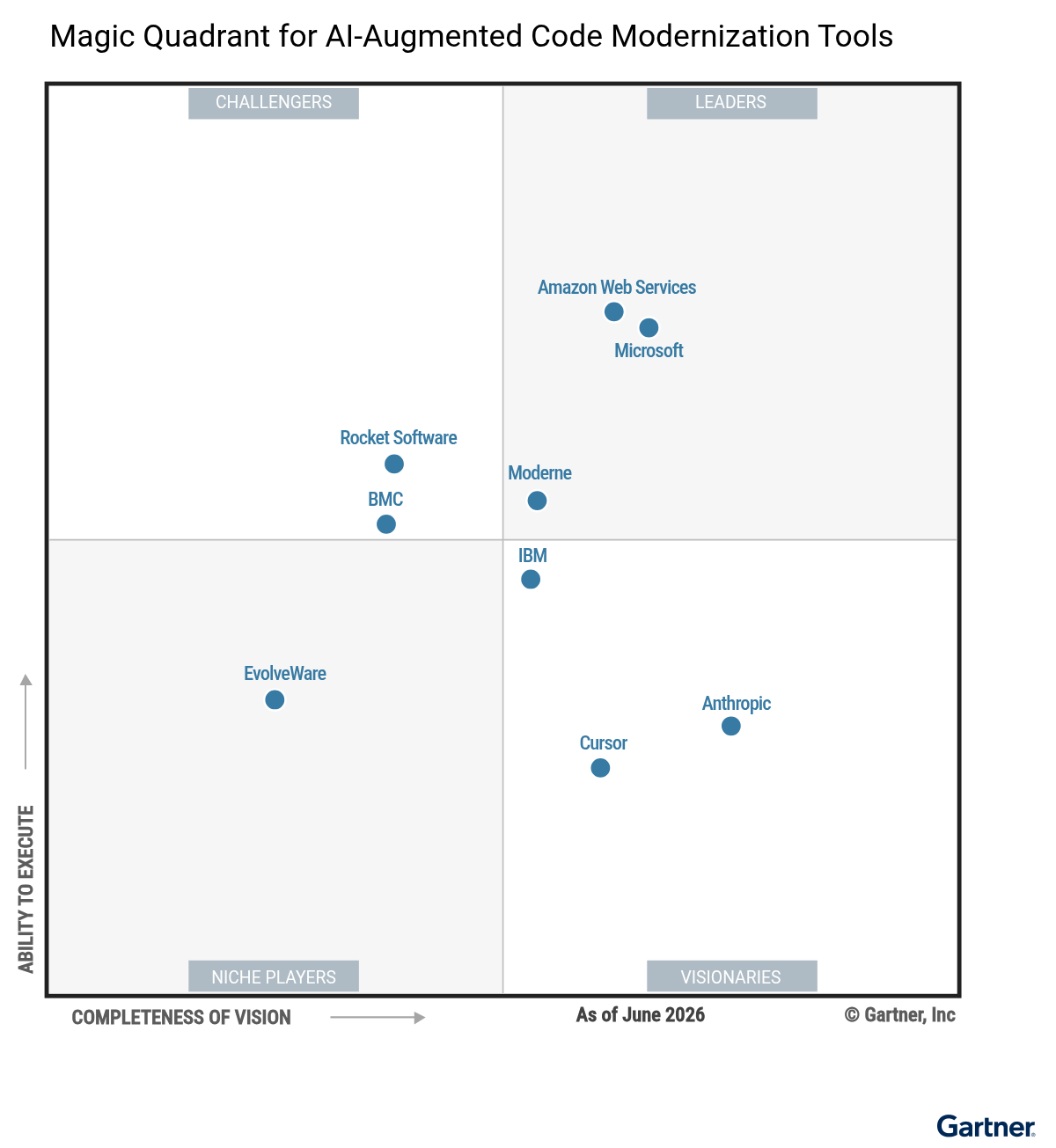
Magic Quadrant
Vendor Strengths and Cautions
Amazon Web Services
Amazon Web Services (AWS) is a Leader in this Magic Quadrant. Its product, AWS Transform, includes agentic AI code refactoring, automated dependency mapping, business logic extraction, and continuous technical debt remediation.
AWS’ operations are geographically diversified across North America, South America, EMEA, and Asia/Pacific, and its clients tend to be large enterprises, particularly in the financial services, healthcare, and public sectors. Since 2025, AWS expanded its platform by launching AWS Transform to general availability in May 2025. It also added the AWS Transform custom capability for any source to target language transformations in December 2025.
- Product or service: AWS Transform provides an integrated platform that automates code translation and business logic extraction across mainframe, .NET, SQL Server, VMware, and custom applications. Customers can consolidate modernization toolchains into a single collaborative workspace, reducing the manual effort required to manage disparate migration tools.
- Innovation: AWS Transform is architected to enable deep agent-level partner integrations. This composable partner architecture allows SIs and ISVs to integrate agents and workflows directly into AWS Transform, embedding domain expertise into transformation workflows.
- Market understanding: AWS offers its core initial assessment agents for VMware, mainframe, and .NET workloads at no additional charge. Customers can execute large-scale portfolio discovery and total cost of ownership (TCO) modeling without initial software licensing costs, helping them efficiently build data-driven business cases for cloud migration.
- Sales execution/pricing: Customers using AWS Transform should note it is free for most transformation use cases, including assessment, Windows modernization agent, mainframe modernization agent, and VMware migration agent. Custom transformation agent and AWS Transform - continuous modernization are offered as paid features billed by agent minute. Customers should evaluate their total modernization economics to account for future pricing changes.
- Geographic strategy: AWS Transform is hosted in eight regions but can be used to migrate and modernize workloads to and from all regions. Organizations with strict data residency requirements should validate what metadata is sent to the supported AWS Transform service region and how local code residency is maintained during modernization workflows.
- Operations: AWS does not disclose key organizational metrics about its operational capacity, such as the number of full-time employees dedicated to developing and supporting AWS Transform. Due to this lack of transparency, prospective customers cannot accurately evaluate the vendor’s long-term operational commitment to complex modernization projects.
Anthropic
Anthropic is a Visionary in this Magic Quadrant. Its product, Claude Code, is an agentic coding platform delivered through a CLI, IDE extensions, cloud agents, CI/CD integrations, and Claude Agent SDK.
Anthropic’s operations are geographically diversified, with strong adoption in North America and Europe. Its offerings are available globally, excluding China. Anthopic’s customers are enterprises across all industries, with strong representation in technology, telecom, banking, and finance industries. Since 2025, Anthropic has delivered subagents, agent teams, and the Claude Agent SDK, letting Claude Code spawn parallel specialized agents that coordinate on long-horizon modernization work.
- Offering (product) strategy: Claude Code can be deployed across all stages of software development and code modernization, regardless of scale or complexity. Customers can use Claude Code for small scale code transformation or complex, multiagent sequences that require automated software verification of legacy languages.
- Market understanding: Anthropic is responding to the shift from assistive IDE copilots to autonomous, delegatable coding agents. The vendor focuses on production-grade autonomous agent platforms running Claude Code, supporting long-duration (possibly multiday), large-repository refactors with high levels of coherence.
- Innovation: Anthropic’s continual model development and successful rollout of Claude Code enables customers to solve persistent brownfield challenges. Claude Code provides an open, agentic architecture, including an Agent SDK and Model Context Protocol (MCP) integrations, that allows enterprises to build specialized modernization pipelines that retrieve context dynamically.
- Operations: Anthropic cites scaling infrastructure reliability amid hypergrowth and API cost forecasting as major customer concerns. It only offers API and subscription pricing, with no on-premises or hybrid path. This pricing model makes it hard for highly data-sensitive buyers to evaluate feasibility for multiyear legacy transformation initiatives.
- Government procurement risk: In March 2026, the U.S. Department of Defense designated Anthropic a supply chain risk. While Anthropic has filed a formal appeal of the designation, it creates procurement and compliance uncertainty for defense contractors and government-adjacent buyers until the legal situation is resolved.
- Customer experience: Anthropic has had consistent periods of degraded response quality since mid-2025 due to infrastructure limitations amid hypergrowth. Customers should be prepared for possible intermittent outages and should identify fallback services.
BMC
BMC Software is a Challenger in this Magic Quadrant. Its product, BMC AMI DevX, focuses on mainframe modernization. It includes BMC AMI DevX Code Insights, which provides visibility into complex mainframe applications and extracts logic from monolithic code; and BMC AMI Assistant, which uses GenAI to help developers understand unfamiliar COBOL, JCL, PL/I, and Assembler code.
BMC’s operations are geographically diversified in the Americas, Europe, Middle East, and APAC (excluding China), and its clients tend to be large organizations, particularly in financial services, insurance, and government. Since 2025, BMC has delivered a portfolio intelligence layer that combines static source code analysis with operational telemetry data. It provides role-appropriate views and generates program requirements using the easy approach to requirements syntax (EARS).
- Overall viability: BMC is a stable, profitable organization with a well-established customer base and operations. BMC’s strong viability profile appeals to customers seeking a long-term vendor partnership where mainframe continuity and optimization is desired.
- Product or service: BMC’s AMI DevX portfolio performs well in technical architecture, integration posture, and professional services dependency. Its offering supports complex modernization needs without excessive reliance on service from the vendor. AMI DevX integrates with existing DevOps toolchains, helping customers standardize processes and accelerate developer onboarding.
- Offering (product) strategy: BMC’s robust partner ecosystem enables it to execute across numerous regions. Its SI partners and dedicated regional staff support customers that need structured implementation support and broader delivery coverage across enterprise transformation programs.
- Market understanding: BMC’s vision for fully autonomous transformation workflows supporting agentic modernization and AI-assisted engineering is still maturing compared with competitors. BMC continues to evolve its product in response to these fast-moving trends.
- Customer experience: BMC’s customer success programs, technical support coverage, and structured adoption mechanisms trail those of its competitors. Prospective customers should assess whether BMC can provide the onboarding, success management, and postdeployment support required for their modernization programs.
- Innovation: BMC’s recent and planned innovations are less differentiated than competitors. Buyers seeking highly autonomous agent-driven workflows to execute large-scale modernization will find BMC’s approach less advanced, as it favors explicit human-in-the loop control to build trust against fully autonomous, multistep AI agentic workflows.
Cursor
Cursor is a Visionary in this Magic Quadrant. It offers an AI engineering platform that enables agents to perform complex modernization tasks, including understanding legacy system architectures, refactoring code, and automating large-scale migrations while maintaining developer oversight.
Cursor’s operations are geographically diversified, with offerings available in all global regions and strong adoption in North America. Its clients tend to be enterprises in financial services, technology, and healthcare. Cursor is investing heavily in long-running asynchronous cloud agents, enterprise governance, proprietary models, and broader AI-native software development life cycle (SDLC) capabilities such as code storage and Git hosting.
- Vertical/industry strategy: Cursor’s ability to deploy self-hosted cloud agents has driven rapid customer growth in highly regulated industries. Its strategy continues to attract prospects in fast-growing industries such as banking and financial services, healthcare, and government.
- Offering (product) strategy: Cursor’s model neutrality allows users to switch between third-party LLMs and its own efficient Composer model while also supporting model routing. This flexibility reduces model lock-in risk for customers, preserves cost balancing, and enables software engineers to apply the right models to the right modernization tasks.
- Market understanding: Cursor’s support for parallel and autonomous agent execution, as well as its investments in AI code review, test validation, and Git hosting, demonstrate its differentiated vision for helping enterprises accelerate modernization initiatives by automating the full software development life cycle.
- Operations: Cursor faces the challenge of scaling its operational support to keep pace with rapid customer growth. Customers could experience challenges as Cursor rushes to expand its global customer success teams and infrastructure to meet international data residency demands.
- Customer experience: Over the past 12 months, Cursor customers experienced a 3.5-hour service outage and expressed frustration with the vendor’s sudden shift in pricing structures (specifically, moving to consumption pricing with shared token pools). Cursor has invested in platform reliability and increased pricing transparency to address these concerns.
- Product or service: Cursor has shifted from a simple AI code editor to a complex, agent-first software engineering platform. Since Cursor does not provide out-of-the-box support for modernization architecture planning, organizations must rely on custom agent workflows and skills to accomplish this task. This product shift requires change and upskilling for engineering teams.
EvolveWare
EvolveWare is a Niche Player in this Magic Quadrant. Its product, the Intellisys Platform, focuses on modernization planning, business rules extraction, legacy application understanding, automated documentation, dependency analysis, and code transformation. Intellisys uses automation and AI/ML technology to analyze databases and other critical dependencies, support the consolidation of business logic into rules to guide modernization and transformation decisions, and migrate code to modern technologies.
EvolveWare’s operations are concentrated in the U.S., with Europe as a secondary market. Its clients tend to be midsize and large organizations, particularly in the insurance, healthcare, and government sectors. Since 2025, EvolveWare has delivered capabilities that generate user stories and technical specifications from a limited number of languages, which can be converted into code using the Intellisys Platform or third-party AI-enabled specification tools.
- Vertical/industry strategy: EvolveWare focuses on highly regulated sectors, with significant adoption in government, services, and insurance verticals. Its on-premises and private cloud deployment models address the strict data privacy needs of these industries.
- Market understanding: EvolveWare helps customers map technical debt before modernization by extracting detailed business logic and generating language-agnostic user stories. The vendor recognizes the need to fully decompose legacy systems rather than simply translating them line by line.
- Geographic strategy: EvolveWare maintains a highly concentrated go-to-market execution in North America. This allows the vendor to align closely with regional compliance frameworks and federal modernization mandates.
- Overall viability: EvolveWare operates at a significantly smaller scale than its major competitors, with a small number of enterprise customers. Highly risk-averse buyers should account for this limited market footprint when considering large-scale, multiyear partnerships.
- Customer experience: EvolveWare lacks a formalized process for measuring customer satisfaction through quantitative metrics like Net Promoter Score (NPS) or CSAT. Additionally, in engagements where clients have chosen to work with their preferred third-party service providers on the Intellisys platform, some have reported challenges due to gaps in platform experience and understanding. These gaps have, in certain cases, led to misaligned expectations and subsequent change requests.
- Offering (product) strategy: Intellisys lacks native autonomous AI agents and does not provide out-of-the-box automated testing suite generation or CI/CD pipeline integration. Customers seeking end-to-end, multiagent orchestration across the entire software development life cycle will find that EvolveWare’s current capabilities are less mature than those of competitors.
IBM
IBM is a Visionary in this Magic Quadrant. Its product, IBM Bob, is positioned as an AI tool that supports the entire SDLC. Within modernization, it enables the safe, incremental modernization of complex legacy systems, combining deterministic analysis with AI reasoning to deliver business logic extraction, automated code refactoring, and intelligent documentation generation.
IBM’s operations are geographically diversified, and its clients tend to be large enterprises in highly regulated industries such as banking, financial services, government, and energy and utilities. IBM continues to expand its enterprise offering through planned 2026 releases, including Bob Remote Agents, a community marketplace, self-hosted deployment models, and enhanced DevSecOps integrations.
- Product or service: IBM Bob excels in system-level understanding by mapping dependency topologies across entire enterprise estates. It supports safe, incremental modernization by evaluating architectural layers, runtimes, and integrations rather than just isolated code fragments.
- Offering (product) strategy: The vendor offers highly specialized IBM Bob Premium Packages for Java, IBM i, and IBM Z environments. These packages provide deep domain tooling, metadata awareness, and direct system connectivity, enabling developers to natively compile and test code within a unified workflow.
- Market understanding: The vendor recognizes that mainframe and midrange modernization does not inherently require a complete platform exit. Instead, IBM positions Bob as a highly effective tool for executing low-risk, in-place modernization, enabling organizations to securely refactor and optimize mission-critical applications natively within their existing infrastructure.
- Operations: The IBM Bob cloud service does not support SOC2 audit compliance or independent third-party penetration testing. Enterprises in highly regulated industries may need to delay adoption until these planned compliance certifications are supported.
- Geographic strategy: IBM Bob is not intended for use in high-risk contexts, as defined under the EU AI Act. Organizations operating in Europe, particularly in highly regulated sectors such as banking and government, must evaluate their legal compliance obligations before deploying the platform for mission-critical modernization.
- Customer experience: IBM Bob is a newly launched offering. Organizations adopting the platform should be prepared to navigate a maturity curve, as peer communities and proven best practices for its advanced agentic workflows are still emerging.
Microsoft
Microsoft is a Leader in this Magic Quadrant. Its product, GitHub Copilot modernization, includes automated application assessment, AI-driven code remediation, containerization planning, and automated cloud deployment capabilities.
Microsoft’s operations are geographically diversified, and its clients tend to be large enterprises in the financial services, government, and manufacturing industries. Microsoft continues to invest in an enterprise modernization control plane with multiagent orchestration and advanced reasoning models to enable safe, scalable, and policy-enforced modernization across entire portfolios.
- Market understanding: Microsoft has effectively embedded its modernization capabilities into familiar developer and DevSecOps workflows. Software engineering teams can quickly adopt these capabilities with minimal friction because the workflows leverage widely used repositories and standard DevOps setups.
- Product or service: Microsoft provides an integrated portfolio-to-production pipeline that unifies the entire SDLC within a single platform. Natively integrating Azure Migrate, GitHub Copilot, Microsoft Defender, and CI/CD tools eliminates tool handoffs and enables a seamless DevSecOps workflow from initial assessment to cloud deployment.
- Offering (product) strategy: Microsoft has established a clear roadmap, structured customer feedback mechanisms, strong systems integrator alignment, and effective handling of customer-raised issues. This positions Microsoft to support enterprises seeking modernization capabilities that can scale across existing engineering environments and delivery models.
- Customer experience: As with other LLM-based modernization tools, customers may encounter an initial learning curve when optimizing prompts for legacy code analysis. Microsoft’s predefined agentic workflows reduce reliance on prompt optimization and enable more consistent results, but customers should assess coverage for their specific modernization scenarios.
- Geographic strategy: Organizations in highly regulated industries may encounter deployment delays due to regional data residency requirements. Microsoft has acknowledged that strict geographic data boundaries can temporarily limit the availability of specific Azure AI models, making regional rollout schedules an ongoing consideration for large-scale modernization efforts.
- Innovation: While Microsoft benefits from extensive foundational AI research, the vendor does not publicly disclose product-level spend or recent patents for its GitHub Copilot modernization offering. Clients should work with their account teams to clarify the product’s long-term roadmap and confirm sustained investment in modernization-specific capabilities.
Moderne
Moderne is a Leader in this Magic Quadrant. Its product, Moderne Platform, is focused on deterministic-first, AI-augmented code modernization using lossless semantic trees (LSTs), semantic search, and framework upgrades. The platform provides robust support for Java, Spring Boot, C#, Kotlin, Python, and JavaScript.
Moderne’s operations are mainly in North America and Western Europe, and its clients tend to be large enterprises in the financial services, technology, and retail sectors. Moderne continues to invest in deeper deterministic tooling, multirepo execution, Moderne Factory with goal-directed agent orchestration, and a layer of durable institutional intelligence.
- Innovation: Moderne equips coding agents across the industry with deterministic tools, such as Prethink and Trigrep, to reduce token consumption and improve execution precision by leveraging compiler-accurate code data. This addresses the challenge of probabilistic AI code generation, which can create unpredictable costs and QA bottlenecks at enterprise scale.
- Offering (product) strategy: The vendor plans to release Moderne Factory, which will coordinate autonomous, goal-directed modernization campaigns across massive multirepository enterprise estates. This release supports its broader vision for an agentic-ready SDLC.
- Product or service: Moderne Platform excels at large-scale execution. Its LST foundation and collection of more than 7,000 deterministic recipes support fast, compiler-accurate framework upgrades and vulnerability remediation while mitigating hallucination risks.
- Operations: Moderne’s support team is relatively small compared with its competitors, although the company states it is actively investing in customer success and forward-deployed engineering resources as it grows. Customers should ensure the offered support plan meets their specific modernization requirements.
- Geographic strategy: The vendor’s market presence is concentrated in North America and Europe. Organizations operating in the Middle East, Africa, or broader APAC regions will find limited localized support and direct sales engagement.
- Overall viability: Moderne remains significantly smaller than its leading competitors in terms of revenue and scale, despite continued growth and retention. Risk-averse enterprises should account for the company’s current scale when considering large-scale, multiyear partnerships.
Rocket Software
Rocket Software is a Challenger in this Magic Quadrant. Its product, Rocket Enterprise Suite, includes Rocket Enterprise Analyzer, Rocket Enterprise Developer, Rocket Visual COBOL, and Rocket Enterprise Server.
Rocket Software’s operations are geographically diversified, and its clients tend to be large enterprises in the insurance, banking, and government sectors. In 2025, the vendor finalized its acquisition of OpenText’s Application Modernization and Connectivity business, acquired Software Migrations Limited (SML) and its Assembler Code Refactoring product, and infused GenAI into Enterprise Analyzer to provide deterministic code explanations.
- Vertical/industry strategy: Rocket Software focuses on highly regulated verticals, such as insurance, banking, and logistics, that have large COBOL and mainframe estates. It targets these sectors with dedicated campaigns and deterministic, auditable AI modernization capabilities that address customers’ strict regulatory and compliance requirements.
- Offering (product) strategy: The vendor provides a versatile modernization platform that includes Rocket Visual COBOL, which supports native polyglot runtime execution. With Rocket Visual COBOL, customers can run Java, Python, and .NET workloads directly alongside their existing COBOL code, allowing for incremental, lower-risk modernization without the need for a full rewrite.
- Market understanding: Rocket Software grounds its GenAI outputs in verified codebase structures, recognizing enterprise concerns over AI hallucinations and the widening COBOL application skills gap. This deterministic approach provides developers with accurate, trustworthy business rule extractions and natural-language code explanations.
- Operations: As enterprises take on increasingly larger and more complex modernization projects, customers should plan early with Rocket to ensure appropriate engineering and project management resource availability for large-scale programs.
- Customer experience: The Rocket Enterprise Suite products have changed ownership on two occasions — from Micro Focus to OpenText and now to Rocket Software. During the postacquisition integration period, Rocket acknowledged that some customers experienced friction, including difficulties accessing software entitlements, errors in license key generation, and delayed product releases. This friction caused transition-related workflow disruption, though Rocket states these issues have since been largely resolved.
- Geographic strategy: Rocket Software’s direct operations and dedicated technical resources are concentrated in North America, Europe, and select APAC markets such as Japan. Enterprise customers operating in the Middle East, Africa, or South America will find limited localized support and direct sales engagement in those regions, though Rocket provides 24/7 global technical support and augments regional coverage through its partner ecosystem.
Inclusion and Exclusion Criteria
To qualify for inclusion, providers must:
- Meet the market definition of AI-augmented code modernization tool.
- Offer a product that includes all of the mandatory features listed in the Market Definition and is already generally available or will be generally available as of 31 March 2026 to all customers and fully documented.
- Sell the solution directly to paying customers as a stand-alone product or along with professional services. The vendor must provide at least first-line support for these capabilities.
- Demonstrate an active product roadmap of 24 months, and go-to-market, pricing, and selling strategies for the solution.
- Have phone, email, and/or web customer support.
- Have at least 25 enterprise customer organizations (of at least 1,000 employees) in the past 12 months as of 1 March 2026.
- Meet a threshold of client relevance, as determined by analyst expertise and informed by public and proprietary information.
Honorable Mentions
Blitzy: Blitzy is an autonomous software development platform for large-scale projects, including legacy modernization and new feature development. The platform reverse engineers enterprise codebases into a dynamic knowledge graph, then orchestrates thousands of agents to execute software development and autonomous validation in parallel. Blitzy supports secure, air-gapped, and virtual private cloud (VPC) deployments for organizations with strict compliance needs in sectors such as finance, aerospace, and insurance.
Cognition: Cognition, the AI lab behind the autonomous software engineer Devin and the Windsurf AI IDE, provides a platform for automating legacy modernization tasks, including framework upgrades, database migrations, and monolithic repositories restructuring. Devin autonomously executes multistep plans and verifies results through unit tests and CI pipelines.
Devsu: Devsu’s Velx is an AI-powered modernization tool for legacy systems in regulated industries such as finance and healthcare. It uses a three-phase process — Explorer, Architecture, and Coder — to map dependencies, suggest migration strategies, and generate code across multiple stacks.
Google Cloud: Google Cloud’s Mainframe Modernization uses Google Gemini models to migrate legacy mainframes to cloud-native architectures. The Mainframe Assessment Tool reverse-engineers legacy code for documentation and provides business rule extraction and analysis capabilities. The Mainframe Modernization Agents solution supports reimagining applications. Dual Run tests functional equivalence by replaying mainframe events on the new system. Mainframe Connector provides data modernization and supports hybrid mainframe and cloud architectures. These features accelerate modernization, enable agentic workflows, and provide risk reduction.
Mechanical Orchard: Mechanical Orchard’s Imogen is a legacy modernization platform that transitions mainframe workloads to cloud-native applications for large enterprises and government agencies. Instead of converting code directly, Imogen treats legacy systems as a “black box,” replicating business behavior by analyzing real data flows. The platform supports continuous modernization by providing a test-driven, automated cloud environment that runs existing systems while components are updated.
Opsera: Opsera’s Forge reverse-engineers legacy and modern codebases, including .NET, Java, Ruby on Rails, C/C++, COBOL, React and Node.js, Angular, and TypeScript, to recover lost business intent and regenerate accurate documentation, architecture diagrams, and business logic. The platform ingests code context and converts it into machine-readable specifications, enabling spec-driven development with traceable work items. This preserves institutional knowledge and supports auditable human-AI collaboration across the full software life cycle, from initial concept through cloud deployment.
Evaluation Criteria
Ability to Execute
We evaluated the following criteria to assess the vendor’s Ability to Execute. Below is a description of what we specifically looked for in each criterion.
Product or Service
- Current product and service capabilities, quality, and feature sets
- Support for various programming languages and frameworks
Overall Viability
- Vendor’s financial status, profitability, strategies for economic downturn, investment plans for the next 12 months, annual revenue for FY25, and projected revenue for FY26
- Customer and market engagement, focusing on customer retention rates
- Organizational structure and workforce, including the number of full-time employees dedicated to the product, and any changes in senior management over the past year
Customer Experience
- Products, services, and programs that enable customers to achieve anticipated results, including quality interactions, technical support, and account support
- Training programs for developers, onboarding timelines, success measurement, and user training needs
- Customer support structure, dedicated full-time equivalents (FTEs), support availability, SLAs, response times, recent outages, and partner involvement
- Customer success program, retention strategies, user community support, ROI measurement, and the metrics and benchmarks used to gauge the effectiveness of the customer success program
Operations
- Ability to meet goals and commitments, focusing on the quality of its structure, skills, experiences, programs, and systems
- SLAs, upgrade policies, release timing, the growth rate of FTEs devoted to enterprise technical support, and subscriber options for update timing
- Staff training, partner employee training, operation and support centers worldwide, onboarding speed, and formal communication processes with customers
We did not evaluate the following evaluation criteria, as we determined that these criteria are not relevant to buyers in this market:
- Sales execution/pricing
- Market responsiveness/record
- Marketing execution
Ability to Execute Evaluation Criteria
| Evaluation Criteria | Weighting |
|---|---|
Product or Service | High |
Overall Viability | Medium |
Sales Execution/Pricing | NotRated |
Market Responsiveness/Record | NotRated |
Marketing Execution | NotRated |
Customer Experience | Medium |
Operations | Medium |
As of 2 June 2026 | |
Source: Gartner (August 2026)
Completeness of Vision
We evaluated the following criteria to assess the vendor’s Completeness of Vision. Below is a description of what we specifically looked for in each criterion.
Market Understanding
- Ability to understand and translate client needs into practical products and services
- Product development, identification of key offerings, and adaptation to evolving client requirements for enhanced product viability
- Proficiency of vendors in monitoring market trends, navigating challenges in the AI-augmented code modernization tools market, and anticipating technological disruptions to formulate a forward-thinking strategic vision
- Commitment to active customer engagement through initiatives like a customer council program
Offering (Product) Strategy
- Approach to product development and delivery that emphasizes market differentiation, functionality, methodology, and features aligned with current and future requirements
- Understanding the AI-augmented code modernization tool offering, including its technical abilities, and trained consulting and system integrator partners
- User base, detailing the number of developers using free and paid versions
- Strategic approach to product development and market positioning, including investment areas, success metrics, methods to avoid commoditization, methods to avoid lock-in, product enhancement strategies, and processes for integrating customer feedback into the product roadmap
Vertical/Industry Strategy
- Strategy for directing resources, skills, and products to meet the specific needs of individual market segments, including verticals
- Industry-specific go-to-market or technology partnerships, providing insight into strategic alliances and potential synergistic benefits
- Customer distribution across various verticals, including key customer names and top industry verticals
- Major initiatives planned to increase market share in vertical industry segments over the next 12 months, assessing forward-thinking strategies, growth potential, and commitment to innovation
Innovation
- Direct, related, complementary, and synergistic allocation of resources to address client pain points/problems, expertise, or capital for investment, consolidation, defensive, or preemptive purposes
- Innovation strategy, including processes and methodologies, future innovation plans, top differentiating innovations, the proportion of revenue invested in R&D, and strategic partnerships for innovation
- How the vendor differentiates itself in the market with innovative product features and strategic partnerships, providing a clear picture of its competitive edge
Geographic Strategy
- Strategy to direct resources, skills, and offerings to meet the specific needs of geographies outside its native region, either directly or through partners, channels, and subsidiaries
- Differentiated delivery, sales, and marketing strategies for various geographies, as well as top three initiatives aimed at expanding market share beyond the core region
- How the vendor ensures compliance with data sovereignty requirements, the internationalization/localization capabilities of its offering, and the number of languages supported
- Vendor’s current and prospective geographic markets, detailing its physical presence, staff count, customers, channel partners, and the number of new customers acquired in each region over the past year
We did not evaluate the following evaluation criteria, as we determined that these criteria are not relevant to buyers in this market:
- Marketing strategy
- Sales strategy
- Business model
Completeness of Vision Evaluation Criteria
| Evaluation Criteria | Weighting |
|---|---|
Market Understanding | High |
Marketing Strategy | NotRated |
Sales Strategy | NotRated |
Offering (Product) Strategy | High |
Business Model | NotRated |
Vertical/Industry Strategy | Low |
Innovation | High |
Geographic Strategy | Medium |
As of 2 June 2026 | |
Source: Gartner (August 2026)
Quadrant Descriptions
Leaders
Leaders provide mature offerings that meet market demand and have demonstrated the vision necessary to sustain their market position as requirements evolve. Leaders deliver enterprise-scale, end-to-end modernization platforms and robust roadmaps for continuous innovation. They differentiate themselves through comprehensive automation, integration across complex application estates, and a focus on delivering reliable, scalable modernization outcomes. As a result, Leaders are the vendors to watch as the market evolves.
Leaders have proven adoption among large global organizations and enjoy high visibility within the market. Their size and financial strength enable them to remain viable in a challenging economy.
Leaders typically respond to a broad market audience by supporting a wide range of requirements. However, they may fail to meet the specific needs of vertical markets or specialized segments.
Challengers
Challengers have a strong Ability to Execute but may lack a strategy to sustain a strong value proposition for new customers. Challengers in this market focus on incremental, low-risk modernization strategies tailored for mission-critical, highly regulated enterprise workloads, leveraging deterministic AI capabilities to ensure reliability and compliance. Their Challenger status reflects sustained execution, broad customer adoption in specialized segments, and roadmaps that prioritize hybrid modernization and extensible code intelligence.
Although Challengers typically have significant size and financial resources, they may lack strong vision, innovation, or an overall understanding of market needs. Challengers may offer products nearing end of life that dominate a large but shrinking segment.
Challengers can become Leaders if their vision develops. Over time, large companies may fluctuate between the Challengers and Leaders quadrants as their product cycles and market needs shift.
Visionaries
Visionaries align with Gartner’s view of how a market will evolve, but their ability to deliver against that vision is less proven. They have effectively shifted from basic code assistance to agent-driven, governed engineering solutions that enable autonomous, scalable, and compliant modernization for complex enterprise environments. Their Visionary status is underscored by advanced orchestration, robust roadmaps for deeper automation and governance, and a commitment to serving highly regulated and global organizations.
For vendors and customers, Visionaries fall into the higher-risk-higher-reward category. They often introduce new technology, services, or business models, and they may need to build financial strength, service and support, and sales and distribution channels. Whether Visionaries become Challengers or Leaders may depend on customer acceptance of the new technology or the development of complementary partnerships. Visionaries are sometimes attractive acquisition targets for Leaders or Challengers.
Niche Players
Niche Players do well in a segment of a market, or they have a limited ability to innovate or outperform other vendors in the wider market. They specialize in controlled, secure modernization for mission-critical mainframe and legacy environments, prioritizing compliance, data privacy, and deterministic AI approaches. Their Niche Player status reflects targeted roadmaps and solutions tailored for highly regulated industries and geographically concentrated markets. Niche Players have limited implementation and support capabilities and relatively limited customer bases. Compared with other quadrants, they do not demonstrate a strong vision for their offerings.
For end users, assessing Niche Players is more challenging than assessing vendors in other quadrants. Some could make progress, while others do not execute well and may not have the vision and means to keep pace with broader market demands.
A Niche Player may be a strong fit for your requirements. However, if it goes against the direction of the market, then it may be a risky choice — even if you like what it offers — because its long-term viability will be threatened.
Context
AI-augmented code modernization tools help organizations address and accelerate previously impractical modernization projects by using AI to upgrade their mission-critical systems in an efficient, risk-controlled manner.
Software engineering leaders seek to refactor and modernize legacy codebases to reduce technical debt, improve performance, and mitigate risks associated with outdated technology and workforce shortages. To realize these benefits, they need tools that enable comprehensive code transformation across languages and frameworks, API modernization, microservices decomposition, database migration, and selective modernization options.
Buyers of AI-augmented code modernization tools use the technology to address top enterprise priorities, such as:
- Scaling modernization efforts
- Ensuring system stability
- Retaining institutional knowledge
- Managing tooling costs
- Reducing infrastructure and licensing expenses
- Achieving lower TCO
- Enabling continuous modernization with strong visibility and governance
All the vendors evaluated support the three use cases: modernization strategy, code transformation, and application reimagining. We have assessed how well each vendor’s tool can support these use cases in Critical Capabilities for AI-Augmented Code Modernization Tools.
Buyers should evaluate AI-augmented code modernization tools across four key areas:
Buyers should evaluate AI-augmented code modernization tools across four key areas:
- Platform coverage and integration: Support for all relevant workloads and seamless interoperability
- Technical depth and transformation quality: Proven migration engines, deterministic code intelligence, and auditability
- Governance and compliance: Transparent, policy-driven controls and regulatory readiness
- Extensibility and performance: Support for multiple AI models, autonomous agents, and developer-centric workflows
In addition, buyers should evaluate a vendor’s credibility based on its ability to provide enterprise-scale references, robust support, and long-term commitment.
Market Overview
Technical debt is now a board-level concern, as AI-augmented code modernization tools enable large-scale, continuous modernization. These technologies have rapidly transformed since 2025, as autonomous coding agents have replaced earlier AI copilots and autocomplete tools.
The maturation of autonomous coding agents is transforming the market landscape by enabling the planning, execution, and delivery of complex modernization workflows. As the reasoning capabilities of frontier AI models advance, software engineering leaders are increasingly delegating teams of humans and agents to deliver modernization objectives with agentic harnesses grounded in their proprietary software ecosystem contexts.
Current Market Landscape
AI-augmented code modernization tools are in the early stages of market maturity, with less than 10% penetration. Mainstream adoption is expected within two to three years. Gartner estimates the total addressable market at $2.5 billion to $3 billion.
This momentum is primarily underpinned by the maturation of agentic AI architectures capable of executing long-horizon modernization workflows, alongside several critical market drivers:
- Multiagent architectures and agentic harnesses have matured, enabling complex, parallel-executed enterprise workflows and making previously intractable modernization problems accessible to in-house teams.
- The Model Context Protocol has improved interoperability, connecting AI agents to enterprise data and tools. This open ecosystem allows organizations to avoid vendor lock-in and integrate their proprietary context while also supporting multimodel flexibility to address cost, regulatory, and performance concerns.
- Cloud service providers have expanded their modernization offerings. As a result, modernization projects are increasing in both scale and complexity, with organizations adopting hybrid strategies that combine replatforming, selective rearchitecture, business logic extraction, and cloud-native rebuilds.
AI-augmented portfolio discovery and mapping have emerged as the baseline for modernization initiatives, effectively displacing subjective tribal knowledge planning with deterministic, data-driven intelligence and complexity quantification. This shift has transitioned assessment outputs from a discrete consulting service into a standard, AI-generated set of artifacts that software engineering leaders now require prior to formal engagement.
As demand for AI-augmented code modernization tools increases, more vendors have entered the market to address modernization challenges. This fragmented market landscape, which includes CSP-native tools, AI-first startups, and niche specialists, makes it difficult for buyers to distinguish scalable solutions from point tools. Selecting the right tool becomes even more challenging as organizations adopt portfolio-level modernization approaches that are more complex than simple replatform or refactor decisions.
Market Outlook
By 2029, organizations will complete 90% of software modernization using AI-augmented tools, a significant increase from less than 10% today.
We project that in the next twelve months:
- Most modernization projects will shift from services-led to tool-led, as autonomous agents take on end-to-end workflows — from assessment through testing and deployment — with humans overseeing decisions and outcomes. Testing automation will become standard, addressing the primary bottleneck in modernization. This shift will deliver significant time and cost savings, clarifying ROI and accelerating enterprise adoption.
- The market will consolidate around comprehensive platforms that cover the entire modernization life cycle, with integration, governance, token cost management, and auditability as key purchase criteria. For GSIs and SIs, outcome-based and fixed-price engagements will become the norm, and only those that adapt to tool-first, platform-driven delivery will remain competitive. Smaller, single-capability vendors will consolidate as buyers demand end-to-end solutions.
- Modernization will move beyond code refactoring toward application reimagining. AI will extract business rules from legacy systems and generate cloud-native specifications, enabling strategic transformation rather than just cost reduction. Mainframe exit programs will accelerate, with AI making large-scale migrations feasible and more cost-effective.
- Regulatory scrutiny will intensify, with new frameworks emerging that require responsible AI practices, audit trails, and compliance infrastructure. Vendors that embed regulatory and domain expertise, including support for data privacy and residency requirements, into their agentic offerings will gain market share over those that offer generic tools, particularly in regulated sectors such as financial services, healthcare, and government. Vendors that fail to provide transparent, governed, and verified AI outputs will lose relevance.
- The use of autonomous coding agents will expand beyond developers to include project managers (PMs), analysts, and ops teams, broadening the total addressable market. Enterprises will increasingly expect coordinated, governed AI orchestration embedded into their existing workflows, including CI/CD, rather than isolated tools or experiments.
As the market evolves, only vendors that deliver practical, integrated, and governed agentic modernization at scale will thrive.
This is the first iteration of the Magic Quadrant for AI-Augmented Code Modernization Tools. It is replacing Gartner’s Market Guide for AI-Augmented Code Modernization Tools.
Ability to Execute
Product/Service: Core goods and services offered by the vendor for the defined market. This includes current product/service capabilities, quality, feature sets, skills and so on, whether offered natively or through OEM agreements/partnerships as defined in the market definition and detailed in the subcriteria.
Overall Viability: Viability includes an assessment of the overall organization's financial health, the financial and practical success of the business unit, and the likelihood that the individual business unit will continue investing in the product, will continue offering the product and will advance the state of the art within the organization's portfolio of products.
Sales Execution/Pricing: The vendor's capabilities in all presales activities and the structure that supports them. This includes deal management, pricing and negotiation, presales support, and the overall effectiveness of the sales channel.
Market Responsiveness/Record: Ability to respond, change direction, be flexible and achieve competitive success as opportunities develop, competitors act, customer needs evolve and market dynamics change. This criterion also considers the vendor's history of responsiveness.
Marketing Execution: The clarity, quality, creativity and efficacy of programs designed to deliver the organization's message to influence the market, promote the brand and business, increase awareness of the products, and establish a positive identification with the product/brand and organization in the minds of buyers. This "mind share" can be driven by a combination of publicity, promotional initiatives, thought leadership, word of mouth and sales activities.
Customer Experience: Relationships, products and services/programs that enable clients to be successful with the products evaluated. Specifically, this includes the ways customers receive technical support or account support. This can also include ancillary tools, customer support programs (and the quality thereof), availability of user groups, service-level agreements and so on.
Operations: The ability of the organization to meet its goals and commitments. Factors include the quality of the organizational structure, including skills, experiences, programs, systems and other vehicles that enable the organization to operate effectively and efficiently on an ongoing basis.
Completeness of Vision
Market Understanding: Ability of the vendor to understand buyers' wants and needs and to translate those into products and services. Vendors that show the highest degree of vision listen to and understand buyers' wants and needs, and can shape or enhance those with their added vision.
Marketing Strategy: A clear, differentiated set of messages consistently communicated throughout the organization and externalized through the website, advertising, customer programs and positioning statements.
Sales Strategy: The strategy for selling products that uses the appropriate network of direct and indirect sales, marketing, service, and communication affiliates that extend the scope and depth of market reach, skills, expertise, technologies, services and the customer base.
Offering (Product) Strategy: The vendor's approach to product development and delivery that emphasizes differentiation, functionality, methodology and feature sets as they map to current and future requirements.
Business Model: The soundness and logic of the vendor's underlying business proposition.
Vertical/Industry Strategy: The vendor's strategy to direct resources, skills and offerings to meet the specific needs of individual market segments, including vertical markets.
Innovation: Direct, related, complementary and synergistic layouts of resources, expertise or capital for investment, consolidation, defensive or pre-emptive purposes.
Geographic Strategy: The vendor's strategy to direct resources, skills and offerings to meet the specific needs of geographies outside the "home" or native geography, either directly or through partners, channels and subsidiaries as appropriate for that geography and market.