How Master Data Management Boosts the Context Layer for AI Agents
17 June 2026 - ID G00857833 - 11 min read
By Stephen Kennedy
D&A leaders face AI initiative failures because agents lack reliable master data context, which often leads to amplified data quality issues. Embed master data management into your context layer to build a trusted foundation, which boosts agent accuracy and helps deliver AI agent success.
Insights at a Glance
Enterprise application vendors (e.g., ERP, CRM, Data Lakehouse), business teams, and technology teams are working feverishly toward building end-to-end customer and product agentic workflows. The 2026 Gartner AI in Software Engineering Survey found that more than 80% of software engineering leaders have deployed four or more agents to production.1 However, a significant majority of these initiatives fail to deliver results. Simply put, they lack a reliable foundation of master data and the context surrounding it. When AI agents lack proper context, they do not just fail; they systematically amplify data quality deficiencies.
To mitigate these failures, data and analytics (D&A) leaders must establish mechanisms by which master data management can be delivered to the context layer. By transforming core MDM capabilities into secure, machine-understandable tools (e.g., MCP tools), D&A leaders can bridge the gap between persistent data management context and dynamic AI runtime context. Currently, D&A leaders capture a significant amount of long-lived and governed context (e.g., business glossaries, metadata descriptions) but are failing to connect this to situation-specific AI usage (e.g., conversation history and prompts). Without dynamic runtime context, costs explode, hallucination rates rise exponentially, and business value deteriorates.
Strategic Planning Assumption
By 2027, organizations that prioritize semantics in AI-ready data will increase their agentic AI accuracy by up to 80% and reduce costs by up to 60%.
Impact
Despite significant investments, a majority of enterprise AI pilots fail to deliver measurable ROI. D&A leaders are racing to deploy autonomous AI agents to automate complex business workflows, but relying on fragmented data and context introduces risks such as costly operational errors and regulatory compliance violations.
D&A leaders face an urgent need to bridge the gap between AI ambition and business reality. Establishing a master data management (MDM) context delivery Service helps transform enterprise data into a trusted, AI-ready asset. This strategic positioning turns AI from an experimental liability into a secure, scalable competitive advantage with near-term business value.
Actions
- Connect master data to AI using model context protocol (MCP) tools
- Build tightly scoped master data management agents
- Connect the MDM context delivery service to business applications and AI workflows
Cautions
- Avoid the single-context-layer product myth: Do not assume a single product or platform can provide all AI-relevant context. Context is inherently ephemeral and dynamically constructed; therefore, treating it as a single platform purchase results in incomplete information and architectural debt.
- Do not attempt a big-bang implementation: Do not treat building a comprehensive context layer as a one-time effort. Recognize that it is a multiyear endeavor; start with high-value use cases and iteratively expand the context layer based on business needs.
- Beware of unmitigated agentic data risk: Do not allow AI systems to operate without proper safeguards. Mandate human-in-the-loop checkpoints, as agents lacking proper context may execute multi-step reasoning that silently compounds defects and amplifies existing data quality issues.
How to Execute
Step 1: Connect master data to AI using model context protocol (MCP) tools
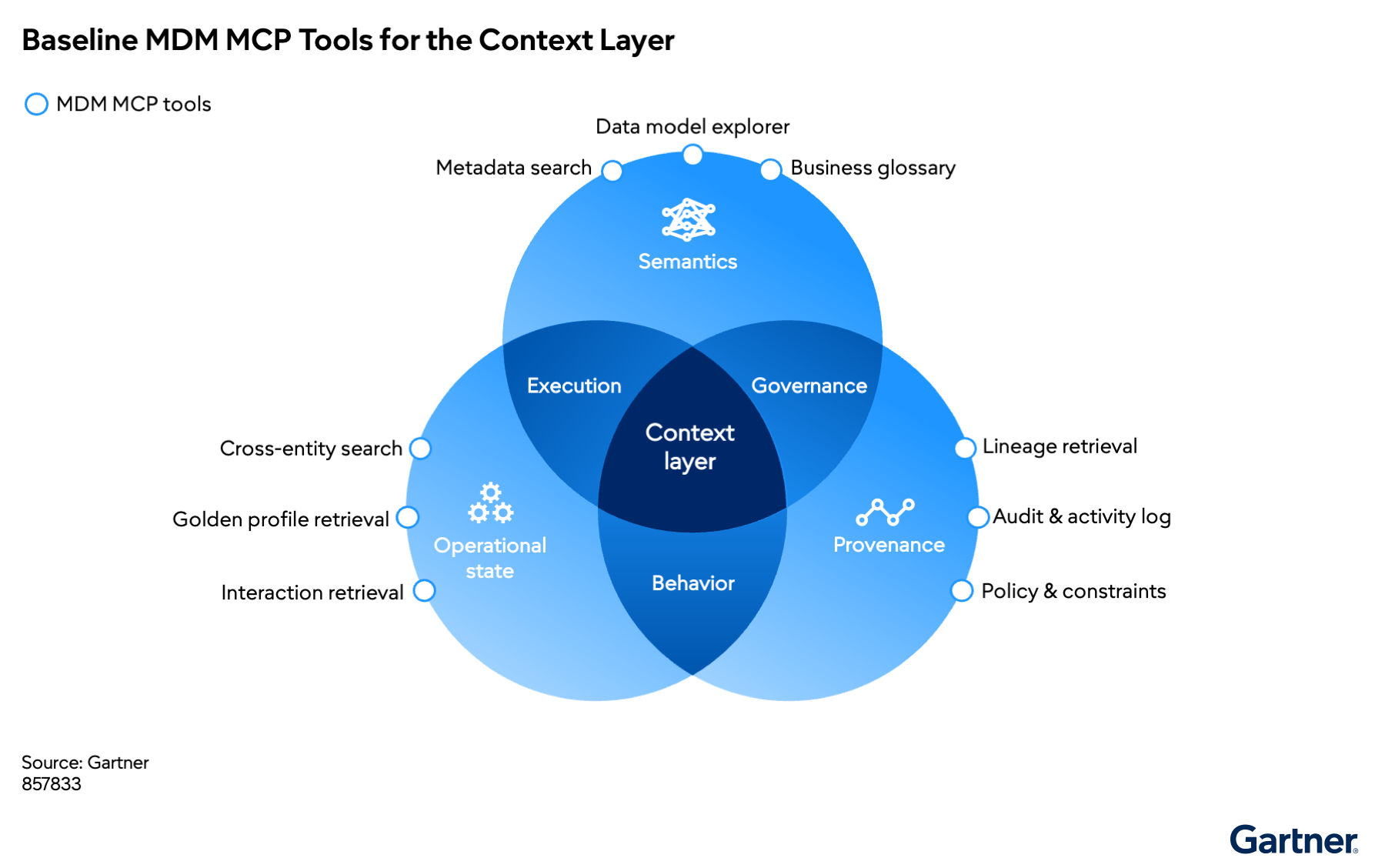
Data and analytics (D&A) leaders must fundamentally change how AI interacts with enterprise data by securely connecting their trusted master data directly to AI systems using the model context protocol . Utilizing MCP provides AI agents with seamless, secure access to real-time context (see “The 3 Core Components of the Context Layer for AI Agents”). By transforming core MDM capabilities into standardized MCP tools, D&A leaders can establish a foundation that safely and consistently exposes trusted entity data and context directly to AI applications. Figure 1 lists the minimum foundational MCP tools needed for master data management to help power the context layer.
Best Practices:
- Expose core MDM functions as MCP tools: Package existing master data capabilities (e.g., searching records, merging duplicates, or verifying addresses) into modular, easy-to-use tools that AI agents can call.
- Curate context: Ensure that quality outweighs quantity when supplying data to AI models by providing agents with only the essential context (e.g., verified entity, entity relationships, semantics, and provenance) will reduce token costs, lower latency, and improve consistency.
- Publish to AI directories: Publish MDM MCP tools in third-party AI tool registries (such as those from hyperscalers, CRMs, ERPs, and data lakehouses) to make them easily discoverable.
Step 2: Build tightly scoped master data management agents
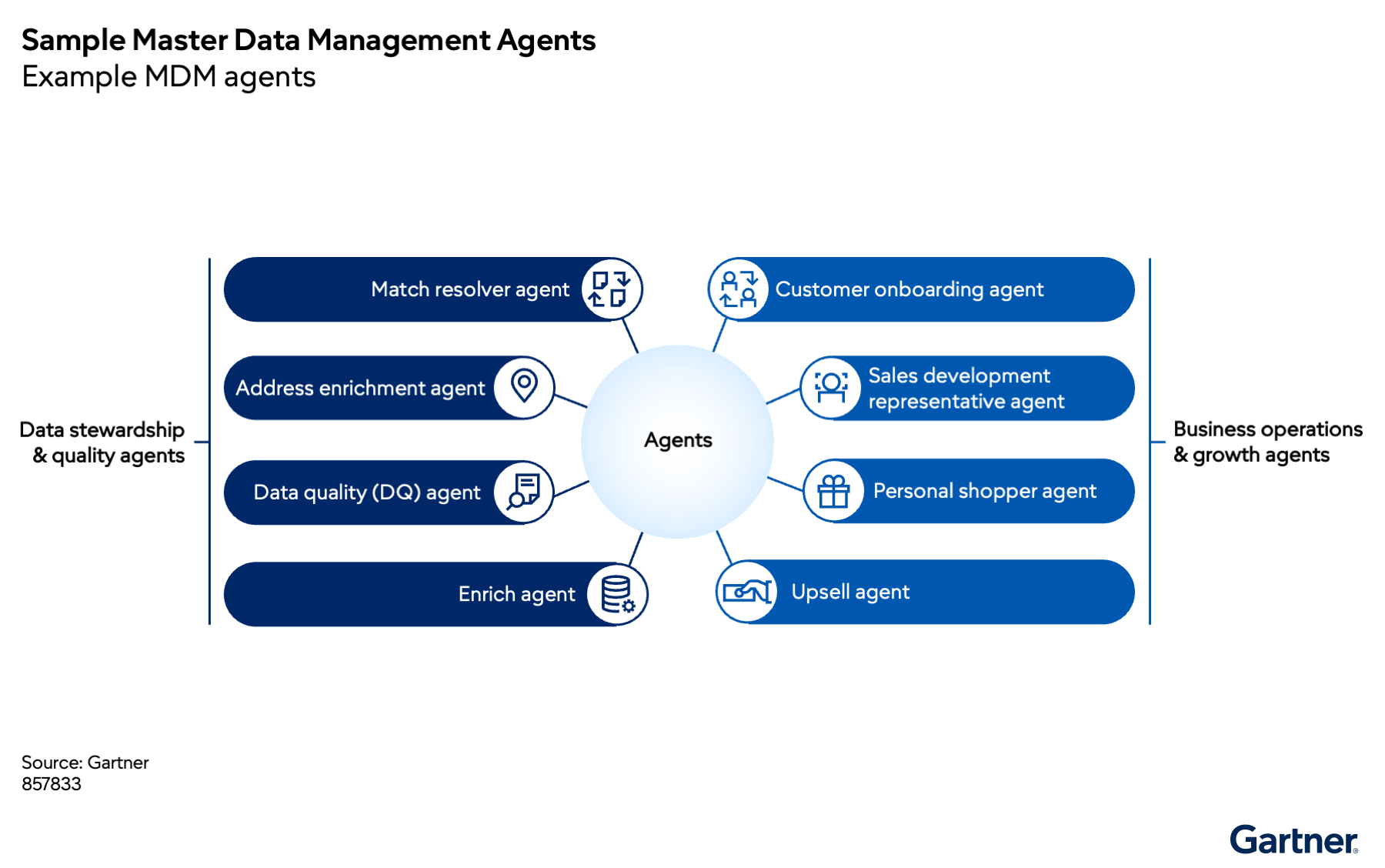
Design tightly scoped, modular agents in which each agent is responsible for a single, narrow function. This encapsulation simplifies the traceability of defects and drastically reduces the “blast radius” of failure. Rather than relying on large, general-purpose AI models, D&A leaders should design and deploy teams of small, highly specialized master data management agents to interact with and extend the context layer.
Separate responsibilities into distinct, focused domains (such as dedicated data stewardship agents operating in the background and business operations agents driving frontline workflows), D&A leaders can orchestrate these specialized subagents to collaborate on broader goals without compromising data and AI governance. Figure 2 lists examples of agents that can be developed to support data stewardship and business operations.
Best Practices:
- Design tightly scoped agents: Build modular, single-purpose agents that focus on a specific task (e.g., data exploration or lead qualification).
- Enforce strict security rules: Ensure that agents only perform actions human users are authorized to do. Agents must inherit the same role-based access controls (RBAC) permissions as the people triggering them to prevent unauthorized data access.
- Establish human-in-the-loop checkpoints: Ensure that for riskier actions or permanent data modifications, agent workflows include escalation boundaries that require human approval before proceeding.
Step 3: Connect the MDM context delivery service to business applications and AI workflows
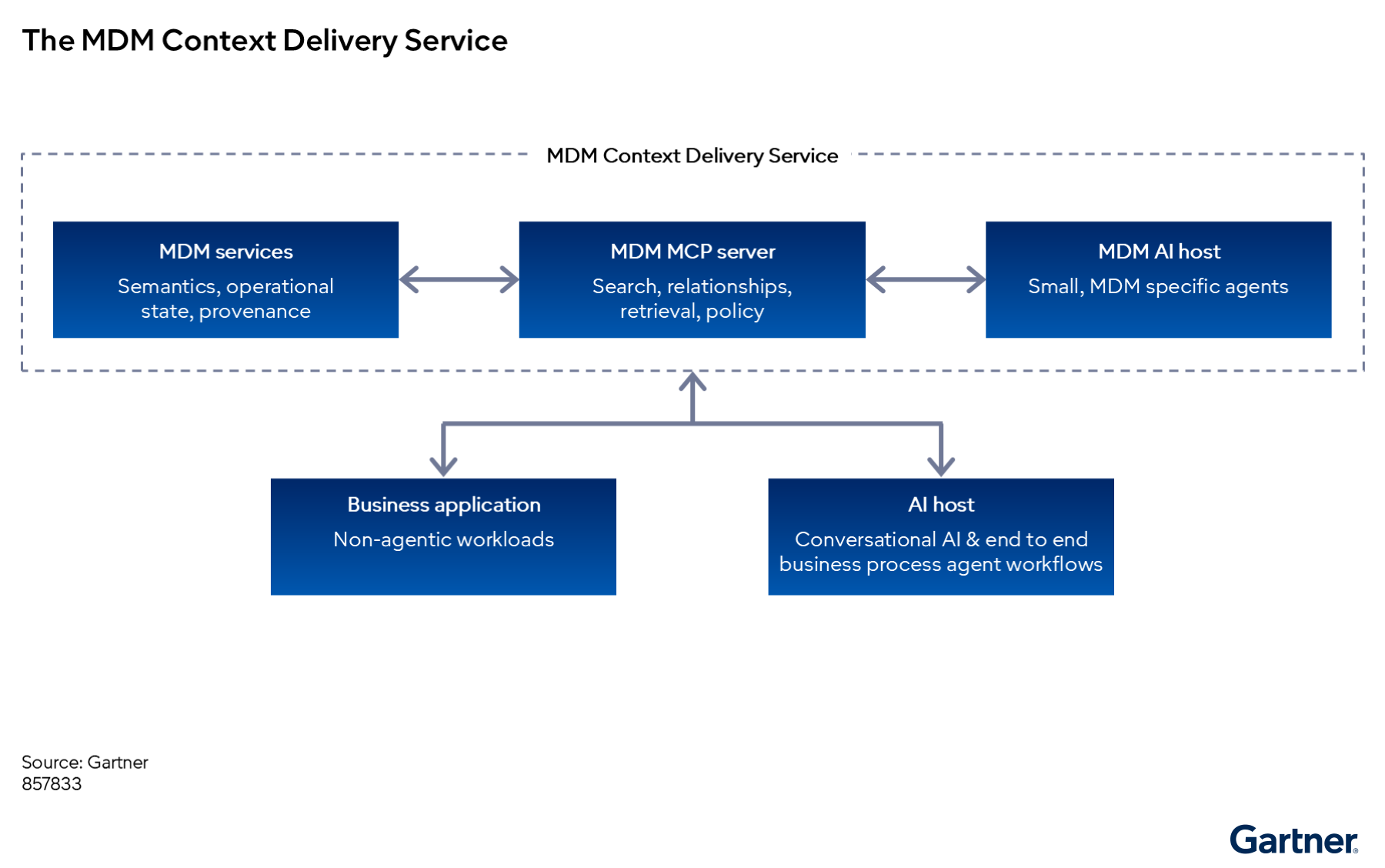
The MDM context delivery service provides unified master data and the key context surrounding it to business applications, agentic workflows, or other components of the broader context layer. D&A leaders must connect their enterprise applications and AI workflows to an MDM context delivery service. As outlined in Gartner’s “Two Worlds of Context: Why AI and Data Teams Keep Talking Past Each Other,” organizations must actively bridge the gap between long-lived data management context and dynamic AI runtime context.
The MDM context delivery service (see Figure 3) acts as a bridge between core enterprise data and front-end business applications. By combining these capabilities into a unified delivery service, D&A leaders can serve traditional business applications for standard non-agentic workloads, as well as AI hosts for conversational AI and end-to-end agentic workflows. This architecture ensures that whether human users are working in their CRMs or autonomous AI agents are executing complex tasks, they are both grounded in the exact same verified master data context.
Best practices for the context delivery service:
- Optimize context limits and token management: Carefully balance the amount of context sent. Too much context (e.g., inputting all MDM records into a single conversation) causes the model to lose track and hallucinate; too little (e.g. not providing data provenance) causes it to make assumptions. Good token management optimizes both accuracy and costs.
- Implement step-by-step context gathering: Instead of pulling everything simultaneously, design the pipeline to gather context sequentially (e.g., find the core entity first, then fetch its relationships, then pull recent interactions) to build a complete picture before reasoning.
- Package memory and guardrails: Short-term memory provides the immediate conversation history, whereas long-term memory supplies the additional historical context required for an agent to successfully execute complex, multistep actions. By pairing this memory with guardrails, this ensures the agent operates safely within approved organizational boundaries.
By establishing a robust master data management context delivery service, D&A leaders provide the verified foundation of facts required to prevent AI hallucinations and mitigate agentic data risk. With this trusted data foundation and proper token management in place, organizations can confidently transition from relying on general-purpose models to deploying teams of tightly scoped, highly specialized MDM agents. The following appendix illustrates how these specialized agents can safely automate complex business workflows across the customer and product life cycles.
Appendix: How Master Data Management Agents Support the Customer and Product Life Cycles
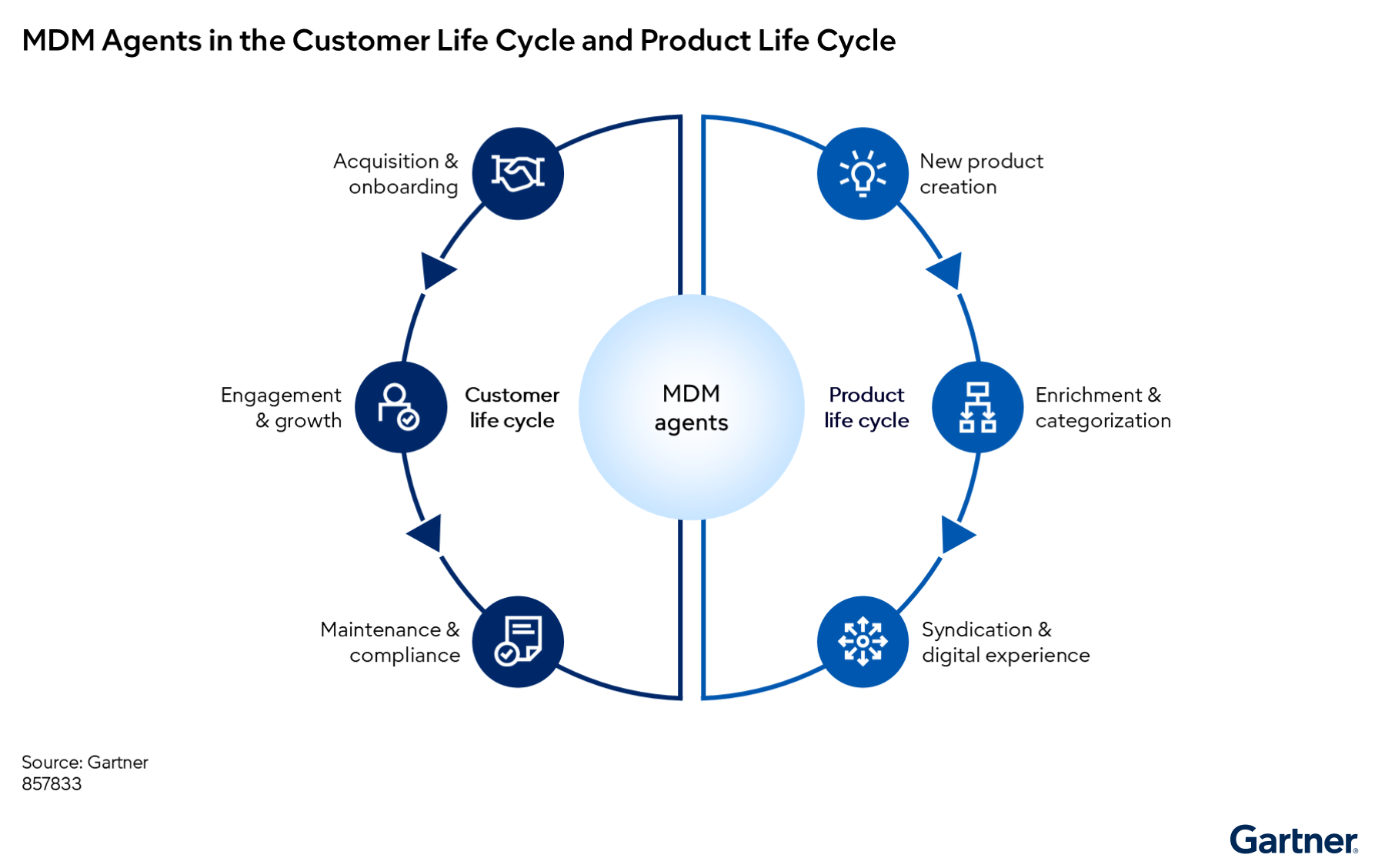
By introducing agents into connected workflows, organizations can execute autonomous actions across their customer and product life cycles.
Appendix
Sample Agent | Description |
Match Resolver Agent | Evaluates potential duplicates and compares external attributes to recommend merges |
Address Verification Agent | Automatically validates and geocodes incomplete addresses using web searches |
Data Quality (DQ) Agent | Autonomously identifies and fixes data anomalies in the background |
Enrich Agent | Appends missing data fields using integrated third-party sources |
Customer Onboarding Agent | Automates profile enrichment and deduplication for new accounts without manual touchpoints |
Sales Development Representative Agent | Instantly verifies inbound leads to prevent duplicate CRM records |
Personal Shopper Agent | Suggests personalized gifts using comprehensive customer profiles and product catalogs |
Upsell Agent | Identifies cross-sell opportunities based on household financial profiles and life events |
Source: Gartner (June 2026)
MDM Agents in the Customer Life Cycle
Acquisition and Onboarding | Engagement and Growth | Maintenance and Compliance |
Customer onboarding agents orchestrate cross-entity searches, match/merge deduplication, and profile enrichment. Sales development (SDR) agents automate lead qualification by verifying inbound data in real time to prevent duplicate CRM records. | Personal shopper agents retrieve comprehensive customer profiles, including demographics, preferences, and family relationships, to deliver hyper-personalized recommendations and targeted upsells. Upsell agents proactively identify cross-sell opportunities by retrieving complete household financial and risk profiles, triggering outreach based on life events. | Address verification agents autonomously validate, standardize, and geocode location data to ensure accurate billing, shipping, and routing. The policy layer allows agents to read and enforce machine-readable constraints like GDPR consent status and data residency at runtime. |
Source: Gartner (June 2026)
MDM Agents in the Product Life Cycle
New Product Creation | Enrichment and Categorization | Syndication and Digital Experience |
Product experience agents allow data stewards to onboard product records by extracting attributes from unstructured content and linking them to the enterprise entity graph. | General-purpose LLMs help categorize product attributes and classify unstructured data assets (e.g. product manuals) into the correct enterprise product categories. | Syndication workflows push mastered product records and digital assets to the digital shelf and external retailer networks, accelerating time to market and sales performance. |
Source: Gartner (June 2026)
Success Measures
1.Task success rate: This measures whether the agent accomplished its assigned business goal or completed its workflow. In the context of MDM, this means evaluating if the agent successfully completed its objective, such as resolving a duplicate record or properly categorizing a product.
How to measure: Instead of relying on traditional pass-fail exact-match testing, write behavioral tests that assert properties of the agent’s outputs as acceptance scenarios. Track this in production by monitoring audit and activity logs to calculate the percentage of workflows in which the agent successfully reached the intended final state.
2. Hallucination rate and answer relevance: This metric measures the frequency of fabricated information, incorrect tool use, and the contextual relevance of the agent’s output. Measuring this proves whether the MDM context delivery service is successfully providing the verified “golden context” needed to ground the AI and prevent it from making up facts.
How to measure: Implement eval-driven development (EDD) by using purpose-built LLM evaluation platforms to monitor runtime AI behavior. Establish continuous evaluation cycles using an “LLM-as-a-judge” pattern to benchmark the agent’s outputs against a library of “golden examples” (verified examples of “what good looks like” created by subject matter experts).
3. Autonomy rate vs. human escalation rate: This metric evaluates the agent’s operational independence and safety. It tracks the ratio of how often the agent completes a workflow entirely on its own compared to how often it hits a confidence boundary or policy guardrail and must pause to request human approval.
How to measure: Analyze the MDM platform’s execution and observability logs to calculate the ratio of autonomous completions to human-in-the-loop checkpoints. For example, through AI or data stewardship, set specific confidence thresholds; measure how many records the agent processes autonomously above that threshold versus how many low-confidence records it routes to a human data steward for manual review.
1 2026 Gartner AI in Software Engineering Survey. This study was conducted to explore how software engineering functions are approaching AI, including budget allocations, the current state of implementation and impact, AI strategy, and use cases. The survey focused on two key areas: the use of AI tools (such as AI code assistants and AI code agents) across the software development life cycle (SDLC) and the development of AI-powered solutions (such as, AI agents) within the software engineering function. The research was conducted online from April through May 2026 among 300 respondents across various industries and regions, including North America (n = 150), Europe (n = 100), and Asia/Pacific (n = 50). Qualifying organizations reported enterprisewide annual revenue of at least $250 million (or equivalent) in fiscal year 2025 and had experience using AI tools within the SDLC, as well as developing AI-powered solutions within their software engineering function. Participants were senior engineering leaders and were involved in decision making related to the use of AI within the engineering function. Disclaimer: The results of this survey do not represent global findings or the market as a whole, but reflect the sentiments of the respondents and companies surveyed.