Critical Capabilities for Public Cloud Optimization and Transformation Services
28 July 2026 - ID G00844483 - 66 min read
By DD Mishra, Christopher Wiles, and 3 more
Public cloud is the foundational core to most organizations’ digital transformation ambitions. SPVM leaders can use this research to assess providers’ capabilities for public cloud optimization and transformation services, ensuring alignment with their strategic cloud business goals and objectives.
Overview
Key Findings
- Geopolitical changes and disruptions, and a volatile, uncertain, complex and ambiguous (VUCA) world are driving a shift in buyers’ cloud strategy toward a more balanced multicloud strategy and sovereign cloud requirements.
- Agentic AI is making core platform transformations more achievable, leading to more efficient and smoother executions of the transformation roadmap.
- The shift from traditional cost-cutting models to value engineering and AI cost governance, driven by the exponential growth in AI computing requirements and resource constraints, is driving unforeseen challenges (e.g., hidden and nondeterministic costs of AI, measuring AI efficacy and ROI, and talent scarcity).
Recommendations
As a sourcing, procurement and vendor management (SPVM) leader responsible for public cloud solutions, you should:
- Redesign your cloud transformation strategy to embed a comprehensive risk assessment process to deal with emerging trends in sovereignty and AI. Use a sovereignty risk matrix that evaluates data, operational, and technological sovereignty to inform workload placement and vendor selection. Integrate these requirements into RFPs and procurement processes.
- Deal with emerging geopolitical shifts by establishing a cross-functional governance framework that includes legal, risk, IT and business stakeholders. Such a framework ensures continuous oversight, scenario planning and adaptive controls to monitor the requirements.
- Transition from traditional FinOps to an integrated AIOps framework. Deploy advanced analytics and AI-driven monitoring tools that support dynamic cost governance, especially for GenAI-related workloads. Focus on developing a sovereign FinOps strategy that addresses premium costs associated with localized, sovereign cloud deployments.
What You Need to Know
The demand for public cloud optimization and transformation services (PCOTS) is steadily increasing as organizations pursue advanced expertise and specialized support to achieve their strategic business goals. The providers featured in this research are dedicated to closing gaps in public cloud maturity by delivering comprehensive services tailored for cloud migration, adoption, modernization, optimization and transformation. Leveraging their deep industry knowledge, toolsets, robust resources, established modernization frameworks, and sophisticated automation tools, these providers effectively address client challenges and drive meaningful business results.
Over the past year, Gartner has observed rapid innovation and market evolution in the realm of public cloud optimization and transformation services. In 2025, service providers and organizations alike have increasingly recognized that transitioning to and optimizing in the public cloud is not merely about cost reduction but rather about achieving robust business outcomes through intelligent system transformation and continuous workload optimization. This report synthesizes Gartner’s observations to provide an in-depth examination of the vendor capabilities that have defined the landscape in 2025.
The market is characterized by the convergence between cloud-native development and legacy system optimization. With increasing investments in integrated tooling platforms, vendors are combining proprietary cloud-native solutions with third-party tools to create orchestration, automation and intelligent analytics frameworks. These frameworks are engineered to deliver measurable business outcomes such as improved agility, enhanced scalability and significant cost efficiencies. In 2026, the focus has shifted from one-time transformation projects to continuous and adaptive workload optimization, which provides organizations with the resilience they need in dynamic market environments.
All providers in this Critical Capabilities and its companion Magic Quadrant continue to serve an increasingly large, diverse set of customers, ranging from small businesses and midsize enterprises (MSEs) to global corporations, spanning various industries and geographies.
You can use this research as a companion to the Magic Quadrant for Public Cloud Optimization and Transformation Services to understand what to look for in a provider and which solution capabilities support your key business use cases. For a more in-depth determination, use the interactive version of this research, which allows you to adjust weighting for each use case to match your needs more specifically.
Analysis
Critical Capabilities Use-Case Graphics
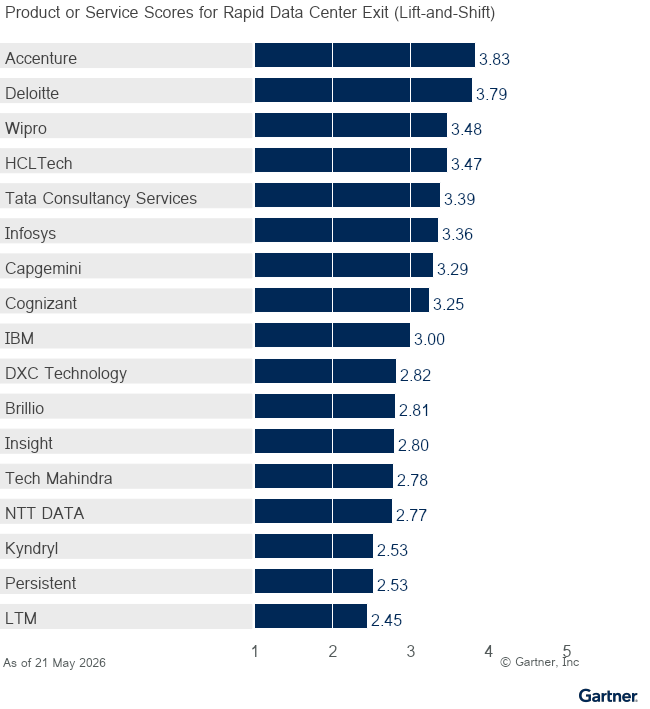
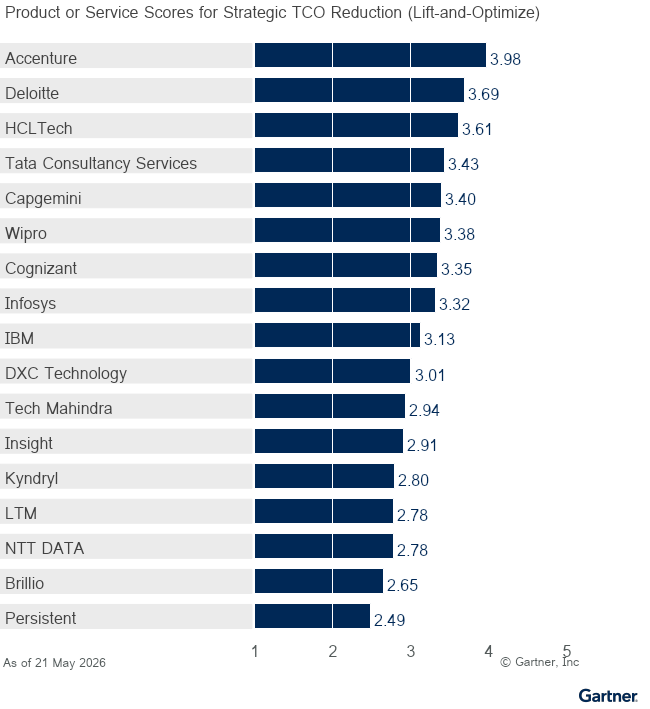
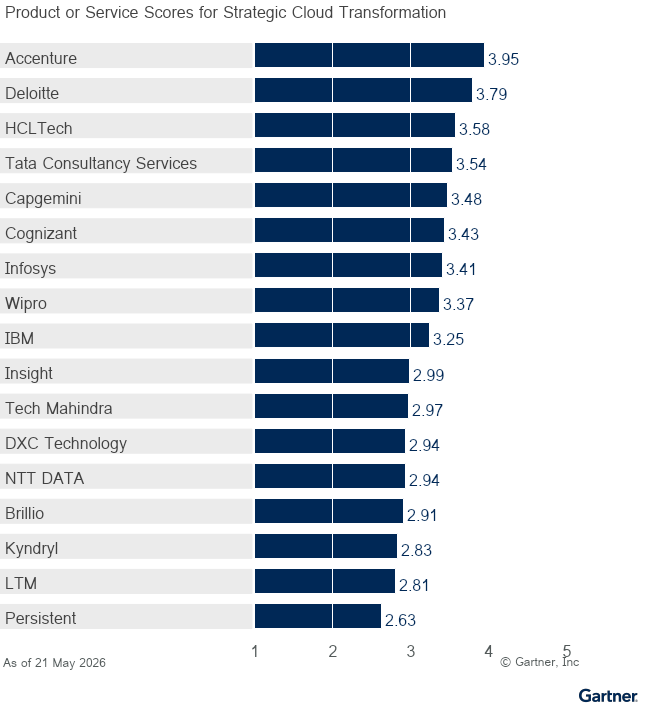
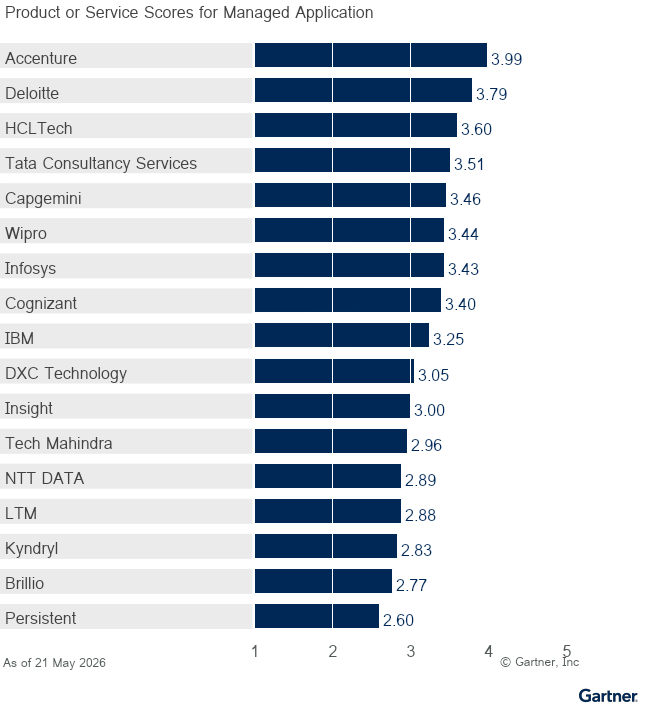
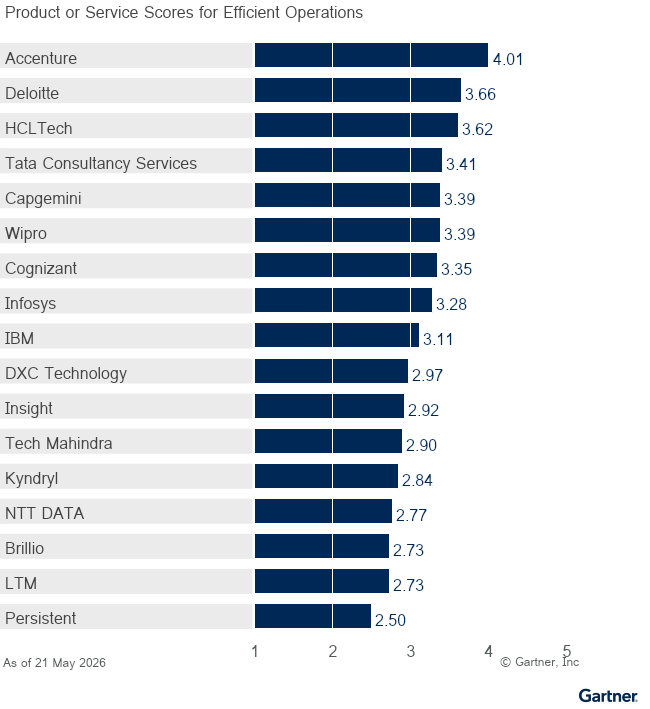
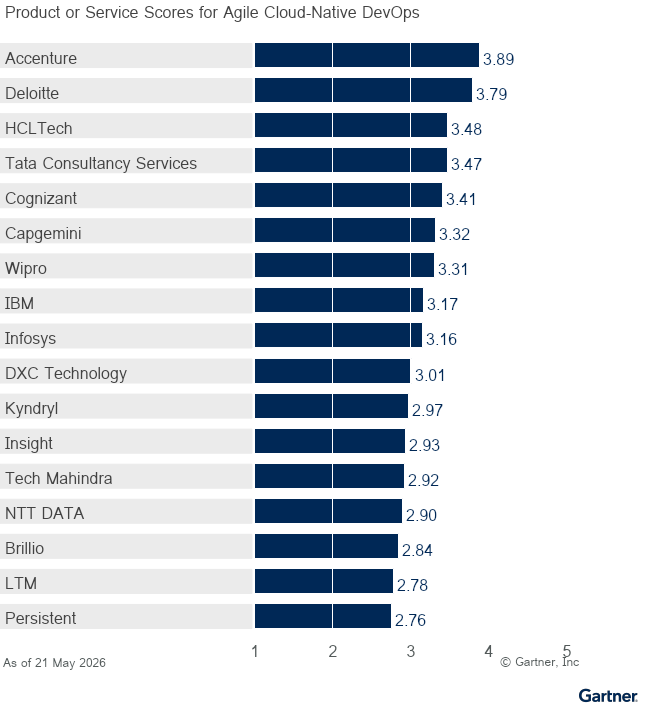
Vendors
Each provider’s description starts with an introduction that includes its PCOTS migration project count across cloud providers: Amazon Web Services (AWS), Google Cloud (formerly Google Cloud Platform), Microsoft Azure and Oracle Cloud Infrastructure (OCI).
Additionally, the sections within the profiles are presented to highlight the five critical capabilities that emphasize each provider’s key strengths.
Accenture
See verified user reviews and ratings for Accenture on Peer Insights.
Accenture is a global services provider with over 786,000 enterprise employees, of which just over 280,000 are PCOTS-focused. Accenture helps clients reinvent and continuously optimize their business through cloud and AI, meeting clients where they are by leveraging industry expertise, ecosystem partnerships and proprietary tools. In 2025, Accenture’s PCOTS business grew by 12% (below the research peer average). Accenture performed about 4,900 PCOTS migration projects for more than 6,700 PCOTS clients across AWS, Azure, GCP and OCI. Accenture approaches modernization with an AI-first, automation-led operating model, focusing on continuous transformation without disruption.
Solution design: Accenture integrates precontract (60%) and postcontract (90%) co-creation with outcome-based models to align technical execution with business value. Its solutions are supported by the multimodal enterprise cloud transformation framework. Customers can benefit from a standardized landing zone that sequences concurrent lift-and-shift, lift-and-optimize, and lift-and-transform strategies to drive architectural efficacy.
Timely delivery: Accenture focuses on delivery velocity and predictability through its mature platform, GenWizard (which has incorporated myNav), which is designed to reduce manual steps and compress development cycles by a reported 35%. However, these platforms need to be carefully assessed for potential “pilot-to-scale gaps,” static vs. dynamic dependencies, and cost estimation accuracies when applied to highly customized or undocumented legacy environments.
Cloud workload transformation: Accenture shows consistent progress in modernization, successfully rebuilding 80% of application workloads into new infrastructure-as-code (IaC) environments during migration. Clients seeking substantial legacy refactoring can extract value from Accenture’s ability to decode and rebuild monolithic debt into resilient, cloud-native microservices.
Cloud-optimized management: Accenture executes automated steady-state operations across 2,500 clients by natively integrating its GenWizard platform and Cloud Manager & Optimizer (CMO) with existing enterprise ITSM APIs. This orchestration supports automated incident resolution and deployment recommendations, providing clients with operational stability. However, clients with highly bespoke or fragmented ITSM environments should verify the integration effort required to achieve true “closed-loop” resolution without human intervention.
Cloud-native toolchains: Leveraging over 5,000 active client deployments that utilize industry-specific cloud-native templates, Accenture blends standard integration tools (such as Jenkins, Argo CD, and Terraform) with its proprietary AI orchestration. This approach utilizes the GenWizard Agent Manager to deliver governed, multiagent workflows and automated pipelines that accelerate secure code deployment. However, clients adopting these advanced AI-orchestrated toolchains should ensure their internal engineering teams are adequately trained to co-manage multiagent workflows.
Brillio
See verified user reviews and ratings for Brillio on Peer Insights.
Brillio is a global services provider with over 6,000 enterprise employees, of which just under 4,200 are PCOTS-focused. Brillio focuses on ensuring continuous operations, resiliency and reliability, alongside FinOps and cost optimization. In 2025, Brillio’s PCOTS business grew below average. It performed 55 PCOTS migration projects for more than 100 PCOTS clients across AWS, Azure, GCP and OCI. Brillio approaches cloud modernization with platform engineering and golden paths to standardize the developer and operations experience.
Solution design: Brillio leverages AI-driven discovery and its proprietary ADAM platform to map business constraints and boost assessment productivity, targeted largely at the midmarket. However, market adoption of Brillio’s proprietary tools remains low compared to its peers. Brillio reports relatively low co-creation rates (precontract and postcontract) compared to industry peers. Clients should ensure sufficient collaborative planning and iterative sprints are explicitly scheduled to validate architectures before execution begins.
Timely delivery: Brillio accelerates delivery by utilizing AI tooling to reduce development cycle times through repeatable, secure landing zones and agile pod-based delivery models designed to compress implementation cycles. With only a 5% increase in dedicated PCOTS staffing in 2025 and a boutique scale (under 4,200 PCOTS staff), Brillio operates well below the delivery capacity of Tier 1 global system integrators. Clients with massive, globally distributed legacy estates should carefully validate Brillio’s scaling capacity for complex, high-volume transformations.
Cloud workload transformation: Workload transformation is a focus for Brillio, driven by a modernization-first approach that includes refactoring and rebuilding custom applications. Brillio emphasizes an AI-led approach; however, its overall automation for strategic cloud transformation remains at roughly 40%. Clients should be aware that deep legacy refactoring will still require intensive, manual engineering effort alongside these AI-assisted tools.
Cloud-optimized toolchains: Anchored by the BrillioOne.AI and ADAM platforms, Brillio’s toolchains offer a unified intelligence layer that connects standard tools to deliver persona-based dashboards and run-book-driven remediation. Organizations should assess the platform for potential capability gaps — such as consolidated multicloud billing or native hyperscaler IAM integration — and verify that relying on proprietary toolchains will not introduce integration hurdles in highly sovereign or air-gapped environments.
Knowledge sharing: Brillio executes knowledge transfer by utilizing AI-led discovery to map legacy systems into contextual knowledge graphs and persistent standard operating procedures (SOPs). Clients can gain transition frameworks that upskill internal teams on-site reliability engineering (SRE) through targeted workshops and hands-on labs. However, knowledge sharing efficacy can be challenged due to a critically low postcontract co-creation rate, demonstrating a lack of continuous collaborative mentoring.
Capgemini
See verified user reviews and ratings for Capgemini on Peer Insights.
Capgemini is a global services provider with over 420,000 enterprise employees, of which about 158,000 are PCOTS-focused. Capgemini focuses on reimagining the business processes of intelligent operations and has performed over 600 PCOTS migration projects for its PCOTS clients across AWS, Azure, GCP and OCI. Capgemini approaches modernization through the lenses of automating, innovating, migrating and optimizing environments.
Solution design: Capgemini emphasizes effective solution design with a focus on precontract engagements to build ROI business cases. Leveraging the Clear Sight IT Decision Maker to consolidate technical discovery and financial modeling, Capgemini can link deals directly to business outcomes. Capgemini employs collaborative workshops to build structured business cases that evaluate efficiency, scalability, risk and compliance to determine the best modernization path for each workload. Gartner has received mixed client feedback regarding flexibility around statements of work; clients should seek relevant qualifications and references to support the projected benefits.
Timely delivery: Capgemini industrializes delivery through a highly automated cloud migration factory (CMF) governed by ClearSight, utilizing AI tools that reportedly reduce cycle times but are less mature than industry peers. While these methodologies accelerate structured transitions and target execution scale, clients should exercise strong vendor management oversight. Gartner observes that a heavier reliance on junior-level talent (27% with two to five years’ experience) and a strategic prioritization of complex modernization over rapid migrations can constrain raw delivery timelines.
Cloud workload transformation: Standing out as one of the market leaders in complex modernization, Capgemini derives a uniquely high 65% of its PCOTS revenue directly from cloud-native refactoring and rebuilding. Capgemini utilizes standard build-to-run foundations to orchestrate workflows, systematically preparing monolithic portfolios for modern, resilient operations with structured pathways for deep application modernization and rearchitecting.
Cloud-optimized management: Capgemini executes stable steady-state operations driven by deep site reliability engineering (SRE) principles and its proprietary SHOP platform for AIOps. It utilizes OrchestrateAI and ClearSight to feed observability, AIOps, and FinOps governance. This approach provides context-aware monitoring, automated remediation and rightsizing for steady-state hybrid operations. However, Capgemini’s automation ecosystem heavily integrates diverse third-party market tools alongside proprietary accelerators rather than enforcing a single, unified proprietary platform.
Knowledge sharing: Capgemini delivers knowledge transfer at scale, supported by immersive “virtual campus” training models and hands-on workshops. By leveraging advanced tools such as GenDiscover and CAST for automated, rapid code-level analysis, Capgemini ensures architectural transparency. Topology and historical incident run books empower AI agents, while continuous feedback loops actively translate operational baselines and design decisions into persistent, reusable artifacts for the client.
Cognizant
See verified user reviews and ratings for Cognizant on Peer Insights.
Cognizant is a global services provider with over 351,000 enterprise employees, of which just under 128,000 are PCOTS-focused. Cognizant connects cloud KPIs directly to business process outcomes, embedding full-stack observability into routine cloud management. In 2025, Cognizant’s PCOTS business grew by an above-average 23%. It performed 2,100 migration projects for more than 1,300 PCOTS clients across AWS, Azure, GCP and OCI. Cognizant approaches modernization through collaborative relationships with hyperscalers and ISVs to deliver integrated and outcome-based solutions.
Solution design: Cognizant aligns target architectures directly with business cases by utilizing its momentum framework, ignition workshops and the WiSE platform to standardize agile presales solutioning. It drives 78% precontract co-creation rates by leveraging “Transformation Recommender” agents and Skygrade to build intelligent baselines. By embedding contracted business outcomes early in the process, Cognizant maps proposed cloud solutions directly aligned with the client’s specific goals and challenges.
Timely delivery: Cognizant focuses on predictable execution with faster migrations by integrating AI to drive reduction in development cycle times. Cognizant reports a workforce that is over 70% certified. Cognizant embeds automation into its timelines by using Skygrade to reduce infrastructure specification effort supported by SLA-backed platform performance. Gartner has received mixed client feedback on the high percentage of low-tenure/junior resources staffed for transformations; clients must clarify resource mix and level/stage of contributions from senior staff in complex PCOTS architecture redesign engagements.
Cloud-native management: Cognizant provides fully managed, compliant CI/CD pipelines operating on standard DevOps best practices and integrating natively with hyperscaler Kubernetes environments like EKS, GKE and AKS. Although the proportion of staff acting as developers/product owners is lower than that of peers, operations are supported by a workforce where a high percentage are cloud-native certified and hold AI/GenAI/ML certifications. Cognizant’s execution metrics of efficient operations are on par with the industry peer average; clients should evaluate Cognizant’s operational approach during the sourcing process to ensure it fully aligns with their expectations for efficiency and resilience.
Cloud-native toolchains: Cognizant employs native toolchain features and GenAI-driven automation to orchestrate the AI-SDLC, automatically elaborate requirements, and generate in-line code documentation within the deployment pipeline. Cognizant utilizes OPA Gatekeeper for policy-as-code and Vault for secrets; it also utilizes multiagent systems and retrieval-augmented generation to automate testing and code deployment across the DevOps life cycle.
Knowledge sharing: Cognizant executes a robust, structured knowledge transfer strategy, deploying agents that assist transition and executing over 1,300 CCOE enablement deals in managed applications. By treating assessment outputs as versioned knowledge models and vector databases queried by AI, Cognizant actively extracts legacy system knowledge into client-owned wikis and drives grassroots upskilling through its BlueBolt innovation platform, ensuring continuous knowledge base enrichment as incidents are resolved.
Deloitte
See verified user reviews and ratings for Deloitte on Peer Insights.
Deloitte is a global services provider with over 470,000 enterprise employees. Deloitte emphasizes cloud and AI FinOps capabilities for spend visibility, optimization and governance. In 2025, Deloitte’s PCOTS business grew above-average by 20%, performing a significant number of migrations across AWS, Azure, GCP and OCI. Deloitte approaches transformation by focusing on tying cloud value directly to tangible business results and measurable business outcomes.
Solution design: Deloitte leverages knowledge from Ascend and industry reference libraries to create a unified baseline for scoping, architecture and business cases tailored to client needs. Through the Ascend platform and a collaborative precontract co-creation approach, reported to be used in 90% of recent transformation deals, Deloitte develops value-aligned, measurable solutions. Deloitte conducts automated discovery and visual decomposition to support strategic blueprint development.
Timely delivery: Deloitte’s PCOTS delivery is structured and governed by TruNorth Portfolio Management platform, which drives reduction in development cycle times and achieves higher automation in lift-and-shift migrations. Deloitte’s delivery model integrates automation and DevOps, using the Cloud Software Factory. However, Deloitte’s focus on deep, complex application rearchitecting could result in longer project timelines for complex scope when compared to simpler rehosting approaches.
Cloud workload optimization: Deloitte supports continuous cloud workload optimization by integrating financial governance and operational reliability, using tools like DevOps Agent Assist for predictive rules and AIOps to monitor KPIs and improve infrastructure efficiency. With a high automation rate, Deloitte can help clients strengthen FinOps governance and support infrastructure cost reductions. However, due to Deloitte’s limited focus on legacy infrastructure and COTS-heavy portfolios, clients should assess the fit for their PCOTS requirements (where the focus is only on long-term legacy infrastructure support).
Cloud-native management: Deloitte manages complex, cloud-native environments by integrating site reliability engineering and DevOps into client operating models, using the OpenCloud platform with AIOps, automated CMDBs and DevSecOps to ensure stable operations. With automated patching, compliance guardrails and a highly certified cloud workforce, Deloitte supports continuous, product-centric delivery across modern digital estates. However, clients should prioritize customer satisfaction and service quality metrics for multiyear contracts.
Cloud-native toolchains: Deloitte delivers cloud-native toolchains through proprietary platforms like Zora AI and Ascend, integrating infrastructure as code and DevSecOps into strategic deals. By deploying LLM-based autonomous agents, clients can achieve 65% average reduction in development cycle times.
DXC Technology
See verified user reviews and ratings for DXC Technology on Peer Insights.
DXC Technology is a global services provider with over 115,000 enterprise employees, of which 35,000 are PCOTS-focused. DXC provides an infrastructure-focused confidence layer for mission-critical environments. DXC Technology did not wish to publicly disclose 2025 PCOTS business growth. It performed over 300 migration projects for more than 1,200 PCOTS clients across AWS, Azure, GCP and OCI. DXC Technology approaches complex environments utilizing a unique combination of techniques and proprietary tools known as precision-guided modernization.
Solution design: DXC emphasizes solution design through its AdvisoryX methodology and data aggregation platform, which ingest client data and create synthetic CMDBs for nonintrusive discovery and precise wave planning. DXC’s strategic transformation precontract co-creation is well below the market average, reflecting a preference for standardized over more tailored approaches. However, its postcontract co-creation occurs in 75% of deals, supporting over 1,000 design and architecture engagements.
Timely delivery: DXC delivers large-scale migrations with high velocity, a reported average of 19 days per workload for major projects through automation in discovery and lift-and-shift processes. AI tools and the Converge 2.0 platform (with AI-assisted pipelines and structured methodologies) drive a reduction in development cycles, enabling the completion of over 800 strategic TCO reduction waves in 2025. A higher percentage of junior staff may hinder progress and quality in complex projects requiring deep architectural expertise in legacy systems, increasing risk for organizations with intricate modernization needs.
Cloud workload optimization: DXC drives lift-and-optimize strategy, representing 35% of PCOTS revenue and supported by over 500 dedicated FinOps deals focused on strategic TCO reduction. DXC’s FinOps capabilities enable immediate rightsizing of resources during migration. Operational baselines and insights support continuous cost optimization and performance tuning, while service catalogs and bidirectional knowledge flow help manage cloud spending and maintain ongoing FinOps alignment.
Cloud-optimized management: DXC delivers multicloud management for over 500 native cloud management platform (CMP) clients with outcome-based pricing and a stable client renewal rate, but limited use of autoscaling and load balancing indicate areas for improvement. The OASIS platform combines persona-aware, agent-assisted automation with unified visibility and policy-driven control for hybrid infrastructures. DXC deploys automated and self-healing capabilities to drive operating cost reductions and incident resolution for its clients.
Cloud-native management: DXC uses a mature platform engineering approach to simplify hyperscaler complexity for developers across 475 clients with industry cloud-native templates/accelerators. DXC supports clients bringing their own CI/CD tooling and manages the environment.
HCLTech
See verified user reviews and ratings for HCLTech on Peer Insights.
HCLTech is a global services provider with approximately 227,000 enterprise employees, of which just over 102,000 are PCOTS-focused. HCLTech positions sovereign cloud as a control-first cloud model, designed for enterprises where data residency and regulatory compliance are non-negotiable. In 2025, HCLTech’s PCOTS business grew by a below-average 10%. HCLTech performed 5,270 PCOTS migration projects for over 4,300 PCOTS clients across AWS, Azure, GCP and OCI. HCLTech enables AI-native transformation, focusing on engineering at scale, enterprise efficiency and growth acceleration.
Solution design: HCLTech uses presales and consulting engagements to co-develop outcome-driven AI and digital transformation solutions based on client aspirations. Its AI Force.Assess platform ingests multisource data, applies deterministic reverse engineering, and reduces manual estimation errors. HCLTech’s client deployments are significantly concentrated on Microsoft Azure, which may limit its ability to deliver truly agnostic, multicloud solutions for clients looking for alternatives.
Timely delivery: HCLTech achieves delivery execution through a stable workforce and a delivery model sequencing complex application portfolios. HCLTech’s over 4,000 DevOps enablement and infrastructure as code (IaC) engagements leverage automated provisioning templates, blueprints and dependency maps for migrations. However, clients should be aware that HCLTech’s AI-driven development cycles reduction falls below the market average, and feedback on project quality and timeliness for certain services is mixed.
Cloud workload transformation: Complex modernization makes up a significant portion of PCOTS revenue. Supported by AI-augmented forward engineering and over 4,000 cloud-native templates, HCLTech systematically rebuilds applications as modern microservices. Automated solutions like ATMA and AIForce.Software.Mod enable containerization and modernization of legacy environments into scalable, cloud-native architectures.
Cloud-optimized management: HCLTech bridges legacy and cloud estates using its AI Force.Ops platform, which deploys initial response agents and service assist co-pilots to accelerate mean time to resolution for traditional infrastructure. Automated remediation platforms support over 4,100 client environments and over 1,400 FinOps deals. Although HCLTech leads in automation workload, some challenges remain in realizing value across its broad solutions portfolio and below-industry-average AI productivity gains.
Cloud-native toolchains: HCLTech uses automated validation loops powered by GenAI to autogenerate test cases, automation scripts and continuous deployment pipeline scaffolds that align with client architectural guardrails. Platforms like AI Force Assess deploy graph-native dependency models and agentic AI data classification for secure, repeatable architectural intelligence.
IBM
See verified user reviews and ratings for IBM on Peer Insights.
IBM is a global services provider with over 264,000 enterprise employees, of which just under 60,000 are PCOTS-focused. IBM continues to invest heavily in hybrid cloud and platform engineering capabilities to extend beyond strategy into large-scale modernization execution. In 2025, IBM’s PCOTS business grew by 23%. It performed over 600 PCOTS migration projects for more than 3,200 PCOTS clients across AWS, Azure, GCP and OCI. IBM approaches modernization by decoding legacy debt and aggressively containerizing portfolios across hybrid environments.
Solution design: IBM delivers solution design by using its IBM Garage methodology and Modernization Acceleration and Transformation Tool (MATT) to automate 40% to 50% of application analysis and value-aligned business cases. With upfront co-creation, including over 2,800 managed applications and over 900 transformation deals, IBM maintains architectural alignment between business objectives and technical execution. Areas of concern shared by clients include low flexibility and stickiness due to heavy reliance on IBM’s proprietary methodology and leaning toward IBM products.
Timely delivery: IBM enhances delivery with the zero-touch migration assistant. This leads to over a 40% AI-driven reduction in development cycles for greater program predictability. IBM’s MATT platform supports optimizing delivery timelines and industry alignment. While IBM focuses on complex rearchitecture and containerization for multicloud migrations, this approach can potentially extend overall transformation timelines compared to simpler rehosting methods.
Cloud workload optimization: IBM provides FinOps visibility through native integrations with Apptio and Turbonomic, reportedly delivering consistent cost reductions through accurate rightsizing. IBM uses well-architected review frameworks and ongoing analysis to identify technical debt and consolidate infrastructure footprints, achieving targeted TCO reductions after migration. However, reported volumes for strategic TCO reduction reviews and FinOps deals are very low compared to the industry average.
Cloud workload transformation: IBM supports cloud workload transformation by using tools such as MATT and Txture to modernize legacy environments. IBM refactors custom applications into microservices, transitions monolithic systems with tools like Code Transporter, and delivers scalable, cloud-native architectures suitable for complex hybrid landscapes. To accelerate these modernizations across the software life cycle, IBM employs an automated and factory-based approach powered by its Hybrid by Design framework.
Cloud-optimized toolchains: IBM’s cloud-optimized toolchains use the IBM Consulting Advantage platform, which incorporates 4,000 digital workers and multiagent orchestration on the ICA framework and AWS Bedrock AgentCore to automate routine interactions and enhance hybrid visibility. The toolchain ecosystem, centered on the IBM AIOps platform, integrates with enterprise ITSM and FinOps governance systems for hybrid infrastructures. However, IBM’s deployment scale of advanced automation for efficient operations trails the market average.
Infosys
See verified user reviews and ratings for Infosys on Peer Insights.
Infosys is a global services provider with over 330,000 enterprise employees, of which 275,000 are PCOTS-focused. Infosys builds competencies on hyperscalers’ sovereign cloud offerings and expands hardware and hosting partnerships for sovereignty. In 2025, Infosys’ PCOTS business grew below average while performing over 9,800 PCOTS migration projects for more than 1,700 clients across AWS, Azure, GCP and OCI.
Solution design: Infosys approaches solution design through co-creation, engaging in 3,200 co-solutioning deals for strategic transformations and 2,800 for managed applications. Infosys uses capabilities of Topaz Fabric for parsing legacy dependencies to develop roadmaps and Living Labs for experimentation and incubation. Infosys leverages its domain talent and industry expertise to closely understand client challenges and co-create optimal cloud solutions. However, precontract co-creation deals report a lower volume of strategic solution design and architecture compared to peers.
Timely delivery: Infosys structures delivery through its Cobalt factory model and a global workforce, with a high percentage of enterprise resources dedicated to PCOTS deals. Infosys primarily adopts application reengineering for cloud transformation, and reports high automation in testing and lift-and-shift migrations. This high automation is enabled by the agentic AI data foundation layer in Topaz Fabric and has been deployed in over 3,200 DevOps enablement pipeline engagements. Despite high automation and reduced development cycles, clients should review migration timelines up front and plan for timeline changes due to potential reengineering or modernization.
Cloud workload optimization: Infosys generates 40% of its PCOTS revenue from workload optimization, using continuous telemetry to identify and eliminate unnecessary resources and achieve structural cost savings. The Infosys FinOps Workbench and structured FinOps models support over 1,200 dedicated deals focused on strategic TCO reduction. Compared to its peers in this capability, Infosys has a relatively lower volume of FinOps optimization deals.
Cloud workload transformation: Infosys derives 60% of its PCOTS revenue from refactoring and rebuilding custom applications, using industry cloud-native templates in 3,550 engagements and Topaz Fabric’s reverse-engineering agents to decode monolithic legacy rules. This approach accelerates modernization and supports large-scale enterprise refactoring into modern microservices, with a focus on PaaS adoption over legacy lift and shift. Agentic AI platforms and Topaz Fabric capabilities are used to manage life cycle modernization. Infosys’ refactoring rate is above the peer average.
Cloud-optimized toolchains: Infosys provides cloud management platform (CMP) capabilities used in 2,900 engagements to govern hyperscaler environments and manage operational expenses. Offerings such as Cobalt, Polycloud and Topaz Fabric provide an intelligence layer that integrates with existing client tools, including ServiceNow. Clients can benefit from unified provisioning, security as code and AIOps governance, supporting high automation in testing and efficient operations.
Insight
See verified user reviews and ratings for Insight on Peer Insights.
Insight is a global services provider with over 14,500 enterprise employees, of which just about 4,300 are PCOTS-focused. Insight utilizes ACE Discovery Agent, an AI-driven application discovery and code intelligence capability designed to help organizations modernize complex portfolios. In 2025, Insight’s PCOTS business grew by 4%, which is significantly behind the average of peers in this market. Insight performed close to 600 PCOTS migration projects for more than 3,300 PCOTS clients across hyperscalers (focus on Azure and GCP). Insight’s PCOTS migration project volume is significantly lower than the scale achieved by top-performing peers.
Solution design: Insight’s solution design approach has evolved from infrastructure planning to business-value alignment. Insight uses ACE Discovery Agent for AI-driven application discovery and code intelligence, and Prism serves as a single pane of glass to govern the cloud portfolio. Insight’s precontract governance definitions and guardrails are less rigorous compared to Magic Quadrant Leaders, which will require a higher level of oversight from client organizations during design.
Timely delivery: Insight uses a “start fast, deploy for use, iterate quickly” delivery principle to avoid lengthy planning phases and accelerate migrations. Insight applies its Radius methodology and standardized Devshop project templates. Insight’s development cycle time reduction is lower than that of industry peers. Insight can accelerate smaller projects but mid-to-large migrations (100 to 499 workloads) have higher migration timelines; enterprise clients should carefully plan their scaling and execution timelines.
Cloud workload optimization: Insight focuses on immediate cost reduction by leveraging reseller relationships to rightsize environments upon migration. Clients can benefit from integrated FinOps tools, such as Cloudability, and native cloud capabilities to support rapid data center exits and active spend management. However, the continuous FinOps managed service penetration is critically low, supporting only a very small percentage of Insight’s client base.
Cloud-optimized toolchains: Insight’s cloud-optimized toolchains use proprietary platforms to provide baseline visibility, consolidated billing and FinOps management. The Insight Cloud CMP anchors these toolchains, unifying billing, monitoring and FinOps while integrating with third-party ITSM platforms for steady-state operational visibility. Insight’s operational automation is less extensive compared to market leaders. Also, Insight’s actual deployment of autonomous LLM-based agents is deployed at a very low percentage of Insight’s client base.
Cloud-native toolchains: Insight’s cloud-native tooling embeds specialized AI agents throughout the development life cycle to autonomously write, test and deploy code. The toolchain leverages agentic AI for codebase analysis and enables automated CI/CD pipeline deployment. However, Insight’s automation in testing and native agile DevOps remains below the market average.
Kyndryl
See verified user reviews and ratings for Kyndryl on Peer Insights.
Kyndryl is a global services provider with over 73,000 enterprise employees, of which 10,000 are PCOTS-focused. Kyndryl enhances its platforms with advanced ML-based optimization, cross-cloud cost arbitrage and carbon footprint tracking for cloud economics. Kyndryl performed over 250 PCOTS migration projects for more than 800 PCOTS clients across AWS, Azure, GCP and OCI. Kyndryl approaches cloud solution design by leveraging automated discovery tools and standardized reference architectures to transition mission-critical legacy workloads.
Solution design: Kyndryl uses its Kyndryl Bridge platform to automate application-layer dependency mapping, which eliminates the need for “blank sheet” designs and informs accurate, outcome-accountable wave plans. The Kyndryl Consult framework helps establish objective, hyperscaler-agnostic migration paths, with automated discovery used to map application dependencies and architect secure landing zones. However, a major focus on lift-and-shift and lift-and-optimize use cases limits Kyndryl’s ability to scale to modernization and transformation initiatives.
Timely delivery: Kyndryl supports execution through its potential to scale, standardized frameworks and an expanded workforce, including a headcount increase in 2025 and 10,000 delivery staff. While this approach maintains steady progress for complex, multipillar legacy migrations, overall transformation timelines may be extended due to the depth of involvement with large mainframe-era estates compared to simpler SMB rehosting projects.
Cloud-optimized management: Kyndryl manages hybrid IT environments by integrating over 22,000 mainframe subsystems and public cloud infrastructure within a single control plane, supported by the Kyndryl Bridge platform. This platform unifies AIOps, FinOps, SecOps, and ITSM tools, providing integrated billing, self-service provisioning and multicloud operations for more than 800 clients. Clients should note Kyndryl’s prime focus is on existing clients for PCOTS transformation as opposed to new client acquisition.
Cloud-native management: Kyndryl manages Kubernetes and modern application ecosystems through Bridge DevOps Intelligence, which provides governance, collaboration and applies SRE principles to technology stacks. Kyndryl addresses Kubernetes sprawl by enforcing policy as code and using the Agentic AI Digital Trust platform for continuous compliance monitoring, identity governance and responsible AI solutions. Clients should assess and validate the approach, benefits and timelines during contracting so that performance metrics in these categories are formally tracked.
Knowledge sharing: Kyndryl addresses industry skills gaps by contractually embedding cloud centers of excellence and two-way knowledge transfer into managed service engagements. Captured knowledge informs workload decisions, dependencies, and improves sequencing to support monitoring and faster resolution using established patterns, helping to mitigate ongoing operational risk.
LTM
See verified user reviews and ratings for LTM on Peer Insights.
LTM is a global services provider with over 87,000 enterprise employees, of which about 30,000 are PCOTS-focused. LTM invests in platforms that support AI-led cloud-native modernization, DevOps, infrastructure, and application development across migration, transformation and ongoing operations. In 2025, LTM’s PCOTS business grew behind the market average of 14%. It performed over 3,400 PCOTS migration projects for more than 670 PCOTS clients across AWS, Azure, GCP and OCI, which is fairly low compared to market peers. LTM approaches complex estates by defining six dimensions of the PCOTS problem space to identify core solutioning areas.
Solution design: LTM develops technical architectures using proprietary platforms such as NovaSphere and engages in presales activities, including 960 co-solutioning deals in strategic transformations and over 600 in managed applications. Architecture generation via NovaSphere tends to emphasize technology-centric models for defining cloud constraints and transformation paths. However, LTM’s maturing market positioning and industry focus, and less emphasis on deep business-roadmap vision compared to market leaders, constrain its scalability.
Timely delivery: LTM uses migration factory pods and tools such as VMigrate to execute bulk migrations, leveraging automation to reduce manual rework and compress transition timelines. UAI-driven orchestration via NovaSphere helps accelerate centralized migration wave execution, though the reported 30% reduction in development cycles is slightly below the market average. LTM utilizes a factory-based, metrics-driven model that combines wave planning with repeatable infrastructure-as-code (IaC) provisioning to reduce manual rework.
Cloud workload optimization: Cloud financial management is a core focus for LTM, reporting 37% of its total PCOTS revenue through continuous, embedded FinOps models. LTM uses BlueVerse Insights across over 500 dedicated TCO reduction deals to achieve savings, driving approximately 20% TCO reductions during the migration phase. However, LTM is still scaling up its AI-driven productivity gains compared to top-tier peers.
Cloud workload transformation: Accounting for over 40% of its revenue, LTM focuses on refactoring and rebuilding custom applications across over 900 DevOps deals. Cloud Insight and AppIQ (along with NovaSphere) are used to ingest inputs, extract technical context and surface hidden legacy dependencies. Cloud Elevate provisions standardized, governed landing zones and workloads using infrastructure as code and policy as code.
Cloud-optimized toolchains: LTM’s cloud-optimized toolchains operate through a standard cloud management platform portal used by over 200 clients for inventory classification, observability and expense management. The toolchains also feature reusable cloud-native templates, reference architectures, and DevSecOps accelerators aligned with industry patterns, monitoring and optimization across cloud environments. LTM leverages its proprietary BlueVerse Tech platform and tools like Infinity Insights to embed intelligence, automation and governance throughout IT operations and the software development life cycle.
NTT DATA
See verified user reviews and ratings for NTT DATA on Peer Insights.
NTT DATA is a global services provider with over 242,200 enterprise employees, of which 30,000 are PCOTS-focused. NTT DATA invests in industry-specific accelerators and solutions, including process models, data models and vertical use cases tailored to regulated industries. NTT DATA performed about 800 PCOTS migration projects for more than 2,600 PCOTS clients across AWS, Azure, GCP and OCI. NTT DATA approaches cloud transitions by prioritizing an evidence-based, AI-assisted co-creation process to determine optimal architectures before large-scale commitments.
Solution design: NTT DATA executes an AI-assisted co-creation process prioritizing business value scoring and R-pattern mapping. NTT DATA utilizes joint co-solutioning in 60% of precontract and 80% of postcontract deals. Client teams can benefit from structured target architectures, establishing baselines across over 200 strategic TCO design engagements that align with client financial initiatives. Clients should ensure sufficient manual architectural validation and expert oversight are conducted, particularly for highly complex or undocumented legacy estates.
Timely delivery: Timeliness is supported through automated governance, widespread infrastructure-as-code and over 100 DevOps pipeline enablement deals. NTT DATA delivery platform provides milestone tracking. Clients should note that complex enterprise estates exceeding 500 workloads still average a protracted 180 days per workload, and the reduction in development cycle times from AI tooling noticeably trails peer averages.
Cloud workload transformation: Driven by a “lift-and-transform” strategy, NTT DATA utilizes composable microservices to rebuild applications natively, which constitutes 44% of its PCOTS revenue. NTT DATA employs a composable service engine and a portfolio of over 500 industry cloud-native templates. Clients should confirm that NTT DATA’s delivery teams possess the specific domain expertise required to fully execute complex refactoring within their particular industry vertical.
Cloud-native management: NTT DATA actively manages Kubernetes sprawl and cloud-native services by enforcing policy as code and namespace-based tenancy, providing dedicated L2+ support and continuous compliance monitoring for over 600 clients. Clients should note the percentage of NTT DATA’s public cloud staff currently holding advanced AI, GenAI or ML certifications trails the market average of top-tier leaders.
Cloud-native toolchains: Blending hyperscaler-native services (like AKS and EKS) with modern CI/CD tools (e.g., GitLab, ArgoCD), NTT DATA applies automated drift detection and canary deployments to ensure secure software development across multicloud environments. Over 100 clients utilize NTT-managed BYO CI/CD tooling augmented by NTT DATA’s Agentic AI Communications Gateway platform. Despite deploying LLM agents in reportedly 90% of engagements, the resulting developer productivity and deployment frequency improvements trail market leaders.
Persistent
See verified user reviews and ratings for Persistent on Peer Insights.
Persistent Systems is a global services provider with over 26,000 enterprise employees, of which just under 17,000 are PCOTS-focused. Persistent Systems is making a strategic investment in a proprietary enterprise agent library to accelerate outcomes such as cloud cost anomaly detection and security posture assessment. In 2025, Persistent Systems’ PCOTS business grew by a significantly above-average 40%. Persistent Systems approaches engagements through a practitioner-first model utilizing proprietary tools to rapidly analyze data and propose accurate target-state designs.
Solution design: Persistent conducts solution design by integrating outcome-based and IP-led pricing models into presales agreements and aligning incentives with business impacts. The approach is supported by advisory-led co-solutioning and a practitioner-first model, and the use of the iNimbus virtual architect. Clients should note that precontract (60%) and postcontract (40%) co-creation rates are below peer averages, and automation during the design phase is below-average level.
Timely delivery: Persistent accelerates transformation timelines by using SASVA and iNimbus reportedly achieving a 30% to 40% efficiency boost, reducing some multiyear programs to months. Delivery is supported by a stable workforce with low attrition rate and about 60% of staff dedicated to strategic transformations. Persistent provides an execution framework with proprietary agentic AI accelerators compressing transformation schedules. However, Persistent’s overall delivery velocity is limited by below-average automation in discovery and testing phases.
Cloud workload transformation: Cloud workload transformation reportedly generates 53% of Persistent’s PCOTS revenue, with a strategic focus on cloud-native modernization. Persistent uses its SASVA toolset to reverse engineer legacy monoliths. Persistent reports refactoring 37% of workloads, though automation during the strategic transformation phase is lower than peer averages. However, Persistent’s lack of focus outside of North America and select hyperscalers only restricts its global viability.
Cloud-native management: Persistent supports modern environments by delivering managed CI/CD pipelines to over 300 global clients and conducting 60 dedicated DevOps enablement engagements. Operational delivery relies on a high percentage of offshore staff. Persistent’s public cloud staff hold advanced AI, GenAI or ML certifications, which are above the peer average.
Knowledge sharing: Persistent supports knowledge sharing by embedding practitioners directly into client teams and validating its approach through over 50 dedicated cloud center of excellence (CCOE) deals. Project artifacts, technical design documents and system configurations are transferred to clients. Internal upskilling is further supported by Persistent University, helping to maintain operational independence and mitigate transition risks. Persistent facilitates knowledge transfer by embedding a reverse knowledge transfer process into its delivery model, utilizing shadowing, hands-on workshops and documentation to equip client teams for independent operations.
Tata Consultancy Services
See verified user reviews and ratings for Tata Consultancy Services on Peer Insights.
TCS is a global services provider with over 580,000 enterprise employees, of which just under 165,000 are PCOTS-focused. TCS makes sustainability engineering central to cloud designs, using automated carbon tracking and scalable Green IT services across environments. In 2025, TCS’ PCOTS business grew by a below-market-average 11%, although its 2025 PCOTS revenue is well above the market average. TCS performed over 1,600 PCOTS migration projects for more than 2,300 PCOTS clients across AWS, Azure, GCP and OCI. TCS approaches cloud adoption by organizing delivery into technical pattern PODs and business-unit-aligned PODs to drive sustainable enterprise cloud transformations.
Solution design: TCS incorporates outcome metrics into nearly 80% of its deals, with presales co-solutioning in 55% of engagements and postcontract co-creation in 45%. While these co-creation rates are slightly below peer averages, clients can benefit from the alignment of financial targets through over 600 strategic TCO design engagements. TCS leverages its AI-Led Advisory Platform to co-create solutions, utilizing a cloud transformation office framework to develop business cases that prioritize strategic customer goals.
Timely delivery: TCS supports timely delivery through its Integrated Quality Management System (iQMS) and a dedicated staffing ratio of 28%, using a large-scale migration factory model. TCS has completed over 1,000 DevOps enablement and IaC engagements and employs AI tools to reduce development cycle times. Tools such as Cloner and Capacity Planner are used to sequence complex execution waves and maintain predictability. While this approach accelerates delivery, clients should assess potential global delivery consistency challenges and ensure that the toolset is current.
Cloud workload optimization: TCS reports 35% of its PCOTS revenue from cloud workload optimization, using the TCS Cloud Exponence FinOptimizer and an AI-led DevFinOps model to continuously decommission idle resources and rightsize hybrid estates. Optimization is achieved with continuous rightsizing and the use of FinOps management tools, though the percentage of fully managed containerization and Kubernetes orchestration is lower compared to peers.
Cloud workload transformation: TCS reports a significant portion of its PCOTS revenue from cloud workload transformation, focusing on refactoring and rebuilding custom applications into cloud-native architectures using over 500 proprietary industry cloud-native templates and accelerators. TCS is still evolving in its scaled agentic AI deployments but lacks clear market differentiation from market leaders.
Knowledge sharing: TCS executes knowledge transfer using a structured shadow-to-reverse-shadow model governed by its iQMS framework, supported by extensive tools, certified talent and process handbooks. The company reports 485 CCOE deals and focuses on building a “knowledge fabric” to support enterprise AI training. Clients should ensure that cloud centers of excellence are formally integrated, as TCS’s quantitative metrics in continuous co-solutioning are slightly below the market average.
Tech Mahindra
See verified user reviews and ratings for Tech Mahindra on Peer Insights.
Tech Mahindra is a global services provider with over 149,000 enterprise employees, of which over 27,500 are PCOTS-focused. Tech Mahindra prioritized investing in AIOps to expand the scope of its PCOTS services and integrated toolsets. In 2025, Tech Mahindra’s PCOTS business reported a 27% year-over-year growth. Tech Mahindra performed 240 PCOTS migration projects for more than 400 PCOTS clients across AWS, Azure, GCP and OCI, which is substantially lower compared to its peers. Tech Mahindra approaches modernization by deepening capability through strategic 360-degree partnerships, providing access to dedicated infrastructure and regulatory expertise.
Solution design: Tech Mahindra utilizes strong co-solutioning capabilities, actively engaging in over 40 strategic TCO reduction and over 70 transformation deals presales, while heavily utilizing consulting-led co-solutioning in 75% of postcontract engagements. While postcontract co-creation is high, Tech Mahindra’s automation rate for the actual design phase is low. Clients should ensure sufficient upfront consulting and manual architectural validation are budgeted before committing to large-scale execution.
Timely delivery: Tech Mahindra employs standardized program governance and the Reforge platform, which compresses delivery timelines by eliminating manual discovery rework. The Lattice Internal Developer Platform (IDP) claims to drive 15% developer productivity gains. Tech Mahindra provides real-time Cloud BlazeTech dashboards, as well as reliable and predictable milestone tracking.
Cloud workload optimization: Tech Mahindra generates 33% of its PCOTS revenue from workload optimization, driving TCO reduction by transitioning FinOps into a continuous, policy-driven Day 2 discipline. However, Tech Mahindra delivered a low number of dedicated FinOps enablement deals (13). Organizations with highly complex, sprawling multicloud environments should validate Tech Mahindra’s capacity to scale FinOps governance practices globally across thousands of workloads. Tech Mahindra derives a small percentage of revenue from true cloud-native transformations.
Cloud-native management: Tech Mahindra manages cloud-native proliferation, such as Kubernetes sprawl, through secure vCluster multitenancy and GitOps governance frameworks executing DevOps at scale via over 80 IaC/pipeline enablement deals. Tech Mahindra’s execution of fully managed cloud-native container services remains low for some platforms. This limits Tech Mahindra’s ability to execute complex modernization into highly abstracted and fully managed cloud-native architectures across its client base.
Cloud-native toolchains: Tech Mahindra integrates advanced GitOps and cloud-native orchestration frameworks to deliver declarative and self-healing deployment workflows for complex microservices. This capability is further supported by “TechM Orion,” an agentic AI platform designed to automate and govern native complex environments. Tech Mahindra reported a low number of cloud-native accelerators/templates compared to market leaders.
Wipro
See verified user reviews and ratings for Wipro on Peer Insights.
Wipro is a global services provider with over 226,000 enterprise employees, of which just under 146,000 are PCOTS-focused. Wipro drives sovereign-first cloud optimization orchestrated via WEGA-enabled governance. It performed more than 1,200 PCOTS migration projects for more than 1,000 PCOTS clients across AWS, Azure, GCP and OCI. Wipro approaches cloud transformations through consulting-led co-creation, utilizing dedicated innovation hubs to architect solutions that integrate industry-specific domain knowledge.
Solution design: Wipro leverages consulting-led innovation hubs like Lab45 and Designit to architect industry-specific solutions, executing deals that include over 570 data center exits and 265 strategic TCO design engagements. Wipro’s co-creation in precontract (45%) and postcontract (60%) deals lags behind peer averages. However, clients can benefit from Wipro’s architectural efficacy that binds technical specifications to financial outcomes during rapid, large-scale transformations.
Timely delivery: Wipro executes with a “factory approach,” orchestrating transformations via Cloud Studio and AI-driven analytics to complete over 500 migrations. Wipro reports 97% automation in discovery and 95% in testing phases, delivering clients up to a 40% reduction in development cycle times and over 1,457 DevOps enablement pipelines, ensuring predictable and scheduled delivery. Wipro integrates structured methodologies and AI-augmented automation into its Cloud Studio migration factory, driving high-speed and predictable transformation execution. The industrialized approach enables Wipro to reduce the implementation timelines (above market average) for large-scale data center exits.
Cloud workload optimization: Supported by the SLICE 2.0 FinOps framework and WINGS platform, Wipro actively targets idle “zombie” footprints postmigration to pursue targeted 30% to 50% infrastructure cost optimizations. Clients can achieve strong cost-efficiency through continuous rightsizing and benefit from 633 dedicated FinOps engagements focused strictly on managing unit economics and eliminating cloud waste. Organizations seeking to optimize primarily through advanced PaaS/container adoption should carefully validate Wipro’s specific container optimization frameworks as Wipro has limited true cloud-native transformations.
Cloud workload transformation: Utilizing vFunction decomposition and the WDIS intelligence suite, Wipro breaks down monolithic legacy applications to construct agile microservices through over 900 industry cloud-native templates. Clients targeting deep legacy refactoring should verify that the specific account team possesses extensive cloud-native execution experience.
Cloud-native toolchains: Wipro integrates the Wipro Intelligence suite, GitHub Actions, Kubernetes and its Cloud Studio platform to automate tasks in agile DevOps. Wipro utilizes its Digital Rig platform to orchestrate DevSecOps pipelines and incorporates outcome-based pricing models into its commercial contracts. Additionally, these toolchains embed WEGA’s multiagent AI systems into engineering workflows to support automated execution.
Context
The landscape of public cloud optimization and transformation services has metamorphosed from a traditional, migration-focused approach into an integrated discipline that prioritizes governance, risk management, and digital sovereignty. Historically, transformation services were largely predicated on rapid migration, scalability and cost-efficiency through a cost-first lens. In contrast, today’s approach — exemplified by emerging public cloud optimization and transformation services —emphasizes “risk-first” procurement, sovereign cloud architectures, and integrated FinOps strategies that align every investment with tangible, business-centric outcomes.
Key Drivers of the Evolution
- Geopolitical disruptions: Recent Gartner research has highlighted that geopolitical turbulence is now a critical factor affecting cloud strategy. Events such as sudden sanctions, trade wars and even geopolitical conflicts (e.g., the war in Ukraine) have raised the profile of digital infrastructure as an element of national security (see Beyond Sovereignty: When Geopatriation Clashes With Data Survivability).
- Strict sovereign and extraterritorial requirements: Governments and regulators worldwide have increased their focus on data sovereignty, pushing back against the market dominance of the U.S.-based hyperscalers. Key legislative instruments, such as the U.S. CLOUD Act, create challenges by enabling extraterritorial access to data stored by U.S. providers even in foreign jurisdictions. In parallel, regulatory frameworks like Europe’s General Data Protection Regulation (GDPR), DORA (for financial resilience), NIS2 (cybersecurity directives) and evolving AI regulatory regimes mandate strict compliance measures with local laws (see Privacy Trends — Digital Border Uncertainty Creates Chaos in the Cloud.
- Client demand, from cost-cutting to value engineering and AI cost governance: Traditional FinOps models, which focused on cost reduction and operational efficiency, are no longer sufficient in the face of emerging AI demands. The exponential growth in AI computing requirements, exacerbated by GenAI initiatives, has generated significant resource constraints, with certain hardware components such as RAM and storage experiencing pronounced price escalations. Gartner research indicates that the practical application of FinOps in a modern context must now incorporate “value engineering” methodologies, where every dollar spent on cloud infrastructure is mapped directly to business outcomes.
These drivers are leading to some key shifts in this PCOTS market. Some of them are:
- Shift from “cost-first” to “risk-first” procurement: Traditionally, organizations conducted cloud assessments by focusing on metrics such as TCO and compute efficiency. Today, they incorporate a sovereignty risk matrix that evaluates data sovereignty, operational sovereignty and technological sovereignty.
- Portable multicloud and edge architecture: Service providers are moving away from the idea of global consolidation into a single hyperscale provider. Instead, they are architecting solutions for true portability and regional resilience.
- Emergence of dedicated sovereign cloud practices: Modern public cloud optimization now involves navigating a mosaic of regional ecosystems. Transformation service providers are starting to strategically engage in partnerships with local or regional cloud entities to address sovereign requirements.
- Evolution of FinOps into “AIOps” and sovereign FinOps: The transformation of cloud cost management has been profound. Whereas traditional FinOps centered on controlling infrastructure spend, the modern mandate now embeds value engineering and risk-based optimization that includes AI cost governance and sovereignty premium optimization.
In this research, managed service providers (MSPs) are scored based on what they can deliver at the global level when they are at their best, as well as what they typically deliver. However, customers should anticipate the need to contract carefully for PCOTS offerings to increase the likelihood of receiving an optimal engagement.
Market Definition
Gartner defines public cloud optimization and transformation services (PCOTS) as services focused on optimizing and transforming cloud workloads to maximize the value from hybrid multicloud environments. It includes migration, optimization, transformation and ongoing management of public cloud infrastructure and platform services. PCOTS providers help organizations realize ongoing business value through the use of public clouds, such as Amazon Web Services (AWS), Google Cloud Platform (GCP), Microsoft Azure, Oracle Cloud Infrastructure (OCI).
PCOTS providers transform client products, applications, workloads and data to the public cloud to achieve their clients’ business outcomes. They promote the use of cloud-native tools, automation, security and platform services. These providers employ globally consistent methodologies for cloud optimization, transformation, and ongoing operations, leveraging integrated automation and tooling platforms enhanced with AI, machine learning, and data and analytics (D&A).
Mandatory Features
The mandatory features for this market include:
- Comprehensive transformation approach: The services emphasize application- and infrastructure-focused optimization and transformation, encompassing the key transformational patterns of Gartner’s “five Rs” of cloud migration (rehost, revise, rearchitect, rebuild and replace). These prioritize the “revise” or “lift and optimize” pattern to be cloud-optimized and the rearchitect/rebuild patterns to be cloud-native or part of a strategic cloud transformation, which both demand substantial software engineering expertise.
- Business-outcome-driven engagement: The service provider’s engagement model prioritizes business outcomes. It initiates discussions by understanding clients’ business needs and objectives and then translating them into future-proof integrated solutions, rather than focusing solely on technology-specific aspects.
- Cloud-native and application development expertise: The services offer a range of application development capabilities that support multiple transformation patterns, with a strong emphasis on cloud-optimized and cloud-native approaches when designing application architectures and operational models. By adhering to these principles, PCOTS providers maximize the benefits of a client’s environment, future-proofing autoscalability, resilience, elasticity and efficient resource utilization for the client’s solutions.
- Multicloud expertise: These services enable organizations to efficiently integrate and manage workloads across multiple public cloud providers by leveraging comparable IaaS and PaaS solutions, ensuring flexibility and innovation.
- Environmental, social and governance (ESG): The services address environmental and social sustainability and governance concerns. It also focuses on the ESG impacts of the service in a client’s environment.
Optional Features
The optional features for this market include:
- Continuous workload optimization: Prioritizing the efficient use of public cloud resources to maximize performance and minimize costs.
- Cloud-native workload transformation: Helping clients modernize and migrate applications to better leverage cloud-native capabilities.
- Integrated tooling platforms: Providing unified management, monitoring, and optimization, across both optimized and transformed public cloud environments, through a comprehensive platform.
- Integration of advanced technologies: Adopting orchestration, automation, artificial intelligence (AI), and machine learning (ML) at an accelerated pace, enabling smarter and more integrated and automated workload management.
- Hybrid multicloud strategies: Supporting organizations adopting hybrid multicloud environments, requiring more complex optimization and integration solutions.
- Enhanced security and compliance: Emphasizing the integration of security and compliance into optimization and transformation processes.
- Continuous innovation: Demonstrating rapid innovation by regularly introducing new features and capabilities to stay competitive.
- Industry cloud solutions: Customizing solutions to address specific industry needs and client requirements.
- Sovereign cloud adoption: Supporting sovereign cloud solutions to address data residency, privacy, and regulatory requirements, especially for organizations in highly regulated industries and regions.
Product/Service Trends
Many global system integrators (GSIs) have cloud transformation capabilities; however, this Critical Capabilities report and its companion Magic Quadrant offer a view of providers that is more specifically focused on public cloud transformation and is business-led or application-led instead of infrastructure-led:
- Solutions are built exclusively with public hyperscale CIPS and SaaS. Providers can deliver complete, transformative solutions using only public cloud resources, freeing the customer from the responsibility of building, maintaining and managing the existing environment.
- Application development services are in scope. Providers have some degree of application development capability, ranging from taking existing code and modernizing it for use in the cloud to building new applications from scratch to be operated as custom-made services.
- SaaS integration and management are in scope, but as an add-on functionality, not an endpoint. Providers may optionally deliver services for managing and integrating SaaS into the customer’s environment.
- Complex application integration and management are in scope. Providers may optionally deliver services for integration and management of complex enterprise applications from providers, such as SAP, Oracle and others in the public cloud.
- Managed service capabilities are in scope. Providers must offer the capability to deliver fully managed services for their clients. This includes oversight of daily operations and optimization of infrastructure operations and management in the public cloud.
Critical Capabilities Definition
Solution Design
This capability evaluates the MSP’s presales and consulting capabilities.
This includes understanding the client’s desired outcomes and challenges; broadening the client’s thinking; co-creating the optimum solutions; and effectively expressing solutions in proposals, statements of work (SOWs) and agreements.
This capability is measured against the following:
- Adoption of co-creation: The MSP’s adoption of co-creation and co-solutioning in both precontract and postcontract interactions with clients.
- Migration approach: The MSP’s drive to find the right migration and transformation approach for the client as opposed to simply adopting low initial cost “lift-and-shift” approaches.
- Business case support: Support provided to clients in building a structured and balanced transformational business case.
- Industry focus: The MSP’s adoption of industry vertical-specific configuration blueprints and solution templates.
- Discover/assess automation: The MSP’s adoption of automation, ML and AI in the discovery and assessment phases of the transformation life cycle, and its ability to maximize the effectiveness of that automation.
- Design automation: The MSP’s adoption of automation, ML and AI in the design phase of the transformation life cycle, and its ability to maximize the effectiveness of that automation.
Timely Delivery
This capability evaluates the MSP’s ability to deliver effectively, including project staffing, working relationships with clients, effective program and project management, and timely delivery of promised outcomes and expectations.
This capability is measured against the following:
- PCOTS services staff: The availability and growth in skilled resources.
- Resource attrition: The evaluation of the service provider’s resource health and personnel sustainability, leading to risks of loss of experience and client account understanding.
- Business outcomes: The adoption of contracted business outcome metrics to drive the successful delivery of PCOTS deals.
- Transformation timeliness: The MSP’s ability to successfully leverage its methodologies, artifacts and assets to ensure fast implementation and migration timelines.
- Delivery methodology: The clarity and maturity of the MSP’s delivery methodologies to ensure the timely delivery of PCOTS projects.
- Migration automation: The MSP’s adoption of automation, ML and AI in the migration phase of the transformation life cycle, and its ability to maximize the effectiveness of that automation.
Cloud Workload Optimization
This capability evaluates the MSP’s ability to apply the “revise” pattern to applications and their environments, preparing them for cloud-optimized (and where feasible, cloud-native) operations approaches.
This capability is measured against the following:
- Database replacement: The ability of the MSP to optimize a client’s public cloud environment through the adoption of database PaaS services to enhance client transformations.
- Serverless environments: The ability of the MSP to optimize a client’s public cloud environment through the adoption of serverless PaaS services, such as Kubernetes and containers, to enhance client transformations.
- Enterprise solutions: The MSP demonstrates the capability to support clients in the optimized deployment of enterprise applications to the public cloud.
- IaaS/PaaS adoption: The MSP’s levels of IaaS/PaaS adoption, which demonstrates a value-based approach to cloud workload optimization.
- Service definition: The MSP’s service definitions and market material demonstrate a clear focus, structured value messaging and associated case studies.
- Optimization approach: The clarity and maturity of the MSP’s optimization approach and methodologies ensure the timely and value-based delivery of PCOTS projects.
- Optimization automation: The MSP’s adoption of automation, ML and AI in the optimization of the public cloud solutions, and its ability to maximize the effectiveness of that automation.
Cloud Workload Transformation
This capability evaluates the MSP’s ability to apply the “rebuild” or “rearchitect” pattern to applications, preparing them for cloud-native DevOps.
This capability is measured against the following:
- Service definition: The MSP’s service definitions and market material demonstrate a clear focus, structured value messaging and associated case studies.
- Industry cloud templates: The MSP demonstrates support for industry-vertical-focused solutions through its investment in industry cloud-native templates or accelerators.
- Cloud-native transformation approach: The clarity and maturity of the MSP’s cloud-native transformation approach and methodologies ensure the timely and value-based delivery of PCOTS projects.
- Cloud-native capabilities: The MSP’s capabilities for building and/or running applications that take advantage of the unique characteristics of cloud environments, such as using immutable, autonomous, scalable and elastic infrastructure patterns.
- Cloud-native transformation automation: The MSP’s adoption of automation, ML and AI in the cloud-native transformation of public cloud solutions, and its ability to maximize the effectiveness of that automation.
Cloud-Optimized Management
This capability evaluates the MSP’s cloud-optimized managed services, focused on the people and process aspects of delivery.
This capability is measured against the following:
- Legacy management: The MSP’s ability to effectively manage a client’s optimized public cloud environment through the support for native autoscaling and load balancing.
- Service definition: The MSP’s service definitions and market material demonstrate a clear focus, structured value messaging and associated case studies.
- Platform capabilities: The MSP provides a cloud-optimized management platform that is public-cloud-agnostic, supports automated provisioning and deployment, manages serverless environments, supports scalability, and provides ongoing observability and compliance.
- Cloud-optimized management approach: The clarity and maturity of the MSP’s cloud-optimized management approach and methodologies ensure successful ongoing management of these solutions.
- Cloud-optimized management automation: The MSP’s adoption of automation, ML and AI in the ongoing management of the cloud-optimized solutions, and its ability to generate maximum efficacy from that automation.
Cloud-Native Management
This capability evaluates the MSP’s cloud-native DevOps capabilities, focused on the people and process aspects of delivery across the entire application life cycle, including effective collaboration with the client’s teams.
This capability is measured against the following:
- Service definition: Do the service definitions and market material demonstrate a clear focus, structured value messaging and associated case studies?
- Cloud-native experience: The MSP’s experience of managing cloud-native solutions at scale.
- Cloud-native developers: The level of MSP’s resources that have cloud-native application/product development skills and experience.
- Platform capabilities: The MSP provides a cloud-native management platform that is public-cloud-agnostic, supports automated provisioning and deployment, and manages cloud-native environments, including ongoing observability and compliance.
- Cloud-native management approach: The clarity and maturity of the MSP’s cloud-native management approach and methodologies to ensure successful ongoing management of these solutions.
- Cloud-native management automation: The MSP’s adoption of automation, ML and AI in the ongoing management of the cloud-native solutions, and its ability to generate maximum efficacy from that automation.
Cloud-Optimized Toolchains
This capability evaluates the MSP’s tools, platforms, automation and other capabilities necessary to support a cloud-optimized life cycle, including how such toolchains both augment MSP personnel and enable client self-service.
This capability is measured against the following:
- CMP capabilities: The MSP’s cloud management platform provides a wide range of capabilities that support public cloud environments in support of cloud-optimized solutions.
- Cloud-optimized automation: The MSP’s adoption of automation, ML and AI in support of cloud workload optimization and the ongoing management of the cloud-optimized solutions, and its ability to generate maximum efficacy from that automation.
- Technology stack completeness: The MSP demonstrates a clear vision for its cloud-native toolchain across the complete cloud transformation life cycle.
- Level of integration: The MSP has invested in integrating and enhancing cloud-native, open-source and third-party solutions to leverage its own methodologies and artifacts to deliver increased value and enable an integrated toolchain.
- Automation/AI/ML: The MSP has enhanced the toolchain solutions through the adoption and integration of AI, ML, orchestration and automation into the end-to-end toolchain.
- Innovation and improvement: The MSP demonstrates a philosophy of continual innovation and improvement that it will use to ensure the toolchain keeps pace with advancements in future technology capabilities.
- Capability utilization: The MSP has successfully deployed its capabilities across multiple client accounts and is focused on the deployment of these capabilities across all new and existing client engagements.
Cloud-Native Toolchains
This capability evaluates the MSP’s tools, platforms, automation and other capabilities necessary to support cloud-native DevOps throughout the life cycle, including how such toolchains both augment MSP personnel and enable client self-service.
This capability is measured against the following:
- ITSM integration: The MSP has successfully integrated its cloud-native tooling with its ITSM and other infrastructure platforms to support the increased cadence of change enablement for cloud-native solutions.
- Cloud-native automation: The MSP’s adoption of automation, ML and AI in support of cloud-native workload transformation and the ongoing management of the cloud-native solutions, and its ability to generate maximum efficacy from that automation.
- Technology stack completeness: The MSP demonstrates a clear vision for its cloud-optimized toolchain across the complete cloud transformation life cycle.
- Level of integration: The MSP has invested in integrating and enhancing cloud-native, open-source and third-party solutions to leverage its own methodologies and artifacts to deliver increased value and enable an integrated toolchain.
- Automation/AI/ML: The MSP has enhanced the toolchain solutions through the adoption and integration of AI, ML, orchestration and automation into the end-to-end toolchain.
- Innovation and improvement: The MSP demonstrates a philosophy of continual innovation and improvement that it will use to ensure the toolchain keeps pace with advancements in future technology capabilities.
- Capability utilization: The MSP has successfully deployed its capabilities across multiple client accounts and is focused on the deployment of these capabilities across all new and existing client engagements.
Knowledge Sharing
This capability evaluates the MSP’s ability to share knowledge with the client (including training, mentorship and co-working to upskill/reskill client personnel), drive transformation and work together effectively.
This capability is measured against the following:
- Innovation: The MSP demonstrates a philosophy of continual innovation and improvement across the services with clear engagement, collaboration and sharing with clients to evolve the public cloud services over time.
- Knowledge sharing: The MSP has a structured approach to the sharing of knowledge, accelerators and artifacts across client accounts and through structured sharing methodologies with client resources during the life of the agreements.
- Knowledge transfer: The MSP has an open approach to knowledge transfer back to client employees or other managed service provider staff when engaged only for public cloud transformation and not ongoing managed services.
Use Cases
Rapid Data Center Exit (Lift-and-Shift)
The client seeks to rapidly migrate a portfolio of applications, accomplished primarily through rehosting, with minimal, if any, follow-on managed services.
This use case is often deployed by clients who have a defined time scale to exit private data center facilities or as an early mass migration to help facilitate a rapid migration driven by commercial challenges like Broadcom’s recent VMware license changes. While not strictly seen as public cloud transformation, it is included in this analysis as a common early-phase use case ahead of future public cloud transformation initiatives.
Strategic TCO Reduction (Lift-and-Optimize)
The client seeks the outcome of significantly reducing the TCO of infrastructure and operations.
To accomplish this, they seek a cloud-optimized migration of a portfolio of applications, including follow-on cloud-optimized managed services, with a potential full or partial handover of operations to the client after transformation.
This use case seeks to reimagine the infrastructure environment to leverage significant automation, cloud-native management, security and services (including PaaS), thereby facilitating cloud-optimized operations without significant change to the application architecture or environment.
Strategic Cloud Transformation
The client seeks the capabilities that support a cloud-enabled digital business transformation so that it can achieve strategic business outcomes.
To accomplish this, it seeks a transformational migration, rebuilding and rearchitecting its application portfolio (and revising applications when this is not feasible), with follow-on cloud-native DevOps-at-scale services.
This use case seeks to rearchitect both the infrastructure environment and application architecture to optimally leverage the advantages of public cloud environments such as immutable, autonomous, scalable and elastic deployment patterns. By embodying these characteristics, cloud-native applications and products can fully exploit the business benefits of cloud environments — such as flexibility, scalability and resilience — while supporting the rapid innovation and development cycles demanded by many organizations’ digital transformation ambitions.
Managed Application
The client seeks cloud-optimized operations or cloud-native DevOps for a single application or small group of applications.
This may entail cloud migration as a first step. Examples include scenarios such as enterprise application migration (including ERP migration), launch of a cloud-native digital application or other project-based work.
This use case focuses on capabilities involved in modifying and optimizing applications to take full advantage of public cloud environments. This transformation can vary in scope and complexity, depending on the organization’s goals and the specific applications involved.
Efficient Operations
The client seeks cloud-optimized operations for one or more applications that are already in the public cloud.
This includes the possibility of needing to perform a “second phase,” “cleanup” or “redo” for previously migrated applications.
This use case focuses on experience, practices, strategies and toolchains aimed at optimizing the use of cloud resources to achieve maximum efficiency and cost-effectiveness. It targets capabilities involved in managing cloud environments and services in a way that minimizes waste, reduces costs and improves performance.
Agile Cloud-Native DevOps
The client seeks cloud-native DevOps for one or more applications that are already in the public cloud.
This includes any necessary transformation work to shift the culture and ways of working across all affected functions.
Agile cloud-native DevOps is an approach that combines the principles of agile development, cloud-native technologies and DevOps practices to create a highly efficient and flexible development and delivery process. Agile supports iterative development, customer collaboration and flexibility in response to change. It emphasizes delivering small, incremental improvements frequently, allowing teams to adapt quickly to feedback and changing requirements.
Cloud-native refers to building and running applications that exploit the advantages of public cloud computing, leveraging cloud services for scalability, resilience and flexibility. DevOps is a set of practices that aim to automate and integrate the processes of software development and IT operations. It focuses on continuous integration and continuous delivery (CI/CD), infrastructure as code, monitoring, and collaboration between development and operations teams to enhance speed and quality of software delivery.
Adoption of an agile cloud-native DevOps approach requires not just changes in processes and skills, but also the establishment of the underlying platforms of capabilities to support these new ways of working at scale.
Vendors Added and Dropped
Gartner reviews and adjusts its inclusion criteria for Magic Quadrants and Critical Capabilities as markets change. As a result of these adjustments, the mix of vendors in any Magic Quadrant and Critical Capabilities may change over time. A vendor’s appearance in a Magic Quadrant and Critical Capabilities one year and not the next does not necessarily indicate that we have changed our opinion of that vendor. It may be a reflection of a change in the market and, therefore, changed evaluation criteria, or of a change of focus by that vendor.
Added
- DXC Technology
- Kyndryl
Inclusion Criteria
For inclusion in this Critical Capabilities report, vendors must have all three validations per hyperscaler.
Amazon Web Services:
- Validated for the AWS Managed Service Provider partner program
- Validated for the DevOps Consulting Competency
- Validated for the Data & Analytics Consulting Competency
Google Cloud:
- Validated for the Managed Services Provider initiative
- Validated for the Application Development — Services specialization
- Validated for the Data Analytics — Services specialization
Microsoft Azure:
- Validated for the Azure Expert MSP certification
- Validated for the Azure: DevOps with GitHub on Microsoft Azure
- Validated for the Azure: Analytics on Microsoft Azure specialization
Must have one of the following ML/AI certifications on a primary or secondary hyperscaler:
- Amazon Web Services: Validated for Machine Learning Consulting Competency
- Google Cloud: Validated for Machine Learning Services specialization
- Microsoft Azure: Validated for AI and Machine Learning specialization
Multicloud capability: Must have at least 20% PCOTS client revenue on two or more of the following: AWS, Microsoft Azure, Google Cloud or OCI.
Must have 10% or more PCOTS clients or PCOTS clients revenue in at least three of the below regions:
- Asia/Pacific (including China/Japan/Australia/New Zealand)
- Europe
- The Middle East and Africa
- North America
- Central and South America
Revenue must be above $300 million annually, with 25% or more PCOTS revenue.
Weighting for Critical Capabilities in Use Cases
| Critical Capabilities | Rapid Data Center Exit (Lift-and-Shift) | Strategic TCO Reduction (Lift-and-Optimize) | Strategic Cloud Transformation | Managed Application | Efficient Operations | Agile Cloud-Native DevOps |
|---|---|---|---|---|---|---|
Solution Design | 15% | 10% | 15% | 10% | 10% | 10% |
Timely Delivery | 60% | 10% | 5% | 10% | 15% | 10% |
Cloud Workload Optimization | 5% | 20% | 5% | 20% | 10% | 5% |
Cloud Workload Transformation | 0% | 1% | 20% | 5% | 0% | 0% |
Cloud-Optimized Management | 0% | 30% | 5% | 15% | 35% | 5% |
Cloud-Native Management | 0% | 4% | 15% | 10% | 0% | 35% |
Cloud-Optimized Toolchains | 0% | 10% | 5% | 15% | 15% | 5% |
Cloud-Native Toolchains | 0% | 5% | 15% | 5% | 5% | 15% |
Knowledge Sharing | 20% | 10% | 15% | 10% | 10% | 15% |
As of 21 May 2026 | ||||||
Source: Gartner (July 2026)
This methodology requires analysts to identify the critical capabilities for a class of products/services. Each capability is then weighted in terms of its relative importance for specific product/service use cases.
Critical Capabilities Rating
Each of the products/services that meet our inclusion criteria has been evaluated on the critical capabilities on a scale from 1.0 to 5.0.
Product/Service Rating on Critical Capabilities
| Critical Capabilities | Accenture | Brillio | Capgemini | Cognizant | Deloitte | DXC Technology | HCLTech | IBM | Infosys | Insight | Kyndryl | LTM | NTT DATA | Persistent | Tata Consultancy Services | Tech Mahindra | Wipro |
|---|---|---|---|---|---|---|---|---|---|---|---|---|---|---|---|---|---|
Solution Design | 4.1 | 2.7 | 3.4 | 3.4 | 4.0 | 3.2 | 4.0 | 3.3 | 3.8 | 3.2 | 3.2 | 2.3 | 3.2 | 2.4 | 3.8 | 3.1 | 3.2 |
Timely Delivery | 3.6 | 2.9 | 3.2 | 3.1 | 3.7 | 2.7 | 3.4 | 2.9 | 3.3 | 2.8 | 2.3 | 2.4 | 2.7 | 2.5 | 3.3 | 2.7 | 3.6 |
Cloud Workload Optimization | 3.9 | 2.2 | 3.6 | 3.4 | 4.0 | 3.4 | 3.6 | 3.5 | 4.0 | 3.0 | 2.5 | 3.3 | 3.0 | 2.4 | 3.7 | 3.2 | 3.7 |
Cloud Workload Transformation | 3.8 | 3.1 | 3.8 | 3.2 | 3.6 | 2.4 | 3.5 | 3.3 | 3.7 | 2.9 | 2.1 | 3.0 | 2.9 | 2.2 | 3.5 | 3.1 | 3.4 |
Cloud-Optimized Management | 3.9 | 2.3 | 3.1 | 3.1 | 3.2 | 2.7 | 3.6 | 2.7 | 2.7 | 2.5 | 2.7 | 2.5 | 2.3 | 2.1 | 3.0 | 2.9 | 3.0 |
Cloud-Native Management | 3.6 | 2.7 | 3.1 | 3.2 | 3.7 | 2.9 | 3.2 | 3.0 | 2.6 | 2.7 | 3.0 | 2.8 | 2.8 | 2.8 | 3.3 | 3.0 | 3.0 |
Cloud-Optimized Toolchains | 4.5 | 3.6 | 3.9 | 3.8 | 4.1 | 3.5 | 3.9 | 4.0 | 4.0 | 3.9 | 3.5 | 3.6 | 3.4 | 3.2 | 3.9 | 2.9 | 3.9 |
Cloud-Native Toolchains | 4.1 | 3.4 | 3.6 | 3.9 | 4.0 | 3.4 | 3.8 | 3.6 | 3.8 | 3.5 | 3.4 | 3.3 | 3.4 | 3.3 | 3.8 | 3.0 | 3.7 |
Knowledge Sharing | 4.2 | 2.8 | 3.4 | 3.7 | 3.8 | 2.8 | 3.3 | 3.0 | 3.0 | 2.6 | 2.9 | 2.5 | 2.6 | 2.8 | 3.5 | 2.7 | 3.3 |
As of 21 May 2026 | |||||||||||||||||
Source: Gartner (July 2026)
Table 3 shows the product/service scores for each use case. The scores, which are generated by multiplying the use-case weightings by the product/service ratings, summarize how well the critical capabilities are met for each use case.
Product Score in Use Cases
| Use Cases | Accenture | Brillio | Capgemini | Cognizant | Deloitte | DXC Technology | HCLTech | IBM | Infosys | Insight | Kyndryl | LTM | NTT DATA | Persistent | Tata Consultancy Services | Tech Mahindra | Wipro |
|---|---|---|---|---|---|---|---|---|---|---|---|---|---|---|---|---|---|
Rapid Data Center Exit (Lift-and-Shift) | 3.83 | 2.81 | 3.29 | 3.25 | 3.79 | 2.82 | 3.47 | 3.00 | 3.36 | 2.80 | 2.53 | 2.45 | 2.77 | 2.53 | 3.39 | 2.78 | 3.48 |
Strategic TCO Reduction (Lift-and-Optimize) | 3.98 | 2.65 | 3.40 | 3.35 | 3.69 | 3.01 | 3.61 | 3.13 | 3.32 | 2.91 | 2.80 | 2.78 | 2.78 | 2.49 | 3.43 | 2.94 | 3.38 |
Strategic Cloud Transformation | 3.95 | 2.91 | 3.48 | 3.43 | 3.79 | 2.94 | 3.58 | 3.25 | 3.41 | 2.99 | 2.83 | 2.81 | 2.94 | 2.63 | 3.54 | 2.97 | 3.37 |
Managed Application | 3.99 | 2.77 | 3.46 | 3.40 | 3.79 | 3.05 | 3.60 | 3.25 | 3.43 | 3.00 | 2.83 | 2.88 | 2.89 | 2.60 | 3.51 | 2.96 | 3.44 |
Efficient Operations | 4.01 | 2.73 | 3.39 | 3.35 | 3.66 | 2.97 | 3.62 | 3.11 | 3.28 | 2.92 | 2.84 | 2.73 | 2.77 | 2.50 | 3.41 | 2.90 | 3.39 |
Agile Cloud-Native DevOps | 3.89 | 2.84 | 3.32 | 3.41 | 3.79 | 3.01 | 3.48 | 3.17 | 3.16 | 2.93 | 2.97 | 2.78 | 2.90 | 2.76 | 3.47 | 2.92 | 3.31 |
As of 21 May 2026 | |||||||||||||||||
Source: Gartner (July 2026)
To determine an overall score for each product/service in the use cases, multiply the ratings in Table 2 by the weightings shown in Table 1.
Acronym Key and Glossary Terms
| CI/CD | continuous integration/continuous delivery |
| CMP | cloud management platform |
| CCOE | cloud center of excellence |
| COE | center of excellence |
| CSP | cloud service provider |
| IA | intelligent automation |
| IaC | infrastructure as code |
| IaaS | infrastructure as a service |
| IoT | Internet of Things |
| ITSM | IT service management |
| MSE | midsize enterprise |
| MSP | managed service provider |
| NLP | natural language processing |
| PaaS | platform as a service |
| PCITS | public cloud IT transformation services |
| T&M | time and materials |
The evaluation of providers’ capabilities for this Critical Capabilities report comes from both Gartner primary and secondary research:
- Primary research includes:
- Briefings from participating service providers
- Feedback from clients
- COE research information-gathering, including publicly available information
- Secondary research includes:
- Client inquiries
- Insight from other Gartner analysts who have spoken with the providers or clients of these providers about their cloud transformation products
- Briefings delivered to Gartner outside of the Critical Capabilities process
- Press releases and other publicly available information
Critical Capabilities Methodology
This methodology requires analysts to identify the critical capabilities for a class of products or services. Each capability is then weighted in terms of its relative importance for specific product or service use cases. Next, products/services are rated in terms of how well they achieve each of the critical capabilities. A score that summarizes how well they meet the critical capabilities for each use case is then calculated for each product/service.
"Critical capabilities" are attributes that differentiate products/services in a class in terms of their quality and performance. Gartner recommends that users consider the set of critical capabilities as some of the most important criteria for acquisition decisions.
In defining the product/service category for evaluation, the analyst first identifies the leading uses for the products/services in this market. What needs are end-users looking to fulfill, when considering products/services in this market? Use cases should match common client deployment scenarios. These distinct client scenarios define the Use Cases.
The analyst then identifies the critical capabilities. These capabilities are generalized groups of features commonly required by this class of products/services. Each capability is assigned a level of importance in fulfilling that particular need; some sets of features are more important than others, depending on the use case being evaluated.
Each vendor’s product or service is evaluated in terms of how well it delivers each capability, on a five-point scale. These ratings are displayed side-by-side for all vendors, allowing easy comparisons between the different sets of features.
Ratings and summary scores range from 1.0 to 5.0:
1 = Poor or Absent: most or all defined requirements for a capability are not achieved
2 = Fair: some requirements are not achieved
3 = Good: meets requirements
4 = Excellent: meets or exceeds some requirements
5 = Outstanding: significantly exceeds requirements
To determine an overall score for each product in the use cases, the product ratings are multiplied by the weightings to come up with the product score in use cases.
The critical capabilities Gartner has selected do not represent all capabilities for any product; therefore, may not represent those most important for a specific use situation or business objective. Clients should use a critical capabilities analysis as one of several sources of input about a product before making a product/service decision.