Hype Cycle for Digital Marketing, 2026
10 July 2026 - ID G00850565 - 121 min read
By Claudia Ratterman, Eric Schmitt
CMOs face a trilemma: flat budgets, high growth demands and disruptive answer engines. This Hype Cycle helps CMOs navigate the shift to autonomous marketing by identifying innovations that enable them to govern AI costs, protect brand trust and unlock competitive advantages.
Analysis
What You Need to Know
Digital marketing leaders face a strategic trilemma: balancing flat marketing budgets, which remain effectively unchanged at 7.8% of revenue, with high enterprise growth expectations and the mandate to drive AI-enabled transformation.1 According to the 2026 Gartner CMO Spend Survey, 73% of CMOs face high or overly ambitious growth targets. Simultaneously, CMOs continue to invest heavily in innovation, allocating an average of 15.3% of their budgets to AI initiatives.1 As generative AI, autonomous AI agents and consumption-based pricing models disrupt traditional execution, CMOs must rapidly rethink how they allocate and manage resources. New agentic and governance-focused innovations, such as multiagent next best action and TrustOps, help organizations address these increasingly complex capabilities. Review this Hype Cycle to identify high-impact technologies that can accelerate autonomous marketing, maintain trust and gain a competitive edge.
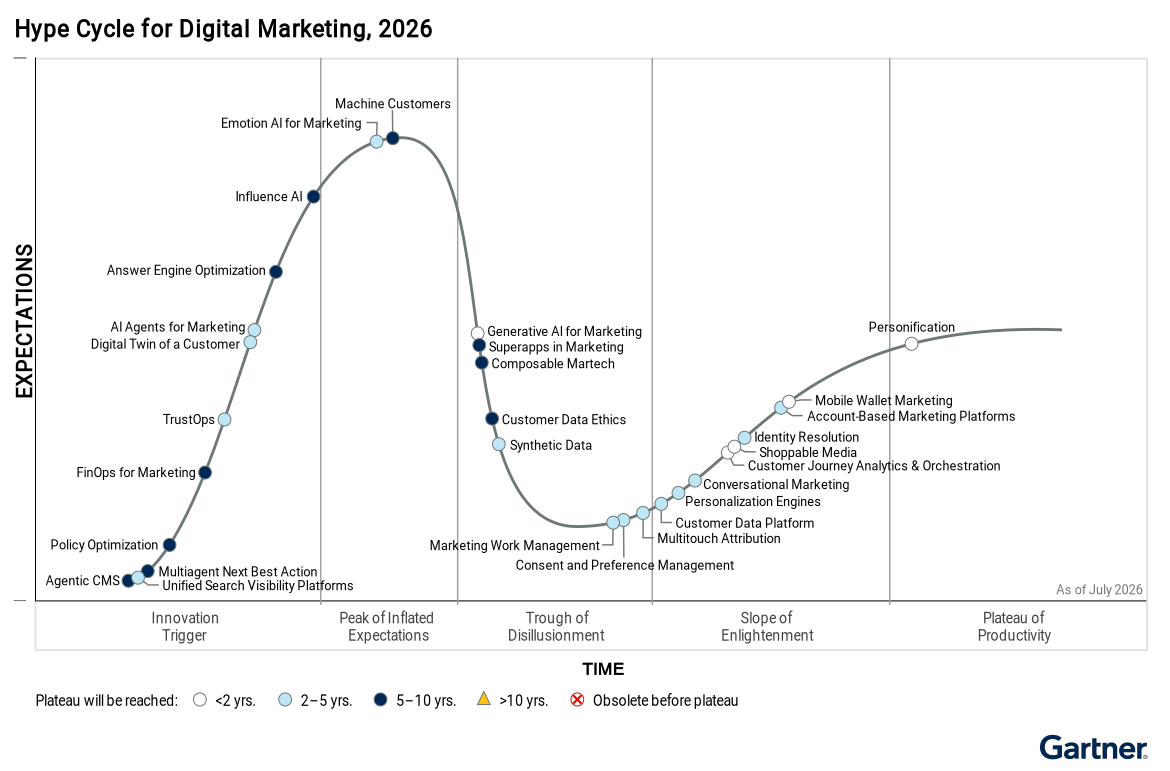
The Hype Cycle
The 2026 Hype Cycle for Digital Marketing reflects a decisive shift from human-led campaign execution to autonomous, agent-driven operations, alongside fundamental changes in customer behavior driven by answer engines. CMOs must navigate this transition by balancing AI’s transformational promise against the realities of data governance, privacy, brand trust and budget scrutiny.
Key trends driving this year’s Hype Cycle include:
- The rapid advancement of agentic AI and multiagent systems: These technologies decompose monolithic marketing decisions into specialized, coordinated actions. As these technologies approach the Peak of Inflated Expectations, CMOs face growing concerns around variable consumption costs and decision accountability, sparking interest in governance disciplines such as marketing FinOps and policy optimization.
- The disruption of the search and discovery ecosystem: As answer engines and large language models alter customer behaviors, innovations such as answer engine optimization and unified search visibility platforms are gaining traction, forcing marketers to optimize for nonhuman intermediaries and machine customers.
- The maturation of foundational data and orchestration technologies: Solutions such as customer data platforms and customer journey analytics and orchestration are emerging from the Trough of Disillusionment and demonstrating their value as enterprisewide context engines. However, the deprecation of traditional tracking methods and evolving privacy expectations continue to drive demand for identity resolution, personification, and consent and preference management.
- The adoption of scalable, composable architectures to protect brand trust: Fast-moving innovations such as TrustOps and generative AI for marketing underscore a dual imperative: use AI to influence decisions and generate content at scale while implementing rigorous operational controls to prevent misinformation, mitigate bias and avoid reputational damage.
The Priority Matrix
The Priority Matrix highlights innovations that will yield significant benefits over time. Transformational technologies that will mature in less than two years, such as generative AI for marketing, can deliver immediate competitive advantages by automating content creation, personalization and campaign optimization at an unprecedented scale.
Over the next two to five years, innovations such as AI agents for marketing, agentic CMS, and answer engine optimization will reshape how organizations engage with both human and machine customers. Early adopters of these transformational and high-impact technologies can drastically improve operational agility, reduce cost to serve and increase visibility in zero-click environments. Additionally, customer journey analytics & orchestration will provide near-term, high-impact benefits by enabling real-time, data-driven interventions across complex multichannel paths.
Over the longer term, innovations such as TrustOps, influence AI and multiagent next best action will fundamentally alter industry dynamics. Digital marketing leaders should invest selectively in these emerging areas to build the governance frameworks and architectural foundations necessary to thrive in an increasingly autonomous, AI-mediated marketing ecosystem.
Priority Matrix for Digital Marketing, 2026
| Benefit | Years to Mainstream Adoption | |||
|---|---|---|---|---|
| Less Than 2 Years | 2 to 5 Years | 5 to 10 Years | More Than 10 Years | |
Transformational | ||||
High | ||||
Moderate | ||||
Low | ||||
Source: Gartner (July 2026)
Off the Hype Cycle
Visual intelligence: This Hype Cycle entry has been removed because most capabilities previously covered (such as using real-world images, videos and text to identify products) now fall under answer engine optimization. As generative AI-powered search alternatives continue to reshape product discovery, the market impact of these capabilities has shifted accordingly. Specialized visual search platforms remain important for some organizations, while others access similar capabilities through adjacent technologies, such as answer engine optimization and major aggregator platforms.
On the Rise
Agentic CMS
Analysis By: Irina Guseva
Benefit Rating: Transformational
Market Penetration: Less than 1% of target audience
Maturity: Emerging
Definition:
Agentic content management systems (CMS) are emerging and quickly rendering traditional WCM and headless CMS approaches obsolete. Built for a dual-persona reality, agentic CMS moves beyond simple website publishing and into automation, decisioning and orchestration to power adaptive experiences for humans and agents.
Why This Is Important
Agentic AI requires a dual-persona approach to content: serving both humans and agents. With organic web traffic projected to drop 80% by 2028, organizations must move beyond traditional stacks. Modern CMS platforms must perform autonomous tasks and execute end-to-end processes without constant intervention. As customers demand intent- and context-driven experiences, an agentic CMS enables rapid innovation and “zero-click” visibility without excessive manual oversight.
Business Impact
- Automation: Agentic CMS brings autonomous automation capabilities for bulk content creation and processing, answer engine optimization (AEO) and generative engine optimization (GEO) that increase employee productivity.
- Decisioning: Agentic CMS supersedes traditional CMS that depended on manual processes for decisions on compliance, workflows and governance.
- Orchestration: Agentic CMS provides capabilities for adaptive and hyperpersonalized experiences for both humans and agents through autonomous operations from orchestration to optimization.
Drivers
Traditional WCM technologies and those that followed as headless CMS were designed to manage, archive, retrieve, and display content for human users. In the evolving digital ecosystem, the function of the CMS is changing and expanding. Traditional CMS frameworks, built on monolithic and siloed architectures, are increasingly inadequate for supporting advanced AI interactions. In today’s environment, an agentic CMS becomes critical in bridging the gap between content storage and emerging AI-driven interactions, in which both humans and machines engage.
Agentic CMSs are designed to be more than repositories of static content. They enable the creation, orchestration, and dynamic reassembly of digital assets and experiences in real time — highly tailored to each specific LLM prompt. This transformation is fueled by a multitude of drivers that range from more sophisticated content modeling to the rise of AEO and GEO optimization to the business imperative behind being more productive and delivering digital experiences faster and better. Organizations are evaluating the evolution of new CMS strategies and seeking approaches to managing the zero-click environment and the emerging LLM as the new CX and UX paradigms.
Many Gartner clients are asking: Are websites going away? How do we assess our brand’s viability in the context of AI-driven content creation and orchestration? How can organizations leverage AI in a CMS? These questions are some of the early drivers behind the agentic CMS evolution.
Obstacles
When considering agentic CMS, organizations must carefully navigate potential obstacles before moving to full-scale adoption and deployment, including:
- Change management and trust: A successful deployment of agentic CMS hinges on overcoming internal resistance and establishing trust mechanisms. One of the challenges lies in change management, lack of user trust and inability to formulate perceived ROI. In the context of CMS, this means educating content teams about the automated decision-making processes, ensuring transparency through audit logs, and gradually shifting from a human-centric to an agent-collaborative model.
- Content and data readiness: A successful adoption of an agentic CMS depends on “AI-ready” data and content that is standardized, secure, and readily accessible. Integrating (or streamlining and centralizing) legacy content repositories and disparate data sources remains a technical hurdle. Establishing new agentic CMS content models requires cross-organizational effort and collaboration.
User Recommendations
Agentic CMSs can have a sweeping impact on the overall enterprise technology stack. As it is still an emerging market, the following steps are recommended:
- Identify specific content management pain points and define core KPIs by understanding stakeholder expectations and conducting a gap analysis between traditional CMS functionalities and anticipated agentic enhancements.
- Establish a composable architecture by transitioning from monolithic legacy systems to a modular architecture that supports integrations beyond traditional APIs and is standardized on MCP or related protocols.
- Conduct controlled POCs before finalizing agentic CMS product selection by beginning with low-risk, noncritical workflows that can demonstrate measurable improvements.
- Embed continuous evaluation methods to track task completion rates, intervention frequency, and ROI metrics by establishing feedback loops so that content teams can refine agentic workflows over time.
Sample Vendors
Adobe; Contentstack; Hygraph; Kontent.ai; Storyblok; Uniform.dev
Gartner Recommended Reading
Multiagent Next Best Action
Analysis By: Audrey Brosnan
Benefit Rating: Transformational
Market Penetration: Less than 1% of target audience
Maturity: Embryonic
Definition:
Multiagent next best action (NBA) is a decision-making architecture in which multiple AI agents coordinate through a common decision context to select and execute marketing actions, such as enforcing brand policy, validating eligibility, selecting creative, and allocating spend. It replaces monolithic single-model decisioning with coordinated, rule-governed marketing decisions across business units and touchpoints.
Why This Is Important
As marketing decisioning scales across channels, segments, and objectives, single-engine NBA systems face structural coordination constraints. They cannot simultaneously optimize marketing’s full portfolio of objectives — such as revenue, brand, cost, compliance, and journey — without centralizing all logic into one brittle model or fragmenting into uncoordinated channel-specific tools. Multiagent decomposition offers an architectural path to scale personalization without these trade-offs.
Business Impact
CMOs managing complex cross-channel programs benefit most. Early implementations suggest measurably faster response times, revenue improvement per interaction, and fewer compliance incidents when agent roles are clearly defined. The architecture enables marketing operations teams to optimize distinct objectives in parallel — brand, cost, and customer preference — without retraining a monolithic model. Enterprise architecture and risk teams gain auditable, explainable decision governance.
Drivers
- Major marketing platform vendors are independently building agentic architectures. Salesforce (Agentforce), Adobe (Brand Concierge), Braze (Braze AI Agents), and Hightouch (Hightouch Agents) each decompose marketing decisioning into specialized agent roles, validating the pattern as a market direction, not a single vendor’s roadmap.
- Cross-channel decisioning complexity increasingly strains what personalization tools can optimize effectively. Multichannel campaigns run simultaneously across digital and physical channels and must balance revenue, brand, compliance, experience, channel, offer, timing, creative, and compute cost, but so many objectives are difficult, if not impossible, to optimize simultaneously in a single martech tool.
- Enterprise demand for auditable, explainable marketing decisions is accelerating. Regulatory scrutiny and brand risk require transparent decision governance that monolithic models struggle to provide.
- Marketing decisioning is converging with service decisioning as MMHs and AI agents make “one experience” feasible across marketing, sales, and service (including regulated contexts like healthcare). CMOs should expect tighter governance: Agents must operate with constraint awareness (consent, privacy, brand, eligibility) that varies by region and channel, or else unified experiences will create unified risk across the C-suite.
- Creative optimization can bridge between content generation and legacy NBA. As generative creative tools produce variants at scale, NBA systems increasingly need agent-style coordination to select, govern, and learn from creative as an intervention, then connect those outcomes to offers, pricing, and timing decisions.
Obstacles
- Most vendor “agent” capabilities are bound to a single model making decisions with agentic branding. Genuine multiagent coordination, in which specialized agents share a common decision context and enforce constraints independently, remains embryonic. Buyers must evaluate architecture, not marketing claims.
- Multiagent architectures require shared context layers, policy enforcement mechanisms, and rules for resolving conflicts between agents that most organizations have not built. Without these three platform prerequisites, agent decomposition creates uncoordinated execution rather than cohesive decisioning.
- Agent communication protocols (Anthropic’s MCP, Google’s A2A) are emerging and adopting quickly, but neither specifies a decisioning context contract or the shared representation of customer state, constraints, and objective weights that NBA requires. Early adopters must build custom decisioning coordination on top of generic protocols.
User Recommendations
- Map agent roles and prerequisites before investing in a multiagent strategy. Define the decisioning functions, including policy, eligibility, creative, budget, and channel, that your organization needs to separate into specialized agents, and validate that data infrastructure supports a common decision context.
- If your first agents are content and campaign copilots, treat them as a learning lab: Standardize policy rules, context definitions, and audit logs so those assets transfer to broader next best action decisioning.
- Evaluate vendor claims against genuine multiagent coordination criteria. Test whether platforms support independent agent optimization with a common decision context and rule enforcement, not decisioning rebranded as “agentic.”
- Plan for a two-to-three-year operational learning curve. Multiagent NBA is embryonic. Organizations starting now build institutional knowledge before the late majority begins, but should stage investment against readiness rather than vendor urgency.
Sample Vendors
Adobe; Amperity; Hightouch; Jasper; MoEngage; Optimove; Pegasystems; Salesforce; SAS Institute; Treasure AI
Gartner Recommended Reading
Unified Search Visibility Platforms
Analysis By: Isoke Mitchell
Benefit Rating: High
Market Penetration: Less than 1% of target audience
Maturity: Embryonic
Definition:
Unified search visibility platforms are enterprise search measurement suites that unify cross-channel data to quantify a brand’s total web presence. These solutions analyze organic search, paid search, answer engine citations, autonomous agent interactions and other public data sources to provide a single source of truth for digital visibility.
Why This Is Important
Today’s search landscape spans traditional search engines, answer engines, social platforms and zero-click queries, creating critical blind spots in marketing data. CMOs can no longer rely on siloed SEO or paid search metrics that understate reach and misallocate budgets. Unified search visibility platforms will deliver a holistic view of total digital visibility, enabling marketing leaders to justify spend, detect emerging threats and drive measurable ROI in an increasingly fragmented ecosystem.
Business Impact
Marketing, PR and demand generation leaders will use these unified search visibility platforms to maximize digital visibility across the entire customer journey, shifting from tactical channel management to a holistic visibility strategy and protecting against “digital obscurity.” Early adopters stand to gain:
- Budget optimization: Eliminates siloed spend, revealing interplay of organic, paid and LLM-powered search.
- Brand protection: Identifies visibility gaps across the search ecosystem.
- Market agility: Enables real-time pivots by quantifying total digital presence.
Drivers
- Generative and agentic AI disruption: The rise of large language models (LLMs) and answer engines has upended click-based search. Brands must now optimize content for both AI models and autonomous agents, measuring citations, brand impressions and “share of answer” as traditional clicks diminish.
- Fragmented customer journeys: AI-informed buyers navigate highly complex, multitouch journeys. CMOs require unified platforms to trace entity-based authority across disparate channels and attribute accurately.
- Channel convergence: The lines between organic search, paid search, social discovery and digital PR are blurring. CMOs need integrated platforms to eliminate silos, prevent paid/organic cannibalization and orchestrate cohesive cross-channel strategies.
- Marketing budget scrutiny: Marketing technology budgets face intense scrutiny, driving CMOs to rationalize their tech stacks by replacing redundant point solutions with integrated, comprehensive measurement platforms.
- Legacy platform consolidation: Enterprise SEO and martech vendors are acquiring niche AI, social and analytics point solutions, accelerating market convergence. This expands native capabilities and pressures marketers to adopt unified solutions or risk technical debt.
- Demand for marketing autonomy and automation: The push to sidestep IT bottlenecks fuels demand for platforms that offer automated content structuring and direct execution. This speeds time to insight without waiting on engineering resources.
- Rapid model iteration and search volatility: Frequent updates to frontier AI models and traditional search ecosystems demand enterprise platforms that aggregate massive datasets. CMOs require these tools to deliver predictive insights, benchmark competitively and provide holistic dashboards to prove ROI amid constant ecosystem shifts.
Obstacles
- Legacy team structures: Traditional marketing organizations have not kept pace with the cross-channel nature of modern search and discovery. Entrenched divisions among organic search, paid media and PR teams create budget and metric ownership disputes, impeding executive buy-in and stalling the adoption of unified visibility platforms.
- Deep technical complexity: Unifying visibility across the digital ecosystem is severely hindered by data fragmentation, unstructured data barriers and inconsistent metadata across legacy marketing tech stacks.
- Compliance and security risks: Aggregating massive cross-channel datasets introduces severe regulatory scrutiny and complex real-time permission syncing challenges for risk-averse enterprise organizations.
- Unified search limitations: Proprietary AI models frequently restrict direct data access and lack transparent APIs, creating a “black box” environment. These antiscraping measures prevent unified search visibility platforms from accurately crawling and reporting on a brand’s true AI-driven footprint across the digital ecosystem.
User Recommendations
- Dismantle operational silos: Restructure your marketing organization to unify organic, paid and digital PR teams under a singular discoverability mandate, ensuring teams can fully leverage the cross-channel insights these platforms provide.
- Rebuild dashboards around revenue: Pivot executive reporting away from siloed traffic metrics. Audit your generative citations and share of answer engines, aligning unified metrics directly to CAC reduction and revenue growth.
- Implement visibility gates and human-first standards: Deploy strict editorial governance to ensure consistent metadata and compliance, balancing the need for answer engine retrievability with high-quality, human-centric engagement.
- Audit and rearchitect martech tooling: Conduct a comprehensive audit of your existing SEO, paid search, social and AEO point solutions. Beyond consolidating overlapping vendors to free up budget, actively integrate data pipelines and workflows between these traditionally isolated components. This replatforming establishes the necessary foundation for unified visibility metrics and forces cross-functional collaboration among siloed teams.
Gartner Recommended Reading
Policy Optimization
Analysis By: Audrey Brosnan
Benefit Rating: High
Market Penetration: 1% to 5% of target audience
Maturity: Embryonic
Definition:
Policy optimization is an operating model that governs how marketing organizations delegate decisions to AI agents, defining which decisions agents can make, what boundaries apply and when a human must step in, so that autonomy scales without creating decisions no one owns or outcomes no one can explain. It is not a technology but a governance discipline that makes AI delegation accountable, explainable and reversible. CMOs steward operational policy; CIOs and legal serve as governance partners.
Why This Is Important
AI agents are turning marketing into a system of autonomous decisions running at machine speed. Marketing runs some of the highest-volume customer-facing AI in the enterprise, yet it has no named governance discipline for decision delegation. Every ungoverned agent decision is one no one can explain to a regulator, a board or a customer if it fails, and the cost of finding that gap after an incident is categorically higher than the cost of governing before first deployment.
Business Impact
Organizations that invest in policy optimization may gain four benefits: faster scaling with fewer governance incidents, lower costs (fewer ungoverned AI agents to fix after deployment), better spend predictability and control, and safer execution in high-volume customer experiences where compliance and brand risk are highest. Formal policy optimization can help CMOs attain board-level improvements in budget predictability, team velocity, compliance cost reduction and customer trust.
Drivers
- Agentic AI capabilities are expanding from task automation to autonomous multistep decision making across channels, budgets and customer interactions. Adobe, Hightouch and Salesforce, among many other providers, position agent capabilities as core platform infrastructure.
- Marketer roles will shift from campaign designers to policy managers who define business goals for agents, set operational boundaries and adjust rules based on agent performance.
- Platform data feeds — usage tracking, cost exports and interaction logs — are maturing enough to support real-time policy monitoring and detection of when agents deviate from expected behavior.
- Policy-bound, staged autonomy models are not new, but borrowed from industries that already govern autonomous systems. Automotive manufacturers and medical device companies both require the ability to scale back autonomy when conditions change, and both treat planned rollback as a standard operating requirement, not a failure. Marketing can apply the same principle to AI agents.
- Financial pressure is intensifying. AI-driven spend variability makes marketing budgets harder to predict, and CMOs who formalize governance now avoid being forced into reactive controls by CFOs later.
Obstacles
- Traditional marketing oversight — campaign approvals, brand guidelines, compliance checklists — was designed for human decisions and lacks the structure required for autonomous agent delegation: machine-enforceable constraints, automated escalation triggers and auditable logs.
- Conflicts across marketing, IT, legal and privacy slow governance adoption. Effective policy optimization requires cross-functional ownership, not single-function mandates.
- Platform-native governance features are vendor-specific and should not substitute for enterprisewide standards. Governance design must be separated from tools to preserve marketings’ control.
- Cultural resistance frames governance as overhead that slows experimentation rather than as an enabler of faster, safer scaling. Few enterprises have mature governance for autonomous AI agents.
- No marketing-specific AI governance adoption benchmarks exist. Enterprise-level proxies confirm the gap but cannot quantify marketing’s exposure directly.
User Recommendations
- Invest in policy optimization as an explicit governance discipline before scaling AI programs. Frame it in governance charters and team mandates as an operating model capability, not a compliance checklist.
- Start with a decision inventory. Map every AI-delegated decision and assess which have formal governance. Establish a minimum governance baseline — decision rights, guardrails, escalation paths and documentation requirements — for each delegation point.
- Assess readiness through two lenses. Require both organizational capability (talent, process, culture) and vendor governance readiness (policy configuration, audit logging, performance monitoring) before expanding autonomy.
- Build deescalation into operating procedures. Define triggers and protocols for scaling back autonomy when unexpected behaviors or cost spikes occur. Planned rollback prevents the cascading failures that improvised corrections create.
Gartner Recommended Reading
FinOps for Marketing
Analysis By: Audrey Brosnan
Benefit Rating: High
Market Penetration: 1% to 5% of target audience
Maturity: Emerging
Definition:
Marketing FinOps makes variable martech and related AI spend governable by linking usage tracking — messages, decisions and AI actions — to marketing units of work and business outcomes so leaders can improve forecasts, set guardrails and continuously optimize. This practice borrows FinOps methods but operates on marketing execution metrics and goals.
Why This Is Important
Consumption pricing and AI agents are converting martech from predictable fixed- into variable cost risk. An increasing share of martech budgets is exposed to consumption-based pricing, likely growing further as vendors embed agentic capabilities. The unpredictability of usage pricing, compounded by the probabilistic behavior of AI agents, demands different practices and behaviors. Legacy governance of slowly varying licensing costs tied to annual budget cycles fails to address these challenges.
Business Impact
Without cost controls for usage-based platforms, CMOs face two possible failure modes:
- Uncontrolled cost escalation as AI-driven marketing scales
- Reactive throttling that stalls growth after a budget shock
Marketing FinOps addresses both by prioritizing anomaly detection in minutes to hours rather than months, a defensible connection between value and cost and safer scaling of automation and personalization. Organizations that build this capability early gain operational learning before competitors.
Drivers
- Consumption and usage-based pricing accounts for a growing share of martech spend, with 56% of CMOs increasing spend in these models (see Insights From the 2026 CMO Spend Survey). Major platforms bill marketing teams in profiles, messages, events, credits and tokens tied directly to campaign execution volume.
- AI agents — operating semiautonomous segmentation, journey orchestration, creative generation and lead qualification — can scale consumption faster than conventional, human review cycles can effectively police.
- FinOps practices are extending rapidly beyond cloud infrastructure. About 60% of organizations have a FinOps team actively advising, managing or executing cloud cost optimization strategies (see Control Software, Cloud and AI Costs by Integrating ITAM and FinOps).
- Marketing automation platforms increasingly expose platform usage data, often via API, that is tagged to specific campaigns and journeys and sufficient to map costs to business activities even without vendor-provided cost-per-action benchmarks.
- Finance pressure is intensifying for spend predictability and direct cost reduction as boards scrutinize AI investment returns and demand defensible forecasts for marketing’s fastest-growing variable cost categories.
- Competitive pressure to scale personalization without proportional headcount growth pushes CMOs toward automation models that require consumption governance by design.
Obstacles
- Most martech platforms lack documented public usage APIs for cost-per-action tracking. This gap constrains unit economics assessments, anomaly detection or basic tracking. Without broader vendor support, marketers face a potential showstopper to adoption.
- Attribution ambiguity makes tying consumption to outcomes noisy and delayed. Most organizations cannot yet allocate usage to specific programs, teams or customer segments at the granularity governance requires.
- Lack of accountability deprioritizes cost control. Building accountability requires mindset and budget shifts many teams find unappealing. Decisions over who can throttle, pause or accelerate automation remain unsettled across marketing, finance and IT.
- Guardrail design creates a genuine tension. Evidence from adjacent domains shows formal approval processes correlate with slower execution without improving reliability. Controls detached from outcome learning loops risk slowing the experimentation velocity CMOs need to compete.
User Recommendations
- Estimate unit costs for high-aggregate, non-AI activities, such as per message, to build early wins and calibrate. Then extend the same discipline to AI-driven costs such as agent actions as a priority, which is easier to tackle once the practice is established.
- Define stop conditions for spend escalation that are appropriate to your organization’s risk tolerance and budgeting processes before scaling AI automation. Work with IT to build the observability needed to capture usage, especially where platforms do not readily expose it.
- Consider a monthly cadence adapted for marketing execution cycles that links usage, outcomes and optimization as a starting governance rhythm: See it, forecast it, control it.
- Prioritize investment where spend is greatest, usually the largest total cost, and build maturity across visibility, forecasting, guardrails and optimization in parallel rather than sequentially. If spend is escalating, begin optimizing even before visibility and forecasting are mature.
Sample Vendors
Amberflo; Amnic; Braintrust; Copy.ai; Pay-i; Portkey; Revenium; TrueFoundry
Gartner Recommended Reading
TrustOps
Analysis By: Andrew Frank, Dave Aron
Benefit Rating: Transformational
Market Penetration: Less than 1% of target audience
Maturity: Emerging
Definition:
TrustOps, short for Trust Operations, is a systematic, enterprisewide approach that interweaves operational policies, organizational culture, technology, tools and cross-functional collaboration to promote trust in content. It includes policies and practices to verify and certify content authenticity and to detect and debunk false or misleading content.
Why This Is Important
Trust is crucial to society and commerce. Technology has long played a key role in mediating trust through media and telecommunications. Now, AI is fundamentally altering the nature of trust by removing barriers to the creation and distribution of untrustworthy content. This poses a high-order threat to the stability of markets and institutions globally.
Business Impact
Disinformation campaigns have the proven power to influence public policy, undermine confidence in markets, destroy reputations and derail crucial innovations. Nearly every public and private industry has suffered from disinformation. TrustOps protects organizations and their collective interest in the integrity of information by grounding and debunking content systematically. This aligns corporate interests with the social benefits of trustworthy communication.
Drivers
- Acknowledgment of economic impacts. Since 2024, World Economic Forum experts have identified mis-, dis- and malinformation (MDM) as top-ranking near-term economic threats. Gartner survey data indicates 68% of executive committees see it as an important issue or top concern.
- Plummeting trust in brands, corporations and content. U.S. consumer trust in “big brands” and “corporate America” have been in decline since at least 2021. In 2026, 61% frequently question whether information they use to make decisions is reliable — up from 44% in 2024.
- Spread of multimedia deepfakes and counterfeits. Generative AI has democratized production of deepfakes increasingly indistinguishable from reality. Instances of spokesperson and brand impersonation are mounting.
- AI agent-assisted reach and targeting. Monitoring services report sharp increases in the frequency and sophistication of AI-assisted narrative disinformation campaigns that exploit social media influence networks and personalized content.
- Influence of AI resources. Roughly a third of the world’s population accesses answer engines monthly, amplifying potential vulnerabilities in training data. Personal AI agents are acquiring abilities to tailor dialogues to align with individuals’ mental models, gaining confidence and monetizing engagement.
- Financial incentives. Though fraud and politics drive much MDM, interest groups with financial motives provide major sources of funding for MDM campaigns, often to discredit disruptive competition or market trends.
- Availability of countermeasures. A growing market for technologies and services to protect information integrity offers opportunities to implement new practices and participate in trust networks.
- Differentiation through trust. As trust becomes scarce, organizations that cultivate it gain long-term market advantages. Increased customer and employee satisfaction, loyalty and advocacy, lower acquisition costs, higher brand value, margin support and market valuation are among the benefits of trust.
Obstacles
- Polarization and distrust. Sociopolitical divisions have made common ground on matters of truth elusive, even within organizations. Internal distrust blocks efforts to build consensus around communication norms and education initiatives.
- Immature countermeasures. Tech and standards for content authenticity require more support from big tech platforms and governments to reach critical scale. Disputes persist over a range of unresolved issues.
- AI pressures. Prioritization of AI adoption often outweighs measures with potential to slow down or constrain adoption. TrustOps may complicate tech investment ROI goals.
- Governance challenges. As the speed and scope requirements of effective MDM countermeasures multiply, executives may still deem existing security and communication practices sufficient. Lack of clear issue ownership and leadership alignment often limits resources and participation. Economic pressure counters arguments for new investment in operational overhead.
- Elusive remedies. Potential impacts of narrative disinformation are often unanticipated in cybersecurity and comms budgets. When disinformation targets an industry, cooperative response mechanisms are lacking.
User Recommendations
- Assess the threat from MDM: Prioritize trust as a core value and determine whether your industry or brand is at high risk from escalating levels of disinformation. Although all businesses have some exposure to MDM, some sectors are more vulnerable than others. Commit to advancing TrustOps policies and practices across the enterprise in line with your risk assessment.
- Organize for cross-functional action: Convene a Trust Council. Assess executive committee concern and who is aligned. Compile a record of MDM issues that have affected your business or market. Develop a business case and project charter to engage leadership and associates.
- Build partnerships and alliances based on trust: Engage with partners on advocacy and activism for truth in media and advertising. Seek common ground on certification and verification practices even where policy divisions exist. Engage vendors to inform your technology roadmap. Seek participation in emerging trust networks, aka TrustNets, based on industry and topical affiliations.
Sample Vendors
Adobe; AI Uniti; Alethea; Alto Intelligence; Blackbird.ai; Cyabra; Lynn; Microsoft
Gartner Recommended Reading
AI Agents for Marketing
Analysis By: Nicole Greene
Benefit Rating: Transformational
Market Penetration: 5% to 20% of target audience
Maturity: Emerging
Definition:
AI agents are autonomous or semiautonomous software entities that use AI techniques to perceive, decide, act and achieve goals based on logic and reasoning. AI agents seek to help marketing better meet customers where they are, with information that guides decisions based on the unique value that the brand provides. AI agency exists on a spectrum, ranging from current systems that act on user guidance to future systems that learn and perform tasks independently.
Why This Is Important
AI agents aim to autonomously automate tasks, make informed decisions and interact intelligently with their digital environments, allowing teams to do more with less. Domain-specific and contextually relevant AI agents focus on making marketing more effective, efficient and consistent to meet customer needs faster and build relevance and trust.
Business Impact
AI agents have the potential to:
- Automate competitive research, customer insight development, marketing operations, content creation, workflows, personalization, agentic commerce, sales enablement, advertising and more.
- Engage directly with machine customers and advanced AI agents, which CEOs estimate could account for nearly 20% of their company’s revenue by 2030.
- Orchestrate complex, cross-functional tasks through multiagent systems (MAS), resolving workflow bottlenecks and delivering transformative scale without continuous human oversight.
Drivers
- Commercial impact: AI agents can execute on behalf of business and customers, selling or purchasing products or composing bundles or solutions to meet unique requirements. AI agents can learn, plan and execute in such environments with a direct impact on revenue and margins.
- Vendor progress: Vendors are touting the capabilities of their AI agents, but most still can only handle basic tasks with reliability. Still, vendors are closing the gap so that AI agents can handle more complex requirements, workflows and skills — establishing multiagent systems while mitigating risk.
- Adoption: Consumer sentiment is a blend of optimism and caution. Consumers value benefits like streamlined commerce, more targeted interactions that better align with their individual preferences, and faster responses.
- Domain-specific modules: More AI agents are using domain-specific models trained on industry and technical data and with fewer parameters than base LLMs, so responses are more tailored. These enable personalized and relevant interactions with consumers, enhancing engagement and conversion rates by tailoring content and responses to specific industry needs, marketing deliverables and consumer contexts.
- Vibe marketing: AI agents can draft campaigns, test voice and tone, and generate messages without waiting on traditional design and approval cycles. They support real-world analysis, assessment and summarization of information to support competitive and customer research.
- Interoperability: Agentic protocols like Model Context Protocol (MCP) and Agent2Agent Protocol (A2A), enable communication among AI applications, AI agents, tools and data sources — accelerating the shift toward collaborative multiagent systems.
Obstacles
- Reliability: Due to the complexity of AI agents, there are various security, data security and governance vulnerabilities. Privacy and ethics concerns are compounded as agents acting ethically lag in their ability to act independently.
- Lack of trust: Users are unsure whether they can trust AI agents to predict and execute tasks. Agents may take multiple actions in rapid succession with significant impact before a human notices, which may negatively impact the customer experience or the organization’s bottom line.
- Data and infrastructure readiness: Over 88% of respondents are not fully prepared when it comes to the data readiness required to support GenAI tools and solutions, which serve as the foundation for AI agents, according to the 2025 Gartner Business Outcomes of Technology Survey. AI agents leverage advanced retrieval-augmented generation (RAG) pipelines and integrate unified customer data to enable scalable deployment of agents beyond the pilot phase.
- Immature governance: To mitigate risks associated with unpredictable behavior and data breaches, enterprises must create built-in guardrails, role-based access controls (RBAC), personally identifiable information (PII) detection, and human-in-the-loop (HITL) oversight to ensure safe agent operations.
- Cost: Unpredictable runaway costs from API and LLM usage will be a barrier to approval of efforts where value is hard to quantify.
User Recommendations
- Implement AI agents across marketing — including data and analytics, content creation, advertising, commerce, and sales enablement — so that teams can learn by doing.
- Be mindful that not every problem is best solved by an AI agent. Map existing human-led workflows and understand decision-making logic, objectives and the tools used. This forms a framework to determine how an agent can automate or augment workflows.
- Develop strategies for how human and machine customers work together to make decisions, optimizing metadata and unstructured data so AI agents can learn context and become more reliable.
- Build a secure, internal simulation environment for testing agentic applications and for controlled, limited pilots that have passed trials to build confidence before deployment.
- Establish human review panels to vet all AI agent outputs before they reach customers, ensuring brand compliance and building internal trust.
- Work with vendors to explore multiagent systems that are capable of operating both collaboratively and independently, supporting decentralized decision making.
Sample Vendors
Adobe; Amazon Web Services; HubSpot; Microsoft; Salesforce; SAP; Zapier
Gartner Recommended Reading
Digital Twin of a Customer
Analysis By: Lizzy Foo Kune
Benefit Rating: High
Market Penetration: 5% to 20% of target audience
Maturity: Emerging
Definition:
A digital twin of a customer (DToC), or synthetic customer/synthetic audience, is a dynamic virtual model used to simulate and predict customer behavior. Powered by hypersynthetic data and large behavioral models, DToCs use diverse inputs — first-party data, qualitative research and public signals — to create proxies that answer future questions. DToCs enable rapid, privacy-compliant scenario testing, expanding insights and reducing costs and risks of traditional customer data collection.
Why This Is Important
DToCs help organizations better understand their customers and anticipate behavior, given certain combinations of data and parameters (e.g., products and services). They increase efficiency and provide a personalized, optimized service for organizations serving customers whose buying habits repeatedly change. Organizations can use a DToC to enhance customer experience (CX) and support new digitalization efforts, products, services and opportunities.
Business Impact
DToCs can transform the way organizations sell products or services by providing customers with better experiences, leading to increased revenue and lasting customer relationships. They will benefit all industries and business models, disrupting customer experience by helping organizations achieve productivity with synthetic market research, focus groups, product design and development, customer journey mapping and orchestration, and customer profile enrichment.
Drivers
- Data limitations: Traditional VoC research suffers from poor survey response rates, survey fatigue and the high cost of recruiting hard-to-reach audiences.
- High data costs: The CX and regulatory costs of invasive data collection techniques fuel the drive to find alternative sources of insight for continued business growth or competitive differentiation.
- Journey design: New methods engage and anticipate a customer’s journey more effectively. DToCs can help by simulating and optimizing how specific cohorts will respond before the journey is built in a campaign workflow.
- Emerging AI techniques: The rapid acceleration of interest in agentic AI, generative AI (GenAI), emotion AI and influence engineering technologies brings more complex solutions incrementally closer to realization.
- Operational efficiency: Declining marketing budgets force marketers to do more with the same, or with a smaller budget. DToCs could limit waste, reducing the costs of imprecise marketing or misaligned products, and the time spent on testing underperforming journey interventions. Synthetic audiences allow for rapid, on-demand testing in days or hours, rather than the months required for traditional panels.
- Product and experience development: New data-driven business models could emerge as marketers find new ways to serve and capture customers in a privacy-constrained environment.
- Customer empathy: DToC promises CX professionals the ability to quickly activate insights from their voice of customer initiatives to achieve tangible business impact.
Obstacles
- The technology behind digital twins has focused on organizations and products. A customer focus is emerging, and a lack of clear KPIs and other success measures limit the potential use of DToCs.
- Organizational resistance and stakeholder skepticism about the use of “fake data” creates a trust gap.
- AI models can hallucinate or amplify biases present in their foundational training sets. Inaccurate or unbalanced synthetic datasets can lead to flawed strategic insights.
- Because synthetic data is generated from models trained on existing and past data, it may struggle to accurately capture entirely new, emerging trends or the full emotional nuance of real human behavior.
- Privacy concerns exist for simulations not originally agreed to by the customer. DToCs could potentially be misused, constraining use cases due to stakeholder concerns about adverse consumer reaction, regulatory scrutiny or other risks.
User Recommendations
- Identify use cases for which DToCs could help deliver a better CX. This includes synthetic focus groups, market research, product design and development, content development, and message testing.
- Define the benefits to customers and establish trust. Explain how they can control or cancel data usage. Use technology to collect consent and manage data subject rights requests, all while working across functions including operations, compliance, legal and communications to establish policy.
- Validate the output of the DToC. Start by running a pilot and comparing results with and without a DToC over an adequate period using statistically significant data, whether you choose to build or buy a DToC. Establish benchmarks for your pilot to better develop and scale DToC. Establish a holdout group as a control before you begin.
- Stress-test vendor models by asking the DToC anomalous questions to detect hallucinations.
Sample Vendors
Aaru; Arima; Artificial Societies; Delve AI; Evidenza; Listen Labs; Panoplai; quantilope; Resonate; Simile
Gartner Recommended Reading
Answer Engine Optimization
Analysis By: Noam Dorros
Benefit Rating: Transformational
Market Penetration: 20% to 50% of target audience
Maturity: Emerging
Definition:
Answer engine optimization (AEO) refers to optimizing content to appear in direct answers provided by public search and large language model (LLM) answer engines. AEO tactics and technology promise to help marketers measure and manage the disruptive impact of GenAI on search.
Why This Is Important
Answer engines and LLM algorithms continue to profoundly disrupt human behavior and communications patterns. As information discovery and retrieval habits are upended, marketing must adapt. CMOs must rethink how to build brands, drive traffic, generate leads and acquire customers. The balance of paid, earned and owned media investments must be reevaluated. AEO refers to the nascent but essential process of maximizing marketing outcomes in this new world.
Business Impact
AEO aims to help marketers harness answer engine disruption by creating and measuring content that is readily discovered and featured by answer engines and AI chatbots. AEO focuses on providing clear, concise answers to specific user queries. It aims to structure content for readability and extraction by LLMs, thereby boosting visibility and increasing brand trust. By using AEO to quickly meet user intent, businesses may gain an edge, despite reductions in site traffic due to answer engine zero-click search dynamics. AEO can be reasonably viewed as an incremental update to search engine optimization (SEO), but its continued evolution is likely to be convoluted as competition for Google heats up and users establish new behavior patterns.
Drivers
The adoption of AEO is driven by several key factors that reflect changes in technology, user behavior and the digital landscape:
- Growth of AI and conversational search: Advanced AI models and chatbots (such as ChatGPT) can interpret and respond to complex queries. Users now expect immediate, accurate answers rather than sifting through multiple webpages, pushing businesses to optimize for these answer engines.
- Rise of voice search and virtual assistants: The increasing use of voice-activated devices, such as smartphones, smart speakers and virtual assistants, has shifted how users search for information. Voice queries are more conversational and specific, making concise, direct answers more valuable.
- Increased competition for visibility: As organic search becomes more competitive, securing placement as a featured answer or snippet can significantly boost visibility and traffic. AEO provides a strategic advantage by positioning content where users are most likely to see it.
- Enhanced search engine capabilities: Search engines are increasingly capable of parsing structured data, understanding context and extracting answers from well-optimized content. Businesses must adapt their content to these evolving algorithms.
- Motivational targeting: In contrast with traditional keyword-based search queries, which marketers interpret as signals of basic intent, conversations with extended context are more likely to reveal the “why” behind a request. This ability offers marketers opportunities to produce content aligned to more specific user concerns, collapsing purchase cycles and enabling more tailored solutions.
- Extended content strategy: Traditional website content is constrained by information architecture design and site-search limitations. Websites designed with AEO in mind have few limitations on the breadth and depth of content exposed to indexers.
Obstacles
AEO presents several obstacles and challenges:
- Lack of algorithm transparency: Search engines and AI assistants do not disclose how they select and rank content.
- Content strategy inertia: The rise of conversational AI means queries are more nuanced, requiring a more agile content strategy that goes beyond keyword focus to deeper search intent and consumer preferences.
- Limited data and measurement tools: It’s difficult to track and measure the impact of AEO compared to traditional SEO.
- Zero-click searches: When direct answers are provided, users may not click through to your site, limiting traffic, conversion and measurement opportunities.
- Frequent algorithm updates: Answer engines frequently update how they craft answers.
- Localization challenges: Optimizing for multiple languages or regions adds complexity.
- Intense competition: Many brands are targeting the same questions, making it difficult to win and retain answer-box positions.
- Brand and content ownership: When answer engines use your content, there is a risk of losing brand visibility.
User Recommendations
Achieving success with AEO requires ongoing adaptation, investment in structured content development and distribution, and acceptance that not all benefits will be directly measurable or controllable. Given this, Gartner recommends that marketing leaders:
- Continue building domain authority through traditional SEO practices, such as ensuring mobile-friendliness and adding appropriate alt text.
- Monitor your brand’s presence on answer engines, either manually or with third-party tools.
- Create concise, authoritative answers to common user questions, and distribute them multimodally across the web and social media — in text, visual, and video formats.
- Use structured data (schema markup) to help engines extract answers.
- Develop use-case-specific landing pages that target key queries.
Gartner Recommended Reading
Influence AI
Analysis By: Andrew Frank
Benefit Rating: Transformational
Market Penetration: 1% to 5% of target audience
Maturity: Emerging
Definition:
Influence AI is the creation and deployment of models and algorithms designed to automate elements of digital experience that guide people’s choices at scale by learning and aligning with their intents and motivations. For instance, an AI agent may achieve a desired outcome for its organization by framing a set of recommendations based on a user’s inferred motives and predicted behaviors, or inducing an external agent to do so.
Why This Is Important
AI already influences customer choices through answer engines and AI sales agents; marketers who fall behind risk losing control of brands and reputations as competitors and AI platforms seek the upper hand in AI-led influence operations. As more buyers entrust agents to act as marketplace advisors and commerce proxies, established trust factors destabilize and new patterns of persuasion emerge.
Business Impact
Pressure is mounting on marketers to turn AI adoption into topline growth, pushing them to look beyond operational efficiency toward AI uses that increase sales and loyalty. As LLM providers amass pervasive power over consumer choices, marketers need to adopt new disciplines of data, content and creativity to forge new trust relationships both directly and through these mediated channels by using AI and scaled personalization to align offers and dialogs with people’s values, mindsets and circumstances.
Drivers
- Rising pressure on AI to deliver growth. AI is under pressure to deliver more tangible benefits. Executive leaders expect marketing to use AI to meet growth goals for revenue and profit. Influencing customer choices offers the clearest path toward meeting these expectations.
- Evolving user expectations. Consumers and business buyers increasingly expect digital experiences tailored to their preferences and needs. Influence AI enables hyperpersonalization by dynamically adapting recommendations, content, and interactions to context and history.
- Advancements in AI and data analytics. Improved modeling techniques, natural language processing and behavioral analytics provide the technical foundation to infer user intent and motivations at scale.
- Marketing’s head start in AI. Marketing’s dependence on communication and content to influence behavior made it an early adopter of machine learning and GenAI for segmentation and creative optimization. This builds confidence in the possibilities of AI agents for influence.
- Omnichannel engagement. Influence AI can operate across multiple channels (web, mobile, voice, etc.), ensuring consistent and context-aware guidance throughout the customer journey.
- New intermediaries. AI answer engines and sales agents will amplify Influence AI’s impact on consumer choices with more personalized, persistent and persuasive guidance. This raises the stakes for marketers to understand and engage these intermediaries by targeting and measuring influence effects.
- Competitive imperative. AI’s rapidly growing digital market presence is reaching a tipping point where the gap between leaders and laggards produces clear wins and losses. Companies that fail to adapt to AI’s influence face strategic peril.
- Governance adoption. Gartner surveys and inquiries show AI governance is a top enterprise action and priority, building tolerance for potentially risky experiments with safety policies and oversight.
Obstacles
- Ethical and privacy concerns and backlash. Influence AI operates by inferring and acting on user motives, raising significant questions about manipulation, consent, and transparency. Regulatory scrutiny is likely to increase as techniques improve. Models may inadvertently reinforce biases, make unfair recommendations or over-personalize, exposing brands to significant backlash.
- Explainability and trust. Users and regulators demand transparency in how AI-driven recommendations are made, especially in regulated industries. Black-box models can undermine trust and hinder adoption. Reports of backlash against excessive personalization may reinforce hesitation.
- Data quality and concentration. Influence AI relies on large volumes of high-quality behavioral data. Fragmented or poor-quality data limits effectiveness. Hyperscalers with massive volumes of behavioral data need to be cautious of regulatory crackdowns.
- Complexity and risk. Deploying, monitoring, and continuously improving influence models requires significant resources, specialized talent, and a robust operational infrastructure. While agentic AI promises to democratize creation of autonomous agents, they can backfire in complex or adversarial situations.
- Machine customers. Buyers’ use of agent proxies may block AI’s psychological influence, favoring differentiation through product innovation and operational efficiency over persuasive interactions.
User Recommendations
- Establish or locate a Trust Council within your organization (see Every Enterprise Needs a Trust Council to Combat the Deluge of AI Disinformation) and add Influence AI governance to its agenda. Articulate how to distinguish beneficial nudges from those that exploit vulnerabilities. Document potential use cases and subject them to neutral, non-commercial ombuds review.
- Recruit user test and focus groups from within and outside your organization for AI influence-related market research, or seek providers for such projects. Be transparent about goals and technologies. Apply strict privacy controls and use synthetic data or digital twins to supplement findings. Devise extensive, adversarial test cases for experimental designs.
- Probe partners, vendors and martech applications for signs of unapproved AI Influence techniques emergent in customer interactions. They may produce strong, but ethically or legally compromised, marketing results. Require compliance with influence policies in service agreements and respond quickly and decisively to perceived violations. Assess competitors’ and platform providers’ activities.
Gartner Recommended Reading
At the Peak
Emotion AI for Marketing
Analysis By: Nicole Greene, Suzanne Schwartz
Benefit Rating: Moderate
Market Penetration: 5% to 20% of target audience
Maturity: Adolescent
Definition:
Emotion AI, also known as affective computing, covers a broad spectrum of techniques that analyze a customer’s emotional state using computer vision, voice, sensors and software logic. It not only infers emotion from cues such as body language, tone and other inputs but also initiates context-specific actions by building and executing emotionally relevant interactions and journeys that open new paths to value exchange.
Why This Is Important
Emotion AI transforms the customer experience by turning human expression and behavior into insights and responses. As machines grow more human-like through advanced sentiment detection, autonomous agents will help marketers scale by tailoring content, recommending next best actions, and delivering adaptive interactions along the customer journey. Leveraging computer vision, deep learning and audio analytics, this approach could help continually personalize experiences.
Business Impact
Emotion AI tailors engagement between humans and chatbots or digital media/humans based on body language, voice analysis and natural language processing (NLP) when users allow for access to these inputs through cameras and other receptors. It improves marketing by making brand interactions more compelling for customers, and can be used to test reactions to brands, products and ads. It amplifies the effectiveness of personalization and builds scalable loyalty, while emphasizing a brand’s unique personality and voice.
Drivers
- Gartner predicts that by 2030, emotion AI will be present in 75% of conversational AI customer-facing business applications, up from less than 15% in 2026.
- Emotions are a key factor across the customer journey. Emotion AI provides an essential tool for optimizing experiences at each stage by grouping target audiences and applying empathy while encouraging desired commercial responses. The irresistible tendency to anthropomorphize (i.e., project human attributes onto) generative AI (GenAI) agents will lead customers to expect humanlike behavior and performance.
- This technology follows a three-step process: identification, interpretation and response adoption, which allows emotion AI to support discerning customer experience (CX) and drive consumer decisions across purchase, ownership and loyalty.
- Multimodal systems utilizing facial, vocal, physiological and contextual signals significantly outperform unimodal systems in these real-world interactions, expanding use cases.
- In an increasingly competitive market, brands that can connect on an emotional level differentiate themselves from those that rely solely on transactional interactions. Emotion AI allows marketers to create brand experiences that feel more human and intuitive, current customer receptivity is mixed, but there is the potential to drive connections that enhance brand recall and equity.
- Market research and neuromarketing tools leverage emotion detection in various user scenarios, including focus groups and product testing. These capabilities are then leveraged in consumer-facing applications, where mobile phones and wearable devices supply inputs from consenting panelists to broaden the impact of emotion AI.
- Marketers can use emotion AI to generate synthetic data to mimic human reactions to content and experiences, replicating field tests and focus groups. Emotion AI will augment traditional marketing personalization by responding to both informational and emotional cues in two-way communication channels (texting, WhatsApp, chat) to enhance customer satisfaction and loyalty.
- Increasing availability of emotion AI features in martech platforms will drive demand as buyers gain awareness of ways to leverage it for automated, real-time adjustments. This will help marketers experiment with the capability in existing marketing strategies and engagement tactics, potentially accelerating its advancement.
- The convergence of computer vision (CV) and robotology is accelerating adoption, enabling machines to interpret nonverbal cues and act as sophisticated, context-aware partners across industries like neuromarketing and retail.
Obstacles
- Consent: Emotion AI needs consent to predict responses at scale, supporting model-based targeting/measuring of media investment. Privacy legislation and the EU AI Act’s classification of emotion AI as “high-risk” in contexts like education or the workplace shrink the potential market and increase compliance burdens, leading to paused projects and regulatory friction.
- Privacy: Emotion AI will affect people’s decisions, requiring transparency across both employee- and customer-facing situations. Adoption of emotion AI in targeting and personalization may spur increased regulator attention.
- Lack of trust: There’s risk of AI backlash from customers who will find emotion AI more invasive or creepy, even beyond the effect of current personalization efforts.
- Varying performance and explainability: Performance varies across modalities and providing transparent, explainable results for complex deep learning models remains a significant challenge. Some emotions are better detected by one sensory technology than another — for example, “irony” can be detected by voice-based analysis, but is challenging in facial analysis.
- Governance: As emotion AI is integrated into martech, ownership and control issues will require frameworks and cross-functional teams to manage corporate policies to govern use cases.
User Recommendations
- Develop ethical guidelines for the use of emotion AI before deploying it. Partner with legal to measure the risks of emotion AI. Tracking and processing human emotion, even with consent, is a gray area.
- Work with the chief data privacy or ethics officer to oversee data collection and use. Cross-functional applications should be scrutinized for risk and transparency. Control bias and improve accuracy by incorporating multimodal signals (facial, voice, text, sensor data) and training models on diverse, representative datasets.
- Protect user privacy by utilizing privacy-preserving ML methods like federated learning, on-device processing and explicit opt-in consent.
- Use proofs of concept (POCs) to apply emotion AI to your customer analytics and behavioral profiling. Focus immediate deployments on safe, clear-value applications with high ROI, such as ad testing, entertainment UX and customer service contact centers.
- As the market matures, most vendors will offer narrow capabilities experience in customer insights or testing and fine-tuning. Look to vendors that focus on the entire CX.
Sample Vendors
Amazon; Behavioral Signals; Cogito; Intelligent Voice; kama.ai; MorphCast; Soul Machines; Stern Tech; Symanto; Uniphore
Gartner Recommended Reading
Machine Customers
Analysis By: Don Scheibenreif
Benefit Rating: High
Market Penetration: 1% to 5% of target audience
Maturity: Emerging
Definition:
Machine customers are nonhuman economic actors that obtain goods or services in exchange for payment. Examples of machine customers include AI agents, generative AI chatbots, smart appliances, connected cars and Internet of Things (IoT)-enabled factory equipment. Machine customers act on behalf of a human customer or an organization.
Why This Is Important
Gartner estimates 5 billion B2B and B2C internet-connected machines can act as customers today, growing to 12 billion by 2030. These machine customers will have varying degrees of autonomy. AI assistants (or chatbots) will also reach into the billions. Machines are increasingly capable of buying, selling and requesting services. Moreover, machine customers are evolving from simple informers to advisors and decision-makers.
Business Impact
Over time, trillions of dollars are expected to be in control of nonhuman customers. This will result in new opportunities for revenue, efficiencies and managing customer relationships. Leaders seeking new growth must reimagine their operating and business models to take advantage of this emerging market of tens of billions of machine customers. Organizations that miss this opportunity will be marginalized, just like those retailers who missed the digital commerce wave.
Drivers
- In the coming years, machine customers are set to become major players in industrial, retail, and consumer sectors. Billions of connected products, powered by advanced technologies, will soon act as autonomous customers, shopping for services and supplies for themselves and their owners. According to Gartner’s CEO and Senior Business Executive Surveys, 29% of CEOs are developing strategies to engage with machine customers and AI agents, with half expected to have a strategy by the end of 2026. By 2030, 19.5% of revenue is projected to come from machine customers.
- Currently, machines inform, recommend, and perform routine tasks but are evolving into sophisticated customers. Examples include Amazon’s Dash Replenishment Service, HP Instant Ink, Tesla’s self-ordering of spare parts, and Fastenal’s auto-replenishing vending machines. More advanced tasks are handled by Waymo’s autonomous taxis and Agility Robotics’ Digit.
- AI platforms and agents are accelerating this trend. Services like Amazon Alexa+, Google Gemini, and OpenAI’s Instant Checkout enable 24/7 inquiries, product recommendations, streamlined check-out, and support for human agents. In B2B, AI-based contract negotiation systems like Pactum AI, used by Walmart and Maersk, generate fair contracts, while supplier discovery and data platforms are shaping machine customer interactions.
- Payment solutions — such as Mastercard’s Agent Pay and Google’s Universal Commerce Protocol — will further empower AI agents to execute digital transactions. Overall, machine customers represent new revenue streams, increased productivity, enhanced health and security, and benefits for both sellers and buyers.
Obstacles
- Operating model changes: Serving machine customers will disrupt existing models. Companies must create separate experiences for machines and humans, scaling operations to meet real-time machine demands or risk losing them.
- Lack of trust: Humans may distrust machine customer technology over privacy and accuracy, while machines may distrust suppliers.
- Fear of machines: Some fear delegating purchasing to machines and AI. Customers and organizations must assess governance for ethical, legal, fraud, and risk standards.
- Security and governance: Increased AI use may lack security, leading to misinformation and reputational damage.
- Cost: Implementing and maintaining these systems is complex and costly. Adapting to changing needs requires significant investment in technology, software, and support.
User Recommendations
- Identify use cases where your products and services can be extended to machine customers. Collaborate with digital, data, strategy, sales, and customer officers to explore the potential.
- Assess B2B customers’ tech purchase intent data to spot machine customer capabilities and use cases.
- Pilot ideas to understand required technologies, processes, and skills. Build digital commerce and AI capabilities — starting with generative and agentic AI.
- Use APIs and bots for low-complexity transactions, then expand to complex purchases.
- Monitor competitor adoption of AI agents as machine customers. Follow examples from Amazon, Google, HP, iProd, NEC, OpenAI, and Tesla for evidence of capabilities and business-model impact.
Sample Vendors
Amazon; Anthropic; Google; HP Inc.; iProd; NEC; OpenAI; Pactum; Perplexity; Tesla
Gartner Recommended Reading
Sliding into the Trough
Generative AI for Marketing
Analysis By: Nicole Greene, Chad Storlie
Benefit Rating: Transformational
Market Penetration: More than 50% of target audience
Maturity: Early mainstream
Definition:
Generative artificial intelligence (GenAI) technologies generate new, derived versions of content, data, designs and methods by learning from large repositories of original source content. GenAI has profound business impacts on content creation, authenticity and regulations; synthetic data; automation of human work; and customer and employee experiences.
Why This Is Important
- Over 75% of marketing leaders anticipate a positive transformation in their organizations through GenAI adoption, according to the 2025 Gartner CMO Spend Survey.
- GenAI supports marketing use cases that demand efficiency and scale, including content development, dynamic personalization, advertising optimization, multichannel campaign optimization and customer experience enhancement.
- Early success is supported by rapid development of GenAI applications and features from hyperscalers, martech vendors and point solutions.
Business Impact
GenAI supports the creation of content, data and experiences at scale. Many pilots and implementations are low-risk and easy to evaluate, like translation, augmented writing and analytics accelerators. With the rapid progress of productivity tools and AI governance, CMOs will shift focus toward differentiated and customer-facing use cases. Responsible AI and security will be necessary for the safe implementation of GenAI, as CMOs bridge the AI trust gap with consumers.
Drivers
- Over a three-year period, GenAI applied to creating and editing video (including avatar), image, voice and music content has accrued more than $1.5 billion in venture capital (VC) investment, according to a Gartner analysis.
- As GenAI capabilities proliferate and evolve, marketers seeking new and higher-value use cases will find marketing a fertile area for new implementations. Respondents to the 2025 Gartner Marketing Transformation Survey reported an average of four areas where they are piloting or using AI solutions. Some of the common areas include content development/management at 61%, creative development/production at 58%, workflow and project management at 49%, campaign planning and execution at 44%, customer journey and personalization management at 39%, and demand generation and lead management at 37%.
- GenAI continues as a competitive area among major technology vendors, largely because it underpins AI agents. Vendors compete on foundation model offerings, enterprise readiness, usability, quality, pricing, infrastructure, safety and indemnification.
- Multimodal models, such as Google’s Nano Banana or Google’s Veo 3, are rapidly improving. Models can combine concepts, attributes and styles to create original images, video and art, or translate audio to different voices and languages. Text-to-image/video generation has advanced, with the ability to create detailed, realistic visuals from natural language prompts.
- Organizations are learning to use their own data and assets to improve GenAI outputs through context engineering and deep tuning. AI-ready data and associated metadata have become central to executing GenAI marketing strategies.
- Improvements in synthetic media (i.e., deepfake technology), include audio cloning and facial mapping, digital humans and virtual influencers. They are becoming commercially accessible and allow customers to engage in their native language and with cultural relevance.
Obstacles
- Democratization of GenAI brings new ethical and societal concerns. Government regulations vary, and may hinder GenAI adoption, requiring new risk mitigation technologies and guardrails.
- According to the 2024 Gartner Marketing Analytics and Technology Survey, the largest hindrance to GenAI use-case adoption in marketing is the gaps in marketers’ skills and roles as well as data and technology.
- In this already untrustworthy environment, concerns surrounding AI’s ability to generate, propagate and amplify false information may further strain the relationship between brands and consumers.
- Unintended, biased, defective or offensive artifacts require human oversight for review to reduce risk and ensure accuracy.
- GenAI is embedded in enterprise applications and point solutions, which can result in duplicative capabilities and integration complexity. Accountability for training and outputs, licensing, and consumption-based pricing is inconsistent, which may cause buyer confusion and result in unplanned costs.
User Recommendations
- Identify low-risk use cases in partnership with governance teams that enhance marketing’s operational capabilities or improve customer experiences with GenAI. Look to a mix of vendors, point solutions and agency partners. Consult vendor capabilities and roadmaps to avoid overlap.
- Examine and quantify GenAI’s advantages and limitations based on your specific use cases. Finding value in using GenAI for marketing requires reasoning skills, budget allocations and effective risk management. Conduct pilots to avoid subpar offerings that exploit the current hype without returns.
- Explore synthetic data as a key enabler to accelerate the development cycle and lessen regulatory concerns surrounding the handling of personally identifiable information (PII) and other sensitive data.
- Adopt “narrative intelligence,” tools that track influence operations propagating misinformation, to detect and debunk false content as GenAI continues to increase the volume and velocity of content.
- Invest in people to sample and review GenAI output to detect and minimize dissemination of inevitable mishaps.
- Use composite AI approaches to combine GenAI with other AI techniques.
Sample Vendors
Adobe; Anthropic; Canva; Google; IBM; Jasper; Meta; OpenAI; Salesforce; WRITER
Gartner Recommended Reading
Superapps in Marketing
Analysis By: Suzanne Schwartz
Benefit Rating: High
Market Penetration: 5% to 20% of target audience
Maturity: Adolescent
Definition:
Superapps provide a unified, closed mobile experience via a core platform that hosts an ecosystem of miniapps, eliminating the need for a separate app store. Users can discover, install, and manage miniapps with consistent personalization. Superapps enable marketers to create cross‑miniapp journeys with real‑time, consented data orchestration that can unlock shoppable moments and customer loyalty.
Why This Is Important
Users demand mobile-first experiences that are powerful and easy to use. Superapps have expanded beyond China and Southeast Asia to India (e.g., Tata Neu, MyJio, Paytm), Latin America (e.g., Rappi, PicPay, Mercado Libre) and the Middle East and Africa (e.g., M-PESA, Careem, Yassir). For digital marketing leaders, superapps can provide a far-reaching gateway for multiple customer interactions across social media, e-commerce and advertising, with customer data across each facet.
Business Impact
Organizations can create superapps to consolidate multiple mobile apps or related services to reduce user experience (UX) friction (such as context switching) and development effort. Technologically, superapps can achieve economies of scale and leverage the network effect of a larger user base. Superapps can bypass marketing channels (e.g., search) and promote customer engagement via miniapps, which are a single conduit to multiple touchpoints, such as social media networks and payment services.
Drivers
- Superapps are gaining interest from organizations that embrace composable application and architecture strategies to power new digital business opportunities in their industries or adjacent markets.
- Superapps are an opportunity to streamline digital experience or to organize multiple apps into a cohesive experience. Multiple internal development teams and external partners provide discrete services to users by building and deploying modular miniapps to the superapp, providing convenient access to a broader range of services in the superapp. App users can configure their superapp experience by selecting the miniapps they want to use.
- The superapp concept has value beyond external marketing. Marketers can use superapps to collaborate with their martech and operations partners. The superapp concept has expanded into enterprise SaaS applications and tools, such as workflow and messaging platforms (i.e., Microsoft Teams and Slack, which already have a large number of add-on apps to their main applications). Superapps are starting to expand to support a wide range of modalities, including GenAI-based conversational UIs, Internet of Things technologies and immersive experiences.
- A superapp advances the concept of a composite application by better integrating services, features and functions into a single app. Multiple internal development teams as well as external partners provide discrete services to users by building and deploying modular miniapps to the superapp, providing convenient access to a broader range of services in the app. With the growth of AI-powered conversational interfaces, superapps’ ability to integrate services will grow over time.
- Superapps can allow for centralized data collection via a singular experience and ecosystem, potentially creating experiences that rival walled-garden models of user engagement.
- To maintain competitive advantage in certain markets, marketers might need to invest in building miniapps for third-party superapps. For example, to compete in China, digital marketing leaders need to build miniapps for existing superapps (e.g., WeChat, Instagram Shopping) to drive customer engagement with their brands.
Obstacles
- Creating the business ecosystem for a superapp can be a bigger challenge than technology implementation. A superapp serves as a platform for internally developed miniapps across the business and for third-party, externally developed miniapps. Creating a network of business partners is required to establish an ecosystem for user base monetization via miniapps.
- Current technologies lack a ready-made framework or solution for creating custom superapps. On the other hand, building your own superapp technical platform for delivering miniapps is difficult. If you choose to leverage commercial low-code tools that offer miniapp development, you risk vendor lock-ins.
- Getting the UX design of a superapp right for the brand and audience while maintaining consistency across miniapps is a challenge. Inconsistency could negatively impact adoption and retention.
- Data sharing can be complex, including user authentication such as single sign-on (SSO) and tracking user preferences. Security and governance are crucial.
- Challenges exist in obtaining approval to publish superapps from leading mobile device manufacturers (see Justice Department Sues Apple for Monopolizing Smartphone Markets, U.S. DOJ).
User Recommendations
- Determine if developing a superapp — or a miniapp within a superapp — is viable for your business, useful for your customers, and capable of helping you meet CX demands, as well as whether your organization is capable of building it, managing an ecosystem around it, and providing developer SDKs or templates for those who want to contribute.
- Educate stakeholders and partners on the potential value of a superapp strategy to help drive loyalty and engagement.
- Identify the core features — for example, commerce, communications and advertising — that will drive a critical mass of adopters and developers to serve users, if you are building a superapp.
- Work with engineering counterparts when building a superapp to offer an easy developer experience (e.g., APIs, design guidelines, software development kits) for partners to build, test and submit miniapps for potential monetization.
- Work with engineering counterparts when building a miniapp to understand the targeted superapp’s developer experience and ensure your brand fits the target ecosystem.
- Clearly define the security and data protection requirements to satisfy policies and laws. Be transparent with users about how their data is tracked and used.
Sample Vendors
Alipay; DingTalk; GeneXus; Ionic; KOBIL; Microsoft; PayPay; Paytm; Salesforce (Slack); Tencent
Gartner Recommended Reading
Composable Martech
Analysis By: Audrey Brosnan, Anne Thomas
Benefit Rating: High
Market Penetration: 5% to 20% of target audience
Maturity: Emerging
Definition:
Composable martech is an architectural strategy in which marketing capabilities are assembled from modular, API-connected components — applications or AI agents — rather than delivered through a single integrated suite. Organizations select and combine both specialized tools, such as customer data platforms, personalization engines and capabilities from emerging AI systems into flexible composites tailored to specific operational needs.
Why This Is Important
Composable martech is shifting from a leading edge concept web wider adoption. Platform vendors are embedding composability through APIs, shared data infrastructure and low-code toolsets while GenAI is accelerating the shift by enabling marketing operations teams to create composite workflows without dedicated engineering support. CMOs evaluating technology strategy face a narrowing window to build competitive advantage before composable patterns gain widespread adoption.
Business Impact
Organizations that adopt composable martech with adequate governance report faster time-to-activation for campaigns, reduced data movement costs through direct cloud data platform activation and greater agility to swap or upgrade individual components without full-stack migration. However, composability without governance discipline creates tool sprawl, broken customer identification and compliance risk. The net impact depends on organizational complexity and readiness, not technology itself.
Drivers
- Martech providers continue to modernize through APIs, low-code toolsets and emerging methods for real-time data access — so-called federated compute or zero-copy — extending several years of interest and adoption by marketers. Composable CDPs remain the leading indicator of the innovation’s traction in marketing, offering a la carte capabilities such as audience management without the cost and data synchronization burden of a full-stack CDP.
- GenAI is lowering the skill floor for composable workflow creation. Natural language workflow creation, automated error recovery and intelligent routing reduce the engineering dependency that historically restricted composability to organizations with advanced IT-marketing partnerships.
- Composability also applies to AI agents. Agents offer modular capabilities, reusable and governed capabilities. They can be orchestrated and can orchestrate other tools, be it software or other agents. AI amplifies what composable martech can deliver and may lower its operational burden.
- Cross-platform data access, such as enabling marketing tools to query data where it lives rather than copying it between systems, is eliminating the integration burden that made composability impractical for most enterprises. Cloud data platforms are now integrated into 47% of martech stacks and 70% of organizations have deployed one.
- Low-code and no-code automation tools such as Workato and Zapier allow even SMB marketers to create composite workflows from components of existing applications. This pattern continues to strengthen as integration platforms embed AI-driven automation that reduces maintenance overhead.
- Organizations are increasingly competent in leveraging broad collections of APIs and event streams, easing adoption of composable and other API-based approaches; AI-agent-driven API consumption is a further accelerant, expanding the connective infrastructure that composable architectures depend on to deliver value.
Obstacles
- Skills and governance gaps are the primary barrier to composable adoption. Only 15% of marketing organizations achieve high-performer status with their martech stacks. Martech capability utilization is 49% and only 15% of teams report positive ROI. Unless these root causes are addressed, adding composable complexity to already-underutilized stacks may compound utilization problems.
- Composable architectures lack industry-standard governance frameworks. Organizations must establish consent management, identity resolution, API governance and access controls before expanding modular adoption, controls that integrated platforms claim to provide by default. Without these controls, composed environments can increase compliance risk and integration sprawl.
- Governance and integration overhead is pushing some enterprises back toward simpler architectures, as signaled by leading retailers consolidating martech stacks by an average of 11% in 12 months.
User Recommendations
- Assess martech complexity before pursuing composability. Organizations with fewer than 15-20 active tools, limited multichannel orchestration needs and centralized marketing operations should evaluate whether integrated suites with emerging composable features deliver sufficient agility at lower governance cost.
- Implement four minimum viable governance controls before activating any composed workflow: explicit consent management with proof of capture, unified customer identity resolution, API management with versioning and authentication, and role-based access control with SSO/MFA. Assign a single governance owner able to review integration requests.
- Evaluate composability readiness using a staged adoption model (pilot, partial composition, production composition) anchored in process standardization rates rather than tool counts. Prioritize process standardization before scaling composable deployments.
Sample Vendors
Adobe; Amazon (Amazon Web Services); Databricks; Google; Hightouch; RudderStack; Salesforce; Snowflake; Workato; Zapier
Gartner Recommended Reading
Customer Data Ethics
Analysis By: Andrew Frank
Benefit Rating: High
Market Penetration: 1% to 5% of target audience
Maturity: Adolescent
Definition:
Customer data ethics describes corporate policies that align business practices with fundamental principles that reflect a company’s avowed values, as distinguished from a reliance on legal compliance to set boundaries on customer data usage. Customer data ethics seeks a consistent foundation for decision making to counteract the paralyzing effects of rapidly shifting and fragmenting data privacy and AI usage standards.
Why This Is Important
As marketers race to adopt data-driven AI solutions for personalization, journey orchestration, advertising and customer analytics, progress on the foundations of customer data privacy has stalled. Fragmentation of laws and platform policies puts the onus on organizations to confront complex trade-offs in a rapidly changing technical environment where brand and legal risks are high.
Business Impact
Personalization is one of the top value propositions for AI in marketing. The 2025 Gartner Marketing Personalization Survey shows personalization delivers significant commercial benefits, but only 4% of CIOs and tech leaders say their data is AI ready. Recent reversals in the trend toward tightening privacy restrictions are leading some organizations to deprioritize ethical data constraints, potentially accelerating AI marketing initiatives while also raising risks of legal hazards and consumer backlash.
Drivers
- Growing regulatory complexity and fragmentation. The legal landscape of privacy an AI laws remains highly volatile and inconsistent. As policies continue to fragment across regions, organizations face challenges maintaining consistent standards for CDE. This creates uncertainty and risks, especially for organizations operating globally. Lack of standards pushes organizations to adopt their own that can be consistently applied, regardless of local variations.
- Evolving and conflicting consumer expectations. Public awareness of data rights and misuse has created anxiety among consumers about how brands may use their data in AI, and raised consumer expectations for companies to go beyond legal compliance to provide transparency and accountability in data practices. Failure to meet these expectations can damage reputations even when technically compliant. Meanwhile, consumer expectations of personalized relationships between customers and brands are also mounting.
- Technological advancements outpacing regulation. Rapid technological progress, especially in AI, is outstripping existing legal frameworks and creating ethical gray areas where the law is silent or ambiguous. This forces organizations to proactively address ethical implications of emerging data uses rather than rely on regulations.
- AI-driven personalization. Advancement in the use of AI for personalized sales and service dialogs has dramatically lowered costs of personalization, exposing data as a primary impediment to personalization goals and raising the need for consistent privacy guardrails.
- Investments in first-party data (FPD) for ad optimization. With reliance on third-party cookies fading, organizations have prioritized collection and use of FPD to fill gaps in ad targeting and measurement needed for ad efficiency. Increasing pressure on rising paid media expenses drives the need for clearer data governance to balance ad accountability with privacy.
- Weaponization of ambiguous statutes. Numerous decades-old privacy laws are being cited in thousands of lawsuits targeting standard website technologies like tracking pixels, chatbots, on-site search bars and session replay software. Laws include California’s 1967 Invasion of Privacy Act (CIPA), the U.S. 1988 Video Privacy Protection Act (VPPA), and many others. Avoiding liability claims elevates the need to revisit the principles behind many standard web practices.
Obstacles
- Lack of skills. Data and AI ethics disciplines lack educational pipelines and career paths to satisfy a rapidly growing need. Consulting providers are scarce.
- Distributed accountability. Hazards arise from the data’s collective use among agencies, vendors and affiliates. Lines of responsibility for infractions are blurry and systemic effects opaque. Vendor compliance validation and monitoring is lacking.
- Governance and cost. Business units seek to keep indirect costs and vague accountabilities off their balance sheets. The perceived potential cost of losing market share to less ethical competitors may also impede adoption under economic pressure.
- Discord on fairness. Laws and norms of fairness vary greatly among regions, communities and within organizations, hampering agreement on principles and practices. Cultural polarization amplifies discord.
- Paradoxical exclusions. Privacy restrictions often hide the precise data needed to detect biases and prevent disparate impacts of policies on protected classes, undermining bias-related ethical commitments.
User Recommendations
- Ground CDE in a Trust Council framework. Embed Trust Council subcommittees in AI Council charters to establish a stable basis for governance.
- Put CDE at the core of AI adoption. Ensure AI projects that use customer data have ethical governance and workstreams attached. Never forget that AI agents lack natural ethical sensibilities. Find opportunities to embed ethical initiatives in funded projects.
- Go beyond compliance. Share customer data ethics principles with customers, employees and other stakeholders in outbound communications. The public should know your priorities.
- Tune out the noise. Don’t allow escalating geopolitical discord or technology and economic volatility to become distractions. A sound ethical policy needs to be grounded in principles that are resilient against disruptive events.
- Focus on the customer view. Craft transparent policies that align with customer expectations. Ask if data practices would disturb people if they knew all about them.
Gartner Recommended Reading
Synthetic Data
Analysis By: Arun Chandrasekaran, Alys Woodward, Anthony Mullen
Benefit Rating: Moderate
Market Penetration: 5% to 20% of target audience
Maturity: Early mainstream
Definition:
Synthetic data is a class of data that is artificially generated rather than obtained from direct observations of the real world. Synthetic data is used as a proxy for real data in a wide variety of use cases, including data anonymization, AI and machine learning development, data sharing, scenario exploration and generative AI model pretraining and fine-tuning.
Why This Is Important
Obtaining and labeling real-world data for AI development is a time-consuming and expensive task. Synthetic data enables rapid data generation, cost-effectively and without personally identifiable information (PII) or protected health information (PHI), making it a valuable technology for privacy preservation. The rise of frontier AI models has highlighted synthetic data as a cost-effective means to build scalable models.
Business Impact
- Avoids using PII when training AI models via synthetic variations of original data or the synthetic replacement of parts of data.
- Reduces costs and saves time in AI development.
- Improves AI performance as more “fit-for-purpose” training data leads to better outcomes.
- Enables organizations to pursue new use cases through intelligent simulation, for which minimal real data is available.
- Addresses fairness issues, such as bias and toxicity.
Drivers
- In regulated industries, such as healthcare and finance, synthetic tabular data is used to preserve privacy in AI training data.
- To meet the increasing demand for synthetic data for natural language automation training, especially for chatbots and speech applications, vendors are introducing new offerings to market, often to train domain generative AI (GenAI) models.
- Synthetic data applications have expanded beyond automotive and computer vision use cases to include platform evaluation and the development of test data.
- Transformer and diffusion architectures, the architectural foundations for GenAI, are enabling synthetic data generation at quality and precision levels not seen before. AI simulation techniques are improving synthetic data quality by better recreating real-world representations.
- There is scope for expansion to other data types. While tabular, image, video, text and speech applications are common, R&D labs are expanding the concept of synthetic data to graphs and multimodal AI. Synthetically generated graphs will resemble, but not overlap, the original. As organizations begin to use graph technology more, this method is expected to mature and drive adoption.
- As data providers for training frontier AI models raise their data access costs, synthetic data will gain traction as an economic alternative.
Obstacles
- Most vendors offering commercial synthetic data solutions directly to enterprises haven’t been able to build successful business models.
- While synthetic data reduces privacy risks, some industries (e.g., healthcare, finance) still face regulatory uncertainty about whether it can fully replace or augment real data for compliance purposes.
- Validating the accuracy of synthetic data is difficult. It can be challenging to confirm whether a synthetic dataset accurately captures the underlying real-world environment.
- Buyers are still confused about when and how to use the technology due to a lack of skills.
- Enterprises have legacy data pipelines, and integrating synthetic data into existing data lakes, analytics systems and AI workflows often requires additional effort, tooling and infrastructure.
- There may be a level of user skepticism because data may be perceived to be “inferior” or “fake.”
User Recommendations
- Identify areas in your organization where data is missing, incomplete or expensive to obtain and is thus currently blocking AI initiatives.
- Establish clear policies on synthetic data life cycle management, storage and access control.
- Work with legal and compliance teams to ensure synthetic data aligns with industry regulations, such as General Data Protection Regulation, Health Insurance Portability and Accountability Act and the California Consumer Privacy Act.
- Educate internal stakeholders through training programs on the benefits and limitations of synthetic data. Institute guardrails to mitigate challenges such as user skepticism and inadequate data validation.
- Measure and communicate the business value as well as the success and setbacks of synthetic data initiatives.
Sample Vendors
Anyverse; Betterdata; Bifrost; MOSTLY AI; NVIDIA; Parallel Domain; Rendered.ai; Toloka AI; Tonic.ai; YData
Gartner Recommended Reading
Consent and Preference Management
Analysis By: Tia Zervas
Benefit Rating: Moderate
Market Penetration: 20% to 50% of target audience
Maturity: Early mainstream
Definition:
Consent and preference management platforms consolidate end users’ choices on how their personal data should be handled. The intent is to enhance transparency by extending control to users to determine what data about them is processed, by whom, and for what purpose. These choices are synchronized across systems — old and new, with on-premises and cloud-based repositories. Organizations can target engaged customers and respect their choices with minimum manual overhead.
Why This Is Important
The EU’s General Data Protection Regulation, the California Consumer Privacy Act, and Brazil’s General Data Protection Law are the standard for organizations to follow to adhere to privacy protections for personal data collected. Consent and preference management (CPM) platforms empower organizations to comply with new laws, preserve and extend essential capabilities, and demonstrate to customers and stakeholders that they care about privacy.
Business Impact
- CPM platforms help address the technical and operational challenges of protecting organizations from compliance violations, while maintaining the ability to use customer data for business purposes.
- CPM platforms can show end users that organizations value their privacy. Compliance is essential for meeting regulatory requirements and is a fundamental expectation of end users. A lack of compliance can be more detrimental than the advantages gained from adhering to it.
Drivers
- Regulatory oversight: Regulators scrutinize organizations’ use of personal data for marketing and advertising. CPM platforms serve as the hub in marketing and advertising technology stacks to process the appropriate consents and maintain audit trails for compliance.
- Evolving laws and variations in legislation: The proliferation of consumer privacy laws across countries and regions makes tracking and complying with local requirements a complex but essential task. CPM platforms address specific requirements, such as auditing websites for compliance, enforcing consent choices, and supporting data subject requests.
- Safety regulations for minors: New child safety regulations now require both age verification and explicit parental consent before processing minors’ data. CPM platforms are adapting to facilitate dual-verification workflows to support these heightened requirements.
- Demand for personalization: As organizations prioritize one-to-one personalized experiences, challenges arise from a lack of a unified data strategy. The absence of a unified customer data strategy presents significant challenges to achieving this at scale. CPM platforms address these hurdles by enhancing preference centers, enabling progressive consent, and supporting advanced profiling capabilities.
- Disparate data across technology: Managing consent and preferences across multiple platforms is resource-intensive, especially with overlapping CPM solutions. Some CPM platforms address this challenge by serving as the primary source of truth of digital users’ consent and preference selections. This function is critical in jurisdictions like the U.S., where implicit consent is still prevalent.
- Consumer expectations: Consumers are increasingly aware of their data rights and demand transparency, control over, and expect a consistent experience across channels. Poorly designed consent flow banners and dialogues degrade the user experience, underscoring the need for improved design enabled by certain CPM platforms.
Obstacles
- Evolving global laws and best practices: Organizations must adapt to region- and country-specific privacy and compliance legislations. CPM platforms tend to oversell their ability to simplify managing consent options, often downplaying the complexity of managing an organization’s internal and external databases.
- Lack of UX design support: Forcing too many privacy choices on consumers degrades UX and leads to high opt-out and abandonment rates. Yet, having too few choices limits the ability to tailor experiences. To strike the right balance requires cross-functional, collaborative activities throughout the organization.
- Complex technology architectures and the rise of AI: Accelerated digital transformation efforts have propelled organizations to rethink how technology solutions work together and how data flows throughout the ecosystem. AI adoption has further complicated the subject of consent since removing data from a model is practically unfeasible if consent is revoked. Adopters need to factor in the number and type of connections — both native and customized (such as APIs and extraction, transformation, and loading) — that are needed to effectively use a CPM platform.
User Recommendations
- Prioritize consent management policies and initiatives as critical for all functions. Establish consent as the foreground to maintain a consistent privacy UX initiative throughout the enterprise.
- Avoid “dark patterns” or deceptive language for consent dialogues that attempt to influence users’ choices.
- Use a “telescoping” approach to disclosures and preference dialogues that allow users to go as deep as they choose into specific details. Offer consistent, easy access to preference settings that users can view and change on demand to ensure a privacy-by-default approach.
- Compare and assess CPM offerings against your organization’s highest-priority privacy protection and integration requirements and internal costs.
- Build your own CPM platform wherein the current CPM market cannot effectively connect and integrate with legacy internal tools.
- Take a modular approach to adoption and avoid excessively broad project scopes. Anticipate sufficient time to resolve unforeseen complications in these projects.
Sample Vendors
BigID; Didomi; Ketch; OneTrust; Osano; PossibleNOW; Syrenis; Transcend.io
Gartner Recommended Reading
Marketing Work Management
Analysis By: Kate Fridley
Benefit Rating: Moderate
Market Penetration: 20% to 50% of target audience
Maturity: Early mainstream
Definition:
Marketing work management (MWM) platforms are self-service systems of record for marketing projects and productivity. They are built to capture the context and detail of past, current, and planned work; enable end-to-end project orchestration; and facilitate the optimization of workflows and resources applied to marketing initiatives. Native or embedded functionality provides varying degrees of strategic, financial, and resource planning.
Why This Is Important
CMOs face increasing demands to maximize efficiency and clearly demonstrate marketing’s strategic value. MWM platforms aid in addressing these challenges by driving continuous improvement and productivity, automating workflows, and reducing complexity in common tasks like scoping and approvals. MWM platforms aim to holistically capture work context and demonstrate marketing’s alignment to business strategy.
Business Impact
MWM platforms are a key tool for simplifying the organizational complexity presented by large, centralized functions or distributed activity across business units, brands, products, or regions. MWM platforms aid in the prioritization and orchestration of marketing initiatives, resource and budget management, operational reporting and analytics, workflow automation, project scoping, and approval management.
Drivers
- AI-driven productivity: Advances in AI have elevated expectations for marketing output and efficiency. MWM platforms improve capacity through workflow automation and optimization, providing a structured environment to track, analyze, and categorize work data for AI productivity. With GenAI enabling mass content production, these platforms help streamline approvals and quality and compliance checks.
- Cost pressures: With marketing budgets stagnant in 2026 at 7.8% of company revenue, CMOs must deliver greater results with fewer resources. MWM platforms help drive continuous improvement, such as by optimizing and automating workflows.
- Proving the value of marketing: Demonstrating marketing’s impact requires operational metrics, such as deliverable quality, timeliness, capacity, and strategic alignment. MWM platforms, when fully utilized, collect and track these metrics to remove bottlenecks, optimize processes, or communicate marketing’s business contributions to stakeholders.
- Resource complexity: The proliferation of automations, prompts, and agents on top of traditional resources (i.e., martech, datasets, and staff) increase the need for centralized resource management. MWM platforms aim to unify work data and context across executional tools.
Obstacles
- Reliance on end-user effort: MWM platforms only enhance processes, productivity, automation, and alignment when users drive marketing team platform adoption, manage integrations with other work execution tools, and monitor vendor roadmaps for advancements.
- Data management burden: AI-driven value depends on rigorous data standardization and governance. The resources required to maintain clean taxonomies and metadata that capture work context may impede meaningful AI benefits.
- Duplicative work management platforms: Organizations often plan and manage work in multiple locations. This need causes data and context fragmentation, creates feature redundancy, increases costs, and decreases platform utility.
- Overlapping technology: Overlapping capabilities between MWM and content management technology (e.g., digital asset management and content marketing platforms) creates buyer confusion over the best-fit tool and delays standardization.
User Recommendations
- Audit the capabilities currently used in your MWM platform. Assess whether there are additional capabilities or AI-driven features that can be leveraged to fulfill your use cases, including project scoping and prioritization, resource and budget management, approval management, workflow management, integration and automation, project orchestration, and operational reporting.
- Evaluate the additional integrations necessary for your MWM platform to maintain a holistic view of marketing. Potential integrations may include DAM or content marketing platforms, campaign management and analytics tools, enterprise BI tools, compliance tools, HR, or ERP technology. Address any metadata gaps that are critical to fill for effective MWM AI strategy implementation.
- Define operational performance measures that will drive critical decisions about marketing’s work and ensure the MWM platform configuration generates the necessary data to baseline productivity and track improvements over time.
Sample Vendors
Adobe; Aprimo; Asana; Atlassian; monday.com; Wrike
Gartner Recommended Reading
Multitouch Attribution
Analysis By: David Walters
Benefit Rating: Moderate
Market Penetration: 20% to 50% of target audience
Maturity: Mature mainstream
Definition:
Multitouch attribution (MTA) solutions enable marketers to quantify and assign fractional credit to each digital touchpoint within multichannel campaigns. Leveraging business rules, advanced algorithms, or experimental controls, MTA models isolate and assess the impact of individual interactions on conversion outcomes, such as sales or lead generation, helping marketing teams measure and improve the effectiveness of digital spend.
Why This Is Important
Measuring the impact of marketing across touchpoints is a foundational need in data-driven marketing. Given high investments in marketing, and attribution’s role as scorekeeper, organizations continue to invest in MTA, even as digital touchpoint tracking becomes more difficult. The sequential user-level data that underpins MTA is beginning to fray and see dropping match rates. With the rise of privacy-centric regulations and the deprecation of third-party cookies, marketing teams face increasing barriers to measurement.
Business Impact
MTA provides granular insights and up-to-date reporting, enabling marketers to make frequent optimization decisions within and across marketing channels to improve conversions without relying on long-cycle, aggregate analysis. As measurement environments evolve, MTA effectiveness depends on first-party data quality and the ability to integrate privacy-safe data partnerships to sustain measurement fidelity.
Drivers
- Scrutiny of marketing spend sustains demand for attribution that associates digital activity with conversion events at the user level, helping organizations defend budgets. More advanced models emphasize incremental impact, distinguishing conversions caused by marketing from those merely correlated with exposure.
- Expectations for agile, test-and-learn execution drive adoption of MTA solutions that refresh results frequently, supporting experimentation and in-flight optimization between longer planning and modeling cycles.
- The expansion of consumer interactions across distinct digital environments, including AI-driven platforms, raises demand for cross-touchpoint measurement, as organizations seek to understand how marketing tactics influence one another beyond traditional channel boundaries.
- Modern marketing organizations push for more granular results and guidance on how to manage spend within a channel and across the entirety of their marketing budget.
- Emphasis on audience-level performance analysis supports ongoing use of MTA, enabling organizations to understand how different segments respond to tactics and sequences.
- Insights around consumers’ digital journeys, including identifying common conversion paths, help marketers identify underperforming touchpoints, sequence content or develop business rules to support next best actions.
- MTA solutions vary in analytic sophistication, providing a path toward higher attribution maturity. A brand can start with simple business rules (e.g., last-touch attribution) and move to more sophisticated business rules (e.g., opener, closer, assist) before finally reaching algorithmic attribution.
- Recent advances in AI and machine learning are enabling more adaptive attribution models, though their effectiveness is limited by data availability and privacy constraints.
Obstacles
- MTA has an inherent difficulty in resolving the behavior of individuals across different devices and environments. Changes to identifiers for advertisers (IDFAs) and identity graph degradation are increasing those difficulties, and Gartner expects data-tracking challenges to continue.
- Regulatory restrictions, consumer privacy concerns and walled-garden data have continued to weaken the identity graph that MTA has classically relied on.
- Data clean rooms or other measurement approaches offset the impact of missing data but also increase the costs of a MTA.
- Rule-based attribution models fail to isolate the true incremental impact of marketing and can reinforce historical performance biases, limiting their usefulness as organizations seek more causal insight.
- Organizational alignment remains a significant barrier, as changes to attribution methods often challenge previously established practices and assumptions, requiring early and sustained cross-functional participation.
- The proliferation of retail media networks further fragments cross-channel measurement, restricting visibility across channels and complicating holistic attribution efforts.
User Recommendations
- Set expectations about where and how MTA will improve decision accuracy. Rightsize your MTA investment to the expected benefit.
- Examine use cases focused on learning and exploration, such as evaluating new marketing tactics and understanding customer conversion paths, in addition to higher-stakes use cases like accountability and optimization.
- Invest in improving first-party data quality, which has become a critical dependency for MTA accuracy as identifiers decline.
- Align insight needs with MTA’s strengths. Consider other methods, such as holdout tests, forecasting and marketing mix modeling, to deliver insights and close any potential measurement gaps presented by MTA.
- Leverage audience analytics using data clean rooms to supplement MTA with additional inputs from walled garden data.
- Prioritize investments in privacy-safe data collaboration tools and prepare for increased reliance on aggregated measurement approaches as granular, user-level data becomes less accessible.
Sample Vendors
Adobe; Rockerbox; Salesforce; TransUnion (Neustar)
Gartner Recommended Reading
Climbing the Slope
Customer Data Platform
Analysis By: Rachel Dooley
Benefit Rating: High
Market Penetration: More than 50% of target audience
Maturity: Early mainstream
Definition:
A customer data platform (CDP) is a software application that supports customer experience (CX) use cases by unifying a company’s customer data from marketing, sales, service, commerce and other sources. CDPs unify customer data to facilitate its output to coordinate profiles between systems, create segments, optimize offers and decisions, and inform analysis while distributing insights that create triggers for other experiences.
Why This Is Important
The CDP market is undergoing a fundamental restructuring. CDPs are evolving from customer data unification and activation tools into intelligent customer context engines to power agentic work. Long central to how customer-facing functions manage profile data, transactional events and analytic attributes to coordinate interactions, CDPs now aim to provide the memory and grounding required for AI agents to reason, decide and execute customer data-related tasks across the enterprise.
Business Impact
CDPs increasingly dictate enterprisewide customer data strategy. They are a hub for managing common data objects, from customer profiles and audiences to purchase history and personalized offers. This enables downstream use cases in marketing like segmentation and predictive modeling, and use cases across sales, service, commerce and product. In 2026, CDPs also serve as customer context engines for emerging agentic use cases, optimizing decision quality to maximize customer value.
Drivers
- The market bifurcation between platformization and agentification forces critical architectural decisions. Buyers must choose between consolidating into integrated enterprise application platforms (EAPs) or adopting a modular agentification model. Agentification positions the CDP as a minimum viable platform for profile and orchestration infrastructure, relying on specialized agents to then operate on that foundation for marketing execution. This paradigm shift accelerates market hype as buyers weigh the stability of suite lock-in against the agility of an enterprisewide data fabric where agentic AI serves as the operational layer.
- With CDPs setting the standard for how enterprises manage customer data, more C-suite stakeholders see the importance of a CDP to function-specific (e.g., marketing, sales, service) and enterprisewide (e.g., analytics, enterprise architecture) needs. Buying groups are expanding, with an average of five functional groups providing funding for CDP purchase and two to three groups contributing to requirements and objectives.
- Agentic AI has eclipsed generative AI as the primary competitive frontier in the vendor landscape. CDPs can now feed governed, real-time data to semiautonomous agents executing complex workflows (e.g., identity resolution agent, data quality agent) with limited human intervention.
- The value proposition of composable architectures has taken root as innovations in data sharing enable CDPs to use customer data centralized in a cloud data warehouse, as opposed to ingesting or copying all data to a CDP. This reduces data management complexity and increases CDP appeal and relevancy to data and analytics and IT functions.
- Organizations are embarking on complex customer journey orchestration initiatives that benefit from the automated workflows and unified customer data provided by a CDP. As customer interactions become increasingly distributed across channels, platforms and AI-mediated touchpoints, automation is required to scale CX processes.
Obstacles
- Cost-to-value: Marketing budgets are being squeezed, while CDP and agentic AI pricing models remain opaque and expensive. Marketers find it challenging to forecast the relationship between use cases, compute and storage costs, which poses risk of profile overages.
- Operational friction: Buyers experience operational friction in implementing such a highly cross-functional tool with enterprisewide implications. It is challenging to assign clear roles and responsibilities, and to maintain communication across teams.
- CDP ubiquity: While CDPs are stand-alone technology solutions, vendors in adjacent categories (e.g., MMH, MAP) have incorporated CDP-like functionality into their offerings, raising cost and redundancy concerns.
- Long-term decision, fast-moving market: Given the complex implementation process, buyers seek long-term partnerships with vendors. However, the stand-alone CDP market is in a period of significant M&A activity that forces buyers to question the future stability of providers.
User Recommendations
- Review the effectiveness of your existing data and analytics model at supporting cross-functional customer data use cases. Start documenting AI use cases that will require unified customer data.
- Use unit cost analysis to comprehensively forecast the total cost of ownership of your CDP approach. Request a measurement tool from CDP vendors to forecast and track consumption and cost.
- Set a plan to determine a clear path forward, deciding between platformization or agentification. Prioritize platformized CDPs embedded within broader enterprise application ecosystems if seeking integrated, end-to-end orchestration across marketing, sales and service alongside robust governance. Opt for agentified CDPs if your organization values agility, modularity and the ability to leverage AI-driven automation with minimal application overhead, especially if you have mature data infrastructure and high marketing velocity.
- Use proofs of concept to validate measurable value creation on promised capabilities.
Sample Vendors
Adobe; Hightouch; Salesforce; Tealium; Twilio; Uniphore
Gartner Recommended Reading
Personalization Engines
Analysis By: Penny Gillespie
Benefit Rating: High
Market Penetration: 20% to 50% of target audience
Maturity: Early mainstream
Definition:
Personalization engines use knowledge about an individual to create and deliver optimum experiences for them. These engines use AI, ML, advanced analytics and sophisticated testing to determine the next best action and/or content. They facilitate customer engagement, measure impact and drive revenue.
Why This Is Important
Getting personalization right is a challenge, especially as its scope continues to increase, encompassing all aspects of a customer’s journey, associated touchpoints and business use cases. The 2025 Gartner CMO Spend Survey showed an expected 33% increase in year-over-year budget allocated to personalization efforts over 2024 (see Insights From the 2025 CMO Spend Survey).
Business Impact
Personalization engines improve outcomes for marketing, digital commerce, merchandising and customer service experience efforts. They enable data collection, segmentation and experience testing, and make real-time, next-best-action recommendations across channels and use cases. They drive revenue through higher value engagement and average order value, increased conversion, improved customer satisfaction, and greater customer lifetime value, while reducing abandonment rates.
Drivers
- Deliver immediate value to customers: Organizations use personalization to build deeper customer relationships by making real-time recommendations (e.g., content, products, services) tailored to customer interest and intent, improving both customer satisfaction and loyalty.
- Offer sophisticated testing: Some vendors have expanded their testing capabilities from A/B and multivariate to include multiarmed bandit. Some have also tightened the reins on testing to stop inefficient testing quicker and monitor statistical soundness.
- Provide multiple AI options: Many providers offer out-of-the-box, built-in, customer-level predictions that can be used for triggering, behavioral segmentation, identifying opportunities and making recommendations. Some offer customer journey optimization algorithms and also support “bring your own algorithms.”
- Simplify usage through conversational inputs and GenAI: Many vendors offer sophisticated functionality and complex testing, but some incorporate conversational inputs to enable users to set up testing more easily, monitor statistical soundness and enable virtual agents. Others use GenAI to automatically create segments, triggers and emotionally relevant messages.
- Predict intent of anonymous customers: Vendors continue to expand their capabilities to understand anonymous customers’ intent and deliver better initial experiences, which in turn promotes customer data sharing.
Obstacles
- Personalization technology and organizational complexity: Personalization engine features and capabilities can require significant expertise. Organizations that allocate more budget to personalization training increase the likelihood of achieving their objectives by 1.7 times.
- Confusing product landscape: Personalization engines often compete against multichannel marketing hubs (MMHs), digital experience platforms (DXPs) and customer data platforms (CDPs) due to overlapping capabilities and inconsistent channel support. This complicates vendor evaluation and selection.
- Complicated vendor offerings: Personalization vendors go to market in three ways: pure-play personalization engines, personalization engines with complementary solutions (e.g., web content management [WCM], CDP and digital commerce), and personalization engines incorporated into an enterprisewide product portfolio (e.g., marketing, sales, digital commerce, customer service and support, ERP). The mix of vendor offerings adds further complexity to evaluation and selection because multiple personalization products may be offered or required contingent on scope (i.e., number of customer journey steps and channels to be supported).
User Recommendations
- Determine your requirements for personalization based on where it will occur in the customer journey, which channels will be supported and the desired outcomes. Create an appropriate CX steering committee to govern the program..
- Assess personalization capabilities in your existing martech stack (e.g., CDP, MMH, DXP). Develop a map/workflow of how these solutions work together to deliver personalization. Identify gaps in existing functionality (e.g., analytics, segmentation, testing, real-time triggering, AI/GenAI, data storage) to determine specific personalization engine requirements.
- Identify and map sources of customer data (e.g., behavioral, contextual, transactional) with appropriate product data (e.g., content, images, inventory levels) to understand data integration and governance needs.
- Invest in training to increase personalization engine adoption and use. Evaluate vendor training resources and customer success teams to accelerate instruction.
Sample Vendors
Adobe; Algonomy; Bloomreach; CleverTap; Insider One; Kameleoon; Mastercard Dynamic Yield; MoEngage; Monetate; Optimizely; Salesforce; SAP
Gartner Recommended Reading
Conversational Marketing
Analysis By: Audrey Brosnan
Benefit Rating: High
Market Penetration: 20% to 50% of target audience
Maturity: Early mainstream
Definition:
Conversational marketing is the use of two-way, AI-enabled dialogue in digital messaging channels to identify intent, answer questions, qualify demand and guide customers through marketing and buying journeys. In 2026, it increasingly relies on AI agents that can coordinate next-best actions across channels with limited human intervention.
Why This Is Important
Conversational engagement has moved well beyond chatbot widgets, becoming a durable interaction strategy that can influence revenue and customer experience. The shift toward agentic engagement increases upside but also raises trust, disclosure and governance constraints that can hinder adoption. CMOs must decide when to treat conversational marketing as a distinct program versus an embedded feature within existing marketing functions, like multichannel marketing.
Business Impact
- Improves pipeline conversion by turning high-intent sessions into qualified opportunities through faster response and guided decision making
- Lowers cost to serve by automating routine inquiries and routing complex cases with better context
- Expands mobile conversion opportunities as RCS and WhatsApp make richer messaging more consistent across devices
- Raises governance and brand risk stakes, requiring clear consent, disclosure and auditability for autonomous dialogue
Drivers
- AI agents can conduct multiturn dialogue that can qualify demand, schedule meetings and execute follow-up across channels. Vendors ship orchestration layers (Salesforce AXL, Agent Fabric) that let one agent definition run across web, email, SMS and messaging, collapsing build-and-deploy cost and widening the use cases a single team can operate.
- RCS reached mainstream standardization in 2025 through iOS 18 support and GSMA Universal Profile 4.0, producing a unified rich-messaging surface across iOS and Android. Verified sender identity, read receipts and interactive cards approach app-level engagement economics, making conversational programs viable at SMS scale.
- Major engagement platforms are embedding conversational agents as first-class capabilities: Agentforce in Salesforce, Merlin in MoEngage, Brand Concierge in Adobe and Athena in Zeta. Productization is shifting conversational marketing from point-tool procurement to platform-native activation.
- Marketing and CX leaders face flat headcount against rising interaction volume, driving demand for tactics that scale without proportional cost. Agentic conversational engagement can offer a clearer unit-economics story than other AI investments, if priced in sessions, rather than messages.
- Customer data platforms now harmonize chat, messaging and transcript data alongside structured profiles, closing the loop between conversational interactions and downstream personalization. Real-time profile capabilities let agents act on prior dialogue context within milliseconds, making proactive conversational engagement a viable investment for more CMOs.
Obstacles
- Consumer wariness of AI and the service-oriented nature of early chatbots cap how far marketers can push autonomy. Customers, legal teams and brand leaders may resist fully autonomous dialogue, so many programs may exist as assistive and supervised experiences for the next 18 to 24 months. Plan for a staged autonomy rather than full automation.
- Near-term uplift proof will largely come from vendor-sponsored case studies, making it hard to defend aggressive adoption claims in a budget review. Insist on methodology, sample size and time window before accepting any benchmark, and hedge forecasts until independent proof points land.
- In this early stage, conversational marketing may be best realized either as a distinct technology investment or as a feature in tools marketers already own. Many martech providers ship agent capabilities that can mimic conversations through journey orchestration or through native conversational agents, potentially creating duplicate spend and ownership disputes.
User Recommendations
- Run conversational marketing as a governed program: define approved use cases, escalation rules, disclosure expectations and measurement standards before scaling to larger or higher-visibility customer touchpoints.
- Use a staged autonomy model: Start assistive, move to supervised autonomy, then allow limited unsupervised actions only for narrow scenarios with stable safety signals.
- Require evidence for performance claims from vendors: demand methodology, sample context and time window for any uplift metrics and treat benchmarks as vendor-reported unless independently replicated.
- Conversational marketing can be realized in multiple tools, from point solutions to existing tools, such as marketing automation. Conduct a martech audit before prioritizing new vendor selection.
- Use AI for scalable interactions while reserving human engagement for moments that require emotional connection and trust-building.
Sample Vendors
Attentive; Conversica; Genesys; Gupshup; HubSpot; Intercom Fin AI Agent; Meta; Podium; Qualified; Salesforce
Gartner Recommended Reading
Customer Journey Analytics & Orchestration
Analysis By: Christopher Sladdin
Benefit Rating: High
Market Penetration: 20% to 50% of target audience
Maturity: Early mainstream
Definition:
Customer journey analytics and orchestration (CJA/O) solutions track and analyze how customers and prospects interact with an organization across assisted, digital and physical channels over time. These solutions enable organizations to prioritize and orchestrate real-time, data-driven interventions across journeys to improve customer experience and business outcomes based on cross-channel interaction, VoC and customer profile data analyzed on a unified journey timeline.
Why This Is Important
Customer journeys have always spanned multiple functions, but organizations have historically managed them through siloed, function-specific views. As journeys grow more complex — spanning more channels, conversational interactions and third-party AI-mediated touchpoints — these fragmented perspectives increasingly obscure what drives outcomes. CJA/O enables leaders to understand, prioritize and influence end-to-end journeys in real time, rather than optimizing isolated interactions.
Business Impact
CJA/O delivers value across marketing, sales, customer service and enterprise CX by enabling organizations to identify high-impact journey improvements, link them to business outcomes and orchestrate action in real time. While many early deployments are function-specific or analytics-led, CJA/O has the greatest impact when used cross-functionally for orchestration, improving revenue, reducing costs, accelerating time to value and strengthening customer loyalty through journey optimization.
Drivers
- CJA/O is a strategic priority for multiple roles, especially as marketing, sales, service and support, CX, and product leaders strive to gain a better understanding of customers’ complete journeys across channels and functions.
- CJA/O can enable greater personalization of customer journeys, including delivering next best actions in real time by leveraging machine learning and AI. These orchestrations can be designed for broader groups of customers (e.g., personas/segments) or for individual customers based on an understanding of the individual’s context and intent.
- Access to CJA/O is accelerating as function-specific suite providers, such as multichannel marketing hubs, contact center as a service or voice-of-the-customer solutions, have acquired or built CJA/O capabilities into their broader solutions. A healthy market of specialist CJA/O vendors remains.
Obstacles
- Many CJA/O platforms demonstrate strength in specific functions but struggle to support true cross-functional journey analysis and orchestration at scale, limiting enterprisewide value realization.
- High dependency on professional services, combined with increasingly complex pricing models that combine value-, consumption- and AI-driven components, increases the total cost of ownership and time to value.
- CJA/O platforms primarily focus on company-owned channels, with limited support for conversational journeys and those that occur in third-party channels. This limits organizations’ ability to fully understand, influence and optimize end-to-end journeys as customer interactions increasingly shift beyond traditional channels.
- Persistent confusion between CJA/O and adjacent technologies (e.g., journey mapping tech, digital, web and product analytics, multichannel marketing hubs, and personalization engines) leads to mis-scoped evaluations, unrealistic expectations and underutilized deployments.
User Recommendations
- Confirm that your needs require customer journey analytics and orchestration, rather than adjacent technologies, such as journey mapping, digital or product analytics, or multichannel marketing hubs.
- Maximize ROI by approaching CJA/O as a cross-functional capability, rather than deploying it within a single function, such as marketing.
- Interrogate vendors’ ability to support VoC integration, B2B and multistakeholder journey analysis, probabilistic identity matching, and orchestration across your required channels — the primary sources of differentiation in this market.
- Evaluate the total cost of ownership carefully, including professional services dependency, pricing flexibility and expected time to value as the scope of your journey analysis and orchestration expands.
- Future-proof your investment by prioritizing vendors that are preparing for conversational and third-party journey moments, not just linear, owned-channel sequences.
Sample Vendors
Adobe; Alterian; CallMiner; CSG; Engage Hub; inQuba; Joulica; Medallia; Woopra
Gartner Recommended Reading
Shoppable Media
Analysis By: Sandy Shen, Jason Daigler
Benefit Rating: Moderate
Market Penetration: More than 50% of target audience
Maturity: Mature mainstream
Definition:
Shoppable media refers to interactive images, videos and other media formats that let shoppers click on the content or a call-to-action object to move shoppers further along the purchase journey. Call-to-action examples include shop, chat, book an appointment and find a product. Organizations can use shoppable media across any channel, including direct-to-customer (D2C) commerce platforms, social media, messaging and email communications.
Why This Is Important
Shoppable media links product inspiration directly to purchase by reducing buying friction with calls to action and useful content such as how-to videos and instructions. The goal is to increase conversions and online revenue. Organizations can use shoppable media across D2C platforms, social media, ads, messaging and email communications to enable the path to purchase.
Business Impact
Shoppable media bridges inspirational content and commerce by giving customers the information they need for product discovery and purchase decisions. By streamlining purchase journeys, shoppable media increases customer awareness, drives revenue growth and gives brands insight into content performance.
Drivers
- Shoppable media inspires shoppers and strengthens brand perception when quality content supports purchase decisions.
- Organizations can reuse shoppable media content across multiple channels, including digital commerce sites, marketplaces, ads, social media, video streaming and TV, increasing the ROI of media spending.
- Sales attribution is straightforward because shoppable media creates a clear link between clicks, add-to-cart actions and conversions, addressing a long-standing challenge in measuring ROI and demonstrating the business impact of traditional marketing spend.
- Major social platforms, including Google, Meta and Pinterest, continue to lead in developing new shoppable ad formats and technologies. For example, in March 2026, Google enhanced its Performance Max video ads with AI voice-over that adds audio generated from an advertiser’s headlines and descriptions.
- AI reduces content creation effort with capabilities such as drafting mock-ups and automating workflows, and improves ROI through better targeting, predictive analysis and overall campaign management.
Obstacles
- Shoppable media is less suited for B2B products because buyers rely more on fact-based product specifications and documents than on inspirational content when making purchase decisions.
- Most shoppable media does not offer personalized experiences that dynamically surface content and calls to action based on user behavior, which limits its ability to improve conversion rates.
- Organizations often rely on multiple shoppable media platforms, each with different publishing technologies and content guidelines, which increases the cost and effort required for content management and adaptation.
- The cost of shoppable media and cost-per-click (CPC) on social media and ad platforms continues to rise, reducing the return on advertising spend. In 2025, Google Ads CPC increased by more than 12% year over year across industries (LocaliQ). Facebook CPC rose by more than 8% between March 2025 and March 2026 (Birch).
User Recommendations
- Assess the impact of different shopper engagement media content and formats on conversion and sales. Work with marketing and sales leaders to define content guidance for selecting the right engagement formats for each use case.
- Select platforms for shoppable media based on target audience, technical capabilities and purchase experience, and curate the content and products for each platform.
- Evaluate vendor solutions for shoppable media based on capabilities for content management, channel publishing and analytics insights.
- Test new shoppable media innovations from vendors and platforms when they align strongly with audience segments and show potential to improve revenue performance.
Sample Vendors
Bambuser; Bazaarvoice; ChannelSight; Firework; PriceSpider; Shoppable; SmartCommerce; Videowise
Gartner Recommended Reading
Identity Resolution
Analysis By: Tia Zervas
Benefit Rating: High
Market Penetration: More than 50% of target audience
Maturity: Mature mainstream
Definition:
Identity resolution (IDR) is the process of locating and matching customer records across multiple datasets derived from customer interactions across multiple touchpoints. IDR providers use match keys — and deterministic or probabilistic logic — to match records that refer to the same individual or household. Marketers use IDR to analyze and deduplicate multisource datasets; to target, run and measure marketing and advertising campaigns; and to discover audience insights.
Why This Is Important
Marketers strive for consistent, personalized interactions, but linking fragmented customer records creates challenges across online and offline channels and touchpoints. This causes disconnected customer experiences across marketing, sales and service. IDR solutions unify customer data across contexts, enabling better communication, targeting and personalization across touchpoints.
Business Impact
IDR is present in both marketing technology (martech) and advertising technology (adtech) solutions, impacting critical customer-facing operations by connecting and consolidating customer identities across touchpoints, marketing, sales and service can improve customer acquisition, lifetime value, retention and satisfaction. IDR applications depend on accurate data values and relationships to extend and enrich customer profiles with external data; without this accuracy, critical data management, customer insight, ad targeting, campaign execution and measurement use cases would fail.
Drivers
- Unified experience: Consumers engage with brands through multiple digital devices and physical locations. This expectation drives the importance of delivering personalized interactions across online and offline touchpoints and channels.
- Data collaboration opportunities: Organizations acknowledge that customer data privacy protection is costly and risky — both in terms of reputation and legal damages. For some large advertisers, privacy risk has increased the appeal of data clean rooms that provide a secure way to match multiparty datasets without exposing personal data. Additionally, there are data collaboration opportunities among channel partners that are enabled by IDR.
- Improved compliance with privacy regulations: Organizations must adhere to data subject rights requests and opt-outs by ensuring users have access to complete information and that their preferences are propagated across data stores and applications.
- Customer analytics and insights: IDR supports clean, deduplicated datasets to generate more accurate customer data and analytics. By resolving identities across channels and eliminating duplicate records, IDR enhances data quality, providing a holistic view of the customer journey.
Obstacles
- Regulatory barriers: GDPR imposes strict limits on personal data processing; while in California, CCPA restricts the sale of personal data. As global laws increase scrutiny of IDR, legislation updates are often broadly interpreted, impacting many IDR practices.
- Big- tech hegemony: Major tech companies restrict IDR by limiting data usage across their platforms and via their browsers and operating systems. They join privacy advocates in opposing multisite identity tracking, further complicating IDR strategies.
- Cost and complexity: Effective IDR requires significant investment and expertise. Not all universal IDs are interoperable. It takes skilled resources to properly target customers, enrich first-party data, maintain identity graphs and ensure they are connected to the proper tools for activation.
- Fragmented tech: IDR exists in many martech tools (e.g., CDP, ESPs, MMH), but these are limited and siloed. Marketers face pressure to streamline their tech stacks and reduce costs amid overlapping capabilities.
User Recommendations
- Separate your use case evaluations by first-, second-, and third-party IDR scenarios and prioritize martech and adtech investments accordingly. As vendors add IDR capabilities to existing solutions, assess how current technology investments (e.g., CDPs, enterprise data warehouses) link customer data, and use that assessment to identify gaps and build a roadmap.
- Review your first-, second- and third-party data sources. Align marketing objectives with the customer data needed to meet them to inform IDR provider evaluation.
- Collaborate closely with IT, data analytics and legal teams when investing in IDR technologies. These partners are critical to meeting marketing objectives while complying with privacy expectations and relevant regulations.
- Conduct scenario planning to determine the technology and data investments needed to limit reliance on third-party cookies for digital advertising and customer engagement. Advertising and cross-channel marketing personalization will increase marketing spend due to third-party cookie deprecation.
Sample Vendors
dentsu (Merkle); Experian; LiveRamp; Omnicom (Acxiom); Publicis Groupe (Epsilon); The Trade Desk; TransUnion
Gartner Recommended Reading
Account-Based Marketing Platforms
Analysis By: Jenifer Silverstein, Ray Pun, Chris Chandler, Upasna Chandna
Benefit Rating: High
Market Penetration: 20% to 50% of target audience
Maturity: Early mainstream
Definition:
Account-based marketing (ABM) platforms allow B2B marketing and sales teams to run ABM programs at scale, including features enabling account selection, planning, engagement and reporting. Platforms enable the creation of target account lists by unifying first- and third-party data. In addition, platforms may engage audiences by activating channels, such as display advertising, social advertising, email and sales engagement, using a mix of native capabilities and integrations.
Why This Is Important
As B2B companies scale and optimize their ABM programs, ABM platforms become essential. Data enrichment, including first-party and third-party intent, and predictive modeling capabilities, improves account selection, while campaign orchestration and activation across multiple channels help broaden reach and engagement. Account-level or buying group reporting on engagement saves time and improves visibility, and sales alerts increase seller activation and collaboration.
Business Impact
ABM remains a key go-to-market (GTM) model for many B2B companies, enabling them to reach net-new customers and expand existing customers in a personalized, yet scalable manner. Originating with the technology sector, adoption expanded to other industries. This is partly due to ABM platforms’ ability to provide contact-to-account or buying group insights that enable better decisions on target audiences, improve engagement across accounts and more easily demonstrate ROI, among other factors.
Drivers
- Many ABM platforms have long leveraged AI-powered features, such as predictive analytics and propensity-to-buy modeling, to help marketers identify and engage potential buyers. Over the past year, innovation has accelerated, with platforms introducing AI agents and expanded GenAI capabilities to support the scaling and personalization of programs for more microtargeted audiences. This evolution began with AI-generated asset creation — including advertising copy, personalized email copy and account summaries for sales — and progressed into optimization of execution within individual channels, such as display advertising and email. As these AI capabilities mature, some ABM platforms offer, or are planning to offer, the optimization and orchestration of audience engagement across multiple channels, further enhancing ABM program effectiveness and reach.
- As part of the broader trend of microtargeted campaigns grows due to AI-enabled personalization, Gartner anticipates that ABM programs will play an increasingly vital role in B2B GTM strategies. Consequently, the interest in ABM technology is expected to remain high. The 2026 Gartner Tech Marketing Benchmarks Survey finds that 76% of all technology marketers with $100 million or more in annual revenue have actively used ABM tech in the past twelve months.
- Gartner observes a fair amount of switching between ABM platform vendors during subscription renewal periods. This is expected for a market that is on the Slope of Enlightenment and the growing maturity of buyers who make purchase decisions based on past experience with ABM platform providers. However, the market continues to remain on track for a steady progression through the Hype Cycle.
Obstacles
- As ABM platforms expand the range of data sources they provide or ingest and broaden the channels available for activation, the boundaries between traditional data providers and marketing and sales technologies are becoming less distinct. At the same time, ABM platforms are enhancing their ability to connect marketing and sales functions, further increasing overlap with the capabilities of adjacent GTM tools and data providers. Specifically, overlapping functionality is observed across ABM platforms and B2B marketing automation platforms, sales engagement platforms, GTM data applications and customer intelligence applications.
- The market size and Hype Cycle progression depend on adoption in geographies beyond North America and in industries beyond high tech. Some vendors continue limited investments in GTM programs and features for specific geographies or verticals. However, most platforms only offer a user experience in English.
User Recommendations
- Identify overlapping functionality and determine which capabilities should be performed by your ABM platforms versus other technologies. Specifically, examine and compare ABM platforms and the audience management, multichannel orchestration and analytics capabilities within B2B marketing automation platforms; the audience management, orchestration of channels such as email, sales insights and alerts capabilities within sales engagement applications; the audience management, intent data and multichannel orchestration capabilities within customer intelligence applications; and audience management and intent data capabilities within GTM data applications.
- Request a proof of concept to assess the relevance and accuracy of vendors’ third-party intent data and enrichment capabilities. Pay special attention to your target markets, including specific geographical regions and industries. Compare vendor intent data samples with your own sales history to confirm its validity.
Sample Vendors
6sense; Demandbase; Expandi Group; Madison Logic; N.Rich; NextRoll; Propensity; ZoomInfo
Gartner Recommended Reading
Mobile Wallet Marketing
Analysis By: Suzanne Schwartz
Benefit Rating: Moderate
Market Penetration: More than 50% of target audience
Maturity: Early mainstream
Definition:
Mobile wallet marketing uses native mobile wallet applications built into smartphone operating systems, such as Apple Wallet in iOS and Google Wallet in Android OS, to deposit a brand’s wallet card or mobile coupon. It can drive customer engagement through coupons or offers, ongoing loyalty memberships and exclusive access, such as tickets.
Why This Is Important
The adoption of mobile wallet marketing continues to accelerate with the ubiquity of smartphones. Common use cases include contactless payment, travel tickets, loyalty programs and events marketing. Convenience driven by the integration of mobile wallets into mobile customer experiences (CX) is now a reality, and consumers value this accessibility and ease.
Business Impact
To drive frictionless purchases and loyalty, mobile wallet cards can be promoted within retail, quick-service restaurant, insurance, entertainment and travel settings. They can be used to drive acquisition by enabling easy loyalty sign-up in-store. For continued engagement, customers can be notified of their loyalty points or discounts when paying with their mobile wallet credit cards.
Drivers
- According to the 2025 Gartner Consumer Values and Lifestyle Survey, 39% of U.S. consumers reported using a mobile wallet on their smartphone within the last three months. Customers tend to use mobile wallets for their ease and convenience.
- Mobile wallets can deliver seamless purchase experiences that integrate loyalty rewards, redemption and receipts into a single deliverable. Customers are coming to expect the option at point of sale.
- Mobile wallets provide customers with convenient access to tickets, return QR codes, credit cards and IDs — all within one location on their mobile device without requiring additional physical copies of these items.
- Mobile wallet cards and mobile coupons contained within a mobile wallet are ways for marketers to link online and offline customer experiences, connecting an otherwise fragmented customer journey across physical and digital locations. In this way, engagement can be segmented and triggered by location.
- Mobile wallet cards — because of their ability to be distributed via a website, an SMS/MMS message with a link, or via email — can be effective tools for driving customers and prospects into stores and offices.
- Increasing deployments of near-field communication (NFC), point-of-sale systems and quick response code (QR code) payment systems can spur greater awareness and usage of mobile wallets and the loyalty memberships contained within.
- Mobile wallet cards can receive updated offers when designed appropriately using tools from major platform providers like Apple and Google or using mobile marketing platforms that support mobile wallet executions.
- Google Wallet and Apple Wallet continue to release feature updates. For example, Google’s Nearby Passes Geofence Notifications have fully rolled out. Google Wallet is also testing postpurchase loyalty enrollment after paying, which enables loyalty sign-ups after a transaction. Apple already offers a similar feature.
Obstacles
- At present, mobile wallets are more likely to replace the need to furnish a specific card than to replace a consumer’s entire wallet. For some use cases, customers are still required to present a physical ID to verify their age and identity. Although progress has been made on the adoption of mobile government IDs, most users are still told to carry their physical ID, limiting mobile wallet to ancillary rather than primary status.
- Awareness among customers is divided generationally. Younger generations are more likely to adopt mobile wallets. For older generations, education and incentives are needed to drive usage; see Drive Digital Commerce by Aligning to Customer Payment Behaviors.
- Venues (stores, offices, sporting stadiums and performance halls) need to have an integrated scanner and point-of-sale systems that are updated to support QR code, NFC tag or bar code scanning.
- Marketers must obtain an opt-in from customers to use a given channel, such as SMS or email, to deliver a wallet coupon or card, causing friction within the customer journey.
User Recommendations
- Evaluate whether mobile wallet technology solves a customer need or marketing use case within your organization.
- Acquire marketing technology that facilitates the creation of mobile wallet elements, such as a mobile marketing platform.
- Ensure that there is support for mobile wallets across all physical and digital sales processes to maintain a cohesive customer experience.
- Utilize mobile wallet passes or cards as a means of authentication; for example, as a conference ticket or as order confirmations to authenticate buyers at product pickup locations. Employ wallet passes as event registration confirmations to provide notifications during the event and enable postevent engagement.
- Use mobile wallet cards or coupons to deliver offers to retail, healthcare, travel and hospitality customers who are not enrolled in your loyalty program, promoting membership by illustrating its benefits. Because mobile wallet cards support dynamic URLs, they can serve to activate enrollment.
Sample Vendors
Airship; Apple; Braze; Google; SAP; Vibes
Gartner Recommended Reading
Entering the Plateau
Personification
Analysis By: Andrew Frank
Benefit Rating: Moderate
Market Penetration: 20% to 50% of target audience
Maturity: Early mainstream
Definition:
Personification allows marketers to deliver targeted digital ads and experiences to individuals based on their inferred membership in a characteristic customer segment without collecting or processing personal data.
Why This Is Important
Personification is a key strategy for reconciling consumer privacy concerns with the benefits of personalized experiences. Ads and experiences based on inferred characteristics and behaviors, rather than explicit personal data, can lead to more relevant and engaging interactions. This improves customer satisfaction and conversion rates while offering superior scalability and optimization potential.
Business Impact
Marketers continue to resist an absolute dependency on hyperscalers’ walled gardens for ad targeting and measurement, and are seeking alternatives to explicit user consent for site personalization. Persona modeling approaches provide the keys to reducing these dependencies while staying within the bounds of privacy requirements and expectations.
Drivers
- Technical advances: Breakthroughs in AI are boosting the effectiveness of customer segment inferences and optimization without personal data (often with synthetic data). Content productivity gains from GenAI are driving vendors and marketers toward personalized content strategies that require effective segmentation to scale.
- Data restrictions: Ongoing challenges to collecting and acting on first-party data are driving marketers to seek relevant connections with customers that don’t require personal data, login and tracking consent.
- Compliance barriers: The cost of compliance with an expanding patchwork of inconsistent regional privacy laws escalates the urgency for a global privacy-safe solution to ad targeting and measurement.
- Cost-efficiency: Personification can reduce the costs associated with AI computation, data storage, processing and security. The cost of rendering user-level personalized content and dialogs can quickly become prohibitive for mass-market brands.
- Monetization opportunities: Businesses with extensive first-party data, such as retail, travel, publishing and telecommunications, face pressure to find ways to monetize their data while staying within the bounds of privacy regulations and consumer expectations. Persona-level offerings address this need.
Obstacles
- Data quality and availability: Although personification reduces the need for personal data, it still relies on accurate behavioral and contextual data to reliably infer and target segments. Incomplete or inaccurate data hinders adoption efforts. Gaps can be amplified by AI overfitting when a model treats noise, outliers or incomplete records as genuine, actionable patterns.
- Walled garden supremacy: The scale and concentration of behavioral data and compute power at Google, Meta and Amazon far outweigh the potential effectiveness of any brand or publisher’s personification efforts. Many will opt to simply rely on these platforms for ad optimization.
- Hidden bias and manipulation: Biases may emerge as unintended side effects of segmentation schemes. Consumers may suspect unauthorized use of personal data. Machine customers acting as proxies for buyers may defy or manipulate personification efforts.
- AI-induced obsolescence: Dynamically inferred, context-based relevance and presentation may obviate the need for personification.
User Recommendations
- Experiment with different personification strategies across platforms to continuously evolve and refine your ad targeting and measurement approach.
- Focus data and analytics resources on customer segmentation strategies to continuously refine and optimize persona definitions based on observed behavioral, contextual and synthetic data.
- Incorporate established clustering approaches using geography and demographics, supplemented by public and commercial data sources.
- Reevaluate personalization strategies and designs to minimize personal data requirements while maximizing opportunities for needs discovery, contextual relevance and creative impact.
- Make privacy-first data collaboration and federated learning with partners a core element of your strategy to use AI for marketing and customer insights.
Sample Vendors
Adobe; Amazon; Google; LiveRamp; Publicis Groupe; The Trade Desk; WPP
Gartner Recommended Reading
Appendixes
See the previous Hype Cycle: Hype Cycle for Digital Marketing, 2025
Hype Cycle Phases, Benefit Ratings and Maturity Levels
Hype Cycle Phases
Phase | Definition |
Innovation Trigger | A breakthrough, public demonstration, product launch or other event generates significant media and industry interest. |
Peak of Inflated Expectations | During this phase of overenthusiasm and unrealistic projections, a flurry of well-publicized activity by technology leaders results in some successes, but more failures, as the innovation is pushed to its limits. The only enterprises making money are conference organizers and content publishers. |
Trough of Disillusionment | Because the innovation does not live up to its overinflated expectations, it rapidly becomes unfashionable. Media interest wanes, except for a few cautionary tales. |
Slope of Enlightenment | Focused experimentation and solid hard work by an increasingly diverse range of organizations lead to a true understanding of the innovation’s applicability, risks and benefits. Commercial off-the-shelf methodologies and tools ease the development process. |
Plateau of Productivity | The real-world benefits of the innovation are demonstrated and accepted. Tools and methodologies are increasingly stable as they enter their second and third generations. Growing numbers of organizations feel comfortable with the reduced level of risk; the rapid growth phase of adoption begins. Approximately 20% of the technology’s target audience has adopted or is adopting the technology as it enters this phase. |
Years to Mainstream Adoption | The time required for the innovation to reach the Plateau of Productivity. |
Source: Gartner
Benefit Ratings
Benefit Rating | Definition |
Transformational | Enables new ways of doing business across industries that will result in major shifts in industry dynamics |
High | Enables new ways of performing horizontal or vertical processes that will result in significantly increased revenue or cost savings for an enterprise |
Moderate | Provides incremental improvements to established processes that will result in increased revenue or cost savings for an enterprise |
Low | Slightly improves processes (for example, improved user experience) that will be difficult to translate into increased revenue or cost savings |
Source: Gartner
Maturity Levels
Maturity Levels | Status | Products/Vendors |
Embryonic | In labs | None |
Emerging | Commercialization by vendors Pilots and deployments by industry leaders | First generation High price Much customization |
Adolescent | Maturing technology capabilities and process understanding Uptake beyond early adopters | Second generation Less customization |
Early mainstream | Proven technology Vendors, technology and adoption rapidly evolving | Third generation More out-of-box methodologies |
Mature mainstream | Robust technology Not much evolution in vendors or technology | Several dominant vendors |
Legacy | Not appropriate for new developments Cost of migration constraints replacement | Maintenance revenue focus |
Obsolete | Rarely used | Used/resale market only |
Source: Gartner
1 2026 Gartner CMO Spend Survey: The purpose of this survey is to look at top-line marketing budgets, and identify how evolving customer journeys, C-suite pressures and cost challenges impact marketing’s strategies and spending priorities. This year’s survey will help us understand how the most successful CMOs are balancing innovation with efficiency and accountability. Conducted online from January to March 2026, the research included 401 respondents from North America (n = 190), the United Kingdom (n = 88), and the rest of Europe (n = 123), which included France, Germany, Belgium, Denmark, Finland, Luxembourg, Netherlands, Norway, and Sweden. Participants were required to be involved in decisions related to setting or influencing marketing strategies/planning, aligning marketing budgets/resources, or leading cross-functional programs and strategies with marketing. Seventy-nine percent of the respondents represented organizations with annual revenues of $1 billion or more. The respondents came from a diverse range of industries: manufacturing (n = 51), financial services (n = 47), insurance (n = 34), consumer products (n = 42), healthcare (n = 48), travel and hospitality (n = 30), IT and business services (n = 40), retail (n = 40), pharmaceutical (n = 36), and media (n = 33). Disclaimer: The results of this survey do not represent global findings or the market as a whole, but reflect the sentiments of the respondents and companies surveyed.