Magic Quadrant for Recurring Billing Applications
12 August 2026 - ID G00843292 - 39 min read
By Mark Lewis, Kelly Fischbein
This Magic Quadrant evaluates 17 vendors that offer a cost-effective, modern, SaaS billing solution suitable for a wide range of industries. Use the ratings in this report to identify a shortlist of vendors for deeper evaluation.
Market Definition/Description
A recurring billing application enables organizations to bill customers for one-time, subscription-based and usage-based fees for goods and services. It consumes orders and/or service contracts documenting the goods and services the customer has purchased, periodically generates fixed recurring fees, and ingests and rates product usage data. It issues one-time or periodic roll-up invoices to the customer and collects payments before determining recognizable revenue and posting to an external general ledger. APIs or UI fragments support a self-service billing portal. Modern recurring billing applications are an important customer touchpoint for measuring customer sentiment and for delivering marketing messaging.
Recurring billing is mission-critical for invoicing customers and collecting revenue for a business. It ensures billing for all goods and services is aggregated into one periodic invoice to the customer. It enables value-based pricing models that are charged based on actual usage of the service. Payment can be automatically collected by a wide range of payment mechanisms. Dunning workflow optimizes the collection of failed or delinquent payments. Revenue recognition logic ensures adherence to the latest international standards such as IFRS 15 and ASC 606.
Mandatory Features
The mandatory features for this market include:
- Ingest orders and service contracts.
- Generate periodic fixed charges.
- Ingest usage data, rate it and generate usage charges.
- Aggregate charges of all types into periodic invoices for each customer.
- Capture payment for an invoice.
- Integrate received revenue with a general ledger system.
Optional Features
The optional features for this market include all of the mandatory features plus:
- APIs or UI fragments to support a billing portal for customers.
- Revenue recognition.
- Self-service quoting, ordering and service contract maintenance.
- Assisted channel quoting, ordering and service contract maintenance.
- Churn prediction and churn prevention.
- Delivery of marketing messages via the invoice.
Magic Quadrant
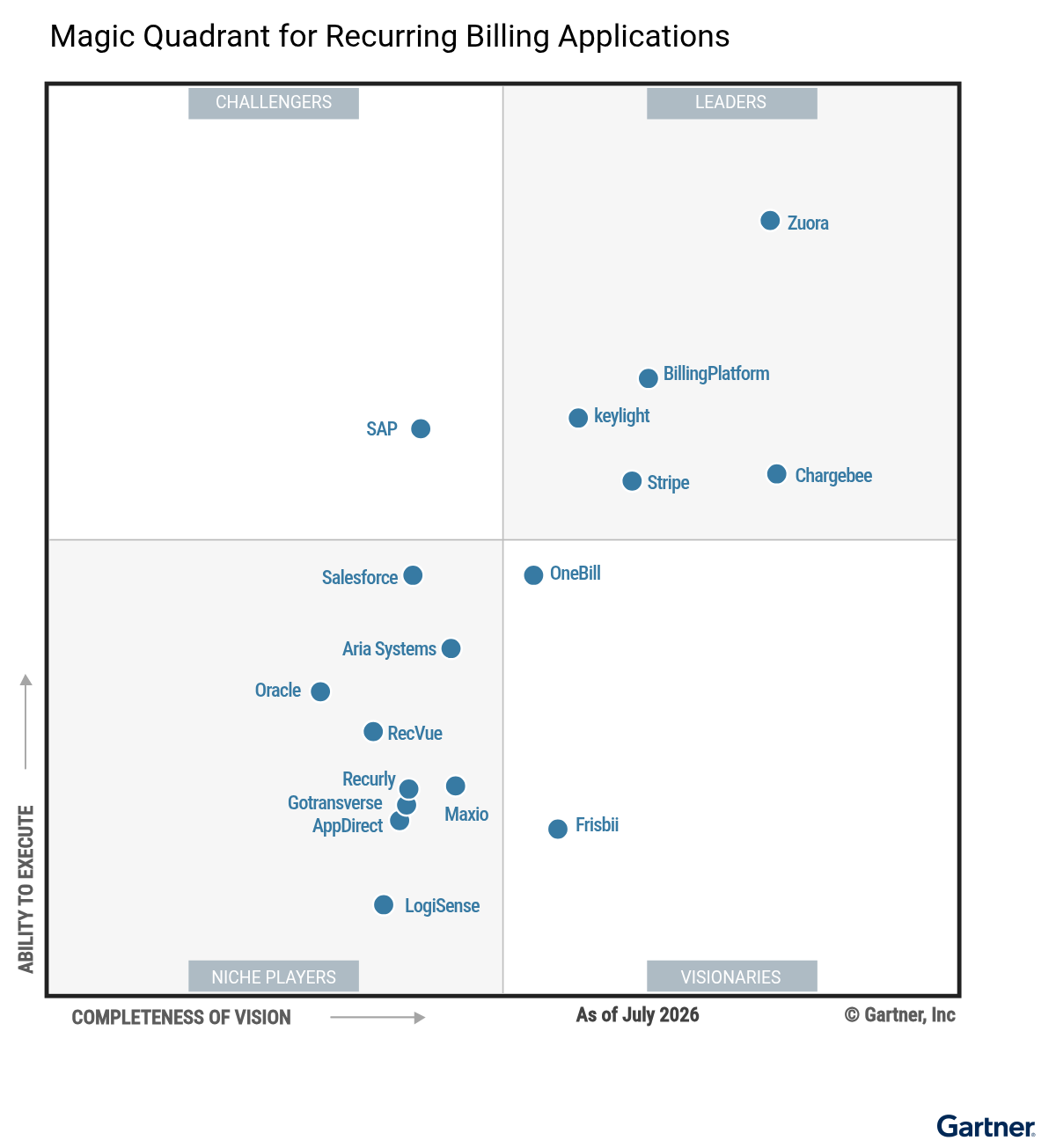
Vendor Strengths and Cautions
AppDirect
AppDirect is a Niche Player in this Magic Quadrant due to its focus on billing for services sold via a marketplace. It is a private company based in San Francisco, California. Launched in 2013, AppDirect AppBilling is best-suited for companies that sell their own and partners’ subscription software applications to B2B customers through a self-service marketplace. It is primarily sold to telecommunications, high-tech software and manufacturing companies. Companies must purchase AppDirect’s marketplace and commerce functionality to use it; billing features are not sold as a stand-alone product. The application runs on AWS or Microsoft Azure. Data can reside in the U.S., Ireland, Germany, Switzerland, Australia or India.
- Marketplace: AppBilling is part of a larger solution for selling and reselling subscription products. End customers can be billed, and resellers then pay appropriate royalties to the providers whose products are sold via a marketplace.
- Service contract management: AppDirect provides prebuilt UIs for B2B customers, resellers and vendors to purchase, manage and cancel subscriptions, and view or pay invoices.
- Flexible invoice templates: The what-you-see-is-what-you-get invoice template designer is one of the best among all vendors evaluated for this report.
- Payment collection: Support for payment collection and dunning is among the weakest of all products evaluated in this report. AppDirect lacks support for key features such as flexible dunning workflows, automatic payment reconciliation, a collections task queue, installment plans and late payment fees.
- Revenue recognition: AppDirect lacks out-of-the-box support for revenue recognition calculations.
- Extensibility: The AppDirect platform supports basic extension attributes on standard objects. About 15 webhooks are exposed to notify external applications of changes to the standard objects in AppDirect. These can also invoke JavaScript functions defined in the platform. Application data is exported by running a report. A customer can’t define custom objects or change the standard UIs. Support is limited for promoting changes between environments.
Aria Systems
Aria Systems is a Niche Player in this Magic Quadrant because of some product gaps. Founded in 2002, it is a private company based in San Francisco, California. Aria Billing Cloud is a mature back-end billing solution suited for B2C and B2B use cases across a wide range of industries. The application is primarily sold to telecommunications, high-tech, media, business services and financial services companies. It runs on AWS, Microsoft Azure, Google Cloud or Oracle Cloud Infrastructure. Data can reside in the U.S., Ireland, Germany, Australia, Singapore or Brazil.
Aria declined requests for supplemental information. Gartner’s analysis is therefore based on other credible sources.
- Complex service contracts: Aria Billing Cloud’s support for modeling complex service contracts is among the best of all the products evaluated for this report. Each sold product can have multiple charges and customer-selectable attributes and be grouped into nested bundles.
- Performance: In the 2025 demonstration shown to Gartner, Aria Billing Cloud rated 1 million usage events in approximately 90 seconds and generated 10,000 invoices in approximately two minutes.
- AI: Aria has invested heavily in AI capabilities. It exposes its native agentic AI via a chatbot, APIs, and integrations with Salesforce and ServiceNow.
- Self-service service contract management: The product includes APIs and a webpage builder customers can use to create a self-service selling and customer care experience.
- Project billing: Aria Billing Cloud lacks out-of-the-box support for project billing.
- Extensibility: The core Aria platform supports basic extension attributes on product and account objects. While more advanced customization is possible in an extensibility tool called Aria Workflow, the tool is primarily used by Aria employees. Customers cannot make changes themselves without supervision by Aria. Invoice templates can only be updated by Aria.
BillingPlatform
BillingPlatform is a Leader in this Magic Quadrant because of its broad product capabilities and highly configurable and extensible platform. Founded in 2012, it is a private company based in Englewood, Colorado. BillingPlatform is a comprehensive, enterprise-grade service contract management and billing solution well-suited for B2C and B2B use cases across a wide range of industries. The application is primarily sold to high-tech, financial services, business services, healthcare, and transportation companies. It runs on AWS or in a private cloud. Data can reside in over 30 different countries.
- Mixed billing: BillingPlatform’s support for billing one-time charges, fixed recurring charges, usage charges, and project time, expenses, and milestones is among the best evaluated for this report.
- Invoicing and collections: The product’s comprehensive, flexible and performant support for invoicing and collections is among the best evaluated for this report.
- Extensibility: BillingPlatform stands out in this Magic Quadrant for its ability to extend the application to support custom business requirements. Implementers can add custom objects, business logic, UIs, APIs and workflows using the tooling provided. BillingPlatform is therefore recommended for organizations with the most complex requirements.
- Service contract management: Companies implementing BillingPlatform have to use its APIs to build their own service contract sales UI for end customers.
- Complex service contracts: Each service contract line only supports one charge, and there is no support for customer-selectable product attributes.
- Custom product demos: Prospective clients should verify which capabilities shown in a sales demo are truly Day 0, out-of-the-box and fully supported by the vendor.
Chargebee
Chargebee is a Leader in this Magic Quadrant because of its innovative product capabilities and strong market momentum. Founded in 2011, it is a private company based in North Bethesda, Maryland. Chargebee is well-suited for billing both fixed recurring and usage charges in B2C and B2B scenarios. The application is primarily sold to the high-tech industry, with additional customers in media, business services, financial services and healthcare. It runs on AWS, Microsoft Azure or Google Cloud. Data can reside in the U.S., Germany, Ireland, Switzerland, India or Australia.
- Self-service service contract management: A highly usable self-service service contract management website can easily be composed using HTML fragments generated by Chargebee. The logo and color scheme of the generated UI can be changed to align with company website branding.
- Invoicing, payment collection and dunning: Chargebee’s invoicing, payment collection and dunning capabilities are among the best evaluated for this report. E-invoicing and value-added tax exemption are well-supported.
- Revenue recognition: Chargebee sells a comprehensive revenue recognition module that can be deployed with or without core billing.
- Complex service contracts: Customers can capture ramps and entitlements in a service contract, but there is no support for customer-selectable product attributes or multiparty revenue sharing, and only one charge is possible per product. Add-on products can be defined and chosen, but otherwise there is no support for product bundles.
- Project billing: Chargebee has no out-of-the-box support for project billing.
- Extensibility: The product lacks support for custom objects. There is no mechanism for changing the layout or content of the standard UI. Logic extensions via script must be uploaded and pass an automated security review before deployment.
Frisbii
Frisbii is a Visionary in this Magic Quadrant because of its focus on companies in Europe and some product gaps. Founded in 2015, it is a private company based in Frankfurt, Germany. Frisbii is best-suited for billing simple subscriptions in B2C and basic B2B scenarios. The application is primarily sold to media, high-tech, financial services, consumer services and retail companies. It runs on AWS. Data can reside in Ireland or Germany.
- European deployments: Frisbii is available in nine European languages and supports a wide range of Europe-specific payment methods and e-invoicing. It is based on European accounting principles and supports calculation of European sales taxes.
- Fee optimization: Transactions are automatically routed to the least expensive connected processor.
- Usability: The application is intuitive and easy to use. Application response times were good in the demo shown to Gartner. A powerful AI onboarding assistant is provided to help implement the software.
- Mixed billing: Frisbii’s support for mixed billing is among the weakest of any of the vendors evaluated for this report. One-time billing and usage billing features are basic compared to other products we evaluated. There is no support for project billing.
- B2B: The product’s invoicing capabilities and support for complex service contracts were among the weakest evaluated for this report and are best-suited to simple consumer subscriptions. It lacks support for bundles, ramps, customer account hierarchies, consolidated billing and split billing. The invoice template supports limited customization. Aside from basic deferred-revenue calculations, there is little support for revenue recognition.
- Extensibility: Frisbii supports adding attributes to the customer, product, contract and order objects, and about 40 webhooks are exposed to enable external logic extensions. The product includes a workflow/integration designer. Otherwise, application capabilities are fairly hard-coded. Customers can’t add custom objects, change the content of standard UIs, add scripted business logic, define approval workflows or easily move data between software environments.
Gotransverse
Gotransverse is a Niche Player in this Magic Quadrant because of gaps in product functionality and poor application usability. Founded in 2008, it is a private company based in Austin, Texas. Gotransverse offers a service contract management and billing solution for B2C and B2B use cases across diverse industries. The application is primarily sold to transportation, telecommunications, financial services, media and high-tech companies. It runs on AWS. Data can reside anywhere supported by AWS.
Gotransverse declined requests for supplemental information or to review the draft contents of this document. Gartner’s analysis is therefore based on other credible sources.
- Assisted service contract management: Gotransverse offers a Salesforce-managed package for selling services within Salesforce CRM as well as an integration with ServiceNow. The vendor also provides a comprehensive and usable native UI for selling and managing services.
- Invoicing: The product has comprehensive support for invoicing and was able to generate 10,000 invoices in about four minutes in the 2025 demonstration to Gartner.
- Industry mix: The product has been deployed in a wide range of industries.
- Project billing: Project billing is limited to basic milestone billing.
- Usability: Gartner found aspects of the Gotransverse product either unintuitive or more difficult to use than other products we evaluated. Particular areas of concern include complex service contracts, usage billing, dunning and staging of updates between environments.
- Extensibility: Customers can define extension fields for standard objects and set up webhooks for many events. Custom scripts can be triggered to calculate usage charges, additional fees, discounts and more. However, the platform lacks key capabilities such as custom objects, workflow and user-friendly tools for promoting changes between environments.
keylight
keylight is a Leader in this Magic Quadrant because of its seamlessly integrated service contract management and comprehensive billing capabilities. Founded in 2015, it is a private company based in Berlin, Germany. keylight delivers a service contract management and billing solution for B2C, B2B2C and B2B use cases. The application is primarily sold to manufacturing, high-tech, retail and financial services companies. It runs on AWS or Google Cloud. Data can reside in the U.S., Canada, Germany, Singapore, or Japan.
- Service contract management: Customers can build their own self-service sales and contract maintenance portal using the product’s portal builder, making this one of the most complete and flexible self-service experiences evaluated in this report. Sales users can create new service contracts via plug-ins for Salesforce, Microsoft Dynamics 365, Pipedrive or HubSpot, with all other transactions supported by the native keylight UI.
- Recurring billing: keylight is strong in every aspect of recurring billing. It was among the best solutions evaluated for complex service contracts, fixed recurring billing, mixed billing, payment collection and dunning, and global deployment.
- Usability: keylight was one of the most intuitive and easy-to-use recurring billing products evaluated for this report.
- Viability: keylight is a smaller company than most evaluated in this Magic Quadrant, though it is growing rapidly. Gartner clients should verify the company’s financial standing to ensure it is viable as a long-term partner.
- Operations: keylight has relatively few customers, with comparatively low volumes of invoices and usage events. It is not yet proven at the scale of some other vendors in this report.
- Usage rating: keylight rated 1 million usage events in a below-average 35 minutes in the demonstration shown to Gartner.
LogiSense
LogiSense is a Niche Player in this Magic Quadrant because of gaps in product functionality and its focus on usage billing use cases. Founded in 1998, it is a private company based in Kitchener, Canada. LogiSense offers a robust back-end billing solution for B2C and B2B use cases, excelling in complex usage billing. The application is primarily sold to telecommunications and high-tech companies. It runs on AWS. Data can reside in the U.S., Canada, the U.K., Germany, Ireland, Australia, Brazil, Japan, India and Singapore.
- Usage billing: LogiSense is among the best of those evaluated for complex usage billing. It can aggregate metered usage events and rate them using price lists, rate plans, negotiated contract prices, tiered or incremental volume discounts, or scripts. Prepaid and postpaid usage models are both supported. LogiSense includes an intuitive mediation workflow engine and a console for tracking and managing import jobs. Events can be imported via API, SFTP or Amazon S3, or on demand in the UI.
- Invoicing: Invoices are generated on flexible, customer-specific schedules. Business account hierarchies can be defined, and invoices can be aggregated for separate contracts or multiple accounts in the same hierarchy. Sales tax is calculated for many jurisdictions by the internal LogiSense tax engine or via integration with Avalara. Invoice templates are customized in Microsoft Word. Invoices are delivered automatically by email, e-invoicing or dropping files into SFTP or Amazon S3.
- Performance: LogiSense was able to achieve the usage rating and invoice generation benchmarks with acceptable response times during the demo shown to Gartner.
- Revenue recognition: The product lacks support for revenue recognition calculations.
- Mixed billing: Although LogiSense is good at usage billing, its one-time and fixed recurring billing were among the weakest evaluated for this report. There is no support for project billing.
- Extensibility: LogiSense data can be exported to S3 locations or other BI solution destinations such as Snowflake for external analysis. Otherwise, LogiSense capabilities are largely hard-coded, and the product lacks key platform features needed for complex enterprise deployments, such as customer-created custom objects and scripting, custom UI extensions and robust artifact migration tooling.
Maxio
Maxio is a Niche Player in this Magic Quadrant because of significant product gaps and its narrow focus on SaaS use cases. Founded in 2009, it is a private company based in Atlanta, Georgia. The application is primarily sold to the high-tech industry, with customers also in business services, media, education, and telecommunications. It runs on AWS. Data can reside in the U.S. or Germany.
- Self-service service contract management: Customers can compose a self-service contract management website using HTML fragments provided by Maxio, with color and branding customizable via Cascading Style Sheets.
- Usage rating: Maxio supports event streams with multiple attached meters that can count and aggregate usage events. It can rate usage using formulas and apply tiered and incremental volume discounts. In a Gartner demo, Maxio rated 1 million usage events in about two minutes.
- Revenue recognition: Maxio provides comprehensive support for deferred revenue recognition, performance obligations, multielement arrangements, stand-alone selling price calculation, partial revenue recognition, real-time contract revenue position, foreign exchange restatement and general ledger integration.
- Mixed billing: Maxio’s overall support for one-time billing, fixed recurring billing and project billing is among the weakest evaluated for this report.
- Global deployment: The application UI is available only in English.
- Extensibility: The platform supports multiple sandboxes for testing, but changes cannot be migrated between sandboxes. Maxio exposes 65 webhooks for key business events. Beyond adding custom attributes to existing objects, the core application is not extensible. The product lacks key platform capabilities needed for complex enterprise deployments, such as custom objects, scripting, UI changes and general-purpose workflow.
OneBill
OneBill is a Visionary in this Magic Quadrant because of its excellent omnichannel user experience and modern architecture. Founded in 2011, it is a private company based in Santa Clara, California. OneBill provides a service contract management and billing solution for B2C and B2B use cases across diverse industries. The application is primarily sold to the telecommunications and high-tech industries. It runs on AWS, HP Cloud or other hosting platforms. Data can reside anywhere supported by the platform.
- Service contract management: OneBill’s self-service contract management application covers the full life cycle of selling, managing, monitoring and paying for services, and it can be configured and extended using a flexible UI flow designer. It also provides an AI chatbot for handling billing enquiries. The quoting and ordering tool for internal sales integrates with Salesforce, and deal negotiation is supported via promotions and explicit discounts.
- Complex service contracts: OneBill allows multiple charges per service contract line, with each product having multiple customer-selectable attributes that drive pricing. Simple bundles with a fixed number of products and multiparty revenue sharing are supported, but ramps are not.
- Mixed billing: OneBill is among the best solutions for one-time billing evaluated for this report. The product can also handle fixed recurring, usage and project billing.
- Viability: Although growing rapidly, OneBill is one of the smaller vendors evaluated in this Magic Quadrant. Gartner clients should verify the company’s financial standing to ensure it is viable as a long-term partner.
- Operations: OneBill has relatively few customers, with comparatively low volumes of invoices and usage events. It is not yet proven at the scale of some other vendors in this Magic Quadrant.
- Extensibility: Basic custom objects can be created, and attributes can be added to most, but not all, standard objects. Data can be exported to Snowflake. OneBill includes a powerful workflow engine triggered by webhooks, external API calls or UI button clicks. However, it lacks support for scripting and UI changes as well as robust artifact migration tooling.
Oracle
Oracle is a Niche Player in this Magic Quadrant because of its limited adoption and lack of innovation. Founded in 1977, it is a public company based in Austin, Texas. Oracle offers a service contract management and billing solution that is best-suited for B2B businesses that run Oracle Fusion Cloud ERP. The application is primarily sold to manufacturing, business services, telecommunications, and media customers. It runs on Oracle Cloud Infrastructure. Data can reside in 25 different countries.
Oracle declined requests for supplemental information. Gartner’s analysis is therefore based on other credible sources.
- Project billing: Oracle offers a robust project management and billing capability as part of its Fusion Cloud ERP product.
- Revenue recognition: The product’s revenue recognition capabilities are among the best evaluated for this report.
- Global deployment: All global currencies are supported, and the application is available in 29 different languages. Oracle has its own tax engine.
- Disparate technology stacks: The solution consists of Oracle CPQ plus Oracle Fusion Contract Management, Oracle Fusion Subscription Management, and the accounts receivable module of Oracle Fusion Cloud ERP. Gartner clients should verify that demonstrated CPQ capabilities are fully supported by the back end. Similarly, some back-end actions, such as suspend and resume, are not supported out-of-the-box by CPQ. CPQ and ERP use different tools, requiring different implementation skills and training.
- Usability: Overall, the user experience of this heterogeneous solution is disjointed, overly complex and often slow.
- Self-service: Oracle Commerce does not currently support managing service contracts. The UI shown for viewing and paying invoices is not suitable for end customers.
Recurly
Recurly is a Niche Player in this Magic Quadrant because of its focus on simple subscription use cases. Founded in 2009, it is a private company based in San Francisco, California. Recurly provides a service contract management and billing solution best-suited for basic subscriptions in B2C and simple B2B use cases. The application is primarily sold to media and high-tech customers. It runs on AWS and Google Cloud. Data can reside in the U.S. or Germany.
- Revenue recognition: Recurly offers a robust revenue recognition engine, which can be purchased as a stand-alone product.
- Invoicing performance: The product generated 10,000 invoices in about two minutes in the demo shown to Gartner.
- Operations: All customers run the latest version of the SaaS software, and the vendor has many customers on its platform. The largest customers produce a relatively high number of monthly invoices.
- Complex service contracts: Recurly has basic support for subscription ramps but lacks support for customer-selectable product attributes, multiple charges per product and grouping products into bundles.
- Usage billing: Recurly’s usage billing is basic: The product can sum metered usage events and rate usage with contract prices and tiered or incremental volume discounts. Formulas, external rating calls and scripted calculations are not supported. Recurly also lacks a flexible mediation engine. Usage data is sent via API; there is no support for importing usage files or monitoring SFTP or Amazon S3 buckets.
- Extensibility: Data can be exported to Snowflake or other tools for analysis. Simple textual extension attributes can be added to major entities. About 90 webhooks are exposed. Otherwise, Recurly’s capabilities are largely hard-wired; it lacks key platform features needed for complex enterprise deployments, such as custom objects, scripting, custom UI extensions, workflows and robust artifact migration tooling.
RecVue
RecVue is a Niche Player in this Magic Quadrant because of gaps in product functionality and its comparatively low number of customers. Founded in 2015, it is a private company based in Palo Alto, California. RecVue targets large-enterprise B2B or B2B2C customers across a wide range of industries. The application is primarily sold to transportation, telecommunications, logistics and high-tech customers. It runs on AWS and Google Cloud. Data can reside in the U.S., Australia, Singapore, Ireland, India and Saudi Arabia.
- Complex service contracts: RecVue allows a salesperson to manually add multiple charges to a service contract line. Products can be grouped into bundles and bundles of bundles. It is also possible to ramp the price or quantity of a service contract line. Multiparty revenue sharing is well-supported.
- Fixed recurring billing: RecVue supports a wide range of fixed recurring billing periods. It handles proration of charges at the beginning and end of the service contract. It can waive charges for one or more billing periods to support a free trial. Recurring billing can be initiated when an external business event occurs. Service contracts can be renewed manually or automatically.
- Revenue recognition: The highly capable revenue recognition engine can be purchased as a stand-alone product.
- Innovation: RecVue demonstrated fewer innovative features than most other vendors evaluated for this report.
- Project billing: RecVue does not support project billing.
- Churn prevention: The product lacks support for churn prediction or prevention.
Salesforce
Salesforce is a Niche Player in this Magic Quadrant because of its product’s relative immaturity. It is a global public company based in San Francisco, California. Launched in 2025, Salesforce’s Revenue Cloud Billing (RCB) is a comprehensive service contract management and billing solution for B2C and B2B use cases across diverse industries. It runs on Salesforce’s own data centers plus AWS, Microsoft Azure, Google Cloud and Alibaba Cloud. Data can reside in the U.S., Japan, Netherlands, Sweden, India, Australia, Indonesia, Singapore, South Korea, France, Germany, Italy, Switzerland, the U.K., Israel, United Arab Emirates, Brazil or Canada.
- Complex service contracts: Salesforce’s support for complex service contracts is among the best evaluated for this report. Each service contract line can have multiple charges and customer-selectable attributes, and can be grouped into nested bundles. Ramps can be set up.
- Mixed billing: One-time invoicing, on-account billing and refunds are all well-supported. Fixed recurring is possible, and usage billing is provided by m3ter. RCB integrates with Salesforce’s project management capabilities and can bill for time and expenses as well as milestone completion.
- Extensibility: The Salesforce platform is highly extensible, supporting custom objects, custom UIs, scripting, approvals workflow, webhooks and staging updates between environments.
- Maturity: RCB is a relatively new product that has not yet been widely deployed. Prospective clients should speak to references that have successfully deployed RCB at their scale and level of complexity.
- m3ter integration: Salesforce acquired m3ter in the summer of 2026. Some of its functionality overlaps that of the core RCB product, and the two are only superficially integrated by the m3ter managed package. Prospective clients should verify the level of effort required to integrate RCB and m3ter for their use cases.
- Usability: Some features, such as ramps, are complex to use for most common use cases.
SAP
SAP is a Challenger in this Magic Quadrant because of its comprehensive product functionality. It is a public company headquartered in Walldorf, Germany. Launched in 2017, SAP Revenue Management provides a service contract management and billing solution for B2C and B2B use cases across diverse industries. The application is primarily sold to manufacturing, business services, high-tech, professional services and retail companies. It runs in the vendor’s own data centers plus AWS, Microsoft Azure, and Google Cloud. Data can reside in one of SAP’s 10 global data centers or anywhere the hyperscalers are present.
SAP declined requests for supplemental information. Gartner’s analysis is therefore based on other credible sources.
- Mixed billing: With comprehensive support for one-time, fixed recurring, usage and project billing, SAP is among the best vendors evaluated for mixed billing.
- Global deployment: SAP is one of the best vendors evaluated for global deployments. The application UI, email templates and invoice templates are translated into more than 30 languages. All global currencies and date and time formats are supported. SAP has sales and professional services resources around the globe, and data can reside in almost every geography.
- Extensibility: The SAP Revenue Management solution combines features from SAP Cloud ERP, SAP Subscription Billing, SAP Commerce Cloud, and SAP CPQ, plus an SAP white-labeled version of DigitalRoute. The SAP Cloud ERP platform is highly extensible, with support for custom objects, custom UIs, scripting, approvals workflows, webhooks and staging of updates between environments. Gartner clients should not assume the same level of extensibility in all four environments.
- Self-service service contract management: SAP Commerce Cloud supports self-service service contract selling and payment capture. However, contract amendments, usage monitoring, and invoice payments are not supported.
- Usage rating: SAP’s usage event rating is not yet proven at scale. The product took 60 minutes to rate 1 million usage events in the demo shown to Gartner in 2025, which was 40 times slower than the fastest products evaluated for this Magic Quadrant.
- Product strategy: SAP Billing and Revenue Innovation Management (BRIM) was not evaluated in this report but is still actively sold by SAP and is the recurring revenue management solution for customers on SAP Private Cloud (RISE). There is considerable confusion among customers, and even the SAP sales team, as to which solution should be used in a given situation.
Stripe
Stripe is a Leader in this Magic Quadrant because it delivers good recurring billing capabilities, is very easy to deploy and has significant market share. It is a private company based in San Francisco, California and Dublin, Ireland. Launched in 2018, Stripe Billing enables rapid deployment of billing for B2C and simple B2B use cases across various industries. The application is primarily sold to high-tech, media and business services companies. It runs on AWS, and data resides in the U.S. or India.
- Payment collection and dunning: Stripe Billing integrates with Stripe Payments to support a wide range of global payment methods, with AI-driven retries for failed automatic payments. It also integrates with Venmo, PayPal and third-party gateways. Payment terms are captured for customers, contracts and invoices. Support for payment tracking and reconciliation is comprehensive. Multiple collections workflows can be defined and bound to events, products or customers, specifying when actions occur and what communications are sent.
- Global deployment: Stripe was one of the best vendors evaluated for global deployments. The application UI, email templates and invoice templates are translated into more than 40 languages. All global currencies and date and time formats are supported. Stripe offers real-time currency conversion. Multiple organizations can coexist in a single Stripe implementation.
- Operations: Stripe supports over 350,000 companies doing recurring billing on its cloud platform, some of which generate very large volumes of invoices.
- Complex service contracts: Aside from good support for ramps, Stripe Billing lacks key features for negotiating complex service contracts, such as customer-specific product attributes and bundles of products.
- Project billing: The product lacks support for project billing.
- Revenue recognition: Support for revenue recognition is limited to simple proration of deferred revenue, partial recognition of performance obligations and simple customizable revenue recognition rules.
Zuora
Zuora is a Leader in this Magic Quadrant because of its comprehensive product functionality and large installed base of customers. Founded in 2007, it is a private company based in Foster City, California. Zuora provides a service contract management and billing solution for B2C and B2B use cases where products are simple. The application is primarily sold to the high-tech industry, with a significant number of media and manufacturing customers. It runs on AWS and Microsoft Azure. Data can reside in the U.S., Germany or Japan.
- Product functionality: Zuora offers comprehensive recurring billing capabilities. It was among the top vendors we evaluated for fixed recurring billing, usage billing, invoicing, payment collection and dunning, and revenue recognition.
- Extensibility: The core Zuora platform is highly extensible, with support for custom objects, custom UIs, scripting, general-purpose workflows, email template design, data export to analytics tools, webhooks and staging of updates between environments. However, the overall solution encompasses at least three technology stacks, which may not all have the same level of extensibility.
- Operations: Zuora supports more than 1,000 companies on its cloud platform, all on the same software release. The largest of these customers generate very high volumes of invoices and rate a high volume of usage events.
- Project billing: Aside from basic fixed-fee milestone billing and approvals, Zuora lacks out-of-the-box support for project billing.
- CPQ usability: Zuora CPQ is a Salesforce-managed package. While functionally capable, the tool is slow, with basic actions taking 10 to 20 seconds.
- Industry strategy: By focusing on high-tech companies and high-volume B2C companies, Zuora has limited its ability to satisfy the needs of larger and more demanding industries, such as telecommunications and financial services.
Inclusion and Exclusion Criteria
In addition to Gartner client relevance, as determined by analyst expertise and opinion, providers need to meet the following criteria to qualify for inclusion:
- Current: The product was generally available for sale on 1 January 2026, without restrictions or special approval.
- Cloud: The product is implemented in the cloud and meets these requirements:
- All technology infrastructure is managed either in the vendor’s own data centers or those of a third party that is not the end customer.
- The vendor implements upgrades as part of the cloud service. Upgrades are not performed by a third party, managed service provider, or the customer themselves.
- The cloud service is licensed on a subscription basis, or metered pay for use.
- All major application capabilities (end-user features, administration, schema extension, workflow, and scripting) are performed in a web browser. Note that Windows graphical user interface applications, either running locally or on a central server, are not acceptable.
- Customers cannot modify the application source code. All customers run the same code. The vendor does not develop code for a specific customer.
- The vendor must have delivered at least two upgrades containing new functionality in the last calendar year. Upgrades may be pushed by the vendor or implemented at a time agreed by the vendor and the customer.
- Must-have recurring billing capability: The product provides out-of-the-box support for all the must-have capabilities listed in the market definition. At a minimum, the product must score at least 2.0 out of 5.0 for the following critical capabilities:
- Fixed recurring billing
- Usage billing
- Invoicing
- Cross-industry: The vendor must derive at least 5% of its revenue from at least three different industries.
Evaluation Criteria
The following criteria were evaluated to calculate each vendor’s Ability to Execute and Completeness of Vision. The evaluation was based on extensive vendor surveys, publicly available financial data, a standardized software demonstration, a customer reference survey, and insights from Gartner inquiry calls.
Ability to Execute
To evaluate a vendor’s Ability to Execute, Gartner considered the following criteria:
Product/Service: The quality and depth of the software itself is the strongest predictor of customer success. The future is SaaS, cloud applications. We only consider features supported in the cloud for this report. The software was evaluated by an extensive live demo to Gartner’s script. We assessed feature completeness, performance and scalability, usability, and extensibility.
Overall Viability: Gartner clients want to purchase software from a financially viable vendor that is committed to the long-term development and support of the software product under consideration. We reviewed survey responses and public financial data to assess the overall financial health of each organization and their level of commitment to their SaaS recurring billing product line.
Sales Execution/Pricing: Continued sales growth is a predictor of the level of future investment in the software product.
Customer Experience: Gartner clients want to acquire highly usable and reliable software that is well regarded by existing customers. The vendor should provide fast and effective technical support when issues are identified. We evaluated customer experience using a combination of usability scores from the live product demo and direct feedback provided in discussions with customers in the previous year.
Operations: Customer satisfaction and profitability of the business line depend on efficient and effective operations. We evaluated responses to the vendor survey to assess the efficiency of software updates, ability to scale the application for the largest projects, and the capacity to support and implement the software around the globe.
Ability to Execute Evaluation Criteria
| Evaluation Criteria | Weighting |
|---|---|
Product or Service | High |
Overall Viability | Low |
Sales Execution/Pricing | NotRated |
Market Responsiveness/Record | NotRated |
Marketing Execution | NotRated |
Customer Experience | Low |
Operations | Low |
Source: Gartner (August 2026)
Completeness of Vision
To evaluate Completeness of Vision, Gartner considered the following criteria:
Market Understanding: Providers must understand customer needs and translate them into products and services. We reviewed survey responses to evaluate recent product enhancements, product roadmap, understanding of the market, and how each vendor competes with competitors.
Offering (Product) Strategy: Buyers need a complete solution for quote-to-cash. While this does not all need to come from one vendor, the vendor must have a complete vision and approach to solving the business process in conjunction with partners. We used the live product demo to assess whether each vendor has a complete offering footprint. This can be achieved through a combination of organic development, acquisition, and/or ecosystems. However, for ecosystems, Gartner pays close attention to the quality and support of third-party vendors. The vendor should have a clear approach for master data management across the integrated systems.
Vertical/Industry Strategy: The requirements for recurring billing in every industry are converging. The dominant players in the future will offer solutions flexible enough to meet the needs of multiple industries. We used the live product demo plus survey responses to assess support for multiple industries.
Innovation: There are several hundred vendors competing in the recurring billing market. To thrive, vendors must provide differentiated capabilities. We used the live product demonstration to assess innovative features of each product.
Geographic Strategy: Gartner clients are often global organizations that require support for local languages, currencies, tax regimes, accounting standards, and payment methods. It is also important to offer local implementation resources. We used survey responses to determine support for global deployments.
Completeness of Vision Evaluation Criteria
| Evaluation Criteria | Weighting |
|---|---|
Market Understanding | Low |
Marketing Strategy | NotRated |
Sales Strategy | NotRated |
Offering (Product) Strategy | Low |
Business Model | NotRated |
Vertical/Industry Strategy | Low |
Innovation | High |
Geographic Strategy | Low |
Source: Gartner (August 2026)
Quadrant Descriptions
Leaders
Leaders have the Ability to Execute their vision through products, services, and demonstrably solid business results in the form of revenue and earnings. Leaders have significant successful customer deployments with multiple proofs of large-scale deployments. They achieve consistently above-average customer experience satisfaction scores. They are often the vendors against which other providers measure themselves.
Challengers
Challengers are often larger than Niche Players and demonstrate higher volumes of new business. They have the size and product capabilities to compete worldwide, but they might not be able to execute equally well in all geographic areas. They often achieve strong customer experience satisfaction scores. They may lack a strong functional vision or may have failed to deliver compelling new product enhancements during the past 24 months.
Visionaries
Visionaries are ahead of most competitors in their product plans and understanding of the market. They anticipate emerging and changing needs, and move the market into fresh areas. They have a strong potential to influence the direction of the market, but are limited in terms of execution and/or track record.
Niche Players
Niche Players offer a product that lacks some key functional capabilities, may not demonstrate the ability to consistently handle large-scale deployments across multiple geographies, or may lack strong sales. These vendors may offer complete portfolios for a specific industry, but face challenges in one or more of the areas necessary to support cross-industry requirements. They may have an inconsistent implementation track record or may lack the ability to support the requirements of large enterprises. Even so, Niche Players sometimes offer the best solutions for the needs of a particular organization, considering the price/value ratio of their solutions.
Context
There are more than 300 vendors in the recurring billing applications market, and the vast majority did not meet the inclusion criteria for this Magic Quadrant.
The majority of the 300 vendors in this market have less than $10 million in annual revenue. A recurring billing deployment is for the long term. Often, these systems are used for 20 or 30 years. Vendor viability is therefore a factor in our Ability to Execute score. This report excludes vendors with less than $10 million in revenue or with no sales growth.
Gartner clients are seeking to procure cloud/SaaS software solutions. Therefore, this Magic Quadrant excludes on-premises products and hybrid cloud/on-premises products that fail to meet our strict definition of a cloud/SaaS application (see the Inclusion and Exclusion Criteria section for more details).
Functional requirements for all industries are converging. Gartner expects vendors of cross-industry recurring billing solutions to dominate in the future. Hence, this report excludes vendors that have a solution specifically built for a single industry.
Gartner expects companies to reduce the footprint of their ERP solutions and offload accounts receivable functionality to modern, SaaS recurring billing applications that can handle billing, collections, and revenue recognition for all types of charges including one-time, fixed recurring, usage, and projects. This report excludes vendors that cannot bill for fixed recurring and usage at a minimum.
There are significant differences in the functional capabilities of the products of vendors included in this Magic Quadrant. For this reason, the product/service criterion received the heaviest weighting for our evaluation of Ability to Execute. A product’s capabilities were determined by a live product demonstration to Gartner’s standardized script. This demo included a benchmark of the vendor’s ability to rate 1 million usage events and to generate 10,000 invoices.
The heaviest weightings for Completeness of Vision were accorded to the level of innovation in its current product.
Gartner recommends using this Magic Quadrant to aid your evaluations, but also exploring the market further to assess the capacity of each vendor to address your unique business problems and technical concerns. Your shortlist should be determined by the complexity and scale of your requirements. This Magic Quadrant is not designed to be the sole tool for creating a vendor shortlist — use it in combination with the companion Critical Capabilities report as part of your due diligence, in conjunction with discussions with Gartner analysts.
Magic Quadrants are snapshots in time. To be impartial and to complete our analysis, we stop our data collection efforts at a consistent time for all vendors. In this case, the survey cutoff date was July 2026, and the product demonstrations were completed by early July 2026. Some product capabilities may have changed since then.
Market Overview
The recurring billing applications market was about $5 billion in 2025, with perhaps $1.5 billion of that generated by the modern SaaS vendors included in this report. The remainder is made up of revenue from on-premises billing vendors dedicated to the telecommunications, financial services, and utilities markets.
Gartner expects modern, cross-industry SaaS solutions to increasingly penetrate those traditional markets with lower-cost, more innovative products. It is likely that consumer and high-tech recurring billing markets have reached, or are close to, peak subscription with almost every opportunity for recurring billing having been explored. New growth for the SaaS players will most likely come from displacing high-cost, established players in the traditional recurring billing industries, plus replacement of accounts receivable footprint in ERP solutions. As high-cost solutions are replaced by lower-cost solutions, the overall total addressable market may actually shrink as the market share for SaaS solutions grows.
There is currently a bubble of activity providing metered billing capability to generative AI (GenAI) startups. Gartner clients should be cautious of vendors that are overexposed to any potential bursting of that bubble as these startups consolidate or fail.
Several vendors introduced GenAI capabilities to their recurring billing product in the last year. Using AI assistants to help users implement or navigate the application or to answer questions about a customer’s bills is intriguing. The more compelling use case is using AI to rapidly implement the software. Early trials of this approach are showing promise. GenAI in recurring billing is a low priority for Gartner clients, who are more motivated by ease of use, functional fit, and predictability of implementations.
Ability to Execute
Product/Service: Core goods and services offered by the vendor for the defined market. This includes current product/service capabilities, quality, feature sets, skills and so on, whether offered natively or through OEM agreements/partnerships as defined in the market definition and detailed in the subcriteria.
Overall Viability: Viability includes an assessment of the overall organization's financial health, the financial and practical success of the business unit, and the likelihood that the individual business unit will continue investing in the product, will continue offering the product and will advance the state of the art within the organization's portfolio of products.
Sales Execution/Pricing: The vendor's capabilities in all presales activities and the structure that supports them. This includes deal management, pricing and negotiation, presales support, and the overall effectiveness of the sales channel.
Market Responsiveness/Record: Ability to respond, change direction, be flexible and achieve competitive success as opportunities develop, competitors act, customer needs evolve and market dynamics change. This criterion also considers the vendor's history of responsiveness.
Marketing Execution: The clarity, quality, creativity and efficacy of programs designed to deliver the organization's message to influence the market, promote the brand and business, increase awareness of the products, and establish a positive identification with the product/brand and organization in the minds of buyers. This "mind share" can be driven by a combination of publicity, promotional initiatives, thought leadership, word of mouth and sales activities.
Customer Experience: Relationships, products and services/programs that enable clients to be successful with the products evaluated. Specifically, this includes the ways customers receive technical support or account support. This can also include ancillary tools, customer support programs (and the quality thereof), availability of user groups, service-level agreements and so on.
Operations: The ability of the organization to meet its goals and commitments. Factors include the quality of the organizational structure, including skills, experiences, programs, systems and other vehicles that enable the organization to operate effectively and efficiently on an ongoing basis.
Completeness of Vision
Market Understanding: Ability of the vendor to understand buyers' wants and needs and to translate those into products and services. Vendors that show the highest degree of vision listen to and understand buyers' wants and needs, and can shape or enhance those with their added vision.
Marketing Strategy: A clear, differentiated set of messages consistently communicated throughout the organization and externalized through the website, advertising, customer programs and positioning statements.
Sales Strategy: The strategy for selling products that uses the appropriate network of direct and indirect sales, marketing, service, and communication affiliates that extend the scope and depth of market reach, skills, expertise, technologies, services and the customer base.
Offering (Product) Strategy: The vendor's approach to product development and delivery that emphasizes differentiation, functionality, methodology and feature sets as they map to current and future requirements.
Business Model: The soundness and logic of the vendor's underlying business proposition.
Vertical/Industry Strategy: The vendor's strategy to direct resources, skills and offerings to meet the specific needs of individual market segments, including vertical markets.
Innovation: Direct, related, complementary and synergistic layouts of resources, expertise or capital for investment, consolidation, defensive or pre-emptive purposes.
Geographic Strategy: The vendor's strategy to direct resources, skills and offerings to meet the specific needs of geographies outside the "home" or native geography, either directly or through partners, channels and subsidiaries as appropriate for that geography and market.