Magic Quadrant for Global Digital Marketing Agencies
25 August 2026 - ID G00841300 - 42 min read
By Jay Wilson, Philip Black, and 1 more
CMOs face pressure to prove agency ROI amid AI disruption and flat budgets. As a result, CMOs are scrutinizing agency spending and reducing the number of agencies on their rosters. This research helps CMOs evaluate the rapidly shifting large, global agency market and form partnerships that drive measurable growth.
Strategic Planning Assumptions
By 2029, 50% of proprietary agency AI platforms will sunset or become obsolete due to M&A activity and client and agency shifts to open-source AI platforms.
By 2030, spend on agency fees as a percentage of marketing budgets will drop to 15%, down from a high of 24.5% at the start of the decade.
Market Definition/Description
Gartner defines global digital marketing agencies as service providers capable of developing and executing global marketing strategies. These full-service agencies bundle their strategic marketing services with an array of complementary offerings and technologies to support their clients’ needs. An agency’s particular combination of offerings and competitive strengths typically correlates to its roots as a traditional advertising or digital agency, or as a management consultancy or systems integrator.
CMOs often turn to global digital marketing agencies to enhance, augment or replace internal marketing capabilities, often working with multiple agencies as part of a roster. Marketers spend nearly as much on these outsourced agencies as they do on internal marketing staff. CMOs report that agencies provide a greater depth and breadth of capabilities than can be found internally and that external agency work output is often of a higher quality. Agencies have relationships with media and technology providers at a greater scale — working on behalf of multiple clients — than a single client organization may have on its own. Importantly, a global digital marketing agency brings global strategy and execution, a cross-industry perspective and proprietary data and technology to a CMO’s brand, and that outside-in perspective is critical to meeting customers’ evolving expectations.
Mandatory Features
Agencies in this market must provide expertise and services, including:
- Marketing and brand strategy by developing and refining marketing’s alignment to business goals
- Creative and content development for digital and traditional channels
- Digital marketing execution (e.g., website, social, email, mobile, app, organic and paid search, digital advertising) enriched with customer experience and digital product design and campaign delivery
- Data-driven marketing and analytics, including marketing performance measurement, as well as customer and market insights
- Marketing technology strategy and implementation, including optimization of martech stacks
- AI strategy, piloting and rollout for marketing use cases
- Digital commerce and personalization, including building and maintaining commerce capabilities
Optional Features
Providers in this market may offer additional capabilities, including:
- Business consulting and transformation services
- Market, audience and competitive research
- Industry vertical expertise
- Marketing organizational design
- Product and service innovation
- Branding and traditional/offline advertising
- Media planning and buying
- Programmatic media
- Public relations, events and promotions
- Proprietary AI platforms and tools to enable marketing workflows from ideation through execution
- Specialized expertise in emerging channels and capabilities, such as AEO/GEO
- UX design
Magic Quadrant
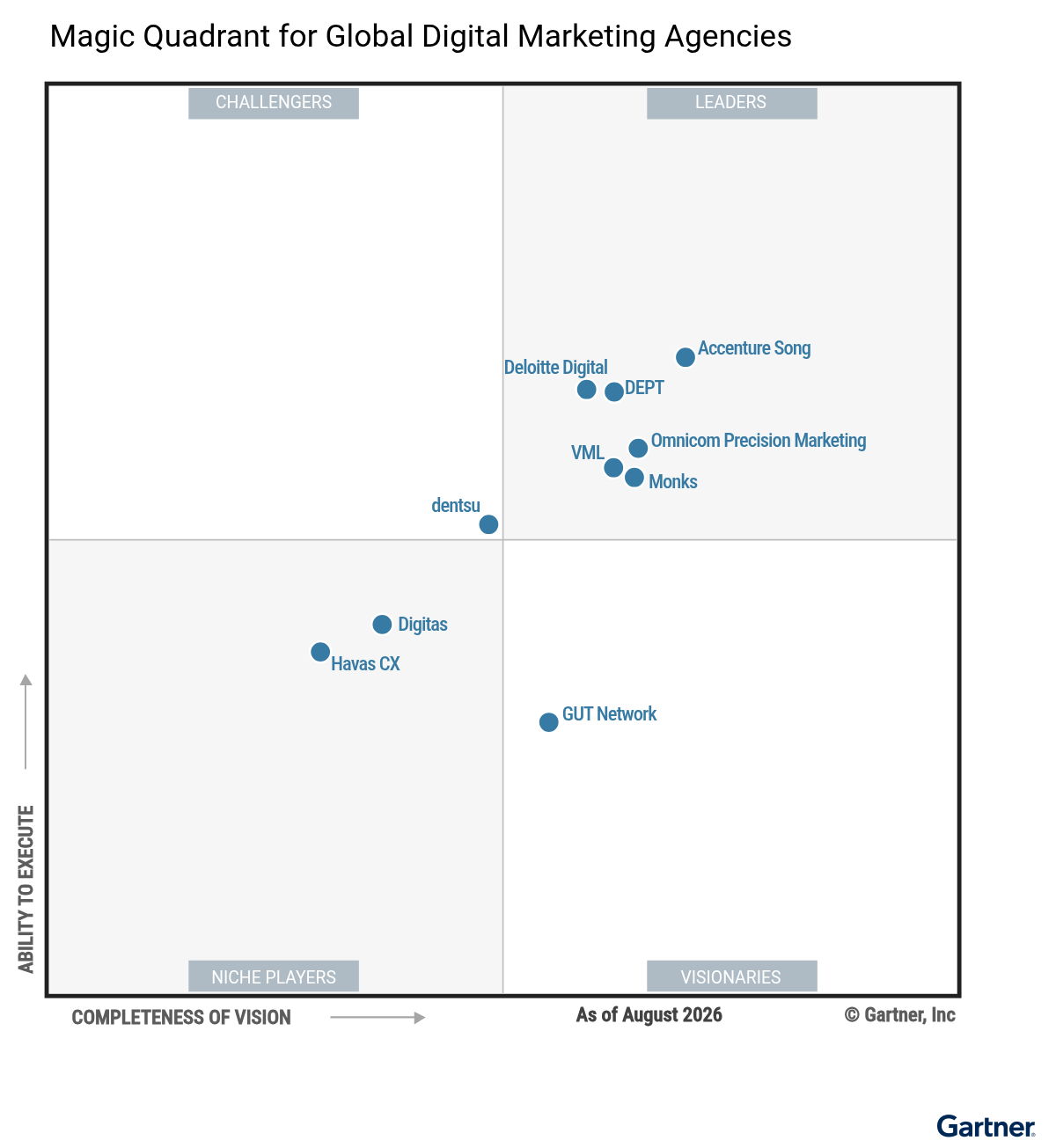
Vendor Strengths and Cautions
Accenture Song
Accenture Song, part of Accenture, is a Leader in this Magic Quadrant. It focuses on tech-powered business transformation, creative marketing services and agentic marketing operations, such as automated briefing, content production and media activation. Its clients tend to be global enterprises needing deep internal marketing operations or end-to-end customer experience overhauls, as well as ongoing campaigns. The firm has locations in 54 countries and more than 90,000 employees, offering global delivery scale. Its AI focus centers on agentic workflows and its Unified Marketing Platform (UMP), backed by a $3 billion enterprise investment in data and AI. Recent improvements include expanded B2B and healthcare capabilities via acquisitions while maintaining the creative leadership of Droga5, its subsidiary agency.
- Global scale and delivery: With over 90,000 specialists — 71% of whom are formally trained in data and AI — Song differentiates with delivery scale and flexibility. For global enterprises, this massive workforce ensures they can rapidly deploy specialized teams with deep industry expertise to execute complex marketing transformations without facing regional talent constraints.
- Creative and consulting fusion: Song bridges robust technology and emotional brand storytelling to drive structural business outcomes and accountability by successfully integrating the creative craft of Droga5 with its core enterprise consulting and digital capabilities. This structural integration helps to ensure brand campaigns are connected to enterprise data architectures, making creative work measurably accountable to revenue growth, rather than solely engagement metrics. As a result, the agency scored well on marketing measurement and attribution.
- AI initiatives and rollout: Song has moved past theoretical AI pilots, embedding generative and agentic AI across its clients’ content supply chains through its proprietary UMP. By unifying the broader marketing life cycle into a single operational system, this platform enables clients to accelerate speed-to-market and scale content production while reducing operational costs.
- Resource continuity: The immense scale of Song’s enterprise transformations can cause friction during active engagements, particularly when projects initiate, scopes expand and new agency team members are introduced. This can make it difficult for CMOs to know who to engage across specialized disciplines.
- Outcome-based pricing models: Song is focusing more on outcome-based pricing models, which may challenge clients who lack visibility into the discrete revenue and CX measures required to enable these complex fee structures. Organizations seeking performance-linked fee structures should be prepared to actively drive and define those commercial negotiations early in the engagement.
- Market and audience research: Song’s use of synthetic audience data and algorithmic proxies for strategy risks sidelining the human-led qualitative research necessary to capture unpredictable cultural shifts. Overindexing on these inputs and models can result in campaigns that lack genuine emotional resonance and fail to connect with actual human buyers. CMOs should ensure synthetic data is deployed in concert with Song’s primary research offerings.
Deloitte Digital
Deloitte Digital, the customer experience brand under Deloitte Consulting, is a Leader in this Magic Quadrant. It unites brand strategy and customer experience with business operations, commerce, data and technology. The creative agency, backed by its IT consulting arm, employs more than 15,800 specialists worldwide. Its clients tend to be B2B and B2C global organizations from diverse industries and sectors requiring robust end-to-end modernization of customary campaigns. Its global scale, deep industry expertise, and AI and data ecosystem support end-to-end modernization, helping large enterprises overhaul digital commerce platforms, marketing operations and customer journeys.
- Brand strategy and digital execution: Deloitte Digital combines expertise in brand strategy, digital marketing execution and digital commerce, driving better client outcomes, such as better CX, more personalized experiences and opex savings. Clients benefit from a single partner that can translate strategy into end-to-end campaign and marketing ROI, reducing execution gaps and accelerating time to value.
- Talent strategy: Deloitte Digital demonstrates a strong holistic approach to upskilling, resourcing and adapting its talent pool to emerging trends and technologies. This offers clients access to skilled teams equipped to navigate evolving market demands, helping ensure innovative solutions and future-ready capabilities.
- Consistent capability delivery: Deloitte Digital remains a solid partner to customers, delivering consistent reliability of efforts across market research, marketing strategy, data analytics and martech. Clients can depend on predictable delivery and sustained expertise across engagements, reducing risk and supporting long-term business transformation initiatives.
- Coordination challenges: The breadth of Deloitte Digital’s diverse teams and capabilities could create coordination challenges across vast, multiple-client workstreams. The operating model is heavily consulting-oriented and built for large-scale enterprise transformation, so approaches can become overly complex for clients seeking straightforward marketing-led initiatives or lightweight creative campaigns.
- Creative perception: Deloitte Digital is known more for consulting than breakthrough brand creativity. Organizations seeking differentiated breakthrough brand creative concepts or culture-shaping campaigns should assess whether its creative approach aligns with their brand and marketing objectives.
- Pricing models: While Deloitte Digital offers an array of pricing models, clients may lack awareness of its more modern fee structures, including outcome-based offerings. Prospects seeking more flexibility to align agency costs directly to business outcomes should evaluate commercial models to ensure they meet budgetary and value realization expectations.
dentsu
dentsu, part of Dentsu Group, is a Challenger in this Magic Quadrant. A smaller holding company network, this evaluation targets the combined capabilities of Dentsu Creative and Merkle. It focuses on connected creativity, media, customer experience management and production. It employs 64,200 staff across more than 145 countries, primarily in Asia/Pacific, and serving mostly global enterprises seeking digital transformation and performance marketing. dentsu’s AI capabilities center on agentic execution via its dentsu.Connect platform. Recently, it consolidated into the “One dentsu” model under a single global P&L. Its core differentiator is the dentsu.Audiences identity graph, which includes 270 million U.S. consumers to supplement first-party data for privacy-safe targeting.
- Data-driven marketing: Merkle’s heritage as a direct, data-driven agency gives dentsu strength in highly targeted, complex campaigns. CMOs struggling with first-party customer data may benefit from its robust dentsu.Audiences dataset, which uses predictive customer lifetime value modeling to orchestrate personalized journeys across paid, owned and earned channels. The agency scored highly on its measurement and attribution capabilities.
- Content supply chain: dentsu co-developed the Adobe GenStudio dentsu+ platform, with an enterprise-ready content supply chain that can significantly reduce production time. It promises to mitigate execution bottlenecks, helping marketers scale 1:1 personalized campaigns while managing costs and reducing creative production waste.
- Operating model: While this evaluation focused on the capabilities of Dentsu Creative and Merkle, the broader “One dentsu” operating model can help clients navigate complex enterprise challenges. dentsu operates a simple, consolidated network operating under a single P&L, which addresses industrywide client frustration with holding company complexity.
- AI and marketing transformation: The agency received lower scores than Leaders in this Magic Quadrant for its vision around marketing transformation and its AI initiatives and use cases. While Merkle serves as dentsu’s primary business transformation lead (except in Japan), its capabilities are less mature than some traditional consultancies in this market.
- U.S.-centric data: dentsu’s data foundation primarily focuses on U.S. audiences. Potential clients with heavily international customer bases should evaluate whether this identity resolution capability will effectively support their non-U.S. markets and campaigns, where the agency uses CCS panel and large-seed person-based data to build synthetic audiences that support insights and activation in global markets.
- Limited scale in LATAM: dentsu has a smaller footprint in Latin America than many other agencies in this research, and reports generating only 2% of its digital experience services revenue from the region. It’s still developing its scale there, primarily through its Merkle consultancy. Organizations with significant business or expansion plans in Latin America should carefully assess dentsu’s local delivery capacity and regional market experience to ensure it aligns with their geographic needs.
DEPT
DEPT, an independent agency, is a Leader in this Magic Quadrant. It focuses on digital commerce, performance marketing and digital product design. It employs 4,000 employees, with a heavy presence in Europe and the Americas. Its clients tend to be tech-centric global enterprises needing growth, performance marketing and complex digital product builds. Guided by its Empathy-First Framework, DEPT offers services such as business-to-agent (B2A) marketing and answer engine optimization (AEO). It recently launched its “Growth Invention company” positioning and has the ability to deploy its Deptify orchestration layer directly into clients’ existing tech stacks without replacing them.
- Market responsiveness and innovation: DEPT is an early adopter and advocate for B2A and AEO strategies, while also engineering complex, headless digital products for major brands. This technical depth helps clients optimize their commerce architectures and deliver highly customized user experiences.
- AI Integration: The agency’s Deptify orchestration platform and persistent AI assistant, D, integrates into clients’ existing enterprise work management, content and media systems. CMOs looking to avoid being locked in to an agency AI platform may find this approach compelling.
- Viability and growth: DEPT exhibits strong commercial viability as an independent agency, transparently reporting double-digit organic growth (14%) and reinvesting 6.4% of its revenue into R&D. DEPT exhibits strong commercial viability as an independent agency, reporting strong organic growth, investment in R&D and workforce expansion.
- Inconsistent creative feedback: Despite presenting a strong creative DNA, DEPT received neutral to slightly negative customer feedback on its creative work. CMOs engaging the agency should set clear creative expectations up front.
- Client appetite for independents: DEPT primarily caters to tech-centric clients that are comfortable taking a risk on an independent agency rather than a traditional holding company network. For CMOs at more traditional organizations, DEPT’s lower name recognition can make it a heavier internal lift to sell the agency to procurement teams that prefer the perceived safety of a legacy network.
- Limited transformation scope: DEPT is not typically engaged to perform enterprisewide technology or organizational transformation. CMOs requiring cross-functional change management or enterprise system overhauls will need to supplement DEPT’s marketing-focused services with a dedicated business consultancy.
Digitas
Digitas, part of Publicis Groupe, is a Niche Player in this Magic Quadrant. The digitally led, full-service global agency connects creative, strategy and innovation with data, media and technology for clients. It employs more than 5,500 full-time employees across 65 offices worldwide, with more than half based in North America and Western Europe. It serves B2C and B2B brands, mostly in retail, financial services and consumer goods. Its client-facing platform, Digitas AI, helps build synthetic audiences, deliver content, and address SEO and AEO while allowing clients to benefit from Publicis Connected Identity Solutions, the holding company’s proprietary identity database.
Digitas did not respond to requests for supplemental information. Gartner’s analysis is therefore based on other credible sources.
- Audience data and customer insights: Digitas utilizes proprietary data assets, which reach most global audiences online, to find and activate high-value growth audiences. This offers clients a path to deep audience insights and more effective, data-driven growth strategies.
- Social strategy and activation: Digitas’ strong social-media-centered activation uses its Share Worthy and Trending (S.W.A.T.) capability, in partnership with TikTok, to bolster social-first campaigns. Marketers that rely heavily on organic and paid social media in their growth strategies should consider Digitas as a differentiated potential partner in these channels.
- AI governance: Digitas demonstrates industry stewardship in responsible AI deployment, and was one of the first agencies to formalize a relationship with the Coalition for Content Provenance and Authenticity (C2PA), operationalizing that standard for multiple clients. CMOs of organizations with rigorous focus on governance and responsible use of AI will find the agency’s credentials in this area compelling.
- LATAM depth: Digitas has a strong global presence across North America, Europe, and APAC, but its Latin America footprint is smaller than some Leaders in this research. Clients with significant needs in that region should assess Digitas’ delivery depth there before engagement.
- CRM and CX focus: Digitas’ role within the broader Publicis network has lacked clarity until recently. With Digitas in the U.S. aligned to Publicis Digital Experiences, leadership has articulated a focus on CRM, commerce and owned media. Prospective clients should determine the best role for the agency given this emphasis.
- Business transformation: While Digitas demonstrates robust marketing transformation capabilities, it lacks the depth of cross-functional business consulting capabilities of some Leaders. These capabilities are often delivered in partnership with Publicis Sapient.
GUT Network
GUT Network, part of Globant, is a Visionary in this Magic Quadrant. The agency focuses on creative, marketing, advertising and digital media. It employs more than 2,400 professionals across more than 20 countries, with a strong LATAM and EMEA presence. It serves B2B and B2C brands across industries seeking consultancy-level strategy, digital experiences and technology-scaled creativity. The agency has a growing focus on healthcare and pharma verticals to complement its CPG, high tech and media work. GUT’s AI capabilities are scaled through Globant, including FUSION, a suite of AI agents utilizing Globant’s AI Pods framework to drive measurable outcomes. The agency differentiates through its proprietary CX methodologies and a robust annual Corporate Website Index.
- Creative strength with technical scale: GUT is known for creative capabilities, guided by its “bravery and boldness” mantra, and is backed by a robust global team of technical professionals who help scale content production and improve speed to market. CMOs seeking a creatively led agency with global technical scale may find GUT’s model enticing.
- Healthcare focus: The GUT Network’s growing healthcare marketing practice helps healthcare and pharmaceutical CMOs navigate regulated Rx and OTC markets using AI-assisted commercial strategies and targeted audience insights. This helps marketers deliver compliant, scaled campaigns, with proven capabilities in reducing production time in a regulated environment.
- B2B marketing expertise: In addition to B2C capabilities, GUT demonstrates differentiated B2B marketing expertise. B2B CMOs may find the agency’s blending of this expertise with creative chops to be differentiated from many B2B agencies.
- Smaller North America and APAC presence: GUT Network’s employee base is heavily concentrated in Latin America and Europe, with the smallest footprint in North America and the Asia/Pacific region of all agencies in this evaluation. Prospective clients requiring extensive onshore support or localized execution in NA and APAC should evaluate whether the agency’s delivery capacity aligns with regional needs.
- Tool complexity and integration: GUT utilizes a complex ecosystem of varied AI tools, platforms, and methodologies — such as FUSION, BIOM and GUT CORE — within its gutOS internal operating system. Prospective clients should carefully assess whether the agency’s tools and integration align with its needs.
- Lacking some core capabilities: GUT’s market research, martech consulting and digital commerce offerings lag behind its other higher-rated strategic and creative capabilities. It received mixed feedback in client reference surveys.
Havas CX
Havas CX is a Niche Player in this Magic Quadrant. The agency is known for its “Meaningful Brands” global research framework and report that measures consumer brand perceptions. It employs nearly 23,000 people across more than 100 countries, serving various industries, including healthcare and pharmaceutical, tech, retail, financial services and sports. Its real-time dashboards connect creative, audience, and performance data, where AI scans live assets to identify visual or textual elements driving engagement and conversion, instantly flagging optimization opportunities. It differentiates by merging creative, media, customer experience and performance marketing to forge emotional connections between brands and consumers.
- Client management and satisfaction: Havas CX forges strong client partnerships, driven by a collaborative, relationship-oriented culture that is engaged with client business objectives. This enhances strategic alignment, responsiveness, and program outcomes.
- Martech and digital commerce integration: Havas CX merges media, customer experience and performance marketing under one unified network. The agency offers clients and prospects a single partner capable of connecting creative, technology, media, and commerce capabilities for more seamless customer experiences and business outcomes.
- Creative capabilities: Known for its storytelling and strong brand-consumer relationships, Havas CX differentiates with its creative capabilities. This compelling storytelling and brand-building can help organizations strengthen their market positioning and create deeper customer engagement across channels.
- AI capability depth: Havas CX’s AI emerging technology capabilities lag Leaders in this Magic Quadrant. Havas CX offers AI capabilities that are supported by proprietary platforms and formal governance, but technical depth remains concentrated in specific teams and markets, rather than being consistently embedded across all agencies. CMOs looking for a partner to implement emerging AI solutions on a global scale may find gaps in Havas CX’s capabilities.
- Client-facing AI transformation and change management: While Havas CX has a formalized internal and continuous learning training program, including tying executive compensation to AI adoption, they have not extended that to client teams to the degree Leaders have. CMOs who are looking for an agency to actively train, upskill and operationally reorganize their internal marketing departments should assess how Havas CX will mobilize and scale its specialist capability across their organization.
- Business model around CX: Modern CX initiatives require technological depth, often using AI, as well as the ability to manage the complexity of delivering experiences globally and across markets. Havas CX has experience delivering local and regional customer experience transformation. However, CMOs whose top priority is executing a CX overhaul across global markets should evaluate whether Havas CX has the experience to handle the scale required for international execution.
Monks
Monks, formerly Media.Monks and part of S4 Capital, is a Leader in this Magic Quadrant. With 6,150 employees, it serves Fortune 500 companies, global brands, tech, e-commerce, digital and cultural projects. Since its 2024 rebrand, Monks has focused on creative digital production, expanding from production partner to end-to-end digital marketing and creative content. It offers speed to market with an agile structure, and high-volume content production, digital activation and always-on campaign execution. It operationalizes AI into content creation and marketing workflows to drive modern scale. Its proprietary AI operating system centralizes and automates the enterprise marketing life cycle to transition clients toward an autonomous, agentic system.
- AI-powered creative scale: Monks focuses on technology for scale while prioritizing human creativity for brand resonance. It leverages AI-first workflows for speed and agility with embedded human oversight. Clients may achieve greater marketing efficiency and content velocity without sacrificing creative quality and brand relevance.
- Collaborative client partnership: Monks demonstrates strong partnerships with clients, ensuring its agile and data-driven model yields results. Organizations benefit from a collaborative partner that is responsive to changing business needs.
- Data-driven performance: Monks uses data and measurement to guide media, content and campaign decisions. By connecting platform performance with creative results, it helps clients understand what is driving outcomes and where to invest for greater impact. This approach improves visibility into marketing performance and strengthens accountability for business results.
- Workforce reductions: Monks’ workforce reductions may raise questions about its ability to maintain delivery capacity as its operating model evolves. Prospective clients should assess whether staffing changes are being offset by increased automation, productivity gains and investment in higher-value strategic and oversight roles needed to support client outcomes.
- Lack of enterprise consulting depth: Given its digital media heritage, Monks lacks depth in advising and engaging the C-suite on complex, enterprisewide strategic transformations. Clients seeking a single, unified approach and contract for high-level business consulting and marketing execution may view it as less mature compared to fully integrated competitors.
- Limitations in large-scale change management: Large-scale transformation depends not only on strategy and execution, but also on effective change management. Prospective clients should evaluate whether Monks has the experience and resources needed to support stakeholder engagement, operating model adoption and organizational alignment throughout transformation programs.
Omnicom Precision Marketing
Omnicom Precision Marketing (OPM), part of Omnicom Group, is a Leader in this Magic Quadrant. It focuses on data-driven performance marketing, martech implementation and content supply chains. The agency employs more than 10,000 employees across 70+ countries and has extensive offshore delivery hubs in Latin America and India. Its clients tend to be midsize to large enterprises in retail, auto and tech seeking digital transformation. OPM’s AI capabilities are anchored by its Omni platform, Acxiom data and ArtBot content orchestration engine. Recent enhancements following its acquisition of IPG include its integration of MRM, a relationship marketing agency, alongside its existing portfolio of recognizable agency brands like Critical Mass, RAPP and Credera.
- Martech strategy and implementation: OPM communicates a clear, coherent vision of how its range of AI and marketing technology stacks fit together. It is an established system integrator, operating as Adobe’s premier global agency partner and acting as “customer zero” to rebuild global enterprises’ martech stacks at scale.
- First-party data enrichment: Anchored by Acxiom Real ID, OPM possesses leading proprietary data access to 2.6 billion verified global IDs, bypassing the reliance on third-party panels or purely synthetic data. This deterministic foundation provides the ground truth needed to train high-fidelity audience models. It also delivers a connected view of how consumers discover and buy products, allowing marketers to execute highly accurate personalization.
- Digital marketing performance: OPM establishes market-leading discoverability through its AI relationship management (ARM) platform, providing end-to-end AEO optimization across LLMs. OPM delivers compelling performance marketing for global brands.
- Marketing strategy alignment: While OPM has strong performance marketing capabilities, mixed client feedback indicates its overarching marketing strategy services have, at times, surfaced a gap between the agency’s marketing execution and enterprise-level strategy. To avoid overly tactical engagements, CMOs should align the agency to outcome-based KPIs early and ensure high-level strategic expectations are actively managed.
- Navigating organizational complexity: While pitching a seamlessly connected agency experience, OPM remains a large, highly complex organization operating across a global network. This immense scale means that coordinating and executing initiatives may prove more difficult for clients than presented.
- Holding company growing pains: Following the recent IPG acquisition and the absorption of legacy agencies like MRM, OPM is undergoing a comprehensive integration of its talent and operations. Clients should anticipate that merging these large-scale workforces could lead to turnover and disruption of day-to-day operations as OPM works through multiple levels of integration.
VML
VML, part of WPP, is a Leader in this Magic Quadrant. The agency focuses on brand strategy, CX, commerce and enterprise solutions. It employs more than 26,000 employees across 55 countries. Its clients are typically large global automotive, CPG, healthcare, and tech enterprises needing large-scale digital transformation. VML’s AI capabilities, powered by WPP Open, drive the full marketing workflow. It recently expanded its strategic partnership with Adobe to co-develop integrated content solutions. Its established consulting practice, focused on growth and business transformation, is scaling through WPP Enterprise Solutions. A core differentiator is its “Human First” creative philosophy and proprietary BAV (BrandAsset Valuator) data.
- AI systems, investment and governance: VML powers its marketing operations through WPP Open, an AI platform that unifies data, creative, media and production across the agency and broader WPP network. Clients seeking to accelerate AI maturity in combination with brand and creative strength can benefit from VML’s tools, investments and expertise.
- Delivery of business results and innovation: VML demonstrates a focused capability in articulating business value delivered, including deep commerce capabilities to drive purchase conversation and revenue growth. It is shifting a larger portion of its commercial agreements toward outcome-based pricing models than many other agencies. CMOs struggling to demonstrate the value of marketing investments will find this rigor compelling.
- Capability and geographic coverage: VML’s geographic and functional scale is orchestrated through global COEs and a flexible, responsive talent model, improving delivery for CMOs with robust, complex global needs.
- Client experience: In comparison with some other Leaders, VML scored lower on its client feedback processes. Its client feedback was also mixed; while clients emphasized high satisfaction with the agency ’s brand capabilities, other feedback in areas like market research and martech was less exemplary.
- WPP restructuring: WPP’s recent structural shifts and VML’s prominent role as its largest consolidated agency may cause friction over the longer term as the holding company attempts to reinvent its business model. Clients should carefully monitor agency resources to ensure that ongoing organizational efficiency measures and realignments don’t impact services.
- Technical and business consulting depth: VML lagged behind some other Leaders in technical categories, and its consulting capability is maturing and expanding. Clients should vet the agency on depth of capability when evaluating them for consulting engagements that include more traditional management consultancy agencies.
Inclusion and Exclusion Criteria
For inclusion in this Magic Quadrant, vendors had to meet the following criteria:
- Core business: Gartner defines global digital marketing agencies as creatively led service providers capable of developing and executing global marketing strategies. These full-service agencies bundle their strategic marketing services with an array of complementary offerings and technologies to support their clients’ needs. An agency’s particular combination of offerings and competitive strengths typically correlates to its roots as a traditional advertising or digital agency, or as a management consultancy or system integrator.
- Full-service provider: To qualify for inclusion in this research, agencies must offer expertise in marketing and brand strategy, creative development across digital and traditional channels, and data-driven marketing and analytics to deliver measurable results. They should provide deep capabilities in digital marketing execution, customer experience design, and marketing technology implementation, while also piloting and rolling out AI strategies for marketing use cases. Additionally, building and maintaining digital commerce and personalization capabilities is essential. Agencies must be able to provide these services as a stand-alone agency offering not tied to an ongoing or project-based business consulting or technology engagement with clients’ organizations.
- Global reach: Providers in this evaluation must have a global reach. They must offer marketing solutions to engage audiences in at least three of four global regions, with resources and staffing on the ground in those regions, which include North America, LATAM, EMEA and Asia/Pacific.
- Revenue and growth: Providers in this evaluation must have a global annual revenue of at least $500 million for digital marketing services as defined above. They must have acquired at least 10 new clients in the past 12 months (which may include new engagements within a different business unit of an existing client or significant new assignments within existing clients’ business units).
Honorable Mentions
The largest agencies most relevant to our clients were selected for evaluation in this Magic Quadrant. However, the decision not to evaluate a provider does not mean that the provider lacks viability. The following are noteworthy agencies not included in the formal analysis. These agencies could be appropriate for clients, contingent on their requirements:
Bounteous: Bounteous is an independent digital agency specializing in strategy, experience design, product engineering, and analytics for digital transformation. Its AI platform, Bounteous Arc, deploys AI agents for enterprise marketing and technology use cases. Based in Frisco, Texas, U.S., it serves clients across the globe.
Brandtech: Brandtech Group, a marketing technology company, owns Jellyfish, a London-based digital marketing agency, and Oliver, which specializes in helping clients build in-house marketing. Oliver’s capabilities are of growing interest to clients looking to build in-house agency capabilities. Brandtech’s Pencil, its AI operating system, enables marketing teams to generate, optimize and launch ads across channels, from social to email, to support the customer journey within a single, secure workspace. Brandtech has a global footprint, serving clients across Europe, North America and Asia.
Cheil: Cheil Worldwide is a global, full service digital marketing agency owned by Samsung. It has particular strength in experiential marketing. CMOs with significant Asia/Pacific needs might consider the agency, which is based in Seoul, South Korea, with a global network spanning Asia, Europe, and the Americas.
Huge: Huge, an independent agency, focuses primarily on design and technology. Its capabilities include marketing and brand strategy, creative and content development, and digital commerce, powered by its human-first AI-native operating model. It has offices in New York, Chicago, and London.
iCrossing: iCrossing is a global digital marketing agency and technology consultancy owned by Hearst, and offers services in strategy, marketing, CX and data across North America, Europe, LATAM and Asia. It focuses on demand generation and conversion through search and AI discoverability, digital commerce and data-driven operations. It is based in New York.
Stagwell: Stagwell holds over 55 agencies in 41 countries, including well-known creative shops such as 72andSunny, Crispin, and Doner. Its Code and Theory network, which specializes in digital transformation, creative, technology, and design, is frequently mentioned by agencies in this Magic Quadrant as a formidable competitor. Headquartered in New York, it operates primarily in the U.S.
Evaluation Criteria
Gartner evaluates agencies on their ability to support CMOs’ growth and transformation imperatives through marketing strategy and global execution across channels, technology consulting and implementation, and CX. We evaluate their vision and delivery of transformative and innovative change fueled by emerging technologies, like AI. We also look at their responsiveness to urgent CMO needs, such as the demand to balance growth, transformation and cost-efficiency, by offering support like outcomes-based pricing, measurement of business impact, change management, and scaled, efficient delivery of content operations.
Overall viability is not considered as part of the evaluation, as all agencies in this research are well-established global players backed by holding companies, management consultancies or private equity firms, or have long-term, stable performance as an independent firm.
Ability to Execute
Ability to Execute Evaluation Criteria
| Evaluation Criteria | Weighting |
|---|---|
Product or Service | High |
Overall Viability | NotRated |
Sales Execution/Pricing | Medium |
Market Responsiveness/Record | High |
Marketing Execution | Low |
Customer Experience | Medium |
Operations | High |
Source: Gartner (August 2026)
Completeness of Vision
Completeness of Vision Evaluation Criteria
| Evaluation Criteria | Weighting |
|---|---|
Market Understanding | High |
Marketing Strategy | Low |
Sales Strategy | Low |
Offering (Product) Strategy | Medium |
Business Model | Medium |
Vertical/Industry Strategy | Low |
Innovation | High |
Geographic Strategy | Medium |
Source: Gartner (August 2026)
Quadrant Descriptions
Leaders
Leaders demonstrate best-in-class execution across all core digital marketing services, ranging from translating complex global business goals into transformational brand strategies, to scaled omnichannel content generation, and industry-leading, AI-enhanced predictive attribution and measurement. They have robust business consulting capabilities, and can serve stakeholders beyond the CMO — including the CIO, CFO, and sales and service leaders. They successfully apply that cross-functional expertise to the development of AI strategies and toolsets, while providing the change management capabilities critical for clients to extract value from AI. Additionally, leaders have deep industry vertical expertise and robust capabilities across global regions.
Challengers
Challengers have strong marketing executional capabilities across geographies. They have similar scale and executional acumen as Leaders, but may lag in vision, particularly relating to the transformative shifts in CMO needs and challenges in the age of AI. Challengers may be positioned to push into a Leader spot in the future as their vision expands, particularly as they deepen and broaden existing client partnerships.
Visionaries
Visionaries articulate important trends, direction and potential evolutionary aspects of this market. However, they have not yet built a position to fully deliver and consistently execute on that vision at scale. Visionaries need to improve their operational scale and delivery, or increase their Ability to Execute from a wider set of technologies and platforms.
Niche Players
Niche Players in this market have the full breadth of capabilities to serve global clients across all marketing use cases, and many of the providers in this segment receive positive client feedback. However, they may have more limited scale and depth, particularly related to consulting, change management and industry vertical capabilities.
Context
CMOs spend nearly a fifth of their budgets — 19.4% — on agency fees. While significant, this allocation is at its lowest point in years, steadily declining from a high of 23.7% in 2022.1 This decline is the result of several factors, not the least of which is the impact of AI on marketing work, and the resulting shifts to outsourcing strategies as CMOs built more capabilities in-house. The impact of AI on agencies’ business models is existential in nature — the fundamental time-and-materials or hourly billing model is rapidly becoming irrelevant in a world where AI automates much marketing execution.
In response, agencies are scrambling to shift their business models to outcome- and deliverable-based compensation, which represents a fundamental shift in budgeting approach and data transparency that CMOs must work with CFOs to adapt to.
Even as marketing execution becomes automated or augmented by AI, the fundamental value of agencies — the ability to bring a higher quality of creative strategy and an outside-in perspective on a client’s business, as well as the ability to scale and flex resourcing rapidly — provides value beyond what most CMOs can access in-house. Combined with a cutting edge expertise in AI tools and tech, agencies remain relevant and valuable business partners to the CMO, but to proactively navigate this landscape, CMOs should:
- Audit the agency roster: CMOs should evaluate their existing agency relationships in the context of this changing environment, particularly noting where creative and media functions are converging. (See Tool: Audit Your Agency Roster to Improve Decision Making.)
- Take a strategic approach to new agency selection: Take a conversational, collaborative approach to new agency selection, focusing on business goals rather than prescriptive lists of capabilities and deliverables. (See 4 Steps to Find the Right Agency.)
- Evaluate internal talent and insourcing: Marketing leaders should assess internal capabilities and strategic insourcing aspirations, reorganizing teams around journey-led workflows while relying on external partners for complex ecosystem integration and AI governance. (See Toolkit: Assess Marketing’s Skills and Competencies for AI Readiness.)
- Prepare for new agency pricing models: As AI makes traditional time-and-materials or hourly-rate-card pricing less relevant, CMOs should proactively discuss alternatives, such as outcome-based or project-based models, with their agencies. To do so, review existing agency scopes, and align OKRs and KPIs to elements of those engagements. Review these with your agency partners in the context of moving to these new compensation models. (See 3 Steps for CMOs to Negotiate Effectively With Marketing Agencies.)
- Align with enterprise AI strategy: CMOs should identify and work within their broader enterprise AI strategy, selectively leveraging agency AI capabilities to accelerate their own AI advancement and internal upskilling. (See CMOs: Set 2026 Vision and Strategy for an AI-Driven World.)
Market Overview
The global digital marketing agency landscape is undergoing seismic shifts due to AI, which renders traditional time-and-materials-based pricing models irrelevant for many executional marketing activities. As a result, CMOs face a complete rearchitecting of how they engage with agency partners. To maintain market competitiveness and drive sustainable growth while maintaining C-suite credibility, CMOs must understand this disruption, and adjust their agency and in-house talent strategies accordingly.
The Evolving Agency Landscape
Agencies are facing new competitive threats from outside the traditional agency, system integrator and consultancy worlds. Major technology providers like Adobe and Salesforce, and hyperscalers like Google, are developing agentic content supply chains tied directly to media execution to appeal directly to brands, potentially making the traditional agency role redundant in synchronizing these efforts.
Simultaneously, unexpected competition from retail media networks like Amazon and social platforms such as Meta are emerging as full-funnel creative engines. Meta’s generative tools, for instance, can now handle creative ideation, testing and media buying in a closed loop, which has the potential to neutralize the need for traditional agency creative strategy and high-volume asset production.
While still emerging, smaller AI-native agencies purpose-built for agentic marketing will also pose a competitive threat to large global agencies. As AI technologies become further democratized and commoditized, a small agency with a core group of leaders with superior strategic thinking and business acumen may soon credibly compete with holding company agencies bogged down with the overhead of 100,000 employees and millions in sunk AI investment costs.
The Convergence of Creative and Media
A further threat to the big agency holding companies is their historically deep siloing of strategy, creative and media capabilities. While this was done in the name of cost-efficiency, and as a workaround to competitive conflicts, the days of linear, siloed handoffs between strategy, creative, media and data are rapidly ending as agentic AI — and the talent to run it — requires seamless connectivity between these disciplines and toolsets. A major factor in marketers’ ability to derive benefit from AI relates to unified, simultaneous workflows powered by shared data, not separate workstreams. As a result, all of the major holding companies have undertaken efforts to simplify and integrate their agency networks, but cultural, operational and financial barriers remain. This increases the potential appeal of independent agencies, with full-service capabilities under a single roof. These agencies are less encumbered by the need to sustain massive workforces and recoup technology investments.
CMOs should look to partner with agencies that are democratizing data access, ensuring that audience insights, creative ideation and content assembly, and media planning and execution are orchestrated together in real time. To support these technical integrations, marketing organizations and their peers will increasingly need deep but broad talent—strategists who capably blend brand, experience, media, and technology expertise. They will also require centralized customer data — either their own first party assets, the deep third party databases offered by many of the agencies in this research, synthetic data, or ideally a combination of the three.
Agency AI Platforms: Prioritizing Interoperability
To adapt, agencies are repositioning themselves as strategic transformation partners, rolling out proprietary AI operating systems to orchestrate the entire marketing life cycle. These platforms feature advanced agentic capabilities, deploying digital workers to manage complex workflows and compliance reviews.
However, CMOs must carefully navigate the risk of vendor lock-in. They should prioritize interoperability, evaluating agencies and their platforms based on their ability to operate directly within the enterprise’s strategic AI aspirations. Rather than becoming disintermediated by an overreliance on an agency’s proprietary AI platform, CMOs should leverage agency AI capabilities to accelerate their own AI maturity, while maintaining an exit strategy once enterprise AI capabilities catch up. (See Weigh the Risks and Benefits of Committing to Agency AI Platforms.)
To their credit, most agencies profiled here recognize the critical role of human talent and change management in helping their clients reach their AI goals.
Pricing: The Billable Hour Loses Relevance
AI is disrupting traditional agency commercial models by compressing human labor and production timelines, rendering hourly pricing increasingly ineffective. We see rapid movement toward project-based, deliverable-based and outcome-based pricing.
As agencies transition their commercial structures, marketing leaders should consider negotiating “gain share” agreements, where agency remuneration is tied directly to measurable business outcomes like revenue growth, campaign ROI or operational cost reductions. Additionally, organizations can expect to see more fixed-fee guaranteed deliverables and SaaS-like subscription models for agency services and tools.
The Agency Selection Process
As the agency value proposition for CMOs shifts dramatically, a robust, intentional process to find the right agency becomes even more critical. CMOs should evaluate prospective agency partners as strategic investments, prioritizing long-term partnership potential and measurable business outcomes over short-term project needs, capability checklists and pure cost comparisons. CMOs must ensure alignment of their internal stakeholders across marketing, IT and business functions early in the search, given the convergence of functions driven by technology broadly and AI specifically. They should avoid rigid, overly prescriptive RFPs that may temper innovative approaches and value-based pricing models. This requires providing agencies with sufficient time during the pitch process to develop tailored, integrated solutions rather than standardized menus of services.
The Talent Pipeline and Organizational Redesign
CMOs can benefit from understanding how AI is fundamentally reshaping the talent and organization strategies of agencies, as they’ve been forced to adapt faster and more radically than we see on the client side. Based on what we’re seeing on the agency front, CMOs might anticipate several critical workforce shifts:
- The inversion of the talent pyramid: As routine tasks like basic copywriting and asset resizing are automated, both brand and agency teams will likely transition to leaner, more senior structures focused on orchestrating AI systems, rather than managing large numbers of junior-level employees executing manual tasks.
- The new marketing talent profile: Demand is surging for talent that can blend deep strategic and creative judgment with technical AI fluency, regardless of role. While AI needs to be integrated into all marketing roles, there’s also surging demand for specialists such as creative engineers, prompt engineers and agentic workflow designers.
- Talent pipeline and success risks: With AI eliminating the entry-level production work that historically trained junior marketers, marketing faces a structural talent pipeline crisis. CMOs and agencies will need to redesign internship, training and recruitment programs around higher-order skills, like systems thinking and AI collaboration, giving junior-level staff more strategic-level responsibilities earlier on. Cutting off the entry level talent pipeline may result in short-term cost savings, but long-term organizational risk.
Nearshoring and Offshoring in the Age of AI
While the need for cost optimization and improved speed to market continues to drive rising demand for nearshore and offshore marketing capabilities, often delivered through agency partnerships, AI is fundamentally altering the offshoring equation. Generative and agentic AI models can now automate many of the high-volume production tasks historically outsourced to cheaper labor markets. As a result, the value proposition of offshoring is shifting away from simple hourly labor arbitrage toward operating highly efficient, AI-driven content supply chains. (See CMOs: Make Smart Offshoring Decisions Amid AI and Cost Pressures.)
1 2026 Gartner CMO Spend Survey. The purpose of this survey is to look at top-line marketing budgets, and identify how evolving customer journeys, C- suite pressures and cost challenges impact marketing’s strategies and spending priorities. This year’s survey will help us understand how the most successful CMOs are balancing innovation with efficiency and accountability. Conducted online from January to March 2025, the research included 401 respondents from North America (n = 190), the United Kingdom (n = 88), and the rest of Europe (n = 123), which included France, Germany, Belgium, Denmark, Finland, Luxembourg, Netherlands, Norway, and Sweden. Participants were required to be involved in decisions related to setting or influencing marketing strategies/planning, aligning marketing budgets/resources, or leading cross-functional programs and strategies with marketing. Seventy-nine percent of the respondents represented organizations with annual revenues of $1 billion or more. The respondents came from a diverse range of industries: manufacturing (n = 51), financial services (n = 47), insurance (n = 34), consumer products (n = 42), healthcare (n = 48), travel and hospitality (n = 30), IT and business services (n = 40), retail (n = 40), pharmaceutical (n = 36), and media (n = 33). Disclaimer: The results of this survey do not represent global findings or the market as a whole, but reflect the sentiments of the respondents and companies surveyed.
2025 Gartner Marketing Technology Survey. This survey aimed to explore the key aspects of marketing technology including utilization, composability, scalability, measurement and collaboration. It also examined the implications of AI and data strategies on marketing technology. Conducted online from June through July 2025, the research included 413 respondents from North America (n = 186), the United Kingdom (n = 91) and Europe (n = 136; including France, Germany, Luxembourg, Denmark, Finland, Netherlands, Norway and Sweden). Qualifying organizations reported enterprisewide annual revenue for fiscal 2024 of at least $100 million, with 77% of the respondents coming from organizations with $1 billion or more in annual revenue. The respondents came from a diverse range of industries: IT and business services (n = 48), manufacturing (n = 48), insurance (n = 38), retail (n = 38), consumer products (n = 37), financial services (n = 36), travel and hospitality (n = 36), healthcare (n = 33), tech products (n = 33), media (n = 33), and pharmaceuticals (n = 33). All the respondents were required to be senior decision makers of their company’s marketing technology strategy, where the majority of their daily responsibilities aligned with either business- or IT-focused marketing. Eighty percent of respondents were aligned to the marketing function, 10% to product marketing and management, 7% to IT and 2% to brand management or other business units. Disclaimer: The results of this survey do not represent global findings or the market as a whole, but reflect the sentiments of the respondents and companies surveyed.
Ability to Execute
Product/Service: Core goods and services offered by the vendor for the defined market. This includes current product/service capabilities, quality, feature sets, skills and so on, whether offered natively or through OEM agreements/partnerships as defined in the market definition and detailed in the subcriteria.
Overall Viability: Viability includes an assessment of the overall organization's financial health, the financial and practical success of the business unit, and the likelihood that the individual business unit will continue investing in the product, will continue offering the product and will advance the state of the art within the organization's portfolio of products.
Sales Execution/Pricing: The vendor's capabilities in all presales activities and the structure that supports them. This includes deal management, pricing and negotiation, presales support, and the overall effectiveness of the sales channel.
Market Responsiveness/Record: Ability to respond, change direction, be flexible and achieve competitive success as opportunities develop, competitors act, customer needs evolve and market dynamics change. This criterion also considers the vendor's history of responsiveness.
Marketing Execution: The clarity, quality, creativity and efficacy of programs designed to deliver the organization's message to influence the market, promote the brand and business, increase awareness of the products, and establish a positive identification with the product/brand and organization in the minds of buyers. This "mind share" can be driven by a combination of publicity, promotional initiatives, thought leadership, word of mouth and sales activities.
Customer Experience: Relationships, products and services/programs that enable clients to be successful with the products evaluated. Specifically, this includes the ways customers receive technical support or account support. This can also include ancillary tools, customer support programs (and the quality thereof), availability of user groups, service-level agreements and so on.
Operations: The ability of the organization to meet its goals and commitments. Factors include the quality of the organizational structure, including skills, experiences, programs, systems and other vehicles that enable the organization to operate effectively and efficiently on an ongoing basis.
Completeness of Vision
Market Understanding: Ability of the vendor to understand buyers' wants and needs and to translate those into products and services. Vendors that show the highest degree of vision listen to and understand buyers' wants and needs, and can shape or enhance those with their added vision.
Marketing Strategy: A clear, differentiated set of messages consistently communicated throughout the organization and externalized through the website, advertising, customer programs and positioning statements.
Sales Strategy: The strategy for selling products that uses the appropriate network of direct and indirect sales, marketing, service, and communication affiliates that extend the scope and depth of market reach, skills, expertise, technologies, services and the customer base.
Offering (Product) Strategy: The vendor's approach to product development and delivery that emphasizes differentiation, functionality, methodology and feature sets as they map to current and future requirements.
Business Model: The soundness and logic of the vendor's underlying business proposition.
Vertical/Industry Strategy: The vendor's strategy to direct resources, skills and offerings to meet the specific needs of individual market segments, including vertical markets.
Innovation: Direct, related, complementary and synergistic layouts of resources, expertise or capital for investment, consolidation, defensive or pre-emptive purposes.
Geographic Strategy: The vendor's strategy to direct resources, skills and offerings to meet the specific needs of geographies outside the "home" or native geography, either directly or through partners, channels and subsidiaries as appropriate for that geography and market.