Market Guide for Warehouse Material Handling Automation Solutions
25 September 2025 - ID G00824235 - 31 min read
By Abdil Tunca, Federica Stufano
Warehouse automation supports warehousing and fulfillment operations with various functions, solutions, and use cases. The large number of vendors in this field makes selection challenging. Supply chain technology leaders should use these insights to learn about automation vendors in the market and identify the appropriate vendor for their business.
Overview
Key Findings
- Demand for cyber-physical automation is high. In the 2025 Gartner Supply Chain Technology User Wants and Needs Survey, 93% of respondents said they have already deployed, or plan to deploy, cyber-physical automation over the next two years.
- Large-scale material handling automation (MHA) solutions are highly customized. However, they can operate at a faster rate than Intralogistics Smart Robots (ISRs).
- Given the wide range of options, users struggle to find the right MHA platforms, vendors, and use cases.
Recommendations
- Build a top-down warehouse automation strategy by identifying, qualifying, quantifying, and documenting the value propositions for different MHA use cases.
- Map your current fulfillment and product handling processes within warehousing and manufacturing by considering the characteristics of goods being handled, order and pick volumes, growth projections, warehouse design, and current labor inefficiencies and constraints.
- Identify and target the most suitable MHA solutions by assessing the scale of customization and key automation features required. Then test and validate best-fit use cases across various platforms, ensuring alignment with your company’s specific needs, taking into consideration product types, weights, dimensions, work volumes, order types, and activities.
Market Definition
Gartner defines the warehouse material handling automation (MHA) solutions market as the hardware, software and electromechanical (mechatronics) systems used to automate various warehouse processes. Warehouse automation solution providers develop, manufacture, sell, customize, integrate, deliver and service holistic warehouse automation solutions. This class of automation solution encompasses the combined processes of connecting, optimizing, automating, monitoring and managing internal material, as well as asset flows within a distribution center. Warehouse MHA consists of components, such as conveyors and sorters, that are often separate machines working as one group and designed to autonomously execute physical tasks. Warehouse automation solutions can vary based on the way they fulfill tasks, and are often referred to as automated storage and retrieval systems (ASRSs).
The demand for warehouse automation continues to rise and the key factors influencing warehouse automation decisions are:
- The challenges with labor availability increase labor rates, placing an increasing burden on logistics leaders to effectively manage their warehousing budgets and logistics costs in a competitive global environment. The volatility of labor availability and rates, combined with the high error rates of human labor, make warehouse automation a valuable investment.
- With the rise of e-commerce, companies need higher service levels to meet customer demands. Warehouse automation minimizes human errors in processes, ensuring accuracy in stock levels and order processing. This leads to enhanced customer satisfaction and better reputations for companies that use automation.
- Warehouse MHA systems streamline repetitive tasks and can operate 24/7 with minimal downtime, reducing manual labor needs and speeding up order fulfillment. This efficiency enables companies to handle higher volumes of orders without increasing operational costs.
Mandatory Features
- Manufacturing of MHA components: Mechanized solutions for storing, moving, transporting or sorting goods automatically. These could be conveyors, shuttles, cranes, load-handling devices or the like.
- Software: This controls the functioning, management and performance of different components of an MHA system and supports its mission and task-processing capabilities as one system.
- System performance analytics and reporting: The system must offer reports and analytics regarding system and operational performance.
- Service and support: Maintenance and support must be available for the hardware and software components of MHA systems.
- Total system service-level agreements (SLAs): The system must be offered with an SLA that outlines KPIs and the methods to measure the success of the project.
Common Features
- Sortation systems: The automated system may have some sort of sortation system that separates products according to set rules.
- Scalability: Cloud or edge hosting of these automation solutions may support scalability and accelerated communication with other automation solutions, as well as other supply chain applications, such as a warehouse execution system (WES) or a warehouse management system (WMS). They allow customers to flexibly grow and repurpose their automation systems as needed.
- Self-learning: Because many of the automation platforms generate significant amounts of data and leverage embedded AI and machine learning capabilities, the solutions can be self-learning and can improve their own performance over time.
- Safety, security and compliance: Automation platforms are designed to meet safety, data security and cybersecurity requirements, as well as industry-specific regulations.
- WMS integration: This is centralized software to manage inventory, order fulfillment and workflows.
Market Description
MHA solutions are a subclass of cyber-physical automation. Broadly speaking, cyber-physical systems are a class of engineered systems that orchestrate sensing, computation, control, networking, and analytics to interact with the physical world, including humans. MHA refers to managing material flows and internal processes involving storing, handling, and moving goods within a warehouse, distribution center, manufacturing site, or fulfillment center. The following are some (sub)functions of MHA solutions:
- Receiving: Automated receiving systems ensure scanning, sorting, and validation of incoming goods.
- Put-Away: Automatically assigns storage locations using conveyors, shuttles, or cranes.
- Automated Storage and Retrieval Systems (ASRS): These systems offer high-density storage with cranes and shuttles for retrieving items on demand.
- Inventory Tracking: Real-time visibility and tracking of inventory using sensors, checkpoints, and scanners.
- Picking: Automated picking via robotic manipulator, good to person systems, pick to light, and voice picking systems.
- Sortation: High-speed sorters (cross-belt, tilt tray, bombay, etc.) for routing items to the correct order or shipping lane.
- Packing: Automated packing machines, box erectors, and dimension checkers for accurate and efficient packing of orders.
- Labeling: Some solutions offer automated label application (print-and-apply) and shipping documentation upon packing.
- Loading: Systems can group orders and route them to dock doors with minimal manual intervention. Telescopic conveyors can load or unload products to and from trailers and containers.
- Returns Management: Automated systems can sort and route returns for restocking, repair, or disposal.
- Replenishments: Automated systems can run replenishments within the storage units on predefined rules and triggers.
Market Direction
The global automated material handling equipment market size is foreseen to grow from $33.3 billion in 2024 to $51.0 billion by 2029 at a CAGR of 8.9% from 2024 to 2029.1 Many factors are driving this demand for greater automation — from consumer and competitive pressures, to the need to supplement frontline labor where there are growing constraints, rising costs and challenges hiring and retaining people. The 2025 Gartner Supply Chain Technology User Wants and Needs Survey (Gartner’s 16th annual study of supply chain technology) explored the roles technology plays in supply chain.2 Consistently throughout the study, labor was identified as a growing challenge for supply chain organizations, and automation was identified as an area for current and planned investment (see figure 1). In this study:
- Hiring, retaining, and managing supply chain labor/talent was identified as one of the top three internal challenges for 28% of study participants.
- Both labor cost reductions and the lack of currently available labor are motivating cyber-physical automation.
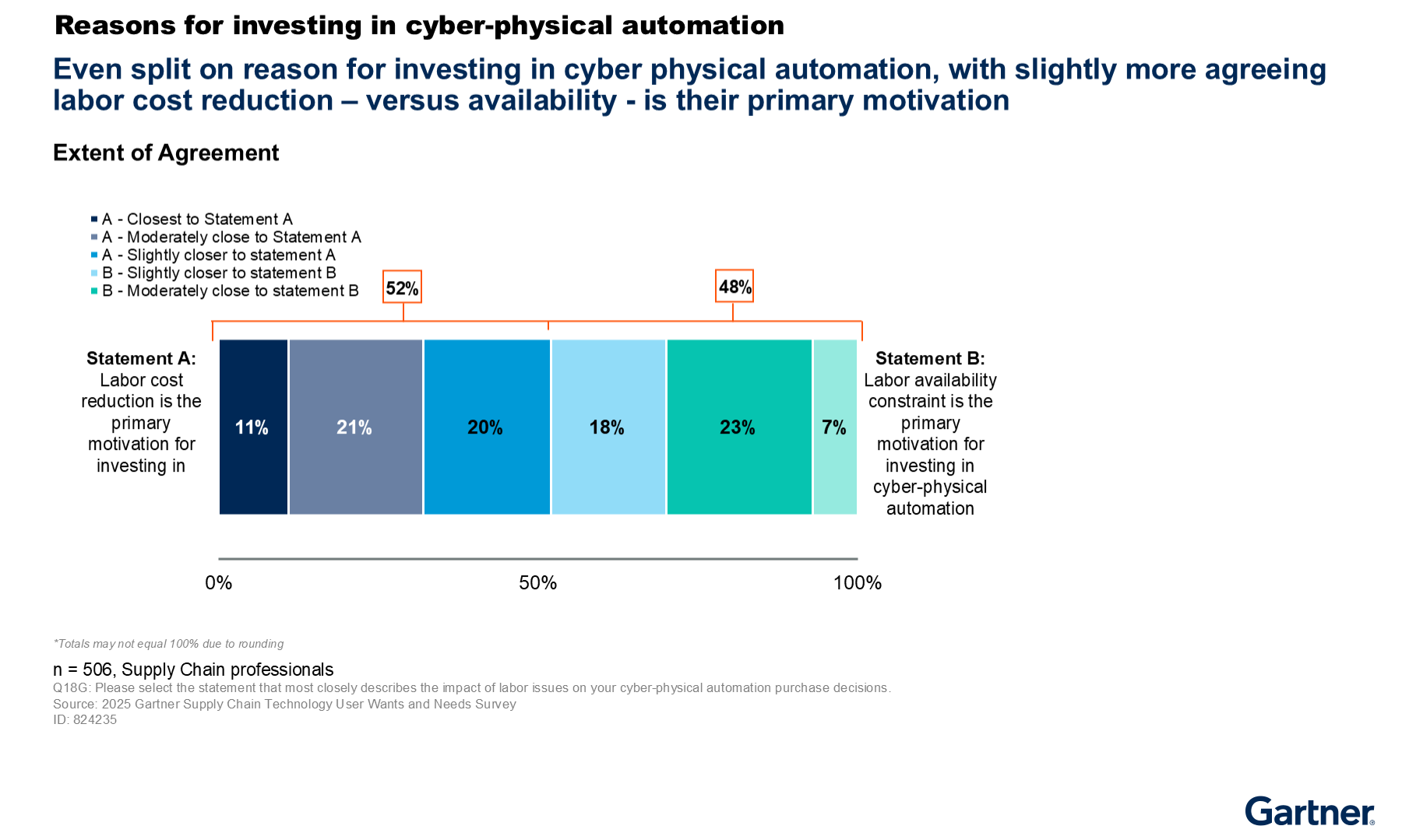
Bottom-line pressures from rising labor costs and growing labor capacity constraints, combined with all the other difficulties logistics organizations face, drive the growing demand for automation.
Even though much of today’s demand is for more flexible automation, such as ISRs, large-scale “bolted to the floor” MHA still consistently has demand for specific industries with high throughputs, such as grocery, manufacturing, and life sciences.
Other market influences include the following:
- Capital Investment Requirements: Large-scale MHA systems require significant upfront investment. This limits adoption to enterprises with high throughput and long-term operational certainty. Companies scrutinize ROI, especially during economic uncertainty, demand volatility, and/or interest rate hikes.
- Implementation Times: Planning a complex design, permitting, and construction phases can stretch to 24 months for a “greenfield.” Most MHA solutions are built from the ground up due to retrofitting challenges of older facilities that need substantial upgrades or complete rebuilds to support fixed automation. This limits large-scale MHA to companies planning new facilities.
- E-commerce and Order Complexity: Increasing e-commerce sales lead to high-throughput needs. Rapid order processing and SKU proliferation drive demand for high-density, high-speed automation solutions.
- Operating Life Span: Fixed systems require a long-term commitment to the facility, ranging from 15 to 20+ years, which is not ideal for businesses with fluctuating demand and limited long-term projections. However, well-established companies with a consistent volume of work and a long-term forecast can benefit from high throughput and high-speed warehouse operations with large-scale conventional MHA systems.
- Pace of Technological Evolution: Technology evolves faster than ever. Fixed systems, such as large-scale MHA solutions, have limited flexibility to scale or modify over time. However, this may be overcome by adopting a hybrid approach with integrated ISRs along with large-scale MHA systems. This could offset the rigidity of traditional systems.
- Vendor Lock-In and Ecosystem Strategy: Large-scale/conventional MHA systems are closed loop, locking buyers into long-term service contracts and upgrade paths. Almost all players in the market have their vendor ecosystem strategy for their solutions. While some companies prefer long-term strategic relationships with automation vendors, this may create problems from a risk mitigation standpoint in the long term. Today, one of the main reasons for the shift from traditional automation to flexible solutions such as ISRs is to avoid long-term, locked-in deals.
Market Analysis
This research considers four of the most popular broad categories of large-scale MHA solutions — Unit load ASRSs, Miniload ASRSs, Shuttle-based ASRS systems, and Vertical Lift Modules/Carousels. Other various subcategories of solutions are included within these broad categories.
- Unit Load ASRSs
- Miniload ASRSs
- Shuttle-Based ASRSs
- Vertical Lift Modules (VLMs)/Carousels
This Market Guide does not cover every large-scale MHA use case or every possible vendor, as many large-scale MHA use cases and solutions are custom-built and can vary dramatically. Supply chain leaders must identify the best-fit use cases for their organization and then select the solutions that fit them. Companies should consider their unique needs by use case, based on product types/weights/dimensions, work volumes, order types, cycle times, facility layouts, and what kinds of activities need support.
Unit Load ASRSs
Unit load ASRSs are designed to handle large, heavy items, typically stored on pallets or large containers. It uses automated cranes or shuttles to move unit loads in and out of high-density storage racks. They include storage racks, stacker cranes, conveyors, and lifts. Automated machines can move pallets horizontally and vertically to and from the storage area.
Some of the main tasks Unit Load ASRSs can fulfill are:
Automated Put-Away: Pallets are automatically stored in designated rack locations.
Automated Retrieval: System fetches pallets for shipping, sorting, or picking.
Inventory Buffering: Unit load ASRSs act as an intermediate storage between manufacturing and shipping.
Sequencing and Staging: Based on the order priority data, the system prepares orders in the correct sequence for outbound processes.
Storage Optimization: The system efficiently uses storage locations by automatically rearranging them based on demand and risk mitigation criteria.
Real-Time Inventory Management: The system can track the exact locations and quantities of products at any given time at the pallet level.
Unit Load ASRSs are best suited for:
- Manufacturing Plants: For storing raw materials, work in progress, or finished goods.
- Cold Storage: They can operate efficiently in refrigerated environments.
- Automotive Industry: For managing large parts and heavy components and sequencing pallets for just-in-time inventory management to the line.
- High Volume Distribution Centers: For high volume “pallet in-pallet out” operations.
- Food and Beverage: For automated buffer storage between processing and shipping with first expired first out (FEFO).
- Third-Party Logistics: For managing high-density multiclient pallet storage with cross-docking and transfer operations.
Miniload ASRSs
A miniload ASRS is a large-scale MHA solution designed to store, retrieve, and manage small to medium-sized items typically stored in totes, bins, trays, or boxes in high-density storage racks. Miniload solutions are generally used for totes under 80 lbs. These systems use automated cranes or shuttles to move totes in and out of storage locations. The system delivers totes directly to goods-to-person stations for further processing, such as sorting, picking, and packing.
Some of the main tasks Miniload ASRSs can fulfill are:
Automated Put-Away: Totes are automatically stored in designated rack locations.
Automated Retrieval: The system fetches totes for shipping, sorting, or picking.
Sequencing and Kitting: The system prepares orders or sub-assemblies in the correct sequence for outbound processes based on the order priority.
Storage Optimization: The system efficiently uses storage locations by automatically rearranging them based on demand characteristics and risk mitigation criteria.
Real-Time Inventory Management: The system can track exact locations and quantities of products at any given time at the case level.
Miniload ASRSs are best suited for:
- E-commerce and Retail: A High number of SKUs and fast order fulfillment needs make miniload ASRSs a good fit for busy e-commerce and retail B2B operations.
- Pharmaceutical and Healthcare: The healthcare industry has no tolerance for inaccuracies, and the high rate of accuracy of miniload systems makes them a perfect fit for this vertical.
- Electronics Manufacturing: Storing smaller parts in cases and totes for subassemblies for electronics manufacturing may be challenging. Miniload systems can increase the efficiency and accuracy of these operations.
- Fast Fashion and Apparel: The Fast Fashion and apparel industries have the highest number of constantly changing SKUs. Managing size, color, variants, and assortments efficiently requires labor and space. Miniload ASRSs can add value by handling large numbers of SKUs with seasonality and high-density vertical storage for these verticals.
Shuttle-Based ASRSs
Shuttle-based ASRSs are high-density, high-throughput warehouse automation solutions that use autonomous shuttles to move goods within storage racks. They use small robotic vehicles called shuttles that travel horizontally along storage levels within racking structures. For vertical movement, a lift or elevator moves shuttles or goods up and down.
Shuttles can move bins, totes, or cartons along tracks on each level. Generally, a shuttle is dispatched to the appropriate level and position. It retrieves a tote or bin and brings it to the lift, which brings it to a pick station or buffer. After picking, the shuttle returns the tote or moves to the next one.
Some of the main tasks Shuttle-based ASRSs can fulfill are:
Automated Put-Away: Totes are automatically stored in designated rack locations via shuttles.
Automated Retrieval: Shuttles move totes for shipping, sorting, or picking.
Order Picking/Goods to Person: Shuttles deliver items directly to pick stations, where operators or robots pick and pack orders.
Buffering and Sequencing: The system temporarily holds totes or products in a specific sequence for downstream processes such as packing, shipping, and production feeding to ensure items arrive at the right place at the right time.
Consolidation: The system gathers items from multiple storage locations for order consolidation. This is particularly useful in split case picking, where items for a single order come from different zones.
Storage Optimization: The system efficiently uses storage locations by automatically rearranging them based on demand characteristics and risk mitigation criteria. Shuttles run after hours to optimize slotting.
Real-Time Inventory Management: The system can track exact locations and quantities of products at any given time at the case and SKU levels.
Shuttle-based ASRSs are best suited for:
- E-commerce and Retail: A high number of SKUs and fast order fulfillment needs make shuttle-based ASRSs a good fit for busy e-commerce and retail B2B operations.
- Grocery and Food Distribution: This vertical’s high SKU variety, freshness, and FIFO/FEFO requirements make shuttle-based systems a good fit, especially for online grocery orders.
- Pharmaceutical and Healthcare: The healthcare industry has strict traceability and tight inventory control requirements that can be handled with shuttle-based ASRSs.
- 3PL Providers: 3PLs looking for flexibility and scalability to serve multiple clients with different product types find Shuttle-based ASRSs particularly useful.
- Fast Fashion and Apparel: Managing size, color, variants, and assortments efficiently requires labor and space. Shuttle-based ASRSs can add value by handling a large number of SKUs with seasonality and high-density vertical storage for these verticals.
Vertical Lift Modules/Carousels
VLMs and Carousels are both types of ASRSs designed to improve space utilization, increase picking efficiency, and enhance inventory accuracy.
VLMs are enclosed systems with trays stored on both sides of a central extractor. The extractor automatically retrieves the desired tray and presents it to an access point for picking or sorting.
Carousels are also enclosed systems; however, instead of having a stable rack inside, they rotate vertically or horizontally like a Ferris wheel or merry go round to put away or retrieve totes from them.
Some of the main tasks VLMs and Carousels can fulfill are:
High-Density Storage: They use vertical space to utilize the capacity.
Automated Tray Retrieval: Items are brought to the operator automatically for sorting and picking.
Secure Inventory Control: Their enclosed design limits unauthorized access to inventory. This increases inventory accuracy.
High Speed Picking: They offer efficient and high-speed picking, especially for small items.
VLMs and Carousels are best suited for:
- Defense: VLMs and Carousels are suitable for storing sensitive parts that need security and traceability.
- Automotive Parts: Storing small parts for the automotive industry, such as nuts, bolts, tools, and dies, is a great use case for VLMs and Carousels.
- Healthcare and Pharmaceutical: VLMs and Carousels offer secure and controlled access for medical devices and medications with compact storage in cleanroom environments.
- Electronics: VLMs and Carousels offer sensitive component storage for Electrostatic Discharge (ESD) protection.
Representative Vendors
The vendors listed in this Market Guide do not imply an exhaustive list. This section is intended to provide more understanding of the market and its offerings.
Vendor Selection
The following is a representative list of Large Scale Warehouse MHA vendors that support the use cases covered in this research. We profile 18 vendors in detail. However, not all MHA vendors are profiled in this research; this does not reflect the validity or viability of other vendors not profiled here. Gartner reached out to more vendors, but some declined to participate. Also, new vendors enter the market routinely, and many newer vendors have yet to establish a market presence (see Table 1).
Representative Vendors in Large-Scale Warehouse MHA
Source (Gartner September 2025)
Vendor Profiles
Beumer Group
Beumer Group did not respond to requests for information for this Market Guide. The vendor’s write-up in this Market Guide has been derived solely from publicly available information, third-party feedback, and independent research conducted by Gartner’s analysts.
Beumer Group operates in the design and manufacture of intralogistics systems for conveying, loading, palletizing, packaging, sortation, and distribution. Beumer is based in Beckum, Germany. It operates in over 70 countries, with over 1,000 Beumer sorters installed worldwide. In October 2024, the Beumer group enhanced its pouch system with an innovative autodrop feature. The same year, Beumer Group won the contract to design and install a new “CrisBag” baggage handling system at Heathrow Airport’s Terminal 2. It also completed the modernization of Changi Airport’s baggage handling system ahead of schedule. This project included mechanical and software updates, conveyors, carousels, and an early bag storage system. Its automated solutions include, but are not limited to, unit load ASRSs, miniload ASRSs, shuttle-based ASRSs, and various custom solutions. It offers automated solutions installed in various industries such as building materials, cement production, chemical industry, e-commerce, fashion, consumer goods, mining, retail, and airport baggage handling. It primarily serves the fashion, e-commerce, and retail sectors.
Daifuku
Daifuku is a global player in the material handling and automation industry. It is headquartered in Osaka, Japan, and was founded in 1937. With operations spanning 24 countries and regions, Daifuku delivers a broad portfolio of technologies designed to optimize warehouse, distribution, and manufacturing environments across multiple industries. In the United States, Daifuku operates manufacturing facilities in Hobart, Indiana, where it recently doubled its production capacity with a grand opening event held on October 2, 2025. In Southeast Asia, Daifuku maintains a strong regional footprint, including a key manufacturing site in Thailand, supporting continued growth and service to regional markets. In April 2024, Daifuku commenced renovating its core production base, Shiga Works, in Shiga, Japan. The company is expected to invest approximately $220 million through 2027. Daifuku’s ASRS solutions, including unit load systems, miniload systems, and multideep shuttle systems for pallet and tote/case handling, are deployed in fulfillment centers supporting retail, e-commerce, pharmaceuticals, and food & beverage sectors.
Dematic
Dematic is a global player in the material handling and automation industry. It is headquartered in Atlanta, Georgia, and was founded in Germany in 1819. In 2016, Dematic was acquired by KION Group, one of the leading suppliers of industrial trucks and supply chain solutions. It currently has a presence in over 35 countries, with research and development engineering centers, manufacturing facilities, and service centers in the U.S., the U.K., Australia, Germany, Austria, Belgium, Spain, Denmark, China, Brazil, Saudi Arabia, and Taiwan. The company established new offices in Saudi Arabia and Taiwan in 2024 to enhance its service capabilities in the Middle East and Asia/Pacific. Dematic offers solutions that include multishuttle systems, unit load ASRSs, miniload ASRSs, sortation, palletizing, picking, AGVs, and AMRs, all powered by Dematic software. In early 2025, Dematic introduced an AI-powered digital twin prototype at the NVIDIA GTC Conference. The key industries Dematic serves with its warehouse automation solutions are apparel, consumer goods, food & beverage, general merchandise, grocery, healthcare, manufacturing, parcel, 3PL, and wholesale B2B.
DMW&H
DMW&H is a North American player in the material handling and automation industry. It was founded in 1964 and is headquartered in Fairfield, NJ. DMW&H doesn’t have offices in other locations. It offers a full service suite from consulting and needs assessment, to system design, integration, installation, and ongoing support. DMW&H is primarily targeting the North American market. In March 2024, DMW&H announced a strategic collaboration with Movu Robotics to integrate modular robotics, such as pallet shuttles (Movu Atlas), AMRs (Movu ifollow), 3D shelving/fulfillment (Movu Escala), and picking arms (Movu Eligo) into scalable, plug-and-play warehouse systems. DMW&H is also known for its flexible and modular solutions, which include SURF dispensing system, SAIL for unit sortation, STEPS for palletizing process, AMRs, ASRSs, and indaGO warehouse execution system. It offers automated solutions primarily for industries with high throughput and growing business needs. Its top industries include wine and spirits, food distribution, retail, e-commerce fulfillment, and parcel last-mile delivery.
E80 Group
E80 Group operates in the design and manufacture of intralogistics systems for manufacturing and distribution operations. It is headquartered in Viano, Italy. E80 Group operates in Australia, Brazil, Chile, China, France, Mexico, Poland, Russia, Sweden, Thailand, the UAE, the U.K., and the USA, as it also serves customers in Japan, Spain, and other regions via global installations. It has shared new projects with Carlsberg and Barilla Spadini over the last few years. Its automated solutions include, but are not limited to, based unit load ASRSs, AGVs, Laser Guided Vehicles (LGVs), palletizers, robotic stretch wrappers, and pallet inspection systems. It offers automated solutions installed in food and beverage, paper and tissue, manufacturing, and other industries. It has deployed over 2,500 robotic systems and 6,500 automatic laser-guided vehicles worldwide.
Fives
Fives is a material handling and automation solutions provider, headquartered in Paris, France. However, its Smart Automation Solutions Division has over 20 locations in Europe, North America, and Asia, and employs 2,000 people. Its offerings encompass various technologies designed to optimize warehouse and manufacturing operations. In 2023, Fives supported DHL’s growth in the U.K., equipping its new 25,000 sqm parcel hub with an automated sorting system capable of sorting 56,000 items per hour. In 2024, it automated Carrefour’s order picking platform for fresh produce with a complete solution including proprietary warehouse management software solutions (WMS/WES) and a high-capacity cross-belt sorter that can sort up to 8,500 parcels per hour. Fives offers various automated solutions such as sorters and singulators, conveyors, AMRs, shuttle-based ASRSs, and depalletizing solutions. Its warehouse automation systems are deployed in postal and courier facilities, e-commerce, retail, fast-moving consumer goods, airports, and general manufacturing.
FORTNA
FORTNA is a global system integrator that designs, implements, and supports intelligent warehouse and distribution solutions. Headquartered in Atlanta, Georgia, the company blends consultative operational expertise with advanced automation, robotics, and intelligent software, supported by AI, to enable organizations to optimize its operations.
FORTNA focuses on parcel/post and distribution and fulfillment omnichannel solutions that serve customers across diversified sectors, including parcel, retail, apparel, industrials, aftermarket parts, food and beverage, healthcare, and 3PLs. It has hundreds of implementations across North America, Europe, and South Africa.
Its portfolio includes automation and software technologies such as sortation and conveyor systems, shuttle — and crane-based AS/RS, robotics, and intelligent software, including WCS, WES, and OptiSlot. It has strategic alliances with AutoStore, Hai Robotics, Geekplus, and Rockwell Automation.
Honeywell Intelligrated
Honeywell Intelligrated is a North American player in the material handling and automation industry, headquartered in Mason, Ohio. Its primary markets are North and South America, Europe, and China. In March 2025, Honeywell partnered with Corvus Robotics to power its drones, which are used to automate inventory tracking with Honeywell software. The same year, Honeywell teamed up with Hai Robotics, integrating its autonomous shuttle systems (HaiPick and HaiPick Climb) with the Momentum WES, which is Honeywell’s real-time orchestration platform for robots, conveyors, and other agents. Its automated solutions include, but are not limited to, unit load pallet ASRSs, miniload ASRSs, shuttle-based ASRSs, and various automation components such as conveyors and sortation systems. Honeywell Intelligrated offers automated solutions primarily for industries with high throughput and high-density storage needs. Its top industries include aerospace, government and public sector, healthcare, life sciences, retail, and manufacturing.
Kardex Group
Kardex is a global provider of automated storage, retrieval, and material handling solutions. In the Americas, its two divisions — Kardex Remstar and Kardex Solutions — work hand in hand to deliver a range of intralogistics systems tailored to customers’ needs. Its portfolio includes Vertical Lift Modules (VLMs), Vertical and Horizontal Carousel Modules, Vertical Buffer Modules, AutoStore Cube-Based Robotic Systems, and Inventory Management Software Solutions. With expertise in system integration, Kardex incorporates these products into fully customized solutions that optimize efficiency, space utilization, and throughput across the supply chain. It serves various industries, including wholesale, retail, e-commerce, energy, mining, automotive, chemicals, electronics, food and beverages, tires, pharmaceuticals, and manufacturing.
KNAPP
KNAPP is a global material handling and automation solutions provider with an extensive software, robotics, and mechatronics portfolio. It was founded in 1952 and headquartered in Hart Bei Graz, Austria. Its offerings encompass various technologies designed to optimize warehouse and manufacturing operations. It has 49 offices globally, over 2,000 installations, and over 8000 workers. In 2025, KNAPP introduced its new Aerobot warehouse robotic system, designed to maximize storage density while offering the flexibility of grid-based robotic systems. KNAPP also offers shuttle-based ASRS, shuttle-based unit load ASRS, and crane-based miniload ASRS systems. Its warehouse automation systems are deployed in various industries, including but not limited to healthcare, fashion, retail, food and beverages, manufacturing, and wholesale.
Lödige Industries
Lödige Industries did not respond to requests for information for this Market Guide. The vendor’s write-up in this Market Guide has been derived solely from publicly available information, third-party feedback, and independent research conducted by Gartner’s analysts.
Lödige Industries is a global company that offers warehouse automation solutions. It is based in Scherfede, Germany. It has office locations in Australia, Canada, China, Denmark, Great Britain, Greece, Ireland, KSA, Malaysia, Oman, Poland, Qatar, Romania, Singapore, Switzerland, the Netherlands, Türkiye, UAE, and the USA, with over 1,000 installations worldwide. Lödige Industries offers a variety of crane-based solutions, including miniload and unit load ASRS solutions, sortation systems, air freight handling, baggage handling, and it is also a specialist in goods lifts and freight lifts with a few different options such as Sherpa, Escorta, and Olympus. In 2023, Lödige Industries announced an expansion of its production site in Brașov. The same year, it provided HK Electric with an automated storage system for cable drums. Lödige Industries serves various sectors, including air cargo and airports, automated car parking, manufacturing, warehousing, and healthcare.
SSI Schaefer
SSI Schaefer did not respond to requests for information for this Market Guide. The vendor’s write-up in this Market Guide has been derived solely from publicly available information, third-party feedback, and independent research conducted by Gartner’s analysts.
SSI Schaefer operates in the design and manufacture of intralogistics systems for conveying, loading, palletizing, packaging, sortation, and distribution. It is headquartered in Neunkirchen, Germany. SSI Schaefer is active in six regions: APAC & MEA, Northern Europe, Central Europe, Southern Europe, North America, and Latin America. SSI Schaefer offers all five solutions covered in this market guide: crane-based miniload and unit load ASRSs, shuttle-based ASRSs, VLMs, and carousels. In 2025, SSI Schaefer implemented a fully automated logistics center using its “Cuby Shuttles” for Apotea, Sweden’s largest online pharmacy. The same year, it partnered with Liebherr to design and deliver a customized intralogistics solution for a new logistics hub in Tupelo, Mississippi. It offers automated solutions in apparel and fashion, food and beverage, grocery, pharma, cosmetics, industrial, appliances, retail, and wholesale industries. It also provides automated solutions for manufacturing plants.
Swisslog
Swisslog is a global logistics automation company headquartered in Buchs/Aarau, Switzerland. It has over 2,500 installations globally. As part of the KUKA Group, Swisslog employs over 3,000 people at more than 30 locations worldwide. Swisslog designs, manufactures, and optimizes automated logistics solutions across the supply chain, supported by its SynQ software platform. Its offerings include solutions for light and palletized goods, as well as mobile robotics for transportation and order fulfillment. Swisslog is also an integrator of AutoStore systems. In 2025, Swisslog partnered with Medline in Aurora for its logistics center for an Autostore system supported by Swisslog’s SynQ software. The same year, Swisslog partnered with Rockwool, the global leader in stone wool insulation, for a fully automated high-bay warehouse in Neuburg an der Donau. Swisslog provides consulting, concept studies, project implementation, and customer service services tailored to specific customer needs. Its warehouse automation systems are deployed in various industries, including but not limited to e-commerce, retail, food and beverages, pharmaceuticals, manufacturing, and wholesale.
System Logistics
System Logistics did not respond to requests for information for this Market Guide. The vendor’s write-up in this Market Guide has been derived solely from publicly available information, third-party feedback, and independent research conducted by Gartner’s analysts.
System Logistics is a material handling automation company that offers various automated solutions. It is based in Modena, Italy. It has office locations in the Americas, Europe, Africa, APAC, and the Middle East. System Logistics offers a variety of stacker crane-based solutions, including miniload and unit load ASRS solutions, shuttle-based ASRS, VLMs, and carousels. In 2025, System Logistics’s Modula line, an advanced carousel system, teamed up with Bonfiglioli to integrate gear motors and inverters, where each Modula lift tray can handle 60 tons of payload. In 2024, it announced an extension of its partnership with Italian snack manufacturer Fiorentini Alimentari for more automated solutions for its logistics. System Logistics serves diverse sectors, including food and beverage, grocery, cold chain, manufacturing, pharmaceuticals, retail, and e-commerce.
TGW Logistics Group
TGW Logistics Group is another global player in the material handling and automation industry, headquartered in Marchtrenk, Austria. It operates globally in logistics and factory automation with locations in Europe, China, North America, South Korea, Türkiye, and the United Kingdom. It has installed over 20,000 “Stingray” shuttles globally. It installs around 160 km of conveying systems annually with its patented “King Drive” rollers. Its automated solutions include, but are not limited to, crane-based unit load ASRSs, crane-based miniload ASRSs, shuttle-based ASRSs, and various automation solutions such as ROVOFLEX, a transport AMR that can also be used for storage and retrieval. In 2025, TGW Logistics Group rolled out a new system for JAKO, the sports apparel company. The same year, the Italian fashion retailer OVS selected TGW for its automation project. TGW Logistics Group offers automated solutions primarily for industries with high throughput and high-density storage needs. Its top industries include fashion and apparel, grocery, industrial goods, consumer goods, and e-commerce.
Toyota Industries Corporation (TICO)
Toyota Industries Corporation (TICO) has strategically acquired several automation companies to strengthen its logistics and material handling industry position. Notable acquisitions include Bastian Solutions and Vanderlande in 2017 and viastore in 2022. These companies now operate under the Toyota Automated Logistics Group (TALG), providing integrated automated material handling solutions. It is headquartered in Takahama city, Japan. However, it is in Europe, North America, and Asia, offering services globally. TALG provides solutions based on its own Functional modules, like crane-based miniload and unit load ASRSs, shuttle-based ASRSs, Conveyors, robotics, and VLMs. It offers automated solutions in retail, e-commerce, food and beverage, automotive, manufacturing, pharmaceuticals, and 3PLs.
Witron
Witron did not respond to requests for information for this Market Guide. The vendor’s write-up in this Market Guide has been derived solely from publicly available information, third-party feedback, and independent research conducted by Gartner’s analysts.
Witron is a material handling and automation solutions provider, headquartered in Parkstein, Germany. Its automated solutions encompass various technologies designed to optimize warehouse and manufacturing operations. It has offices in Europe, Canada, the U.K., Australia, Singapore, and the USA, and over 100 projects in 13 countries. Witron offers various automated solutions such as crane-based miniload, unit load ASRS, and shuttle-based ASRSs. In 2025, Witron partnered with Axfood and launched a state-of-the-art omni-channel distribution center near Stockholm. The same year, it signed a contract with TJ Morris for an automated facility in Doncaster, U.K. Its warehouse automation systems are deployed in various industries, including but not limited to grocery, food retail, discount retail, wholesale, consumer packaged goods, pharmaceutical, and healthcare.
Stöcklin Logistik
Stöcklin Logistik is an international warehouse automation solutions provider headquartered in Laufen, Switzerland. The company maintains offices in the USA, Mexico, Germany, the Netherlands, France, Slovenia, and the Czech Republic, and has completed more than 2,500 installations worldwide.
Its portfolio includes end-to-end intralogistics systems such as crane-based miniload and unit-load ASRS, shuttle systems, case picking depalletizers, and autonomous mobile robots, including fully automated forklifts.
In 2025, Stöcklin Logistik delivered a fully automated shuttle solution for Luxembourg’s largest food retailer. The company is also collaborating with the Royal Library of the Netherlands on a customized five-aisle channel storage system designed to handle more than 260,000 containers and integrate conveyor and control technology for millions of printed materials.
Stöcklin Logistik supports various sectors, including automotive, pharmaceuticals, manufacturing, and other industries.
Market Recommendations
- Identify areas in your operation with growth opportunities and define specific goals for cost reduction, throughput increase, labor savings, and space optimization.
- Quantify pain points such as picking errors, labor turnover, speed, and productivity.
- Align your logistics and automation goals with your organization’s long-term growth, not just short-term ROI.
- Understand your operational profile and limitations, such as distribution model, order profiles, volumes, fluctuations, facility constraints, safety, and regulatory restrictions.
- Evaluate technology fit by use cases. While some solutions are better for high throughput case picking (such as shuttle systems), some have better performance for each picking (such as Goods-to-person and pick walls)
- Plan your project as early as possible and manage the change by communicating role and flow changes transparently to reduce resistance.
- Vet your partner for automation carefully by asking industry references, past installations, and uptime metrics.
- Phase deployment over time to maximize ROI and ramp up as your demand requirements change.
- Pilot extensively and proceed with caution if your volume fluctuates often.
- Engage specialized consultancies that have experience with MHA systems. You will unlikely have the internal expertise to pursue this solely within your organization. But do not assume specialist knowledge in these systems from traditional MHE vendors or SIs. Please see Market Guide for Warehouse Automation Partners.
- Collaborate with these organizations to model various alternatives — from simple and minimal automation to higher levels of automation — considering value, risk, cost, time to value, and adaptability.
1 Automated Material Handling Equipment Market Size, Share & Trends, MarketsandMarkets.
2 2025 Gartner Supply Chain Technology User Wants and Needs Survey. This survey aimed to investigate the roles of digital and technology in supply chains. It also aimed to assist supply chain technology leaders in their efforts to modernize legacy application landscapes and create credible business cases for their digital transformations. Additionally, it examined how supply chain organizations are structuring themselves to support digital initiatives and their evolving perspectives on effectively leveraging emerging technologies within their supply chain organizations. The survey was conducted online from 16 October through 6 December 2024 among 506 respondents from North America (n = 153), Western Europe (n = 162), Asia/Pacific (n = 111) and Latin America (n = 80). Respondents were from organizations with $250 million or more in 2023 enterprisewide annual revenue. Industries surveyed included manufacturing (consumer products, industrial, high-tech, life sciences and healthcare), retail, transportation and logistics, and wholesale trade. Qualifying respondents had job roles tied to supply chain function and were involved in decision making regarding supply chain management processes or operations. Disclaimer: The results of this survey do not represent global findings or the market as a whole, but reflect the sentiments of the respondents and companies surveyed.
Note 1: Gartner’s Initial Market Coverage
This Market Guide provides Gartner’s initial coverage of the market and focuses on the market definition, rationale for the market and market dynamics.