Magic Quadrant for Real-Time Transportation Visibility Platforms
ARCHIVED
24 February 2025 - ID G00814199 - 30 min readBy Carly West, Oscar Sanchez Duran, and 1 more
Real-time transportation visibility continues to be a key priority for shippers, logistics providers and their customers. Supply chain technology leaders can use this research to gain insight on current market trends and vendors in the real-time transportation visibility platform market.
Market Definition/Description
Gartner defines the real-time transportation visibility platform (RTTVP) market as platforms that provide real-time location and status insights into orders once they have left the warehouse. This includes other facilities, such as those of a brand owner, supplier, contract manufacturer or service provider. Such platforms, owned and managed by third-party software vendors, represent part of the supply chain visibility market that predominantly — but not solely — addresses domestic road transportation modes. RTTVPs obtain data through integration (via API or electronic data interchange [EDI], for example) with carrier systems, direct feeds from telematics (in-cab or in-trailer devices) or other technologies or apps.
RTTVPs are used to gain near-real-time status and location of shipments in transit, along with predictive estimated times of arrival. This information can be used internally, as well as externally, to inform and update both types of customers related to shipments delays, estimated times of arrival (ETAs) and statuses. The use cases may vary based on the type of organization and the complexity of their transportation network. Typical complexity levels or use cases are:
Level 1 Complexity
Level 1 RTTVP complexity applies to situations where companies need visibility in one region for only one mode of transportation.
Level 2 Complexity
Level 2 RTTVP complexity occurs when a company needs visibility to multiple modes managed from a single region.
Level 3 Complexity
Level 3 RTTVP complexity occurs when a company needs visibility in multiple regions across multiple modes.
Level 4 Complexity
At Level 4 RTTVP complexity, a company needs global visibility across all modes.
Level 5 Complexity
In Level 5 RTTVP complexity, companies are getting global visibility into all modes and utilizing all advanced capabilities within the platform.
Mandatory Features
The must-have capabilities for this market include:
- A sellable and implementable stand-alone RTTVP product.
- Road transport visibility among other modes.
- Basic tracking — Shipment location and status in transit
- Messaging/alerts — Notifications for delays and status changes
- Predictive ETA — Algorithm to predict ETA using live and historical in-transit information with external factors like traffic and weather independent of provided ETA from other parties, for example
Common Features
The optional capabilities for this market include:
- Order capture — Capturing order and shipment information from host systems, like a transportation management system (TMS), an ERP, or a warehouse management system (WMS)
- Data cleansing/data compliance — Monitoring data for accuracy, completeness, consistency, reliability and timeliness
- Dashboards — Different views of data and reporting for user ease
- Carrier networks/integration — Direct integration to carriers for tracking information, independent of devices or mobile applications
- Advanced analytics and reporting
- Networked visibility
- Collaboration
- Predictive insights
- Sustainability calculations
Magic Quadrant
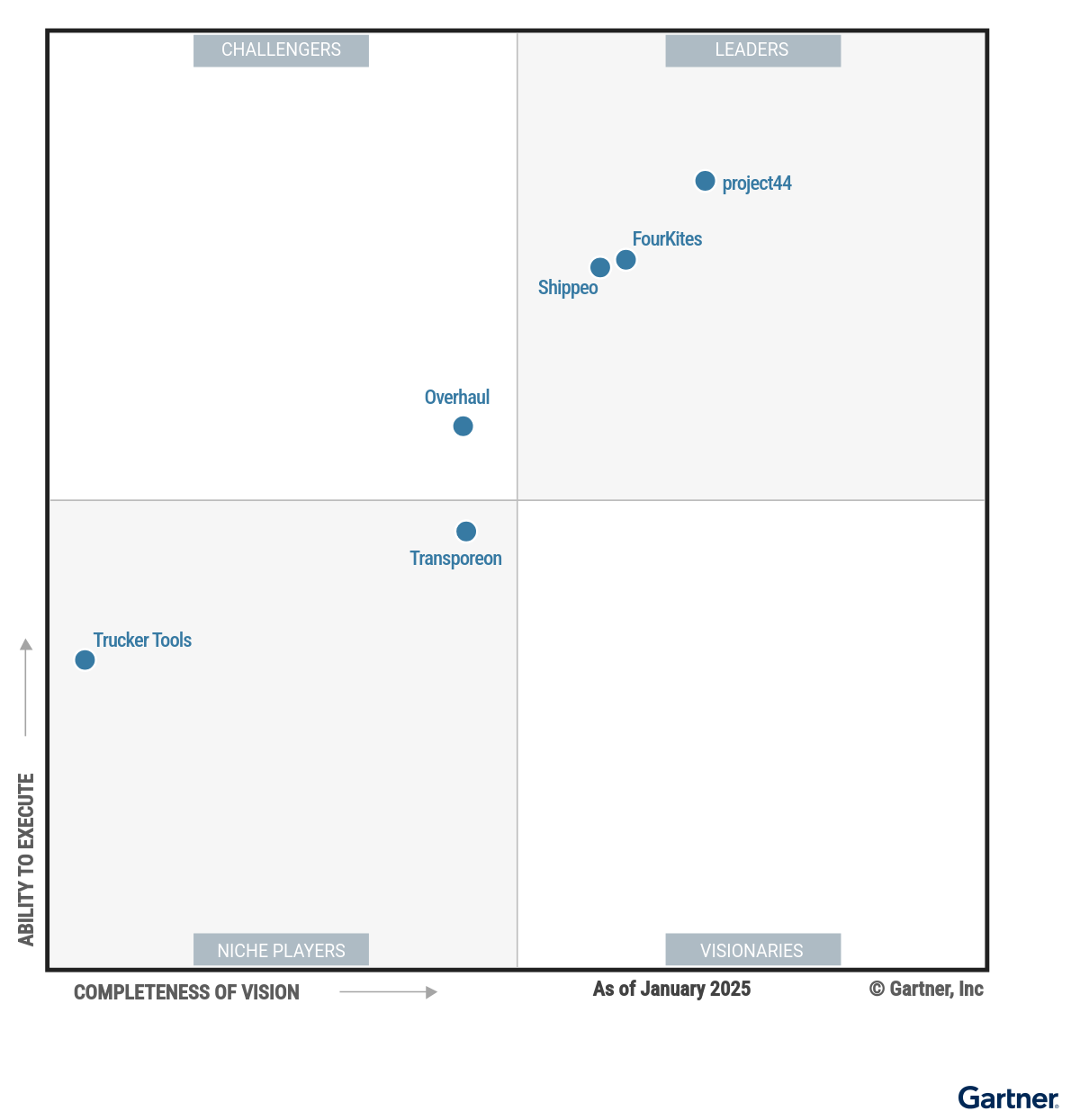
Vendor Strengths and Cautions
FourKites
FourKites is a Leader in this Magic Quadrant. The FourKites platform provides visibility across all shipping modes and also extends beyond transportation visibility by offering several extended capabilities. It has a strong presence in North America and Europe, with some customer presence in other regions. It has customers in many industries, with a large presence in the food and beverage, consumer packaged goods (CPG), chemicals, manufacturing, paper and packaging, pharmaceuticals, and retail industries. Recent and planned innovations include improvements in tracking quality and reliability and AI initiatives for workflow and task automation.
- Offering (product) strategy: FourKites’ product goes beyond providing all the core capabilities of an RTTVP by offering a large carrier network and many extended capabilities. Some of these capabilities include order and inventory visibility, late reason code, network visibility for inbound shipments and dynamic yard management.
- Operations: FourKites reports longer-than-average staff tenure periods across many departments in the organization. This could correlate to more industry expertise, understanding of customer challenges and stability for customers over time.
- Overall viability: FourKites remains one of the largest RTTVP vendors in terms of revenue, number of customers and geographic reach. Its recent focus on financial management has paid off, as the company turned profitable in 2024 and reported positive cash flow with zero debt.
- Sales strategy: FourKites grew at a slower-than-average rate in 2024, compared with some of its competitors, although it remains one of the largest RTTVP vendors.
- Customer experience: The vendor has undergone efforts to streamline and improve support in this evaluation period. However, Gartner’s client inquiries and Gartner Peer Insights reviews indicate that some FourKites users have reported unsatisfactory experiences with its service and support for technology deployment and live operations. As with any RTTVP, prospects and users should clearly understand their role in ensuring data quality and consistency as the contract owners with logistics service providers (LSPs).
- Sales execution/pricing: FourKites reports fewer partnerships with resellers, systems integrators (SIs) and consultants, compared with other vendors in this research. This limited utilization of resellers and consultants to promote and implement its solution could impact growth in the future.
Overhaul
Overhaul is a Challenger in this Magic Quadrant. The Overhaul platform offers a combination of transportation visibility and risk management capabilities across all shipping modes. Its solution provides actionable insights that focus on anticipating and preventing risks associated with movement of goods. It has a primary presence in North America and Europe, with some customer presence in South America and Asia. Overhaul has customers in many industries, including high tech/consumer electronics, life science/pharmaceuticals, retail and LSPs. Recent and planned innovations include the use of generative AI (GenAI) and risk intelligence for advanced pattern detection to identify shipments that need urgent attention, and a prescriptive analytics suite to provide network visibility.
- Offering (product) strategy: Overhaul continues to have a unique approach to minimizing and preventing risks for in-transit transportation movements. Its platform provides capabilities that go beyond transportation visibility, including risk prevention, compliance and insurance.
- Product or service: Overhaul offers market-leading risk management capabilities. It is the only vendor in this research that offers specialized security services. Overhaul connects with insurance companies and police departments in some countries to provide an extra level of protection for high-value shipments and opportunities to reduce insurance costs.
- Vertical/industry strategy: Overhaul continues to attract new customers both within its key industries and in new verticals, such as industrial manufacturing, automotive and wholesale distribution. The vendor effectively blends product capabilities, industry partnerships and channel partners to deliver tailored, industry-specific solutions.
- Sales execution/pricing: Overhaul’s subscription costs are higher than some of its competitors. Potential customers should evaluate whether the higher costs are acceptable, based on Overhaul’s unique capabilities.
- Geographic strategy: Overhaul has a relatively small presence in Asia and South America, compared with other vendors in this research, as it focuses on reaching more customers in North America and Europe.
- Overall viability: Overhaul has not yet achieved its near-term target of becoming profitable, despite strong revenue and customer acquisition in 2024.
project44
project44 is a Leader in this Magic Quadrant. Its platform leverages an API-first approach to build network and carrier connectivity, providing a visibility platform that includes a large multimodal network. It provides real-time information, ETAs and predictive insights across all shipping modes. Most of its customers and operations are in North America and Europe, with some presence in the Asia/Pacific (APAC) and other regions. project44 has customers in many industries, with a large presence in LSP, industrial manufacturing and retail. Recent and planned innovations center around AI, including bots, agents, task and exception management automation, and data quality enhancements, along with expanded reports and dashboards.
- Innovation: project44 invests a relatively high amount of its RTTVP technology revenue in research and development, compared with other vendors in this research, and it has a large number of dedicated RTTVP development engineers. It has a strong product roadmap for 2025 and completed the largest percentage of 2024 product roadmap items, compared with the other vendors in this research.
- Offering (product) strategy: project44’s platform provides all core RTTVP capabilities and many extended capabilities. Its network is one of the largest, with an extensive carrier network and partner network, and one of the highest volumes of shipments being tracked annually.
- Sales execution/pricing: project44 is one of the largest RTTVP vendors in terms of total revenue and revenue growth in 2024, and number of customers and presence in deals.
- Customer experience: Within Gartner client inquiries, some users expressed concerns about project44’s shipment tracking quality and consistency. Although customer feedback has improved year over year, prospects and users should clearly understand their role in ensuring data quality and consistency as the contract owners with LSPs.
- Operations: project44 reports below-average employee tenure, compared with other vendors in this Magic Quadrant.
- Overall viability: project44 is not yet profitable, despite strong revenue and customer numbers.
Shippeo
Shippeo is a Leader in this Magic Quadrant. The Shippeo platform facilitates collaboration between shippers, third-party logistics companies (3PLs) and carriers across all shipping modes, with an emphasis on data quality and ETA accuracy. Shippeo’s customers are mostly in Europe, but it has expanded in other regions such as North America, APAC and the Middle East. Shippeo has presence in industries such as retail, industrial manufacturing, LSP, automotive, CPG and chemicals. Recent and planned innovations include disruption alerts and risk management dashboards, a road-tracking reliability index to improve the quality and completeness of location data, and enhancements to ETA predictions.
- Product or service: Shippeo’s focus on data quality has become a key differentiator for its platform, as it ensures highly accurate ETA predictions and has created a foundation for further automation capabilities. The platform provides multiple dashboards and analytics tools to quantify the impact of data quality issues, identify the root cause of those issues and provide suggestions on how to resolve them.
- Business model: Shippeo has focused on data quality in recent years, which has become a key differentiator of its product. This establishes a strong foundation now that the vendor is moving to provide further automation capabilities.
- Market responsiveness and record: Shippeo has a strong track record for delivering on business objectives and metrics when it comes to predicting ETAs. Shippeo remains the only vendor in this Magic Quadrant offering contractual SLAs on ETA accuracy, tracking accuracy and carrier onboarding.
- Overall viability: Shippeo has not yet become profitable, despite continuing to show strong revenue and customer growth.
- Marketing execution: Despite Shippeo’s increased marketing budget, its brand recognition outside of Europe lags the other Leaders in this research. This is demonstrated by lower web traffic, social media followers and search queries.
- Geographic strategy: Shippeo continues to trail the other leaders in this research when it comes to overall geographic reach. In 2024, it continued to dominate in Europe and grew in North America in terms of revenue and number of customers; however, it has yet to establish a sizable presence in other regions.
Transporeon
Transporeon, a Trimble company, is a Niche Player in this Magic Quadrant. The Transporeon platform provides real-time data, ETAs and predictive insights on all shipping modes, excluding rail (outside of Europe) and parcel air. Transporeon offers complementary products in areas such as transportation and yard execution, sustainability, freight audit, and freight procurement. Most of Transporeon’s customers and operations are in North America, Europe and the APAC region, with some presence in other regions. Its customers span many industries, with the largest presence in industrial manufacturing, CPG, petrochemicals and high tech/consumer electronics. Recent and planned innovations center around AI to support predictive analytics, model coverage and user interface (UI) improvements.
- Offering (product) strategy: Transporeon offers a wide range of functionality, including transportation execution, sourcing, freight audit and yard management, to support both shipper and carrier/private fleet transportation.
- Vertical/industry strategy: Transporeon has a presence in many industries, including CPG, industrial manufacturing, high tech and petrochemicals.
- Overall viability: Transporeon is one of the few RTTVP vendors that has a track record of profitability over the past several years.
- Product or service: Transporeon does not offer visibility into air parcel and rail transportation outside of Europe. Prospects and customers that need visibility into these modes should plan to supplement with an additional platform or seek an alternative.
- Geographic strategy: Transporeon has been relatively slow to expand in Central and South America compared to other vendors in this research, as its sales approach has focused on growth in North America and Europe.
- Sales execution/pricing: In 2024, Transporeon’s RTTVP-specific growth — in terms of new customer deals and revenue — was smaller than some vendors in this research. This is partly driven by the vendor’s approach to bundling products and capabilities together. Visibility is often sold in combination with other offerings.
Trucker Tools
Trucker Tools is a Niche Player in this Magic Quadrant. Its platform provides visibility into brokered loads through the use of an app for drivers. It offers load board and capacity tools to help brokers find truckload capacity information and load booking. Trucker Tools offers visibility into only over-the-road (OTR) truckload shipments and operates in North America, with a small presence in Central America. Its customer base is mostly LSPs, with a small presence in industrial manufacturing, CPG and wholesale industries. Recent and planned innovations include a fraud toolkit, revamped load track interface, text-to-track improvements and expanded carrier sourcing.
In December 2024, Trucker Tools was acquired by DAT Freight & Analytics.
- Market understanding: Trucker Tools focuses on drivers, and the driver experience is a differentiator for the company. Its platform includes an app with more than 20 tools that deliver benefits to drivers. Trucker Tools also provides better visibility into brokered loads compared to some vendors.
- Product or service: Trucker Tools continues to have a unique, OTR focus on maximizing truckers’ asset utilization. The platform also enables capacity sourcing and digitizes all carrier interactions to help brokers.
- Business model: Trucker Tools focuses on owner operators and small-to-midsize carriers, primarily in North America. It has one of the largest carrier networks in this segment of the market.
- Offering (product) strategy: Trucker Tools focuses primarily on brokers and LSPs and does not provide capabilities for intermodal, rail, parcel and last mile. Prospects and customers who are in other industries and need visibility into these modes should plan to supplement with an additional platform or seek an alternative.
- Geographic strategy: Trucker Tools’ customer base and operations are primarily in North America. It has a small presence in Latin America, but no customers or carriers in any other regions. Prospects and customers outside North America and Central America should seek alternatives until Trucker Tools expands into their region.
- Operations: Trucker Tools has the fewest shipper customers, compared with other vendors in this research. Its presence is highly concentrated in the third-party logistics (3PL), broker and carrier industries, because most of its customers are LSPs. It has developed tools to support this niche market, but has yet to expand its capabilities to meet the needs of customers in other industries.
Vendors Added and Dropped
We review and adjust our inclusion criteria for Magic Quadrants as markets change. As a result of these adjustments, the mix of vendors in any Magic Quadrant may change over time. A vendor's appearance in a Magic Quadrant one year and not the next does not necessarily indicate that we have changed our opinion of that vendor. It may be a reflection of a change in the market and, therefore, changed evaluation criteria, or of a change of focus by that vendor.
Added
- Transporeon
Dropped
- Blume Global was dropped from this Magic Quadrant due to a lack of publicly available information to make an inclusion determination or score its Ability to Execute and Completeness of Vision.
- IntelliTrans was dropped from this Magic Quadrant due to not meeting the inclusion criteria for carrier network size.
Inclusion and Exclusion Criteria
To be included in this year’s RTTVP Magic Quadrant, a vendor must offer the following:
- A credible, stand-alone RTTVP product, live customers and vision for shipper and non-asset-based 3PL. The RTTVP must include at least domestic transportation visibility, analytics, transportation management system (TMS) integration, a solid carrier network, basic tracking, messaging/alerts, predictive ETA, data cleansing and dashboards.
- Gartner evaluates vendors’ support for the following shipping modes — over-the-road full truckload (FTL) and less than truckload (LTL), rail, intermodal, barge, small package, ocean, air, and private and dedicated fleet.
- RTTVP market presence: An RTTVP that is sold as a stand-alone, self-serve application and is used by the buyer, independent of other services offered by the vendor.
- Global presence: The vendor must meet all of the following criteria:
- RTTVP customer references in at least two of the following geographic regions: North America; Central America; South America; Europe, the Middle East and Africa (EMEA); and the APAC region.
- Twenty or more RTTVP customers outside of its home geographical region.
- Ability to implement and support customers in those other regions.
- Carrier network: Ten thousand or more carriers connected to its network, with at least 5,000 of the carriers being connected through direct integration to carriers, not solely by use of the vendor’s mobile application, other Internet of Things (IoT) device connections or web portal.
- Cross-industry presence: New and existing RTTVP customers in five or more industries. Examples include 3PL/logistics services, consumer goods, retail, wholesale distribution, high tech, oil and gas, aerospace and defense, automotive, chemicals, life sciences/medical devices, healthcare, and industrial products.
- Vendor momentum and sustainability criteria based on revenue, subscription or customer growth: The vendor must meet one of the following criteria:
- Previous fiscal year combined RTTVP subscription and service revenue of greater than $10 million.
- Current subscription and service revenue of greater than $5 million and a three-year compound annual customer and revenue growth rate of at least 25%.
- Number of shipments: The vendor must have 2 million or more shipments transacted on its RTTVP in 2023, and more than 3 million tracked from 1 January through 30 August 2024.
- Current RTTVP customers: The vendor must meet all of the following criteria:
- Must have at least 50 live RTTVP customer** references independently and holistically using the RTTVP stand-alone solution being evaluated. Those should have contracted the RTTVP stand-alone solution for evaluation in this Magic Quadrant, either as stand-alone software or as part of an application bundle. Customers using other products and leveraging the RTTVP capabilities as a free add-on shall not be included in the customer count.
- At least 10 new live paying customers** sold and closed in 2024.
** A customer is defined as a single legal entity who holds a contractual agreement for use of the system directly with the vendor. The customer independently and holistically uses the RTTVP stand-alone solution being evaluated. This does not include customers using other products sold by the vendor and getting visibility as a free add-on. Gartner does not count customers of reseller partners or service provider clients for the purpose of this MQ.
Due to end-user demand for evaluations of other significant vendors’ RTTVP offerings, we also consider inclusion of RTTVP vendors that meet the following criteria, even if the offering does not meet the initial RTTVP-specific criteria:
- Unique and compelling market position in a specific vertical industry or geography: The vendor must have a unique, compelling and differentiated market position in a specific vertical industry or geography, where this differentiation is important to buyers. New customer win rates, vendors appearing in Gartner client inquiries in these industries or geographies, explicit vendor focus in these industries or geographies, client references, and the vendor’s reputation in the industry or geography were also considered. These vendors must also meet the revenue and number-of-customer criteria.
This Magic Quadrant does not include other stand-alone transportation-related software applications (such as track-and-trace solutions, telematics solutions and TMS solutions).
This Magic Quadrant does not include any vendor that does not sell RTTVP as a stand-alone solution. If a vendor sells RTTVP in addition to other technology offering or services, they will only be considered if they sell RTTVP as a stand-alone solution and meet all the inclusion criteria for that solution alone.
Evaluation Criteria
Ability to Execute
Gartner analysts evaluate providers based on the quality and efficacy of their processes, systems, methods or procedures. This evaluation seeks to determine the extent to which they enable the technology provider’s performance to be competitive, efficient and effective, and to positively impact revenue, retention and reputation within Gartner’s view of the market.
Ability to Execute Evaluation Criteria
| Evaluation Criteria | Weighting |
|---|---|
Product or Service | High |
Overall Viability | Medium |
Sales Execution/Pricing | High |
Market Responsiveness/Record | Medium |
Marketing Execution | Medium |
Customer Experience | High |
Operations | High |
Source: Gartner (February 2025)
Completeness of Vision
Gartner analysts evaluate providers on their ability to convincingly articulate logical statements. This includes statements on current and future market direction, innovation, and customer needs and competitive forces, and how well they map to Gartner’s view of the market.
Completeness of Vision Evaluation Criteria
| Evaluation Criteria | Weighting |
|---|---|
Market Understanding | High |
Marketing Strategy | Low |
Sales Strategy | Medium |
Offering (Product) Strategy | High |
Business Model | Medium |
Vertical/Industry Strategy | High |
Innovation | High |
Geographic Strategy | High |
Source: Gartner (February 2025)
Quadrant Descriptions
Leaders
Leaders have a compelling vision and a reliable Ability to Execute. Leaders in the RTTVP market have broad, deep and differentiated functionality that addresses a broad range of user requirements. These vendors have proven products and track records of customer success, and have demonstrated momentum in growing their market presence. Leading vendors support transportation visibility strategies for large customers with substantial freight volumes, as well as demonstrate their ability to deploy their solutions to smaller shippers. Leaders should also offer adaptable technical architectures that allow for rapid innovation, which is needed to stay ahead of market demands.
Leaders are innovators with compelling strategies for addressing the ongoing market changes related to the emergence of new technologies, expanded model support and support for global transportation operations. Leaders are also furthest ahead in supporting the transportation needs of multiple geographies and adding capabilities to support the more complex needs of multileg global logistics and transportation. Leaders listen to their customers; but, just as importantly, their customers look to them for thought leadership, and they establish symbiotic relationships.
Key characteristics:
- Broad and deep RTTVP offering
- Participation in a high percentage of new deals
- A strong and consistent track record
- Consistent performance and vigorous client growth and retention
- Enduring visibility in the marketplace, from both sales and marketing perspectives
- Broad and deep carrier network
- Presence across a large number of industries
- Proven ecosystem of partners
- Global scale
Challengers
Challengers offer reliable RTTVP solutions and have a historically reputable presence in generally supporting moderately complex transportation visibility requirements. However, Challengers trail Leaders in certain aspects of RTTVP, such as technology, functional breadth, modal support, global geographic presence, momentum and recognition in the RTTVP market. Challengers may have reasonable RTTVP functional breadth or depth, but they may lack functionality in some areas, such as global multimodal visibility, appointment scheduling, yard management, data quality or certain aspects of advanced analytics. Challengers are often followers that introduce emerging capabilities only after these capabilities have been established in the market by more innovative vendors, or they focus on a different subset of functionality not always largely in demand. In addition, Challengers trail Leaders in the depth and breadth of their carrier networks and technology partners.
Key characteristics:
- Capable, proven RTTVP solution, with numerous live customers
- Consistent track record of successful implementation
- Offerings that are not as broad or as deep as RTTVP Leader offerings
- Lacking or trailing in carrier networks and technology partners
- Lacking the same global scale as RTTVP Leaders
Visionaries
Visionaries have a compelling vision for achieving a differentiated position in the RTTVP market, possess strong visibility, vision and capabilities, and are innovating beyond basic RTTVP capabilities. However, they lack certain characteristics in their Ability to Execute.
Visionaries might have compelling product strategies, but they lack market momentum, have too few live customers, have functional gaps in their RTTVP, or lack the market presence to move higher in their Ability to Execute. At a minimum, solutions in the Visionaries Quadrant fall into one of two broad categories. They can be established RTTVP offerings that have yet to mature into leading positions in the market, or they can be innovative offerings from specialist vendors with unique and potentially disruptive views of where the market is going. These vendors can exhibit innovation in RTTVP products, services, or go-to-market and deployment strategies, but lack innovation in other areas.
Key characteristics:
- Coherent, compelling and innovative strategy that seeks to deliver a robust and vibrant offering to the market
- Thought leader in one or more RTTVP solution dimensions that tend to be on the leading edge of emerging concepts
- Not yet demonstrating an ability to handle a broad range of user requirements
- Execution gaps or lack of global scale
- Innovation in RTTVP products, services, go-to-market strategy, and vertical or deployment strategies
Niche Players
All RTTVP solutions in this Magic Quadrant support core RTTVP capabilities across multiple for-hire modes of transportation, including those of vendors in the Niche Players quadrant. Niche Players are often functionally satisfactory for many users, smaller shippers or companies with moderate visibility complexity or sophistication. Niche Players could well be the best choice for these types of users. However, these vendors offer solutions lacking the full depth, breadth or robustness of functionality demanded by the most complex and sophisticated RTTVP users; might have limited global presence; or lack a persuasive vision for RTTVP. These vendors might also lack the experience, number of clients, customer references or business viability of the leading vendors in the market. Yet, Niche Players are often viable or preferable for many RTTVP buyers.
Key characteristics:
- Focus primarily on a limited geography or industry
- Generally not a differentiated offering, although it can have some unique capabilities
- Not yet well-established and visible in the market
- Not a broad or deep RTTVP solution
- Market momentum, and product or company viability, that is slower than other vendors
- Lacking in carrier networks and technology partners
Context
This research focuses specifically on real-time transportation visibility platforms providing visibility to mainly domestic modes of shipping, such as FTL, LTL, intermodal, rail, small package, totes, and private or dedicated fleets. Furthermore, the emphasis in this research is on solutions that support primarily FTL and LTL visibility (as that is the biggest part of the market). All of the RTTVP providers covered in this research offer carrier connectivity to a large network of carrier companies, as well as data integration and analytics. However, transportation economics and business conditions within the market are driving companies to use visibility for more modes, which places more importance on a provider’s ability to offer multiple modes of transportation for visibility. Companies are increasingly looking for a single platform for all their transportation visibility, independent of mode and region of transportation.
Shippers, LSPs or other companies investing in RTTVP should consider the following factors when looking into vendors:
- Modal coverage: Although the main volume of these solutions is for over-the-road transportation; organizations should also consider the vendors’ capabilities for other modes, such as last-mile, intermodal, rail, parcel, ocean and air.
- Global presence: Gartner observes an increasing number of RFPs that offer a more global scope. Understand the regions the vendor operates in.
- Carrier network: The size of the carrier network and the quality and depth of the carrier connection will impact the ease of onboarding of your carriers. It will also affect the time required to go live with the solution, as well as the quality of the data and the consistency of output. Comparing the vendor carrier network to the end-user company’s carrier network is important.
- Data quality: The goal of this solution is to receive data that will then be used to create valuable insights. It is important to understand how the vendor ensures the accuracy and quality of the data (see Key Considerations to Improve Data Quality in Real-Time Transportation Visibility Platforms).
- TMS/ERP partnerships: RTTVPs often work alongside a TMS or ERP solution. Having existing integrations to a TMS or ERP will speed up implementation and impact how the data can be used to drive workflows.
- Compliance: Connecting to an RTTVP vendor does not always guarantee carrier and data compliance, so it is important to understand how the vendor addresses this and what SLAs they will offer to commit to the outcome. Looking at some reference customers is a good exercise to understand how a vendor achieves this.
- Supplier network: When looking for inbound visibility, it is also important to compare the vendor’s supplier or customer network to the end-user company’s suppliers. Vet for inbound shipment data sharing capabilities and willingness (see Expand Transportation Visibility to Inbound Movements for Better-Informed Decisions).
Market Overview
As supply chains continue to experience disruptions and volatility, real-time visibility into orders and shipments is a “must have” feature. Nearly every company, regardless of its size, location or industry, needs real-time location information and predictive ETAs to effectively run and manage their transport operations. To get these insights, an increasing number of companies are evaluating and implementing RTTVPs.
The RTTVP market has consolidated into a relatively small number of vendors that have built extensive, varied carrier networks to support a larger number of customers. These established vendors have taken most of the market share, either through organic growth or via mergers and acquisitions.
RTTVPs’ products and services have extended beyond their traditional focus on domestic road transportation visibility within a single region (typically North America or Europe). As more customers seek a single solution that provides multimodal, worldwide transportation visibility, established RTTVP vendors are continuing to develop extended capabilities and expand their networks in new regions.
Now, most RTTVPs provide visibility into numerous shipping modes, with a big focus on ocean; and across multiple regions, with expansion into Asia/Pacific and Latin America.
Supply chain technology leaders should also be aware of four additional market trends when evaluating RTTVP vendors:
RTTVP vendors continue to build partnerships with other visibility vendors. For example, they may partner with vendors in the tracking-and-monitoring device segment to offer one view to customers, whether they need devices or not. Many RTTVP vendors have also partnered with specific ocean, rail, intermodal or barge visibility providers.
Vendors are offering “networked visibility.” Shippers can see real-time location updates on their vendor-managed (inbound) and customer pickup (outbound) freight, in addition to the already-managed freight on the platform. This gives companies full visibility across their supply chains, enabling them to enhance warehouse operations, reduce yard congestion, and improve carrier and driver productivity. Integration with suppliers for shipment information has become a key requirement in many RFPs for RTTVP customers and prospects today (see Improve Inbound Transportation Visibility to Optimize Operations).
Companies are looking for extended value from visibility, not visibility alone. End users are sharpening their focus on the data quality and the output from RTTVPs to increase productivity and efficiency across their network operations (see Build a Strong Business Case for Real-Time Transportation Visibility Platform Investment). Some questions end users are asking are:
- Are the shipments tracking as expected?
- Are the ETAs accurate enough to trust?
- Is it feasible to get accurate information from carriers?
- What effort level will it require of my team to get the data?
- What impact does it have on my supply chain?
Vendors are prioritizing development of AI functionality and capabilities in their solutions. Most vendors are focused on the quality and output of their techniques to ensure the AI-generated recommendations and actions are applicable and usable to their customers. As AI evolves and grows, the vendors are building additional functionality to enable automation, leveraging their massive datasets to make the platforms more meaningful to customers.
Acronym Key and Glossary Terms
| 3PL | Third-party logistics |
| CPG | Consumer packaged goods |
| FTL | Full truckload |
| LSP | Logistics service provider |
| LTL | Less than truckload |
| OTR | Over-the-road |
| RTTVP | Real-time transportation visibility platforms |
| TMS | Transportation management system |
For this research, we considered Gartner Peer Insights reviews for real-time transportation visibility platforms posted from 1 January 2024 through 31 December 2024.
Ability to Execute
Product/Service: Core goods and services offered by the vendor for the defined market. This includes current product/service capabilities, quality, feature sets, skills and so on, whether offered natively or through OEM agreements/partnerships as defined in the market definition and detailed in the subcriteria.
Overall Viability: Viability includes an assessment of the overall organization's financial health, the financial and practical success of the business unit, and the likelihood that the individual business unit will continue investing in the product, will continue offering the product and will advance the state of the art within the organization's portfolio of products.
Sales Execution/Pricing: The vendor's capabilities in all presales activities and the structure that supports them. This includes deal management, pricing and negotiation, presales support, and the overall effectiveness of the sales channel.
Market Responsiveness/Record: Ability to respond, change direction, be flexible and achieve competitive success as opportunities develop, competitors act, customer needs evolve and market dynamics change. This criterion also considers the vendor's history of responsiveness.
Marketing Execution: The clarity, quality, creativity and efficacy of programs designed to deliver the organization's message to influence the market, promote the brand and business, increase awareness of the products, and establish a positive identification with the product/brand and organization in the minds of buyers. This "mind share" can be driven by a combination of publicity, promotional initiatives, thought leadership, word of mouth and sales activities.
Customer Experience: Relationships, products and services/programs that enable clients to be successful with the products evaluated. Specifically, this includes the ways customers receive technical support or account support. This can also include ancillary tools, customer support programs (and the quality thereof), availability of user groups, service-level agreements and so on.
Operations: The ability of the organization to meet its goals and commitments. Factors include the quality of the organizational structure, including skills, experiences, programs, systems and other vehicles that enable the organization to operate effectively and efficiently on an ongoing basis.
Completeness of Vision
Market Understanding: Ability of the vendor to understand buyers' wants and needs and to translate those into products and services. Vendors that show the highest degree of vision listen to and understand buyers' wants and needs, and can shape or enhance those with their added vision.
Marketing Strategy: A clear, differentiated set of messages consistently communicated throughout the organization and externalized through the website, advertising, customer programs and positioning statements.
Sales Strategy: The strategy for selling products that uses the appropriate network of direct and indirect sales, marketing, service, and communication affiliates that extend the scope and depth of market reach, skills, expertise, technologies, services and the customer base.
Offering (Product) Strategy: The vendor's approach to product development and delivery that emphasizes differentiation, functionality, methodology and feature sets as they map to current and future requirements.
Business Model: The soundness and logic of the vendor's underlying business proposition.
Vertical/Industry Strategy: The vendor's strategy to direct resources, skills and offerings to meet the specific needs of individual market segments, including vertical markets.
Innovation: Direct, related, complementary and synergistic layouts of resources, expertise or capital for investment, consolidation, defensive or pre-emptive purposes.
Geographic Strategy: The vendor's strategy to direct resources, skills and offerings to meet the specific needs of geographies outside the "home" or native geography, either directly or through partners, channels and subsidiaries as appropriate for that geography and market.