How CHROs Can Prepare Their Function and the Enterprise for AI Transformation
25 March 2025 - ID G00826630 - 15 min read
By Eser Rizaoglu, Stephanie Clement
As a C-suite member, CHROs play a key role in safely using AI at scale to deliver business outcomes. Use this research to prepare both HR and the enterprise for AI transformation by focusing on desired business, behavioral and workforce readiness outcomes.
Overview
Key Findings
- CHROs want to use AI to drive business outcomes by improving HR employee productivity, streamlining business processes and upskilling the broader workforce to assist in delivering game-changing improvements for the enterprise.
- As AI becomes more pervasive and changes employees’ tasks, roles and lives, CHROs want to use AI in ways that encourage positive behavioral outcomes and intentionally manage its impact on employees.
- A lack of workforce readiness remains a top barrier to AI tool adoption.
Recommendations
- Improve HR business outcomes by directing your teams to find deep productivity zones with GenAI, then shift your focus to addressing broader workforce needs by leveraging an AI portfolio that produces enterprisewide outcomes.
- Promote a culture that embraces innovation by instructing HR to build employee-centered change management plans for roles affected by AI transformation. Add new human behavioral expert roles in HR to facilitate the emerging human-machine partnership across the workforce.
- Increase workforce AI readiness by providing general AI literacy for all employees while using AI champions to drive ongoing change and enablement for employees whose roles will transform the most.
Introduction
The stakes are high for the AI initiatives many organizations are racing to roll out — in part because CEOs believe the hype around AI’s potential impact is justified. In a recent Gartner survey, 74% of CEOs said AI is the technology that will affect their industry the most.1 This is a significant leap from 59% in early 2024, and 21% in 2023.1
As a member of the C-suite, you have two roles to play in AI transformation. First, as a CHRO, you will be focusing on how AI can transform your own function. Second, you will need to focus on your role in ensuring that AI transformation across your enterprise helps achieve positive outcomes for the workforce. This includes understanding and helping to shape the impact of AI on jobs, ensuring a human-centric approach to AI and leading related cultural and change transformations.
As a C-suite member, you will influence the pace at which your organization progresses when it comes to AI transformation:
- Steady AI pace — You may proceed at a more measured pace because your enterprise has modest AI ambitions and AI is not yet disrupting your industry. This pace is suitable for risk-averse organizations and those with limited resources to spend on AI.
- Accelerated AI pace — You need to move at a faster pace because your enterprise ambition is to be AI-first or AI is already reinventing your industry. This pace is suitable for larger organizations or innovative enterprises that are seeking to gain a competitive edge with AI.
Regardless of the pace your organization adopts, delivering business outcomes using AI will be challenging. AI can create serious risks, unpredictable costs and negative behaviors that could harm your organization. This is why your strategic vision, culture-building and change management leadership as well as a focus on talent play a critical role in influencing an enterprise’s AI adoption pace.
Help prepare your enterprise and HR function’s AI ambitions by focusing on three sets of outcomes: business, behavioral and workforce readiness (see Table 1). You can begin by implementing the steady-AI-pace actions, then transition to layering in the accelerated-AI-pace actions.
Help prepare your enterprise and HR function’s AI ambitions by focusing on three sets of outcomes: business, behavioral and workforce readiness (see Table 1). You can begin by implementing the steady-AI-pace actions, then transition to layering in the accelerated-AI-pace actions.
Key Actions to Enable Your Enterprise’s AI Ambition
| Outcomes |  Steady AI pace |  Accelerated AI pacea |
|---|---|---|
Business | Maximize employee productivity gains from generative AI | Manage numerous generative AI benefits like a portfolio |
Behavioral | Put people at the center of your change management strategy | Prepare for the rise of AI agents |
Workforce readiness | Deliver AI literacy programs | Expedite and monitor AI readiness through AI champions |
a In addition to steady AI pace | ||
Source: Gartner
Analysis
Assist in Delivering Business Outcomes Using AI
The 2024 Gartner Productivity Impact of AI survey shows that 35% of respondents are part of teams that experienced high productivity gains by using AI, generative AI (GenAI) or other technologies.2 These gains came through teams being able to complete daily work at greater speed, perform additional work with the same level of resources and spend time on more value-added work.
Steady AI Pace: Maximize Employee Productivity Gains From GenAI
Productivity gains from GenAI vary depending on role complexity and employee experience level, such as in low-complexity enterprisewide roles like call center agents (see Figure 1). For example:
- Less experienced employees benefit the most from GenAI, as it helps them perform routine tasks, decreasing the scope of learning needs and improving time to full performance.
- Highly experienced employees in these same roles get little benefit because they already know the nuances of the job. From an HR job function perspective, a similar scenario would apply to shared services agent roles.
At one business process software company, there were dramatic GenAI-assisted productivity increases among new customer service agents.2 Workers with just two months of experience using the tool performed at levels comparable to agents who had been in the role for more than six months without GenAI. After six months, the GenAI-assisted workers’ performance was approximately 50% greater than that of colleagues not using GenAI.2
Conversely, for high-complexity enterprisewide roles (like software engineers or lawyers), focus on augmenting more experienced employees to gain the most from GenAI because they can effectively validate and utilize AI outputs. Less-experienced employees are still learning what good looks like in their roles and struggle to get much value from GenAI, as they may be more susceptible to errors such as hallucinations, which require in-depth knowledge to identify. From an HR roles perspective, a similar case would apply for employee relations experts or strategic talent leaders. For more insights, see How Generative AI Productivity Will Change Your Workforce.
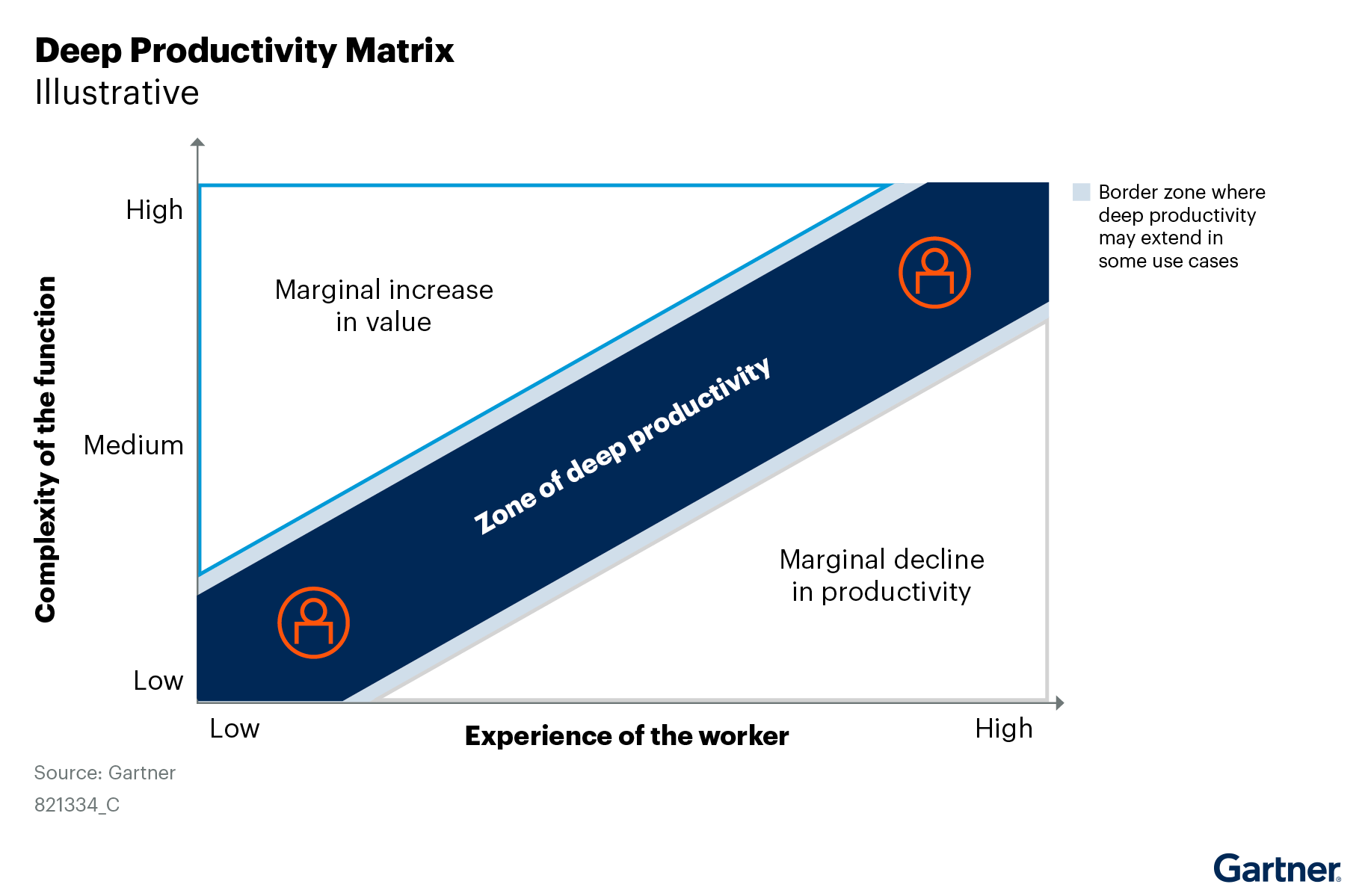
Encourage HR leaders to participate in your business leaders’ AI transformation initiatives to ensure your HR team and the enterprisewide workforce realize the greatest GenAI-driven productivity gains. HR should assist the business and look to their own teams to:
- Identify and assess the most labor-intensive tasks and roles in your organization
- Identify and assess the complexity of these roles
- Prioritize critical roles essential to the organization’s core functions and those that have the most significant impact on business outcomes
- For these prioritized roles, examine the employee experience levels
- Identify where you can achieve the greatest levels of deep productivity gains and benefits
Accelerated AI Pace: Manage Numerous GenAI Benefits Like a Portfolio
In addition to the actions highlighted in the steady-AI-pace section, focus on using GenAI to go beyond productivity and pursue a wider range of benefits. These benefits could include transforming HR service delivery to improve employee experience.
Manage GenAI benefits like a portfolio by tailoring the following illustrative example to your organization’s AI adoption stage:
- 50% of your portfolio efforts focus on GenAI initiatives related to augmenting HR staff members’ work, with the aim of improving HR staff productivity.
- 30% of portfolio efforts focus on GenAI initiatives related to improving HR operations and HR processes, with the aim of helping transform HR service delivery.
- Up to 20% of portfolio efforts focus on ensuring the enterprisewide workforce receives necessary GenAI upskilling.
Enterprisewide workforce readiness initiatives involve working with business leaders to identify skills and role requirements that effectively use GenAI for business-level, game-changing improvements that create new revenue streams or redesign the enterprise value proposition.
Recommendations:
- Steady-AI-pace CHROs should instruct your HR teams to work with business-unit leaders to assess role complexity and experience levels to be able to identify where GenAI deep productivity zones would be most maximized. See Who Benefits Most From Generative AI Productivity?.
- In addition to the previous recommendation, accelerated-AI-pace CHROs can also appoint an HR AI product owner to lead HR’s AI initiatives as well as address and steer workforce AI skills needs in cross-functional AI governance board meetings.
Manage Behavioral Outcomes of AI
As AI becomes more pervasive in business environments, CHROs will have to promote a culture that embraces innovation and agility, as well as lead change management efforts that minimize risk from intense employee reactions across the enterprise. As highlighted in the 2024 Gartner Worker Productivity Survey, worker resistance to change is a top barrier to achieving productivity from GenAI usage. Left unaddressed, this resistance to change could negatively affect aspired outcomes.4
Steady AI Pace: Put the Employee at the Center of Your Change Management Strategy
Be intentional about who owns which behavioral outcomes you seek to achieve. Otherwise, you’ll often get accidental ownership of these outcomes. As part of your change management approach:
- Collaborate with HR and enterprisewide employees to co-create and redesign work affected by AI in the new human-machine partnership and ensure co-ownership of implementation.
- Support peer-to-peer interactions and address concerns to reduce any anxiety about AI’s potential impact.
- Use employee-experience-based change success metrics to ensure that employee experience remains at the center of your change management approach and drive greater levels of trust and change adoption. Example metrics can include changes in employee Net Promoter scores or employee psychological safety metrics.
When redesigning employees’ work, focus on using AI to remove routine, low-value tasks or reduce their unenjoyable work processes, while increasing capacity for things they enjoy and areas where they want to stretch their experience. Removing tedious tasks will increase productivity as well as improve employee engagement, product quality and customer experience.
Accelerated AI Pace: Prepare for More AI Agents
Technology vendors have already launched many AI agents (especially in HR, finance and IT), which is contributing to the growing hype around agentic AI. AI agents becoming more prevalent across organizational functions will result in a new human-machine partnership within HR and the broader enterprise.
Definition
AI agents are autonomous or semiautonomous software entities that use AI techniques to perceive, make decisions, take actions and achieve goals in their digital or physical environments.
Many HR technology vendors have already released multiple agents within their products, specializing in different workflows such as recruitment, employee self-service and payroll. Accelerated-AI-pace CHROs are already having to learn how their teams can work with multiple agents in their functions and understand AI agents’ impact on human-led work.
With the shift to human-machine partnership in HR as well as the broader enterprise, a human-first approach toward AI prevents possible negative outcomes for all employees. To craft your approach:
- Evaluate whether adding human behavior experts would benefit your team, such as behavioral scientists, ethicists, neuroscientists or social psychologists.
- Instruct these experts to achieve the right behavioral — and business — outcomes in a human- and AI-agent-augmented workforce by monitoring, influencing and taking the right steps to mitigate negative outcomes for employees.
Recommendations:
- For steady-AI-pace CHROs, direct your HR teams to work with cross-enterprise AI teams to build an employee-centered change management plan for employees whose work will be most impacted by AI transformation.
- In addition to the previous recommendation, accelerated-AI-pace CHROs should prepare for AI agents’ impact on HR employees and the broader workforce by deploying behavioral experts to ensure human-centric outcomes.
Enable Workforce Readiness for AI
The 2024 Gartner Employee Perspectives of the Future of Work Survey shows that 63% of employees have not used GenAI tools to significantly reduce the effort required to perform critical tasks in their role.3 A lack of workforce readiness remains a top barrier to AI tool adoption.
CHROs should instruct their HR team to prepare and upskill the workforce to embrace AI tools and mitigate the potential for strong adverse employee reactions to emerging human-machine partnerships. AI training programs and strategic deployment of AI champions across the organization can effectively complement broader change management efforts and enable workforce readiness for AI.
Steady AI Pace: Deliver AI Literacy Programs for Your Workforce
To reap the benefits of AI, organizations must first help their workforce learn how to use it effectively and responsibly, with all its possibilities and limitations. The 2024 Gartner Worker Productivity Survey shows that a top barrier to achieving productivity gains from GenAI solutions was the lack of training on how to use them.4
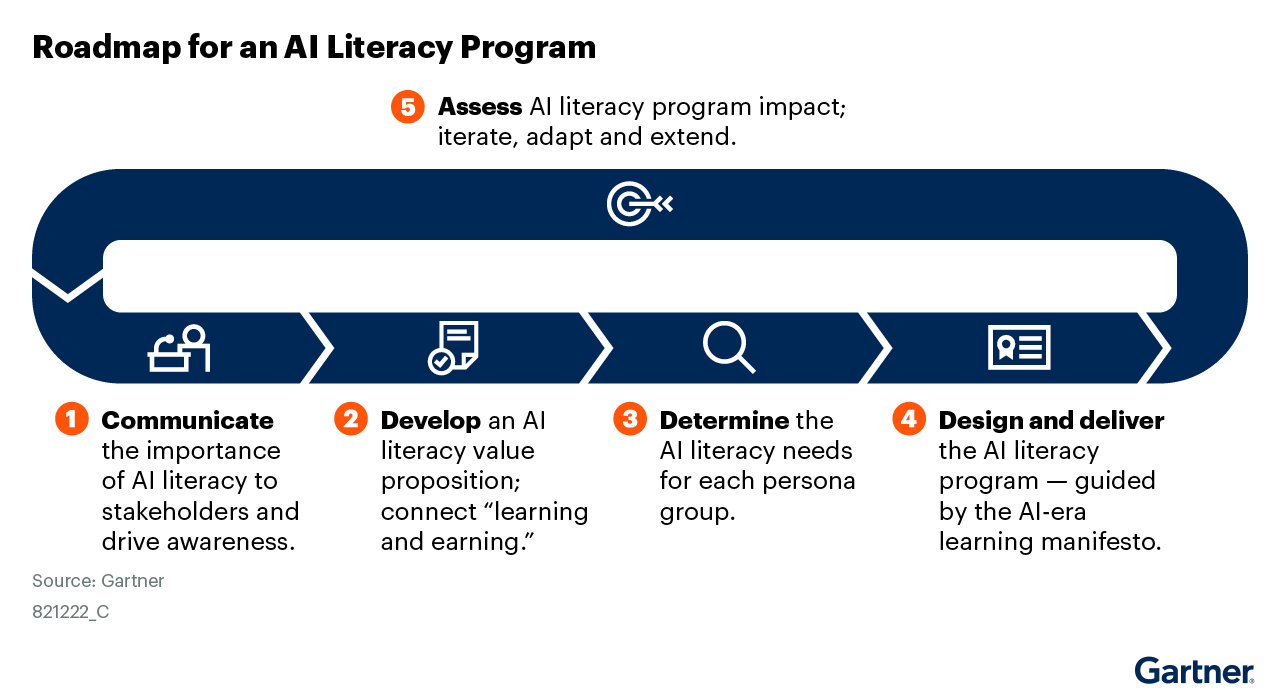
Instruct your HR teams, in partnership with your technology teams, to develop AI literacy programs for different personas within the workforce to successfully scale up AI use. A roadmap to proactively initiate, design, execute and monitor an AI literacy program requires an iterative series of activities, organized in the five steps shown in Figure 2.
Accelerated AI Pace: Expedite and Monitor AI Readiness Through AI Champions
In addition to setting up a workforce AI literacy program, CHROs within AI-accelerated pace organizations should instruct their HR teams to expedite AI upskilling and literacy programs for the workforce segments most affected by AI.
Use the following two-pronged concurrent approach:
- Build a community of practice (CoP) of early AI adopters from different parts of the business. Include those who have a good understanding of — and are enthusiastic about — AI and who have the influence to drive change in their respective areas. Formalize this part-time “AI champion” role by codifying a set of responsibilities. These could include identifying AI use cases, educating their respective areas, driving AI adoption, promoting AI tools and sharing success stories. Continually monitor the champion program, improving and expanding it to more areas of the business as it achieves traction.
- Leverage this CoP and partner the AI champions with your HR teams to build out the following steps in an upskilling and literacy program for the workforce segments most affected by AI:
- Identify relevant workforce segments most directly affected by AI and those with the greatest opportunity and business value (refer to Figure 1).
- Work with representatives from each segment to identify and target use cases for the greatest business value.
- Build empathy maps to understand effects on these prioritized roles.
- Define and track leading indicators for each employee segment to monitor employee readiness.
This two-pronged approach allows for a continual feedback loop that can remain agile as AI’s impact on the workforce continues to change.
Recommendations:
- For steady-AI-pace CHROs, direct your teams to build AI literacy programs and AI policies designed to educate all employees on the concept of AI, its boundaries and risks and how to critically analyze AI uses. See Create an AI Literacy Roadmap to Drive Responsible and Productive AI.
- In addition to the previous recommendation, accelerated-AI-pace CHROs should direct their HR teams to focus on the segments of the workforce most affected by AI and with the greatest perceived business benefit. This will ensure that each segment’s nuanced requirements are addressed, and that communities of practices and AI champions can be deployed to drive effective change.
1 Mid-2024 Update Gartner CEO and Senior Business Executive Survey. This survey was fielded in June through July 2024. In total, 110 actively employed CEOs and other senior executive business leaders qualified and participated. All respondents were screened for active employment in organizations greater than $50 million in annual revenue. The sample mix by role was CEOs (n = 88); CFOs (n = 9); COOs or other C-level executives (n = 7); and chairs, presidents or board directors (n = 6). The sample mix by location was North America (n = 42), Europe (n = 37), Asia/Pacific (n = 24), Latin America (n = 3), the Middle East (n = 1) and South Africa (n = 3). The sample mix by size was $50 million to less than $250 million (n = 10), $250 million to less than $1 billion (n = 25), $1 billion to less than $10 billion (n = 46) and $10 billion or more (n = 29).
2 2024 Gartner Productivity Impact of AI Survey. This study was conducted to understand organizations’ most relevant measures of productivity, assess the extent to which technology investments (especially AI) impact productivity and gauge the variation in AI’s impact on productivity across different workforce segments. The research was conducted online from 28 June through 25 August 2024. In total, 724 respondents were interviewed across North America (n = 225), Europe (n = 231) and Asia/Pacific (n = 268). Qualifying organizations operated across all industries and reported enterprisewide annual revenue for FY23 of at least $250 million or equivalent. Qualified participants were employed full-time and in their role and on their current team for at least two years. Respondents were asked to report on a technology they were familiar with, and one that was deployed and used by their team at least once per month. Disclaimer: The results of this survey do not represent global findings or the market as a whole but reflect the sentiments of the respondents and companies surveyed.
3 2024 Gartner Employee Perspectives on the Future of Work Survey. The 2024 Gartner Employee Perspectives on the Future of Work Survey was conducted to understand employee perspectives regarding various emerging technologies, and how it impacts their daily work. The research was conducted online from 20 August through 27 September 2024 and contains responses from 3,496 employees with representation from various geographies, industries and functions. Disclaimer: The results of this survey do not represent global findings or the market as a whole but reflect the sentiments of the respondents and companies surveyed.
4 2024 Gartner Worker Productivity Survey. This survey investigated the impact of generative AI and other technologies, such as process/workflow automation, business intelligence and role-specific tech on worker productivity. It assessed the productivity gains by workers based on their technology utilization, generative AI adoption, role/function complexity and career experience (total career tenure), as assessed by their managers. It explores the timelines of generative AI implementation, overall quality of the generative AI effort, and barriers to implementation and adoption. It also examines the impact of technology on worker productivity, and the productivity culture in organizations. Qualified respondents were manager level or higher and had a team reporting to them. Qualifying organizations were from North America, Asia/Pacific and EMEA, and reported enterprisewide revenue of at least $50 million or the equivalent. Disclaimer: The results of this survey do not represent global findings or the market as a whole, but reflect the sentiments of the respondents and companies surveyed.