How to Capture AI-Driven Productivity Gains Across the SDLC
11 April 2025 - ID G00827469 - 14 min read
By Philip Walsh, Keith Mann
AI can drive 25% to 30% SDLC productivity gains by making development teams more efficient and effective. Software engineering leaders must look beyond task-level metrics and channel time savings to improve software quality, expand team capacity and prioritize high-value/low-efficiency life cycle events.
Overview
Key Findings
- Measuring efficiency gains from AI at the task level fails to capture real productivity impact because task-level time savings do not linearly aggregate into system-level gains.
- Organizations reporting more extensive AI adoption (teams with over 50% of developers using AI) and greater success in meeting business objectives extend AI beyond daily coding tasks, applying it more broadly across the software development life cycle (SDLC).
Recommendations
- Channel fragmentary time savings into increased capacity for customer-facing changes and value-adding work by connecting task-level efficiency gains to team and value stream outcomes.
- Scale AI usage strategically by targeting high-value, low-efficiency SDLC events (for example, refactoring, migrations) and upstream creative activities (for example, requirements gathering, user stories, ideation) to unlock more substantial, system-level productivity gains.
Strategic Planning Assumption
By 2028, development teams that diligently apply an ensemble of AI-powered tools to the SDLC will achieve 25% to 30% productivity gains, up from the 10% delivered by the code-generation-focused approach in 2024.
Introduction
We all saw the headline: “55% faster.” More importantly, your C-suite saw it. Now they’re asking why the headcount can’t go down. Where are big productivity gains? Can’t we be doing more with less?
Gartner’s Developer Experience Assessment Survey, capturing data from over 5,000 developers across 51 organizations, reveals a sobering reality: Almost half of team members (52.8%) report the impact of AI on team productivity to be 10% or less, including 13% seeing no measurable improvement at all.1 This is despite broader adoption trends. Of the total respondents, 77% of software engineering leaders reported that their enterprises are either piloting or deploying AI code assistants. A total of 68% of software engineering managers report their organizations are implementing AI to augment development workflows to at least a moderate extent.2,3
Larger gains are possible: ~30% of respondents report gains of 11% to 25%, and ~14% report gains of 26% to 50%.1 However, without a systematic approach to leveraging AI across the entire SDLC, organizations risk investing in AI tools while achieving only marginal improvements in overall productivity. This threatens to undermine the business justification for AI adoption and miss the opportunity for stronger productivity gains.
Organizations must move beyond task-level efficiency metrics to realize substantial, system-level productivity gains from AI across the SDLC. Success requires two key shifts:
- Organizations must channel fragmentary time savings into increased capacity for customer-facing changes and value-adding work by connecting task-level efficiency metrics to team and value stream outcomes.
- They should scale AI usage strategically by targeting high-value, low-efficiency SDLC events (for example, refactoring, migrations) and upstream creative activities (for example, requirements gathering, user stories, ideation) to unlock more substantial, system-level productivity gains.
Analysis
Channel Fragmentary Time Savings Into Real Productivity Gains
AI tool vendors and studies on AI’s impact often spotlight productivity gains by citing time saved on discrete developer tasks. Software engineering leaders then commonly attempt to project total labor-hour savings by summing up these microlevel efficiencies. Yet, the reality is more nuanced. Small increments of “freed” time — often just 20 to 30 minutes — can be offset by added time debugging, reviewing and understanding AI-generated code, making it difficult to repurpose the time for significant feature development.
The Truth About Time Savings
Developers need longer blocks of concentration for higher-value tasks, but many factors (for example, fixed meeting schedules, unplanned support work and team coordination overhead) fragment the day. An IEEE study at Microsoft found that developers typically manage just 40 to 50 minutes of uninterrupted coding time per stretch. Consequently, even a 50% reduction in routine task time (which is likely too optimistic anyway) can still translate into disconnected slivers of 20 minutes each, making it difficult to convert fragmentary time saved into genuinely productive time reapplied.4 Developers themselves confirm this constraint. In Gartner’s Developer Experience Assessment Survey, “time to focus on core work” ranks as the most important developer experience attribute, yet only 38% are satisfied with it.1
From 55% to Negative Gains: AI’s Vanishing Returns
An eye-catching 2023 Microsoft-commissioned study found developers using GitHub Copilot could complete coding tasks 55.8% faster.5 However, a large-scale 2024 academic study of over 4,000 developers found that individuals completed 26.08% more tasks overall when using AI code assistants — a clear efficiency boost, but significantly less impressive than the headline 55% savings.6 Most telling, the 2024 DORA Report found that AI adoption actually led to small declines in delivery throughput (down by 1.5% for every 25% increase in AI adoption).7 The authors attribute these setbacks to larger, riskier changesets that impede integration and heighten coordination overhead.
This progression demonstrates why organizations should be cautious about extrapolating dramatic task-level time savings into predictions about organizational productivity. While AI tooling clearly provides valuable efficiency gains for specific tasks, their impact diminishes at each level of analysis as other constraints and system dynamics come into play.
Reinvest Time Savings to Improve Quality and Expand Team Capacity
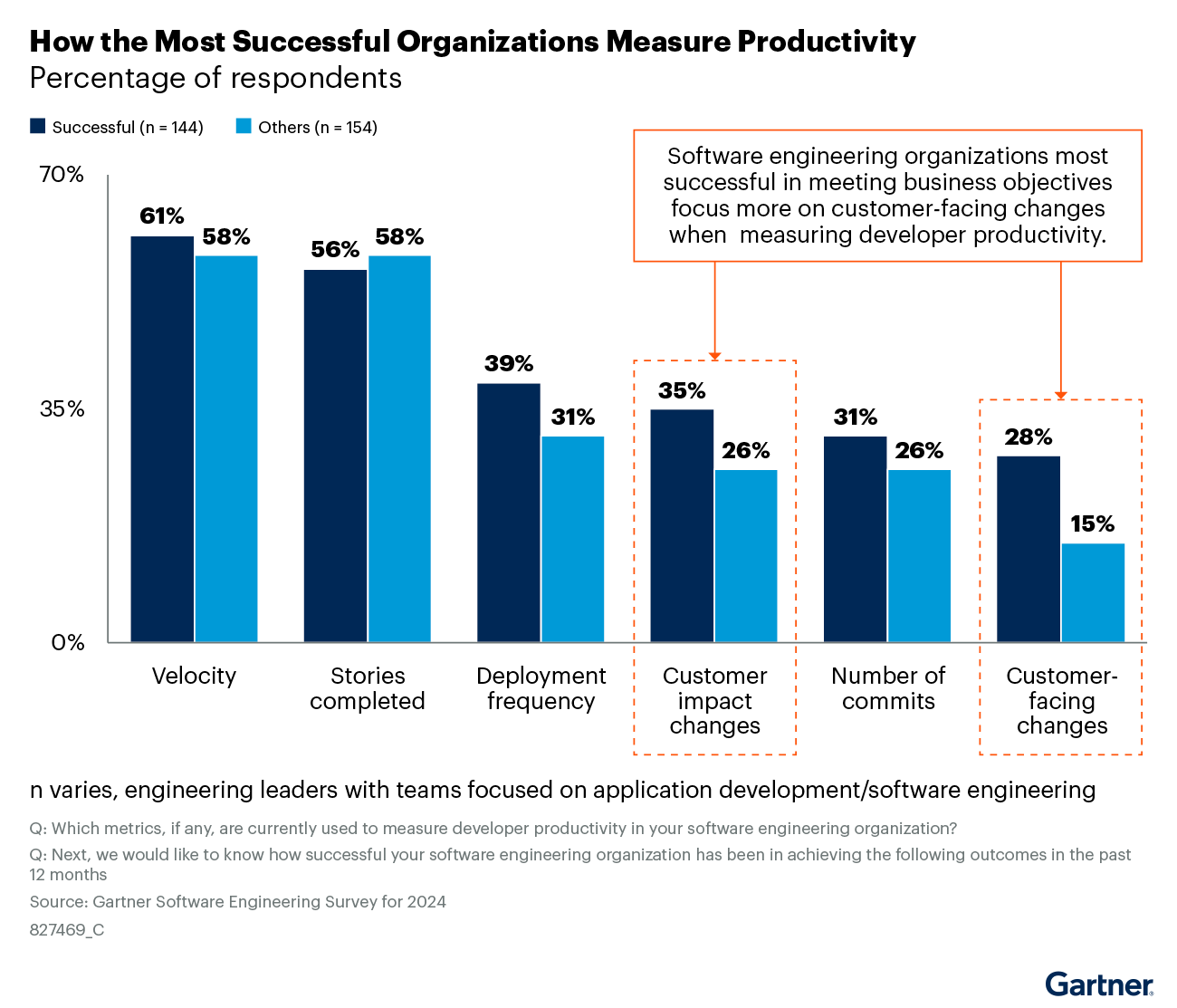
Organizations that focus heavily on velocity, story points or deployment frequency risk missing the real impact of AI-driven time savings. The 2024 Gartner Software Engineering Survey found that while most organizations track similar developer productivity metrics, the organizations most successful in meeting business objectives focus more on customer-facing changes (see Figure 1).8 This suggests that what truly matters is an organization’s ability to consistently deliver meaningful, customer-facing features — something easily disrupted by high defect rates and chronic technical debt.
The key is to reinvest AI-driven micro-savings into activities that steadily improve code quality, security and maintainability — including existing parts of the codebase as well as newly generated code.
Poor software quality is diverting developer time from work on new features; 45% of developer time on average is dedicated to tasks such as minor enhancements, maintenance and bug fixing.⁹
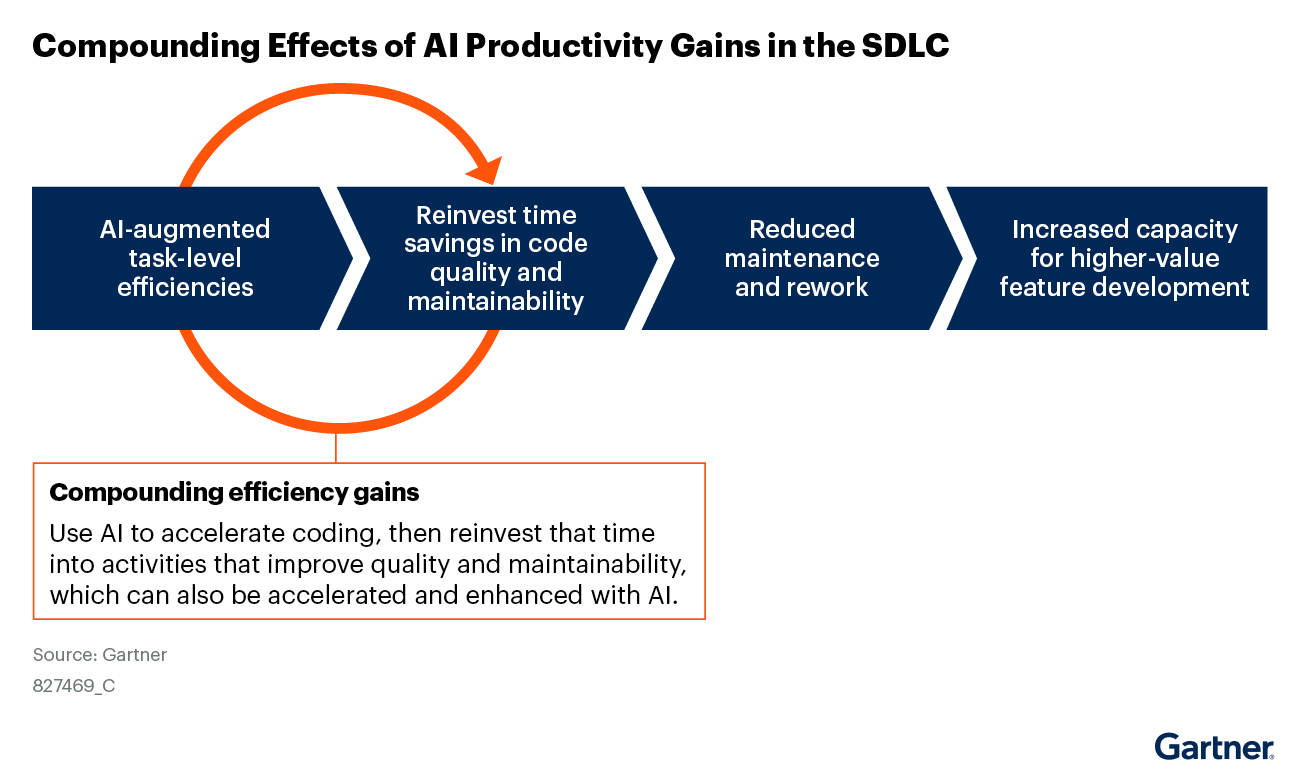
When developers systematically reduce technical debt and fix latent quality issues, they cut down on future rework and unplanned outages, ultimately freeing more capacity for high-value functionality. Even short intervals of 20 to 30 minutes can be used effectively by applying AI-driven time savings to quality-focused tasks, while also leveraging AI to accelerate those very tasks, creating a compounding effect (see Figure 2).
- Targeted Code Reviews: AI can partially automate code review tasks — for example, flagging style violations or suggesting improvements — so developers can focus more on deeper logic checks and team knowledge sharing. Many AI code assistant tools now include code review capabilities (see Magic Quadrant for AI Code Assistants).
- Technical Debt Paydown: Keep a running “hit list” of refactoring or technical debt remediation items. With AI-driven refactoring tools that pinpoint hot spots or generate optimized code, small windows of time can efficiently chip away at legacy complications, helping prevent major future slowdowns. To understand how vendors are offering AI capabilities to address technical debt and for code refactoring, see Cool Vendors in AI-Augmented Development and Testing for Software Engineering.
- Enhanced Documentation and Test Coverage: AI-based documentation assistants can generate or update technical docs, while automated test generation can boost coverage quickly. Developers then refine and validate these outputs, ensuring each microtask contributes to fewer downstream defects (see Quick Answer: How Can AI Provide Benefits for Software Testing?).
- Microbursts of Upskilling: Implement agile learning principles to tackle short, focused learning modules. AI-driven tutorials tailored to the developer’s current task can make these 20- to 30-minute windows a natural fit for fast skill development, further enhancing the team’s capacity to deliver high-value work. For details, see How to Upskill Software Engineering Teams in the Age of AI.
Software engineering leaders should empower teams to decide which combination of these quality-focused (and skill-focused) efforts offer the greatest strategic value, while also tracking how they spend less time on emergencies and rework (see Top Strategies for Improving Code Quality). Over time, these compounding gains will free capacity for genuinely innovative or customer-facing initiatives, realizing productivity benefits that transcend the overly simplistic “sum of the parts” calculations often cited in AI tool marketing.
Pursue Multiple Pathways to SDLC Productivity With AI
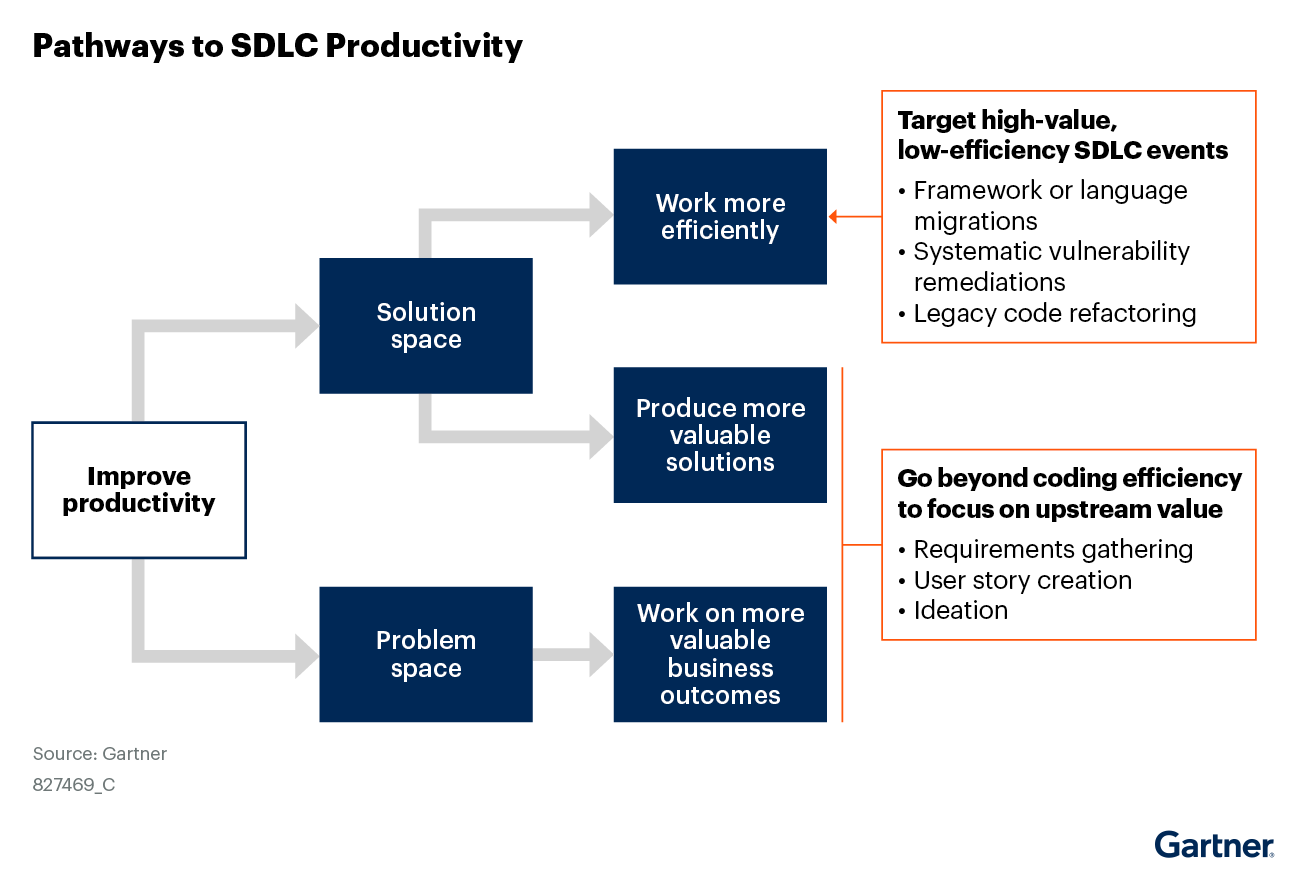
Productivity in software development is not only about reducing the cost of inputs, but also about increasing the value of outputs and outcomes. To realize systemic AI-driven productivity gains across the SDLC, organizations must pursue both of these pathways to productivity, maximizing efficiency (delivering faster) while also ensuring effectiveness (solving the right problems in the best way). See Figure 3 for these pathways.
Target High-Value, Low-Efficiency SDLC Events
While day-to-day AI use cases like code generation offer incremental improvements, they typically yield modest overall productivity gains (10% or less). According to the 2025 Gartner Software Engineering Survey, organizations most successful at meeting business objectives report greater time savings from AI when using it for understanding existing code, translating or modernizing legacy code and refactoring.10
These are high-value, low-efficiency SDLC events that significantly disrupt planned work and demand deep comprehension:
- Outdated development framework or development language migrations
- Systematic code security vulnerability remediations
- Legacy code refactoring
- Architectural technical debt remediation
By strategically applying AI to these disruptive activities — part of the solution space, where efficiency gains can become truly transformative — software engineering leaders can reclaim days of work otherwise lost to refactoring or remediation. This frees up capacity and cognitive load for higher-value tasks, enabling teams to focus on delivering more innovative, impactful solutions that drive business outcomes.
Go Beyond Coding Efficiency to Focus on Upstream Value
In parallel with tackling big, complex refactoring or migration efforts, leaders should also look upstream in the development life cycle. AI can deliver more transformative impact in the problem space — where teams frame requirements, define user stories and ideate around design concepts.
According to the 2025 Gartner Software Engineering Survey, organizations that surpass 50% AI adoption report substantially higher time savings in upstream activities compared with those below that threshold.¹⁰ These activities include:
- Requirements gathering
- User story creation
- Ideation
Ultimately, the greatest gains come not from replacing human creativity but from amplifying it, enabling teams to move more quickly through lower-level tasks so they can invest more energy in discovery, innovation and customer value.
By leveraging AI to inform strategic decisions (for example, validating user demand or evaluating alternative solution approaches), teams ensure they are building solutions that truly address user needs. This aligns with the “valuable solutions” dimension of the solution space, where rapid feedback loops and user-centric design yield higher-quality, more impactful outcomes.
While this note provides a strategic framework for realizing broader, system-level productivity gains with AI, you can find more detailed, use-case-level analysis in the following research:
1 Gartner Developer Experience Assessment Survey: This survey of software development team members assessed their satisfaction with and perceived importance of 21 key attributes of the developer experience. The assessment provides a benchmark of developers’ experience and identifies improvement priorities for the organization. The results include responses from 5,112 software development team members from 51 organizations across industries, geographies and revenue bands. Disclaimer: The results of this survey do not represent global findings or the market as a whole, but reflect the sentiments of the respondents and companies surveyed.
2 2025 Gartner Technology Adoption Roadmap for Large Enterprises Survey: This survey harnesses the collective wisdom of IT leaders to understand deployment plans, adoption timelines, value and risks of more than 200 technologies across infrastructure and operations; data and analytics; software engineering; cybersecurity; and strategic portfolio management. The survey was conducted through an online panel from August through October 2024 among 569 respondents from North America, EMEA and Asia/Pacific across industries in enterprises with annual revenue of more than $1 billion. Qualified respondents were CxOs, senior IT leaders, their peers and their direct reports. This research summarizes findings from 138 respondents identified as software engineering leaders. Software engineering leaders indicate their enterprise’s current adoption plan for each technology across the following stages: not monitoring, monitoring, planning, piloting, in deployment and already deployed. These results were aggregated to determine a final adoption stage for each technology. The results will allow leaders in infrastructure and operations to cut through vendor hype to determine which technologies to invest in and when, to remain competitive among peers. Disclaimer: The results of this survey do not represent global findings or the market as a whole, but reflect the sentiments of the respondents and companies surveyed.
3 2024 Gartner Improving Engineering Team Productivity and Leadership Survey: This survey was conducted to understand managers’ perceptions of their teams’ productivity, leadership effectiveness, and the usage and impact of AI. The survey was conducted online from September through November 2024 among 400 English-speaking software engineering managers from North America (50%), EMEA (35%) and APAC (15%). Qualifying respondents operated in multiple industries and reported enterprisewide revenue for fiscal year 2023 of at least $250 million or equivalent, with 84% over $1 billion in revenue. Disclaimer: The results of this survey do not represent global findings or the market as a whole, but reflect the sentiments of the respondents and companies surveyed.
7 Accelerate: State of DevOps, Google Cloud.
8 2024 Gartner Software Engineering Survey: This survey was conducted to identify the most important roles and skills for software engineering leaders and the change in their demand and importance since last year, understand how talent is sourced generally and for acquiring necessary artificial intelligence (AI)/machine learning (ML) skills, and what tools are seen to increase developer productivity and the metrics used to measure them. It also examines how software engineering leaders anticipate change in their operating budgets and the cost management steps taken. It further aims to identify the quality and testing techniques, and programming languages software engineering leaders currently use and/or plan to use; their frequency of usage of UX design, user research and AI in generating components of user experience; and its impact on user satisfaction, accessibility and usability. It also intends to understand the software engineering leaders’ responsibilities they find most difficult, the career paths available for senior-level individual contributors and how they are set up, how organizations attract and retain top performers in those career paths, and what management training is offered to staff. The survey was conducted online from October through December 2023 among 300 respondents from the U.S. (n = 241) and the U.K. (n = 59). Qualifying organizations operated in multiple industries (excluding the IT software industry and education sector) and reported enterprisewide revenue for fiscal year 2022 of at least $250 million or equivalent, with 63% over $1 billion in revenue. Qualified participants were highly involved in managing software engineering/application development teams and the activities they perform. Disclaimer: The results of this study do not represent global findings or the market as a whole but reflect sentiment of the respondents and companies surveyed.
9 IT Key Metrics Data 2024: Applications Measures: This research contains high-level IT applications cost efficiency and staff productivity ratios that should be used as part of a perennial cost and value optimization program. The information provided was collected throughout 2023 from a global audience of CIOs and IT leaders. Key cost and staff distributions as well as metrics based on environment size are also included.
10 2025 Gartner Software Engineering Survey: This survey was conducted to provide a comprehensive understanding of the current landscape in software engineering. It aimed to identify the demand for various roles, essential skills and upskilling strategies within the software engineering organization. It explored the integration of AI in software engineering workflows, their leadership experiences and prior roles of the current leaders. It also assessed their budget expectations, team structures, organizational outcomes and priorities. The survey was conducted online from October through December 2024 among 400 respondents from the U.S. (n = 320) and the U.K. (n = 80). Qualifying organizations operated in multiple industries (excluding the IT software industry involved in the development of commercial software and the education sector) and reported enterprisewide revenue for FY23 of at least $250 million or equivalent. Qualified participants were highly involved in managing software engineering/application development teams and the activities they perform. Disclaimer: The results of this study do not represent global findings or the market as a whole, but reflect the sentiments of the respondents and companies surveyed.