Magic Quadrant for Strategic Cloud Platform Services
4 August 2025 - ID G00826104 - 42 min read
By Alessandro Galimberti, Dennis Smith, and 4 more
Digital sovereignty, AI and cloud resilience are among the new trends shaping how organizations select a public cloud provider in 2025. Use this Magic Quadrant to understand how hyperscalers are adapting to new customer demands and determine which providers are right for your business.
Market Definition/Description
Gartner defines strategic cloud platform services (SCPS) as standardized, automated, public cloud offerings integrating infrastructure services (for example, computing, network and storage), platform services (for example, application, data and value-added services such as AI/ML) and transformation services (resources to help customers adopt cloud-oriented IT delivery models). Although owned by the service provider, infrastructure and platform services may be hosted in providers’ infrastructures or customers’ data centers. Services should be elastically scalable, metered by use and consumable via web-based interfaces and programmable APIs. Transformation programs may be delivered by automated, self-service interfaces, and managed interactions facilitated by account teams/partners.
Not all enterprise cloud journeys are the same; however, there are similarities. In Cloud Journey: A Comprehensive Guide to Navigate Complexity and Avoid Pitfalls, Gartner defines four broad types of cloud journeys that our clients take:
- Technology replacement
- Cloud-native adoption
- Cloud innovation
- Business transformation
Each journey requires a different combination of cloud services and digital transformation activities. To choose the right approach, Gartner clients must determine where they are and where they’re headed. There are many types of cloud service providers (CSPs) in the market — infrastructure/platform/software as a service (IaaS/PaaS/SaaS), as well as managed services providers (MSPs). However, few strategic global hyperscalers combine the breadth and depth of capabilities necessary to meet any enterprise where it is, help it determine where it’s headed, and provide the cloud services and transformation support to help it get there.
Customers must consider their relationship with their SCPS provider of choice as long term and strategic. While selecting the SCPS provider that is right for their business, Gartner clients must:
- Gauge the relative strengths and weaknesses of each provider in the areas that are important to the business.
- Determine which providers are most aligned with their immediate and long-term objectives in the cloud.
- Learn about provider programs and resources to help digitally transform the organization.
Mandatory Features
The SCPS market is based on delivery of integrated public cloud IaaS and PaaS services that are suitable for supporting mission-critical, large-scale production workloads, whether enterprise or cloud-native. The mandatory features for this market include:
- Elastic, real-time provisioning and resizing of software defined compute, network, storage and platform services with capacity, sold and billed on a metered-usage basis
- Self-service access via web browser, to a web services API and command line interface (CLI)
- Cloud software infrastructure services facilitating automated management, including monitoring, autoscaling and managed data backup
- Managed database and application platforms as a service offering
- A global presence and scope (for example, regional cloud data centers on multiple continents)
- The ability to securely interact with all services using identity and access management (IAM) controls, encryption, data protection and secrets management
- Artificial intelligence/machine learning (AI/ML) capabilities — IaaS/PaaS platforms, an offering of first-party and third- party foundation models, and specialized hardware and tools for building and consuming classic AI/ML and generative AI (GenAI) services
- An architecture for service resilience that enables customers to replicate resource configurations and data between provider zones and regions, and failover from one location to another as needed, in an automated way
Common Features
The most common IaaS and PaaS features for the SCPS market include:
- Serverless PaaS options, such as functions as a service (FaaS) and serverless SQL or NoSQL databases
- Company-developed, publicly available software development kits (SDKs) in three or more programming languages
- A distributed, continuously available control plane supporting a hyperscale architecture
- Managed continuous integration/continuous delivery (CI/CD) offerings to support complete application and data management life cycles, including automated integration, build, testing and deployment
- A distributed cloud offering, as defined by Gartner
- A published service-level agreement (SLA) for 75% or more of all IaaS and PaaS services in all regions, with a minimum of 99.5% availability for each service in each region
- The ability to extend and integrate a customer’s private data center network and core IT services with the provider’s cloud environment
- Preconfigured IaaS and PaaS environments optimized to support common workloads such as SAP and Oracle databases, and specialty workloads such as Internet of Things (IoT), high-performance computing (HPC), AI/ML, GenAI and non-x86
- Data sovereignty cloud options, including support for data residency controls, capabilities to bring and hold your own encryption keys, and options to deploy into locally managed and autonomous zones and regions
- Vertical industry platform solutions comprising data models, platform services and partner ecosystems to support industry-specific needs
- Cloud financial management tools and services that enable customers to forecast, track, manage, optimize and allocate cloud costs
Providers in the SCPS market also offer standard means of assisting customers to move to a cloud operating model for delivery of IT services. These include:
- A strategic co-innovation service offering, all or partially subsidized by the provider, designed to help customers create a cloud adoption strategy and implementation plan
- A cloud migration program that includes migration planning, automated application assessment, rightsizing, cost estimation, and physical data and resource migration tools
- A globally scaled partner network of solution integrators, MSPs and technology solution providers. Capabilities should include:
- Programs that enable partners and certify them with technical specialties and/or preferential status indicators
- Customer self-service tools to find, evaluate, select and communicate with partners
- Globally available, self-service resources and provider-assisted engagements to help customers plan, build and operate high-quality cloud environments, including enterprise training and support, adoption frameworks and best practices, planning services and customer success reviews
- A digital marketplace offering a wide range of certified third-party software products and services associated with the platform
Less common features for this market include:
- Sustainability management and energy consumption tools and services, including workload placement tools
- Centralized policy management, with support for programmable policy as code
- Tools and services to support more advanced agile CI/CD methodologies, such as GitOps and DataOps
- Tools and services to support multicloud computing, including integrations with other vendor cloud services, as well as the potential deployment of provider services in other vendor clouds
- Co-investment programs in which the cloud provider shares in the cost, risk and reward of a joint provider-partner or provider-customer venture
Magic Quadrant
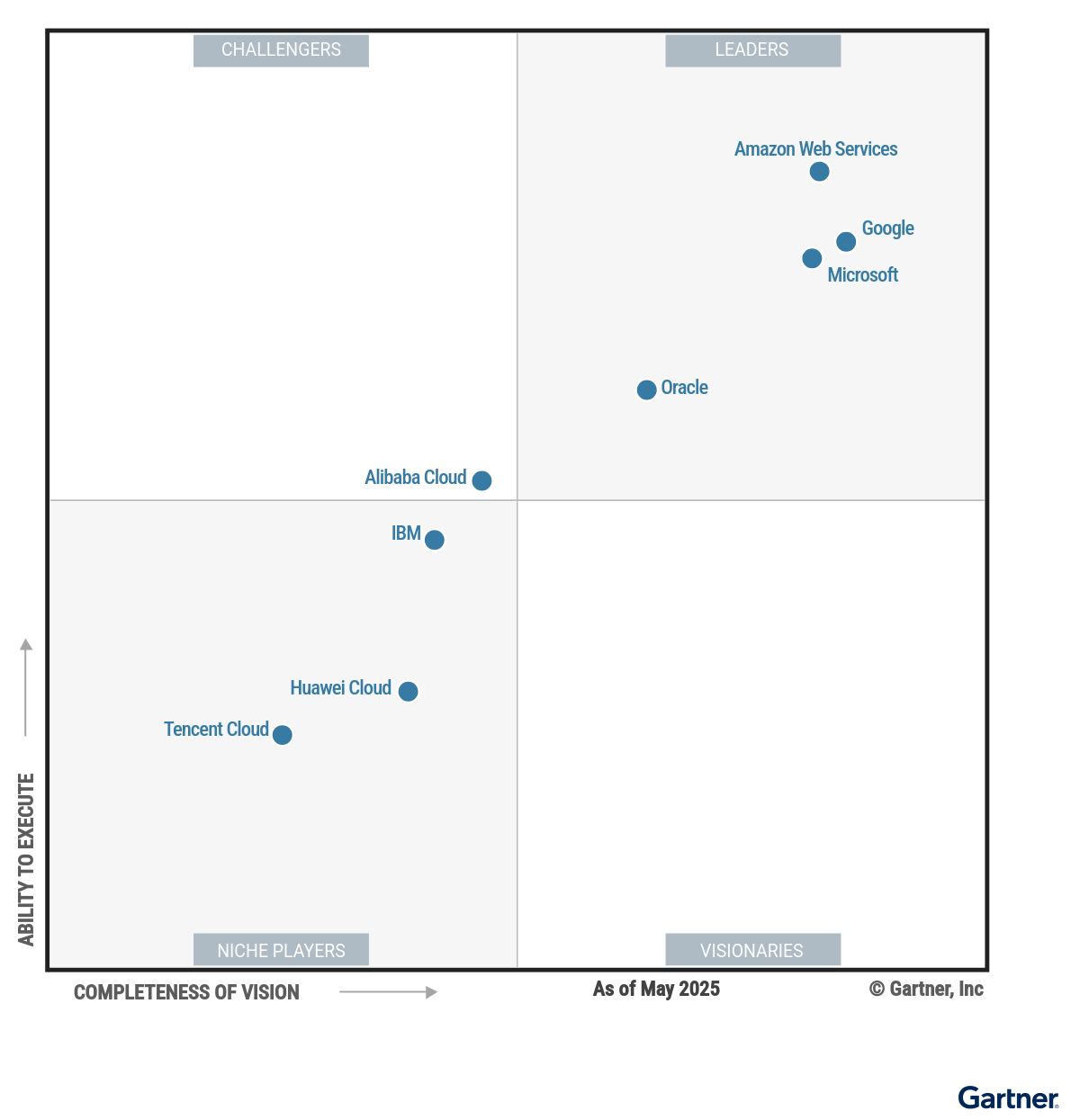
Vendor Strengths and Cautions
Alibaba Cloud
Alibaba Cloud is a Challenger in this Magic Quadrant. Alibaba Cloud serves as the digital technology and intelligent backbone of the Alibaba Group, leveraging its proprietary Feitian cloud computing operating system to offer a broader array of services than its Chinese competitors. With a robust market presence in China and the Asia/Pacific region, Alibaba Cloud is strategically well-positioned to support Chinese enterprises in their global expansion efforts, aligning with the Chinese government’s “go overseas” initiative.
In May 2025, Alibaba Cloud unveiled its new “AI + Cloud” strategy, aiming to expedite the development of a global cloud computing network. This strategy involves an investment of over $53 billion in cloud and AI infrastructure data centers. Alibaba Cloud will also enhance its strategic investments in the global market to accelerate the international deployment of AI models and enhance the global service ecosystem. However, not all of those AI services or products are available outside the Chinese mainland.
- Robust digital ecosystem and digital transformation enablement: Alibaba Cloud leverages its parent company’s e-commerce, digital payments, logistics and entertainment ecosystem to deliver comprehensive digital transformation solutions for Chinese enterprises expanding globally. Strategic alliances with global technology leaders like SAP, VMware and Salesforce help Alibaba to further provide integrated solutions that meet complex business needs.
- Significant AI investment and generative AI expertise: Alibaba Cloud plans to expand its AI infrastructure and accelerate the deployment of AI applications like Bailian (Model Studio), Platform for AI (PAI) and big data solutions. Currently, it has open-sourced more than 200 models, resulting in over 100,000 derivative models, establishing it as the world’s largest open-source model cluster. The Qwen3 series, a new generation of hybrid reasoning models, has also been fully open-sourced.
- Flexible and competitive pricing models: Alibaba Cloud offers a wide range of pricing models to fulfill diversity requirements, including Elasticity Assurance (EA), a flexible option allowing customers to pay a small fee to reserve guaranteed resources for a set period. In 2024, it also implemented aggressive discount campaigns for both cloud core services and large language model API prices in both global and China markets.
- Limited partner ecosystem in North America and EMEA: Alibaba’s international presence primarily targets Chinese enterprises expanding into global markets. Compared with other vendors in this evaluation, Alibaba Cloud’s sales, consulting, technology and service teams remain predominantly focused on China and the Asia/Pacific region, limiting its appeal to partners in North America and EMEA.
- Slow global market momentum: Alibaba Cloud holds a substantial IaaS market share in Asia; however, it lacks a significant presence in other regions. Even with 2024 price cuts, its IaaS market share declined, and the growth of enterprises adopting Alibaba Cloud in EMEA and North America remains slow.
- Limited international availability of AI and ML technologies: Alibaba’s AI and ML proprietary technologies, developed in response to trade tensions impacting Chinese vendors’ access to global hardware innovations, include resources such as Lingjun intelligent cloud computing, Yitian 710, Hanguang 800 and PAI-Lingjun — Alibaba’s flagship AI platform. However, these technologies have either not been released internationally or are available only in select regions.
Amazon Web Services
Amazon Web Services (AWS) is a Leader in this Magic Quadrant. AWS offers a comprehensive range of cloud infrastructure,platform and transformation services, catering to a broad array of IT requirements. With a focus on enterprise customers, AWS facilitates customer digital transformation through a number of programs, such as its Migration Acceleration Program (MAP) and the AWS Enterprise Transformation program. Additionally, AWS has built a broad and comprehensive partner network over many years to help organizations achieve their cloud transformation goals. In May 2024, the company appointed Matt Garman, who previously led the organization’s sales, services and marketing function, as the new CEO.
AWS has maintained profitability, holds a leading 41.3% share of the cloud infrastructure and platform services (CIPS) market, and achieved growth in that market of $15.7 billion year over year. However, 2024 is the second consecutive year in which the company has lost overall market share in CIPS to key competitors. AWS’ strategy continues to focus on enhancing its industry-leading IaaS and PaaS services and its partner network, while positioning itself to capture AI innovation opportunities and market share in the years ahead.
- Largest public cloud community: AWS has built strong global community engagement for cloud professionals, providing significant opportunities for those who want to better understand and utilize AWS or deepen their skills. In addition to its flagship re:Invent conference, the company is hosting other in-person events for engaging technical and business audiences, including AWS re:Inforce and AWS Summits.
- Cloud-inspired silicon: AWS has leveraged its global-scale cloud computing experience to develop custom silicon designs for both general-purpose (Graviton) and AI-specific (Inferentia and Trainium) application use cases. Custom chip design opens up opportunities for tighter and more performant integrations between hardware and software, as well as improved overall power efficiency and greater end-to-end control of supply chains.
- Global scale and operational execution: AWS’s significant share of global cloud market revenue has enabled it to build a larger and more robust network of integration partners than some other providers in this analysis, which in turn helps organizations successfully adopt cloud. AWS has had a robust overall availability record for many years, effectively navigating IT supply chain disruptions throughout the COVID-19 pandemic, as well as recent global demands for AI training GPU hardware.
- Lagging in SaaS and nascent low-code capabilities: AWS lacks an extensive portfolio of SaaS applications, and does not appear in 2024’s Gartner’s list of top 20 SaaS vendors by global revenue, unlike other vendors in this analysis. In the emerging market for low-code application platforms, the company’s recent launch of Amazon Q Apps and Amazon App Studio comes several years after some competitors’ efforts to address the needs of modern business technologists building application workflows.
- Minimal multicloud support: Only a few components of the AWS platform — such as Amazon ECS Anywhere,Amazon EKS Anywhere, Amazon Athena and AWS Systems Manager — can operate outside the AWS cloud; many services are restricted to AWS cloud or distributed cloud with branded AWS hardware only. While the company’s 2024 announcement of a database partnership with Oracle is a good first step, there are many more areas where strategic multicloud partnerships will become important to enterprise customers in the years ahead, especially where GenAI is concerned.
- A “marketplace” approach for GenAI models: AWS offers a range of AI models through partnerships and its Bedrock platform, including its own, such as Amazon Nova, which lag in industry benchmarks. While offering a wide range of GenAI models benefits customers, less performant first-party models provide less competitive differentiation in the intensely competitive AI landscape, as “AI gravity” begins to influence customer decisions.
Google is a Leader in this Magic Quadrant. Google Cloud appeals to enterprises aiming to eventually transition to a fully cloud-native IT approach, particularly when implementing AI services. Google Cloud offers a strong and complete portfolio of IaaS and PaaS capabilities supported by a broad global network of cloud regions. Google continues to improve its enterprise capabilities in both technology and customer engagement practices. Its network of partners has grown and includes key offerings to help enterprises adopt Google Cloud services to address their enterprise needs.
Google is well-suited to support cloud-native processes with its core strengths in container-based architecture, advanced data center design and industry-leading GenAI infrastructure and models. Google’s increasingly vibrant cloud-native developer community has fueled its growth and rising market share in the SCPS market. In 2024, GCP revenue grew by 26.3% — the highest percentage growth of any vendor in this evaluation.
- A Google-wide AI strategy: The “new way to cloud” vision has driven innovations that position Google Cloud as a relevant platform for organizations seeking business transformation. This strategy aims to accelerate digital transformation through AI-powered innovation, establish a modern and adaptable infrastructure to support agile enterprise operations, ensure enterprise-class security and compliance, leverage enterprise data, and enhance collaboration through offerings such as Google Search and Google Workplace.
- Leading the AI solutions stack: Google is a clear leader in AI services, providing best-of-breed solutions across all layers of the AI stack. Its capabilities begin at the infrastructure layer, with efficient custom silicon chips — such as Tensor Processing Units (TPUs) — designed to support frontier model training and inference. The Gemini family of AI models is recognized as among the highest-rated in industry benchmarks. Google further extends its AI capabilities through Agentspace to combine AI agents and AI-powered enterprise search.
- A partner sovereign cloud offering: Google provides a comprehensive portfolio tailored to address the diverse and evolving sovereignty needs of customers across various industries, geographies and regulatory landscapes. Its offerings include the Google Cloud Data Boundary, which enables customers to utilize public regions with an added layer of control from a local partner; Google Cloud Dedicated, which offers a dedicated and isolated cloud region operated by a local partner; and the Google Cloud air-gapped solution, which can be dedicated to a single customer or operated by local partners to offer a trusted community cloud.
- Support and account management consistency and quality: Gartner clients have raised concerns that Google has shown inconsistency in the quality of its technical field operations, including aftercare support for premium customers and support to their partner ecosystem, particularly outside North America.
- Legacy application sensitivity: Google’s innovations are grounded in cloud and AI, while it continues to enhance its support for legacy applications and processes. Google has made progress in supporting legacy requirements through its expanded partnership with VMware and support for enterprise applications such as SAP, but alienates some customers with its focus on cloud-native architectures and AI.
- Loose integration between GCP and Google Workspace: Google has a broad portfolio of offerings spanning infrastructure, platform services and applications. However, there is no explicit and clear integration between GCP and Google Workspace. As a result, customers get little leverage between investments made in these offerings.
Huawei Cloud
Huawei Cloud is a Niche Player in this Magic Quadrant. While it primarily operates within the Chinese mainland, Huawei Cloud has been expanding its presence internationally. Notably, Huawei plays a significant role in China’s expansive “One Belt, One Road” initiative, directing data center infrastructure investments toward Africa, the Middle East, Oceania and Latin America. The company’s customer base mainly consists of large organizations in telecom, banking and government.
Huawei Cloud is positioned for 2025 with an overarching “AI intelligence” strategy. It aims to drive intelligent transformation across various industries, leveraging AI technologies and its own hardware, such as the Ascend chipsets, to provide robust computing power for diverse AI applications. In 2024, Huawei Cloud market share in CIPS market grew by 20.5%, and it experienced rapid growth in the Asia/Pacific region, especially in the Chinese mainland.
- Proven success with large accounts in emerging markets: Huawei Cloud leverages its parent company’s strong reputation and established presence in emerging markets. Its proven track record with large enterprises and governments provides Huawei Cloud with a competitive edge over rivals in emerging markets such as the Middle East and Latin America, positioning it favorably for hybrid cloud and digital sovereignty opportunities.
- In-house AI infrastructure and industry models: Huawei Cloud has made substantial investments in the R&D of AI infrastructure and comprehensive AI/ML services and products. This includes the AI CloudMatrix 384, featuring Ascend processors interconnected in an all-to-all mesh network, AI-native storage and high-performance network clustering. Additionally, the AI agent and Pangu Doer form a unified AI intelligent system that integrates Pangu models with cloud services, enhancing the traditional cloud experience.
- Unique industry approach: To better support its main target industries — such as finance, telecommunications, coal, healthcare and the public sector — Huawei Cloud leverages its “Industry Legion” resources. These “legions” integrate marketing, sales, R&D, product and services teams, along with the ecosystem, to deliver comprehensive industry cloud solutions, or enterprise cloud offerings tailored to the specific requirements of industrial enterprises.
- Impact of international sanctions and geopolitical tension: Trade and diplomatic relations between China and the U.S. and its allies are strained, and this has created high barriers to trust for Huawei in some western nations. In these geopolitically challenging times, clients in international markets are showing renewed interest in Huawei Cloud; however, Huawei still faces direct bans or restrictions on the use of its hardware and Ascend chipset in some of those markets.
- Capacity and availability challenges: Not all Huawei Cloud services are available in sufficient quantities internationally, and even common compute instance types may exhibit capacity limitations. Notably, most of Huawei’s newest AI/ML infrastructure, modern processors and services have not yet been deployed outside of China. Examples include M9, deployed only in LA Mexico City; and CloudMatrix-based AI computing services, only available in the Chinese mainland.
- Geographic strategy to meet nonnative needs: Huawei Cloud’s aggressive global expansion strategy targets both local customers and Chinese enterprises seeking to “go overseas.” However, there remains a need for the company to more clearly articulate how its resources, skills and product offerings are tailored to meet the specific needs of regions outside the Chinese mainland, either directly or through partnerships.
IBM
IBM is a Niche Player in this Magic Quadrant. IBM Cloud is primarily focused on IaaS, hybrid cloud, AI/ML, container services and data-related offerings. IBM’s core market focus is on large enterprise customers in regulated industries, especially those with existing investments in other IBM technologies. IBM is the only cloud hyperscaler that provides first-party IBM Power cloud resources as part of its portfolio.
IBM continues to differentiate itself by positioning IBM Cloud as one of many products enabling a hybrid strategy — alongside IBM Red Hat, Apptio and HashiCorp. It also offers complete solution outcomes through a service engagement with IBM Consulting or local partners. However, based on Gartner market statistics, IBM is the smallest provider in this evaluation in terms of revenue, with a year-over-year decline in market share; in 2024, its market share was 1.5%.
- IBM Power Virtual Servers: IBM aims to provide its IBM Power customers with a cloud-like experience for their IBM AIX, IBM i and Linux on Power workloads. IBM Power Virtual Server (VS), along with the company’s recently launched distributed cloud option, enables customers to run IBM Power-based logical partitions on IBM Cloud or in the customer’s data center.
- Multiplatform AI: The new IBM Telum II processor for IBM Z mainframes and the IBM Spyre Accelerator for IBM Power and IBM Z introduce in-system AI inferencing for IBM enterprise systems. This allows regulated environments to utilize IBM AI services and use cases, such as fraud detection and watsonx Code Assistant, with low latency and within the boundaries of their core systems.
- Guided industry cloud strategy: IBM Cloud’s strategy to deliver industry cloud solutions at scale primarily relies on IBM Consulting. Unlike other market contenders that must partner with system integrators and independent software vendors, IBM can provide infrastructure and industry-specific outcomes within a single contract.
- Missed mainframe as a service (MFaaS) opportunities: IBM Cloud misses the opportunity to offer a cloud-like experience for IBM Z mainframes that integrates its mainframes with value-added cloud services and provides easy access for training and education. IBM Wazi as a Service — the only IBM Cloud service based on mainframe — supports only nonproduction workloads and a limited subset of capabilities of the IBM Z platform.
- Loosely integrated portfolio of services: Most of IBM’s differentiating products — such as Red Hat, Apptio, Turbonomic and HashiCorp — are only loosely integrated with IBM Cloud. As a result, customers must navigate various products, interfaces and skill sets to access the breadth of services, which is a relatively disjointed experience compared with what’s offered by Leaders in this Magic Quadrant.
- Limited number of cloud regions and multiple architectures: IBM Cloud operates in 17 locations worldwide — a limited footprint compared with other vendors in this evaluation. Within these locations, customers must navigate multizone regions, single-campus multizone regions, classic data centers and Power VS. Different location types require distinct architectural best practices, have different constraints, offer varying cloud services and may necessitate different skills.
Microsoft
Microsoft is a Leader in this Magic Quadrant. Microsoft Azure has a breadth and depth of capabilities that allow it to perform competitively across all enterprise IT use cases. Azure’s ability to successfully combine IaaS and PaaS, along with infusing AI capabilities, is becoming a proven differentiator. Microsoft’s vast network of worldwide partners makes Azure a logical choice for many customers in regional markets and those needing implementation assistance.
Microsoft competes aggressively in every area of cloud computing and integrates Azure with its broader portfolio of solutions to enable a “better together” story in the market. Microsoft also strategically partners with other popular IT vendors — such as SAP, Broadcom (VMware), Oracle, NVIDIA and OpenAI — to offer joint solutions. Propelled by the continual adoption of its AI-related infrastructure and services, Azure revenue grew by 26% in 2024, and its public cloud market share is now at 27%.
- AI integration: Microsoft was the first offering GenAI services and since then has successfully integrated AI into its broad portfolio. The company led all vendors in this evaluation at delivering AI into the hands of end users, culminating in real productivity gains.
- A cross-product strategy: Azure uniquely and natively integrates with the company’s broader portfolio — Microsoft 365, Dynamics 365, Fabric, Entra, Defender, Copilot, Teams and other offerings — to reduce complexity and risk and to improve productivity and collaboration. Additionally, Microsoft has integrated Azure services with its ecosystem of general-purpose developer tools (such as Power Platform, GitHub and Visual Studio) as well as third-party tools (such as Red Hat and Databricks products), making Azure compelling to developers worldwide.
- Multicloud support: Through its Azure Local, Azure Arc and Azure IoT offerings, Microsoft enables consistent, centralized management across on-premises, edge and multicloud environments. IT engineers can leverage a unified control plane for resource management, governance and policy enforcement across all environments.
- Capacity shortages: Gartner clients continue to report capacity shortages in multiple Azure regions, which have led to offering restrictions. Inconsistent availability of Azure capacity complicates the customer’s ability to deploy new workloads or implement failover strategies for existing workloads, especially in regions where an explicit region pairing exists.
- Purchasing and account management: Gartner clients often cite challenges in managing and optimizing their Azure expenditures, including frustration with the various Azure purchasing programs. These issues are exacerbated by changes in account team priorities, such as the push for Microsoft Customer Agreement Enterprise, as reported by many Gartner clients.
- Emergent in-house AI capabilities : Unlike some other Leaders that have a fully developed in-house AI stack at the silicon and model layers, Microsoft relies heavily on industry investments and partnerships, notably with OpenAI.
Oracle
Oracle is a Leader in this Magic Quadrant. Oracle Cloud Infrastructure (OCI) offers a range of bare metal, IaaS and PaaS services based on x86 and ARM chipsets, and AMD- and NVIDIA-based infrastructure for AI/ML. OCI differentiates through its support for the Oracle Database, its distributed and sovereign cloud options, lower prices for on-demand compute instances, strong data integration tools and high-performance networking.
OCI is out-innovating the market with its distributed and sovereign cloud capabilities. It is also well-positioned to deliver large-scale compute services for AI using its OCI Superclusters. OCI is successfully partnering with other major cloud players to offer the Oracle Database in their clouds, or a direct connection to the Oracle Database running in OCI. In 2024, OCI revenue grew 21.5%, making Oracle one of the fastest-growing cloud hyperscalers, with a current market share of 2.6%.
- Wide sovereignty portfolio: Oracle provides multiple options for distributed and sovereign clouds, while maintaining consistent cloud services and pricing across all environments. OCI offers standard commercial, private, sovereign and partner-operated regions, with OCI Superclusters for large-scale private AI/ML use cases.
- Broad global footprint: Based on its unique distributed cloud architecture, which allows the solution to be scaled down as well as up, OCI offers services from 51 public cloud regions in 26 countries. While not all of these regions have multiple availability domains, OCI’s services are delivered in countries where no other major hyperscaler is available.
- Multicloud support: OCI delivers direct integration with other cloud provider environments. The Oracle Database runs in all major providers, and OCI embeds its own Exadata-based managed database services directly into selected regions of Microsoft Azure, AWS and Google Cloud. Additionally, no egress fees are applied on top of the high-performance interconnects to Azure and Google Cloud.
- AI strategy: OCI is focused on delivering AI infrastructure capabilities to model builders, selected large accounts and partners as it actively promotes high-performing infrastructure for AI and partnerships with high-profile AI/GenAI providers. This strategy has risks, because model builders can easily move to other vendors if OCI falls behind on technical capabilities or pricing. As an organization, Oracle is focused on embedding GenAI capabilities into its business applications.
- Lack of trust over reported breach: Oracle has recently suffered from exfiltration of encrypted credentials and associated data from Oracle Cloud Classic. The company’s initial denial of the breach, coupled with delays in disclosure, has resulted in a lack of clarity and transparency, raising concerns among some Gartner clients and leading to confusion and an erosion of trust in Oracle’s extended portfolio of cloud services, including OCI.
- Industry strategy focused on Oracle applications: Unlike immediate competitors that offer industry use cases directly on their cloud platforms, Oracle delivers industry solutions separately through products such as Oracle Fusion and Oracle Industry Applications. Positioning OCI solely as infrastructure still limits access to industry use cases for many customers using non-Oracle applications.
Tencent Cloud
Tencent Cloud is a Niche Player in this Magic Quadrant. Tencent differentiates itself by prioritizing cloud-native services that not only support its commercial cloud business, but also cater to other business groups within its parent company. Tencent Cloud has a wide portfolio of public cloud services available internationally, and continues to enhance its container-based PaaS services.
Tencent Cloud’s attempt to expand from its historical focus on social media and gaming customers into more general enterprise IT markets continues to have mixed results; while revenue increased by 20.9% in 2024, its market share remained stable at 2.7%.
- Scalable services: Through its historical support for some of the largest gaming and social media applications in the world, Tencent Cloud has optimized its infrastructure and platform services to support highly scalable distributed applications.
- Price discounts: Tencent Cloud offers discounts that are significantly higher than U.S. cloud providers and moderately higher than Chinese providers. These prices may be attractive to customers looking to deploy workloads on Tencent Cloud at a low cost.
- Industry cloud services: Tencent offers technology building blocks, such as AI-enabled media services and SuperApp solutions, that enable organizations to accelerate their digital initiatives. This approach is particularly effective for industries such as gaming, media and entertainment, public sector, financial services, and telecommunications.
- Product and solution clarity: While Tencent Cloud offers a full complement of IaaS and PaaS services internationally, its production documentation and transparency for these services lags those of other vendors in the evaluation.
- Highly targeted focus: Tencent is concentrating on delivering customized services for some of the world’s largest and most demanding customers in industries such as media, entertainment and gaming. However, its ability to provide these services does not scale effectively to a broader and more diverse customer base.
- Small partner ecosystem: While Tencent has a large ecosystem in China, the range and size of its implementation partners outside of China continues to be very limited. Customers must vet third-party integrators carefully for their level of expertise with Tencent Cloud.
Inclusion and Exclusion Criteria
To qualify for inclusion in the Magic Quadrant for Strategic Cloud Platform Services, cloud providers must meet the following criteria.
Market participation: A qualifying provider must:
- Provide public cloud IaaS and PaaS services that are suitable for supporting mission-critical, large-scale production workloads, whether enterprise or cloud-native.
- Sell public cloud IaaS and PaaS as stand-alone services, without the requirement to use any managed services (including guest OS management) or to bundle it with managed hosting, application development, application maintenance or other forms of outsourcing.
- Host its IaaS and PaaS services in infrastructure it owns or leases. Distributed cloud IaaS and PaaS services may be hosted in infrastructure residing in customers’ data centers; however, the services themselves must be owned and managed by the service provider.
Market traction and momentum: A qualifying provider must:
- Offer its public cloud IaaS and PaaS services through public cloud regions comprising ISO 27001-audited (or equivalent) data centers on at least three continents. In every case, Gartner is specifically evaluating an SCPS provider’s global cloud offering, which may differ from what a provider offers to customers in its home country.
- Either:
- Have at least one public cloud IaaS+PaaS offering that has been generally available for more than three years. This offering must have generated a minimum of $1 billion in revenue in calendar year 2024 (directly from sales of the offering and excluding managed and professional services), with at least $250 million in revenue coming from outside of the provider’s home country.
- Or:
- Have at least one public cloud IaaS+PaaS offering that has been generally available for less than three years. This offering must have generated a minimum of $500 million in revenue in calendar year 2024 (directly from sales of the offering and excluding managed and professional services), with a compound annual revenue growth rate at the end of 2024 of at least 40%.
Business capabilities relevant to Gartner clients: Qualifying providers must:
- Be able to invoice, offer consolidated billing and negotiate custom contracts with customers globally.
- Maintain sales and support offices on at least three continents.
- Have 24/7 customer support (including phone support) in a minimum of two languages.
- Offer language localization (minimum of two language options) of their contracts, service portal, documentation and support.
- Offer both free and fee-based cloud adoption assistance to customers through programs and services that help them become proficient in cloud computing best practices and transform their IT organizations to a cloud-based service delivery model.
Technical capabilities relevant to Gartner clients: In addition to meeting the technical criteria for market participation above, at a minimum providers must:
- As part of their IaaS services, offer software-defined computing, storage and networking. Providers must provide access to their services via self-service access via web browser, to a web services API, and CLI interface.
- As part of their PaaS services, offer both managed application platform as a service and managed database platform as a service options. The managed database PaaS options must include support for both relational and nonrelational databases.
- Support the elastic, real-time provisioning and scaling of both IaaS and PaaS services and capacity, sold and billed on a metered-usage basis.
- Offer cloud services facilitating automated infrastructure management, including, at a minimum, monitoring, autoscaling and managed data backup.
- Offer AI/ML capabilities through an integrated IaaS and//PaaS platform, offering of first-party and third-party foundation models, and specialized hardware and tools for building and consuming classic AI/ML and generative AI services.
- Offer a published SLA for 75% or more of all IaaS and PaaS services they sell in all regions, with a minimum of 99.5% availability for each service in each region.
- Offer an architecture for service resilience that enables customers to replicate resource configurations and data between provider zones and regions, and failover from one location to another as needed, in an automated way.
Evaluation Criteria
Ability to Execute
We assessed vendors’ Ability to Execute in this market by using the following criteria:
Product or Service: This criterion looks at the core IaaS and PaaS services that the vendor offers to the SCPS market in terms of breadth, depth and quality of features. Consideration is given to a vendor’s ability to deliver the comprehensive set of infrastructure, platform, data, management, governance and industry-specific capabilities expected by the market. Weight is also given to a vendor’s particular capabilities in emerging technical areas such as AI/ML and in support of customer digital transformation.
Overall Viability: This criterion includes an assessment of the organization’s overall financial health, as well as the financial and practical success of its public cloud business unit. Considerations include a track record of growth, commitment to this market and stability.
Sales Execution/Pricing: This criterion assesses the vendor’s capabilities in all presales activities and the structure that supports them. This includes deal management, pricing and negotiation, presales support, and the overall effectiveness of the sales channel. Consideration is given to the depth and quality of the vendor’s sales force as well as its pricing and discounting models. Weight is also given to how well a vendor adapts its selling to specific geographies and industries.
Market Responsiveness/Record: This criterion looks at a vendor’s ability to successfully respond and change direction based on the evolving needs of the market. Considerations include response to competitors, ability to perceive and adapt to changing customer needs, and pace of introduction of new services, features and programs.
Marketing Execution: This criterion looks at the quality and effectiveness of programs that deliver the vendor’s message in order to influence the market, promote the brand, increase awareness of products and establish a positive identification in the minds of customers. Considerations include a vendor’s ability to demonstrate thought leadership, as well as the ability to convey truthful yet compelling market messages to each target buyer, region and industry.
Customer Experience: This criterion covers the vendor programs that enable customers to achieve anticipated results with their products. This includes presales interactions, customer enablement and implementation assistance, and ongoing technical and account support. Consideration is also given to the quality of a vendor’s partner programs and partner involvement processes as well as delivery of positive customer experiences in all target geographies and industries.
Operations: This criterion looks at the ability of the vendor to meet its operational responsibilities. Factors include the quality of its organizational structure, its technical and commercial operational processes, its platform resilience, and its ability to meet SLAs. This assessment also includes an evaluation of vendors’ outages, security vulnerabilities and capacity shortage events. Consideration is also given to the quality and consistency of customer-facing interfaces and interactions. Lastly, weight is given to the degree to which a vendor offers options for customers to easily and reliably automate their own operational activities within the vendor’s environment.
Ability to Execute Evaluation Criteria
| Evaluation Criteria | Weighting |
|---|---|
Product or Service | High |
Overall Viability | High |
Sales Execution/Pricing | Medium |
Market Responsiveness/Record | Medium |
Marketing Execution | Low |
Customer Experience | Low |
Operations | High |
Source: Gartner (August 2025)
Completeness of Vision
We assessed vendors’ Completeness of Vision in this market by using the following criteria:
Market Understanding: This criterion assesses a vendor’s ability to understand customer needs and translate them into products and services. Consideration is given to the ability of a vendor to understand enterprise requirements in each of five areas: efficiency and scalability, speed and agility, location flexibility, technical innovation, and digital transformation.
Marketing Strategy: This criterion looks for clear, differentiated messaging consistently communicated internally and externalized through social media, advertising, customer programs and positioning statements. Consideration is given to how well a vendor markets to three types of customers: the traditional enterprise, the digital enterprise and digital natives. Weight is also given to the maturity of a vendor’s approach to marketing in regions outside its home country.
Sales Strategy: This criterion considers whether the vendor has a sound strategy for selling that uses the appropriate networks. Consideration is given to a vendor’s strategies for selling to business leaders and IT leaders, for selling internationally, for selling into specific vertical industries, and for selling with and through partners.
Offering (Product) Strategy: This criterion evaluates whether a vendor’s approach to product and service development and delivery emphasizes market differentiation, functionality, methodology, and features that cover current and future market requirements. Consideration is given to how well articulated a vendor’s product strategy is in each of six strategic cloud platform service areas: integrated IaaS and PaaS core services, distributed and edge, application and data PaaS, AI/ML including generative AI, workload migration and modernization, industry specific solutions and sovereignty-related solutions.
Business Model: This criterion looks at the design, logic and execution of the vendor’s business proposition to achieve continued success. Consideration is given to how well a vendor articulates its value proposition as a provider of IaaS and PaaS services as well as its value as a strategic IT partner.
Vertical/Industry Strategy: This criterion looks at a vendor’s strategy to direct resources, skills, products and product integrations to meet the specific needs of individual market segments, including verticals. Consideration is given to the vendor’s solution strategy and roadmap as well as its partner ecosystem. Some weight is given to a vendor’s breadth of coverage across major industry verticals such as manufacturing, healthcare, telecom, banking and financial services, pharma and life sciences, retail, and insurance.
Innovation: This criterion looks at how a vendor applies its resources, expertise and partnerships in a coordinated way to lead and differentiate in the market. Consideration is given to a vendor’s track record of innovation in infrastructure, platform services and integrated solutions. Weight is also given to business innovations such as new approaches to market-making, product licensing and customer digital transformation.
Geographic Strategy: This criterion looks at a vendor’s strategy to direct resources, skills and offerings to meet the specific needs of geographies outside its home or native region. Consideration is given to a vendor’s strategy for establishing global sales and delivery capabilities, and whether it makes available a complete product offering in regional markets and distributed locations. Weight is also given to how well a vendor responds to the shifting geopolitical landscape and regulatory requirements of the markets it sells into.
Completeness of Vision Evaluation Criteria
| Evaluation Criteria | Weighting |
|---|---|
Market Understanding | High |
Marketing Strategy | Medium |
Sales Strategy | Medium |
Offering (Product) Strategy | High |
Business Model | Medium |
Vertical/Industry Strategy | Medium |
Innovation | High |
Geographic Strategy | Medium |
Source: Gartner (August 2025)
Quadrant Descriptions
Leaders
Leaders distinguish themselves by offering a set of services suitable for strategic adoption and having an ambitious and well-aligned roadmap. They can serve a broad range of use cases, although they do not excel in all areas, may not necessarily be the best providers for a specific need and may not serve some use cases at all. Leaders in this market have appreciable market share and many referenceable customers.
Challengers
Challengers are well-positioned to serve some current market needs. They deliver a good service that is targeted at a particular set of use cases, and they have a track record of successful delivery. However, they are not adapting to market challenges sufficiently quickly or do not have a broad enough scope of ambition.
Visionaries
Visionaries have an ambitious vision of the future and are making significant investments in the development of unique technologies. Their services are still emerging, and they have many capabilities in development that are not yet generally available. Although they may have many customers, they might not yet serve a broad range of use cases well or may have a limited geographic scope.
Niche Players
Niche Players may be excellent providers for particular use cases or in regions in which they operate, but they should ultimately be viewed as specialist providers. They often do not serve a broad range of use cases well or have a broadly ambitious roadmap. Some may have solid leadership positions in markets adjacent to this market, but are limited in their SCPS capabilities.
Context
While public cloud services are available to any enterprise, not all enterprise cloud journeys are the same. Gartner has identified four broad types of cloud journeys that our clients take:
- Technology replacement
- Cloud-native adoption
- Cloud innovation
- Business transformation
Each journey requires a different combination of cloud services and digital transformation activities. To choose the right approach, cloud customers must determine where they are and where they’re headed. While many types of cloud service providers (CSPs) exist in the market, few strategic global hyperscalers offer the breadth and depth of capabilities required to meet enterprises where they are, assist in defining their goals, and provide the necessary cloud services and transformation support to achieve those objectives.
This SCPS Magic Quadrant evaluates the largest global public cloud providers on their ability to become a long-term strategic partner of an organization by delivering a comprehensive array of IaaS and PaaS capabilities and helping customers transform their IT operations and business using cloud infrastructure. It helps clients compare and contrast providers on common criteria and map each provider’s unique differentiators against their particular cloud journey.
Gartner clients can use the Magic Quadrant for Strategic Cloud Platform Services to:
- Gauge the relative strengths and weaknesses of each provider in areas that are important to their business.
- Determine which providers are most aligned with their immediate and long-term objectives in the cloud.
- Learn about provider programs and resources to help modernize and transform their organization.
Market Overview
Gartner currently refers to the market for integrated delivery of public cloud IaaS and PaaS services as “cloud infrastructure and platform services.” In 2024, the global market for CIPS stood at $243 billion and, with a 21.1% growth rate, was one of the fastest-growing cloud market segments. (See Market Share: Enterprise Public Cloud Services, Worldwide, 2024.)
The SCPS market segment, which this Magic Quadrant report examines, is a subset of the CIPS market controlled by global hyperscale cloud providers. The CIPS market has been consolidating around these providers for several years. Today, the eight SCPS providers featured in this Magic Quadrant control over 97% of the total CIPS market.
For many years, the global SCPS providers have been racing to dominate the industry’s enterprise IT infrastructure and become the most important platform providers in the world. Today, these hyperscalers are expanding beyond standard IaaS and PaaS services to offer complete solutions in strategic new areas such as big data, digital sovereignty, AI/ML and industry clouds.
Over the past three years, the race for preeminence in generative AI has resulted in a deluge of new GenAI services from all providers, based on both NVIDIA and proprietary hardware designs. Beginning in 2025, geopolitical instability has led IT leaders in both public and private sectors to assess dependencies on global public cloud hyperscalers. As alternatives are often disruptive, cloud sovereignty is gaining traction as a target for geopatriation.
All SCPS providers offer a wide range of services, and all have global sales, support and delivery capabilities. However, each provider has a unique approach to winning in the market, with distinct strengths and weaknesses in its services, programs and partner ecosystem. For better or worse, enterprises will be heavily reliant on their chosen provider for many years to come. To select the right cloud provider, customers are moving beyond technical evaluations to assess how well each vendor can serve as a strategic partner on their long-term cloud computing journey.
Acronym Key and Glossary Terms
| CSP | Cloud solution provider (CSP) is a term used by Microsoft to refer to a partner that resells or supports the customer’s use of Microsoft cloud services including Microsoft Azure. Note that the acronym CSP is also used elsewhere in the IT industry to refer to cloud service providers (i.e., public cloud providers) and communications service providers (i.e., telecom service providers). |
| MSP | Managed service provider (MSP) is a term used to refer to a company that manages a customer’s IT resources on their behalf. In this document, it specifically refers to a public cloud MSP that secures and manages a customer’s public cloud accounts, resources, configurations and data on their behalf. |
| PUE | Power usage effectiveness (PUE) is a metric used to measure and communicate the energy efficiency of a data center |
In formulating its vendor evaluations in this Magic Quadrant, Gartner has drawn on a wide variety of sources, including hands-on product usage, vendor product documentation, vendor survey data, the Gartner Critical Capabilities for Strategic Cloud Platform Services and other published Gartner reports. Additionally, customer survey data, Gartner Peer Insights, secondary market research and many other materials, along with the judgment and expertise of the Magic Quadrant authors. All market size, vendor market share and market share growth data in this report were drawn from Gartner’s Market Share: Enterprise Public Cloud Services, Worldwide, 2024.
Ability to Execute
Product/Service: Core goods and services offered by the vendor for the defined market. This includes current product/service capabilities, quality, feature sets, skills and so on, whether offered natively or through OEM agreements/partnerships as defined in the market definition and detailed in the subcriteria.
Overall Viability: Viability includes an assessment of the overall organization's financial health, the financial and practical success of the business unit, and the likelihood that the individual business unit will continue investing in the product, will continue offering the product and will advance the state of the art within the organization's portfolio of products.
Sales Execution/Pricing: The vendor's capabilities in all presales activities and the structure that supports them. This includes deal management, pricing and negotiation, presales support, and the overall effectiveness of the sales channel.
Market Responsiveness/Record: Ability to respond, change direction, be flexible and achieve competitive success as opportunities develop, competitors act, customer needs evolve and market dynamics change. This criterion also considers the vendor's history of responsiveness.
Marketing Execution: The clarity, quality, creativity and efficacy of programs designed to deliver the organization's message to influence the market, promote the brand and business, increase awareness of the products, and establish a positive identification with the product/brand and organization in the minds of buyers. This "mind share" can be driven by a combination of publicity, promotional initiatives, thought leadership, word of mouth and sales activities.
Customer Experience: Relationships, products and services/programs that enable clients to be successful with the products evaluated. Specifically, this includes the ways customers receive technical support or account support. This can also include ancillary tools, customer support programs (and the quality thereof), availability of user groups, service-level agreements and so on.
Operations: The ability of the organization to meet its goals and commitments. Factors include the quality of the organizational structure, including skills, experiences, programs, systems and other vehicles that enable the organization to operate effectively and efficiently on an ongoing basis.
Completeness of Vision
Market Understanding: Ability of the vendor to understand buyers' wants and needs and to translate those into products and services. Vendors that show the highest degree of vision listen to and understand buyers' wants and needs, and can shape or enhance those with their added vision.
Marketing Strategy: A clear, differentiated set of messages consistently communicated throughout the organization and externalized through the website, advertising, customer programs and positioning statements.
Sales Strategy: The strategy for selling products that uses the appropriate network of direct and indirect sales, marketing, service, and communication affiliates that extend the scope and depth of market reach, skills, expertise, technologies, services and the customer base.
Offering (Product) Strategy: The vendor's approach to product development and delivery that emphasizes differentiation, functionality, methodology and feature sets as they map to current and future requirements.
Business Model: The soundness and logic of the vendor's underlying business proposition.
Vertical/Industry Strategy: The vendor's strategy to direct resources, skills and offerings to meet the specific needs of individual market segments, including vertical markets.
Innovation: Direct, related, complementary and synergistic layouts of resources, expertise or capital for investment, consolidation, defensive or pre-emptive purposes.
Geographic Strategy: The vendor's strategy to direct resources, skills and offerings to meet the specific needs of geographies outside the "home" or native geography, either directly or through partners, channels and subsidiaries as appropriate for that geography and market.