Critical Capabilities for Contact Center as a Service
10 September 2025 - ID G00826572 - 35 min read
By Jason Bridge, Drew Kraus, and 3 more
CCaaS platforms now deliver AI-enhanced, scalable customer engagement across digital and voice channels, enabling automation, personalization and integration for customer service and support technology leaders to transform customer and employee experiences and operations.
Overview
Key Findings
- Contact center as a service (CCaaS) buyers increasingly expect seamless, hyperpersonalized experiences across self-service and agent-assisted channels. To achieve this, organizations are prioritizing unified customer journeys, driving CCaaS investments toward platforms that enable consistent engagement experiences across digital, voice, and automated interaction modes.
- The infusion of generative AI and advanced automation across CCaaS platforms has amplified agents’ capabilities. Providers are focused on delivering against critical digital strategies by embedding AI to enhance knowledge delivery, real-time decisioning, and intent recognition — enabling more proactive, predictive, and scalable service and support. These capabilities are becoming critical differentiators in digital-first service strategies.
- While CCaaS offerings have matured for high-volume, digitally enabled contact centers, disparities remain in global delivery capabilities, compliance readiness, and SLA targets, credit, and transparency.
Recommendations
Customer service and support technology leaders working through the selection phase for contact center applications should:
- Improve customer service and support outcomes while maintaining low operational risk by selecting CCaaS platforms with unified, natively developed suites that support AI-driven orchestration, real-time analytics, and seamless integration with core business systems. Prioritize solutions that enable consistent, personalized experiences across all customer touchpoints.
- Drive efficiency and agility by evaluating providers that demonstrate measurable ROI through automation, generative AI, and proactive service capabilities. Look for platforms that support dynamic scaling, empower agents with intelligent assistance, and reduce customer effort through predictive engagement.
- Ensure global readiness and resilience by prioritizing vendors with proven geographic delivery capabilities, multilingual support, and transparent SLAs with clear and transparent targets and meaningful credits for missing targets. Evaluate providers’ ability to meet compliance, data residency, and availability requirements aligned with your organization’s operational footprint.
What You Need to Know
The purpose of this Critical Capabilities research is to provide insights into the functional capabilities offered by vendors evaluated in the companion document Magic Quadrant for Contact Center as a Service. We examine nine vendors across 14 critical capabilities we view as key differentiators for the following five common customer service and support use cases:
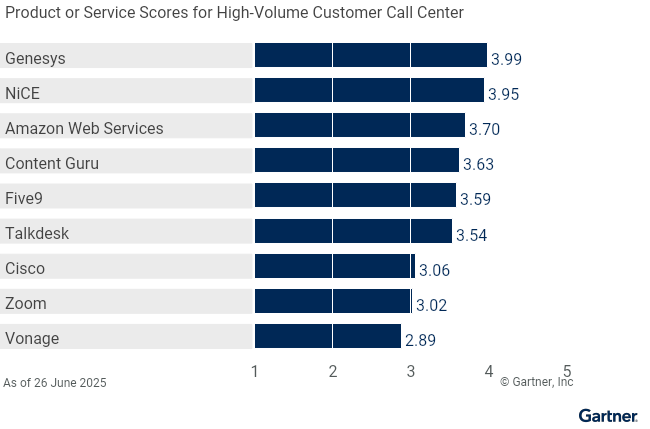
- High-volume customer call center addresses replacing the legacy call center platform, one of the primary goals clients strive to attain with CCaaS.
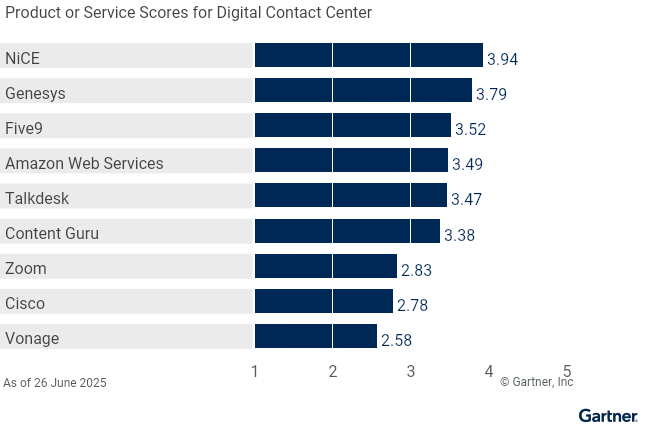
- Digital contact center addresses another primary client goal: offering rich digital customer service capabilities as part of the customer service and support solution.
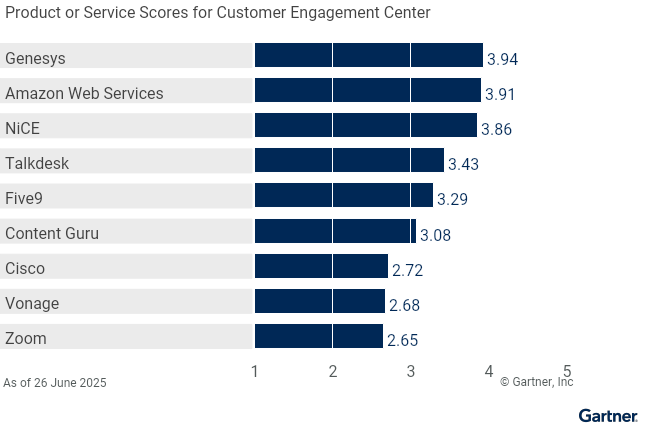
- Customer engagement center addresses the need for deeper integration with business applications, delivering an enhanced customer experience across all channels of engagement.
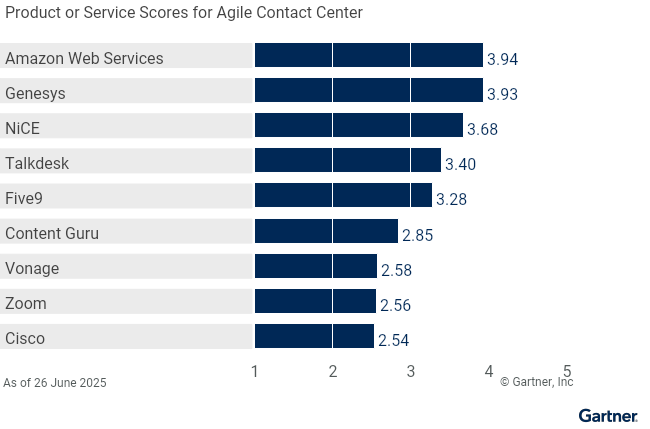
- Agile contact center addresses the need for customer service and support technology leaders to rapidly change the setup of the customer service environment in line with operational and budgetary needs.
- Global contact center addresses the need for organizations to build a global capability to serve customer support requirements with a single CCaaS platform provider.
Customer service and support technology leaders can use this research to identify vendors that meet their specific requirements. The observations and scores in these profiles are derived solely from Gartner’s assessment of vendors’ capabilities.
Based on the focus of your customer service objectives, Gartner recommends that you adjust the weighting of the capabilities to better reflect your situation, rather than using the use-case tables below without adjustment. To do this, click the “customize” button on the interactive version of the document and adjust the weightings of the capabilities within that use case. This will enable you to better assess the functional appropriateness of the vendors within this research.
Note:
Gartner has adapted the 2025 Critical Capabilities for CCaaS to reflect an increasing demand for functions spanning the CCaaS and CRM customer engagement center (CEC) solution markets. As a result, the following changes have been made to the critical capabilities:
- Workflow orchestration and automation expands from the previous automation of engagement to include new capabilities that support the design, orchestration and monitoring of customer service workflows, tasks and processes.
- Agent experience and virtual agent assistance expands from the previous agent experience to include the extent to which the workspace/desktop is configurable to enable the advisor to manage all customer engagements holistically and efficiently, and how AI automation assists the agent in their tasks and interactions.
Analysis
Critical Capabilities Use-Case Graphics
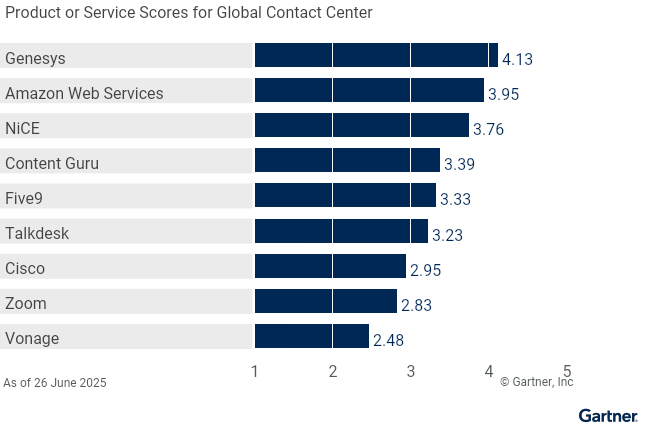
Vendors
Amazon Web Services
Amazon Web Services (AWS) is headquartered in Seattle, Washington, and is a subsidiary of Amazon. Amazon Connect is built on its native AWS cloud platform and integrates with broader AWS services (AI, machine learning, storage, computing). Amazon Connect is an open, API-first platform with an expanding portfolio of packaged offerings to deliver customer service and support capabilities.
Amazon Connect receives above-average ratings in most critical capabilities. Its strongest score is the global contact center use case, given the global footprint of its offerings, followed by the agile contact center use case, where AWS’s extensive marketplace and active developer community support specialized integrations. Amazon Connect achieves a high rating in the customer engagement center use case due to its strong marketplace, automation and workflow orchestration capabilities. AWS’s weakest rating is the digital contact center use case, largely driven by lower Peer Insights client ratings.
Cisco
Cisco, based in San Jose, California, is a leading provider of networking, communications, collaboration, and security solutions. Within its collaboration portfolio, Cisco maintains strong brand equity among IT teams — especially in highly regulated sectors like healthcare, finance, and government. Its Webex Contact Center is frequently considered by organizations looking to modernize or consolidate legacy platforms, particularly as a successor to Unified Contact Center Enterprise and Express deployments.
Cisco has continued to execute on its roadmap, adding new capabilities, including Next Best Action and Webex AI Agent and AI Assistant for Contact Center. Webex Contact Center has continued to innovate in an increasingly competitive market, with many past third-party integrations now becoming native capabilities. Cisco achieves its highest ratings in the high-volume customer call center and global contact center use cases due to strong telephony capabilities and a robust, global footprint. Its lower score in the agile contact center use case is due in part to its limited marketplace of third-party solutions.
Content Guru
Content Guru, headquartered in Bracknell, U.K., is best known for its storm CONTACT CCaaS platform, a core offering of the privately held Redwood Technologies Group. The company has expanded its global footprint across Europe, U.S., and Asia, and continues to support mission-critical emergency services across Europe. In 2025, storm CONTACT achieved U.S. FedRAMP High authorization, reinforcing its position as a trusted provider for security-sensitive sectors including government, healthcare, and finance. Content Guru is a strong choice for organizations seeking highly resilient, scalable, and secure customer engagement solutions.
Content Guru receives its strongest rating in the high-volume customer call center use case, where its data center design is well-aligned for emergency services. Its second-best rating is the global contact center use case, acknowledging its expanding global go-to-market footprint into North America and Asia. Its lowest rating is the agile contact center use case, as a result of limited applications in its marketplace and the lack of a try-and-buy option.
Five9
Five9 is headquartered in San Ramon, California, and publicly listed on Nasdaq. Five9 introduced AI trust and governance tools, and agent assist has been enhanced to offer real-time guidance and customizable LLM-powered interaction summarization in its Five9 Intelligent CX Platform.
Five9 receives midrange scores across all use cases. Five9’s top use-case ratings are in the high-volume customer call center and digital contact center. Strong scores for telephony and digital, combined with improved SLAs and downtime credits, drive the high-volume customer call center use case scores, while an expanded digital offering with async web and mobile messaging, its overhauled social messaging platform, and its open, bring-you-own-channel support the digital contact center use case scores. Five9’s lowest rating is in the agile contact center use case, where its marketplace has a smaller number of partners than several of its competitors, and the developer community is less active than others.
Genesys
Genesys, a private company headquartered in Menlo Park, California, continues to expand its global reach with its flagship Genesys Cloud CX platform. In 2025, the company introduced Genesys Cloud CX 4, a next-generation package that integrates advanced AI capabilities — including agent assistants, customer journey management, and Cloud AI Experience tokens— to enhance automation, personalization, and operational efficiency. With strong adoption across regulated industries and multinational enterprises, Genesys is a top contender for organizations prioritizing global scalability, robust SLAs, and deep integration ecosystems.
Genesys Cloud CX has high ratings in all use cases, especially in the global contact center, customer engagement center, and high-volume customer call center use cases. Genesys receives strong capability ratings for its robust marketplace of third-party integrated solutions, its telephony and digital offerings, and its broad partner ecosystem. Genesys’ lowest ratings are in the workflow orchestration and virtual agent capabilities, though these compare favorably to most of the competition.
NiCE
NiCE, a public company headquartered in Hoboken, New Jersey, continues to lead in AI-powered customer experience with its CXone platform. In 2025, NiCE launched CXone Mpower agents — enterprise-grade AI agents designed to automate full customer journeys across front-, mid-, and back-office operations. With a global footprint and a comprehensive, AI-first feature set, NiCE remains a top choice for large enterprises with complex interaction flows and a focus on intelligent automation.
NiCE CXone Mpower has strong performance in all five use cases, especially in the digital contact center use case. The addition of social media routing by sentiment, improved async social messaging support, and universal routing and workflow capabilities drove the strong showing. NiCE’s lowest areas of differentiation are in the global and agile contact center use cases, where its marketplace and developer community offerings are less mature than those of some competitors.
Talkdesk
Talkdesk, founded in Portugal and headquartered in Palo Alto, has a global presence with a sweet spot in North American and European markets with its modular CX Cloud platform. In early 2025, Talkdesk introduced AI agents for voice, enabling humanlike, multilingual self-service powered by agentic AI that understands context, expresses empathy, and takes autonomous action. The company also enhanced consult transfers to queues, allowing agents to initiate warm transfers with configurable wait times, music, and prioritization logic, improving routing flexibility and agent experience. These innovations reinforce Talkdesk’s position as a strong choice for healthcare, banking, insurance, and retail organizations seeking intelligent automation and tailored workflows.
Talkdesk receives above-average scores across most use cases. Its strongest scores are in agile contact center and customer engagement center use cases, driven by an engaged developer community and a broad set of productized connectors to CRM and other back-end platforms. Talkdesk’s lowest ratings are in the high-volume customer call center and global contact center use cases, which are constrained by limited global coverage outside of North America and Europe.
Vonage
Vonage, headquartered in Holmdel, New Jersey, is a subsidiary of Ericsson and delivers customer experience solutions through its Vonage Contact Center (VCC) platform. In early 2025, Vonage launched VCC Intelligent Workspace, an AI-powered omnichannel interface that enhances agent productivity with features like Customer 360 and Agent Assist 1. Additional updates include screen recording controls, centralized scheduling, and enhanced team monitoring for voice and abandoned interactions. These capabilities strengthen Vonage’s appeal to small and midsize organizations in Europe and North America, particularly those leveraging Salesforce, where VCC offers deep native integration.
Vonage’s best score is in the agile contact center use case, driven largely by an improving marketplace of third-party integration. Vonage’s lowest scores are in the global and digital contact center and the high-volume customer call center use cases, limited by a lack of multilanguage admin support, complex pricing, and restrictive SLA credits in the event of unplanned downtime.
Zoom
Zoom, headquartered in San Jose, California, has grown its presence in the customer experience space through its Zoom Contact Center, a platform that initially launched in February 2022 that integrates voice, video, and digital channels within the broader Zoom ecosystem. Built on the same cloud platform as Zoom’s collaboration and telephony offerings, Zoom Contact Center unifies self-service, agent assistance, and workforce engagement. It provides AI-powered agent, customer, and back-office use cases, in addition to outbound campaign management and integrations with platforms like Microsoft Teams and Zoom Team Chat. Although Zoom is relatively new to the CX space, clients seeking a unified collaboration, telephony communications, and contact center solution should consider it.
Zoom’s highest rating is in the digital contact center use case, driven by digital and social media channel maturity, along with native workflow orchestration and AI capabilities. Zoom’s lowest rating is for the agile contact center use case, largely due to a limited CX marketplace portfolio.
Context
Customer service and support technology leaders should apply this research to their own contact center requirements and strategic objectives. While CCaaS contracts do not typically exceed three years, resource training investments often extend upward of seven to nine years. However, shorter-term contracts offer more flexibility and responsiveness, which enables leaders to pivot their approach if necessary. Organizations should align vendor product and service capabilities with their own aspirations for customer service development.
Clients can adjust the weightings for the five use cases to determine their best-fit provider. We have selected the most critical capabilities that will influence a contact center decision over the next 12 months.
Use this research alongside selected capability evaluations from overlapping application areas in customer engagement center, digital customer service and workforce engagement. This is especially important in cases where some CCaaS providers’ suite capabilities may not meet the use cases for some complex customer service environments.
Market Definition
Gartner defines contact center as a service (CCaaS) as solutions offering SaaS-based applications that enable customer service departments to manage multichannel customer interactions holistically from both a customer-experience and employee-experience perspective.
CCaaS is a key technology platform used to support the customer service experience, whether it be self-service or assisted by customer service representatives. All organizations need to offer customer assistance. The preference is for remote support via voice and digital channels over physical presence in offices and stores, though it is common for organizations to offer multiple options.
The ambition is for customers to self-serve assistance, through web portals or chatbots. But it is also recognized that complex issues still need the support of employees. CCaaS technology is instrumental in orchestrating both self- and assisted-service engagement with customers. The technology can also manage the quality of engagement between the customer and the customer service representative, recognizing that premium customer experiences are achieved through premium employee experiences.
Mandatory Features
While CCaaS solutions can support a variety of customer interaction channels, to be considered “CCaaS” the solutions must be anchored in inbound voice routing/automatic call distribution (ACD). CCaaS solutions must also support:
- Application and native communication connectivity, providing voice and data access (telco “points of presence”) as well as application hosting on public and/or private data centers to support client access, including in markets where the provider supports connectivity but does not actively market and sell its services.
- The routing of digital interactions (including email, web chat, SMS, social media, video or other channels).
- Prepackaged agent, supervisor and reporting applications, although these environments may be extended using a GUI-based interface or open APIs.
- Workforce engagement management (WEM) that covers some or all of agent staff scheduling and forecasting, call and/or desktop recording and analytics, quality management, agent assistant functionality, knowledge management, and workflow routing of noninteraction work items.
Gartner’s definition of CCaaS excludes:
- Hosted contact center services, in which system hardware and software are dedicated to individual customers.
- Managed services, in which hardware and software are dedicated to a particular customer and run on that customer’s premises or in a third-party data center, but are managed by a third-party service provider.
- Enterprise server software repurposed as CCaaS offerings.
Optional Features
Other optional CCaaS capabilities may include:
- Outbound voice (predictive, progressive or preview dialing)
- Customer self-service automation (interactive voice response [IVR]/voice portal, self-service bots, virtual customer assistants)
- Integration with customer tracking (CRM) and other enterprise databases
- Real-time and historical tracking and analytics
Product/Service Trends
The core functional components of a CCaaS solution are:
- Contact routing and interactions — Focusing on delivering a channel-agnostic, architected design to create customer service journeys, including intelligent self-service. Services are consumed on a per-seat, per-concurrent user, or per-transaction basis.
- Resource management — Developing and maintaining engaged and empowered staff based on the understanding that engaged employees power a stronger customer experience
Differentiating functional components of a CCaaS solution are:
- Process orchestration — Supporting increasingly complex and personalized customer engagements
- Knowledge and insight — Delivering customer and operational insights and recommending next best actions across all functional groupings
Critical Capabilities Definition
Data Center Design
The strength of the data center architecture used to provide resilient and scalable computing power to support global, on-demand customer service.
This is the ability to support high-availability and/or disaster-recovery configurations for scalable customer service environments. The overall architectural robustness includes elastic data center infrastructure or computing power and multinational presence by leveraging either traditional colocation or infrastructure as a service (IaaS) partners.
Providers that meet or exceed this capability have broad global coverage and the ability to seamlessly scale infrastructure resources down or up to meet unpredictable service requirements.
Telephony-Centric Offer
Scalable, robust telephony-centric service with competitive voice carrier services and a telephony-centric license structure.
Managing high volumes of telephone calls is a key requirement for many organizations in adopting contact centers as a service. CCaaS providers should be able to reference customers that have large call volumes and high occupancy requirements. The optimum business model for CCaaS includes telecom connectivity as part of the overall service, but “bring your own telco” is an important feature for larger organizations with more complex telecom arrangements. CCaaS providers with telecom licenses can buy minutes at wholesale rates, enabling them to be more competitive with customers’ outbound calling requirements. Interconnect agreements for carrier connections provide higher levels of overall service availability.
Scores for this capability are higher where high-volume call environments are demonstrable, providers can leverage better rates from wholesale agreements, and telecom services are included in meaningful SLAs.
Digital-Centric Offer
Digital-centric service supporting multiple touchpoints of digital engagement holistically across self- and assisted service with a digital-centric license structure.
Consistency, persistence, and seamless orchestration and integration across digital and voice channels are crucial to maintaining a positive digital customer experience. This capability should encompass a range of synchronous and asynchronous touchpoints.
Synchronous messaging is when customers and advisors are engaged in a live channel with a defined beginning and end to the conversation. Webchat and live chat are examples of this. Some organizations will include email and SMS as live communication channels.
Asynchronous messaging is different in that the two parties of the conversation are not necessarily present at the same time. The persistence of asynchronous messaging means the conversation is continuous, with the chat history retained as part of the interaction (via Apple Messages for Business, Instagram, X, WhatsApp, etc.). In-app mobile messaging includes software development kits (SDKs) for customer support apps that are accessible from smartphones or tablets. In-app messaging could be synchronous or asynchronous.
CCaaS applications already natively support email, live chat and chatbots/virtual customer assistants as channels of engagement. This capability looks deeper at the more advanced digital capabilities, enabling context preservation across all engagement channels to orchestrate seamless conversations.
Scores for this capability are higher with demonstrable support for:
- A range of social/mobile app-oriented digital engagement
- Seamless data aggregation and context preservation across channels
- A flexible license approach that enables organizations to shift users from telephony-centric to digital-centric environments
Marketplace
The availability and population of third-party applications and integrations, consumable via the CCaaS provider’s own marketplace.
The application marketplace approach is designed to provide fast, easy integration into customer service applications, supporting the speed and agility of a system of differentiation. Leading CCaaS providers will maintain their own application marketplaces, supporting applications developed by communities, partners, or the providers themselves.
Providers with extensive marketplaces with a broad spectrum of customer service applications that can be acquired through try-and-buy options will score highly in this category.
Developer Environment
The availability of a developer environment to enable customization of the CCaaS platform and integrate with other applications, all in a nonlive test environment.
Customization of the contact center environment is increasingly important as organizations scale their customer service environments for greater automation and efficiency. The developer environment enables a level of composability to create customized services and integrations and the option to test and verify before being deployed in a live customer service environment. Sandboxes provide features such as versioning, test migration, and rollback tools.
Providers that meet this requirement will have visible developer websites with active community discussions and knowledge sources to support the development, integration, testing, upgrading, and diagnostics with applications in a test bed environment.
Workforce Engagement Management
The depth of workforce engagement management (WEM) solutions offered primarily as an embedded CCaaS suite capability, or alternatively, as an embedded OEM with a strategic WEM partner.
This is the ability to offer a comprehensive set of WEM capabilities as part of the CCaaS suite. WEM should be a core focus for CCaaS providers in broadening their product sets. This is important as customer service organizations look to consolidate providers offering all aspects of workforce engagement in customer service. Core capabilities to be offered as part of the CCaaS provider’s own software suite are:
- Time management — A flexible platform that allows employees to self-manage their work-life balance and associated schedule requirements, including flexibility over breaks at work, shift swaps, and organizing remote working.
- Evaluation and improvement — The ability to provide a personalized assessment of employee performance linked to individual attributes and to instigate a tailored coaching/training program in line with their personality traits, learning preferences, and career aspirations.
To meet vendor consolidation initiatives, clients also expect CCaaS providers to offer the following:
- Metrics and recognition — The ability to set, monitor, visualize, and reward engagement and performance in line with individual objectives.
- Voice of the employee — The ability to capture, analyze, and act on feedback from employees, captured either directly through surveys and polls and/or indirectly from interaction (e.g., voice recordings) and operational data (e.g., system performance, shift patterns).
Another WEM capability is assistance and task management, which is captured in the agent experience capability of this research.
To satisfy greater scale and niche requirements, CCaaS provider marketplaces should be populated with best-of-breed WEM providers and with productized connectors. Providers that meet this capability will not be heavily reliant on partners for all capabilities of WEM.
Workflow Orchestration & Automation
This is how the application supports the design, orchestration and monitoring of customer service workflows, tasks, and processes.
Personalization and real-time persistence within customer engagement workflows involve automating processes using an adaptive rule engine, AI techniques, or a combination of both to dynamically manage customer inquiries and associated activities based on contextual information. These capabilities enable customer service to efficiently deliver customers’ expected outcomes while facilitating customer activity tracking and monitoring against service-level agreements, ensuring that customers are successfully routed and approved through the path to resolution. Some CCaaS applications provide advanced business process automation capabilities, supporting the coordination and execution of complex processes, decision reasoning engines and business activity monitoring (BAM).
Customer Administration Portal
The ability for customer service organizations to create, modify, and manage core operational and reporting parameters of cloud-based contact center environments in real time.
Customer service and support technology leaders must be able to manage the resources available to them to deal with unpredictable service requirements. This must take place in real time and includes all facets of queuing, routing, reporting, and administration.
Providers that meet this requirement will have an intuitive portal that uses visual graphics and wizards to facilitate administration at multiple operational levels. Additionally, the administration portal will feature a consolidated interface with administration, reporting, and WEM accessible through the same UI. Customer administration portals with broad language support for system administration and agent interfaces will have better applicability in global contact center operations.
Agent Experience and VAA
The extent to which the workspace/desktop is configurable to enable the advisor to manage all customer engagements holistically and efficiently, and to use automation to assist the agent in their tasks.
The demanding role of the customer service advisor can be best supported by a configurable workspace with extensive visibility of engagement channels, integration with, or embedded into leading enterprise software applications. Virtual agent assistants (VAAs) provide contact center employees with real-time context and guidance, and are a key investment for organizations when improving employee experience (EX), given that increasingly the requests that reach assisted service are getting more complex.
Providers that meet this requirement will complement configurable workspaces with strong integration to enterprise CRM, knowledge management, and AI-infused (including generative AI) agent-assist tools that drive agent enablement, empowerment, contextual guidance, and knowledge.
Pricing and Contract Elasticity
Overall competitiveness of pricing models and the ability for customers to flexibly add and revise active agent license counts.
A key operational benefit of CCaaS is the speed and flexibility of service provision. This capability enables organizations to scale their customer service application resources up and down in line with the requirements to meet seasonal and unplanned demands. To align with service delivery and customer preferences, there should also be a range of service charges for concurrent, named-user licensing and consumption-based pricing. Pricing should be transparent: Pricing should be publicly listed, and charges should be clearly defined in contract proposals.
Providers that meet this requirement will offer comprehensive pricing models and monthly contract elasticity, with no penalties for overconsumption, at market rates for the quality of service they offer. Additionally, high-scoring providers will offer transparent pricing, including clearly defined package details in the desired customer currency. Scores for this capability are also influenced by Gartner Peer Insights for pricing and contract elasticity.
SLAs and Trust Center
The vendor’s ability to support meaningful SLAs and provide open visibility into its performance.
Trust is one of the greatest hurdles for customer service organizations to overcome. Customer service and support technology leaders expect the ability to deliver reliable customer service and uninterrupted operations to their customer bases. SLAs typically vary between 99.95% and 99.999% but can be set at 100% for high uptime requirements like emergency service use cases. The variation in service level is, in part, connected with data center architecture and carrier services employed. Organizations need to ensure that CCaaS providers are transparent with their service levels, not just of the platform but of connectivity to key business applications.
Providers that meet this requirement will have a minimum of 99.99% availability as a standard and with it, a clear set of compensation payments for nonperformance. Providers that exceed this capability will be transparent with service ratings on their website and will have strong Gartner Peer Insights ratings and meaningful SLA service credits for nonperformance.
Customer Experience
The customer’s perceptions and related feelings are caused by the one-off and cumulative effects of interactions with a supplier’s employees, systems, channels, and products.
A decision on a CCaaS partner is a multiyear decision, with many relationships lasting more than five years. This rating is influenced by customer experience data that Gartner collects through Gartner Peer Insights and by Gartner analysts’ interactions with clients about their experiences with CCaaS providers.
Providers that meet or exceed this capability consistently come into the consideration set for contact center service selection and have strong scores for overall rating on Gartner’s Peer Insights and consistent positive feedback from Gartner customer service analysts’ client inquiries.
Channel Partner Program
A partner network to lead sales, implementation and service for CCaaS offers.
As CCaaS matures, the most effective way of scaling a business is to enable customers to procure the service through a specialized channel partner with competencies in supporting customer service technologies. Customers will be able to view and assess partners based on their requirements from the CCaaS provider’s web portal.
Providers that meet this capability will have an expansive network of geographically distributed CCaaS partners. Additionally, regional coverage and certification tiers will be visible to customers on the provider’s public website.
Real-Time Continuous Intelligence
An application’s ability to support real-time analysis of current and historical data to enable smarter real-time decision making.
Continuous intelligence is a design pattern in which real-time analytics are integrated into a business operation. It processes both current and historical data to surface insights needed to inform a real-time interaction. Incorporating continuous intelligence into a CCaaS application enables smarter real-time decision making. For example, the application might decide under which business process rule to proceed, under which conditions an interaction should be rerouted, and to which skill group or individual it should go. It can also analyze the root cause of a problem posed by a customer in real time through solution analysis and the use of a decision support engine.
Use Cases
High-Volume Customer Call Center
This use case addresses replacement of the legacy call center platform, one of the primary goals clients strive to attain with CCaaS.
While a primary focus in this use case is on the scale and operational effectiveness of telephony requirements, we expect that all CCaaS platforms can provide multichannel capabilities. As such, the digital-centric offer and the automation of engagement capabilities also influence this use case. Overall, this use case evaluates scenarios that manage large volumes of calls and interactions. Customer service organizations need CCaaS platforms that can scale rapidly to support high volumes of phone calls with the highest levels of resiliency.
Automation plays an important role in the initial customer response, in supporting automation of simpler responses and for classifying and scheduling responses that need advisor assistance. Planning and scheduling of staff is an important capability for efficient operations.
For this use case, there is a stronger weighting for the telephony-centric offer, data center design, WEM, and SLAs and trust center.
Digital Contact Center
This use case addresses the primary goal of offering more digital customer service capabilities as part of the customer service suite of technology.
Digital customer service has escalated significantly in the last two years, with customers’ expectations evolving in terms of how they can engage with their suppliers. The rise in asynchronous messaging and mobile applications (e.g., Apple Messages for Business, Facebook Messenger, WhatsApp) means that CCaaS providers must enhance digital engagement and live customer service. They must also offer intelligent self-serve capabilities to ensure seamless communication across multiple channels. New brands emerging in the market are offering digital-only customer service, so CCaaS providers have to be able to position their portfolio to reflect a non-telephony-centric proposition.
For this use case, there is a stronger weighting on the digital-centric offer, workflow orchestration and automation of engagements, and the agent experience and VAA.
Customer Engagement Center
This use case addresses the need for deeper integration with business applications, offering a stronger customer experience across all channels of engagement.
Tight integration of business application software improves customer service and leads to stronger customer engagement. The goal of a customer engagement center (CEC) is to leverage historic and real-time data to provide reactive and proactive service to customers as they move between customer engagement channels while still retaining the customers’ context. The goal is also to apply the appropriate business rules to determine the next best action, information, or process with which to engage the customers.
For this use case, there is a stronger focus on the marketplace, real-time continuous intelligence, customer experience, agent experience, developer environment and workforce engagement management.
Agile Contact Center
This use case addresses the need for customer service managers to rapidly change the setup of the customer service environment in line with operational and budgetary needs.
Agile contact centers tend to be deployed for more specific customer service requirements — for example, to rapidly introduce new communication channels, or to set up a support function for a new product or service. The agile suite offers greater flexibility in terms of speed of deployment and ability to easily integrate with third-party applications, scalability, and service elasticity.
For this use case, there is a stronger focus on the customer administration portal, pricing and contract elasticity, and the marketplace.
Global Contact Center
This use case addresses the need for organizations to build a global capability to serve customer service requirements with a single CCaaS platform provider.
As CCaaS scales to thousands of seats, large multinational organizations are starting to consolidate multiple instances of CCaaS and premises-based technology with a common platform provider. They will typically do this for all their requirements in multiple regions around the globe. CCaaS providers need to rely on partner resources to provide centralized and local support for global customers. Additionally, they should deliver these services on a resilient and scalable data center architecture that supports high-availability, on-demand customer service.
For this use case, there is a stronger focus on the channel partner program, data center design, and the ability to easily modify operations via the customer administration portal.
Vendors Added and Dropped
We review and adjust our inclusion criteria for Critical Capabilities as markets change. As a result of these adjustments, the mix of vendors in any Critical Capability may change over time. A vendor’s appearance in a Critical Capability one year and not the next does not necessarily indicate that we have changed our opinion of that vendor. It may be a reflection of a change in the market and, therefore, changed inclusion criteria, or of a change of focus by that vendor.
Added
Zoom
Dropped
8x8
Inclusion and Exclusion Criteria
To qualify for inclusion, providers needed to fulfill all of the following requirements:
- A minimum of $83 million total revenue as of 31 December 2024, composed of concurrent licenses, named user licenses and application consumption. This revenue stream is restricted to enterprise customers and does not include business process outsourcing (BPO) or contact center outsourcing business. We require a letter of attestation from an appropriate finance executive certifying that the minimum revenue requirements are met.
- A minimum of 10% of CCaaS software license revenue from net new (“new logo”) clients.
- Average deal size above 100 customer service representatives.
- Demonstrated sales, marketing and operational (including company registration) presence in three of the following geographic regions:
- North America
- Europe
- South America (including Central America)
- Asia/Pacific
- Middle East and Africa
- Services should be offered primarily on multitenant platforms and on multiple instances of microservices software as required to meet the needs of customers across several geographies. (Multitenant software describes how the service provider operates a single software instance on which multiple customers can be supported.) To be included in this research, vendors need to show how their CCaaS platform is designed to support organizations with customer service teams from 25 users up to many thousands of users. The platform must also be able to support both voice and nonvoice channels. This must be evidenced in the vendor’s strategic intent for the CCaaS platform, contract reviews evaluated by Gartner analysts, and analysis of company size in Gartner Peer Insights and Gartner Digital Markets platforms. CCaaS providers need to demonstrate how, irrespective of architecture employed, their software inherently provides all customers with transparent access to the same set of services irrespective of location. Software updates must be simultaneously “pushed” to all customers regardless of location, avoiding the traditional “major upgrade” cycles typical of on-premises or single-tenant hosted/managed deployments.
- Contact center seat license ownership must be retained by the service provider. Customer contracts must allow for elasticity of usage (enabling customers to scale agent licenses or consumption up or down as usage demands change).
- At least 50% of CCaaS service revenue must be from inbound voice agent licenses (automatic call distribution [ACD]). Other licenses may include outbound voice (predictive, progressive or preview dialing) and must include routing of digital interactions (including email, web chat, SMS, social media, video, or other channels). They may also include IVR/voice portal, WEM, call and/or desktop recording and analytics, knowledge management, workflow routing of noninteraction work items, integration with customer tracking (CRM) and other enterprise databases, and real-time and historical tracking and analytics. The service must provide prepackaged agent, supervisor, and reporting applications, although these environments may be extended using a GUI-based interface or open APIs.
- A CCaaS provider must rank among the top providers in the Customer Interest Indicator defined by Gartner for this research. Data inputs used to calculate relevancy include Gartner client interest, customer reviews, and market awareness.
Gartner’s definition of CCaaS excludes:
- Hosted contact center services, in which system hardware and software are dedicated to individual customers
- Managed services, in which hardware and software are dedicated to a particular customer and run on that customer’s premises or in a third-party data center, but are managed by a third-party service provider
- Enterprise server software repurposed as CCaaS offerings
Weighting for Critical Capabilities in Use Cases
| Critical Capabilities | High-Volume Customer Call Center | Digital Contact Center | Customer Engagement Center | Agile Contact Center | Global Contact Center |
|---|---|---|---|---|---|
Data Center Design | 15% | 5% | 5% | 5% | 20% |
Telephony-Centric Offer | 25% | 5% | 5% | 5% | 5% |
Digital-Centric Offer | 5% | 25% | 0% | 5% | 5% |
Marketplace | 0% | 0% | 10% | 20% | 5% |
Developer Environment | 0% | 0% | 10% | 10% | 5% |
Workforce Engagement Management | 15% | 5% | 5% | 0% | 5% |
Workflow Orchestration & Automation | 5% | 20% | 15% | 5% | 5% |
Customer Administration Portal | 5% | 5% | 5% | 10% | 10% |
Agent Experience and VAA | 5% | 15% | 10% | 5% | 5% |
Pricing and Contract Elasticity | 5% | 5% | 0% | 20% | 0% |
SLAs and Trust Center | 10% | 5% | 5% | 0% | 5% |
Customer Experience | 5% | 5% | 15% | 5% | 5% |
Channel Partner Program | 0% | 0% | 5% | 5% | 25% |
Real-Time Continuous Intelligence | 5% | 5% | 10% | 5% | 0% |
As of 26 June 2025 | |||||
Source: Gartner (September 2025)
This methodology requires analysts to identify the critical capabilities for a class of products/services. Each capability is then weighed in terms of its relative importance for specific product/service use cases.
Each of the products/services that meet our inclusion criteria has been evaluated on the critical capabilities on a scale from 1.0 to 5.0
Critical Capabilities Rating
Product/Service Rating on Critical Capabilities
| Critical Capabilities | Amazon Web Services | Cisco | Content Guru | Five9 | Genesys | NiCE | Talkdesk | Vonage | Zoom |
|---|---|---|---|---|---|---|---|---|---|
Data Center Design | 3.8 | 3.9 | 4.1 | 3.4 | 3.8 | 4.0 | 3.0 | 2.6 | 2.9 |
Telephony-Centric Offer | 4.3 | 3.5 | 4.4 | 4.0 | 4.5 | 3.8 | 3.7 | 3.9 | 3.1 |
Digital-Centric Offer | 3.3 | 3.0 | 3.5 | 4.0 | 3.8 | 4.0 | 3.4 | 2.1 | 2.9 |
Marketplace | 4.7 | 1.3 | 1.5 | 2.7 | 4.0 | 3.3 | 2.9 | 1.8 | 1.0 |
Developer Environment | 4.8 | 3.5 | 2.5 | 3.1 | 4.3 | 3.8 | 3.9 | 3.4 | 2.7 |
Workforce Engagement Management | 3.2 | 2.6 | 3.1 | 3.5 | 4.0 | 4.8 | 3.8 | 2.0 | 3.0 |
Workflow Orchestration & Automation | 3.1 | 2.2 | 3.1 | 3.0 | 3.5 | 3.7 | 3.0 | 2.5 | 2.3 |
Customer Administration Portal | 3.7 | 2.7 | 3.8 | 3.6 | 4.1 | 4.2 | 4.1 | 2.8 | 3.8 |
Agent Experience and VAA | 3.9 | 2.7 | 3.4 | 3.4 | 3.8 | 4.2 | 3.9 | 2.9 | 2.7 |
Pricing and Contract Elasticity | 3.1 | 2.3 | 2.6 | 3.4 | 3.5 | 3.3 | 3.4 | 2.7 | 3.0 |
SLAs and Trust Center | 3.3 | 2.7 | 3.1 | 3.4 | 3.8 | 3.0 | 3.5 | 3.0 | 3.4 |
Customer Experience | 3.8 | 2.9 | 3.2 | 3.6 | 4.0 | 4.1 | 3.2 | 3.0 | 3.3 |
Channel Partner Program | 4.4 | 2.7 | 3.2 | 3.0 | 4.7 | 3.2 | 2.6 | 1.8 | 2.6 |
Real-Time Continuous Intelligence | 4.0 | 3.0 | 3.1 | 3.3 | 3.6 | 4.1 | 3.9 | 2.4 | 2.3 |
As of 26 June 2025 | |||||||||
Source: Gartner (September 2025)
Table 3 shows the product/service scores for each use case. The scores, which are generated by multiplying the use-case weightings by the product/service ratings, summarize how well the critical capabilities are met for each use case.
Product Score in Use Cases
| Use Cases | Amazon Web Services | Cisco | Content Guru | Five9 | Genesys | NiCE | Talkdesk | Vonage | Zoom |
|---|---|---|---|---|---|---|---|---|---|
High-Volume Customer Call Center | 3.70 | 3.06 | 3.63 | 3.59 | 3.99 | 3.95 | 3.54 | 2.89 | 3.02 |
Digital Contact Center | 3.49 | 2.78 | 3.38 | 3.52 | 3.79 | 3.94 | 3.47 | 2.58 | 2.83 |
Customer Engagement Center | 3.91 | 2.72 | 3.08 | 3.29 | 3.94 | 3.86 | 3.43 | 2.68 | 2.65 |
Agile Contact Center | 3.94 | 2.54 | 2.85 | 3.28 | 3.93 | 3.68 | 3.40 | 2.58 | 2.56 |
Global Contact Center | 3.95 | 2.95 | 3.39 | 3.33 | 4.13 | 3.76 | 3.23 | 2.48 | 2.83 |
As of 26 June 2025 | |||||||||
Source: Gartner (September 2025)
To determine an overall score for each product/service in the use cases, multiply the ratings in Table 2 by the weightings shown in Table 1.
Critical Capabilities Methodology
This methodology requires analysts to identify the critical capabilities for a class of products or services. Each capability is then weighted in terms of its relative importance for specific product or service use cases. Next, products/services are rated in terms of how well they achieve each of the critical capabilities. A score that summarizes how well they meet the critical capabilities for each use case is then calculated for each product/service.
"Critical capabilities" are attributes that differentiate products/services in a class in terms of their quality and performance. Gartner recommends that users consider the set of critical capabilities as some of the most important criteria for acquisition decisions.
In defining the product/service category for evaluation, the analyst first identifies the leading uses for the products/services in this market. What needs are end-users looking to fulfill, when considering products/services in this market? Use cases should match common client deployment scenarios. These distinct client scenarios define the Use Cases.
The analyst then identifies the critical capabilities. These capabilities are generalized groups of features commonly required by this class of products/services. Each capability is assigned a level of importance in fulfilling that particular need; some sets of features are more important than others, depending on the use case being evaluated.
Each vendor’s product or service is evaluated in terms of how well it delivers each capability, on a five-point scale. These ratings are displayed side-by-side for all vendors, allowing easy comparisons between the different sets of features.
Ratings and summary scores range from 1.0 to 5.0:
1 = Poor or Absent: most or all defined requirements for a capability are not achieved
2 = Fair: some requirements are not achieved
3 = Good: meets requirements
4 = Excellent: meets or exceeds some requirements
5 = Outstanding: significantly exceeds requirements
To determine an overall score for each product in the use cases, the product ratings are multiplied by the weightings to come up with the product score in use cases.
The critical capabilities Gartner has selected do not represent all capabilities for any product; therefore, may not represent those most important for a specific use situation or business objective. Clients should use a critical capabilities analysis as one of several sources of input about a product before making a product/service decision.