Critical Capabilities for Digital Communications Governance and Archiving Solutions
10 November 2025 - ID G00829698 - 34 min read
By Rizvan Hussain, Michael Hoeck, and 2 more
New and more complex digital communications tools require modern solutions that enforce corporate governance and regulatory compliance. Heads of I&O can use this report to compare digital communications governance and archiving products from 14 vendors based on 11 critical capabilities and six use cases.
Overview
Key Findings
- Enterprise employees are expanding their use of mobile and messaging applications, such as SMS, WhatsApp, iMessage, WeChat and Signal, as well as off-channel communications tools, leading to governance and compliance challenges.
- Digital communications governance and archiving (DCGA) vendors are rapidly expanding their use of AI/machine learning (ML) throughout their offerings. These capabilities are intended to improve accuracy and scalability to manage a greater number of communications sources and the volume of each.
- The convergence of text-, audio- and video-based content into a single enterprise communications tool is raising enterprise expectations for governance and archiving solutions to integrate both text and audiovisual content within a unified platform.
- The rise of generative AI (GenAI) and enterprise chatbots in business operations is introducing new challenges related to prompt engineering, response generation and governance.
Recommendations
Heads of infrastructure and operations (I&O) responsible for digital communications governance and archiving should:
- Streamline the vendor-selection process by organizing vendor capabilities for mobile and messaging application capture into categories such as phone carrier integrations, native messaging application integrations and DCGA vendor-developed consolidation tools.
- Ensure governance alignment and transparency by assessing DCGA vendors’ AI/ML capabilities against enterprise requirements, such as AI-based data classification, policy enforcement and support for investigation and supervision workflows.
- Enhance governance by leveraging DCGA solutions that can perform language detection, translation and transcription of audiovisual content.
- Implement AI governance and chatbot monitoring by selecting DCGA solutions that capture and audit prompt-response interactions, enforce policy controls, integrate with existing digital communications governance frameworks and support explainability, compliance and risk mitigation across user inputs and AI-generated outputs.
Strategic Planning Assumptions
By 2029, 40% of digital communications governance and archiving customers will monitor conversations of internal and external-facing GenAI, AI assistant and chatbot tools to monitor their agentic AI-based responses, up from less than 5% in 2025.
By 2029, 30% of enterprises will shift to a proactive employee digital communications governance approach to improve corporate policy outcomes and advance business insights, up from less than 10% in 2025.
By 2029, 85% of DCGA customers will consolidate the supervision of text- and audio/video-based content to a single DCGA solution, which is a major increase from fewer than 20% in 2025.
By 2030, 70% of enterprises using digital communications governance and archiving solutions will adopt AI-driven features and processes, up from 40% in 2025, due to increasing data complexity and governance demands.
What You Need to Know
Employees are now using an expanding set of digital communications tools to accomplish their day-to-day work. All organizations are challenged to keep pace with this expansion while ensuring appropriate governance measures are in place to satisfy regulatory compliance and corporate policies for acceptable use. Heads of I&O should use this report to evaluate digital communications governance and archiving solutions that align best with their organization’s governance requirements.
To help clients understand the suitability of different DCGA offerings, this Critical Capabilities report evaluates vendor products based on six use cases:
- Connectors
- Archive and retention
- Regulatory compliance
- Investigations
- Internal analytics and insights
- User governance
It assesses the ability of 14 vendor products to address these use cases by evaluating each use case against 11 critical capabilities:
- Platform architecture and security
- Archive platform
- Policy management
- Connectors: text-based
- Connectors: audiovisual
- Search/index
- Investigations
- Historical reconstruction
- Supervision/surveillance
- Data insights
- User notifications
Analysis
Critical Capabilities Use-Case Graphics
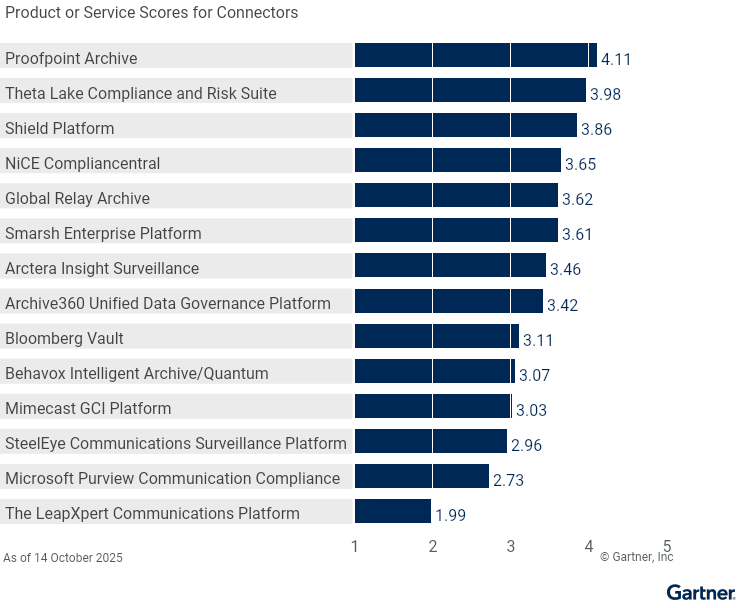
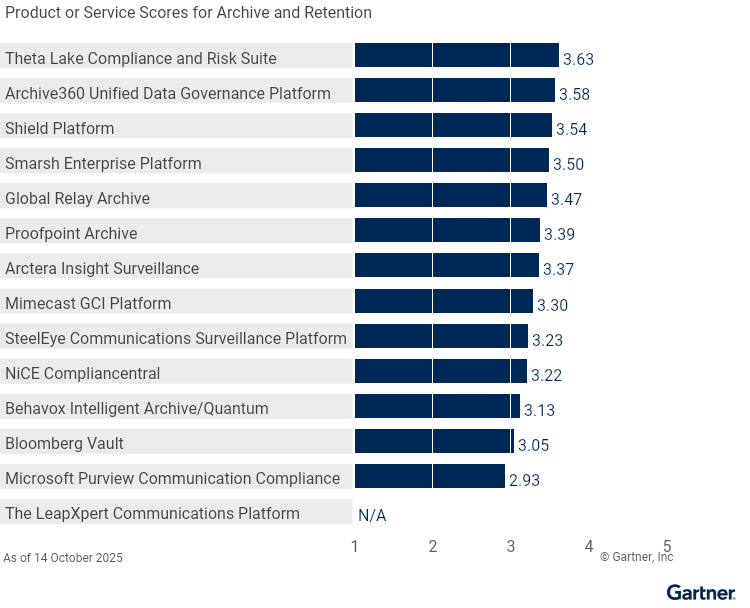
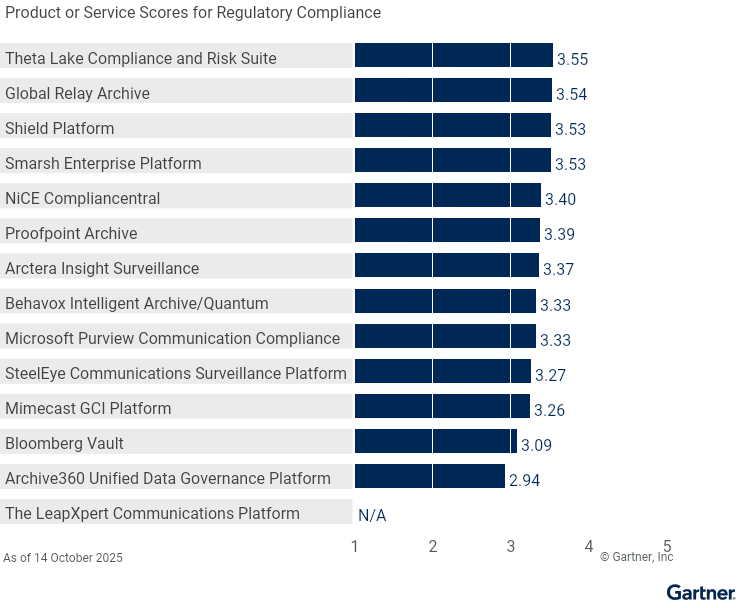
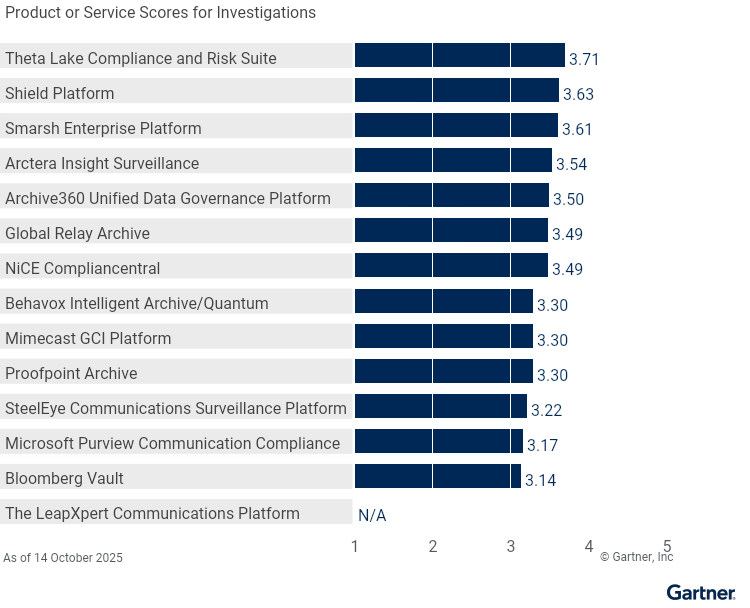
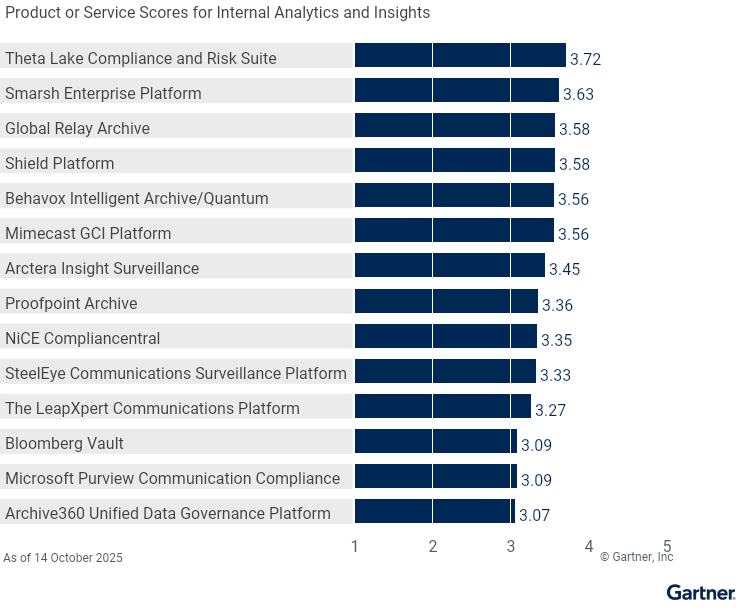
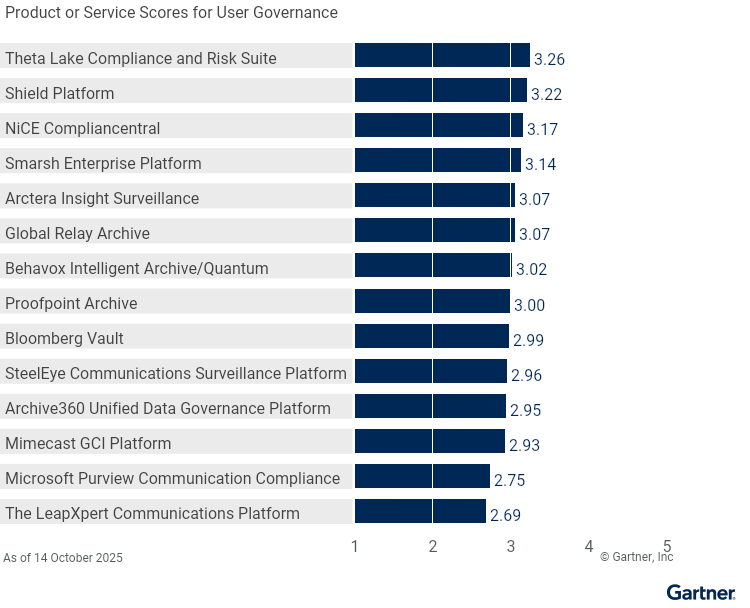
Vendors
Archive360 Unified Data Governance Platform
Archive360 Unified Data Governance Platform is a public cloud-based offering from Archive360. It is deployed primarily on Microsoft Azure as a SaaS-based, single-tenant offering. Archive360 Unified Data Governance Platform is complemented by its FastCollect Framework of tools for collecting, migrating and sourcing data through onboarding data pipelines.
Archive360’s key strength is its cloud-native architecture on Microsoft Azure. It is currently in FedRAMP In Process status. Its AI capabilities use Azure OpenAI Service, built on GPT-4. Its FastCollect Framework enables flexibility to integrate with and migrate data from multiple database and storage environments, often working around API limitations for improved throughput efficiencies. Its archive approach collects and stores data in native formats or by using JSON objects to improve data accessibility. Customers can accommodate data sovereignty in a fully supported instance deployed in a country of their choice. Archive360 has enhanced its investigations capabilities through integration with Microsoft Copilot Studio, allowing users to interact with data using natural language prompts. Archive360 also publishes its data to Snowflake, PowerBI and Tableau.
Customers evaluating Archive360 should be aware of its limited use of AI in the supervision and surveillance use case, lacking implementation of AI data models for flagging content and AI/GenAI compliance summaries. Its user notification capabilities lack user acknowledgement workflows for policy violations, and real-time notifications are limited to Microsoft Teams and mobile channels. Additionally, Archive360 requires the use of data exports and third-party analytics tools for reports such as violation summary reports and time-series trending analysis.
Archive360 Platform meets all the requirements for all use cases except regulatory compliance and user governance. Its highest-scoring use case is archive and retention.
Arctera Insight Surveillance
Arctera’s DCGA offerings are Arctera Insight Surveillance, Insight eDiscovery and Insight Information Governance. The primary focus here is Insight Surveillance. Arctera’s DCGA offerings provide an AI-powered, end-to-end solution for capturing, archiving, monitoring and analyzing digital communications. Arctera supports a choice of on-premises or SaaS deployments on Microsoft Azure for its DCGA solutions.
Arctera’s key strength is its capabilities in its AI-enabled investigations, text-based connectors and user notifications. GenAI is embedded across the Arctera platform, powering natural language queries and generating case summaries in investigations, and summarizing lengthy audio files during review. Arctera supports voice/video captures with direct integration to Zoom and Teams, as well as supporting common audio and video formats from other call recording platforms using Microsoft’s OpenAI Whisper model. Transcription occurs before classification for consistent policies across all communications.
Customers evaluating Arctera should be aware that it lacks audiovisual direct integrations with GoToMeeting, Slack and RingCentral, and whiteboards such as Zoom, Microsoft and Cisco Webex. Arctera’s DCGA solution does not support customer access to archive data without a DCGA license, making vendor APIs available to customers to export data or storing data in a nonproprietary format.
Arctera meets all of the use case requirements. Its highest-scoring use case is investigations.
Behavox Intelligent Archive/Quantum
Behavox Intelligent Archive/Quantum are the primary DCGA solutions for Behavox. They are built on a Google Cloud Platform (GCP) environment as a SaaS-based, single-tenant deployed offering. They also support multitenant offerings such as Pathfinder. The solutions are also complemented with the integration of Behavox Pathfinder for the investigations use case.
Behavox’s key strength is its capabilities in data insights, supervision/surveillance and investigations. The foundation of its offering is the AI-based risk policies that enable these capabilities throughout the solution. These policies are custom-built for various industry verticals, including financial services, telecom and other industries using machine learning. They are trained in native languages to incorporate nuance and cultural context to advance accuracy across multiple jurisdictions. Its supervision/surveillance AI-based capabilities provide clear details and explainability for why content is flagged and includes confidence scores and added metadata context. Additionally, it allows customers to configure surveillance groups and responsibilities based on human resource-linked attributes such as region, entity or employee groups. Behavox also includes its own financial industry-trained audio transcription, providing distinct capabilities to recognize industry jargon and analyze it across use cases.
Customers evaluating Behavox Intelligent Archive/Quantum should be aware that it lacks support for whiteboard content and the integration of audiovisual content from captured GenAI and social media platforms. Behavox also lacks the ability to present single or multiple sources of content into a timeline interface within its supervision/surveillance offering.
Behavox meets all of the use case requirements. Its highest-scoring use case is internal analytics and insights.
Bloomberg Vault
Bloomberg Vault is a SaaS-based offering hosted exclusively on Bloomberg’s proprietary, dedicated infrastructure. It is an integrated solution that addresses financial services regulatory requirements for digital communications. Specific modules include communications and voice capture, surveillance, specialized trade reconstruction and daily compliance file delivery.
Bloomberg Vault’s key strength is its native, real-time integration with Bloomberg communications sources, supporting requirements such as preventive information barriers and ethical walls. It spans a broad base of over 120 channels across communications, voice and trade feeds. The platform has introduced targeted, AI-based surveillance policies supported by “explainability statements” to provide transparency. Additionally, its specialized module for trade reconstruction can correlate disparate data types, including communications, orders, routes, files and executions for regulatory review.
Customers evaluating Bloomberg Vault should be aware of its reliance on third-party connectors for most non-Bloomberg data. The platform’s proprietary hosting model, which Bloomberg positions as a security advantage, can represent a mismatch for organizations with a public cloud-first strategy. Furthermore, while Vault’s search function can query across multiple communication types in a single review, the platform currently lacks a unified timeline interface to display these results in a single chronological view.
Bloomberg Vault meets all the use case requirements except user governance. Its highest-scoring use case is investigations.
Global Relay Archive
Global Relay’s DCGA products include Global Relay Archive, Global Relay App, Global Relay Connectors, Global Relay Surveillance, Global Relay eDiscovery, Global Relay My Archive, Data Migration and eDiscovery as a Service. Combined, these products provide a comprehensive array of DCGA features. Global Relay’s solutions are hosted in their own private cloud infrastructure. The primary focus here is Archive.
Global Relay’s key strength is its capabilities in the support of audiovisual connectors, text-based connectors and user notifications. Global Relay has an extensible AI framework with prompt-based large language model (LLM) and deep learning models, and agentic AI that incorporates reasoning and chain of thought across three tiers (category, subcategory and indicator) for surveillance, automation and workflows. The suite of 100+ Global Relay connectors and APIs normalize chats, social, voice, documents, email and trade data into clean, structured data.
Customers evaluating Global Relay should be aware of limited capabilities in policy management, search and index, and historical reconstruction. Global Relay does not provide an on-premises solution and supports its offerings only through its own private cloud. Global Relay does not allow customer access to archive data without a DCGA license, and does not provide vendor APIs for data export.
Global Relay meets all use case requirements. Its highest-scoring use case is connectors.
Microsoft Purview Communication Compliance
Microsoft Purview Communication Compliance is a SaaS-hosted offering. The modules assessed in this report include Communication Compliance integrated with Data Lifecycle Management and eDiscovery. It runs on Microsoft Azure, which enables clients to address most data residency concerns.
Microsoft Purview Communication Compliance’s primary strength is its investigation capabilities. Purview eDiscovery is offered in Standard and Premium packages. It provides an end-to-end, case-managed workflow to preserve, collect, analyze, review and export content that has been stored in Microsoft 365. This includes communications from Microsoft Exchange Online and Microsoft Teams, as well as documents from Microsoft SharePoint Online and OneDrive. Microsoft Purview Communication Compliance provides proactive capabilities to detect, capture and act on messages that may exceed policy settings. Policies can be based on regulatory compliance and business conduct, such as sensitive information and employee conduct.
Customers evaluating Microsoft Purview Communication Compliance should be aware of the potential storage fees related to adding integrated data sources outside of Microsoft 365, which are placed in Exchange Online mailboxes and SharePoint Online document stores. Microsoft Purview integrations do not include audiovisual content from social media sources and any third-party call recording solutions. Additionally, it has limited support for chat, unified communications as a service (UCaaS) and whiteboard sources.
Microsoft meets the requirements in all use cases except connectors, archive and retention, and user governance. Its highest-scoring use case is regulatory compliance.
Microsoft did not respond to requests for supplemental information. Gartner’s analysis is therefore based on other credible sources.
Mimecast GCI Platform
Mimecast has rearchitected its offering, replacing the Mimecast Cloud Archive with the Mimecast Governance, Compliance and Insights (GCI) Platform. This cloud-native, multiapplication platform is a suite of applications, including Search & Discover for investigations and Signal for real-time supervision, designed to provide unified governance across collaboration channels.
Mimecast’s key strength is its purpose-built AI framework, which is embedded as a core component and included in the base cost. It leverages proprietary natural language processing (NLP) models to classify content for sentiment, toxic speech and sensitive data, and uses GenAI to accelerate investigations with natural-language search and summarization features. Another strength is the platform’s event-driven architecture, which enables the Signal application to provide near-real-time monitoring, alerting and policy enforcement on collaboration platforms like Microsoft Teams and Slack. The platform now includes native connectors for these core platforms, capturing contextual interactions like edits, deletions and emoji reactions.
Customers evaluating the Mimecast GCI Platform should be aware that its 7-second search performance SLA is specifically defined for its email search service and is measured across a distinct set of end-user and administrative interfaces. The platform relies on third-party integrations for the capture and transcription of noncore sources like audiovisual and mobile communications.
Mimecast meets all requirements for the evaluated use cases, except for user governance. Its highest-scoring use case is internal analytics and insights.
NiCE Compliancentral
NiCE Compliancentral is the vendor’s DCGA offering. It includes NTR-X, which provides communication capture and archive; SURVEIL-X, which enables communication and trade surveillance; ARCHIVE-X, which is a standalone archive offering. NiCE Compliancentral is primarily deployed on public cloud services, offering a choice of either Amazon Web Services or Microsoft Azure. NiCE offers an on-premises solution, if required.
NiCE’s key strength is its AI-enabled investigations, text-based connectors and AI-enabled supervision/surveillance. NiCE uses LLMs trained on financial compliance data to classify alerts as suspicious, assign confidence scores and provide explanations in English to key influencing terms. These alerts are categorized into themes, such as insider dealing and front running, to help compliance teams prioritize reviews efficiently or trigger automated escalation or closure via NiCE’s workflow engine.
Customers evaluating NiCE should be aware that it lacks advanced search capabilities such as an AI-based search assist, use of NLP and automated suggestions and refinements, and data anonymization techniques to protect sensitive information. In addition, NiCE’s support for whiteboard content is limited to Zoom, and data access requires a DCGA license.
NiCE meets all use case requirements. Its highest-scoring use case is connectors.
Proofpoint Archive
Proofpoint Archive 6.0 is a SaaS-based offering that is hosted on Amazon Web Services (AWS) as a multitenant solution. Proofpoint Archive integrates with several Proofpoint products: Proofpoint Capture for data source connectors, Proofpoint Patrol for social media monitoring, Proofpoint Discover for archive investigations, Proofpoint Supervision for content review, and Proofpoint Automate for message analysis. Additionally, Proofpoint Track provides upstream and downstream data reconciliation and resilience with the target archive.
Proofpoint Archive’s key strength is the scope of connector coverage across text-based and audiovisual content sources. The integration of the acquired Nuclei offerings has expanded the scope of covered sources. Proofpoint Capture is designed to integrate new content sources, deliver proactive communications analytics during capture, and provide independent search plus reconciliation capabilities that can share insights with the target archive. Proofpoint Discover provides an intuitive user experience to navigate through investigation use cases, providing network and timeline views to identify communication patterns and distribution of messages over a period of time. In addition, Proofpoint Discover and Supervision modules provide interfaces in German and Spanish.
Customers evaluating Proofpoint should be aware that while Proofpoint 6.0 has reached parity with features offered in Archive 5.0, new enhancements for Proofpoint Track for reconciliation and resilience of captured content remain a work in progress. Its search features lack AI-based assistants and use of natural language processing to simplify query definitions. Proofpoint Archive also lacks distinct capabilities for trade and order reconstruction.
Proofpoint Archive meets the requirements of all use cases. Its highest-scoring use case is connectors.
Shield Platform
Shield delivers DCGA capabilities through its unified platform, which includes the Shield Data Hub for capture and archive management, integrated with its Discover and Surveillance modules. The platform is complemented by the AmplifAI suite for agentic and Generative AI capabilities, as well as a Voice offering to enable review and detection of voice comms alongside eComms and Information Barriers for MNPI handling. It is delivered primarily as a single-tenant SaaS solution on AWS and supports customer-managed deployments.
A key strength is Shield’s single-tenant SaaS architecture for security and privacy assurances, complemented by a focus on data assurance. New features like the Data Completeness Report provide record-level traceability and verifiable proof of ingestion to address data integrity requirements. Shield’s use of AI has evolved into the AmplifAI suite, which uses agentic and generative AI across Fortified Surveillance to enhance coverage and reduce false positives. AmplifAI also employs Risk Reasoning to provide GenAI-powered summaries that accelerate review, and Shiela, an AI assistant, to support natural language search in place of complex queries. The platform supports bring-your-own-model (BYOM) deployments. Additionally, its proprietary transcription engine supports over 100 languages and now transcribes the audio track from video files.
Customers evaluating Shield should note that while it transcribes audio from video content, it currently lacks optical character recognition (OCR) for on-screen text, does not guide reviewers through flagged video, and does not support GenAI conversation capture.
Shield meets the requirements for all use cases. Its highest-scoring use case is connectors.
Smarsh Enterprise Platform
Smarsh Enterprise Platform is a public cloud-based offering from Smarsh. It is deployed principally as a SaaS-based offering, and customers can choose deployment as a single tenant or multitenant architecture. It is most often deployed on AWS infrastructure, and Smarsh has accommodated some deployment requests on GCP. Enterprise Platform encompasses capabilities to support archive, supervision/surveillance and investigations. It is complemented by Conduct, Discovery, Cloud Capture, Capture and Capture Mobile.
A key strength of Enterprise Platform is its connector coverage. Building on continued connector expansion to communications sources such as GenAI capture, whiteboard and mobile carrier coverage, it is extended with Smarsh’s acquisition of Call Cabinet. Its addition provides integration with multiple call platforms and audio sources, and AI-based transcription, sentiment analysis and speaker identification. Smarsh’s Enterprise Platform has an open API-based architecture that enables additional options to connect with other data sources and services. Search performance for end users and investigations is built on a common architecture that optimizes performance using metadata searches with iterative facets. Its Enterprise Conduct surveillance capabilities include Intelligent Agent filters to reduce content noise for Level 1 compliance analysts using contextual AI, multilingual support, semantic understanding and resilience to misspellings.
Customers evaluating Enterprise Platform should be aware of Smarsh’s lack of FedRAMP approvals. It also lacks on-demand translation and data visualization capabilities in its investigation offerings.
Smarsh meets the requirements for all use cases. Its highest-scoring use case is internal analytics and insights.
SteelEye Communications Surveillance Platform
SteelEye offers its DCGA capabilities through the SteelEye Communications Surveillance platform. The solution is available as a SaaS offering hosted on public cloud infrastructure, with options for customer-managed private cloud and on-premises deployments.
The Communications Surveillance platform’s key strength lies in its capability for investigations. It features case management with timeline visualizations, allowing cases to be populated with communications, alerts and documents. It’s an integrated solution with trade surveillance, trades and orders, and their alerts can also be added to cases. The customizable and segregable user interface supports tailored workflows, while a consolidated archive offers a unified view of all data types through a single pane of glass. Advanced search filters enable cross-channel investigations, with native support for email and contextual chat threading, including emoji, edits, deletions and reactions. Legal hold can override retention policies, and free export functionality via GUI and API supports searches, audit reports and alerts.
Customers evaluating SteelEye Communications Surveillance platform should note that alerting is not directly visible from the platform for login attempts, permission changes or behavioral anomalies, though some monitoring can be configured externally via security tooling. SteelEye also does not offer native connectors for sources such as social media, whiteboards and GenAI platforms.
SteelEye meets the requirements for all use cases except connectors and user governance. Its highest-scoring use case is internal analytics and insights.
The LeapXpert Communications Platform
The LeapXpert Communications Platform is offered as a multitenant or dedicated tenant SaaS solution on Microsoft Azure, AWS and GCP. LeapXpert also provides support for private cloud and on-premises deployments for very specific requirements. It has various SLA offerings based on deployment type, including a 99.5% availability SLA for its SaaS platforms.
The LeapXpert Communications Platform provides governed, secure communication across a broad range of consumer messaging channels, including WhatsApp, iMessage, SMS, RCS, WeChat, Telegram, Signal and LINE. It supports flexible deployment and onboarding options. It integrates natively with Microsoft Teams, Slack, WeCom, Purview, Azure and Intune; and offers both a Native Mode (using employees’ native messaging applications) and a Governed Mode (through the use of Microsoft Teams, Slack and Leap Work) for data capture and governance. The platform includes advanced governance controls, compliance reporting and security features such as antivirus/anti-malware, Data Leakage Prevention (DLP), ethical walls and fraud detection. Its federated messaging architecture uses official APIs for secure, scalable communication, reinforced by granular role-based access control (RBAC) and enterprise-grade security such as Bring-Your-Own-Key (BYOK) and transit/at-rest data encryption.
Customers evaluating The LeapXpert Communications Platform should be aware that its support for communications capture is limited to mobile and messaging application sources. They should also be aware that it does not natively provide record-keeping functionality, regulatory compliance or investigation capabilities, and requires integration with third-party solutions that deliver these functions. It offers multiple methods such as APIs, SMTP, FTP/SFTP and other methods to share captured content in other offerings.
LeapXpert was scored in the connectors, internal analytics and insights, and user governance use cases. Its highest ranking was in the internal analytics and insights use case.
Theta Lake Compliance and Risk Suite
Theta Lake’s DCGA product is called the Theta Lake Compliance and Risk Suite. It is offered through three feature bundles: the Unified Capture Module, the Unified Search and Archiving and the Proactive Compliance Module. The product is deployed as a SaaS solution on Amazon Web Services and Microsoft Azure Cloud. Theta Lake can also leverage a customer’s AWS S3 or Azure storage accounts with Bring Your Own Storage (BYOS).
Theta Lake’s key capabilities are in AI-enabled investigations, text-based connectors and data insights. Theta Lake unifies search and data, and adds contextual navigation of conversations across tools and modalities, with full replays and timeline views of content and communications. The solution supports hundreds of search parameters of any supported content modality or type. It assigns results to investigations and saves searches as workflows. Theta Lake provides a developer platform through its API-driven product.
Customers evaluating Theta Lake Compliance and Risk Suite should be aware that it does not support full deployments on-premises or as a SaaS solution in the Google Cloud. In addition, customers requiring capabilities beyond governance focused analytics, such as sales forecasting, client engagement and productivity trends, may require the use of third-party analytics tools.
Theta Lake meets the requirements for all use cases. Its DCGA solution’s highest score is in the connectors use case.
Context
Heads of I&O should use DCGA solutions to solve challenges associated with the broadening scope of communications tools used by employees. Heads of I&O must consider the following when selecting and deploying DCGA solutions:
- Mitigate potential corporate and regulatory compliance violations by shifting from a reactive to a proactive posture using DCGA solutions.
- Shortlist DCGA solutions that best align the scope of digital communications sources to required business use cases, such as compliance, governance, data retention, investigations, supervision, surveillance, analytics and insights.
- Narrow selection to DCGA vendors that properly align their platform infrastructure with the data sovereignty requirements of the business.
- Challenge DCGA vendors to clearly explain how the integration of native and third-party-developed communications connectors works in their respective solutions. This should include details on data format, completeness of metadata capture, and any bidirectional feedback between source and archive.
- Scope vendors’ capabilities to support mobile and messaging application communications in the selection criteria, as employee usage and regulatory and corporate oversight of these tools accelerate.
- Differentiate vendor solutions by assessing whether data models, AI/ML and NLP are critical components of their offerings in data classification, investigations, supervision, surveillance and analytics use cases.
- Request vendors to provide transparency and explainability of outcomes in their use of AI/ML.
Market Definition
Gartner defines digital communications governance and archiving (DCGA) solutions as designed to enforce corporate governance and regulatory compliance, and derive insights from an evolving number of digital communications tools utilized by organizations. For the various communications tools in use across the enterprise, DCGA solutions enable consistent policy management and enforcement, reveal new data insights, and provide reporting capabilities of their use.
Organizations utilize DCGA solutions to proactively manage, monitor, collect and archive communications content. They are critical to an organizations’ efforts to meet a growing number of regulatory compliance mandates and an expanding scope of organizational communications governance and data insights.
Compliance requirements include monitoring, oversight, audits and investigations for regulated industries such as financial services and health sciences. They also extend to investigation requirements of the public sector to respond to public records requests. Corporate governance requirements include employee conduct and handling of sensitive data in the use of digital communication tools.
DCGA solutions are also emerging as a valued source of insights to utilize communications data as part of data and analytics efforts. They can enrich communications data to reveal operational and behavioral insights, such as enterprise intelligence, employee experience, misconduct risks and industry-specific assessments. They also provide advanced reporting and API capabilities, including integration with third-party data and analytics tools.
The DCGA market aligns to three vendor categories. These include vendors that develop archive- and platform-integrated solutions, which capture and analyze communication channels; vendors that focus on monitoring communications, such as supervision and surveillance use cases; and those that solely develop communications connectors to a variety of communications tools used by enterprises. As part of their direct integration and ability to centralize access to communications data, DCGA solutions facilitate multiple use cases such as archiving, search, supervision, surveillance, investigations, user governance and data analytics and insights.
While email remains a primary communications channel in the scope of DCGA solutions, there are multiple types of communications channels to be factored into a governance strategy, including text-, voice- and video-based content. The scope of these communications tools is constantly changing as new messaging applications are frequently introduced to the market and adopted by employees. Recent evidence suggests that enterprise organizations’ customers are dictating the communications tool of choice.
Mandatory Features
Mandatory features of a DCGA solution include:
- Collecting, processing and storing text-based content found in communications sources, such as email, messaging, workstream collaboration, unified communications and meeting solutions, in the vendor’s own archive platform or third-party archive platform
- Administering basic life cycle, export, reporting and access activities of supported communications
- Classifying, categorizing and tagging captured content based on content metadata
- Capabilities to proactively monitor or surveil communications
- Organizing search activity into saved searches, assignment to investigations/cases, and data export management
Common Features
Common features of a DCGA solution include:
- Supporting capture of rich media communications formats such as audio, video and screen-sharing content.
- Supporting mobile text messaging and chat communications sources, including SMS, MMS and industry-specific tools (e.g., financial services and healthcare).
- Providing advanced integrations, processing and management of communications data from messaging applications and RCS, including collection and rendering of advanced characteristics such as edits, deletions, reactions, emojis and rich media content.
- Capturing and monitoring use of AI-based interactions, such as Microsoft Copilot and OpenAI ChatGPT.
- Capturing and monitoring use of customer-hosted chatbot tools to interact and provide responses, advice and direction to customers.
- Consolidating multiple communications sources into single-search, conversation timelines and proactive monitoring views.
- Classifying and categorizing captured content, based on the complete communications content and context, then aligning it to the appropriate data retention schedule.
- Translating multiple language communications content into a selected language; this includes the ability to adapt policies written in one language and apply them to multiple languages.
- Transcribing audio, video, image or other on-screen content to text.
- Performing a complete reconciliation process to monitor, report and audit captured communications, from originating source to archive storage.
- Automating monitoring, alerting and tagging to create efficiencies and improve accuracy using artificial intelligence/machine learning (AI/ML). This would include capabilities such as implementation of techniques to reduce false-positive and false-negative outcomes; integration of data models, including large language models (LLMs) and natural language processing, to perform classification and categorization and expand proactive monitoring beyond lexicon-based rules; and assessing communications for sentiment, tone and other behavioral analytics.
- Presenting and sharing data insights from captured communications data using vendor-developed reporting and API capabilities, as well as integration with third-party data and analytics tools.
- Enriching and anonymizing employee communications analysis to deidentify employee sentiment and insights.
- Implementing GenAI and agents to administer the operations of DCGA solutions and augment key capabilities such as investigation, supervision/surveillance, search/index, and data analytics and insights.
- Allowing real-time interaction with communications tools to provide immediate alerts and feedback to users and optionally remediate user actions.
Product/Service Trends
Digital communications governance and archiving solutions integrate with a variety of communications tools to enable enterprises to monitor and enforce corporate governance and regulatory compliance.
Key capabilities include capture, archiving, data retention, surveillance, supervision, behavioral analytics, auditing and investigations.
Critical Capabilities Definition
Platform Architecture and Security
This critical capability evaluates the platform architecture and security capabilities, including any AI enhancements.
Archive Platform
This critical capability evaluates the administrative requirements, deployment platform and data storage options for archiving, as well as its reliability and serviceability.
Policy Management
This critical capability evaluates the ability to support the creation and mapping of retention policies to data, as well as enforce the data life cycle management of those policies.
Connectors: text-based
This critical capability evaluates the scope of integration with digital communications tools and content in text or written form. Critical sources include email, workstream collaboration, meeting solutions, IM, messaging applications and SMS/text.
Connectors: audiovisual
This critical capability evaluates the scope of integration with digital communications tools and content in audio or visual form. Critical sources include workstream collaboration, meeting solutions, messaging applications, whiteboards, video, voice and call recordings.
Search/Index
This critical capability evaluates the ability to retrieve data from an index of archived data.
Investigations
This critical capability evaluates the ability to create, manage and perform investigations of data stored within a DCGA solution, including any use of AI capabilities to enhance this ability.
Historical Reconstruction
This critical capability evaluates the ability to establish a timeline sequence across multiple communications sources and types to reconstruct the communications time series and associate it with a key event.
Supervision/Surveillance
This critical capability evaluates the ability to conduct proactive monitoring of digital communications content created by employees, including any use of AI capabilities to enhance this ability.
Data Insights
This critical capability evaluates the ability to use data insights throughout the DCGA solution.
User Notifications
This critical capability evaluates the ability to provide direct feedback to users of digital communications tools and/or administrators of upstream digital communications tools or other products integrated with the DCGA solution.
Use Cases
Connectors
The connector’s use case involves the ability of DCGA solutions connectivity capabilities to various digital communication sources.
Archive and Retention
The archive and retention use case involves the ability of DCGA solutions to store multiple sources of digital communications.
Archive and retention provides life cycle management and assurance of data integrity. It also enriches stored data and provides role-based access to search, retrieve and export data.
Regulatory Compliance
The regulatory compliance use case involves the ability of DCGA solutions to support enterprise efforts to satisfy regulatory-driven requirements.
This includes retaining content according to specified retention policies, conducting investigations at the request of regulators and auditors, and proactively monitoring, reviewing and supervising digital communications sources.
Investigations
The investigations use case involves the ability of DCGA solutions to conduct and manage the identification of digital communications evidence.
They also support audits, litigation, internal investigations and regulatory oversight.
Internal Analytics and Insights
The internal analytics and insights use case involves using DCGA solutions to enrich captured digital communications and extract data insights using NLP and data models.
This use case expands surveillance to insights that can be utilized by other areas of the business. Examples of data insights include workforce behavior, employee conduct, employee sentiment, fraud detection, insider trading and risk analysis.
User Governance
The user governance use case involves the ability of DCGA solutions to provide direct feedback on users’ actions while using digital communications tools.
User governance also delivers alerts and notifications to upstream communications sources or security platforms.
Vendors Added and Dropped
We review and adjust our inclusion criteria for Critical Capabilities as markets change. As a result of these adjustments, the mix of vendors in any Critical Capability may change over time. A vendor’s appearance in a Critical Capability one year and not the next does not necessarily indicate that we have changed our opinion of that vendor. It may be a reflection of a change in the market and, therefore, changed inclusion criteria, or of a change of focus by that vendor.
Added
- Behavox
Dropped
- ZL Tech: This vendor was dropped because the absence of new DCGA updates during the past year resulted in its inability to meet the inclusion criteria.
Inclusion and Exclusion Criteria
To qualify for inclusion, vendors must:
- Develop a qualifying DCGA solution that meets all mandatory features, as defined in the Market Definition.
- Meet at least one of the following revenue criteria. Revenue must be derived solely from its DCGA solution product portfolio. This revenue should not include revenue generated from implementation services or through managed service provider (MSP) sales. It needs to meet at least one of the following revenue criteria:
- Generated more than $40 million in reported annual recurring revenue (ARR) on 31 May 2025 or
- Generated more than $10 million in reported ARR on 31 May 2025, combined with YoY ARR growth greater than 25%
- Actively sell and support its DCGA solutions under its own brand name in at least two of the following four major geographies: North America, Latin America, EMEA and Asia/Pacific.
- Have made its qualifying DCGA solution generally available and fully supported for use by customers since 1 July 2023.
- Be the developer of the DCGA product(s), and not be only an OEM reseller, MSP or value-added reseller (VAR).
- Have released new products or made updates to existing DCGA products that were released during the past 12 months and generally available to all customers, without restrictions, on or before 31 May 2025.
We excluded vendors from this Critical Capabilities if they had products or solutions that are designed and mainly positioned as solutions for archiving a single content type.
Weighting for Critical Capabilities in Use Cases
| Critical Capabilities | Connectors | Archive and Retention | Regulatory Compliance | Investigations | Internal Analytics and Insights | User Governance |
|---|---|---|---|---|---|---|
Platform Architecture and Security | 10% | 20% | 10% | 10% | 10% | 10% |
Archive Platform | 0% | 60% | 0% | 0% | 0% | 0% |
Policy Management | 0% | 5% | 20% | 5% | 0% | 10% |
Connectors: text-based | 50% | 5% | 5% | 5% | 5% | 10% |
Connectors: audiovisual | 40% | 5% | 5% | 5% | 5% | 10% |
Search/Index | 0% | 5% | 10% | 20% | 20% | 0% |
Investigations | 0% | 0% | 0% | 40% | 0% | 0% |
Historical Reconstruction | 0% | 0% | 0% | 15% | 0% | 0% |
Supervision/Surveillance | 0% | 0% | 50% | 0% | 0% | 0% |
Data Insights | 0% | 0% | 0% | 0% | 60% | 0% |
User Notifications | 0% | 0% | 0% | 0% | 0% | 60% |
As of 14 October 2025 | ||||||
Source: Gartner (November 2025)
This methodology requires analysts to identify the critical capabilities for a class of products/services. Each capability is then weighted in terms of its relative importance for specific product/service use cases.
Critical Capabilities Rating
Each of the products/services that meet our inclusion criteria has been evaluated on the critical capabilities on a scale from 1.0 to 5.0.
Product/Service Rating on Critical Capabilities
| Critical Capabilities | Archive360 Unified Data Governance Platform | Arctera Insight Surveillance | Behavox Intelligent Archive/Quantum | Bloomberg Vault | Global Relay Archive | Microsoft Purview Communication Compliance | Mimecast GCI Platform | NiCE Compliancentral | Proofpoint Archive | Shield Platform | Smarsh Enterprise Platform | SteelEye Communications Surveillance Platform | The LeapXpert Communications Platform | Theta Lake Compliance and Risk Suite |
|---|---|---|---|---|---|---|---|---|---|---|---|---|---|---|
Platform Architecture and Security | 3.5 | 3.3 | 3.1 | 2.9 | 3.5 | 3.2 | 3.3 | 3.1 | 3.2 | 3.4 | 3.4 | 3.2 | 3.1 | 3.4 |
Archive Platform | 3.8 | 3.4 | 3.2 | 3.1 | 3.5 | 2.9 | 3.4 | 3.2 | 3.4 | 3.6 | 3.6 | 3.3 | 3.1 | 3.7 |
Policy Management | 3.1 | 3.0 | 3.1 | 3.0 | 3.0 | 3.0 | 2.9 | 3.2 | 3.0 | 3.1 | 3.1 | 3.1 | 2.9 | 3.1 |
Connectors: text-based | 3.7 | 3.9 | 3.8 | 3.4 | 3.9 | 3.4 | 3.4 | 3.9 | 4.2 | 4.0 | 4.0 | 3.1 | 2.0 | 4.2 |
Connectors: audiovisual | 3.1 | 2.9 | 2.2 | 2.8 | 3.3 | 1.8 | 2.5 | 3.5 | 4.2 | 3.8 | 3.2 | 2.7 | 1.7 | 3.9 |
Search/Index | 2.8 | 3.3 | 3.0 | 3.0 | 3.2 | 3.0 | 3.3 | 3.0 | 3.0 | 3.1 | 3.1 | 2.9 | 2.7 | 3.3 |
Investigations | 4.1 | 4.0 | 3.8 | 3.4 | 3.8 | 4.0 | 3.7 | 3.9 | 3.7 | 4.1 | 4.1 | 3.6 | 1.7 | 4.2 |
Historical Reconstruction | 3.1 | 3.0 | 2.7 | 2.8 | 3.2 | 1.5 | 2.7 | 3.3 | 2.2 | 3.1 | 3.3 | 2.8 | 1.9 | 3.1 |
Supervision/Surveillance | 2.7 | 3.5 | 3.6 | 3.2 | 3.8 | 3.7 | 3.4 | 3.6 | 3.5 | 3.7 | 3.8 | 3.5 | 1.9 | 3.7 |
Data Insights | 3.0 | 3.5 | 3.9 | 3.1 | 3.7 | 3.2 | 3.8 | 3.5 | 3.4 | 3.7 | 3.9 | 3.6 | 3.7 | 3.9 |
User Notifications | 2.7 | 2.9 | 3.0 | 3.0 | 2.8 | 2.7 | 2.9 | 3.0 | 2.6 | 3.0 | 3.0 | 2.9 | 2.9 | 3.0 |
As of 14 October 2025 | ||||||||||||||
Source: Gartner (November 2025)
Table 3 shows the product/service scores for each use case. The scores, which are generated by multiplying the use-case weightings by the product/service ratings, summarize how well the critical capabilities are met for each use case.
Product Score in Use Cases
| Use Cases | Archive360 Unified Data Governance Platform | Arctera Insight Surveillance | Behavox Intelligent Archive/Quantum | Bloomberg Vault | Global Relay Archive | Microsoft Purview Communication Compliance | Mimecast GCI Platform | NiCE Compliancentral | Proofpoint Archive | Shield Platform | Smarsh Enterprise Platform | SteelEye Communications Surveillance Platform | The LeapXpert Communications Platform | Theta Lake Compliance and Risk Suite |
|---|---|---|---|---|---|---|---|---|---|---|---|---|---|---|
Connectors | 3.42 | 3.46 | 3.07 | 3.11 | 3.62 | 2.73 | 3.03 | 3.65 | 4.11 | 3.86 | 3.61 | 2.96 | 1.99 | 3.98 |
Archive and Retention | 3.58 | 3.37 | 3.13 | 3.05 | 3.47 | 2.93 | 3.30 | 3.22 | 3.39 | 3.54 | 3.50 | 3.23 | N/A | 3.63 |
Regulatory Compliance | 2.94 | 3.37 | 3.33 | 3.09 | 3.54 | 3.33 | 3.26 | 3.40 | 3.39 | 3.53 | 3.53 | 3.27 | N/A | 3.55 |
Investigations | 3.50 | 3.54 | 3.30 | 3.14 | 3.49 | 3.17 | 3.30 | 3.49 | 3.30 | 3.63 | 3.61 | 3.22 | N/A | 3.71 |
Internal Analytics and Insights | 3.07 | 3.45 | 3.56 | 3.09 | 3.58 | 3.09 | 3.56 | 3.35 | 3.36 | 3.58 | 3.63 | 3.33 | 3.27 | 3.72 |
User Governance | 2.95 | 3.07 | 3.02 | 2.99 | 3.07 | 2.75 | 2.93 | 3.17 | 3.00 | 3.22 | 3.14 | 2.96 | 2.69 | 3.26 |
As of 14 October 2025 | ||||||||||||||
Source: Gartner (November 2025)
To determine an overall score for each product/service in the use cases, multiply the ratings in Table 2 by the weightings shown in Table 1.
Critical Capabilities Methodology
This methodology requires analysts to identify the critical capabilities for a class of products or services. Each capability is then weighted in terms of its relative importance for specific product or service use cases. Next, products/services are rated in terms of how well they achieve each of the critical capabilities. A score that summarizes how well they meet the critical capabilities for each use case is then calculated for each product/service.
"Critical capabilities" are attributes that differentiate products/services in a class in terms of their quality and performance. Gartner recommends that users consider the set of critical capabilities as some of the most important criteria for acquisition decisions.
In defining the product/service category for evaluation, the analyst first identifies the leading uses for the products/services in this market. What needs are end-users looking to fulfill, when considering products/services in this market? Use cases should match common client deployment scenarios. These distinct client scenarios define the Use Cases.
The analyst then identifies the critical capabilities. These capabilities are generalized groups of features commonly required by this class of products/services. Each capability is assigned a level of importance in fulfilling that particular need; some sets of features are more important than others, depending on the use case being evaluated.
Each vendor’s product or service is evaluated in terms of how well it delivers each capability, on a five-point scale. These ratings are displayed side-by-side for all vendors, allowing easy comparisons between the different sets of features.
Ratings and summary scores range from 1.0 to 5.0:
1 = Poor or Absent: most or all defined requirements for a capability are not achieved
2 = Fair: some requirements are not achieved
3 = Good: meets requirements
4 = Excellent: meets or exceeds some requirements
5 = Outstanding: significantly exceeds requirements
To determine an overall score for each product in the use cases, the product ratings are multiplied by the weightings to come up with the product score in use cases.
The critical capabilities Gartner has selected do not represent all capabilities for any product; therefore, may not represent those most important for a specific use situation or business objective. Clients should use a critical capabilities analysis as one of several sources of input about a product before making a product/service decision.