Magic Quadrant for Marketing Work Management Platforms
1 December 2025 - ID G00826174 - 41 min read
By Michael McCune, Rachel Dooley, and 4 more
MWM platform adoption is widespread, but productivity gains remain limited. With vendors integrating on-platform AI assist features, CMOs who enforce standardized usage across teams and stakeholders can significantly enhance capacity and business outcomes.
Strategic Planning Assumption(s)
By 2027, 70% of marketing work will happen on a guided, not planned, basis to accommodate increased speed in content production and insight delivery.
By 2028, 80% of enterprise AI asset purchases will take place via AI marketplaces, up from less than 20% in 2025.
Market Definition/Description
Gartner defines marketing work management (MWM) platforms as a self-service system of record for marketing projects and productivity. MWM platforms provide a holistic view into past, current and planned work and enable the optimization of resources applied to marketing initiatives. MWM platforms offer intake management, resource allocation, project orchestration, operational performance measurement and workflow automation, and more. Native or integrated tools may enable varying degrees of strategic, financial and talent planning.
MWM platforms are deployed by marketing operations leaders to:
- Centralize the documentation of work requests and align initiatives to strategy.
- Scope and route work to appropriate resources using templates based on type, tier and complexity.
- Estimate the value and prioritize the order of work execution based on parameters determined by the business.
- Standardize the execution of work across internal teams and external agencies.
- Track work progress, budget expenditures and resource utilization over time.
- Assure compliance with regulatory, legal and privacy standards as defined by the enterprise and in a manner that simplifies review and approval of work.
Mandatory Features
The mandatory features for this market include:
- Intake management that captures work requests from the business in a standardized and consistent manner. Adaptable fields, along with file and document associations, provide relevant detail on the scope of work for different types of requests.
- Resource planning based on type, tier and complexity of projects allows marketing to prioritize and schedule work. Utilized resources may include humans, technologies, agencies and budget, and be located within or outside of the marketing function.
- Platform and operations support aggregates system data, including behavior and other metadata, into a single database that users can query, explore or filter. Security and compliance goals are enhanced through administrative controls, which also allow for user, data and work plan management while facilitating integrations with other workplace and business applications.
- Workflow and automation functionality removes repetitive activities and standardizes procedural decisions to trigger further action and templated execution. Two-way synchronization with other tools enables marketing to recognize work executed in other platforms.
- Reporting, analytics and dashboards provide comprehensive, dynamic and customizable reports and dashboards for team members and different levels of management. These features include reports on overall plan attainment, the status of initiatives and measures of operational performance.
- In-context collaboration facilitates the scoping of requested work, iteration and review of work-in-progress, and approvals of completed work. Integration with compliance tools can satisfy enterprise goals while simplifying workflows.
Common Features
The common features for this market include:
- Budget management enables the tracking of marketing spend across strategic priorities, work types, resources and time periods. Reporting on spend against business outcomes enhances financial agility for marketing and its stakeholders.
- Campaign operations organizes and tracks work related to the point-in-time amplification of product, brand and corporate narratives. Parent projects relate to multiple subprojects and enables marketing to align schedules and resources so that campaigns may launch and run for an appointed period of time.
- Digital operations organizes and tracks work related to the design and delivery of “always on” market or customer interactions. This work may include ideation, prototyping, QA testing, pilot experiments and iterative work to facilitate scale and optimize the intended experiences.
- Project operations organizes and manages work related to the transformation and change of the marketing function. Such work may include conducting workflow audits, establishing operational measures, improving use of data and technology, and collaboration on cross-functional initiatives.
- Strategy alignment connects marketing efforts to enterprise strategy through goal and target setting that can cascade through the function. Derivative strategies that are function-specific may also be created or weighted, and bottom-up ideation can enable strategy evolution through coordinated input.
- Talent planning enables marketing to incorporate skills acquisition, tool utilization and process participation suggestions into staff development plans that build competencies across individual contributors.
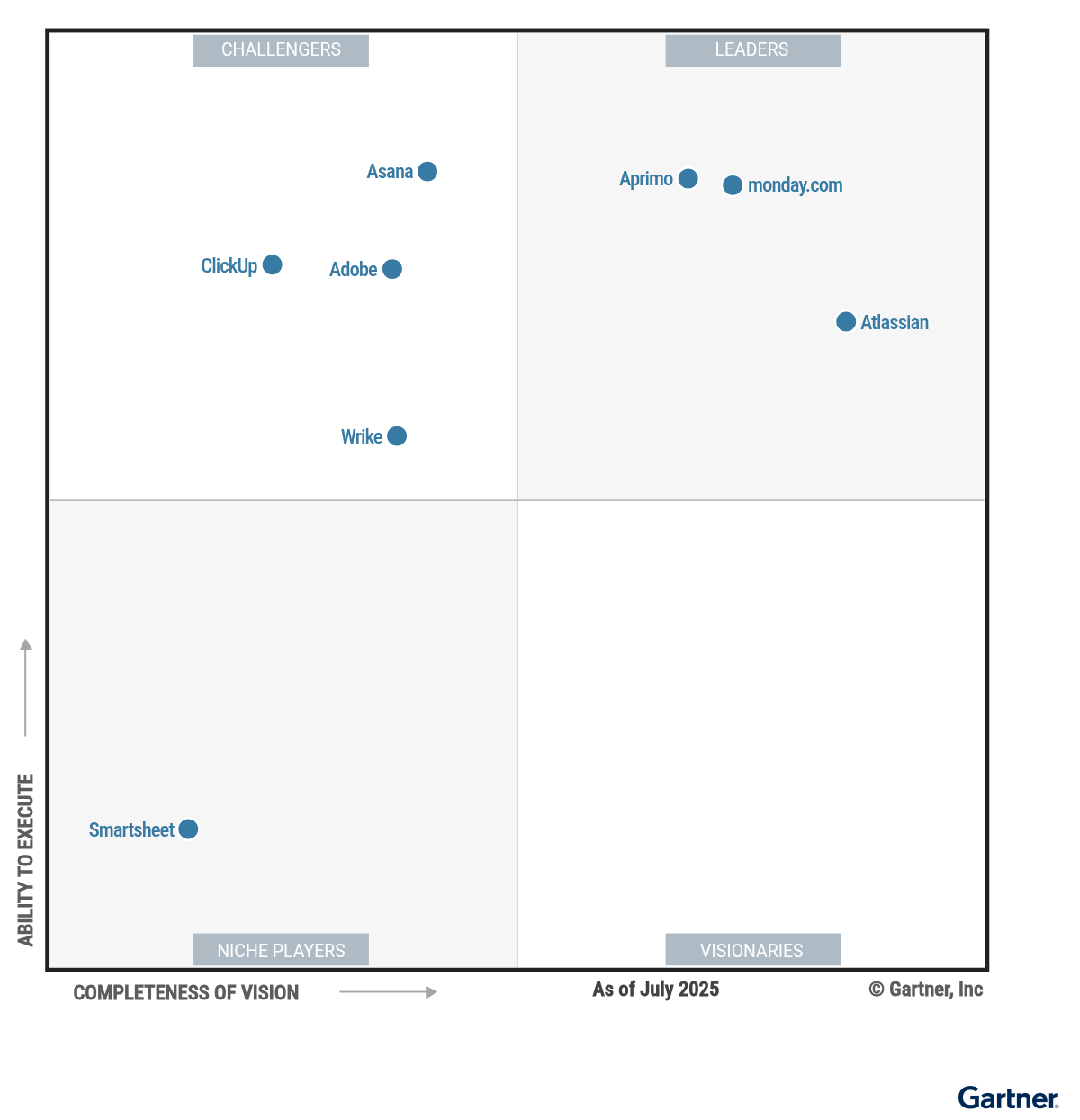
Magic Quadrant
Vendor Strengths and Cautions
Adobe
Adobe is a Challenger in this Magic Quadrant. Based in San Jose, California, the Adobe Workfront product comprises modules for planning, workflow, and automation, aiming to unify marketing initiatives and create an authoritative, auditable system of record for large enterprises across diverse sectors. Adobe supports Workfront through a globally distributed operation, with 50% of its staff based outside the U.S. This is complemented by investments in multilingual onboarding and localized user groups to support the 40% of clients outside the U.S.
Adobe’s roadmap includes deploying a Workflow Optimization Agent within the broader Adobe Experience Platform Agent Orchestrator. Functional agents for system design, planning, and project management are live, and additional ones are pending. Plans also include an insights assistant for analysis of cross-platform structured and unstructured data, along with investments to expand the number of downloadable extensions available through Workfront’s marketplace ecosystem.
- Approval workflows: Adobe’s focus on making content production more efficient includes removing approval and compliance bottlenecks. Redesigned approval systems provide nuanced controls, detailed audit logs, and communication tracking. CMOs can leverage these updates to embed and scale approval guidance.
- Sector coverage: Adobe’s scale and financial performance enable investment in sector-specific marketing expertise. Workfront provides templates, starter kits, and accelerators for broad and narrow industries and configures solutions for agencies and professional services. CMOs concerned with speed to value can lean on these tools.
- Partner ecosystem: Adobe’s ecosystem has the largest partner network in this evaluation. It includes global service integrators, agencies, and marketing services providers that facilitate the platform’s deployment, configuration, and integration with other Adobe products. CMOs of large enterprises will find ample support for on-platform configuration.
- Unit pricing: Workfront’s core Workflow module has the highest per-user cost among vendors assessed, and case-by-case solution pricing limits transparency. The cost and required user numbers for the new Workfront Planning module are uncertain, and guidance on agentic action fees is pending. CMOs should conduct total cost of ownership comparisons as details emerge.
- AI flexibility: Adobe’s AI strategy seeks to support automation, discovery, and integration across workflows with in-platform tools. An AI assistant, GenAI features, and some functional agents have been deployed, but the option to create your own agent or bring your own model via a Model Context Protocol (MCP) server does not exist today. CMOs must align their enterprise AI strategy with available capabilities.
- Marketplace utility: Adobe Exchange operates as a listing of integrations with badges that indicate the level of vendor commitment to Adobe, but lacks direct downloads, end-user ratings, or payments to publishers. Workfront listings are few. CMOs seeking a more efficient solution to solving integration needs should monitor Adobe’s plans to develop this platform.
Aprimo
Aprimo is a Leader in this Magic Quadrant. Based in Chicago, Illinois, Aprimo is focused solely on the needs of marketing, and its marketing work management (MWM) platform is designed to address the workflow and project orchestration needs of complex, global marketing teams. It enables a comprehensive marketing management solution by bringing together key creative and marketing execution tools, corporate analytics, compliance, and ERP systems.
The platform is known for its ability to streamline marketing operations with visual workflow builders and for offering agentic capabilities to execute critical, time-consuming marketing tasks such as content and compliance reviews. Aprimo’s roadmap focuses on using the Aprimo AI Agents framework to further develop AI assistance in executing marketing activities, including planning, creation, approvals, and insight gathering.
- Offering strategy: Aprimo’s strategy is dedicated exclusively to supporting marketing organizations and accelerating the automation of marketing work with AI. CMOs tasked with streamlining the complexity of large, global enterprise teams should consider Aprimo to execute and deliver omnichannel personalization.
- Innovation: Ideas for potential AI applications are funneled to Aprimo Labs for early-stage research and rapid prototyping. This structure has enabled Aprimo to release significant innovations over the past year, including digital colleagues such as Librarian Agents, Brief Creator, and Smart Reviews.
- Global operations: Aprimo’s platform is designed to provide functionality that facilitates global use, including accommodations for regional privacy compliance. Its partnership with Microsoft ensures autoscalability and reliable global availability.
- Marketing strategy: Half of Aprimo’s clients are in healthcare, life sciences, or financial services, and market awareness is strongest across large enterprises in those regulated sectors. Awareness with buyers in other segments is limited.
- Marketplace: Aprimo’s marketplace is smaller than that of most of the vendors in this research. Multiple integration paths are necessary to realize maximum value from MWM platforms. Potential customers must determine whether Aprimo’s marketplace offers the necessary integrations to meet their requirements.
- Partner ecosystem: Aprimo continues to have a small number of certified partners. Buyers who rely on implementation partners should evaluate how limited capacity could impact deployment and onboarding timelines.
Asana
Asana is a Challenger in this Magic Quadrant. Based in San Francisco, California, Asana primarily serves the collaborative work management use case and prioritizes marketing organizations as its second-largest target market. It generates 60% of its revenue in the U.S., and its operations are geographically diversified. Asana extends its platform’s capabilities by providing integrations to fulfill common marketing needs, such as Adobe Creative Cloud for asset review and collaboration, Tableau and Power BI for analytics and data visualization, and Salesforce and HubSpot for campaign execution.
Asana has augmented its user-friendly interface and task-tracking capabilities with new features, including adding AI to its automation rule builder to create prebuilt AI workflow rules that can be embedded in projects. Its roadmap includes custom-made solutions for marketing teams, such as AI-supported campaign execution and the ability to build, govern, and collaborate with custom AI agents — Asana AI Teammates — as digital colleagues alongside human staff.
- Market responsiveness: Asana more than tripled its spend on efforts to understand the needs of marketing functions. This increased focus is reflected in its roadmap, which includes prebuilt AI agents for marketing use cases and marketing-focused add-ons such as budget and campaign management.
- Customer experience: Asana’s customer success managers have built expertise in marketing workflows, campaign management, and operations, and they promise tailored guidance to CMOs seeking implementation and utilization support. CMOs without enough user licenses for tailored support can access self-serve resources through Asana’s user community, which it recently expanded to include a verified expert program of marketing workflow specialists.
- Pricing transparency: Asana’s pricing is competitive and transparent, with guidance on how AI usage will impact costs. CMOs expecting to grow their platform usage can choose between flexible tiers and modular add-ons tailored to their specific needs.
- Reporting, analytics, and dashboards: Asana’s simplified dashboards focus on task and project status tracking, and its native integrations for reporting capabilities are limited to tools such as Google Sheets, Power BI, and Tableau. CMOs should evaluate the level of investment required for customized reporting solutions against their analytics requirements within Asana.
- AI customization: Asana’s MCP server and custom agent creation tool remain in beta. CMOs seeking to implement advanced AI use cases should assess whether Asana will offer the flexibility in time to meet their needs.
- Business model: Asana achieved positive free cash flow in 2025 but still reported a narrow loss and minor restructuring this year. It also appointed new executive leaders as CEO and chief product officer. CMOs looking to leverage new AI innovations or marketing-focused solutions should monitor strategic shifts to ensure Asana delivers on its roadmap.
Atlassian
Atlassian is a Leader in this Magic Quadrant. Based in Australia with a U.S. headquarters in San Francisco, California, it generates half its revenue from outside North America. It supports a global client base through its direct operations and its engaged ecosystem of partners and users. Atlassian’s Teamwork Collection, which includes Confluence, Jira, Loom, and Rovo, is its solution for enterprise work management and targets functional leaders like the CMO.
Atlassian’s data strategy aims to comprehensively capture work-related context to enhance management capabilities. Based on this strategy, it delivers a platform intelligence capability that streamlines project planning, workflow automation deployment, and the analysis of optimization opportunities. Its roadmap includes expanding these capabilities to personalized user memory for the AI assistant, Rovo, and an integrated project manager agent to support scalable work administration.
- Project orchestration: From intake to ideation and planning, marketers can expect an AI assist that translates unstructured data into project briefs and actual projects. Human users remain in control and can ignore or edit suggestions, and they will spend less time on administrative tasks. CMOs seeking to alleviate marketers of project management drudgery should consider Atlassian.
- Product strategy: Atlassian’s data strategy prioritizes the ease of integrations via native app connectors or through the AI assistant Rovo. The strategic commitment encompasses a large and dynamic marketplace that offers solutions from its global user base. CMOs lacking integration resources can lean on the platform for robust help.
- Workflow and automation: The platform offers a library of prebuilt automations and a natural language rule builder to simplify workflows and mundane tasks. A testing environment enables admins to review and export approved rules for use, and CMOs can enable more frontline staff to optimize workflows with this capability.
- Platform operations: Atlassian uses a centralized AI model management approach, restricting clients from bringing their own models or orchestrating actions across multiple models, which differs from other vendors in this evaluation. CMOs whose AI strategy dictates the use of their own model(s) will find Atlassian’s platform limiting.
- Marketing strategy: Atlassian aims to generate advocacy among IT users, CIOs, and digital operations leaders; however, it has limited visibility among traditional marketers. CMOs attracted to the platform’s capabilities should ensure change management plans address perceptual biases that could stymie adoption.
- Content collaboration: While the platform can easily set up approval steps in workflows, it lacks automation rules for color detection, font analysis, or content design elements. CMOs who require robust approvals for creative output will need to review integration with their preferred approval platform and the manner in which audit trails are captured and stored.
ClickUp
ClickUp is a Challenger in this Magic Quadrant. Based in San Diego, California, ClickUp’s operations are largely U.S.-focused, with a presence in Europe and APAC. Over half of its clients are outside the U.S., prompting recent investments in regional data centers, expanded language support, and a growing global partnership ecosystem.
ClickUp’s MWM platform focuses on improving productivity and efficient marketing execution by enabling users to augment human-led tasks with AI. Its roadmap focuses on allowing users to build their own agents, with plans to improve the extensibility of its agent platforms for sharing and integrating agents across ClickUp and third-party tools. Planned upgrades to core features aim to help teams plan and balance work more effectively.
- Model-agnostic approach: ClickUp lets users select the AI or large language model (LLM) that fits their needs, including ClickUp’s AI or integrated LLMs. Users can also leverage APIs to extract information from ClickUp to inform their AI or LLM. This flexibility provides CMOs with multiple paths for workflow optimization.
- Market responsiveness: ClickUp’s significant investments in customer listening and R&D, along with its agile roadmap, enable it to prioritize product updates based on customer and market signals. It rewards teams that turn insights into product enhancements that keep the platform ahead.
- Customer engagement: ClickUp maintains strong brand loyalty, reflected in one of the highest claimed retention rates among vendors evaluated. Its user communities are engaged and growing. CMOs seeking to accelerate product adoption and deepen usage will benefit from ClickUp’s active communities, where events, peer collaboration, and recognition programs sustain engagement.
- Marketplace limitations: ClickUp does not offer a public marketplace for third-party integrations or extensions. While native integrations and verified consultants are available, the lack of a marketplace restricts customers’ and partners’ ability to co-create or buy niche solutions. CMOs should determine if the absence of this resource hinders any need for niche solutions.
- Large enterprise strategy: Over three-fourths of ClickUp’s customers are small enterprises with revenue under $50 million annually. ClickUp has limited visibility among Gartner’s enterprise clients, and while its workshop-based approach to selling is personalized, it may challenge scalability. CMOs should conduct a limited proof of concept (POC) to see if ClickUp can deliver consistent engagement across complex, multiteam enterprise environments.
- Pricing: ClickUp has the second-highest per-user cost against the standard RFP used in this research. Although higher-tier plans include AI features in a bundled price, ClickUp is moving from unlimited AI usage to a credit-based model for some premium functions. This transition introduces uncertainty, as guidance on consumption rates and cost implications is not yet provided. CMOs should evaluate ClickUp’s pricing and AI usage model and use POCs to project costs under real-world conditions.
monday.com
monday.com is a Leader in this Magic Quadrant. Based in Israel, it maintains a presence in North America, Europe, LATAM, and APAC. It provides a flexible work management tool that drives high user adoption and platform interoperability through its open marketplace and third-party AI partnerships. Marketing represents a significant user segment of monday.com.
The vendor’s roadmap includes a unified marketing command center to help optimize marketing activities through features such as a content calendar, social listening, and analytics. It also has plans to extend its current AI functionality with an AI agent marketplace of prebuilt agents for common marketing tasks, as well as the ability to create custom agents.
- AI strategy: monday.com enables the integration of customer AI models via its MCP server, available in the monday marketplace. It also launched in-platform AI features, including a context-aware AI assistant and AI risk analyzer. Its roadmap features an AI-powered app builder, monday vibe, as well as AI-powered search functionality.
- Overall viability: monday.com is in strong financial health. It is profitable with more than $1.2 billion in annual recurring revenue and significant cash reserves. Its 2024 net-new logo growth rate among marketing organizations was among the highest in this evaluation. CMOs can feel confident about monday.com’s robust financial position and reliability in the market.
- Platform adoption: monday.com reports strong seat utilization after three months, in a market where utilization is crucial for accurate data collection and operational efficiency. It focuses on ease of use, as evidenced by investments in AI support for compliance detection and localization, and a growing customer success program. CMOs seeking broad platform adoption should consider monday.com’s benefits.
- Vertical support: While monday.com provides many function-specific templates, it lacks vertical-specific templates and starter kits. CMOs lacking enablement resources, such as a dedicated admin for marketing work management, and needing preconfigured industry packages for industries like healthcare, consumer packaged goods, or financial services, should assess fit carefully.
- Unstructured data management: monday.com is the only vendor in this evaluation that does not allow users to submit unstructured data into intake forms, an increasingly relevant capability for grounding AI models with context. CMOs with requirements to incorporate unstructured data into the intake process should weigh the importance of this capability in their purchase decision.
- Multiproduct business: monday.com offers several products, including monday work management for projects and tasks, monday dev for product teams, monday service for IT and support, and monday CRM for customer-facing teams. CMOs should work with monday.com to ensure this broader product strategy continues to meet the ongoing needs of the marketing function.
Smartsheet
Smartsheet is a Niche Player in this Magic Quadrant. Based in Bellevue, Washington, its operations are globally diverse, with a growing presence in LATAM. Its platform unifies teams through data-driven, collaborative workflows for transparent planning, execution, and reporting. Smartsheet emphasizes flexibility via customizable workspaces that deliver real-time updates and robust project governance. Users can extend this foundation with Brandfolder, Smartsheet’s digital asset management platform, and Smartsheet’s Bridge for low-code custom automation.
Smartsheet was recently acquired by Blackstone and Vista Equity Partners, which have expressed plans to accelerate investment in the work management solution. Integrations currently include Adobe Creative Cloud, Salesforce, and Google products are also available. Smartsheet’s roadmap features AI-driven agents, UI enhancements, intelligent search capabilities, hybrid waterfall and agile views, and expanded compliance and security features, many of which will have embedded AI assistance.
- Offering strategy: Smartsheet’s API support and extensive partner marketplace, which has over 300 solutions and templates, broadens the platform’s flexibility, workflow orchestration, and automation. AI-generated formulas enable advanced reporting. CMOs unable to standardize on a single MWM platform and requiring high-level analytics may benefit from Smartsheet’s data-first approach.
- Localization and scale: Smartsheet Regions confines data sharing to users within the same geographic area, ensuring compliance with regional data protection and privacy laws. Hosted on Amazon Web Services, Smartsheet offers elastic, demand-based data storage for performance optimization and cost-efficiency. CMOs leading market-expansion initiatives may value the platform’s scalable, compliant-focused infrastructure.
- Customized data control: Smartsheet Collections enables granular access for stakeholders and external partners to workspace items such as reports, dashboards, and external links or applications like Miro. Dynamic dashboards and dependency configurations allow simultaneous updates to data and reports. CMOs seeking precise marketing strategy oversight can leverage executive-level reporting and real-time visibility to spot trends, address issues, and develop data-driven narratives.
- Marketing alignment: Smartsheet’s depth in enterprisewide collaboration and IT-driven solutions drives broad market adoption but dilutes its focus on marketing-specific use cases. CMOs should review release notes to assess trade-offs in its cross-functional approach.
- Time to value: Smartsheet’s Data Shuttle allows users to upload and offload data easily. However, the platform’s limited native integrations can extend setup time. CMOs should plan for in-house or partner resources for initial customizations and ongoing feature management.
- Pricing transparency: Lower-tier plans list costs but omit many of the platform’s differentiators. Some features are available as add-ons, while AI tools and unlimited sharing features (such as file and attachment storage) require upgrading to premium tiers with custom pricing. CMOs should define must-have features upfront.
Wrike
Wrike is a Challenger in this Magic Quadrant. Based in San Diego, California, its operations are globally diverse. Its MWM platform is focused on streamlining marketing work requests and facilitating collaboration on marketing work in the enterprise. Wrike’s recent acquisition of Klaxoon brought whiteboard functionality to the platform and supports its efforts to incorporate more unstructured data and ideation into workflows.
Wrike integrated an MCP server into its platform, allowing customers to bring their own AI model and agents, alongside contextual search that prioritizes results based on user activity. Its roadmap focuses on incorporating additional native agentic capabilities for brief creation at intake, resource alignment, and scheduling, as well as a custom agent builder.
- Collaboration innovation: Wrike’s new whiteboard enables teams to collaborate more effectively, transforming unstructured ideas into structured projects and tasks through AI automation. These features may be especially valuable for CMOs who prioritize teamwork and innovation.
- Pricing and packaging: Wrike’s transparent pricing allows free guest users to request and approve work, and it does not charge for connecting AI models via its MCP. Product tiers include AI action volumes, with additional volume available for a set fee. CMOs can expect transparent cost estimates for scaled model usage.
- Deployment and adoption support: Wrike has strengthened its go-to-market strategy with new capabilities around change management and integration best practices and expanded its partner network via the Klaxoon acquisition. This provides more support to CMOs seeking platform deployment and adoption support.
- Native AI agent approach: Wrike’s MCP server allows users to incorporate their own AI agents, and Copilot capabilities provide systematic intelligent assistance. Wrike’s release of its AI agents and upgrades to its user community solution center occurred after the evaluation period for this market.
- Offer strategy: While Wrike’s acquisition of Klaxoon helps marketers translate unstructured data into structured plans, incorporating the capability into the platform requires resources to manage and integrate. CMOs focused on AI capability building should ensure their organizations’ AI readiness does not outpace Wrike’s deployment of AI assistance.
- Roadmap visibility: CMOs who need visibility into the innovation roadmap before making purchasing decisions will need to request access to the six- and 12-month roadmaps, as the information is not shared publicly. Customers can attend the two community webinars per year or an AI Demo Day to learn about upcoming innovation.
Vendors Added and Dropped
We review and adjust our inclusion criteria for Magic Quadrants as markets change. As a result of these adjustments, the mix of vendors in any Magic Quadrant may change over time. A vendor's appearance in a Magic Quadrant one year and not the next does not necessarily indicate that we have changed our opinion of that vendor. It may be a reflection of a change in the market and, therefore, changed evaluation criteria, or of a change of focus by that vendor.
Added
No vendors were added.
Dropped
Airtable is a workflow automation and data management platform. It enables IT professionals and business users to build functional, no-code applications for business operations. It was dropped from this Magic Quadrant due to a lack of native capabilities for out-of-the-box marketing work management.
Inclusion and Exclusion Criteria
To qualify for inclusion, providers need:
- MWM platforms and related capabilities to be generally available as of August 1, 2025. General availability (GA) is defined as something a vendor’s clients have in a production environment, rather than something they are testing or evaluating.
- MWM platforms that are generally available must include the mandatory features described in the market definition.
- Subscription revenue for the vendor’s marketing work management platform offering is at least USD$100 million for the calendar year 2024.
- Rank among the top 15 organizations in Gartner’s Customer Interest Indicator (CII). CII rankings are driven by a broad set of balanced internal and external measures. The data inputs represent customer sentiment, customer interest, and customer engagement.
Honorable Mentions
Uptempo is an enterprise marketing operations platform that unifies strategy, finance, and performance. Though it does not satisfy all criteria for inclusion in this Magic Quadrant, it ranks among the top 10 vendors cited in Gartner inquiries on marketing work management. Uptempo does not position itself as an MWM platform, but Gartner clients remark on its ability to create a marketing system of record based on merging financial data with marketing strategy and performance outcomes.
Evaluation Criteria
Ability to Execute
Gartner assesses a vendor’s Ability to Execute by evaluating its products, services, viability, and overall customer experience. Ultimately, a vendor’s Ability to Execute is judged by its ability to keep its promises and its success in doing so.
To reflect this, Gartner’s Magic Quadrant for Marketing Work Management Platforms assigns a “high” weighting to the product or service criteria and market responsiveness. Delivering on critical capabilities cannot be ignored by vendors, nor can efforts to address shifts in demand by marketing function leaders.
The criteria for overall viability, sales execution/pricing, and customer experience each have a “medium” weighting. This reflects the need for continuous market engagement to address current customer needs.
Marketing execution and operations are assigned a low weighting due to the common nature of vendor demand generation efforts and close similarities in operational capabilities.
Ability to Execute Evaluation Criteria
| Evaluation Criteria | Weighting |
|---|---|
Product or Service | High |
Overall Viability | Medium |
Sales Execution/Pricing | Medium |
Market Responsiveness/Record | High |
Marketing Execution | Low |
Customer Experience | Medium |
Operations | Low |
Source: Gartner (December 2025)
Completeness of Vision
Gartner also evaluates vendors’ ability to grasp current and future market and technology trends, customer needs, and competitive forces — their Completeness of Vision.
Ultimately, vendors are assessed on their understanding of user needs and market forces that impact how solutions must evolve to remain future-fit. This is a qualitative assessment based on Gartner’s interactions with end users and their subsequent understanding of the market.
As the MWM market responds to CMO demand for help improving productivity and the deployment of AI assistance, market understanding, offering (product) strategy, and innovation are the most important components of vision. These three criteria have “high” weightings.
A strategy on how to go to market, generate revenue, and address sector needs helps a vendor communicate its future value and align with industry needs in a manner that engenders customer commitment. Accordingly, sales strategy, marketing strategy, vertical/industry strategy and business model all have “medium” weightings.
Geographic strategy and business model both have a “low” weighting. Scalable service and support models minimize the differentiation of investment in direct operations, and business models remain similar across vendors.
Completeness of Vision Evaluation Criteria
| Evaluation Criteria | Weighting |
|---|---|
Market Understanding | High |
Marketing Strategy | Medium |
Sales Strategy | Medium |
Offering (Product) Strategy | High |
Business Model | Low |
Vertical/Industry Strategy | Medium |
Innovation | High |
Geographic Strategy | Low |
Source: Gartner (December 2025)
Quadrant Descriptions
Leaders
Leaders in this Magic Quadrant demonstrate the Ability to Execute expected functionalities and a strong alignment with CMO demands for marketing work management. They exhibit a robust focus on workflow design combined with the integration flexibility needed for work transparency and visibility.
Challengers
Challengers in this Magic Quadrant excel with strong product functionality and execution. The focus of their own roadmap may facilitate growth, but it is not clearly aligned with end-user demands for future functionalities in a marketing work management platform.
Visionaries
No providers were classified as Visionary in this Magic Quadrant. Such providers might have ignored user subscription models and instead focused on pricing data transactions required between marketing tools to document the progression of work.
Niche Players
Niche Players in this Magic Quadrant exhibit characteristics that may provide value to some marketing organizations (such as “no code” automation design), but not in a manner consistent with CMO demands or in a way marketing organizations are equipped to support.
Context
This Magic Quadrant assesses vendors’ capabilities on the basis of both their execution as of 1 August 2025 and their stated future development plans. As vendors and the market evolve, the assessments may be valid for only one point in time.
Clients should not use this Magic Quadrant in isolation as a tool for selecting vendors and products. They should treat it as one reference point among the many required to identify the most suitable vendor and product. Clients should not disqualify a provider simply because it is not in this Magic Quadrant. Gartner’s inclusion criteria focus analysis on the most established providers in the market, but other regional or specialized service providers may present better alternatives for your business requirements.
When selecting a platform, use this Magic Quadrant in combination with the report on Critical Capabilities for Marketing Work Management. We also recommend using Gartner’s client inquiry service. A Gartner expert can help shortlist the most suitable candidates for specific client requirements and assist with an analysis of shortlisted candidates.
Clients should not ascribe their own definitions of Completeness of Vision or Ability to Execute to this Magic Quadrant (they often incorrectly equate these with product vision and market share, respectively). The Magic Quadrant methodology uses a range of criteria to determine a vendor’s position, as shown by the Evaluation Criteria section.
Market Overview
Budget constraints continue to pressure CMOs to maximize the productivity of existing resources, and leveraging an MWM platform became a pillar strategy for driving continuous improvements. As a result, from 2023 to 2025, adoption of MWM platforms surged: market penetration grew by 19%, with 82% of marketing organizations now using an MWM platform. Factoring in organizations that are in an implementation or procurement phase brings the percentage of enterprises that have adopted or are in the process of adopting these platforms to 93%.1
The core function of MWM platforms is to serve as marketing’s system of record, tracking “who did, is doing, and will do what work when.” This requires detailed categorization and tagging of work at every level — portfolio, program, project, task, and subtask. CMOs increasingly require granular documentation to support audit trails and operational performance metrics such as capacity, timeliness, and productivity. However, this level of detail presents ongoing challenges for both users and platform providers in terms of data management and platform usability.
Administrative overhead also remains a significant challenge. According to Gartner research, marketers spend more than one-third of their time on activities related to managing work, rather than executing it.2 This raises concerns about the return on investment and the opportunity cost of time spent deploying and utilizing a platform. Striking the right balance between planning, management, execution, and transformation eludes CMOs, and resources to enable postdeployment configuration are rare.
Value for Data
Vendors seeking to help CMOs answer the productivity call continue to provide more ways to capture complex data, promising to help CMOs prove marketing’s value and get credit. This now includes talent data, budget data, and strategy data. Yet despite facilitating the planning of work, the value of this data (if present) frequently goes unrealized due to subpar reporting capabilities.
The lack of robust, out-of-the-box reporting on key operational performance metrics, coupled with limited data management resources, remains a significant pain point. While platforms support project management and execution, task and resource-level data often fail to address CMOs’ core need for continuous productivity improvement. Additionally, the work required to standardize and access operational performance data retained within MWM platforms limits the ability to generate insights.
Over the past year, vendors in this Magic Quadrant have continued to embed AI assistance in their platforms, transforming the challenge of data granularity into an opportunity for enhanced productivity. While creating and governing standardized units of work, taxonomies of tasks, and attributes of resources still take effort, the context-rich and structured environment of MWM platforms with AI assistance can provide the previously lacking resource that enables the delivery of the productivity promise. This shifts the CMO’s data issue from bane to benefit.
But not automatically, and certainly not in a uniform “agentic” manner.
Building the AI Assist
Vendors use a variety of naming conventions and aspirational descriptions when (re)labeling their AI assistance. CMOs must examine the actual capability more closely to understand how the assistance manifests in the platform. Based on an evaluation of vendor offers in this market, the following three categories can be used to distinguish claims:
- Advanced automation: Triggers and rules are not new to MWM platforms. These controlled, deterministic actions are human-defined and maintained, but they are also increasingly easier to build and deploy. Libraries of prebuilt automations that transform data or request actions by other tools help make workflows more efficient. Natural language automation builders facilitate the creation of multistep actions by generalist roles, depending on permissions.
- Context-aware support: Searching for and surfacing information is a long-standing feature of MWM platforms. AI models can greatly help expand the reach and understanding of what may be useful to a user. Incorporating knowledge of user role, skills, team, work, and task enriches contextual awareness and helps prioritize results. Further development of the model application can also enable the interpretation of results as probabilistic advice for the user — their “next best work.”
- Digital colleague: True goal-directed and autonomous action in a specified domain of work aligns with the AI promise, but it is the least found AI assistance in MWM platforms. Enabling a model to reason, decide, execute, learn, and adapt requires human governance and trust. Like humans, the role needs to be defined, and candidates need to be evaluated, onboarded, trained, developed (and, at times, let go). Still, the context-rich and prescribed environment of MWM platforms is ripe for practical, low-risk use.
The level of AI assistance from different features will progress at a different pace within the same platform. Some of this is dependent on how the vendors devise ways to scale the application of the models they choose to work with, and some will depend on how clients are enabled to bring their own.
Whose AI Is It Anyway?
MWM platform vendors are embedding AI across work planning and execution, automation, and optimization. This advance in capabilities requires CMOs to consider a new set of strategic decisions. Unlike creative operations, the generated output is internal collaboration and prioritization, where ethical use and bias mitigation are not at the forefront. Model provenance will matter most — which method of integration is best suited for trust with their data, workflows, and operational advantages?
The proliferation of vendor-native, third-party, and bring-your-own-model (BYOM) options introduces opportunities for customization and innovation, but also raises critical concerns around cost, data governance, and long-term value. CMOs must weigh these choices carefully, balancing the promise of AI-driven productivity against the risks of complexity, fragmentation, and unintended consequences.
Custom Agent Cost Management
Custom AI agents have arrived, along with the ability to tailor them to a marketing organization’s unique workflows, language, and compliance requirements. While vendors may promise rapid deployment and low-code configurability, the design and complexity of digital colleagues will impact cost per action and related credit consumption. As marketing learns how to make meaningful customizations to agents, vendors may discover costs they had yet to consider in their pricing. And like human colleagues, digital ones also require management time from another human.
Besides the potential for increased platform fees, there may be higher support requirements and the risk of vendor lock-in. CMOs should rigorously evaluate and continuously update their forecast total cost of ownership, including both direct and indirect expenses, and ensure that custom agent investments are aligned with measurable business outcomes.
Multimodel Utilization Data Risks
With the rise of multimodel environments — where different AI models are applied to distinct use cases or datasets within a single platform — comes a new layer of data risk. Each model may have its own data ingestion, processing, and storage protocols, which can increase the likelihood of data silos, inconsistent outputs, and compliance gaps. Driving continuous improvement in marketing productivity could be hampered by inconsistent contextual awareness due to a lack of access to data, or because a model was designed for a specific, more narrow context.
The proliferation of on-platform models can complicate auditability and data lineage, making it harder to demonstrate responsible AI governance. CMOs must work closely with IT and compliance leaders to establish clear policies for data access, retention, and monitoring across all AI models in use and ensure that marketing’s data assets are protected from inadvertent exposure or misuse.
Bring-Your-Own-Model Cannibalization
The flexibility to BYOM is increasingly offered by leading platforms, appealing to organizations with advanced data science capabilities or proprietary algorithms. However, this flexibility can introduce the risk of cannibalization — where in-house models duplicate or undermine the value of vendor-provided features, leading to inefficiencies, redundant investments, and unclear accountability for outcomes.
BYOM strategies may become critical for CMOs to realize major productivity gains, but the approach may also strain platform integration, support, and upgrade paths, reducing the overall agility of the marketing organization. CMOs should carefully assess the strategic rationale for BYOM, ensuring that it complements — rather than competes with — core platform capabilities, and that roles and responsibilities for model performance are clearly defined.
Promising Agentic Platform Capabilities
MWM platforms are on the cusp of enabling true productivity gains in four key areas, but each requires access to on-platform data to be realized. Effective AI assistance requires investment in metadata creation and governance. CMOs will still need to diligently set strategies and enable the capture of data necessary to create context that satisfies the need for specific delegated action to be taken at scale.
The four key opportunities for reducing administrative burden (“work to do work”) include:
Operational Performance Analysis
Who did what work when has always been extant in a work management platform, but turning that into an understanding of projects per FTE over time, or how long it takes to complete a project once started (timeliness), has been stymied by the additional resources necessary to generate effective analysis. Integrating AI into platform capabilities now allows for scalable analysis and user-driven insights.
But it doesn’t do magic. There is still a “garbage in, garbage out” challenge, as timestamps for work start and completion may be generated in different ways across workflows and systems. Marking when a work request was submitted may hide how many weeks it was discussed. Layering in alignment with strategy or objectives can create further noise in the data despite good intentions. Still, the payoff is there if effort is made to standardize the data.
Workflow Optimization
Audit trails are valuable, but workflow optimization requires detailed documentation and analysis of task execution and dependencies. Awareness alone does not drive improvement. Emerging AI models within MWM platforms can continuously (and tirelessly) analyze workflows, recommend optimizations, and facilitate rapid adoption of best practices.
Although effort is still necessary to define and articulate which project types and tasks align with specific outcomes, this investment in standardization now enables incremental optimization at scale, allowing users and AI models to collaborate in refining workflows without detracting from broader productivity initiatives.
Resource Alignment
Resource alignment is not just about who is available to do what work. MWM platforms have always provided custom fields to sync or capture data on roles and staff to help align staff with projects. While this helps standardize pick lists, it does little to ease the challenge of routing the right work to the right resource at the right time. Scaling such efforts beyond team managers who had insight and views of current commitments was nearly impossible.
AI-driven analysis of resource commitments and project requirements can now enable scalable planning, breaking down organizational silos and supporting real-time capacity management. Enhanced documentation of skills and tool usage ensures optimal resource prioritization and dynamic realignment. What’s more, discrete documentation of desired skills and future tool alignment can ensure the resources are provided opportunities to gain experience that builds competency and capacity.
Project Prioritization Promises
CMOs strive for optimal project prioritization, and AI-driven analysis can streamline this process. However, AI does not guarantee that all resources are assigned to the next best work. Should a project jump to the front of a queue because it is aligned with strategy? Because it supports a key result? Because seasonality dictates it? Because a product launch was delayed? What about prioritizing marketing’s work to improve its own performance?
AI can facilitate transparent, rapid project ranking based on stakeholder-defined criteria, but organizational politics remain a challenge. No stakeholder enjoys experiencing what can feel like a subjective demotion of their critical initiative. Speed and visibility don’t solve for politics, but empowering stakeholders to model prioritization scenarios can enhance alignment with enterprise growth objectives and mitigate internal conflicts.
Leadership Requirements
As AI becomes a foundational element of marketing work management, the question is not just how much automation or intelligence a platform provides, but whose AI is shaping your organization’s workflows, insights, and competitive edge. CMOs must take an active role in AI life cycle management, including model selection and governance and balancing innovation with operational discipline and risk management.
Additionally, the opportunity to leverage the AI assistance within MWM platforms may require a reset of the marketing operations remit. The resources required to standardize and expand data will exceed what a product admin can provide and involve change management as well as governance of AI use. CMOs should anticipate the need to narrow the scope of marketing operations in order to realize the larger potential value of the platform.
By approaching custom agent development, multimodel utilization, and BYOM strategies with clear-eyed analysis and cross-functional collaboration, marketing leaders can harness AI’s potential for improving productivity while safeguarding the integrity and agility of their teams.
1 2025 Gartner Marketing Technology Survey. This survey aimed to explore the key aspects of marketing technology, including utilization, composability, scalability, measurement and collaboration. It also examined the implications of AI and data strategies on marketing technology. Conducted online from June through July 2025, the research included 413 respondents from North America (n = 186), the United Kingdom (n = 91) and Europe (n = 136; including France, Germany, Luxembourg, Denmark, Finland, Netherlands, Norway and Sweden). Qualifying organizations reported enterprisewide annual revenue for fiscal 2024 of at least $100 million, with 77% of the respondents coming from organizations with $1 billion or more in annual revenue. The respondents came from a diverse range of industries: IT and business services (n = 48), manufacturing (n = 48), insurance (n = 38), retail (n = 38), consumer products (n = 37), financial services (n = 36), travel and hospitality (n = 36), healthcare (n = 33), tech products (n = 33), media (n = 33), and pharmaceuticals (n = 33). All the respondents were required to be senior decision makers of their company’s marketing technology strategy, where the majority of their daily responsibilities aligned with either business- or IT-focused marketing. Eighty percent of respondents were aligned to the marketing function, 10% to product marketing and management, 7% to IT and 2% to brand management or other business units. Disclaimer: The results of this survey do not represent global findings or the market as a whole, but reflect the sentiments of the respondents and companies surveyed.
2 2025 Gartner Critical Considerations for Driving Marketing Productivity Session Poll. A poll asking, “What percentage of total time do marketing resources in your organization spend on the “work to do work”?” was conducted among attendees of the “Critical Considerations for Driving Marketing Productivity” breakout session at the 2025 Gartner Marketing Symposium/Xpo in North America on 3 June 2025 and at the 2025 Gartner Marketing Symposium/Xpo in Europe on 13 May 2025. In all, 145 attendees participated in this poll across these two sessions. Disclaimer: The results of this survey do not represent global findings or the market as a whole, but reflect the sentiment of the respondents surveyed.
Ability to Execute
Product/Service: Core goods and services offered by the vendor for the defined market. This includes current product/service capabilities, quality, feature sets, skills and so on, whether offered natively or through OEM agreements/partnerships as defined in the market definition and detailed in the subcriteria.
Overall Viability: Viability includes an assessment of the overall organization's financial health, the financial and practical success of the business unit, and the likelihood that the individual business unit will continue investing in the product, will continue offering the product and will advance the state of the art within the organization's portfolio of products.
Sales Execution/Pricing: The vendor's capabilities in all presales activities and the structure that supports them. This includes deal management, pricing and negotiation, presales support, and the overall effectiveness of the sales channel.
Market Responsiveness/Record: Ability to respond, change direction, be flexible and achieve competitive success as opportunities develop, competitors act, customer needs evolve and market dynamics change. This criterion also considers the vendor's history of responsiveness.
Marketing Execution: The clarity, quality, creativity and efficacy of programs designed to deliver the organization's message to influence the market, promote the brand and business, increase awareness of the products, and establish a positive identification with the product/brand and organization in the minds of buyers. This "mind share" can be driven by a combination of publicity, promotional initiatives, thought leadership, word of mouth and sales activities.
Customer Experience: Relationships, products and services/programs that enable clients to be successful with the products evaluated. Specifically, this includes the ways customers receive technical support or account support. This can also include ancillary tools, customer support programs (and the quality thereof), availability of user groups, service-level agreements and so on.
Operations: The ability of the organization to meet its goals and commitments. Factors include the quality of the organizational structure, including skills, experiences, programs, systems and other vehicles that enable the organization to operate effectively and efficiently on an ongoing basis.
Completeness of Vision
Market Understanding: Ability of the vendor to understand buyers' wants and needs and to translate those into products and services. Vendors that show the highest degree of vision listen to and understand buyers' wants and needs, and can shape or enhance those with their added vision.
Marketing Strategy: A clear, differentiated set of messages consistently communicated throughout the organization and externalized through the website, advertising, customer programs and positioning statements.
Sales Strategy: The strategy for selling products that uses the appropriate network of direct and indirect sales, marketing, service, and communication affiliates that extend the scope and depth of market reach, skills, expertise, technologies, services and the customer base.
Offering (Product) Strategy: The vendor's approach to product development and delivery that emphasizes differentiation, functionality, methodology and feature sets as they map to current and future requirements.
Business Model: The soundness and logic of the vendor's underlying business proposition.
Vertical/Industry Strategy: The vendor's strategy to direct resources, skills and offerings to meet the specific needs of individual market segments, including vertical markets.
Innovation: Direct, related, complementary and synergistic layouts of resources, expertise or capital for investment, consolidation, defensive or pre-emptive purposes.
Geographic Strategy: The vendor's strategy to direct resources, skills and offerings to meet the specific needs of geographies outside the "home" or native geography, either directly or through partners, channels and subsidiaries as appropriate for that geography and market.