Magic Quadrant for Custom Software Development Services
1 December 2025 - ID G00827209 - 77 min read
By Jaideep Thyagarajan, Katie Gove, and 3 more
This Magic Quadrant evaluates service providers (full-spectrum and pure-play) on their ability to build innovative digital products leveraging design, AI, and expertise in other technologies. Sourcing, procurement, and vendor management leaders can use this research to identify and select potential service providers.
Strategic Planning Assumptions
By 2028, 75% of enterprise software engineers will use AI code assistants, up from less than 10% in early 2023.
By 2028, GenAI will enable 40% of software team members to come from nontraditional software engineering or technical educational backgrounds, up from 20% in 2025.
By 2028, development teams that diligently apply an ensemble of AI-powered tools to the software development life cycle will achieve 25% to 30% productivity gains, up from the 10% delivered by the code-generation-focused approach in 2024.
Market Definition/Description
Gartner defines custom software development (CSD) services as the professional services engaged by organizations to design, build, modernize or iterate custom applications and software products to meet their unique business needs. CSD services entail gathering business requirements and coding applications from inception, building applications on a platform as a service (PaaS), or assembling applications from existing web services or other reusable pieces of code. Services marketed as “software product engineering” or “digital product development” likely fall under the CSD services category as defined by Gartner. These solutions are typically not available as commercial off-the-shelf (COTS) products and require custom development.
Sourcing, procurement and vendor management leaders can leverage CSD services through one of the following use cases:
- Unique user experience: This use case focuses on software designed to provide a unique user experience to the buying organization’s employees and clients. It encompasses dynamic websites, personalized content and promotions, smartphone and tablet applications, and voice and text interactions. This use case is common in consumer-facing industries such as retail, financial services and entertainment.
- Unique operational processes: This use case highlights software that operates or automates business processes unique to the buyer organization. These processes enhance operational efficiencies by streamlining routine business activities and boosting productivity through the elimination of human and systematic errors. Examples include enabling payment processing providers to handle millions of transactions daily and offering operational support systems for telecommunications providers to manage new customer provisioning and network management. This use case often necessitates expertise in industry-specific verticals and their regulatory environments.
- Unique products: This use case focuses on introducing new products or services with distinctive features that drive revenue growth and open new market channels for CSD buyers. Increasingly, AI and GenAI are central to this innovation, enabling hyperpersonalized experiences, intelligent automation and data-driven business models. Successful delivery requires deep market and competitive understanding, coupled with specialization in technologies like Industrial IoT, AR/VR, AI/ML, GenAI and embedded systems. These engagements demand rapid prototyping, experimentation, hypothesis-driven development and close client collaboration to shape product implementation roadmaps. Typical examples include AI-powered infotainment systems in automotive and GenAI-driven digital platforms in media, entertainment and gaming sectors.
Mandatory Features
The mandatory features for this market include:
- Custom solution design: Capability to gather client-specific business, technical and user requirements and design architecture tailored to unique workflows, industry contexts and technology stacks.
- Software engineering approaches: Ability to utilize agile and DevOps methods within diversified, inclusive and multidisciplinary teams.
- Technical architecture and cloud: Ability to design a new software solution and scalable infrastructure that grows with the client’s business.
- Delivery capabilities: Capability to deliver from onshore, “nearshore” or offshore development centers, with some providers offering innovative resourcing solutions such as crowdsourcing, hire-to-order, build-operate-transfer or captive center purchases.
- Technology depth and breadth: Proficiency in modern technologies, such as cloud-native, microservices, APIs, AL/ML, GenAI, mobile, and front-end and back-end stacks.
- Quality engineering: Ability to integrate QA, test automation, performance and security testing embedded in delivery along with shift-left and continuous testing practices.
- Custom integration and interoperability: Ability to build integrations with internal systems, SaaS platforms, third-party APIs, or IoT/data sources, with an emphasis on reliability, security and scalability.
Common Features
The common features for this market include:
- Business acumen: Ability to understand the client’s business issues and operations and articulate desired business outcomes to help shape a vision and product roadmap for new custom software.
- Design (user and customer experience): Ability to enable rich user interface (UI) design and user experience (UX) interaction functionality for custom software or products that translate into meaningful and relevant user experiences.
- Analytics and business intelligence (BI): Ability to offer best practices, strategies and implementation services for analytics and BI tools, applications and packaged solutions as part of custom software.
- Low-code/no-code enablement: Ability to help clients build internal capability using platforms like Mendix, OutSystems or Microsoft Power Platform.
- Platform engineering: Ability to build scalable, resilient and developer-friendly foundations that accelerate product delivery and innovation.
- API and integration: Ability to implement technologies and solutions that integrate, share and govern data in the same or different systems, ensuring the real-time exchange of data and events, along with monitoring.
- AI/ML and multiexperience development: Ability to embed AI and/or ML models as part of a custom software solution and ability to leverage for customers various modalities, digital touchpoints, apps and devices to design and develop optimized and seamless experiences for multiple personas.
- Relationship and customer experience: Ability to work effectively with other systems integrators and partners to deliver value and build long-lasting relationships with client stakeholders.
- Sustainability and ESG features: Ability to design and build software with energy efficiency, carbon reporting or accessibility in mind.
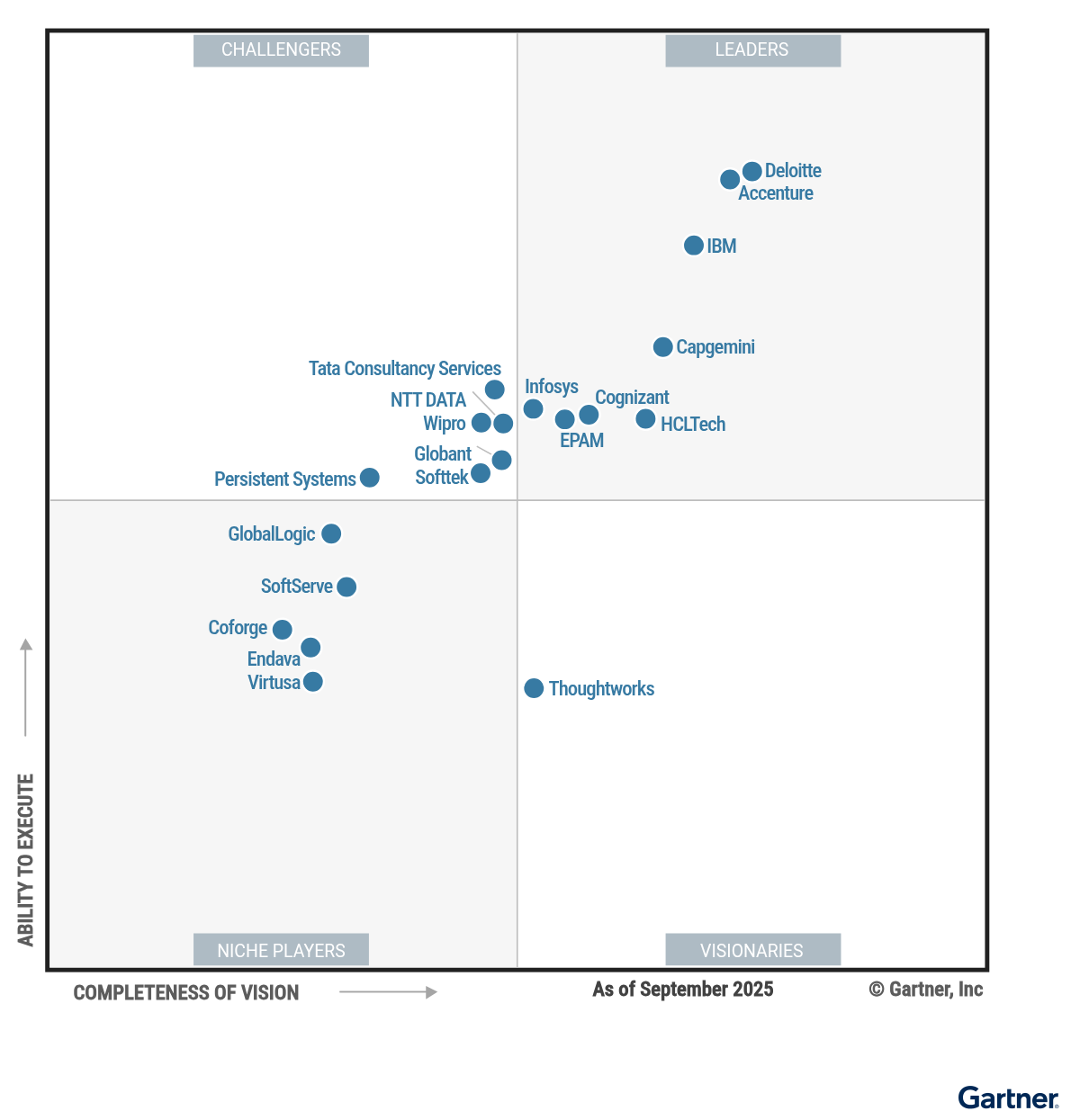
Magic Quadrant
Vendor Strengths and Cautions
Accenture
Accenture is a Leader in this Magic Quadrant. This full-service provider is headquartered in Ireland. Gartner estimates that its custom software development (CSD) services revenue grew by 14% year over year (YoY) through December 2024. Of this revenue, 90% came from large enterprise clients and 10% from midsize clients. Accenture’s CSD services revenue breakdown is 41% from North America, 40% from EMEA, 16% from Asia/Pacific, and 3% from Latin America. The company’s top three industries by number of clients are: manufacturing and natural resources; banking and investment services; and communications, media, and services. Accenture is prioritizing the integration of AI across the software development life cycle (SDLC), focusing on practical industry applications and the modernization of legacy systems.
- AI-native engineering at scale: Accenture has implemented AI-native engineering practices across the SDLC, supported by proprietary agent marketplaces, cognitive enterprise frameworks, and a global workforce of approximately 129,000 professionals, driving 30% to 40% productivity gains for complex custom development and modernization projects. This enables clients to achieve faster time to market and enhanced outcomes for their CSD initiatives.
- End-to-end industry context: Accenture leverages deep industry expertise and a broad partner ecosystem to deliver context-aware solutions across the value chain. The company has proven its ability to lead major transformations, including complex mainframe migration and AI platform implementation, through close client and partner collaboration. This means clients benefit from tailored, industry-specific solutions and successful transformation outcomes driven by collaborative expertise.
- Talent transformation and nonlinear value delivery: Accenture invests in upskilling (for example, it acquired online education provider Udacity in 2024) and shifts talent toward business-aligned roles, integrating AI agents to automate routine work. This empowers employees to focus on higher-value, industry-specific tasks, enabling clients to benefit from more innovative, impactful solutions and greater value beyond traditional headcount measures.
- Early-stage pricing models: Accenture is piloting outcome-based and agent-based pricing. However, with only 5% of CSD revenue from outcome-based contracts — a figure below the evaluated group average of 11% — clients interested in innovative pricing are encouraged to discuss options early and indicate their preferences. This enables Accenture to tailor pricing solutions that best align with their needs and objectives.
- Integration complexity and change management: Accenture’s focus on large-scale transformations, often leveraging advanced AI agents and cognitive frameworks, may introduce integration complexity for clients with intricate legacy environments. The solutions deployed may sometimes be perceived as overengineered if not closely aligned with business needs. To mitigate these risks, clients should set clear objectives, prioritize robust change management, and consider phased rollouts with Accenture.
- Workforce evolution and talent recalibration: Accenture’s adoption of AI agents and other advanced technologies will lead to changes in talent composition, requiring the recalibration of workforce skills and roles. This shift may impact traditional talent pipelines and approaches to workforce sustainability. Clients should carefully review proposed team structures, knowledge transfer strategies, and long-term support plans, particularly for projects that demand ongoing innovation and maintenance.
Capgemini
Capgemini is a Leader in this Magic Quadrant. This full-service provider is headquartered in France. Gartner estimates its CSD services revenue declined by 2% YoY through December 2024. Of this revenue, 79% came from large enterprise clients, 14% from midsize clients, and 7% from small clients. Capgemini’s CSD revenue breakdown is 58% from EMEA, 36% from North America, 5% from Asia/Pacific, and 1% from Latin America. The company’s top industries by number of clients are: manufacturing and natural resources; communications, media, and services; and government. Capgemini’s CSD is anchored in large-scale engineering today, but is steadily shifting toward cloud-native and AI-enabled builds for the future.
- Agentic AI platform-led delivery: Capgemini has integrated agentic and generative AI into key software development processes via proprietary frameworks and advanced multiagent orchestration. Through 2024, large language model (LLM)-based agents were used in a majority of client projects, with a considerable portion of AI-generated code. Reported outcomes include increased productivity gains and shorter development cycles, translating to faster project delivery and more cost-effective, innovative custom solutions for clients.
- Flexible commercial models: Capgemini offers a mix of outcome-based and hybrid contracts, representing approximately 40% of its CSD revenue. This approach aligns contract terms with client business objectives, as seen in engagements with major insurers and logistics clients.
- Industry and regulatory expertise: Capgemini’s sector-focused teams and governance frameworks support clients in regulated industries. The company conducts deal-level CISO reviews in CSD engagements and aligns with regulations such as the EU AI Act, supporting risk management in sensitive environments.
- Limited North American resource pool: While only 10% of Capgemini’s custom software development workforce is based in North America (which is below the peer group average of 51%), approximately 25% of its global resources are dedicated to North American clients. North American clients with regulatory or proximity-sensitive requirements should inquire about local and nearshore delivery depth.
- Senior talent pool: Approximately 20% of Capgemini’s CSD full-time equivalents (FTEs) have more than 10 years of experience, which is slightly below the peer group average. Capgemini’s broad talent pool and strong commitment to ongoing training and development ensure a high level of capability across teams. For highly complex, domain-specific development programs, clients may wish to discuss specific experience requirements to ensure the best possible fit.
- Decline in CSD revenue and FTE growth: Capgemini has reported a slight decline in CSD revenue growth rates and headcount in recent quarters, which may indicate near-term resourcing constraints. While this is not unique among service providers navigating a slower discretionary spend environment, clients should carefully assess delivery capacity and continuity in large, multiyear custom development programs.
Coforge
Coforge is a Niche Player in this Magic Quadrant. This pure-play provider is headquartered in India. Gartner estimates that its CSD services revenue grew by 21% YoY through December 2024. Of this revenue, 52% came from large enterprise clients, 45% from midsize clients, and 3% from small clients. Coforge’s CSD services revenue breakdown is 53% from North America, 36% from EMEA, and 11% from Asia/Pacific. The company’s top three industries by number of clients are: banking and investment services; insurance; and travel, transportation and hospitality. Coforge currently provides domain-focused digital engineering services. It plans to expand its proprietary platforms and elevate its capabilities in AI-driven transformations.
- Focused domain specialization: Coforge has deep vertical expertise in the banking, insurance, and travel industries, driving approximately 70% of its revenue from clients in those verticals. The company applies domain knowledge to address sector-specific requirements, particularly in areas that benefit from detailed process understanding.
- Proprietary delivery platforms: Coforge has developed proprietary engineering platforms (Forge-X) and AI-enabled tools, including BlueSwan, CodeInsightAI, and EvolveOps.AI, to support delivery consistency and transformation initiatives. These platforms offer structured methodologies and reusable components, which help manage risks in complex projects.
- Workforce expansion and project pipeline: Coforge’s FTE count increased by 46%, the highest growth rate among its evaluated peers. This significant expansion suggests a robust project pipeline and reflects growing client demand for the company’s services. The increase in workforce (particularly technology and engineering talent) capacity positions Coforge to support larger and more complex client engagements.
- Proprietary platform-centric approach: Coforge’s differentiation relies substantially on its proprietary engineering platforms, which are built using open-source standards and frameworks. However, these platforms may not always align seamlessly with diverse client technology stacks or integration needs. Prospective buyers should assess the flexibility, interoperability, and long-term fit of Coforge’s platforms within their own IT environments.
- Limited industry expertise: Coforge’s CSD portfolio is still concentrated in a few verticals — notably banking, financial services, and insurance (BFSI) and travel — which limits cross-industry diversification. Clients seeking broad sectoral benchmarks or innovation drawn from multiple industries should evaluate whether Coforge can replicate its depth outside these anchor domains.
- Experience mix and offshore delivery concentration: Eighty percent of Coforge’s delivery workforce is offshore, with 43% of those workers having less than five years’ experience. In the absence of strong governance structures, this may introduce variability in delivery quality for highly complex or innovative projects. Clients should inquire about team structure, senior oversight, and knowledge management practices to ensure quality and consistency across distributed teams.
Cognizant
Cognizant is a Leader in this Magic Quadrant. This full-service provider is headquartered in the U.S. Gartner estimates that its CSD services revenue grew by 4% YoY through December 2024. Of this revenue, 82% came from large enterprise clients and 18% came from midsize clients. Cognizant’s CSD services revenue breakdown is 74% from North America, 21% from EMEA, and 5% from Asia/Pacific. The company’s top three industries by number of clients are: manufacturing and natural resources; healthcare and life sciences; and communications, media, and services. Cognizant is prioritizing the integration of AI across the software development life cycle, focusing on practical industry applications, the modernization of legacy systems, and adapting its talent model to support more efficient, scalable custom solutions for clients.
- Strong digital engineering: Cognizant excels at integrating advanced technologies — such as AI, machine learning (ML), the Internet of Things (IoT), and cloud computing — into custom software solutions, while simultaneously focusing on enhancing user experience and business outcomes.
- Enterprise-scale industry focus: Cognizant has experience executing large-scale digital transformation projects, combining custom software engineering with commercial solutions. The company has domain expertise in sectors that include manufacturing, healthcare, and communications, which informs its approach to addressing industry-specific requirements.
- Talent development and responsible AI: Cognizant’s workforce strategy includes ongoing upskilling, with over 70% of delivery staff trained in AI and modern engineering practices. The company has adopted an ISO 42001-certified responsible AI framework to support ethical and compliant AI delivery. This approach is intended to strengthen both internal capabilities and client confidence in the adoption of new technologies.
- New client acquisition: Cognizant’s rate of acquiring new clients is below the peer average of 15%. Given the project needs of its clients, Cognizant has intentionally focused on its existing customer base. New prospects should conduct thorough due diligence and seek clear alignment on project objectives and delivery expectations before engagement.
- Delivery model balance: Cognizant’s delivery model relies primarily on offshore resources (76%), which supports efficiency and scalability. This approach may present challenges for clients that require more localized or collaborative engagement, or for projects that benefit from colocated teams. Adjusting resource allocation to better align with client preferences may be necessary.
- Pricing approach: While Cognizant offers competitive pricing, clients are encouraged to ensure that contracts are structured around clear strategic objectives and measurable outcomes for their custom software engagements, rather than focusing solely on price. The adoption of outcome-based and risk-sharing commercial models is still developing, which may impact the ability to align contractually with long-term client goals.
Deloitte
Deloitte is a Leader in this Magic Quadrant. This global full-service provider comprises multiple member firms serving local markets in different regions. Gartner estimates that its CSD services revenue grew by 18% YoY through December 2024. Of this revenue, 74% came from large enterprise clients, 24% from midsize clients, and 2% from small clients. Deloitte’s CSD services revenue breakdown is 46% from North America, 23% from EMEA, 26% from Asia/Pacific, and 5% from Latin America. The company’s top three industries by number of clients are: banking and investment services, government, and healthcare and life sciences. Deloitte’s current and future focus is to help clients transform their businesses by providing comprehensive CSD services, leveraging deep industry expertise to deliver tailored solutions and measurable business outcomes.
- AI and engineering investments: Deloitte has committed and invested a significant portion of its revenue to AI and GenAI, using proprietary platforms like AI Assist to automate workflows and accelerate prototyping throughout the software development life cycle. These investments position Deloitte at the forefront of enterprise AI adoption.
- Industry expertise and multidisciplinary approach: Deloitte’s IndustryAdvantage program integrates deep sector knowledge with technology, drawing on expertise from finance, supply chain, human capital, tax, and cybersecurity, enabling tailored solutions for complex, cross-functional challenges.
- Contracting and commercial flexibility: Deloitte offers flexible, outcome-based contracts (above the peer group average), along with milestone payments and value-based billing. These are supported by transparent productivity improvements and forward pricing in multiyear engagements. This flexibility provides clients with commercial agility and clear value realization.
- Not suited for tactical/flexible staffing deals: With only a limited portion of CSD revenue coming from staff augmentation, Deloitte is built for large, longer-term, outcome-driven programs rather than flexible resourcing, making it less suited for capacity-based engagements. Clients seeking only flexible staffing may find Deloitte less suitable for such needs.
- Challenges with traditional buyers and RFPs: Deloitte’s lab-based, rapid prototyping methodology may limit the company’s opportunity to apply it to conventional procurement processes or buyers/organizations that prefer traditional procurement models and RFP-driven engagements.
- Inconsistent geographic experience and delivery: Gartner client feedback via inquiries suggests that the Deloitte customer experience might not always be uniformly positive across all regions. In particular, clients in ANZ and Asia/Pacific report a different customer experience from those in other regions. Buyers with significant operations or specific expectations in these regions should investigate further.
Endava
Endava is a Niche Player in this Magic Quadrant. This pure-play provider is headquartered in the U.K. Gartner estimates that its CSD services revenue declined by 1% YoY through December 2024. Of this revenue, 58% came from large enterprise clients, 26% from midsize clients, and 16% from small clients. Endava’s CSD services revenue breakdown is 57% from Western Europe, 37% from North America, 5% from Asia/Pacific, and 1% from the Middle East and Africa. The company’s top three industries by number of clients are: communications, media, and services; banking and investment services; and transportation. Endava is gradually expanding its engineering services by investing in select nearshore and offshore operations, adopting AI where relevant, and focusing on addressing specific business challenges for its clients.
- Focused AI integration across offerings: Endava has made a deliberate shift to embed AI into its core services, with organizationwide training and proprietary accelerators such as Morpheus and Compass. Its selection as an OpenAI launch partner, though among a small group, signals credible technical expertise for clients seeking targeted AI enablement.
- Selective global delivery and talent development: Endava offers a balanced delivery model, leveraging nearshore and offshore resources as needed, and invests in developing AI-focused talent through targeted university hiring. This approach supports its ability to scale within existing client relationships and deliver niche expertise where required.
- Evolving advisory and consulting capabilities: While historically engineering-led, Endava is expanding its advisory and consulting services, supported by recent acquisitions and senior hires. This allows the firm to engage in higher-value, strategic conversations with clients that are navigating new technology adoption, particularly AI.
- Recent growth volatility, market headwinds, and transformation efforts: Endava experienced a revenue decline in the last fiscal year. In response, Endava has undertaken efforts to transform into an AI-native company, including updates to its strategy, offerings, organizational structure, and people management, in addition to executive-level changes. Clients should consider Endava’s ongoing transformation and leadership changes when evaluating its future momentum and stability.
- Dependence on existing account expansion: Endava’s growth strategy is heavily reliant on increasing its share of wallet within existing accounts, with less emphasis on net-new client acquisition or vertical/geographic expansion. Clients seeking fresh perspectives or innovation may wish to investigate Endava’s appetite and capacity for new market penetration.
- Limited differentiation in delivery model: Endava’s nearshore and offshore delivery models mirror industry norms and no longer offer a competitive advantage. With 60% of revenue still coming from traditional time-and-materials (T&M) engagements, the firm’s commercial approach remains largely conventional. Clients seeking flexible, risk-sharing, or value-based commercial models should assess Endava’s willingness and ability to move beyond traditional T&M structures.
EPAM
EPAM is a Leader in this Magic Quadrant. This pure-play provider is headquartered in the U.S. Gartner estimates that its CSD services revenue increased by 1% YoY through December 2024. Of this revenue, 78% came from large enterprise clients, 17% from midsize clients, and 5% from small clients. EPAM’s CSD services revenue breakdown is approximately 59% from North America, 35% from EMEA, 3% from Asia/Pacific, and 3% from Latin America. The company’s top three industries by number of clients are: communications, media, and services; retail; and banking and investment services. EPAM focuses on service delivery using DevOps, agile methodologies, and data analytics, and invests significantly in AI to enhance its service delivery.
- Proven business impact in complex industries: EPAM has a track record of delivering tangible business outcomes in regulated industries by building custom software solutions. Recent client engagements include $6 million in ROI and 40% faster contract review in healthcare, and $25 million to $30 million in new revenue for a leading financial institution, underscoring EPAM’s ability to engineer solutions that directly impact business outcomes.
- Engineering excellence and quality: EPAM applies agile and DevOps methodologies, supported by data-driven governance frameworks, to deliver complex custom software projects at scale. EPAM’s commitment to continuous improvement and rigorous quality standards ensures reliable delivery and long-term client success.
- IP-driven acceleration and ecosystem leverage: EPAM’s AI accelerators (DIAL and QuantHub) automate orchestration and data engineering in custom software development, enabling up to 30% faster delivery and rapid monetization. These platforms have driven $6 million in ROI and a pathway to $600 million in efficiency gains for clients. DIAL’s open-source strategy is expanding ecosystem adoption and amplifying EPAM’s innovation impact.
- Multiexperience capabilities in a rapidly advancing market: While some leaders in this study presented case studies demonstrating an exhaustive multiexperience approach, EPAM highlights multiexperience development as a capability, with particular strength in web and mobile. As the market is moving faster toward broader innovation across diverse experience modalities, clients interested in advanced experience initiatives may wish to discuss EPAM’s approach and examples in this area to ensure alignment with their objectives.
- Adapting engagement models: EPAM’s shift toward co-investment and outcome-based engagements may be ahead of some clients transitioning from traditional models, especially in procurement-driven environments. Clients should be aware that misalignment on engagement model expectations and unclear commercial terms can lead to delivery gaps or missed value, making it essential to clarify these aspects early in the partnership.
- Integration of acquisitions: EPAM’s acquisition strategy has broadened its CSD capabilities, but integrating these assets into a seamless, differentiated offering is an ongoing process that may impact client experience. Clients should seek clarity on how acquisitions will improve solution quality and strategic outcomes.
GlobalLogic
GlobalLogic is a Niche Player in this Magic Quadrant. This pure-play service provider is headquartered in the U.S. and operates as an independent subsidiary of Hitachi. Gartner estimates that its CSD services revenue grew by 12% YoY through December 2024. Of this revenue, 28% came from large enterprise clients, 24% from midsize clients, and 48% from small clients. GlobalLogic’s CSD services revenue breakdown is 68% from North America, 24% from EMEA, 4% from Asia/Pacific, and 4% from Latin America. The company’s top three industries by number of clients are: communications, media, and services; manufacturing and natural resources; and banking and investment services. GlobalLogic is prioritizing AI-driven delivery, integrating GenAI and agentic AI across its VelocityAI SDLC platform to enhance software development life cycle efficiency and outcomes.
- AI usage in client projects: GlobalLogic adopts an AI-first approach to software development, leveraging proprietary tools such as VelocityAI to integrate AI capabilities throughout the project life cycle. Ninety percent of its engagements utilize LLM-based autonomous agents for tasks such as code generation, testing, and automation. This enables clients to accelerate software delivery, enhance quality, and drive innovation through advanced AI-powered solutions.
- Engineering and ecosystem integration: GlobalLogic draws on its Silicon Valley background and Hitachi’s global resources to address complex custom-build needs, with a focus on telecom, healthcare, and energy. The company partners with major technology providers and leverages access to Hitachi’s broader digital engineering ecosystem to support large-scale, cross-industry solutions.
- Strong presence among small clients: GlobalLogic reported that roughly 47% of its CSD services revenue comes from small clients (organizations with fewer than 999 employees). This figure — the highest in the cohort — demonstrates its ability to deliver tailored solutions and support for smaller enterprises alongside larger engagements.
- Market breadth: GlobalLogic has limited experience in verticals such as retail, consumer packaged goods, government/public sector, and traditional financial services. Clients in these less-targeted sectors should evaluate GlobalLogic’s experience and capabilities in their specific domains to ensure alignment with their needs.
- Limited pool of senior talent: Given that roughly 76% of GlobalLogic’s CSD FTEs have less than five years’ experience and only 7% possess 10 years or more, there is a potential risk of limited deep domain expertise and leadership within the company’s CSD team. Clients should proactively clarify project complexity and required expertise, and request senior oversight or involvement for critical or complex tasks to ensure quality and mitigate potential risks.
- Limited adoption of outcome-based contracts: Sixty-nine percent (among the highest in this cohort) of GlobalLogic’s CSD client engagements are structured as T&M contracts, while only 7% (below the group average) are tied to business outcomes. Clients seeking outcome-based arrangements may find limited options and should clarify contract terms to ensure alignment with their business objectives.
Globant
Globant is a Challenger in this Magic Quadrant. This pure-play provider is headquartered in Luxembourg. Gartner estimates that its CSD services revenue grew by 4% YoY through December 2024. Of this revenue, 48% came from large enterprise clients, 17% from midsize clients, and 35% from small clients. Globant’s CSD services revenue breakdown is 56% from North America, 22% from Latin America, 19% from EMEA, and 3% from Asia/Pacific. The company’s top three industries by number of clients are: communications, media, and services; transportation; and banking and investment services. Today, Globant’s CSD is rooted in its digital-native, design-led approach, with a clear focus on expanding AI-driven and cloud-native engineering for the future.
- Nearshore proximity strength: Globant has a strong Latin America nearshore presence, with 67% of its CSD FTEs based in that region (the highest percentage in this study). This enables Globant to offer time-zone alignment for U.S. and European clients, blending agility and cost-efficiency, and positioning its CSD delivery as both intimate and scalable.
- Strong vertical plays: Globant is particularly strong in the communications, media, and services verticals (which includes high tech), along with financial and professional services, with clients that include several high-profile digital-first giants. This validates its ability to execute in highly complex, custom-built platform environments by leveraging domain-specific CSD accelerators.
- Industry-focused studio model: Globant has strategically realigned its operations and P&L around industry-specific AI Studios (such as finance, media and entertainment, airlines, healthcare and life sciences, and retail). This structure, complemented by investments in industry-specific functional experts and assets, enables the company to understand and address unique business challenges with tailored solutions and deep domain knowledge.
- Evolving engagement models and traditional pricing: While Globant’s AI Pods model is gaining attention, 73% of its CSD services revenue still comes from deals under $500,000 and relies on traditional T&M frameworks. Buyers seeking complex, large-scale solutions should assess the company’s fit for their needs and be prepared for evolving commercial options.
- Recent scaling of industry alignment: Globant’s verticalization and business consulting depth are relatively recent, with a stronger presence in media, entertainment, and financial services than in energy/utilities, manufacturing, or the public sector. Its exposure in these latter industries remains less pronounced, despite recent go-to-market shifts. Clients should carefully evaluate Globant’s industry expertise and track record within their own sectors.
- Limited integration of design in CSD: Design is explicitly leveraged in only 18% of Globant’s CSD deals, and its number of design-focused FTEs (around 670) is small relative to the total CSD FTEs (over 25,000) and other capability areas (for example, accessibility and multiexperience, each with over 4,000 FTEs). As a result, design services may not be as deeply embedded across all CSD engagements.
HCLTech
HCLTech is a Leader in this Magic Quadrant. This full-service provider is headquartered in India. Gartner estimates that its CSD services revenue grew by 10% YoY through December 2024. Of this revenue, 71% came from large enterprise clients, 26% from midsize clients, and 3% from small clients. Gartner estimates that HCLTech’s CSD services revenue breakdown is 55% from North America, 32% from EMEA, 12% from Asia/Pacific, and 2% from Latin America. The company’s top three industries by number of clients are: communications, media, and services; manufacturing and natural resources; and healthcare and life sciences. HCLTech’s CSD services provide industry-focused support to help clients develop digital products using adaptive, AI-powered technologies.
- Unique “chip to cloud” capability: HCLTech offers capabilities spanning from hardware design to cloud solutions — a rare distinction among large IT services providers. This enables the company to design inference chips or embed vision algorithms directly into devices, which can significantly reduce costs and increase market uniqueness for clients by optimizing decisions at the hardware level.
- Outcome-based commercial models: HCLTech is moving toward flexible, outcome-based contracts — 25% of its contracts now follow this model, which is above the group average — tying fees to improvements or transactions rather than to effort-based billing. This directly aligns incentives with client results, including metrics-based and per-trade pricing.
- Strategic industry alignment and repeatable solutions: HCLTech has made a deliberate shift to organize its client-facing teams by global industry verticals, ensuring sharper, context-rich engagement and accelerating time to value for clients. This restructuring is supported by significant investments in industry expertise and the development of repeatable, productized, industry-specific solutions.
- Brand awareness for CSD: The market still perceives HCLTech to be stronger in its infrastructure business, and further work is needed to establish stronger brand awareness and market perception, specifically for its CSD services. Buyers new to HCLTech might need to conduct additional due diligence to fully understand the company’s CSD capabilities beyond its historical reputation.
- Newness of key strategic partnerships: While HCLTech has forged strategic partnerships with entities like OpenAI, this particular collaboration is very new. This means that the tangible impact on CSD clients from such partnerships has yet to be fully demonstrated through extensive real-world applications. Buyers should conduct real-time evaluations to assess the vendor’s true capabilities.
- Integration and complexity risk from IP/platform proliferation: HCLTech’s rapid investment in, and proliferation of, proprietary intellectual property (IP) and platforms is a strength for innovation, but it could introduce integration and complexity risks for clients. Buyers should assess how seamlessly these new platforms and IP will integrate with their existing, potentially legacy, systems.
IBM
IBM is a Leader in this Magic Quadrant. This full-service provider is headquartered in the U.S. Gartner estimates that its CSD services revenue grew by 7% YoY through December 2024. Of this CSD services revenue, 88% came from large enterprise clients, 10% from midsize clients, and 2% from small clients. IBM’s CSD services revenue breakdown is 39% from North America, 30% from Asia/Pacific, 28% from EMEA, and 3% from Latin America. The company’s top three industries by number of clients are: banking and investment services, government, and manufacturing and natural resources. IBM is shifting its focus toward AI-driven product engineering and open technology ecosystems, aiming to deliver ongoing, measurable outcomes for clients.
- Open innovation and technology agnosticism: IBM combines proprietary assets with a pragmatic, client-focused approach, embracing best-of-breed, third-party, and open-source technologies. This gives clients flexibility and freedom of choice, ensuring solutions are tailored to their needs without the risk of vendor lock-in.
- Proven methodologies for accelerated value: The IBM Garage methodology and Consulting Advantage platform are recognized for accelerating transformation, which IBM states are delivering five to seven times more value and achieving outcomes two to three times faster than traditional methods. IBM’s orchestration of cross-functional product squads and agile release trains has proven effective in demanding client environments.
- Flexible commercial models and commitment: IBM shares risk and reward through innovative financial models like revenue sharing, value-based modernization, and shared IP. This approach resonates with clients seeking measurable business impact — 33% of IBM’s CSD services revenue came from business-outcome-based commercials, the highest in this study.
- Prioritizing technology over business context: IBM’s strong emphasis on AI in every engagement may lead to solutions that are technology-focused rather than business-centric, missing the nuances of specific industry or organizational context. Clients should insist on business case validation and pilot phases that prioritize business outcomes and user adoption over a technology showcase.
- Scale and process rigor: IBM’s enterprise-scale governance, operating models, and global delivery centers are strengths for large, complex programs, but they can introduce overhead or slow decision making for smaller or fast-moving clients. Clients should clarify expectations regarding pace, autonomy, and decision rights. Clients should also request tailored governance models aligned with their organization’s scale and culture.
- IBM technology stack preference: Despite the company’s stated openness, there is a visible infusion of IBM products and platforms across case studies, raising concerns about implicit bias or long-term proprietary dependencies. While platforms like ICA are deliberately designed to prevent lock-in, clients should require clear documentation of technology selection criteria and explicit options for substituting IBM assets with third-party or open-source alternatives.
Infosys
Infosys is a Leader in this Magic Quadrant. This full-service provider is headquartered in India. Gartner estimates that its CSD services revenue grew by 3% YoY through December 2024. Of this revenue, 72% came from large enterprise clients, 25% from midsize clients, and 3% from small clients. Infosys’ CSD services revenue breakdown is 66% from North America, 20% from EMEA, and 14% from Asia/Pacific. The company’s top three industries by number of clients are: banking and investment services, manufacturing and natural resources, and retail. Infosys adopts a holistic approach to custom software transformation, leveraging AI, cloud, and secure design principles to enable clients to achieve measurable business outcomes and sustained value.
- Distinct CSD focus: Infosys derives 58% of its overall revenue from CSD — the second highest among full-service peers in this study. It stands out by building locally deployable custom AI models, such as Java-based transformers for enhanced data security, making it a strong partner for secure, tailored software and AI solutions.
- Strategic-level engagement model: Infosys effectively addresses complex business- and technology-driven custom-build challenges, as evidenced by its client case studies. Its consulting-led approach, including executive sessions to co-develop business cases, enables Infosys to engage at a strategic level and deliver solutions that address both technical and business needs.
- Responsible AI integration: Infosys goes beyond basic compliance by embedding security, privacy, and responsible AI practices into its software development. Achievements such as EU Binding Corporate Rules approval and ISO 27701 certification highlight its commitment to data privacy and ethical AI. Infosys also stands out by open-sourcing its Responsible AI Toolkit and participating in AI governance bodies.
- Market penetration: Buyers in Western Europe and Japan — and from midsize organizations — should note that Infosys has less presence and lower CSD revenue in these segments. Before engaging, ensure Infosys can demonstrate tailored solutions and a proven track record with clients similar to your size and region, rather than relying on approaches designed for large enterprises.
- Traditional client/governance structures: Infosys faces challenges aligning its agile practices with clients that prefer traditional governance models, such as fixed milestones and detailed requirements. Differences in approach may limit the effectiveness of agile delivery. Clients should ensure their own governance structures can support agile and outcome-based approaches to maximize value.
- Stand-alone IP monetization: Infosys recognizes that effectively monetizing its IP and platforms — such as Topaz and Helix — as stand-alone products in alignment with client interests is an area for improvement. Clients evaluating only software solutions should closely examine Infosys’ product offerings and pricing, separate from integrated service packages.
NTT DATA
NTT DATA is a Challenger in this Magic Quadrant. This full-service provider is headquartered in Japan. Gartner estimates that its CSD services revenue grew by 2% YoY through December 2024. Of this revenue, 56% came from large enterprise clients, 31% from midsize clients, and 13% from small clients. NTT DATA’s CSD services revenue breakdown is 48% from Asia/Pacific, 21% from North America, 20% from EMEA, and 11% from Latin America. The company’s top three industries by number of clients are: banking and investment services, government, and manufacturing and natural resources. NTT DATA is focused on delivering personalized, responsible AI-driven solutions using human-assisted engineering.
- AI-enabled engineering: NTT DATA is taking an AI-first approach to software design and development, leveraging its aXet platform to support GenAI and agentic AI workflows — now used by 40% of its engineers. The company offers multitiered certification programs to upskill employees on AI and provides solutions to help clients adopt and advance their AI maturity, while maintaining access to rapidly upskilling professionals.
- Strong partner ecosystem: NTT DATA’s expanded alliances — with AI-driven startups through its venture capital (VC) program and with industry leaders such as AWS, Google, Microsoft, and NVIDIA — are enabling access to cutting-edge technologies, specialized expertise, and co-innovation opportunities. This network allows NTT DATA to rapidly scale solutions and deliver differentiated value to clients across industries.
- Growth acceleration: Following the merger of NTT DATA and NTT Ltd, the company has made several acquisitions to expand its capabilities. These include Niveus (providing Google Cloud Platform expertise), JASTEC (to strengthen NTT DATA’s asset base in Japan), GHL (for financial services), and ProvenTech (an expansion into the life sciences sector). These acquisitions give clients access to expanded regional coverage and deeper vertical expertise in life sciences and payments.
- Postmerger integration challenges: Postmerger integrations at NTT DATA can prolong the alignment of teams, tools, and processes. Clients should work on a deliverables-based agreement to ensure that NTT delivers what they sign up for.
- Clarity in business outcome articulation: NTT DATA generates 23% of its CSD services revenue (which is above the group average) by tying solutions to business outcomes. However, in some case study presentations, the link between its technical work and direct user or business impact is not always clear. Clients should consider requesting clearer demonstrations of how technical solutions improve user experience and deliver business value.
- Limited offshore/nearshore leverage: Compared with its peers, NTT DATA has fewer CSD resources in places like India, Eastern Europe, and South America, which can raise cost structures in price-sensitive deals. Cost-conscious clients should thoroughly assess whether NTT DATA can commit to shifting more custom-build work to lower-cost delivery centres.
Persistent Systems
Persistent is a Challenger in this Magic Quadrant. This pure-play provider is headquartered in India. Gartner estimates that its CSD services revenue grew by 18% YoY through December 2024. Of this revenue, 65% came from large enterprise clients, 28% from midsize clients, and 7% from small clients. Persistent’s CSD services revenue breakdown is approximately 78% from North America, 11% from Asia/Pacific, and 11% from Western Europe. The company’s top three industries by number of clients are: communications, media, and services; banking and investment services; and healthcare and life sciences. Persistent is focused on AI-native engineering, building GenAI platforms, and developing deeper ecosystem partnerships.
- AI-first, platform-driven approach: Persistent integrates AI across the software development life cycle using its proprietary platforms — SASVA, iAURA, and GenAI Hub — to boost productivity and streamline delivery. While proprietary AI platforms are increasingly common among its peers, Persistent’s $47 million investment in platform and framework development signals a focused commitment to technology innovation and operational efficiency.
- Consistent growth and viability: Persistent’s 20 consecutive quarters of growth and 24% compound annual growth rate (CAGR) over four years reflect strong financial health and stability in the CSD market. This enables continued investment in talent and innovation. Persistent has high client retention, with 87% of its deals coming from existing customers. For clients, this means partnering with a financially stable, reliable provider committed to ongoing innovation and long-term relationships.
- Talent upskilling: Persistent has invested in upskilling its workforce on GenAI by leveraging a role-based learning framework and targeted training model. It uses a talent management platform (Talent.ai) to automate the entire talent life cycle and supports continuous learning initiatives through Persistent University. This ensures clients benefit from a highly skilled, continuously upskilled workforce and enhanced service delivery through expanded local presence.
- Limited outcome-based engagements: Persistent generates only 3.7% of its CSD services revenue from business-outcome-based engagements, with the bulk (68.2%) still tied to time-and-materials models. While Persistent is shifting toward value-based modes, clients should discuss engagement models and expectations to ensure they align with their business objectives.
- Design and user experience capabilities in a competitive landscape: Compared with the cohort, Persistent demonstrates particular strength in delivering technical improvements. Notably, the percentage of Persistent’s engagements that were design-centric was 45%, which is below the group average. Clients with an interest in holistic, human-centric business value and advanced UX or design thinking skills may wish to learn more about Persistent’s approach and experience to see how it aligns with their objectives.
- Strategic transformation capabilities among industry peers: Compared to the cohort — where some leaders demonstrated strong capabilities in driving strategic, greenfield, or complex transformations — Persistent is frequently recognized as a capable execution partner, particularly for technical debt reduction and established modernization projects. Clients considering transformation-led initiatives may wish to learn more about Persistent’s approach and relevant experience to assess how their goals can be effectively addressed.
SoftServe
SoftServe is a Niche Player in this Magic Quadrant. This pure-play provider is headquartered in the U.S. Gartner estimates that its CSD services revenue declined by 4% YoY through December 2024. Of this revenue, 37% came from large enterprise clients, 36% from midsize clients, and 27% from small clients. SoftServe’s CSD services revenue breakdown is approximately 81% from North America, 18% from Western Europe, and 1% from Asia/Pacific. The company’s top three industries by number of clients are: communications, media, and services; healthcare and life sciences; and manufacturing and natural resources. SoftServe’s value proposition centers on taming the complexity of its clients’ digital initiatives by offering a range of technology and engineering services and accelerating value delivery at scale.
- High-impact and emerging technologies: SoftServe maintains a robust technology and engineering focus, prioritizing investment in high-value, emerging areas such as AI, GenAI, cloud engineering, data, digital twins, simulations, and robotics. It has established dedicated GenAI and NVIDIA labs, reflecting significant investment and a close partnership with NVIDIA. This enables SoftServe to develop unique and differentiated solutions.
- Talent development and engineering excellence: SoftServe recruits talent from the top 20% of the market distribution and invests in continuous upskilling, reskilling, and internal mobility through programs such as its proprietary SoftServe University. This ensures that clients have access to rapidly advancing professionals who can adapt quickly to evolving business needs.
- Nearshore advantage: With 91% of its CSD talent based in Eastern Europe, SoftServe delivers true nearshore scale. Clients gain the dual benefit of good engineering depth and tight timezone alignment. This results in faster iteration, higher quality, and lower friction than offshore-heavy peers.
- Growth momentum concerns: SoftServe’s CSD practice has seen revenue and FTEs decline, signaling pressure on its core growth engine. This raises concerns about delivery scalability and sustained investment in engineering depth. Clients should investigate whether SoftServe can maintain quality and innovation in engagements despite the shrinking base.
- Predominant reliance on traditional engagement models: SoftServe’s use of alternative and outcome-based pricing represents a very small fraction of its deals (3% outcome-based, 7% fixed price). The vast majority (48%) of its revenue still comes from traditional T&M or dedicated team models due to client preference.
- Approach to junior talent development: SoftServe’s workforce rebalancing involved laying off junior talent in favor of retaining senior staff in high-impact areas such as AI and cloud. This raises questions about its ability to maintain a continuous pipeline of experienced professionals, despite its investment in accelerated talent development programs. Clients should consider how SoftServe’s focus on senior talent may impact the long-term availability and development of skilled professionals for their future needs.
Softtek
Softtek is a Challenger in this Magic Quadrant. This pure-play provider is headquartered in Mexico. Gartner estimates that its CSD services revenue grew by 10% YoY through December 2024. Of this revenue, 61% came from large enterprise clients, 36% from midsize clients, and 3% from small clients. Softtek’s CSD services revenue breakdown is 47% from North America, 28% from LATAM, 21% from EMEA, and 4% from Asia/Pacific. The company’s top three industries by number of clients are: banking and investment services, manufacturing and natural resources, and transportation. Softtek is focused on maximizing the end-to-end value of engagements through nearshore composable services, enterprise agile DevOps and GenAI.
- Talent stability: With a low attrition rate of 8% (below the group average), the company demonstrates strong talent retention and team continuity. Its AI-powered talent management platform, combined with ongoing upskilling initiatives, ensures consistently high team quality. This stability is particularly valuable for organizations seeking long-term, collaborative relationships.
- Industry expertise and specialized delivery: Softtek operates 10 dedicated industry specialty groups, each supported by its own center of excellence, industry subject matter experts and innovation solution labs. This structure enables the development and testing of new technologies in industry-specific contexts, making the provider a strong fit for clients requiring tailored, sector-focused solutions.
- Strength in midsize client segment: Softtek derives approximately 36% of its revenue from midsize clients (above the group average). This highlights a diversified growth engine and balanced account portfolio. It also reduces overreliance on a few mega accounts and signals resilience.
- Limited Asia/Pacific reach: Softtek derives only around 4% of its CSD revenue and has just 8% of its CSD FTEs in Asia/Pacific, highlighting thin regional penetration and delivery depth. This weak footprint limits local client intimacy and competitiveness. Clients should therefore assess whether Softtek can provide sufficient presence and support before scaling in the region.
- Unproven innovation scaling and adoption: Despite significant investment in AI tools, upskilling, and proprietary platforms such as FRIDA, there is a lack of clear proof points regarding the adoption and impact of these innovations. The interplay between global partners, centers of excellence, and innovation labs is not yet well-documented. Clients should seek validation through references and case studies.
- Ongoing transition to outcome-based engagements: Forty-four percent of Softtek’s CSD engagements remain on T&M contracts. It is not yet clear to what extent the provider has evolved into a strategic CSD partner with an outcome focus. Prospective clients should conduct thorough due diligence to ensure the chosen engagement model aligns with their transformational and commercial objectives.
Tata Consultancy Services
Tata Consultancy Services (TCS) is a Challenger in this Magic Quadrant. This full-service provider is headquartered in India. Gartner estimates that its CSD services revenue grew by 5% YoY through December 2024. Of this revenue, 83% came from large enterprise clients, 15% from midsize clients, and 2% from small clients. TCS’ CSD services revenue breakdown comprises 50% from North America, 34% from EMEA, 14% from Asia/Pacific, and 2% from Latin America. The company’s top three industries by number of clients are: banking and investment services, retail, and healthcare and life sciences. TCS is currently focused on delivering scalable, high-quality custom software solutions across industries while investing in next-generation engineering capabilities — such as AI, cloud-native architectures, and agile delivery models — to drive digital transformation for clients.
TCS declined requests for supplemental information or to review the draft contents of this document. Gartner’s analysis is therefore based on other credible sources.
- High engineering process discipline: TCS’ disciplined delivery frameworks — agile at scale, ISO-certified processes, and CMMI Level 5 maturity — are tuned for custom software development. These methodologies ensure every solution is built with predictable quality, robust traceability, and compliance, while also enabling close collaboration with clients.
- Long-tenure client relationships: Ten to 15+ year partnerships with major clients underscore TCS’ ability to deliver custom software solutions that adapt and scale as clients’ needs evolve. This longevity reflects not just trust and delivery resilience, but also a deep understanding of clients’ unique technology landscapes.
- Scale as a strategic advantage: TCS’ vast scale empowers the company to rapidly assemble and deploy expert software engineering teams tailored to each client’s specific technology stack and project requirements. Whether it’s launching a new digital platform or modernizing legacy applications, this scale ensures seamless continuity and global delivery.
- Lack of delivery agility: While TCS’ scale benefits large, complex projects, it can add governance layers that slow response in fast-changing, agile programs — especially those needing quick pivots or small, cross-functional teams. Clients expecting frequent changes or tight timelines should set clear contractual terms for faster decisions.
- Design-led innovation is less differentiated: TCS excels in engineering and delivery, but in design-led, UX-rich product development — especially for consumer-facing digital work — some of its peers may stand out more. Clients seeking advanced user experience or front-end innovation should consider pairing TCS with a UX/design specialist or closely reviewing TCS’ track record in similar efforts during vendor selection.
- Multitiered project structure and distributed delivery risk: With TCS frequently managing large, multitiered projects involving several layers of management and globally distributed technical teams, there’s a risk of knowledge loss and technical debt in long custom software builds. Clients should insist on strong knowledge management and regularly audited continuity plans to ensure project resilience.
Thoughtworks
Thoughtworks is a Visionary in this Magic Quadrant. This pure-play provider is headquartered in the U.S. Gartner estimates that its CSD services revenue declined by 11% YoY through December 2024. Of this revenue, 70% came from large enterprise clients, 18% from midsize clients, and 12% from small clients. Thoughtworks’ CSD services revenue breakdown comprises 35% from North America, 35% from Asia/Pacific, 25% from EMEA, and 5% from Latin America. The company’s top three industries by number of clients are: communications, media, and services; banking and investment services; and retail. Thoughtworks focuses its offerings on design-led engineering, AI-first software development, and industry-specific solutions to address mission-critical technology challenges for its clients.
- Thought leadership and industry influence: Thoughtworks’ legacy in agile, microservices, and data mesh is reinforced by ongoing “thought capital” in areas such as platform engineering, responsible AI, and sustainable delivery. Its Technology Radar and experimentation culture shape industry direction and attract clients seeking collaborative innovation.
- Strategic shift to industry depth: Thoughtworks is pivoting from a purely technology-first, industry-agnostic model to one with industry focus. By hiring industry leads and building proprietary, industry-specific assets (e.g., prompt libraries, code generation frameworks), Thoughtworks is moving up the value chain, targeting more strategic industry-specific programs.
- Differentiated, high-value partnerships and ecosystem play: Thoughtworks is crafting unique, high-value partnerships (e.g., NVIDIA for model post-training, Mechanical Orchard for mainframe modernization) that create one-of-a-kind offerings. Its ability to co-innovate with partners and avoid commoditized services enables the company to secure mind share and premium positioning — even as a “small” player in a crowded field.
- Leadership and market flux: Thoughtworks is in the midst of a sweeping transformation — new leadership, new offerings, new commercial models, and a recent privatization. While this creates opportunity, it also introduces risk, such as organizational churn and potential dilution of culture. Clients should seek clear governance structures and regular executive engagement to ensure continuity and alignment throughout multiyear initiatives.
- Outcome-based contracts: Despite Thoughtworks’ emphasis on business value and transformation, only 4% of its CSD revenue currently comes from outcome-based contracts, while approximately 71% remains tied to traditional T&M models. Clients seeking true risk-sharing or value-based engagements should clarify contract structures and ensure alignment with their desired outcomes.
- Concerns about overall viability: Thoughtworks has experienced declines in CSD services revenue (-11%) and FTEs (-5%). This dual contraction raises concerns around growth momentum and delivery capacity, warranting caution for clients evaluating long-term scalability and stability.
Virtusa
Virtusa is a Niche Player in this Magic Quadrant. This pure-play provider is headquartered in the U.S. Gartner estimates that its CSD services revenue declined by 8% YoY through December 2024. Of this revenue, 82% came from large enterprise clients and 18% from midsize clients. Virtusa’s CSD services revenue breakdown is 76% from North America, 14% from EMEA, and 4% from Asia/Pacific. The company’s top three industries by number of clients are: communications, media, and services; banking and investment services; and healthcare and life sciences. Virtusa aims to support client innovation with its CSD services, helping with digital transformation and improving platform modernization.
- Strong industry-focused engineering: Virtusa’s “domain-driven engineering” integrates reusable industry components and GenAI, with particular strength in banking, financial services, and insurance. Solutions are offered for select domains through evolving IP libraries, frameworks, toolkits, and domain specialists, primarily under the Virtusa Helio brand.
- Advanced modernization and platform development: Virtusa reliably delivers complex engineering projects, especially in application and legacy modernization, with proven cost and time benefits. GenAI tools, including those in the Helio product family, support code generation and business rules extraction.
- Flexible global engagement and talent models: Virtusa provides commercial flexibility, with 54% of deals structured as T&M and 46% as fixed-price, including project-based and build-operate-transfer (BOT) models. Its global footprint spans 22 countries and over 50 locations, supported by advanced centers in India and Sri Lanka, and nearshore sites in Mexico, Bulgaria, Poland, and Canada.
- Demonstrated innovation: Virtusa demonstrates solid technical execution and is investing in new technologies and IP, but evidence of disruptive or transformative innovation remains light. While progress is being made, measurable business impact from these initiatives is not yet clear. Organizations seeking breakthrough transformation may wish to clarify expectations around innovation outcomes.
- Narrow vertical focus: With 60% of sales concentrated in banking and a continued reliance on existing clients, there is a risk of long-term viability if market conditions change. Prospective clients should assess Virtusa’s long-term growth strategy and diversification efforts.
- Technology-centric services: Virtusa’s case studies reflect competent technology delivery, though the depth of customer context and vertical alignment could be strengthened. While domain expertise exists, clients are encouraged to request proof of industry-specific insights and outcome-focused engagement, along with examples of business impact, before embarking on complex transformations.
Wipro
Wipro is a Challenger in this Magic Quadrant. This full-service provider is headquartered in India. Gartner estimates that Wipro’s CSD services revenue grew by 1% YoY through December 2024. Of this revenue, came 88% from larger enterprise clients, 11% from midsize clients, and 1% from small clients. Wipro’s CSD services revenue breakdown is 64% from North America, 25% from EMEA, and 10% from Asia/Pacific. The company’s top three industries by number of clients are: banking and investment services, healthcare and life sciences, and manufacturing. Wipro is embedding GenAI and agentic AI across the SDLC, reporting significant productivity gains and reductions in total cost of ownership. Wipro is redefining enterprise transformation by fusing advanced AI talent development with industry-specific innovation, leveraging a disciplined, consulting-led approach and a rapidly expanding ecosystem of proprietary platforms and partnerships.
- AI-led transformation at scale: Wipro embeds AI across the SDLC, deploying over 1,500 use cases and more than 200 AI agents, with dedicated AI leaders in client accounts. The firm proactively delivers AI solutions, achieving up to 35% productivity gains and 40% cost reductions for clients, thereby enabling them to unlock significant efficiencies while maximizing cost savings.
- Enterprise-grade delivery and platform engineering: Wipro’s global delivery model and industry-aligned teams enable the execution of large, complex transformation programs, supported by a catalog of accelerators and platforms. Strategic partnerships with hyperscalers and software vendors accelerate time to value for clients. Major wins, including a $650 million insurance contract and a 15% increase in large deal bookings, showcase Wipro’s scale and delivery capability.
- Disciplined talent development and industry alignment: Fifty percent of Wipro’s engineering workforce has completed advanced AI training, supported by partnerships with leading institutions (e.g., IIT Delhi) and internal upskilling programs. The firm’s pivot to industry-aligned engineering teams (e.g., BFSI, healthcare) enhances domain expertise and solution relevance.
- Concentration on existing client base: Wipro’s CSD revenue is heavily reliant on existing clients, with only 2.5% coming from net-new logos. This raises concerns about scalability and client prioritization. New clients should secure upfront commitments on focus, innovation, and outcomes to ensure sustained value.
- Evolving business value narrative: Wipro’s CSD services excel in technical delivery and AI-driven productivity, but its consulting-led transformation capabilities are still developing. External messaging emphasizes technology over strategic advisory. Clients needing strong business outcome alignment or heavy consulting support should clarify expectations early.
- Lower investments in reskilling/IP creation: Wipro’s CSD invests a lower share of revenue in reskilling and new asset/IP creation compared with the group average. This underinvestment may constrain future readiness and differentiation, warranting scrutiny from both new and existing clients.
Vendors Added and Dropped
We review and adjust our inclusion criteria for Magic Quadrants as markets change. As a result of these adjustments, the mix of vendors in any Magic Quadrant may change over time. A vendor's appearance in a Magic Quadrant one year and not the next does not necessarily indicate that we have changed our opinion of that vendor. It may be a reflection of a change in the market and, therefore, changed evaluation criteria, or of a change of focus by that vendor.
Added
The following vendors were added to this Magic Quadrant:
- Capgemini
- Coforge
- GlobalLogic
Dropped
The following vendors were dropped from this Magic Quadrant due to not meeting this year’s inclusion criteria, primarily the cut-offs for total CSD services revenue, number of FTEs, and regional revenue and FTE balance:
- DXC Technology
- Encora
- Hexaware
Inclusion and Exclusion Criteria
The criteria for inclusion of service providers in this Magic Quadrant are based on a combination of quantitative and qualitative measures.
Qualitative Criteria
Enterprise: They must demonstrate that their CSD solutions are in production with clients in all three of the following CSD use cases:
- Unique user experience
- Unique operational processes
- Unique products
Capabilities: Service providers must have capabilities in at least five of the following areas:
- Design (user and customer experience): Enable rich user interface design and user experience interaction functionality for custom software or products that translate into meaningful and relevant user and customer experiences.
- AI and GenAI expertise: Embed AI and/or ML models as part of a custom software solution.
- Software engineering approaches: Develop software in rapid increments using methods such as Agile, DevOps, and product centricity.
- Multiexperience development: Leverage various modalities, digital touchpoints, apps, and devices to design and develop optimized and seamless experiences for multiple personas for customers.
- Technical architecture and cloud: Design a new software solution and scalable infrastructure that grows with the client’s business. It involves establishing a technical design (blueprint), including software building blocks with required functionality and interfaces.
- Quality engineering: Provide quality engineering practices to help build custom software with high levels of quality, reliability, and maintainability.
- API integration services: Focuses on the implementation of technologies and solutions that integrate, share, and govern data in the same or different systems, ensuring the real-time exchange of data and events, along with monitoring.
- Analytical and BI service experience: Offer best practices, strategies, and implementation services for analytical and BI tools, applications, and packaged solutions as part of custom software.
Quantitative Criteria
Business and operations: Service providers must satisfy the following criteria:
- For full-service providers (a company that derives less than 70% of its revenue exclusively from custom software development services):
- A minimum of $3,800 million annual worldwide revenue during the period of January 2024 through December 2024 for CSD services.
- A minimum of 42,000 employees dedicated to CSD services in 2024.
- For pure-play companies (a company that derives more or equal to 70% of its revenue exclusively from custom software development services):
- A minimum of $725 million annual worldwide revenue during the period of January 2024 through December 2024 for CSD services.
- A minimum of 7,300 employees dedicated to CSD services in 2024.
Geography: Providers must offer implementation services for CSD solutions with:
- The provider must have internal sales and customer account support teams in at least three of five regions (North America, EMEA, APAC, Japan, and Latin America).
- A minimum of three of five geographies (North America, EMEA, APAC, Japan, and Latin America) with clients headquartered for CSD services.
This Magic Quadrant excludes:
- All activities related to enterprise commercial off-the-shelf application suites (e.g., Oracle, Salesforce, SAP, or Workday), including any custom development done (e.g., for SAP Business Technology Platform [SAP BTP] or Force platforms).
- Stand-alone engagements for testing, integration/API, data migration, analytics, and AI/ML.
- Ongoing application management of legacy applications.
- All activities related to business process outsourcing.
- Any product revenue, such as the resale of software licenses and providers’ own or third-party products.
- Any physical (on-premises and cloud) compute assets associated with revenue.
- Advisory consulting on business strategy and technical processes, such as agile or DevOps transformation.
Honorable Mentions
The criteria for inclusion of service providers in this research are based on a combination of quantitative and qualitative measures, as noted in the Inclusion and Exclusion Criteria section. Below are several noteworthy providers that did not meet all the inclusion criteria but could be appropriate for clients, contingent upon their specific requirements.
The following is a nonexhaustive list:
- Altimetrik is an AI-first data and digital engineering technology services firm based in the U.S. It focuses on cloud-first custom builds, data engineering and AI, and rapid MVP/product delivery. The company has approximately 4,200 CSD-focused FTEs, who work across the U.S., India, Poland, Mexico, Canada, and other hubs. Altimetrik did not meet the CSD services revenue and FTEs cut-off criteria for inclusion in this research.
- Apexon is a digital engineering services and platform solutions company headquartered in the U.S. It has 4,500 CSD-focused digital engineers across 17 global offices focused on AI, analytics, app development, cloud, commerce, DevOps, UX, and quality engineering. Apexon did not meet the CSD services revenue and FTEs cut-off criteria for inclusion in this research.
- Ascendion is a software engineering company headquartered in the U.S. It has over 11,000 CSD-focused technologists who leverage GenAI to provide experience, platform, cloud, data, and quality engineering services to enterprise clients. Ascendion has over 40 offices, eight delivery centers across India, Mexico and the Philippines, and four AI labs across Austin, Chennai, Hyderabad, and Manila. Ascendion did not meet the CSD services revenue cut-off criteria for inclusion in this research.
- CI&T is a digital product engineering company headquartered in Campinas, Brazil. It delivers custom software through agile squads and its CI&T Flow platform. The company has approximately 6,500 CSD-focused FTEs and operates from over 25 global delivery centers. CI&T did not meet the CSD services revenue and FTEs cut-off criteria for inclusion in this research.
- DataArt is a global software engineering firm headquartered in the U.S. It helps clients innovate, build, modernize, and operate modern digital platforms based on the expertise of over 5,000 CSD-focused consultants in more than 40 locations in the U.S., Europe, Asia, and Latin America. DataArt did not meet the CSD services revenue and FTEs cut-off criteria for inclusion in this research.
- EY is a global consulting and professional services provider headquartered in London, U.K. Its technology practice delivers custom software and enterprise transformation at scale. The firm has approximately 7,000 CSD-focused FTEs supported by over 700 offices and global delivery centers. EY did not meet the CSD services revenue and FTEs cut-off criteria for inclusion in this research.
- LTIMindtree is a multinational IT services company headquartered in India. It has more than 57,000 CSD-focused professionals across 30 countries and is part of the Larsen & Toubro (L&T) Group. LTIMindtree provides not only software engineering services, but also services for interactive, data, cloud, and enterprise applications. LTIMindtree did not meet the CSD services revenue cut-off criteria for inclusion in this research.
- Mphasis is a multinational technology services company based in India. It is a full-service provider and offers application, cloud, modernization, and AI services. Mphasis has approximately 13,500 CSD-focused FTEs in 19 countries, providing application, infrastructure, and business process outsourcing services. Mphasis did not meet the CSD services revenue and FTEs cut-off criteria for inclusion in this research.
- Tech Mahindra is a global system integrator with approximately 32,000 CSD-focused professionals in 90 countries. It is headquartered in India and is part of the Mahindra Group. Tech Mahindra offers a full spectrum of services, including custom development, enterprise applications, business process, and network and design services. Tech Mahindra did not meet the CSD services revenue cut-off criteria for inclusion in this research.
- UST is a global full-service provider headquartered in the U.S. It offers end-to-end IT and selected business process services and solutions. It leverages its own set of AI-powered low-code accelerators for product development, process automation, DevSecOps/SRE, data engineering, and advanced analytics, including an ecosystem of partners to transform products driven by experience, security, improved future readiness, and maintainability. UST did not meet the CSD services revenue and FTEs cut-off criteria for inclusion in this research.
Evaluation Criteria
Gartner evaluates service providers on their Ability to Execute and their Completeness of Vision, as per the definitions below. When the two sets of criteria are evaluated together, the resulting analysis provides a view of how well a provider performs a spectrum of services compared with its peers, and how well it is positioned for the future.
For more information on Gartner’s Magic Quadrant research methodology, refer to our Research Methodologies on the Gartner website.
Ability to Execute
Gartner analysts evaluate providers on the quality and efficacy of the processes, systems, methods, or procedures that enable IT provider performance to be competitive, efficient, and effective, and to positively impact revenue, retention, and reputation within Gartner’s view of the market.
Solution/service: The provider’s Ability to Execute rapid iterative software engineering methods to ensure that the delivered software is useful and valuable. This includes current service capabilities, quality, feature sets, and skills.
The subcriteria include the following:
- Client feedback on the provider’s demonstration of Agile/DevOps behaviors (not just observance of Agile/DevOps processes)
- Agile/DevOps, technical architecture, and cloud certifications held within the organization
- Proportion of employees who hold such certifications
- Use of product-centric approaches and multidisciplinary fusion teams (e.g., plan to drive customer adoption from MVP to launching it into production and scaling it)
Overall viability: This includes an assessment of the organization’s overall financial health as well as the financial and practical success of the custom software development (CSD) business unit. This criterion also includes the ability of the organization to focus its offering on the CSD practice and to continue to evolve and maintain custom-developed software in the long term.
The subcriteria include the following:
- Business metrics for the CSD practice, such as profitability, utilization, cash flow, and funding
- For providers that choose not to share their business performance, a convincing approach to demonstrate to clients that their business is healthy and viable
Sales execution/pricing: The provider’s ability to effectively understand the business problem and develop a clear proposal offering a creative solution and attractive pricing. These criteria also include the provider’s track record in sustaining organic growth through a mixture of repeat business from existing customers and winning new customers.
The subcriteria include the following:
- Organic constant-currency revenue growth over more than 12 months
- Repeat business percentage
- Growth in billable delivery resources over a period of 12 months
- Ability to offer flexible pricing models
Market responsiveness/track record: This evaluation criterion was not included in the Ability to Execute for this Magic Quadrant. It refers to a provider’s ability to respond, change direction, be flexible, and achieve competitive success as opportunities develop, competitors act, client needs evolve, and market dynamics change.
Marketing execution: The clarity, quality, creativity, and efficacy of programs designed to deliver the organization’s message in order to influence the market, promote the brand, increase awareness of capabilities, and establish a positive identification in the minds of customers. This “mind share” can be driven by a combination of thought leadership, referral relationship building, and sales activities.
The subcriteria include:
- Demonstrable branding and thought leadership activity presenting benefit delivery
Customer experience: The ability of the provider to deliver working software that delights customers and has a positive impact on their business. This includes the:
- Ability to understand the client’s business goals
- Ability to forecast accurately and deliver as promised
- Steps the provider takes when problems are found
- Usability, reliability, and responsiveness of the software it delivers
- Client’s overall perception of a provider’s contribution to a successful project
The subcriteria include:
- Client feedback on the experience working with the provider
- Whether the provider’s work achieved the outcomes the client was aiming for
Operations: The ability of the organization to attract and retain talent, thus building a capable and motivated workforce. Factors include:
- Quality of the delivery organizational structure
- Work location strategies
- Reputation in the industry as an employer
- Recruitment, training, and personal development programs
- Creation of diverse and inclusive work environments
- Management of attrition
The subcriteria include:
- Approach to on-site, onshore, nearshore, offshore, and work-from-home delivery
- Recruitment, training, and attrition of personnel
- Attrition rates
- Glassdoor ratings
- Standards and certifications (e.g., ISO, Capability Maturity Model Integration [CMMI] Level 5)
Ability to Execute Evaluation Criteria
| Evaluation Criteria | Weighting |
|---|---|
Product or Service | High |
Overall Viability | Medium |
Sales Execution/Pricing | Medium |
Market Responsiveness/Record | NotRated |
Marketing Execution | Low |
Customer Experience | High |
Operations | High |
Source: Gartner (December 2025)
Completeness of Vision
Gartner analysts evaluate providers on their ability to convincingly articulate logical statements. This includes current and future market direction, innovation, customer needs, and competitive forces, and how well they map to Gartner’s view of the market.
Market understanding: This evaluation criterion was not included in the Completeness of Vision for this Magic Quadrant. It refers to the provider’s ability to understand buyers’ needs and to translate that understanding into products and services.
Marketing strategy: Clear and distinctive messaging consistently communicated to account managers, customer programs, and positioning statements.
The subcriteria include the following:
- Growth strategy
- Targeted investments to increase presence in new geographies and industries
Sales strategy: A sound strategy for selling that uses the appropriate networks, including marketing, service, and communication.
The subcriteria include:
- Strategies for selling services, including incentive plans for adding new clients and growing existing clients
- Account management:
- Structure, roles, and locations
- Proportion of time dedicated to new business development versus delivery/escalations
- Strategy for growth with current clients
- Sales and marketing strategy for acquiring new clients
Offering (product) strategy: A provider’s vision to deliver a service that develops software using iterative software engineering methods with frequent business feedback and rapid time to value.
The subcriteria include:
- Understanding, capabilities, and IP for agile software development
- Understanding, capabilities, and IP for DevOps ways of working
- Understanding, capabilities, and IP to help clients co-create products —from product strategy to optimizing operational efficiency through product management.
- Understanding, capabilities, and IP for product-centric teams
- Understanding, capabilities, and IP for design thinking
- Understanding, capabilities, and IP for human-centered design, user research, accessibility, value stream mapping, customer journey, product goal, and product vision, including sequencing and dependencies
- Methods to ensure the security of the software developed for clients
- Understanding, capabilities, and IP to provide hosting options and cloud services (e.g., cloud-agnostic infrastructure as a code, management and automation of public and private cloud infrastructures)
- Understanding, capabilities, and IP to co-build artificial intelligence POCs
Business model: A provider’s approach to risk and its attitude toward business models that accept risk in pursuit of client satisfaction, profit, and growth.
The subcriteria include:
- Demonstration of significant revenue streams for custom software development that go beyond charging for effort (use of alternative pricing models)
- Joint-ventures, co-investments, and IP-based pricing models
- Demonstration of willingness to make the provider dependent on the impact and business outcomes of the software developed
- A clearly visible service line and organization to deliver CSD services and a strategy for how this entity collaborates with other parts of the business to offer clients an end-to-end solution.
Vertical/industry strategy: The ability to provide development team members or intellectual property specific to a client’s industry, and therefore bring to the project depth of understanding of terminology and business processes.
The subcriteria include the following:
- Consultants/engineers with experience, training and domain knowledge of a specific industry sector
- IP specific to the client’s industry
Innovation: A provider’s innovative use of technology such as APIs, data and analytics, artificial intelligence, cloud, and multiexperience.
The subcriteria include capabilities in and experience with:
- APIs, API management tools, and integration technologies
- Data analytics and business intelligence
- AI and GenAI technologies
- Technical architecture and cloud
- Multiexperience development
- Platforms to facilitate code intelligence, automated testing, and CI/CD
Strategies to drive innovation initiatives include:
- Investing in startups, software partners, and research communities
Geographic strategy: The provider’s strategy to use a global delivery model to collaborate in the same time zone as its clients, while protecting a client’s IP and data.
The subcriteria include:
- Consultants/engineers who have a close cultural fit with the client’s team and are located in the same city, country, or at least a similar time zone as the provider’s target sales strategy
- Effective use of technology to enable clients and consultants/engineers to collaborate when not colocated
- Approaches to remote and distributed software engineering teams that enable collaboration while ensuring clients’ IP and data are kept secure (especially when consultants/engineers are working from home)
- Focus on hybrid delivery models and investing in employee value proposition
Completeness of Vision Evaluation Criteria
| Evaluation Criteria | Weighting |
|---|---|
Market Understanding | NotRated |
Marketing Strategy | Low |
Sales Strategy | Medium |
Offering (Product) Strategy | High |
Business Model | High |
Vertical/Industry Strategy | High |
Innovation | High |
Geographic Strategy | Medium |
Source: Gartner (December 2025)
Quadrant Descriptions
Leaders
Leaders are performing well today, gaining traction and mind share in the market. They have a clear vision of market direction and are actively building competencies to sustain their leadership position in the market.
Challengers
Challengers execute well today for the portfolio of work selected, but they have a less well-defined view of the market’s direction than Leaders do. Consequently, they may be tomorrow’s Leaders, or they may not be aggressive and proactive enough in preparing for the future.
Visionaries
Visionaries articulate important market trends and directions. However, they may not be in a position to fully deliver and consistently execute on that vision. They may need to improve their service delivery.
Niche Players
Niche Players focus on a particular segment of the market, such as a specific industry, client size, functional area (for example, human capital management or supply chain), or geography. Their Ability to Execute is limited to those areas. Their ability to innovate may be affected by their narrow focus. Many of the providers in this segment received positive client feedback, and many can be considered leading players within their niche market focus.
Context
This Magic Quadrant addresses the CSD service capabilities of providers that meet Gartner’s criteria for inclusion.
This Magic Quadrant evaluates 20 providers. It is a point-in-time analysis, with the status of all provider profiles reflected as of July 2025. Quantitative data collected was for a 12-month period ending 31 December 2024. As part of the research, the analyst team generated over 1,000 separate data points that collectively determined the placement of the dots on the Magic Quadrant.
When considering custom software development, clients are advised not to simply select service providers in the Leaders quadrant. A provider may appear in a particular quadrant based on Gartner’s extensive analysis across the full-service life cycle in many industries and other criteria. However, for any given deal, a client company’s selection criteria will be narrower and more specific. Consequently, providers in the Challengers, Visionaries or Niche Players quadrants may prove to be more appropriate for the engagement. A more detailed analysis of the service providers’ capabilities, with scoring based on use cases, is available in Critical Capabilities for Custom Software Development Services, Worldwide.
Additionally, because the inclusion criteria in the Magic Quadrant results in the analysis of a subset of providers in the CSD services market, clients should not disqualify any potential competitors simply because they do not appear in this research. Other IT service providers not evaluated in this Magic Quadrant may present better alternatives for your business requirements. Consider using a sweet-spot analysis to ensure you have an optimum basis and evaluation criteria to down-select the most suitable providers. A Gartner analyst can help with a stand-alone of the most suitable candidates based on client requirements.
About the Vendor Profiles
Each vendor profile includes a summary of key characteristics of that provider’s practice, including growth, geography, and client size. It also reviews each provider’s strengths and cautions regarding CSD services, and emphasizes the areas where the providers are strong and the areas that need improvement.
Participating providers were asked to provide a percentage breakdown of revenue derived from clients of different sizes by number of employees (January 2024 through December 2024).
Gartner has chosen to include information on each provider’s practice according to the following areas:
- Introduction: This outlines the type and scope of services that service providers are mainly focused on.
- Growth: The providers in this Magic Quadrant are estimated to have grown CSD services revenue, as a group, 7% year over year (YoY). Their ability to grow solidly offers an indication of providers’ investment, focus, and vision in the CSD practice, and their ability to take advantage of opportunities.
- Client geography: A breakdown of where each provider’s revenue comes from, indicating the regions where the provider is strongest and has the largest number of clients. It is worth noting that the majority of all client revenue is generated in North America and Europe.
- Industry: Some providers are industry-agnostic, some are laser-focused on only a few industries, and some are more focused on a set of industries but work with clients in multiple industries. This area serves as an indication of the industries that are more prominent (based on the number of clients and percentage of revenue) for providers, and the industries in which providers have experience (see Note 1). However, a focus on a particular industry does not always mean that other industries are excluded from coverage.
- Client size: Participating providers were asked to provide a percentage breakdown of revenue derived from clients of different sizes by number of employees. This information was used to determine the size of the organization that is the provider’s “sweet spot.” The three segments are: small organizations, with up to 999 employees; midsize organizations, with 1,000 to 10,000 employees; and large organizations with more than 10,000 employees.
- Custom software development focus: This looks at the proportion of the overall application services business that is dedicated to CSD services.
Note that additional information on suitability for specific use cases, delivery capacity, resources, and capabilities — such as for software engineering approaches, technical architecture and cloud, design (user and customer experience), business acumen, AI/ML expertise, API and integration expertise, analytics and BI expertise, multiexperience development, quality engineering, and talent operations — can be found in the companion Critical Capabilities for Custom Software Development Services, Worldwide. It is strongly recommended that these two resources be used together to get the best understanding of provider reach, capability, and suitability.
Many capable providers were not assessed as part of our analysis due to not meeting this Magic Quadrant’s inclusion criteria and methodology (see the Inclusion and Exclusion Criteria section). Thus, noteworthy providers that did not meet all inclusion criteria are presented in the Honorable Mentions section. Some of these may even be a better fit for specific custom software development services engagements, depending on the size and complexity of the engagement, geography, industry, and other factors. Clients are advised to speak with a Gartner analyst to narrow down a shortlist of best-fit service providers covered in this Magic Quadrant, and to discuss providers not covered here. Clients should also check the referenceable customers of the providers and customer references on Gartner’s Peer Insights platform.
Market Overview
The custom software development services market in 2024 was marked by robust growth and rapid evolution, underpinned by organizations’ increasing demand for tailored solutions that address complex, industry-specific business needs. As digital transformation accelerates across sectors, enterprises are leveraging custom software to drive operational efficiency, enhance customer experiences, and secure competitive advantages in an increasingly dynamic marketplace.
The CSD services market recorded an average revenue growth rate of 6% and FTE growth of 5% in 2024, with service providers covered in this research collectively posting approximately $99 billion in revenue. Despite this overall expansion, market performance was not uniform; five providers experienced revenue declines, attributable to macroeconomic headwinds, a general slowdown in IT spending, and disruptive impacts from AI, including GenAI. These disruptions highlight the bifurcation between providers who are proactively investing in emerging technologies and those struggling to adapt.
Parallel to CSD, the digital product engineering services (DPES) market is projected to surge from $216 billion in 2023 to $354 billion by 2028 — an impressive CAGR of 10.4%. This expansion is fueled by enterprises’ growing need to bridge digital and physical worlds, with nearly 60% planning to increase DPES spending in the coming year. AI and GenAI are central to this transformation, enabling providers to deliver differentiated experiences and enhanced service delivery, which are now critical success factors.
AI and GenAI have emerged as both accelerators and disruptors within the CSD landscape. Providers investing heavily in AI-driven assets, orchestration platforms, and workforce upskilling are gaining a competitive edge, driving productivity and innovation. In 2024 alone, over $9 billion (an average of 9% of revenue) was invested in AI- and GenAI-related training, reskilling, and asset development. Enterprises, meanwhile, vary widely in their readiness to adopt GenAI, necessitating strategic support from providers to identify high-impact use cases and build applications with embedded large language models.
The market is undergoing significant disruption as the pace of AI adoption creates a divide: those embracing new technologies are pulling ahead, while laggards face competitive pressures and potential obsolescence. Providers are responding by investing in GenAI capabilities, upskilling talent, and developing proprietary platforms to improve developer and tester productivity.
Despite increasing demand, the CSD market faces persistent challenges. Rapid technological change and the complexity of integrating new solutions can strain project management, leading to issues such as scope creep and difficulties in meeting timelines and budgets. Ensuring high-quality software through rigorous testing and managing evolving client expectations remain perennial hurdles.
Talent acquisition and retention are also critical, as providers compete for highly skilled professionals in a tight labor market. Security, compliance, and cost management add further layers of complexity, particularly as clients demand long-term support and scalable solutions. Providers are responding with investments in training, reskilling, and the development of industry-specific assets and IP to expedite custom development and maintain quality standards.
Of the total CSD revenue reported, 89% was derived from existing customers, underscoring the importance of long-term client relationships. The time and materials model remains dominant, accounting for 45% of overall revenue — a reflection of clients’ preference for flexibility and transparency in project execution. However, business-outcomes-based commercial models accounted for an average of 11%.
Industry demand is concentrated in banking and financial services (20%), manufacturing and natural resources (15%), and communications, media, and services (14%). These sectors are driving innovation and digital transformation, fueling demand for custom-made software solutions.
The talent pool engaged in CSD projects is both deep and diverse, with an estimated 1.14 million resources involved — an increase of 5.56% over the previous year. Attrition rates have improved slightly, averaging 12% compared to 13.7% last year, as providers intensify investments in training and reskilling to keep pace with technological change. Notably, there has been an uptick in the proportion of senior professionals, reflecting the market’s need for experienced talent capable of navigating complex development environments.
Providers are also pursuing inorganic growth strategies, acquiring specialized and boutique firms to expand their technology, design, and consulting expertise. This approach is complemented by aggressive recruitment and upskilling initiatives, especially in emerging markets where talent shortages are less acute.
The custom software development services market in 2024 and beyond is defined by growth, innovation, and disruption. Providers who invest in AI, GenAI, talent, and industry-specific IP are well-positioned to capitalize on rising demand, while those slow to adapt risk falling behind. Navigating technological change, talent dynamics, and regulatory challenges will be critical for both providers and clients as they seek to unlock the full value of custom software in an increasingly digital world.
This Magic Quadrant assesses the relative positioning of the providers in delivering CSD services. In the companion Critical Capabilities research, specific use cases have been identified so that the performance in each area can be judged.
Evaluation in this Magic Quadrant is informed by:
- Gartner client interactions: Gartner inquiries from user organization clients on service vendors relating to CSD services and over the 12-month period (September 2024 through July 2025)
- Primary research: Feedback from over 250 Peer Insights submissions
- Primary research: A 60-minute vendor briefing from each featured service provider addressing capability proof points of each evaluation criterion in the Magic Quadrant
- Secondary research: Press releases and publicly available information, including company websites and financial reports
- Other Gartner analysts: Peer review by 20 Gartner analysts. Their views and comments were considered. In addition, this research was reviewed at internal research community sessions.
- Gartner Peer Insights and inquiries: Gartner’s analysis in this Magic Quadrant is also based on customer responses, Gartner Peer Insights reviews (at the time of writing) and inquiry interactions. We considered reviews from Gartner Peer Insights posted from September 2024 through July 2025.
Note 1: Industries
Definitions:
- Large enterprise clients: Organizations with over 10,000 employees.
- Midsize clients: Organizations with more than 1,000 but fewer than 10,000 employees.
- Small clients: Organizations with fewer than 1,000 employees.
This Magic Quadrant addresses the capabilities of the included providers in the following 27 industries:
- Aerospace and defense
- Agriculture
- Automotive
- Banking
- Chemicals
- Consumer products
- Defense and security
- Engineering, construction and operations
- Healthcare (providers)
- High tech
- Higher education and research
- Industrial machinery and components
- Insurance
- Life sciences
- Media
- Mill products
- Mining
- Not for profit
- Oil and gas
- Professional services
- Public sector
- Retail
- Sports and entertainment
- Telecommunications
- Travel and transportation
- Utilities and energy
- Wholesale distribution
Ability to Execute
Product/Service: Core goods and services offered by the vendor for the defined market. This includes current product/service capabilities, quality, feature sets, skills and so on, whether offered natively or through OEM agreements/partnerships as defined in the market definition and detailed in the subcriteria.
Overall Viability: Viability includes an assessment of the overall organization's financial health, the financial and practical success of the business unit, and the likelihood that the individual business unit will continue investing in the product, will continue offering the product and will advance the state of the art within the organization's portfolio of products.
Sales Execution/Pricing: The vendor's capabilities in all presales activities and the structure that supports them. This includes deal management, pricing and negotiation, presales support, and the overall effectiveness of the sales channel.
Market Responsiveness/Record: Ability to respond, change direction, be flexible and achieve competitive success as opportunities develop, competitors act, customer needs evolve and market dynamics change. This criterion also considers the vendor's history of responsiveness.
Marketing Execution: The clarity, quality, creativity and efficacy of programs designed to deliver the organization's message to influence the market, promote the brand and business, increase awareness of the products, and establish a positive identification with the product/brand and organization in the minds of buyers. This "mind share" can be driven by a combination of publicity, promotional initiatives, thought leadership, word of mouth and sales activities.
Customer Experience: Relationships, products and services/programs that enable clients to be successful with the products evaluated. Specifically, this includes the ways customers receive technical support or account support. This can also include ancillary tools, customer support programs (and the quality thereof), availability of user groups, service-level agreements and so on.
Operations: The ability of the organization to meet its goals and commitments. Factors include the quality of the organizational structure, including skills, experiences, programs, systems and other vehicles that enable the organization to operate effectively and efficiently on an ongoing basis.
Completeness of Vision
Market Understanding: Ability of the vendor to understand buyers' wants and needs and to translate those into products and services. Vendors that show the highest degree of vision listen to and understand buyers' wants and needs, and can shape or enhance those with their added vision.
Marketing Strategy: A clear, differentiated set of messages consistently communicated throughout the organization and externalized through the website, advertising, customer programs and positioning statements.
Sales Strategy: The strategy for selling products that uses the appropriate network of direct and indirect sales, marketing, service, and communication affiliates that extend the scope and depth of market reach, skills, expertise, technologies, services and the customer base.
Offering (Product) Strategy: The vendor's approach to product development and delivery that emphasizes differentiation, functionality, methodology and feature sets as they map to current and future requirements.
Business Model: The soundness and logic of the vendor's underlying business proposition.
Vertical/Industry Strategy: The vendor's strategy to direct resources, skills and offerings to meet the specific needs of individual market segments, including vertical markets.
Innovation: Direct, related, complementary and synergistic layouts of resources, expertise or capital for investment, consolidation, defensive or pre-emptive purposes.
Geographic Strategy: The vendor's strategy to direct resources, skills and offerings to meet the specific needs of geographies outside the "home" or native geography, either directly or through partners, channels and subsidiaries as appropriate for that geography and market.