2026 CIO and Technology Executive Agenda: The A.R.T. of Strategic Pivots in a Turbulent World
13 October 2025 - ID G00840871 - 11 min read
By Daniel Sanchez Reina, Mandi Bishop, and 3 more
CIOs and technology executives face a turbulent year demanding bold pivots and sharp reprioritization. This research delivers actionable strategies to elevate execution and leadership impact. With 94% of CIOs bracing for major shifts, 2026 will be defined by agile, strategic moves, not static plans.
Insights at a Glance
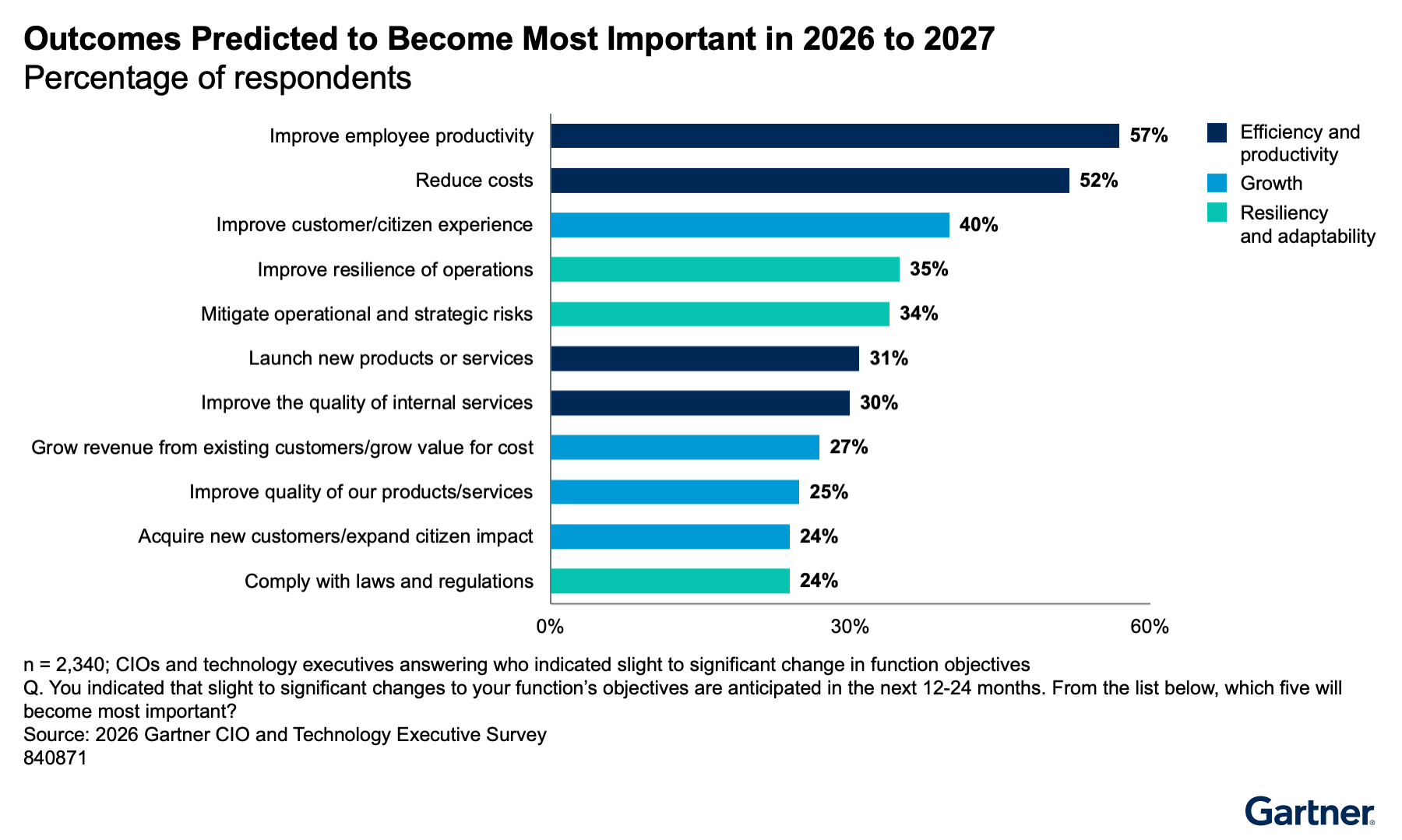
CIOs and technology executives face a turbulent 2026 defined by strategic pivots, not static plans. Success requires bold moves as 94% of leaders anticipate major changes stemming from geopolitical shifts and emerging digital sovereignty laws. As a result, a majority of CIOs report pressures to improve employee productivity (57%) and reduce costs (52%).
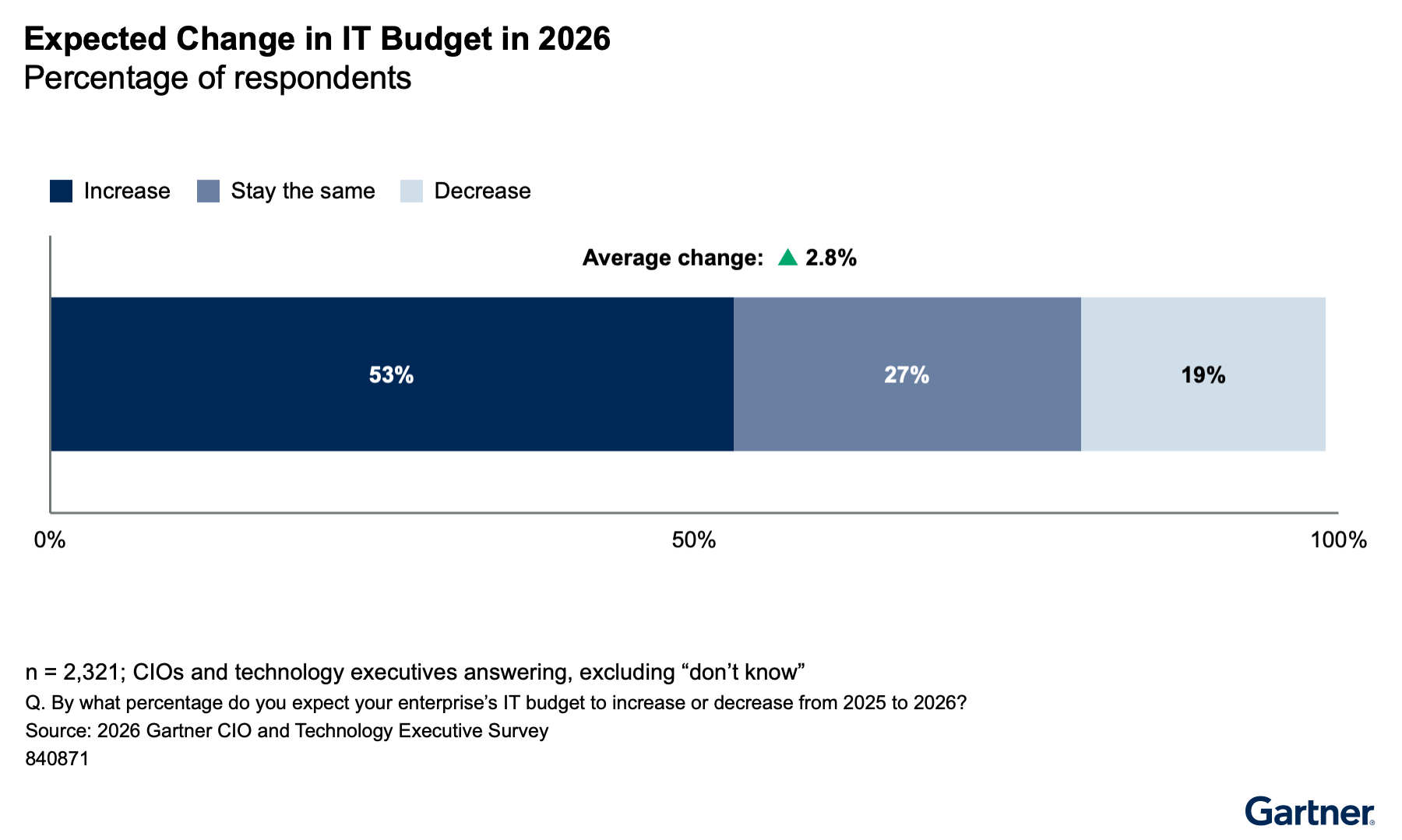
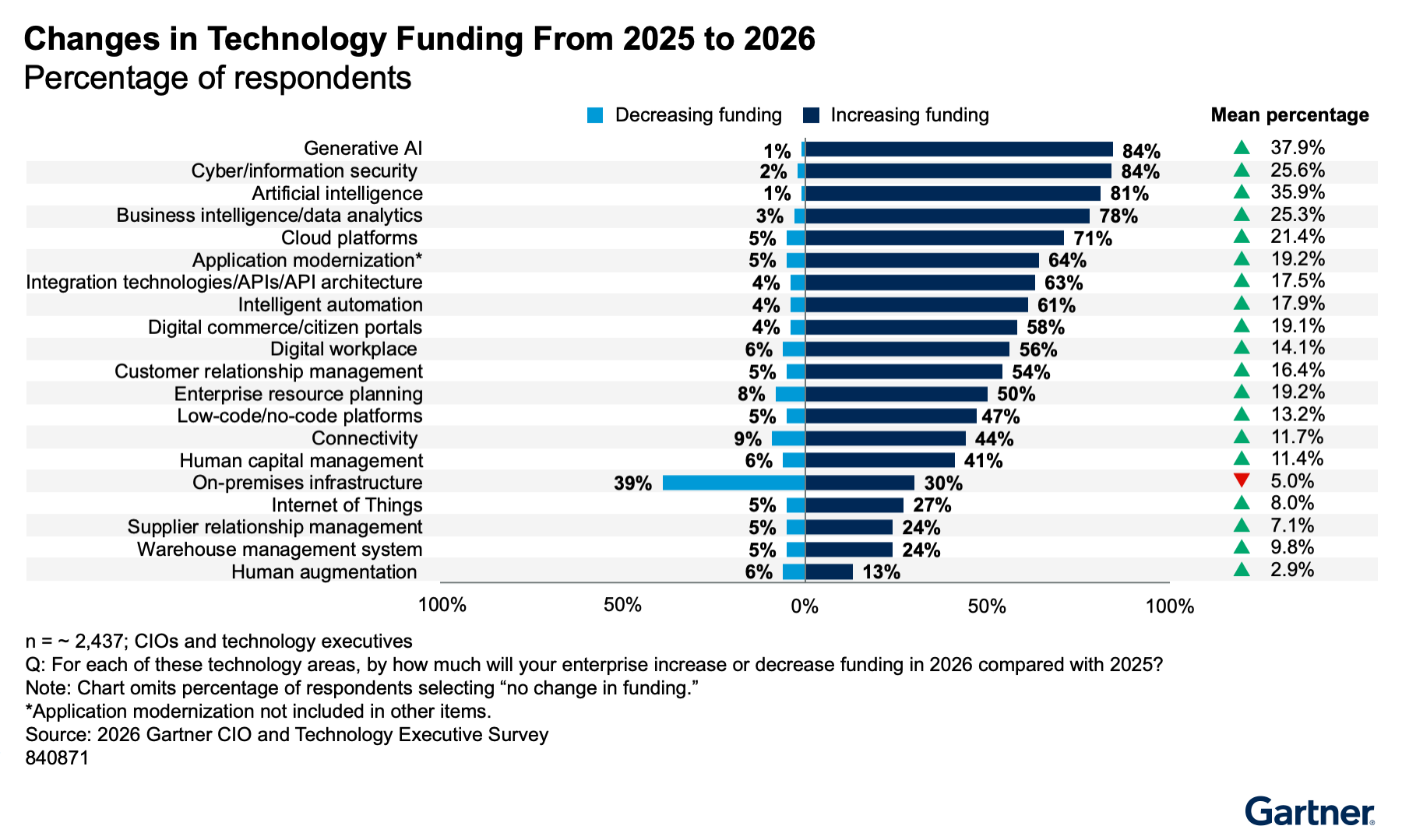
Although overall IT budgets will only grow marginally, investments are aggressively shifting to AI and generative AI. However, there is increased pressure for direct financial impact from AI/GenAI implementation, rather than simply “time saved.”
Leaders must master the A.R.T. pillars — Agility at in-flight reprioritization, Risk management like a “risk sentinel,” especially in managing vendor risks, and Tenacity in critical execution to provide financial value:
- Agility — Embrace dynamic reprioritization. Decisively terminate underperforming initiatives off-cycle to reallocate resources to high-value areas. Incorporate scenario planning — across IT and the C-suite — as a habit to prepare for disruptions.
- Risk — Pivot from a geographically agnostic global sourcing strategy to one that is geostrategically aligned, reflecting concerns on data sovereignty and tariff risks. Shift sourcing strategies to regional focus when needed, carefully assessing global versus local vendor trade-offs against evolving digital sovereignty landscapes.
- Tenacity — Convert productivity and “time saved” from digital and AI initiatives into tangible financial value. Eighty-eight percent of AI value currently comes from time savings, not cost reduction or increased revenue.
Strategic Planning Assumption
By 2030, 70% of governments will enforce digital sovereignty laws, requiring CIOs and technology executives to redesign data architectures for compliance and cross-border resilience.
Issue Context
The Gartner 2026 CIO and Technology Executive Survey is the largest global study of its kind, with 2,501 CIOs and technology executives participating worldwide, including leaders with titles beyond “CIO” like chief digital officer, chief technology officer, chief innovation officers, etc. It delivers actionable strategies to enhance execution and leadership impact, notably as the majority of CIOs expect their plans and outcomes to shift in the coming year.
These are the main consequences of such an expected shift in plans and outcomes:
- In 2026, the bar for success for CIOs and technology executives is expected to be much higher than it is currently. Most technology leaders anticipate increasing pressures to improve employee productivity and cost efficiency (see Figure 1).
- Despite overall growth in the technology sector, IT budgets globally are projected to grow by 2.8%, yet inflation will eat up that slight increase in most countries. This will force CIOs and technology executives to prioritize strategic investments and demonstrate greater ROI for every cent spent (see Figure 2).
- In the face of budgetary pressures, technology leaders are aggressively increasing investment in AI and supporting technologies that will create competitive differentiation. Traditional AI, GenAI and cybersecurity take the lead. As expected, reliance on on-premises infrastructure continues to decrease to reduce technical debt (see Figure 3).
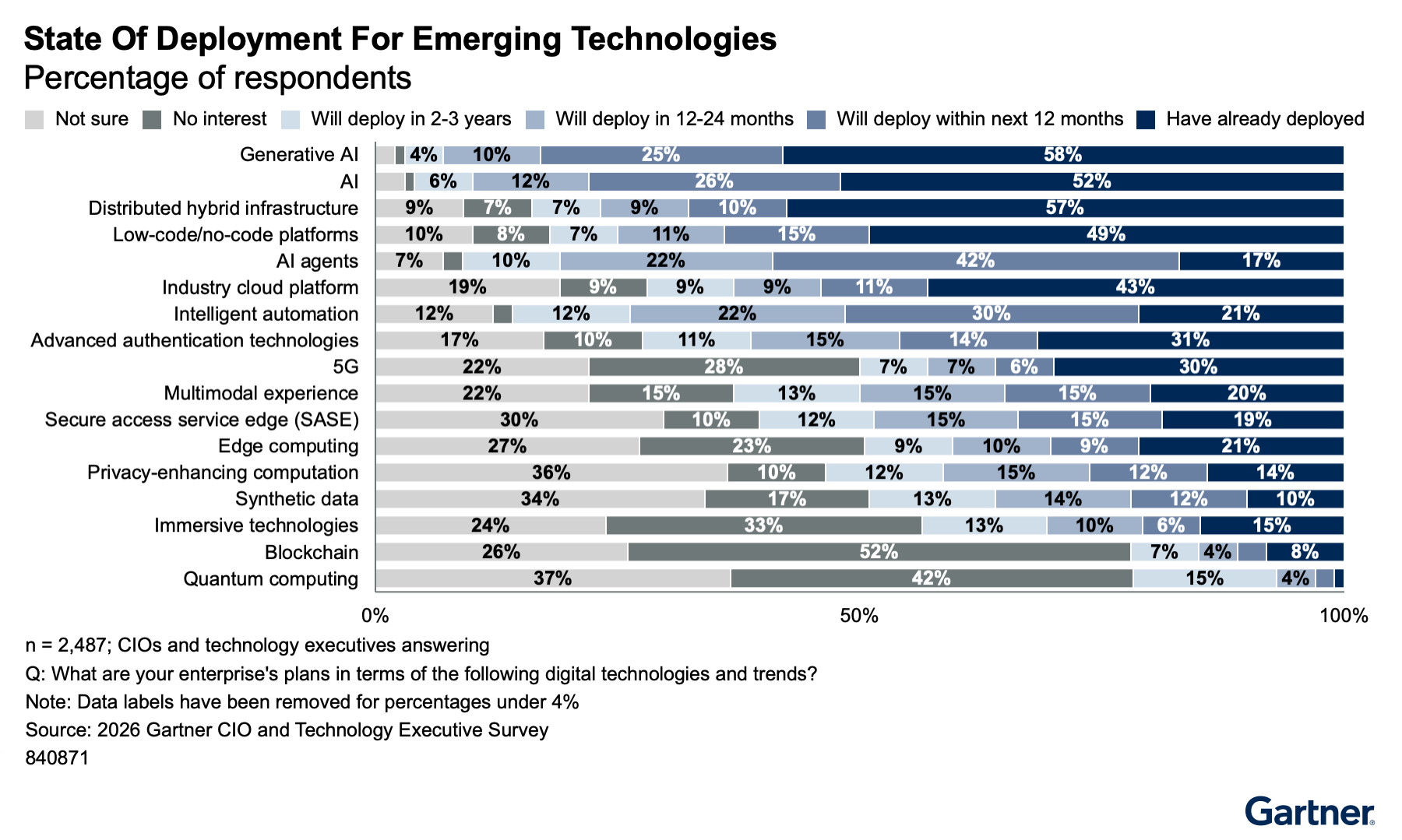
- Technology executives around the world are rapidly moving AI and generative AI beyond piloting into active deployment. This demonstrates a mature approach to integrating emerging technologies. Noteworthy is the impressive progression of agentic AI (See Figure 4).
Impact Brief
In 2026, CIOs must act decisively to brace for major shifts. Thriving in this complex and volatile landscape will give technology leaders a prime opportunity to prove their leadership and their ability to execute. CIOs who fail to pivot with contextual mandates, such as agile reprioritization, proactive vendor risk management and tenacity in converting productivity gains into financial value, will undermine their effectiveness. This, in turn, will diminish their strategic impact and risks, eroding their influence across the organization.
More Detail
Understanding the Tech Leader Opportunity Matrix
Under the turbulent scenario described, the cost pressures, the restrictions in IT budget and the demand for value realization of AI/GenAI, CIOs must strengthen their ability to execute.
The Tech Leader Opportunity Matrix is a tool for understanding the ability of CIOs and tech executives to execute in the context of their scope of accountability. To comprehend this matrix, it’s essential to first understand the four distinct areas of accountability that CIOs and technology executives may be accountable for within an enterprise (see Figure 5).
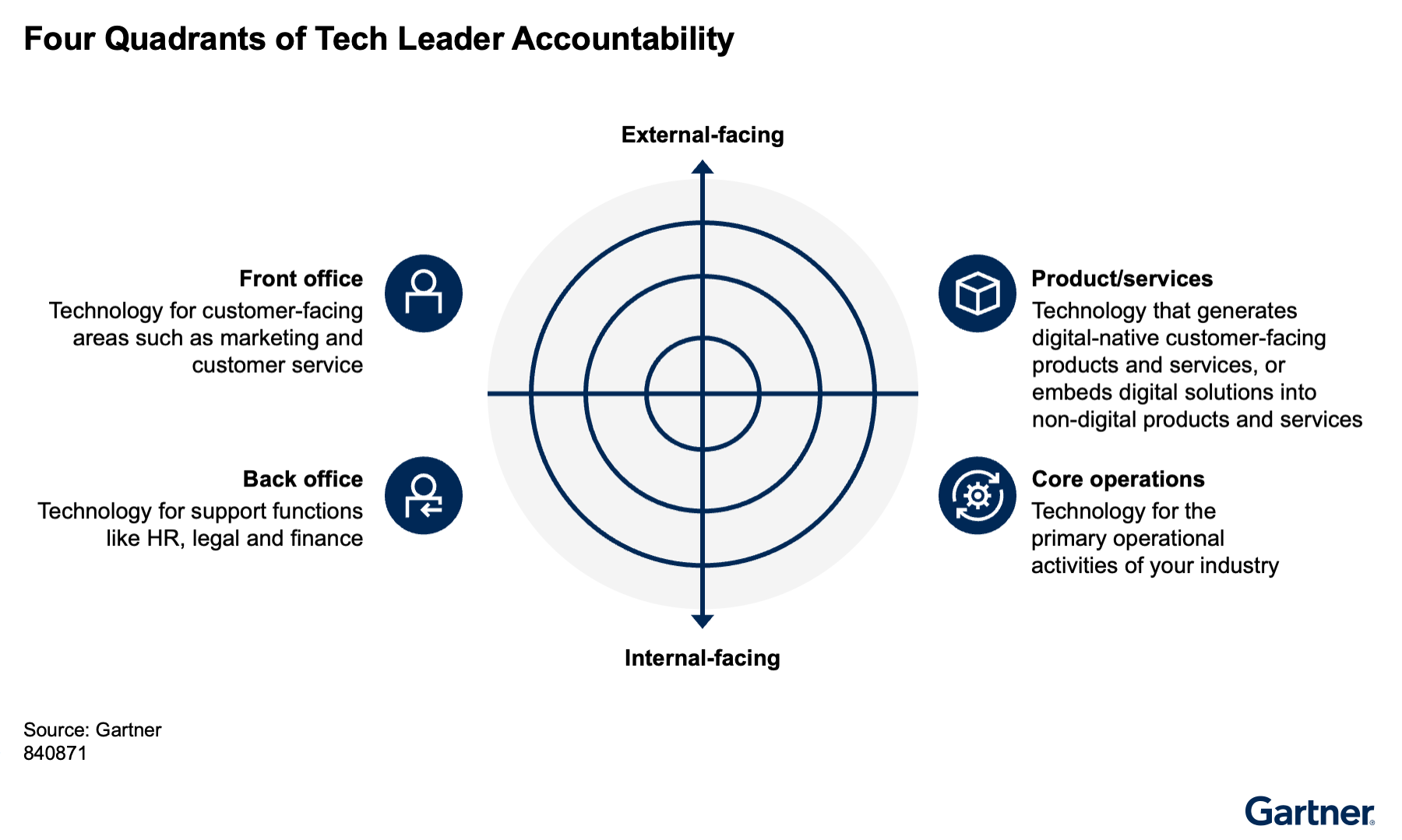
- The back office: Technology for support functions like HR, legal and finance.
- The front office: Technology for customer-facing areas such as marketing and customer service.
- Core operations: Technology for the primary operational activities of your industry, like banking operations or manufacturing factories.
- Products/services: Technology that generates digital-native customer-facing products and services, or embeds digital solutions into nondigital products and services increasing their value.
The Tech Leader Opportunity Matrix itself is composed of two axes (see Figure 6).
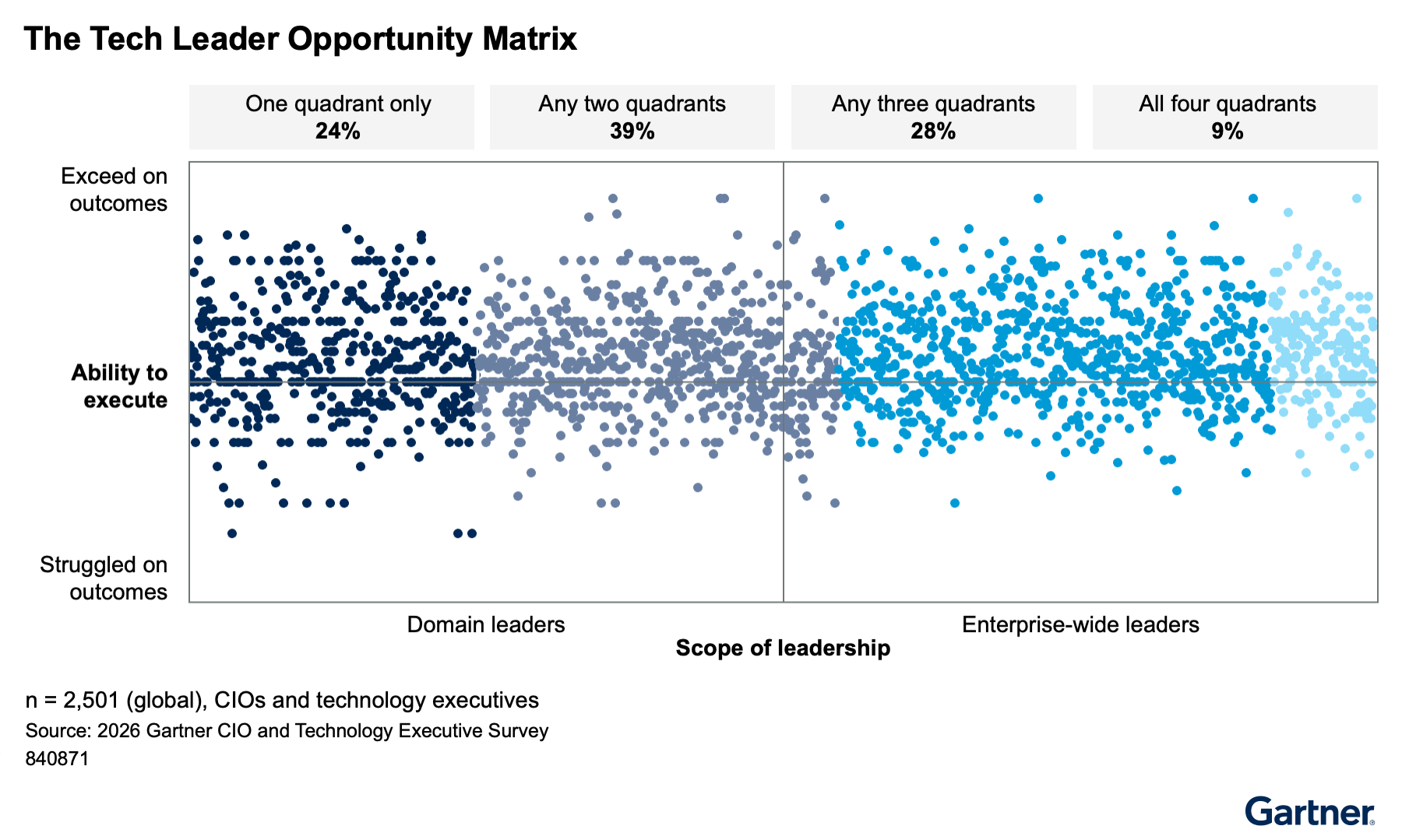
The Y-axis represents the CIOs’ (and their teams’) ability to execute — that is, the realization of the enterprise outcomes that their most critical digital initiatives focus on (like cost reduction, operational excellence, revenue/mission growth and customer/citizen experience). Leaders who exceed their promised outcomes are positioned higher on this axis.
The X-axis represents the CIO’s scope of accountability — that is, how many of these four quadrants they oversee. Only 9% of senior technology leaders are responsible for all four parts, while a majority (24% for one quadrant only, 39% for two, 28% for three) manage a more limited scope. Those responsible for one or two quadrants are called domain leaders, and those responsible for three or four are called enterprisewide leaders.
Dispelling Myths
The study reveals that many commonly held assumptions about what makes a technology leader successful do not hold true. Factors often believed to be vital in reality do not matter in determining a CIO’s ability to execute or scope of leadership:
- Bigger budget — Having more IT budget does not predict success or a broader scope of leadership.
- Bigger team — The size of the team does not correlate with improved ability to execute or leadership scope.
- Bigger company or tech-forward industry — Being in a larger company or in a specific industry (e.g., financial services vs. public sector) does not inherently make a leader more successful.
- CEO reporting lines — Reporting structure is not a factor that correlates with the ability to execute. There are high performing leaders across all reporting lines and all four quadrants of technology leadership.
While CIOs have limited control over these factors, our research offers encouraging news: success in 2026 (Y-axis) will be driven by elements directly within the CIO’s span of control: the A.R.T. pillars set out in the next section. It’s worth mentioning that the scope of leadership (i.e., the position in the X-axis) is not correlated to success: any CIO, regardless of the “amount” of accountability, has an equal chance of success in 2026.
Increasing Your Ability to Execute: The A.R.T. Pillars
Our study indicates that in today’s climate of unpredictability and uncertainty, CIOs who are most likely to enhance their ability to execute (i.e., most likely to advance their position on the Y-axis), are distinguished by three key characteristics:
Being an Agile Reprioritizer (“A”): Pivot From Annual Cycles to Dynamic Reprioritization
CIOs who are agile reprioritizers (that is, who master dynamic, off-cycle reprioritization rather than relying on rigid, calendar-based planning) multiply their ability to execute by 1.24 — that is, they are 24% more likely to be a top performer — amid relentless market instability. Yet just 18% of CIOs demonstrate this skill.
Actions to become an agile reprioritizer:
- Implement dynamic, off-cycle reprioritization: Agile reprioritizers must have the courage to decisively discontinue underperforming or misaligned initiatives to reallocate resources to initiatives that deliver the highest strategic value. Given the potential for political sensitivities and resistance from internal stakeholders, it will be critical for CIOs to build coalitions and secure support across the organization to ensure successful reprioritization.
- Use scenario planning to force bold decisions: Effective agile reprioritization requires anticipating potential outcomes and disruptions before they materialize. CIOs should use scenario planning not just as a theoretical exercise, but as a tool to inform bold decisions, enabling the organization to proactively address emerging threats and opportunities rather than reacting after the fact.
— Karen O’Driscoll, Chief Information Officer, Cochlear“I work in an organization which values perfection, which is critical for the medical products we design and manufacture. When applied more broadly, this can hinder our ability to adapt and respond quickly. I am leading the transformation with my peers to prioritize work based on enterprise value, make faster risk-based decisions and deliver value in an iterative way.”
Being a Geopolitical Risk Mitigator (“R”): Pivot From Global to More Regional Sourcing
Behaving like a risk sentinel who protects the enterprise from potential threats (whether cyberthreats or other types, such as geopolitical risks), and implementing appropriate controls and mitigation measures, provides a significant boost to operational efficiency: 1.51x. That is, these tech executives are 51% more likely to be top performers. This was supposed to be in the CIO’s agenda long ago. However, only 28% of technology leaders excel in this area.
One of the most critical risk sentinel behaviors is responding to geopolitical risk. One in two (50%) of non U.S. enterprises plan to adjust vendor strategies, compared to just 31% in the United States.
CIOs must repurpose IT vendor and sourcing strategies to stay ahead of threats driven by data sovereignty, the strategic autonomy of AI and the growing influence of dominant technology providers, often referred to as “vendor nations.” This shift requires a pivot from primarily global IT vendors to pondering the right global versus regional vendor mix.
Actions to become a geopolitical risk mitigator:
- Ponder your vendor mix: CIOs must pivot from a global sourcing strategy that is geographically agnostic to one that is geostrategically aligned, reflecting concerns on data sovereignty and tariff risks. While regional vendors offer stronger compliance with regional laws, reduced privacy risks and greater solution flexibility, global vendors typically provide more advanced capabilities, easier scalability and support for international expansion. With the prediction that at least 70% of countries will implement comprehensive digital sovereignty laws by 2030, leaders should immediately assess the trade-offs between global and local vendors.
- Strengthen on-site support: Amid growing geopolitical tensions, movement of people may be restricted. It can affect on-site engineering presence and support availability. Query your vendors about on-site presence in your country or in your geopolitical region. You might have to consider a shift from moving people to work to moving work to people, for both internal and external staffing sources.
Being a Tenacious Executor (“T”): Pivot From Productivity to Financial Impact
Tenacious executors resist distractions and stay focused on extracting financial value from the most strategic technology initiatives, especially AI. This disciplined approach improves execution ability by 1.25x. Yet, only 33% of CIOs consistently demonstrate this capability, limiting their impact on enterprise performance and strategic outcomes.
Actions to become a tenacious executor:
- Reframe setbacks as opportunities to learn: Managing volatility requires leaders to encourage a different mindset when it comes to acceptance of risks and setbacks. Leaders with the highest ability to execute were able to encourage team members to take risks if they could justify them relative to likelihood and impact. Equally, they encouraged teams to address challenges without becoming discouraged.
- Be radically outcome-focused: Prioritize the most critical initiatives, even as new ones keep coming. This is a key lever to becoming a tenacious executor and a capability that only one in three CIOs currently demonstrate. To navigate the negative reactions such focus may trigger across the enterprise, strengthen your political capital by cultivating strategic relationships with C-suite leaders who share a similar radical focus on outcomes, ensuring their consistent support.
- Translate “time saved” into “money saved:” Time saved is not money saved. According to a Gartner CFO survey, 88% of the value achieved by AI is attributed to time saved, while only 5% reflects actual cost savings and 6% increased revenue. To capture real financial value, CIOs must be tenacious as they lead substantial enterprise change. This means moving beyond task augmentation to reengineering processes and teams, which can go from restrained hiring or headcount reduction to directly contributing to revenue or mission growth.
— Juan Manuel Garcia, Chief Information Officer, Repsol“AI allows us to work with our managed service providers to reduce both the number of agents and the rate we are paying for services. Because we can demonstrate that, the vendor can also get a lot of savings by using AI.”
Closing
2026 will be dominated by pivots and dynamic reprioritizations, often in-flight. Apply the A.R.T. pillars to increase your ability to execute. Here are a few related Gartner resources: