Critical Capabilities for Custom Software Development Services
9 December 2025 - ID G00827109 - 67 min read
By Ryan McKinney, Katie Gove, and 3 more
This Critical Capabilities research evaluates system integrators on their ability to build new custom products leveraging design, GenAI, APIs and other technology expertise. Sourcing, procurement and vendor management leaders can use this research to identify and select potential service providers.
Overview
Key Findings
- Growth in the custom software development services (CSD) market slowed in 2024 with an average of 6% growth in reported revenue, down from 7% in 2023.
- Generative AI (GenAI) is transforming custom software development by automating code generation and enhancing code quality through intelligent refactoring.
- Several service providers reported targeted investments in GenAI and its augmentation in the software development life cycle (SDLC), resulting in accelerated development cycles and improvement in the efficiency and effectiveness of CSD projects.
- Legacy modernization projects have surged this year as AI-driven business rules extraction simplifies updating legacy code. Many organizations are choosing now to engage custom software vendors to modernize systems with custom engineering to achieve greater efficiency, reduced costs and faster deployment.
Recommendations
IT sourcing, procurement and vendor management (SPVM) leaders deploying an IT services and solution strategy and selection to identify custom software development (CSD) service providers should take these steps:
- Narrow down service providers to those that match your needs by reviewing the three use cases and 10 critical capabilities profiled in this research. Each use case covers a spectrum of services that can be explored with the 20 service providers covered here.
- When evaluating a potential CSD vendor, assess its ability to collaborate effectively with both business and IT stakeholders, its proven expertise in technology and relevant domains, and its capacity to deliver tailored solutions aligned with your requirements.
- Examine the vendor’s business acumen, talent management practices and pricing models to ensure a suitable fit for your organization’s maturity.
- Review the vendor’s financial stability and contingency planning to mitigate operational risks, and confirm the presence of transparent communication channels for project continuity.
- Prioritize vendors with robust generative AI capabilities, demonstrated success in deploying AI-driven automation and a portfolio of reusable AI tools, ensuring that they understand your industry’s unique needs and can deliver innovative, future-ready solutions.
Strategic Planning Assumptions
By 2028, 75% of enterprise software engineers will use AI code assistants, up from less than 10% in early 2023.
By 2028, GenAI will enable 40% of software team members to come from nontraditional software engineering or technical educational backgrounds, up from 20% in 2025.
By 2028, development teams that diligently apply an ensemble of AI-powered tools to the software development life cycle will achieve 25% to 30% productivity gains, up from the 10% delivered by the code-generation-focused approach in 2024.
What You Need to Know
This Critical Capabilities research on CSD services assesses 20 providers’ relative capabilities in three use cases to successfully design, build and develop custom software and deliver business value. Sourcing, procurement and vendor management leaders should use this research to identify and narrow down relevant service providers appropriate for their specific business, domain and technical requirements. SPVM leaders should look for providers that can not only develop software, but also help with ideation, transformation and integration with other enterprise solutions. To most effectively assess providers for downselection, SPVM leaders are encouraged to use this Critical Capabilities research in tandem with the companion Magic Quadrant for Custom Software Development Services.
This Critical Capabilities research provides an in-depth view of the service providers beyond the core strengths, cautions and relative positions included in the Magic Quadrant. All service providers’ solutions have been scored against the 10 critical capabilities that Gartner deems are leading factors for sourcing executives to consider when evaluating service providers for the specific use cases identified. Although the capabilities are the same across the three use cases, their weightings vary depending on the focus of the delivery.
The profiles below highlight the capabilities and performance of each vendor for the three use cases. Some of the leading providers performed equally well across all three use cases. Use the relative positions in the use-case chart and the critical capability scores to gain a better understanding of each provider’s capabilities. Leverage these use-case scenarios and capability criteria in conjunction with the Magic Quadrant strengths and cautions to speed up the identification of candidate providers to meet your CSD service requirements.
Note: While this research focuses on the 20 largest CSD and pure-play CSD providers, it is important to recognize that engaging organizations of this scale may not be suitable for every business, and the listed providers may not align with your specific requirements. Therefore, Gartner recommends leveraging resources such as the Tool: Vendor Identification for Custom Software Development Services to identify vendors that best match your organization’s needs.
Analysis
Critical Capabilities Use-Case Graphics
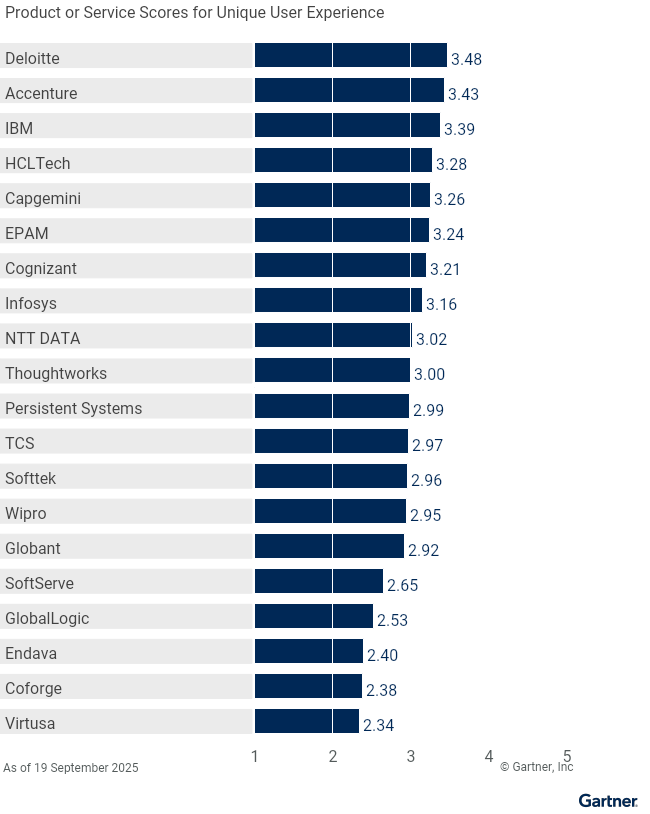
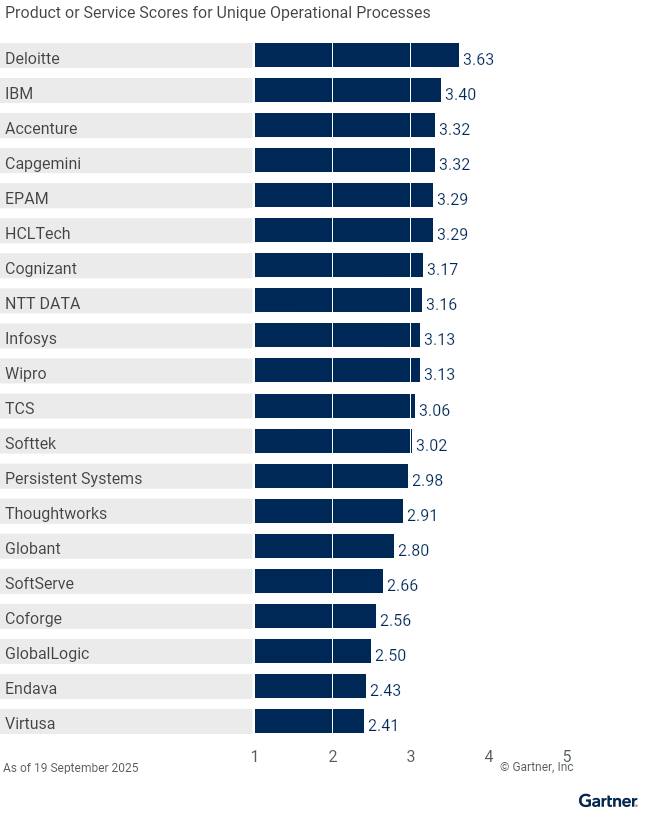
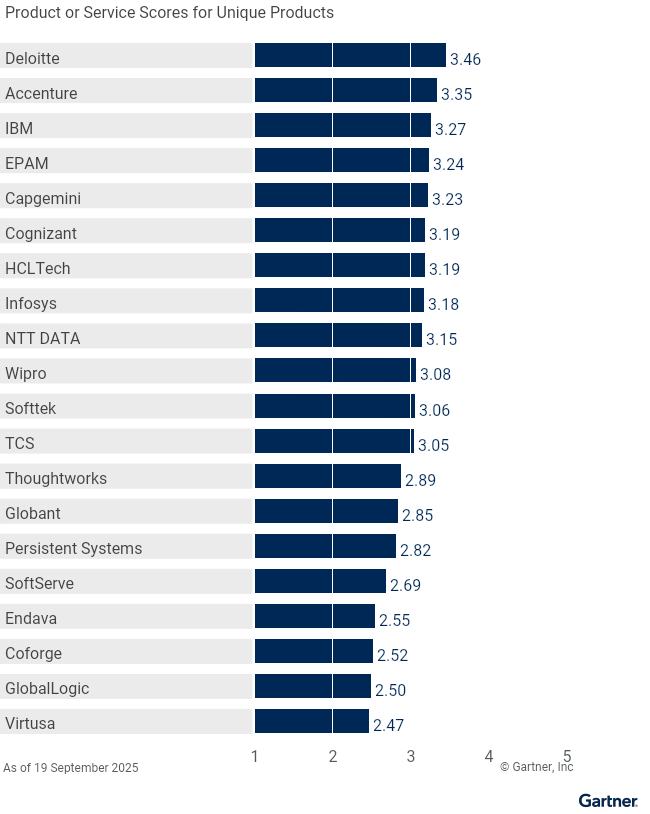
Vendors
Accenture
Accenture is a strong fit for large global enterprises seeking end-to-end transformation using custom solutions that require deep industry expertise and advanced proprietary assets. It continues to mature its capabilities in AI, with most offerings now powered by AI. With a large CSD practice, Accenture consistently scores highly across use cases, helping clients engineer scalable, high-performance solutions by integrating advanced technologies, robust architectures and domain expertise throughout the SDLClife cycle.
Accenture has 129,200 CSD services resources — 1.7% growth year over year (YoY) — with 8% in North America (NA), 8% in Latin America (LATAM), 16% in EMEA and 69% in Asia/Pacific (APAC). The company has committed to talent upskilling through AI and industry-focused training initiatives like the LearnVantage platform and a Udacity partnership.
Unique user experience: Accenture combines industry expertise, proprietary AI assets, and globally distributed, cross-functional design teams (20,000+ FTEs in design) to deliver unique user experiences at scale. For a retail client, Accenture built a hyperpersonalized e-commerce platform using its agent marketplace and automation frameworks, resulting in an MVP being launched in under five months. It leveraged a recommendation engine and GenAIthat enabled 90% of users to increase shopping confidence. The platform’s headless, API-first architecture and automated QA tooling ensured rapid scalability and ongoing customer engagement improvements.
Unique operational processes: Accenture leverages its proprietary AI Refinery, agent marketplace and a network of technology specialists (13,500 FTEs in integration and APIs) to deliver unique operational processes for complex enterprises. For a leading retailer, Accenture helped modernization efforts for more than 400 custom apps and 3,600 integration points by embedding AI agents for planning, migration, testing and governance. This resulted in the client achieving a 40% acceleration in delivery timelines, 50% reduction in deployment errors and over 80% test automation coverage across its modernization effort. Reviewer agents and human oversight ensured high quality and compliance throughout the transformation.
Unique products: Through investments in AI engineering, sovereign cloud and a flexible global talent model (170,000-plus FTEs certified in agile and DevOps), Accenture enables clients to launch new digital products tailored to specific market and regulatory needs. In partnership with a Middle Eastern government-backed AI company, Accenture built a unified AI platform and marketplace from scratch, leveraging its AI Refinery and agent marketplace assets. Designed for data sovereignty and multilingual operations, the platform provides a scalable foundation for new digital businesses and supports rapid deployment of domain-specific agents. This resulted in a subscription-based, sovereign-ready ecosystem that empowers public sector innovation and digital growth.
Capgemini
Capgemini supports large enterprises and public sector organizations with end-to-end digital transformation, AI-driven modernization, and complex, domain-specific software engineering. It serves midsize businesses and startups through its Sogeti consulting business, offering agile, scalable cloud-native solutions. Capgemini’s CSD practice covers AI-powered engagement, intelligent automation, platform composability and outcome-based delivery, backed by deep industry expertise in regulated and innovation-driven sectors.
Capgemini had 100,000 FTEs in CSD services in 2024, 29% of its global workforce. Its delivery model is globally distributed: 53% of resources are in APAC, 30.5% in Western Europe and 9.7% in NA. Capgemini emphasizes talent development, mandating AI training for all software engineers. ItsGenAI Campus and NEXT learning platform support upskilling, while partnerships with leading AI providers and an AI-powered internal job board foster workforce agility and innovation.
Unique user experience: Capgemini blends deep design expertise, proprietary frameworks and a global network of more than 7,500 FTEs focused on UX. Its creative consultancy, frog, leads customer experience (CX) strategy and personalization, supported by the SCORE design framework and Foundry Innovation Hub. For the America’s Cup, Capgemini used its UX expertise to develop WindSight IQ, an analytics platform that allows users to view wind movement in real time. This case exemplifies Capgemini’s ability to deliver impactful, large-scale user experiences leveraging advanced technology and strong design.
Unique operational processes: Capgemini uses its modern software engineering approach and nearly 30,000 FTEs in integration and analytics to drive unique operational processes. Its software house model and AI-powered integration engineering enhance automation and efficiency, while its IDEA platform significantly accelerates data migrations. For a leading investment bank, Capgemini reimagined the know-your-customer (KYC) workflow with agentic AI and custom orchestration, enabling Perpetual KYC (PKYC) with around 25 agents for real-time risk profiling. This resulted in operational gains such as a 40% to 60% onboarding improvement and a reduction in onboarding time from over 100 days to 40 to 50 days.
Unique products: Capgemini helps clients launch innovative digital products through its 55,000-plus FTEs in software engineering and a robust portfolio of AI-powered tools. Its modular software engineering platform and various frameworks use agentic AI across the software development life cycle (SDLC) to create industry-specific solutions. One example is a smart energy grid orchestration platform designed to help utilities modernize their electric grids while transitioning to sustainable energy. Efficiency was key; the platform delivered a 50% improvement in supervisory control and data acquisition (SCADA) modernization timelines and the establishment of an agentic SDLC foundation to accelerate product roadmaps.
Coforge
Coforge is well-suited for midsize to large enterprises aiming to modernize legacy platforms, launch digital products, or embed intelligence in operations. It serves banking and insurance, travel, and public sector clients, with strong Agile and DevOps expertise, including Atlassian, Microsoft Azure DevOps, and open-source continuous integration/continuous delivery (CI/CD) toolchains. As a new entrant in this year’s research, Coforge has over 20,000 CSD services resources — 77% of its workforce, up 46% from last year. However, Coforge’s capability scoring shows it lacking in multiexperience development and analytics. Its CSD resources are distributed with 11% in NA, 1% in LATAM, 7% in EMEA and 82% in APAC. Coforge is training staff in GenAI skills via its LMS (Percipio) and has established an AI center of excellence to formalize training.
Unique user experience: Coforge employs 768 design professionals and offers Coforge Experience services, covering experience design, portal, mobile apps, CMS, ECM and digital marketing. For a client, it built an e-commerce platform using Adobe Target and Analytics for A/B testing, personalization and behavior analysis, resulting in a 60% transaction increase. Yet, Coforge did not demonstrate leading-edge UX or multichannel innovation, showing only basic design and customer experience (CX) capabilities.
Unique operational processes: With more than 500 FTEs in analytics and API integration, Coforge uses its Quasar AI platform for industry use cases and agents, leveraging AI to improve code quality and developer productivity. In developing a payment platform for a global bank, Coforge designed a multilayered data ingestion architecture, AIOps framework and machine learning (ML) pipeline for predictive analytics and autonomous remediation, improving system availability and reducing mean time to repair (MTTR) by 30%. While Coforge can deliver basic integration and API work, there is limited evidence of advanced, ecosystem-scale integration capabilities.
Unique products: Coforge has 18,000 agile and DevOps professionals assisting with legacy modernization, product engineering, integration and SDLC acceleration. It has developed AI accelerators for reverse/forward engineering (CodeInsightAI), touchless continuous delivery (Forge-X), automated ticket analysis (TicketX), AIOps (EvolveOps.AI) and an internal self-service chatbot (Amyra). A recent modernization project involved over 40 autonomous scrum teams, a data innovation lab and GitHub Copilot for code summarization, resulting in a 33% reduction in time and effort and zero repeated errors. While Coforge is adopting modern engineering practices in projects, more evidence of broader DevOps maturity, automation and modern SDLC approaches is needed.
Cognizant
Cognizant is a good fit for long-term, enterprise-scale engagements designed to create transformational growth, agility and effectiveness from custom software. The company provides a balance of deep domain expertise with nimble execution at pace and scale. Its focus spans through financial services, health sciences, products and resources, and communications, media and technology. Cognizant’s stated strengths include AI innovation, client centricity and platform-powered engineering, underpinned by a focus on measurable outcomes for its clients.
Cognizant has 148,400 CSD services resources, representing a 2.4% increase from last year. Its CSD resources are distributed with 16% in NA, 1% in LATAM, 7% in EMEA and 76% in APAC. Cognizant fosters continuous upskilling and innovation through learning ecosystems like MySkills and Cognizant Academy as well as partnerships with leading universities and technology providers to equip its workforce with advanced, industry-relevant skills.
Unique user experience: Cognizant delivers hyper-personalized digital experiences by combining human-centric design, AI-driven personalization, and immersive Experience Studios in major global cities. With 24,540 FTEs in design-related roles, Cognizant enables user focused, iterative development and co-creation with clients. Working with a media company, Cognizant established a modern custom software development delivery model using AI-powered platforms like Cognizant Flowsource and Cognizant Neuro AI. This enabled the client to launch a free, ad-supported service tier and specialized, lower-priced content, directly countering streaming giants and resulting in improved revenue and over $23 million in fraud control and productivity savings.
Unique operational processes: Cognizant leverages proprietary frameworks, agile and DevOps capabilities (with nearly 59,000 FTEs in agile and 19,600 in DevOps), and platform-powered automation to drive efficiency and resilience. Key platforms like Flowsource, Neuro IT Operations and Skygrade enable AI-infused SDLC management, system resilience and cloud-native development. For a major retailer, Cognizant modernized a legacy mainframe order management system to a cloud-native platform while adding AI-powered personalization that understood search context, enabling an enhanced user experience.
Unique products: Cognizant empowers clients to launch next-generation digital products through 15,000 AI engineers and proprietary platforms. The company leads in GenAI and agentic AI, with over 1,200 GenAI projects and more than 100 agentic AI initiatives. For a global semiconductor provider, an onboard GenAI architecture achieved 200-millisecond AI response times and 80% cloud usage reduction. Additionally, AI-native assistants for education clients support over 1 million students with personalized learning.
Deloitte
Deloitte is a strong fit for large global enterprises seeking comprehensive, outcome-focused solutions, particularly in financial services, healthcare and government. Deloitte has more CSD practitioners than most vendors in the cohort, and that capacity continues to increase year over year. Its workforce is distributed across North America (39%), APAC (32%), EMEA (25%), and LATAM (4%), with revenue distribution closely matching headcount, reflecting strong client proximity. Deloitte is a top performer in critical capability assessments, showing high capability across all evaluation criteria.
Deloitte has invested heavily in upskilling, with all its technology practitioners re-/upskilled through programs like the GenAI Fluency Program, and all its enterprise staff trained in GenAI fluency. The firm holds more than 95,000 certifications in cloud, data, AI/ML, GenAI, agile, DevOps and quality engineering, with a 25% growth in certifications from 2023 to 2024.
Unique user experience: Deloitte employs more product design specialists than the majority of the cohort. Its human-centered agile design process, enhanced by AI-driven user insights, ensures software is built around real customer needs with frequent iterations. For example, Deloitte worked with a large country’s digital service to design a secure identity verification app, leveraging its design thinking to create a single, user-friendly solution that had to be inclusive of the requirements of a diverse citizenry.
Unique operational processes: Deloitte enhances operational processes using integrated technology and automation, including AI-enabled process automation to streamline development and deployment. Proprietary tools include AI Assist (productivity platform), AI Integration Assist and Migration Assist for platform migrations. Deloitte excels at evolving business processes during and after development, as shown with an automotive manufacturer where it modernized a global industrial Internet of Things (IIoT) platform using AWS architecture and embedded AI/ML algorithms. This enabled real-time monitoring and optimization, achieving 5% lower energy consumption, 5% improved product quality,and up to 4% higher equipment effectiveness.
Unique products: Deloitte leverages its reported $4 billion investment in AI and GenAI and $2 billion in the IndustryAdvantage program for sector-specific solutions. Proprietary platforms like AI Assist and the Multi-Agent System (MAS), plus new businesses such as Zora AI and AI Factory Silicon to Service (S2), are central to its strategy. Deloitte has 11,942 FTEs in agile and DevOps and pursues acquisitions to strengthen AI and software engineering. For example, Deloitte helped a major tech client design, prototype and scale a flagship agentic AI platform, resulting in a 25% reduction in time to market and enabling a key product announcement.
Endava
Endava is well-suited for clients in EMEA and NA across payments, financial services and communications. It supports product, technology architecture, process automation and security services through a global team of experts. Endava has 10,810 CSD services resources — a 1% decline from last year — with 5% in NA, 12% in LATAM, 65% in EMEA and 18% in APAC. The company emphasizes talent development and AI integration, including in-house tech training via Endava University. Endava invests in “Pods” for technical innovation, such as the Dava.X AI Pod focused on AI, ML and computer vision. Despite strong case studies, Endava scores at the lower end in all metrics, especially talent operations and analytics and business intelligence (BI) expertise.
Unique user experience: Endava’s 445 design FTEs focus on customer experience strategy, product design and brand strategy. This includes AI-driven personalization, multiexperience development, and immersive technologies using Unreal and Unity, as well as game and hardware engineering for mobile and web. In one case, Endava developed a SaaS omnichannel multitenancy platform for a client with fragmented media systems and manual workflows. The solution featured a configurable low-code UX, composable API-first architecture and end-to-end workflow from planning to payments, resulting in faster campaign activation cycles and full-funnel visibility.
Unique operational processes: Endava uses proprietary frameworks, including The Endava Adaptive Model (TEAM), TEAM Enterprise Agile Scaling (TEAS) and API Factory for scalable agile delivery and industrialized API production. It has 110 FTEs in API/integration and 230 in analytics/BI. For an international specialty insurer, Endava created a digital twin, an ID matching service, an AI layer for relationship analysis and a large language model (LLM) for natural language data queries. The outcome was a next-generation CRM enabling real-time insight into claims and clear data visualization for underwriters and claims handlers.
Unique products: Endava builds scalable, secure cloud-native platforms using microservices and an AI-native approach. Its proprietary Morpheus platform is a multiagent AI toolkit for complex challenges, and Compass uses AI-driven insights for system analysis and modernization. With 14,810 FTEs in software engineering, Endava supports these innovations. For a top-10 global pharmaceutical company, Endava used Morpheus to build AI agents that created and reviewed clinical code, applied regulatory guidelines, and generated unit tests, achieving a 40% efficiency gain on a clinical trial bottleneck — equivalent to annual savings of over $36 million.
EPAM
EPAM is a strong choice for organizations seeking comprehensive technology transformations. EPAM emphasizes partnership models that align commercial success with client outcomes, focusing on co-innovation and shared risk. The company has 42,805 CSD FTEs, with 39% in Eastern Europe, 19% in APAC, 13% in Latin America, 6% in North America, 12% in Western Europe, and 11% in the Middle East and Africa. Its current clients are primarily in communications and media, retail, and banking. EPAM holds over 1,800 certifications across major cloud providers (AWS, Azure, Google, Databricks, Snowflake). GenAI literacy is claimed across all engineering functions, with 40% at advanced and 5% at mastery levels.
Unique user experience: EPAM’s design capabilities are rooted in human-centered methods, with UI experts and graphic designers embedded in multidisciplinary teams. More than 7,500 FTEs work in design thinking, supported by the AI agency Empathy Lab, Experience AI investments and Humanique — an ML and GenAI tool for synthetic consumer personas. For a major fashion brand, EPAM developed a gamified loyalty program via a mobile app, leveraging predictive modeling and generative personalization. This initiative earned the client four retail innovation awards, including Most Innovative Global Retailer and Customer Experience Excellence.
Unique operational processes: EPAM employs AI-native working practices, notably its AI/Run framework and “Humans with Agents” methodology, transforming SDLC and agile methods into event-driven, agentic approaches for rapid software creation. Its DIAL AI workbench, AI Ops for observability and RAG Framework support multiple LLM models. EPAM has 870 FTEs in API/Integration and 4,790 in analytics/BI. For a digital health client, DIAL AI deployed Paralegal AI Agents, reducing contract review time by 40% and accelerating revenue recognition by 30%. Coding Agents from DIAL AI cut documentation time by 80% and boosted developer productivity by 40%.
Unique products: EPAM focuses on AI product scale (MLOps, LLMOps), AI/ML services, AI platforms and tools, horizontal solutions, and AI product design. The company is willing to share risk and tie fees to client outcomes, investing heavily in reusable, productized assets. Over 36,000 FTEs work in software engineering. EPAM co-developed Unity Muse, an AI-powered platform that enables game creators to generate sprites, textures and animations using natural language prompts, leveraging Azure OpenAI, Azure ML and Azure Infrastructure Services.
GlobalLogic
GlobalLogic is a good fit for projects with high technical complexity, but scores at the lower end on other capabilities, particularly where vision and uniqueness are a requirement. It has reorganized well following significant disruption to its business, having had significant operations in Ukraine. GlobalLogic supports clients in engineering complex, mission-critical solutions through a product engineering mindset, flexible engagement models and global delivery capabilities.
GlobalLogic employs 31,485 CSD services professionals globally, with 29% in Eastern Europe, 50% in APAC, 4% in LATAM, 13% in NA and 2% in Western Europe. The company’s workforce is structured around high-impact, cross-functional teams and is supported by ongoing investment in AI fluency and technical upskilling via proprietary learning platforms. GlobalLogic’s “AI-first” approach is embedded across its VelocityAI SDLC platform.
Unique user experience: GlobalLogic has 745 design FTEs delivering differentiated digital products through advanced AI and design expertise. For a leading energy sector client, GlobalLogic developed a metaverse-powered platform enabling remote inspections of nuclear sites, integrating 3D models, advanced UX and real-time data. This solution leveraged AI, GenAI and agentic AI for automated documentation and object detection, resulting in a 30% reduction in manual processes and improved efficiency, while enabling remote meetings without specialized hardware.
Unique operational processes: GlobalLogic has more than 1,800 FTEs across APIs, integration, and analytics and BI. It partnered with a major cellular carrier to modernize billing and customer service operations. By deploying advanced analytics and AI-powered automation, the company integrated diverse data streams into a centralized data lake, applying preprocessing and feature engineering. AI-driven predictive models and intent prediction algorithms were developed to contextualize customer calls and route them. This led to a reduction in routine customer care calls, improved customer satisfaction, significant cost savings and reduced average call handling times.
Unique products: GlobalLogic’s 19,000-plus software engineering FTEs leverage proprietary AI platforms such as VelocityAI and the Intelli-Insights ML application accelerator to deliver custom software products to clients. It recently built a real-time video analysis platform for a sports technology provider. The solution automated content creation and analysis using AI and machine learning, transforming raw computer vision data into actionable insights. This platform reduced video production time from hours to minutes, increased user engagement, and simplified talent discovery for players and coaches, eliminating the need for specialized operators and enhancing accessibility.
Globant
Globant is well-suited for clients pursuing digital transformation, especially those seeking strong partnerships to leverage AI and GenAI in CSD services. With over 31,000 FTEs (“Globers”), about 29,200 are dedicated to CSD services — a 7% year-over-year increase. Resource distribution is 67% in LATAM, 3% in NA, 11% in EMEA and 19% in APAC.
Globant emphasizes upskilling and reskilling through AI academies and proprietary AI-powered internal tools (Geno for staffing, Mirai for recruiting), alongside strategic hires for industry expertise. Internal platforms like Globant University (Net Promoter Score [NPS] 84 for learning, 98% global training in 2024) support talent development. The company has invested $35 million in reskilling and training CSD FTEs.
Unique user experience: Globant employs 7,651 design FTEs focused on human-centered design and integrating AI and design thinking throughout development. It invests in user research, rapid prototyping and creative ideation, with designers trained in accessibility standards (WCAG 2.2 AA) for inclusive experiences. For a major airline, Globant led a full-stack digital transformation, replacing legacy systems with microservices architecture and enabling hyperpersonalized, omnichannel experiences across web, mobile, screenless and contact center channels, delivering measurable gains in revenue, satisfaction and efficiency.
Unique operational processes: With 2,961 FTEs in API and analytics and BI, Globant’s own operational processes combine specialized AI agents with human oversight to address complex workflows and regulatory needs. ITs delivery model uses AI Pods (e.g., Product Definition and Architecture Design AI Pods) to analyze, design, build and test software. For a global bank, Globant’s AI Pods transformed a 30-year-old mainframe core banking system to a modern microservices architecture, reducing a key migration step from 650 hours to just 24.
Unique products: Globant’s 26,858 FTEs in agile and DevOps leverage cloud-native architecture, microservices and multiexperience development. It built a comprehensive “phygital” ecosystem for a major stadium, creating seamless experiences for fans and visitors. This included mobile apps for games and concerts; frictionless access control via biometrics (“GameFace ID,” “Identity Pass”) and license plate recognition for parking; cashless and queueless shopping and bar experiences; and integration with partners like Ticketmaster for custom ticketing within the app.
HCLTech
HCLTech is a strong fit for large and midsize organizations seeking a strategic partner for custom software development, especially for digital and AI-driven transformation. With 43,300-plus CSD resources and 5% YoY growth, HCLTech demonstrates significant scale. Its workforce is primarily in APAC (61%), followed by NAM (19%), EMEA (16%) and LATAM (4%). HCLTech stands out for its API and integration expertise and its ability to create unique user experiences.
HCLTech prioritizes AI fluency and cognitive skills over traditional tenure-based metrics, investing heavily in workforce upskilling. The company has over 50,000 GenAI certifications, reflecting its commitment to future-ready skills. Flagship AI offerings include AI Force (for SDLC transformation), AI Foundry (for AI-powered business decision making) and AI Labs (for client education and value demonstration). These platform-led, repeatable solutions are designed to accelerate outcomes, improve compliance and enhance operational efficiency.
Unique user experience: HCLTech employs 3,464 FTEs with design capabilities across UX and CX. Its approach bridges design and development through innovations such as a Figma-to-code pipeline, which standardizes UX across web and mobile and generates deployable code directly. This accelerates delivery by 35% to40%, ensuring design fidelity and engineering discipline. For a retail-centric money transfer service, HCLTech leveraged AI Force to improve engineering efficiency and AI Foundry to streamline KYC processes. The result: a 65% drop in transaction failure rate, 40% faster refund processing and a 60% boost in engineering productivity.
Unique operational processes: With 7,250 FTEs focused on API integration and analytics and BI, HCLTech uses AI Foundry to enhance business decision making and transform processes. For a client in diagnostics and pharma, HCLTech created a personalized oncology medicine platform. Previously, fragmented research and data challenges slowed progress. HCLTech delivered a trusted bioinformatics platform for data exchange, insights and product development, enabling collaboration among scientists, universities, laboratories and researchers globally, cataloging massive datasets from varied sources and automating data cleanup and annotation via AI/ML. This solution ensures secure data access, privacy and lineage, accelerating research and innovation.
Unique products: HCLTech’s 5,435 FTEs in agile and DevOps showcase product-centric capabilities, prioritizing co-creation, rapid iterative delivery and scalable MVPs. For a major global bank, HCLTech enhanced fraud detection and alert resolution in trade surveillance, enabling comprehensive trade audits for compliance. Outcomes included a 60% reduction in alert prioritization effort, a 90% drop in news analysis time, alert resolution time cut from 11 to two minutes, and improved compliance through consistent workflows, audit readiness and regulatory alignment.
IBM
IBM is well-suited for global enterprises seeking a strategic partner in software development and product engineering. The company brings deep experience across traditional and emerging areas, including GenAI and quantum computing, with a focus on continuous improvement, agile delivery and integrated AI capabilities throughout the development life cycle.
IBM has nearly 30,000 CSD services resources — about 10% of its workforce, up 10% from last year. Resource distribution is 15% in NA, 9% in LATAM, 16% in EMEA and 60% in APAC. The IBM Consulting Advantage platform offers AI-powered tools for consultants and technical staff across the software life cycle. IBM prioritizes ongoing upskilling, ensuring that employees are versed in AI and agile practices. Cross-functional teams and the Garage methodology (for accelerating digital transformation at scale) foster collaboration, knowledge sharing and continuous improvement. IBM scores highly in use cases and capabilities, though its business acumen lags slightly behind peers.
Unique user experience: IBM delivers unique user experiences through multidisciplinary squads, agile methods and reusable design assets, orchestrated via IBM Garage and Consulting Advantage. For an airline, IBM designed a world-class guest experience across mobile and web, collaborating with technology partners and using a comprehensive design language system. The result was native iOS and Android apps and an AI-powered digital concierge, accelerating digital product delivery by 30% and enabling seamless, personalized traveler interactions.
Unique operational processes: IBM drives operational excellence through its global delivery centers and agile-at-scale methodologies, bringing together multidisciplinary teams and best practices for complex change. For a global sporting organization, IBM reengineered digital operations, shifting from annual to quarterly product releases. By mapping value streams and implementing custom workflow frameworks and opportunity scorecards, IBM enabled transparent, data-driven decision making. The client achieved continuous innovation and operational resilience, balancing the demands of a major event with organizational constraints.
Unique products: IBM’s delivery model combines industry expertise, reusable AI components and a global engineering network committed to open innovation. In consumer goods, IBM Consulting helped a multinational shift from traditional manufacturing to an AI-powered enterprise, developing domain-specific AI products, including an “AI lawyer” for regulatory compliance. This platform-centric approach reduced campaign approval cycles from six to eight weeks to two to three days and enabled rapid scaling of AI solutions across functions. The client saw significant improvements in efficiency and regulatory agility, with AI adoption driving measurable top- and bottom-line gains.
Infosys
Infosys is a strong fit for large global enterprises seeking a proven CSD provider for products and platforms. Infosys demonstrates robust execution and invests in advanced product engineering, with a focus on responsible AI. While not outstanding in any single category, its capabilities are strong across the board, making it a good fit for organizations with multifaceted requirements. It has expanded its portfolio with new industry solutions, partnerships and proprietary accelerators, notably enhancing Infosys Topaz, its flagship AI-driven platform.
Infosys has over 183,000 CSD services resources — 57% of its total workforce, up 1% from last year. Resource distribution is 16% in NA, 1% in LATAM, 5% in EMEA and 78% in APAC. Talent development is driven by proprietary learning platforms, partnerships (e.g., Udacity) and specialized AI academies, ensuring certification and future readiness. Infosys uniquely uses hackathons for hiring, promotes exponential engineering with small, high-impact teams, and fosters ongoing learning through co-innovation with startups and academia, keeping talent agile and specialized in emerging tech.
Unique user experience: Infosys has approximately 70,000 FTEs in design, supported by more than 20 global Design Studios offering “studio as a service” and embedding AI as the new user interface for intelligent, conversation-led interactions. Infosys delivered a unified “super app” for a telecom provider using micro frontend architecture, focusing on hyperpersonalization and AI-augmented customer journeys. Infosys reported that the app achieved over 60 million downloads, No. 1 ranking in lifestyle and a 4.8-star overall rating, and raised NPS from 38 to 41.
Unique operational processes: Infosys leverages its AI-first iLEAD platform, custom architecture, and embedded security and observability to transform client operations. With 33,105 FTEs in API and integration and 22,112 in analytics and BI, Infosys rebuilt workflows for a global food and beverage client, consolidating 40-plus legacy apps into four platforms with offline sync. This delivered $250 million (1%) annual sales growth and $8 million annual cost savings, reduced sync time from 30 minutes to under one minute, and achieved 99.9% app availability.
Unique products: Infosys’s product creation is enabled by integrated CSD service delivery, domain and product engineering, IP portfolio, and a broad innovation network for co-creation. With 119,546 FTEs in agile and 110,350 in DevOps, Infosys developed a centralized core entertainment platform for a telecom holding company, consolidating operations across six markets using cross-platform tech (Flutter) and cloudification. The platform serves more than 11 million subscribers, handles 2 million-plus streaming transactions per second with 99.7% availability, reduced multiplatform support teams from 200 to 50 engineers, and processes over 1 billion voice commands annually.
NTT DATA
NTT DATA is a strong fit for midsize to large global enterprises seeking a partner for custom CSD solutions, especially where AI capabilities are essential. With nearly 70,000 CSD services resources — 36% of its workforce, up 3% from last year — NTT DATA’s resources are distributed as follows: 9% in NA, 13% in LATAM, 24% in EMEA and 54% in APAC. The company is actively upskilling its workforce on AI, with 80% holding white belt certification via its Global GenAI academy, and is expanding further in APAC and LATAM.
Unique user experience: NTT DATA employs more than 3,000 design professionals and has strengthened its design capabilities through strategic investments. It has branded custom experience-focused design offerings with Launch in North America and Tangity globally, that function as design studios. Its global design network is expanded via summits and client partnerships, driving next-generation prototypes for enhanced engagement. For a tech client facing operational inefficiencies and integration challenges, NTT DATA consolidated 78 applications into four solutions, supported by 10 AI agents, resulting in improved user experience, higher availability and increased operational win rates.
Unique operational processes: NTT DATA’s AI/ML practice includes 6,000-plus resources, enhancing analytics and BI services with AI-driven tools like Microsoft 365 Copilot, expanded training on Power BI and Tableau, automated data validation, mobile enablement, and improved migration and managed services. For a major automobile manufacturer, NTT DATA created a multicloud solution connecting to various LLMs, enabling 70,000 users to develop 9,000 applications, addressing fragmented initiatives and legacy infrastructure without a large central organization.
Unique products: NTT DATA’s 22,000 agile and DevOps professionals leverage modern software engineering for efficient, sustainable and ethical software delivery. Its aXet platform aims to accelerate development and modernization, with a focus on green software engineering and data-driven insights to meet sustainability goals. NTT DATA delivers agentic AI, advanced GenAI (RAG, sentiment analysis) and custom ML models, supported by MLOps on CRISP-ML(Q) standards. For a leading energy company, NTT DATA replaced costly physical training facilities with a full-room sensing virtual experience, simulating real-world scenarios and edge cases for flexible, lifelike digital training.
Persistent Systems
Persistent Systems is a good fit for large and midsize enterprises in NA seeking a CSD provider focused on digital product engineering, leveraging an offshore-centric delivery model. The company has launched proprietary AI platforms like SASVA and iAURA, which are central to its service delivery. Persistent shows middle-of-the-pack capabilities, with fair performance in user experience but lower scores in business acumen and unique products.
Persistent has nearly 18,500 CSD services resources — 74% of its workforce, up 12% from last year. Resource distribution is 13% in NA, 1% in LATAM, 1% in EMEA and 84% in APAC. The company invests heavily in upskilling, reskilling and certifications, offering a role-based learning framework for GenAI and agentic AI fluency. Persistent has expanded delivery locations and established three GenAI studios in the U.S., U.K. and India, and uses the talent.ai platform to automate the talent life cycle.
Unique user experience: Persistent supports user and customer experience through onshore senior UX strategists and certified designers (design thinking, Figma, WCAG, IA, UX writing). It leverages Figma, Miro and the APEX framework for ethical, impactful AI deployment. For a radiology client, Persistent built a cloud-native platform with persona-based UX, streamlining workflows, enhancing clinical staff productivity, and improving user satisfaction and early cancer detection while reducing cognitive load.
Unique operational processes: Persistent’s platform-led approach features substantial investment in AI training and GenAI asset development. Platforms like SASVA, iAURA and GenAI Hub support software development, enterprise data management and rapid GenAI application deployment. Persistent designs LLM-powered chatbots, voice bots, copilots and advanced RAG/semantic search solutions. For an insurance client, it built an end-to-end document processing platform using Azure OpenAI and AWS, resulting in a 50% reduction in manual document processing and a 20% productivity boost.
Unique products: Persistent’s software engineering is driven by its Modern Delivery Framework (MDF) and advanced AI platforms. Projects are delivered by agile fusion teams, and Persistent is a SAFe Gold partner, with a 35% increase in certified agile FTEs. For a workflow product client facing fragmented technology and rising R&D costs after acquisitions, Persistent modernized the product development process using MDF and SASVA, accelerating go-to-market for new solutions within 18 months.
SoftServe
SoftServe is a strong fit for companies seeking specialized software engineering, new product development, and advanced technological solutions. Serving industries such as communications, media, healthcare, life sciences, manufacturing and natural resources, SoftServe excels in long-term client relationships and a technology-driven approach across both emerging and mature high-impact areas.
SoftServe employs more than 9,600 people, with 7,300 FTEs dedicated to CSD. The 9% YoY decline in CSD headcount is due to a “Run Lean” initiative, retaining talent in agentic engineering and platform modernization and industry-specific SMEs. Resources are distributed with 2% in NA, 5% in LATAM, 92% in EMEA and a small number in APAC. SoftServe focuses its investments in upskilling, reskilling and internal mobility, supported by SoftServe University as its internal training hub.
Unique user experience: SoftServe’s 488 design FTEs use a human-centered approach focused on user research, rapid prototyping and design thinking. Its solutions are accessible and WCAG-compliant. For instance, SoftServe partnered with a client to develop a GenAI-driven visual modeling extension for a 3D design app, enabling realistic visuals with true-to-life lighting in under a minute and democratizing 3D design for 35 million users. The solution leveraged Stable Diffusion and OpenAI GPT-4, eliminating significant learning curves and making advanced functionality widely accessible.
Unique operational processes: SoftServe’s 80 API practitioners (56 certified) and 183 analytics and BI experts (148 certified) deliver configurable solutions for real-time data streaming, warehousing, and visualization. For a large retail client SoftServe used NVIDIA Omniverse and FlexSim to create digital twins of distribution centers, simulating human and robotic workflows for trailer unloading. This approach eliminated costly physical simulations and resulted in a 25% reduction in staffing and drop zone space, and a 7% decrease in unloading time, all while maintaining safety and performance.
Unique products: SoftServe’s 8,317 Agile and DevOps FTEs deliver new products and services, with deep expertise in technical architecture, cloud-native solutions, microservices, containerization and DevSecOps, and frequently co-invest with hyperscalers. Its AI, GenAI and agentic AI team (228 practitioners, 55 certified) covers cloud AI services, ML models, MLOps and innovation with partners like NVIDIA. For a client, SoftServe developed proprietary AI-driven software for optical manufacturing machines, combining GenAI with machine data to detect deviations and recommend corrective actions. Integrated with the client’s IoT platform, this “Industrial Assistant” provides instant access to manuals and historical error data, improving reliability and eliminating the need for physical documentation and frequent engineer dispatches.
Softtek
Softtek is a strong fit for large and medium-sized organizations seeking a smaller, agile agency for nearshore development, particularly in NA and LATAM. With 11,347 CSD resources (a 2% decrease from last year), 64% are in LATAM, 24% in Western Europe, 3% in NA and 1% in Eastern Europe. Softtek has invested in AI native reskilling through internal AI academies and career paths, resulting in 70% of CSD professionals reskilled with AI-augmented processes and 15% of the workforce in AI and SDLC automation roles.
Unique user experience: Softtek employs 2,591 FTEs in design, focused on human-centric, emotional, frictionless and branded experiences, supported by La Moderna creative agency, industry groups and centers of excellence. For a multinational airline facing unreliable check-ins and failed bookings, Softtek created a consistent UI/UX system, rearchitected the back end with API-first and microservices, and modernized mobile and web channels. Using its FRIDA GenAI platform, it accelerated SDLC and time to market, achieving a 50% increase in digital check-ins, 80% rise in user satisfaction and two-times faster delivery of new features.
Unique operational processes: Softtek delivers industry-specific solutions via SMEs, specialty groups and solution labs that prototype emerging tech. With 1,041 FTEs in API/integration and 1,003 in analytics and BI, Softtek uses its agentic solutions framework and FRIDA platform to enable agent-driven automation and support specialists throughout the SDLC, doubling SDLC velocity in the past year. Its “team of teams” model emphasizes multidisciplinary agile pods, and ISO 42001 compliance ensures AI ethics. For a major healthcare provider, Softtek built a centralized data platform and web app with AI assistants and summarizing tools, resulting in 50% capacity improvement and 33% reduction in resolution time. It implemented strict guardrails for AI model usage and monitored LLM token consumption and cloud costs.
Unique products: Softtek’s 9,243 FTEs in agile and DevOps support a product-centric approach with flexible nearshore delivery. It offers 30 industry solutions and more than 40 AI assets for outcome-based solutions. For a global people, risk and capital management client, Softtek created an employee experience product that improved on a legacy system by leveraging composable, scalable cloud-native architecture, API-first principles, microservices, micro frontends and AI/ML capabilities. Using FRIDA Intelligent Test Automation and the “Continuous Everything” framework, Softtek doubled the customer base, reduced operating costs by 25% and raised customer satisfaction from 3.7 to 4.5 points out of 5.
TCS
Tata Consultancy Services (TCS) is a good fit for large organizations with global operations seeking traditional services and ongoing client relationships. The company offers balanced capabilities across use cases, but scores in the midrange across criteria. TCS supports its services with investments in intellectual property, innovation and technology skills.
TCS has nearly 100,000 CSD services resources — about 17% of its workforce, unchanged from last year. Resource distribution is 9% in NA, 1% in LATAM, 7% in EMEA and 83% in APAC. TCS invests heavily in upskilling through continuous learning programs, digital platforms like TCS iON and partnerships with educational institutions. Its talent initiatives include the Elevate program for leadership and specialized training in emerging technologies, keeping employees current with industry trends.
Unique user experience: TCS has an estimated 40,000 FTEs in design, combining domain expertise with proprietary IP to deliver unique client experiences. For a pharmaceutical client, TCS standardized and modernized IT testing and QA, deploying agile delivery and shift-left automation to improve user experience for over 4,000 users, reduce quality costs by 33% and achieve a 98.2% defect containment rate. Delivered via the Contextual-Masters ecosystem and DevOps-ready accelerators, this initiative led to faster time to market and improved satisfaction.
Unique operational processes: With about 60,000 FTEs in API and integration and 12,000 in analytics and BI, TCS leverages system integration, operations management, and process engineering to deliver unique operational processes. For a telecom provider, TCS built a business-aligned DevOps model, merging development and operations, introducing demand-based sourcing, proactive monitoring and automation. This improved productivity, governance, accountability, SLA performance and reduced costs, using agile, lean and DevOps frameworks and embedded automation.
Unique products: TCS has around 80,000 FTEs in agile and 15,000 in DevOps, using ecosystem partnerships, industry expertise and assets to create new software solutions. TCS helped a high-tech enterprise reinvent its legacy suite by developing a next-gen everything-as-a-service (XaaS) platform, reducing time to market by 30% and increasing scalability. This transformation was powered by TCS’s Software Product Innovation Services, incorporating agile SaaS design, AI-driven automation and platform reusability. The Co-Innovation Network (COIN) enabled domain expertise, innovation-led engineering and flexible engagement models for accelerated custom product development.
TCS did not respond to requests for supplemental information or to review the draft contents of this document. Gartner’s analysis is therefore based on other credible sources.
Thoughtworks
Thoughtworks is a strong choice for global organizations seeking agile, design-led custom software solutions to drive complex digital transformation, especially where innovation, scalability and modern engineering practices are critical. While its talent operations scores are low, Thoughtworks is evaluated well for design and technical expertise.
The company has 8,891 CSD services resources, 5% less than last year. Of these, 8% are in NA, 14% in LATAM, 11% in EMEA and 65% in APAC. Talent upskilling is driven through its AI-first Thoughtworks University and targeted return-to-work programs for women technologists. Recent initiatives include large-scale hackathons and new AI-focused curricula to keep teams ahead in emerging technologies.
Unique user experience: Thoughtworks has over 2,600 FTEs dedicated to design. These agile, cross-functional teams with design-led engineering expertise enabled a leading fitness technology company to transform its UX from hardware-centric to software-driven offerings. By designing interactive features on connected devices and boosting personalization and community engagement, Thoughtworks drove over 900,000 app downloads and 600,000 nonmember device downloads. The partnership also improved platform reliability, enabling uninterrupted workouts during Wi-Fi outages..
Unique operational processes: Through globally distributed delivery teams and a focus on data-driven modernization, Thoughtworks creates unique operational processes for clients. It has 5,724 FTEs dedicated to API and integration and 1,403 to analytics and BI. It led the development and transformation of core operational platforms for a European auto manufacturer, including global point-of-sale and dealer management systems. Data centricity was key. The new platform was a “source of truth” for users that improved data accuracy and dealer efficiency, supported increased car sales turnover, reduced average lead times for delivery, and positioned the client for ongoing platform evolution and AI integration.
Unique products: Thoughtworks leverages deep expertise from its 8,465 FTEs dedicated to agile and 5,774 to DevOps. Drawing on experience in large-scale public sector transformation and microservices architecture, Thoughtworks partnered with a national government in Asia to build and scale digital public infrastructure, including a preventative health platform that incentivizes healthy behavior and a national digital identity (NDI) platform. The NDI system now supports over 5 million citizens, enabling secure access to more than 2,000 government services and processing 500 million authentication transactions annually. These efforts have resulted in a robust, scalable digital ecosystem with high service availability and stability, setting a benchmark for digital government transformation.
Virtusa
Virtusa is a good fit for modernization projects and custom platform solutions and typically serves large and midsize enterprises. Its main offerings include experience development and management, data and analytics, GenAI, and cloud transformation. Virtusa shows its strongest capabilities in unique operational processes, but overall scored low across surveyed case studies. It has nearly 20,000 CSD services resources — down 21% from last year — with 11% in NA, 2% in EMEA and 84% in APAC. Virtusa invests in upskilling through comprehensive learning paths and AI lab-supported skill transformation programs, alongside flexible working models and recognition initiatives that earn regular workplace accolades.
Unique user experience: Virtusa has over 480 FTEs dedicated to design, applying a human-centered approach and modern development practices to create harmonized omnichannel experiences. Its design process leverages the DesignOps framework, XD Playbook portal, and AI-assisted research and ideation. Virtusa specializes in UI development (React, Angular, Vue.js, Ember.js) and multichannel mobile development (Java/Kotlin, Swift, Flutter, React Native, Ionic Capacitor) for consistent cross-platform experiences. In a healthcare case study, Virtusa developed a GenAI-powered solution for call center agents, providing precall summaries, real-time assistance and automated postcall summaries. This reduced average call handling time, improved agent efficiency, and enhanced satisfaction for both employees and customers.
Unique operational processes: Virtusa’s platform modernization and proprietary frameworks are driven by its “engineering first” culture. Its Helio Engineering pillar focuses on SDLC automation and modernization. Virtusa has 362 FTEs in API and integration and 1,252 in analytics and BI. For a global bank, Virtusa modernized a critical legacy debit platform managing 66 million customers and 1 billion monthly transactions, addressing scalability and documentation challenges. Virtusa built a microservices architecture on AWS and accelerated testing through automation, resulting in $10 million annual cost savings and 50% faster time to market, highlighting its ability to deliver complex, mission-critical solutions at scale.
Unique products: Virtusa uses its Helio platform and AI Lab assets to create new revenue streams and enhance capabilities. Helio is its GenAI solution and ecosystem for AI implementation. The AI Lab develops proprietary AI tools and agentic automation. With 1,377 FTEs in software engineering, Virtusa builds solutions with loosely coupled architecture and reusable industry building blocks. For a major professional membership association, Virtusa developed digital coaching and assistant products, expanding the client’s portfolio and enabling new revenue streams beyond traditional certifications. The result was about 100,000 paid users in a year, demonstrating Virtusa’s ability to drive new product features and business models.
Wipro
Wipro is a solid choice for global enterprises seeking industry-specific modernization and custom software solutions, leveraging strong engineering expertise and a robust platform ecosystem. Wipro’s large CSD practice offers advanced technical architecture and delivery strengths, with a focus on measurable outcomes across the software development life cycle. The company ranks middle of the pack for surveyed use cases.
Wipro employs 74,500 CSD services resources, with significant presence in North America and Europe, and ongoing expansion in Japan and Africa. All employees are trained in AI fundamentals, and 50% of Wipro’s 61,000 engineers have advanced AI training. Wipro’s commitment to talent development includes targeted diversity initiatives — 37% of its workforce are women — and partnerships with top academic institutions for continuous innovation and upskilling.
Unique user experience: Wipro combines industry expertise, design thinking and AI-powered platforms to deliver differentiated user experiences at scale. With around 8,400 FTEs in design thinking, Wipro created a digital super app for a travel and cultural organization, integrating cultural and spiritual values with seamless, multichannel digital journeys. The solution’s modular architecture and AI-driven personalization enabled rapid rollout and high user engagement, improving operational efficiency and end-user experience.
Unique operational processes: Wipro drives operational excellence for large, complex enterprises by leveraging a catalog of over 1,500 AI use cases, over 200 AI agents, and 13,000 FTEs focused on BI tools, applications and packaged solutions. In financial services, Wipro modernized payment processing with a multiagent AI architecture that automated referral management and streamlined decision making. This led to reduced manual interventions, faster processing times, improved regulatory compliance and embedded outcome-based commercial terms.
Unique products: Wipro’s platform engineering and industry-specific accelerators enable rapid launch of new digital products, supporting 61,000 software engineers. For a major aviation client, Wipro developed a cloud-based ground operations platform, standardizing processes across locations and enabling self-service capabilities. Proprietary AI-driven SDLC tools and a hybrid delivery model helped the client achieve ambitious rollout timelines, reduce operational costs and support ongoing innovation in a competitive market.
Context
This Critical Capabilities research is a companion note to Magic Quadrant for Custom Software Development Services. It focuses on 10 critical capabilities for success across three use cases:
- Unique user experience
- Unique operational processes
- Unique products
This Critical Capabilities research addresses the CSD services capabilities of vendors that meet Gartner’s criteria for inclusion. The evaluation of providers in this Critical Capabilities research is based on factors determined by Gartner as being relevant to the market for CSD services. This Critical Capabilities research is a point-in-time analysis, with the status of all provider profiles reflected as of July 2025. Quantitative data collected was for a 12-month period ending 31 December 2024.
Additionally, because the inclusion criteria in this research result in the analysis of the largest vendors in the CSD services market, clients should not disqualify any potential competitors simply because they do not appear in this Critical Capabilities report. Other IT services vendors not evaluated in this report might present better alternatives for your business requirements. A Gartner analyst can help with a shortlist of the most suitable candidates based on client requirements.
Use this Critical Capabilities report as a tool to help inform your shortlist and evaluation of providers. However, do not discount a provider simply because of its use-case placement or because it does not appear in this research.
Market Definition
Gartner defines custom software development (CSD) services as the professional services engaged by organizations to design, build, modernize or iterate custom applications and software products to meet their unique business needs. CSD services entail gathering business requirements and coding applications from inception, building applications on a platform as a service (PaaS), or assembling applications from existing web services or other reusable pieces of code. Services marketed as “software product engineering” or “digital product development” likely fall under the CSD services category as defined by Gartner. These solutions are typically not available as commercial off-the-shelf (COTS) products and require custom development.
Sourcing, procurement and vendor management leaders can leverage CSD services through one of the following use cases:
- Unique user experience: This use case focuses on software designed to provide a unique user experience to the buying organization’s employees and clients. It encompasses dynamic websites, personalized content and promotions, smartphone and tablet applications, and voice and text interactions. This use case is common in consumer-facing industries such as retail, financial services and entertainment.
- Unique operational processes: This use case highlights software that operates or automates business processes unique to the buyer organization. These processes enhance operational efficiencies by streamlining routine business activities and boosting productivity through the elimination of human and systematic errors. Examples include enabling payment processing providers to handle millions of transactions daily and offering operational support systems for telecommunications providers to manage new customer provisioning and network management. This use case often necessitates expertise in industry-specific verticals and their regulatory environments.
- Unique products: This use case focuses on introducing new products or services with distinctive features that drive revenue growth and open new market channels for CSD buyers. Increasingly, AI and GenAI are central to this innovation, enabling hyperpersonalized experiences, intelligent automation and data-driven business models. Successful delivery requires deep market and competitive understanding, coupled with specialization in technologies like Industrial IoT, AR/VR, AI/ML, GenAI and embedded systems. These engagements demand rapid prototyping, experimentation, hypothesis-driven development and close client collaboration to shape product implementation roadmaps. Typical examples include AI-powered infotainment systems in automotive and GenAI-driven digital platforms in media, entertainment and gaming sectors.
Mandatory Features
The mandatory features for this market include:
- Custom solution design: Capability to gather client-specific business, technical and user requirements and design architecture tailored to unique workflows, industry contexts and technology stacks.
- Software engineering approaches: Ability to utilize agile and DevOps methods within diversified, inclusive and multidisciplinary teams.
- Technical architecture and cloud: Ability to design a new software solution and scalable infrastructure that grows with the client’s business.
- Delivery capabilities: Capability to deliver from onshore, “nearshore” or offshore development centers, with some providers offering innovative resourcing solutions such as crowdsourcing, hire-to-order, build-operate-transfer or captive center purchases.
- Technology depth and breadth: Proficiency in modern technologies, such as cloud-native, microservices, APIs, AL/ML, GenAI, mobile, and front-end and back-end stacks.
- Quality engineering: Ability to integrate QA, test automation, performance and security testing embedded in delivery along with shift-left and continuous testing practices.
- Custom integration and interoperability: Ability to build integrations with internal systems, SaaS platforms, third-party APIs, or IoT/data sources, with an emphasis on reliability, security and scalability.
Common Features
The common features for this market include:
- Business acumen: Ability to understand the client’s business issues and operations and articulate desired business outcomes to help shape a vision and product roadmap for new custom software.
- Design (user and customer experience): Ability to enable rich user interface (UI) design and user experience (UX) interaction functionality for custom software or products that translate into meaningful and relevant user experiences.
- Analytics and business intelligence (BI): Ability to offer best practices, strategies and implementation services for analytics and BI tools, applications and packaged solutions as part of custom software.
- Low-code/no-code enablement: Ability to help clients build internal capability using platforms like Mendix, OutSystems or Microsoft Power Platform.
- Platform engineering: Ability to build scalable, resilient and developer-friendly foundations that accelerate product delivery and innovation.
- API and integration: Ability to implement technologies and solutions that integrate, share and govern data in the same or different systems, ensuring the real-time exchange of data and events, along with monitoring.
- AI/ML and multiexperience development: Ability to embed AI and/or ML models as part of a custom software solution and ability to leverage for customers various modalities, digital touchpoints, apps and devices to design and develop optimized and seamless experiences for multiple personas.
- Relationship and customer experience: Ability to work effectively with other systems integrators and partners to deliver value and build long-lasting relationships with client stakeholders.
- Sustainability and ESG features: Ability to design and build software with energy efficiency, carbon reporting or accessibility in mind.
Product/Service Class Definition
This Critical Capabilities research evaluates the capabilities of worldwide vendors and includes those that complete the following tasks:
- Gathering business requirements and coding the application from inception, building it on a PaaS, or assembling it from existing software components
- Integration of the developed application with other systems, within the enterprise or with external partners
- Incident resolution at Level 2 or Level 3, correction of defects in the software, and refactoring of technical debt in the software
- Continual development and ongoing management of the developed software using agile/DevOps in multidisciplinary teams
This Critical Capabilities research excludes:
- All activities related to enterprise commercial off-the-shelf application suites (e.g., SAP, Oracle, Workday, Salesforce)
- Stand-alone engagements for testing, integration/API, data migration, analytics and AI/ML
- Ongoing application management of legacy applications
- All activities related to business process outsourcing
- Any product revenue, such as resale of software licenses, or your own or third-party products
- Any revenue associated with physical (on-premises and cloud) compute assets
- Advisory consulting on business strategy and technical processes, such as agile or DevOps transformation
Services that are marketed as “software product engineering” or “digital product development” are likely to be good examples of the category Gartner defines as “custom software development services.”
A more detailed analysis of the included vendors’ capabilities, with scoring based on use cases, is available in Magic Quadrant for Custom Software Development Services.
Critical Capabilities Definition
Business Acumen
This critical capability focuses on the provider’s ability to understand the client’s business issues and operations and to articulate desired business outcomes to help shape a vision for new custom software.
Business acumen capabilities are measured against:
- An ability to understand business requests effectively and to efficiently and rapidly deliver them using the relevant technology
- Experience in working with organization dynamics and collaborating with business and IT
- Investments in industry-specific functional experts
- Investments in industry and process assets such as preconfigured processes and industry-specific enhancements
- Strong problem-solving skills to analyze complex technical issues, identify root causes and implement effective solutions
Design (User & Customer Experience)
This critical capability focuses on the provider’s ability to enable rich UI design and UX interaction functionality for custom software or products that translate into meaningful and relevant user and customer experiences.
Design (user and customer experience) capabilities are measured against:
- A service provider’s ability to bring in a human-centered approach to experiences — anchored in understanding the customer’s needs through deep and varied user research methods, rapid prototyping and generating creative ideas — that will transform the way customers develop products
- Design system capabilities (i.e., a repository of reusable assets) — guided by clear visual, UI and technical standards — that serve as the building blocks to quickly and consistently design and develop digital products
- Investment in co-innovation with ecosystem partners (e.g., Adobe, Salesforce, etc.) to develop assets for rapid product design and building capabilities in DesignOps
- Understanding of, and track record in, delivering accessible experiences, including ensuring compliance with the Web Content Accessibility Guidelines
- Expertise in user-centric design and techniques such as user research, personas, user journey mapping and usability testing to gain insights and drive the development of user-centric solutions
AI and GenAI Expertise
This critical capability focuses on the provider’s ability to embed AI, generative AI, agentic AI and ML models as part of a custom software solution.
For example, a custom application could use AI/ML to analyze consumer buying behavior, extract data from scanned documents, detect patterns in pictures or videos, or translate speech into structured commands.
AI, GenAI and agentic AI expertise capabilities are measured against:
- Expertise in major pretrained cloud AI service providers
- Capability to build and train new ML models using leading technologies
- Capability to set up and manage a data pipeline to drive AI-based systems, such as data wrangling, DataDevOps and feature selection
- Capability to include data scientists as an integrated part of a multidisciplinary team
- Client examples of the solutions delivered using AI/ML expertise
- Certified AI/ML experts
- Capability to deliver, integrate and monitor ML models inside applications and provide support for the full MLOps life cycle
- Capability to utilize a wide variety of AI techniques including, but not limited to, ML, optimization, rule-based systems and graph techniques
- Expertise in LLMs and NLU, along with building NLU interfaces and chatbots
- Expertise in building semantic search and information retrieval capabilities
- Expertise in agentic AI systems that exhibit autonomous decision-making capabilities
- Expertise in building and using AI coding assistants for software development and testing to reduce developer lead time
- Prompt engineering: Providing inputs to AI models to specify and confine responses, with capabilities measured by practices, templates and tooling that expedite response times and turnaround times for deliverables, enhancing agility and accommodating urgent requests
Analytics and BI Service Experience
This critical capability focuses on the provider’s ability to offer best practices, strategies and implementation services for analytics and BI tools, applications and packaged solutions as part of custom software.
Analytics and BI service experience capabilities are measured against:
- Knowledge of best practices and strategies for implementation
- Preconfigured solutions (e.g., for problems found within implementations) for specific industries
- Experience in using analytics and BI tools, applications and packaged solutions
- Certified analytics and BI experts
API and Integration Expertise
This critical capability focuses on the implementation of technologies and solutions that integrate, share and govern data in the same or different systems, ensuring the real-time exchange of data and events, along with monitoring.
API and integration expertise capabilities are measured against:
- Expertise in API design, implementation and management
- Expertise in full life cycle API management, service mesh, integration platforms, and messaging and event management technologies
- Skill sets to manage different integration scenarios, real-time data integration, application integration, batch data integration, event streaming and B2B integration
- Consulting/advisory offerings (e.g., API-first productization framework; standardized API discovery, etc.)
- Expertise on API portals
- Certifications on API management and integration services of hyperscalers (e.g., AWS API Gateway, AWS Lambda, AWS Kinesis, Microsoft Azure API Management, Google Apigee, etc.).
Engineering Approaches & Practices
Modern software engineering approaches and practices encompass a comprehensive set of capabilities that focus on the provider’s ability to develop and deliver software efficiently, sustainably and ethically.
These practices are designed to attract and retain top talent, foster continuous improvement, and deliver innovative custom applications globally, while also meeting sustainability goals and providing market-ready AI solutions.
Modern software engineering approaches and practices are measured against:
- Adoption of agile/DevOps culture: Cultivating an environment that embodies agile and DevOps principles, focusing on product-centric principles with business-aligned and multidisciplinary teams.
- Enterprise agile and DevOps: Implementing scalable practices that align with organizational goals and drive enterprisewide agility.
- Use of metrics and analytics: Measuring the success and effectiveness of product-centric services and software engineering teams through data-driven insights and software engineering intelligence platforms.
- Use of software engineering intelligence platforms to gather insights into the development and deployment of software products and effectiveness of software engineering teams.
- Green software engineering: Building software that is carbon-efficient and carbon-aware. Providers are evaluated on their practices, templates and tooling to scale green software engineering capabilities across client organizations, ensuring sustainability goals are met.
- Adherence to ethical and professional standards: Upholding integrity, confidentiality, respect for intellectual property rights, and compliance with legal and regulatory requirements in software development.
Multiexperience Development
This critical capability focuses on the provider’s ability to leverage various modalities, digital touchpoints, apps and devices to design and develop optimized and seamless experiences for multiple personas for customers.
Multiexperience describes the interactions across a variety of digital touchpoints (e.g., web, mobile apps, chatbots, AR/VR, wearables), using a combination of interaction modalities (e.g., no-touch, voice, vision, gesture) in support of seamless and consistent digital user journeys.
Multiexperience development capabilities are measured against:
- The number of touchpoints to serve customers (and employees) effectively, including chatbots, voice and personal assistants, wearables, and AR/VR
- An ability to ensure that all touchpoints of interaction with a client’s business are consistent, and that customers can transition seamlessly between them without having to relearn or duplicate steps
- Key partnerships with leading vendors in this space (e.g., partnership with NVIDIA Omniverse and joint go-to-market initiatives and offering development)
- An ability to provide optimized experiences supporting different workflows for different personas
Talent Operations
This critical capability focuses on the provider’s ability to attract and retain talented people through strong learning programs, training and certifications to efficiently develop new custom applications globally.
It can be defined as a philosophy held by an organization that focuses on using problem-solving skills, teamwork and leadership to continually improve how it operates.
Talent operations capabilities are measured against:
- Investments in resourcing globally, regionally and by country. These investments also include talent management, staff attraction and retention, knowledge management, and partnerships with clients and/or educational institutions.
- Investments in and delivery against standardized measures (KPIs, SLAs, etc.).
- An ability to attract, grow and retain talent to deliver custom software.
Technical Architecture and Cloud
This critical capability focuses on the provider’s ability to design a new software solution and scalable infrastructure that grows with the client’s business. It involves establishing a technical design (blueprint), including software building blocks with required functionality and interfaces.
Technical architecture and cloud capabilities are measured against depth of capabilities and certified expertise in:
- Cloud-native architecture
- Microservices architecture and mesh app and service architecture
- Cloud-native services
- Containerization (Kubernetes, Docker, etc.) to enable scalable, portable and consistent deployment environments
- Edge computing for low-latency responses, improved reliability and offline capabilities
- Serverless/functions as a service to accelerate time to market and reduce operational overhead
- Polyglot languages, web frameworks, progressive web apps and cross-platform frameworks
- The ability to tightly integrate security and other compliance practices into custom software development and deployment processes and tooling — e.g., infrastructure as code, API-driven provisioning and deployment, CI/CD toolchains, DevOps, DevSecOps, and value stream delivery platforms
- Security and privacy architecture
- Vulnerability mitigation strategies
- Co-investment with AWS, Google or Microsoft
- Interoperability with cybersecurity services (e.g., ensuring NIS2 directive cybersecurity) and FinOps
Quality Engineering
This critical capability focuses on the provider’s ability to provide quality engineering practices to help build custom software with high levels of quality, reliability and maintainability.
Quality engineering capabilities are measured against:
- An ability to provide static code analysis, automated testing, functional and nonfunctional testing, site reliability engineering, and chaos engineering
- Experience in using testing tools and solutions
- Certified quality engineers
- A focus on quality issues such as overall user experience, quality of service, availability, scalability and performance
- An ability to support clients with test-driven development, behavior-driven development and automated acceptance testing, accessibility testing, and API security testing tools
- Ability to use AI and generative AI to expedite and improve testing activities
Use Cases
Unique User Experience
This use case focuses on software that will be used not by the buyer’s employees, but by the buyer’s customers, and that offers a high quality, consistent user experience.
Examples include developing dynamic websites and personalizing content and promotions, smartphone apps, tablet applications, and voice and text interactions.
This use case is common in consumer-facing industries, such as retail, financial services and entertainment. Businesses seek to differentiate themselves by offering their customers best-in-class user experiences.
Unique Operational Processes
This use case focuses on software that operates or automates business processes that exist only at the buyer organization.
These processes improve operating efficiencies by streamlining the regular operations of a business and increase productivity by eliminating the variability of human and systematic error.
Examples include enabling payment processing providers to process millions of transactions a day, and providing operational support systems for telecommunications providers that provision new customers and manage networks and government agencies. This use case may require specialization in industry verticals and their regulatory environments.
Unique Products
This use case focuses on a new product or service, with differentiating features, that a CSD buyer will sell to increase revenue and alternative channels for growth.
Consumer demand drives these products, which require a thorough understanding of the market and competitors.
This use case may require specialization in specific technologies, such as IIoT, augmented reality/virtual reality (AR/VR), AI/ML or embedded systems. These services would require rapid prototyping, experimentation, hypothesis-based development and close collaboration with clients to create a product implementation roadmap. Examples include infotainment systems in the automotive sector and digital platforms in the entertainment, media and gaming sectors.
Vendors Added and Dropped
Added
The following vendors were added to this Critical Capabilities:
- Capgemini
- Cofogre
- GlobalLogic
Dropped
The following vendors were dropped from this Critical Capabilities due to not meeting this year’s inclusion criteria, primarily the cut-offs for total CSD services revenue, number of full-time equivalents (FTEs), and regional revenue and FTE balance:
- DXC Technology
- Encora
- Hexaware
Inclusion and Exclusion Criteria
This Critical Capabilities document is a companion report to Magic Quadrant for Custom Software Development Services. These two reports use the same provider inclusion criteria. Thus, the providers analyzed in this Critical Capabilities document are the same as those analyzed in the Magic Quadrant.
The criteria for inclusion of service vendors for this Critical Capabilities research are based on a combination of quantitative and qualitative measures.
Qualitative Criteria:
Enterprise:
They must demonstrate that their CSD solutions are in production with clients in all three of the following CSD use cases:
- Unique user experience
- Unique operational processes
- Unique products
Capabilities:
Service providers must have capabilities in at least five of the following areas:
- Design (user and customer experience): Enable rich UI design and UX interaction functionality for custom software or products that translate into meaningful and relevant user and customer experiences.
- AI and GenAI expertise: Embed AI, ML and/or GenAI models as part of a custom software solution.
- Software engineering approaches: Develop software in rapid increments, using methods such as agile, DevOps and product centricity.
- Multiexperience development: Leverage various modalities, digital touchpoints, apps and devices to design and develop optimized and seamless experiences for customers’ multiple personas.
- Technical architecture and cloud: Design a new software solution and scalable infrastructure that grows with the client’s business. It involves establishing a technical design (blueprint), including software building blocks with required functionality and interfaces.
- Quality engineering: Provide quality engineering practices to help build custom software with high levels of quality, reliability and maintainability.
- API integration services: Implement technologies and solutions that integrate, share and govern data in the same or different systems, ensure the real-time exchange of data and events, and provide monitoring.
- Analytical and BI service experience: Offer best practices, strategies and implementation services for analytical and BI tools, applications and packaged solutions as part of custom software.
Quantitative Criteria:
Business and operations:
Service providers must satisfy the following criteria:
- For full-service providers (a company that derives less than 70% of its revenue exclusively from custom software development services):
- A minimum of $3,800 million annual worldwide revenue during the period of January 2024 through December 2024 for CSD services.
- A minimum of 42,000 employees dedicated to CSD services in 2024.
- For pure-play companies (a company that derives more or equal to 70% of its revenue exclusively from custom software development services):
- A minimum of $725 million annual worldwide revenue during the period of January 2024 through December 2024 for CSD services.
- A minimum of 7,300 employees dedicated to CSD services in 2024.
Geography:
Providers must offer implementation services for CSD solutions with:
- Internal sales and customer account support teams in at least three of five regions (North America, EMEA, APAC, Japan and Latin America).
- A minimum of three of five geographies (North America, EMEA, APAC, Japan and Latin America) with clients headquartered for CSD services.
This Critical Capabilities excludes:
- All activities related to enterprise commercial off-the-shelf application suites (SAP, Oracle, Workday or Salesforce, for example) including any custom development done (for example, for SAP Business Technology Platform [SAP BTP] or Force platforms).
- Stand-alone engagements for testing, integration/API, data migration, analytics and AI/ML.
- Ongoing application management of legacy applications.
- All activities related to business process outsourcing.
- Any product revenue, such as the resale of software licenses and providers’ own or third-party products.
- Any physical (on-premises and cloud) compute assets associated with revenue.
- Advisory consulting on business strategy and technical processes such as agile or DevOps transformation.
Weighting for Critical Capabilities in Use Cases
| Critical Capabilities | Unique User Experience | Unique Operational Processes | Unique Products |
|---|---|---|---|
Business Acumen | 5% | 15% | 20% |
Design (User & Customer Experience) | 25% | 0% | 10% |
AI and GenAI Expertise | 5% | 20% | 5% |
API and Integration Expertise | 5% | 15% | 5% |
Analytics and BI Service Experience | 5% | 10% | 5% |
Engineering Approaches & Practices | 10% | 20% | 25% |
Multiexperience Development | 25% | 0% | 5% |
Talent Operations | 10% | 10% | 10% |
Technical Architecture and Cloud | 5% | 5% | 10% |
Quality Engineering | 5% | 5% | 5% |
As of 19 September 2025 | |||
Gartner (December 2025)
This methodology requires analysts to identify the critical capabilities for a class of products/services. Each capability is then weighted in terms of its relative importance for specific product/service use cases.
Each of the products/services that meet our inclusion criteria has been evaluated on the critical capabilities on a scale from 1.0 to 5.0.
Critical Capabilities Rating
Product/Service Rating on Critical Capabilities
| Critical Capabilities | Accenture | Capgemini | Coforge | Cognizant | Deloitte | Endava | EPAM | GlobalLogic | Globant | HCLTech | IBM | Infosys | NTT DATA | Persistent Systems | SoftServe | Softtek | TCS | Thoughtworks | Virtusa | Wipro |
|---|---|---|---|---|---|---|---|---|---|---|---|---|---|---|---|---|---|---|---|---|
Business Acumen | 3.3 | 2.7 | 2.4 | 3.2 | 3.1 | 2.7 | 2.6 | 1.6 | 2.8 | 3.1 | 2.3 | 3.5 | 3.5 | 1.8 | 2.2 | 3.1 | 3.2 | 2.8 | 2.1 | 3.2 |
Design (User & Customer Experience) | 3.9 | 3.5 | 2.8 | 3.3 | 3.6 | 2.4 | 3.4 | 2.7 | 3.1 | 3.2 | 3.4 | 3.5 | 2.8 | 2.8 | 2.4 | 3.4 | 3.0 | 3.1 | 2.2 | 3.2 |
AI and GenAI Expertise | 3.6 | 3.6 | 3.0 | 3.4 | 4.2 | 2.3 | 3.1 | 2.7 | 2.8 | 3.2 | 4.0 | 3.0 | 3.5 | 3.4 | 2.6 | 3.2 | 2.5 | 3.0 | 2.0 | 3.2 |
API and Integration Expertise | 3.1 | 3.6 | 2.2 | 3.3 | 3.5 | 2.2 | 3.4 | 2.2 | 2.8 | 4.1 | 3.4 | 3.1 | 2.7 | 3.3 | 2.8 | 2.8 | 3.7 | 3.3 | 2.1 | 3.4 |
Analytics and BI Service Experience | 3.3 | 3.4 | 1.7 | 2.5 | 3.9 | 1.8 | 3.6 | 2.1 | 2.7 | 3.4 | 3.6 | 3.2 | 2.7 | 3.1 | 2.2 | 2.9 | 3.2 | 2.8 | 3.0 | 3.3 |
Engineering Approaches & Practices | 3.4 | 3.5 | 2.6 | 3.5 | 3.3 | 3.2 | 3.1 | 2.9 | 3.0 | 2.9 | 3.3 | 3.2 | 3.2 | 2.9 | 3.1 | 3.3 | 2.6 | 3.0 | 2.7 | 3.1 |
Multiexperience Development | 3.3 | 3.0 | 1.5 | 3.4 | 3.0 | 2.5 | 2.6 | 2.1 | 3.1 | 3.3 | 3.3 | 3.0 | 3.0 | 3.1 | 2.8 | 2.5 | 2.6 | 3.3 | 2.1 | 2.5 |
Talent Operations | 3.1 | 2.7 | 3.4 | 2.9 | 4.0 | 2.0 | 4.3 | 3.6 | 2.8 | 3.4 | 3.3 | 3.0 | 3.3 | 3.6 | 2.2 | 2.3 | 3.7 | 2.0 | 2.2 | 2.1 |
Technical Architecture and Cloud | 3.2 | 3.2 | 2.2 | 3.1 | 3.6 | 2.3 | 3.5 | 2.5 | 2.7 | 3.2 | 4.1 | 2.5 | 3.1 | 3.2 | 3.1 | 2.9 | 3.5 | 2.8 | 3.1 | 3.4 |
Quality Engineering | 3.2 | 3.7 | 2.8 | 2.6 | 3.3 | 2.3 | 3.7 | 2.7 | 2.1 | 3.1 | 3.9 | 3.1 | 3.0 | 3.0 | 3.4 | 3.3 | 2.8 | 3.2 | 3.2 | 3.5 |
As of 19 September 2025 | ||||||||||||||||||||
Gartner (December 2025)
Table 3 shows the product/service scores for each use case. The scores, which are generated by multiplying the use-case weightings by the product/service ratings, summarize how well the critical capabilities are met for each use case.
Product Score in Use Cases
| Use Cases | Accenture | Capgemini | Coforge | Cognizant | Deloitte | Endava | EPAM | GlobalLogic | Globant | HCLTech | IBM | Infosys | NTT DATA | Persistent Systems | SoftServe | Softtek | TCS | Thoughtworks | Virtusa | Wipro |
|---|---|---|---|---|---|---|---|---|---|---|---|---|---|---|---|---|---|---|---|---|
Unique User Experience | 3.43 | 3.26 | 2.38 | 3.21 | 3.48 | 2.40 | 3.24 | 2.53 | 2.92 | 3.28 | 3.39 | 3.16 | 3.02 | 2.99 | 2.65 | 2.96 | 2.97 | 3.00 | 2.34 | 2.95 |
Unique Operational Processes | 3.32 | 3.32 | 2.56 | 3.17 | 3.63 | 2.43 | 3.29 | 2.50 | 2.80 | 3.29 | 3.40 | 3.13 | 3.16 | 2.98 | 2.66 | 3.02 | 3.06 | 2.91 | 2.41 | 3.13 |
Unique Products | 3.35 | 3.23 | 2.52 | 3.19 | 3.46 | 2.55 | 3.24 | 2.50 | 2.85 | 3.19 | 3.27 | 3.18 | 3.15 | 2.82 | 2.69 | 3.06 | 3.05 | 2.89 | 2.47 | 3.08 |
As of 19 September 2025 | ||||||||||||||||||||
Gartner (December 2025)
To determine an overall score for each product/service in the use cases, multiply the ratings in Table 2 by the weightings shown in Table 1.
Acronym Key and Glossary Terms
| CMS | Content management system |
| ECM | Enterprise content management |
| FTE | Full-time equivalent |
| MLOps | Machine learning operations |
| MVP | Minimum viable product |
| LLMOps | Large language model operations |
| QA | Quality assurance |
| RAG (in a GenAI context) | Retrieval augmented generation |
| WCAG | Web Content Accessibility Guidelines |
Evaluation in this Critical Capabilities research is informed by:
- Gartner client interactions — Gartner inquiries from user organization clients on service vendors relating to CSD services and over the 12-month period (September 2023 through July 2024).
- Primary research — A 75-minute vendor briefing from each featured service provider addressing capability proof points of each critical capability.
- Secondary research — Press releases and publicly available information, including company websites and financial reports.
- Other Gartner analysts — Peer review by 20 Gartner analysts. Their views and comments were considered. In addition, this research was reviewed at internal research community sessions.
- Gartner Peer Insights and inquiries — Gartner’s analysis in this Critical Capabilities research is also based on customer responses, Gartner Peer Insights reviews (at the time of writing) and inquiry interactions. We considered feedback from over 250 submissions to Gartner Peer Insights posted from September 2023 through July 2024.
Critical Capabilities Methodology
This methodology requires analysts to identify the critical capabilities for a class of products or services. Each capability is then weighted in terms of its relative importance for specific product or service use cases. Next, products/services are rated in terms of how well they achieve each of the critical capabilities. A score that summarizes how well they meet the critical capabilities for each use case is then calculated for each product/service.
"Critical capabilities" are attributes that differentiate products/services in a class in terms of their quality and performance. Gartner recommends that users consider the set of critical capabilities as some of the most important criteria for acquisition decisions.
In defining the product/service category for evaluation, the analyst first identifies the leading uses for the products/services in this market. What needs are end-users looking to fulfill, when considering products/services in this market? Use cases should match common client deployment scenarios. These distinct client scenarios define the Use Cases.
The analyst then identifies the critical capabilities. These capabilities are generalized groups of features commonly required by this class of products/services. Each capability is assigned a level of importance in fulfilling that particular need; some sets of features are more important than others, depending on the use case being evaluated.
Each vendor’s product or service is evaluated in terms of how well it delivers each capability, on a five-point scale. These ratings are displayed side-by-side for all vendors, allowing easy comparisons between the different sets of features.
Ratings and summary scores range from 1.0 to 5.0:
1 = Poor or Absent: most or all defined requirements for a capability are not achieved
2 = Fair: some requirements are not achieved
3 = Good: meets requirements
4 = Excellent: meets or exceeds some requirements
5 = Outstanding: significantly exceeds requirements
To determine an overall score for each product in the use cases, the product ratings are multiplied by the weightings to come up with the product score in use cases.
The critical capabilities Gartner has selected do not represent all capabilities for any product; therefore, may not represent those most important for a specific use situation or business objective. Clients should use a critical capabilities analysis as one of several sources of input about a product before making a product/service decision.