Critical Capabilities for Digital Technology and Business Consulting Services
13 January 2026 - ID G00832143 - 58 min read
By Mark Whitehouse, Alan Stanley, and 5 more
The DTBCS market is increasingly driven by integrated, interdependent actions and initiatives, rather than by layers of the traditional technology stack. Here, we evaluate the capabilities of 17 service providers against four defined use cases, helping heads of IT sourcing and procurement identify the service provider that best matches their requirements.
Overview
Key Findings
- AI, generative AI (GenAI), and agentic AI are fundamentally reshaping the digital technology and business consulting services (DTBCS) practice and delivery model. These technologies can deliver massive efficiency gains. Currently, these gains seem to be elusive for customers and few are seeing tangible benefits.
- Clients increasingly demand services linked to tangible, measurable business outcomes. This approach moves beyond purely technical implementation to focus on business-outcome-centered transformation. Clients are increasingly demanding that vendors have “skin in the game” by linking payment to the achievement of promised business outcomes.
- Global service integrators (GSIs) are making significant inroads into traditional consulting areas by leveraging their capability to provide a full-stack consulting approach that connects IT and business functions. Their primary relationship is often established with the CIO and CTO, giving them the technical acumen needed to tackle client pain points such as technical debt and the complexity of legacy systems.
Recommendations
- Conduct a rigorous assessment when engaging consulting firms that advocate for an AI-first approach, to confirm that the benefits they promise are both genuine and attainable. Ask for evidence such as case studies, pilot results, and clear implementation plans. This will help you verify that the proposed AI solutions are not just theoretical but can be practically delivered and sustained within your organization.
- Structure your contracts so that vendor payments are directly tied to the achievement of specific, measurable business results. This incentivizes consulting partners to focus on delivering real value, rather than simply completing project milestones. Clearly define the business outcomes in advance, establish metrics for success, and ensure both parties are aligned on how progress will be tracked and reported throughout the engagement
- Broaden your search for a consulting partner, recognizing that GSIs now compete effectively alongside traditional consulting companies. Assess firms from both categories, considering their expertise, ability to integrate IT and business functions, and track record in delivering outcome-based transformations. This approach will help you identify the partner best suited to address your unique challenges and deliver sustained business impact.
What You Need to Know
This Critical Capabilities research assesses the relative capabilities of 17 providers of consulting services across four use cases — digital businesses, technology, digital product engineering, and brand and marketing — to ensure business value. Heads of IT sourcing, procurement and vendor management should use this research in tandem with the companion Magic Quadrant for Digital Technology and Business Consulting Services to identify the relevant service providers appropriate for their specific scope/use case, domain, and technical requirements.
All service providers have been scored against 12 capabilities that Gartner considers essential for sourcing executives to assess when choosing service providers for the specific use cases, depending on the focus of the engagement and delivery. Although the capabilities are the same across the four use cases, their weightings vary, allowing for a more accurate evaluation of each provider’s strengths in each use case.
The 12 capabilities listed below, along with reasons for their inclusion, are described in detail in the Critical Capabilities Definition section of this research:
- Thought leadership and research
- Business transformation expertise
- Technology transformation expertise
- Expertise in new product or service development
- Regulatory and geopolitical knowledge
- Tools, benchmarks, indexes, frameworks, methodology
- Capability building and organizational change management
- Talent management
- Service delivery model
- Partnerships and alliances
- Engagement flexibility and outcome commitment
- Marketing expertise
The capability scores are used to position the service providers for the following four use cases:
- Digital business consulting
- Digital technology and cloud enablement consulting
- Digital product engineering consulting
- Digital marketing and brand strategy consulting
The profiles below highlight each vendor’s capabilities and performance across the four use cases. Use these scenarios and capability criteria alongside the Magic Quadrant to speed up the identification and narrow the selection of candidate providers that best meet your DTBCS requirements.
Analysis
Critical Capabilities Use-Case Graphics
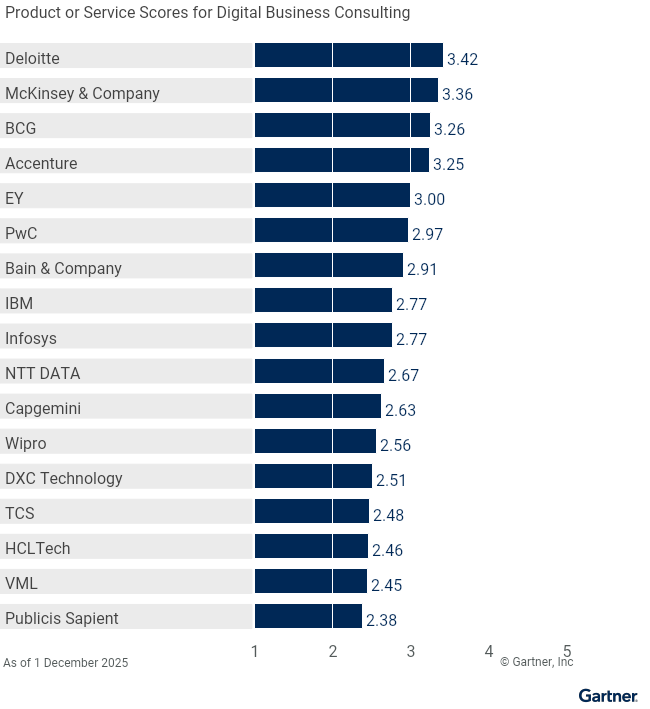
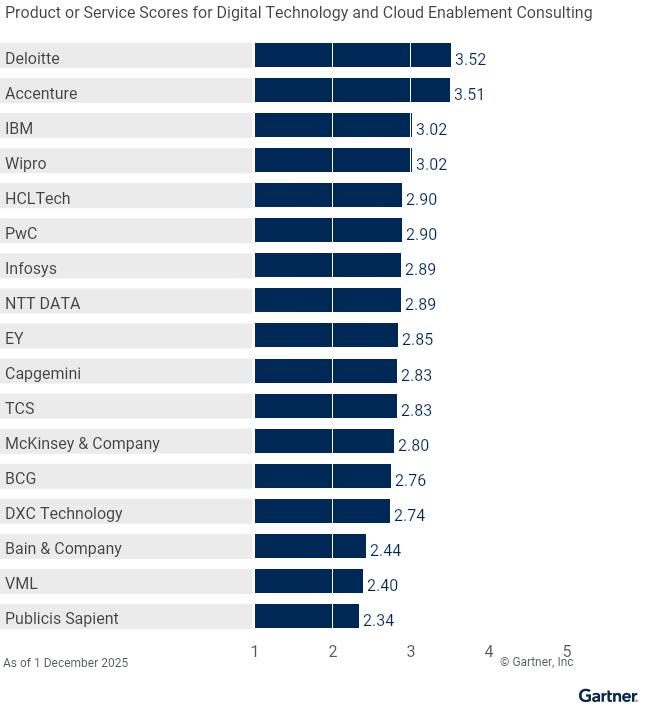
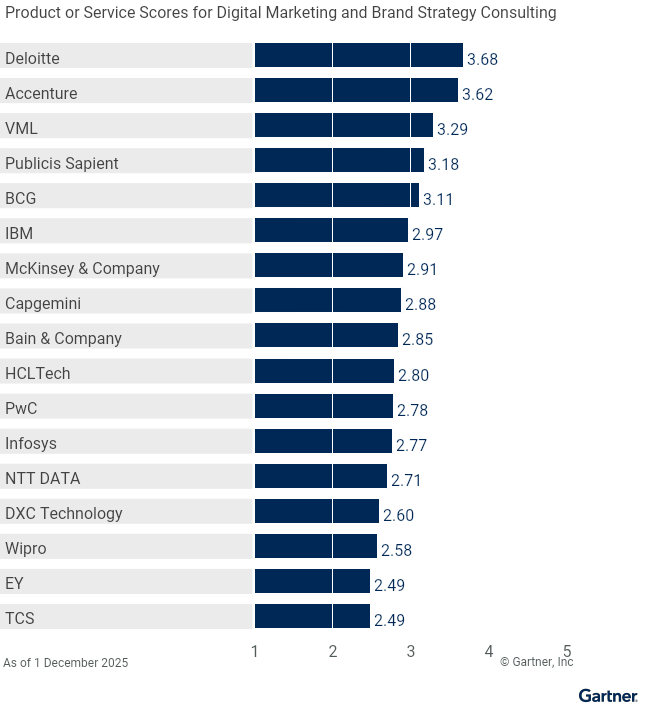
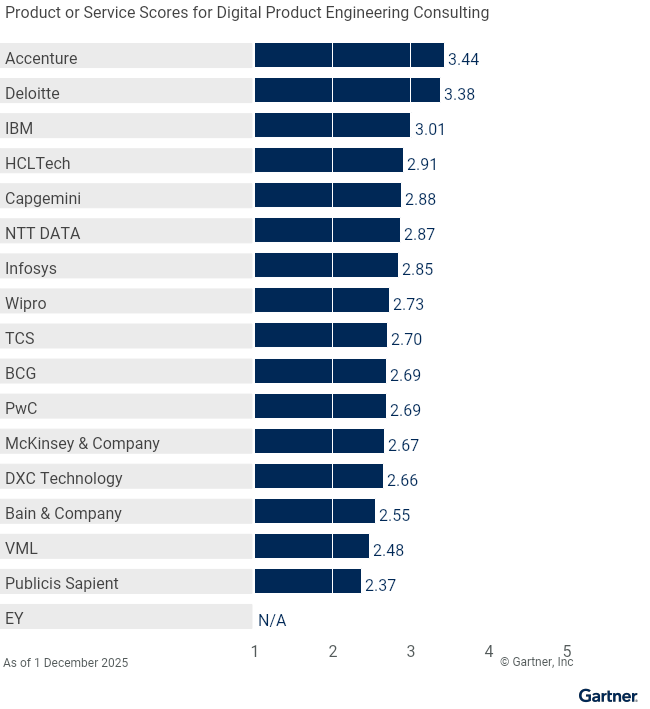
Vendors
Accenture
Accenture is a global professional services leader known for its end-to-end capabilities, serving over 9,000 clients worldwide. The firm delivers transformation at scale by uniting Strategy, Consulting, Technology, and Operations into a single unit: Reinvention Services. This integrated model provides differentiated offerings across 13 industries, accelerating business strategy implementation and driving financial and ESG value for stakeholders.
Gartner estimates that the number of full-time equivalent (FTE) resources Accenture employs across the four consulting use cases is as follows: 50,000 in digital business consulting; 10,000 in digital technology and cloud enablement consulting; 5,000 in digital marketing and brand strategy consulting; and 5,000 in digital product engineering consulting.
Accenture’s delivery is notably strong in digital technology and cloud enablement consulting. This is demonstrated by the firm’s strategic focus on integrating data and AI seamlessly across its services, leveraging proprietary IP to drive reinvention for clients. For example, the firm utilizes specialized expertise for large-scale technical projects. Furthermore, Accenture has completed work for a leading media, communications and entertainment company that uses agentic architecture. This architecture includes a virtual avatar integrated into RDK, which enables control of smart home IoT devices. This strong capability is supported by substantial investment in GenAI and strategic partnerships with technology providers such as NVIDIA, Palantir, and Databricks.
A distinguishing aspect of Accenture’s capabilities lies in its Innovation and Technology Adoption strategy. This reflects its significant investment in GenAI and the development of proprietary AI-native assets designed to accelerate client value realization. Examples include the GrowthOS, a GenAI-powered system enabling clients to identify and launch new revenue-generating opportunities approximately twice as fast as traditional methods. The firm also utilizes tools such as the Spend Analyzer, which automates spend classification and has driven significant productivity improvements for clients.
An opportunity for improvement across Accenture’s capabilities is in enhancing its engagement flexibility and outcome commitment. This reflects the company’s explicit acknowledgment that hybrid pricing models (fixed price, time and materials [T&M], milestone based, and performance linked) are the norm, which complicates the simple classification of outcome-based fees. Although Accenture explicitly ties fees to jointly defined results in large and mega transactions, the company reports that internal finance categorization systems under-capture outcome elements embedded in standard contracts, suggesting room for clearer standardization in explicit outcome measurement across all engagement types.
Bain & Company
Bain & Company helps organizations achieve full potential and competitive advantage, using a CEO and investor perspective to drive complex, high-value transformations. The firm provides digital business, technology, and AI strategy, operational change management, and large-scale digital execution through its integrated business model, anchored by the Vector (Technology, AI, and Insights) platform. Supported by a global delivery network and a “One Team” approach, Bain blends strategic consultants with technical experts across regions.
Gartner estimates that the number of resources (FTEs) Bain employs across the four consulting use cases is as follows: 8,500 in digital business consulting; 500 in digital technology and cloud enablement consulting; 900 in digital marketing and brand strategy consulting; and 1,000 in digital product engineering consulting.
Bain’s strongest use case is digital business consulting. This is reflected in its robust methodology, which centers on driving full potential transformation and linking fees to measurable business outcomes.
Bain scored well for the engagement flexibility and outcome commitment capability, with about 40% of DTBCS revenue tied to fixed-price, gain-sharing, or risk-reward models, aligning incentives with auditable client outcomes like revenue uplift or cost reduction. The ARC platform is used across more than 700 client programs to ensure disciplined execution, track outcomes, and reduce attrition and delays by up to 30%.
Bain’s biggest opportunity for improvement exists in scaling digital technology and cloud enablement consulting capacity. Despite strategic investments in AI boutiques (e.g., PiperLab) and partnerships, the relative headcount dedicated to pure technical consulting remains small compared with its large business strategy workforce. This limits the firm’s internal ability to scale heavy technical execution, which it currently delivers through partners.
BCG
Boston Consulting Group (BCG) serves large organizations seeking end-to-end transformation, with a focus on strategic foresight, AI scaling, and navigating geopolitical uncertainty. BCG primarily targets clients with over 10,000 employees and delivers integrated consulting services through its “OneBCG” model, combining generalist consultants with specialist units such as BCG X and Platinion.
Gartner estimates that the number of resources (FTEs) BCG employs across the four consulting use cases is as follows: 4,000 in digital business consulting; 3,000 in digital technology and cloud enablement consulting; 3,000 in digital marketing and brand strategy consulting; and 3,000 in digital product engineering consulting. BCG’s transformation approach emphasizes people-centric change, with 70% people and process, 20% technology, and 10% algorithms. The firm uses a consulting-led Build-Operate-Transfer model and often ties compensation to measurable business outcomes. Its global center of excellence (CoE) network, including BCG X Innovation Hubs, supports innovation and capability building, with CoEs located in North America, Western Europe, Asia/Pacific, Latin America, and the Middle East and Africa.
A notable use case for BCG is digital business consulting, where the firm excels in linking strategy to execution. For example, BCG partnered with a major mining company to co-create an AI-powered scheduling platform, reducing demurrage costs by 10% and delivering multimillion-dollar annual savings. The project included a “see one, do one, teach one” model, transferring full platform ownership to the client’s internal teams and building organizational capability for ongoing change and AI adoption.
BCG’s distinguishing capability is its strategic foresight and regulatory/geopolitical knowledge. Acting as a “Strategic Navigation System” for executives, BCG leverages proprietary AI tools, such as the Strategic Foresight Framework and CEO Radar for real-time scenario planning. Its Center for Geopolitics provides expertise on topics such as the geopolitics of AI, economic statecraft, and tech resilience, supporting clients in adapting strategy amid volatility.
An area for improvement is BCG’s scale in large, multiyear technology implementation programs. While BCG offers build capabilities via BCG X and Platinion, its footprint for extensive technical delivery is smaller than traditional global system integrators. For programs that require ongoing managed services or staff augmentation, BCG typically provides orchestration and change management, with clients engaging third-party partners for hands-on delivery. Organizations seeking a single provider for both strategy and high-volume technical execution should carefully assess BCG’s role.
Capgemini
Capgemini serves organizations seeking digital transformation and business reinvention, with a focus on large enterprises and global brands across sectors such as financial services, public sector, automotive, energy and utilities, consumer products and retail, aerospace and defense. The firm is well-suited for clients requiring transformation at scale and acceleration of software-defined products and services along the value chain. Capgemini delivers business, technical, marketing, and product consulting services through its Capgemini Invent arm, which combines strategy, technology, data science, and design expertise to help clients innovate and scale transformation initiatives.
Capgemini has approximately 420,000 employees globally, and Gartner estimates that 10,000 are dedicated to DTBCS. Its operational model is a global delivery network, leveraging a hub-and-spoke structure with major delivery centers in India and Poland.
Capgemini’s approach is characterized by a research-driven, outside-in methodology enhanced by AI-powered frameworks and proprietary accelerators such as the Resonance AI Framework, Automation Drive, and Agentic-Enabled Software Engineering. This enables clients to achieve accelerated time to market, improved operational efficiency, while embedding sustainability and human-centric design principles throughout transformation programs.
A notable use case for Capgemini is in digital business consulting for enterprise transformation. This reflects Capgemini’s robust methodology for defining future-state operating models and leveraging digital twins, AI-driven analytics, and automation to optimize global operations. For example, most of its work with Fortune 100 companies has delivered process harmonization, predictive analytics, and automation at scale, reducing operational costs and improving compliance and agility across geographies.
A distinguishing aspect of Capgemini’s capabilities is its technology transformation expertise. The company combines deep industry expertise with advanced AI and engineering capabilities. This strength reflects Capgemini’s strong investments in intelligent industry, GenAI solutions, and partnerships with technology leaders such as Siemens, Unity, and Microsoft. As a result, Capgemini enables clients to bridge the gap between physical and digital worlds through digital twins, immersive experiences, and AI-native solutions.
An opportunity for improvement across Capgemini’s capabilities is in expanding outcome-based commercial models. This reflects its current reliance on traditional time-and-materials engagements and a lower proportion of certified consultants in niche regulatory domains, which may limit traction in highly regulated markets and performance-based contracting scenarios.
Capgemini did not respond to requests for supplemental information. Gartner’s analysis is therefore based on other credible sources.
Deloitte
Deloitte is a major global provider in the DTBCS market, leveraging its heritage and multidisciplinary capability to position itself as a strategic partner. The firm aspires to be clients’ most valuable partner, focusing on identifying, creating, and protecting long-term value — including putting fees at risk based on client outcomes. Deloitte’s strategy centers on an Advise, Implement, Operate (AIO) model, emphasizing business-led technology solutions grounded in deep sector and functional expertise.
Gartner estimates that the number of resources (FTEs) Deloitte employs across the four consulting use cases is as follows: 105,000 in digital business consulting; 14,000 in digital technology and cloud enablement consulting; 16,000 in digital marketing and brand strategy consulting; and 12,000 in digital product engineering consulting.
Deloitte is notably strong in digital business consulting and technology transformation, using its Vision to Value approach to guide clients through value identification, creation, and realization, especially in major programs like SAP or cloud transformations. The firm focuses on quantifiable outcomes and directs about 70% of new investment toward delivery modernization, continually refining execution capabilities.
A distinguishing aspect of Deloitte’s capabilities is its proprietary tools, benchmarks, frameworks, and methodologies. These include the Strategic Choice Cascade (SCC) for strategy alignment and the Ten Types of Innovation framework. Internal efficiency is driven by the Ascend platform, which now features GenAI productivity tools like Sidekick (U.S.) and PairD (EMEA), leveraging large language models and proprietary data for faster, more insightful strategy generation.
Deloitte’s main opportunity for improvement is in geographic reach and regional strength. While strong in established markets, Gartner estimates that Deloitte has only 2% of DTBCS resources in Latin America, which may limit access to specialized local expertise. Clients with interests in this region may want to encourage Deloitte to further invest and expand its workforce to better meet local needs.
DXC Technology
DXC Technology serves organizations seeking experience-led enterprise transformation, focusing on Fortune 500 clients and regulated sectors such as financial services, manufacturing, and public sector. It delivers business, technical, marketing, and product consulting through its DXC Consulting arm. DXC has 18,470 resources dedicated to DTBCS services, making up 15% of its total employees. Its operational model is built on a global delivery network and a matrixed structure, balancing global consistency with local relevance. Teams are located worldwide: 6% of DTBCS FTEs in North America, 52% in Asia/Pacific, 39% in EMEA, and 3% in Latin America.
DXC’s resource allocation across the four consulting use cases is as follows: 4,450 in digital business consulting; 13,540 in digital technology and cloud enablement; 65 in digital marketing and brand strategy; and 415 in digital product engineering. DXC’s approach centers on its Experience-Led Transformation (XLT) methodology, using Motivational UX and proprietary accelerators. This delivers such benefits as up to 30% faster time to market and 25% operational cost reductions.
A key use case for DXC is digital technology and cloud enablement consulting, with the firm specializing in large-scale XLT programs. This highlights DXC’s strength in using cloud, data, and AI to modernize operations, resulting in outcomes like accelerated time to market and cost savings. DXC’s consulting approach leverages the full technology stack to deliver end-to-end business outcomes that enhance citizen and customer experiences.
A distinguishing capability for DXC is its expertise in technology transformation, especially in cloud migration, modernization, and supporting complex environments. DXC enables experience-led transformation by using AI, cloud, and data to modernize operations. Proprietary accelerators and toolkits, such as the AI-powered orchestration suite and cloud-native transformation toolkit, enable rapid deployment of scalable solutions and streamline design and implementation.
An area for improvement is DXC’s service delivery model. The company has seen declining revenue in some digital transformation consulting services as clients shift toward standardized, AI-enabled solutions. DXC has not engaged in any M&A activity in the last two years. In a market where competitors are acquiring capabilities, this lack of inorganic growth may hinder DXC’s ability to quickly expand its portfolio in emerging technology areas.
EY
EY serves organizations seeking transformation by applying an investor mindset and deep sector expertise to complex problems, linking technology outcomes to enterprise value metrics like total shareholder return (TSR). The firm primarily targets large enterprises, which generate 89% of its DTBCS revenue, but also serves midsize organizations through its EY Private channel. Consulting services are delivered via integrated business, technology, risk, and people subservice lines.
Gartner estimates that EY’s FTEs are primarily aligned across the four consulting use cases as follows: digital technology and cloud enablement consulting (35,000); digital business consulting (35,000); and digital marketing and brand strategy consulting (3,500); and digital product engineering (10,000). EY’s approach uses the Enterprise Reimagined framework and proprietary assets like TransformationEQ and EYQ, an internal large language model, to boost transformation success by prioritizing the human experience and enabling AI-augmented delivery and insights.
A notable use case for EY is digital business consulting, representing about 55% of the company’s DTBCS revenue. EY invests in roughly 29 offerings, including business planning, finance, organizational, HR, and supply chain transformation, staffed by an estimated 37,500 global FTEs. This is enhanced by production-grade agentic AI use cases with embedded safety, security, and compliance, and by EY’s IP portfolio (EY Nexus, T-Hub, and Catalyst) that helps identify value pools and capture business value for clients.
A distinguishing aspect of EY’s capabilities is its deep focus on business transformation expertise integrated with regulatory and geopolitical knowledge, exemplified by its “investor mindset” from EY-Parthenon. This approach links transformation efforts to enterprise value and total shareholder return using frameworks such as census.AI and due diligence modeling. EY leverages its assurance and tax knowledge, pulling auditors into system reviews to ensure AI solutions are audit-ready and cyber-resilient. Its EY Green Tax Tracker details over 3,000 green taxes and 74 carbon pricing initiatives across 68 jurisdictions, aiding clients navigating regulatory shifts.
An opportunity for improvement is increasing engagement flexibility and outcome commitment. While EY offers gain-share models and outcome-based pricing, only 5% to 10% of contracts are truly outcome-based; most use T&M (70%) or fixed price (20%), often tied to output metrics rather than financial outcomes. Additionally, 82% of its talent has less than five years’ experience which may impact senior expertise and timezone-aligned execution.
HCLTech
HCLTech serves organizations seeking integrated digital transformation and domain expertise, specializing in banking, financial services, and insurance (BFSI), Manufacturing, Life Sciences and Healthcare (LSH), and telecom, travel, and logistics (TTL) verticals. It delivers business, technical, marketing, and product consulting services through its Enterprise Transformation & Advisory Practice.
HCLTech has 17,800 resources dedicated to DTBCS services, constituting 8% of its total employees. Its operational model is supported by a global delivery network, with teams strategically located across regions.
Gartner estimates that the number of resources (FTEs) HCLTech employs across the four consulting use cases is as follows: 4,000 in digital business consulting; 10,000 in digital technology and cloud enablement consulting; 1,400 in digital marketing and brand strategy consulting; and 2,000 in digital product engineering consulting. HCLTech’s approach is characterized by its technical capabilities and leverage of its Experience Management Office (XMO) framework. This offers clients, HCLTech claims, faster time to value via repeatable solutions and measurable business outcomes by integrating deep engineering expertise.
A notable use case for HCLTech is digital technology and cloud enablement consulting, reflecting the firm’s core capability in providing end-to-end technology. This strength relies on deep expertise in platform engineering, AI technologies, and cloud integration, offering the technical credibility required to define client digital roadmaps and execute AI business cases globally.
A distinguishing aspect of HCLTech’s capabilities is its focus on new product or service development through its digital product engineering consulting services, which aims to accelerate time to market by co-creating innovation with clients. This development process is formalized through methodologies such as Design to DevOps, a unified approach from concept to realization. The firm leverages dedicated resources, including GenAI Labs and customer experience labs, for rapid prototyping, and deploys proprietary tools such as the Business Innovation Canvas (BIC), a GenAI accelerator that converts business ideas into actionable deliverables. Examples of this expertise include providing end-to-end development for a smart coffee roasting appliance and transforming a DSLR camera into an AI-assisted, beginner-friendly platform.
An opportunity for improvement across HCLTech’s capabilities is to expand its relationships across the C-suite. Traditionally, HCLTech’s stakeholders have been the CIO and CTO. However, if HCLTech wishes to increase the volume of its digital business strategy consulting practice, it will need to foster relationships beyond traditional stakeholders.
IBM
IBM Consulting provides digital technology and business consulting services, with a strong emphasis on AI-driven solutions, cloud services, and data analytics. Its vertical strategy focuses on driving digital transformation for large global enterprises, particularly within highly regulated sectors such as banking and investment services, manufacturing and natural resources, and the public sector/government.
Gartner estimates that IBM Consulting has over 80,000 technology and industry consultants providing services across the 4 use cases. Central to IBM’s approach is the integration of AI, including GenAI and agentic AI, across consulting delivery. Its innovation centers include IBM Watson Centers and IBM-Microsoft Experience Zones, specifically dedicated to hybrid cloud and GenAI innovation.
A notable use case for IBM Consulting is digital technology and cloud enablement consulting. IBM brings extensive experience and history in this area, combined with accelerating AI adoption by co-creating tailored solutions through IBM Watson Centers and leveraging hybrid cloud leadership anchored by Red Hat OpenShift. A key outcome of its AI-driven transformation approach is the improvement of processes, such as simplifying casework and policy management using GenAI.
IBM Consulting’s core strength is its expertise in technology transformation, notably in enterprise AI and modernization for complex, regulated environments. As a global consultancy within a technology company, IBM Consulting combines strategic guidance with its proprietary tech stack. This enables accelerated, asset-led transformations using Hybrid Cloud Leadership (Red Hat OpenShift) and AI-driven infrastructure modernization (e.g., z17 mainframe). IBM Consulting also modernizes legacy code with watsonx generative AI, reducing clients’ manual R&D time.
An opportunity for improvement across IBM Consulting’s capabilities is accelerating revenue growth in pure business-led consulting and overcoming regional client hesitation for large transformation deals. The poor growth in DBTCS suggests IBM Consulting must address reluctance among regional clients to pursue large, purely strategic business-led transformations. Customers seeking large-scale strategic transformation may perceive the firm as more conservative in deal-making in certain regions.
Infosys
Infosys supports organizations in digital transformation and AI strategies, specializing in cloud and digital solutions across key verticals. As a recognized global partner in digital services and consulting, it delivers business, technical, marketing, and product consulting services through Infosys Consulting.
Gartner estimates that the number of resources (FTEs) Infosys employs across the four consulting use cases is as follows: 2,000 in digital business consulting; 4,000 in digital technology and cloud enablement consulting; 2,000 in digital marketing and brand strategy consulting; and 2,000 in digital product engineering consulting. Infosys uses a “strategy-through-execution” model, leveraging proprietary AI platforms like Topaz Fabric and cloud solutions such as Infosys Cobalt. The Infosys Value Realization Method (VRM) identifies value aligned with the client’s business model, helping accelerate time to market through prebuilt assets and Living Labs prototyping.
A key use case for Infosys is digital technology and cloud enablement consulting. The Topaz and Cobalt platforms offer sector-specific AI models and prebuilt assets to convert plans into measurable results, meeting high demand for AI-first and cloud modernization in North America. Topaz Fabric provides IT operations, technology transformation, quality engineering, and cybersecurity as asset-based services, tailored to client needs.
Infosys’ capabilities are distinguished by its tools, benchmarks, indexes, frameworks, and methodology. Investments in Topaz Fabric (12,000+ assets, 150+ models) use a “responsible by design” framework. Infosys is the first global provider to be certified in ISO 42001 (AI Management), emphasizing ethical AI deployment, and has scaled this through the Agentic Foundry, which has delivered over 300 agentic AI solutions.
An opportunity for improvement is core business strategy expertise and regulatory knowledge. Infosys’ revenue is highly concentrated among technical buyers, potentially resulting in a technology-first bias unless non-IT leaders anchor engagements in their KPIs. Infosys relies on external partners for regulatory and compliance needs, so clients must validate the service model and assess external advisors for complex regulatory matters. IT SPVM leaders seeking partners for fundamental business model transformation or innovative growth initiatives may find Infosys less suited to these needs.
McKinsey & Company
McKinsey & Company is a private firm serving organizations globally that seek transformative value with technology and digital transformation, with a particular focus on C-suite and large enterprises.
McKinsey’s consulting model is global, structured around Sectors, Functions, and Geographies, combining local market knowledge with global best practices for regional relevance and impact. This model leverages a vast network of expertise, integrating deep sector knowledge, functional methodologies, and proprietary assets, supported by senior partner leadership and a rigorous talent acquisition model that justifies premium pricing.
Gartner estimates McKinsey has over 13,000 FTEs delivering DTBCS across all four use cases. McKinsey’s approach is an impact-driven partnership model that links technology to growth and productivity outcomes. This model integrates proprietary tools, such as its in-house GenAI platform, Lilli, and the Agents@Scale approach, which accelerate insights and help rewire client workflows for efficiency and sustainable value.
A notable use case for McKinsey is digital business consulting, emphasizing the firm’s strategy heritage and C-suite advisory, linking strategic planning to hands-on technology execution. Engagements typically start with a Digital Diagnostic to assess readiness, quantify value, and develop a business case for transformation.
A distinguishing capability is engagement flexibility and outcome commitment. McKinsey links fees to deliverables or measured outcomes with explicit ROI ties, supported by a high percentage of sole source deals and CEO engagement. Outcome-based and at-risk contracts represent at least two-thirds of engagements, with performance tracked through client surveys and impact metrics such as revenue uplift and operational savings.
An opportunity for improvement is commercializing proprietary digital assets as standardized, long-term products or services. McKinsey’s independent, platform-agnostic stance means it does not sell proprietary technology. While it co-develops accelerators and IP like Agents@Scale, ownership usually shifts to clients or partners, limiting McKinsey’s ability to provide ongoing standardized SaaS offerings that may benefit a wider client base.
NTT DATA
NTT DATA serves organizations seeking accelerated digital transformation through full-stack technology partnerships, with a particular focus on multinational and disruptive clients in manufacturing, financial services, and healthcare. It delivers integrated business, technical, marketing, and product consulting services through its globally integrated consulting organization.
Gartner estimates that the number of resources (FTEs) NTT DATA employs across the four consulting use cases is as follows: 18,000 in digital business consulting; 6,000 in digital technology and cloud enablement consulting; 2,500 in digital marketing and brand strategy consulting; and 1,500 in digital product engineering consulting. Its operational delivery model utilizes a global network managing over 70 centers in 25 or more countries, emphasizing local adaptation. NTT DATA’s delivery approach is characterized by its Innovation-Led Consulting Framework, which embeds ethical AI governance and modular architectures. This model, supported by a significant $3.6 billion annual investment in research and development (R&D), offers clients benefits such as accelerated time to value, modernization of business models, and secure, culturally aligned outcome delivery.
A notable use case for NTT DATA is digital business consulting. This reflects the firm’s integrated approach to full-stack transformation, connecting strategy through execution. NTT DATA employs its Innovation-Led Consulting Framework, embedding ethical AI governance and deep industry expertise to co-create solutions for compliance and cost optimization. The emphasis is on utilizing proprietary platforms, such as the modular Industry Cloud accelerator (used in over 1,200 projects), to drive large-scale modernization and measurable business outcomes across regulated sectors.
A distinguishing aspect of NTT DATA’s capabilities is innovation and technology adoption. This is backed by NTT Group’s significant R&D investment and a strategic focus on becoming an AI-driven company. This funding supports the development and scaling of proprietary platforms, including the Syntphony global asset framework and the Smart AI Agent Ecosystem. The firm leverages global innovation centers and strategic alliances with partners like OpenAI and NVIDIA for co-creation and rapid prototyping.
An opportunity for improvement across NTT DATA’s capabilities is in engagement flexibility and outcome commitment transparency. While the firm offers value-based deal structuring, procurement generally prefers T&M or fixed-price contracts. NTT DATA tracks client success primarily using internal financial metrics, specifically consulting revenue and gross profit, rather than consistently tracking and publicizing quantifiable business outcomes or sustained customer satisfaction metrics across all transformation engagements.
Publicis Sapient
Publicis Sapient serves organizations seeking holistic digital business transformation, delivering tailored solutions enabled by AI through its SPEED (Strategy, Product, Experience, Engineering, Data & AI) operating model. The firm primarily targets large global enterprises, with 80% of DTBCS revenue coming from clients with 10,000+ employees. Its client base spans high-impact industries such as financial services, retail, consumer products, telecom, media and tech, transportation and mobility, travel and hospitality, and the public sector.
Gartner estimates that Publicis Sapient employs over 20,000 FTEs delivering DTBCS across all four consulting use cases. Based on our estimates, the percentage of employees across these use cases is as follows: digital business consulting (15%); digital technology and cloud enablement consulting (30%); digital marketing and brand strategy consulting (20%); and digital product engineering 35%. (Percentages may vary by +/- 10%). The SPEED operating model and proprietary platforms such as Slingshot and Bodhi emphasize AI-assisted workflows, delivering faster cycle times, lower change-failure rates, and measurable value capture throughout engagements.
A key use case for Publicis Sapient is digital product engineering consulting — the largest portion of its DTBCS revenue. The firm excels at deploying cross-functional engineering pods and proprietary platforms like Slingshot to accelerate software development life cycle (SDLC) functions, efficiently moving clients from legacy systems to AI-ready platforms for continuous delivery and modernization.
A distinguishing capability is technology transformation expertise, reflected in the company’s platform-led “Services as Software” approach. This industrializes complex technology projects, especially legacy modernization, using proprietary AI platforms. Sapient Slingshot, its AI-powered platform, automates and accelerates processes across the SDLC, including prototyping, coding, maintenance, and deployment.
An opportunity for improvement is achieving greater market traction within the midsize and small enterprise (MSE) segment. Despite efforts to create tailored models for smaller clients, only 5% of Publicis Sapient’s DTBCS revenue comes from clients with 1,000-2,499 employees, indicating a need to better scale offerings beyond large enterprises.
PwC
PwC serves organizations seeking accelerated growth and outcomes by integrating digital, cloud, and business consulting capabilities. It maintains a dedicated focus on large global enterprises alongside midsize and small enterprise clients. Priority investment sectors for FY26 include healthcare and life sciences, retail and consumer, and energy and utilities. PwC delivers Strategy, Consulting, and Operate services through its global consulting organization, which employs a hybrid pyramid-and-pod model.
Gartner estimates that the number of resources (FTEs) PwC employs across the four consulting use cases is as follows: 21,000 in digital business consulting; 20,000 in digital technology and cloud enablement consulting; 3,500 in digital marketing and brand strategy consulting; and 500 in digital product engineering consulting. The focus on client outcomes defines PwC’s delivery approach, underpinned by an AI-first model. The firm leverages core proprietary assets such as the patented Agent OS orchestration framework and the Concourse platform for orchestrating delivery excellence. This rigorous, tech-enabled methodology offers clients swift transformation with speed and precision, accelerates decision making, and builds confidence through Phase 0 pilots and co-creation upfront.
PwC excels in the digital business consulting use case, consistently driving large-scale transformations measured strictly by outcome, not effort. This approach, supported by an AI-first delivery model, delivers quantifiable business impacts, including 40% productivity gains and 70% automation efficiencies in GenAI-enabled client engagements.
A distinguishing capability for PwC is its deep regulatory and geopolitical knowledge. Leveraging proprietary data such as the Global Compliance Survey 2025, PwC embeds “compliance by design” and digital trust into its technology adoption strategies. This focus is crucial for regulated industries managing complex reporting demands and cybersecurity risks, operationalized through specialized offerings such as the AI-powered risk suite.
The biggest opportunity for improvement lies in new product development, as indicated by the relatively low number of FTEs assigned to this area compared with other use cases. As clients favor consultancies that can create, launch, scale, and maintain innovative digital products and services, this is an area that needs to be addressed for the benefit of PwC and clients.
TCS
Tata Consultancy Services (TCS) supports organizations seeking integrated digital transformation by orchestrating business and technology capabilities. It mainly targets large enterprises globally in industries such as manufacturing, communications, media, services, and banking. TCS delivers digital business, technical, marketing, and product consulting through its integrated Global Consulting unit. TCS reports over 50,000 FTEs delivering DTBCS across all four consulting use cases.
A key use case for TCS is digital technology and cloud enablement consulting, reflecting the company’s orchestration of business, technology, and transformation capabilities to deliver customer value. The Future of Business offering uses a foresight methodology built on possibility chains, helping leaders navigate complex futures and position for long-term value.
TCS stands out in technology transformation, pivoting toward AI-led digital transformation and viewing future enterprises as “AI-first by design.” Its AI Advisory and Consulting blends strategy with execution to guide technology fit, value realization, and regulation. A core differentiator is TCS AI WisdomNext, a proprietary multimodel, multimodal, multicloud AI platform that accelerates GenAI adoption at scale while ensuring regulatory compliance. TCS has proven its ability to integrate digital technology consulting into complex, AI-centric deals.
An opportunity for improvement across TCS’ capabilities lies in increasing engagement flexibility and outcome commitment transparency. Scaling the use of fully outcome-based engagements is needed, as there are currently few transparent examples of business-outcome-based pricing in DTBCS.
VML
VML serves organizations seeking end-to-end digital transformation and growth by combining Brand Experience (BX), Customer Experience (CX), and Commerce (CO). It focuses particularly on blue chip client partners such as Colgate-Palmolive, Ford, Microsoft, and Nestlé. It delivers business, technical, marketing, and product consulting services through its VML Enterprise Solutions division.
Gartner estimates that the number of resources (FTEs) VML employs across the four consulting use cases is as follows: 1,000 in digital business consulting; 1,500 in digital technology and cloud enablement consulting; 1,000 in digital marketing and brand strategy consulting; and 1,500 in digital product engineering consulting. VML’s approach is characterized by linking strategy (“Think”) with execution (“Do”) and leveraging the AI-powered operating system, WPP Open, as a core pillar of its go-to-market strategy. This enables a consultative, problem-first approach across CX, commerce, and technology modernization, offering clients accelerated end-to-end execution at scale and the timely resolution of customer pain points.
A notable use case for VML is digital marketing and brand strategy consulting, which accounts for 25% of its DTBCS revenue. This reflects VML’s primary business focus on martech, sales tech, and commerce tech related services, supported by a high proportion of revenue attributed to CMO buyers (30%). The strength is further supported by VML’s focus on Creative Transformation, powered by its proprietary AI-enabled OS, WPP Open, which facilitates GenAI content creation and outreach at scale.
A distinguishing aspect of VML’s capabilities is AI-enabled industry compliance and technology integration. This reflects its development of reusable, specialized assets such as Brand Guardian, an AI compliance agent specifically designed to streamline the complex medical, legal, and regulatory (MLR) review process in highly regulated industries like healthcare/pharma. Furthermore, VML is recognized for its expertise in embracing modularity and composable technology (MACH technologies) to build flexible systems for continuous innovation, particularly in rapid growth markets like Asia.
An opportunity for improvement across VML’s capabilities lies in increasing engagement flexibility and outcome commitment transparency. While the firm offers value-based deal structuring, only 5% of revenue comes from gainsharing engagements. As customers are demanding their partners have more “skin in the game,” this percentage will need to increase.
Wipro
Wipro provides consulting services focused on delivering business impact and transformation value. It focuses on transformation in sectors such as BFSI, and healthcare and life sciences, delivering business, technical, marketing, and product consulting through its Wipro Consulting arm. Wipro Consulting includes the wholly owned subsidiary Capco, which maintains its own brand despite being integrated into Wipro Consulting.
Gartner estimates Wipro’s resource allocation across the consulting use cases to be: 14,000 in digital business consulting; 4,000 in digital technology and cloud enablement; 3,000 in digital marketing and brand strategy; and 3,000 in digital product engineering. Wipro’s AI-first, experience-led model leverages the proprietary WeGA Studio 2.0 GenAI framework, with the company reporting up to 60% reduction in cycle times.
A key use case for Wipro is digital technology and cloud enablement consulting, reflecting the firm’s strategy to lead with consulting and position itself at the forefront of transformation. Wipro blends domain expertise across 14 industries and 43 countries with an AI-first model, aligning proposals with client transformation roadmaps and CxO priorities.
A distinguishing aspect of Wipro’s capabilities is innovation and technology adoption. This reflects the firm’s strategy of embedding AI/GenAI capability into nearly all client assets and projects, resulting in a significantly increased volume of deals using AI solutions. Wipro supports this through the Wipro Innovation Network (WIN) — a global ecosystem connecting clients, partners, and experts for co-creation and accelerated transformation. The firm develops and leverages specialized proprietary assets such as Sovereign AI, a regulatory-compliant, multilingual digital assistant for public sector transformation, and Campaign Buddy, a GenAI-powered platform that cuts campaign production time by 50%. These investments emphasize Wipro’s focus on rapid deployment and high-impact technology adoption.
An area for improvement is business transformation. Wipro is working to strengthen relationships beyond the CIO to other C-suite executives, as past relationships were mainly anchored with CIO/CTO functions. Wipro Consulting is not positioned as a separate brand (except Capco). This limited external branding for the consulting organization may disadvantage Wipro against pure-play consulting firms when competing for strategy-led transformation deals.
Context
This Critical Capabilities research complements Gartner’s Magic Quadrant for Digital Technology and Business Consulting Services. It addresses the digital technology and business consulting services capabilities of vendors that meet Gartner’s criteria for inclusion. Our evaluation of providers is based on factors determined by Gartner as being relevant to the market for DTBCS. This Critical Capabilities research is a point-in-time analysis, with all the vendor profiles reflecting the status as of November 2025. Quantitative data collected was for a 12-month period ending 30 June 2025.
Additionally, because the inclusion criteria in this research result in the analysis of the largest vendors in the digital technology and business consulting services market, clients should not disqualify any potential competitors simply because they do not appear in this Critical Capabilities report. Other service vendors not evaluated in this report might present better alternatives for your business requirements. A Gartner analyst can help with a shortlist of the most suitable candidates based on client requirements.
Use this Critical Capabilities report as a tool to help inform your shortlist and evaluation of providers. However, do not discount a provider simply because of its use-case placement
Market Definition
Digital technology and business consulting services reflect the intermingled nature of information, technology and business. This market is increasingly driven by joined, interdependent actions and initiatives, rather than characterized by layers of the traditional technology stack. Digital technology and business consulting services are project-based consulting services that create the ambition and design for information, technology and business processes for clients.
Digital technology and business consulting services leverage the expertise of skilled business and technology specialists to help clients affect strategic change and achieve sustainable operational improvements. These services are consumed by clients across all industries depending on the use cases described below.
Digital Business Consulting Services
Digital business consulting services are contractually engaged by clients with the objective of generating increased business value by using digital technologies to optimize clients’ operating models and transform their business models. Business consulting services included in Gartner’s services forecast are limited to advisory services that preface, enable or influence IT adoption.
Digital business consulting services are contractually engaged by clients with the objective of generating increased business value by using digital technologies to optimize clients’ operating models and transform their business models. Business consulting services included in Gartner’s services forecast are limited to advisory services that preface, enable or influence IT adoption.
Digital Marketing and Brand Strategy Consulting Services
Digital marketing services involve developing and executing marketing strategies for global brands. Brand strategy services help clients crystallize a differentiated strategic market position and bring that strategy to life to drive the organization’s growth.
Digital marketing services involve developing and executing marketing strategies for global brands. Brand strategy services help clients crystallize a differentiated strategic market position and bring that strategy to life to drive the organization’s growth.
Digital Technology and Cloud Enablement Consulting Services
Consulting services that align ambition and design phases of back office IT environments and systems with a focus on cost, convenience and day-to-day operations — particularly in leveraging cloud-based technologies. These consulting services enable digital business transformation initiatives, acting as the underlying technical architecture and fabric for transformation. Technology Consulting segments include Application Technology Consulting, Infrastructure Technology Consulting, and Technology Strategy and Governance.
Consulting services that align ambition and design phases of back office IT environments and systems with a focus on cost, convenience and day-to-day operations — particularly in leveraging cloud-based technologies. These consulting services enable digital business transformation initiatives, acting as the underlying technical architecture and fabric for transformation. Technology Consulting segments include Application Technology Consulting, Infrastructure Technology Consulting, and Technology Strategy and Governance.
Digital Product Engineering Consulting Services
Consulting services that support organizations seeking to develop products and services relying heavily on digital sources of value creation — which are customizable, interactive, intelligent or connected. These services may include help with the design of products or services or unique customer experiences. Co-creation in close partnership with the client organization — whether virtual or in a physical lab environment — is often a key aspect of these services.
Consulting services that support organizations seeking to develop products and services relying heavily on digital sources of value creation — which are customizable, interactive, intelligent or connected. These services may include help with the design of products or services or unique customer experiences. Co-creation in close partnership with the client organization — whether virtual or in a physical lab environment — is often a key aspect of these services.
Mandatory Features
The mandatory features for this market include:
- Thought leadership and research: Ability of the provider to set vision for the industry/sector/technology area, publish research that expands the horizons of the industry and commercialize intellectual property- (IP) driven advisory services at scale.
- Client portfolio and case studies references: The diversity of client portfolio, scale and tenure of relationship, and the business impact of the services delivered to the clients. This feature also reflects the reputation and brand strength of the provider as a trusted advisor.
- Business transformation ambition expertise: The provider’s ability to deliver advisory services that preface, enable or influence the adoption of IT across HR, supply chain, finance, risk, marketing and customer management. This feature also reflects the ability of the provider to advise clients on their consumer/employee/citizen experience transformation programs.
- Technology transformation design expertise: The ability of providers to advise and guide clients in their digital transformation initiatives leveraging established and emerging technologies.
- Expertise in new product, service or experience development: Ability of the provider to innovate and create new revenue opportunities, design, build and take to market new products, services or experiences for the clients across a range of industries.
- Regulatory and geopolitical advisory expertise: Ability of the provider to advise and guide the client through rapidly shifting geopolitical and industry/sector specific regulatory environments (global and regional) as they consume, build and buy innovative technologies to transform their business and agencies.
- Tools and methodologies: Provider’s investment, thought leadership and inventory of industry/sector specific tools, benchmarks, indexes and frameworks that form the basis of consulting and advisory engagements.
- Capability building and change management: An ability of the provider to elevate the skills of the clients’ leadership teams and employees, create new organizational and business capability for the client, transform the organization’s processes and grow the adoption of technology. This allows the client organizations to realize their full potential.
Common Features
The common features for this market include:
- Talent growth and development: Provider’s ability to attract and retain best-in-class talent across experience levels globally. This critical capability also measures the provider’s ability to structure the talent pool effectively to meet a myriad of client engagements, providing career path/mobility to its personnel and putting in place effective training programs to nurture the talent.
- Strength and depth in chosen geographic markets: Provider’s ability to advise its global clients on their operations through its extensive reach and network, while maintaining deep contextual and regional relevance through on-ground resources and expertise.
- Service delivery model: Ability of the service provider to be agile to support a variety of clients, structure engagements for cost-effectiveness using repeatable frameworks and methodologies, and leverage global centers of excellence for deep domain expertise.
- Innovation and technology adoption: Service providers ability to work with customers across the spectrum from co-creating with customers to driving their innovation agenda. This critical capability measures the service provider’s capability to enable their clients to adopt technology from readiness assessments through to user adoption.
- Strategic partnership and alliances: Strength, diversity and capability of the provider’s partner or alliance network. This includes design, technology and innovation partners. This feature differentiates the partner’s ability to bring to the client the strengths of its ecosystem.
- Business outcome commitment: Ability of the provider to operate in a variety of commercial models directly impact its clients top line, bottom line and total customer experience outcomes, and get compensated based on business outcomes delivered to the clients.
- Public sector expertise: Ability of the provider to understand the nuances of public sector enterprises and agencies. The impact provider has delivered in shaping citizen outcomes and enabling technology adoption in the government.
Product/Service Trends
The DTBCS market is focused on providing consultancy to aid the transformation of digital technology, digital business, digital products, and digital marketing.
The adoption of an AI-first framework is transforming consultancy companies by making them more agile, data-driven, and capable of delivering personalized solutions at scale. While it presents challenges, its adoption is becoming essential for firms aiming to remain relevant and competitive in the evolving business landscape. However, its advantages to their customers is largely unproven.
There continues to be a convergence in the capabilities among the providers. Companies that are more widely known as global system integrators (GSIs) have invested greatly in this area and are rapidly closing the capability gap between themselves and the more historically accepted “consulting” companies.
Critical Capabilities Definition
Thought Leadership and Research
This critical capability focuses on the service provider’s ability to set vision for the industry/sector/technology area, publish research that expands the horizons of the industry, and commercialize intellectual property (IP)-driven advisory services at scale.
Measurement criteria for this capability may include:
- Published research and white papers: Published research papers and publication metrics (e.g., number of publications, citation counts, and impact factor scores for their published work), white papers, and articles that demonstrate the provider’s thought leadership in the industry.
- IP portfolio: Patents, proprietary methodologies, indexes, benchmarks, frameworks, and tools that the company has developed. Ability to commercially exploit the IP on behalf of the client.
- Industry awards and recognition: Awards or recognitions received for thought leadership, innovation, or contribution to the industry.
- Investment in thought leadership development and showcase: The company’s investment in thought leadership development for research and advisory, including budget allocations, focus areas, and outcomes.
- Advisory services based on IP: Examples of advisory services that are driven by their intellectual property (especially use of GenAI-based tools in delivering consulting and advisory services) and how these services have been scaled commercially.
Business Transformation Expertise
This critical capability focuses on the service provider’s ability to deliver advisory services that preface, enable, or influence the adoption of IT across HR, supply chain, finance, risk, marketing, and customer management.
This feature also reflects the ability of the provider to advise clients on their consumer/employee/citizen experience transformation programs.
Measurement criteria for this capability may include:
- Client transformation and tenure metrics: Total number of transformation projects completed, average number of projects per client, average number of business functions supported per client, and tenure of client relationships.
- Transformation case studies: Detailed case studies that showcase successful business transformation projects across various functions such as HR, supply chain, finance, risk, marketing, and customer management.
- Advisory methodologies and frameworks: Methodologies and frameworks used by the company for advising business transformation. This includes any proprietary approaches or tools they employ.
- Industry-specific expertise: Expertise in specific industries and sectors, highlighting how transformation strategies are tailored to meet unique industry needs. Number of experts at an industry subvertical level, density of engagements across industries, percentage of industry-specific IP, knowledge of industry regulations as evidenced by certifications or ability to adopt/adapt clients.
- Cross-functional transformation expertise: Examples of projects that involved transformation across multiple business functions, demonstrating an ability to integrate IT solutions across business functions.
- Consumer/employee/citizen experience transformation expertise: Assessment of provider maturity in delivering programs or projects aimed at transforming consumer, employee, or citizen experiences, including strategies employed and measurable improvements.
Technology Transformation Expertise
This critical capability focuses on the service provider’s ability to advise and guide clients in their digital transformation initiatives, leveraging established and emerging technologies.
Measurement criteria for this capability may include:
- Technology transformation case studies: Detailed case studies that demonstrate successful technology transformation, including technical debt reduction, improved foundational technology capability for clients to build on their digital transformation programs, and shift in innovation index.
- Technology adoption metrics: References/named case studies that demonstrate technology adoption enablement based on advisory/consulting service delivered by the provider. Technology adoption could be demonstrated through improved implementation speed, user adoption rates, and overall performance improvements for the clients.
- Expertise in emerging technologies: Expertise in advising clients on leveraging/adopting emerging technologies such as AI, IoT, blockchain, metaverse, and quantum computing. Measurement criteria may include capability of the provider to deploy these technologies to achieve/demonstrate outcomes.
- Technology strategy and roadmaps: Strategic technology roadmaps developed for clients, outlining the steps and milestones in their digital transformation journeys as measured through readiness assessments, current state/gap assessment frameworks, templates, industry standard benchmarks, indexes, etc.
- Innovation and R&D investments: Investment in technology innovation and research and development, including focus areas and outcomes.
Product Development Expertise
This critical capability focuses on the service provider’s ability to innovate and create new revenue opportunities, as well as design, build, and take to market new products, services, or experiences for clients across a range of industries.
Measurement criteria for this capability may include:
- Number of new products/services launched.
- Impact on client revenue through new products/services/experience.
- Client feedback scores on new product/service effectiveness.
- Innovative or market-leading business model transformations.
- Innovation case studies: Request detailed case studies that showcase successful development and launch of new products, services, or experiences across various industries. Include information on the innovation process, challenges faced, and market impact.
- Product development methodologies: Methodologies and frameworks used for product and service development, including any proprietary approaches or tools.
- Market research and analysis: Ability of provider to conduct primary/secondary market research and analysis, manage customer feedback process, conduct ideation workshops, and facilitate market testing of ideas.
- Prototyping and testing capabilities: Ability (measured through infrastructure, vendor ecosystem, partnerships with academia) of the provider to prototype and test capabilities, including examples of how it validates product concepts and ensures quality.
Regulatory/Geopolitical Knowledge
This critical capability focuses on the service provider’s ability to advise and guide the client through rapidly shifting geopolitical and industry/sector-specific regulatory environments (global and regional) as it consumes, builds, and buys innovative technologies to transform its business and agencies.
Measurement criteria for this capability may include:
- Track record and case studies: Distribution of clients and engagements that involve advising clients on regulatory and geopolitical aspects. Case studies that demonstrate successful navigation of regulatory and geopolitical challenges for clients across various industries and regions. Specifically measuring strategies employed and outcomes achieved.
- Expertise in industry-specific regulations: Expertise in relevant regulatory frameworks and industry-specific regulations (e.g., data privacy like GDPR/CCPA, and industry-specific regulations).
- Personnel and talent management: Distribution and type of talent profiles suited for advising clients in the regulatory space. Ability of the provider to attract, retain, and manage former senior civil servants, ex-diplomats, ex-government officials, and tax/policy experts who not only bring their networks but also credibility to the advisory services through their institutional knowledge and experience.
- Regulatory change monitoring: Systems or processes for monitoring regulatory changes and geopolitical developments, trend spotting, and mechanisms for demonstrating thought leadership (such as executive forums) to ensure clients are informed and prepared.
Methodology and Assets
This critical capability looks at the service provider’s investment, thought leadership, and inventory of industry/sector-specific tools, benchmarks, indexes, and frameworks that form the basis of consulting and advisory engagements.
Measurement criteria for this capability may include:
- Inventory of tailored tools and frameworks: Number of industry- or sector-specific tools, benchmarks, indexes, and frameworks that the provider uses in consulting and advisory engagements; including descriptions of each tool and its application. Client feedback on effectiveness of the tools.
- Proprietary methodologies: Number of proprietary methodologies or frameworks developed by the company, highlighting their unique features and advantages.
- Investment in continuous development: Investment in the development and enhancement of tools, benchmarks, frameworks, and innovation initiatives. Specific investment in AI-based tools used in delivering consulting and advisory services.
- Benchmarking and index creation: List and demonstration of systems and processes for creating benchmarks/indexes, including data sources, methodologies, and validation processes. Ability and demonstrated instances of the provider to set industry standards using proprietary frameworks.
Organizational Change Management
This critical capability focuses on the service provider’s ability to elevate the skills of the client’s leadership teams and employees, create new organizational and business capability for the client, transform business processes, and increase technology adoption, enabling client organizations to realize their full potential.
Measurement criteria for this capability may include:
- People: Number and distribution of experts with appropriate qualification to deliver complex change management programs.
- Change management and user adoption methodologies: Number and variety of tailored methodologies and frameworks used for organizational change management (e.g., resistance management, stakeholder mapping, engagement techniques, communication strategies) and improving user adoption (of technology), including proprietary approaches or tools specific to an industry vertical.
- Organizational change management case studies: Case studies that demonstrate successful organizational transformation projects, highlighting strategies employed and outcomes achieved.
- Metrics for measuring success: Maturity in measuring the success of change management initiatives, demonstrated through innovative metrics to measure skills improvement, technology adoption rates, and process efficiency gains. Importantly, the capability of the provider to translate these into an outcome-based engagement with its clients.
Talent Management
This critical capability focuses on the service provider’s ability to attract and retain best-in-class talent across experience levels globally.
It also measures the provider’s ability to structure the talent pool effectively to meet myriad client engagements, providing career path/mobility to its personnel, and putting in place effective training and incentive programs to nurture the talent.
Measurement criteria for this capability may include:
- Talent acquisition strategies: Strategies for attracting top talent across experience levels globally, including recruitment processes, employer branding, and partnerships with educational institutions.
- Employee retention metrics: Employee retention measures, such as turnover rates, average tenure, and employee satisfaction scores, to assess the provider’s ability to retain talent.
- Talent pool structure: Structure of the talent pool for a typical engagement measured on the diversity of skills, experience levels, and geographic distribution.
- Career path and mobility programs: Career path and mobility opportunities for employees, highlighting how they support career growth and progression, promotion rates, high performer retention rates, etc.
- Talent management, training, and development programs: Variety and quantity of training and development programs offered to employees, including onboarding, continuous learning, leadership development, and skill enhancement initiatives. Global talent management practices, highlighting how providers manage and support a diverse and geographically dispersed workforce.
- Succession planning and leadership pipelines: Succession planning processes and leadership development pipelines to ensure a steady flow of future leaders.
- Innovation in talent management: Innovative talent management practices or technologies used to enhance recruitment, development, and retention efforts.
Service Delivery Model
This critical capability focuses on the service provider’s agility to support a variety of clients, structure engagements for cost-effectiveness using repeatable frameworks and methodologies, and leverage global centers of excellence (CoEs) for deep domain expertise.
Measurement criteria for this capability may include:
- Centers of excellence: Number, type, and uniqueness of global CoEs, highlighting areas of deep domain expertise and how these centers contribute to service delivery.
- Use of automation and AI: AI solutions and automation tools used to enhance service delivery efficiency and effectiveness of consulting engagements.
Partnerships and Alliances
This critical capability focuses on the strength, diversity, and effectiveness of the provider’s partner or alliance network, which includes design, technology, and innovation partners. This feature differentiates the provider’s ability to bring to the client the strengths of its partner ecosystem.
Measurement criteria for this capability may include:
- Partner and alliance network overview: Number of active partnerships/alliances, including design, technology, and innovation partners. Assessment of regional partnerships, highlighting how providers leverage local expertise and resources.
- Diversity of partnerships: Diversity of partner ecosystem measured through the strategic importance of the partners across different industries, technologies, and geographic regions.
- Collaborative initiatives and projects: Number, type, and impact of unique collaborative initiatives/offerings and projects undertaken with partners, showcasing the strengths and capabilities brought to clients through the ecosystem.
Outcome Commitment
This critical capability focuses on the service provider’s ability to operate in a variety of commercial models, directly impact its clients’ topline, bottom line, and total customer experience outcomes, and link its service fee to the business outcomes delivered to the clients.
Measurement criteria for this capability may include:
- Commercial models offered: Variety of commercial models offered, including fixed-price, T&M, performance-based, and other innovative models that align with client needs.
- Outcome-based engagements: Percentage of deals with outcome-based arrangements. Demonstrable impact on clients’ top line, bottomline, and total customer experience. Client satisfaction scores on outcome-based delivery.
Marketing Expertise
This critical capability focuses on the service provider’s ability to advise and guide clients in elevating their digital marketing effectiveness and brand value, leveraging strategic, data-driven, and creative approaches across digital channels.
Measurement criteria for this capability may include:
- Digital marketing strategy case studies: Detailed case studies that demonstrate successful digital marketing and brand consultancy engagements, including improvements in digital presence, brand awareness, customer engagement, and measurable business outcomes.
- Campaign performance metrics: References or named case studies that demonstrate the impact of digital marketing initiatives, such as increased website traffic, lead generation, conversion rates, customer retention, and ROI, based on advisory or consulting services delivered by the provider.
- Expertise in digital channels and tools: Demonstrated ability to advise clients on leveraging and integrating key digital marketing channels (SEO, SEM, social media, content marketing, email, influencer marketing, etc.) and tools (analytics, automation, CRM, etc.) to achieve business objectives.
- Brand positioning and messaging: Capability to develop and refine brand positioning, messaging frameworks, and visual identity guidelines, ensuring consistency and resonance across all digital touchpoints and customer segments.
- Market and customer insights: Use of market research, competitor analysis, and customer journey mapping to inform brand and marketing strategies, as measured through actionable insights, strategic recommendations, and successful implementation.
- Innovation and adaptability: Investment in staying current with evolving digital marketing trends, platforms, and consumer behaviors, including the ability to pilot and scale new approaches or technologies for clients.
Use Cases
Digital Business Consulting
This use case supports buying organizations in their purchase of consulting and advisory services that facilitate IT adoption across business functions.
Examples of digital business consulting services include strategic digital business transformation reviews, business process reengineering engagements aimed at enabling technology adoption, IT readiness assessments, organization change management, proof of value, and business case assessments. These services would also include assessing the current state and proposing a future state based on deep existing knowledge of business, benchmarking technology and industry best practices, and technology selection and sourcing services.
This use case excludes business analysis and non-IT related business engagements such as audits and financial/risk reviews.
Digital Technology and Cloud Enablement Consulting
This use case supports buying organizations in their purchase of source technology consulting services for implementing, migrating, and developing digital and cloud solutions.
Examples of digital and cloud enablement consulting include: advisory services that enable digital business transformation initiatives; ideation/innovative co-creation services; providing technical architecture and design for enterprise digital transformation; application strategy consulting; cloud/infrastructure strategy; technology modernization/technical debt reduction strategy; AI, data and analytics strategy; and governance/AI ethics-related advisory services.
This use case excludes developing detailed solution architecture, actual transformation/modernization project work, discovery and design services for ERP implementation, and cybersecurity advisory services.
Digital Marketing and Brand Strategy Consulting
This use case supports the buying organization in defining its brand, product, and service experience strategy, as well as its marketing strategy and content strategy.
It also includes support for customer growth strategy, information and service architecture design, and the launch of new products and services.
Examples of digital marketing and brand strategy consulting include: readiness assessments, diagnostics, experience technology roadmapping, DX platform/solution selection, user research, persona design, rapid prototyping, and UI/UX design. These services would leverage concepts and approaches like design thinking, ethnography, heuristic research and evaluation, mood map design, sitemap design, and visual experience design.
These services exclude implementation of commerce, sales, service, and martech platforms, as well as operational services such as marketing campaigns and content operations.
Digital Product Engineering Consulting
This use case supports organizations with services that help them in new product and service development.
It is especially valuable for products, services, and experiences that rely heavily on digital sources of value creation — those that are customizable, interactive, intelligent, or connected.
Examples of digital product engineering consulting may include: ideation and design services for products; services and experiences that integrate digital components into physical products; conducting surveys; orchestrating and managing customer feedback; and co-creation in close partnership with the client organization to conceptualize and design “smart” products — whether in a virtual or in a physical lab environment. The design of new services or unique customer experiences will often involve pioneering digital technologies/concepts that are new to market.
This use case excludes development activities related to new products (physical and software) such as software development or mechanical (CAD, CAE) design or electronics design/embedded systems engineering work.
Vendors Added and Dropped
We review and adjust our inclusion criteria for Critical Capabilities as markets change. As a result of these adjustments, the mix of vendors in any Critical Capability may change over time. A vendor’s appearance in a Critical Capability one year and not the next does not necessarily indicate that we have changed our opinion of that vendor. It may be a reflection of a change in the market and, therefore, changed inclusion criteria, or of a change of focus by that vendor.
As this is a new Critical Capabilities report, no vendors were added or dropped.
Inclusion and Exclusion Criteria
To qualify for inclusion in this research, providers:
- Need $1 billion in combined revenue for digital business consulting and digital technology and cloud enablement consulting services.
- Must be able to deliver three out four use cases as described in the Market Definition section:
- Must deliver the digital business consulting service use case
- Must deliver the digital technology and cloud enablement consulting service use case
- Must deliver either the digital product engineering consulting or digital marketing and brand strategy consulting use case. If delivering both use cases, the combined revenue must be at least $150 million or, if delivering only one of these two use cases, revenue for the use case must be at least $100 million.
- Must have global presence and the ability to serve clients across all geographical regions (North and South America, Europe, Middle East, Africa, Asia and Oceania) is mandatory.
Weighting for Critical Capabilities in Use Cases
| Critical Capabilities | Digital Business Consulting | Digital Technology and Cloud Enablement Consulting | Digital Marketing and Brand Strategy Consulting | Digital Product Engineering Consulting |
|---|---|---|---|---|
Thought Leadership and Research | 15% | 5% | 5% | 5% |
Business Transformation Expertise | 25% | 5% | 5% | 5% |
Technology Transformation Expertise | 5% | 35% | 0% | 10% |
Product Development Expertise | 0% | 5% | 0% | 35% |
Regulatory/Geopolitical Knowledge | 10% | 5% | 5% | 5% |
Methodology and Assets | 10% | 10% | 15% | 15% |
Organizational Change Management | 15% | 10% | 15% | 5% |
Talent Management | 5% | 5% | 5% | 5% |
Service Delivery Model | 5% | 5% | 5% | 5% |
Partnerships and Alliances | 5% | 5% | 5% | 0% |
Outcome Commitment | 5% | 10% | 10% | 10% |
Marketing Expertise | 0% | 0% | 30% | 0% |
As of 1 December 2025 | ||||
Source: Gartner (January 2026)
This methodology requires analysts to identify the critical capabilities for a class of products/services. Each capability is then weighed in terms of its relative importance for specific product/service use cases.
Critical Capabilities Rating
Each of the products/services that meet our inclusion criteria has been evaluated on the critical capabilities on a scale from 1.0 to 5.0.
Product/Service Rating on Critical Capabilities
| Critical Capabilities | Accenture | Bain & Company | BCG | Capgemini | Deloitte | DXC Technology | EY | HCLTech | IBM | Infosys | McKinsey & Company | NTT DATA | Publicis Sapient | PwC | TCS | VML | Wipro |
|---|---|---|---|---|---|---|---|---|---|---|---|---|---|---|---|---|---|
Thought Leadership and Research | 3.5 | 3.1 | 3.7 | 2.0 | 3.5 | 2.2 | 2.9 | 2.7 | 3.0 | 3.0 | 3.9 | 2.6 | 2.7 | 3.0 | 2.5 | 2.5 | 2.4 |
Business Transformation Expertise | 3.0 | 3.0 | 3.2 | 3.5 | 3.4 | 2.6 | 3.5 | 1.3 | 2.2 | 2.5 | 3.4 | 2.2 | 2.2 | 2.7 | 2.2 | 2.3 | 2.1 |
Technology Transformation Expertise | 4.0 | 1.5 | 1.9 | 3.5 | 3.9 | 3.3 | 2.8 | 3.2 | 3.2 | 3.0 | 2.1 | 3.1 | 2.2 | 2.7 | 3.4 | 2.2 | 3.8 |
Product Development Expertise | 3.5 | 2.0 | 1.9 | 3.5 | 3.3 | 2.8 | 2.2 | 3.2 | 3.0 | 2.7 | 1.8 | 2.9 | 2.3 | 1.9 | 2.8 | 2.4 | 2.6 |
Regulatory/Geopolitical Knowledge | 3.0 | 3.1 | 2.9 | 2.0 | 3.9 | 3.0 | 3.1 | 3.0 | 2.5 | 2.7 | 3.4 | 2.8 | 2.5 | 3.0 | 2.6 | 2.4 | 2.8 |
Methodology and Assets | 3.6 | 3.5 | 3.4 | 2.5 | 3.5 | 2.6 | 3.5 | 2.6 | 3.7 | 3.3 | 3.3 | 3.3 | 2.6 | 3.8 | 2.6 | 3.0 | 2.9 |
Organizational Change Management | 3.0 | 2.5 | 3.5 | 2.5 | 3.0 | 2.3 | 2.3 | 2.8 | 2.5 | 2.5 | 3.5 | 2.8 | 2.0 | 2.5 | 2.5 | 2.3 | 2.5 |
Talent Management | 3.0 | 2.7 | 3.2 | 2.0 | 3.2 | 2.4 | 2.5 | 2.8 | 2.7 | 2.9 | 3.3 | 2.9 | 2.3 | 3.2 | 2.5 | 2.5 | 2.9 |
Service Delivery Model | 3.4 | 2.8 | 3.2 | 2.5 | 3.4 | 2.2 | 2.8 | 3.0 | 3.2 | 3.1 | 3.3 | 3.0 | 2.6 | 3.4 | 2.6 | 2.7 | 2.6 |
Partnerships and Alliances | 3.4 | 3.0 | 3.4 | 2.5 | 3.4 | 2.3 | 3.0 | 3.2 | 3.2 | 2.8 | 2.9 | 2.6 | 2.8 | 3.3 | 2.3 | 2.8 | 2.6 |
Outcome Commitment | 3.2 | 3.2 | 3.5 | 2.0 | 3.1 | 2.4 | 2.9 | 2.9 | 2.9 | 3.0 | 2.9 | 2.5 | 2.3 | 3.1 | 2.4 | 2.5 | 2.4 |
Marketing Expertise | 4.5 | 2.5 | 2.5 | 4.0 | 4.5 | 3.0 | 1.5 | 3.0 | 3.0 | 2.5 | 2.0 | 2.5 | 5.0 | 2.0 | 2.5 | 5.0 | 2.5 |
As of 1 December 2025 | |||||||||||||||||
Source: Gartner (January 2026)
Table 3 shows the product/service scores for each use case. The scores, which are generated by multiplying the use-case weightings by the product/service ratings, summarize how well the critical capabilities are met for each use case.
Product Score in Use Cases
| Use Cases | Accenture | Bain & Company | BCG | Capgemini | Deloitte | DXC Technology | EY | HCLTech | IBM | Infosys | McKinsey & Company | NTT DATA | Publicis Sapient | PwC | TCS | VML | Wipro |
|---|---|---|---|---|---|---|---|---|---|---|---|---|---|---|---|---|---|
Digital Business Consulting | 3.25 | 2.91 | 3.26 | 2.63 | 3.42 | 2.51 | 3.00 | 2.46 | 2.77 | 2.77 | 3.36 | 2.67 | 2.38 | 2.97 | 2.48 | 2.45 | 2.56 |
Digital Technology and Cloud Enablement Consulting | 3.51 | 2.44 | 2.76 | 2.83 | 3.52 | 2.74 | 2.85 | 2.90 | 3.02 | 2.89 | 2.80 | 2.89 | 2.34 | 2.90 | 2.83 | 2.40 | 3.02 |
Digital Marketing and Brand Strategy Consulting | 3.62 | 2.85 | 3.11 | 2.88 | 3.68 | 2.60 | 2.49 | 2.80 | 2.97 | 2.77 | 2.91 | 2.71 | 3.18 | 2.78 | 2.49 | 3.29 | 2.58 |
Digital Product Engineering Consulting | 3.44 | 2.55 | 2.69 | 2.88 | 3.38 | 2.66 | N/A | 2.91 | 3.01 | 2.85 | 2.67 | 2.87 | 2.37 | 2.69 | 2.70 | 2.48 | 2.73 |
As of 1 December 2025 | |||||||||||||||||
Source: Gartner (January 2026)
To determine an overall score for each product/service in the use cases, multiply the ratings in Table 2 by the weightings shown in Table 1.
Critical Capabilities Methodology
This methodology requires analysts to identify the critical capabilities for a class of products or services. Each capability is then weighted in terms of its relative importance for specific product or service use cases. Next, products/services are rated in terms of how well they achieve each of the critical capabilities. A score that summarizes how well they meet the critical capabilities for each use case is then calculated for each product/service.
"Critical capabilities" are attributes that differentiate products/services in a class in terms of their quality and performance. Gartner recommends that users consider the set of critical capabilities as some of the most important criteria for acquisition decisions.
In defining the product/service category for evaluation, the analyst first identifies the leading uses for the products/services in this market. What needs are end-users looking to fulfill, when considering products/services in this market? Use cases should match common client deployment scenarios. These distinct client scenarios define the Use Cases.
The analyst then identifies the critical capabilities. These capabilities are generalized groups of features commonly required by this class of products/services. Each capability is assigned a level of importance in fulfilling that particular need; some sets of features are more important than others, depending on the use case being evaluated.
Each vendor’s product or service is evaluated in terms of how well it delivers each capability, on a five-point scale. These ratings are displayed side-by-side for all vendors, allowing easy comparisons between the different sets of features.
Ratings and summary scores range from 1.0 to 5.0:
1 = Poor or Absent: most or all defined requirements for a capability are not achieved
2 = Fair: some requirements are not achieved
3 = Good: meets requirements
4 = Excellent: meets or exceeds some requirements
5 = Outstanding: significantly exceeds requirements
To determine an overall score for each product in the use cases, the product ratings are multiplied by the weightings to come up with the product score in use cases.
The critical capabilities Gartner has selected do not represent all capabilities for any product; therefore, may not represent those most important for a specific use situation or business objective. Clients should use a critical capabilities analysis as one of several sources of input about a product before making a product/service decision.