Magic Quadrant for Clinical Communication and Collaboration
13 January 2026 - ID G00826633 - 42 min read
By Barry Runyon, Gregg Pessin
Clinical communication and collaboration systems enhance care team effectiveness, optimize nursing operations and reduce toil. Healthcare provider CIOs and clinical leaders should use this research to assess vendors’ foundational and differentiating capabilities.
Market Definition/Description
Clinical communication and collaboration (CC&C) systems are mobile platforms that clinicians, care teams, patients and caregivers use to collaborate on treatment and care activities within ambulatory, acute, postacute and virtual care settings. CC&C systems improve situational awareness surrounding the patient and information sharing at the point of care and during care transitions. CC&C systems represent the convergence of conventional inpatient communications, such as telephony and paging, with modern channels enabled by mobility, interoperability and the Internet of Things (IoT).
CC&C solutions facilitate communication and collaboration among physicians, nurses, support staff and health system services. CC&C care teams increasingly include patients, caregivers and family members, making CC&C a viable tool for patient and family engagement and virtual care. CC&C can positively affect care outcomes, patient safety, care team efficiency, clinician productivity and morale, care coordination, and patient throughput and capacity management.
CC&C systems represent the convergence of conventional communication channels (such as telephony and paging) with modern devices and technologies (such as smartphones, secure chat, text messaging and video). Real-time and responsive care collaboration approaches are vital at the point of care and during care transitions. They are essential to satisfy increased consumer and patient expectations and key care quality measures that affect the organization’s reputation and revenue goals.
CC&C systems improve operational efficiency by incorporating patient data in systems, such as patient flow, bed management, location services and resource scheduling systems (such as on-call, physician or nursing). CC&C solutions are part of an emerging care team collaboration ecosystem, including interactive patient care, nurse call, resource scheduling systems, and alarms and notifications middleware.
Common CC&C use cases include:
- Accessing and viewing critical patient results
- Collaborating with care team members in real-time
- Engaging the patient and caregiver in care and treatment
- Enhancing the patient experience and reducing care team toil
- Improving patient safety and care quality measures
- Participating in virtual care encounters
- Managing medical device alarms and notifications
- Optimizing care handoffs and transitions
Mandatory Features
The mandatory features for this market include:
- Care team collaboration — The ability to communicate and collaborate with care team members over secure and compliant channels, such as secure messaging, chat, unified communications and workforce collaboration platforms.
- Critical results — The ability to securely access, view and integrate patient information housed in the electronic health record (EHR), ancillary and other essential clinical systems to support CC&C workflows.
- Secure messaging — The ability to facilitate secure messaging and chat sessions among patients, care team members, support staff, community physicians and other legitimate stakeholders.
- Task and workflow management — This feature enables the care team to assign and track tasks, set priorities and automate routine workflows, enhancing efficiency. It includes collaboration tools like shared task lists and document sharing, facilitating effective teamwork regardless of location.
- Analytics — The ability to apply advanced analysis, logic-based and AI techniques to interpret events, and support and automate decisions and actions.
Optional Features
The optional features for this market include:
- Alarm management — The ability to connect to alarms and notification middleware to acquire, filter, escalate and manage medical device codes and alarms.
- Interoperability — The ability to acquire, exchange and integrate patient information with point-of-care, operational, and patient and clinician context systems (such as nurse call, on-call, patient flow and bed management systems) using industry interoperability standards and protocols.
- Patient/family engagement — The ability to include the patient, family members and caregivers in the care team communications, collaborative sessions and workflows.
- Voice/telephony integration — The ability to initiate and receive voice calls and integrate with Session Initiation Protocol (SIP), PBX and voice over IP (VoIP) technologies.
- Reporting — The ability to capture, analyze, report on and optimize patient and care team activity.
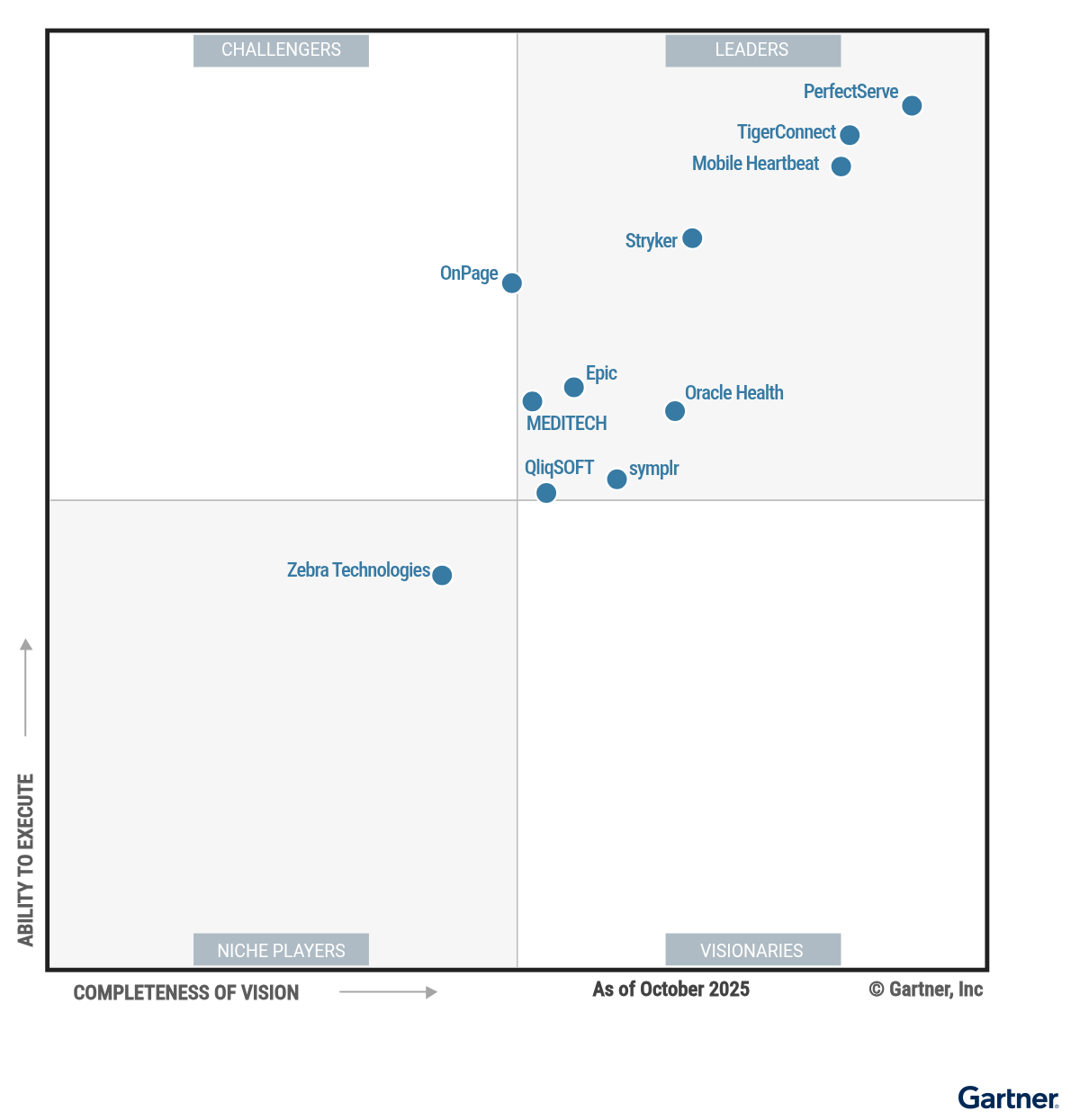
Magic Quadrant
Vendor Strengths and Cautions
Epic
Epic is a Leader in this Magic Quadrant. Epic’s CC&C products include Secure Chat, Epic Video Client, Hello World and Epic Voice over IP (VoIP).
Epic does 100% of its business in the healthcare sector and deploys its CC&C products and services in acute, ambulatory, long-term, skilled nursing, home, and virtual care settings. Epic is a privately held company with implementations in the NA, EMEA and APAC geographic regions.
Epic’s CC&C functionality natively integrates with its electronic health record (EHR) platform, as well as its ancillary offerings and specialty modules. Epic leverages GenAI to respond to patient messages, summarize patient data, improve rounding and clinical notetaking, and optimize CC&C workflows. Epic’s CC&C capabilities are available on desktops and iOS/Android mobile devices. Provider organizations that are live on Epic can also extend the platform to external non-Epic providers.
- Customer collaboration: Epic actively collaborates with customers to identify emerging product and service requirements. Its R&D and customer support teams directly interact with the customer, and the vendor also facilitates user group events to collect customer feedback.
- Embedded CC&C capabilities: Its CC&C products are integrated into Epic’s suite — including EpicCare Link, MyChart, Cheers, and Healthy Planet — enabling seamless workflows and a unified experience for customers. Furthermore, the vendor’s pricing encompasses all current CC&C channels, which can also be licensed separately.
- Long-term viability: Epic is a closely held company with approximately 5,000 employees dedicated to R&D activities. It has no funded debt, and its corporate equity is increasing as its EHR platform and market footprint expand. Therefore, customers can expect long-term growth and stability.
- EHR platform-dependent capabilities: Epic’s CC&C products are tethered to its EHR platform. To access Epic’s CC&C capabilities, healthcare provider customers must install Epic’s EHR platform or be affiliated with a healthcare provider that is live on an Epic EHR platform.
- Increasing TCO and vendor lock-in: Epic’s EHR footprint continues to expand among healthcare providers as it replaces incumbent EHRs and best-of-breed departmental systems. Due to the vendor’s growing market footprint and influence, and pricing disclosure constraints, potential customers may find it challenging to negotiate with Epic for lowering the total cost of ownership (TCO) of its CC&C products.
- Undocumented chats: Epic’s Secure Chat messages are not automatically part of the legal medical record. Messages are typically purged after a set period, though this can vary by facility. Hence, customers will need to decide whether Secure Chats are included in the patient’s chart.
MEDITECH
MEDITECH is a Leader in this Magic Quadrant. MEDITECH is predominantly an EHR solution vendor offering the cloud-based Expanse EHR platform. Expanse includes CC&C products and capabilities such as Expanse Now, Expanse Patient Connect, Expanse Point of Care, Expanse Care Compass, and Expanse Cam.
MEDITECH does 100% of its business in the healthcare sector, including inpatient, ambulatory, long-term, home and virtual care venues. Its customers include physician practices, outpatient clinics, community hospitals, academic medical centers and integrated delivery networks. MEDITECH is a privately held company that has implemented its services in the NA, EMEA, APAC and LATAM geographic regions.
MEDITECH leverages GenAI to automate documentation during clinical encounters and at key transitions of care, as well as provide intelligent search and summarization capabilities directly within the workflow Its CC&C capabilities are available on desktops and iOS/Android smartphones and tablets.
- Strong viability: MEDITECH is a 56-year-old, privately held company with approximately 975 employees dedicated to product R&D activities. Its annual headcount is stable, and its customer retention rate is very high, indicating long-term stability
- Role-specific provider capabilities: MEDITECH’s Expanse EHR platform includes CC&C products and capabilities targeted at different roles, such as physicians, nurses, patients, and consumers. This role-based approach ensures each user group has tailored tools to support efficient and coordinated care.
- Integration of customer feedback: MEDITECH engages its customers through executive advisory sessions, user panels, and targeted focus groups to inform the development of its products and services. New products are piloted with select clients for early feedback, and competitive wins and losses are analyzed to ensure that the Expanse portfolio meets customer needs.
- EHR platform-dependent access: MEDITECH’s CC&C capabilities are only available as a component of its Expanse platform, so customers must fully adopt MEDITECH’s EHR to access them. MEDITECH’s national data exchange network, Traverse Exchange, supports clinical communication and collaboration across organizations.
- Limited transparency: MEDITECH is a privately held company and is not subject to SEC scrutiny, regulations, or reporting requirements. Its financial information is not public and is often only available to prospective customers upon request. Therefore, prospective customers should put in extra effort to assess the company’s financial viability.
- Third-party professional services: MEDITECH does not offer professional services natively; instead, it relies on MEDITECH-certified third-party consulting firms. These third-party consulting firms undergo initial training, as well as ongoing reinforcement and monitoring by MEDITECH to ensure optimal support.
Mobile Heartbeat
Mobile Heartbeat is a Leader in this Magic Quadrant. Its MH-CURE and Banyan Platform, delivered through a subscription model and supported by professional services, focus exclusively on clinical communications. Mobile Heartbeat is a wholly owned subsidiary of HCA Healthcare, serving North America. Mobile Heartbeat supports acute, ambulatory, long-term and rehabilitation care venues.
Mobile Heartbeat’s on-premises CC&C solution, MH-CURE, and its cloud-native Banyan Platform offer advanced directory capabilities that are sensitive to EHR data and clinician bed assignments, creating a dynamic, comprehensive care team. Its nurse call and clinical alarm integration delivers real-time, actionable notifications directly to clinicians’ mobile devices. Care team members can access EHR information from within the platform. It offers an innovative handheld Bluetooth-connected badge that proxies some of its smartphone app functions.
- Team-based communications: Mobile Heartbeat organizes care teams into patient-centered coordination channels to efficiently facilitate team-based communication, providing a centralized place where care team members can view the latest patient updates.
- Interoperable and customizable architecture: Its application modularity and interoperability allow healthcare providers to customize and tailor the solution to their environments. APIs deliver cross-application communication, voice gateway connectivity, and device management.
- Large-scale implementations: Mobile Heartbeat has a proven record of deployment across large enterprises, supporting a wide range of workflows and scenarios. One customer generates over 500 million messages annually.
- Lagging AI enhancements: Although Mobile Heartbeat introduced GenAI capabilities in its UI, it lags behind other vendors in the production deployment of AI agent capabilities for deep platform analytics.
- Limited virtual care: Mobile Heartbeat’s products continue to have limited utility for home-based and virtual care use cases. Capabilities such as remote monitoring may require the assistance of third-party partners.
- Limited geographic strategy: Mobile Heartbeat is wholly owned by HCA Healthcare, which constitutes a significant portion of its client base. Since most HCA hospitals are in the U.S., the company’s geographic reach may be limited.
OnPage
OnPage is a Challenger in this Magic Quadrant. Its suite of cloud-based, tiered CC&C products includes OnPage Mobile, Enterprise, Connect, Enhanced, and Voice. Its business is 100% focused on the healthcare sector in the EMEA, NA and LATAM geographic regions. OnPage serves a variety of inpatient and outpatient venues, including hospitals, clinics, and ambulatory, postacute, skilled nursing facilities, long-term, and home-care settings.
OnPage’s products provide real-time, secure communication with escalation, capabilities, read receipts, and audit trails, enhancing patient safety and meeting regulatory standards. Its platform helps improve operational efficiencies by streamlining on-call scheduling and consolidating the number of communication tools. OnPage’s open API architecture allows for improved integration with EHRs, nurse call systems and ancillary systems.
- Intelligent alerting: OnPage ensures critical messages are delivered and acknowledged through persistent, intelligent alerting with customizable escalation workflows. This reduces, if not eliminates, missed alerts.
- Application integrations: It offers a publicly available API that enables seamless integration with both clinical and nonclinical systems, such as EHRs, patient flow and ITSM platforms. This allows organizations to build custom workflows.
- On-call scheduling: OnPage’s scheduling function allows clinicians to view schedules directly from their mobile devices. This enables real-time visibility, shift swaps, and seamless integration with alerting and call routing.
- Limited virtual care: OnPage’s virtual care functions support remote consults, but continue to lack the video visits functionality, a highly desired capability.
- Partial AI implementation:. OnPage lacks competitively advanced AI capabilities, even though it has enhanced its platform with GenAI-based reporting and UI improvements. This is a conspicuous disadvantage in a market that has begun to embrace advanced AI agents this past year.
- Limited geographic strategy: Although OnPage offers sales in LATAM and EMEA, these geographies are partner-supported and may impact the level of support and responsiveness experienced by customers in these regions. Only U.S. customers have direct company sales.
Oracle Health
Oracle Health is a Leader in this Magic Quadrant. Its CC&C product suite delivers voice, messaging and secondary alarm notifications, and clinical mobility via integration with its EHR. The product suite includes Oracle Health EHR Nursing Mobility, Oracle Health Messenger, Oracle Health Voice, Oracle Health Care Team Assignments and Oracle Health Event Management.
Oracle Health does 100% of its business in the healthcare and life sciences sector, including acute, ambulatory and physician practice care venues. It is a publicly traded company, and its CC&C solution is installed in the NA, EMEA, APAC and LATAM geographic regions.
Oracle Health leverages GenAI within its new AI-based EHR to automate documentation creation, surface clinical insights, streamline workflows and reduce alarm fatigue. As Oracle Health begins to transition CC&C into its new AI-based EHR, GenAI capabilities will be available throughout CC&C workflows. Oracle Health’s CC&C capabilities are available on desktops and iOS/Android mobile devices.
- Enterprisewide integration: The Oracle Health EHR Nursing Mobility platform (formerly CareAware Connect) works in tandem with its messaging, voice, event and scheduling CC&C counterpart services to support enterprisewide care team collaboration and pervasive situational awareness surrounding the patient.
- Customer collaboration: Oracle Health works closely with the customer C-suite to understand how its CC&C platform capabilities can contribute to safe and efficient digital care delivery and align with the provider KPIs in nursing operations and the patient experience.
- Global presence: Oracle Health remains a strong presence in NA, with ongoing efforts to expand its cloud infrastructure, establish strategic partnerships, and increase market share in EMEA, APAC, and LATAM. Its foundation in these regions are built upon the preexisting global footprint of Cerner, which Oracle acquired to form Oracle Health in 2021.
- Support challenges: The size and complexity of the Oracle Health organization can lead to delays in maintaining and following through on service requests. Timely technical support for performance issues and customization needs can be challenging to access.
- Overall viability: Oracle Health’s EHR footprint has been negatively impacted by EHR replacement and M&A activity, resulting in a shrinkage of its total addressable U.S. market. This has resulted in a corresponding decrease in the adoption of its CC&C platform, which impacts its long-term viability.
- Unclear roadmap: The vendor’s new AI-based EHR platform, designed from the ground up to be AI-enabled, is not an add-on to existing technology. Consequently, customers are unsure of what this means for their existing Oracle Health product and service investments, and what the migration path might be.
PerfectServe
PerfectServe is a Leader in this Magic Quadrant. Its CC&C suite of products provides a full range of communication and collaboration capabilities. PerfectServe’s products are 100% focused on the healthcare sector and serve acute, ambulatory, and long-term care venues, as well as virtual care encounters. It operates in the U.S. and Canada, with a smaller presence in Ireland.
PerfectServe offers a cloud-based platform that includes paging, operator console for call and transfer centers, enterprise alerting, secure messaging, and patient communications. Its Dynamic Intelligent Routing utilizes care team assignments, schedules and other integrated information to route messages to the right person in real time. It uses AI to collect notes from calls and messages, summarizing them for clinicians. It includes conversational AI to improve triage and route calls, using the rules in its routing engine.
- Extensive AI capabilities: PerfectServe’s AI automatically summarizes call notes and utilizes conversational agents to efficiently disposition and route calls, helping clinicians save time and improve response accuracy. Its finely tuned LLM and AI prompting enable deeper insights into workflows and easy tracking of KPIs for better operational decision making.
- Multifunctional platform: PerfectServe has built a single cloud-based platform that offers CC&C, optimized provider scheduling, operator console, mass notification, patient engagement, and practice communications. This allows customers to consolidate vendors, simplifying management and potentially reducing costs.
- Strong integrations: PerfectServe has over 250 integrations with clinical, IT and telecom systems. These integrations are managed from their cloud platform, which enables easier management and operation across their customer base.
- Complex configuration: To fully benefit from PerfectServe’s advanced features, customers must navigate complex configurations that most likely require specialized training. This may lead to longer implementation times and higher training costs.
- Geographic limitations: Although PerfectServe covers NA and Ireland, its current support staff is based in NA. PerfectServe uses channel partners for non-NA client sales and support.
- Potential alarm fatigue: PerfectServe’s ability to consolidate, route and deliver patient-related event information can result in frequent notifications that may contribute to alert and alarm fatigue for clinical staff. Potential customers considering PerfectServe should plan on spending substantial time setting up routing and notification rules or engaging PerfectServe’s professional services.
QliqSOFT
QliqSOFT is a Leader in this Magic Quadrant. QliqSOFT’s secure text message service, QliqCHAT, is complemented by its Quincy digital communication platform with app-less secure patient texting, AI chatbots, virtual visits and campaign automation, with add-ons for digital forms, on-call scheduling, call masking, remote staff GPS tracking, and discrete distress signaling. QliqSOFT is a privately held company and does 100% of its business in the healthcare sector within care at home, inpatient, and outpatient venues. It deploys its CC&C products in care at home, healthcare systems, hospitals, and ambulatory clinics in NA.
The QliqSOFT CC&C platform consolidates multiple point solutions for secure messaging, care team information sharing and custom form development for recipient-reported data. It leverages AI in its Quincy platform to create and deploy conversational AI chatbots for patient engagement, therapeutic monitoring, and medication management. QliqSOFT products are available on desktops and iOS and Android smartphones and tablets.
- Nuanced market understanding: QliqSOFT stays up-to-date on rules and trends related to the ambulatory, acute, and postacute verticals by engaging with experts and prospects to understand challenges and by attending events. This ensures customers get solutions that address real challenges and evolving requirements.
- Targeted marketing and feedback: QliqSOFT customizes messaging for each vertical segment and shares it across the website, social media, and sales channels, making it easier for customers to find relevant solutions. The vendor also involves clients in piloting new capabilities and enhancements to collect feedback.
- Singularness of purpose: QliqSOFT’s CC&C platform provides compliant, secure, real-time messaging and call routing for healthcare provider care teams. It provides on-call scheduling and integration with existing EHR, PMS, and other clinical systems to streamline information exchange, clinical workflows, and care coordination.
- Limited geographic reach: QliqSOFT’s platform is only available in NA and isn’t localized for other languages or regions. Hence, customers in other regions may find it unsuitable for their needs.
- Limited acute care capabilities: QliqSOFT’s platform focuses on secure messaging and collaboration, but lacks support for acute care needs, such as real-time device integration and alarm management. Therefore, customers in acute care settings may face gaps in critical functionality.
- Limited voice support: QliqSOFT’s platform doesn’t integrate with PBX systems or offer pager emulation, which may limit communication options for customers who rely on these technologies.
Stryker
Stryker is a Leader in this Magic Quadrant. It entered the CC&C market in February 2022, acquiring the established CC&C vendor, Vocera Communications. Stryker’s CC&C portfolio includes its Vocera clinical communication and workflow platform, Vocera Edge smartphone app for clinical communication, Vocera Engage middleware for interoperability and alarm management, Vocera Ease patient and family communication products, and its Vocera Smartbadge and Minibadge and new Sync Badge hands-free wearable communications devices.
Stryker does 90% of its business in the healthcare sector, including acute, ambulatory and long-term care venues. It is a publicly traded, global medical device and technology company, with customers in the NA, EMEA, and APAC geographic regions.
Vocera Engage includes Engage Medical Device Alarm Notification (EMDAN), an FDA 510(k)-cleared middleware, to deliver secondary alarm notifications and enable integrations with physiologic monitors and critical clinical and operational systems such as nurse call, laboratory, radiology, bed management, and patient flow. Vocera Engage routes, prioritizes, and escalates alarms and notifications while maintaining the patient and care team context. Stryker CC&C products are available on desktops, iOS/Android mobile devices, and as hands-free devices.
- Care coordination: Stryker improves care coordination by using smart messaging and call prioritization, routing, and escalation. This helps customers respond faster to urgent needs and improves clinical and operational KPIs.
- Hands-free communication: Stryker’s hands-free communication badges are unique in the industry. They respond to intuitive voice commands and integrate with the larger Vocera clinical communication platform. They are built specifically for the hospital’s fast-paced, complex environment to enhance care team communication, reduce alarm fatigue, and strengthen staff safety.
- Capabilities through acquisition: As a well-established, best-of-breed CC&C mobile platform, Stryker’s acquisition of Vocera allows both entities to leverage their respective market presence and strengths to uniquely drive care team collaboration, improve patient safety, and streamline clinical workflows.
- Limited smartphone implementations: When referencing Stryker clients, be sure to ask whether the client is predominantly a smartphone or badge CC&C user.
- Stand-alone CC&C capabilities: As a stand-alone CC&C vendor, Stryker will face increased competition from maturing EHR-based CC&C solutions, and cost optimization pressures to reduce the size of healthcare provider application portfolios.
- Corporate strategy concerns: Stryker’s Vocera acquisition represented a move away from its core business and raised concerns about its long-term commitment to the CC&C market. This may result in limited product innovation and customer support. Customers should closely monitor Stryker’s roadmap and investment in CC&C solutions.
symplr
symplr is a Leader in this Magic Quadrant. symplr’s CC&C product suite includes its Clinical Communications SaaS platform, as well as its EHR collaboration and nurse mobility modules.
symplr is a privately held company and does 100% of its business in the healthcare sector within the acute, ambulatory, long-term and virtual care venues with customers for its CC&C platform in the U.S.
symplr’s CC&C offering is a component of its more extensive next-generation workforce management for healthcare platform. symplr leverages GenAI for analytics, reporting, and workflow optimization. CC&C products are available on desktops and iOS and Android mobile devices.
- Care team support: symplr’s CC&C platform optimizes care team productivity, collaboration and nursing operations to help mitigate significant clinical staffing shortages and retention issues.
- Workforce management support: symplr’s CC&C solution, which is integrated into its workforce management platform, enables healthcare providers to support staffing, retention, and frontline worker well-being, while seamlessly connecting with demand management and real-time recruiting services.
- AI innovation: symplr’s CC&C SaaS platform will increasingly handle complex CC&C workflows by automating messaging tasks through the use of AI, providing the healthcare team with the necessary context to optimize care team communication.
- Limited public financial disclosure: symplr is backed by the private equity investment firms Clearlake Capital and Charlesbank Capital Partners. It is not subject to SEC scrutiny, regulations or reporting requirements, so additional effort is required to assess its financial performance.
- Limited geographic reach: symplr deploys its platform only in NA and does not localize its product suite to support different languages and geographies, making it unsuitable for customers from other regions.
- Fewer secondary features: symplr’s Clinical Communications product focuses on essential, secure, role-based caregiver communication and strong EHR integration. However, it lacks some of the broader collaborative CC&C features, particularly patient-facing communication.
TigerConnect
TigerConnect is a Leader in this Magic Quadrant. The TigerConnect platform includes a complete set of CC&C capabilities, including clinical collaboration, provider scheduling, alarm management, transfer coordination, EMS communication, and patient engagement. It is 100% focused on the healthcare provider sector, serving U.S. and Canadian hospitals, clinics, ambulatory care, EMS, long-term care, home care, and virtual care settings.
TigerConnect ‘s cloud-native CC&C suite of product capabilities is founded on its CareConduit workflow orchestration platform, which routes events, alerts, and AI-driven insights across the care continuum to the appropriate person. These combined capabilities provide a unified healthcare communication platform. TigerConnect has deployed AI at the platform level, with scheduling agents and EMS protocol assistance currently in production.
- AI approach: TigerConnect’s enterprisewide AI program, launched in 2024, streamlines scheduling, protocol support, messaging, and workflow, enabling customers to boost operational efficiency and improve care team responsiveness.
- Complete platform: TigerConnect’s unified CC&C platform integrates with EHRs and clinical systems, consolidating messaging, scheduling, alarm management, and patient engagement. This enables customers to streamline workflows and support the entire patient journey, including prehospital care.
- Interoperable, clinical workflows: TigerConnect’s workflow automation platform, CareConduit, provides interoperability and intelligent workflow automation to help reduce manual processes. This platform connects EHRs, medical devices, and AI models, routing critical insights and events to the right care team member in real time. This represents a shift from a message-oriented approach to an automated workflow approach.
- Limited geographic reach: TigerConnect deploys its platform only in NA and does not localize its product suite to support different languages and geographies, making it difficult for customers from other regions to use.
- Product complexity: TigerConnect’s extensive product features can make navigation challenging for users, potentially causing confusion and slowing workflow when switching between different application functions.
- Customer experience: Customers have reported slower-than-expected response times for customer support assistance, some recurring application issues, and service disruptions during updates.
Zebra Technologies
Zebra Technologies is a Niche Player in this Magic Quadrant. Its application, Workcloud Sync, provides CC&C capabilities across various mobile and desktop endpoints. It is available globally and serves many industries, including the healthcare provider sector. For healthcare, it serves a variety of care venues, such as hospitals, clinics, ambulatory care, universities, and large integrated delivery networks.
Zebra focuses on three key capabilities: equipping workers with devices, connecting those devices, and ensuring that the devices can interact with the necessary data sources. For healthcare, this means an open architecture that allows integration with the EHR, nurse call and alert/alarm systems. It has introduced GenAI enhancements for knowledge-based inquiry and device support. In addition to its ruggedized mobile computers, Zebra has introduced a Bluetooth-connected communications badge.
- Hardware manufacturing: As a leading manufacturer of clinical-grade point-of-care hardware, Zebra provides purpose-built communication devices, bar code scanners, and label printers that enable customers to enhance staff mobility, accuracy, and operational efficiency.
- Composable architecture: Zebra’s Workcloud product is based on a composable architecture that allows integration with EHRs, nurse call systems, alarm middleware, and telemetry. This flexibility allows customers to tailor workflows to their specific needs and optimize care delivery.
- Role-based communication: Zebra provides a dynamic role management engine that routes various types of communication based on real-time role presence, licensure level, location, and availability. This capability ensures the right clinician is contacted at the right moment, minimizing delay and reducing cognitive burden during escalation.
- Limited CC&C platform: Zebra’s CC&C platform is new to the market; it includes endpoint hardware and software, the capability to connect those endpoints, and, through integrations, access to data available in the healthcare ecosystem. This means that its capabilities are relatively limited compared to some other vendors in this research.
- Business model: Zebra was historically focused on selling its purpose-built hardware solutions for the healthcare industry. It has optimized its hardware and endpoint operating system for CC&C use cases, features and capabilities. The introduction of its CC&C software platform broadens this business model.
- Nascent AI enhancements: Although Zebra introduced a GenAI capability for support, including dynamic translation, it currently lags behind other vendors in the production deployment of AI agent capabilities.
Vendors Added and Dropped
We review and adjust our inclusion criteria for Magic Quadrants as markets change. As a result of these adjustments, the mix of vendors in any Magic Quadrant may change over time. A vendor's appearance in a Magic Quadrant one year and not the next does not necessarily indicate that we have changed our opinion of that vendor. It may be a reflection of a change in the market and, therefore, changed evaluation criteria, or of a change of focus by that vendor.
Added
No vendors were added to this Magic Quadrant.
Dropped
No vendors were dropped from this Magic Quadrant.
Inclusion and Exclusion Criteria
To qualify for inclusion in this research, vendors must demonstrate:
1. They do most of their business in the healthcare provider space (ambulatory, inpatient, post-acute care spaces).
2. Their platform includes competitive product offerings that align with the various CC&C critical capabilities, minimally those designated as must-have:
a. Must-have:
- Analytics: The ability to apply advanced analysis, logic-based, and AI techniques to interpret events, and support and automate decisions and actions.
- Care team collaboration: The ability to communicate and collaborate with care team members over secure and compliant channels, such as chat, unified communications, and workforce collaboration platforms. Collaboration also includes the ability to assign and track tasks, set priorities, and automate routine workflows.
- Critical results: The ability to securely access, view and integrate patient information housed in the EHR, ancillary and other essential clinical systems to support CC&C workflows.
- Secure messaging: The ability to facilitate secure messaging and chat sessions among patients, care team members, support staff, community physicians and other legitimate stakeholders.
- Task and workflow management: This feature enables the care team to assign and track tasks, set priorities and automate routine workflows, enhancing efficiency. It includes collaboration tools like shared task lists and document sharing, facilitating effective teamwork regardless of location.
b. Standard:
- Alarm management: The ability to connect to alarms and notification middleware to acquire, filter, escalate, and manage medical device codes and alarms.
- Interoperability: The ability to acquire, exchange and integrate patient information with point-of-care, operational and patient and clinician context systems using industry interoperability standards and protocols.
- Voice/telephony integration: The ability to initiate and receive voice calls and integrate with system-in-package (SIP), PBX and VoIP technologies.
c. Optional:
- Patient/family engagement: The ability to include the patient, family members and caregivers in the care team communications, collaborative sessions, and workflows.
- Reporting: The ability to capture, analyze, and report on patient and care team activity.
3. They have 10 or more healthcare provider customers in production deployments.
4. They support a combination of on-premises, hosted, hybrid, and cloud service delivery models.
5. They offer, directly or through partnerships, implementation and support services for their platform.
Evaluation Criteria
Ability to Execute
Product/Service: The capabilities, features and overall quality of the core goods and services that compete in and or serve the defined market.
What we specifically looked for here was:
- List of CC&C products and services for the global healthcare provider market.
- Understanding of the depth and breadth of CC&C critical capabilities support.
- Customer feedback on product roadmap, capabilities, implementation, maintenance, support, performance, contracting and pricing.
Overall Viability: The organization’s overall financial health, as well as the financial and practical success of the relevant business unit. This includes the likelihood that the organization can continue to offer and invest in the product, as well as the product’s position in the organization’s portfolio.
What we specifically looked for here was:
- Vendor’s overall financial viability and business model sustainability.
- Year-over-year customer growth and profitability.
- Customer perception of product and service roadmap.
Sales Execution/Pricing: The organization’s capabilities in all presales activities and the structures that support these activities. This includes deal management, pricing and negotiation, presales support and the overall effectiveness of the sales channel.
What we specifically looked for here was:
- Notable sales-related campaigns, activities, and industry conference events.
- Number of net new customers acquired during the last fiscal year.
- Understanding of current pricing model and contract flexibility.
Market Responsiveness and Track Record: The ability to respond, change direction, be flexible and achieve competitive success as opportunities develop, competitors act, customer needs evolve and market dynamics change. This includes the provider’s history of responsiveness to changing market demands.
What we specifically looked for here was:
- Understanding of customer retention rate and circumstances that influence it.
- Example of the vendor’s ability to adapt to an evolving CC&C market.
- Example of how a vendor responded to a customer’s decision to investigate a competitor’s offering or revisit the CC&C market.
Marketing Execution: The ability to deliver clear, high-quality, creative and effective messaging via publicity, promotional activity, thought leadership, social media, referrals and sales activities. This includes the organization’s ability to influence the market, promote the brand, increase awareness of products and establish a positive reputation among customers.
What we specifically looked for here was:
- Understanding of the vendor’s approach to increasing its product’s brand recognition in the market.
- Understanding of the vendor’s range of programs and initiatives to increase customer familiarity with the product.
- Understanding of vendor’s social media presence.
Customer Experience: The degree to which a vendor’s products, services and programs enable customers to achieve their desired results. This includes the quality of supplier/buyer interactions, technical support or account support, as well as ancillary tools, customer support programs, availability of user groups and service-level agreements.
What we specifically looked for here was:
- Understanding of how a vendor determines a customer’s overall perception of their product capabilities and delivery.
- Examples of product service-level agreements in force.
- Understanding of the vendor’s ability to be flexible and adapt during contract negotiations.
Operations: The ability of the organization to meet its goals and commitments. This includes the quality of its organizational structure, skills, experiences, programs and systems that enable the organization to operate effectively and efficiently.
What we specifically looked for here was:
- Examples of programs and initiatives that contribute to customer success.
- Number, type, and quality of implementation and product support specialists committed to an individual customer account.
- Names and locations of certified implementation partners.
Ability to Execute Evaluation Criteria
| Evaluation Criteria | Weighting |
|---|---|
Product or Service | High |
Overall Viability | Medium |
Sales Execution/Pricing | Medium |
Market Responsiveness/Record | High |
Marketing Execution | Medium |
Customer Experience | High |
Operations | Low |
Source: Gartner (January 2026)
Completeness of Vision
Market Understanding: The ability to understand customer needs and translate that understanding into products and services. Vendors with a clear vision of the market listen to and understand customer demands, and they can shape or enhance market changes with their vision.
What we specifically looked for here was:
- Vendor understanding of the business and industry drivers for CC&C.
- Vendor understanding of the departmental and enterprise CC&C needs of the healthcare provider.
- Vendor’s vision and thought leadership on how the CC&C market or platform will evolve over the next 2 to 3 years.
Marketing Strategy: The ability to clearly communicate differentiated messaging, both internally and externally, through social media, advertising, customer programs and positioning statements.
What we specifically looked for here was:
- Examples of differentiated product and service messaging.
- An understanding of channels used for this messaging.
- Recent product positioning messaging.
Sales Strategy: The ability to create a sound strategy for selling that uses the appropriate networks, including direct and indirect sales, marketing, service and communication. This includes partnerships that extend the scope and depth of a provider’s market reach, expertise, technologies, services and their customer base.
What we specifically looked for here was:
- An understanding of the vendor’s overall sales strategy.
- What product positioning messaging resonates with prospects and customers and with what customer role.
- Insight into the most effective vendor sales channels and partner ecosystems.
Offering (Product) Strategy: The ability to approach product development and delivery in a way that meets current and future requirements, with an emphasis on market differentiation, functionality, methodology and features.
What we specifically looked for here was:
- Vendor’s approach to acquiring and understanding the key functional and nonfunctional requirements of their customers.
- Vendor’s approach to product feature, function, and capability prioritization.
- Vendor’s approach long-term product planning and release management.
Business Model: The design, logic and execution of the organization’s business proposition.
What we specifically looked for here was:
- An understanding of the vendor’s current business model.
- The rationale used to arrive at the current business model.
- A brief explanation of the vendor’s value proposition.
Vertical/Industry Strategy: The ability to strategically direct resources (sales, product, development), skills, and products to meet the specific needs of verticals and market segments.
What we specifically looked for here was:
- Percentage of business done in the healthcare provider vertical.
- How changing circumstances in the healthcare provider vertical has changed the vendor’s approach or pace of product planning, development, sales, and marketing.
- Other industry verticals outside of healthcare the vendor participates in, if any.
Innovation: Marshaling of resources, expertise or capital for competitive advantage, investment, consolidation, or defense against acquisition.
What we specifically looked for here was:
- Percentage of operational budget dedicated to research and development.
- Understanding of potential CC&C use cases that leverage emerging technologies.
- Understanding of ability to deliver on past product roadmap capabilities.
Geographic Strategy: The ability to direct resources, skills and offerings to meet the specific needs of regions outside the providers’ home region, either directly or through partners, channels and subsidiaries.
What we specifically looked for here was:
- Approach to selling, implementation and support outside of native geography.
- Customer growth outside of native geography.
- List of regions that the CC&C product is deployed in, outside of native geography.
Completeness of Vision Evaluation Criteria
| Evaluation Criteria | Weighting |
|---|---|
Market Understanding | High |
Marketing Strategy | High |
Sales Strategy | Medium |
Offering (Product) Strategy | High |
Business Model | Low |
Vertical/Industry Strategy | NotRated |
Innovation | Medium |
Geographic Strategy | Medium |
Source: Gartner (January 2026)
Quadrant Descriptions
Leaders
Leaders are in the strongest position to influence the CC&C market’s direction. They demonstrate a market-defining vision of how CC&C will evolve. Leaders can execute against that vision through their organization’s capabilities, business model and platform. They have shown business results in the form of references and growth. They excel in their combination of market understanding, innovation, platform features and overall viability. While maintaining a well-established base of long-term customers, Leaders consistently win new deals and deliver successful implementations. Their customers are deployed in several geographic regions and are often the vendors against which other vendors measure themselves.
Challengers
Challengers have established presence, credibility and viability and have demonstrated the ability to meet customers’ expectations. However, they have not shown the same leadership or innovation as the Leaders. Challengers tend to have a good technology vision, but may not have adequate foresight to define the future of the CC&C market. Challengers are well-placed to succeed in the market. They are often a good choice for organizations that value execution and a broader integrated product suite over vision.
Visionaries
Visionaries are ahead of most potential competitors in delivering innovative capabilities and sophisticated CC&C experiences. These vendors embody trends that are shaping the CC&C market. There may be some need for more awareness of the overall market and concerns about the ability to execute the full extent of their vision. Visionaries have strong innovation and robust product roadmaps. Visionaries are an excellent choice for organizations that want innovation and are willing to push the boundaries of what’s perceived as possible. Visionaries who add execution power to their innovative platforms can become Leaders. Visionaries are the most likely to be acquired by more prominent platform vendors.
Niche Players
Niche Players often offer compelling CC&C solutions. Still, they may also:
- Be limited in architectural and deployment flexibility.
- Lack specific key functional capabilities.
- Lack the ability to deliver across multiple geographies.
- Lack the ability to support the requirements of large enterprises.
- Lack the ability to implement complex global deployments.
Niche Players are not winning new customers across multiple geographies as fast as their mainstream counterparts. Niche Players can often offer the best solutions to meet the needs of particular and well-defined CC&C use cases. When a Niche Player is a good fit, it will likely provide a much better price-to-value ratio and a time-to-market advantage. Some Niche Players demonstrate a degree of vision that suggests they might become Visionaries, but they might struggle to make this vision compelling. Other Niche Players may have the opportunity to become Challengers if they continue to develop their platforms to improve their overall execution. They may also work to establish a track record of continual innovation.
Context
CC&C solutions have traditionally facilitated communication among physicians, nurses and care team members. CC&C increasingly includes patients, caregivers and family members in the care team, making CC&C a viable tool for patient/provider engagement and, in some cases, virtual care. CC&C can positively impact patient safety, care team efficiency, nursing productivity and morale. CC&C can also improve care coordination and address patient throughput challenges. CC&C systems represent the convergence of conventional inpatient communications, such as voice and paging, with modern channels, such as secure messaging and video.
New care collaboration channels are vital at the point of care and during care transitions. They are essential to satisfy increased consumer and patient expectations and key care quality and performance indicators that affect provider reimbursement and revenue. Due to the persistent need for healthcare providers to improve operational efficiency, CC&C systems are increasingly leveraging operational intelligence housed in systems such as patient flow, bed management, and resource scheduling systems. Focus your CC&C initiatives on reducing care team toil, including the tasks that erode nursing morale and well-being and contribute to burnout and retention issues.
When considering a CC&C platform:
- Favor CC&C solutions that include patient engagement and care coordination capabilities, such as pre- and post-treatment follow-up, real-time family and caregiver communications, virtual bedside rounding, and EMS-to-ED communication and collaboration.
- Enhance care team collaboration by implementing CC&C solutions that integrate with nurse call, interactive patient care, resource scheduling systems, and alarm and notification systems via industry-standard protocols.
- Select CC&C product offerings that support CC&C’s essential use cases, including accessing critical patient results, collaborating and coordinating care, engaging patients and their caregivers, and ensuring patient safety.
- Prioritize CC&C product offerings that meet the CC&C critical capabilities, as outlined in Critical Capabilities for Clinical Communication and Collaboration.
Market Overview
CC&C platforms are becoming more automated, predictive, and smart as interoperability advances allow them to more effectively acquire and activate operational intelligence from surrounding clinical and operational systems. CC&C platforms are continuing to evolve alongside advances in real-time healthcare system (RTHS) features and capabilities. They will increasingly become:
- Aware: CC&C platforms will become increasingly “situationally aware,” with real-time, enterprise-level knowledge of essential clinical and patient event information derived from current and historical data sources.
- Collaborative: CC&C platforms will become increasingly collaborative. Collaboration is higher-order communication and requires the convergence of point-of-care solutions, interoperability middleware, IoT, analytics, and AI. Therefore, it is not enough for care team members to merely communicate via mobile channels — they must share patient information and context with colleagues and adjacent IT systems in real time.
- Smart: CC&C platforms will become increasingly automated and autonomous to achieve care delivery objectives. They will use real-time operational intelligence to appropriately elevate and orchestrate essential clinical workflows and processes within the patient’s context.
CC&C vendor RFI responses indicate the following trends:
- Support for team-based staffing: Staffing shortages and retention are significant concerns for healthcare providers, and team-based staffing is gaining popularity. In this context, CC&C has become a critical tool for leveraging team-based staffing models that rely on increasing the care team efficiency and individual contributor productivity.
- Management of complex communication: CC&C platforms have become more critical as risks for communication failures increase. CC&C platforms can effectively handle complex, role-based teams without creating more administrative burdens for staff.
- Increase in engagement capabilities: More patient engagement and virtual care capabilities are available as CC&C solution vendors focus on empowering families and caregivers to become more engaged care team members.
- Focus on ROI: Due to constrained budgets, increased labor costs and inflationary pressures, CC&C vendor solutions have begun to emphasize the ROI of CC&C, along with its impact on clinical and operational KPIs.
- Efficiency in communication: CC&C platforms can effectively remediate inefficient clinical workflows, disjointed care team handoffs and care transitions that still characterize many care team interactions.
- Use of AI: AI and ML now augment CC&C products and platforms through workforce scheduling optimization, workflow automation, and smart message routing and escalation.
- Support for nontraditional care venues: There is increasing support for postacute care, hospital-at-home, and home care workflows, which will drive CC&C vendor planning roadmaps.
- EMS-to-ED collaboration: CC&C platforms have begun supporting EMS-to-ED collaboration and data sharing, and streamlining prehospital interactions and workflows.
- Violence alert mechanisms: CC&C solution vendors are addressing workplace violence by introducing specialized third-party staff duress and panic button systems.
- Unified communication platforms: As they evolve, CC&C platforms will leverage unified communications platforms to integrate traditional (voice, paging, desktop) and modern communication channels and devices (messaging, hands-free devices, smartphones) across all care venues.
- EHR-based CC&C: EHR vendors such as Epic, MEDITECH, and Oracle Health have CC&C-enabled their EHR and mobile product suites. However, they are not generally available to non-EHR users.
- RFI survey: For this 2025 Magic Quadrant report, Gartner invited the 11 CC&C vendors that participated in the 2024 Magic Quadrant report to prequalify and complete the RFI. All eleven met the inclusion criteria, and nine vendors opted to complete the RFI. Epic and Stryker choose not to complete the RFI.
- Vendor demonstrations: The final set of vendors provided video demonstrations of their platforms related to CC&C critical capabilities and key use cases.
- Secondary research, Peer Insights, and client inquiry: Data collected from secondary research sources, Gartner Peer Insights data, and Gartner client CC&C vendor and market inquiries informed this research and analysis.
Ability to Execute
Product/Service: Core goods and services offered by the vendor for the defined market. This includes current product/service capabilities, quality, feature sets, skills and so on, whether offered natively or through OEM agreements/partnerships as defined in the market definition and detailed in the subcriteria.
Overall Viability: Viability includes an assessment of the overall organization's financial health, the financial and practical success of the business unit, and the likelihood that the individual business unit will continue investing in the product, will continue offering the product and will advance the state of the art within the organization's portfolio of products.
Sales Execution/Pricing: The vendor's capabilities in all presales activities and the structure that supports them. This includes deal management, pricing and negotiation, presales support, and the overall effectiveness of the sales channel.
Market Responsiveness/Record: Ability to respond, change direction, be flexible and achieve competitive success as opportunities develop, competitors act, customer needs evolve and market dynamics change. This criterion also considers the vendor's history of responsiveness.
Marketing Execution: The clarity, quality, creativity and efficacy of programs designed to deliver the organization's message to influence the market, promote the brand and business, increase awareness of the products, and establish a positive identification with the product/brand and organization in the minds of buyers. This "mind share" can be driven by a combination of publicity, promotional initiatives, thought leadership, word of mouth and sales activities.
Customer Experience: Relationships, products and services/programs that enable clients to be successful with the products evaluated. Specifically, this includes the ways customers receive technical support or account support. This can also include ancillary tools, customer support programs (and the quality thereof), availability of user groups, service-level agreements and so on.
Operations: The ability of the organization to meet its goals and commitments. Factors include the quality of the organizational structure, including skills, experiences, programs, systems and other vehicles that enable the organization to operate effectively and efficiently on an ongoing basis.
Completeness of Vision
Market Understanding: Ability of the vendor to understand buyers' wants and needs and to translate those into products and services. Vendors that show the highest degree of vision listen to and understand buyers' wants and needs, and can shape or enhance those with their added vision.
Marketing Strategy: A clear, differentiated set of messages consistently communicated throughout the organization and externalized through the website, advertising, customer programs and positioning statements.
Sales Strategy: The strategy for selling products that uses the appropriate network of direct and indirect sales, marketing, service, and communication affiliates that extend the scope and depth of market reach, skills, expertise, technologies, services and the customer base.
Offering (Product) Strategy: The vendor's approach to product development and delivery that emphasizes differentiation, functionality, methodology and feature sets as they map to current and future requirements.
Business Model: The soundness and logic of the vendor's underlying business proposition.
Vertical/Industry Strategy: The vendor's strategy to direct resources, skills and offerings to meet the specific needs of individual market segments, including vertical markets.
Innovation: Direct, related, complementary and synergistic layouts of resources, expertise or capital for investment, consolidation, defensive or pre-emptive purposes.
Geographic Strategy: The vendor's strategy to direct resources, skills and offerings to meet the specific needs of geographies outside the "home" or native geography, either directly or through partners, channels and subsidiaries as appropriate for that geography and market.