Magic Quadrant for Configure, Price and Quote Applications
22 January 2026 - ID G00831006 - 43 min read
By Luke Tipping, Mark Lewis
The configure, price and quote applications market continues to evolve toward omnichannel solutions that support selling all types of goods and services. This Magic Quadrant evaluates 16 CPQ applications to help buyers find the best one for their needs.
Market Definition/Description
Gartner defines configure, price and quote (CPQ) applications as software that enables sales organizations to automate and optimize the creation of quotes and capture of orders.
A CPQ application is a sales tool that captures the new goods and services a customer wants to buy or the changes a customer wants to make to existing goods and services. While generally focused on assisted sales channels, CPQ capabilities such as product configuration and pricing must be shared with the self-service commerce channel. The new purchases and changes must be priced, and a binding contract must be formed with the customer before sending an order to downstream fulfillment systems.
Mandatory Features
The mandatory features for this market include:
- Support for sales users, including integration with sales force automation solutions
- Search and selection of products and services to sell
- Selection of product options and features (i.e., configuration)
- Automatic pricing of the chosen products and services
- Negotiation of terms and proposal generation
- Order placement
- Extensibility framework that enables a company to set up the application for its processes, products and services
Optional Features
The optional features for this market include:
- Support for the digital commerce channel via prebuilt UIs, integrations and/or APIs
- Subscription selling and management
- Selling complex tangible goods
- Contract negotiation
- Approvals workflow
- Prebuilt integrations with fulfillment applications, such as ERP
Magic Quadrant
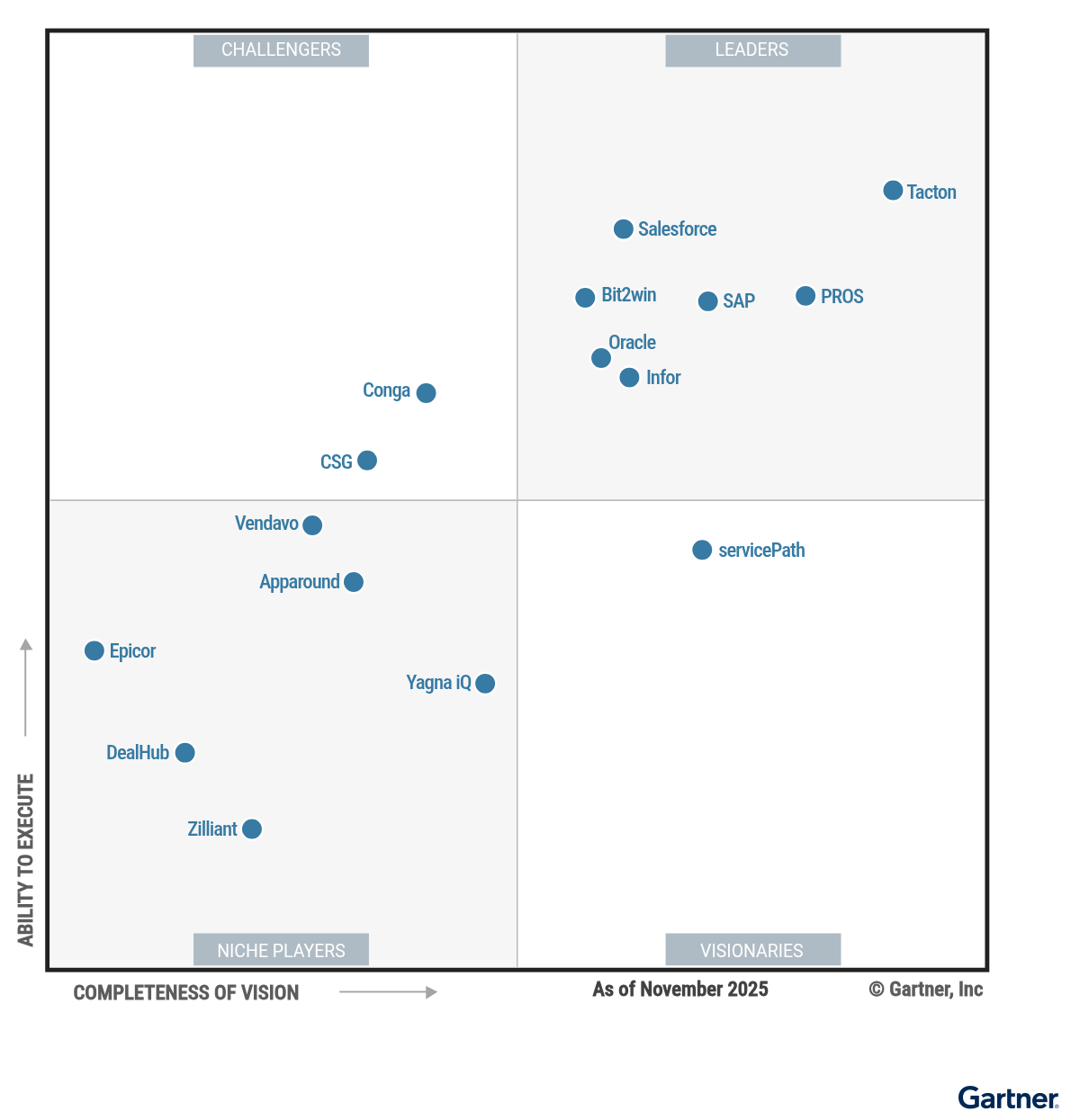
Vendor Strengths and Cautions
Apparound
Apparound is a Niche Player in this Magic Quadrant due to its limited market presence and narrow industry focus. It is a private company based in Pisa, Italy. Apparound CPQ is best-suited for selling simple products using a mobile device. The product’s main strengths are a native application on Android, iOS or Windows when running disconnected from the network, and signature capture on mobile devices. It has productized integrations with Salesforce Agentforce Sales, Microsoft Dynamics 365 Sales and HubSpot for the direct sales channel. Resellers can create quotes and orders via the standard Apparound UI. The assisted sales UI is built on public web service APIs that can be used as the basis for other channels, such as self-service digital commerce. However, the configurator and pricer cannot be used without an Apparound quote. The product runs on Amazon Web Services (AWS), Microsoft Azure and the vendor’s own data center.
- Mobile UI: Apparound CPQ has a responsive UI for Microsoft Windows, plus native apps for Android and iOS that work when disconnected from the network. The mobile apps support bar code scanning and signature capture. It is also possible to capture one-time payments and deposits and to plan installment payments. These features make the product suitable for use in stores or when selling door to door.
- Utilities and telecom industries: Apparound has a significant number of deployments at utilities and telecommunications companies. Its product works well for organizations selling simple subscriptions.
- Large-scale deployments: Apparound CPQ is proven to support enterprise customers with a large number of users and transactions. It offers a 99.9% uptime SLA and frequent product updates, and all customers run on the latest release.
- Market presence: Apparound has limited market presence. While the vendor maintains a sales office in North America, its employees and customers are primarily concentrated in Europe.
- Configurator: The configuration rule engine has limited capability compared with that of products from other vendors in this Magic Quadrant. Apparound CPQ is not suited for selling complex goods and services.
- Service contract management: Users can sell simple subscriptions, but Apparound CPQ does not support either managing service contracts or amending or terminating services after they are sold.
Bit2win
Bit2win is a Leader in this Magic Quadrant due to its ability to sell complex solutions and robust support for utilities and telecom industries. Bit2win is a private company based in Rome. The product integrates with Salesforce Agentforce Sales and Microsoft Dynamics 365 Sales for the direct sales channel, and with Salesforce Partner Relationship Management for resellers. Bit2win exposes APIs that support composing a custom self-service application. A live production implementation was shown during the demo to Gartner. Mobile tablets are supported by the responsive UI, and users can perform some basic selling actions when disconnected from the internet. The product runs on Microsoft Azure, AWS, Google Cloud, Alibaba Cloud and the vendor’s own data center.
- Product: Bit2win is one of the best overall products evaluated in this report. It was among the strongest evaluated for CRM integration, product selection, selling services, pricing, order management and extensibility. It is also one of the most usable products.
- Utilities industry: Bit2win has multiple deployments at large utility companies (10,000+ users). The product includes robust support for selling and managing subscriptions and industry-specific, needs-based product recommendations and service cost estimation. It integrates with SAP IS-U and Fincons’ youtiverse.
- Performance and usability: Bit2win has a fast, intuitive end-user interface and is easily capable of handling large transactions and the generation of a large proposal.
- Market presence: Bit2win has limited market presence outside of Southern Europe, with few customers in North America.
- Upgrades: At the time of our research, there were relatively few deployments of Bit2win, but the companies running it were using five different versions of the software. This raises questions about why customers are not upgrading to the latest version. Having many versions in production will be difficult for the vendor to sustain as the product is more widely deployed.
- B2B deal negotiation: Bit2win has limited out-of-the-box capability for long-term deal negotiation and no support for digital sales rooms.
Conga
Conga is a Challenger in this Magic Quadrant due to its extensive feature set. Conga is a private company based in Houston, Texas. In 4Q25, Conga announced its acquisition of PROS CPQ and PROS B2B profit optimization software assets, with the deal expected to close in 1Q26. Conga offers a broad set of CPQ capabilities for companies selling complex goods and services. Conga CPQ has a native Salesforce Lightning Web Components UI integrated with Salesforce Agentforce Sales for direct sales and an integration with Microsoft Dynamics 365 Sales. The quoting experience can also be embedded in Salesforce Partner Relationship Management for resellers. The reseller UI is the same as the direct sales experience. There is also a stand-alone web UI that offers significantly better response times and user experience. A custom self-service application can be composed from the APIs provided by Conga. The product runs on AWS, Microsoft Azure and IBM Cloud.
- Pricing functionality: Conga CPQ’s out-of-the-box pricing functionality is the best evaluated for this Magic Quadrant, with robust support for list pricing, cost-plus pricing, volume discounts, attribute-based pricing, sales agreements, promotions and bundles.
- Server architecture: Conga CPQ has a modern, composable, high-performance architecture that enables commerce through a wide range of sales channels.
- Extensibility: Conga CPQ is highly extensible, with support for custom objects, extending standard tables, constructing new UIs over any object, scripting, state workflow, analytics and the staging of updates between environments.
- Salesforce UI: The native Salesforce UI for sales end users is slow and difficult to use. Conga now offers a UI built on standard web technology that offers significantly better response times and user experience.
- Reseller channel: The Conga CPQ UI for resellers is overly complex and not suitable for lightly trained reseller users.
- Maturity: Conga CPQ was released on the Conga Advantage platform in 2024. A lot of code has changed and/or moved platforms. Potential buyers should check Conga’s references to ensure the new platform is stable and performs well.
CSG
CSG is a Challenger in this Magic Quadrant due to its global presence and focus on the telecommunications industry. It is a public company based in Englewood, Colorado. CSG Quote & Order is a good option for B2B telecommunication service providers. It has a native Salesforce Lightning UI integrated with Salesforce Agentforce Sales. Resellers can sign into the standard CSG Quote & Order UI to create quotes and orders. The CSG catalog and configurator can easily be added to a reseller or customer portal. A custom self-service application can be composed from the APIs provided by CSG Quote & Order. The product runs on AWS, Microsoft Azure, Google Cloud, Alibaba Cloud, IBM Cloud, Oracle Cloud and the vendor’s own data center.
- Telecom industry: CSG Quote & Order offers a full suite of CPQ, order management and billing solutions for the telecommunications industry. It is the best solution evaluated in this report for the complex requirements of B2B telecommunications providers. The product supports TM Forum API standards and has excellent support for selling and managing complex service contracts.
- Order management: CSG Quote & Order’s out-of-the-box order management capabilities are the best among vendors evaluated in this report. These include comprehensive order decomposition and orchestration engines, and the ability for users to place, track and make changes to in-flight orders.
- Composability: CSG Quote & Order has good support for composing custom and self-service applications. The product is built on an extensive library of fast, well-documented industry standard RESTful APIs. Current customers are successfully selling complex telecommunications services on websites built over those APIs.
- CRM integration: CSG Quote & Order does not currently offer native integration with Microsoft Dynamics 365 CRM. The productized integration with Salesforce CRM is clunky and difficult to use.
- Usability: The CSG Quote & Order user experience is marred by having to transition to and from Microsoft Excel to maintain pricing rules, having to maintain proposal templates in HTML and being limited to placing extension attributes in a special area of the screen.
- Upgrades: At the time of this research, CSG Quote & Order customers were running five different versions of the software. This raises questions about why customers are not upgrading to the latest version. Having many versions in production will be difficult for the vendor to sustain as the product is more widely deployed.
DealHub
DealHub is a Niche Player in this Magic Quadrant because of significant gaps in its product capabilities. It is a private company with headquarters in Holon, Israel, and Austin, Texas. DealHub CPQ is best-suited to organizations that sell simple or moderately complex products and require a digital sales room. The product offers a highly configurable, productized integration with Salesforce Agentforce Sales, Microsoft Dynamics 365 Sales and HubSpot for the direct sales channel, and with Salesforce Partner Relationship Management for resellers. Because of slow response times, Gartner does not recommend building a self-service application over the APIs exposed by DealHub. The vendor was unable to demonstrate a live production self-service implementation to Gartner during the demo. The product runs on Microsoft Azure.
- Digital sales rooms: DealHub CPQ’s best feature is its ability to generate a highly usable digital sales room for each transaction, where the sales person and customer can collaborate on the deal, chat, work through an agreed action plan, share documents and close the deal.
- Market momentum: DealHub is growing faster than most other vendors evaluated in this report.
- Bills of materials and reusable subassemblies: The DealHub product configurator supports hierarchical product BOMs and reusable subassemblies. However, broader configuration capabilities are limited.
- Product capabilities: DealHub CPQ was in the bottom three of vendors evaluated for the following capabilities: direct sales channel, reseller channel, composable, select products/offers, sell tangible goods, configuration, long-term deal negotiation, manage order, and extensibility.
- Customization: Potential buyers should validate whether demonstrated functionality is truly out of the box. It is possible to configure a UI to sell and manage recurring services or professional services, but little of this is Day 0 capability. A new Playbook must be configured to capture long-term deals.
- Extensibility: The product lacks basic extensibility capabilities such as custom objects, extending standard objects, scripting, state workflow and analytics.
Epicor
Epicor is a Niche Player in this Magic Quadrant due to capability gaps and its relatively small market presence. It is a private company based in Austin, Texas. Epicor CPQ is well-suited for companies needing a visual configurator for complex manufactured goods, especially those using Epicor ERP. It offers productized integration with Salesforce Agentforce Sales, and is also available as a stand-alone solution. The UI can be branded for resellers and exposed as a punch-out quoting tool in custom portals. Epicor CPQ’s visual configurator can be embedded in third-party self-service commerce platforms, with all features accessible via REST APIs. The product runs on Microsoft Azure.
Epicor declined requests for information for this document. Gartner’s analysis is therefore based on other credible sources. Epicor reviewed the content for factual accuracy.
- Visual configuration: Epicor CPQ offers excellent native support for 2D, 3D and augmented reality visual configuration, as well as productized integration with CAD generation systems. The 3D rendering engine is one of the first to leverage the photorealistic capabilities of WebGPU.
- Reseller channel: The product includes a robust integration with Salesforce Partner Relationship Management, as well as support for skinning the UI to match the branding of the reseller and exposing a punch-out quoting tool in the reseller’s custom portal.
- Rule engine: Most logic, rules and customization features use the Epicor CPQ Snap! rule engine, which has an innovative drag-and-drop UI that supports logical conditions, state workflow and visual programming. These features make Epicor’s product relatively easy for administrators to learn.
- Selling services: Epicor CPQ has no out-of-the-box support for selling services. The product is not recommended for selling services or mixed baskets of products and related services.
- Pricing functionality: Epicor CPQ’s out-of-the-box pricing capabilities are among the weakest of vendors evaluated in this Magic Quadrant. Most pricing logic must be implemented using the Snap! rule engine.
- B2B deal negotiation: While Epicor CPQ supports basic capabilities, such as manual price adjustments, approvals and proposal generation, it lacks more advanced capabilities, such as line grouping, goal-seeking price adjustments, price recommendations, redlining and electronic signature. There is no support for digital sales rooms.
Infor
Infor is a Leader in this Magic Quadrant due to its mature product and focus on the manufacturing industry. It is owned by Koch Industries and is based in New York City. Infor’s CPQ is best-suited to sellers of tangible goods running Oracle E-Business Suite ERP, Infor ERP, or Microsoft Dynamics 365 Finance and Operations. Direct sales users are supported by integrations with Salesforce Agentforce Sales and Microsoft Dynamics 365 Sales. Resellers can log into Infor CPQ to create quotes and orders. Infor Rhythm for Commerce integrates with Infor CPQ and provides a self-service sales catalog and check-out flow. A productized integration between the Infor CPQ configurator and Adobe Commerce is also available. Infor has live customers that have composed a custom self-service selling experience using Infor CPQ APIs. The Infor configurator can be deployed as a composable UI. The product runs on AWS.
- Selling complex tangible goods: The Infor CPQ configurator supports selling and manufacturing complex goods with one of the best rule administration tools we evaluated. The product also supports high-quality 3D visualization of the configured products, BOM generation and CAD drawing generation.
- Composability: Infor CPQ’s out-of-the-box composability capabilities are among the best evaluated in this report. In the demo shown to Gartner, Infor demonstrated robust APIs for new product configurations, updating configuration models and proposal generation.
- Reseller channel: Infor CPQ support for the reseller channel was among the best evaluated for this report. A partner manager can negotiate reseller agreements and track them using out-of-the-box analytics. Resellers can define their sales territories, manage users, create quotes and orders, and embed the product configuration UI within their customer-facing storefront.
- Selling services: Infor CPQ’s support for selling and managing services is among the weakest evaluated for this Magic Quadrant. Gartner does not recommend the product for selling or managing services.
- Deal negotiation: Infor CPQ has very little out-of-the-box support for long-term deal negotiation and no support for digital sales rooms.
- ERP integration: Although Infor CPQ can be purchased as a stand-alone product and deployed with non-Infor ERP systems, such as Oracle, it is primarily sold to companies that run on Infor ERP. Potential buyers not running on Infor ERP should validate functionality and performance with their technology stack.
Oracle
Oracle is a Leader in this Magic Quadrant due to its market presence, comprehensive CPQ functionality, and the scope of its quote-to-cash offerings. Oracle is a global public company based in Austin, Texas. Oracle CPQ is best-suited to enterprise-scale implementations, particularly when the customer has other Oracle software assets, such as Oracle Sales, Oracle E-Business Suite, Oracle Fusion Cloud ERP or Oracle Order Management. The direct sales channel is supported by integrations with Salesforce Agentforce Sales, Microsoft Dynamics 365 Sales and Oracle Sales. There is limited out-of-the-box support for the reseller channel. Most user actions are exposed as headless REST APIs, and users can compose a self-service commerce experience. Oracle Commerce is sold as an add-on for Oracle CPQ. The CPQ product runs on Oracle Cloud.
- Selling services: Oracle CPQ is among the best products evaluated for ordering and managing recurring services. It supports renewals, amendments, suspensions, terminations, order stacking and service billing via an integration with Oracle Subscription Management.
- Performance: The Oracle CPQ user experience is consistently fast. Oracle demonstrated editing a very large transaction and generating a very large proposal with excellent response times.
- Large deployments: With more than 10 deployments of 10,000 users or more, Oracle CPQ is proven to work at enterprise scale.
- Administration: Some Gartner clients report that Oracle CPQ is difficult to implement and maintain over time. Although the pricing administration UI was recently refreshed, it is still unergonomic. Other parts of the administration UI are dated and have a steep learning curve compared with competitors’ products.
- Product selection: Product selection is supported by a basic hierarchical catalog, with limited support for faceted search and no product comparison capabilities. Oracle CPQ is not recommended for selling a large number of products.
- Reseller channel: Oracle CPQ offers limited out-of-the-box support for the reseller channel. The product is not recommended for sales organizations that operate primarily through channel sales.
PROS
PROS is a Leader in this Magic Quadrant due to its deep and broad product capabilities. It is based in Houston, Texas. PROS was acquired by Thoma Bravo in 4Q25, and Conga — a Thoma Bravo portfolio company — is expected to close its acquisition of PROS CPQ and the related B2B profit optimization software assets in 1Q26. PROS Smart CPQ is a strong choice for selling a wide range of tangible goods, especially when paired with the vendor’s price optimization solutions. It supports direct sales channels through integrations with Microsoft Dynamics 365 Sales and Salesforce Agentforce Sales. Reseller agreements can be defined, and resellers given limited access to PROS Smart CPQ. The solution offers a full set of high-performance APIs for building digital commerce experiences and has multiple live customers. It runs on Microsoft Azure.
- Usability and performance: PROS Smart CPQ has a fast, intuitive end-user interface and one of the best product catalogs evaluated for this Magic Quadrant. The product easily handled a 10,000-line quote during the demo shown to Gartner.
- B2B deal negotiation: PROS offers comprehensive support for negotiating sales transactions and is one of few vendors evaluated in this report with significant out-of-the-box capabilities for long-term agreements between a sales organization and a customer. The product offers intelligent price recommendations, proposal generation and electronic signature, and the ability for users to define long-term discounts, negotiate and track rebates, and collaborate on quotes with customers.
- Composability: PROS Smart CPQ offers a comprehensive set of high-performance APIs for building digital commerce experiences, and the vendor demonstrated several live customers.
- Selling services: PROS Smart CPQ’s out-of-the-box support for selling and managing services is limited. The product is not recommended for selling services.
- Order management: PROS Smart CPQ has no out-of-the-box capabilities for order decomposition, order tracking or changing booked orders.
- Visual configuration: PROS Smart CPQ lacks native support or productized integrations for 3D visual configuration.
Salesforce
Salesforce is a Leader in this Magic Quadrant due to its broad product capabilities and global reach. It is a global public company based in San Francisco. Salesforce Revenue Cloud Advanced (RCA) was launched in 2024 as a replacement for Salesforce CPQ and will also become the new platform for Salesforce Industries CPQ. Salesforce RCA is an enterprise-grade, composable CPQ solution intended for all industries and sales channels. It integrates with Salesforce Agentforce Sales for the direct sales channel, Salesforce Partner Relationship Management for resellers and Salesforce B2B Agentforce Commerce for digital commerce channels. All capabilities are exposed as APIs that can be used to build self-service or agentic AI user experiences. The product runs on AWS, Microsoft Azure, Google Cloud, Alibaba Cloud and the vendor’s own data center.
- Configuration: Salesforce RCA’s constraint-solving configurator is one of the best evaluated for this report. Built on a powerful product classification system, it includes a fast and intuitive selling UI, reusable subassemblies, systems configuration across the current order and the installed base, and seamless integration with the product eligibility and pricing engines.
- Pricing: Salesforce RCA’s out-of-the-box pricing capabilities are extensive, and the underlying engine is configurable enough to support any conceivable custom requirement. Price calculations are clearly explained to the user, and tax is applied automatically via an integration with Avalara.
- Market momentum: Salesforce RCA is a significant improvement over the products it replaces. Salesforce is capitalizing on its extensive market reach by aggressively converting existing customers to RCA, and ensuring all new deals are for RCA.
- Maturity: Consistent with feedback from early adopters of Salesforce RCA, we observed some product instability and occasional slow response times during the demo shown to Gartner. It was often necessary to refresh the browser window to see the results of an action. Potential buyers should speak to references with similar complexity that have achieved a successful roll-out before starting a Salesforce RCA project.
- Usability of B2B negotiation: Salesforce was able to create a very large transaction in the demo shown to Gartner, but response times when editing the transaction were slow (5 to 10 seconds for every new line added). Goal-seeking price adjustments and expected sales compensation were slow and overly complex to use.
- Digital sales room: While Salesforce offers Slack for collaboration with prospects, a true digital sales room is a web-based microsite that users can access with only a browser.
SAP
SAP is a Leader in this Magic Quadrant due to its global reach, rich product capabilities and growing market presence, especially in the SAP installed base. It is a global public company based in Waldorf, Germany. SAP CPQ is well-suited for companies that sell simple or complex manufactured products through multiple channels, especially if they use SAP ERP solutions. It integrates with a wide range of CRM platforms (Microsoft Dynamics 365 Sales, NetSuite, Salesforce Partner Relationship Management, Salesforce Agentforce Sales, SAP Sales Cloud, Oracle Siebel CRM and SugarCRM). The CRM integration is flexible and declarative. Users can connect one CPQ instance to multiple CRM instances. Resellers are given limited access to the same UI as the direct sales users. A self-service solution can be composed on top of the web service APIs exposed by SAP CPQ, although SAP was not able to demonstrate any live customers to Gartner. The product runs on Microsoft Azure.
- Product selection: SAP CPQ provides a rich sales catalog and powerful search, as well as product comparison, rapid order entry, eligibility checking, saved favorite configurations and prepick pricing. Guided product recommendations are driven by attribute filtering rules or SAP’s own machine learning algorithms.
- Configuration: The configurator has a flexible UI and supports most advanced requirements, including attributes and reusable subassemblies. The condition/action rule engine is one of the most powerful and flexible we evaluated.
- Propose and negotiate: SAP CPQ has good support for negotiating sales transactions, including manual and goal-seeking price adjustments, intelligent price recommendations, payment schedules and electronic signature. Approval probability estimates driven by machine learning allow sales users to graphically adjust discounts before submitting deals for approval.
- Service management: SAP CPQ’s UI flow for service renewals is unintuitive compared with that of other products in this report. SAP has minimal support for service amendments and cancellations.
- Demo versus actual product: Several features were customized for the demo shown to Gartner. Potential buyers should check which features shown during a sales demo are available out of the box and inquire about the depth of productized integrations with other products.
- B2B deal negotiation: SAP CPQ provides no out-of-the-box support for digital sales rooms or the negotiation of long-term B2B deals.
servicePath
servicePath is a Visionary in this Magic Quadrant due to its industry focus but limited market presence. It is a private company based in Burlington, Ontario. servicePath CPQ+ is best-suited to companies that sell complex services or solutions composed of goods and services, such as technical service providers, professional services companies, B2B communications service providers, financial services companies and field services companies. The direct sales channel is supported by integrations with Salesforce Agentforce Sales, Microsoft Dynamics 365 Sales and HubSpot. Resellers can access extensive functionality in the servicePath web application. Custom self-service applications can be composed using the published APIs, although not all system capability is currently exposed. The product runs on AWS.
- Technical service industry: servicePath CPQ+ is designed specifically for technical service providers selling complex solutions, including hardware, software, network access and professional services. These product types are supported out of the box.
- Selling services: The product is one of the best we reviewed for selling and managing services. Users can sell complex services and solutions; however, amendments to existing contracts are limited to simple products. The financial dashboard and cash-flow modeling tool are unique among the products in this Magic Quadrant.
- Innovation: servicePath CPQ+ is among the most innovative products evaluated for this Magic Quadrant. It is possible to attach multiple CRM instances to a single CPQ instance. The configurator generates dynamic SKUs. AI assists with approval reviews. An audit trail tracks changes to the product catalog and quotes.
- Selling complex tangible goods: servicePath CPQ+ is not recommended for selling complex tangible goods. There is no out-of-the-box support for shipping or visual configuration.
- Extensibility: Productized extensibility is limited to look-up tables, adding columns to standard objects and webhooks. Other extensions must be implemented by the vendor. servicePath CPQ+ lacks tooling to move artifacts between environments.
- B2B deal negotiation: servicePath CPQ+ provides no out-of-the-box support for digital sales rooms or long-term B2B deal negotiation.
Tacton
Tacton is a Leader in this Magic Quadrant due to its increasing market presence, well-architected product and clear focus on the manufacturing industry. It is a private company headquartered in Stockholm and Chicago. Tacton CPQ is best-suited to manufacturers with complex products and visualization requirements. The product includes some lightweight CRM capabilities of its own, but also integrates with Salesforce Agentforce Sales or Microsoft Dynamics 365 Sales. Support for the reseller channel is excellent, including easily consumed punch-out catalog and configuration UI components. These embeddable UI components, along with extensive APIs, also enable the composition of a custom self-service UI. Tacton was able to demonstrate live production customers selling complex products through the self-service channel. The product runs on AWS.
- Complex manufacturing industry: Tacton CPQ is the best solution evaluated for this Magic Quadrant for manufacturers of complex products. Its constraint-solving configuration rule engine is suited to modeling complex configure-to-order (CTO) and engineer-to-order (ETO) products. 3D and augmented reality visual configurations are natively supported, as is CAD automation. The ETO workflow and support for complex systems configuration are the best we evaluated for this report.
- Innovation: Tacton CPQ is among the most innovative products evaluated for this Magic Quadrant. It offers a basic digital sales room for sharing transaction documents with the customer. It also supports comparison of two quotes, alternate quote lines, synchronizing model definition updates with in-progress transactions, and mounting an external catalog within the Tacton CPQ UI.
- Extensibility: The application architecture and extensibility features of Tacton’s offering are the best evaluated for this report. The platform includes a powerful state workflow engine that controls every object in the system, including calculations and integrations. Logic can be extended with a JavaScript-like language called TPEX.
- Product selection: Tacton CPQ has a hierarchical sales catalog, product search, basic faceted search and excellent support for reordering previous configurations. However, it lacks support for product comparison, rapid order entry and product recommendations based on a questionnaire.
- Managing services: Tacton CPQ has good out-of-the-box support for selling services, including the best support for subscription ramps of any vendor we evaluated for this Magic Quadrant. However, it is not possible to amend or terminate services after they are sold.
- Pricing and negotiation: Tacton CPQ has limited out-of-the-box pricing and negotiation capabilities. It supports price lists, cost-plus pricing, volume discounts and attribute-based pricing; however, all other pricing logic must be implemented using formulas and custom objects in the flexible admin UI. There is no support for contract redlining.
Vendavo
Vendavo is a Niche Player in this Magic Quadrant due to its limited market presence. It is a privately owned company based in Denver, Colorado. Vendavo Intelligent CPQ should be considered when combined with the purchase of the Vendavo price optimization and management solution. It is best-suited to selling simple or lightly configured tangible products or simple services. The direct sales channel is supported by integrations with Salesforce Agentforce Sales, Microsoft Dynamics 365 Sales, SAP Sales Cloud, SugarCRM, and Infor. Reseller channel users can launch Vendavo Intelligent CPQ from Salesforce Partner Relationship Management. Customers can build their own self-service UI on top of the services provided by the platform, although Vendavo only had examples of live customers calling its pricing API. The product runs on AWS and Microsoft Azure.
- Long-term deal negotiation: Vendavo Intelligent CPQ is among the best products evaluated in this report for out-of-the-box capabilities supporting long-term agreements between a vendor and a customer. It provides an intuitive UI for defining and applying group/line-level discounts, as well as AI-based price discount guidance, comprehensive rebate support and the ability for mass agreement updates.
- Performance: In the demo shown to Gartner, the response times of Vendavo Intelligent CPQ were consistently fast. Vendavo demonstrated editing a very large transaction and generated a very large proposal with excellent response times.
- Marketplaces: Vendavo Intelligent CPQ enables distributors to sell products from multiple manufacturers. Manufacturers upload their products and pricing to Vendavo, then publish products and pricing to a select group of distributors, which can sell those products through Vendavo Intelligent CPQ. The product then brokers purchase orders back to the manufacturers.
- Complex manufacturing: Vendavo Intelligent CPQ integrates with Threekit for visual configuration, but otherwise lacks key out-of-the-box capabilities necessary to support complex manufacturing requirements (e.g., BOM generation, routing rules, reusable subassemblies, systems configuration).
- Selling services: Vendavo Intelligent CPQ supports the sale of simple recurring services, but it is not recommended for selling complex services that are amended over time or solutions that include services. There is no support for subscription ramps.
- Order management: Vendavo Intelligent CPQ provides limited out-of-the-box capabilities for order decomposition and orchestration, and no support for order tracking, amendment or cancellation.
Yagna iQ
Yagna iQ is a Niche Player in this Magic Quadrant due to its narrow industry focus and some significant product gaps. It is a private company based in Dallas. Yagna iQ CPQ is designed for high-tech companies selling through partner networks. It integrates with Microsoft Dynamics 365 and Salesforce Agentforce Sales for direct sales, while distributors and resellers are managed via Yagna iQ’s partner management features. Users can collect payments and distribute funds to resellers. AI parses email requests for quotes. Web service APIs support composable self-service UI, though Yagna iQ could not show a live customer website. Mobile access is available via iOS and Android apps. The product runs on AWS and Microsoft Azure.
- Electronics and high tech: Yagna iQ supports resellers of Cisco and VMware products with connectors to Cisco Commerce Workspace and VMware Partner Connect.
- Reseller channel: Yagna iQ is designed for resellers of high-tech products. The product includes a robust process for onboarding and managing partners, as well as support for reseller agreements. It is possible to collect payments and distribute funds to resellers. The product lacks a punch-out ordering UI that users can embed within the reseller’s website or intranet.
- Mobile support: Mobile users can run Yagna iQ in an iOS or Android app.
- Product capabilities: Yagna iQ scored among the bottom three vendors evaluated for the following capabilities: composable, sell tangible goods, long-term deal negotiation, manage order, and extensibility.
- Performance: Potential buyers should pay close attention to the end-user response times of the Yagna iQ application. In the demo shown to Gartner, common actions such as product search, add to cart and launching the configurator were slow. It took about 30 seconds to generate a 70-page proposal, and the product repeatedly hung when editing a 1,000-line quote.
- Extensibility: Yagna iQ lacks productized extensibility features. Instead, the vendor is willing to enhance its application based on requests from individual customers. This approach will not scale as its customer base grows, and customers might experience long lead times to make even simple changes.
Zilliant
Zilliant is a Niche Player in this Magic Quadrant because of significant product gaps and limited market presence. It is a private company based in Austin, Texas. Zilliant CPQ is best-suited to companies using SAP ERP that want to expose SAP Variant Configurator models to front-office teams. It integrates with Salesforce Agentforce Sales and SAP Sales Cloud for direct sales, and Salesforce Partner Relationship Management for resellers. Customers can use Zilliant’s lightweight digital commerce solution or build their own self-service UI using provided APIs. The vendor has previously demonstrated product selection and cart functionality on a live customer website. The product runs on AWS and the vendor’s own data center.
Zilliant declined requests for supplemental information or to review the draft contents of this document. Gartner’s analysis is therefore based on other credible sources.
- Intelligent price guidance: Zilliant CPQ integrates with Zilliant’s price optimization module, although the current integration is slow and not easy to use.
- SAP Variant Configurator integration: Zilliant CPQ can expose existing SAP Variant Configurator models in the front office. This feature can be a useful interim step before redeveloping the product models in a more user-friendly sales configurator.
- Webhooks: Zilliant CPQ has extensive support for webhooks that enable integrated systems to respond to events occurring within the product.
- Product capabilities: Zilliant CPQ is one of the least capable solutions evaluated for this Magic Quadrant. The product was in the bottom three of the vendors for the following capabilities: composable, select products/offers, sell services, configuration, pricing, propose and negotiate, manage order, and extensibility.
- Large transactions and proposals: In the demo shown to Gartner in October 2024, it took an impractical 16 seconds to launch or edit a very large transaction. Generating a very large proposal was also slow, taking about a minute.
- Manufacturing industry: Although targeted at manufacturing companies, Zilliant CPQ has limited support for complex product configuration and BOM generation. It has no out-of-the-box support for selling recurring maintenance contracts, routing rules, CAD integration, systems configuration or shipping.
Vendors Added and Dropped
We review and adjust our inclusion criteria for Magic Quadrants as markets change. As a result of these adjustments, the mix of vendors in any Magic Quadrant may change over time. A vendor's appearance in a Magic Quadrant one year and not the next does not necessarily indicate that we have changed our opinion of that vendor. It may be a reflection of a change in the market and, therefore, changed evaluation criteria, or of a change of focus by that vendor.
Added
The following vendors/products were added to the Magic Quadrant this year:
- DealHub
- Salesforce Revenue Cloud Advanced (RCA)
Dropped
The following vendors/products were dropped from this Magic Quadrant this year:
- Salesforce (Salesforce Industries): Salesforce Industries CPQ will ultimately be replaced by Salesforce RCA and is no longer actively sold by the vendor.
Inclusion and Exclusion Criteria
To qualify for inclusion in this Magic Quadrant, each vendor was required to demonstrate that it satisfied the following criteria:
- Current. The vendor’s product must be generally available for sale as of 1 January 2025, without restrictions or special approval.
- Cloud. The vendor’s product is implemented in the cloud, as defined below:
- All technology infrastructure is managed either in the vendor’s own data centers or those of a third party that is not the end customer.
- The vendor implements upgrades as part of the cloud service. Upgrades are not performed by a third party, managed service provider or the customers themselves.
- The cloud service is licensed on a subscription basis or metered pay for use.
- All major application capabilities (end-user features, administration, schema extension, workflow and scripting) are performed in a web browser. Note that Windows GUI applications, running either locally or on a central server, are not acceptable.
- Customers cannot modify the application source code. All customers run the same code. The vendor does not develop code for a specific customer.
- The vendor must have delivered at least two upgrades containing new functionality in the last calendar year. Upgrades may be pushed by the vendor or implemented at a time agreed on by the vendor and the customer.
- Core CPQ capability. The product must provide out-of-the-box support for all the core capabilities listed in the Market Definition. The product must score at least 1.5 out of 5 for Configuration, 1.5 out of 5 for Pricing and 2.0 out of 5 for Propose and Negotiate in the live demonstration performed for the Critical Capabilities report.
- Growing. The vendor must have closed new deals for this product for at least 1,500 new sales users (direct + indirect) or average contract value of $1 million between 1 September 2024 and 31 August 2025. Vendors were required to list the clients, transaction dates, additional user counts and revenue for transactions meeting these criteria in response to the vendor survey. Expansions within existing clients were allowed, but not renewals of existing seats. This list of transactions is confidential.
- Enterprise grade. The product must have had at least 25 customers, 10,000 total sales users (direct + indirect) running in production, and at least three companies in production with more than 300 sales users as of 1 September 2025. Vendors were required to list companies and user counts for implementations running in production on the cloud that meet these criteria in response to the vendor survey. This list of clients is confidential.
- Stand-alone. The product can be purchased stand-alone with no prerequisite to purchase an ERP, billing application or price management application. Requiring a particular CRM platform is acceptable.
Honorable Mentions
ServiceNow: ServiceNow continues to invest in its CPQ offering and gain customers. The acquisition of Logik.ai in 2025 adds a powerful configuration engine to the already capable pricing, quoting and service contract management features.
Evaluation Criteria
Ability to Execute
The following criteria were evaluated to calculate each vendor’s Ability to Execute. The evaluation was based on a vendor survey, publicly available financial data, a standardized software demonstration and Gartner inquiry calls.
Ability to Execute Evaluation Criteria
| Evaluation Criteria | Weighting |
|---|---|
Product or Service | High |
Overall Viability | Low |
Sales Execution/Pricing | Low |
Market Responsiveness/Record | NotRated |
Marketing Execution | NotRated |
Customer Experience | Low |
Operations | Low |
Source: Gartner (January 2026)
Completeness of Vision
The following criteria were evaluated to calculate each vendor’s Completeness of Vision. The evaluation was based on a vendor survey, a standardized software demonstration and Gartner inquiry calls.
Completeness of Vision Evaluation Criteria
| Evaluation Criteria | Weighting |
|---|---|
Market Understanding | Medium |
Marketing Strategy | NotRated |
Sales Strategy | NotRated |
Offering (Product) Strategy | Low |
Business Model | NotRated |
Vertical/Industry Strategy | Low |
Innovation | High |
Geographic Strategy | Low |
Source: Gartner (January 2026)
Quadrant Descriptions
Leaders
Leaders have the Ability to Execute their vision through products, services and demonstrably solid business results in the form of revenue and earnings. Leaders have significant successful customer deployments with multiple proofs of large-scale deployments. They achieve consistently above-average customer experience satisfaction scores. They are often the vendors against which other providers measure themselves.
Challengers
Challengers are often larger than Niche Players and demonstrate higher volumes of new business. They have the size and product capabilities to compete worldwide, but they might not be able to execute equally well in all geographic areas. Challengers often achieve strong customer experience satisfaction scores. They may lack a strong functional vision or may have failed to deliver compelling new product enhancements during the past 24 months.
Visionaries
Visionaries are ahead of most competitors in their product plans and understanding of the market. They anticipate emerging and changing needs and move the market into fresh areas. They have a strong potential to influence the market’s direction but are limited in terms of execution and/or track record.
Niche Players
Niche Players offer a CPQ product that lacks some key functional components, may not demonstrate the ability to consistently handle large-scale deployments across multiple geographies or may lack strong sales. These vendors may offer complete portfolios for a specific industry, but face challenges in one or more of the areas necessary to support cross-industry requirements. They may have an inconsistent implementation track record or may lack the ability to support the requirements of large enterprises. Even so, Niche Players sometimes offer the best solutions for the needs of a particular sales organization, considering the price:value ratio of their solutions.
Context
There are more than 50 vendors in the CPQ applications market, but most did not meet the inclusion criteria for this Magic Quadrant. Almost all Gartner clients are seeking to procure cloud/SaaS CPQ software solutions. Therefore, this Magic Quadrant excludes on-premises products and hybrid cloud/on-premises products that fail to meet our strict definition of a cloud/SaaS application (see the Inclusion and Exclusion Criteria section for more details). New cloud solutions with fewer than 10,000 users in a production environment were also excluded.
The products of vendors included in this Magic Quadrant exhibit significant differences in their functional capabilities. For this reason, the product or service criterion received the heaviest weighting for our evaluation of Ability to Execute. A product’s capabilities were determined by a three-hour scripted demonstration.
B2B companies are now demanding quoting and ordering solutions that support all channels of user interaction. In response to this need, this Magic Quadrant places considerable weight on composable, omnichannel capabilities.
CPQ is part of a broader quote-to-cash or “revenue life cycle management” process. Vendors are building or acquiring CPQ, price management, price optimization, rebate management, long-term deal negotiation and recurring billing capabilities to deliver an integrated quote-to-cash suite. This Magic Quadrant evaluates long-term deal negotiation features that enable a salesperson to negotiate all of the terms of how a vendor and a customer will do business over an extended period of time. Although few good solutions for this important capability are currently available, Gartner expects to see meaningful innovation in this area in the next five years.
The heaviest weightings for Completeness of Vision were accorded to each vendor’s past execution of its product roadmap and vision, as well as to the level of innovation in its current product.
Gartner recommends using this Magic Quadrant to aid your evaluations and to explore the market further to assess each vendor’s capacity to address your unique business problems and technical concerns. Your shortlist should be determined by the complexity and scale of your requirements. This Magic Quadrant is not designed to be the sole tool for creating a vendor shortlist — use it with the companion Critical Capabilities report as part of your due diligence, in conjunction with discussions with Gartner analysts.
Magic Quadrants are snapshots in time. To be impartial and to complete our analysis, we stop our data collection efforts at a consistent time for all vendors. In this case, the survey cutoff date was 23 October 2025, and the product demonstrations were completed by 18 November 2025. Some product capabilities may have changed since then.
Market Overview
Demand for new CPQ solutions continues to rise as sales organizations aim to modernize their technology stacks to support the pursuit of their commercial goals. According to the 2025 Gartner RevTech Survey, 41% of respondents said they were exploring CPQ applications or had active plans to pilot a solution by the end of 2026. This demand is reinforced by evidence of measurable benefits: organizations that have already deployed a CPQ solution are 2.3 times more likely to report achieving target growth from their existing customers.
The CPQ market continues to evolve as vendors respond to changing B2B buyer expectations and industry dynamics. Prospective buyers of CPQ technology increasingly seek solutions that can underpin both assisted sales channels — whether direct or through resellers — and customer self-service. Digital sales room capabilities offered by several vendors in this report reflect a broader push toward omnichannel selling using CPQ as a buyer-seller collaboration tool and the single point of validation and pricing.
One of the most significant trends is the proliferation of service and solution selling in almost every industry. Prospective buyers of CPQ applications increasingly look for capabilities that enable them to sell, amend, terminate and renew services with recurring pricing, as well as combine the sale of tangible goods with one-time or recurring services.
Additionally, sales organizations need a tool to negotiate long-term agreements that define how they transact with their B2B customers over extended periods. These agreements often span multiple transactions and require advanced CPQ functionality for negotiation, pricing and rebates.
CPQ vendors are experimenting with the inclusion of agentic-AI-powered capabilities in their products. While these innovations signal a shift toward greater automation and intelligence, most offerings remain immature in this area and provide limited incremental value at this stage. Vendors are also experimenting with AI-driven configuration, pricing recommendations and workflow automation, but adoption is still in its early phases.
A major development in the market is the introduction of Salesforce Revenue Cloud Advanced (RCA). Salesforce RCA is a significant improvement over the products it replaces, and Salesforce is aggressively converting its existing customer base to RCA. All new deals are focused on the RCA product. Gartner expects RCA to win a significant portion of the global CPQ market.
In the past year, the market has also seen notable consolidation through acquisitions:
- PROS was acquired by Thoma Bravo in Q425, with its CPQ and B2B profit optimization assets transferring to Conga (a Thoma Bravo portfolio company). At this stage, the implications for the future roadmaps of PROS Smart CPQ and Conga CPQ remain unclear.
- ServiceNow acquired Logik.ai, adding advanced configuration capabilities to its existing quoting tool.
- Tacton acquired Variantum and Serenytics to expand beyond CPQ into product engineering and order fulfillment, strengthening its appeal for complex manufacturers.
- DealHub acquired Subskribe, combining CPQ with subscription management and billing capabilities to support both one-time and recurring service selling.
2025 Gartner RevTech Survey. This survey was conducted to help sales leaders understand how to build a sales tech stack that drives revenue growth and seller performance, and how to structure sales tech leadership to ensure effective decision making about sales technology. The survey was completed from August through September 2025 with an online sample of 202 CSOs and senior sales executives across North America (n = 156), Western Europe (n = 38), and Asia/Pacific (n = 8). Qualifying respondents belonged to a sales function of an organization with enterprisewide annual revenue in 2024 of at least $100 million or the equivalent. Industry segments included manufacturing, information technology and high tech, banking and financial services, and healthcare. Disclaimer: The results of this survey do not represent global findings or the market as a whole, but reflect the sentiments of the respondents and companies surveyed.
Ability to Execute
Product/Service: Core goods and services offered by the vendor for the defined market. This includes current product/service capabilities, quality, feature sets, skills and so on, whether offered natively or through OEM agreements/partnerships as defined in the market definition and detailed in the subcriteria.
Overall Viability: Viability includes an assessment of the overall organization's financial health, the financial and practical success of the business unit, and the likelihood that the individual business unit will continue investing in the product, will continue offering the product and will advance the state of the art within the organization's portfolio of products.
Sales Execution/Pricing: The vendor's capabilities in all presales activities and the structure that supports them. This includes deal management, pricing and negotiation, presales support, and the overall effectiveness of the sales channel.
Market Responsiveness/Record: Ability to respond, change direction, be flexible and achieve competitive success as opportunities develop, competitors act, customer needs evolve and market dynamics change. This criterion also considers the vendor's history of responsiveness.
Marketing Execution: The clarity, quality, creativity and efficacy of programs designed to deliver the organization's message to influence the market, promote the brand and business, increase awareness of the products, and establish a positive identification with the product/brand and organization in the minds of buyers. This "mind share" can be driven by a combination of publicity, promotional initiatives, thought leadership, word of mouth and sales activities.
Customer Experience: Relationships, products and services/programs that enable clients to be successful with the products evaluated. Specifically, this includes the ways customers receive technical support or account support. This can also include ancillary tools, customer support programs (and the quality thereof), availability of user groups, service-level agreements and so on.
Operations: The ability of the organization to meet its goals and commitments. Factors include the quality of the organizational structure, including skills, experiences, programs, systems and other vehicles that enable the organization to operate effectively and efficiently on an ongoing basis.
Completeness of Vision
Market Understanding: Ability of the vendor to understand buyers' wants and needs and to translate those into products and services. Vendors that show the highest degree of vision listen to and understand buyers' wants and needs, and can shape or enhance those with their added vision.
Marketing Strategy: A clear, differentiated set of messages consistently communicated throughout the organization and externalized through the website, advertising, customer programs and positioning statements.
Sales Strategy: The strategy for selling products that uses the appropriate network of direct and indirect sales, marketing, service, and communication affiliates that extend the scope and depth of market reach, skills, expertise, technologies, services and the customer base.
Offering (Product) Strategy: The vendor's approach to product development and delivery that emphasizes differentiation, functionality, methodology and feature sets as they map to current and future requirements.
Business Model: The soundness and logic of the vendor's underlying business proposition.
Vertical/Industry Strategy: The vendor's strategy to direct resources, skills and offerings to meet the specific needs of individual market segments, including vertical markets.
Innovation: Direct, related, complementary and synergistic layouts of resources, expertise or capital for investment, consolidation, defensive or pre-emptive purposes.
Geographic Strategy: The vendor's strategy to direct resources, skills and offerings to meet the specific needs of geographies outside the "home" or native geography, either directly or through partners, channels and subsidiaries as appropriate for that geography and market.