Quick Answer: How Does Data Lineage Accelerate Data Management Capabilities?
ARCHIVED
3 June 2025 - ID G00831900 - 6 min readBy Guido De Simoni, Robert Thanaraj
Organizations struggle to understand how and where data flows, which can have lasting impacts on business operations. D&A leaders should leverage data lineage best practices to improve governance, enhance decision-making and ensure regulatory compliance.
Quick Answer
How can data lineage accelerate data management capabilities?
- Data lineage is a means of following the journey that data takes as it moves through data processing systems. Just like a traffic navigator smartphone app, a live data lineage capability can be a handy tool in the hands of data managers and consumers.
- By building and utilizing data lineage, organizations can better understand what happens to data as it travels through different pipelines, including changes to data definition, quality, curation, merging and use.
- Data lineage tracks data as it moves through enterprise systems and interacts with other pieces of information in varying contexts. This provides reliable lineage reports that trace such data contexts.
- Data lineage effectively contributes to observability. It provides insights on the granularity, latency and freshness of data in data pipelines enabling efficient issue tracking and resolution.
More Detail
All organizations struggle to understand how and where data flows and the impact it has on your business operations. By analyzing data lineage, you can track where data has come from, what touches it and where it goes (see Data and Analytics Essentials: Foundations of Metadata Management). Sometimes this includes data outside your organization.
Please note the following when thinking about data in motion:
- Data moves along the data integration pipeline from operational/transactional systems toward the analytical ecosystem. Examples of this data include large payloads (the part of transmitted data that is the actual intended message) historically batched extraction, transformation and loading (ETL), change data capture (CDC) and message-based integration and virtualization.
- Data is transmitted among services in a distributed-service architecture. Examples of small data payloads include the data required to process one payment, onboard one new employee or acknowledge receipt of one shipment.
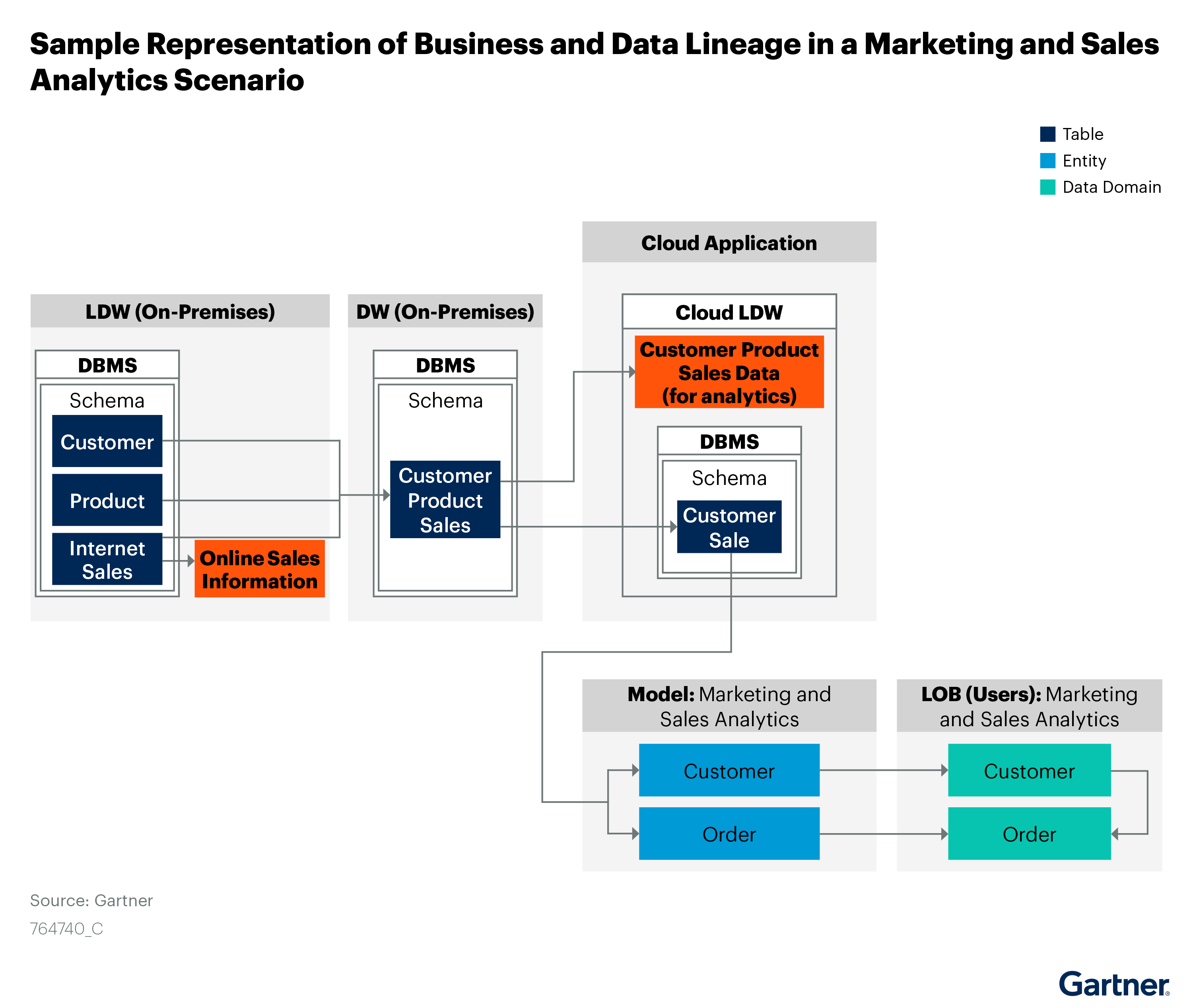
Figure 1 provides a sample representation of data lineage for a particular scenario. Please note that while business lineage provides a macro view of data’s role in business processes, data lineage offers a micro view of data’s technical journey through systems.
Five Ways Data Lineage Impacts Data Management
Data lineage enhances core data management capabilities across five key areas:
- Data engineering and DataOps — Data lineage enables multiple data management personas (including data engineers, data architects and database administrators) to assess impact by tracing data dependencies across enterprise systems. It also improves the troubleshooting and monitoring capabilities of data flows.
- Cloud-based data migration strategies — Data lineage facilitates seamless cloud migrations by leveraging cloud-native tools, ensuring data integrity and continuity during transitions and reducing the risks associated with moving data to new storage locations.
- Enhanced decision making with AI Integration — Data lineage, integrated with AI-driven analytics, automates the extraction of insights from data, enabling faster and more accurate decision-making processes, which are crucial for optimizing business operations and enhancing products and services.
- Data and analytics governance — Data lineage provides granular visibility over the data life cycle, which helps businesses manage risks, comply with industry regulations and perform audits.
Utilization of real-time data streams: Real-time data lineage tracking optimizes the use of both new and old datasets, ensuring businesses can promptly respond to market changes and evolving data collection techniques and technologies.
Motivations for introducing data lineage solutions include:
- Building trust in data used across self-service BI and analytics tools
- Identifying data that is covered by regulatory and legal obligations, including the European Union’s General Data Protection Regulation (GDPR), the Basel Committee on Banking Supervision (BCBS) 239 standard and the U.S. Health Insurance Portability and Accountability Act (HIPAA)
- Providing metadata that supports data and analytics governance effort processes with objectives like diagnosing incorrect data on an analytical dashboard
- Providing metadata that can be used during the design phase (or at the gathering requirements stage) for impact analysis
Common Data Lineage Best Practices
Consider the following best practices when introducing data lineage to your organization:
- Implement metadata management software. Data and its lineage are dynamic. You need to move beyond manually capturing data lineage in spreadsheets and automate the process. Most established metadata management solutions include data lineage as a key capability (see Tool: Vendor Identification for Data and Analytics Governance Platforms). Some vendors specifically focus on data lineage, such as Orion Governance and Solidatus.
- Include metadata sources. Database management systems (DBMs), big data tools, ETL software, Master Data Management software and other custom applications create their own data about the data they process. Include this metadata in your lineage, as it helps to understand data flow and modifications.
- Verify metadata sources. Encourage the owners of applications and tools to verify their respective metadata sources, as these data stewards are the people who clearly understand the accuracy and relevance of metadata.
- Extract metadata and lineage using forward and/or backward data flows through your system. This simplifies the process of mapping connections, relationships and dependencies among systems and within data. For example, you can start from the CRM system and work forwards, or start from the analytics dashboards and work backward.
- Validate end-to-end data lineage. Validate lineage progressively by starting from high-level connections between systems. Next, delve into connected datasets, followed by data elements before validating transformation documentation.
Recommendations When Deploying Data Lineage
Data and analytics leaders planning to invest in data lineage must evaluate both the required effort and the necessary level of investment in technology.
- Invest in a standardized data integration platform streamlines pipeline data movement, offering a unified interface for tracking. Additionally, data virtualization and fabric naturally enhance data lineage.
- Ensure that your data lineage solution accounts for input parameters, runtime information and default values, and parses all of these elements to automate end-to-end data lineage delivery.
- Choose other technologies that may offer the right solution when understanding programming logic is impossible because of inaccessible or unavailable code (pattern-based lineage), or if you are considering using a transformation engine to control data movement (lineage by data tagging).
- Introduce active metadata management, which allows you to add automation capabilities that bring a proactive approach in data lineage delivery (see State of Metadata Management: Aggressively Pursue Metadata to Enable AI and Generative AI). For example, proactive notifications can inform you about overly complex parts of your data pipelines where refactoring or redesign would help to reduce the risk of failure.
- Use manual lineage when code is unavailable or inaccessible. Manual lineage requires interviewing people to document data flow and focusing on the data life cycle. Use spreadsheets for simple mapping techniques. Reviewing code involves manually checking tables and comparing columns, which can be time-consuming and tedious. Increasing code volume and complexity further complicate manual lineage.
How Data Lineage Supports Data Observability
In DevOps, observability is a technical solution that enables teams to actively debug their systems. Data observability is based on exploring properties and patterns that have not been defined in advance.
Like its DevOps counterpart, data observability uses automated monitoring, alerting and triaging to identify and evaluate data quality and discoverability issues, leading to better-managed data pipelines and more productive teams. Data lineage is an essential element of a data observability solution. For example, in runtime contexts, when data breaks, the first question is always “where?” Data lineage tells you which upstream sources and downstream users were impacted, as well as which teams are generating the data and who is accessing it.
For more, see Market Guide for Data Observability Tools.
- Gartner inquiry data
- Vendor briefings on metadata management, DBMS, data integration and data quality solutions