Magic Quadrant for Personalization Engines
3 February 2026 - ID G00832271 - 43 min read
By Penny Gillespie, Jason Daigler, and 2 more
Personalization differentiates the customer experience, driving revenue and efficiency. The market grew 26.1% in 2024 to $1.2B, yet business and functional capability gaps remain. Successful digital marketing leaders closely examine AI and testing capabilities while being wary of possible add-ons.
Market Definition/Description
Personalization engines use knowledge about customers to create and deliver an optimum experience for them and measure the impact on customer experience. These engines apply AI, advanced analytics and business rules to create meaningful experiences across channels that facilitate customer engagement and drive revenue.
Personalization engines create a relevant, individualized interaction between two parties designed to enhance the recipient’s experience. A recipient can be a prospect, customer (known or anonymous) or employee (engaging with a customer or prospect). In commercial settings, the engines apply advanced analytics to interpret customer data — whether known or anonymous, behavioral or contextual — and adjust engagement based on where the customer is in their journey and how they’re interacting. The engines adapt content, offers and interactions in real time that facilitate the customer’s journey.
These engines are commonly used in marketing, digital commerce, and service and support:
- In marketing, they drive engagement by delivering relevant messages to the right audience at the right time and through the right channel.
- In digital commerce, they facilitate purchasing by providing meaningful content, tailored product recommendations and targeted promotional offers.
- In service and support, they enhance customer experiences by addressing needs and preferences with personalized assistance.
Personalization can range from broad targeting to highly individualized engagement, depending on what is known about the customer and how they’re interacting. This leads to stronger engagement, higher acceptance of recommendations, improved conversion, higher average order value, and reduced bounce and abandonment.
Mandatory Features
The mandatory features for this market include:
- Real-time digital behavior tracking, data collection, ingestion and storage (data augmented by batch and streaming data)
- Ability to alter interactions in real time based on individuals’ actions, context, data or a combination of the three
- Segmentation of individuals across known data and inferred beliefs to support personalization rules, including responding to contextual data and user feedback
- Extensive testing capabilities (e.g., A/B, multivariate, multiarmed bandit), including the ability to test a wide variety of personalization elements and tactics (e.g., messaging, campaigns, recommendations)
- Automated machine learning capabilities that improve personalization outcomes, including identifying underperforming audiences and recommending specific actions to improve outcomes
- Customer experience (CX) data profile creation and management capabilities
- Personalization performance tracking (e.g., campaign, commerce, recommendations) and reporting
- Embedded generative AI (GenAI) in content creation, testing and other employee tasks
Optional Features
Optional features of personalization engines include:
- Agentic AI in employee tasks
- Two-tiered data structures to support both a B2B business account and the associated buyer(s)
- Individual customer data unification and profile management
- Customer journey orchestration
- Privacy and consent management features
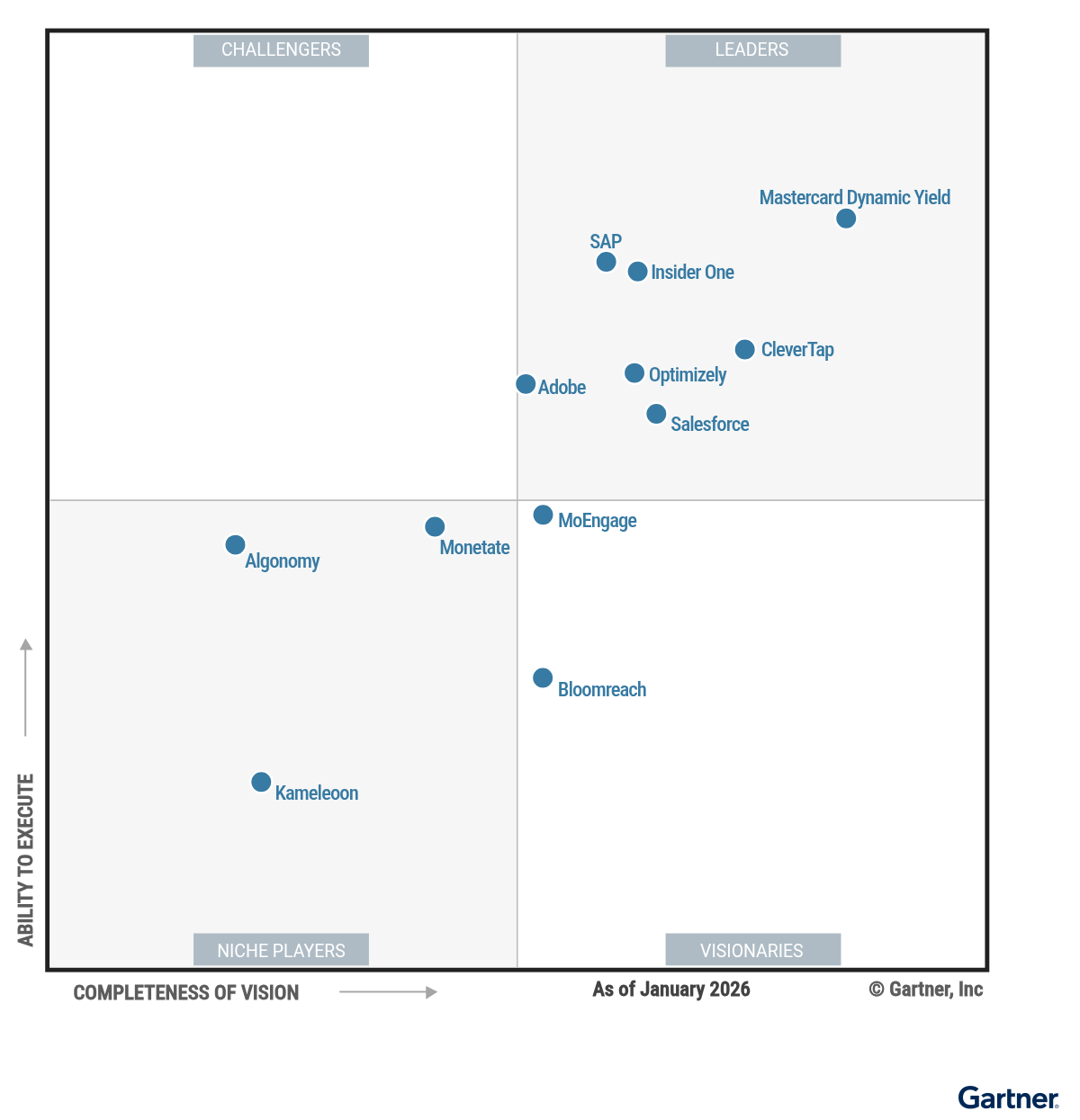
Magic Quadrant
Vendor Strengths and Cautions
Adobe
Adobe is a Leader in this Magic Quadrant. Its Adobe Journey Optimizer focuses on real-time, omnichannel personalization with AI decisioning. While it also offers Adobe Target for use cases such as A/B experimentation and contextual personalization, this evaluation focuses on its main personalization engine, Journey Optimizer. Adobe’s operations are geographically diversified, with no single region of emphasis. It primarily serves B2C, B2B and hybrid clients in midsize to global enterprises, with a strong presence in financial services, government, healthcare, IT products, manufacturing, media, real estate, retail and travel. Adobe’s roadmap includes adding agentic AI for automated journey creation, launching workflows for tuning predictive AI models automatically or manually in Journey Optimizer, and expanding integrations with loyalty platforms.
- AI innovation: Adobe’s AI capabilities include AI-powered decisioning for matching experience variants to segments, AI Assistant for operational insights about journeys, and Microsoft Copilot for segment creation. Adobe also possesses several AI-related patents.
- Geographic scope: Adobe maintains an extensive network of system integration partners. It also provides help desk support across major geographies worldwide, enabling clients to access localized expertise.
- B2B capabilities: Adobe distinguishes itself with its comprehensive understanding of the differences between personalizing for individual buyers versus accounts. Its customizable B2B data model builds paths based on different buying group roles and user-definable buying group roles within account schemas.
- Product overlaps: Journey Optimizer and Target have distinct use cases but share overlapping capabilities, which may create uncertainty about product selection. Additional cost and increased implementation time could occur if both products are required and deployed.
- Feature dependencies: Adobe Customer Journey Analytics is needed for customizable dashboards and cross-campaign analysis. Additional modules are needed for advanced segmentation, zero-party data collection and customer lifetime value targeting.
- Service offering: Unlike many other vendors, Adobe charges extra fees for typically complimentary services like identifying and calculating product value, sharing of best practices for personalization, and product performance guidance. It does not offer tiered service levels for application availability.
Algonomy
Algonomy is a Niche Player in this Magic Quadrant. Its Digital Experience Personalization and Omnichannel Customer Marketing products focus on personalized engagement and product recommendations formulated with AI and GenAI. Algonomy’s operations are geographically diversified, with a large presence in North America. It primarily serves B2C clients in midsize to global enterprises, with a strong presence in consumer products, IT products and services, manufacturing, and retail. Algonomy’s roadmap includes adding a private large language model capable of ingesting client data for better addressing individual client needs, launching voice chat support, and introducing AI-powered visual search.
- Segmentation: Algonomy’s segmentation builder uses advanced predictive models for nuanced audience segmentation, such as clustering and churn prediction. Clients can prompt its AI assistant with natural language questions to create new segments and incorporate them directly into triggers.
- Product bundling: Ensemble AI calculates affinity-based scores for each product and uses them to bundle relevant products for customers. Natural language prompts enable the AI assistant to automatically create these product bundles.
- Client portfolio: Algonomy serves a balanced mix of midsize to global enterprises. This broad client distribution contributes to the highest growth rate of net new customers in 2024 among vendors in this research.
- Language support: Algonomy’s administrative panel is restricted to English, Japanese and Portuguese. Product language support for its user interface is currently available in English, French, Japanese and Portuguese. Future language offerings are subject to client demand.
- B2B capabilities: Algonomy’s platform links user profiles of B2B users to account information, but it is limited to recommending products to users based solely on account visibility. Companies needing more advanced B2B personalization functionality may find limitations with the platform.
- User interface: Algonomy’s platform relies heavily on drop-down menus and URLs for detailed views of triggers and results. It does not offer a simplified, drag-and-drop interface for this functionality, a feature available from several other vendors.
Bloomreach
Bloomreach is a Visionary in this Magic Quadrant. Its Composable Personalization Cloud, known more recently as Bloomreach’s Agentic Personalization Platform, focuses on digital commerce and marketing, supporting omnichannel engagement and advanced targeting. Bloomreach’s operations are mostly concentrated in North America and Europe, with additional presence in Asia/Pacific. It primarily serves B2C clients in small businesses to midsize enterprises, with a strong presence in consumer products, financial services, manufacturing, retail, and travel. Bloomreach’s roadmap includes adding specialized agents that autonomously build, execute and optimize marketing programs; expanding shopping experiences through Clarity, its conversational agent; and investing in prescriptive intelligence that leverages deep neural models for next best actions and real-time optimization.
- AI capabilities: Bloomreach integrates Affinity for intuitive audience creation and Loomi AI for delivering real-time, context-driven product recommendations across multiple channels. These native modules support advanced targeting and segmentation, enabling efficient and intelligent campaign setup.
- Complimentary support: Bloomreach provides free consulting, customer success management and product value guidance. Clients also receive free access to peer networking, performance optimization advice and shared best practices for personalization.
- Native platform: Bloomreach provides functions such as event triggering, as well as a wide selection of templates for audience segmentation and testing within the platform. Users can efficiently design, launch and optimize personalized experiences.
- Industry coverage: Bloomreach supports a less concentrated set of industries in its client base, compared to many other vendors in this Magic Quadrant. As a result, its industry-specific capabilities and support may be less comprehensive for organizations outside of its concentration.
- B2B capabilities: The platform offers limited capabilities for organizations seeking B2B-specific solutions. This may restrict Bloomreach’s effectiveness for enterprises with complex account-based and buyer role personalization needs.
- Service and support integration: Bloomreach offers fewer integrations and features for customer service and support use cases. Capabilities for these offerings are less comprehensive than other vendors in this Magic Quadrant.
CleverTap
CleverTap is a Leader in this Magic Quadrant. Its CleverTap Personalization Engine, part of the All-In-One Customer Engagement Platform, focuses on digital commerce, with its multichannel marketing, TesseractDB, analytics and experimentation. CleverTap’s operations are geographically diversified, with a concentration in North America and Asia/Pacific. It primarily serves B2C clients in small businesses to global enterprises, with a strong presence in consumer products, education, financial services, healthcare, media, nonprofit, retail, travel and wholesale. CleverTap’s roadmap includes continuing investment in its native AI capabilities and agentic AI framework for prompt-to-action agents, expanding loyalty and promotions, and adding offer management following its April 2025 acquisition of rehook.ai.
- User experience: CleverTap offers a modern user interface with an intuitive campaign setup, using a clear who/what/when structure. Integrated AskAI enables users to convert text prompts into actionable queries, enhancing workflows and campaign management.
- System integration partner approach: CleverTap works with a diverse set of system integration partners, supporting both global and regional implementation models. It engages them with influenced, sourced and implemented account models, while also developing new approaches in partner-led integration services.
- AI capabilities: CleverTap continues to invest in agentic AI, with multiple prompt-driven agents facilitating campaign orchestration and automation. The product roadmap emphasizes expanding AI-driven personalization and transparency.
- Pricing structure: CleverTap’s outcome-based pricing depends on overall data volume and package multipliers applied to the number of data points consumed in personalization. This approach can complicate forecasting and make it difficult for organizations to assess total cost of ownership.
- B2B capabilities: The vast majority of CleverTap’s clients are B2C organizations. While individual-level personalization is supported, account-level features for B2B use cases such as schema mapping or visualization are not available.
- Application partner network: While CleverTap offers a range of application partners, the number of partners is lower than most vendors in this research. This limitation can increase time to market and implementation costs for organizations seeking partners outside of its current network.
Insider One
Insider One, formerly known as Insider, is a Leader in this Magic Quadrant. Its Insider One Omnichannel Experience and Customer Engagement Platform personalization engine focuses on personalization with predictive, generative, conversational and agentic AI. Insider One’s operations are geographically diversified with a large presence in Europe and Asia/Pacific. It primarily serves B2C clients in midsize to large enterprises, with a strong presence in consumer products, education, financial services, government, IT products, manufacturing, media, nonprofit, real estate, retail, transportation and travel. Insider One’s roadmap includes launching GenAI for multilingual campaigns, adding a triggering system to engage customers with AI agents, and enhancing marketer visibility into criteria driving AI decisioning.
- Application ecosystem: Insider One enhances its platform with multiple application ecosystem partnerships, especially for customer relationship management, marketing automation, email marketing and data warehousing. It offers easy integration with Snowflake and connectors for multiple data sources, software development kits, webhooks and APIs.
- Triggering capabilities: Insider One offers close to 150 out-of-the-box triggers, including date, behavior, event, attributes and predictive elements. Triggering templates and reachability checks enable nuanced personalization of customer journeys.
- Customer experience: In Gartner Peer Insights, customers are very likely to recommend Insider One to others, and they rate their experiences highly, especially in areas such as support services. This reflects satisfaction in key customer interactions.
- Pricing structure: Insider One offers many of its capabilities as add-ons. This modular approach can increase total cost of ownership and may confuse buyers as to which modules are needed.
- B2B capabilities: The platform lacks dedicated B2B features and integrations, such as personalizing based on accounts and buyers’ roles. This limited focus on B2B use cases will require organizations with more traditional B2B account requirements to incur additional costs for customization.
- Enterprise innovation patents: While Insider One’s future innovation focuses on AI agents and analytics, its number of patents falls well below those of its peers. The lack of patents may risk its ability to sustain its edge in innovation.
Kameleoon
Kameleoon is a Niche Player in this Magic Quadrant. Its AI Personalization product consists of two modules: Web Experimentation and Feature Experimentation. They focus on marketing and digital commerce, using real-time algorithms to score visitors and trigger targeted experiences. Kameleoon’s operations are mostly concentrated in Europe, with additional presence in North America and Asia/Pacific. It primarily serves B2C clients in midsize to global enterprises, with a strong presence in consumer products, financial services, healthcare, IT products, retail and travel. Kameleoon’s roadmap includes adding agentic capabilities for context understanding and experimentation, enhancing reporting with a conversational analytics layer via natural language prompts, and expanding PBX functionality for ideation of personalization and experimentation.
- Client enablement: Kameleoon offers a range of complimentary services, such as usage cost calculations, technical resources, training, and user conference attendance. These services facilitate onboarding, implementation and ongoing operations.
- Prompt-based experimentation: Customers can prompt or create personalized experiences variations from mockups or Figma designs. The platform builds them directly on the website without requiring a separate prototype, resulting in rapid development of a fully functional experience.
- Partner ecosystem: Kameleoon has a broad set of application partners. It supports at least two partners with prebuilt solutions for analytics and BI tools, customer data platforms, content management, data storage, digital commerce, email marketing and marketing automation.
- Geographic scope: With most of its clients concentrated in Europe and North America, Kameleoon’s ability to serve buyers outside these regions is limited. Product language support for the user interface and administrative panel is restricted to English, French and German.
- Service and support: Kameleoon’s customer support is only available during business hours in the regions of operation. Service-level agreements for incident response times lagged behind other vendors in this Magic Quadrant.
- R&D investment: Kameleoon’s allocation of revenue to research and development for its personalization capabilities is lower than that of other vendors in this Magic Quadrant. Its approach to funding innovation is less mature compared to peers, which can result in a slower pace of enhancements.
Mastercard Dynamic Yield
Mastercard Dynamic Yield is a Leader in this Magic Quadrant. Its Experience OS personalization engine focuses on digital commerce and marketing, enabling personalization across the full customer life cycle. Dynamic Yield’s operations are geographically diversified, with no single region of emphasis. It primarily serves B2C and hybrid clients in midsize enterprises to global enterprises, with a strong presence in consumer products, financial services, retail and travel. Dynamic Yield’s roadmap includes investing in agentic, brand-trained AI and multiagent systems, enhancing conversational commerce, semantic understanding and autonomous check-out; and building on the launch of Experience Search and its conversational customer assistant, Shopping Muse, for improved customer experiences.
- AI capabilities: Dynamic Yield embeds AdaptML’s AI capabilities, enabling targeted and purpose-built personalization. AdaptML uses predictive and deep learning to estimate engagement likelihood, segment audiences, generate personalized recommendations, and optimize visual content for digital campaigns.
- Product strategy: Dynamic Yield continues its forward-looking approach with empathic personalization. This provides emotionally attuned responses based on a user’s state, predicting and responding to individual needs and emotions in real time.
- Mastercard data: Dynamic Yield’s Element uses Mastercard data to enable geography-based predictive targeting and spend insights. Retailers can use aggregated and anonymized transactions for segmentation, and financial institutions can apply propensity modeling to tailor materials for bank cardholders.
- B2B capabilities: Dynamic Yield’s B2B capabilities are less developed, with limited prebuilt integrations and fewer examples supporting complex B2B use cases, such as deep account-based personalization. Organizations with advanced B2B requirements may find the platform less suited to their needs, compared to other vendors in this Magic Quadrant.
- Modular platform: Navigating Dynamic Yield’s applications, packages, modules and extensions may present challenges for marketers, especially when configuring advanced features. This can increase implementation time and resource requirements for some organizations.
- Industry coverage: Dynamic Yield’s platform capabilities and integrations are less comprehensive outside its core industries. Industry-specific features and support may be limited for organizations outside less-represented verticals.
MoEngage
MoEngage is a Visionary in this Magic Quadrant. Its MoEngage personalization engine focuses on digital commerce and marketing, using customer data, a drag-and-drop editor, server-side personalization, and custom widgets. MoEngage’s operations are geographically diversified, with no single region of emphasis. It primarily serves B2C clients in midsize to large enterprises, with a strong presence in consumer products, financial services, IT products, media, retail and travel. MoEngage’s roadmap includes enhancing Merlin AI Offer Decisioning for automated, optimized offer presentation, expanding its portfolio solution to unify customer data across brands and franchises into a single profile and adding customer scorecards to assist in maximizing value.
- AI capabilities: MoEngage demonstrates a solid understanding of the market by investing in AI agents for operational and decisioning tasks in personalization, including Merlin AI. The platform also supports data management by enabling MoEngage AI agents to clean and transform data.
- Customer focus: MoEngage offers customers meaningful opportunities to contribute to development of its product roadmaps. Clients seeking a vendor with capabilities they can grow and shape may have ample opportunity to do so with MoEngage.
- Profile management: MoEngage offers comprehensive customer profile capabilities, allowing ingestion of data from multiple sources and display of individual profiles. Predictive insights within profiles support precise segmentation and personalization strategies.
- Industry coverage: MoEngage offers fewer industry-specific solutions compared to competitors, with limited reach outside of standard B2C models. The platform’s capabilities may not be as comprehensive for organizations in less-represented sectors.
- Enterprise suitability: MoEngage has a primary client base of midsize enterprises and much fewer global enterprise clients when compared to other vendors in this Magic Quadrant. This may impact its ability to support global, complex requirements at scale.
- B2B functionality: B2B features in MoEngage are limited or require customization to address specific data and hierarchical relationship needs. The platform does not provide dedicated account structures or integrations commonly required by B2B organizations.
Monetate
Monetate is a Niche Player in this Magic Quadrant. Its Monetate Personalization Engine consists of two AI-driven integrated suites: Symphony for personalization and Maestro for experimentation and testing. It focuses on marketing and digital commerce, with comprehensive testing capabilities highlighted by its acquisition of SiteSpect. Monetate’s operations are geographically diversified, with no single region of emphasis. It primarily serves B2B, B2C and hybrid clients in small businesses to global enterprises, with a strong presence in construction, consumer products, retail and travel. Monetate’s roadmap includes enhancing its Monet AI Assistant with development through its Knowledge Agent and Experience Agent, adding direct data syncing to Snowflake and introducing a new user experience for its personalization platform.
- Customer experience: Monetate ties a percentage of direct sales team compensation to customer experience scores within their accounts. This approach is uncommon at scale among vendors in this Magic Quadrant and demonstrates commitment to customer satisfaction, which can drive loyalty and growth.
- Client support: In 2025, Monetate launched Monetate Concierge, an unlimited customer service program with best-in-class global support 24 hours a day, 365 days a year. Existing customers will be transitioned to Concierge support at no extra cost.
- Testing technology: Monetate’s acquisition of SiteSpect added a patented zero-flicker delivery. It enables real-time website content modification for A/B testing and personalization without altering the original server code, and avoids the visual flicker effect by applying variations at the network level before the page renders.
- R&D investment: Monetate dedicates a smaller portion of its revenue to research and development than other vendors in this Magic Quadrant. This may slow the rate of innovation and upgrades.
- Support integrations costs: Support for common service and support tool integrations (e.g., chatbots, voice assistants, digital kiosks, call centers) is strictly via API. While Monetate Concierge can assist in the API manual setup and management, it comes at an additional cost.
- Product language support:. Monetate’s product administrative panel and user interface product language support is only available to users in English. Additionally, customer training is restricted to offerings in English and Spanish.
Optimizely
Optimizely is a Leader in this Magic Quadrant. Its Optimizely Digital Optimization — part of the Optimizely One suite, which includes Personalization, Web Experimentation, Feature Experimentation and Analytics modules — focuses on marketing. Optimizely’s operations are geographically diversified, with no single region of emphasis. It primarily serves B2B, B2C and hybrid clients in small businesses to large enterprises, with a strong presence in consumer products, education, financial services, IT products and services, manufacturing, media, retail and travel. Optimizely’s roadmap includes advancing its AI-native orchestration layer, Opal, for automated personalization with autonomous agents, upgrading its warehouse-native segmentation and voice-driven experiment creation via Experimentation MCP Server, and enhancing its edge delivery.
- AI integration: Optimizely’s Opal provides an AI-native orchestration layer that automates workflows and enables self-optimizing personalization at scale. It reduces manual effort and eases setup of personalization tasks.
- Data analytics: Its Optimizely Warehouse-Native Analytics, resulting from its NetSpring acquisition, strengthens Optimizely’s ability to connect experimentation with data warehouse analytics. This integration improves insight accuracy and supports enterprise-level governance.
- Developer enablement: Optimizely offers freemium offerings targeted to developers, as well as integrated tools like Opal and Microsoft Copilot, to support productivity. Optimizely’s emphasis on the developer segment simplifies experimentation setup and accelerates iteration cycles for power user technical teams.
- User interface: Optimizely’s user interface relies heavily on text-based drop-down menus and lacks visual workflow elements. This text-heavy design makes navigation less intuitive and may cause steeper learning curves for new users.
- AI usage: Opal AI’s credit-based pricing model leads to significant variability in credit consumption based on task and agent type. This can make it challenging to predict usage and manage budgets, highlighting the importance of credit usage notifications in the Optimizely Admin Center.
- Customer data platform: Optimizely’s customer data platform may be required for achieving advanced use cases in personalization. This reliance may complicate integration strategies for enterprises with existing data ecosystems.
Salesforce
Salesforce is a Leader in this Magic Quadrant. Its Salesforce Personalization focuses on AI-driven real-time personalization across its entire product portfolio. While it offers Marketing Cloud Personalization for campaigns and content across email, web and mobile, this evaluation focuses on its main personalization engine, Salesforce Personalization. Salesforce’s operations are geographically diversified, with no single region of emphasis. It primarily serves B2B, B2C and hybrid clients in midsize to global enterprises, with a strong presence in consumer products, financial services, healthcare, IT products and services, manufacturing, media, pharmaceutical, retail, transportation, travel, and wholesale. Salesforce’s roadmap includes expanding no-code tools for mobile apps while enhancing its agentic AI and automated experimentation winner selection.
- Application ecosystem: Salesforce offers a robust application ecosystem with a wide range of third-party data ingestion options and an extensive application marketplace. This enables organizations to extend platform capabilities and connect with diverse external tools and services.
- Service provider network: Salesforce collaborates with solution integrators worldwide, providing comprehensive support and ensuring global service coverage. Its established partner network helps clients implement and optimize personalization initiatives across regions.
- Data foundation: Salesforce Personalization is natively integrated with its Data 360, enabling advanced customer profile management and maintenance. This integration supports unified data access and facilitates precise personalization strategies.
- Product architecture: Salesforce has two personalization offerings. Salesforce Personalization is built on Data 360, while Marketing Cloud Personalization is based on Salesforce’s acquisition of Evergage. Each solution has distinct features, which may make it challenging for buyers to determine the best fit or combination for their particular needs.
- Pricing structure: Pricing involves multiple variables, including credit-based AI features and Data 360 usage, along with additional costs for certain add-ons. This structure may make it challenging for organizations to accurately estimate total cost of ownership.
- Template availability: Salesforce Personalization currently lacks built-in templates for audience segmentation and testing. This may increase time to value for organizations seeking rapid deployment.
SAP
SAP is a Leader in this Magic Quadrant. Its SAP Engagement Cloud, the new name for its Emarsys and Enterprise editions, supports marketing, digital commerce and customer service. Engagement Cloud is part of SAP Business Suite and can be bundled with SAP Customer Data Platform. SAP’s operations are geographically diversified, with no single region of emphasis. It primarily serves B2B, B2C and hybrid clients in midsize to global enterprises, with a strong presence in consumer products, manufacturing, natural resources, media, retail, travel and wholesale. SAP’s roadmap includes adding its AI-powered Joule Assistant and Agents for audience segmentation and cross-channel content creation, expanding localization and translation capabilities and data integrations across SAP. It also plans to introduce self-service onboarding.
- Customer satisfaction: In Gartner Peer Insights, customers give high ratings on their experience with SAP Engagement Cloud, particularly in areas like contract negotiations, integration and deployment and support services. This shows satisfaction in key interactions.
- SAP portfolio integration: SAP Engagement Cloud connects to marketing, service, customer loyalty and sales for unified, personalized journeys. Bidirectional data exchange enables customer service representatives to add value and generate revenue, while enabling sales and marketing support, proactive retention, and mindful revenue.
- Global scope: SAP Engagement Cloud serves clients across the globe in a range of industries, providing worldwide support for sales, operations and service. It maintains an extensive global partner network and supports privacy laws in all regions except China.
- Incident response time: SAP’s service-level agreements for incident response times are significantly longer than those of peers. Organizations needing rapid issue resolution may require more comprehensive support.
- Incurred algorithm cost: Support for “bring your own algorithm” requires an additional cost, while ingestion or propensity scores or predictions from external models require integration. This could limit flexibility for organizations seeking advanced algorithmic personalization.
- Third-party requirements: Some advanced promotion, testing or recommendation use cases, such as full-factorial multivariate testing, may require a purchase of Mastercard Dynamic Yield. This dependency can impact organizations seeking these specialized capabilities.
Vendors Added and Dropped
We review and adjust our inclusion criteria for Magic Quadrants as markets change. As a result of these adjustments, the mix of vendors in any Magic Quadrant may change over time. A vendor's appearance in a Magic Quadrant one year and not the next does not necessarily indicate that we have changed our opinion of that vendor. It may be a reflection of a change in the market and, therefore, changed evaluation criteria, or of a change of focus by that vendor.
Added
- Algonomy
- MoEngage
Dropped
Sitecore no longer appears in this Magic Quadrant because it did not meet two criteria:
- Automated machine learning and embedded GenAI capabilities are not inherently part of Sitecore Personalize.
- It segments individuals predominantly via Sitecore CDP, which is a separate product SKU.
Inclusion and Exclusion Criteria
To be included in this Magic Quadrant, each vendor had to satisfy the following inclusion criteria, defined by Gartner, as of 22 October 2025.
Offer the personalization engine as an independent product.
- Vendor must offer the personalization engine as a stand-alone product separate from other products like the content management system, multichannel marketing hub, customer data platform, digital experience platform, search and product discovery, digital commerce platform, Marketing Automation Platform (MAP) and analytics solution.
Have proven industry coverage.
- Vendor must have proven customer engagement across industries with at least 25% of revenue generated from non-retail industries (e.g., consumer goods and services, entertainment, hospitality, high tech, manufacturing, media, telecom, tourism, transportation, wholesale).
Achieve minimum requirements in terms of market presence and momentum.
For inclusion in this Magic Quadrant for Personalization Engines, vendor must have achieved:
- Total revenue from the sale or license of personalization engine greater than $25 million for calendar year 2024 or the most recent fiscal year end, excluding services, and either of the following:
- A minimum of 25 net new customer deployments of the personalization engine in 2024, excluding pilots.
- A minimum of 20% year-over-year growth in 2024 from the sale or license of the personalization engine when compared to 2023.
Include key mandatory features for this market.
- Real-time digital behavior tracking, data collection, ingestion and storage (data augmented by batch and streaming data)
- Ability to alter interactions in real time based on individuals’ actions, context, data or a combination of the three
- Segmentation of individuals across known data and inferred beliefs to support personalization rules, including responding to contextual data and user feedback
- Extensive testing capabilities (e.g., A/B, multivariate, multiarmed bandit), including the ability to test a wide variety of personalization elements and tactics (e.g., messaging, campaigns, recommendations)
- Automated machine learning capabilities that improve personalization outcomes, including identifying underperforming audiences and recommending specific actions to improve outcomes
- Customer experience (CX) data profile creation and management capabilities
- Personalization performance tracking (e.g., campaign, commerce, recommendations) and reporting
- Embedded generative AI (GenAI) in content creation or testing or other employee tasks
Evaluation Criteria
Companies evaluating personalization engines have an array of requirements that vary based on industry, channels served (e.g., email, digital, store, sales rep, service rep, point of sale), and required use cases (e.g., marketing, sales, customer service, self-service, store). The best assessment tool, however, for those seeking a personalization engine remains vendors’ clients’ testimonials and customer references.
The evaluation criteria and weights describe the specific characteristics and their relative importance that support Gartner’s view of the market. Prospective buyers can use these criteria to comparatively evaluate the personalization engine providers in this research.
Ability to Execute
Gartner analysts evaluate providers on the quality and efficacy of the processes, systems, methods or procedures that enable IT provider performance to be competitive, efficient and effective, and to positively impact revenue, retention and reputation within Gartner’s view of the market.
Gartner made no changes to any weights in the Overall Viability criterion this year. The Product or Service criterion remains high, as it is typically the No. 1 item used by prospects to evaluate vendors and create their shortlists. Overall Viability also remains high this year, because viability is viewed as a crucial criteria by clients and prospects. All other criterion weights remain as either medium or low.
Ability to Execute Evaluation Criteria
| Evaluation Criteria | Weighting |
|---|---|
Product or Service | High |
Overall Viability | High |
Sales Execution/Pricing | Low |
Market Responsiveness/Record | Low |
Marketing Execution | Low |
Customer Experience | Medium |
Operations | Low |
Source: Gartner (February 2026)
Completeness of Vision
Gartner analysts evaluate providers on their ability to convincingly articulate logical statements. This includes current and future market direction, innovation, customer needs and competitive forces and how well they map to Gartner’s view of the market.
Gartner made no changes to any weights in the Completeness of Vision Evaluation Criteria this year. In order to produce the best products and services, vendors must understand the market and its needs. As a result, the Evaluation Criteria, Marketing Understanding and Offering (Product) Strategy retain their weighting of high. All other weightings remain medium or low with the exception of Business Model, which is not rated because it is so tightly woven into many of the other criteria (e.g., operations, vertical/industry strategy, geographic strategy, sales execution/pricing and marketing execution).
Completeness of Vision Evaluation Criteria
| Evaluation Criteria | Weighting |
|---|---|
Market Understanding | High |
Marketing Strategy | Medium |
Sales Strategy | Low |
Offering (Product) Strategy | High |
Business Model | NotRated |
Vertical/Industry Strategy | Low |
Innovation | Medium |
Geographic Strategy | Low |
Source: Gartner (February 2026)
Quadrant Descriptions
Leaders
Leaders demonstrate a solid understanding of the market and offer product capabilities organizations need now. They are typically committed to customer success. Leaders offer sophisticated personalization engines at enterprise scale, covering multiple industries and an expansive geographic footprint. They deliver clear business value and are continually exploring emerging technology — taking personalization to the next level and thus protecting the investments of today’s buyers.
Challengers
Challengers are well-positioned to succeed in the market. However, they focus their personalization engine on a narrower set of use cases or a limited set of industries or geographies. At the same time, they have been successful in executing their strategy and growing both their revenue and customer counts. Their vision may be hampered by the lack of a coordinated strategy across the various products in their portfolios. Alternatively, they may lack the marketing efforts, sales channel, geographic presence, industry-specific content or awareness of the vendors in the Leaders quadrant.
Visionaries
Visionaries have a strong and unique vision for delivering personalization capabilities. They are thought leaders and innovators, but often lack scale and the ability to provide consistent execution. They offer depth of functionality in the areas they address and can be quite sophisticated in their offerings. However, they may have gaps relating to broader functionality requirements, serve a smaller number of customers, or have a more narrow scope in operations and/or sales execution than leaders.
Niche Players
Niche Players typically lack breadth across their personalization engine portfolio, but may focus on a specific domain or aspect of personalization, such as recommendations, measurement, targeting, and testing or reporting. They serve a smaller market and may lack significant quantities of customer reviews and ratings when compared to Leaders. While Niche Players may have strength in their specific domain, they often lack supporting services or may have a smaller, less diverse set of partners. Typically, Niche Players may not have achieved the necessary scale to solidify their market positions and are often limited in their industry and geographic scope.
Context
This research is an assessment of vendors’ capabilities based on past execution, current abilities and future development plans as they pertain to both the vendors’ overall performance and personalization engine revenue.
For these personalization engines, this Magic Quadrant evaluation emphasized financial results (i.e., total revenue, personalization revenue, customer growth, profitability), coupled with product breadth and level of AI sophistication. It also assessed how well an organization’s marketing, sales and operations approaches supported it. Strong consideration was also given to overall customer experience, innovation and partner networks due to the many touchpoints of personalization. Consideration was also given to the organization’s geographic reach and the types of customers it serves (business model(s), size, and industries). See Notes 1 through 4 for details on how we classified geographic reach and customer types. Evaluated products also supported a minimum of two use cases in these areas: marketing, digital commerce and customer service.
This research, however, did not evaluate other solutions that may comprise a vendor’s total personalization product portfolio (e.g., search and product discovery, customer data platform, multichannel marketing hub, digital experience platform) unless the solution was natively embedded as part of the personalization engine and not sold separately.
Readers should use this Magic Quadrant with its companion document, Critical Capabilities for Personalization Engines, and Gartner’s Peer Insights (product reviews and ratings) for personalization engines.
Market Overview
Personalization, at its core, is about delivering the right experience at the right time to move a recipient toward their desired outcome. In turn, this focus brings rewards to the organization through revenue, customer satisfaction and cost-efficiency. Today’s personalization engines use sophisticated AI to identify customer intent and guide customers through their journeys. Many vendors are incorporating GenAI to both facilitate the use of personalization engines and improve personalization results.
Key trends shaping the market include:
Expansion Across Verticals
While many, if not most, personalization engines began in retail and digital commerce, this foundation has grown to include marketing, customer service and sales. Vertical support is no longer limited to retail, with all personalization engines in this Magic Quadrant serving a minimum of 10 industries, which is an increase from last year. This reflects the broadening applicability of personalization technology across organizations.
Personalization Remains a Capability Gap
The 2024 Gartner CMO Spend Survey shows that chief marketing officers (CMOs) have identified personalization as a gap between current capabilities and what marketing organizations need to achieve their business goals. In early 2025, 48% of CMOs responding to the 2025 Gartner CMO Spend Survey reported they plan to increase investment in digital shelf content, and 64% cited planned increases in personalization of digital commerce touchpoints over the next 12 months. CMOs also told Gartner that they expected their spend on personalization efforts to grow from 19.3% of marketing budget in 2024 to 25.9% in 2025.
CMOs have further reported to Gartner that investment in personalization helps them achieve both revenue and profit growth. About one-fifth of respondents to Gartner’s 2025 survey said GenAI supports their personalization efforts, which leads to higher returns in optimization, targeting and personalization.
Customer Reluctance and Demand for Convenience
Consumers continue to hesitate to share information with organizations in exchange for personalized communications. According to the 2025 Gartner Consumer Values and Lifestyle Survey, just over 60% of U.S. consumers would rather give up more relevant and personalized experiences than have their digital behaviors tracked. This trend has remained steady over the past several years.
At the same time, consumers report that they want convenience. In the 2024 Gartner Consumer Behavior in Retail Survey, 73% of consumers ranked the ability to shop quickly and efficiently as one of the three most important factors influencing their shopping decisions. Consumers also described convenience as helping them manage busy lives, reducing effort to get what they need, providing information about products and prices quickly, offering some but not too many choices, and simplifying their lives.
Vendor Focus on Customer Intent and Content Creation
In response to these trends, personalization engine vendors are helping their clients achieve greater success by continuing to improve their ability to understand customer intent, whether customers are known or anonymous. Vendors are using AI to personalize experiences, reduce customer effort and identify the best choices for customers. Personalization engines are also using GenAI to enhance content creation and improve employee efficiency.
Market Growth
In the cross-CRM market, the fastest-growing segment was personalization engines, which grew 26.1% in 2024 to $1.2 billion, down from 21.1% in 2023 (see Market Share Analysis: CRM Marketing and Cross-CRM Software, Worldwide, 2024).
While personalization engines share common features and functionality, the market remains fragmented due to differences such as their scope — including channels covered, their supported use cases and their degree of AI sophistication. Gartner expects vendors to remain highly innovative as they continue to use AI to meet rising expectations for tailored customer experiences.
Vendors add even more market complexity with their distinct approaches. Some focus solely on personalization technology. Others offer complementary solutions like digital experience platforms, search, and product discovery, including web content management and digital commerce. Still others provide customer relationship management enterprise solutions like marketing, sales enablement, customer service, digital commerce and enterprise resource planning, with these functions increasingly connected for more advanced initiatives.
As you evaluate personalization engine vendors, it is important to recognize that technology alone does not guarantee success. The 2025 Gartner CMO Spend Survey shows that companies allocating more of their budget to personalization training than to technology are 1.7 times more likely to exceed their objectives. Prioritizing enablement and skill development alongside platform selection can significantly improve your organization’s ability to deliver effective, scalable personalization.
As a digital marketing leader, use this Magic Quadrant to assess the strengths and strategic direction of personalization engine vendors. Identify solutions that best match your organization’s immediate marketing goals and long-term customer engagement strategy. Refer to the companion Critical Capabilities for Personalization Engines to determine which platforms deliver the features and outcomes most essential to your business.
Gartner 2024 CMO Spend Survey. This survey looked at top-line marketing budgets and aimed to identify how evolving customer journeys, C-suite pressures and cost challenges impact marketing’s spending priorities and channel effectiveness. The research was conducted online from February through March 2024 among 395 respondents in North America (n = 200) and Europe (n = 195). Respondents were required to be involved in decisions pertaining to setting or influencing marketing strategy/planning and to aligning marketing budget/resources, and/or they were required to lead cross-functional programs and strategies with marketing. Seventy-four percent of the respondents came from organizations with $1 billion or more in annual revenue. Respondents came from a variety of industries: financial services (n = 46), insurance (n = 35), manufacturing (n = 48), consumer products (n = 32), media (n = 35), retail (n = 38), healthcare (n = 47), pharma (n = 37), IT and business services (n = 41), and travel and hospitality (n =36). Disclaimer: Results of this survey do not represent global findings or the market as a whole, but reflect the sentiments of the respondents and companies surveyed.
2025 Gartner CMO Spend Survey. This survey explored top-line marketing budgets with the goal of understanding how changing customer journeys, pressures from the C-suite and cost challenges affect marketing’s spending priorities and channel effectiveness. Conducted online from January through March 2025, the research included 402 respondents from North America (n = 202), the United Kingdom (n = 97) and Europe (n = 103; including France, Germany, Belgium, Denmark, Finland, Netherlands, Norway and Sweden). Participants were required to be involved in decisions related to setting or influencing marketing strategies/planning, aligning marketing budgets/resources, or leading cross-functional programs and strategies with marketing. Seventy-seven percent of the respondents represented organizations with annual revenue of $1 billion or more. The respondents came from a diverse range of industries: manufacturing (n = 52), financial services (n = 50), insurance (n = 43), consumer products (n = 43), healthcare (n = 42), travel and hospitality (n = 37), IT and business services (n = 36), retail (n = 36), pharma (n = 32), and media (n = 31). Disclaimer: Results of this survey do not represent global findings or the market as a whole, but reflect the sentiments of the respondents and companies surveyed.
2025 Gartner Consumer Values and Lifestyle Survey. The purpose of this survey was to understand consumer lifestyles and motivations. The research was conducted online in two parts from 11 August to 16 September 2025 among 6,110 respondents in the U.S. (4,038), Canada (1,016), and the U.K. (1,056). The first part of the survey included screening, demographic, sentiment, values, and lifestyle questions. The second part included questions specific to given categories (e.g., money and spending, technology and media, retail, and health). Respondents were required to be at least 15 years old. Country-specific quotas for geographic area, age, gender, and employment status in the U.S., and geographic area, age, gender, and employment status in the U.K. and Canada, were set to approximate each country’s total population.
2024 Gartner Consumer Behavior in Retail Survey. The survey objectives are to understand consumer preferences in relation to retail experiences in the physical store environment, quick-service restaurants and fuel stations. The survey looks to investigate actions retailers can take to support customers in their shopping process. We explore various factors that influence consumer shopping behavior, such as aspirations, convenience, financial status, values and safety. The survey also assessed the preference and usage of different types of payment methods, such as cash; credit; debit card; buy now, pay later; QR code; and tap devices, while shopping in a physical store or online. The survey also includes customer experience aspects while using in-car payment systems and services at fuel retailing. The survey was conducted online from August through September 2024. In total, 2,480 customers participated in the survey. Qualified customers were ≥18 years of age and must have interacted with a retailer in person at least once in the last six months. The countries covered were the U.S. (n = 736), the U,K. (n = 449), Canada (n = 356), China (n = 432), India (n = 209) and Japan (n = 298). Disclaimer: The results of this survey do not represent global findings or the market as a whole, but reflect the sentiments of the customers surveyed.
Additional Sources:
- Gartner Peer Insights reviews for “personalization engines”: We considered reviews posted from November 2024 through October 2025.
- Gartner inquiry data was collected from October 2024 through September 2025.
- Google Search data was collected from October 2024 through September 2025.
- Gartner site search data was collected from October 2024 through September 2025.
- Web traffic analytics data was collected from September 2024 through August 2025.
- Secondary research: Gartner uses public sources of Information like company websites, press releases, financial reports, articles and public domain videos.
Note 1: Geographical Reach
Geographical reach is referenced in vendors’ profiles as it pertains to various aspects of their operations.
- Geographically diversified refers to vendors whose operations extend across multiple world regions, rather than being concentrated in a single area.
- Regional emphasis indicates a significant concentration of clients or operations in one or more specific world regions. Regions referenced in this research include:
- North America
- Latin America
- Europe
- Middle East
- Africa
- Asia/Pacific
For example, a vendor described as “geographically diversified with a large presence in Asia/Pacific” would have clients across multiple regions, but a notable concentration in the Asia/Pacific market.
Note 2: Client Types
Business models are referenced in vendor’s profiles in regards to the type of customers they serve. The following business models were used.
- B2B: Organizations conducting business primarily with other businesses.
- B2C: Organizations serving individual consumers.
- Hybrid: Organizations operating in both B2B and B2C spaces.
Note 3: Vendor Organizational Size Definitions
Organizational size categories are referenced in vendors’ profiles in regards to their customer base in 2024 for their personalization engines. The following sizes were considered:
- Small business: 1 to 249 employees
- Midsize enterprise: 250 to 4,999 employees
- Large enterprise: 5,000 to 24,999 employees
- Global enterprise: 25,000+ employees
- Government: Includes all levels of government organizations
Organizational size segments are only included in a vendor’s profile if the category is estimated to represent more than 10% of a vendor’s total customer base.
Note 4: Vendor Industry Focus
Industries are referenced in vendors’ profiles if they represent more than 5% of a vendor’s attributed revenue. The following industries are considered:
- Agriculture
- Construction
- Consumer products (personal care, beauty, OTC, homecare, FMCG, food & beverage)
- Education
- Financial services (to include banking, insurance, brokerage)
- Government
- Healthcare providers
- IT products (hardware, software, SaaS, IT services, telecommunications)
- IT services (B2B)
- Manufacturing (chemicals, industrial equipment, consumer durables, nondurables)
- Natural resources (fishing, forestry, mining, electric/gas distribution, metals, wood, paper)
- Media (advertising, publishing, broadcasting, cable and satellite, entertainment)
- Nonprofit/charity and NGO
- Pharmaceutical, biotechnology and life sciences
- Real estate
- Retail (department stores, grocery, big box, specialty, convenience, luxury)
- Transportation and logistics (motor freight, air cargo, warehousing, postal, courier, pipelines, 3PL)
- Travel (including hospitality, airlines, hotels, restaurants, catering, amusement)
- Wholesale (including distributors)
- Other vertical markets
Ability to Execute
Product/Service: Core goods and services offered by the vendor for the defined market. This includes current product/service capabilities, quality, feature sets, skills and so on, whether offered natively or through OEM agreements/partnerships as defined in the market definition and detailed in the subcriteria.
Overall Viability: Viability includes an assessment of the overall organization's financial health, the financial and practical success of the business unit, and the likelihood that the individual business unit will continue investing in the product, will continue offering the product and will advance the state of the art within the organization's portfolio of products.
Sales Execution/Pricing: The vendor's capabilities in all presales activities and the structure that supports them. This includes deal management, pricing and negotiation, presales support, and the overall effectiveness of the sales channel.
Market Responsiveness/Record: Ability to respond, change direction, be flexible and achieve competitive success as opportunities develop, competitors act, customer needs evolve and market dynamics change. This criterion also considers the vendor's history of responsiveness.
Marketing Execution: The clarity, quality, creativity and efficacy of programs designed to deliver the organization's message to influence the market, promote the brand and business, increase awareness of the products, and establish a positive identification with the product/brand and organization in the minds of buyers. This "mind share" can be driven by a combination of publicity, promotional initiatives, thought leadership, word of mouth and sales activities.
Customer Experience: Relationships, products and services/programs that enable clients to be successful with the products evaluated. Specifically, this includes the ways customers receive technical support or account support. This can also include ancillary tools, customer support programs (and the quality thereof), availability of user groups, service-level agreements and so on.
Operations: The ability of the organization to meet its goals and commitments. Factors include the quality of the organizational structure, including skills, experiences, programs, systems and other vehicles that enable the organization to operate effectively and efficiently on an ongoing basis.
Completeness of Vision
Market Understanding: Ability of the vendor to understand buyers' wants and needs and to translate those into products and services. Vendors that show the highest degree of vision listen to and understand buyers' wants and needs, and can shape or enhance those with their added vision.
Marketing Strategy: A clear, differentiated set of messages consistently communicated throughout the organization and externalized through the website, advertising, customer programs and positioning statements.
Sales Strategy: The strategy for selling products that uses the appropriate network of direct and indirect sales, marketing, service, and communication affiliates that extend the scope and depth of market reach, skills, expertise, technologies, services and the customer base.
Offering (Product) Strategy: The vendor's approach to product development and delivery that emphasizes differentiation, functionality, methodology and feature sets as they map to current and future requirements.
Business Model: The soundness and logic of the vendor's underlying business proposition.
Vertical/Industry Strategy: The vendor's strategy to direct resources, skills and offerings to meet the specific needs of individual market segments, including vertical markets.
Innovation: Direct, related, complementary and synergistic layouts of resources, expertise or capital for investment, consolidation, defensive or pre-emptive purposes.
Geographic Strategy: The vendor's strategy to direct resources, skills and offerings to meet the specific needs of geographies outside the "home" or native geography, either directly or through partners, channels and subsidiaries as appropriate for that geography and market.