Market Guide: Private Connectivity for Cloud Services, Global
6 October 2025 - ID G00834641 - 48 min read
By Gaspar Valdivia, Lisa Pierce, and 1 more
Enterprises continue to shift mission-critical workloads to cloud IT, elevating their requirements for high-performing, secure multicloud connections, cloud-like operations, and cloud-to-cloud enablement. IT leaders can use this research to navigate the breadth of private connectivity options.
Overview
Key Findings
- With increased investment in cloud services, businesses are becoming more dependent on secure and reliable cloud interconnections, which internet connections cannot always guarantee.
- Multicloud approaches increase the networking complexity of managing branch-to-cloud and cloud-to-cloud network connectivity. Colocation hubs (CHs), carrier-based cloud interconnects (CBCIs), and software-defined cloud interconnects (SDCIs) provide a hub to connect an enterprise to various cloud, network, and internet service providers.
- Providers of private connectivity to cloud services are adopting flexible commercial models, including consumption-based pricing and granular, scalable bandwidth options, to align with enterprise requirements for flexibility and cost-efficiency.
- Security features such as encryption and firewalling, as well as compliance, are now baseline requirements in private interconnections to the cloud, while other value-added and ancillary services can help build further differentiation in the competitive landscape.
Recommendations
- Obtain higher bandwidth services and lower egress costs by deploying private cloud interconnects to extend private wide-area network (WAN) connectivity from the enterprise to cloud services if you have high data egress volumes.
- Simplify multicloud network complexity by leveraging private connectivity options to cloud services that offer integrated management and dynamic orchestration across diverse cloud providers. These capabilities will help address challenges in managing branch-to-cloud and cloud-to-cloud connectivity.
- Ensure cost control and flexibility as cloud service demands change by prioritizing providers that offer options for consumption-based pricing, instant quoting, and on-demand bandwidth scaling.
- Minimize risk and ensure critical workloads remain safeguarded by confirming that providers integrate robust security measures. Request evidence of certifications and test security features in pilot deployments.
Strategic Planning Assumption
By the end of 2028, 30% of large enterprises will use SDCI services to connect to the public cloud service providers (CSPs), up from less than 15% in 2024.
Market Definition
Gartner defines private connectivity to cloud services as Layer 2 and Layer 3 connections, alternatives to internet services, that provide private connections for an enterprise’s WAN from the enterprise into the private port of one or more public cloud services. These cloud services can be infrastructure as a service (IaaS), platform as a service (PaaS), and SaaS providers. These private connection services may or may not include the WAN connection from the enterprise site to the connectivity hub or colocation point.
Private interconnections to cloud services refer to dedicated connections that link an organization’s IT infrastructure (either on-premises or hosted at data centers provided by third parties) directly to a cloud service provider’s network. Unlike public internet connections, private interconnects offer enhanced security, reliability and performance guarantees by bypassing the public internet. Typically, providers preprovision physical connectivity from their hubs to public cloud service providers’ networks, and over that infrastructure, via software, they provision logical connectivity to cloud service providers’ private ports for individual enterprise customers. Leveraging this infrastructure, providers also commonly offer other networking, security, management and administrative functions.
The primary business problem addressed by private interconnects to cloud services is limited performance guarantees and the complexity and inefficiency of managing multiple cloud connections through the public internet. As enterprises increasingly adopt cloud services and pursue multicloud strategies, the need for a streamlined, secure and cost-effective connectivity solution becomes paramount. Traditional internet connections can introduce latency, security vulnerabilities and unpredictable performance, which can hinder business operations and impair user experience.
These problems are heightened by the fact that public cloud ports, typically used in internet connections to the cloud, are intended for shared use and offer very limited or no performance guarantees for latency, jitter or packet loss. In addition to the need for dependable connectivity, enterprise clients source private interconnects to cloud services to better control routing for cloud-to-cloud traffic. Also, private interconnect services can help reduce the cost of data egress fees from cloud services (typically much lower in private ports than public ports at cloud service providers’ networks).
Private interconnects to cloud services provide dedicated, high-performance connections between an organization’s on-premises infrastructure and cloud service providers’ private ports, bypassing the public internet. Overall, private interconnects to cloud services help enterprises leverage cloud technologies in more secure and protected ways than using public connections. Typically, outcomes pursued by enterprises using private interconnects to cloud services include:
- Enhanced security and compliance. Private connections reduce exposure to internet-based threats, helping organizations meet stringent data protection and compliance requirements.
- Improved performance and reliability. Guaranteed service availability, reduced latency and overall network performance help businesses ensure seamless operation of cloud-based applications, leading to better user experiences for employees and customers.
- Scalability and flexibility. Often, providers of private interconnects to cloud services, particularly software-defined cloud interconnects (SDCI), allow for scalable bandwidth and rapid configuration changes. These capabilities help businesses to adapt quickly to changing demands and seamlessly integrate new cloud services.
- Streamlined multicloud management. Service portals and optional APIs provided by private interconnect providers simplify the management of connections to multiple cloud service providers, facilitating data movement between clouds and optimizing overall network architecture.
- Cost-efficiency. Private interconnects can help enterprises obtain cost savings by optimizing data egress and/or transfer costs.
Mandatory Features
- Private connectivity. Providers must offer direct, private connections to cloud service providers — such as multiprotocol label switching (MPLS), Ethernet, wavelengths or cross-connects — ensuring enhanced security and performance compared to public internet connections.
- High-bandwidth connections. Solutions must support high-bandwidth connections (1 Gbps or more) to the private port of the cloud service provider’s network to ensure efficient data transfer and optimal performance of cloud-based applications.
- Scalability. The ability to easily scale bandwidth and connectivity options up and down to accommodate changing business needs and growing data demands is essential.
- Centralized management and performance dashboard. A user-friendly digital interface for monitoring and managing connections, allowing for rapid provisioning and configuration changes, as well as assessment of applications’ and connections’ performance.
- Multicloud support. Providers must enable seamless connectivity to multiple cloud service providers (at least the three main hyperscalers: Amazon Web Services, Google Cloud Platform and Microsoft Azure) in at least America, Asia/Pacific and Europe.
- Ad hoc physical deployments of point-to-point connections from a customer location to a cloud service provider’s network are not considered in this market.
Common Features
- Software-defined cloud interconnections. Software-defined networking (SDN) capability enabling the creation of virtual connections and quickly provisioning logical connectivity from one entry point to several cloud, network and internet service providers.
- Security features. Built-in security measures, such as encryption and compliance with industry standards, necessary to protect data in transit and meet regulatory requirements.
- Reliability and redundancy. High availability and failover capabilities necessary to ensure continuous operation and minimize downtime in case of network issues.
- Low-latency connections. Solutions to support connections with minimal latency (a few milliseconds) to ensure optimal performance of cloud-based applications with near-real-time data transfer needs.
- Access aggregation. Sourcing and procurement of the access connections from corporate locations to cloud service provider points of presence.
Market Description
The entry-level cloud connectivity configuration uses dedicated or broadband internet to direct user application traffic to a public port at the cloud provider’s nearest point of presence (POP). This configuration is the default option for many enterprises. However, as enterprise cloud application traffic grows, this basic connectivity can become inadequate because shared ports do not guarantee application performance. Individual applications also have varying security, bandwidth, and reliability requirements that a public cloud port cannot guarantee.
Today, all major cloud providers offer private ports as entry points to their cloud backbones. Enterprises can directly establish point-to-point connections to these private cloud ports from their Multiprotocol Label Switching (MPLS) ports in a data center or another enterprise facility using dedicated cloud connect solutions offered by cloud providers. Examples include Alibaba Cloud’s Express Connect, Amazon Web Services (AWS) Direct Connect, Azure ExpressRoute, Google Cloud Interconnect, IBM Cloud Direct Link, and Oracle Cloud Infrastructure (OCI) FastConnect. Egress costs are typically significantly reduced using private interconnects instead of the internet.
However, as enterprises leverage the cloud more extensively and use multiple providers across locations and regions, establishing and managing these direct connections individually can be time-consuming, complex, and expensive. In response, several alternative private connection services have surged over the years (see Figure 1).
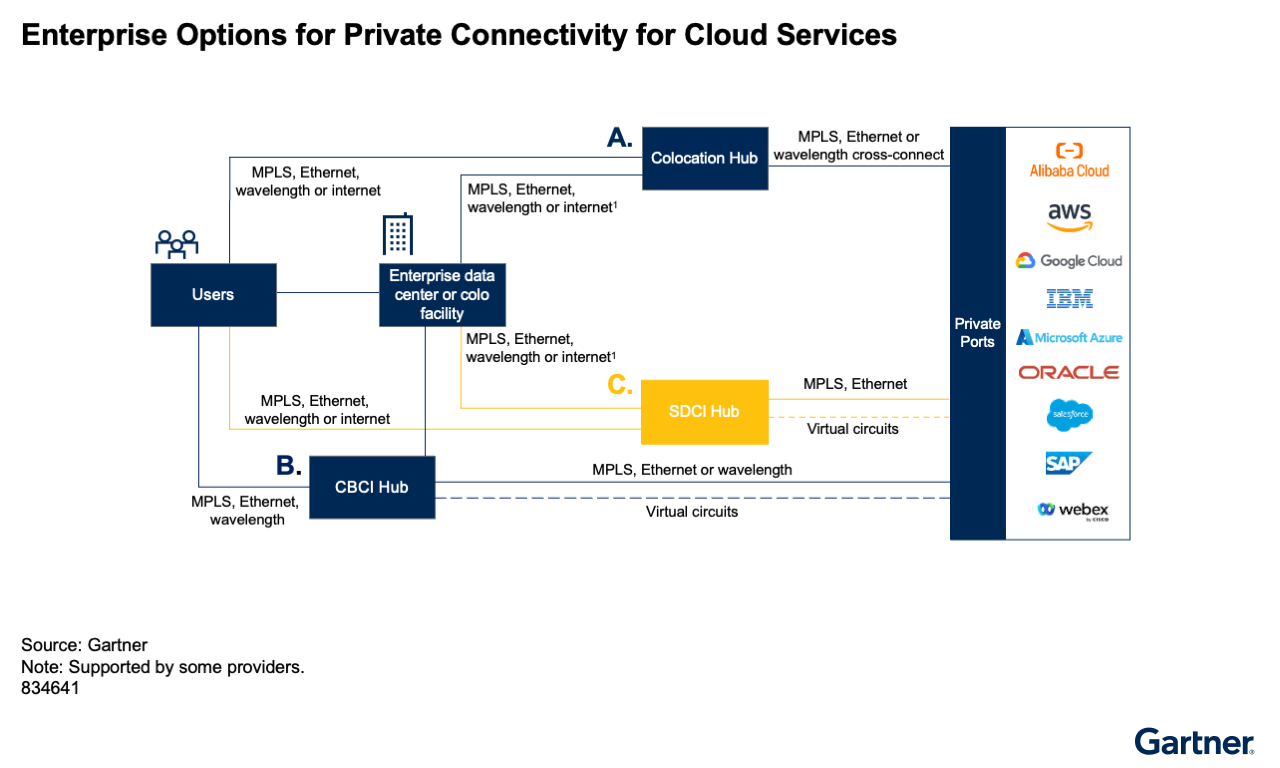
- Colocation Hubs (CHs): Direct cross-connects in colocation facilities for private, one-to-one, high-speed connections to cloud providers. Some providers use private WAN services like Ethernet and Wavelength to support one-to-multiple CSP connections, often as virtual connections. Enterprises need to source a private WAN connection to the colocation hub independently. This solution is appealing when an enterprise runs multiple IaaS and SaaS applications that, in aggregate, generate high traffic and similar concentrated traffic patterns to a small group (typically 2 or 3) IaaS providers.
- Carrier-Based Cloud Interconnects (CBCIs): Dedicated point-to-point and virtual private connections over shared prebuilt links connecting the enterprise WAN to the CSP’s private cloud port or colocation facility. CBCIs include a private WAN connection from the customer edge location to the private cloud port or colocation hub. Enterprises with only a few high-priority, high-traffic applications will find these services useful.
- Software-Defined Cloud Interconnects (SDCIs): Intentionally designed to support multicloud environments, SDCIs quickly provision logical connectivity to CSPs, creating virtual connections from one entry point in the fabric to several cloud, network and internet service providers. Typically, clients subscribe to a bandwidth allowance from the SDCI provider that they can leverage flexibly across CSPs. Some SDCI providers also provide multi-CSP billing, application and network performance monitoring and management, security, and administrative functions on an integrated basis. In some cases, enterprises must independently source connectivity to the SDCI site. Enterprises find this service useful when they require centralized access to many cloud applications and managed service support, including capacity flexibility, unified billing and security policy management (see Hype Cycle for Enterprise Networking, 2025).
Several service providers offer some or all of these service alternatives.
Market Direction
According to the 2026 Gartner CIO and Technology Executive Survey, 71% of respondents plan to increase their cloud service funding in 2026 compared to 2025, while just 5% anticipate reductions. The average budget increase expected by survey respondents in 2026 is over 20%. With increased investment in cloud services, businesses are becoming more dependent on secure and reliable cloud interconnections, which internet connections cannot always guarantee. While the internet is — and in the midterm will continue to be — the service most frequently used to connect users to the cloud, Gartner expects enterprise demand for uncontended, high-speed, and private connections to cloud services to grow:
- Gartner forecasts enterprise spend in public cloud services (IaaS, PaaS and SaaS) to grow by 18.0% in 2025 to reach $706 billion worldwide (see Forecast: Public Cloud Services, Worldwide, 2023-2029, 2Q25 Update).
- In Forecast: Communications Services, Worldwide, 2023-2029, 2Q25 Update, the prediction is that private connections for cloud services will grow at a compound annual growth rate of 18.1% from 2024 to 2029, with a total spending of $8.2 billion.
Market Analysis
The private connectivity for cloud services market is a dynamic landscape, with service providers’ offerings continuously evolving to meet more complex demands for handling data flows to and between clouds. Over the past few years, several data center providers, carriers and exchange providers have invested in building capabilities to orchestrate and automate virtual connectivity on demand and allow for agile, near-real-time adjustments to cloud connections. While these developments align well with enterprise needs for dynamic cloud deployments, many still see these as value-adds rather than absolute prerequisites.
Gartner sees service providers actively vying for position by offering diverse options and capabilities to address more sophisticated enterprise needs.
Range of Services and Cloud Interconnection Points
Service providers differentiate their cloud connectivity offerings by the geographical reach of their infrastructures to enable high-performing cloud connections across multiple international locations. Investments in broadening data center presence and the number of cloud on-ramps and high-capacity network backbones continue to be a cornerstone of competitive positioning. Providers like AT&T, Console Connect, and Colt have built or leveraged metro, regional, and international networks supported by dozens or hundreds of POPs.
Also, competitors differentiate based on the range of connectivity services available. Options range from point-to-point cross-connects at colocation providers’ data centers (for example, Digital Realty, Equinix and NTT) to cloud connects over MPLS, Ethernet, wavelength, and dedicated internet services with options up to 100 Gbps ports. Local partnerships further extend reach into emerging markets and shared data centers, which also facilitate extranet connections and, in some cases, last-mile connectivity solutions through third-party agreements.
Service reliability is another competitive lever. Service providers strive to differentiate by delivering end-to-end quality through multihoming, fast failover mechanisms, and SLAs that sometimes cover the entire enterprise-to-cloud journey. Some service providers leverage redundancy options, advanced monitoring and near-real-time visibility of network data flows, and proactive assurance services — often enhanced by data analytics, machine learning (ML), and AI techniques — to quickly characterize and remedy cloud connectivity service degradations. Examples include NTT, Orange Business, Verizon, and other communications service providers.
Multicloud Support
Enhanced support for multicloud connectivity has emerged as a critical competitive trend, requiring providers to offer a comprehensive set of capabilities. The competitive advantage in multicloud connectivity is defined by a provider’s ability to simplify and secure a diverse array of connectivity options, ensuring seamless integration among public and private networks to support a comprehensive multicloud strategy.
Therefore, in addition to bolstering reach and performance, service providers’ offerings emphasize the breadth and depth of cloud service partnerships. Beyond the traditional cloud hyperscalers, service providers now offer pre-established connections to a wider array of CSPs such as Alibaba Cloud, Tencent Cloud, OVHcloud, and Nutanix, as well as to SaaS providers. This breadth of pre-established integrations allows enterprises to gain agile, sometimes near-real-time, delivery of new virtual connections across multiple cloud environments.
Support for multicloud connectivity typically means:
- Connecting a client to a range of cloud providers from the same node. This capability enables customers to leverage a broad mix of cloud services simultaneously without needing disparate connectivity arrangements.
- Interconnecting multiple cloud providers with each other. This function enables secure data transfers between cloud platforms.
- And, depending on the service provider, providing multicloud networking software capabilities with advanced software functions to support secure and efficient data handling and help enterprises orchestrate data flow across multiple clouds.
Flexibility, Scalability, and Ease of Use
Service providers are increasingly shifting their cloud connectivity offerings toward solutions that provide flexibility, scalability, and ease of use, addressing customer demands to order, deploy, configure, and modify cloud connectivity on demand. Leading service providers leverage software-defined functions that allow for agile provisioning and configuration on top of extensive and automated delivery on prebuilt network infrastructure. For example, Console Connect, Digital Realty’s ServiceFabric, and Equinix Fabric offer highly programmable methods that connect hundreds of data centers and POPs to a wide range of CSPs. Communications service providers such as BT, Orange Business, and Tata Communications also offer or are building this capability.
On top of these software-defined network fabrics, leading service providers have built on-demand service delivery capabilities exposed through service portals. These service portals offer intuitive graphical user interfaces that empower customers to self-provision, adjust bandwidth, and monitor performance in near real time. Also, enterprises can view usage statistics, quality of service (QoS) metrics, and SLA compliance. Such ease of access ensures that organizations can rapidly scale their deployments and reconfigure connections to match rapidly changing business needs with minimal friction.
APIs are emerging as another essential building block for agile cloud connectivity. For example, service providers like Colt, DE-CIX, PacketFabric, and others provide open APIs that integrate directly with IT service management (ITSM) and infrastructure-as-code tools like Terraform. This API-first approach enables developers to automate connectivity provisioning and management, ensuring that network resources can adjust dynamically in response to workload changes. Additionally, network function virtualization (NFV) has been adopted by several providers — such as AT&T, BT, and NTT — to deliver on-demand virtual appliances for capabilities such as software-defined WAN (SD-WAN) and next-generation firewall services. Such NFV integration allows enterprise customers to incorporate and orchestrate advanced network functions in their cloud connectivity fabric.
Commercial terms have also evolved to complement these technological capabilities for greater flexibility and scalability. Most sophisticated providers now offer flexible contract durations, instant quoting, consumption-based pricing models, and the ability to scale bandwidth, both upward and downward, in real time. This combination of metered pricing, self-service ordering, and on-demand delivery — often branded as Network as a Service (NaaS) — caters to enterprises’ requirements for agility and cost-efficiency (see Hype Cycle for Enterprise Networking, 2025).
Security and Compliance Support
Security and compliance have become essential in private connections to cloud services, often considered basic requirements for service providers. Most providers offer basic security features such as encryption, distributed denial of service (DDoS) mitigation, and firewall capabilities in concert with their connectivity solutions. Examples include offerings from Console Connect, Digital Realty, and Epsilon.
Greater differentiation arises when service providers integrate more advanced security capabilities beyond the basics. Gartner sees the following differentiating capabilities:
- Service providers such as Console Connect and Digital Realty offer traffic segmentation and isolation, using virtual LAN (VLAN) and private network infrastructure to enhance security and a software-defined programmable overlay for flexibility.
- Some providers, typically network service providers, extend their security portfolio in private connections to cloud services with deep packet inspection (DPI), which allows for detailed analysis, identification, and mitigation of threats in network traffic. Some alternative connectivity providers, such as Apcela and Cato Networks, also offer this capability.
- Some providers are now integrating advanced frameworks such as Secure Access Service Edge (SASE), Security Service Edge (SSE), and other advanced security capabilities. Examples of these security functions include next-generation firewalls (NGFW), data loss prevention (DLP), integration with security information and event management (SIEM) systems, threat intelligence, or a suite of managed security services (MSS).
Service providers increasingly offer security through virtual network functions (VNFs) hosted on the providers’ cloud interconnection hubs. Network service providers such as BT, Tata Communications, Vodafone, and others support networking and security VNFs in their hubs. Typically, they provide VNF management options that allow for dynamic instantiation and modification of network functions across cloud interconnection hubs (NFV service nodes). These types of offerings are not only offered by network service providers. Equinix, for example, also provides VNF support to customers who purchase Equinix Network Edge.
VAS and Ancillary Services
For many service providers, private connection offerings are part of a broader portfolio of either hosting/colocation services or communication services. Therefore, it is not uncommon that service providers augment private connection offerings with broader solutions that can integrate a range of value-added and ancillary services. Key service adjacencies and differentiated offerings include (see Table 1):
- Connected cloud colocation and hosting services. For example, Digital Realty, Equinix, and a few communications service providers, such as NTT, offer integrated colocation services that enable enterprises to host cloud providers within secure, carrier-neutral facilities. This approach reduces latency, enhances performance, and simplifies the path to cloud adoption.
- Advanced internet backbones and end-to-end connectivity. For example, AT&T, BT, and Tata Communications provide large-scale internet backbone connectivity directly linked to major SaaS, cloud, and security service providers. They also offer comprehensive end-to-end support spanning both wired and wireless access, ensuring seamless connectivity for diverse applications. Other providers, like Equinix and IaaS providers, offer inter-data center WAN transport to their installed base.
- Ecosystem integration. Providers like Console Connect, Equinix, and others facilitate direct interenterprise connectivity through their marketplaces, enabling customers to connect with other ecosystem partners, carriers, and internet exchanges.
- Application performance monitoring (APM) and analytics. Several providers integrate APM and real-time analytics into their service portals, offering customers near-real-time visibility into application performance across connected cloud and network environments. Examples include Deutsche Telekom, Epsilon, Verizon, and others.
- Managed services options, professional services, and consulting. Communication service providers such as Orange Business, Verizon, Vodafone, and others offer managed SD-WAN, MSS, and professional services, including consulting.
- Internet of Things (IoT) integration. For example, Console Connect has introduced an Edge SIM solution that delivers on-demand wireless connectivity for IoT and mobility applications, enabling enterprises to access cloud services consistently outside fixed networks.
- Industry-specific solutions. Although private connections for cloud services are a horizontal offering in the vast majority, some service providers show some degree of industry alignment in their offerings and, more often, marketing pitches. For example, Digital Realty and Equinix highlight tailored disaster recovery solutions and secure, compliant data workflows for regulated industries such as finance and healthcare. Other examples are Epsilon, which emphasizes specialized vertical offerings for e-commerce, or Tata Communications’ tailored service positioning for financial services and aviation.
Representative Vendors
The vendors listed in this Market Guide do not imply an exhaustive list. This section is intended to provide more understanding of the market and its offerings.
Representative Vendors
| Vendor | Headquarter | Private Connectivity for Cloud Service Products | Regions with CHs (1) | Countries with CHs |
|---|---|---|---|---|
Reston, VA, USA | Arcus Platform — MPLS overlay, Ethernet, Wavelength | 5 Regions. No CH in Africa | 16 countries | |
Dallas, TX, USA | AT&T Business cloud connectivity — MPLS, Ethernet, Wavelength (U.S. only) | CHs in all six regions | 48 countries | |
London, United Kingdom | MPLS, Ethernet, Wavelength, Global Fabric | 5 Regions. No CH in the Middle East | 35 countries | |
Tel Aviv, Israel | Dedicated L2 connections (e.g., AWS Direct Connect), IPsec | CHs in all six regions | 20 countries | |
London, United Kingdom | Dedicated Cloud Access — IP-VPN, Ethernet, Wave | 4 Regions. No CH in Africa and Latin America | 27 countries | |
Hong Kong | Point-to-Point Ethernet (L2) and CloudRouter (L3) | CH in all six regions | 19 countries | |
Frankfurt am Main, Germany | MPLS, Ethernet, Wavelength (via partners) | 5 Regions. No CH in Africa | 17 countries | |
Bonn, Germany | IntraSelect Cloud Connect — MPLS, Ethernet (country-dependent), Wavelength (Germany and U.S.) | CHs in all six regions | 43 countries | |
Austin, TX, USA | PlatformDIGITAL — Cross Connects and Service Fabric (L2 & L3) | 5 Regions. No CH in the Middle East | 24 countries | |
Singapore | Epsilon Cloud Connect — IP VPN, Ethernet, Wavelength | 5 Regions. No CH in Latin America | 15 countries | |
Redwood City, CA, USA | Cross Connect, Equinix Fabric (L2), Fabric Cloud Router (L3) | CHs in all six regions. | 30 countries | |
Arlington, VI USA | Cloud Connect — MPLS and Ethernet | 4 Regions. No CH in Africa and the Middle East | 21 countries | |
Brisbane, Australia | Ethernet private port services, Virtual Cross-Connects (L2), Megaport Cloud Router (L3) | 4 Regions. No CH in Africa and the Middle East | 26 countries | |
Tokyo, Japan | Private IP (MPLS), Ethernet, Wavelength | CHs in all six regions | 30 countries | |
Paris, France | Cloud Connectivity — IP VPN, Ethernet (France) | CHs in all six regions | 15 countries | |
Culver City, CA, USA | Point-to-Point Ethernet (L2), Virtual Cloud Router (L3), Quick Connect (simplified L3) | 3 Regions. No CH in Africa, Latin America, and the Middle East | 5 countries | |
Mumbai, India | IZO Multi Cloud Connect — MPLS, Ethernet, Wavelength. | CHs in all six regions | 25 countries | |
New York, NY, USA | Secure Cloud Interconnect, Software-Defined Interconnect, International Wavelength Services | 4 Regions. No CH in Africa and Middle East | 15 countries | |
Newbury, United Kingdom | Vodafone Cloud Connect — MPLS, Ethernet, Wavelength. | 4 Regions. No CH in Latin America and the Middle East | 18 countries | |
CH = Cloud interconnection Hub Regions = Africa, Asia/Pacific, Europe, Latin America, the Middle East, North America | ||||
Source: Gartner
Vendor Selection
Gartner estimates that over 100 vendors offer cloud on-ramps and private connectivity to cloud services in addition to the native private connect options offered by CSPs such as AWS Direct Connect and Azure’s ExpressRoute.
The sample vendors highlighted in this research were selected based on the scope of cloud connect services, international footprint, and depth of cloud service partners. The selection includes vendors with private connectivity offerings for cloud services that deliver services globally. They operate cloud interconnect hubs in at least three of these six geographic regions: Africa, Asia/Pacific, Europe, Latin America, the Middle East, and North America.
Vendor Profiles
Apcela
Apcela, headquartered in Reston, VA, mostly serves U.S. companies both domestically and internationally, and it delivers a software-defined networking solution for multicloud environments through its Arcus Connect platform. This platform leverages an SD-WAN overlay integrated with Apcela’s global backbone network, creating express lanes between data centers, branch offices, remote users, and cloud providers like AWS, Azure, and Salesforce, improving performance by up to 40 times. Apcela operates 45 hubs, located in 16 countries and territories across Asia/Pacific (5), Europe (7), North America (29), Brazil, and the United Arab Emirates (UAE), offering MPLS, Ethernet, Wavelength, and internet connections.
Apcela’s private cloud connectivity solution incorporates SDCI capabilities by integrating native cloud products and third-party platforms like Equinix Fabric and Megaport. Apcela offers automated provisioning that is supported via APIs and integrations with infrastructure-as-code tools (Python/Terraform) aligned with NaaS. A single pane of glass provides ordering, billing, trouble reporting, and trend analysis across multiple public CSPs. Pricing is based on port plus committed bandwidth per month, with flexible contract terms (monthly, annual, and multiyear). Apcela supports DPI as an add-on with SD-WAN or NextGen Firewall-based deployments. Security features include Palo Alto Networks NextGen firewalls (with NextGen stateful firewall, IDS, IPS, secure web gateway [SWG], and DLP functions), encryption, DDoS mitigation, and firewalling.
Apcela does not offer specialized solutions for specific verticals. Its product enhancements are customer-driven, prioritizing features based on direct customer needs and feedback rather than predefined plans. Apcela has not shared specific enhancements planned for commercial launch in the coming months.
AT&T
Headquartered in Dallas, Texas, AT&T primarily provides network, security, and cloud-related services to U.S. and global enterprises. Its core private cloud connectivity portfolio includes AT&T NetBond, which provides private MPLS connections to 5 major IaaS and two SaaS providers with virtual links from 1 Mbps to 10 Gbps, and Ethernet and Wavelength services in the U.S. AT&T operates over 930 hubs to connect to CSPs, directly or via exchanges like Digital Realty and Equinix, in 47 countries and territories across Asia/Pacific (14), Europe (25), Latin America (10), North America (2), Israel, and South Africa. Ethernet aggregation supports flexible Layer 2 and Layer 3 services. As a carrier, AT&T supplies access as part of its cloud connect service.
AT&T’s solution incorporates NaaS and SDCI capabilities, supporting API-driven automated provisioning and on-demand bandwidth adjustments via its Business Center portal and APIs. This portal also acts as a single pane of glass for ordering, billing, and trouble reporting. Pricing is based on port/bandwidth, with NetBond offering 95th percentile usage-based billing and real-time bandwidth changes. SLAs cover network and site availability, data delivery, jitter and latency. Security features include encryption, DDoS mitigation, advanced firewalls (NGFW/VNF), and managed SASE, with DPI available via firewall-based VNFs at 45 NFV service nodes. Depending on the CSP and OEM, this can include inspecting cloud-to-cloud traffic.
AT&T offers specialized cloud connectivity for verticals such as the public sector, financial services, and healthcare. Planned enhancements include expanding SDCI capabilities, integrating on-demand NFV functionality into a global platform, and extending direct connectivity to more hyperscaler regions. AT&T also plans for an enhanced digital experience portal featuring a visual designer and cloud egress cost optimizer, along with AI-driven operational technologies.
BT
Headquartered in London, BT serves U.K.-based and international enterprises with a broad portfolio of network and security services. BT offers cloud connectivity via MPLS, Ethernet, Wavelength, and internet services, with 50 Mbps to 100 Gbps ports. BT has started to provide internet connections to CSPs over Global Fabric, an automated multiservice core network backbone for enterprise services. It includes 63 hubs in 35 countries across Asia/Pacific (10), Europe (18), Latin America (4), North America (2), and South Africa. As a carrier, BT supplies access as part of its cloud connect service.
BT’s solution offers NaaS and SDCI capabilities through Global Fabric, enabling automated provisioning supported by APIs, a self-service portal, and an app. Pricing includes a consumption-based model for bandwidth with options for both dedicated (at an additional charge) and shared cloud ports. Services boast up to 99.99% SLAs for multisite connectivity, real-time monitoring, and hyperscaler-defined resilience. Security features include VNF-based firewalls, media access control security (MACSec) encryption for dedicated connections, embedded DDoS mitigation, and DPI support as an option. Multicloud networking is supported as an add-on, leveraging native cloud networking technologies, overlay options such as Cisco and Broadcom, and custom integrations for platforms like Aviatrix.
While not explicitly vertical-focused, BT solutions are widely utilized by finance, healthcare, and government clients to meet specific requirements. Planned enhancements include expanding Global Fabric to offer direct cloud coverage to over 70% of hyperscaler POP locations and integrating MPLS into the NaaS platform. BT also plans to develop VNF capabilities further for additional networking and security features.
Cato Networks
Cato Networks, headquartered in Tel Aviv, Israel, provides a single-vendor SASE platform that integrates SD-WAN with a complete security stack, including FWaaS, SWG, cloud access security broker (CASB), zero-trust network access (ZTNA), and DLP, delivered as a global, cloud-native service. Its core cloud connectivity offerings include Cloud Interconnect for dedicated connections (such as AWS Direct Connect, Azure ExpressRoute, and Google Cloud Interconnect), leveraging Cato’s global private backbone. The company also offers network virtual appliances (NVAs/vSockets) for SD-WAN capabilities within cloud instances and supports Internet Protocol security (IPsec) tunnels for secure connectivity. A unified management platform oversees all connectivity options. Cato operates 38 hubs hosted in fabric providers such as Digital Realty and Equinix. These hubs are located in 20 countries and territories across Asia/Pacific (4), Europe (12), Latin America (2), and North America (2), but none in Africa or the Middle East.
Cato provides automated provisioning supported by APIs and a certified Terraform provider, and it leverages SDCI capabilities from fabric providers. Cato’s service portal offers a single pane of glass for ordering, billing, trouble ticketing, and trend analysis across multiple public CSPs. However, it does not include native billing management for cloud providers. It provides a 99.999% SLA for multicloud connectivity and features WAN optimization and QoS with up to 10 Gbps per Virtual Private Cloud (VPC). Pricing is primarily bandwidth-based for sites and cloud connectivity, and per named users for remote users. Cato’s private cloud connectivity solution features this fully converged SASE platform, complemented by other security capabilities like IPS, next-generation anti-malware (NGAM), Transport Layer Security (TLS) inspection, extended detection and response (XDR), encryption, DDoS mitigation, and firewalling.
Cato Networks does not offer specialized product editions tailored for specific verticals. However, its platform is designed to meet the performance, compliance, and security needs of diverse environments through its cloud-native architecture. Planned enhancements include increasing SDCI connectivity to 20 Gbps per VPC, offering burstable billing, and offering SDCI in the Chinese mainland.
Colt Technology Services
Headquartered in London, Colt Technology Services is a wireline provider specializing in serving the enterprise market. Its core cloud connectivity portfolio, Dedicated Cloud Access (DCA), offers a range of solutions, including Cloud on Demand, Ethernet, and Wave. These offerings support Layer 1, Layer 2, and Layer 3 connections. Colt’s network has a fiber backbone connecting over 32,000 buildings and 1,100 data centers worldwide. The company maintains direct partnerships with nine major public CSPs like AWS, Azure, Google, Oracle, and IBM. Colt operates 165 hubs globally, located in 27 countries and territories across Asia/Pacific (5), Europe (19), North America (2) and the UAE.
Colt’s private cloud connectivity solution features NaaS and SDCI capabilities through its On Demand platform, enabling automated provisioning via APIs. Layer 2 connections to major CSPs can be established in approximately five minutes. Colt provides a single pane of glass for ordering, billing, trouble reporting, and trend analysis across multiple CSPs. Services offer SLAs for delivery timelines, availability, and performance (round-trip delay, frame loss). Connectivity speeds for DCA Wave reach up to 100 Gbps. For many services, pricing includes fixed monthly charges based on contracted bandwidth, with an hourly billing option for Cloud on Demand. Security features include MACsec encryption for enhanced security on DCA Ethernet and DCA Wave services, with integrated firewall/NAT functionalities within its SD-WAN portfolio.
Colt offers specialized cloud connectivity for capital markets through its PrizmNet service. Planned enhancements include expanding interconnect locations with CSPs directly and via Equinix, as well as developing a DCA ultra-low-latency offering for cloud-to-cloud connections aimed at applications like algorithmic trading. Colt also plans to launch Cloud Gateway On Demand for automated IP VPN across its network.
Console Connect
Console Connect, owned and operated by PCCW Global and headquartered in Hong Kong, operates as a software-defined interconnection platform and NaaS provider based on a global MPLS backbone. Its private cloud connectivity options include MPLS ports ranging from 500 Mbps to 10 Gbps, Ethernet ports ranging from 1 Mbps to 10 Gbps and 1 Gbps, and Wavelength with 10 Gbps and 100 Gbps port options. Console Connect operates 133 hubs across 21 countries and territories in Asia/Pacific (8), Europe (9), Latin America (2), North America (2), South Africa and the UAE. The platform offers access to over 200 cloud on-ramps, and CSP partners include AWS, Microsoft Azure, Google Cloud, Oracle, Alibaba, IBM, Huawei, and Tencent. However, not all its hub sites support these providers.
Console Connect’s private cloud connectivity solution features NaaS and SDCI capabilities, with automated provisioning via a web portal or APIs. The platform leverages in-house multicloud networking software through its CloudRouter service for Layer 3 connectivity between enterprise locations and CSPs. A single pane of glass supports ordering, billing, trouble ticketing, and trend analysis across multiple public CSPs. The service offers assured QoS with SLAs covering availability, latency, packet loss, and jitter. Pricing follows a consumption-based model for bandwidth, with options for flat-rate port fees and pay-as-you-go charges. Security includes a private core network for traffic segregation and automated anti-DDoS mitigation. Console Connect does not offer DPI.
Console Connect does not offer specialized services tailored for specific verticals. However, its Edge SIM product provides secure cellular and IoT connectivity for devices across more than 180 countries. Console Connect plans to integrate SD-WAN offerings from key vendors as Virtual Edge services for upstream connectivity. It also plans to introduce automated Layer 1 services, enabling users to quote, order, and provision subsea cable routes as well as rapid rerouting capabilities in case of cable cuts.
DE-CIX
DE-CIX, headquartered in Frankfurt am Main, Germany, provides interconnection services for networks, clouds, and enterprises globally. Its Cloud Connect portfolio includes DirectCLOUD for private, low-latency access to 5 major CSPs (including AWS, Microsoft Azure, Google Cloud, Oracle, and IBM) and a long tail of other tier 2 CSPs. It also offers Cloud ROUTER for cloud-to-cloud and hybrid connectivity. It supports MPLS, Ethernet, Wavelength, and internet access via its partner ecosystem. DE-CIX operates over 50 internet Exchanges (IXs) and 69 hubs located in 17 countries across Asia/Pacific (4), Europe (8), Latin America (2), Turkey, the UAE, and the United States.
DE-CIX’s private cloud connectivity features NaaS and SDCI capabilities, with automated provisioning supported via the IX-API and Terraform. A single pane of glass through its self-service portal handles ordering, billing, trouble ticketing, and trend analysis. The service offers a 99.99% uptime SLA. Pricing is per port per month with committed bandwidth options, including flexible on-demand or usage-based models. Security features include MACSec encryption, DDoS mitigation, and Resource Public Key Infrastructure-based (RPKI-based) Border Gateway Protocol (BGP) route validation. DE-CIX does not offer DPI. Multicloud networking is supported via Cloud ROUTER.
DE-CIX does not offer specialized solutions tailored for specific verticals. Planned enhancements include introducing support for BGP communities, Generic Routing Encapsulation (GRE) and IPsec tunnel support for SASE use cases and aggregated route announcements, and strengthening NaaS capabilities. DE-CIX has also recently signed an agreement to offer direct interconnections to Alibaba.
Deutsche Telekom
Headquartered in Bonn, Germany, Deutsche Telekom (DT) serves primarily German-headquartered domestic and global corporations with an array of network, security, and cloud-related services. DT’s Intraselect Cloud Connect provides private connections to CSPs through MPLS or Ethernet (country-dependent), and Wavelength (in the U.S. and Germany). DT operates 118 hubs in 43 countries and territories in Africa (3), Asia/Pacific (14), Europe (12), Latin America (6), the Middle East (6), and North America (2). It uses both exchange and direct connections to reach five major CSP partners (AWS, Microsoft Azure, Google Cloud, IBM, and Oracle) plus Open Telekom Cloud (DT’s own), SAP, and StackIT. As a carrier, DT supplies access as part of its cloud connect service.
Intraselect Cloud Connect offers a 99.97% availability SLA for MPLS and fully-managed, encrypted private cloud-connectivity optimized for low latency. DT currently does not provide APIs for automated provisioning or a single pane of glass for multicloud ordering or billing. Pricing is based on port, bandwidth, and contract term. Private port sizes range from 50 Mbps to 10 Gbps. Optional security services include DPI on virtual firewalls, as well as observability and monitoring capabilities from Cisco ThousandEyes, Splunk, and others. DT offers multicloud networking through partners like Prosimo.
DT does not offer specialized vertical solutions but accommodates specific latency and regulatory demands. Planned enhancements focus on expanding its infrastructure with the Software Defined Business Hub, a platform to support NaaS and SDCI capabilities, and launching additional services like Layer 2 connectivity, SD-WAN Hubs, and MPLS extensions globally.
Digital Realty
Digital Realty, headquartered in Austin, TX, is a global data center, colocation, and interconnection solutions provider. Its ServiceFabric platform offers on-demand virtual interconnections and cross-connects, supporting hybrid IT, multicloud, and AI architectures. It operates over 300 data centers and 177 hubs in 24 countries and territories across Africa (2), Asia/Pacific (5), Europe (13), Latin America (2), and North America (2). None in the Middle East. It connects to over 670 data centers, over 290 cloud on-ramps, and 140 partners, including eight major CSPs like Alibaba, AWS, Azure, Google, IBM, Oracle, OVH Cloud and Nutanix.
Digital Realty’s ServiceFabric incorporates SDCI capabilities with an API-first architecture for automated provisioning and orchestration. Digital Realty does not directly offer NaaS and multicloud networking software. A partial single pane of glass is available for ordering, billing, and trend analysis. Security features include encryption in transit, traffic segmentation, and API security, with DDoS mitigation and firewalling via partners. DPI is not available. Pricing is bandwidth-based with flexible options for scalability. Digital Realty does not offer an SLA for its private connectivity to cloud services.
Digital Realty offers specialized solutions for specific verticals such as finance, healthcare, and manufacturing, addressing their unique compliance and data workflow requirements. Planned enhancements include expanding its global footprint through seamless API integration with third-party sites, adding further cloud on-ramps with major CSPs, and enhancing connectivity options.
Epsilon Telecommunications
Epsilon Telecommunications, headquartered in Singapore, is a software-defined network provider offering end-to-end connectivity and communication solutions to international clients, leveraging a global network backbone. Epsilon’s Cloud Connect portfolio offers IP, Ethernet and Wavelength options with speeds up to 100 Gbps. It connects to six leading CSPs, including Alibaba, AWS, Microsoft Azure, Google, IBM, and Oracle, and to SaaS applications such as Cisco Webex, SAP, Service Now, and Zoom. The company operates 34 hubs located in 15 countries and territories across Asia/Pacific (8), Europe (6), South Africa, the UAE, and the United States, but none in Latin America. Epsilon provides last-mile access internationally as part of its Cloud Connect service.
Epsilon operates a proprietary NaaS platform, Infiny, offering automated provisioning via APIs. It has integrated CSP-native APIs into its Infiny platform to enable end-to-end programmability for developers. The service portal allows managing ordering, billing, and performance for Epsilon’s services. SLA offers a 99.95% availability and targets for installation, mean time to repair, round-trip delay, packet loss, and jitter. Pricing is flexible, with port-based, term-based, and usage-based options. Epsilon’s Cloud Routing service provides any-to-any connectivity between cloud providers over both the internet and dedicated private connections. Epsilon’s platforms offer security capabilities including encryption, DDoS mitigation, and DPI functions. Blackholing is also available.
Epsilon offers specialized solutions for e-commerce and other industries, combining Layer 1, Layer 2, and Layer 3 transport with security plugins. Planned enhancements include expanding cloud on-ramps in the Asia/Pacific and Latin America regions and expanding Microsoft Azure Peering Service (MAPS) connections through additional internet exchange peering. Epsilon is also developing a capability to present real-time network performance data for Wavelength services.
Equinix
Equinix, headquartered in Redwood City, CA, is a global digital infrastructure provider operating 270 data centers and offering colocation and interconnection services globally. Its core private cloud connectivity portfolio includes physical Cross Connects and Metro Connect, as well as software-defined interconnects through Equinix Fabric. Equinix Fabric provides on-demand access to over 35% of all major cloud on-ramps, in markets where it operates, from providers like Alibaba, AWS, Azure, Google, IBM, and Oracle for over 220 cloud on-ramps worldwide. It also interconnects with many other CSPs (such as Huawei, OVHCloud, and Tencent) and SaaS providers. In addition, Equinix Fabric Cloud Router provides an on-demand, managed virtual router service. Equinix also offers Network Edge for VNF hosting. The company operates 64 hubs, located in 30 countries and territories across Asia/Pacific (8), Europe (12), Latin America (5), North America (2), Turkey, the UAE, and South Africa.
Equinix’s private cloud connectivity features SDCI capabilities, delivered via Equinix Fabric, Network Edge, and Fabric Cloud Router. APIs and integrations with infrastructure-as-code tools like Terraform support automated provisioning and observability. A single pane of glass via the Equinix customer portal allows for managing ordering, billing, trouble ticketing, and trend analysis. The service offers 99.9% (single-port) and 99.999% (dual-port) availability SLA. Pricing involves monthly fees for ports and virtual connections. Other networking and security features are available through third-party VNFs via Network Edge.
Equinix does not offer specialized cloud connectivity products for specific verticals; however, it facilitates industry-specific interconnection ecosystems within its data centers, serving sectors like finance, healthcare, and manufacturing. Its solutions support regulatory and data sovereignty requirements through country-specific private cloud connectivity. Planned enhancements include additional capabilities to simplify networking between major public CSPs and AI-driven observability for Equinix’s digital services.
GTT
Headquartered in Arlington, Virginia, GTT serves distributed enterprises, primarily headquartered in the U.S. and Europe, with an array of network, security, and cloud-related services. GTT provides direct connectivity to CSPs at 1, 10, and 100 Gbps, and via exchanges from 100 Mbps to 10 Gbps. In addition to public internet, private Ethernet and MPLS connections are available, but wavelength is not. GTT operates over 60 hubs located in 21 countries and territories across Asia/Pacific (4), Europe (14), North America (2), and Brazil (none in the Middle East and Africa, but is currently being built in South Africa). It connects to major CSPs, including AWS, Microsoft Azure, Google Cloud, and Oracle, as well as popular SaaS providers such as Cisco Webex, Salesforce, SAP, and ServiceNow. As an aggregator, GTT routinely supplies access as part of its cloud connectivity services.
GTT Envision platform delivers network orchestration and automation capabilities. GTT currently supports Connectbase and ServiceNow APIs and an additional 40 vendors, while planning SDCI automated provisioning. GTT EnvisionDX offers a partial single pane of glass for viewing circuits, billing, and trouble ticketing, with ordering capabilities forthcoming. Still, cloud connect services are not yet integrated into this portal. Pricing is based on port, bandwidth, and contract term, backed by SLAs for availability, time to repair, latency, packet loss, and jitter. Optional services include premise-based and cloud-based firewalls, DDOS mitigation, DPI, managed detection and response (MDR), SD-WAN, SASE, virtual routers, and WAN Optimization via several vendors, including Fortinet, HPE, and Palo Alto Networks.
GTT does not offer specialized solutions for specific verticals. In 2026, GTT will integrate its cloud connect services into GTT EnvisionDX to offer unified ordering of public cloud providers, edge, and core networks. Monitoring and change management are longer-term GTT Envision objectives.
Megaport
Megaport, headquartered in Brisbane, Australia, provides IaaS and SDCI services via a global backbone connecting over 1,000 carrier-neutral data center locations. It operates cloud interconnect hubs in 26 countries across the Americas (4), Asia/Pacific (5) and Europe (17) but has no presence in the Middle East or Africa. Core offerings include Layer 2 Ethernet private port services with speeds up to 400 Gbps, directly connecting to major CSPs like AWS, Microsoft, Google Cloud, IBM, and Oracle. Megaport does not offer wavelength-based connectivity.
Megaport’s cloud connectivity solution provides SDCI capabilities with a self-serve portal and open APIs, enabling customers to scale bandwidth, add or modify connections, and monitor performance. A single pane of glass offers visibility into bandwidth usage and connection status, but APM and DPI are not supported. Services offer 100% uptime SLAs for Megaport services. Pricing is based on port fees plus bandwidth, with no charge for usage, and offers flexible terms, including options for no contract term. The Megaport Cloud Router is a managed Layer 3 virtual router allowing high-speed connectivity between CSPs environments, data centers, and branch locations with encryption via IPsec. Megaport also supports virtual network appliances on its Megaport Virtual Edge platform, including 6wind, Aruba, Aviatrix, Cisco, Fortinet, Palo Alto Networks and Versa Networks.
Megaport does not offer specialized services tailored to specific verticals. Megaport has not shared plans for future enhancements.
NTT
Headquartered in Tokyo, Japan, NTT delivers a wide array of infrastructure, connectivity, security, and managed services. Its core private cloud connectivity portfolio is built on an SDN architecture, providing multicloud and cloud-to-cloud connections, complemented by a broad NFV catalog for network and security functions. NTT offers MPLS, Ethernet, Wavelength, and internet services globally. It offers cloud connectivity, directly and via exchanges, through 60 hubs, located in 30 countries and territories across Asia/Pacific (11), Europe (14), North America (2), Brazil, South Africa, and the UAE. As a carrier, NTT supplies access as part of its cloud connect service.
NTT’s private cloud connectivity features NaaS and SDCI capabilities, enabling near-real-time virtual connections through its global software-defined network platform. Automated self-service provisioning of cloud interconnects and network services, such as IPsec VPN connections, is supported via APIs and integrations with ITSM tools like ServiceNow, Ivanti, and Mulesoft. A single pane of glass via NTT’s service portals provides real-time visibility and analytics for ordering, billing, trouble ticketing, and network and application performance. Services come with SLAs for availability, latency, jitter, and bandwidth. Pricing is flexible, with fixed (bandwidth), usage-based (data volume), and burstable options. Security includes a cloud-based SASE/SSE platform, firewalls, DDoS protection, encryption, and DPI. NTT integrates multicloud networking software from partners like Arrcus, Aviatrix, and Cisco.
NTT offers specialized cloud connectivity for automotive, manufacturing, healthcare, and retail, including Edge-as-a-Service for compliance needs. Planned enhancements include deeper integrations with CSPs for inventory and managing WAN/security services within customer cloud environments. NTT also plans infrastructure improvements for high data transfer rates for large AI model training, investments in graphics processing unit-as-a-service (GPUaaS), and an all-photonics network for high-capacity, low-latency optical paths with bandwidth-on-demand.
Orange
Orange Business, headquartered in Paris, France, is a telecommunications service provider with local subsidiaries in 26 countries across Europe and Africa, and it has a broad portfolio of services. Its core private cloud connectivity portfolio includes a legacy Layer-3 offer (Galerie via IP VPN), an Ethernet Layer-2 offer for French customers, and its new Evolution Platform services. This platform delivers on-demand Cloud Connect Private and IPsec for Azure and AWS. Connections to 7 major CSPs, popular SaaS applications, and Bleu (Orange’s sovereign cloud in France) are offered, directly and via exchanges, from 29 hubs. These hubs are located in 15 countries and territories across Asia/Pacific (5), Europe (5), and North America (2), Brazil, South Africa, and the UAE. As a carrier, Orange supplies access as part of its cloud connect service.
Evolution Platform enables Orange to offer NaaS and SDCI capabilities, with automated provisioning via APIs and integration with ITSM tools for swift self-service. A single pane of glass supports ordering, billing, trouble ticketing, and trend analysis through its portal. Services feature a 100% availability SLA for On-Demand Cloud Connect Private. The Evolution Platform aims for sub-5ms latency from 90% of its POPs to major clouds. Pricing is flexible, with hourly charges for on-demand services (no commitment) or port-based committed bandwidth. Security includes encryption, DDoS mitigation, and firewalling, with DPI as an add-on. Also, Orange offers APM options and multicloud networking software from Aviatrix while it is working on adding Palo Alto Networks, which now integrates Prosimo’s software.
Orange does not offer specialized product editions for specific verticals; however, its solutions address regulatory demands for data sovereignty and compliance in industries like finance and healthcare. Planned enhancements include expanding the Evolution Platform partnerships to cover additional IaaS and SaaS providers (such as Google Cloud Platform, Oracle, Cloud Avenue, S3NS, Equinix, and Webex) and sovereign clouds and launching on-demand Layer-2 cloud connectivity worldwide.
PacketFabric
PacketFabric, headquartered in Culver City, CA, delivers NaaS solutions to enterprises. Its core private cloud connectivity portfolio includes direct, private connections to five major CSPs (including AWS, Azure, Google Cloud Platform, IBM, and Oracle), point-to-point Ethernet (1-100 Gbps), and a virtual cloud router for scalable multicloud interconnection. It supports MPLS, Ethernet, Wavelength, and internet services. PacketFabric network directly connects over 250 colocation facilities and leverages partnerships for further reach. It operates 44 cloud onramp hubs located in four European countries and the United States.
PacketFabric’s platform is fully automated and software-defined, incorporating SDCI capabilities. Automation is facilitated through APIs and integration with Terraform for infrastructure-as-code deployments that align with NaaS capabilities. Its portal provides a single pane of glass for near-real-time provisioning, ordering, billing, and trend analysis, though trouble reporting and resolution are handled via email. SLAs guarantee availability and performance. Pricing is flexible, including usage-based billing and fixed per-port options. Security features include DDoS mitigation, firewalling, and encryption. APM is supported, but DPI is not offered. Multicloud networking is supported via the Virtual Cloud Router.
PacketFabric delivers specialized cloud connectivity solutions for midsize organizations and enterprise customers with high-bandwidth and compliance requirements. These solutions enable use cases in verticals, including financial services and healthcare, and low latency for AI/ML workloads. Planned enhancements include a new AI-driven platform that integrates with the existing software portal. This capability will enable customers to input requests in natural language, receive recommended configurations, and complete procurement in a unified environment.
Tata Communications
Tata Communications, headquartered in Mumbai, India, is a global telecommunications provider offering a range of enterprise connectivity and managed network services. Its IZO Multi Cloud Connect for private cloud connectivity offers MPLS, Ethernet, Wavelength, and internet services with port speeds up to 100 Gbps via a Tier 1 global backbone. It operates 106 hubs, either in owned data centers or third-party colocation facilities, located in 25 countries and territories across Asia/Pacific (9), Europe (11), North America (2), Brazil, South Africa and the UAE. It connects to major CSPs and SaaS providers like AWS, Microsoft, Google, Oracle, and IBM and 11 others, including Alibaba Cloud, Tencent, Amadeus, Zoom, Salesforce, Cisco, Huawei, SAP, Cisco Webex, Zoom and ServiceNow, although at fewer hub locations. As a network services provider, Tata Communications supplies last-mile access as part of its cloud connect service.
IZO MCC offers NaaS and SDCI capabilities with on-demand VNFs and automated provisioning via a self-service portal and APIs. The TCx customer portal provides a single pane of glass for ordering, billing, moving, adding, changing, or deleting (MACD), ticketing, performance monitoring, and reporting. Tata customers can opt for a self-managed hub or managed SDCI services, which rely on Tata’s in-house platform. Services include 100% uptime availability SLAs. Pricing options include fixed and usage-based for ports, virtual connections, virtual devices, and VNF license charges. Security includes encryption, DDoS, firewalls (as VNFs), IPsec (up to 100 Gbps), MACSec, and DPI. Multicloud networking is also supported through Tata’s in-house developed software.
Tata Communications offers specialized cloud connectivity for verticals such as finance, aviation, contact centers, and high-frequency trading. Looking ahead, Tata plans to expand its “Multi Cloud Network Hub” solution to aggregate network and perimeter security functions.
Verizon
Headquartered in New York, NY, Verizon offers a global suite of network, security, and cloud services. Its core private cloud connectivity portfolio includes Secure Cloud Interconnect (SCI), Software Defined Interconnect (SDI), and International Wavelength Services, supporting Layers 1, 2, and 3 connections. Verizon’s global IP network connects to approximately 300 CSPs via over 200 data centers, leveraging partnerships with providers like Equinix. Verizon operates 35 hubs, supporting SCI and SDI, across 15 countries and territories in Asia/Pacific (5), Europe (7), North America (2), and Brazil (none in Africa and Middle East). It connects to major CSPs like AWS, Microsoft, Google, Oracle, and IBM, and six others, including Alibaba Cloud, Avaya, Cisco Webex, F5, Salesforce, and SAP, at a limited number of hub locations. As a carrier, Verizon supplies access as part of its cloud connect service.
Verizon’s solutions feature automated provisioning for SCI and SDI and APIs for on-demand delivery. The Verizon Enterprise Center portal provides a single pane of glass for ordering, billing, trouble ticketing, and real-time performance monitoring. SLAs are confined to availability and time-to-repair. Connectivity speeds for Wavelength services range from 1 Gbps to 100 Gbps and add a round-trip delay SLA. Pricing is usage-based for SCI, aligned with NaaS models, and fixed bandwidth-based for SDI. Security includes FWaaS, DDoS mitigation, IPsec encryption, zero trust principles, and DPI integrated into its network detection and response (NDR) platform. It also supports multicloud networking software through its NaaS Cloud Management.
Verizon offers specialized cloud connectivity solutions for specific compliance and performance needs in verticals such as financial services, healthcare, gaming and media, government, and manufacturing and logistics. Planned enhancements include advancing next-generation IPv6 capabilities to SCI services and simplifying network management. Verizon is exploring integration with infrastructure-as-code tools.
Vodafone
Headquartered in Newbury, U.K., Vodafone provides network, digital, and managed services to enterprise clients both domestically through local operating companies in 15 countries and internationally via Vodafone Business. Its private cloud connectivity portfolio includes Cloud Connect, Data Centre Interconnect, and a Software Defined Cloud Connect, supporting Layer 1, Layer 2, and Layer 3 connections. Vodafone operates 69 hubs across 19 countries and territories in Asia/Pacific (4), Europe (12), North America (2), and South Africa, and directly peers with major CSPs like AWS, Microsoft Azure, and Google. It also provides private connectivity to Alibaba Cloud, IBM, Oracle, and SAP. Like other carriers, Vodafone supplies access as part of its cloud connect service.
Vodafone’s solution integrates NaaS and SDCI capabilities with automated provisioning supported via APIs. A single pane of glass portal allows managing delivery updates, service requests, billing, and performance monitoring. Services offer guaranteed performance, including sub-5ms latency from Super POPs to the cloud and a 99.99% availability SLA. Speeds range from 50 Mbps to 10 Gbps for Software Defined Cloud Connect, with direct ports up to 400 Gbps and multi-tenanted ports up to 100 Gbps. Pricing is flexible, with bandwidth-based, usage-based, and hourly options. Cloud Connect supports multicloud networking software (Prosimo), and offers APM. Security includes virtual firewalls, CASB, DLP, SWG, ZTNA, and DDoS mitigation, with DPI also supported.
Vodafone offers specialized cloud connectivity for specific industry verticals, such as sovereign networking solutions for secure government and critical national infrastructure organizations. Vodafone plans to evolve its Multi-Cloud Network offer into a new Vodafone Business NaaS Multi-Cloud Connect product, develop GPUaaS to support AI demands, and invest in quantum-safe networking.
Market Recommendations
- Assess your current and projected cloud connectivity needs, including bandwidth, latency, and security requirements. Map critical applications and data flows to identify which workloads demand private links versus the public internet.
- Choose private connectivity over the public internet when there are stringent security and compliance requirements, predictable high-volume traffic, or a need for guaranteed low latency for mission-critical applications. Egress costs are typically significantly reduced when using private interconnects, as opposed to the internet.
- Choose colocation hub services if cloud application data traffic is distributed among many CSPs located at the colocation hub, and self-management is preferred. Select SDCI services if cloud application data traffic is distributed across several CSPs and bandwidth flexibility, consistent security, unified billing, and managed service are preferred.
- Shortlist qualified cloud-connect service providers based on geographic footprint, SLAs, and security certifications. Choose service providers that provide comprehensive SLAs, rapid failover, and advanced monitoring.
- Analyze the cost implications of private connectivity models, such as pay-as-you-go, committed-use discounts, and bandwidth tiers. Define your usage patterns and require offerings that include consumption-based pricing with real-time bandwidth adjustments and instant quoting when your use cases create highly variable demand for cloud data transfer.
- Engage service providers for a targeted proof of concept that mirrors real-world traffic patterns and peak usage scenarios. Monitor and measure latency, throughput, jitter, and security controls during the trial period. Test providers’ service portals to determine if they offer instant quoting and bandwidth adjustment features to ensure cost control and flexibility as cloud service demands change.
2026 Gartner CIO and Technology Executive Survey. This survey was conducted online from 1 May to 30 June 2025 to help CIOs and technology executives benchmark their priorities and investment plans against those of peers worldwide. Qualified respondents led a digital/technology function and were accountable for running or improving/growing a specific area of their enterprise. In total, 2,501 CIOs and technology executives participated, with representation from all geographies, revenue bands and industry sectors (public and private).
Note 1 Gartner’s Initial Market Coverage
This Market Guide provides Gartner’s initial coverage of the market and focuses on the market definition, rationale for the market and market dynamics.