The State of AI Maturity in Banking and Investment Services
31 December 2025 - ID G00841970 - 23 min read
By Benjamin Seesel, Van To, and 1 more
To meet intense pressure for AI value capture, banking and investment services CIOs must build a mature approach across areas like AI governance, engineering, and strategy. Industry CIOs can use this research to benchmark AI maturity against peers and understand actions to boost maturity.
Insights at a Glance
Banking and investment services have a vision for the role of AI at their firms, but are less mature in the ability to translate that vision into action. To boost AI value realization, banking CIOs must build a robust approach across seven key areas including AI strategy, governance, engineering, and data readiness.
Key Takeaways
- The AI Maturity Survey results reveal that banking and investment services CIOs have identified high-potential AI use cases but face execution barriers related to data readiness, literacy gaps, and organizational design.
- Higher maturity in developing AI strategy and ambition results from extensive work CIOs and their teams have done to develop use case portfolios. Pressure from Boards and CEOs to figure out AI in banking and investment services has been intense and CIOs have rightly responded by prioritizing AI strategy development first.
- Banks and investment services companies lag in their AI organizational maturity because they struggle to identify the right structure to manage AI flow from all directions. AI-ready data challenges include rigid functional and technology silos and immature capabilities for metadata management. AI literacy gaps in the industry and workforce fear of AI-driven job losses represent key challenges in the area of people and culture.
Actions
- Assess AI maturity objectively: Use a systematic approach to assess AI maturity against both strategy and execution-related dimensions, and prioritize development steps accordingly (see AI Maturity Assessment).
- To improve AI strategy development, put the customer at the center: AI use cases in banking and investment services will most likely pay off when they solve problems for the customer, not just employees internally. Use voice of the customer data and other customer insight sources to prioritize use cases and refine AI strategy.
- To improve AI execution, first jump-start stakeholder conversations: Banks and investment services firms have significant gaps in capabilities necessary for AI implementation, such as data readiness and engineering. These gaps require substantial investments in technology, change management, and organizational redesign and are not wholly within the CIO’s control to address. The first step for CIOs is to have timely conversations with the CEO, CFO, business unit leaders, and the Board to build support for the investments necessary to accelerate AI implementation.
Issue Context
AI priorities for banking and investment services CIOs are quickly evolving. The early industry focus was on AI use cases such as intelligent document processing, developer support, and general employee knowledge assist to boost efficiencies. But with the pressure to deliver tangible AI value on the rise, CIOs are increasingly exploring transformative AI use cases in areas like customer experience, lending, financial advice, and payments. While industry CIOs consider only 16% of their AI use cases to be “game changing” in 2025, they expect that proportion to jump to 42% in 2027.1 And just as AI strategies in the industry are changing, so are implementation priorities. CIOs are accelerating investments in technical areas like AI platforms and domain-specific models, as well as efforts to boost employee engagement and AI adoption. As banking and investment services CIOs continue to refine AI strategies and implementation priorities, many seek an objective view of how peers are progressing on the AI journey and how it compares to their own progress (see AI Maturity Assessment).
Impact Brief
AI has the power to transform client experiences, business models, and ways of working in banking and investment services. For these reasons, banks and investment firms are investing heavily in AI. Industry CIOs project that AI spend at their organizations will increase significantly over the next two years, but only a minority believe that AI has delivered bottom-line benefits such as cost savings and revenue growth.1 And only 27% of industry IT leaders are exceeding expectations for progress in implementing AI capabilities.2 Against this uneven start to the AI journey in banking and investment services, pressure is mounting from business stakeholders on CIOs to accelerate AI value realization, with competitive advantage, cost reduction, and better client experiences among the top outcomes executives expect.1 Industry CIOs can expect regular requests from CEOs and Boards across 2026 to report their AI progress. CIOs can use peer benchmarks to compare their AI journey to other firms, present their accomplishments to executives with industry context, advocate for more AI resources, and identify ways to accelerate the journey.
More Detail
The Dimensions of AI Maturity
Banking and investment services CEOs and boards of directors increasingly demand tangible financial returns from AI. Progress to date has been slow. Only 38% of banking CIOs believe that their current AI investments will positively impact firm financial performance, and even fewer believe that their CEOs would rate AI as a material revenue or cost savings driver for the firm (see Why AI ROI Is Lagging in Banking and What CIOs Must Do to Maximize Value).3
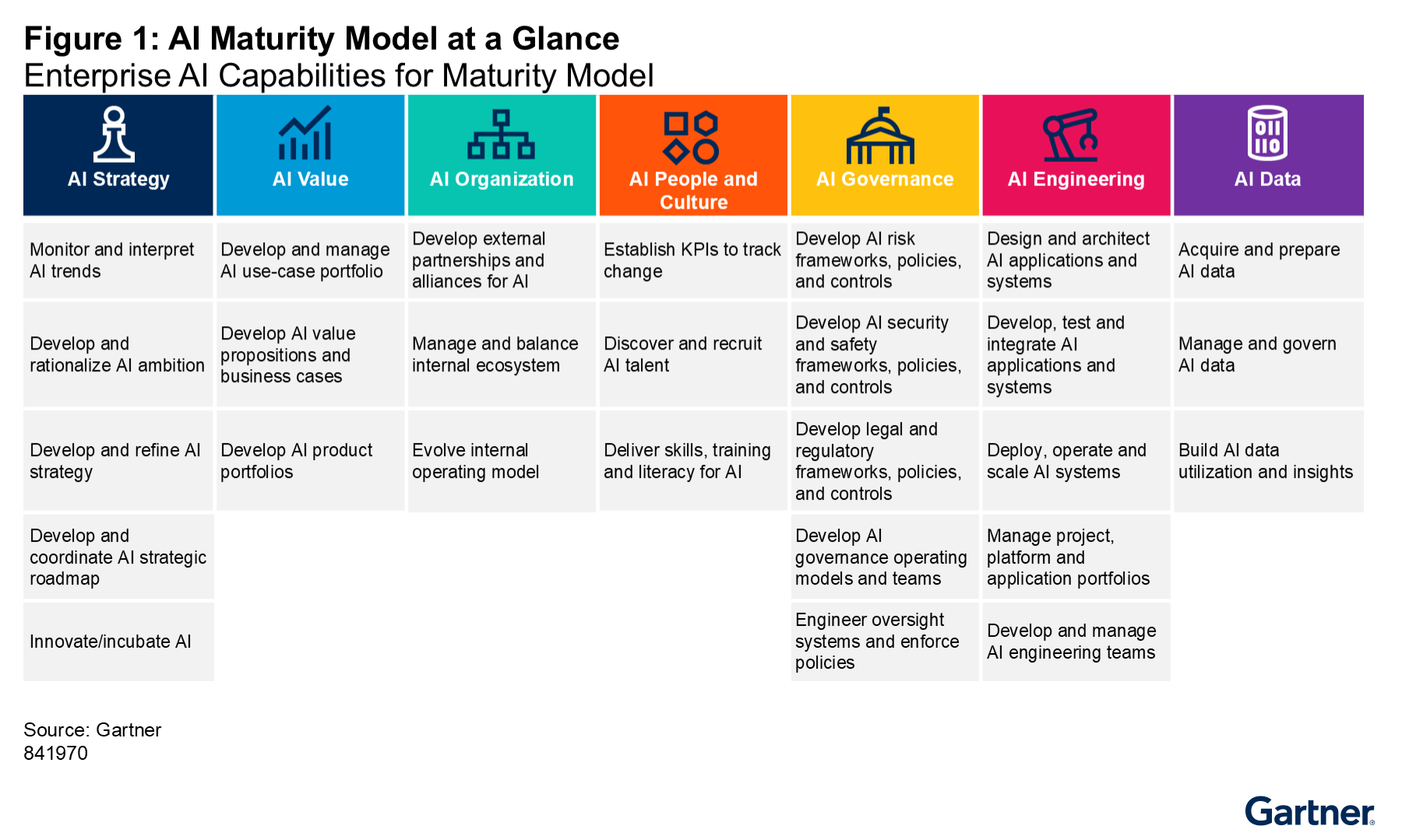
To boost AI value realization, banking CIOs must cultivate seven dimensions of AI maturity:
- Strategy — setting and developing AI ambition and the long-term AI roadmap
- Value — building AI use case and product portfolios
- Organization — establishing internal and external structures and ecosystems to manage AI
- People and Culture — recruiting, retaining, and developing AI talent
- Governance — establishing controls, policies, and technologies to mitigate AI risk
- Engineering — setting up AI platforms, systems, and applications
- Data — building and governing AI-ready datasets
Figure 1 provides an overview of Gartner’s AI Maturity Model, (see Evidence section for a detailed explanation of the model). Financial Services CIOs can use the model with their C-suite partners to lay the foundation for establishing transformative AI capabilities necessary to scale their AI investments.
The Current State of AI Maturity in Banking and Investment Services
In 2Q and 3Q of 2025 Gartner conducted a survey of banking and investment services IT leaders to understand the current level of AI maturity at their firms. Survey respondents are based in North America and the EMEA and Asia/Pacific regions. The survey revealed that industry maturity is highest in the dimensions of AI strategy, value, and governance. Industry maturity is lowest in the dimensions of AI engineering, data, and organization. For all dimensions, there is a material gap between current and desired maturity.
The maturity gap is problematic for banking and investment services CIOs. With AI expenditures projected to jump from 5% to 13% of industry IT budgets by 2027, AI is not inexpensive.1 With so much spend, industry CEOs and Boards of Directors are increasingly pressuring CIOs to move from AI experimentation to scaling and financial returns. AI-driven cost savings and revenue cannot happen consistently without mature capabilities across all aspects of AI strategy and implementation.
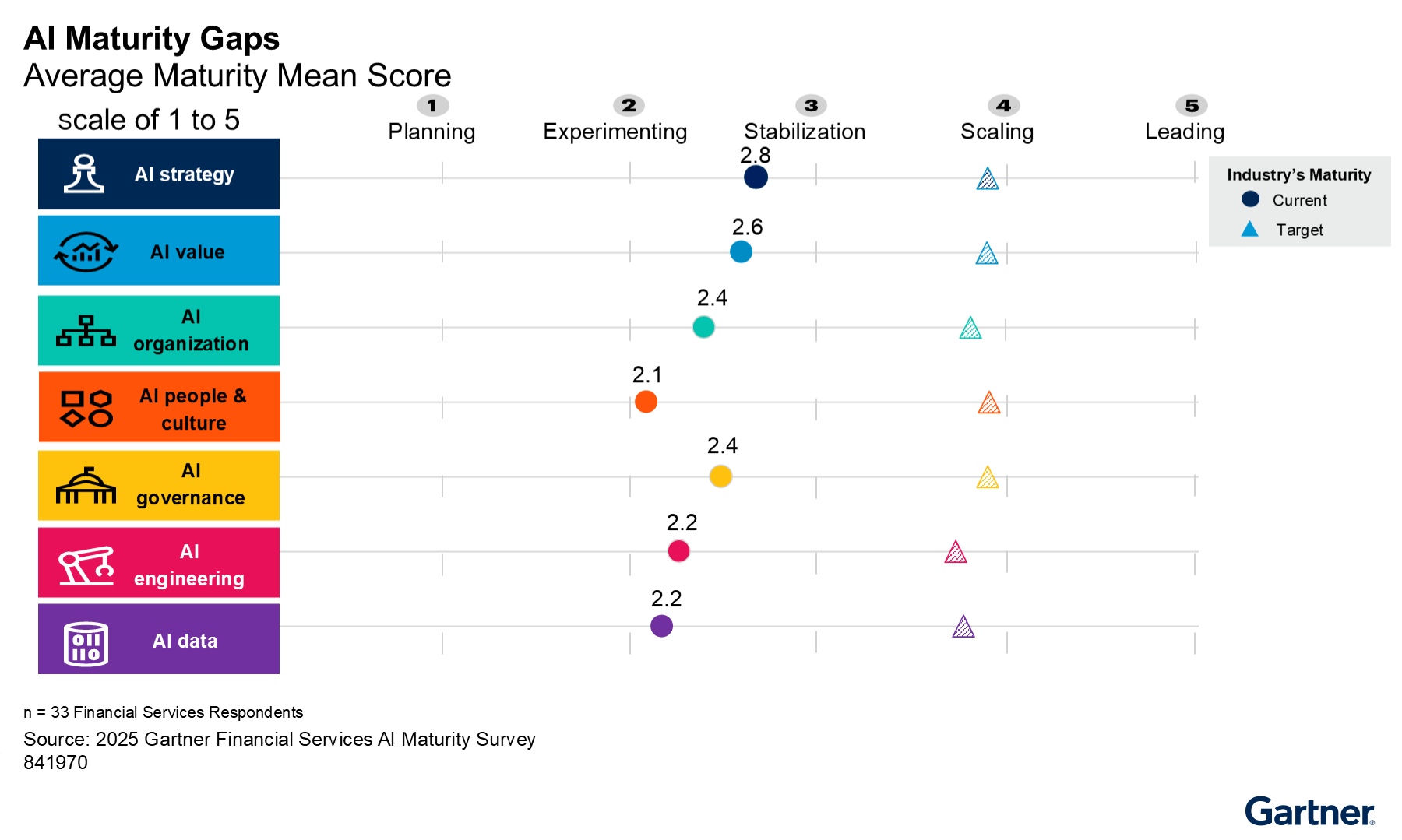
CIOs have a vision for the AI-powered bank but have yet to translate that vision into action.
The level of investment in AI by IT leaders to date, issues related to legacy infrastructure, bank employee perceptions of AI, and factors inherent to the banking industry explain both the areas of high and low AI maturity. IT leaders and business partners have engaged in strategy conversations about AI use cases for several years, while banks have had to build governance capabilities quickly due to the heavily-regulated nature of the industry. Conversely, AI-ready data in banking is constrained by organizational silos and immature metadata management capabilities which will be a roadblock to AI success (see Powering Innovation With AI-Ready Data for Banking CIOs). Engineering challenges include escalating technology costs and the difficulties of integrating AI systems with legacy bank infrastructure. Talent-related AI challenges in banking include lack of skilled personnel and low adoption rates.2
The picture overall is of an industry in which CIOs have a vision for the role of AI in the firm, but less certainty on how to translate that vision into action. To close the AI strategy-to-execution gap in banking, CIOs and IT leaders must build a detailed roadmap toward being a truly AI-enabled bank, defined as a bank or investment services firm where AI reaches its potential to augment humans in some roles and fully replace them in others. This exercise must explore and produce detailed action steps to move AI capabilities up the curve from experimentation to scaling, including:
- Rebuild legacy banking workflows with AI at the center
- Evaluate and select AI models and platforms, with a detailed assessment of their fit and interoperability with existing bank systems (see Innovation Insight: Domain-Specific Language Models (DSLMs) Reduce Risks for Generative AI in Financial Services and Market Guide for Generative AI Platforms in Banking and Investment Services).
- Adapt the IT operating model from one focused on minimizing the cost of IT assets to one focused on leveraging AI to reinvent the delivery of banking services.
- Prioritize the technology investments needed to govern AI at scale (see Govern AI Using TRiSM: The Technical Framework for Trust, Risk, and Security).
- Evaluate AI’s impact on key banking roles, while combining the best qualities of people and AI.
- Produce AI-ready data (see Powering Innovation With AI-Ready Data for Banking CIOs).
IT leaders can use peer benchmark data to compare their AI progress against other firms, present their accomplishments to business partners with industry context, advocate for more AI resources, and identify ways to accelerate the journey.
AI Strategy
AI can play many roles in banking and investment services. It can be a tool to boost client or employee experiences; a capability to enhance the front or back office; a technology to drive incremental or transformative performance improvements; or all of the above. CIOs and business leaders who disagree on AI’s intended role in the firm and the path to get there will be unable to align on investments needed to achieve AI’s promise and financial outcomes.
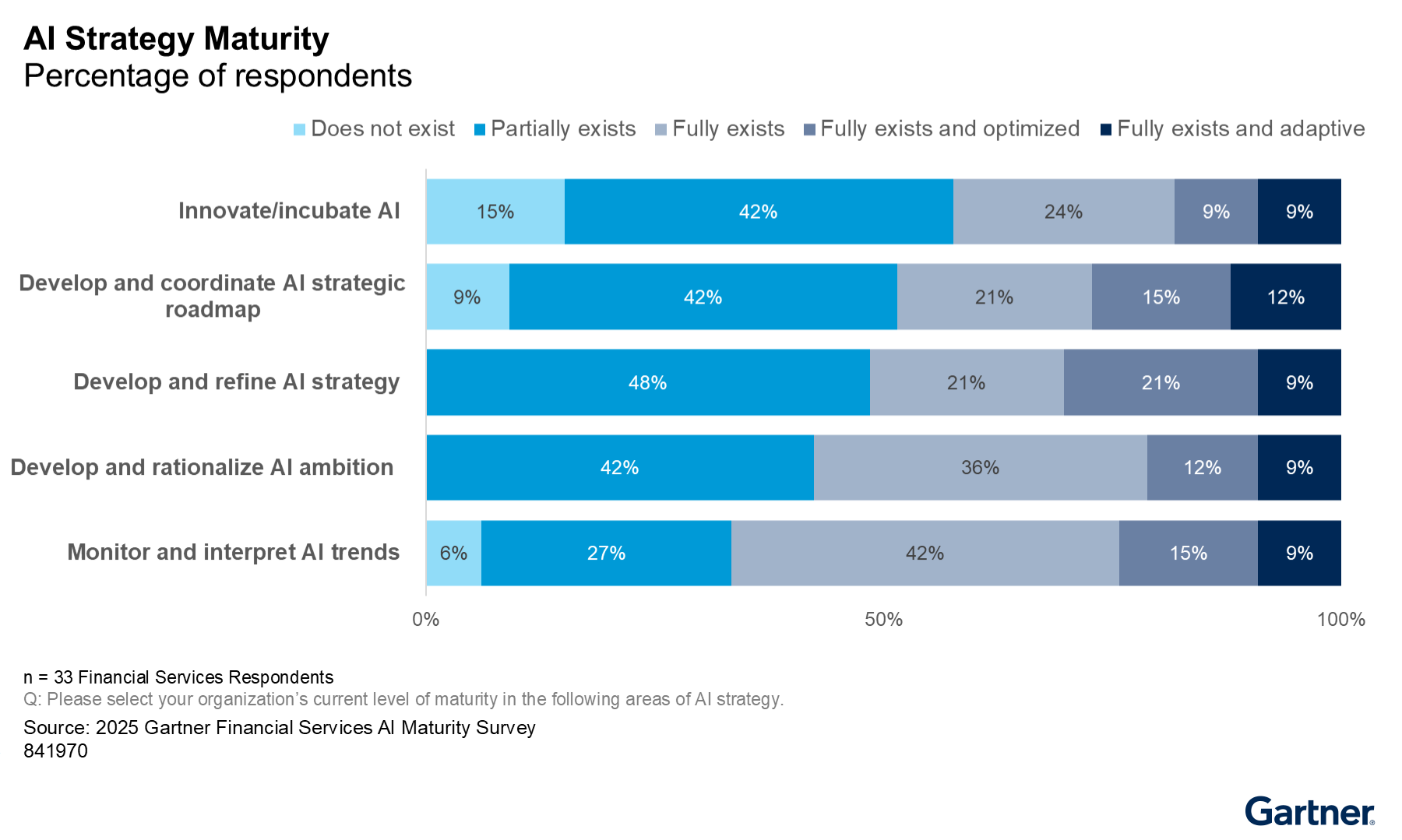
AI strategy includes the ability to:
- Incubate AI investments
- Develop and coordinate the AI strategic roadmap
- Develop and refine AI strategy
- Develop and rationalize AI ambition
- Monitor and interpret AI trends
Overall, banking and investment services CIOs see their firms as most mature in this category among the seven maturity model dimensions. Within the AI strategy dimension, banking CIOs rate themselves as being most mature in monitoring and interpreting AI trends, and least mature in incubating AI initiatives.
Significant investments by industry CIOs to understand the implications of AI for banking, establish their ambition, and develop roadmaps explain the high level of AI maturity in this dimension.
Recommendations for banking and investment services CIOs to boost maturity in AI strategy:
- CIOs work with business partners to establish clear goals for AI investments by assessing the types of value AI brings and which ones align to existing enterprise objectives (see The 3 Business Cases of Generative AI Value).
- Determine with stakeholders AI’s optimal role in the organization by establishing a transparent menu of strategic options for AI from which everyone can choose (see Gartner AI Opportunity Radar: Set Your Enterprise’s AI Ambition).
- Advocate that the next Board meeting agenda include a review and update of the firm’s AI ambition and roadmap.
- Invest deliberately with staff, resources, and technology to move from a stabilized AI foundation to a scaling maturity level that allows AI to become systemic in achieving internal and external goals. CIOs must take specific steps that connect the organization’s resources to mature the use of AI in the organization.
Key Resources:
AI Value
AI value reflects an organization’s ability to develop tangible AI use cases and products. Use cases are the clearest practical manifestation of the AI strategy discussed in the previous section, and selecting them judiciously is critical to AI value creation. The evidence increasingly shows that incremental AI use cases will not deliver substantial cost savings and revenue growth in banking and investment services. Use cases must instead solve problems for firm customers to deliver material financial outcomes (see Why AI ROI Is Lagging in Banking and What CIOs Must Do to Maximize Value).
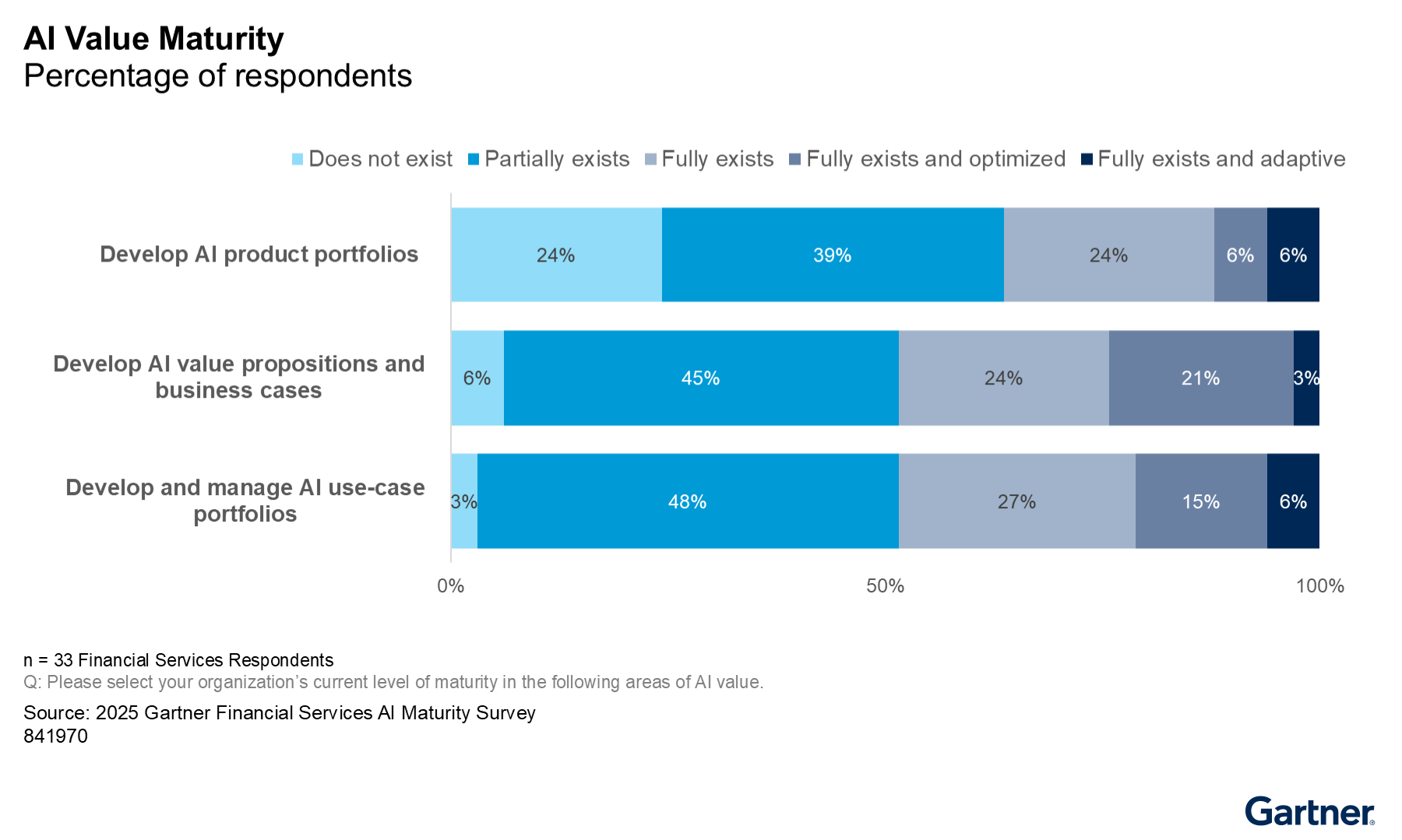
Key components of AI value include being able to:
- Develop AI value propositions and business cases
- Develop and manage AI use-case portfolio
- Develop AI product portfolios
The majority of financial services survey respondents report making significant progress in developing AI value propositions and business cases, with 69% reporting medium or higher maturity (see Figure 4).
However, most financial services organizations are still in the early to middle stages of developing AI product portfolios. This reflects that while many banks have made good progress on internally-focused AI use cases such as developer support and fraud prevention, they have made less progress incorporating AI into banking offerings to serve customers externally. Regulatory uncertainty around AI and still-maturing AI models and applications explain the cautious approach to date, but IT leaders increasingly realize that AI must target customer problems in banking to deliver material value.
Recommendations for IT leaders in banking and investment services to boost maturity in AI value:
- Gain stakeholder alignment on AI use cases by developing strategic and financial criteria to prioritize AI use cases, and vetting the criteria with business partners to gain agreement (see Generative AI Use-Case Assessment to Prioritize Banking Investments).
- Use voice of the customer data to prioritize AI use cases that address client needs. Assess the current AI use case portfolio to understand which use cases resolve actual banking and investment services customer pain points by vetting the use cases against line of business leader views and voice of the market data.
- Review AI use cases at peer companies for ideas and inspiration (see AI, GenAI and Agentic AI in Banking: Case Examples From the 2025 Eye on Innovation Awards).
Key Resources:
AI Organization
Organizational issues matter deeply to AI success in banking and investment services. Internally, structures such as communities of excellence and steering committees play a critical role in creating line of sight and accountability to ensure that the firm pursues AI objectives in structured and ethical ways. Externally, most financial institutions partner with a large array of third parties on their AI journey, ranging from AI platform vendors to existing core system vendors incorporating AI into their offerings. CIOs must evaluate this external ecosystem regularly to ensure that the firm is working with the right partners on AI initiatives, and adjust accordingly.
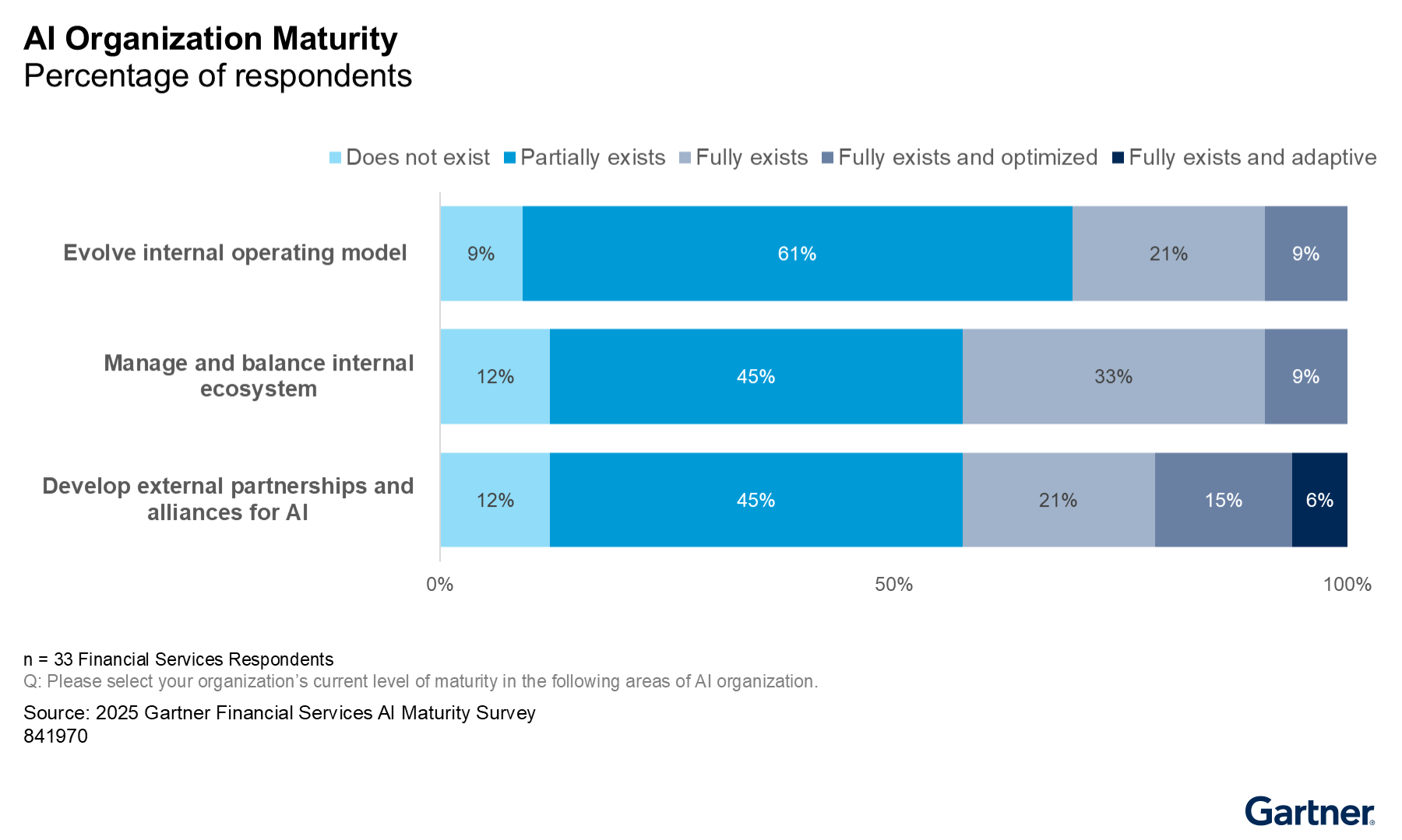
The survey defines AI organization as a firm’s ability to:
- Evolve internal operating models
- Manage and balance the internal ecosystem
- Develop external partnerships and alliances for AI
Most organizations are at the “does not exist” or “partially exists” level of maturity across all three capabilities, signaling slow progress in organizational transformation. Within this dimension, respondents are relatively most mature in evolving their internal operating model and least mature in managing and balancing the internal ecosystem.
There are many reasons why AI organizational maturity lags among financial services firms, such as inertia, cultural resistance, and the priority placed on technology investments over organizational redesign, resulting in outdated operating models.
Recommendations for IT leaders in banking and investment services to boost maturity in AI organization:
- Add a discussion item at your next IT leadership off-site to explore how the IT operating model should adapt in light of AI (see How to Identify and Implement IT Operating Models in Banking).
- Identify ecosystem gaps and partnerships that need strengthening by mapping the internal and external ecosystem of partners supporting the bank’s AI strategy.
- Optimize AI decision rights by convening conversations with business partners to explore the appropriate degree of centralization vs decentralization for AI organizational design and decision-making in the firm.
Key Resources:
AI People and Culture
Banking and investment services associates are nervous about the impact of AI on the firm. Some worry about AI taking over. Others feel lost, like they lack the right training. CIOs must nourish AI competencies in the workforce to boost adoption, hone messaging to address employee fears, and cultivate human/AI synergies in order to maximize AI value capture.
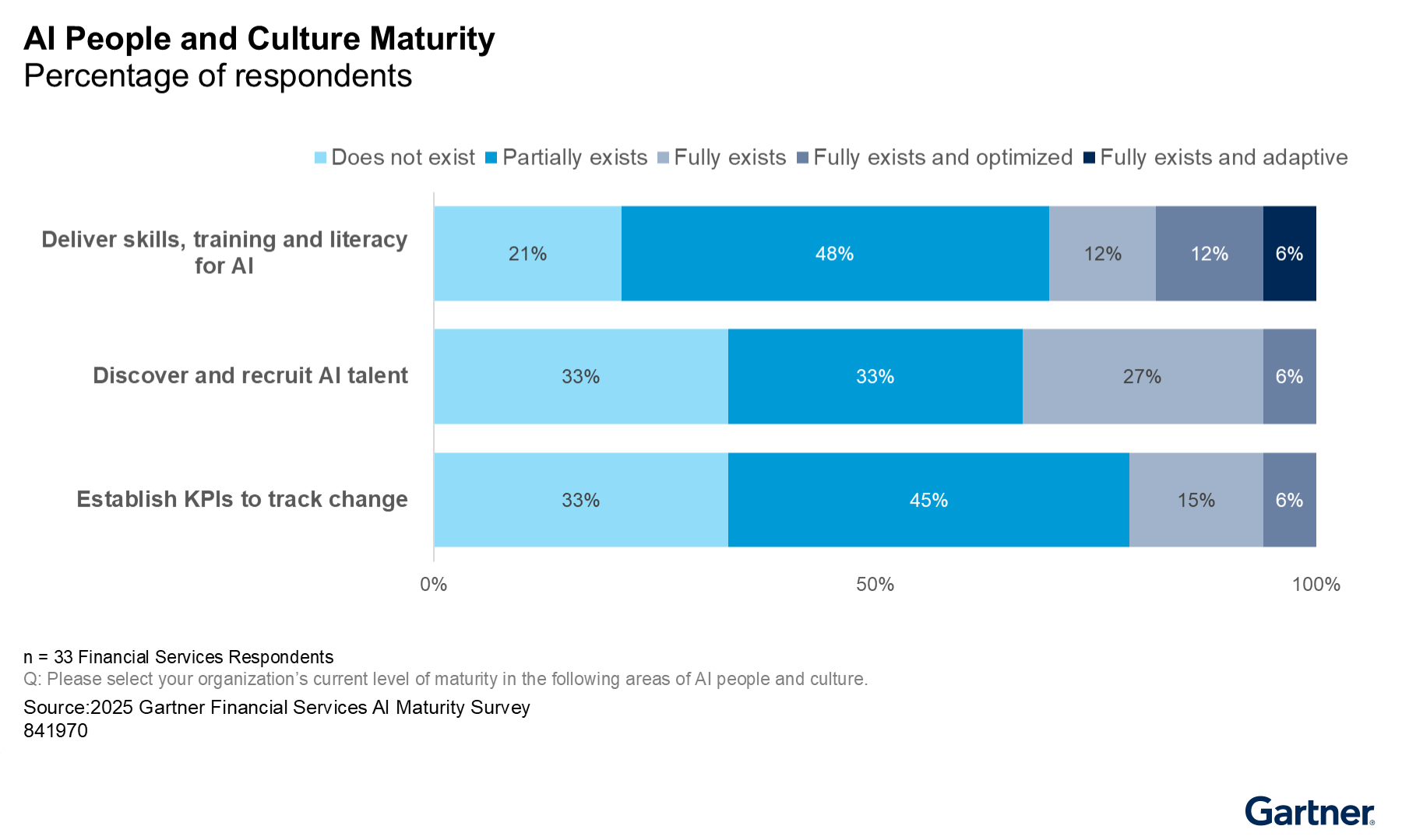
AI people and culture refers to the bank’s ability to:
- Deliver skills, training, and literacy for AI
- Discover and recruit AI talent
- Establish KPIs to track change
The maturity level of AI people and culture is generally low, with most banking organizations operating at less than medium maturity. A third of financial services respondents report that the capabilities to discover and recruit AI talent, and establish KPIs to track change, “do not exist” at their firms (the lowest level of maturity). Furthermore, 21% report that the capability to deliver skills, training and literacy for AI does not exist at their firms.
Recommendations for IT leaders in banking and investment services to boost maturity in AI people and culture:
- Build an AI skills development plan by identifying key banking jobs, mapping their responsibilities, and assessing how AI will change their workflows.
- Boost employee engagement with AI by developing organizational messaging that clearly connects AI skills development to business outcomes and employee MBOs.
- Make AI skills development more targeted by identifying key employee personas (e.g., technical employees, nontechnical employees, etc.) and customizing training and development for each group.
- Accelerate AI-related change management by identifying KPIs to track AI-related impacts on the firm and recommending that business leaders incorporate these metrics into relevant dashboards.
Key Resources:
AI Governance
Banking and investment services are heavily regulated, and regulators are increasingly scrutinizing AI models and use cases in sensitive areas like lending and financial advice. Moreover, many banks and investment services firms have historically pursued a “fast follower” approach to innovation. As a result, risk aversion is widespread in the industry and can hinder AI progress. Robust governance is necessary to overcome internal and external stakeholder fears about potential negative impacts of AI on the firm and customers.
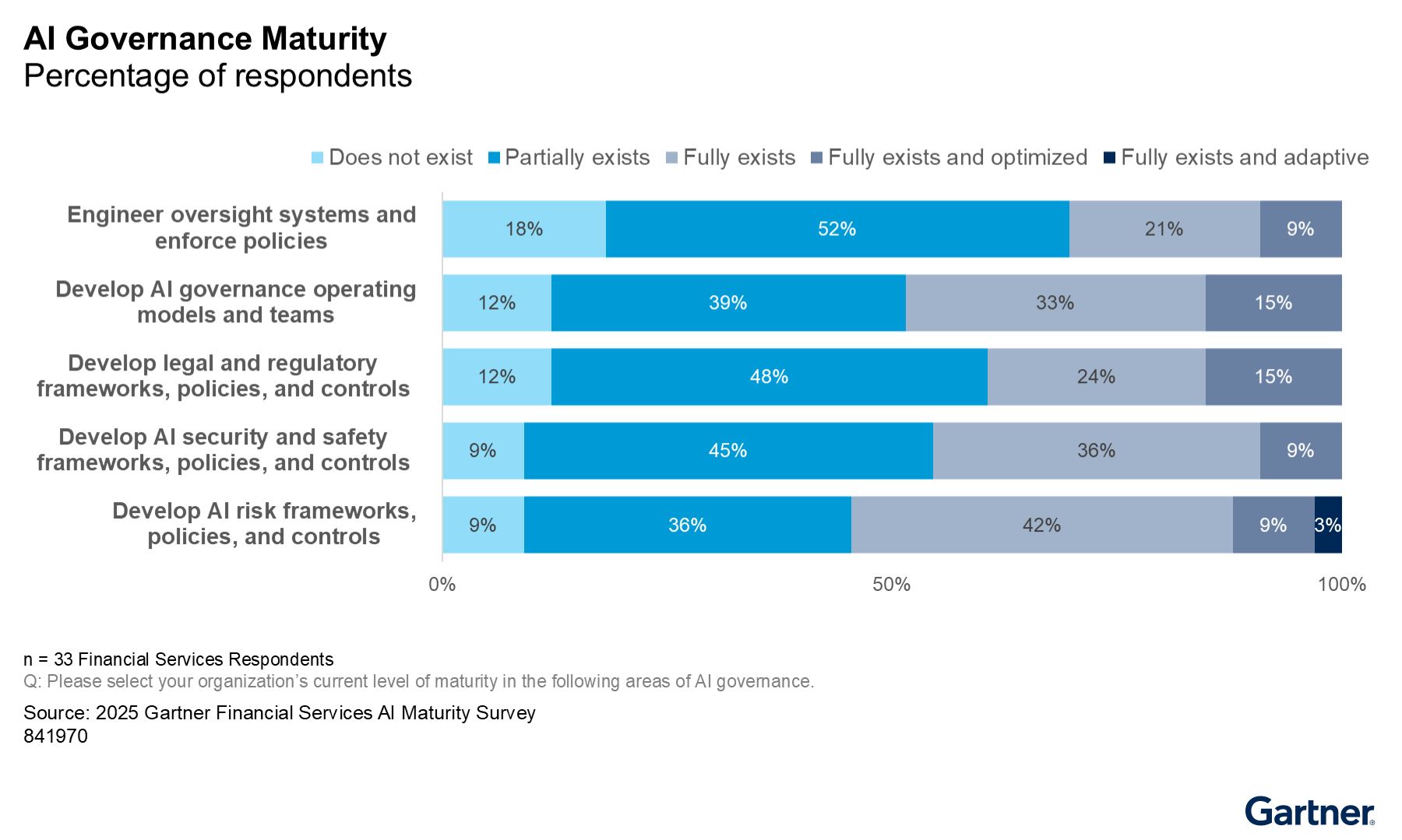
AI governance refers to the bank’s ability to:
- Engineer AI oversight systems and enforce policies
- Develop AI governance operating models and teams
- Develop legal and regulatory frameworks, policies, and controls
- Develop AI security and safety frameworks, policies, and controls
- Develop AI risk frameworks, policies, and controls
Among the 7 dimensions of AI maturity surveyed, industry IT leaders report that their firms are relatively more mature in this category overall than certain other categories. IT leaders and their risk and compliance peers have developed AI governance capabilities quickly in response to a number of factors inherent to the industry — these include:
- A “mixed signals” regulatory environment, in which regulators demand explainability of AI models (particularly in areas like lending and portfolio management), while at the same time clear legislative and regulatory rules of the road are yet to emerge.
- Continued concerns among industry IT leaders about AI-related risks including data security breaches, unreliable agent behaviors, and operational disruption from agentic system failures.1
- The importance of customer and employee trust as a foundational pillar of success in the industry.
Recommendations for IT leaders in banking and investment services to boost maturity in AI governance:
- Establish governance requirements by discovering and inventorying all AI used within the firm, including AI established by legacy core platform vendors as well as solutions from specialized AI vendors.
- Create guardrails for employee behavior by working with legal and compliance experts to define accountability and responsibility for unacceptable AI use or behavior in third-party embedded AI applications.
- Organize your exploration of AI TRiSM providers by understanding four key technology layers of TRiSM: AI governance, AI runtime enforcement, information governance, and infrastructure and stack (see Market Guide for AI Trust, Risk and Security Management).
- Bolster your AI policy by checking it against common flaws, including basic errors, impractical requirements, and perverse incentives, and discuss suggested changes with colleagues in Risk and Compliance (see Eliminate 10 Fatal Flaws in your AI Policy to Boost Enterprise Value).
Key Resources:
AI Engineering Maturity
Increasing ambition for AI value capture underscores why banking and investment services CIOs must resolve key technical questions. Industry players are leveraging AI not just to automate tasks, but to fundamentally restructure work, enhance service delivery and secure a leading role within the financial ecosystem. These objectives will increasingly require firms to invest in modular, enterprisewide AI platforms to improve scale, efficiency, and security (see JPMorgan’s AI Blueprint: Why Banking CIOs Must Move Beyond Use Cases to Platform Thinking).
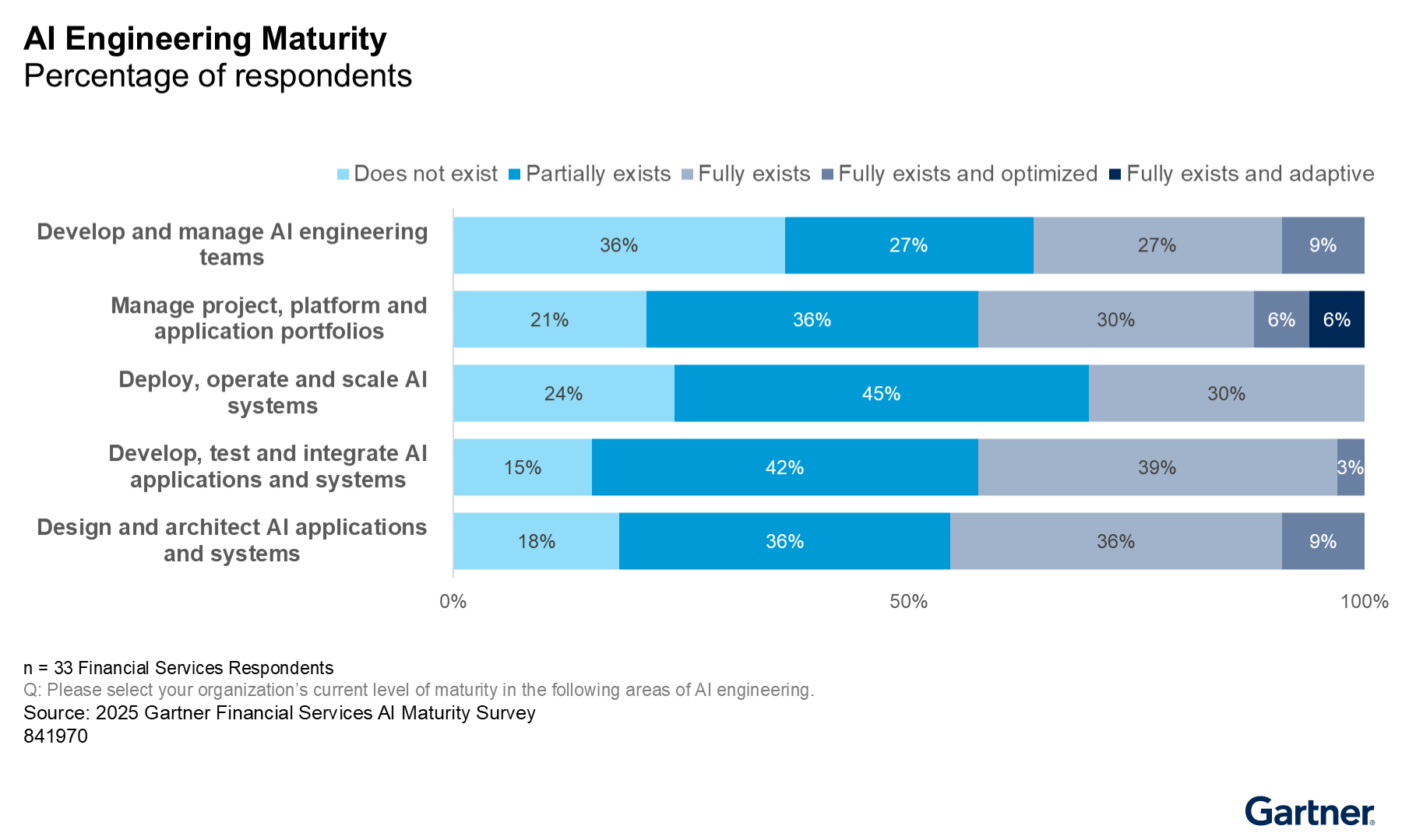
AI engineering refers to the bank’s ability to:
- Develop and manage AI engineering teams
- Manage project, platform, and application portfolios
- Deploy, operate, and scale AI systems
- Develop, test, and integrate AI applications and systems
- Design and architect AI applications and systems
Overall, CIOs in banking and investment services see AI engineering as a development area, roughly tied with AI data and organization for the least mature among the seven AI dimensions surveyed. Key AI engineering challenges in banking include:
- The proliferation of AI “point solutions” in different parts of the bank that are difficult to track and manage
- Escalating costs of GenAI implementation, as well as related security and governance risks
- Legacy bank systems that are incompatible with AI tools and applications
- Lack of robust infrastructure to support AI
- The risk of unauthorized access to PII and data leakage
Recommendations for IT leaders in banking and investment services to boost maturity in AI engineering:
- Evaluate GenAI platform vendors by their ability to support prioritized use cases and also the features and capabilities that align with AI ambition and pace of adoption (see Market Guide for Generative AI Platforms in Banking and Investment Services).
- Evaluate your readiness for domain-specific language models by assessing the firm’s data readiness, talent pool, resources and risk appetite against realistic expectations (see Innovation Insight: Domain-Specific Language Models (DSLMs) Reduce Risks for Generative AI in Financial Services).
- Build a roadmap for your journey to AI engineering maturity, with early steps focusing on defining technical team responsibilities and subsequent actions focused on optimizing infrastructure and acquiring tools for AI model development.
- Gain visibility and keep track of AI models and point solutions around the enterprise by exploring AI governance platforms that provide a centralized, discoverable registry of all AI use cases and AI services like SaaS services with embedded AI that can support multiple use cases (see Market Guide for AI Governance Platforms).
Key Resources:
AI Data
Data considerations are critical both to capture the upside and avoid the downside of AI in banking and investment services. Robust, accessible data can help CIOs and their D&A colleagues train AI models to produce better results for the firm and customers. By contrast, siloed or messy data is not AI-ready and less useful toward these ends. Moreover, unsecure data and the prospect of PII leaking outside the firm from AI initiatives gone wrong represent existential dangers in an industry that relies heavily on trust from customers and experiences significant regulatory scrutiny.
AI data includes the ability to:
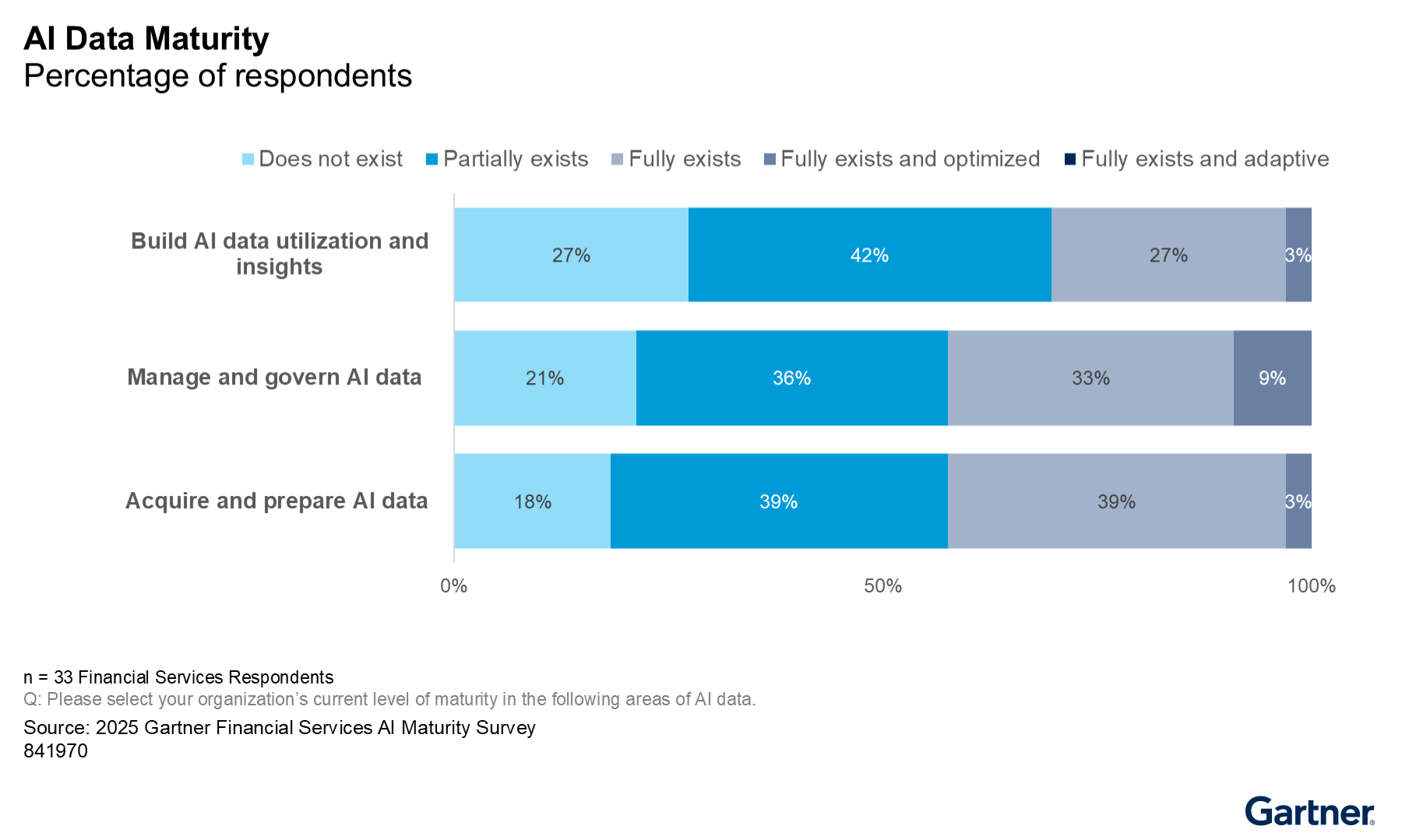
- Acquire and prepare data to support AI use cases
- Manage and govern AI data
- Build AI data utilization and insights
Of the seven dimensions of Gartner’s AI Maturity Model, banking and investment services CIOs perceive their firms as least mature in this category. Within the AI data dimension, banking CIOs rate themselves as most mature in building AI data utilization and insights, defined as the ability of the firm’s data to support AI objectives, model development, and outputs. CIOs rate their firms as least mature in the ability to acquire and prepare data for AI use.
The prevalence of batch-based legacy systems in banking that lack interoperability; the presence of siloed, disparate data systems across areas like mortgage, payments, and other product areas; the use of outdated data formats across silos; and a general lack of data literacy and maturity in the industry combine to limit the availability of AI-ready data in banking and investment services.
Recommendations for banking and investment services CIOs to boost maturity in AI data:
- Prioritize data organization and cleanup efforts by reviewing the firm’s list of prioritized AI use cases to understand which datasets matter most to AI ambitions.
- Explore possibilities to break down data siloes by integrating data from various sources, including legacy systems, into unified platforms like data lakes, logical data warehouses or data fabrics to provide a holistic view.
- Establish robust metadata management practices by focusing on capturing comprehensive context and lineage and moving toward active metadata management. This strengthens governance, compliance and transparency for model management by addressing semantic silos.
Key Resources:
1 2H25 Gartner Financial Services Leaders’ Priorities and AI Survey. This survey sought to understand financial services leaders’ most pressing priorities for the year, as well as AI initiatives at their organizations. This survey was conducted online from 30 September through 3 November 2025. In total, 158 executives at financial services organizations participated, including 82 banking and investment services respondents and 56 insurance respondents. Respondents were located in North America (n = 71), Europe (n = 35), Asia/Pacific (n = 16), the Middle East and Africa (n = 11), and Latin America and the Caribbean (n = 5). Disclaimer: The results of this survey do not represent global findings or the market as a whole, but reflect the sentiments of the respondents and companies surveyed.
2 2Q25 Gartner Financial Services Leaders’ Priorities and AI Survey. The main objective of this survey was to learn about top priorities and AI initiatives at financial services organizations. This survey was conducted online from 19 June through 18 July 2025. In total, 201 senior IT leaders at financial services organizations participated. Respondents were from North America (n = 106), Europe (n = 47), Asia/Pacific (n = 23), Latin America and the Caribbean (n = 16) and the Middle East and Africa (n = 9). Disclaimer: The results of this survey do not represent global findings or the market as a whole, but reflect the sentiments of the respondents and companies surveyed.
3 2025 Gartner AI Survey — CIO and Technology Leader View Industry.
2025 Gartner Financial Services AI Maturity Survey. This survey sought to understand the current and target levels of AI maturity at financial services organizations. This survey was conducted online from 2 April through 16 September 2025. In total, 33 executives at financial services organizations participated. Disclaimer: The results of this survey do not represent global findings or the market as a whole, but reflect the sentiments of the respondents and companies surveyed.