Market Trend: Generative AI and Agentic AI Drive Contact Center Agent Reductions for Customer Service Cost-Efficiency
18 August 2025 - ID G00809709 - 9 min read
By Megan Fernandez
Personnel represent the bulk of customer service costs, making operational cost-efficiency a critical priority. Providers should help prospects identify customer service interactions best suited for automation, and clearly quantify cost savings, to stand out in an increasingly competitive CX market.
Overview
Market Opportunities and Challenges
- Customer service automation drives measurable cost-efficiencies — but requires precision targeting. With personnel costs representing 64% (according to Gartner benchmarking data) of customer service spending, automation presents a significant opportunity for service providers to deliver quantifiable operational savings for prospects. However, success depends on a targeted approach — identifying and automating low-complexity, low-sensitivity interactions, while reserving high-touch, high-sensitivity interactions for human agents. Providers who can deliver data-backed frameworks and practical use cases for automation will accelerate contact center buy-in and differentiate in a crowded CX market.
- Evolving customer service GenAI and agentic AI capabilities expand addressable interaction types — yet complexity remains a barrier. Advancements in GenAI, language models and agentic AI (systems enabled with the planning and execution of autonomous actions), are expanding the scope of automatable interactions. Gartner projects up to 40% automation containment by 2029. However, not all interactions are viable candidates for automation. Service providers must guide clients in mapping and segmenting interaction profiles by complexity, sensitivity and business priority to maximize value while maintaining service quality.
- Quantification of value is essential — which requires ROI benchmarking data. Customer service leaders increasingly demand data-driven justification for automation investments. Service providers must leverage benchmarking data to demonstrate potential cost savings, such as the $104 billion in labor cost reductions projected from agentic AI-driven and GenAI automation by year-end 2026. At the same time, providers must help navigate customer service practice challenges, ensuring that automation initiatives align with business objectives and customer experience imperatives.
Strategic Planning Assumptions
Data hygiene and knowledge management initiatives occurring in 18 months to two years will fuel customer-facing GenAI bot adoption, contributing to a 7% to 9% annual reduction in contact center agents from 2027 to 2029.
Introduction
Gartner benchmarking data indicates that personnel costs account for approximately 64% of customer service spending.1 In the face of ongoing global business uncertainty, customer service leaders are prioritizing operational transformation to drive efficiency and manage costs. Technology and service providers have an opportunity to help identify practical opportunities for automation within customer service operations and quantify the resulting cost reductions.
Demonstrating realistic opportunities for automation has become essential for informed decision making. Presenting practical use cases along with data-backed evidence of operational savings not only supports project justification but also accelerates the customer service investment cycle.
Market Trend
Communications service providers (CSPs) must collaborate closely with customer service and support teams to identify high-impact opportunities for automating customer service interactions. A blanket approach — positioning GenAI customer service automation as a universal solution — will not yield optimal outcomes. Furthermore, failure to facilitate timelines that allow for extensive planning and testing with interaction flows will be a detriment to project success. Risks associated with incorrect outputs (generated from incorrect data and hallucinations) continue to occur. Failure to conduct testing and the implementation of effective guardrails to ensure output accuracy will prevent automation success.
In addition to CSP project implementation support, two key requirements will exist for many organizations to move forward with contact center transformation initiatives:
- Identification of realistic customer service automation — Evaluate interaction profiles to construct contact center routing intelligence.
- Quantifiable benchmarking to demonstrate value — Translate projected cost savings within unique customer service environments by calculating interaction and agent automation savings using benchmarking data.
Customer Service Automation Drives Measurable Cost-Efficiencies
Most organizations manage a diverse mix of customer interaction types, each with unique characteristics that influence the optimal resolution path. Underlying customer service and support solutions should enable seamless retention of context and real-time interaction data as customers transition across channels, minimizing friction and enhancing the overall service experience. While advancements in language models and data management practices will expand the range of interactions suitable for automation, not all interactions will be viable candidates. Complex, sensitive or high-priority cases will likely continue to require human support.
CSPs should guide prospects to identify and categorize their most frequent interaction types, assessing each for complexity, sensitivity and business priority. This targeted approach enables organizations to prioritize automation initiatives where they will deliver the greatest value, ensuring both operational efficiency and a positive customer experience.
Figure 1 shows a customer service agent resource scale based on interaction profiles.
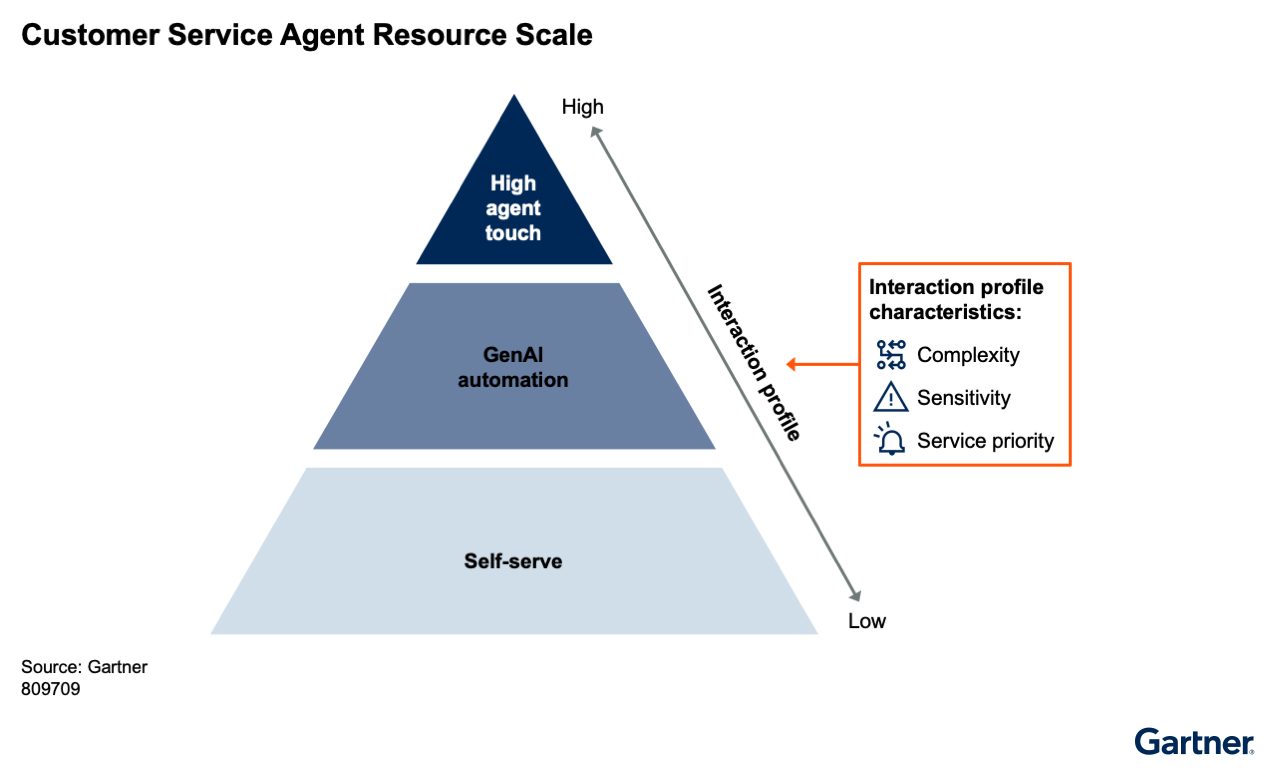
Customer service interactions characterized by high complexity, elevated sensitivity or critical service prioritization should be routed directly to human agents, with minimal involvement from GenAI bots and agentic AI actions, and furthermore, without being forced down self-service paths. In contrast, interactions that are low in complexity, sensitivity and priority are well-suited for automated self-serve and GenAI- and AI-driven resolution.
It is important to note that if an interaction scores highly in any one of these three dimensions — complexity, sensitivity or priority — the recommended approach is to prioritize agent-assisted workflows. This ensures that customer needs are met appropriately, while automation is leveraged where it delivers the greatest efficiency and value.
Additionally, service exceptions or incorrect mapping of interaction types must be accounted for. For example, when an interaction is initially classified as low in complexity but the customer is unable to achieve the desired outcome. In such cases, there should be a dynamic reclassification of the interaction type and immediate reallocation to a human agent.
Figure 2 provides an example of customer service interaction mapping.
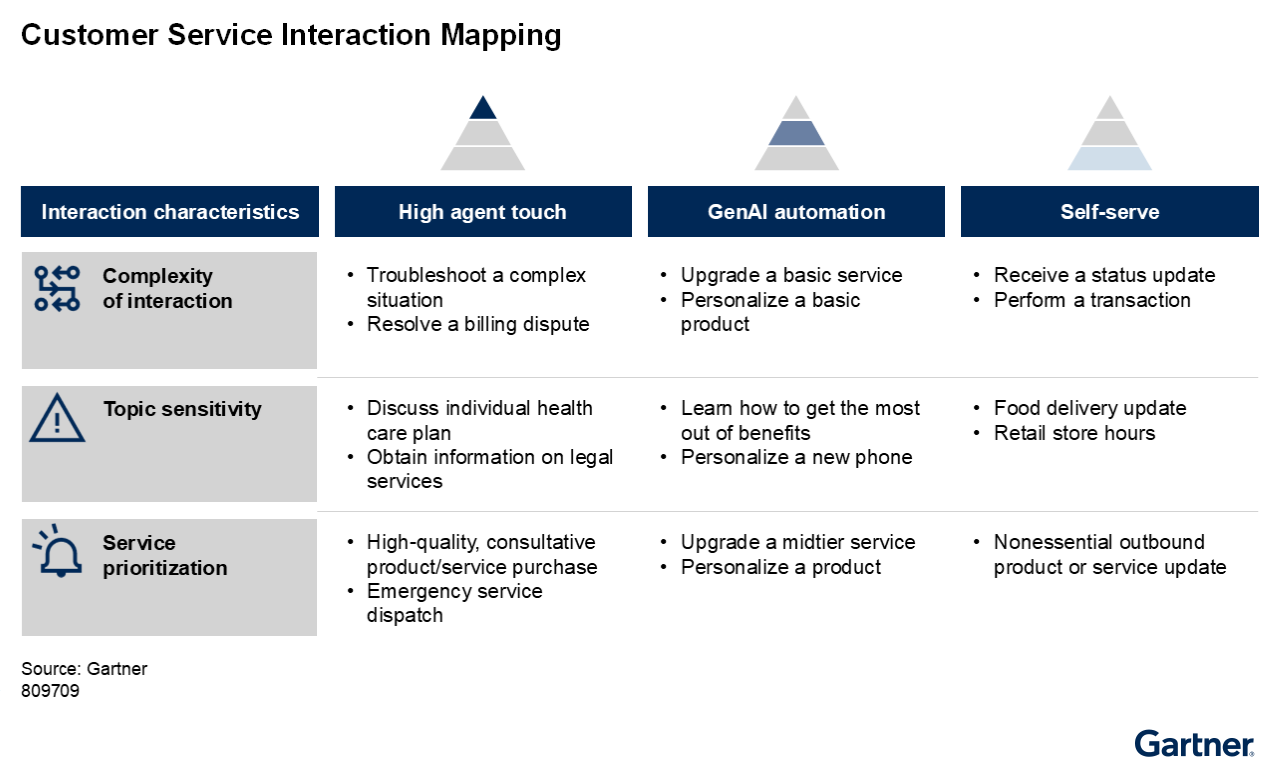
Common interaction profiles that score highly in complexity, sensitivity or service prioritization include troubleshooting issues, dispute resolution, consultations on sensitive topics, requests for emergency services, and guidance on high-value or “special care” purchases. Mapping interactions against these three characteristics helps organizations identify which interactions should remain with live customer support teams rather than being candidates for automation.
For these high-touch scenarios, agents are well-positioned to benefit from advanced back-office GenAI capabilities such as interaction and case summarization, real-time analytics and the surfacing of relevant knowledge and insights. These tools can enhance agent effectiveness and improve the overall customer experience without compromising the quality of support.
Conversely, interactions that score low on complexity, sensitivity and service priority — such as transactional inquiries, single-intent requests, status updates, delivery confirmations, basic business information and nonessential outbound notifications — are ideal candidates for self-serve and GenAI bot automation. Looking ahead, Gartner anticipates that by 2028, advancements in GenAI and agentic AI autonomous actions will enable automation of a broader range of medium-complexity interactions, further expanding the scope and impact of customer service automation initiatives.
Quantification of Value Using ROI Benchmarking Data
IT leaders often face challenges in quantifying the business benefits and tangible cost factors associated with contact center and customer service transformation initiatives. CSPs play a critical role in supporting organizations by providing frameworks to assess the impact of automation and self-serve enablement.
Customer Service GenAI Automation Metrics
According to Gartner’s 2025 contact center forecast (see Forecast Analysis: Contact Center, Worldwide) approximately 25% of agent interactions are projected to be automated by year-end 2027 — double the containment rates forecast for year-end 2025. By 2029, Gartner estimates that automation will contain around 40% of customer service interactions. This shift is expected to result in the automation of approximately 600,000 agent roles in 2025, with annual reductions exceeding 1 million agents beginning in 2027.
The opportunity for positioning cost savings through customer service automation will continue to expand as GenAI capabilities mature and organizations improve their data hygiene practices. Advancements in GenAI language models, agentic AI execution, bot functionalities and governance frameworks (see Executive AI Governance Playbook) will broaden the range of interactions suitable for automation.
On the customer side, enhanced readiness of data and knowledge sources will further enable GenAI-driven workflows, allowing bots to handle increasingly complex interactions. Ultimately, improved access to both real-time and historical data across multiple channels and systems of record will eventually make some higher-complexity interactions viable candidates for automation. This evolution will drive greater operational efficiencies and deliver measurable business value for organizations investing in customer service transformation.
While providers increasingly position customer service automation (and fewer agent seats), they will have opportunities to position implementation and consultative services associated with automation enablement as well as technology that supports effective automation outcomes. Additionally, Gartner expects providers to see increased demand for solutions that support agents in resolving complex customer service interactions including AI-generated, next-best-actions tools to assist with case management like summarization and case closure software.
Customer service providers have an opportunity to position high-value technology and services to enable customer service operational efficiency improvements in their customer base (see Technology Insight: Generative AI Contact Center Use Case Priorities, 2025).
Figure 3 shows contact center seats projections.
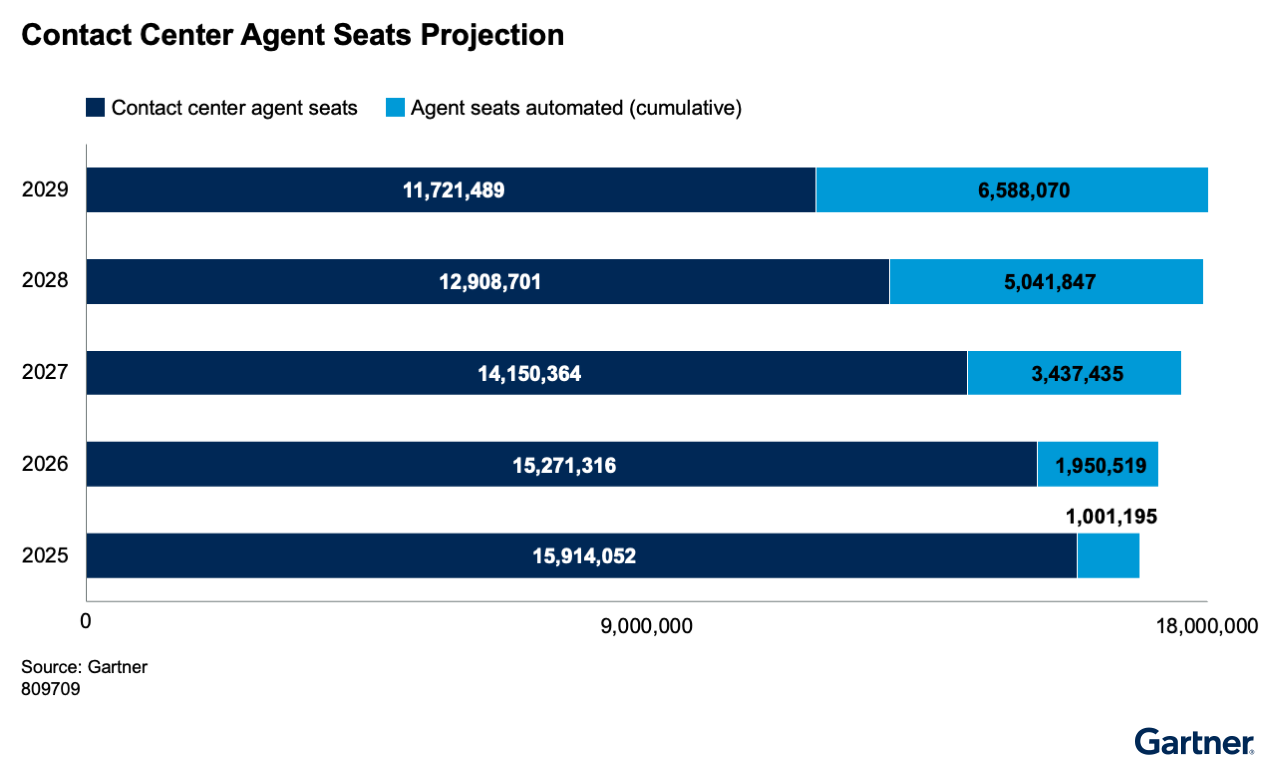
From a financial perspective, anticipated reductions in customer service agents are expected to generate substantial operational cost savings. Gartner has developed a model that projects agent seat requirements in the absence of GenAI automation, factoring in both the forecast growth in customer service interactions and the corresponding increase in agent headcount needed to support this demand without automation.
By comparing the estimated number of agents required in a nonautomated scenario to the projected agent count with GenAI and agentic AI automation, we can quantify the impact of automation on workforce requirements. As illustrated in Table 1, the projected removal of nearly two million agents in 2026 is expected to deliver labor cost savings of approximately $104 billion, based on an average fully loaded agent cost of just over $53,000 (see Note 1).
Operational Cost Savings Associated With Contact Center Agent Seat Automation, 2025-2029, Worldwide
| 2025 | 2026 | 2027 | 2028 | 2029 | |
|---|---|---|---|---|---|
Agent seat growth without automation (Gartner estimate) | 16,915,247 | 17,221,836 | 17,587,800 | 17,950,548 | 18,309,559 |
Agent seats automated (cumulative) | 1,001,195 | 1,950,519 | 3,437,435 | 5,041,847 | 6,588,070 |
Total contact center agent seats — Gartner forecast projections | 15,914,052 | 15,271,316 | 14,150,364 | 12,908,701 | 11,721,489 |
Cost per agent — annual fully loaded agent | $51,750 | $53,561 | $55,436 | $57,376 | $59,384 |
Operational cost savings in $M | $51,812 | $104,472 | $190,557 | $289,282 | $391,228 |
Source: Gartner (August 2025)
Looking ahead, the cumulative automation of approximately 6.5 million agents — corresponding to a total agent workforce of 11.7 million in 2029 — has the potential to drive operational cost savings of nearly $391 billion by year-end 2029. These projections underscore the transformative financial impact of GenAI automation on customer service operations.
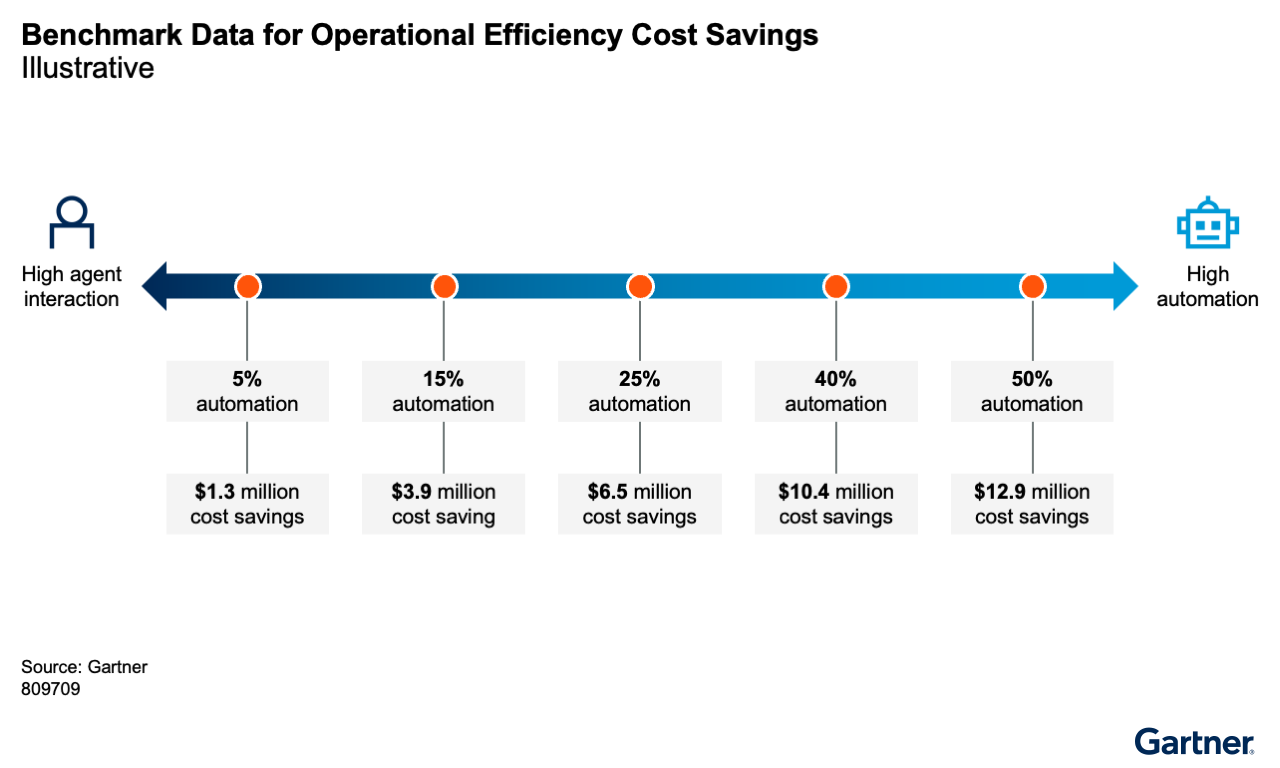
CSPs can leverage Gartner benchmarking data to help prospects quantify potential cost-efficiencies from automation at the individual project level. Figure 4 illustrates a framework for calculating interaction and agent automation savings, using a 500-seat contact center as an example. With an average fully loaded agent cost of $52 thousand per year, a 5% reduction in headcount can translate to approximately $1.3 million in annual savings. Scaling automation to 50% can drive annual cost savings of $12.9 million.
1 Industry average from Gartner’s benchmarking tool: See B2C Service and Support Metrics Benchmark.
Note 1: Explanation of Fully Loaded Agent Cost
The fully loaded agent cost includes base salary, benefits, employer taxes and a proportional share of operational overhead (such as facilities, technology and training). These costs vary significantly by geography, employer and role complexity. For example, fully loaded agent costs in North America and parts of Europe typically approach $60 thousand per year, while the costs in other regions may be substantially lower.