Magic Quadrant for Transportation Management Systems
30 March 2026 - ID G00832918 - 50 min read
By Brock Johns, Oscar Sanchez Duran, and 1 more
Transportation management systems help supply chain leaders optimize transport cost and service and manage disruptions. As requirements shift and the TMS market grows, the vendor landscape has become more complex. Supply chain technology leaders should use this research to help evaluate the TMS market.
Market Definition/Description
Gartner defines transportation management systems (TMSs) as software that supports multimodal sourcing, planning and execution of the physical transport of goods across the supply chain. It allows a shipper to manage varying levels of transportation complexity across multiple transport modes and geographic regions. TMS solutions are utilized by shippers of differing sizes, operational complexities, industries and geographic locations.
TMS solutions are utilized to plan and execute the physical transport of goods across the supply chain. They provide a shipper with the ability to manage the entire transportation life cycle of an order or shipment. This includes:
- Sourcing and procuring transportation capacity from third-party companies by supporting bid and rate management and optimization
- Intaking orders to provide a shipment plan, including order and shipment consolidation, mode selection, routes, rate and carrier selection
- Taking the shipment plan and enabling communications with carriers to facilitate execution against the plan
- Tracking and tracing the movements of shipments from pickup to final delivery
- Matching expected transportation charges against actual charges to manage discrepancies
- Making better transportation decisions by utilizing embedded analytics and reporting capabilities to measure key performance indicators, such as on-time performance; emissions calculations; and costs by customer, product line and location.
TMS solutions enable a shipper to have tighter control of their transportation operations, optimize costs, improve efficiencies and have improved visibility into the movement of goods.
Mandatory Features
The mandatory features for this market include:
- Availability as a stand-alone, self-service application, used independently of other products or services (including outsourced or managed services) offered by the vendor.
- All mandatory product features supported by a vendor’s proprietary technology and not relying on any third-party technology, product or services.
- Freight sourcing and procurement capabilities to source and procure transportation capacity from third-party companies by supporting bid management and optimization.
- Planning capabilities to intake orders to provide an optimized cost and service shipment plan, including order and shipment consolidation, mode selection, route determination and carrier selection.
- Execution capabilities to take the shipment plan and enable communications with carriers to facilitate execution against the plan.
- Visibility capabilities to track and trace the movements of shipments from pickup to final delivery. Settlement capabilities to match expected transportation charges against actual charges to manage discrepancies.
- Analytic capabilities to make better transportation decisions by utilizing embedded analysis and reporting capabilities to measure key performance indicators, such as on-time performance; emissions calculations; and costs by mode, customer, product line and location.
Optional Features
The optional features for this market include:
- Appointment/dock scheduling capabilities to allow for the management of appointments for outbound or inbound loads and collaboration between shippers and carriers to schedule dock door appointments electronically.
- Private fleet vehicle routing and scheduling/dispatching capabilities for dispatching and private fleet operations, including asset-based planning, final-mile optimization, fleet dispatching and driver planning.
- Parcel optimization and manifesting capabilities to select the best parcel carrier from all contracted carriers, execute shipments, obtain event-based visibility, and print labels and manifests.
- Transportation modeling capabilities to support strategic and tactical planning by creating “what-if” scenarios for potential network or route changes and forward-looking scenario analysis and planning.
- Transportation forecasting capabilities to enable simulated scenarios by calculating and managing capacity needs weeks in advance, and creating placeholders for predicted orders in the future transportation plan.
- 3D load-building capabilities to optimize the 3D configuration of goods in a truck or container, using load design ability to build plans for mixed pallets, optimal pallet patterns, and load optimization to manage space and capacity based on shipment characteristics.
- Direct integration to carrier networks (a large number of external carriers connected via API or electronic data interchange [EDI]) to support transportation procurement and execution capabilities by exchanging data such as rates, booking requests and confirmations and tracking events. Carrier networks can be included as part of the core TMS product or through partnerships with external carrier networks.
Magic Quadrant
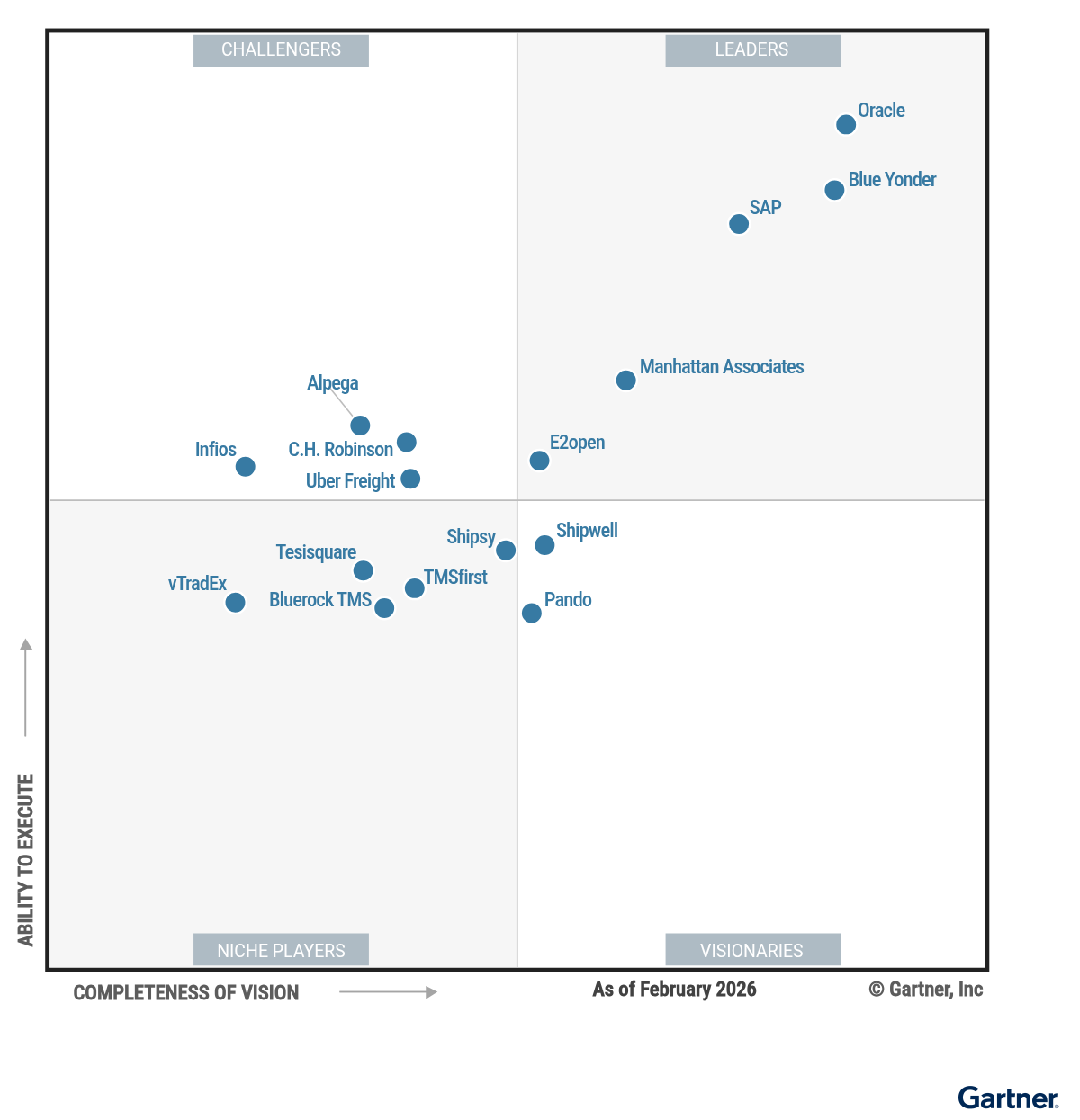
Vendor Strengths and Cautions
Alpega
Alpega is a Challenger in this Magic Quadrant. Alpega TMS offers capability bundles to accommodate varying complexity in transportation operations. While its customer base is primarily in Europe, Alpega also serves clients in other regions like North America or Asia. Alpega supports industry verticals such as third-party logistics, discrete manufacturing, automotive, fast-moving consumer goods and pharmaceuticals. Its product roadmap emphasizes enhanced carrier collaboration, process digitalization supporting the direct ingestion of data from eCMR and other freight documents, and improved analytics. Alpega is also working on integrating AI into its TMS’ core, and redesigning its UI to simplify end-user communication.
- Sales execution/pricing: Despite current market headwinds, Alpega continued to add enterprise-level organizations as customers. It renovated its pricing model, lowering sales friction and investments for its customers.
- Overall viability: Alpega’s overall viability remains strong. The vendor reported that it exceeded the “rule of 40” milestone in 2024, demonstrating its longstanding financial health as an organization. Alpega recently completed a leadership succession plan to appoint a new CEO. It also remains owned by private equity firm Castik Capital.
- Sales strategy: Alpega introduced a new low-commitment offering that targets specially growing midmarket organizations, complements its flexible pricing model, and allows customers to scale. Additionally, Alpega has also incorporated some changes to its internal organization to strengthen its sales and customer retention team structures.
- Vertical/industry strategy: Alpega’s industry-specific functionalities remain limited, even though it operates across multiple industry sectors. Organizations seeking TMS with robust, industry-specific features should closely scrutinize Alpega’s approach to vertical market specializations.
- Innovation: Alpega developed a comprehensive roadmap for 2026, but did not show the same level of innovation and product roadmap vision as other vendors in this Magic Quadrant. Alpega lags behind most vendors on introduction of GenAI and AI agents within its TMS product.
- Geographic strategy: Alpega remains focused on Europe as its primary market, with no plans to change its geographic strategy. This limits its customer growth in other regions and hinders its expansion opportunities in other markets.
Bluerock TMS
Bluerock TMS is a Niche Player in this Magic Quadrant. Its Bluerock TMS primarily focuses on unified logistics orchestration and interoperability with other systems such as yard management, sustainability intelligence and warehouse management. While its customer base is primarily in Europe, Bluerock’s presence with clients in regions like North America and the Middle East is growing. Bluerock supports industry verticals such as manufacturing, retail, e-commerce, life sciences and transportation. Its 2026 innovation roadmap includes additional enhancements to its network orchestration, expansion of its LTL and asset centric planning capabilities, and ongoing enhancements in AI, including agentic AI capabilities.
- Customer experience: Bluerock’s continuous value realization program ensures clients receive improvements in operational performance, automation and scalability, which enables measurable business outcomes and ongoing value. This has contributed to a 99% retention rate among its existing clients.
- Marketing strategy: Bluerock’s marketing strategy is disciplined and ROI-focused. It emphasizes efficient resource use, measurable results, third-party validation and a coordinated, multichannel approach tailored to different buyer personas. This ensures clients receive relevant, targeted information and support throughout their decision-making journey.
- Geographic strategy: While most of Bluerock’s revenue and clients are based in Europe, it’s making investments in North America by using a partner-driven approach to tap into local expertise and support scalable adoption.
- Sales execution/pricing: Bluerock customer growth has been low in the last 12 months, compared to other vendors in the Magic Quadrant. This is attributed to the shift toward midsize to large enterprise clients.
- Marketing execution: While Bluerock has made investments to increase its budget and presence at industry events year over year, its market visibility still trails behind its competitors. This impacts brand awareness and new customer acquisition.
- Vertical/industry strategy: Bluerock’s strategy skews its customer base toward logistics service providers, and its focus on other verticals such as manufacturing, retail and healthcare are only now starting to take shape. Customers should evaluate Bluerock’s depth of experience and roadmap innovation for their respective industry.
Blue Yonder
Blue Yonder is a Leader in this Magic Quadrant. Its Blue Yonder Transportation Management (Blue Yonder TMS) is primarily focused on transportation planning and execution as part of a comprehensive suite of solutions that includes warehouse management, yard management and order management. Its operations are geographically diversified, and its clients span various enterprise sizes and industries. Recent or planned innovations include seamless interoperability between Transportation Management and the Blue Yonder Network, a central hub for inbound messages facilitating integrations with its Platform Data Cloud, and ongoing agentic AI enhancements, such as generative AI agents that identify risks and opportunities across the network.
- Overall viability: Blue Yonder’s customer retention, market presence and sustained investment in innovation and TMS-related headcount growth make it a strong partner.
- Marketing execution: Blue Yonder effectively reaches a broad range of stakeholders through targeted campaigns that drive increased engagement and lead generation. This approach aligns with the company’s brand recognition in the TMS market.
- Offering (product) strategy: Blue Yonder TMS is updating its user experience with GenAI and Logistics Ops Agents and expanding its functionality to address varying levels of transportation complexity. The platform utilizes the Blue Yonder Network to connect implementation partners and complementary technologies, enabling multiparty collaboration and a unified data source for customers.
- Operations: Blue Yonder has longer implementation timelines compared to some competitors, which may pose challenges for customers that need faster time to value or targeted point solutions.
- Vertical/industry strategy: Potential customers should assess Blue Yonder’s industry-specific features and future plans. Some specialized capabilities may be limited, and the company’s recent innovations focus on broader needs rather than specific industries.
- Marketing strategy: Blue Yonder has limited traction and minimal presence in the midmarket segment. This may present challenges in differentiation and scalability across diverse customer segments.
C.H. Robinson
C.H. Robinson is a Challenger in this Magic Quadrant. Its Navisphere TMS focuses on end-to-end transportation management, including embedded real-time transportation visibility and support for a fully-managed transportation offering. C.H. Robinson operates globally, with the bulk of its customers based in North America. Its clients are primarily medium-to-large organizations within the industrial manufacturing, consumer goods and automotive sectors, though it serves other industry verticals as well. Recent innovations include an AI-powered logistics planner orchestrator, usability enhancements in its purchase order management module, and more than 500 new carrier connections.
- Market understanding: C.H. Robinson tightly aligns to key TMS market trends, including the increasing use of AI and AI agents, the growing scope of real-time visibility, and growing geopolitical tensions.
- Sales execution/pricing: C.H. Robinson’s increase in customer numbers last year ranked it among the top third of vendors in terms of acquiring new customers, demonstrating its product’s tight alignment to customers’ current demands.
- Overall viability: C.H. Robinson continues to demonstrate longstanding financial health through investments in its TMS solution to grow dedicated resources, as well as R&D investments year over year.
- Innovation: While C.H. Robinson’s 2026 roadmap focuses on AI capabilities, most of the product features it released in 2025 were enhancements to existing capabilities, rather than new ones. Potential clients should evaluate whether the company’s TMS roadmap fully aligns with their future requirements and needs.
- Geographic strategy: Despite C.H. Robinson’s plans to strengthen its go-to-market strategy in regions like Asia/Pacific and the Middle East, and increase its physical presence in other regions, most of its new customers are in North America.
- Customer experience: C.H. Robinson’s SLA for uptime availability is below average, compared to other vendors in this Magic Quadrant. It also doesn’t provide differing support models as part of its standard offering, with some Peer Insights reviews citing system support as a large issue.
E2open
E2open (a WiseTech Global company) is a Leader in this Magic Quadrant. Its product, e2open Transportation Management, provides end-to-end transportation management while offering additional logistics capabilities like global logistics orchestration and logistics visibility. Its operations are geographically diversified, with the majority of its customers in North America. E2open customers tend to be small and midsize shippers, with a strong concentration in the food and beverage, consumer products, industrial and retail industry verticals. Its 2026 innovations will focus on expanding use cases for its digital assistant and predictive planning intelligence to aid planners’ routing decisions.
- Market understanding: E2open displays clear knowledge regarding industry trends and the future evolution of transportation and the TMS market. This is important for customers seeking a partner that evolves to support changing transportation dynamics.
- Offering (product) strategy: E2open offers a broad range of TMS capabilities supplemented by additional logistics applications and capabilities. It also offers global trade management capabilities, which have increased in importance.
- Product or service: E2open’s TMS solution supports a wide range of customer use cases, including industries and domestic and international transportation. This differentiates it from some vendors in this Magic Quadrant.
- Innovation: E2open did not display the same level of innovation as other vendors in this Magic Quadrant. It trailed in GenAI tool and AI agent development and deployment, and its delivered innovations in 2025 were not highly differentiated. Potential customers should determine whether the company’s TMS roadmap fully aligns with their future requirements and needs.
- Market responsiveness/record: Some existing clients expressed concerns regarding e2open’s service and support capabilities. This is a recurring issue, and potential customers should understand how these capabilities may change now that e2open is a WiseTech Global company.
- Customer experience: Some existing e2open customers expressed frustration with the vendor when negotiating contracts. Customers noted that they experienced limited flexibility when negotiating key terms and costs.
Infios
Infios is a Challenger in this Magic Quadrant. Its Infios TM broadly focuses on providing domestic and international functionality. Infios primarily operates in North America, with clients spread relatively evenly among small, midsize and large organizations. Roughly half of its customers are shippers in wholesale distribution, food and beverage, and industrial verticals. The other half of its customer base is split between 3PLs, freight forwarders and brokerage verticals. In 2025, Infios focused on connecting its TMS with its order management system (OMS) and warehouse management system (WMS), as well as European expansion. Its 2026 focus includes additional AI agents and user experience (UX) enhancements.
- Sales strategy: Infios deploys a broad sales approach to target shippers and 3PLs of all sizes, and follows a simple pricing model based on freight under management. It recently integrated a customer support program into its base subscription pricing, shifting away from a separate cost for customers and making its total cost of ownership (TCO) more attractive.
- Overall viability: Infios TM, acquired from MercuryGate in October 2024, is part of the broader Infios Intelligent Supply Chain Execution suite (which includes OMS and WMS solutions). This positions Infios TM as a key piece of the Infios strategy to compete with other supply chain execution suite vendors.
- Customer experience: Infios provides a multilayered approach for collecting customer feedback and influence for the future direction of the product. This includes both executive and product advisory boards and offering a product roadmap idea portal for Infios’ full customer base. Additional programs include helping customers track and measure ROI and various options for training and certification programs.
- Innovation: Infios did not exhibit the same level of innovation and product roadmap vision as other vendors in this Magic Quadrant, particularly in the areas of GenAI and AI agents. Potential customers should determine whether the company’s TMS roadmap fully aligns with their future requirements and needs.
- Geographic strategy: Infios TM has expanded resources across Europe as part of the broader Infios umbrella, but its presence in emerging and higher-growth markets (like Asia and South America) trails other vendors in this Magic Quadrant. Potential customers with operations in these regions should evaluate Infios’ ability to support their needs from a sales and support standpoint.
- Market responsiveness/record: Infios TM has a lower customer retention rate than other vendors in this Magic Quadrant. It has also been slower than other vendors in enhancing its user experience for TMS users, including its use of embedded GenAI capabilities.
Manhattan Associates
Manhattan Associates is a Leader in this Magic Quadrant. Its Manhattan Active Transportation Management (TM) system primarily focuses on end-to-end transportation management as part of the Manhattan Active Supply Chain Platform, which includes warehouse management, yard management and labor management systems. Its operations are geographically diverse, with North America comprising most of its customer base. Its clients are mostly large corporations in the retail, grocery, wholesale distribution and manufacturing industries. Manhattan Associates’ recent developments include the Freight Payment Agent and Unified Parcel zone skipping, and ongoing enhancements in agentic AI, such as the Transportation Planner Agent to automate load consolidation and routing.
- Overall viability: Manhattan’s consistent profitability continues to make it a Leader in the Magic Quadrant. Its strategic expansions in high-growth regions like Europe and Latin America, as well as its TMS-dedicated headcount increase, indicate that it’s a stable TMS partner.
- Market responsiveness: Manhattan Associates achieved one of the strongest retention rates in this Magic Quadrant, demonstrated strong R&D investment with full execution of its 2025 roadmap, and delivered robust agentic AI solutions to enhance TMS capabilities aligned with industry trends and evolving operational needs.
- Marketing strategy: Manhattan Associates builds market recognition by showcasing its platform through interactive demos and simulations. It’s also increasing its overall marketing investment and tailoring strategies by region, industry and buyer persona, using account-based marketing to ensure customer needs are addressed.
- Sales execution/pricing: Manhattan Associates places strong emphasis on marketing its TMS solution, yet it has one of the lowest year-over-year growth rates for net-new customers among Magic Quadrant Leaders. This lower growth rate may be linked to its historical reliance on internal resources for implementation, though Manhattan is now expanding its implementation partner ecosystem.
- Vertical/industry strategy: Manhattan Associates places significant emphasis on the retail, grocery and life sciences sectors, but lacks a differentiated go-to-market strategy for several other verticals. As a result, the company’s strategic focus and specialized offerings outside its core industries remain limited.
- Customer experience: Manhattan Associates offers a tiered support model, with costs for both standard and premier support that vary based on usage and user count. Instructor-led training remains a separate, quote-based service. Customers should proactively plan for these support and training costs as part of their overall investment.
Oracle
Oracle is a Leader in this Magic Quadrant. Its Oracle Fusion Cloud Transportation Management (Oracle OTM) system focuses on transportation management as part of a set of logistics solutions that includes warehouse management, global trade management (GTM) and intelligent technologies. Oracle operates on a global scale, serving a broad spectrum of clients that vary in both organizational size and industry sector. Its recent or planned innovations include sustainability capabilities enhancements, integration with Oracle Business Network, mobile app improvements, and an AI agent studio that allows end users to create their own AI agents with developer tools.
- Market understanding: Oracle continues to effectively address key transportation management trends, especially in AI. Oracle maintains strong AI investments and capabilities to respond to global disruptions and strengthen compliance across the organization.
- Marketing execution: Oracle remains one of the strongest and most recognizable software brands in the TMS markets. Many of the vendors in this Magic Quadrant consider Oracle one of their top direct competitors.
- Offering (product) strategy: Oracle’s solution offers broad capabilities and deep functionality that support transportation complexity for companies of all sizes. It also maintains one of the most extensive partner ecosystems in the TMS market.
- Vertical/industry strategy: Oracle’s continued industry-agnostic approach to the TMS market limits its ability to deliver on industry-specific TMS capabilities. Organizations seeking vertical or industry-specific specialization in TMS should evaluate Oracle’s current and planned capabilities closely.
- Operations: Oracle’s solution does not include prebuilt industry templates or configuration wizards to support TMS implementations. Organizations looking for an industry-specific Oracle configuration should evaluate their selected system integrator’s expertise and implementation templates directly.
- Geographic strategy: Despite Oracle’s global footprint, it hasn’t experienced the growth in Asia/Pacific that clients might expect from a company of this size and brand reputation.
Pando
Pando is a Visionary in this Magic Quadrant. Pando primarily focuses on multimodal transportation management as part of a comprehensive suite of solutions that includes freight procurement, freight audit and payment, and 3D load optimization. Its operations are geographically diverse, with a primary focus on Asia and North America, and its clients span various enterprise sizes and industries, particularly consumer products, retail and manufacturing. Pando’s recent or planned innovations include GenAI-based automated proof of delivery (POD) checks for handwritten documents, agentic AI that uses GenAI to read and process incoming emails, and ongoing enhancements in agentic AI, like AI agents for domestic transportation to automate planning workflows.
- Innovation: Pando invests a higher-than-average share of its TMS revenue into R&D, with a strong focus on agentic AI that enables assistant agents for complex workflows like freight procurement, invoice auditing, and email automation. These capabilities provide clients the tools to advance beyond predictive analytics.
- Market understanding: Pando aligns with key TMS market trends, such as AI capabilities, speed to value and ROI, and supports sustainability and the circular economy. This focus enables customers who prioritize agility in their transportation operations to stay competitive and responsive within evolving market dynamics and industry expectations.
- Customer experience: Pando conducts postimplementation audits, adoption tracking and engagements to help customers optimize system usage and realize outcomes over time. This strategy is designed to support ongoing value beyond the initial implementation phase.
- Sales execution/pricing: Despite growth in its sales and partner ecosystem in North America, Pando acquired fewer net-new TMS customers in 2025, compared to other vendors in the Magic Quadrant. This may indicate challenges related to market recognition and pricing alignment, relative to more-established competitors.
- Overall viability: Pando is one of the smallest vendors in this Magic Quadrant in terms of TMS customers and revenue. Potential customers should evaluate Pando’s growth and profitability to determine if they’re comfortable with its market position and viability.
- Geographic strategy: Pando’s presence outside Asia is growing, but the majority of its customer base remains there. Potential clients outside of Asia should evaluate Pando’s ability to support their needs from a sales and support standpoint.
SAP
SAP is a Leader in this Magic Quadrant. Its flagship TMS product, SAP Transportation Management (SAP TM), optimizes freight procurement, transportation planning, execution and settlement. SAP maintains a global presence, with a client base primarily consisting of large enterprises spanning sectors like consumer products, mill products, mining, chemicals, agriculture, wholesale distribution and many other industries. SAP’s recent innovations include AI capabilities that target use cases like goods receipt processing. It also began integrating Joule, SAP’s business AI, into its TMS solution. SAP’s roadmap includes further enhancements and integrations to its TMS, GTM, WMS and Logistics Business Network products.
- Overall viability: SAP’s market position and large installed base presents strong overall viability that prospective customers can depend on. As a TMS provider, SAP’s cloud adoption and number of live customers continue to grow.
- Marketing execution: SAP is one of the most well-recognized global brands. Its RISE with SAP and GROW with SAP programs, which bundle SAP TM with other SAP products, remain successful. SAP also launched a new product, SAP Logistics Management, that targets regional and local distribution operations by combining transportation, warehouse and carrier collaboration into a single offering that aims to drive further SAP TM adoption.
- Vertical/industry strategy: SAP’s customers span a vast number of industry verticals. SAP provides industry-specific capabilities for industries like automotive or mill/mining, as well as implementation templates. Additionally, SAP industry-specific business units (IBUs) generate tailored go-to-market strategies, including materials and programs focused on industry-specific challenges.
- Market responsiveness: While SAP TM is considered a premium brand, end users especially consider SAP TM an expensive product due to its high subscription costs and longer-than-average implementation times. End users should carefully evaluate SAP TM’s fit to their business requirements and expectations around TCO and expected ROI.
- Sales strategy: While SAP has experienced success growing its customer base and cloud adoption, SAP TM remains sold almost exclusively to customers in the SAP ecosystem. End users considering SAP TM should carefully evaluate the product’s suitability and compatibility with their current IT ecosystem and organization strategy.
- Customer experience: Per customer feedback data from Peer Insights, SAP TM remains a “complex” TMS to implement. Complaints center around the solution’s overall cost and complexity to set up and configure.
Shipsy
Shipsy is a Niche Player in this Magic Quadrant. Its Shipsy TMS primarily focuses on end-to-end transportation management as part of a comprehensive suite of solutions that includes freight procurement, route optimization and hub operations. Its operations are geographically diversified, and its clients span various enterprise sizes and industries. Its recent or planned innovations include ongoing developments in agentic AI, such as autonomous control tower agents for exception detection and resolution, and a freight settlement AI agent.
- Sales execution/pricing: Thanks to its investments in senior leadership in new geographies, Shipsy continues to deliver one of the highest growth rates in this Magic Quadrant. Shipsy offers potential clients a closer, more localized relationship with their TMS technology services provider.
- Innovation: Shipsy still dedicates a larger-than-average portion of its revenue toward its R&D. As a result, its agentic AI innovation remains strong, moving toward settlements and control towers while maintaining high transparency by sharing roadmap updates with clients on a monthly basis.
- Marketing execution: Shipsy effectively leverages targeted campaigns like its AI-native settlements initiative, which has generated a notable number of leads in the past year. This demonstrates the company’s ability to translate technology trends into pipeline results.
- Overall viability: In terms of number of customers and revenue, Shipsy remains one of the smallest vendors in this Magic Quadrant. It’s one of the newer entrants to the TMS market and was not profitable in 2025. Clients seeking a provider with robust market history should evaluate Shipsy carefully.
- Geographic strategy: Shipsy has market penetration in Asia and the Middle East/Africa. Though it recently expanded into Europe by establishing local offices to support its enterprise clients, its presence in North America remains limited.
- Vertical/industry strategy: Shipsy remains narrowly focused on logistics service providers (LSPs), retail, and consumer goods, which account for the vast majority of its customer base. It has minimal presence in complex industrial sectors like aerospace, high tech, and defense, so potential clients in these industries should carefully evaluate whether Shipsy can support their goals.
Shipwell
Shipwell is a Visionary in this Magic Quadrant. Its solution, Shipwell TMS, focuses on combining traditional TMS capabilities with visibility and workflow automation. Shipwell primarily operates in North America, with some presence in other regions such as South America and Europe. Its customers tend to be small and midsize shippers with higher concentration in the food and beverage, industrial, and consumer products industries. Its 2026 focus areas include expanding its AI workers (AI agents to expand a company’s digital workforce), additional international capabilities, and enhancements to its parcel capabilities.
- Offering (product) strategy: Shipwell focuses on developing an end-user-friendly product with the appropriate level of functional capability to support customers in the small and midsize market. It also continues to increase its focus on AI capabilities to improve the user experience.
- Sales execution/pricing: Shipwell TMS offers support to potential customers via business case development, ROI calculations and projections, and tailored demo environments. These supporting activities help potential customers in their TMS evaluation and selection process, while also helping Shipwell grow its customer base.
- Innovation: Shipwell enhanced its embedded GenAI chatbot and released an AI agent for track and trace. It executed well against its product roadmap for both 2024 and 2025, balancing innovation while adding functionality to improve its overall product offering.
- Geographic strategy: Shipwell’s geographic expansion continues to lag behind other vendors in this Magic Quadrant. Though it recently shifted its geographic strategy, it’s unclear if this will accelerate its global footprint. Potential customers seeking a global TMS solution should carefully consider the vendor’s capabilities to implement and support them outside North America.
- Overall viability: Shipwell is one of few vendors in the Magic Quadrant that was not profitable in 2025. Potential customers should evaluate Shipwell’s growth and profitability to determine whether they are comfortable with its position and viability in the market.
- Operations: Shipwell trails other vendors in this Magic Quadrant in implementation resources, and its network of implementation partners remains very small. Organizations that are interested in global deployments or are based outside North America should evaluate Shipwell’s implementation and support resources.
Tesisquare
Tesisquare is a Niche Player in this Magic Quadrant. Its TESI TMS is part of the Tesisquare Platform, a broader supply chain application portfolio with collaboration capabilities that connect stakeholders through a common data hub for transportation management. While its customer base is primarily in Europe, Tesisquare also serves clients in other regions like North America and South America. Tesisquare supports different industry verticals, such as food and beverage, fast-moving consumer goods, wholesale distribution and retail. Its current innovations emphasize incorporating AI into its TMS to enhance its virtual assistant and provide prescriptive transportation insights.
- Offering (product) strategy: Tesisquare’s TMS offering continues to focus on providing a modular and extensible product that can be easily expanded through partnerships. The organization forged new partnerships in 2025 to ensure its TMS product’s scalability and modernization.
- Business model: TESI TMS is an intrinsic part of the Tesisquare supply chain offering and one of its important contributors to its revenue growth. The vendor remains committed to its development and further evolution, putting special emphasis on AI application, IoT integration, and automation capabilities.
- Overall viability: Tesisquare continues to demonstrate longstanding financial health as an organization. The vendor increased its TMS revenue and continued its expansion strategy in 2025, acquiring a new company in France (Puissance i) and opening two new sales offices in the U.S.
- Geographic strategy: The vast majority of Tesisquare’s customer base remains located in Italy. While Tesisquare has an expansion strategy in place for 2026, its customer growth in other regions remains limited.
- Innovation: Tesisquare’s AI capabilities, while practical, currently lack use-case innovation. Tesisquare is planning a major release in 2026 that includes technology stack enrichments, changes to its product architecture and native integration of AI, but potential customers must determine whether these enhancements will meet their needs.
- Sales execution/pricing: Tesisquare continues to trail most of the other vendors in this Magic Quadrant in terms of customer growth in the previous 12 months.
TMSfirst
TMSfirst is a Niche Player in this Magic Quadrant. Its product, TMSfirst, focuses primarily on providing global, multimodal transportation management with complementary solutions for procurement and visibility. Its operations are primarily based in North America, but it supports customers in regions like Europe, Asia and South America. Its customers tend to be medium to large enterprise shippers, with higher concentration within 3PLs, petrochemicals, manufacturing and utilities. Its 2026 focus includes additional AI agents and predictive capacity planning.
- Sales execution/pricing: TMSfirst offers support to potential customers via business case development, ROI calculations and projections, and guided demo environments. It also offers scaled and ramp-up pricing, and proofs of concept (POCs). These supporting activities help potential customers in their TMS evaluation and selection process.
- Market understanding: TMSfirst displays clear knowledge of industry trends, future evolutions in transportation, and the TMS market. Customers seeking a partner that evolves to support changing transportation dynamics may find these traits valuable.
- Innovation: TMSfirst invests a higher-than-average percentage of its TMS revenue into R&D, compared with other vendors in this Magic Quadrant. It also deployed AI agents for exception management and exhibited a solid product roadmap for 2026, blending additional AI capabilities with enhancements to sustainability and predictive capacity planning.
- Marketing execution: TMSfirst has lower brand name recognition and customer familiarity than other vendors in this Magic Quadrant. Its selective event strategy narrows its reach, reduces pipeline opportunities, and limits chances for potential customers to interact with and understand TMSfirst. Potential customers should determine if they’re comfortable with TMSfirst’s market positioning, brand strategy and company value alignment.
- Marketing strategy: TMSfirst’s primary marketing channels are limited compared to other vendors in this Magic Quadrant. This limits its reach and ability to increase market awareness. It has committed a larger budget toward marketing activities in 2026, but it remains to be seen if these efforts will aid its growth.
- Operations: TMSfirst has fewer integration resources and ecosystem partnerships than other vendors in this Magic Quadrant. TMSfirst’s internal teams lead the majority of its implementations, with others augmented by partners. Potential customers should evaluate its resources and its ability to support implementations outside North America.
Uber Freight
Uber Freight is a Challenger in this Magic Quadrant. Its solution, Uber Freight TMS, mainly focuses on self-service transportation management technology for shippers, though it does offer a fully outsourced, managed transportation option as well. Its operations and customers are primarily in North America, though it does support customers in Europe. Uber Freight TMS customers are primarily small and midsize shippers, with higher customer concentrations in the petrochemicals, food and beverage, automotive, and consumer products industries. Its recent and planned innovations include Insights AI for automated analysis and recommendations, as well as the addition of other AI agents, and further modernization of multiple TMS modules.
- Market understanding: Uber Freight displayed clear knowledge regarding industry trends and the future evolution of transportation and the TMS market. This is important for customers seeking a partner that will evolve to support changing transportation dynamics.
- Market responsiveness/record: Uber Freight TMS has a strong track record for supporting customers. Uber has demonstrated that it delivers on outcome-based objectives and metrics that support strong customer retention.
- Sales execution/pricing: Uber Freight offers support to potential customers via business case development and ROI calculations and projections. It also offers scaled and ramp-up pricing. These supporting activities help potential customers in their TMS evaluation and selection process.
- Geographic strategy: Uber’s geographic expansion continues to lag other vendors in this Magic Quadrant. Its growth outside of North America is limited and confined to Europe. Potential customers seeking a global TMS solution should carefully consider the vendor’s capabilities to implement and support them outside North America.
- Vertical/industry strategy: Uber Freight supports customers across a wide number of industries, but it doesn’t display the same level of industry-focused innovation or industry specific strategies as other vendors in this Magic Quadrant. Potential customers should closely evaluate any required industry specific requirements.
- Operations: Uber Freight TMS continues to lead most of its own implementations and has fewer implementation partners than other vendors in this Magic Quadrant. Potential customers considering global TMS deployments should evaluate Uber Freight’s resources and ability to support implementations outside North America.
vTradEx
vTradEx is a Niche Player in this Magic Quadrant. Its TMS, eLOG TMS, is part of a broader logistics product suite that includes order management, transportation management, route optimization, warehouse management and some yard management capabilities. While vTradEx’s operations are predominantly based in China, the vendor’s presence is growing in other parts of the world. vTradEx customers tend to be large enterprises with higher customer concentrations in the 3PL, automotive, high-tech and consumer products industry verticals. Its recent and planned innovations include prediction capabilities for delays and disruptions, international transportation enhancements, new AI agents and new interfaces for API connections.
- Operations: vTradEx has a strong implementation partner ecosystem within Asia, differentiating it from other vendors in this Magic Quadrant. It also provides a good support model, along with implementation tools like prebuilt industry templates and setup wizards for configuration.
- Business model: vTradEx is well-positioned in emerging TMS markets like China. It offers a broader logistics suite with a focus on execution that includes TMS and WMS, enabling the organization to engage with potential customers seeking to rationalize their logistics technology vendor portfolio.
- Customer experience: vTradEx focuses on customer experience that includes rapid response times for support and strong SLAs for system uptime and availability. It also offers services for postimplementation audit adoption of the TMS that include usage analytics, training and workshops, and continuous improvement consultations.
- Geographic strategy: vTradEx has limited expansion outside its home region. Despite its use of partnerships to expand its global presence, vTradEx’s presence in other regions is still small compared with other vendors in this Magic Quadrant. Potential customers seeking a global TMS solution should carefully consider the vendor’s capabilities to implement and support them outside China.
- Innovation: vTradEx did not exhibit the same level of innovation and product roadmap vision as other vendors in this Magic Quadrant, including capabilities for GenAI and AI agents. Potential customers should evaluate whether the company’s TMS roadmap fully aligns with their future needs.
- Marketing execution: vTradEx remains largely focused in its local market and its limited marketing execution impacts its international expansion, which is slower when compared to other vendors in this Magic Quadrant. Its brand recognition outside China is low compared with its peers.
Vendors Added and Dropped
We review and adjust our inclusion criteria for Magic Quadrants as markets change. As a result of these adjustments, the mix of vendors in any Magic Quadrant may change over time. A vendor's appearance in a Magic Quadrant one year and not the next does not necessarily indicate that we have changed our opinion of that vendor. It may be a reflection of a change in the market and, therefore, changed evaluation criteria, or of a change of focus by that vendor.
Added
No vendors were added to this Magic Quadrant.
Dropped
Aptean was dropped from this Magic Quadrant, as it did not meet the TMS technology customer criteria.
Inclusion and Exclusion Criteria
All of the following TMS solution capabilities must have been commercially available (in general availability [GA]) as of 31 October 2025.
Gartner defines “general availability” as the release of a product to all customers. When a product reaches GA, it becomes available through the company’s general sales channel — as opposed to a limited or controlled release, pre-GA or beta version.
To qualify for inclusion, providers need the following.
TMS product:
- It must have availability as a stand-alone, self-service technology application, used independently of other products or services (including outsourced or managed services) offered by the vendor.
- It must be an end-to-end native, holistic, multimodal TMS technology product that fully supports all mandatory capability features (freight sourcing and procurement, planning, execution, settlement, visibility and analytics). All mandatory product features must be supported by a vendor’s proprietary technology and not rely on any third-party technology, product or services.
- It must be an end-to-end native, holistic, multimodal TMS technology product that fully supports at least three common capability features (appointment/dock scheduling, private fleet vehicle routing and scheduling/dispatching, parcel optimization and manifesting, transportation modeling, transportation forecasting, and 3D load building).
- The TMS must support the following transportation modes: truckload, less-than-truckload, parcel, and ocean.
Vendor momentum:
Vendor momentum and viability criteria are based on revenue, subscription or customer growth (all revenue numbers must be reported in U.S. dollars constant currency). The vendor must meet one of the following:
- At least $10 million in TMS technology revenue for the previous fiscal year, comprising license and/or subscription fees. Revenue must come from stand-alone technology sales to TMS customers only and not from other products, services or implementation fees.
- A three-year compound annual customer and revenue growth rate of at least 20% from stand-alone TMS technology sales to TMS customers only.
TMS technology customers:
A customer is defined as a single legal entity that holds a contractual agreement for use of the TMS directly with the vendor. The customer independently and holistically uses the TMS solution being evaluated. This does not include customers using other products sold by the vendor or customers using only a subset of TMS capabilities or modules. Gartner does not count customers of reseller partners or service provider clients for the purpose of this Magic Quadrant.
The vendor must meet all the following criteria:
- At least 50 live TMS technology customers.
- At least 10 new named (new logos) TMS technology customer deals sold in the previous 12 months.
- At least 10 live TMS technology customers headquartered outside the vendor’s home geographic region.
- At least two new named (new logos) TMS technology customers headquartered outside the vendor’s home region during the previous 12 months.
- The vendor must have TMS technology customers in at least two of the following geographic regions: North America, South America, Europe, the Middle East and Africa, Australia and New Zealand, and Asia.
The vendor must have existing or new TMS technology customers in at least seven industries. Examples include 3PLs, government, healthcare providers, manufacturing and natural resources, retail, energy and utilities, and wholesale.
Evaluation Criteria
Ability to Execute
Gartner analysts evaluate vendors on the quality and efficacy of the processes, systems, methods or procedures that enable provider performance to be competitive, efficient and effective, and to positively affect revenue, retention and reputation. Vendors are also evaluated on how well their efforts to market and communicate their vision for their product resonate with the market. Ultimately, they are judged on their ability and success in capitalizing on their vision.
Product or Service: This includes current product capabilities, quality, feature sets and the like. A focus is placed on differentiated TMS technology products, including support for mandatory and common capabilities. The overall breadth of capabilities and the depth of product functionality are also important factors.
Overall Viability: Consideration is given to the year-over-year product revenue growth, vendor/business unit profitability, the amount of revenue invested in research and development for the TMS product, and any changes in organizational structure or key personnel.
Sales Execution/Pricing: Consideration is given to the clarity and competitiveness of the vendor’s pricing model for TMS technology, the number of net-new TMS technology deals, and customer feedback on the quality of sales-related activities.
Market Responsiveness and Track Record: This criterion considers the provider’s history of responsiveness to changing market demands and its track record for TMS technology.
Marketing Execution: Consideration is given to a vendor’s social media presence, range of programs and approaches to increase its TMS technology’s product profile, and overall brand awareness of the vendor’s product.
Customer Experience: Consideration is given to customer feedback on sales experience with the vendor and overall customer satisfaction with the TMS technology product.
Operations: Consideration is given to the vendor’s implementation resources and tools to support its TMS technology product both in its home region and globally.
Criteria for product or service, overall viability, market responsiveness, customer experience and operations are weighted high. These are often key drivers for vendor selection with potential buyers. Buyers express interest in product functionality, the vendor’s ability to deliver against objectives, overall satisfaction with the vendor, the vendor’s viability, and the vendor’s ability to provide implementation, support and consistent delivery.
Criteria for sales execution/pricing and marketing execution are given medium weight. This ensures that vendors have sufficient investment and growth in their TMS products. It also ensures a diverse set of customer requirements, a track record of maintaining long-term customer relationships, and the ability to build brand-name recognition, while using multiple brand channels, due to an increasingly competitive market.
Ability to Execute Evaluation Criteria
| Evaluation Criteria | Weighting |
|---|---|
Product or Service | High |
Overall Viability | High |
Sales Execution/Pricing | Medium |
Market Responsiveness/Record | High |
Marketing Execution | Medium |
Customer Experience | High |
Operations | High |
Source: Gartner (March 2026)
Completeness of Vision
Gartner analysts evaluate vendors on their ability to convincingly articulate logical statements about current and future market direction, innovation, customer needs and competitive forces. Vendors are evaluated on their ability to articulate — to Gartner and the market — a “statement of direction” for the next two to three years that matches (or surpasses) Gartner’s vision for the evolution of the TMS market. Ultimately, vendors are rated on their understanding of how market forces can be exploited to create opportunities for the vendor.
Market Understanding: Consideration is given to a vendor’s alignment with top trends, thought leadership and market knowledge, and competitive differentiators.
Marketing Strategy: Consideration is given to overall positioning statements and strategies to target specific market segments by addressing unique industry, geographic or size/complexity requirements.
Sales Strategy: Consideration is given to the number of TMS technology-focused sales resources, pricing models, cost elements, sales channels and sales partnership strategies.
Offering (Product) Strategy: Consideration is placed on differentiated product capabilities, new or planned features, and the vendor’s overall partnership/ecosystem development strategies.
Business Model: Consideration is given to the vendor’s business and TMS technology product value proposition and commitment to the TMS product.
Vertical/Industry Strategy: Consideration is given to the number of industries with active and new TMS technology customers and differentiated TMS technology product capabilities for specific industries/verticals.
Innovation: Consideration is given to the level of investment in research and development, quality of the product roadmap, and execution and delivery of the vendor’s previous TMS technology product roadmap.
Geographic Strategy: Consideration is given to the number of regions and offices, dedicated sales resources, and countries with existing and new TMS technology customers.
Criteria for market understanding, offering (product) strategy, innovation and geographic strategy are weighted high. In terms of vision, these criteria are the most impactful in a buyer’s decision. Buyers are looking for vendors that understand the trends and changing dynamics in transportation, offer depth and breadth in their product portfolios, have strong product roadmaps, and support their business needs across a diverse set of geographic locations.
Criteria for marketing strategy and sales strategy are given medium weight. This is to ensure that vendors have a strategy to improve market visibility, provide clear and consistent messaging, and have adequate sales channels and resources to continue to grow their businesses.
Criteria for business model and vertical/industry strategy are weighted low. Vendors should show the ability to adapt or evolve their business model as needed, that this market is significant to their overall business, and that they have consistent vertical focus. These are rated low because TMS buyers do not often consider these criteria as important in their evaluation of vendors and products.
Completeness of Vision Evaluation Criteria
| Evaluation Criteria | Weighting |
|---|---|
Market Understanding | High |
Marketing Strategy | Medium |
Sales Strategy | Medium |
Offering (Product) Strategy | High |
Business Model | Low |
Vertical/Industry Strategy | Low |
Innovation | High |
Geographic Strategy | High |
Source: Gartner (March 2026)
Quadrant Descriptions
Leaders
Leaders have the ability to execute their vision through their TMS products and demonstrate solid business results in the form of revenue and customer growth. Leaders have significant successful customer deployments in a wide variety of industries, across multiple geographies, and with multiple proofs of deployments. They offer functionally rich solutions that are especially beneficial to larger organizations with a high level of transportation complexity. Leaders should be able to support global transportation operations and are often the vendors against which other providers measure themselves.
Challengers
Challengers are often larger than Niche Players and demonstrate higher volumes of new business. They have the size and product capabilities to compete worldwide, but they might not be able to execute equally well in all geographic areas. They often achieve high customer experience satisfaction. They may lack a strong functional vision or may have failed to deliver compelling new product enhancements during the past 12 months. Challengers may lag behind Leaders in terms of their product roadmaps.
Visionaries
Visionaries are typically seeking to deliver a unique or differentiated approach to the market. They may be considered thought leaders and tend to be on the leading edge of emerging concepts and technologies. Visionaries may have a smaller number of live customers and/or lack a substantial market presence. These vendors usually have deficiencies in their Ability to Execute, particularly in areas such as market visibility, growth, track record or operations. Vendors in this category can be established TMS vendors that have yet to mature into leading positions in the market, or they can be innovative vendors that are more specialized, with unique views of where the market is heading.
Niche Players
Niche Players offer a TMS product that lacks breadth and depth of capabilities, or may not demonstrate the ability to consistently handle deployments across multiple geographies, or may lack strong sales. These vendors may offer a complete TMS for fewer specific industries, but face challenges in one or more of the areas necessary to support cross-industry requirements. They may have an inconsistent implementation track record or may lack the ability to support the requirements of large or higher transportation complexity enterprises. Even so, Niche Players sometimes offer the best solutions for the needs of particular organizations, considering the price/value ratio of their solutions.
Context
Gartner continues to see expansion in the sophistication, functional breadth and depth, and geographical scope of the broader TMS market. However, as shipper requirements grow, notable differences remain across solutions. These differences include the capability to address the most complex transportation requirements, a vendor’s ability to deploy and support outside its home region, and the TMS’s native support for modes other than over the road. Vendors are increasingly looking to leverage artificial intelligence, particularly GenAI and agentic AI, to further differentiate their products. In addition, the challenges that organizations have faced in orchestrating end-to-end processes have increased the importance of transportation and supply chain execution convergence.
This Magic Quadrant provides a comparative analysis of leading TMS vendors, offering actionable insights into each provider’s strengths and weaknesses. Use this resource as a strategic guide to identify, compare and shortlist vendors that best match your organization’s specific requirements and long-term vision. As the market evolves with increasing emphasis on time to value, intuitive user experiences, sustainability and artificial intelligence, thorough vendor evaluation is more critical than ever.
Key considerations and recommended next steps for clients include:
- Prioritize fit and functionality: Consider your organization’s level of transportation complexity and focus on solutions that best fit its needs and requirements. Focus on breadth of TMS functionality beyond mandatory capabilities and depth of functionality, particularly in functionality for transportation planning and optimization.
- Review support models: Review potential vendors’ global reach, in terms of ability to support global operations and in ability to support implementation and ongoing support. SLAs such as uptime percentage and response and resolve times vary across the market.
- Focus on time to value: To address challenges in AI adoption and TMS implementation timelines, prioritize solutions with rapid deployment, intuitive interfaces and strong integration capabilities. Solutions that offer guided demos, POCs and clear implementation roadmaps can reduce deployment timelines and help organizations pivot rapidly in dynamic market conditions.
- Ecosystem effect: The strength of the partner ecosystem, including technology alliances and system integrator relationships, plays a pivotal role in successful TMS deployment and ongoing optimization. A robust partner ecosystem can accelerate implementation and also support continuous improvement and long-term value realization.
- Scrutinize AI claims: AI deployments should be rigorously assessed based on current capabilities, future innovation roadmaps, the vendor’s commitment to timely delivery, and demonstrated proof of delivery. Request metrics or case studies showing measurable improvements.
- Review roadmaps and future direction: Request each vendor’s roadmap, compare planned features to your future needs (both short-term and long-term), and exclude vendors with plans that do not support your requirements.
- Leverage customer references: Strengthen your evaluation by seeking references from current customers. Focus on real-world deployment scenarios and outcomes to validate vendors’ capabilities and claims. Ask customer references for details on implementation, integration challenges, time to value, ongoing support and quantifiable results.
- Build a better business case: Strengthen business cases that align investments with operational goals by quantifying expected efficiency gains, cost reductions and resilience improvements. AI deployments should be rigorously assessed based on current capabilities, future innovation roadmaps, the vendor’s commitment to timely delivery, and demonstrated proof of delivery.
Market Overview
This Magic Quadrant evaluates vendors based on the evolving needs of shippers and the effects of market changes in a landscape that remains highly fragmented. No new vendors entered the quadrant this year and one, Aptean, was dropped as it did not meet the inclusion criteria. Movement in the quadrant reflects the capability of providers to deliver on emerging requirements, as well as business transformations occurring within the market and the removal of Aptean.
Market Dynamics and Strategic Implications
The TMS market has faced headwinds in terms of longer sales and implementation cycles, due to external factors such as tariffs and operational disruptions in 2025. However, Gartner expects the TMS market to remain a growing market, with most vendors participating in this Magic Quadrant reporting strong growth in revenue and customer acquisition. Gartner continues to see high interest from prospective buyers for TMS applications, despite customer challenges in articulating compelling business cases against other company technology priorities.
One of the primary goals of logistics leaders with TMS in 2025 was to ensure resilience against global disruptions. TMS vendors responded to that need by enhancing their control-tower-like capabilities and strengthening their partnerships with other software vendors for the integration of risk data, thus providing further insights on potential disruptions and real-time alerts. This also shows the growing emphasis on and importance of robust partner ecosystems and system integration relationships. Other considerations include the improvements in sustainability capabilities and insights, particularly in the European market, and the opportunity to outsource logistics operations through managed services partnerships.
Additionally, market consolidation continued with high-impact transactions, most notably WiseTech Global’s $2.1 billion acquisition of e2open, which ultimately required the regulatory-forced divestiture of Expedient to resolve competition concerns in Australia.
Technology Trends and Vendor Differentiation
UX and predictive analytics remain critical factors for organizations seeking to enhance their transportation strategies. Vendors assessed in this Magic Quadrant differentiated themselves through the depth of their planning and optimization functionality, as well as their ability to provide sustainability capabilities such as emissions calculations and meaningful data reporting.
Concurrently, the eruption of AI and AI agents to automate repetitive tasks is changing the market focus, with these capabilities now at the forefront of vendor roadmaps. While leading providers are investing in more advanced AI capabilities, many vendors are using AI agents to automate repetitive tasks like appointment scheduling, exception management and freight procurement.
Additionally, the convergence of transportation and broader supply chain execution is a key trend, as more organizations pursue supply chain orchestration that is supported by end-to-end supply chain decision making.
The following were used to collect information about the vendors and their TMS offerings:
- Vendor presentations and demonstrations to the Gartner analyst team: Specifically, to support this research, each vendor is allotted time to present information about its company and its solutions. Each vendor is allotted the same amount of time for this research, but Gartner also conducts interactions with vendors throughout the year as part of normal and ongoing relationships with user and vendor clients.
- Research and data collection: Each vendor is asked to fill out a survey that investigates, in more detail, factual information about its company and TMS offering. All research and data collected was as of 15 December 2025. Also, as part of this exercise, Gartner reviews customer references on Gartner Peer Insights submitted during the past 12 months.
Ability to Execute
Product/Service: Core goods and services offered by the vendor for the defined market. This includes current product/service capabilities, quality, feature sets, skills and so on, whether offered natively or through OEM agreements/partnerships as defined in the market definition and detailed in the subcriteria.
Overall Viability: Viability includes an assessment of the overall organization's financial health, the financial and practical success of the business unit, and the likelihood that the individual business unit will continue investing in the product, will continue offering the product and will advance the state of the art within the organization's portfolio of products.
Sales Execution/Pricing: The vendor's capabilities in all presales activities and the structure that supports them. This includes deal management, pricing and negotiation, presales support, and the overall effectiveness of the sales channel.
Market Responsiveness/Record: Ability to respond, change direction, be flexible and achieve competitive success as opportunities develop, competitors act, customer needs evolve and market dynamics change. This criterion also considers the vendor's history of responsiveness.
Marketing Execution: The clarity, quality, creativity and efficacy of programs designed to deliver the organization's message to influence the market, promote the brand and business, increase awareness of the products, and establish a positive identification with the product/brand and organization in the minds of buyers. This "mind share" can be driven by a combination of publicity, promotional initiatives, thought leadership, word of mouth and sales activities.
Customer Experience: Relationships, products and services/programs that enable clients to be successful with the products evaluated. Specifically, this includes the ways customers receive technical support or account support. This can also include ancillary tools, customer support programs (and the quality thereof), availability of user groups, service-level agreements and so on.
Operations: The ability of the organization to meet its goals and commitments. Factors include the quality of the organizational structure, including skills, experiences, programs, systems and other vehicles that enable the organization to operate effectively and efficiently on an ongoing basis.
Completeness of Vision
Market Understanding: Ability of the vendor to understand buyers' wants and needs and to translate those into products and services. Vendors that show the highest degree of vision listen to and understand buyers' wants and needs, and can shape or enhance those with their added vision.
Marketing Strategy: A clear, differentiated set of messages consistently communicated throughout the organization and externalized through the website, advertising, customer programs and positioning statements.
Sales Strategy: The strategy for selling products that uses the appropriate network of direct and indirect sales, marketing, service, and communication affiliates that extend the scope and depth of market reach, skills, expertise, technologies, services and the customer base.
Offering (Product) Strategy: The vendor's approach to product development and delivery that emphasizes differentiation, functionality, methodology and feature sets as they map to current and future requirements.
Business Model: The soundness and logic of the vendor's underlying business proposition.
Vertical/Industry Strategy: The vendor's strategy to direct resources, skills and offerings to meet the specific needs of individual market segments, including vertical markets.
Innovation: Direct, related, complementary and synergistic layouts of resources, expertise or capital for investment, consolidation, defensive or pre-emptive purposes.
Geographic Strategy: The vendor's strategy to direct resources, skills and offerings to meet the specific needs of geographies outside the "home" or native geography, either directly or through partners, channels and subsidiaries as appropriate for that geography and market.