Quick Answer: Which Consumers Will Embrace Agentic Commerce?
3 September 2025 - ID G00839359 - 11 min read
By Jason Daigler, Sandy Shen, and 1 more
U.S. consumers show some signs of openness to agentic commerce, with readiness varying significantly by generation, income level and community type. While acceptance among younger, more affluent, and urban consumers might be expected, successful digital commerce leaders will adjust their investments more precisely to align with their target customers.
Quick Answer
Which consumers are most willing to adopt agentic commerce?
- Younger consumer demographics, specifically millennials and Gen Z, demonstrate a greater inclination toward AI-assisted shopping.
- Higher-income consumer segments exhibit a more pronounced willingness to adopt agentic commerce.
- Residents of urban and suburban environments generally display higher receptivity to agentic commerce compared to individuals in rural or small-town communities.
More Detail
The accelerating adoption of GenAI is poised to disrupt traditional commerce models, prompting organizations to reevaluate their engagement strategies for both human and nonhuman customers. Digital commerce is experiencing a significant shift with the rapid expansion of GenAI platforms. This evolving phenomenon will lead to agentic commerce, whereby consumers:
- Use GenAI platforms for product discovery
- Make purchases either using GenAI platforms’ native check-out capabilities or by using AI agents that can independently search for, evaluate, and purchase products and services
- Are served by seller-provided AI agents (seller agents) that assist with the buying journey
Agentic commerce refers to an approach to building commerce solutions based on the use of one or multiple software entities that are classified, completely or at least partially, as AI agents that can discover products, negotiate, decide and transact.
At present, some consumers use AI while shopping during the exploration and research phases of the shopper journey, but these applications are yet to be broadly adopted. As of March 2025, only 11% of consumers reported having recently used a GenAI app or tool while shopping.1 However, broad adoption of GenAI platforms has accelerated drastically in 2025, and digital commerce leaders must gauge future receptivity and adoption among their target audiences to properly prepare for new processes and technology investments related to agentic commerce.
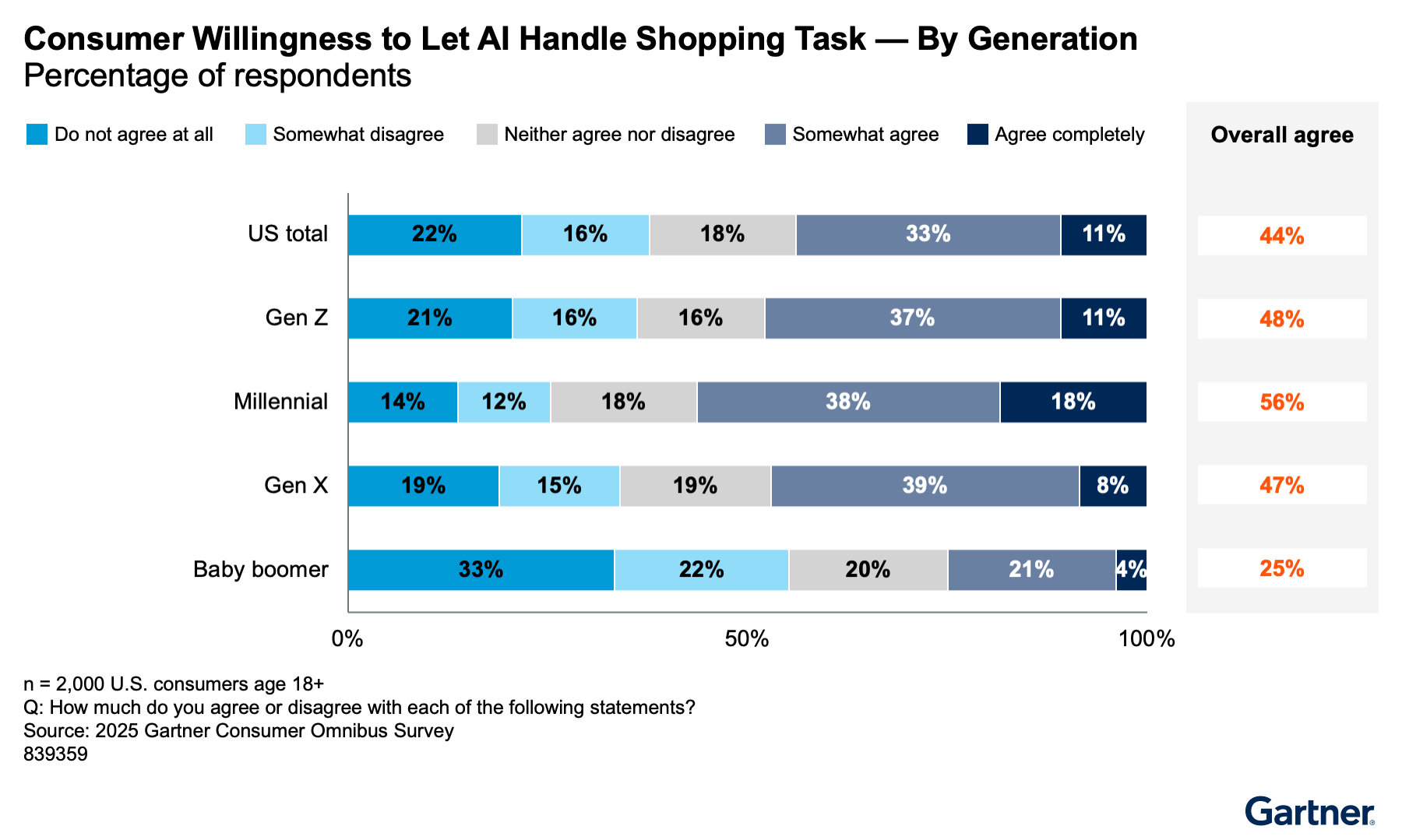
Gartner surveyed U.S. consumers on their openness to the concept of using AI to assist with shopping-related activities. The 2025 Gartner Consumer Omnibus survey assessed agreement with the following statement: “I’d be willing to let AI apps/tools handle or assist me in some of my shopping tasks (researching, narrowing down products/brands, reordering items, etc.).”1
Overall, 44% of U.S. consumers expressed willingness to let AI tools assist with these types of shopping tasks.1 However, this average masks significant variation across demographic groups. The following sections explore how readiness differs by generation, household income and community type.
Generational Differences
Generational attitudes concerning agentic commerce demonstrate notable variation. Data indicates that millennials are the most receptive, with 56% expressing willingness to allow artificial intelligence (AI) to handle or assist with shopping tasks. Following this segment, Gen Z exhibits 48% receptivity, closely matched by Gen X at 47%. In contrast, baby boomers display significantly lower openness, with only 25% overall agreement.1 These findings confirm the expected outcome that there is a greater inclination among younger consumer demographics to adopt AI in their digital commerce buying journeys.
The lifestage or household dynamics typical of these generations also demonstrate a similar pattern. For example, parents with children in the household — a demographic composed largely of millennials and some older Gen Zers — report higher openness to agentic commerce (64%) than empty nesters (29%), a household lifestage represented primarily by baby boomers and Gen Xers. These differences align with expected digital fluency and emerging technology adoption patterns, but also parallel younger consumers’ growing desire to maximize shopping decisions. Since 2021, the proportion of Gen Zers, millennials and Gen Xers who say they exhaustively look for and research as many options as possible to find the best fit while shopping has increased by more than 10 percentage points (13, 15 and 10 points, respectively), while baby boomers have slightly decreased in this behavior (a decrease of 3 percentage points).1,2
If your target customer is a millennial or Gen Z (more receptivity):
If you deploy conversational interfaces or chatbots in native channels such as mobile apps, you should create agents that can interact with messaging platforms and social media, where younger consumers already engage.1,3 Positioning these tools as smarter shopping assistants that support customers’ research, make the process less labor- or time-intensive, and elicit confidence in purchasing decisions may help with adoption. Additionally, you should ensure your brand is discoverable by GenAI platforms and AI agents used by consumers.4
If you deploy conversational interfaces or chatbots in native channels such as mobile apps, you should create agents that can interact with messaging platforms and social media, where younger consumers already engage.1,3 Positioning these tools as smarter shopping assistants that support customers’ research, make the process less labor- or time-intensive, and elicit confidence in purchasing decisions may help with adoption. Additionally, you should ensure your brand is discoverable by GenAI platforms and AI agents used by consumers.4
If your target customer is a baby boomer (less receptivity):
Avoid aggressive rollouts of conversational technologies. Instead, offer optional agent support alongside traditional shopping experiences that prioritize simple navigation. Offer chatbots to simplify routine tasks such as reordering or managing subscriptions, and provide clear opt-in controls and the ability to escalate a conversation to a human to maintain trust and comfort.
Avoid aggressive rollouts of conversational technologies. Instead, offer optional agent support alongside traditional shopping experiences that prioritize simple navigation. Offer chatbots to simplify routine tasks such as reordering or managing subscriptions, and provide clear opt-in controls and the ability to escalate a conversation to a human to maintain trust and comfort.
Income-Based Readiness
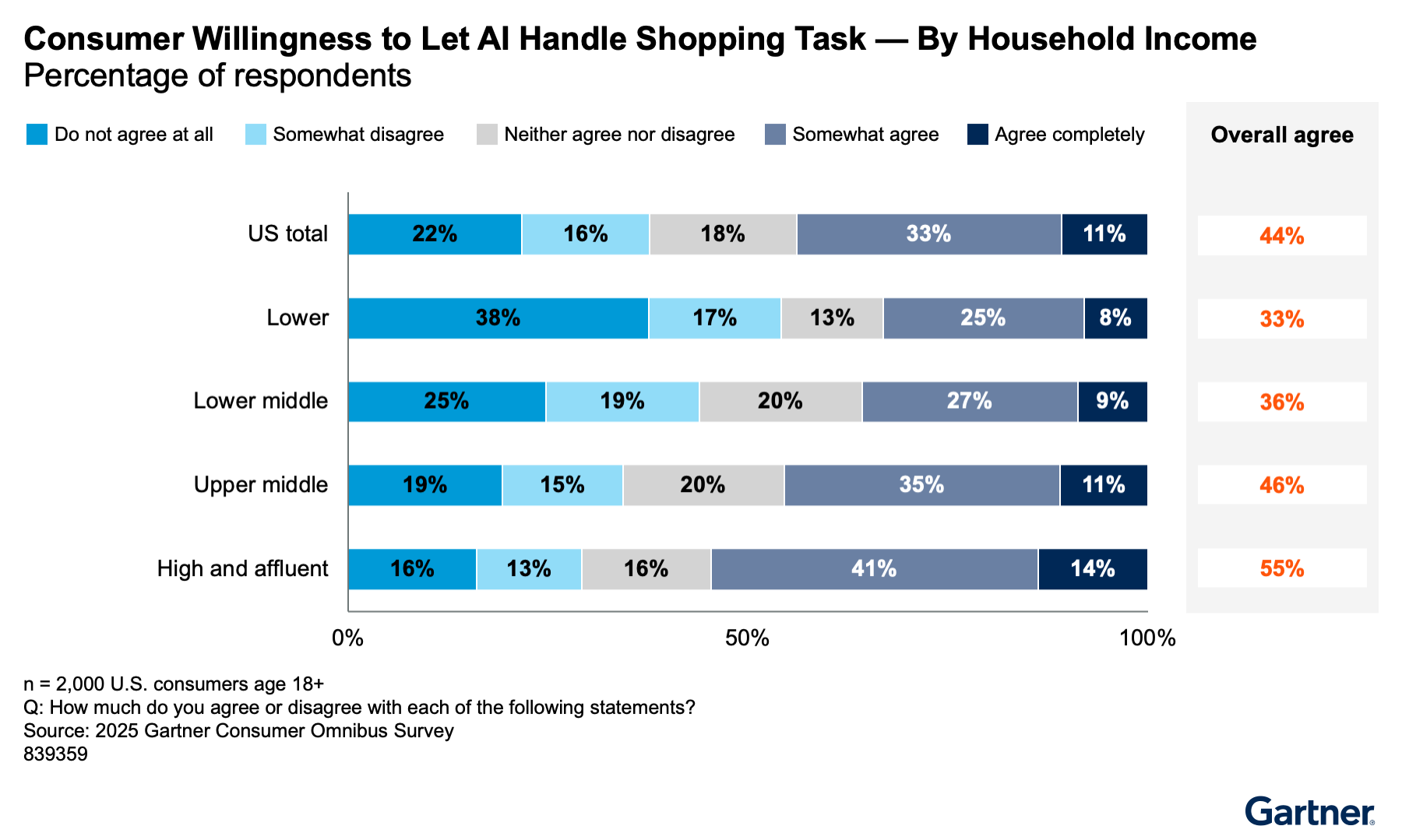
Consumer receptivity to agentic commerce demonstrates a positive relationship with ascending household income levels. Specifically, 55% of respondents within the high-income and affluent demographics express willingness to adopt AI-assisted shopping. In contrast, 46% of the upper-middle income group agree with the statement. Consumers in the lower-middle income bracket exhibit greater hesitation, with 33% demonstrating overall agreement, while only 25% of low-income respondents articulate openness to such functionalities.1
Greater willingness to embrace agentic commerce among consumers with higher household incomes aligns with their ability to prioritize convenience, premium offerings and time savings over costs. When asked whether they would rather spend money to save time, as opposed to spending time to save money, 39% of higher-income consumers prioritize time over costs, compared with just 22% of lower-middle and low-income consumers.5 Meanwhile, more than a third (37%) of higher-income consumers say they frequently turn to tools and services that save them the mental effort of researching and picking products to buy, compared with just 26% of lower-middle and low-income consumers.1
If your target customer has high or affluent income (more receptivity):
These customers already have higher expectations for convenience-offering experiences while shopping, and may even be willing to pay a premium for AI-embedded services that support this. Invest in AI-based guided selling tools that support complex product discovery, bundling and concierge-style recommendations, especially for more expensive, highly customizable products. These guided selling tools can evolve to become seller agents that interact with customers’ AI agents in the future.6
These customers already have higher expectations for convenience-offering experiences while shopping, and may even be willing to pay a premium for AI-embedded services that support this. Invest in AI-based guided selling tools that support complex product discovery, bundling and concierge-style recommendations, especially for more expensive, highly customizable products. These guided selling tools can evolve to become seller agents that interact with customers’ AI agents in the future.6
If your target customer has lower income (less receptivity):
If chatbots are introduced, do so gradually alongside traditional shopping experiences, focusing on assistive features such as guided search or reorder prompts. Embed education into chatbot agent interactions to build trust and familiarity, and prioritize functionality that delivers utility and savings, such as deal alerts and budget-conscious recommendations.
If chatbots are introduced, do so gradually alongside traditional shopping experiences, focusing on assistive features such as guided search or reorder prompts. Embed education into chatbot agent interactions to build trust and familiarity, and prioritize functionality that delivers utility and savings, such as deal alerts and budget-conscious recommendations.
Community Type Influence
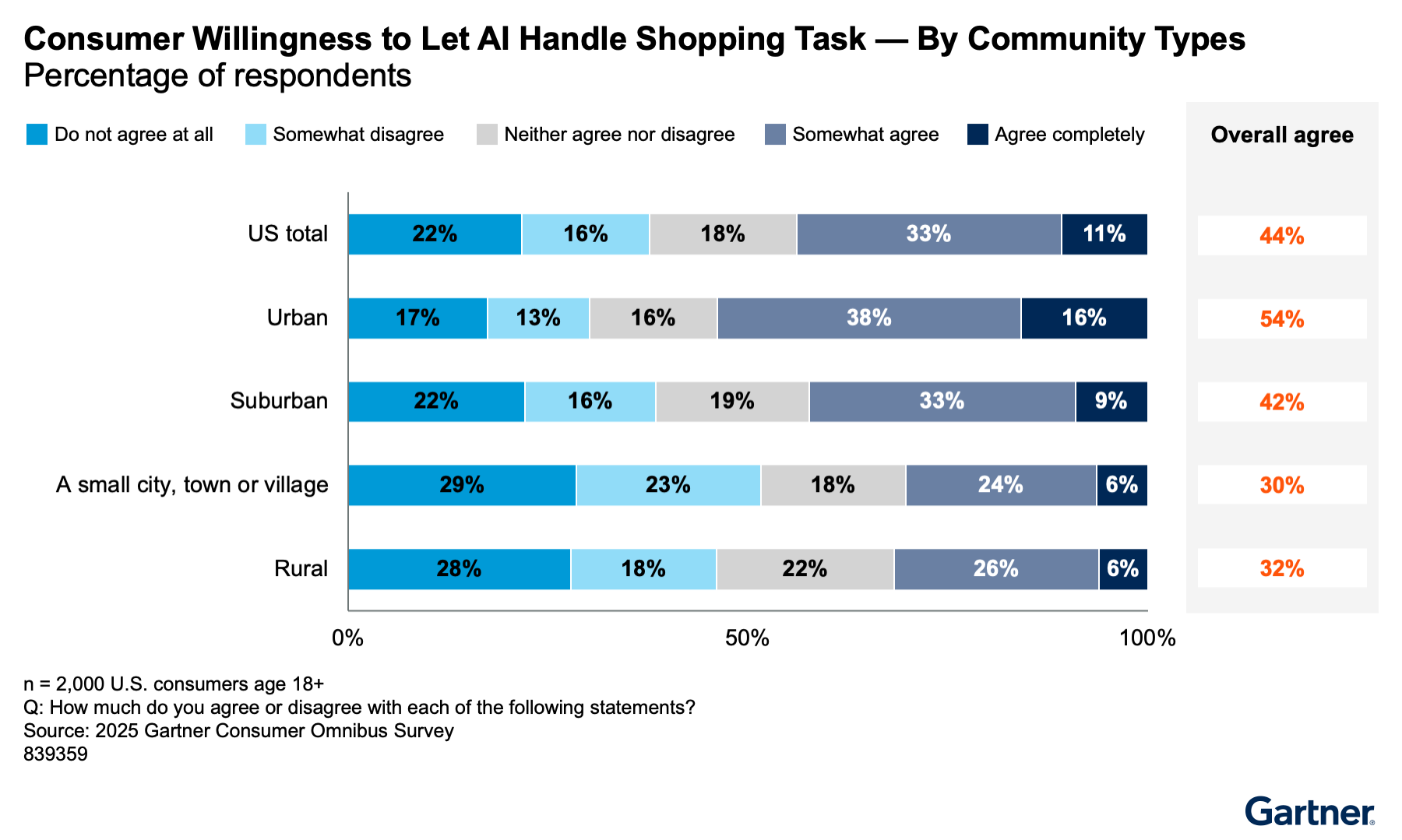
Differences in receptivity toward agentic commerce are also apparent across community types. Urban residents demonstrate the highest receptivity, with 54% expressing willingness to adopt AI assistance, followed by suburban dwellers at 42%. Conversely, consumers residing in small towns and villages exhibit 30% overall agreement, while those in rural areas, with 32% overall agreement, display a notably lower inclination to embrace AI-assisted shopping. On average, rural and small-town areas often have lower costs of living and different demographic profiles compared to urban centers, including a higher proportion of older and lower-income residents, as well as varying levels of educational attainment.3 Consumer research on GenAI attitudes has shown that these demographic skews tend to report less enthusiasm toward the technology in general.5,7
If your target customer lives in an urban or suburban area (more receptivity):
If you integrate AI chatbots into omnichannel strategies, ensure they support seamless transitions between digital and physical retail environments, where infrastructure and consumer expectations favor hybrid interactions with brands. For example, urban and suburban consumers are more likely to report having recently used an online store locator (38%), buy online and pick up in store (32%), showroom shop (visiting a physical store to check out a product they intend to buy online: 32%), and use third-party delivery services (28%).3 AI chatbots that are aware of store inventory and can recommend other products or nearby stores could be particularly helpful to urban customers.
If you integrate AI chatbots into omnichannel strategies, ensure they support seamless transitions between digital and physical retail environments, where infrastructure and consumer expectations favor hybrid interactions with brands. For example, urban and suburban consumers are more likely to report having recently used an online store locator (38%), buy online and pick up in store (32%), showroom shop (visiting a physical store to check out a product they intend to buy online: 32%), and use third-party delivery services (28%).3 AI chatbots that are aware of store inventory and can recommend other products or nearby stores could be particularly helpful to urban customers.
If your target customer lives in a rural or small-town area (less receptivity):
Introduce AI chatbots gradually, starting with features that simplify the buying journey without requiring full autonomy. Embed education into chatbot interactions to explain how agents support product discovery and fulfillment, and use agents to bridge access gaps in areas with limited retail options.
Introduce AI chatbots gradually, starting with features that simplify the buying journey without requiring full autonomy. Embed education into chatbot interactions to explain how agents support product discovery and fulfillment, and use agents to bridge access gaps in areas with limited retail options.
Technology Investment
Organizations targeting younger generations, higher-income demographics and urban residents should pursue technology investments and strategy changes to capitalize on the opportunities presented by agentic commerce, such as seller agents, Model Context Protocol (MCP) servers, answer-optimized content (AOC) or direct integrations with GenAI platforms. Companies selling products targeting older generations, lower-income demographics, and residents of rural communities should be cautious about overinvesting in applications or strategies that facilitate agentic commerce. Instead, they should closely monitor the adoption of GenAI platforms and the willingness of their target customers not only to use GenAI platforms but also to trust them with tasks in the buying journey.
Contributors
Sunny Shao
1 2025 Gartner Consumer Omnibus Survey. The purpose of this survey was to understand consumer behaviors and sentiment across a wide range of topics and industries that included shopping behaviors, brand communications, loyalty, pharmacy and banking. The research was conducted online from 11 through 31 March 2025 among 2,000 respondents in the United States. Respondents were required to be at least 18 years old. Quotas were set for geographic areas, age, gender, ethnicity and employment status to approximate the U.S. adult population as a whole.
Respondents of the 2025 Gartner Consumer Omnibus survey saw the following text:
Q. How much do you agree or disagree with each of the following statements?
I’d be willing to let AI apps/tools handle or assist me in some of my shopping tasks (researching, narrowing down products/brands, reordering items, etc.)
This consumer-facing description is intended to gauge generalized receptivity to the broader concept of AI-assisted shopping, and the scenario presented does not necessarily encompass or align to all aspects of Gartner’s definition of agentic commerce or AI agents.
Analysis of these responses does not imply that these customer groups will embrace all applications stated in this note, for example, using GenAI platforms for product discovery, making purchases either using GenAI platforms’ native check-out capabilities or by using AI agents that can independently search for, evaluate, and purchase products and services, and being served by seller-provided AI agents (seller agents) that assist with the buying journey.
2 2022 Gartner Consumer Priorities Survey. The purpose of this survey was to explore consumer attitudes and behaviors related to spending, online shopping, social media and streaming video. This research was conducted online in December 2021 among 1,713 respondents. Respondents were required to be between the ages of 18 and 75 years old and live in the United States. Quotas were set for age, gender, ethnicity and employment status (when available) to approximate the U.S. population as a whole.
3 2024 Gartner Consumer Values and Lifestyle Survey. The purpose of this survey was to understand consumer lifestyles and motivations. The research was conducted online in two parts, from 30 July to 28 August 2024 among 6,174 respondents in the U.S. (n = 4,146), Canada (n = 1,012) and the U.K. (n = 1,016). The first part of the survey included screening, demographic, sentiment, values and lifestyle questions. The second part included category-specific (for example, money and spending, retail, shopping, sustainability, health, and beauty) questions. Respondents were required to be at least 15 years old. Quotas in the U.S. were set for geographic areas, age, gender, ethnicity and employment status to approximate the U.S.population as a whole. Quotas in the U.K. and Canada were set for geographic areas, age, gender and employment status to approximate the U.K. and Canadian population as a whole.
4 For guidance on ensuring your brand is discoverable by GenAI platforms and AI agents, see:
5 2024 Gartner Cultural Attitudes and Behaviors Survey. The purpose of this survey was to understand consumer attitudes and emerging behaviors. The research was conducted online from 23 September to 15 October 2024 among 1,532 U.S. respondents. Of these, 1,109 were recontacted respondents aged 18+ who had previously taken the 2024 Gartner Values and Lifestyle Survey in July or August 2024. The remaining 423 respondents were aged 15+ and had volunteered or registered to participate in online surveys. The survey included screening, demographic and category-specific (such as technology, media, workplace, spending and shopping) questions. Quotas in both the recontacted and overall samples were set for geographic areas, age, gender, ethnicity and employment status to approximate the U.S. population as a whole.