Innovation Insight: AI in Accounts Payable Applications
24 October 2025 - ID G00830667 - 13 min read
By Miles Onafowora, Grisha Munjal
AI-driven accounts payable transformation is accelerating. CFOs should use the use cases and evaluation criteria in this research to guide purchase and renewal discussions, ensuring technology choices drive measurable improvements in efficiency and control.
Overview
Key Findings
- AI-enabled invoice automation in accounts payable improves invoice data accuracy and streamlines workflow, but more critically, it reduces human touchpoints per invoice to 1.2 from 4.3 in a traditional AP setup.
- Most AP applications offer foundational AI for intelligent invoice capture, matching, and account coding, while top-tier solutions typically offer advanced fraud and anomaly detection, predictive cash-flow analytics, and conversational supplier support.
- AI features in AP applications, due to the ability to scale and process large datasets faster in the cloud, enable new activities such as anomaly prevention and fraud detection, previously difficult to achieve and maintain with manual efforts.
Recommendations
- Prioritize AI features that enhance operational efficiency and automation, and financial intelligence and risk management. This approach will facilitate structured discussions with vendors focused on the common AP pain points, such as reducing effort in the invoice cycle and capturing risk insights ahead of errors.
- Evaluate where your existing AP application lacks AI features and schedule a roadmap review with your vendor. Use these discussions to assess their delivery timelines, proof-of-concept results, pricing models, and ongoing investment in AI, informing your decision to renew or explore alternative AP vendor solutions.
Strategic Planning Assumption
By 2029, 30% of finance teams will generate hard ROI from AI in transactional processes through predictive risk and revenue insights, deprioritizing efficiency gains.
Introduction
The accounts payable (AP) application market is at a pivotal moment, as organizations seek to explore what technologies to adopt to overcome the labor-intensive processes and need to allocate resources to deal with invoice processing exceptions. Vendors investing in AI-enabled AP offerings can address the reliance of humans manually verifying mismatches, which are often error-prone and time-consuming, with AI features that apply relevant rules to routinely analyze complex multiway matching and determine adjustments to the invoice where necessary.
However, navigating which AI features to adopt remains challenging for buyers. AI in AP applications presents these specific challenges:
- AI-enabled automation introduces human-in-the-loop oversight; it remains difficult for buyers to evaluate the level of sophistication in vendors offering to determine how much they can reduce their AP teams.
- AP vendors frequently underdeliver on proven AI use cases that show consistency in reducing matching error, sophisticated learning loops and integration success.
- Pricing models for premium AI features lack transparency.
AI-enabled AP applications are increasingly demonstrating measurable improvements in efficiency, fraud detection, and real-time analytics, reducing human dependency. This approach will facilitate structured discussions with vendors and help CFOs balance the value AI can deliver with AP applications.
Description
AI in accounts payable applications (APA) is primarily made up of the use of machine learning, natural language processing, and predictive analytics to automate and enhance invoice processing, payments, and financial controls. AI-enabled AP software reduces manual intervention by automating tasks like invoice data extraction, coding, matching, exception handling, and fraud detection. These applications improve accuracy, accelerate approval cycles and deliver real-time analytics for spend management and compliance.
A defining feature of AI in AP is the integration of automation with human-in-the-loop oversight. While AI manages routine processes, AP staff focus on exception and validation management and use analytics to stay ahead of payment risks.
As the technology matures, AI-driven AP solutions are evolving from rule-based automation to systems that learn from data, adapt to new scenarios, and provide actionable insights. This innovation transforms manual AP workflows into intelligent, automated processes, boosting efficiency, accuracy, and financial oversight while supporting the evolving role of finance teams.
Benefits and Uses
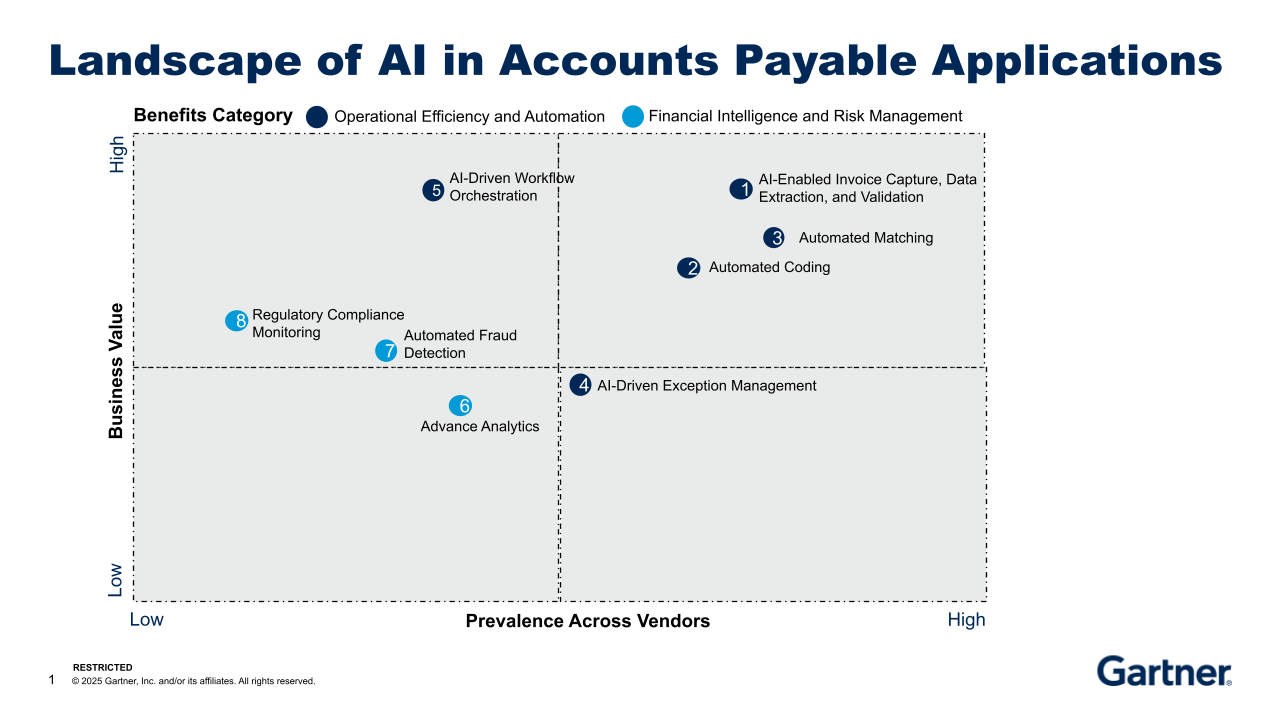
AI in AP anchors itself on improving process efficiency, accuracy, and financial control for CFOs. AI in this market is driving value in two primary categories: operational efficiency and automation, and financial intelligence and risk management. See Figure 1 for the evolving landscape of AI in accounts payable offered by vendors, comparing the business value of individual functionalities against the prevalence across vendors.
Operational Efficiency and Automation
1. AI-Enabled Invoice Capture, Data Extraction, and Validation
Advanced optical character recognition (OCR), natural language processing (NLP), and machine learning (ML) models automatically recognize, extract, validate, and cross-reference invoice data from both structured and unstructured sources (e.g., PDFs, emails). Leading solutions embed end-to-end audit trails and allow finance teams to set confidence thresholds that automatically flag ambiguous captures for human review, ensuring both speed and control.
Business Value and Prevalence of AI Feature Today: Business value of this feature is highest when applications use advanced machine learning and NLP to handle a wide variety of invoice layouts, languages, and unstructured formats. Basic solutions may rely on template-based or rules-driven OCR, which can miss data or require frequent manual intervention. The prevalence of AI invoice capture is high, but vendors offering adaptive, self-learning models are able to deliver maximum automation and accuracy outputs. Buyers with diverse, global supplier bases and high invoice variability benefit most from the latest AI advancements.
Benefits: This invoice capture feature progresses AP processes toward touchless invoice processing, reduces manual data entry, enhances data accuracy, supports accelerated downstream processing and improves throughput for high-volume, low-exception scenarios.
2. Automated Invoice Coding
AI models analyze invoice content, historical transactions, and chart-of-accounts structures to recommend or assign GL codes using machine learning as its central technology for coding. NLP technology helps the system understand the invoice description and recognize terms that accurately categorize expenses, especially effective as word variations between invoices are common. Confidence scores indicate reliability, and low-confidence cases are routed for review.
Business Value and Prevalence of AI Feature Today: Business value for this feature is high due to AI leveraging machine learning that adapts to new coding patterns and exceptions over time, rather than static rules. Some solutions use deep learning to continually refine coding accuracy, while others depend on initial rule sets that require frequent manual updates. Automated GL coding is highly prevalent, but vendor offerings with true learning capabilities are able to handle evolving business structures and reduce manual oversight. Buyers with frequent coding changes or complex ledger structures see the greatest impact from this advanced AI feature.
Benefits: Clients benefit from fewer posting errors, faster invoice processing, improved compliance, and the ability to redeploy staff to higher value tasks.
3. Automated Matching (PO/Receipt Reconciliation)
AI automates the comparison of invoice details with purchase orders, goods receipts and other documentation requirements, identifying mismatches and ensuring only valid transactions are processed for payment. Advanced solutions use fuzzy matching and exception logic to handle data variations.
Business Value and Prevalence of AI Feature Today: Business value for this feature as AI uses probabilistic and unsupervised learning to recognize matching patterns and adapt to new exceptions, rather than relying solely on deterministic or rule-based matching. This advanced use of AI can learn from historical exceptions and improve over time, reducing false positives and manual intervention. While matching is broadly available, only vendors leveraging self-improving AI models can deliver the lowest exception rates and the most seamless automation, especially in environments with frequent data inconsistencies.
Benefits: Clients will see faster approvals, reduced risk of payment errors, and streamlined reconciliation, especially when using AP applications with advanced matching logic.
4. AI-Driven Exception Management
ML and predictive analytics, NLP and emerging email remittance capture, detect invoice discrepancies such as price variances, quantity mismatches, and missing approvals. Based on historical data, they assign risk scores, prioritize critical issues, and automate routing to the correct approvers. Real-time dashboards track exception status and highlight root-cause trends.
Business Value and Prevalence of AI Feature Today: Business value for AI-driven exception handling is medium, driven by vendors’ ability to use unsupervised learning and anomaly detection to automatically identify new exception types and suggest resolutions, rather than just flagging rule-based discrepancies. Some vendor offerings use AI to predict exception root causes and recommend corrective actions. This advanced capability is less prevalent, with many platforms still relying on static rules and manual routing. The true business value is realized in organizations with high exception rates and a need for continuous process improvement.
Benefits: Clients can expect faster exception resolution, shorter cycle times, and improved compliance, particularly with vendors offering advanced prioritization and predictive analytics.
5. AI-Driven Workflow Orchestration
AI-enabled integration middleware and workflow orchestration platforms coordinate between various AI models, data sources and business systems to dynamically route invoices, approvals, and exceptions across systems and users, optimizing task sequencing and workload. This AI technology acts as a conductor scheduling tasks, applying business rules across the AP workflow.
Business Value and Prevalence of AI Feature Today: Business value is high for this feature, and only increases further when AI leverages real-time data and reinforcement learning to reprioritize tasks, predict bottlenecks, and adapt workflows automatically. Most platforms offer basic workflow automation, but few vendors leverage AI to dynamically optimize the end-to-end AP process. Prevalence of intelligent orchestration is moderate, and organizations with complex, high-volume AP operations and frequent process changes should prioritize the evaluation of this feature with vendors.
Benefits: Orchestration ensures SLA compliance, reduces cycle times, enhances transparency, and automatically adapts workflows to changing volumes and business priorities. By combining automated approvals with intelligent recommendations, buyers gain both operational efficiency and stronger compliance oversight.
Financial Intelligence and Risk Management
6. AI-Enabled Advanced Analytics and Insights
AI-driven advanced analytics coupled with traditional automation has the ability to deliver on real-time insights through predictive modelling, anomaly detection and adaptive learning. AI aggregates AP data into persona-based dashboards that report on KPIs, cash flow forecasts, payment insights and error rates.
Business Value and Prevalence of AI Feature Today: Business value is medium, and will rise as AP applications move from descriptive analytics to predictive and prescriptive analytics powered by machine learning. The most advanced solutions use AI to forecast trends, simulate scenarios, and make recommendations, not just report on past activity. Prevalence of true AI-driven analytics is moderate, as many platforms still offer only static or descriptive reporting. Organizations with mature data strategies and the ability to act on predictive insights gain the most from advanced AI analytics.
Benefits: Leveraging this AI-driven advance analytics at its core improves cash flow management, supports strategic payment planning, and uncovers cost-saving opportunities through data-driven decision-making. Different stakeholders across the AP process have persona-based user interfaces that link with business rules and approval schedules to improve effective decision making within the AP application.
7. AI-Enabled Fraud Detection
AI automation and ML are the primary technologies in this feature which continuously monitor invoice and transaction data for anomalies and potential fraud by analyzing multiple data points such as IP address, device information, upload location, and historical transaction patterns. These systems can automatically flag suspicious activities for further review and provide real-time alerts to AP teams.
Business value and Prevalence of AI Feature Today: Business value today is medium-high, with applications using unsupervised machine learning and behavioral analytics to detect novel fraud patterns, rather than just relying on static rules or duplicate checks. Some AI models can learn from emerging threats and adapt detection criteria automatically. Prevalence of true AI-powered fraud detection is still low to moderate, as many solutions are limited to rule-based alerts. Buyers with complex supplier ecosystems or a history of fraud benefit most from this AI feature.
Benefits: Adopting AI-driven fraud detection techniques in APA strengthens financial controls, improves transaction security, and mitigates the risk of fraud-related financial losses. The AI features not only detect fraud but are able to forecast potential vulnerabilities before they materialize, AP teams further benefit by having a prioritized workflow of suspicious transactions.
8. Regulatory Compliance Monitoring
AI-driven analytics is used for ongoing compliance monitoring by automatically checking transactions against evolving invoicing regulations, tax mandates, and company policies, while maintaining a comprehensive, time-stamped audit trail of all actions. Advanced AI capabilities can proactively flag potentially noncompliant invoices, validate tax calculations, and monitor for regulatory changes, resulting in responding quickly and efficiently.
Business Value and Prevalence of AI Feature Today: Business value today is medium, applications that use AI to continuously monitor regulatory changes and automatically update compliance rules, rather than relying on static, manually maintained lists. Some solutions use NLP to interpret new regulations and adapt controls in real time. Prevalence of this advanced capability is emerging, with the highest impact in multinational organizations and highly regulated sectors.
Benefits: This capability helps reduce compliance risk, improves audit readiness, and enables organizations to adapt rapidly to regulatory changes, ensuring ongoing adherence to legal and policy requirements.
Risks
Hallucinations and Inaccuracy in Accounts Payable: AI models, especially GenAI, can generate incorrect invoice data, misclassify transactions, or produce inaccurate text, leading to potentially misleading invoice information, wrong payments or flawed reporting. This necessitates human validation and correction to guarantee accuracy in the AP process.
Bias and Discrimination: In AI-driven accounts payable software, bias can arise either from skewed datasets or from algorithmic design, resulting in consistently misclassifying invoices from certain suppliers or unfairly flagging some expense reports. The same underlying data may be neutral in one use case (e.g., automating coding) yet introduce bias in another (e.g., fraud detection), underscoring the need to distinguish between data bias and model bias.
Regulatory and Compliance Challenges: The rapidly evolving landscape of AI regulations across geographies, particularly concerning personal and employee data, can create compliance issues. AI must adhere to both local and international compliance. In addition to it, if AI models are not regularly updated as per company and government regulations, it can lead to working in a noncompliant manner.
Varying Sophistication Across Vendors: AI capabilities for accounts payable differ significantly among vendors; some may lack sophisticated tools for complex invoice structures, high-accuracy data extraction, or specific areas like fraud detection or cash management. Vendor AI investment may focus on use cases that don’t align with all organizations’ needs.
Alternatives
Low-Code/No-Code Automation Tools: Utilizing automation tools with low-code/no-code application development capabilities can achieve similar benefits to AI for streamlining workflows without relying on advanced AI models or packaged AP applications. Finance leaders should vet low-code/no-code solutions for built-in explainability — such as audit trails, decision-path visualizations, and rule overlays — to satisfy compliance and control requirements.
Hybrid Approach: Many organizations opt for a hybrid approach, using specialized AP applications in conjunction with existing ERP and S2P solutions, rather than a single end-to-end solution, to leverage distinct capabilities.
Outsourcing to 3rd party providers: Organizations can outsource AP operations to specialized service providers or BPO firms that utilize AI-enabled automation for invoice processing, data extraction, matching, and compliance monitoring. This model allows organizations to leverage external expertise, advanced technology, and scalable resources without significant internal investment or infrastructure.
Recommendations
For maximum impact, CFOs should lead the transition to intelligent AP automation, fostering a culture of innovation and data-driven decision making. They should invest in solutions that automate manual tasks and deliver actionable insights, empowering finance teams to focus on strategic priorities.
Representative Providers
The following vendors are recognized for offering accounts payable applications and are investing in AI and GenAI capabilities to enhance automation, analytics and user experience within their products:
- Airbase
- AvidXchange
- Basware
- Coupa
- Esker
- GEP
- Ivalua
- JAGGAER
- Medius
- Pagero
- Quadient
- Serrala
- SoftCo
- Zycus
The insights and analysis presented are primarily drawn from a comprehensive review of Gartner’s research and survey data, complemented by direct client interactions, practitioner experience and vendor evaluation in these two specific pieces:
- Magic Quadrant for Accounts Payable Applications: Published on 19 March 2025, by Mike Helsel, Miles Onafowora and Nick Duffy.
- Critical Capabilities for Accounts Payable Applications: Published on 24 March 2025, by Mike Helsel, Miles Onafowora and Nick Duffy.