Magic Quadrant for Supply Chain Strategy, Planning and Operations Consulting
23 June 2026 - ID G00841199 - 40 min read
By Michael Dominy, Caleb Thomson
Supply chain strategy, planning and operations consulting improves quality and efficiency for functions like manufacturing, warehousing and logistics. Supply chain leaders can use this Magic Quadrant to source and select providers that focus on these services and have more than $5 billion in total revenue.
Market Definition/Description
Supply chain strategy and planning consulting is a subset of corporate strategy consulting. Gartner defines the latter as “strategic advisory services that analyze risks and opportunities for clients, working with them to develop a detailed strategic roadmap.” Supply chain operations consulting is a specialized form of business operations consulting, which Gartner defines as “transformation advisory services that improve quality and efficiency for business operations in an organization.” These services focus on improving operations in functions that have physical assets, such as manufacturing, warehousing and logistics.
Supply chain leaders often need help from consulting firms across a spectrum of projects. These leaders include chief supply chain officers (CSCOs), supply chain strategists and functional supply chain leaders in planning, logistics, customer service, manufacturing, and sourcing and procurement. Projects can range from developing supply chain strategy and strategic planning to implementing new practices in specific functions.
Examples of supply chain strategy and planning projects include:
- End-to-end supply chain strategy and roadmaps
- Supply chain and manufacturing network design
- Digital supply chain strategies and roadmaps
- Organizational design
- Postmerger/postacquisition supply chain and operational integration planning
- Supply chain segmentation
- Product portfolio/SKU rationalization
- Cost-to-serve analysis
- Complexity reduction/optimization
- Sales and operations planning (S&OP)
- New product introduction and launch (NPI&L)
Supply chain operations consulting is focused in industries that are highly dependent on the management of physical flows of material and inventory from suppliers through internal operations, such as manufacturing or distribution to end customers or patients. These industries include industrial manufacturing, consumer products, retail, life sciences, high tech, natural resources, and oil and gas.
Examples of supply chain operations consulting projects include:
- Business process improvement
- Process and operational training
- Functional improvements in areas such as:
- Sourcing and procurement operations
- Distribution center design, layout and operations
- Transportation and fleet operations
- Factory layout and operations
- Postsale and aftermarket services
Mandatory Features
- Quantitative analysis of overall or function-specific performance
- Capability or maturity assessment for end-to-end supply chain and multiple supply chain functions
- Identification of capability gaps and process improvement opportunities across the supply chain or individual function
- Business case analysis that includes defining and assessing options and initiatives for closing gaps for the defined scope of the project, including cost-benefit analysis
- Implementation roadmap for capability and process improvements, including timeline and resources required
- Change management and communications plan development and execution
- Supply chain network modeling and optimization
Optional Features
- Peer group benchmarking and leading practice definition
- Organization design to support target operating model
- Program management for capability and process improvements initiatives
- End-to-end or function-specific digital strategy and roadmap
- Product portfolio/SKU rationalization
- Supply chain segmentation and cost-to-serve analysis
- Software selection or service provider selection, such as system integrator, third-party logistics (3PL) provider or external manufacturing service provider
- Sales and operations planning (S&OP)
- New product introduction and launch
- Lean Six Sigma or other industry operational excellence program implementations
- Distribution or manufacturing facility layout, design and optimization
- Sourcing and procurement initiatives, such as strategic sourcing and category management
Magic Quadrant
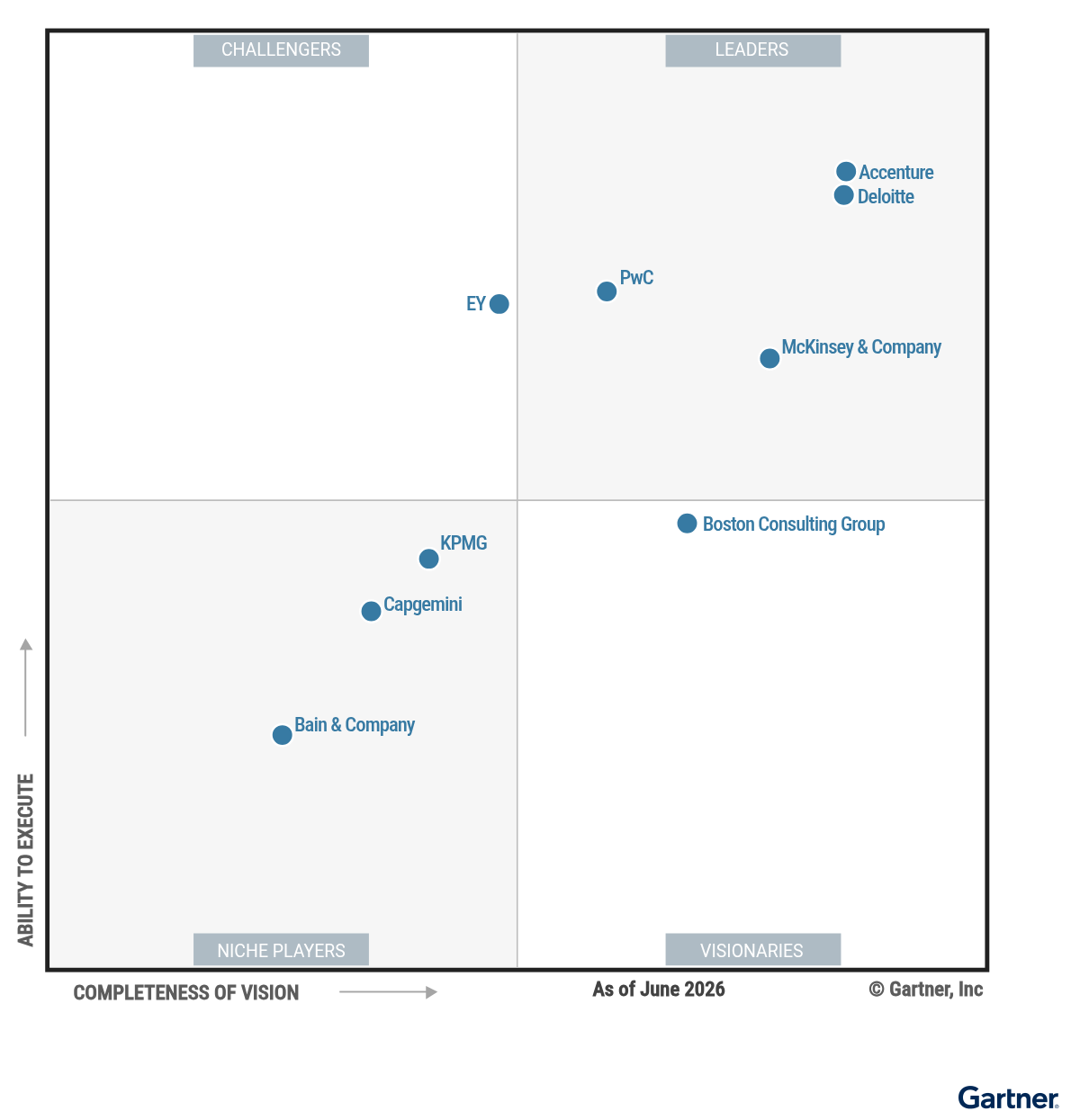
Vendor Strengths and Cautions
Accenture
Accenture is a Leader in this Magic Quadrant. It’s a publicly traded professional services firm providing end-to-end supply chain strategy, planning, and operations consulting to large, global enterprises. Its client base spans North America, EMEA, and Asia/Pacific, with strongest representation in consumer goods and retail, industrial manufacturing, and life sciences. Accenture’s supply chain offering integrates strategy, planning, procurement, and physical operations, supported by a large global delivery network and proprietary consulting assets. The firm is evolving its consulting model toward asset-enabled, outcome-oriented reinvention, expanding its AI-enabled, agentic supply chain capabilities while maintaining a human-led operating model.
- Ability to execute complex, global transformation programs: Accenture delivers large-scale, multiyear supply chain transformations across strategy, planning, and operations that leverage substantial global talent and an integrated delivery model. This enables clients to pursue enterprisewide transformation with a single lead partner and reduced integration risk.
- Compelling vision for AI-enabled and autonomous supply chains: The firm presents a clear vision for its supply chain services, centered on advanced analytics, digital twins, and agentic AI embedded into core processes. Investments in proprietary platforms and repeatable assets reinforce this direction, offering solutions designed to scale and deliver sustained performance improvement.
- Strong enterprise and industry alignment: Accenture consistently frames supply chain transformation in the context of enterprise objectives like growth, resilience, and sustainability. It uses industry-specific reference models to tailor its approach, increasing relevance and ensuring solutions align with sector-specific economic and regulatory realities.
- Potential challenges for smaller or narrowly scoped engagements: Accenture focuses on delivering large, cross-functional programs, and its engagements assume relatively high readiness for transformation. This may be overly complex for clients seeking targeted or tactical support, and clients with limited scope or maturity may experience longer mobilization timelines.
- Depth varies across regions and service lines: While Accenture has strong global reach, depth of expertise can vary by geography and specific service areas, particularly outside its largest markets. Clients operating in less-mature regions should validate local depth for critical roles.
- Premium positioning and commercial expectations: Accenture’s focus on large, value-based, and outcome-oriented models may limit accessibility for smaller enterprises. Its commercial structures typically gear toward enterprise programs, requiring clients to ensure alignment upfront on scope, risk sharing, and value realization.
Bain & Company
Bain & Company (Bain) is a Niche Player in this Magic Quadrant. It’s a privately owned company that provides enterprise-aligned supply chain services across strategy, planning, procurement, logistics, and manufacturing, with digital, analytics, and AI embedded throughout. Bain is geographically diversified, with 67 offices across 40 countries, and tends to serve large, complex organizations, with notable strength in industrials, consumer products, retail, technology, and health and life sciences. Bain is investing in AI-enabled orchestration, proprietary IP such as EDGE, MapAI and Bain Intelligent Operations Network, targeted digital capability expansion, and ecosystem partnerships to extend delivery and accelerate time to value.
- Integrated transformation delivery: Bain combines strategy, planning, and operations with structured transformation delivery through Results360, the ARC change management tool, and capability building. Its senior-partner-led integrated model provides C-level clients with clearer governance, stronger adoption, and more durable value capture.
- Future-back vision anchored in enterprise strategy: Bain roots its vision in enterprise strategy, cross-functional decision making, and “future-back design,” which starts with the enterprise’s ambition and works backwards to determine supply chain strategy. It embeds AI, digital twins, and scenario modeling into transformation journeys. This helps clients more easily model cost, resilience, growth, and capital trade-offs associated with alternative supply chain designs in different time horizons.
- Responsiveness to supply chain disruptions: Bain has continued to grow amid changing market forces such as geopolitics, regionalization, and AI. It stood up new IP and expanded its capabilities by acquiring Proxima and Umbrage. This gives clients access to newer decision support tools and services that can shorten diagnostics and improve orchestration across the supply chain.
- Ecosystem-led execution: Bain deliberately positions itself as tech-agnostic to remain independent of system integrator incentives, in order to be unbiased in pursuing the best interests of the client. It leverages a partner ecosystem that includes firms like Palantir, AWS, and Optilogic to extend implementation and delivery. Clients seeking a single-provider model for heavy, end-to-end software deployment may need to manage more handoffs across vendors and implementation partners.
- Best fit for large-scale transformation over narrower deployment models: Bain has clear strengths in large, executive-led transformation programs, but it’s less-suited for technology-heavy work, smaller stand-alone engagements, or situations where buyers want a one-stop shop for software-enabled transformation. Clients seeking narrowly scoped technology implementation efforts will find it a poor fit.
- Client readiness can shape the pace of advanced operational change: Bain’s use of ecosystem partners can add complexity compared with some peers. Clients should ensure sufficient technology, operating maturity and commitment to upskilling to leverage Bain’s services effectively.
Boston Consulting Group
Boston Consulting Group (BCG) is a Visionary in this Magic Quadrant. It’s a privately held management consulting firm providing end-to-end supply chain strategy, planning, and operations consulting to large, global enterprises across the Americas, EMEA, and Asia/Pacific. BCG serves a broad set of industries, with particular strength in industrial manufacturing, consumer products and retail, life sciences, energy, and technology-enabled environments. BCG’s supply chain and operations offering integrates strategy, planning, procurement, logistics, and manufacturing with embedded AI, analytics, and digital capabilities delivered through integrated BCG squads, BCG X, and specialty units like Inverto and Platinion. The firm emphasizes enterprise-aligned reinvention, value-led technology transformations, and sustained adoption at scale.
- Strong Completeness of Vision: BCG articulates a clear vision centered on AI-enabled, end-to-end supply chains, including digital twins, agentic planning, and physical AI. The vendor emphasizes digital assets and value-led transformations tied directly to business outcomes, positioning BCG well for clients seeking to drive future supply chain performance.
- Depth across strategy, planning, and manufacturing-led operations: BCG demonstrates balanced strength across strategy, integrated planning, manufacturing transformation, and network optimization. Proprietary tools like End-to-End Plan, Supply Network Optimization, Compass Performance Benchmarking, and Manufacturing AI support this strategy. Its ability to link enterprise strategy to manufacturing operations differentiates it from firms with a heavier advisory or planning bias.
- Integrated delivery model with strong change and adoption capabilities: BCG’s delivery model combines consultants, digital builders, analytics experts, and execution teams into integrated squads. Its program and change management capabilities support scaling and improve the likelihood of sustained value realization across multiyear transformations.
- Execution intensity: BCG’s engagements often involve enterprisewide change, advanced analytics, and significant organizational transformation. Enterprises seeking narrowly scoped or short-term initiatives may not need such a comprehensive approach.
- System integration and ongoing managed services: While BCG designs and builds AI-enabled solutions, it typically partners with vendors for large-scale system integration. Clients seeking a single provider for end-to-end system implementation and managed services may need to coordinate across partners.
- Premium positioning: BCG predominantly targets larger, global organizations and private-equity-backed firms with board-level sponsorship and value-based objectives. However, its client base is broader in practice and includes midsize companies, public sector, and nonprofits. Its pricing models may limit accessibility for smaller organizations or more tactical buyers.
Capgemini
Capgemini is a Niche Player in this Magic Quadrant. It is a publicly traded consulting and transformation firm delivering end-to-end supply chain business consulting, with an emphasis on AI-enabled decision intelligence and the linkage between strategic intent and executable supply chain outcomes through integrated governance, planning and execution frameworks.
The firm supports clients across supply chain strategy, integrated business planning, procurement, logistics, distribution, and manufacturing operations. Its consulting approach emphasizes end-to-end coherence across processes, data, and decision making, helping medium to large enterprises improve agility, cost performance, and service outcomes across global supply chains.
Capgemini operates a geographically diversified model, with deep roots in EMEA and growing capabilities across North America and Asia/Pacific. Current investments focus on expanding agentic-AI-enabled consulting assets, industrializing reusable accelerators, strengthening outcome-linked engagement models, and deepening data, cloud, digital-twin and intelligent operations capabilities through partnerships and targeted acquisitions. .
- Integrated strategy-to-operations execution model: Capgemini’s Value Realization Office approach and the broader capabilities of the organization help connect transformation design to operational delivery. This gives clients a clearer route from roadmaps to measurable business outcomes, while potentially reducing handoff risk.
- AI-enabled operating-model vision: Capgemini has a coherent forward view around hyperautomation, agentic orchestration, resilience, and sustainability that’s reinforced by assets like RAISE, Reflow, Gen AI Strategic Intelligence System (GSIS), and ProcureFlow, a partner offering. This helps clients move beyond isolated AI pilots toward scalable operating-model change linked to end-to-end supply chain transformation.
- Targeted sector focus areas: While its depth varies across selected industries, it has notable strength in automotive, consumer products, and life sciences. It has procurement automation and logistics co-innovation with major operators and ecosystem partners. This increases the likelihood that clients receive use cases grounded in their constraints and realities, rather than generic transformation templates.
- Evolving brand awareness: While Capgemini has an integrated strategy-to-execution model, it is continuing to develop executive mind share, and it’s still working on progressing market perception to align with its identity as a premium C-suite business-advisory organization. Potential clients in some regions, particularly those outside of Europe, may seek internal validation and alignment of Capgemini’s advisory credentials and fit.
- Evolving commercial model: Capgemini is still evolving parts of its commercial model and portfolio toward more productized, asset-led, and outcome-based engagements. Clients may need to strengthen early scoping, KPI baselining, and maturity validation before committing to broad rollouts with the firm.
- Breadth versus depth: Capgemini offers a breadth of capabilities, but lacks depth in certain geographies compared to some peers, especially when clients require simultaneous top-tier strategy and deployment on a global scale. For the most complex multiregion transformations, clients may need additional staffing and specialist support.
Deloitte
Deloitte is a Leader in this Magic Quadrant. It’s a privately owned professional services firm providing end-to-end supply chain strategy, planning, and operations consulting as part of its broader multidisciplinary portfolio. It serves large, global enterprises across North America, EMEA, and Asia/Pacific, specializing across all industries, including industrial manufacturing, consumer products, life sciences, retail, high tech, energy, and asset-intensive industries. Its Supply Chain & Network Operations offering integrates strategy, planning, sourcing, logistics, manufacturing, product development, and change management. Deloitte heavily invests in AI, GenAI, and agentic capabilities, utilizing proprietary platforms (IntelligentOps, Ascend, Zora AI and Converge) and its global Smart Factory network.
- Strong execution: Deloitte uses proprietary AI assets (IntelligentOps, Ascend) to accelerate deployment and adoption across supply chain strategy, planning, logistics, procurement, and manufacturing. This targets clients that need execution tracking and accountability.
- Differentiated operations: Deloitte demonstrates depth in manufacturing, physical AI, and automation, anchored by its global Smart Factory network. It combines shop floor expertise, digital twins, robotics, and industrial data operations, distinguishing it from peers that focus heavily on planning or advisory and making it valuable to operations-intensive and regulated industries.
- Integrated multidisciplinary delivery: Deloitte mobilizes supply chain expertise alongside technology, data, human capital, risk, and regulatory specialists for complex, cross-functional transformations. This allows large enterprises facing geopolitical risk, compliance, or capital-intensive change to use a single provider for strategy, execution, and adoption.
- High complexity: Deloitte’s services span multiple teams and governance layers. Clients must ensure upfront alignment on scope and accountability, especially when working with Deloitte on highly focused initiatives.
- Regional expertise: The firm’s depth of supply chain expertise and innovation is specialized by location; Its advanced capabilities are more mature in North America and selected locations in EMEA and Asia/Pacific. Global clients must validate regional specialization.
- Tactical projects: Deloitte’s value proposition favors large, multiyear transformations involving substantial technology, operating model, and change components that smaller organizations or functional buyers may find excessive. Smaller, more niche clients should weigh the pros and cons of the breadth and depth that Deloitte brings.
EY
EY is a Challenger in this Magic Quadrant. It’s a privately owned global professional services partnership. Its Global Supply Chain & Operations services broadly focus on end-to-end supply chain strategy, planning, procurement, manufacturing, logistics, and intelligent operations. It’s further differentiated with strong offerings across integrated trade, tax, and risk capabilities. EY is geographically diversified across the Americas, EMEA and Asia/Pacific, and it tends to serve large multinational enterprises with complex cross-border operations. Its current investments center on EY.ai, its Supply Chain Intelligence Platform, and physical AI/innovation labs.
- Broad cross-functional execution: EY combines its supply chain strategy, planning, procurement, manufacturing, and logistics consulting with in-house tax, trade, risk, and sustainability capabilities to provide a broader and more integrated delivery model than many strategy-led or domain-specific competitors. This makes EY well-suited to clients pursuing enterprisewide redesign and execution across multiple geographies and functions.
- Innovation strategy: EY’s investor lens approach and sector-first asset development model demonstrate its clear vision on where supply chains are headed: linking AI, data, and operating-model redesign to measurable business outcomes. This helps clients prioritize initiatives around growth, resilience, cost, and service, rather than technology deployment alone.
- Alliance-backed transformation with experiential delivery assets: EY supports transformation programs with immersive innovation hubs, teardown labs, and strategic alliances with companies like P&G, Microsoft and NVIDIA, alongside increasing use of value-based and outcome-based deal structures. This combination strengthens stakeholder engagement and supports repeatable value realization.
- Focused on more custom delivery rather than packaged scale: EY emphasizes integrated enterprise transformation, but it’s less explicit than some peers in articulating a unified, market-facing narrative for supply chain transformation. Clients looking for a standardized, scalable approach may encounter more flexibility than prescriptive guidance.
- Delivery model complexity: EY’s broad, cross-service-line model across strategy, tax, technology, and risk can be complicated to manage. As a result, engagement scoping, commercials and governance may require more upfront alignment than firms with narrower, more focused offerings, especially when engagements are highly customized with individualized outcome-based pricing structures.
- Industry-specific technical expertise: EY brings broad supply chain and operations coverage, but its industry-specific offerings lag behind others. EY relies on alliances and accelerators more than some competitors. Clients should validate that its methods, assets, and leadership depth are sufficiently tailored to their industry and transformation needs.
KPMG
KPMG is a Niche Player in this Magic Quadrant. It’s a privately held professional services firm providing supply chain strategy, planning, and operations consulting within its global advisory portfolio. The firm serves large, multinational enterprises across North America, EMEA and Asia/Pacific, with strong penetration in life sciences and healthcare, consumer products and retail, industrial manufacturing, energy and regulated industries. KPMG integrates supply chain strategy, planning, sourcing, logistics, manufacturing operations and change management, anchored by AI-first target operating models that it delivers through its Velocity platform and proprietary assets like Supply Chain Predictor. Its approach emphasizes value-stream-oriented operating models, enterprise risk and ESG alignment, and scalable delivery through global centers of excellence and the KPMG Delivery Network.
- Vision anchored in AI-first operating models: KPMG articulates a differentiated vision centered on AI-enabled, value-stream-based supply chain operating models. Its Velocity platform integrates strategy, target operating model design, analytics, and agentic AI into a repeatable architecture, supporting enterprisewide decision making across complex, multinational supply chains.
- Supply chain planning and operating model transformation depth: KPMG demonstrates particular strength in planning-led transformation, including IBP, S&OP, demand, supply, and inventory planning, and planning-as-a-service models. It emphasizes governance, role clarity, and behavioral change rather than technology implementation alone, which helps clients improve forecast accuracy, working capital, and service performance while sustaining new ways of working.
- Integrated risk, ESG, and regulatory alignment: KPMG embeds enterprise risk management, ESG, and regulatory considerations into its supply chain strategy and operating model design. This is particularly valuable for clients in highly regulated and geopolitically exposed industries, differentiating KPMG from providers with a narrower operational focus.
- Less depth in large-scale manufacturing execution: KPMG’s strengths are more pronounced in strategy, planning, operating model design, and analytics than in asset-intensive, multisite manufacturing execution. Clients pursuing deep shop floor transformation should validate execution depth and explore partner support early.
- Functional projects: KPMG’s Velocity platform and AI-first frameworks are designed for enterprise-scale transformation, which may include more comprehensive engagements, as well as narrowly scoped engagements. Clients should scope projects carefully.
- Supply chain staffing and capabilities vary by region and function: Planning and procurement COEs’ resources differ by region. The manufacturing COE is smaller than planning and procurement. Clients should confirm supply chain focus and leadership continuity before engaging.
McKinsey & Company
McKinsey & Company (McKinsey) is a Leader in this Magic Quadrant. It’s a privately held management consulting firm providing end-to-end supply chain strategy, planning and operations consulting through its global Operations Practice. Supply chain work represents a significant portion of the firm’s client activity and is delivered across more than 60 countries. McKinsey serves large, global enterprises in consumer products, industrial manufacturing, life sciences, energy, high tech, and asset-intensive industries. Its supply chain services integrate strategy, planning, procurement, manufacturing, logistics, and service operations, supported by proprietary digital and analytics assets, deep sector expertise, and large-scale transformation delivery. McKinsey continues to expand technology-enabled and agentic capabilities through platforms like EcliptOS and QuantumBlack.
- Strong future of supply chain vision: McKinsey demonstrates a well-articulated vision for supply chains that tightly connects strategy, planning, and execution. Its approach emphasizes end-to-end reinvention rather than functional optimization, supported by clean-sheet operating model design, sector-specific playbooks, and quantified value cases. This positions McKinsey well for large, multiyear transformations with board-level sponsorship.
- Sector expertise at global scale: McKinsey structures supply chain work at the intersection of operations and industry practices, enabling teams to embed supply chain initiatives within sector economics and regulatory contexts. Its global footprint and “one-firm” staffing model allow it to rapidly deploy specialized expertise across regions.
- Advanced digital, analytics, and agentic capabilities: McKinsey continually invests in proprietary analytics, digital twins and AI-enabled platforms, including EcliptOS and Spendscape. Through QuantumBlack and alliance partnerships, McKinsey increasingly embeds agentic workflows across planning, procurement, manufacturing, and logistics, supporting faster decision making, closed-loop execution and sustained value capture.
- Premium positioning: McKinsey focuses on large, complex supply chain transformations, delivering broad organizational change, custom analytics, and senior-level expertise. Organizations seeking specialized, niche engagements may seek specialists as a more attractive and less costly option.
- Ongoing large-scale outsourcing: While McKinsey excels at designing and launching transformations, it places less emphasis on managed services or operational outsourcing than some of its peers. Clients should plan to transition run-state ownership to other providers.
- Technology implementation: McKinsey collaborates with system integration partners for large-scale ERP and core systems transformations, while delivering significant implementation support across most supply chain and digital initiatives. Clients that need systems implementation should plan to use additional partners for application implementation.
PwC
PwC is a Leader in this Magic Quadrant. It’s a privately owned global network with operations and supply chain solutions services that are broadly focused on end-to-end supply chain strategy, planning, sourcing, and procurement modernization, product development and manufacturing, and supply chain execution. Program, change, and digital enablement are embedded throughout. PwC is geographically diversified, with its largest practitioner concentration in North America, followed by EMEA and Asia/Pacific. It primarily serves large multinational clients in industrials, consumer markets, life sciences, technology and telecom, and energy and utilities. Its current investment priorities include AI-enabled delivery, digital assets, acceleration centers, and physical AI and robotics.
- Broad business transformation support: PwC differentiates through an execution-led model that connects strategy, planning, procurement, manufacturing, and logistics, which aligns well with finance- and operations-led buyers. These offerings can also embed tax, trade, regulatory, and workforce considerations earlier and more often than many peers.
- Embedded AI vision: PwC positions AI as embedded decision support inside operating workflows, rather than as a stand-alone technology program. Clients benefit from its more pragmatic innovation roadmap that’s tied to KPIs, governance, and operational value realization.
- Market responsiveness: PwC demonstrates responsiveness through growth in multi-service-line offers and programs, and proof of successful projects across inventory optimization, S&OP, sourcing, manufacturing, and logistics. Clients benefit from the vendor’s ability to translate supply chain redesign into measurable cash, cost, service, and resilience outcomes across the business.
- Delivery model complexity: PwC benefits from a “one-firm” model for large transformations, but that same model can make pursuit, solutioning, and mobilization feel heavier than with more modular or specialist competitors. Clients seeking narrowly scoped or highly specialized engagements may find smaller, modular providers a more effective fit than large-scale enterprise transformation models
- Executing its vision: PwC has a compelling innovation vision that continues to evolve. While progress has been made in leveraging internal technology platforms more effectively with clients, their use with clients remains inconsistent compared to some of their peers.
- Best fit for large-scale business transformation: PwC best aligns to complex, cross-functional transformation agendas in large enterprises. Its messaging consistently leads with business reinvention and execution rather than stand-alone specialized engagements, which may not be a fit for every need.
Inclusion and Exclusion Criteria
To qualify for inclusion in this Magic Quadrant, providers need to meet all the following criteria:
Services capabilities:
- Support the mandatory features in the Market Definition in all major geographic regions (North America, EMEA and Asia/Pacific) for all three aspects of the Market Definition:
- End-to-end supply chain strategy
- Supply chain planning (non-technology-implementation-focused projects)
- Supply chain operations (nontechnology-implementation-focused) consulting in at least two of the following: Direct materials sourcing and procurement, manufacturing operations, and logistics (transportation, distribution or service parts)
- Actively market, sell and have delivered supply chain strategy, planning, and operations consulting services on a stand-alone basis as of 1 January 2024 — not bundled or as an add-on to other services, such as enterprise transformation implementation engagements or recurring/managed services contracts, nor as add-ons to solution implementation projects or related supply chain staff augmentation.
- Actively market, sell and have delivered stand-alone supply chain strategy, planning, and operations consulting services engagements to companies in at least two industries that manufacture, distribute, or sell physical products (consumer goods, life sciences, industrial manufacturing, electronics, or semiconductors).
Market presence:
- Have completed at least 20 stand-alone engagements between 1 January 2024 and 31 December 2025 in supply chain strategy, planning, or operations consulting with unique customer entities, with at least five of these being net-new customers.
- Have delivered, in calendar year 2025, at least five stand-alone supply chain strategy consulting engagements with a scope that encompasses all the supply chain functions. At a minimum, the project scope must have included at least three major functions within the supply chain (planning, warehousing, transportation, manufacturing, procurement, aftermarket, etc.)
- Have delivered, in calendar year 2025, at least two supply chain strategy and two supply chain operations stand-alone engagements in two or more of the following areas: Direct materials sourcing and procurement, manufacturing operations, or logistics, in each major region (Americas, EMEA and Asia/Pacific).
- Have at least 1,000 supply-chain-business-focused consultants. This excludes those that are primarily focused on implementing supply chain technology or ongoing support services (ITO, BPO, etc.). Must have a minimum of 250 supply-chain-business-focused consultants in North America and Western Europe, respectively.
- At least 60% of the total supply chain strategy, planning, and operations consultant headcount must reside within North America and Europe.
- Provider must appear as a top 50 vendor for Gartner inquiries for supply chain business consulting.
Evaluation Criteria
Ability to Execute
Product/Service: In addition to the criteria named in the Evaluation Criteria Definitions section, we evaluated the name of the vendor’s service offering, what services it offers, and the breakdown of services by the buckets outlined in the Market Definition.
Overall Viability: In addition to the criteria named in the Evaluation Criteria Definitions section, we evaluated the vendor’s current and new customer count, investment plans for its services, and relative distribution of services by region.
Sales Execution/Pricing: In addition to the criteria named in the Evaluation Criteria Definitions section, we evaluated the vendor’s contracting/pricing models, how revenue is broken down by buyer type, and typical length of engagements.
Market Responsiveness and Track Record: In addition to the criteria named in the Evaluation Criteria Definitions section, we evaluated the trends that the vendor sees in the market, the role of AI/agentic AI in the consulting services market, and how the vendor has adapted its offerings.
Marketing Execution: In addition to the criteria named in the Evaluation Criteria Definitions section, we evaluated who (role/persona) the vendor targets, KPIs to measure its marketing effectiveness, and examples of its thought leadership.
Customer Experience: In addition to the criteria named in the Evaluation Criteria Definitions section, we evaluated how the vendor approaches customer (client) experience, how it incentivizes CX for your delivery teams, and how it measures CX.
Operations: In addition to the criteria named in the Evaluation Criteria Definitions section, we evaluated the vendor’s talent and retention, use of AI in its operations, and how it measures its operational performance.
Ability to Execute Evaluation Criteria
| Evaluation Criteria | Weighting |
|---|---|
Product or Service | High |
Overall Viability | Low |
Sales Execution/Pricing | Medium |
Market Responsiveness/Record | Medium |
Marketing Execution | Low |
Customer Experience | High |
Operations | Medium |
Source: Gartner (June 2026)
Completeness of Vision
Market Understanding: In addition to the criteria named in the Evaluation Criteria Definitions section, we evaluated the vendor’s understanding of the competitive landscape, changes planned for its offerings and how it spots trends in the market.
Marketing Strategy: In addition to the criteria named in the Evaluation Criteria Definitions section, we evaluated changes to the vendor’s marketing strategy, buyers it plans to target and its top marketing strategies
Sales Strategy: In addition to the criteria named in the Evaluation Criteria Definitions section, we evaluated the vendor’s changes to its sales strategies, its ideal customer/client account, and changes to its pricing/contracting strategies.
Offering (Product) Strategy: In addition to the criteria named in the Evaluation Criteria Definitions section, we evaluated the investments made by the vendor in capability areas within the Market Definition, its use of AI agents, and its capability differentiators.
Business Model: In addition to the criteria named in the Evaluation Criteria Definitions section, we evaluated the vendor’s competitive versus sole-sourced deals, commercial/contracting models it uses, and its asset- versus people-based services.
Vertical/Industry Strategy: In addition to the criteria named in the Evaluation Criteria Definitions section, we evaluated how the vendor’s business breaks down by industry, changes planned to its targeted verticals, and any unique or industry-specific capabilities or services.
Innovation: In addition to the criteria named in the Evaluation Criteria Definitions section, we evaluated recent innovations delivered by the vendor,, its planned innovations this year, and how it engages clients in innovation.
Geographic Strategy: In addition to the criteria named in the Evaluation Criteria Definitions section, we evaluated how the vendor’s business breaks down by geography and any changes planned for its geographic strategy.
Completeness of Vision Evaluation Criteria
| Evaluation Criteria | Weighting |
|---|---|
Market Understanding | Medium |
Marketing Strategy | Low |
Sales Strategy | Low |
Offering (Product) Strategy | High |
Business Model | Medium |
Vertical/Industry Strategy | High |
Innovation | Medium |
Geographic Strategy | High |
Source: Gartner (June 2026)
Quadrant Descriptions
Leaders
Leaders provide mature offerings that meet market demand and have demonstrated the vision necessary to sustain their market position as requirements evolve. The hallmark of Leaders is that they focus on and invest in their offerings to the point where they lead the market and can affect its overall direction. As a result, Leaders can become the providers to watch as you try to understand how new market offerings might evolve.
Leaders typically possess a large, satisfied customer base (relative to the size of the market) and enjoy high visibility within the market. Their size and financial strength enable them to remain viable in a challenging economy.
Leaders typically respond to a wide market audience by supporting broad market requirements. However, they may fail to meet the specific needs of vertical markets or other more specialized segments.
Supply chain strategy, planning and operations consulting Leaders are characterized by their ability to fundamentally reinvent or reorient the business of client organizations across all use cases and capabilities as assessed in this Magic Quadrant.
Leaders in this market excel in several key areas:
- Outcome-based value: Leaders distinguish themselves by demonstrating transformative client experiences, underwriting business outcomes, and structuring commercial arrangements commensurate with those outcomes.
- Geographic reach: They have a strong presence across multiple regions, specialized go-to-market strategies, and targeted relationships.
- Strategic agility: They proactively adapt their offering strategy in response to market dynamics.
- AI maturity in service delivery: Not only do they grasp the impact of AI on the consulting business, but they also leverage AI with a high level of maturity across all facets of service delivery.
Challengers
Challengers have a strong Ability to Execute, but may not have a plan that will maintain a strong value proposition for new customers. Larger providers in mature markets may be positioned as Challengers because they choose to minimize risk or avoid disrupting their customers or their own activities.
Although Challengers typically have significant size and financial resources, they may lack strong vision, innovation, or an overall understanding of market needs. Challengers may offer products nearing the end of their lives that dominate a large but shrinking segment.
Challengers can become Leaders if their vision develops further. Over time, large companies may fluctuate between the Challengers and Leaders quadrants as their product cycles and market needs shift.
Challengers in supply chain strategy, planning and operations have a balanced portfolio across all use cases and capabilities as assessed in this Magic Quadrant.
Challengers typically possess robust operational foundations, which are evident in:
- The broad scope of their service offerings.
- Their agility in responding to market changes, as well as the effectiveness of their talent management and established service delivery models.
- Their service to a diverse clientele across various industry verticals and maintenance of a balanced mix of offerings across the primary use cases (supply chain strategy, supply chain planning, procurement, logistics and manufacturing).
- Their high market responsiveness and quickness to adapt to trends, whether through offering nuanced services or realigning their go-to-market strategies.
- Their success at integrating and capitalizing on artificial intelligence across their service portfolio and consulting engagements. However, their proprietary market sensing capabilities, particularly at the industry or domain level, are still under development.
The tools and frameworks employed by Challengers are utilized effectively in numerous client engagements, but they have not yet achieved recognition as industry standard benchmarks. Their approach emphasizes the industrialization of execution, leading them to adopt a global geographic strategy with minimal differentiation at the regional level.
Visionaries
Visionaries align with Gartner’s view of how a market will evolve, but their ability to deliver against that vision is less proven. In growing markets, this status is typical. In more mature markets, it may reflect a competitive strategy for a smaller provider — such as selling an innovation ahead of mainstream demand — or a larger provider trying to differentiate itself.
For providers and customers, Visionaries may fall into the “higher risk, higher reward” category. They often introduce new services or business models, and they may need to build financial strength, service, and sales channels. Whether Visionaries become Challengers or Leaders may depend on if customers accept the new services or the providers can develop partnerships that complement their strengths. Visionaries are sometimes attractive acquisition targets for Leaders or Challengers.
Visionaries in this Magic Quadrant articulate a sophisticated and forward-looking understanding of the market:
- Many have a substantial portfolio of tools and industry benchmarks.
- They have strong offerings and go-to-market strategies that are well-supported by a geographic strategy.
- They differentiate themselves through highly focused regional and/or vertical/industry strategies that give them a competitive edge.
- They expand the horizons of the provider market by leading with innovative business models, pioneering new service offerings or capabilities, driving path-breaking innovation and IP, and curating peer learning forums and opportunities for clients.
- They specialize in specific functional domains, leading to uneven maturity in their offerings across use cases.
- The providers assessed as part of this quadrant were still evolving their offerings, resourcing and capabilities in at least two of the use cases or major capability areas.
- Operational agility constrained by organizational models, traditional talent structures, and a struggle to shift market perceptions about their strong historical positioning deters the ability of Visionaries to fully capitalize on market opportunities.
Niche Players
Niche Players do well in various segments (industry and/or functional domains) of a market. They have a limited ability to innovate or outperform other providers in the wider market in certain functions, capability areas or industries. They typically have lesser depth and penetration across functional domains, industries, or geographic regions, or focus on fewer of them. Niche Players may have reasonably broad capabilities, but a more limited customer base or lesser resourcing and engagement in several functional areas. Compared to vendors in other quadrants, they tend to have less comprehensive and innovative vision for their offerings across the scope of services in this market.
Niche Players exhibit a strong Ability to Execute within selected areas, which typically involves several capability areas as defined in this Magic Quadrant. These providers frequently receive positive client feedback, demonstrating leadership within some but not all aspects of the scope of this Magic Quadrant.
For end users, assessing Niche Players is more challenging than assessing providers in other quadrants. Some could make progress, while others do not execute well as leaders, and may not have the vision and means to keep pace with broader market demands.
A Niche Player may be a perfect fit for your requirements.
Context
Buyer Needs, Priorities, and Market Readiness
Buyers, led by chief supply chain officers (CSCOs) and senior supply chain leaders, now prioritize rapid time to value, measurable ROI, and executable roadmaps that close capability gaps. Mandatory features — such as quantitative performance analysis, end-to-end capability and maturity assessments, gap identification, business-case development with cost-benefit analysis, implementation roadmaps, change-management plans, and supply chain network modeling — have effectively become expected capabilities for competitive differentiation.
Client preference has moved toward engagements that progress quickly from diagnostics and proof-of-value analysis to deployment of differentiating platforms or assets, enabled by proprietary technology, that are used to accelerate improved capabilities during the engagement. These assets are “leave-behinds” that clients can use on an ongoing basis at no additional cost (embedded in cost of the engagement) or as a software subscription that includes product support services. In some cases, the assets are bundled with a managed services offering that includes business process services delivered to the client on a continual basis.
Market readiness varies by use case: Strategic end-to-end roadmaps, network design, digital strategy and S&OP are broadly mature, while large-scale production deployments of agentic AI and fully industrialized digital twins are still transitioning from pilots to governed, repeatable workflows. Practical inhibitors to buyer readiness remain consistent across the market: Poor data quality, fragmented legacy systems, multipartner handoffs, and talent constraints slow scaling of advanced analytics and AI, and many buyers are explicitly asking for explainability and responsible-AI controls as part of standard deliverables.
Consulting Provider Responses to Buyer Needs
Providers are responding by industrializing consulting through repeatable assets, vertical playbooks, and
productized accelerators that compress pilot-to-scale timelines. A clear majority have evolved from
pure advisory models to consult-plus-technology or consult-plus-software-and-execution models that
can carry a program from strategy through implementation to operation. Common responses include
COEs, prebuilt control-tower templates, digital twins, agent libraries and training academies.
Go-to-market has shifted to outcome-led, account-based, and verticalized programs with proof-led thought leadership and commercial KPIs (pipeline-influenced, time to value, deal velocity) replacing vanity metrics. Commercial experimentation is visible in the increased use of milestone, gainshare, fixed-fee and subscription/managed-service constructs to better align incentives with measured business outcomes. These moves align with this Magic Quadrant’s high-weighted evaluation criteria; offering and product strategy has become a primary differentiator as firms invest in AI agents, digital twins and domain accelerators; vertical and geographic strategies are more explicitly articulated with sector microvertical playbooks and regional delivery hubs. And customer experience and product/service capabilities are being measured through NPS/VoC, value realization dashboards, and adoption metrics.
Recurring cross-provider themes include strong partnerships with vendors to build data foundations and explainable AI, heavy investment in reskilling and hybrid “operator-architect” roles, and tighter integration playbooks to mitigate execution risk tied to implementation partners. At the same time, several providers withheld granular commercial metrics or long-term scale targets, and concrete, large-scale production examples of agentic AI remain less common than roadmaps and pilots — signaling that parts of the market remain in transition.
Other Noteworthy Themes
- Regulatory requirements, export controls, serialization and data localization are now routinely embedded into network, planning, and traceability designs, rather than treated as add-ons.
- AI adoption is pervasive in provider service offering roadmaps and delivery models, but is shifting from experimentation to industrialization, with governance, explainability, and staged scaling called out as necessary prerequisites.
- Common inhibitors to rapid value realization are data quality, fragmented systems, multipartner orchestration risks, and talent shortages; vendors address these through preconfigured assets, data-cleaning agents, and regional delivery hubs.
- Commercial models are evolving toward outcome orientation (gainshare, milestone, subscription) and asset monetization (licensing/platform fees), even as standardized public reporting of asset-versus-people revenue mixes and outcome-based pricing remains inconsistent across providers.
- The market shows early signs of structural consolidation around firms that can combine deep vertical IP, scalable digital platforms and outcome-linked commercial constructs, a dynamic reflected in the market’s move from Market Guide to Magic Quadrant evaluation.
Recommendations to buyers of supply chain consulting services:
- Ensure that key experts and leaders, such as project managers and domain experts presented during the proposal process, will be on the project by specifying in the contract that you must interview staff and have approval authority. This is important for key roles and any backfills or replacements that might be needed if a consultant transitions off the project.
- Modernize the service provider sourcing and procurement to explicitly include assets as part of the evaluation process. Rate-card-based, time-and-expenses-focused sourcing can lead to lower cost engagements, but miss the goal of the initiative.
- Broaden the range of possible providers and define a more competitively priced longlist by including IT and business process outsourcing providers that your company uses.
- Follow best practices for IT and professional services sourcing and selection. Providing general descriptions of what you want to do or worse, simply calling a few firms, too often results in spending more than is necessary or getting insufficient deliverables. Instead, use a structured process that includes weighted selection criteria, client references, and an evaluation model.
- Ask for sample deliverables in your RFP. You need to know how detailed a supply chain roadmap or business case will be when deciding which service provider’s proposal is right for you.
- When contracting with a large consulting firm that recently acquired a specialist, insist that individuals from the acquired firm comprise most of the project team. The acquired firm, not the large global provider, has the specialized expertise.
Market Overview
This Magic Quadrant replaces the Market Guide for Supply Chain Strategy, Planning and Operations Consulting.
The providers in this Magic Quadrant are those with more than $5 billion in total revenue and an exclusive or dominant focus on supply chain consulting services. They might have additional services, such as system integration, business process outsourcing, or managed services offerings. All of the providers, regardless of which quadrant they reside in, are large global and highly qualified across multiple capability areas within the market definition. The positioning of each provider is relative to the others within the Magic Quadrant — not the market in totality.
There is a complementary Magic Quadrant (Magic Quadrant for Specialist Supply Chain Strategy, Planning and Operations Consulting) that includes providers with less than $5 billion in total revenue.
Supply chain leaders often need help from consulting firms across a spectrum of projects. These leaders include CSCOs, supply chain strategists, and functional supply chain leaders in planning, logistics, customer service, manufacturing, and sourcing and procurement. Projects can range from development of supply chain strategy and strategic planning to implementation of new practices in specific functions.
Supply chain operations consulting is focused on industries that are highly dependent on the management of physical flows of material and inventory from suppliers through internal operations, such as manufacturing or distribution to end customers or patients. These industries include industrial manufacturing, consumer products, retail, life sciences, high tech, natural resources, and oil and gas.
Supply chain strategy, planning, and operations consulting excludes project work specifically tied to software implementation within the client’s business. However, it may precede, follow, or run concurrently with software deployments or outsourcing.
The supply chain strategy, planning, and operations consulting market is in a phase of rapid maturation, driven by buyer demand for faster, more cost-effective and outcome-oriented engagements. The COVID-19 pandemic and subsequent recurring disruptions accelerated a shift away from long, siloed advisory projects toward integrated, asset-enabled approaches that combine advanced analytics, digital tooling, and deep functional and industry expertise.
This shift is material enough that analyst evaluation has moved from point assessments to a Magic Quadrant format, reflecting a market with clearer competitive differentiation and repeatable product-and-service models.
Core enabling technologies — digital twins, control towers, multiechelon inventory optimization, scenario engines, and AI/GenAI (including agentic architectures) — have become standard pillars of vendor value propositions, and sustainability and regulatory constraints are increasingly embedded into network and planning designs, rather than being treated as add-ons.
Ability to Execute
Product/Service: Core goods and services offered by the vendor for the defined market. This includes current product/service capabilities, quality, feature sets, skills and so on, whether offered natively or through OEM agreements/partnerships as defined in the market definition and detailed in the subcriteria.
Overall Viability: Viability includes an assessment of the overall organization's financial health, the financial and practical success of the business unit, and the likelihood that the individual business unit will continue investing in the product, will continue offering the product and will advance the state of the art within the organization's portfolio of products.
Sales Execution/Pricing: The vendor's capabilities in all presales activities and the structure that supports them. This includes deal management, pricing and negotiation, presales support, and the overall effectiveness of the sales channel.
Market Responsiveness/Record: Ability to respond, change direction, be flexible and achieve competitive success as opportunities develop, competitors act, customer needs evolve and market dynamics change. This criterion also considers the vendor's history of responsiveness.
Marketing Execution: The clarity, quality, creativity and efficacy of programs designed to deliver the organization's message to influence the market, promote the brand and business, increase awareness of the products, and establish a positive identification with the product/brand and organization in the minds of buyers. This "mind share" can be driven by a combination of publicity, promotional initiatives, thought leadership, word of mouth and sales activities.
Customer Experience: Relationships, products and services/programs that enable clients to be successful with the products evaluated. Specifically, this includes the ways customers receive technical support or account support. This can also include ancillary tools, customer support programs (and the quality thereof), availability of user groups, service-level agreements and so on.
Operations: The ability of the organization to meet its goals and commitments. Factors include the quality of the organizational structure, including skills, experiences, programs, systems and other vehicles that enable the organization to operate effectively and efficiently on an ongoing basis.
Completeness of Vision
Market Understanding: Ability of the vendor to understand buyers' wants and needs and to translate those into products and services. Vendors that show the highest degree of vision listen to and understand buyers' wants and needs, and can shape or enhance those with their added vision.
Marketing Strategy: A clear, differentiated set of messages consistently communicated throughout the organization and externalized through the website, advertising, customer programs and positioning statements.
Sales Strategy: The strategy for selling products that uses the appropriate network of direct and indirect sales, marketing, service, and communication affiliates that extend the scope and depth of market reach, skills, expertise, technologies, services and the customer base.
Offering (Product) Strategy: The vendor's approach to product development and delivery that emphasizes differentiation, functionality, methodology and feature sets as they map to current and future requirements.
Business Model: The soundness and logic of the vendor's underlying business proposition.
Vertical/Industry Strategy: The vendor's strategy to direct resources, skills and offerings to meet the specific needs of individual market segments, including vertical markets.
Innovation: Direct, related, complementary and synergistic layouts of resources, expertise or capital for investment, consolidation, defensive or pre-emptive purposes.
Geographic Strategy: The vendor's strategy to direct resources, skills and offerings to meet the specific needs of geographies outside the "home" or native geography, either directly or through partners, channels and subsidiaries as appropriate for that geography and market.