Communicate Business Benefits When Building the Case for SC Planning Transformation
13 October 2025 - ID G00826036 - 12 min read
By Eva Dawkins, Cristina Carvallo
Supply chain planning digital transformations require equal focus on technology, people and process. SC planning leaders should craft a holistic business case narrative that details how benefits will be realized across all areas, engaging stakeholders and securing strong support for transformation.
Overview
Key Findings
- Supply chain planning leaders primarily build their business cases around implementing supply chain digital initiatives to improve costs and efficiencies. A strong business case for SC planning technology includes the capability improvements that will enable proposed key performance indicator (KPI) gains.
- SC planning leaders struggle to calculate and track transformative improvements quantitatively when outcomes are driven by impacts from both technology and capability improvements, especially when organizational and process maturity baselines aren’t captured.
- SC planning leaders who engage stakeholders early in the digital transformation process using an effective communication strategy are more likely to achieve positive business impacts.
Recommendations
- Build the business case narrative to encompass all three pillars of digital transformation: technology, organization and process. To strengthen executive buy-in, leaders should explicitly link capability improvements to business objectives and planning goals.
- Define benefits that can be mapped to strategic company and supply chain objectives and their relevant key performance indicators and metrics.
- Engage stakeholders and end users early in the digital transformation planning process, leveraging behavior and impact-based arguments to clearly communicate proposed changes and measurable business outcomes. This approach aligns with effective change management practices and fosters commitment to achieving and sustaining future-state planning maturity.
Introduction
Organizations that fail to sustain adequate investment in supply chain planning technology risk falling behind competitors. In the 2025 Gartner Supply Chain Technology User Wants and Needs Survey, SC professionals stated that technology is a leading enabler for a business’s success and growth.1 To secure investments and drive change SC planning leaders need to engage leadership and cross-functional stakeholders. Building a business case to secure funding for improvements is the first step on the road to higher planning maturity and its associated efficiency and accuracy gains, but can prove to be a daunting task for SC planning leaders. One of the top three concerns SC professionals had related to pursuing supply chain initiatives was difficulty developing a meaningful business case.1 An SC planning leader needs to create a business case that clearly articulates expected benefits, details how progress and success will be measured, and wins support and/or approval from stakeholders.
Today’s increasingly volatile, uncertain, complex, and ambiguous (VUCA) environment is driving rapid innovation in supply chain planning technology, particularly those leveraging artificial intelligence (AI), such as agentic AI and GenAI. Just to maintain regular business operations, SC planning leaders are regularly challenged to construct business cases that leverage emerging technologies to remain on par with competitors.
In the 2025 Gartner Supply Chain Technology User Wants and Needs Survey, 33% of SC planning professionals indicated it would be harder to justify funding for supply chain IT projects.1 Given this challenge, it is imperative that SC planning technology business cases address all concerns of leadership, provide a clear picture of how the transformation will impact people and processes and include measurable goals and objectives with well-defined metrics. Qualitative and strategic goals/objectives will provide context for quantitative metrics associated with profitability, service, cost and productivity, among others. Supply chain planning leaders embarking on the journey to implement or transform supply chain planning can use this research to build a strong business case for change that can drive executive buy-in and secure initiative funding.
Analysis
Digital Transformation Is Not Just About the Technology
Many leaders believe technology will solve all of their problems, so the focus of their business cases is on getting approval for a technology investment. Without a doubt, technology plays a key role in driving planning improvements. But technology is an enabler, so you need to take a holistic approach to building the business case by including benefits to people/organization and process. We know that not everyone is doing this, as evidenced by the number of clients we advise, who are challenged with rebuffed change management and stalled digital adoption efforts. Every supply chain planning technology implementation is part of a supply chain planning transformation and failing to recognize this inserts significant risk on your project (see Figure 1).
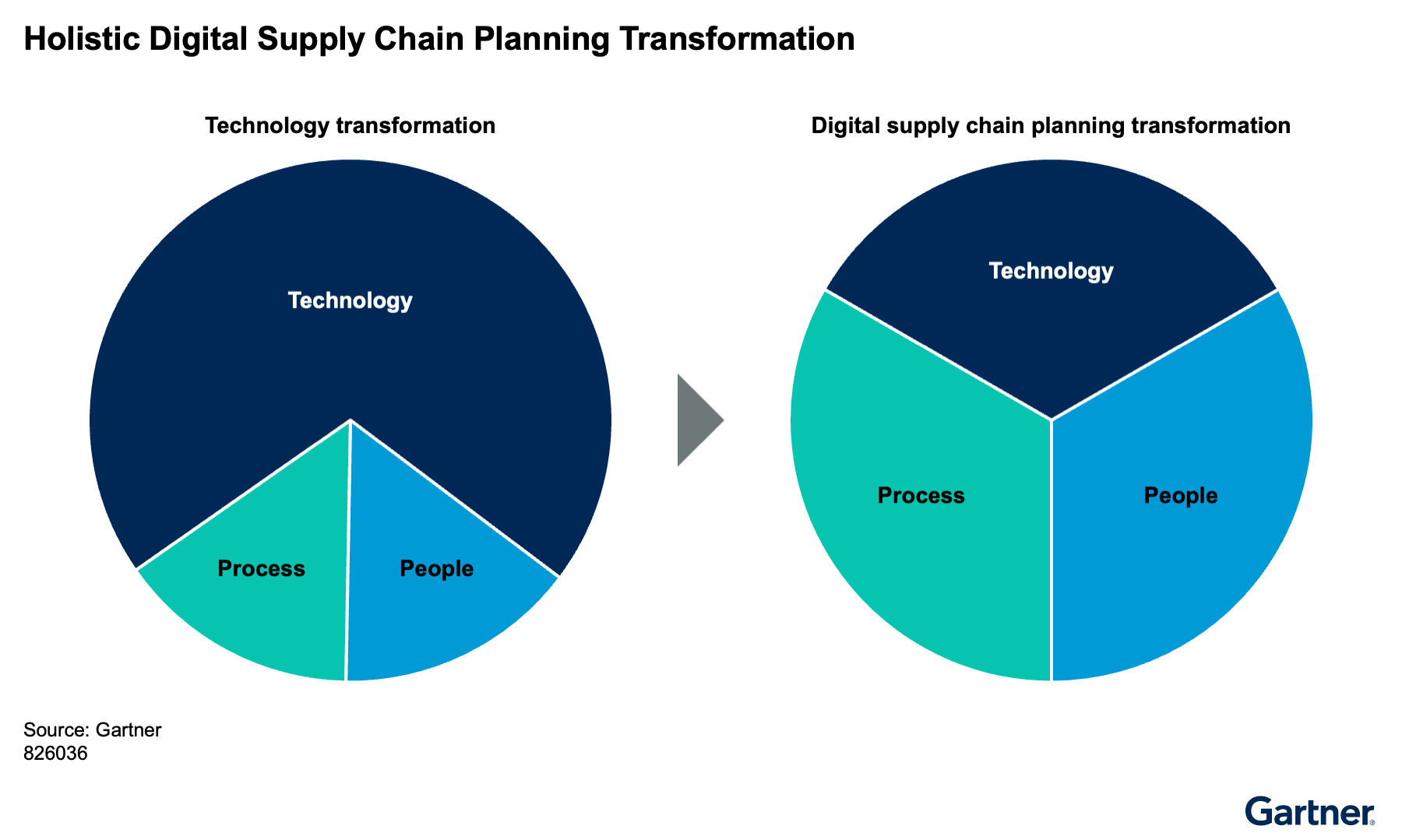
A holistic approach to supply chain planning transformation begins with a comprehensive maturity assessment. Gartner research shows that many organizations conduct SC planning maturity assessments to evaluate current capabilities and identify improvement opportunities.
Key steps include:
- Conduct a supply chain planning maturity assessment: Tools like the Supply Chain Score for Planning help uncover capability gaps and clarify required changes in process, people and technology.
- Assess individual skills: Evaluate planners’ competencies to identify skills gaps and tailor training or upskilling programs to address specific needs (see Tool: Demand-Planning Competency Self-Assessment and Tool: Supply Planning Competency Self-Assessment).
- Review organizational design: Perform job analyses to determine if new roles are needed or existing roles should evolve to fully leverage new technology capabilities (see Define Scope, Organizing Principles and Capability Gaps to Reorganize SC Planning).
- Evolve processes: Align processes with new technology by piloting improvements and scaling successful changes across the organization (see: 3 to Design Effective, Scalable Supply Chain Planning Processes).
By systematically addressing these areas, organizations can ensure their supply chain planning transformation delivers sustainable, measurable outcomes.
Build a holistic business case that accounts for the required investments in processes and people
Define Benefits That Align With Organizational Objectives and Can Be Tracked
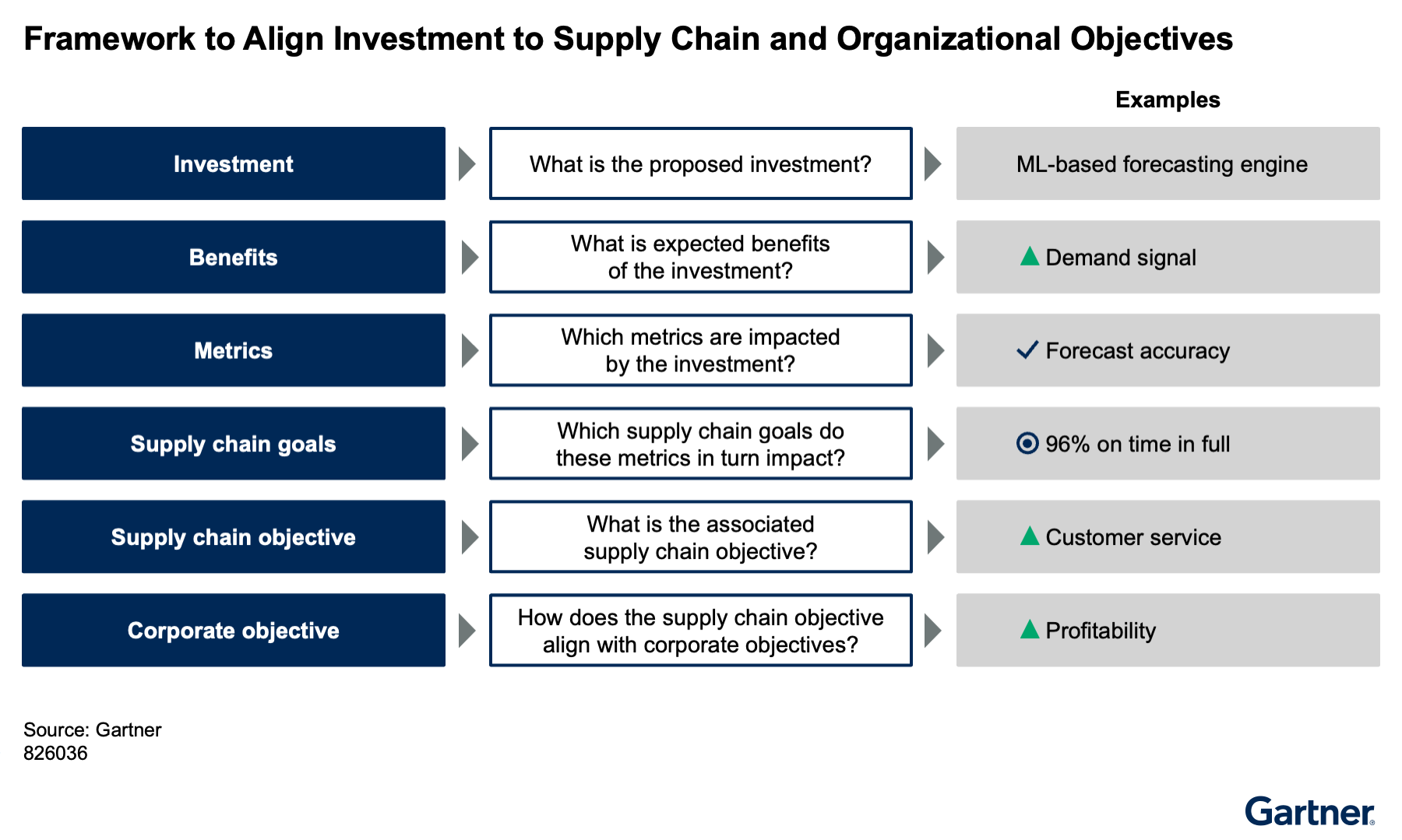
It is important to outline feasible transformation goals and objectives for your business case. The fate of your next initiative proposal depends on it! Although benchmarking is a necessary part of business case development, one size does not fit all. It is imperative that your specific benefit targets are based on your company’s situation and its size of the opportunity based on its focus areas and, importantly, its starting point. Defining measures for your goals and objectives should be accomplished through collaboration with relevant stakeholders to ensure there is no debate over how much progress has been made or whether success has been achieved. Figure 2 provides a simple framework that can be used to align an investment to supply chain and organizational objectives.
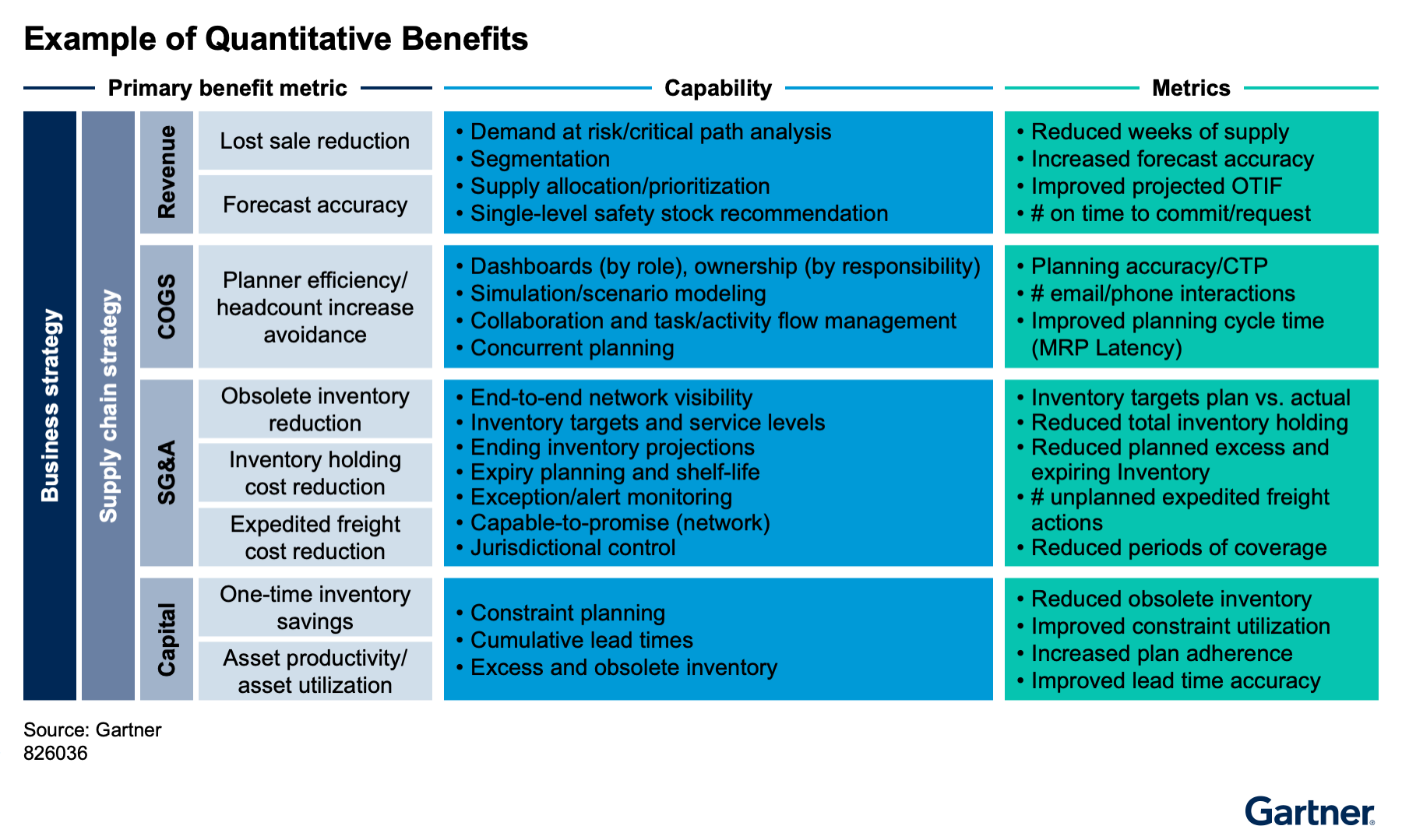
Something as basic as units of measure (dollars, time, etc.) and time buckets of measure (daily, weekly, monthly, etc.) should be included in metric definitions, as well as any methods of conversion, aggregation or reconciliation. Examples of quantitative metrics often included in SC planning transformation are included in Figure 3.
Governance should be established around transformation goals/objectives and their metrics to include who is accountable for tracking, how frequently this should occur and which stakeholders require associated reporting. A crucial component of tracking progress that falls under the purview of governance is data. What data is necessary to measure and track each goal? Who owns, manipulates, and has access to the data? Is the data available? When is it available? And at what frequency? Quantitative data will play a primary role in constructing the business case for transformation, as it will be an objective method of measuring progress and calculating expected and actual return on investment (ROI). The Ignition Guide to Creating a Business Case for Supply Chain Investments provides templates for capturing and reporting quantitative data to provide financial and risk analysis.
An often overlooked step in business case development is to capture the current state baselines against which productivity, profitability, service, and solution adoption metrics will be assessed. It is not uncommon for SC planning leaders to find themselves well into implementation and even post go-live without any way of measuring progress because they don’t know where they started the journey. The assessments you used to help identify gaps and opportunities will provide much of your baseline data, as well as historical KPIs. Productivity baselines can be obtained from any job analyses conducted, and team-based metrics can be captured through collaborative discussion. For example, task, decision and process cycle times should be captured to understand planner hours recovered from manual-based activities.
Communicate a Clear Message That Wins Stakeholder Support
As you craft your communication strategy you will need to appeal to a variety of stakeholders, each of whom is asking “What’s in this transformation for me? How does it align with my objectives?” Start by getting alignment on the existence of a business problem. If you can convince stakeholders there is a problem that needs to be solved, it will be much harder for them to reject a possible solution. This is where having clear outcomes that you need to improve upon will really help your case.
Begin by leveraging quantifiable metrics to build a credible and compelling business case for supply chain planning transformation. Presenting a data-driven analysis of business challenges establishes trust and introduces stakeholders to your perspective. However, to secure full support, it is essential to connect transformational initiatives directly to overall corporate or segment strategy. Additionally, articulate qualitative benefits that resonate emotionally with stakeholders, addressing both rational and emotional drivers of decision making. Ultimately, influencing both how stakeholders think and feel is critical to winning their commitment to change.
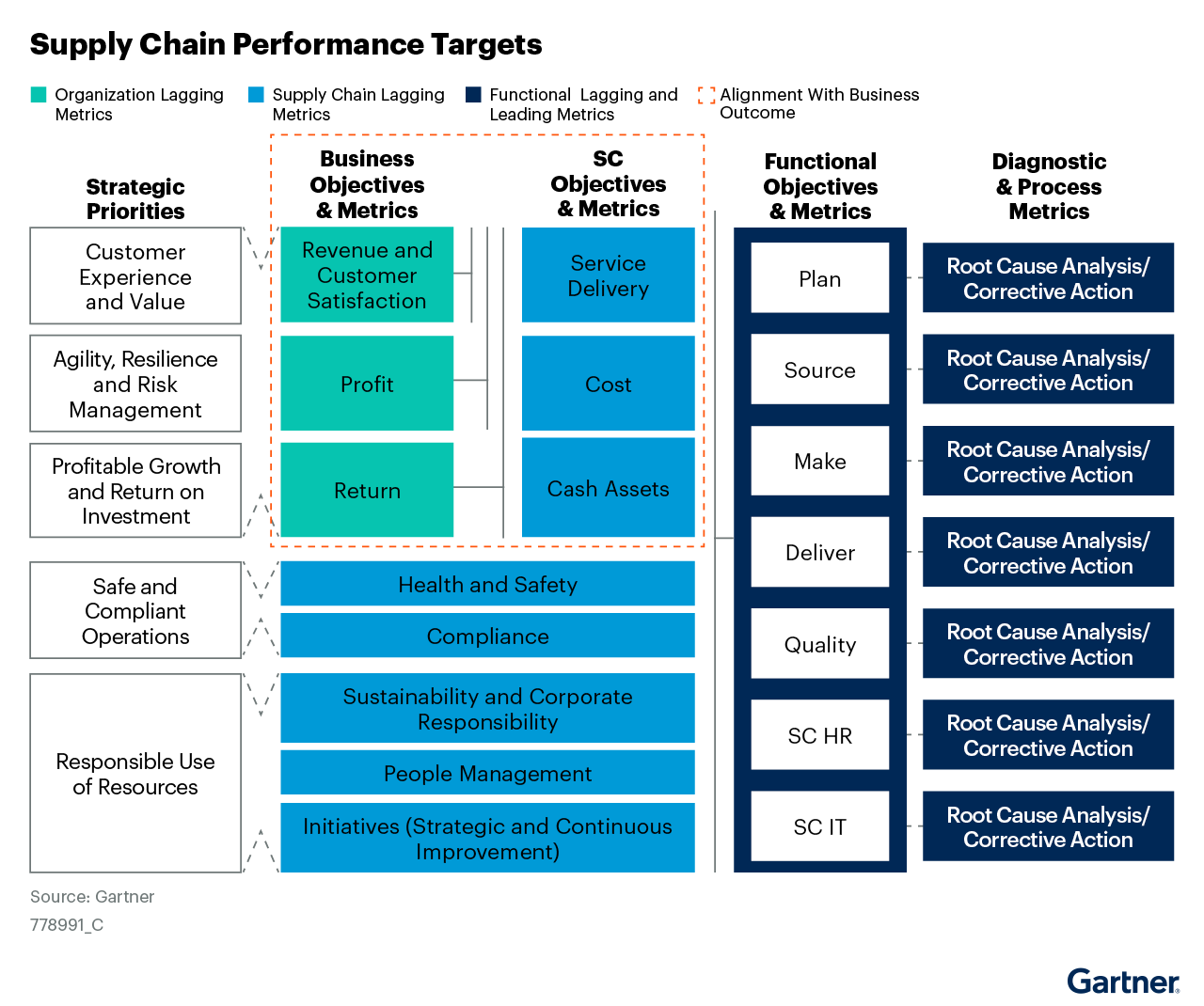
Linking the implementation or improvement of planning processes to strategic considerations can be critical to create a need for change. It should help generate a sense of urgency by making business leaders feel uncomfortable if they delay the project by highlighting increased levels of uncertainty of outcomes from maintaining a status quo approach. Generic strategic considerations to include in your business case include: keeping up with industry best practices or competitors, supporting the organization’s projected growth or improving the organization’s readiness for crisis response. The use of graphical tools, for example (as seen in Figure 4), can help communicate the connection between business strategy and supply chain initiatives to diverse sets of stakeholders (see Setting Supply Chain Targets: A Holistic Approach to Align With Business Priorities).
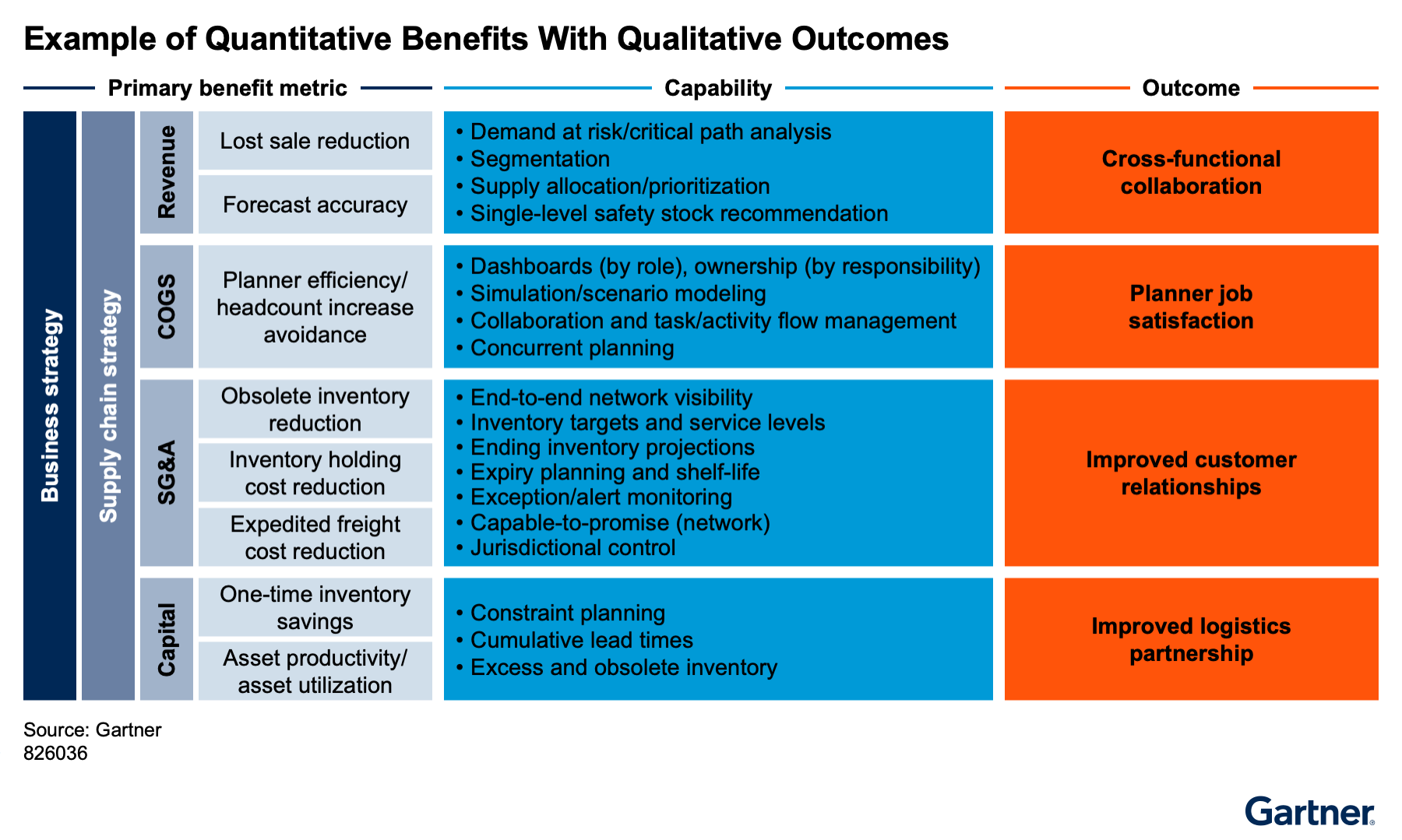
Qualitative benefits provide essential context that bridges the quantitative elements of the business case with the interests and perspectives of stakeholders. Using language that resonates and holds common meaning across stakeholder groups is critical. By translating financial outcomes into a compelling transformational narrative, qualitative benefits help connect the business case to both the hearts and minds of decision makers. Some of the qualitative benefits you might include in your business case are shown in Figure 5.
Including metrics in the four categories (service, cost, inventory and productivity) and fortifying your narrative with strategic considerations and qualitative benefits will help ensure you can address a variety of stakeholder audiences. An effective communication strategy anticipates as many concerns and questions as possible. Take a divide and conquer approach; speak with each stakeholder individually to secure buy-in, so that when it’s time to get final approval you already know the outcome. An explainer document can be tailored for each stakeholder type (see Communicate Change Using an Explainer Document to Gain Employee Commitment).
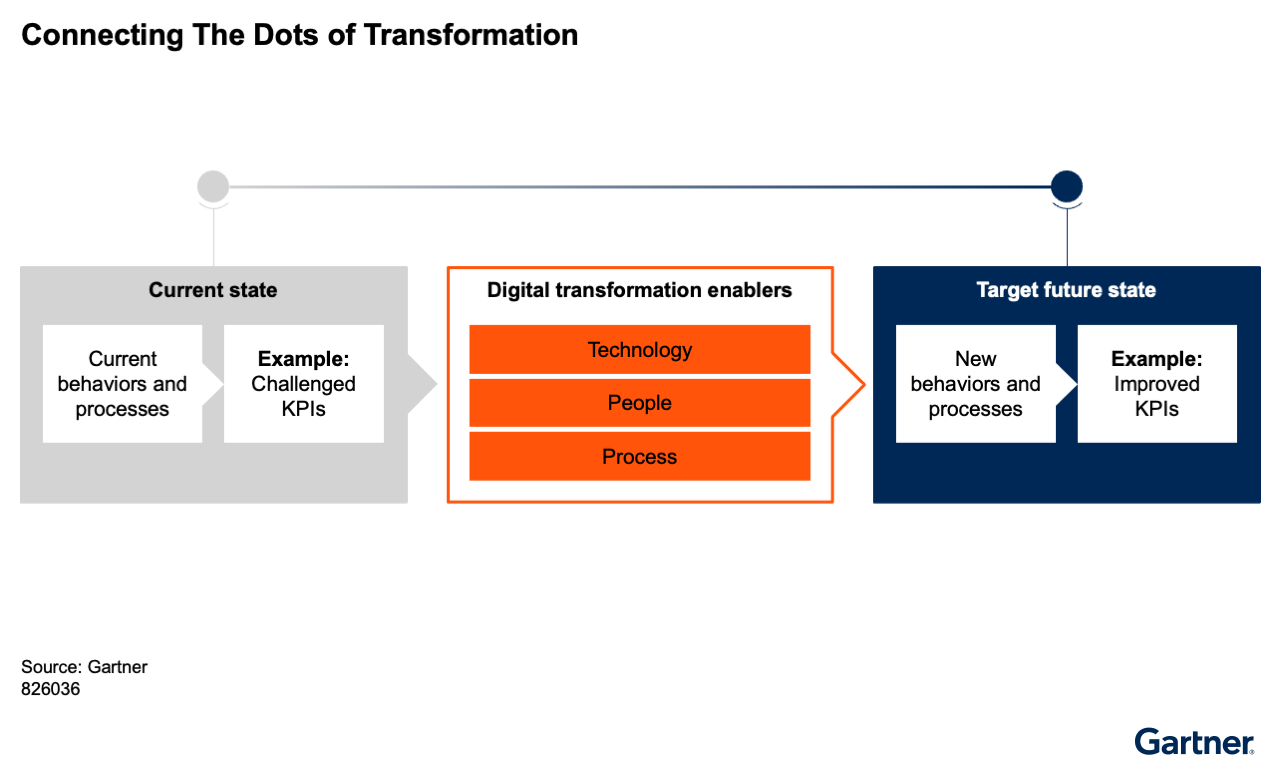
Connecting the dots for stakeholders in a practical manner helps them understand that technology is not the singular answer to planning challenges, but is an enabler to organization and process change. As Figure 6 shows, your current state, which includes all of your baseline measures, is the result of prior and current behaviors that led to historical and current outcomes. To articulate how future-state goals/objectives will be achieved, demonstrate how the solution will enable new behaviors and processes that are necessary to have the desired impact. These new behaviors paint the picture of what your transformation hopes to achieve and what will be most observable to all stakeholders on a daily basis.
1 2025 Gartner Supply Chain Technology User Wants and Needs Survey. This survey aimed to investigate the roles of digital and technology in supply chains. It also aimed to assist supply chain technology leaders in their efforts to modernize legacy application landscapes and create credible business cases for their digital transformations. Additionally, it examined how supply chain organizations are structuring themselves to support digital initiatives and their evolving perspectives on effectively leveraging emerging technologies within their supply chain organizations. The survey was conducted online from 16 October through 6 December 2024 among 506 respondents from North America (n = 153), Western Europe (n = 162), Asia/Pacific (n = 111) and Latin America (n = 80). Respondents were from organizations with $250 million or more in 2023 enterprisewide annual revenue. Industries surveyed included manufacturing (consumer products, industrial, high-tech, life sciences and healthcare), retail, transportation and logistics, and wholesale trade. Qualifying respondents had job roles tied to supply chain function and were involved in decision making regarding supply chain management processes or operations. Disclaimer: The results of this survey do not represent global findings or the market as a whole, but reflect the sentiments of the respondents and companies surveyed.
2024 Gartner Digital Business Impact on Supply Chain Survey. This study was conducted to identify how digital business initiatives are impacting the supply chain organization, including what processes, functions and organizational areas are affected and what technologies are being prioritized to enable such initiatives. The research was conducted online from April through June 2024 among 419 respondents from North America (n = 135), Western Europe (n = 138), Asia/Pacific (n = 92) and Latin America (n = 54). Qualifying organizations reported enterprisewide annual revenue for the fiscal year 2023 of at least $500 million and had either already implemented a “Digital Business Model” or digital supply chain initiative, or were planning to do so within the next two years. Respondents had senior manager roles or above and were ultimately responsible for decisions related to the digital supply chain initiative at their company or were a member of a group responsible for such decisions.
Disclaimer: The results of this study do not represent global findings or the market as a whole but reflect sentiment of the respondents and companies surveyed.
Disclaimer: The results of this study do not represent global findings or the market as a whole but reflect sentiment of the respondents and companies surveyed.
2023 Gartner Organizing to Succeed in Digitalizing the Supply Chain Survey. This study was conducted to help clients evolve their organization around digitalization, driving best practices, digital strategies, technologies and the associated change management across complex global organizations.
The research was conducted online from July to August 2023 among 362 respondents from North America (n = 173), Western Europe (n = 130) and Asia/Pacific (n = 59). Qualifying organizations reported enterprisewide annual revenue for the most recent fiscal year of at least $250 million. Respondents were screened for being personally actively involved in digital supply chain initiatives, either already implemented or to be implemented in the next two years. Disclaimer: The results of this study do not represent global findings or the market as a whole, but reflect the sentiment of the respondents and companies surveyed.
The research was conducted online from July to August 2023 among 362 respondents from North America (n = 173), Western Europe (n = 130) and Asia/Pacific (n = 59). Qualifying organizations reported enterprisewide annual revenue for the most recent fiscal year of at least $250 million. Respondents were screened for being personally actively involved in digital supply chain initiatives, either already implemented or to be implemented in the next two years. Disclaimer: The results of this study do not represent global findings or the market as a whole, but reflect the sentiment of the respondents and companies surveyed.