Magic Quadrant for Process Intelligence Platforms
5 May 2026 - ID G00840852 - 55 min read
By Tushar Srivastava, David Sugden, and 1 more
Process intelligence platforms unify process mining, modeling, and monitoring to help enterprises visualize, analyze, and automate processes. As AI scales, organizations can leverage these tools to provide the operational context needed to plan and prioritize the best areas to deploy AI agents.
Market Definition/Description
Gartner defines process intelligence platforms as solutions that combine development and runtime software tools to mine, analyze, model, design, and monitor processes. They offer capabilities such as process and task mining, process modeling and designing, advanced process analysis, alerting, SLA and threshold-based tracking, anomaly detection, and interactive decision support by providing data about current processes and their conditions.
- AI and process automation opportunity discovery: By analyzing task and process-level data, the platform can pinpoint bottlenecks, delays, governance issues, compliance gaps, and manual handoffs that are ideal candidates for task or process automation and AI augmentation. It can also identify redundant steps and resource constraints that contribute to process inefficiencies. This use case helps discover and design to-be workflows by providing prioritized opportunity lists with estimated ROI, enabling enterprises to accelerate automation initiatives and maximize operational efficiency. Furthermore, this use case extends to providing a business operations context to ground AI agents, ensuring alignment with organizational goals and compliance requirements.
- Process improvement and optimization: This use case is essential for enterprises seeking to improve and optimize their operations by discovering, designing, modeling, and analyzing business processes. This enables end users to collaboratively redesign workflows (such as customer journeys, service delivery, or internal operations), leverage simulation capabilities to test future-state scenarios, and evaluate the impact of proposed changes. It also needs a centralized repository for storing process models, best practices, and improvement initiatives, enabling easy access, version control, and knowledge sharing across teams. Finally, through predictive and prescriptive analytics, users can identify optimal process improvements, anticipate outcomes, and make data-driven decisions that align with strategic objectives.
- Governance, risk, and compliance: Monitoring of process executions against regulatory requirements and internal policies ensures visibility into compliance. Automated audits, conformance checks, and risk scoring highlight policy violations and control weaknesses, empowering stakeholders to mitigate risks, enforce governance standards, and maintain audit trails.
- Bridging strategy to execution for digital transformation: This use case bridges the gap between strategic planning and daily operations by enabling data-driven actions. For example, when leadership sets a target customer satisfaction score, process intelligence tracks metrics such as response times and handoff delays, alerting teams to corrective steps and enabling process redesign where needed. If market data indicates a surge in demand, the platform simulates impacts across manufacturing and logistics, recommends adjustments, and updates roadmaps accordingly. By linking objectives, such as cost-to-serve reductions or quality improvements to key performance indicators (KPIs) and actionable triggers, organizations can ensure that every decision directly supports customer outcomes.
- Operations intelligence: This use case leverages dashboards, SLA tracking, and anomaly detection to continuously monitor process performance. It alerts to surface imminent issues, such as delays or exceptions, while historical and predictive analytics guide rapid root-cause analysis.
Mandatory Features
The mandatory features in a process intelligence platform include:
- Process mining: Analysis of processes by extracting event data from information systems, offering automated discovery, conformance checking, and advanced process analytics.
- Root cause analysis: Automatically detects deviations and bottlenecks in running processes, offering diagnostic insights, such as variant comparisons and conformance checks.
- Process modeling and design: Offering process modeling (as is) to understand, document, and analyze how a process currently works, and process design (to be) to create or re-create a business process to achieve specific performance goals, such as improved efficiency, reduced cost, or better quality.
- Simulation and optimization: Allow users to run “what if” scenarios (simulations) on the modeled processes by adjusting parameters like resources, costs, and cycle times. This helps identify and test potential bottlenecks and optimization opportunities before implementing changes in the real world.
- Customer journey mapping: Capability to mine, model, and analyze client interactions, including sentiment analysis of customer feedback and touchpoints, to enhance insights and optimize the overall customer experience.
- Performance and KPI reporting: Allow users to generate comprehensive reports and dashboards based on the process models, allowing for the analysis of KPIs like process costs, throughput times, and resource utilization. This provides a quantifiable basis for assessing efficiency and value.
- Process monitoring: Observation and tracking of process execution, including SLA and threshold-based tracking, anomaly detection, and event stream processing.
- Automated alerting: Integrated observability that triggers notifications via email or other platforms when predefined thresholds or SLA violations occur.
Optional Features
- Task mining: Techniques that infer useful information from low-level user interface logs, keystrokes, and screen recordings to identify automation opportunities and boost worker productivity.
- Contextual modeling: Includes business architecture landscape viewpoints that provide context, events, rules, and requirements tailored to different stakeholder roles.
- Integration capabilities: Enable connectivity with risk management systems, finance platforms, technology architecture, infrastructure components, application repositories, and data stores.
Magic Quadrant
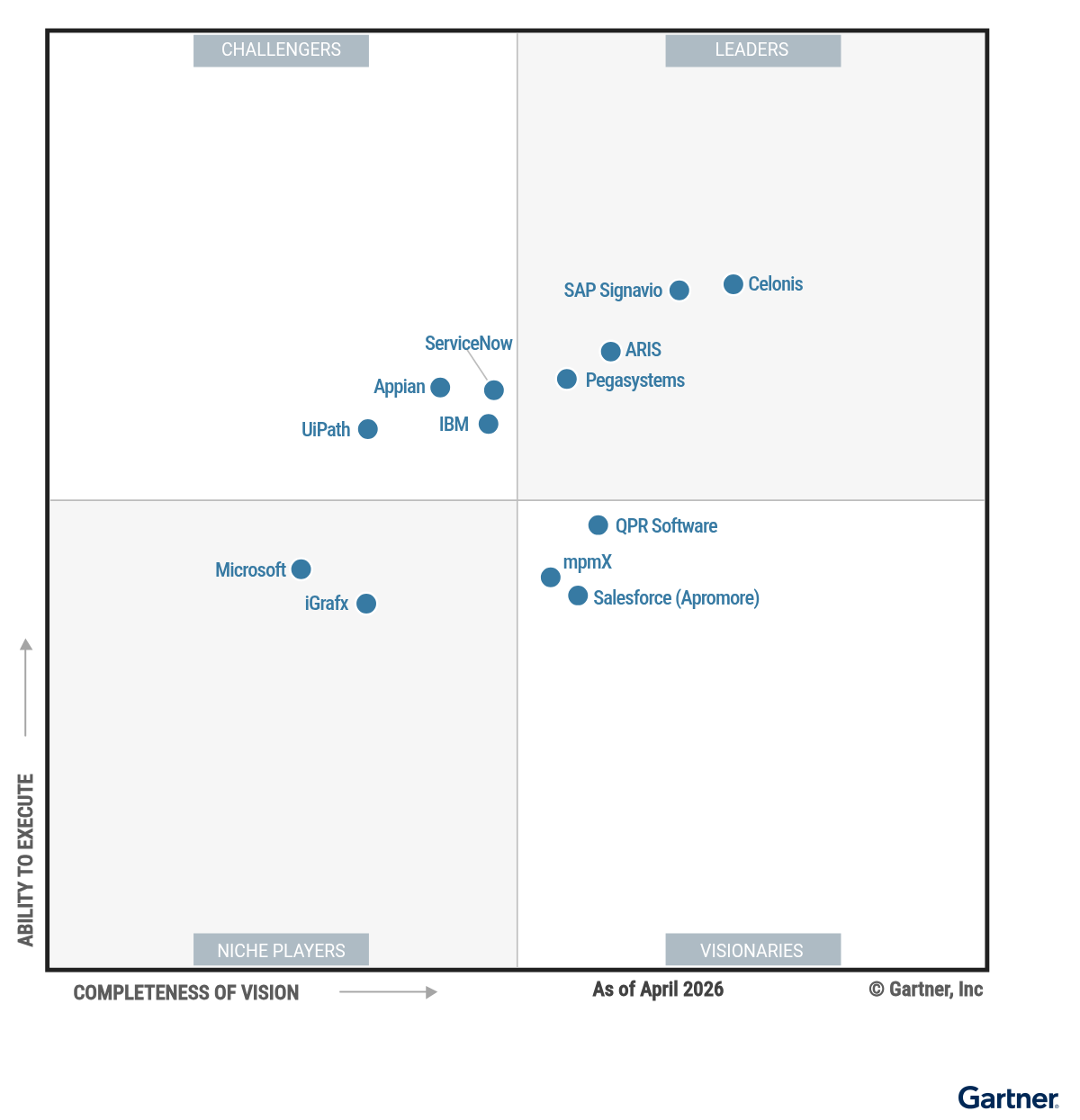
Vendor Strengths and Cautions
Appian
Appian is a Challenger in this Magic Quadrant.
Its Appian Process HQ product offers process mining, process modeling and analysis, and task mining natively.
The company’s operations are geographically diversified. Appian primarily serves large global enterprises and government agencies in highly regulated verticals such as the public sector, financial services, insurance, and life sciences.
Future investments focus on agentic process intelligence, which aims to deploy AI agents that can autonomously resolve process bottlenecks to drive continuous process optimization, Model Context Protocols (MCP) and Agent2Agent protocol (A2A) interoperability, model choice, and unstructured document processing (via DocCenter).
- Real-time data analysis: Appian’s process intelligence capabilities leverage Data Fabric to enable analytics on live source data, accelerating time to insight for teams seeking to analyze live data and address process bottlenecks.
- Unified platform: Appian Process HQ combines outcomes of data fabric, process mining, and task mining analysis in one environment. The platform offers automated techniques for process discovery and guided intelligence, operating directly on live enterprise data. By automatically surfacing bottlenecks, the platform can potentially enable users to translate insights into automated workflows and agentic actions without switching tools.
- Integrated automation: For Appian customers, the platform natively connects process intelligence with automation capabilities. Users can deploy automation from analytical findings, closing the gap between discovery and execution in a single ecosystem.
- Lack of object-centric process mining (OCPM): Appian lacks fully native OCPM capabilities out of the box. These features remain in prototype and testing phases. Organizations with diverging or converging operations may find it challenging to analyze interconnected business objects without relying on traditional data models.
- Platform dependency: Process intelligence is tightly integrated with Appian’s broader automation suite and is primarily positioned as a monitoring tool for process automation. End users rarely choose it as a stand-alone process intelligence solution. Organizations seeking a pure-play process intelligence platform should check with Appian to confirm alignment with their specific requirements.
- Actionability gap in closed-loop execution: Although Appian has the vision for autonomous operations, a gap remains between process insight and automated action. AI-driven recommendations are not currently automated; users must still act on suggestions and enrich data manually to execute changes. Consequently, even though Appian has the foundational components in place, bridging the automated action gap must be a main priority for the platform going forward.
ARIS
ARIS is a Leader in this Magic Quadrant.
ARIS offers process mining and process modeling and analysis natively, while partnering with ProcessMaker for task mining.
Operations are primarily concentrated in EMEA and North America, with clients ranging from midmarket to large global enterprises in sectors such as life sciences, consumer packaged goods, automotive, financial services, government, and manufacturing.
ARIS is investing in an agentic process intelligence hub for AI agent governance and plans to launch native OCPM on its near-term roadmap. The roadmap also includes an MCP server to share process knowledge with external AI agents and an AI workbench for advanced predictive analytics.
- Unified platform: ARIS unifies process mining, process modeling and analysis, and lightweight task automation (with ARIS Flows capabilities) around a centralized enterprise repository built on an object-oriented metamodel. This enables organizations to establish a governed single source of truth that directly links discovered process bottlenecks to business designs, roles, risks, and compliance controls.
- Scalability: The platform’s microservices architecture, utilizing a native Kubernetes infrastructure, can potentially support multiple process cases that enable organizations to scale process intelligence across various departments and use cases.
- Deployment flexibility: ARIS offers full feature parity across public cloud, managed private cloud, and on-premises deployment options in 16 supported global regions. As a result, government agencies and regulated enterprises can run process intelligence within their own infrastructure to ensure data sovereignty.
- Third-party task mining: Task mining is delivered through an OEM partnership with ProcessMaker rather than as a proprietary solution to capture user desktop activities. Organizations must rely on third-party technology for task-level insights, which may add licensing and support complexity.
- AI modeling limitations: While the platform’s AI features generate new process drafts from documents or unstructured text, they currently cannot directly edit existing process models in the design environment. Nontechnical users still need manual modeling expertise for process redesigns and continuous operational improvement initiatives.
- Complex user experience: Gartner clients and Peer Insights reviewers report a steep learning curve and resource-intensive onboarding, specifically for mastering the extensive and complex repository. While ARIS has recently invested in streamlining navigation for key use cases and natively incorporating integration capabilities, buyers should closely evaluate the platform’s usability, as mastering its extensive capabilities can introduce workflow friction and delayed time to value compared with more streamlined competitors. The interface requires excessive navigation and has historically relied on older middleware for integration
Celonis
Celonis is a Leader in this Magic Quadrant.
Celonis offers process mining, task mining, and process modeling and analysis natively.
Operations are primarily concentrated in EMEA and North America, with clients ranging from midmarket to large global enterprises in sectors such as life sciences, consumer packaged goods, banking, manufacturing, and automotive.
Future investments include developing a semantic layer to connect corporate strategy with object-centric process data, expanding agent mining to monitor and optimize autonomous workflows, and enhancing process intelligence networks for secure, real-time data sharing across the value chain.
- Data-driven benchmarking: Celonis offers data-driven industry benchmarks by aggregating anonymized process data from community enterprise customers. As these benchmarks are regularly refreshed using actual system execution data, they can provide granular operational metrics. For end users, this benchmarking can potentially enable them to track industry performance shifts and compare their own operations against peers, helping pinpoint the root causes of underperformance. Additionally, the platform’s Transformation Hub allows organizations to natively track ROI and link the financial impact of process changes directly to core business objectives.
- Product innovation: Celonis offers mature OCPM capabilities at scale via its Process Intelligence Graph. This architecture decouples process logic from underlying source-system architectures. By natively supporting multiobject and multiperspective process analysis, the platform allows enterprises to capture complex business realities and interdependent workflows within a single data model to manage end-to-end operations.
- Partner ecosystem and marketplace: Celonis has a strong market presence, with more than 50% of the market share, supported by over 300 partners, including hyperscalers like Microsoft, AWS, and Databricks, plus top-tier system integrators. It has a good marketplace ecosystem to help organizations accelerate time to value by deploying domain-specific solutions and connecting process intelligence to data lakehouses.
- Complex pricing and add-on structure: While Celonis has transitioned to process-based licensing, its overall commercial structure remains complex. Gartner clients frequently mention issues with the vendor’s pricing structure. Buyers should carefully evaluate Celonis’ pricing model and the expected total cost of ownership when scaling deployments or accessing expert support.
- Process modeling limitations: Celonis’ process modeling and simulation capabilities within Celonis Process Management (CPM) lag those of other Leaders, with Gartner clients frequently reporting limited advanced design features. Process architects may find the CPM suite restrictive when designing and simulating complex operational changes.
- Celonis Process Management repository: The Celonis Process Management repository remains a separate system with its own tooling, despite sharing the same look and feel with the broader Celonis platform. While Symbio (acquired by Celonis) is integrated for features such as metadata management, conformance testing with the Celonis Process Adherence Manager, and Business Process Model and Notation (BPMN) model exchange, these integrations do not unify the repositories. Gartner clients should be prepared to maintain this separate repository.
IBM
IBM is a Challenger in this Magic Quadrant.
Its IBM Process Mining and IBM Blueworks Live products, though not integrated, focus on delivering a process intelligence framework.
IBM operates globally and serves large enterprises across a broad range of industries, including banking, financial services, and insurance (BFSI), telecommunications, healthcare, public sector, and manufacturing.
Future investments prioritize an AI-first approach, building an ecosystem of specialized agents, including a blueprint designer, process hygiene, initiative planner, and deployment agents to automate the end-to-end life cycle from discovery to execution in platforms such as IBM Business Automation Workflow.
- Data extraction: To handle complex operational data environments, IBM Process Mining offers an embedded Python engine that can extract and transform data using Python code, provided the source system allows API access. For systems like SAP, IBM provides dedicated stand-alone utilities like an ABAP extractor, giving operations and data engineering teams the ability to ingest data without being forced to rely on external extraction, transformation, and loading (ETL) tools.
- Automated prescriptive analysis: IBM lowers the barrier to entry for process mining through its prescriptive process mining capability. Rather than requiring extensive data preparation or prebuilt industry packages, the platform can generate an automated, baseline report from any standard uploaded event log. While the out-of-the-box analysis is limited to default KPIs (e.g., time and cost), the system uses deterministic algorithms to run background what-if simulations, estimating the potential ROI in time and cost if a simulated bottleneck is modified. This provides organizations with rapid, factual baseline insights to kickstart their process optimization efforts, even with low levels of process intelligence maturity.
- Flexible deployment and data residency: IBM supports SaaS, on-premises, and hybrid environments, allowing clients to meet data sovereignty and compliance needs by keeping operational data in-region.
- Platform fragmentation and commercial complexity: IBM Blueworks Live and IBM Process Mining are separate products requiring separate agreements, leading to complexity in adoption, licensing, and the user experience. Buyers may encounter friction when managing multiple tools instead of dealing with a single platform license.
- Ecosystem lock-in and proprietary automation bias: While IBM positions its process intelligence tools as a general foundation for enterprise improvement, the platform’s capabilities heavily favor its own proprietary automation estate. Currently, out-of-the-box integration for monitoring automated workflows is restricted to IBM Business Automation Workflow and IBM Cloud Paks environments. Because direct integrations with third-party automation tools remain limited and are placed on a 12- to 24-month roadmap, organizations seeking a platform-neutral solution may find this approach restrictive.
- Unstructured data limitations: IBM’s platform does not natively handle unstructured data such as documents, emails, or chat logs for process intelligence and analysis. Organizations looking to leverage unstructured data must ensure it is fully structured before it can be uploaded and ingested, which can increase the overall data preparation burden.
iGrafx
iGrafx is a Niche Player in this Magic Quadrant.
Its iGrafx Process360 Live platform offers process mining and process modeling and analysis natively, while relying on partnership with Skan AI for task mining.
iGrafx operates internationally and serves enterprises across a broad range of industries, including highly regulated sectors like finance and healthcare, as well as shared services and manufacturing.
Future investments prioritize an AI-driven, self-optimizing approach, connecting process intelligence with agentic AI to automate the continuous improvement life cycle and building a business operations cockpit to orchestrate these agents and recommend actions without user intervention.
- Scalable, case-based pricing: iGrafx uses a simple subscription model based on user count and case volume. All core platform capabilities, including mining, modeling, simulation, and governance, are included. Because pricing is decoupled from overall data volume, organizations can add new metrics or data dimensions to their analysis midproject without triggering unexpected data processing fees.
- Unified platform and centralized repository: The platform natively integrates process mining, modeling, simulation, and governance through a centralized process repository that links roles, systems, risks, and KPIs. Organizations can manage the entire process improvement life cycle in a single environment, eliminating friction from disconnected point solutions.
- Predictive analytics and conformance checking: iGrafx employs a ray-based analytics framework and graph neural networks to forecast process execution and configure proactive alerts. Its conformance checking tool analyzes multi-instance patterns and detects concurrent tasks within BPMN models, reducing manual data preparation for analysts.
- Reliance on third-party task mining: iGrafx does not offer native task mining, and instead partners with Skan AI to provide desktop-level user insights. Organizations seeking a unified solution for process and task mining for their process intelligence initiatives should be aware that iGrafx supports the integration between platforms, though separate vendor contracts may be required.
- No native object-centric process mining: The platform lacks out-of-the-box OCPM. While iGrafx supports preprocessing through a KNIME-based pipeline, customers must perform data modeling and define matchings before ingestion to aggregate related event logs for object-centric analysis. Organizations with complex, interconnected workflows face higher data engineering effort and potentially longer time to value compared with competitors that offer native OCPM.
- Static alerting limitations: iGrafx provides static thresholds and SLAs for alerting but does not support dynamic or adaptive alert rules based on historical trends or changing business context. Although the platform allows for proactive alerting using predictive outputs, operations teams must manually recalibrate alerts to avoid fatigue or missed anomalies when operating conditions change.
Microsoft
Microsoft is a Niche Player in this Magic Quadrant.
Its core Power Automate Process Mining platform offers native process and task mining and leverages Microsoft Visio for process modeling and analysis and Microsoft SharePoint as a process repository.
Operations are geographically diversified, serving midmarket to large enterprises across telecommunications, healthcare, manufacturing, financial services, and the public sector.
Microsoft’s roadmap focuses on establishing an agentic operating system as the governance layer for autonomous AI agents, deepening Microsoft Fabric OneLake integration for zero-copy data architecture, and deploying a process intelligence MCP server.
- Integrated process and task mining: The platform combines process mining with task mining via the Power Automate desktop recorder, providing visibility from high-level workflows to granular manual tasks. Operations teams can pinpoint root causes of bottlenecks and transition from discovery to targeted automation.
- Ecosystem integration: Microsoft offers integration of its process intelligence capabilities with Microsoft Fabric and OneLake. This can enable customers to perform process mining queries in place without data replication. By natively leveraging the broader Microsoft ecosystem, including Power BI for dashboards and Power Automate for remediation, organizations may benefit from a unified, closed-loop experience from data ingestion to automated action.
- Accessible pricing model: Core process mining capabilities are included in the standard Power Automate Premium license, eliminating the need for separate software purchases. Organizations can start process analysis using existing entitlements and scale up with flat-fee add-ons as usage grows.
- Ecosystem dependency: While Microsoft positions its process intelligence as an extensible solution that reduces integration overhead, the platform’s architecture and execution capabilities favor Microsoft’s proprietary Power Platform and broader data ecosystem, including Microsoft Fabric, Power BI, and Copilot Studio. This approach may deter organizations operating in highly heterogeneous IT environments that seek a platform specifically for general-purpose, platform-agnostic process intelligence.
- Licensing and commercial complexity: Microsoft does not offer its process mining solution as a stand-alone, independent tool. Instead, it is packaged and marketed as an embedded feature and incremental add-on within the Power Platform ecosystem. Organizations seeking a pure-play process intelligence solution may find it complex to purchase.
- Reliance on Visio and lack of a dedicated repository: The platform lacks native classical process modeling and a dedicated repository, instead relying on Visio for diagramming and SharePoint for storage and collaboration. While this SharePoint integration provides capabilities such as categorization, process metadata, version control, and approval workflows to support process governance, it creates a fragmented workflow that lacks integration between mined data and the deep process modeling found in unified competitor platforms.
mpmX
mpmX (formerly MEHRWERK) is a Visionary in this Magic Quadrant.
The mpmX platform offers process mining and business intelligence analytics, and partners with NiCE for task mining, Bizzdesign Hopex for process modeling and design, and Camunda for process orchestration and automation.
mpmX operates internationally, with a presence in Europe and North America, and targets SMEs and enterprise customers across industries, including manufacturing, financial services, retail, telecommunications, and healthcare.
Future investments prioritize a data-sovereignty-first AI approach, an ecosystem built around its mpmX MCP server, and agent mining capabilities to act as a secure governance layer for AI agents natively in data platforms like Qlik, Snowflake, and Databricks.
- Native ecosystem presence: Besides its stand-alone offering, mpmX can operate directly within major enterprise data environments, specifically Qlik, Snowflake, and Databricks, using a zero-copy architecture. Organizations can deploy process intelligence directly in these environments while maintaining control over sensitive information.
- Data sovereignty and privacy: Rather than relying on extraction pipelines that replicate and move data into a separate vendor cloud, mpmX deploys directly onto a customer’s existing data infrastructure or on-premises environments. By utilizing this zero-copy approach, data is processed where it resides, minimizing data movement and avoiding the centralization of sensitive data. This approach can potentially help regulated buyers maintain data sovereignty and GDPR compliance.
- Product licensing: mpmX offers a subscription model that imposes no restrictions on the number of processes or cases analyzed. This licensing approach allows organizations to scale their process intelligence initiatives across multiple departments and use cases without hitting artificial, case-count ceilings.
- No native task mining: mpmX does not provide native task mining; it relies on integrations with third-party tools such as NiCE to capture desktop-level user interactions. Organizations seeking a unified solution for both process and task mining must manage multiple vendors, which can introduce integration friction, separate licensing agreements, and fragmented vendor support.
- Geographic concentration: mpmX’s customer base is heavily concentrated in EMEA. Growth in the U.S. market has been slower, with more limited marketing reach than larger competitors. Organizations outside Europe may find fewer local partners or user communities compared with more globally distributed vendors.
- Partner-dependent modeling and analysis: mpmX relies on its partnership with Bizzdesign Hopex for process modeling, advanced analysis, and simulation rather than providing these features natively. Buyers should clarify licensing terms, integration specifics, and support responsibilities when considering a multivendor stack.
Pegasystems
Pegasystems is a Leader in this Magic Quadrant.
Its Pega Process Mining, Pega Task Mining, and Pega Infinity products, which are natively integrated, focus on delivering a unified process intelligence framework.
Pegasystems operates globally and serves large enterprises across a broad range of highly regulated industries, including financial services and healthcare, insurance, communications, manufacturing, and government agencies.
Future investments prioritize an autonomous enterprise approach, building an ecosystem of specialized AI agents, improving OCPM, and developing a proprietary process-specific LLM to automate the end-to-end life cycle from insight to action on Pega Infinity platforms.
- Generative modernization via Pega Blueprint: Pegasystems bridges process discovery and application design by connecting mined as-is data and business rules directly to Blueprint. Stakeholders can use natural language to collaboratively refine designs and generate to-be application designs, including case life cycles, data models, and user interfaces. This closed-loop pipeline can potentially accelerate legacy modernization.
- Unified offering: Pegasystems provides a single architecture that integrates process mining, task mining, and process modeling and analysis without reliance on third-party tools. Organizations can connect system-level performance metrics directly to employee desktop behaviors, enabling operations teams to drill down from high-level bottlenecks to manual tasks within a single platform.
- Regional data sovereignty and compliance: Pegasystems supports data residency mandates through localized infrastructure deployments to keep sensitive customer data within national borders. This enables organizations in regulated regions to deploy process intelligence while maintaining compliance.
- Sales execution focus: While Pegasystems positions its process intelligence as a broad engine for enterprise transformation, the platform’s closed-loop execution and application-generation capabilities heavily favor its proprietary Pega Infinity platform and automation ecosystem. This approach may deter organizations seeking a platform specifically for general-purpose process intelligence.
- Commercial and licensing complexity: The company uses several distinct licensing models concurrently. The core platform is typically licensed based on cases or usage, while process mining is priced by the volume of analyzed work units and task mining by the number of users or monitored desktops. Many advanced features, such as Pega Process AI and Pega GenAI assistants, are also sold as separate add-ons. Because these models are combined, enterprise procurement and pricing transparency can be complicated.
- No OCPM: While Pegasystems currently enables multiobject analysis through virtual joins, a fully native architecture based on OCPM remains on its near-term roadmap. Consequently, organizations needing mature, native OCPM to analyze interdependent operations may face limitations compared with competitors that have established OCPM capabilities.
QPR Software
QPR Software is a Visionary in this Magic Quadrant.
Its QPR ProcessAnalyzer and QPR EnterpriseArchitect products offer process mining and process modeling and analysis natively, while relying on third-party partners for task mining.
Operations are mostly focused in EMEA, serving midmarket to large enterprises, concentrated in manufacturing and consumer packaged goods, BFSI, and pharmaceuticals and life sciences.
QPR’s roadmap prioritizes enabling agentic AI operations by launching an MCP interface to securely expose process insights to autonomous AI agents, unifying case-centric and OCPM models, and automating process modeling from unstructured data.
- Native Snowflake architecture: QPR’s platform is built natively on Snowflake, enabling zero-copy analytics that keep data securely within the customer’s environment. This integration enables process analysis without manual data replication or ETL pipelines. However, the platform is not limited to Snowflake customers, and organizations can also access the solution through QPR’s managed service, AWS-hosted offerings, and on-premises configurations.
- OCPM: QPR was an early innovator in OCPM. The platform automatically generates object-centric data models from relational schemas by identifying object-to-object relationships, eliminating tedious manual mapping. A native OCPM flowchart visualizes multiple interacting processes such as orders, items, and deliveries in a single view.
- Unified process mining and modeling: QPR tightly integrates its process mining and enterprise architecture modeling tools. Users can discover as-is flows from event logs, export them into the enterprise architect repository in BPMN 2.0 format, edit or optimize them, and send them back to the process analyzer for automated conformance checking.
- Process modeling and analysis: QPR’s modeling environment and simulation reports have an outdated appearance and lack modern design. Setting up simulations requires significant technical expertise and lacks guided or AI-assisted setup, making onboarding challenging for new users.
- Geographic concentration and partner-dependent reach: QPR focuses direct sales and growth on Europe. In other regions, such as Latin America, Asia/Pacific, and the Middle East, the company relies on partners for implementation and support. Organizations outside Europe should confirm that local partners have the expertise needed for deployment and ongoing success.
- No native task mining: QPR has retired its proprietary task recording technology and now relies on third-party partners for granular, task-level data capture. Organizations that require integrated process and task mining must procure and manage a separate tool, increasing procurement friction and deployment complexity compared with unified competitor solutions.
Salesforce (Apromore)
Apromore by Salesforce is a Visionary in this Magic Quadrant.
Its Apromore Enterprise Edition integrates process and task mining, process modeling, and analysis modules.
Operations are geographically diversified with a presence across North America, EMEA, and Asia/Pacific. Clients are primarily midmarket to global enterprises, especially in banking, financial services, and insurance.
Salesforce’s roadmap centers on replatforming Apromore to run natively on the Salesforce ecosystem for embedded process intelligence across all Salesforce clouds. Future investments prioritize agentic process monitoring for autonomous AI agents and conversational process intelligence within collaboration tools like Slack and Microsoft Teams.
- Product innovation: Apromore features a no-code AutoML engine that can predict in-flight case outcomes, remaining cycle times, and SLA breaches using explainable AI. Apromore Copilot can run multiple what-if simulations and compare the outcomes to recommend targeted process changes that help users meet KPI targets.
- Business user accessibility: The platform offers a no-code user experience and conversational AI Copilot that allows users to build dashboards, investigate root causes, and optimize processes in natural language. This helps business users drive process changes independently without needing technical expertise such as writing complex data queries, configuring machine learning algorithms, and manually calibrating simulation models.
- Unified platform: Apromore merges desktop task mining data with back-end process logs into a single model. This provides process analysts with visibility into manual delays and application switching, helping organizations reduce inefficiencies. For Salesforce customers, Apromore could align with planned enhancements to Salesforce Agentforce.
- Platform migration: Apromore’s planned replatforming to the Salesforce ecosystem will eventually require customers to migrate to the Salesforce Hyperforce infrastructure. While Salesforce plans to support non-Salesforce applications, organizations should closely monitor the product roadmap and must work with Salesforce to evaluate potential migration efforts, and future pricing structures, as commercial details for the postmigration Salesforce ecosystem have not yet emerged.
- OCPM: While Apromore offers multiobject analysis through parent-child table joins, it does not offer a native many-to-many graph architecture. Enterprises with complex, interdependent operations may face manual data preparation hurdles and convergence problems.
- SaaS-only deployment: While Apromore retired its on-premises licensing in 2022, customers have an alternative option to host their data store or deploy the platform within their own private cloud tenancy. Organizations with strict data residency or regulatory requirements that mandate entirely air-gapped deployments for their local, physical data centers will need to transition to a secure, isolated cloud environment to adopt the platform.
SAP Signavio
SAP Signavio is a Leader in this Magic Quadrant.
It natively offers process mining and process modeling and analysis and relies on partners KYP.ai, Mimica, and Knoa for task mining.
Operations span the Americas, EMEA, and Asia/Pacific. Clients are medium to large enterprises across industries, especially consumer products, retail, distribution, and manufacturing.
Future investments establish process intelligence as an AI knowledge layer by using Process Atoms to govern multiagent systems, expanding Process Networks for cross-object analysis, and integrating with SAP Business Data Cloud for zero-extraction process mining.
- Platform integration: SAP Signavio combines process mining, process modeling, journey mapping, and governance into a single suite. It integrates with SAP products (albeit with different licensing models) such as SAP LeanIX and WalkMe. By reducing the need to stitch together disconnected tools, this approach can potentially lower the total cost of ownership and reduce integration overhead.
- Process atoms: SAP Signavio introduced Process Atoms as a foundation for an AI-ready knowledge layer for process mining and modeling. This approach shifts root cause analysis from descriptive analytics to prescriptive intelligence through its automated root cause analysis engine. This approach deconstructs processes into granular process fragments and modular business rules to statistically isolate combinations of behaviors and data attributes that drive metric deviations and inefficiencies. By testing hypotheses across event logs, this engine replaces manual hypothesis testing with automated discovery.
- Value analysis and benchmarking data: The software includes a value analysis framework to calculate the monetary impact of process gaps and track ROI across the transformation life cycle. Supported by an internal benchmark database containing data from multiple customers and process metrics, this elevates process intelligence from a diagnostic tool to an ROI tracker, eliminating the need for manual spreadsheets.
- SAP-centric focus: SAP Signavio’s capabilities are tailored to the SAP ecosystem. Although the vendor provides integration templates for Salesforce, Microsoft Dynamics, JIRA, ServiceNow, and other non-SAP systems, organizations with heterogeneous landscapes may experience delayed time to value. For many external systems and data lakes, customers cannot use zero-copy connections and must rely on traditional data extraction and replication.
- Reliance on beta and prototype features: Some major innovations are currently in beta or prototype phases. For example, while SAP Signavio released an object-centric view for SAP processes and object-based data modeling for SAP and non-SAP objects, full OCPM analysis including dashboards and widgets remains restricted to SAP Signavio Labs. Similarly, advanced data-driven simulation and multiagent AI systems utilizing process atoms are currently in beta or on the near-term roadmap.
- Lack of native task mining: SAP Signavio does not offer a native task mining tool and instead relies on partners like KYP.ai, Knoa, Mimica, and its own digital adoption platform, WalkMe. While WalkMe provides a lightweight alternative, it is limited to browser-level analysis. End users that require task capture across desktop applications must manage third-party software, which adds friction related to legal considerations, cross-platform deployment, and ongoing vendor management.
ServiceNow
ServiceNow is a Challenger in this Magic Quadrant.
ServiceNow offers process mining and task mining natively. More formal enterprise/process design modeling is available separately through Enterprise Architecture and Enterprise Modeling and Visualization.
Operations are globally diversified. Clients are primarily midmarket to large global enterprises across industries such as financial services, the public sector, technology, telecommunications, and healthcare.
ServiceNow’s roadmap emphasizes agentic automation and AI democratization, including planned launches of process mining AI agents for conversational mining and proactive KPI prediction, as well as intent and activity analysis to recommend relevant AI agents for workflow optimization.
- Native platform integration: ServiceNow process intelligence operates directly within the ServiceNow platform, enabling native data mining for workflows running on ServiceNow without requiring data extraction or ETL pipelines. Because the intelligence and action layers share the same platform, existing ServiceNow customers can benefit from a closed-loop cycle in which discovered insights can trigger process and task automations.
- Agentic enterprise vision and AI democratization: The platform supports AI governance, enabling organizations to monitor agent behaviors, detect compliance deviations, and improve workflows. ServiceNow democratizes access to process intelligence through Now Assist, its agentic-enabled conversational AI interface. This helps end users go beyond standard data querying, as the conversational interface uses AI to drive recommended actions.
- Adoption accelerators: ServiceNow facilitates initial value realization by offering complementary, preinstalled evaluation projects directly on customer production instances. This methodology enables users to analyze the preceding seven days of data (with a limit of 3,600 records) across core IT and customer service workflows at no charge. For existing clients, this approach enables native exploration of process mining and identification of process bottlenecks within the platform.
- ServiceNow-centric focus: While the platform provides a zero-ETL experience for native ServiceNow workflows, ingesting and analyzing data from third-party systems requires additional access through Integration Hub Import. While ServiceNow simplifies OCPM for its native workflows, organizations managing heterogeneous IT landscapes should verify the added implementation steps and consumption costs.
- Native simulation and benchmarking: ServiceNow Process Mining does not currently offer native, design-specific process simulation or synthetic data generation, instead relying on empirical before-and-after comparisons of changes that have already been deployed. Additionally, benchmarking is provided via Performance Analytics benchmarks, which are part of the broader ServiceNow platform.
- Process modeling: While ServiceNow intentionally houses process modeling within its Enterprise Architecture workspace to link models directly to underlying configuration management database (CMDB) components, this architectural decision means modeling and mining do not exist in a single, unified environment. Process modeling is offered via a separate module, which requires an additional subscription, presenting an extra commercial requirement and navigational step for users compared with vendors offering natively integrated process intelligence suites.
UiPath
UiPath is a Challenger in this Magic Quadrant.
Its UiPath Process Mining, Maestro, and Task Mining products offer process mining, process modeling and analysis, and task mining natively. Insights are directly operationalized through native automation capabilities.
Its operations are diversified with a presence in the Americas, EMEA and Asia/Pacific.
Clients are from industries including BFSI, healthcare, manufacturing, telecom, and the public sector.
Future investments focus on expanding LLM-driven AI capabilities, including enhancements to UiPath Autopilot for conversational analytics and AI-driven data preparation, and deepening Maestro Optimize for execution-aware observability.
- Native automation integration: UiPath natively integrates process intelligence with its automation capabilities. Insights are operationalized into human, robot, and AI agent workflows within the same platform. This eliminates the need to switch between disconnected tools or third-party handoffs, allowing users to turn bottlenecks into automated actions or redesigned workflows.
- Ecosystem and community support: UiPath’s process intelligence offering is backed by more than 650 partners that contribute prebuilt components and accelerators to the UiPath Marketplace. This ecosystem helps organizations access industry-specific templates and best practices, accelerating deployment timelines and reducing the learning curve for new initiatives.
- Native task mining: UiPath includes native task mining to capture desktop activities (such as clicks and keystrokes) and an NLP engine for unstructured text in emails, chats, and documents. Task mining projects can be launched directly from process mining views to drill down into specific steps. This provides organizations a more realistic, granular view of how work is performed across structured system logs and unstructured human interaction.
- Lack of native OCPM: UiPath does not offer a native OCPM data model and instead relies on multiperspective mining and side-by-side workflow monitoring dashboards to evaluate interconnected processes. Lacking a unified multiobject schema, organizations that need mature OCPM to analyze interdependent operations may face limitations compared with competitors that offer established OCPM capabilities.
- Maestro maturity: While UiPath launched Maestro a year ago as its native modeling and orchestration capability, it requires maturation compared with other automation vendors. Users often experience friction, needing more clicks and manual steps to move from insight to concrete action than with leading alternatives. The basic modeling environment lacks robust out-of-the-box features such as advanced role delegation and instead relies on workarounds.
- No centralized process repository: The platform lacks a centralized process repository, which has been in controlled general availability (GA) since March 2026. Process assets are distributed across various platform components, such as data models in UiPath Data Service, workflows in UiPath Orchestrator, and UX templates in UiPath Apps. This distribution forces users and governance teams to manage documentation and life cycle controls across disconnected environments, making it difficult to maintain a single source of truth and track organizational changes.
Vendors Added and Dropped
We review and adjust our inclusion criteria for Magic Quadrants as markets change. As a result of these adjustments, the mix of vendors in any Magic Quadrant may change over time. A vendor's appearance in a Magic Quadrant one year and not the next does not necessarily indicate that we have changed our opinion of that vendor. It may be a reflection of a change in the market and, therefore, changed evaluation criteria, or of a change of focus by that vendor.
Added
- No vendors were added to this Magic Quadrant.
Dropped
- ABBYY: ABBYY did not meet inclusion criteria.
- Decisions: Decisions did not meet inclusion criteria.
- Proxverse: Proxverse did not meet inclusion criteria.
Inclusion and Exclusion Criteria
To qualify for inclusion in this Magic Quadrant, each vendor has to meet the following criteria:
Technical Criteria
- A provider must demonstrate active participation in the process intelligence market and meet the Gartner definition for the process intelligence market, including the characteristics listed in the definition’s purpose summary, mandatory features, and optional features sections.
- If process intelligence capabilities are offered as a part of an automation or enterprise software offering, it should not be only used to conform the automation execution with the designed process. Instead, process intelligence capabilities should be offered to clients to identify unknown patterns, deviations, and behaviors outside the designed flow.
- Process modeling and design: It is not enough to have separate tools for mining, modeling, and designing; the offerings must be connected to allow a user to edit, analyze, redesign, and validate processes within an integrated environment. This capability can be achieved through partnerships, provided the connection is seamless, publicly verifiable, and offered to end users as part of a standard license.
- Advanced business process analysis: The offering should be able to progress from ingesting unstructured data to modeling and analysis.
The offering should enable deep inspection and optimization capabilities such as (nonexhaustive examples):
- Simulation and optimization: Allow users to run “what-if” scenarios (simulations) on the modeled processes by adjusting parameters like resources, costs, and cycle times. This helps identify and test potential bottlenecks and optimization opportunities before implementing changes in the real world.
- Performance and KPI reporting: Allow users to generate reports and dashboards based on the process models, allowing for the analysis of key performance indicators (KPIs) like process costs, throughput times, and resource utilization. This provides a quantifiable basis for assessing efficiency and value.
- Dependency and compliance analysis: The tools facilitate understanding the dependencies between processes, organizational roles, IT systems, and associated documents (e.g., RACI matrix analysis). They also perform automated checks to ensure processes comply with defined modeling standards (like BPMN 2.0 syntax) and internal/external regulations.
- Process monitoring: Involves tracking process performance to detect deviations, identify bottlenecks, and provide alerts for critical process instances. This enables organizations to maintain operational efficiency, ensure process compliance, and respond quickly to emerging issues.
Market Criteria
- Have at least 100 clients using process intelligence.
- Be recognized in the process intelligence market, as evidenced by regular appearances on client shortlists, by appearances at tradeshows, and by references as a competitor by other vendors.
- Offer a clear vision of its product. Provide thought leadership in the process intelligence market through webinars, market-related white papers, blog articles, and user communities.
- General availability: Evaluated products should be generally available to all clients by 1 November 2025. Please note, GA is defined as something clients have in a production environment, rather than something they are testing or evaluating. Betas with limited distribution (e.g., invite only, limited user numbers) or finite duration (e.g., expiry date for use) are not generally available and will be excluded from evaluation.
- Have been a recognized vendor in this market for at least 24 months.
Honorable Mentions
The following vendors are not included in this research because they do not meet one or more of the inclusion criteria:
- AlphaFlow Technology — AlphaFlow Technology primarily serves the Chinese market with process mining, process automation, and process analysis offerings. It utilizes heuristic miners for discovery and enables conformance checking against BPMN models. The platform integrates fragmented data to provide multidimensional analysis, real-time alerts, and automation opportunity identification.
- Fluxicon — Fluxicon’s Disco is a specialized desktop tool for process mining. Leveraging the Fuzzy Miner algorithm, it provides automated discovery, performance visualization, and filtering. Designed for process mining adoption, it helps enterprises adopt process intelligence.
- Inverbis — Vendor that provides a cloud-native process mining platform focused on advanced data analysis and organizational optimization. While maintaining its academic roots in Spain, it has expanded across Europe, targeting business process mining and digital real-time operational decision making.
- Palantir — Vendor that integrates process mining into its broader “Foundry Ontology.” It focuses on closed-loop operational impact, allowing users to move from process discovery to real-time simulation and direct system write-backs via its automation layer.
- process.science — Vendor that delivers embedded process mining directly within major BI environments like Power BI, Qlik Sense, and Tableau. It acts as a strategic white-label partner for other process intelligence vendors while expanding its native AI-driven monitoring and predictive analytics capabilities.
- PuzzleData — Vendor headquartered in South Korea that offers the ProDiscovery platform. It provides comprehensive process intelligence through real-time monitoring and automated discovery, enabling organizations to streamline complex workflows and accelerate their BPA journey.
- Skan AI — Skan AI uses computer vision and AI to observe digital work at the desktop level, capturing the flow of human-system interactions across enterprise applications. The platform applies neurosymbolic AI to build operational context graphs from observed work patterns, enabling process discovery, optimization, and the deployment of context-aware AI agents. Skan has a focus on regulated industries including financial services, insurance, and healthcare.
- Stereologic — Vendor that specializes in nonintrusive, computer vision-based process and data discovery using patented semantic screen recognition. It can either use or bypass back-end logs to capture actual work across any applications, providing a hierarchical model for root cause analysis and an automated simulator for employee training.
- UpFlux — UpFlux is a process intelligence platform in Latin America, serving enterprises in industry, utilities, and healthcare. Built on a process mining foundation, the platform combines conversational AI operating on live process data, autonomous agents executing operational cycles, and a layer that quantifies return on AI investment. The company positions this offering as enterprise AI for the region.
Evaluation Criteria
In Magic Quadrants, Gartner positions vendors on two axes: Ability to Execute and Completeness of Vision. These axes reflect numerous criteria that measure each vendor’s performance and its future vision. Vendors receive evaluations based on Gartner’s methodology for Magic Quadrants. Vendors are invited to provide data for the evaluation criteria via questionnaires and briefings, but evaluations also reflect the results of Gartner customer insights and information gathered from client inquiries.
Ability to Execute
We evaluated the vendors’ Ability to Execute in the process intelligence platforms market by using the following dimensions and criteria.
Product or service: We assessed what the vendor’s process intelligence offering delivers to process intelligence practitioners and how it does so. These offerings may be packaged as a single product, multiple products, a platform or, in many cases, stand-alone products that are also bundled as a component in a broader platform. In the case of broader platforms, we assessed only the process intelligence component and mentioned the opportunities to connect to other components of the platform. We assessed current capabilities, quality, and feature sets, as defined in the Market Definition/Description section. Vendors may offer these capabilities natively or through agreements/partnerships with OEMs. Our product assessments explore how well the products meet the core and tangential capabilities and support the use cases.
Overall viability: We assessed the organization’s overall financial health and the business unit’s financial and practical success. We also assessed the likelihood that the organization would continue to offer and invest in the product, as well as advance the product’s position within the organizational product portfolio. We considered multiple forms of growth, including organic growth, as well as acquisitions and the securing of additional funding. We valued organic growth more highly than other types of growth.
Sales execution/pricing: We assessed the vendor’s sales execution, including presales activities and the structure that supports them. We included responsiveness in sales engagement, deal size and management, pricing and negotiation, presales support, scalability, and the overall effectiveness of the sales channel. We also assessed the clarity of the vendor’s pricing.
Market responsiveness and track record: We considered the vendor’s history of responsiveness to customer requests and changing market needs, including its overall track record in the field. We gave high scores to vendors that were able to respond quickly and change development and/or company direction to meet the needs of an evolving marketplace.
Marketing execution: We assessed the vendor’s programs, campaigns, and events designed to deliver its message to influence the market, promote the brand and business, increase product awareness, and establish in customers’ minds a positive identification with the product/brand and organization. We assessed these programs for their clarity, quality, creativity, and efficacy.
Customer experience: We sought evidence of how products and services enabled customers to achieve anticipated results. We gave high marks for an excellent track record of successful implementations. We looked for clearly articulated mechanisms for ensuring customer success and support for customers, and at what cost. We examined organizational responsiveness, the availability of user groups, and service-level agreements. We also factored in customers’ experiences doing business with the vendor and their perceptions of the organization.
Operations: We evaluated the vendor’s ability to meet its goals and commitments. We considered the quality of the organizational structure (such as skills, experiences, programs, systems, applicable standards, the underlying infrastructure, and other vehicles that enable effective and efficient operations).
Ability to Execute Evaluation Criteria
| Evaluation Criteria | Weighting |
|---|---|
Product or Service | High |
Overall Viability | Medium |
Sales Execution/Pricing | Medium |
Market Responsiveness/Record | Medium |
Marketing Execution | Medium |
Customer Experience | High |
Operations | Low |
Source: Gartner (May 2026)
Completeness of Vision
We evaluated the vendors’ Completeness of Vision in the process intelligence platforms market by using the following dimensions and criteria.
Market understanding: We evaluated each vendor’s understanding of customer needs and how it translated that into products and services. We looked for vendors to demonstrate a clear vision of their market. We also assessed how they listened for and understood their customers’ underlying needs, and how they used that understanding to shape or enhance the market.
Marketing strategy: We sought clear, differentiated messaging that the vendor consistently communicated internally and externalized through its website, social media, advertising, customer programs, and positioning statements. We included differentiating strategy based on regions, specific countries and buyer personas, and ways to measure and adapt the strategy.
Sales strategy: We wanted to understand the vendor’s sales strategy and how it used direct and indirect sales, marketing, service, and communication. We also examined the vendor’s use of, and reliance on, partners to extend its scope and reach, focusing on the levels of expertise and technology required, as well as the partners’ services and customer base. We also included target customer personas and sales strategies differentiated for the vendor’s context, size, level of maturity, and geographic locations.
Offering (product) strategy: We explored the vendor’s approach to developing a compelling product and service vision, with an emphasis on market differentiation, functionality, methodology, and features as they mapped to current and future requirements.
Business model: We assessed the design, logic, and execution of the vendor’s business proposition to achieve continued success. We explored support for customers in different deployment modes, the vendor’s business capabilities, its overall value propositions, related profit models, and the resources at its disposal.
Vertical/industry strategy: We assessed the vendor’s strategy to direct resources (sales, product, and development), skills, and offerings to meet the specific needs of individual industry segments. We examined any focus on particular industry verticals and associated standards, as well as revenue performance in the vendor’s top sectors.
Innovation: We explored the vendor’s innovation vision, examining its resources, expertise, and capital for investment. We looked for a strong product vision that pushed the market forward, while considering the disruptive and opportunistic forces of digital on businesses. We also considered the vendor’s ideas for innovation and market development.
Geographic strategy: We examined the vendor’s strategy to direct resources, skills, and offerings to meet the specific needs of geographies outside its “home” geography, either directly or through partners, channels, and subsidiaries, as appropriate for that geography and market.
Completeness of Vision Evaluation Criteria
| Evaluation Criteria | Weighting |
|---|---|
Market Understanding | High |
Marketing Strategy | Medium |
Sales Strategy | Medium |
Offering (Product) Strategy | High |
Business Model | Medium |
Vertical/Industry Strategy | Low |
Innovation | High |
Geographic Strategy | Low |
Source: Gartner (May 2026)
Quadrant Descriptions
Leaders
Leaders have a deep understanding of market realities, a track record of success, and the ability to influence the market’s direction, as well as attract and keep a growing customer base.
In the process intelligence platform market, Leaders understand, facilitate, and support diverse use cases. Leaders also add other functionality, products, and services to core process intelligence offerings.
Leaders demonstrate a market-leading vision, but also the Ability to Execute on that vision.
A Leader is not always the best vendor choice. A focused, smaller vendor can provide excellent support and commitment to suit individual needs. Other vendors may provide a certain capability — such as a focus on a particular industry, a better cost-performance ratio, a specific use case, or a commitment to specific features or functions — that is important to an organization. This more-focused type of vendor would not appear as a Leader in the overall process intelligence market. However, within a specific market segment or for a particular use case, it may well be treated as one.
Challengers
Challengers excel in their ability to attract a large user following, but this ability is limited to a subset or segment of the market. For their target audience, Challengers are effectively Leaders, but that specificity presents a barrier to adoption for those outside that subsegment. For instance, in the process intelligence market, a Challenger may have a strong, proven presence or following in the business process automation (BPA) segment. However, this focus may limit sophistication in evolving use cases or advanced functionality for other use cases in this market.
Alternatively, a Challenger might understand all use cases well and achieve a strong following in its home market, but still struggle to deliver the same levels of success globally.
Although Challengers are typically of significant size with significant financial resources, they may lack elements of the vision we expect, innovative ideas and plans, or an overall understanding of market needs. In some cases, Challengers may offer products that dominate a large, but shrinking, segment of the market. Challengers can become Leaders if their vision develops. Large companies may move between the Challengers and Leaders quadrants as their product cycles and market needs shift.
Visionaries
Visionaries are innovators that drive the market forward by responding to emerging, leading-edge customer demands and offering new opportunities to excel. Typically, these vendors appeal to leading-edge customers and may have minimal mainstream presence or name recognition in the market. Their ability to deliver sustained, dependable execution in the mainstream enterprise market is not sufficiently tested or has not yet reached the required level of awareness.
Visionaries may evolve into Leaders. Alternatively, they may narrow their target markets to focus on core competencies, core technologies, or existing customers, or excel in a new market and become Niche Players in the process intelligence market. They could also develop their specialties to advance in execution and become Challengers.
Niche Players
Niche Players operate in a market subsegment or have a limited ability to innovate or outperform other vendors in the wider market. These limitations may result from a focus on a particular area of functionality, vertical industry, or region, or because they are new entrants. Alternatively, Niche Players may struggle to remain relevant in a market that is moving away from their offerings.
Niche Players may have broad functionality but limited implementation, support capabilities, and customer bases. Niche Players can often represent the best choice for a specific category of buyer or for a particular use case. They typically offer specialized expertise, focused support practices, flexible terms and conditions, lower costs, and greater dedication to a particular market segment and its customers.
Some Niche Players are poised to improve their Ability to Execute and enterprise features, enabling them to evolve into Challengers. Others will discover innovative solutions that attract interest beyond their niche segments, emerging as Visionaries. Some will strive to strengthen and broaden their businesses to challenge the Leaders. In this fast-evolving market, opportunities exist for all.
Context
The process intelligence market is no longer an exploratory niche; it has become a mainstream enterprise technology.
Imagine a train operations control room. Dispatchers cannot prevent collisions or optimize rail schedules without seeing exactly how and where trains are currently operating. Similarly, business leaders cannot improve what they cannot see. They require a real-time view of their business processes to prevent operational failures, improve customer experience, and optimize efficiency. Process intelligence acts as an enterprise control tower, continuously monitoring execution to detect bottlenecks, track KPI performance, and trigger automated alerts or interventions before minor issues escalate into operational crises.
With the rapid rise of agentic AI and the subsequent need for process automation, traditional, isolated process analysis tools are failing to meet evolving demands. Process intelligence has matured to offer unified visibility and actionable insights, shifting organizations from reactive troubleshooting to proactive, continuous improvement.
As one of the biggest innovations, OCPM is starting to play a critical role in analyzing complex, interdependent processes. As evidenced from our client interactions, vendor surveys, and briefings, OCPM is now reaching a critical adoption phase.
Rather than forcing operational reality into a flat, single-case notion, OCPM tracks parallel object life cycles and reveals the complete web of relationships across different entity types and cross-departmental workflows.
Crucially, this multidimensional visibility provides the foundation to enable and govern agentic AI. Past automation technologies were heavily scripted and lacked the dynamism required for complex operations. Today, OCPM provides the real-world process execution data and business context that AI agents need to operate effectively and autonomously. Without this verified process context, AI agents risk drifting or making context-blind decisions. By leveraging OCPM, organizations can successfully design the orchestration of their processes, ensuring that autonomous actions are grounded in reality and measured against strategic objectives.
Furthermore, process modeling and analysis in this market go far beyond designing processes with the mere intent to automate. The goal is to go deeper and broader to maintain a governed single source of truth for the enterprise where strategy and execution converge.
By natively unifying process mining with process modeling, organizations can continuously enrich designed models with live, contextual insights from actual event data, enabling real-time adjustments and gap analysis.
Actions for clients:
Buyers evaluating the process intelligence platforms market should no longer treat these solutions as static, project-based reporting tools. Instead, they should:
- Leverage processes as the “secret ingredient” for sustainable differentiation — Recognize that while foundational AI technology can be easily imitated by competitors (making it essentially a zero-sum game), your unique, optimized business processes cannot. Use process intelligence to deeply understand, protect, and continuously improve this competitive advantage.
- Enable agentic AI through verified context and planning — Use process intelligence outputs to provide the real-world operational data and structural context that AI agents need to function effectively and autonomously.
- Evaluate vendors on their native OCPM capabilities — Prioritize platforms capable of natively handling the true complexity of your interconnected enterprise processes in real time.
Market Overview
The process intelligence market generated more than $1.5 billion in revenue in 2025, representing a 30% year-over-year increase as the sector is going through a hypergrowth phase.
Gartner observes a renaissance in business process management (BPM). Many enterprises that have previously invested in automation technologies and increasingly in AI agents are realizing that without understanding the ground reality of processes, they remain stuck at the same process maturity level and are unable to improve outcomes.
As a result, the process intelligence market is reaching a pivotal moment. Mass adoption of process and task mining continues, and process intelligence is no longer an alien concept for enterprises. The market is growing in both size and client interest.
Two main drivers underpin this growth:
- Process intelligence is becoming essential amid rapid change, data growth, and increasing complexity. It is gradually emerging as an enablement layer for AI. Vendors are responding to this by embedding capabilities such as generative AI assistants for natural language querying, automated root cause diagnostics, and predictive scenario simulation. Vendors are also beginning to position process intelligence as the foundational context and control layer for agentic AI. Additionally, vendors are starting to offer MCP servers to encapsulate process context for agentic solutions.
- Traditional, isolated process analysis can no longer meet the needs of enterprises facing accelerated automation and the rise of AI. Interdependent, complex processes require an OCPM lens. When OCPM is combined with process modeling and analysis, simulations, KPI analysis, and dashboarding, it provides a comprehensive view of enterprise process performance.
Market Outlook
The demand for process intelligence platforms is driven by several core enterprise challenges:
- Data complexity and fragmentation: The explosion of data across multiple siloed systems and unstructured sources makes traditional process discovery insufficient.
- AI and automation adoption: As enterprises invest heavily in AI, GenAI, and automation, there is a critical need for reliable, process context to maximize ROI, avoid automation failures, and support intelligent agent workflows.
- Customer experience expectations: Rising customer demands for personalized interactions require organizations to continuously monitor, optimize, and adapt their processes.
Current Market Landscape
The process intelligence market is transitioning from basic process discovery to delivering measurable, automated operational impact for enterprises. The current landscape is being shaped by six major technological shifts:
- OCPM: Moves beyond single-case analysis by examining related objects, such as orders, invoices, and shipments, together. This reveals cross-departmental handoffs and dependencies and provides a holistic view of customer journeys across processes and applications.
- Context layer for AI agents: Introduces observability and machine-readable process rules to govern autonomous AI systems. Captured execution data ensures that agents follow enterprise policy, supports postexecution auditability, and prevents workflow hallucinations.
- Agent mining: Tracks and governs AI agents in motion. Organizations can monitor automated decisions, enforce compliance, and audit agent behavior.
- Zero-copy data architectures: Queries data in place in lakehouses (e.g., Snowflake, Databricks, Microsoft Fabric) rather than copying to warehouses, reducing complexity, speeding deployments, and lowering data-handling risk.
- Conversational and generative AI: Democratizes process insights via natural language queries and chatbots. Generative AI can draft process maps from unstructured sources like policies or email threads.
- Enhanced predictive analytics and simulation: Combines predictive models with discrete event simulation to forecast SLA breaches, test scenarios, quantify ROI, and generate synthetic logs that project future states. Autocalibrated simulations evaluate the impact of automation and resource changes on key metrics.
- Process Mining Manifesto, IEEE Task Force on Process Mining.
- Wil M.P. van der Aalst, Object-Centric Process Mining: An Introduction
- W. van der Aalst, “Process Mining: Data Science in Action,” Springer Verlag, 2016.
- W. van der Aalst and J. Carmona (Eds), “Process Mining Handbook,” Springer Verlag, 2022.
Ability to Execute
Product/Service: Core goods and services offered by the vendor for the defined market. This includes current product/service capabilities, quality, feature sets, skills and so on, whether offered natively or through OEM agreements/partnerships as defined in the market definition and detailed in the subcriteria.
Overall Viability: Viability includes an assessment of the overall organization's financial health, the financial and practical success of the business unit, and the likelihood that the individual business unit will continue investing in the product, will continue offering the product and will advance the state of the art within the organization's portfolio of products.
Sales Execution/Pricing: The vendor's capabilities in all presales activities and the structure that supports them. This includes deal management, pricing and negotiation, presales support, and the overall effectiveness of the sales channel.
Market Responsiveness/Record: Ability to respond, change direction, be flexible and achieve competitive success as opportunities develop, competitors act, customer needs evolve and market dynamics change. This criterion also considers the vendor's history of responsiveness.
Marketing Execution: The clarity, quality, creativity and efficacy of programs designed to deliver the organization's message to influence the market, promote the brand and business, increase awareness of the products, and establish a positive identification with the product/brand and organization in the minds of buyers. This "mind share" can be driven by a combination of publicity, promotional initiatives, thought leadership, word of mouth and sales activities.
Customer Experience: Relationships, products and services/programs that enable clients to be successful with the products evaluated. Specifically, this includes the ways customers receive technical support or account support. This can also include ancillary tools, customer support programs (and the quality thereof), availability of user groups, service-level agreements and so on.
Operations: The ability of the organization to meet its goals and commitments. Factors include the quality of the organizational structure, including skills, experiences, programs, systems and other vehicles that enable the organization to operate effectively and efficiently on an ongoing basis.
Completeness of Vision
Market Understanding: Ability of the vendor to understand buyers' wants and needs and to translate those into products and services. Vendors that show the highest degree of vision listen to and understand buyers' wants and needs, and can shape or enhance those with their added vision.
Marketing Strategy: A clear, differentiated set of messages consistently communicated throughout the organization and externalized through the website, advertising, customer programs and positioning statements.
Sales Strategy: The strategy for selling products that uses the appropriate network of direct and indirect sales, marketing, service, and communication affiliates that extend the scope and depth of market reach, skills, expertise, technologies, services and the customer base.
Offering (Product) Strategy: The vendor's approach to product development and delivery that emphasizes differentiation, functionality, methodology and feature sets as they map to current and future requirements.
Business Model: The soundness and logic of the vendor's underlying business proposition.
Vertical/Industry Strategy: The vendor's strategy to direct resources, skills and offerings to meet the specific needs of individual market segments, including vertical markets.
Innovation: Direct, related, complementary and synergistic layouts of resources, expertise or capital for investment, consolidation, defensive or pre-emptive purposes.
Geographic Strategy: The vendor's strategy to direct resources, skills and offerings to meet the specific needs of geographies outside the "home" or native geography, either directly or through partners, channels and subsidiaries as appropriate for that geography and market.