Magic Quadrant for Talent Acquisition (Recruiting) Suites
8 May 2026 - ID G00836283 - 44 min read
By Rania Stewart, Jackie Watrous, and 1 more
Talent acquisition suites have experienced rapid and significant transformation over the past year, driven primarily by accelerated adoption of AI and increasingly autonomous agents. Recruiting leaders can use this Magic Quadrant to guide their hiring technology needs.
Market Definition/Description
Talent acquisition (recruiting) suites are used by recruiting teams to manage the candidate engagement and selection process. Capabilities include applicant tracking systems (ATSs), candidate relationship management (CRM) and/or onboarding. ATSs handle job requisition, job posting, application, and candidate selection workflows, while CRMs engage, source and pipeline candidates prior to application submission. Today’s talent acquisition suites offer a variety of functions with an emphasis on automation and AI-enabled capabilities to provide a streamlined, engaging experience for all stakeholders involved in the hiring process, such as recruiters, hiring managers, and candidates.
Organizations that do their own hiring require a means to engage, select and onboard would-be employees.
Applicant tracking system (ATS)
ATS allows recruitment teams to improve operational efficiency by automating workflows for job requisitions, collecting, assessing and interviewing job applicants (screening), as well as extending and signing job offers. They also serve to enhance the applicant’s experience through the hiring process by providing enhanced career portals, and streamlining recruiter-applicant communications. The ATS may include additional features such as candidate matching and interview scheduling, or these features may be acquired through the vendors’ third-party partnerships with point solution specialists. Partnerships are also typically required for assessment and background-checking needs.
Candidate relationship management (CRM)
When a talent acquisition (TA) suite includes CRM capabilities, its purpose is to identify and continuously engage potential candidates for future job openings. Ready-now talent pools or candidate pipelines provide a competitive advantage to an organization by enabling it to reduce its time to source talent. CRM features include the ability to send personalized marketing campaigns to maintain a connection with talent pools until the right job opportunity is available. These capabilities can be an integral part of the sourcing and engagement stage of recruitment.
Employee onboarding
When a TA suite includes employee onboarding capabilities, its purpose is to automate the transactional data collection and compliance paperwork necessary to support prehire activities leading up to the first day of work, as well as sometimes the first 30/60/90+ days of new-hire readiness. This is intended to accelerate a new joiner’s speed to productivity. Features also include the delivery of engaging content to reinforce a new joiner’s decision to join the organization and begin relationship building. Onboarding typically begins at the conclusion of the selection process and commonly integrates with an organization’s core HR, payroll, learning management, and case management systems.
Mandatory Features
All TA suites minimally include an ATS and a CRM module. The mandatory features for this market include:
ATS:
- Career sites, including branded content pages and job posting capabilities
- Automated job requisition, application and candidate selection workflows to manage job and applicant statuses throughout the recruitment process
- Communication with applicants throughout the hiring process
- Interview management (such as scheduling, feedback collection, candidate comparison)
- Offer management (such as approval routing, offer templates, compensation details)
CRM:
- Pipeline or talent pool management, including tagging and grouping prospective candidates by key attributes
- Recruitment marketing and campaign management to deliver branded, personalized content to maintain a connection with talent pools
- Bidirectional candidate engagement (such as chatbot, texting, emails)
- Analytics and reporting that includes tracking engagement levels, success of outreach campaigns, and other KPIs for talent sourcing and engagement
Common Features
Additionally, a TA suite includes these common features, including a distinct onboarding module:
ATS:
- Candidate assessment and AI-enabled candidate ranking or scoring for screening
- Interview management (including questions, feedback, and comparison)
- Multimodal communication (such as SMS, text messaging, and social networks like WeChat and WhatsApp)
- Virtual assistants
- Compliance features such as data retention, auto-deletion, and candidate attestation
- Analytics to support prebuilt and custom reporting capabilities for business outcomes, operations/KPIs, and compliance
CRM:
- Advanced career site capabilities for greater personalization and open-position matching
- Event management
- Preapply workflow optimization and automation for talent sourcing and engagement
- Social media integration to broaden sourcing channels and engagement with prospects
Employee onboarding:
- Data collection and processing
- Policy review and electronic signature
- Compliance form collection and processing
- Social and cultural assimilation
- Asset provisioning integration triggers/status awareness
Magic Quadrant
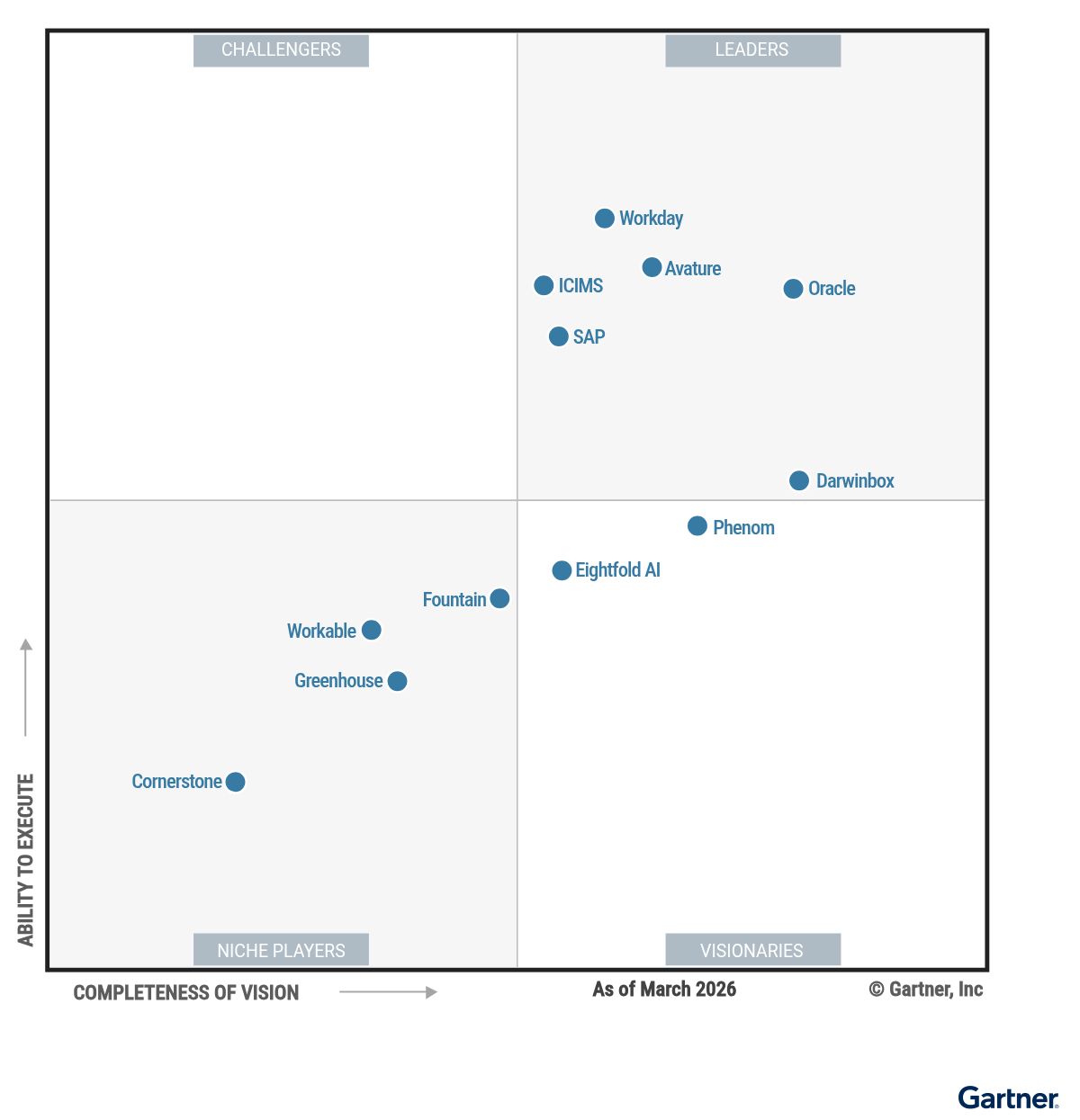
Vendor Strengths and Cautions
Avature
Avature is a Leader in this Magic Quadrant. It is a private talent management company, headquartered in London, that released its first TA offering in 2008. The majority of its talent acquisition suite (TAS) client revenue stems from North America, followed by Europe.
Avature serves clients in an array of verticals. Its top three for TAS are retail, manufacturing and healthcare. Approximately 85% of its TAS revenue comes from clients with more than 10,000 employees.
Its TAS products are Avature ATS and Avature CRM. They are best suited for government and large organizations with a cloud-based HCM core that require extensive configurations to support complex global hiring.
By the end of 2026, Avature plans to enhance its Agent Builder, allowing clients to build and modify their own AI agents. It also plans to add AI Connect, enabling Avature agents to connect with external AI agents to extend capabilities as needed.
- Product: Avature has achieved one of the largest organic, nonacquisition product capability improvements in this research. Through prior platform investments, it has accelerated GA delivery of multiple AI agents, such as sourcing for automating talent rediscovery and an interviewing agent for generating scorecards and recommendations from interview transcripts.
- Operations: Avature’s support model operates 24/7, ensuring reliable service with reinforcement from robust security practices and its FedRAMP authorization. Its fully native, component-based architecture enables extensive configuration, a leading attractor to Avature net new clients based on Gartner client inquiry.
- Product strategy: Avature is pivoting from a create-your-own toolkit approach to include more out-of-the-box agentic AI solutions for accelerated time to value. The 2026 roadmap highlights innovations like Agent Builder and AI Connect, enabling custom orchestration while maintaining flexibility for complex customer needs.
- Features: High autonomy and configurability can be overwhelming, even for recruiting-tech-savvy clients, with customers indicating the platform is sometimes too complex and requires a high learning curve. While Avature Copilot is useful, it is not always intuitive for administrators, according to customer feedback.
- Customer experience: Recurring customer feedback from Gartner inquiries reflects mixed results from enablement tools designed to deliver greater client autonomy. Avature’s service-level agreement (SLA) packages are industry standard, but its focus remains on product metrics rather than client outcomes such as adoption and performance.
- Vertical/industry strategy: While Avature has a strong presence in manufacturing, retail and healthcare, its emphasis on configurability means there are limited prepackaged industry solutions. This suits large enterprises and staffing firms but lacks the Industry Accelerators concept offered by some competitors.
Cornerstone
Cornerstone is a Niche Player in this Magic Quadrant. It is a private HCM company, headquartered in Santa Monica, California, that released its first TA offering in 2012. The majority of Cornerstone’s customers are in North America, followed by EMEA and Asia/Pacific.
Cornerstone serves clients in an array of verticals. Its top three for TAS are manufacturing, retail and engineering. Most sales are made to organizations with between 1,000 and 5,000 employees, although Cornerstone has clients with more than 5,000 employees.
Its TAS product is Cornerstone Elevate. It is best suited for midsize organizations that have less-complex hiring scenarios but want to leverage the vendor’s market-leading learning and development portfolio.
By the end of 2026, Cornerstone plans to add AI agents to its offering. It also plans to enhance its privacy and compliance for external career sites.
- Product: Cornerstone offers a range of standard template options and integrated postemployment capabilities, including its market-leading learning and development offering. This holistic approach enables organizations to manage the entire talent life cycle within a unified platform.
- Geographic strategy: Cornerstone sells its TAS, an integrated part of its broader learning and talent suite, in 180 countries, giving it the largest physical footprint in the market. Its extensive partner network enables local implementation, allowing the company to flexibly scale and adapt to the varying needs of each region.
- Customer experience: Cornerstone’s recruiting analytics provide clear and easy-to-understand metrics that help SMBs track platform usage and adoption without complexity. The inclusion of an idea portal, live customer feedback and user testing gives clients accessible channels to share input and engage with product development.
- Features: Cornerstone’s TAS offers limited flexibility, a dated user interface compared to competitors, modest interview management features, and a virtual assistant mainly focused on navigation. AI skills matching does not fully reflect the acquired SkyHive capabilities, and skills field labeling and nomenclature remain inconsistent.
- Operations: Cornerstone’s tech stack is highly fragmented, due to a long history of loosely integrated acquisitions, which may impact platform consistency and operational reliability. This is further supported by the coexistence of two separate and overlapping TAS recruiting offerings being sold under the Cornerstone Galaxy umbrella.
- Sales strategy: The primary sales approach focuses on cross-selling to its large existing customer base, particularly SMB clients, rather than aggressively pursuing new clients on the merits of its talent acquisition capabilities. Recruiting is positioned as a module within broader talent management deals.
Darwinbox
Darwinbox is a Leader in this Magic Quadrant. It is a private HCM company, headquartered in Hyderabad, India, that released its first TA offering in 2017. The majority of its TAS client revenue comes from the Asia/Pacific region, followed by North America and the Middle East and Africa.
Darwinbox serves clients in an array of verticals. Its top three for TAS are IT, manufacturing and financial services. Approximately 30% of its TAS revenue comes from clients with more than 10,000 employees.
Its TAS product is Darwinbox Recruitment. It is best suited for midsize and large organizations, whether or not they have an existing cloud-based HCM core, as it offers its own HCM and supports stand-alone purchase of Darwinbox Recruitment.
By the end of 2026, it plans to further enhance its depth as a more autonomous, end-to-end recruiter agent. It also plans to release an omnichannel communication hub to support high-volume hiring.
- Product: High configurability and a unified architectural design provide a seamless user experience, with automation and AI tools integrated directly into workflows. Darwinbox’s strong HCM integrations are also evident through its onboarding compliance form management, intuitive preboarding agent and AI-enabled jobs management.
- Innovation: With 40% to 45% of R&D investment dedicated to AI, Darwinbox is advancing its Super Agent architecture for more nimbly orchestrating subagents to meet clients’ varying workflow demands. New features, such as AI-driven semantic search, confidential hiring and the Sapien Design System UI upgrade, further support market-leading innovation.
- Market responsiveness: Darwinbox proactively anticipates and responds to market needs, with year-over-year feature expansion closely aligned to customer and industry demands. This year’s delivered agentic lineup further showcases its ability to interpret and deliver on emerging trends.
- Features: While Darwinbox continues to acquire enterprise customers, these organizations are in the initial phases of their AI adoption journey. According to feedback from Gartner inquiry themes, a relatively small percentage of customers are currently utilizing the platform’s full AI capabilities.
- Operations: Customer feedback indicates performance can lag and become inconsistent with large data volumes. As the company continues its measured expansion beyond Asia/Pacific into North America and Europe, consistent platform support is still being validated.
- Geographic strategy: Despite notable North American growth, Darwinbox’s hyperscale ambitions rely on rapidly scaling sales and support teams — a process that has historically challenged service consistency for many vendors. Its partner-led approach in the U.K. and Western Europe aligns with industry patterns where less direct vendor control has often been observed.
Eightfold AI
Eightfold AI is a Visionary and a new entrant in this Magic Quadrant. It is a private talent intelligence company, headquartered in Santa Clara, California, that released its first TA offering in 2017. The majority of its TAS client revenue stems from North America, followed by Europe.
Eightfold serves clients in an array of verticals. Its top three verticals for TAS are manufacturing, IT and financial services. Approximately 92% of its TAS revenue comes from clients with more than 10,000 employees.
Its TAS products are Talent Acquisition and Talent Tracking. They are best suited for large organizations that prioritize skills intelligence but do not require highly extensive ATS configurations.
By the end of 2026, it plans to further enhance its AI Interviewer agent to include real-time identity verification and advanced fraud detection. It also plans to add a new, autonomous AI scheduling agent.
- Product: Eightfold offers a robust skills-centric talent intelligence foundation along with consistent AI explainability, a market-leading agentic AI Interviewer and unique resume multiapply functionality. The platform also features capabilities across both talent acquisition and posthire talent management, supporting end-to-end workforce needs.
- Customer experience: Eightfold provides world-class support tiers and expert-led workshops that engage C-suite leaders. Based on customer feedback themes, this approach has earned strong customer advocacy and loyalty from its large enterprise client base.
- Innovation: Eightfold’s strategy centers on secure, autonomous execution and ethical AI, supporting responsible innovation at scale. This is supported by its deep track record of market leadership in skills AI, balanced with market-distinguishing enterprise-grade security complements such as ISO 42001 certification and FedRAMP authorization.
- Product: The core ATS component of the TAS is relatively new and lacks some commonly sought ATS features, such as bulk offer management, which is planned for late 2026. Demand is also increasing for the platform to better position its strategic skills-based intelligence strengths for more acute AI-job-impact workforce planning capabilities.
- Vertical/industry strategy: While Eightfold’s platform supports modular deployment for targeted use cases, its client base often seeks transformational, “all-in” outcomes to fully leverage its advanced AI and process automation capabilities. As a result, successful adoption may require significant change management and is often best suited to organizations with higher HR functional maturity, such as large enterprises.
- Sales execution/pricing: High pricing and a focus on large enterprise clients create a barrier to access for smaller organizations and new clients. The company’s historical emphasis on the Global 2000 (positioned to broaden in 2026) has limited its relevance and accessibility for a broader range of market segments.
Fountain
Fountain is a Niche Player and new entrant in this Magic Quadrant. It is a private, frontline-first company, headquartered in San Francisco, California, that released its first TA offering in 2015. The majority of its TAS client revenue stems from North America.
Fountain serves clients with frontline hiring needs. Its top three profiles are outsourced services and business process outsourcing, staffing and workforce providers, and franchise-based operators. Approximately 3% of its TAS revenue comes from clients with more than 10,000 employees.
Its TAS products are Find Faster and Hire Better. They are best suited for midsize and large organizations focused on high-volume hiring and augmenting an existing recruiting solution.
By the end of 2026, it plans to enhance its AI-driven candidate reactivation for likely reengagement like seasonal rehiring. It also plans to upgrade its AI Recruiter copilot to identify hiring risks within the recruiting pipeline.
- Product: Fountain’s platform embeds agentic AI solutions that automate interview management and candidate applications, focusing on high-volume, frontline hiring with selective human involvement. It supports multilocation service brand features, 42 languages and intuitive advanced analytics.
- Innovation: With 51% of full-time employees in R&D, Fountain focuses on AI roadmap execution, releasing Anna AI Recruiter for screening and interviewing, as well as agent-assisted automations and enhancements purpose-built for hiring managers. These drive speed and efficiency, supporting seamless onboarding and rehire processes key to high-volume frontline hiring.
- Sales execution/pricing: Fountain offers flexible pricing models, including per employee per month, per hire and franchise options, catering to diverse high-volume hiring needs and emphasizing rapid time to value. The AI Recruiter agent is priced per interview, providing relative flexibility and affordability for smaller enterprises.
- Features: Fountain’s high-volume specialization limits its features for complex experienced or professional hiring, such as advanced talent sourcing and tracking for talent pools. Clients may need a separate system for these capabilities. Its integration marketplace is also limited, which can restrict connectivity with other HR technologies.
- Operations: Fountain operates on a continuous delivery model rather than versioned releases, accelerating feature time to market but relying on automated testing to catch faulty code. Its ISO 42001 AI certification is still pending, and scaling support beyond core markets is an ongoing consideration.
- Geographic strategy: While the mobile-first, multilanguage approach supports gig and hourly hiring across borders, Fountain’s physical presence is largely in the U.S., and it prioritizes depth in existing markets over regional expansion. This may limit responsiveness to clients with needs in new or emerging regions.
Greenhouse
Greenhouse is a Niche Player in this Magic Quadrant. It is a private TA company, headquartered in New York, that released its first TA offering in 2012. The majority of its TAS client revenue comes from North America, followed by Europe.
Greenhouse serves clients in an array of verticals. Its top three for TAS are IT, financial services and healthcare. Nearly all of its TAS revenue comes from clients with fewer than 10,000 employees.
Its TAS products are Greenhouse Recruiting, Sourcing Automation and Real Talent. It is best suited for midsize and smaller enterprises that have cloud-based HCM cores, hire predominantly in North America and prioritize candidate experience.
By the end of 2026, Greenhouse plans to enhance MyGreenhouse as a means to keep job seekers in the loop with real-time updates. It also plans to upgrade its Dream Job indicator, enabling the system to more effectively identify and highlight candidates who demonstrate particularly high enthusiasm.
- Product: Greenhouse offers capabilities like fraud signal detection, simplified skills scoring and identity verification through CLEAR verification, a biometric ID service. These tools provide practical value for customers seeking straightforward, assistive AI and compliance-focused enhancements, like those in banking and fintech.
- Market responsiveness: Greenhouse quickly responds to the market, delivering high-visibility features that resonate with its core midmarket audience. Its ability to market and launch new tools, like Real Talent, MyGreenhouse and Dream Job, supports continued relevance among high-growth, midmarket tech companies.
- Vertical/industry strategy: Greenhouse is particularly strong in the technology sector, with 38% of its base in this vertical. The extensive Greenhouse marketplace provides a safety net for niche-vertical clients by offering a wide range of integrations and add-ons, enabling them to customize their solution beyond Greenhouse’s native capabilities.
- Features: Compared to leading competitors, Greenhouse lacks what are now standard enterprise-grade AI features, such as conversational AI to engage with candidates, job recommendations, interview summaries/scorecards, and advanced AI agents. Recent updates are primarily assistive AI with less R&D investment than market competitors.
- Operations: Increasing customer comments — reflected in Gartner client inquiry feedback — highlight challenges in scaling service quality such as customer focus, services expertise and page response times. This suggests an inconsistent support framework.
- Geographic strategy: While Greenhouse is extending its selling presence in regions such as Asia/Pacific and Latin America, its geographic footprint remains relatively limited, and its ability to fully meet client needs in these markets is still emerging compared to broader market coverage. This may impact its appeal to global enterprises seeking rapid and extensive international expansion.
ICIMS
ICIMS is a Leader in this Magic Quadrant. It is a private TA company, headquartered in Holmdel, New Jersey, that released its first TA offering in 2000. The majority of its TAS client revenue comes from North-America-based multinational organizations.
ICIMS serves clients in an array of verticals. Its top three for TAS are healthcare, financial services and retail. Approximately 44% of its TAS revenue comes from clients with more than 10,000 employees.
Its TAS products are ICIMS Applicant Tracking, ICIMS Frontline AI, and ICIMS Candidate Experience Management (CXM). They are best suited for midsize and large organizations with a cloud-based HCM core requiring extensive configurability to support multinational hiring needs.
By the end of 2026, it plans to enhance its Frontline AI with deeper ICIMS ATS integration. It also plans to upgrade its interview agent to automate self-scheduling, transcription and feedback summarization.
- Product: ICIMS offers behavior-based sourcing campaigns, strong content management for career sites, integrated virtual chat, video testimonials and a differentiated employer branding solution for recruitment marketing. The platform has undergone a major UX facelift, now featuring a clean, modern interface, while CRM (ICIMS CXM) engagement scores combined with skills match scores help improve candidate conversions.
- Market responsiveness: The acquisition of Apli for high-volume hiring demonstrates ICIMS’ ability to respond to evolving market needs. Recent efforts to simplify contracts and launch turnkey integrations address longstanding time-to-value pain points for customers.
- Market understanding: ICIMS positions its AI as adaptive rather than autonomous, prioritizing transparency and compliance for heavily regulated enterprises. The company’s UX improvements and the Apli acquisition reflect a proactive response to competitive threats from both disruptors and up-market HCM suites.
- Features: ICIMS offers its conversational AI chatbot capability exclusively through the separately packaged Frontline AI solution, which is designed as an experience layer for high-volume and frontline hiring workflows. As a result, this key feature is not available within the core ATS, which may limit access for organizations seeking chatbot functionality for broader recruiting needs.
- Operations: ICIMS’ implementation experience remains longer than the market average, primarily due to the platform’s high level of configurability and the complexity of typical customer requirements. Extended timelines are common when deploying multiple modules or advanced configurations.
- Innovation: ICIMS’ approach to innovation is more reactive than pioneering, relying primarily on acquisitions rather than in-house R&D to keep pace with competitors. Despite offering customers flexibility in how they apply AI, ICIMS still trails other market leaders in delivering advanced agentic AI options.
Oracle
Oracle is a Leader in this Magic Quadrant. It is a public company, headquartered in Austin, Texas, that offers HCM software. Oracle released its first natively developed TA offering in 2018. The majority of its TAS client revenue stems from organizations based in North America, followed by those in Europe and the Middle East.
Oracle serves clients in an array of verticals. Its top three for TAS are government, healthcare and financial services. Approximately 25% of its customers come from clients with more than 10,000 employees.
Its TAS products are Oracle Cloud Recruiting and Recruiting Booster. It is best suited for midsize-to-large organizations that use its core HCM offering and do not require a stand-alone product.
By the end of 2026, Oracle plans to introduce agent-powered, proactive hiring workspaces that surface the next best actions for recruiters and hiring managers. It also plans to expand its available autonomous agents.
- Product: Oracle incorporated an AI Agent Studio, labor market insights and an NLP-powered AI assistant into its platform. Integrations with WhatsApp and Google Calendar are welcome additions based on Gartner client inquiry, along with intelligent offer management that supports dynamic contract clauses to automatically tailor candidate offer details for recruiter efficiency.
- Product strategy: The roadmap emphasizes Proactive Hiring Workspaces, shifting the UI focus from data entry to more intelligent, action-focused decision support. Oracle continues to fully leverage its broader Oracle Cloud ecosystem for rapid scalability.
- Sales execution/pricing: Oracle’s disruptive Zero-Cost Embedded AI strategy bundles AI capabilities that include traditional, generative and agentic AI along with AI Agent Studio and builder platform into its base subscription at no additional cost, undercutting competitors. This validates Oracle’s value for perceived premium pricing, making its offerings more cost-effective.
- Integrations: Oracle’s third-party marketplace for predelivered integrations is highly selective and relatively limited, compared to competitors. This may present challenges for clients seeking to flexibly address deep specialized needs or evolving needs beyond its native features (now including AI Agent Studio).
- Operations: While Oracle Cloud Infrastructure-backed data residency offers scale and support, a slow release cadence and administrative processes (compared to more nimble recruiting specialists) remain a top customer complaint. Adoption of quarterly innovations is driven by customer success resources, but operational agility is constrained by the broader, quarterly HCM release cycles.
- Market understanding: Customer perception often lags behind Oracle’s self-assessed AI maturity, and while the platform is technically open, Oracle does not significantly reduce friction when adding third parties where a predefined partnership does not exist. This can create more reliance on Oracle-delivered features and limit flexibility for organizations that prioritize ease of integration with a broad partner ecosystem.
Phenom
Phenom is a Visionary in this Magic Quadrant. It is a private TA company, headquartered in Ambler, Pennsylvania, that released its first TA offering in 2010. The majority of its TAS client revenue comes from North America, followed by Europe.
Phenom serves clients in an array of verticals. Its top three for TAS are healthcare, manufacturing and retail. Approximately 69% of its TAS revenue comes from clients with more than 10,000 employees.
Its TAS products are Phenom Hire and Phenom Talent CRM. They are best suited for large organizations with an existing cloud-based HCM core that require basic ATS functionality with high-volume hiring capabilities and prioritize advanced CRM capabilities.
By the end of 2026, Phenom plans to introduce Talent Optimization & Work Redesign to connect business objectives to AI-powered workforce planning recommendations. It also plans to add a conversational analytics experience.
- Product: Phenom’s platform highlights strong candidate screening and interview intelligence agents, as well as a highly regarded user experience. It excels in industry-specific skill ontologies, workflow recommendations, and AI-powered external sourcing and content generation.
- Innovation: Phenom invests 40% of R&D in AI, launching over 25 specialized agentic use cases including Fraud Detection, Voice Screening, Candidate Concierge and Sourcing Agents. The platform’s audit score reporting and legal defensibility features bolster confidence in its AI-driven approach.
- Market responsiveness: The introduction of the Value Acceleration Model (VAM) and AI Bootcamps have significantly reduced implementation timelines, addressing a key pain point for customers. The X+ suite and agent builder capabilities demonstrate Phenom’s commitment to rapid adaptation and evolving customer needs.
- Platform maturity: While Phenom’s ATS functionality has improved with features like multiple concurrent workflows and offer management, it remains relatively new. Integrations are still a challenge, as highlighted by Gartner customer inquiry feedback, which also notes a recurring theme of advanced features that initially lack depth and feel underdeveloped.
- Customer experience: Despite a focus on outcomes and value, Phenom’s rapid growth and big logo wins have strained support resources, leading to ongoing concerns about the consistency of the customer experience. Although customer feedback channels are robust, many users feel their issues, particularly around integration support responsiveness and product maturity, have not yet been fully addressed.
- Product strategy: Phenom’s expansion into applied AI infrastructure and the rollout of its Unified Orchestration Engine reflect a strategy focused on broadening its portfolio to enable more cross-sell opportunities. Yet, Phenom has temporarily shifted focus away from the depth of its core recruiting CRM, as shown by customer inquiries calling for greater CRM personalization and product refinement (2026 roadmap).
SAP
SAP is a Leader in this Magic Quadrant. It is a public company, headquartered in Walldorf, Germany. In September 2025, it acquired SmartRecruiters, a leader in this Magic Quadrant last year. The majority of its TAS client revenue comes from North America and is balanced with representation across all regions.
The combined entity’s client base serves an array of verticals. Its top three for TAS are healthcare, retail and financial services. Gartner estimates about half of SmartRecruiters’ customer base has over 10,000 employees.
The new TAS product is SmartRecruiters for SAP SuccessFactors, and is also available as a stand-alone product. SAP is no longer selling net new licenses for SAP SuccessFactors Recruiting, its original product, and will only provide regulatory support going forward. SmartRecruiters will be the only recruiting solution for new clients and is best suited for midsize to large and public-sector organizations with complex global hiring requirements that use SAP’s SuccessFactors for HCM solutions. Current users of SAP SuccessFactors Recruiting should consider SmartRecruiters and other alternatives in the future.
By the end of 2026, it plans to further enhance its AI-powered native integration capabilities for SAP SuccessFactors clients adopting SmartRecruiters. It also plans to add an agent-driven CRM.
- Product: SAP’s integration of SmartRecruiters brings Winston AI chat, skills matching explainability and advanced analytics capabilities into a modern drag-and-drop UI. Strong rule-based composable hiring workflows provide the flexibility to construct unique hiring journeys and hiring personas.
- Market responsiveness: The SmartRecruiters acquisition shows SAP’s commitment to responding to the market and expanding its recruiting capabilities, reinforced by its simplified pricing and packaging. It is prioritizing agent orchestration and seamless integration to address evolving customer demand for greater recruiting productivity.
- Geographic strategy: SAP has offices in 78 countries, support for over 40 languages, and a network of 25,000 partners, giving it one of the most extensive physical support networks in the market. The acquisition strengthens its presence and sales reach in Europe and North America.
- Features: Winston AI streamlines screening, matching, feedback capture, and actionable insights for hiring teams, but lacks some advanced agentic workflow features found in competing solutions. It also does not currently offer candidate fraud detection, which is planned for 2026.
- Operations: Migration and integration of SmartRecruiters will demand considerable focus from SAP’s development and support teams, though a one-click, agentic integration is being developed to ease this process. While SAP SuccessFactors is FedRAMP authorized, SmartRecruiters is not — a gap for clients with government needs, but not for clients in other industries.
- Innovation: As SAP balances migration and innovation, delivery on competitive roadmap commitments is outstanding. Restricted workflow orchestration (Joule and Winston integrate in 2026), limited advanced AI agents and a self-assessed Level 1 AI transparency rating may pose competitive challenges compared to other Leaders.
Workable
Workable is a Niche Player and new entrant in this Magic Quadrant. It is a private HCM company, headquartered in Boston, Massachusetts, that released its first TA offering in 2012. The majority of its TAS client revenue stems from North America, followed by Europe.
Workable serves clients in an array of verticals. Its top three for TAS are IT, manufacturing and healthcare. Approximately 5% of its TAS revenue comes from clients with more than 10,000 employees.
Its TAS product is Workable Recruiting. It is best suited for small and midsize businesses that may require a cloud-based HCM core, hire across geographic regions, and prioritize enterprise-grade recruiting capabilities balanced with ease of setup and use.
By the end of 2026, Workable plans to enhance its conversational analytics and reporting experience. It also plans to launch a new AI recruiting agent that expands its existing AI capabilities across sourcing, candidate evaluation and recruiter workflows.
- Product: Workable delivers scalable SMB capabilities, with intuitive UX, robust job board integrations, and a comprehensive API/data integration marketplace. It has embedded salary estimators, out-of-the-box assessment and interview tools, Dropbox Sign for offers, strong onboarding, and full iOS/Android apps for consumer-grade usability.
- Sales execution/pricing: Workable’s transparent pricing based on headcount and absence of large implementation fees make it highly attractive for SMBs seeking speed and simplicity. Optimized for rapid deployment, it enables organizations to get started quickly without a heavy investment.
- Vertical/industry strategy: Workable is dominant in IT and manufacturing midmarket segments and has a strong reputation for plug-and-play ease in SMBs across nonregulated industries. Its marketplace and alliance strategy provides vertical-specific features without requiring deep product customization.
- Features: Embedded career site features are light, remaining static rather than dynamic, and its natural language question AI functions act more as search and filter than market-leading AI. It lacks AI-based job recommendation filters, provides limited interview self-scheduling capabilities, and may struggle with high complexity or distributed hiring scenarios.
- Operations: Workable manages 80% of implementations directly and efficiently, optimizing support and operations for SMBs with standard customer services and limited options for extensive handholding. Continuous delivery may be challenging for clients who require more structured release management.
- Sales strategy: Workable’s sales investment is low compared to competitors, and its shift to targeted account-based selling for larger prospects is still in early stages. With single-digit percent revenue growth, retaining customers against more aggressive upmarket competitors may be difficult.
Workday
Workday is a Leader in this Magic Quadrant. It is a public company, headquartered in Pleasanton, California, that released its first TA offering in 2014. It acquired HiredScore in 2024 and Paradox in September 2025. Both were considered part of Workday for this Magic Quadrant. The majority of its TAS client revenue comes from North America, followed by EMEA and Asia/Pacific.
Workday serves clients in an array of verticals. Its top three for TAS are retail, healthcare and financial services. Approximately 38% of its customers come from clients with 1,000 to 5,000 employees.
Its TAS products are Workday Candidate Engagement and Workday Recruiting, which are not available stand-alone. They are best suited for midsize-to-large organizations that emphasize AI matching, chat tools and Workday HCM.
By the end of 2026, Workday plans to enhance screening with a conversational AI interface for filtering and bulk actions. It also plans to add Paradox features like CRM Events and AI-powered Interview Scheduling.
- Product: Workday offers Paradox and HiredScore capabilities and distinct agents for candidate experience, recruiter and hiring manager tasks, multimodal self-service, and talent mobility. It includes offer management with bulk processing and touchless offer rules, AI interview feedback summaries, trend analytics, drag-and-drop dashboards and integration partners via Workday Build.
- Customer experience: Workday provides premium support through its Accelerated Plus plan, active user communities and the First Success metric for new hires filling skills gaps. Client satisfaction is notable, with strong Gartner Peer Insights ratings.
- Vertical/industry strategy: Workday is strong in financial services and offers industry accelerators for healthcare and banking through partners. The Paradox acquisition shows commitment to greater verticalization capacity, particularly industries where frontline and hourly hiring present recruiting function and business productivity gains.
- Features: Without adding Paradox features, Workday’s candidate experience and high-volume handling is limited, and without HiredScore, AI-enabled skills inference and matching are relatively weak. Both add-ons are essential, but are distinct SKUs that are cost- and time-intensive.
- Innovation: Workday’s recent innovation has been largely inorganic, relying on acquisitions that introduce integration risks and add to a fragmented suite. Foundation recruiting lacks agents, and features like social login, job requisition agent skill and GenAI interview feedback are incremental, not transformative.
- Sales Execution/pricing: Workday uses a headcount model that counts fractional workers pro-rata, includes flex credits for AI, and applies a standard innovation fee, contributing to a high total cost of ownership. Accessing advanced recruiting capabilities requires purchasing Workday Recruiting, Workday Candidate Engagement, Paradox, and HiredScore.
Vendors Added
We review and adjust our inclusion criteria for Magic Quadrants as markets change. As a result of these adjustments, the mix of vendors in any Magic Quadrant may change over time. A vendor's appearance in a Magic Quadrant one year and not the next does not necessarily indicate that we have changed our opinion of that vendor. It may be a reflection of a change in the market and, therefore, changed evaluation criteria, or of a change of focus by that vendor.
- Eightfold AI, Fountain and Workable were added to this research because they met the qualifying inclusion criteria.
- SAP and SmartRecruiters were evaluated as separate vendors in the previous version of this report. Following SAP’s acquisition of SmartRecruiters in September 2025, they are now evaluated as a single entity: SAP (SmartRecruiters).
Inclusion and Exclusion Criteria
To be included in this Magic Quadrant research, each vendor needed to:
- Deliver generally available (GA) product capabilities that meet all the Market Definition criteria for Mandatory Features, without the use of third-party providers/partner marketplace. Mandatory Features must have been GA to the customer base/new customers no less than one year prior to 1 November 2025.
- For each of the following, customer counts must come from organizations with 1,000 employees or more that are actively using GA products, meeting the Market Definition:
- Provider must have greater than 150 paying customers (unique logos).
- Provider must have greater than 25 paying customers in more than one geographic region (NA, LATAM, APAC, EMEA).
- Provider must have at least 25 net new customers greater than total customers lost in the time period 1 November 2024 to 1 November 2025.
In addition, the vendor is required to meet one of the following:
- Meet the Market Definition criteria for Cloud HCM Suites for more than 1,000-employee enterprises.
- Gartner client relevance, as determined by analyst expertise and guided by public and proprietary information.
Honorable Mentions
Gartner tracks more than 40 vendors in the TAS space. Although this research identifies 12 vendors that have met our inclusion criteria, the exclusion of a vendor does not mean that the vendor and its products lack viability. Described below are several noteworthy vendors that did not meet all of our inclusion criteria. However, they could be appropriate for clients, contingent on requirements.
Ashby is becoming increasingly well-known for its ATS/CRM capabilities. Ashby was not included in this research because it did not meet the qualifying criteria for number of customers using its ATS and geographic representation.
Employ has two established TAS brands in its portfolio that are well-known to both SMBs and larger organizations: Lever and Jobvite. Both offerings were not included in this research because they did not meet the qualifying criteria for net new customer counts and geographic representation.
Gem is well-known for its CRM capabilities and has recently added AI-powered sourcing, scheduling and ATS capabilities. Gem was not included in this research because it did not meet the qualifying criteria due to low relevance to Gartner clients, as determined by analyst expertise and guided by public and proprietary information.
Evaluation Criteria
Ability to Execute
Gartner analysts evaluate providers on the quality and efficacy of the processes, systems, methods or procedures that enable IT provider performance to be competitive, efficient and effective, and to positively impact revenue and retention in Gartner’s view of the market.
In this Magic Quadrant, product or service, market responsiveness and track record, customer experience and operations criteria are particularly important.
Product or service: Core goods and services that compete in and/or serve the defined market. This includes current product and service capabilities, quality, feature sets, skills, etc. This can be offered natively or through third-party partnerships, as defined in the Market Definition and detailed in the subcriteria.
Market responsiveness and track record: Ability to respond, change direction, be flexible and achieve competitive success as opportunities develop, competitors act, customer needs evolve and market dynamics change. This criterion also considers the provider’s history of responsiveness to changing market demands.
Customer experience: Products and services and/or programs that enable customers to achieve anticipated results with the products evaluated. Specifically, this includes quality supplier/buyer interactions, technical support or account support. This may also include ancillary tools, customer support programs, availability of user groups and SLAs.
Operations: The ability of the organization to meet goals and commitments. Factors include quality of the organizational structure, skills, experiences, programs, systems and other vehicles that enable the organization to operate effectively and efficiently.
This year, operations was raised to a High weighting to reflect higher differentiation among vendors. Conversely, sales execution/pricing was lowered to Medium due to diminishing differentiation among vendors. Overall viability and marketing execution were decreased to Low, also due to less differentiation among vendors.
Ability to Execute Evaluation Criteria
| Evaluation Criteria | Weighting |
|---|---|
Product or Service | High |
Overall Viability | Low |
Sales Execution/Pricing | Medium |
Market Responsiveness/Record | High |
Marketing Execution | Low |
Customer Experience | High |
Operations | High |
Source: Gartner (May 2026)
Completeness of Vision
Gartner analysts evaluate providers on their ability to convincingly articulate logical statements. This includes current and future market direction, innovation, customer needs and competitive forces, as well as how well they map to Gartner’s view of the market.
In this Magic Quadrant, market understanding, offering (product) strategy and innovation criteria are particularly important:
Market understanding: Ability to understand customer needs and translate them into products and services. Vendors that show a clear vision of their market — that listen, understand customer demands and can shape or enhance market changes with their added vision.
Offering (product) strategy: An approach to product development and delivery that emphasizes market differentiation, functionality, methodology and features as they map to current and future requirements.
Innovation: Direct, related, complementary and synergistic layouts of resources, expertise or capital for investment, consolidation, or defensive or preemptive purposes.
This year, geographic strategy was lowered to a Medium weighting due to decreased differentiation among vendors. Sales strategy and vertical/industry strategy are also weighted Medium. Marketing strategy was decreased to Low, due to lower differentiation among vendors in these areas. Business model is also weighted Low.
Completeness of Vision Evaluation Criteria
| Evaluation Criteria | Weighting |
|---|---|
Market Understanding | High |
Marketing Strategy | Low |
Sales Strategy | Medium |
Offering (Product) Strategy | High |
Business Model | Low |
Vertical/Industry Strategy | Medium |
Innovation | High |
Geographic Strategy | Medium |
Source: Gartner (May 2026)
Quadrant Descriptions
Leaders
Leaders in this market have a strong capability set and strategic investment vision that addresses complex, multinational hiring needs across the four key use cases. They are well-aligned with the market shift toward autonomous AI agents and platform consolidation, and they are ahead of their peers in deploying agentic workflow use cases at scale.
Leaders’ innovation pace surpasses other vendors. However, Leaders are not always the best choice. A smaller, more focused vendor might offer superior support and commitment for specific needs.
Leaders shape the direction of the market by extending their offering coverage further along the hiring and talent pipeline, developing new class-leading automation, semiautonomous and autonomous capabilities and platform extensibility models, and deploying them at scale.
Challengers
Challengers are strong in execution, but narrower than Leaders in their vision for taking market leadership. With a strong legacy presence, they focus more on established products, services and geographies and are typically followers of the market innovations created by Leaders and Visionaries.
Challengers in this market have the operational capability to meet some complex hiring scenarios. However, gaps may be evident in the critical capabilities, whether in depth of product capabilities or keeping pace with new paradigms like agentic AI.
Visionaries
Visionaries have market-leading plans for the future, often pioneering new approaches to autonomous or semiautonomous recruiting and agentic orchestration. They demonstrate a strong understanding of emerging trends, such as the need for AI to handle end-to-end workflows rather than just isolated tasks. However, their current capabilities are not class-leading in terms of scope and/or quality.
Visionaries in this market demonstrate a strong understanding and strategic approach to delivering their solutions to a more narrow range of customer needs.
Niche Players
Niche Players focus on a particular segment of the market, such as high-volume or frontline hiring, specific verticals, such as serving SMBs versus large enterprises, or geographic regions. They may offer superior capabilities for these specific use cases — often outperforming Leaders in areas like rapid deployment for hourly workers or specialized candidate engagement. However, they lack the comprehensive suite capabilities to address the broad, complex needs of large global enterprises or the vision to drive the market’s shift toward consolidated, autonomous platforms.
A Niche Player is often the best choice for organizations with focused requirements that align with the vendor’s specific strengths.
Context
This Magic Quadrant provides a snapshot of the current TAS market, and year-over-year comparisons should be avoided. It is designed to assist you in selecting a TAS, but it should not be used as your sole resource. Use the companion Critical Capabilities for TAS to help identify how products compare against functional categories and how well they align with use cases.
Your final selection criteria must reflect your organization’s functional and technical requirements, as well as its business objectives. Do not, for example, select a Leader or reject a Niche Player solely based on such a categorization. Assess any vendor that meets your “must have” requirements — a vendor in any of the four quadrants could be the best choice for your needs.
Market Overview
The talent acquisition suite (TAS) market has experienced rapid and significant transformation over the past year, driven primarily by accelerated adoption of AI and increasingly autonomous agents.
Historically, recruiting technology focused on workflow automation and recruiter productivity. AI has expanded that aperture, becoming central to product design, with generative AI (GenAI) assistants and conversational agents now standard features. The next frontier is the adoption of semiautonomous and autonomous agentic workflows. Organizations are seeking greater efficiency, faster time-to-fill and improved candidate experience — especially in high-volume hiring.
Competitive Dynamics
The Magic Quadrant reflects a highly active market.
The Magic Quadrant reflects a highly active market.
Legacy players that previously occupied the Challengers quadrant have been forced to improve rapidly, often through acquisition. These acquisitions successfully shift legacy players into the Leaders quadrant, and leaves the Challengers quadrant empty. The Niche Players quadrant is more segmented, living up to its name, with new entrants focusing on small and midsize businesses (SMBs) and frontline-dominant organizations. In the Visionaries quadrant, vendors leverage AI-native platforms and embedded talent intelligence to accelerate ATS maturity.
The Leaders quadrant is increasingly crowded. No clear leader has emerged, and even stable placements require heavy investment to maintain market standing.
Vendor Landscape and Consolidation
As AI becomes ubiquitous, the market is consolidating. By 2027, nearly all vendors are expected to have integrated AI, and Gartner predicts continued market consolidation due to the expansion of core HCM suites offering comprehensive recruitment functionality (see Tool: Talent Acquisition (Recruiting) Technology Vendor Market Catalog).
As AI becomes ubiquitous, the market is consolidating. By 2027, nearly all vendors are expected to have integrated AI, and Gartner predicts continued market consolidation due to the expansion of core HCM suites offering comprehensive recruitment functionality (see Tool: Talent Acquisition (Recruiting) Technology Vendor Market Catalog).
This consolidation challenges status quo assumptions about whether HCM suites provide enough depth for recruitment, prompting buyers to weigh their own priorities and willing trade-offs when evaluating augmenting their HCM modules against investing in stand-alone TAS platforms.
Key Market Trends
AI innovation is a major differentiator, with vendors embedding AI across job match recommendations, conversational AI with candidates and interview summaries/scorecard.
AI innovation is a major differentiator, with vendors embedding AI across job match recommendations, conversational AI with candidates and interview summaries/scorecard.
Buyers increasingly value platforms that combine a rich applicant tracking system (ATS), candidate relationship management (CRM) and support last-mile customization via APIs and low-code tools. With CEOs and CHROs now placing heightened pressure on their teams to deliver AI-driven efficiency gains, particularly in recruiting, organizations are seeking solutions that provide measurable business value, such as productivity gains and improved candidate experience. Compliance and responsible AI practices are additional top priorities, especially for regulated and global organizations.
Adoption Patterns and Inhibitors
Adoption of AI varies widely, with inhibitors including uneven AI maturity, unclear pricing, gaps in assessment or onboarding, and stricter regulations. Delivery models differ, with some vendors offering direct implementation and others relying on partners, impacting speed and local support. Buyers favor vendors that enable faster time to value and offer transparent service tiers.
Adoption of AI varies widely, with inhibitors including uneven AI maturity, unclear pricing, gaps in assessment or onboarding, and stricter regulations. Delivery models differ, with some vendors offering direct implementation and others relying on partners, impacting speed and local support. Buyers favor vendors that enable faster time to value and offer transparent service tiers.
Implications for Buyers
TAS buyers are shifting away from primarily relying on traditional automation and recruiter-driven workflows, emphasizing AI-driven and selective semiautonomous agent capabilities. Evaluation criteria now prioritize the depth of AI functionality, measurable improvements in efficiency and candidate experience, flexibility and scalability and responsible AI governance.
TAS buyers are shifting away from primarily relying on traditional automation and recruiter-driven workflows, emphasizing AI-driven and selective semiautonomous agent capabilities. Evaluation criteria now prioritize the depth of AI functionality, measurable improvements in efficiency and candidate experience, flexibility and scalability and responsible AI governance.
Summary
TASs are evolving from modular point solutions to intelligent, integrated platforms where AI, integration breadth and operational outcomes drive buyer decisions. Vendors that combine AI-led efficiency gains with strong integration ecosystems, clear compliance postures and customer-centric deployment models are emerging as market leaders. Market share will increasingly reflect how well vendors deliver predictable business impact for enterprise and high-volume hiring needs.
TASs are evolving from modular point solutions to intelligent, integrated platforms where AI, integration breadth and operational outcomes drive buyer decisions. Vendors that combine AI-led efficiency gains with strong integration ecosystems, clear compliance postures and customer-centric deployment models are emerging as market leaders. Market share will increasingly reflect how well vendors deliver predictable business impact for enterprise and high-volume hiring needs.
Note 1: Mergers and Acquisitions
Recent M&A activity in this space includes:
- Cornerstone acquired Talespin’s extended reality capabilities and a team of domain experts in March 2024, and SkyHive’s workforce skills intelligence capabilities and a team of domain experts in May 2024.
- ICIMS acquired Apli, an AI-powered recruitment automation innovator focused on improving frontline hiring, in September 2025.
- Phenom acquired Tydy, an onboarding platform in July 2024. It acquired EDGE, focused on workforce intelligence, resource planning and talent mobility in February 2025. It acquired Included, focused on agentic people analytics and workforce insights, in January 2026.
- SAP acquired WalkMe, a digital adoption platform providing contextual in-app guidance and automation for workflow improvement, in September 2024, as well as SmartRecruiters, a leading talent acquisition software provider, in September 2025.
- Workday acquired HiredScore, an AI-enabled talent orchestration solution, in March 2024, and Paradox, an AI-powered talent acquisition suite, in October 2025.
Ability to Execute
Product/Service: Core goods and services offered by the vendor for the defined market. This includes current product/service capabilities, quality, feature sets, skills and so on, whether offered natively or through OEM agreements/partnerships as defined in the market definition and detailed in the subcriteria.
Overall Viability: Viability includes an assessment of the overall organization's financial health, the financial and practical success of the business unit, and the likelihood that the individual business unit will continue investing in the product, will continue offering the product and will advance the state of the art within the organization's portfolio of products.
Sales Execution/Pricing: The vendor's capabilities in all presales activities and the structure that supports them. This includes deal management, pricing and negotiation, presales support, and the overall effectiveness of the sales channel.
Market Responsiveness/Record: Ability to respond, change direction, be flexible and achieve competitive success as opportunities develop, competitors act, customer needs evolve and market dynamics change. This criterion also considers the vendor's history of responsiveness.
Marketing Execution: The clarity, quality, creativity and efficacy of programs designed to deliver the organization's message to influence the market, promote the brand and business, increase awareness of the products, and establish a positive identification with the product/brand and organization in the minds of buyers. This "mind share" can be driven by a combination of publicity, promotional initiatives, thought leadership, word of mouth and sales activities.
Customer Experience: Relationships, products and services/programs that enable clients to be successful with the products evaluated. Specifically, this includes the ways customers receive technical support or account support. This can also include ancillary tools, customer support programs (and the quality thereof), availability of user groups, service-level agreements and so on.
Operations: The ability of the organization to meet its goals and commitments. Factors include the quality of the organizational structure, including skills, experiences, programs, systems and other vehicles that enable the organization to operate effectively and efficiently on an ongoing basis.
Completeness of Vision
Market Understanding: Ability of the vendor to understand buyers' wants and needs and to translate those into products and services. Vendors that show the highest degree of vision listen to and understand buyers' wants and needs, and can shape or enhance those with their added vision.
Marketing Strategy: A clear, differentiated set of messages consistently communicated throughout the organization and externalized through the website, advertising, customer programs and positioning statements.
Sales Strategy: The strategy for selling products that uses the appropriate network of direct and indirect sales, marketing, service, and communication affiliates that extend the scope and depth of market reach, skills, expertise, technologies, services and the customer base.
Offering (Product) Strategy: The vendor's approach to product development and delivery that emphasizes differentiation, functionality, methodology and feature sets as they map to current and future requirements.
Business Model: The soundness and logic of the vendor's underlying business proposition.
Vertical/Industry Strategy: The vendor's strategy to direct resources, skills and offerings to meet the specific needs of individual market segments, including vertical markets.
Innovation: Direct, related, complementary and synergistic layouts of resources, expertise or capital for investment, consolidation, defensive or pre-emptive purposes.
Geographic Strategy: The vendor's strategy to direct resources, skills and offerings to meet the specific needs of geographies outside the "home" or native geography, either directly or through partners, channels and subsidiaries as appropriate for that geography and market.