Innovation Insight: Penetration Testing as a Service
3 October 2025 - ID G00825820 - 15 min read
By Mitchell Schneider, Dhivya Poole, and 3 more
PTaaS delivers continuous, scalable security testing via a combination of automation and human expertise and is available through on-demand and subscription models. Security and risk management leaders should evaluate PTaaS as a potential alternative or complement to traditional penetration testing, particularly for organizations pursuing CTEM.
Overview
Key Findings
- Traditional penetration testing models, along with the associated procurement and contractual processes, are too slow and infrequent to keep pace with today’s dynamic threat landscape.
- Penetration Testing as a service (PTaaS) enables more frequent, scalable and automated testing, helping organizations reduce exposure windows and accelerate remediation.
- PTaaS is increasingly adopted to support continuous threat exposure management (CTEM) programs, offering dynamic scoping and real-time collaboration across the teams involved.
- Leading PTaaS providers are expanding their offerings to include external attack surface management (EASM) and red teaming, consolidating exposure management capabilities.
Recommendations
Security and risk management leaders responsible for security operations must:
- Define your testing objectives and risk tolerance, then determine where PTaaS fits — whether as a primary testing strategy or to supplement traditional engagements for specialized needs.
- Use PTaaS to operationalize continuous exposure discovery, especially for internet-facing assets. Where deeper insight is needed, integrate red teaming and automated validation tools into your testing cadence to uncover valid attack paths and exploitable vulnerabilities in high-risk and/or complex areas.
- Evaluate PTaaS providers based on their ability to scale delivery, automate workflows, and integrate with your DevSecOps processes. Ask how they translate efficiency gains into improved reporting, faster remediation cycles and more immediately actionable findings.
- Consolidate exposure management functions by selecting PTaaS providers that offer EASM and adversarial exposure validation (e.g., breach and attack simulation) services as part of a unified CTEM strategy.
Strategic Planning Assumptions
By 2029, organizations adopting PTaaS will perform penetration testing up to five times more frequently than those relying solely on traditional methods.
By 2028, remediation cycles will be twice as fast in organizations using PTaaS compared to those dependent on manual testing approaches.
Introduction
Traditional penetration testing is typically delivered as a scoped, project-based engagement — often expensive, infrequent, slow to mobilize and followed by delayed or inconsistent remediation. In today’s fast-paced environment, where assets and exposures change rapidly, this low-frequency, high-scope model struggles to keep up. Organizations attempting to increase testing cadence often face cost bloat and operational friction.
Without more scalable and responsive approaches like PTaaS, security leaders risk falling behind adversaries, missing critical exposures, and failing to meet evolving business and regulatory demands.
According to the 2024 Gartner Designing and Building Modern Security Operations Survey, 43% of more mature security operations centers (SOCs) have a dedicated internal penetration testing analyst (typically compliance-driven), compared to just 24% of less mature SOCs. Mature SOCs are characterized by higher levels of process formalization, automation, and integration with broader security and IT operations. These organizations are more likely to invest in specialized roles that support both traditional and alternative testing approaches — including PTaaS — and are better positioned to integrate these services into broader exposure management strategies. While the data does not imply that less mature SOCs won’t benefit from PTaaS, it does suggest that PTaaS adoption may correlate with operational maturity and readiness to scale testing efforts.
PTaaS enhances traditional penetration testing by combining automation with human expertise, delivered through a SaaS platform. It supports both point-in-time and continuous testing, enabling faster discovery, real-time collaboration and more actionable results. While PTaaS can complement or, in some cases, replace certain types of testing (e.g., external infrastructure and web application), it is best integrated into a broader strategy that includes traditional testing to ensure compliance and depth.
Most PTaaS offerings are subscription-based, enabling monthly, weekly or change-based/real-time testing. Providers may use internal teams or crowdsourced testers (see Figure 1), supported by automation and standardized methodologies to ensure consistency and scalability. Increasingly, PTaaS platforms also integrate with DevSecOps workflows and offer adjacent capabilities such as EASM and automated validation — positioning PTaaS as a key supporting service across multiple phases of CTEM, with validation as the primary focus.
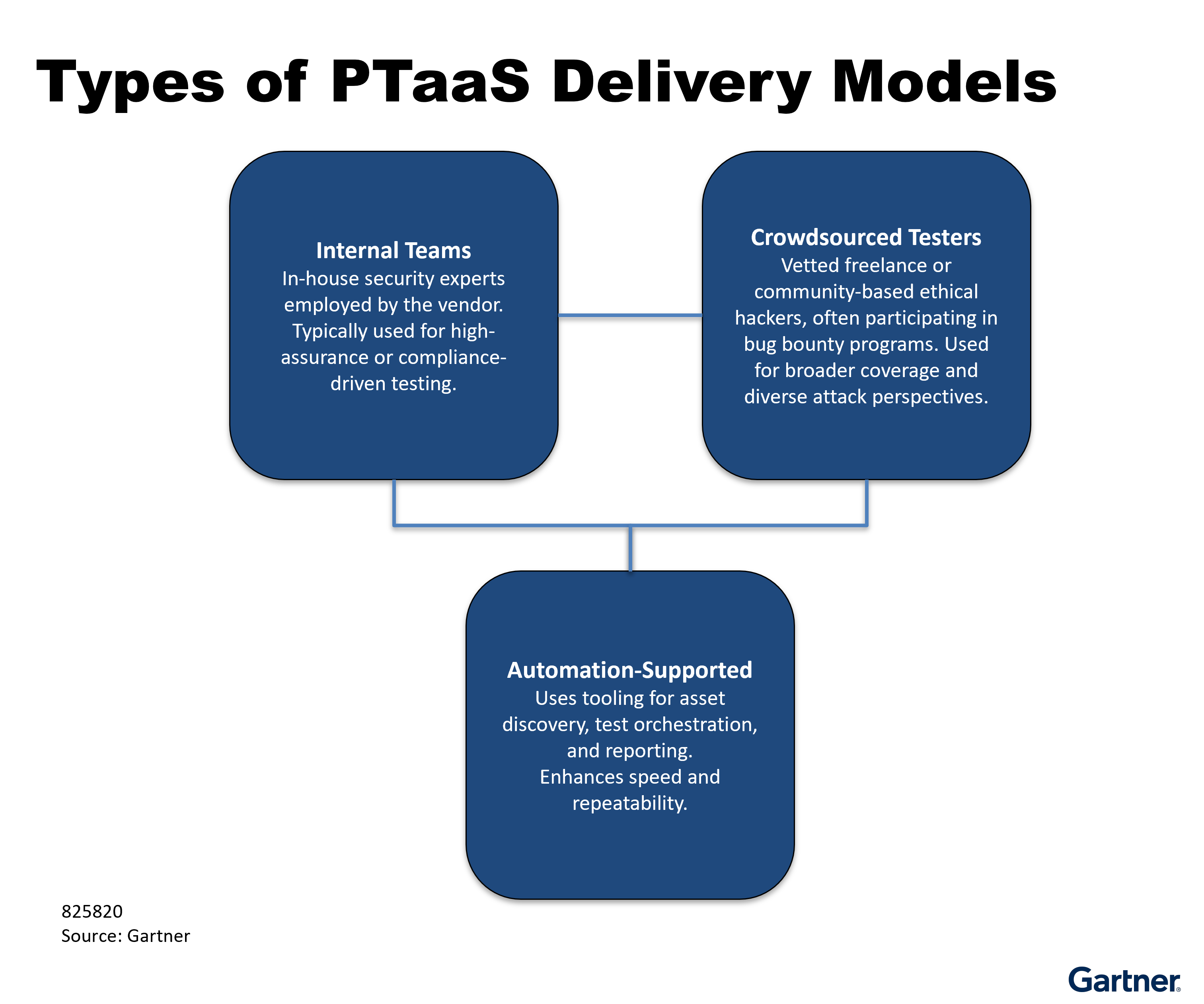
PTaaS delivers faster, more actionable insights into threats and exposures by continuously mobilizing testing capabilities, helping organizations extend the reach and responsiveness of their overall penetration testing strategy. For a side-by-side comparison of traditional and PTaaS models, see Table 1.
Overview of Traditional Penetration Testing and PTaaS Models
Traditional Penetration Testing (Pentesting) | Penetration Testing as a Service | |
Scoping | Custom requirements gathering, SOW delivery for quoting, project-based pricing — takes weeks to quote. | Packaged offerings, standardized quoting, subscription-based pricing — takes days to quote. Typically broader asset coverage than traditional testing, with scope and priorities adjustable midtesting based on client feedback. |
Delivery | Manual and tool-assisted testing, often on-site and/or remote. | Automation-first delivery via SaaS platform, with human validation — fully remote, enabling scalability. |
Frequency | Typically annual or ad hoc; driven by compliance cycles or major changes in infrastructure. Limited agility to respond to emerging threats or business needs. | Continuous or on-demand testing; aligned with agile development cycles, DevSecOps practices, and evolving threat landscapes. Enables proactive exposure management. |
Additional Services Offered | On-site testing (e.g., social engineering or wireless security), highly customized testing such as supply chain access or application testing, and other red-team custom mandates. | Device and discovery services, vulnerability assessment, external attack surface management, and adversarial exposure validation (AEV) (e.g., BAS), all delivered as a managed service. |
Integrations | Limited direct integration into system or application workflows. Collaboration is typically structured around predefined milestones rather than continuous engagement. Strong alignment with external standards and compliance requirements, including tailored reporting. | Native integration into security and development tools and workflows (such as continuous integration/continuous deployment [CI/CD] and IT service management [ITSM]), and offers real-time collaboration with pentesters, development teams, and other business units. |
Reporting | The findings report is typically delivered via a standard document, such as a static PDF. Findings are typically delivered as a single report at the end of the engagement, often in a static format such as a PDF. | The findings report is delivered via a client web portal. This can provide real-time views into ongoing testing. |
Pricing | Project-based pricing requires an SOW for each engagement. Pricing is based on requirements and scope. | Subscription-based pricing, monthly billing based on the size of the customer environment, and on the number of testing packages purchased. |
Source: Gartner (October 2025)
Description
Definition: Penetration Testing as a Service (PTaaS)
PTaaS provides technology-led, point-in-time and continuous application and infrastructure testing aligned with penetration testing (pentesting) standards, which have traditionally relied heavily on human pentesters using commercial/proprietary tools. The service is delivered via a SaaS platform, leveraging a hybrid approach of automation and human pentesters (crowdsourced or vendors’ in-house team) to increase the efficiency and effectiveness of the results.
PTaaS is designed for rapid execution without the overhead of complex scopes of work. Many providers offer flexible service tiers that support faster scheduling, targeted objectives, and integration with DevSecOps pipelines and ticketing systems. These integrations allow for real-time collaboration, automated workflow orchestration and continuous tracking of remediation progress (see Figure 2). The funnel model reflects how PTaaS providers blend automated and high-touch services across asset discovery and enumeration, validation and prioritization workflows — though the specific subservices and their depth continue to evolve as the market matures.
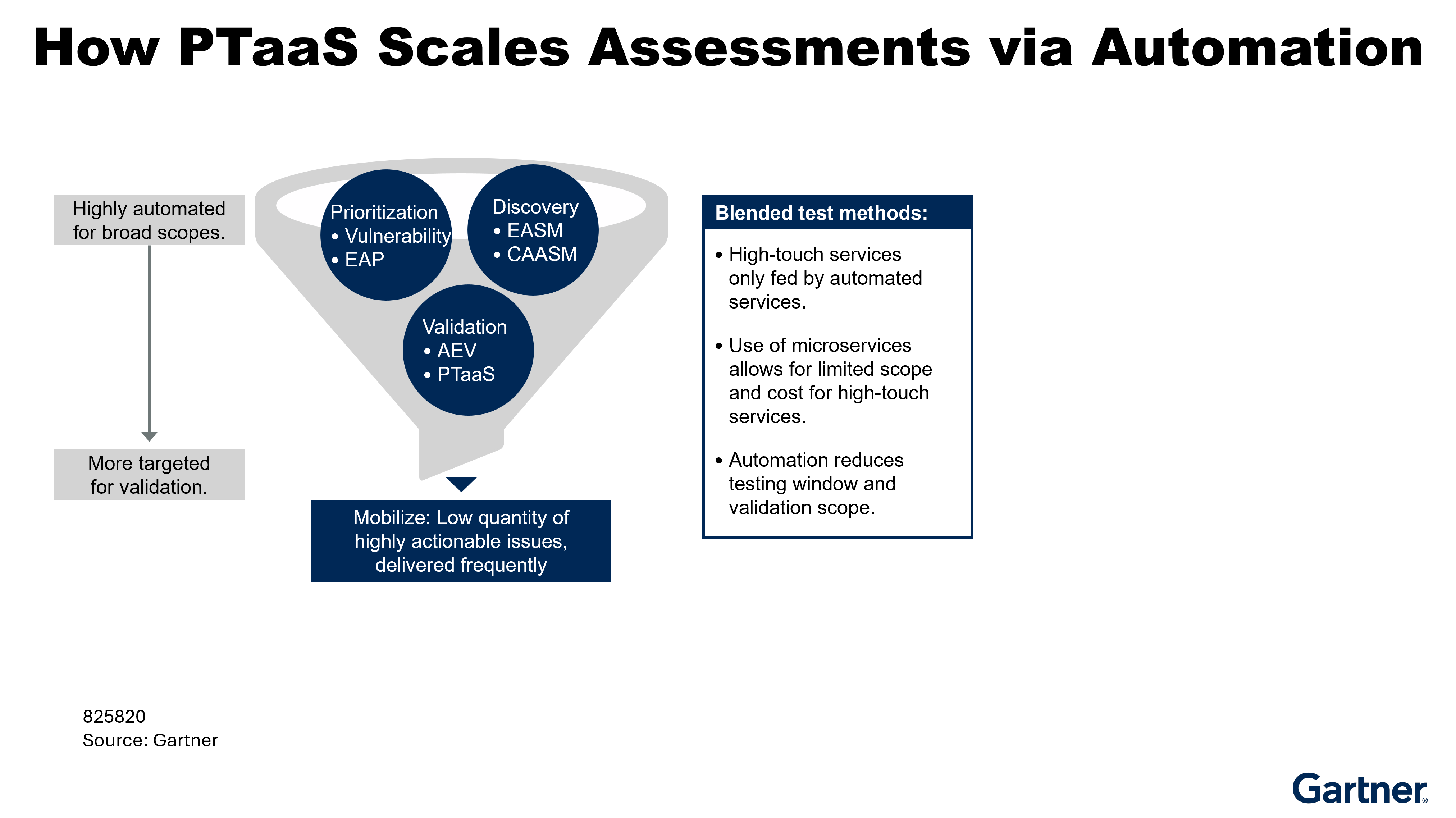
While some PTaaS providers use vetted external testers, this operating model can limit continuity and standardization. Organizations with regulatory or data residency requirements should assess where testing staff and platforms are located. PTaaS is not yet a full replacement for traditional penetration testing in compliance-driven environments, where formal attestation and depth of testing are often required. According to the 2024 Gartner Designing and Building Modern Security Operations Survey, adoption of automated penetration testing tools, which is a core component of many PTaaS platforms, increases with organizational size, with 33% of large enterprises and 46% of global enterprises reporting usage, which is significantly higher compared to midsize enterprises. While the survey did not directly assess PTaaS adoption, the increased use of automated penetration testing tools — a foundational component of many PTaaS platforms — reflects growing interest in technology-driven approaches to scale testing efforts and improve efficiency.
Bug bounty programs remain a complementary approach. Unlike PTaaS, which is time-based and structured, bug bounties are issue-based and open-ended. Some PTaaS providers offer both models, allowing organizations to combine structured validation with broader community-driven discovery.
Benefits and Uses
Uses
PTaaS supports a range of testing objectives for organizations seeking to augment or modernize their security validation programs:
Increased Testing Frequency
PTaaS is used to support more frequent penetration testing compared to traditional project-based approaches. PTaaS is a continuous, uninterrupted effort over the course of the contract life span, commonly delivered in one to three-year contracts. This gives clients data about risks more frequently, and the window of time from risk exposure to risk remediation is shortened. In contrast, a project-based penetration test may take up to a year from a risk being exposed until it is remediated. PTaaS automates many of the traditionally labor-intensive tasks that can delay traditional pentesting.
Compliance Objectives
For some clients, the main reason for getting a penetration test is to comply with third-party testing requirements mandated by a regulatory or auditing body. Often referred to as check-box testing, PTaaS can help clients meet these regulatory requirements as part of the service, offering high levels of standardization, support for custom reporting formats, and alignment with specific compliance frameworks.
Reduced Exposure
Risk can come in many forms and there is not a simple one-size-fits-all. However, the modern attack landscape shows that overlooked exposure, unsecured systems and overall lack of visibility into attack readiness make for a high-risk situation for clients. The time of exposure to transient risks is critical, and even a very thorough project-based penetration test might be too late to reduce these fast-moving risks. PTaaS helps support CTEM strategies by providing frequent assessments that enable organizations to identify and address emerging risks associated with changing attack surfaces.
Benefits
In addition to helping clients meet a variety of testing objectives, PTaaS has a number of benefits over traditional project-based penetration testing services.
Cost Efficiency
Increasing the frequency of project-based penetration testing to a monthly cadence is technically feasible, but often exceeds the annual security testing budgets of many organizations. PTaaS helps manage this challenge by offering a scalable model that supports more frequent testing without proportionally increasing costs. Through automation and standardized testing workflows, PTaaS enables better utilization of billable talent hours. For some organizations, this allows for a shift toward identifying and addressing smaller sets of vulnerabilities more regularly; thereby, improving responsiveness and cost efficiency without requiring a full-scale test each time.
Risk-Based Prioritization
PTaaS supports risk-based prioritization by helping organizations focus remediation efforts on exposures that pose the greatest risk. This includes considering asset visibility, accessibility, business criticality, and threat severity; thereby, enabling more effective allocation of security resources.
Some providers enhance this prioritization by incorporating contextual analysis (e.g., machine learning and large language models) that maps technical findings to business impact. This helps security teams better understand which vulnerabilities could disrupt operations or affect critical assets, improving decision-making and stakeholder alignment.
To support prioritization at scale, PTaaS platforms increasingly use automation and adaptive testing techniques (e.g., selective rescanning and intelligent asset grouping). These capabilities allow for continuous assessment across complex environments, ensuring that prioritization remains timely and aligned with evolving risk conditions.
Enhanced Mobilization
Mobilization of findings refers to how quickly testing results can move from discovery to remediation by the asset owner. Traditional project-based penetration tests often deliver results in static formats like PDF reports, which require additional analysis and coordination to translate findings into actionable steps. PTaaS supports this process by enabling more frequent delivery of findings in smaller batches, allowing teams to respond more quickly and efficiently without waiting for a full test cycle.
PTaaS platforms further enhance mobilization by providing structured interfaces that link findings to prescriptive actions. Integration with external systems (e.g., ticketing platforms) helps route findings to the appropriate teams with relevant context, reducing the time and effort needed to initiate remediation. This workflow-centric approach supports continuous improvement and better alignment with operational rhythms.
Integration with Threat Detection, Investigation and Response (TDIR)
Integrating a security information and event management (SIEM) system with penetration testing enhances security by providing real-time monitoring and analysis of system logs and events. This integration offers deeper insights into network vulnerabilities, improving threat detection and incident response capabilities. Organizations benefit from a comprehensive view of their IT security posture, enabling proactive identification and mitigation of potential threats.
Application Development Process Feedback
PTaaS facilitates real-time collaboration between developers and penetration testers, allowing for direct guidance and clarification. This reduces reliance on static scanner outputs (e.g., DAST/SAST) and helps teams resolve findings more effectively. However, the value of this collaboration depends on the maturity of workflows and processes across development and operations, which must be in place to fully realize the benefit.
Exposure Assessment Extension
Some PTaaS providers are expanding their offerings to include adjacent capabilities such as EASM, cyber asset attack surface management (CAASM), and AEV. While these additions may appear as vendor-specific features, they reflect a broader trend across providers for consolidating exposure management capabilities — not just at the tooling layer, but across services and workflows. This consolidation helps reduce reliance on multiple third-party tools, streamlines vulnerability/exposure aggregation and prioritization, and supports more efficient remediation/mitigation by aligning findings with misconfigurations, control gaps, and asset context. However, the effectiveness of these integrations varies across providers and depends on how well these capabilities are operationalized within client environments.
Risks
Market Maturity and Variability
PTaaS remains an evolving market. Providers differ significantly in their delivery models, automation capabilities, and service depth. This variability can make it difficult for buyers to compare offerings or predict service consistency.
Lack of Customizable Testing
PTaaS is designed to be a packaged offering that is quick to purchase and use. As such, some clients with highly specialized testing needs might miss more customization options. While some PTaaS providers are open to adding custom work using the classic project-based SOW method, others are only interested in delivering their packaged offerings.
Limited Business Impacts
Penetration testing should provide business impact context, as this helps organizations understand which findings pose the greatest operational, financial, or reputational risk. Without this context, teams may struggle to prioritize remediation efforts effectively, potentially focusing on low-risk issues while overlooking critical exposures. However, not all PTaaS providers do so by default. Clients should ensure this is part of their requirements when engaging a provider, as some offerings may lack depth in relating findings to business risk. They might also include add-on impact analysis (or “what if” analysis) as part of their offerings. This can leave the client with a finding that lacks true priority in terms of its importance.
Limited Specialization
Some PTaaS may lack specialized testing that is required to meet objectives. For example, testing options such as wireless security, physical, database testing, social engineering, or directed red-team mandates may not be offered by a PTaaS provider. Clients who need such specialized testing services may have to utilize a project-based penetration testing provider.
Compliance Acceptance
Heavily regulated industries may still require a traditional, consulting-style penetration test performed by a named third-party to meet compliance mandates. While PTaaS is gaining acceptance in some organizations, it may not be recognized as a valid alternative in others due to concerns about testing depth, lack of formal attestation, or perceptions that subscription-based platforms (e.g., AEV) function more like internal tools than independent services. Clients should confirm with their auditors or regulators whether PTaaS meets their specific compliance requirements.
Adoption Rate
PTaaS adoption continues to accelerate, with an estimated 20% to 50% of the targeted market actively using these services (see Hype Cycle for Security Operations, 2025). Adoption tends to be higher among high-maturity organizations seeking efficiency gains, scalability, and integration with internal testing teams. These organizations often blend PTaaS with in-house penetration testers to enhance coverage and cadence while still meeting compliance requirements through traditional third-party engagements when necessary.
Recommendations
- Map testing objectives to PTaaS capabilities by identifying where automation, frequency, and integration can replace or augment traditional testing.
- Use PTaaS for broad, recurring assessments and reserve traditional consulting engagements for specialized testing such as physical, wireless or red teaming.
- Establish a cybersecurity validation program by integrating PTaaS into DevSecOps workflows and using it to continuously assess exposure and remediation effectiveness.
- Evaluate separate additional exposure assessment capabilities when evaluating PTaaS providers that offer attack surface management (ASM) and adversarial exposure validation services.
Representative Providers
- Bishop Fox
- BreachLock
- Bugcrowd
- Cobalt
- HackerOne
- NetSPI
- Praetorian
- Siemba
- Synack
- TrollEye Security
This document’s analysis of PTaaS capabilities is not tied to one particular provider’s offering. We researched multiple providers and their capabilities using private and public resources, such as vendors’ documentation, end-user inquiries, data sheets and vendors’ briefings of Gartner analysts.
2024 Gartner Designing and Building Modern Security Operations Survey. This survey was conducted to help us understand how organizations design and build modern security operations and develop optimal cybersecurity structures and operating models to help prioritize and reduce exposure to threats. The survey was conducted online from 28 May through 25 June 2024 among 208 respondents (n = 203 from a vendor panel and n = 5 from a conference list) across North America (n = 85 in the U.S. and Canada), EMEA (n = 83 in France, Germany, Italy and U.K.) and Asia/Pacific (n = 40 in Australia, India and Japan). Qualifying respondents’ organizations had $100 million or more in 2023 enterprisewide annual revenue and 250 or more employees. Qualifying respondents were aware and at least somewhat knowledgeable of security operations in their organization. Qualifying respondents were also required to be involved in decisions related to security operations. Disclaimer: Results of this study do not represent global findings or the market as a whole but reflect the sentiments of the respondents and companies surveyed.
Contributors
Craig Lawson, Pete Shoard, Jeremy D’Hoinne, Aaron Lord, Luis Castillo and Elizabeth Kim