AI Race: Differentiating in AI Services With Assets
21 April 2026 - ID G00850594 - 6 min read
By Tom Coshow, Craig Lowery
Software revenue will equal and overtake services spending in the next three to four years. Once a stalwart services organization, IBM has positioned itself to overcome this shift with a unique blend of reusable software assets, its AI heritage, and a vast portfolio of AI capabilities.
Insights at a Glance
The Software Advantage
Gartner forecasts a weakening services-to-software ratio, predicting that software revenue will equal and overtake services spend in the next three to four years. This shift uniquely favors IBM, which possesses a broad portfolio of software assets, a strong AI heritage, a leading portfolio of capabilities, including Bob, watsonx, and IBM Enterprise Advantage, and an integrated business model, compared to other global consulting system integrators.
Heritage and Innovation
Unlike competitors suddenly increasing the AI aspect of their branding, IBM entered the AI domain far earlier with its Watson solutions. Its continuous R&D investments in neurosymbolic AI, LLMs and specialized hardware provide a unique differentiation and a mature foundation.
IBM’s AI Portfolio
IBM actively utilizes its AI software — including its Bob and watsonx with watsonx.data, watsonx.governance, and watsonx Orchestrate — to deliver enterprise-scale results and modernize legacy systems. Combined with asset-based services like IBM Enterprise Advantage and established methodologies like IBM Garage, IBM ensures scalable, high-quality implementations that escape POC jail and move into production.
Strategic Planning Assumption
By 2028, global software revenue will accelerate to match and then surpass IT services spend, altering the competitive landscape for consulting vendors.
Issue
- The enterprise AI services race is intensely competitive, with a focus on scalable implementations that deliver demonstrable business outcomes rather than just proofs of concept (POCs).
- The financial relationship between software and services revenue is fundamentally changing: software costs are increasing, and implementation project sizes are declining. This is reducing software-related services revenue.
- Most global system integrators (GSIs) lack the proprietary software assets needed to fully capitalize on a software-dominated spending environment.
- IBM combines services, software, and infrastructure into a highly integrated business model, with services and software now making up 70% of its revenue.
- Pressure is being put on GSIs to lower prices as clients assume they are cutting costs by using AI.
Impact
The urgency for clients lies in the shifting economic reality of IT budgets. As software spend overtakes services spend, consulting firms relying purely on human capital will struggle, whereas IBM’s integrated software assets will allow it to lead the AI consulting field.
Clients must reevaluate AI service providers based on their embedded software capabilities and platforms:
- Platform readiness: IBM’s AI portfolio offers immediate utility for modernization projects, allowing buyers to avoid integrating multiple third-party tools.
- Governance and scaling: Solutions must move beyond initial testing. IBM’s integration of its IBM Garage methodology enables scalable, quality AI deployments.
- Future-proofing: IBM’s extensive portfolio — bolstered by acquisitions like Red Hat, Turbonomic, Cognitus, Confluent, Apptio, DataStax and HashiCorp — provides a ready-made toolbox of best-of-breed solutions for sustained value, bringing together services, software, and industry expertise to support client productivity and operational efficiency.
More Detail
The Coming Software Dominance
The technology consulting industry is approaching a critical financial inflection point. Gartner forecasts that the historical services-to-software revenue ratio is weakening steadily, dropping from 1.41 in 2023 to parity (1.00) in 2028, and shifting to software dominance (0.93) by 2029. In roughly three years, software revenue is projected to overtake services revenue due to an increase in software pricing and a reduction in large-scale implementation projects (see Figure 1).
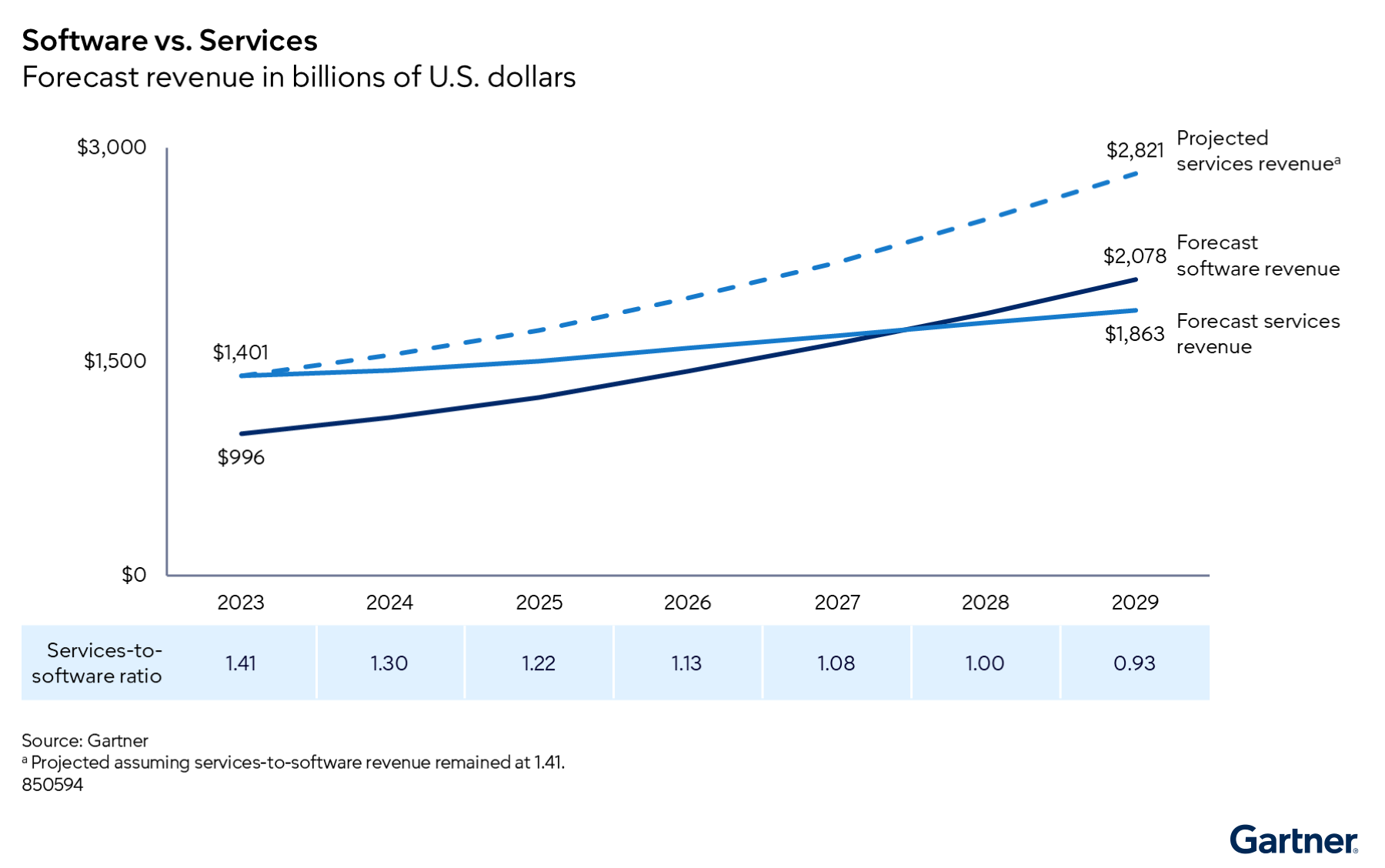
This macroeconomic shift poses a major threat to traditional GSIs like Accenture and Deloitte, but it is a massive tailwind for IBM. Because IBM holds a comprehensive, ready-made toolbox of acquired software assets — including Red Hat, Apptio, DataStax, and HashiCorp — it is uniquely positioned to capture the growing software spend while delivering technology consulting services. Consequently, IBM will lead the AI consulting field over time as its competitors are forced to rely on external software ecosystem partnerships.
Supporting Sovereignty
- GSIs must deploy high-performance, scalable, and secure hardware platforms — such as IBM’s Power Systems, Storage Solutions, and IBM Sovereign Core — to ensure data residency, compliance, and privacy within national borders. This is critical for sovereign AI initiatives, which mandate strict control over sensitive datasets and computational resources, especially in regulated sectors like government, healthcare, and finance.
- GSIs need integrated software stacks that support end-to-end AI life cycle management, including model training, deployment, monitoring, and auditing — capabilities exemplified by IBM’s watsonx and Cloud Pak for Data. These platforms enable GSIs to deliver AI solutions that adhere to local regulatory frameworks, facilitate explainability, and enforce governance, making IBM an important player in sovereign AI deployments.
Pricing Pressure and Market Convergence
- AI is performing services, replacing service providers and people.
- Software is becoming more expensive as it is infused with AI.
- Large providers will be challenged by local services providers as sovereign AI becomes a priority.
- More will be expected for less. Services providers will have to charge less as it is expected that much of their work is coming from AI instead of from highly paid humans. Clients expect lower pricing for new services because they know this and want to reallocate funds.
Unmatched AI Heritage vs. New Entrants
The current AI race has triggered a frenzy of technology providers suddenly deciding to call themselves AI companies. IBM, however, has profound longevity and foundational experience in the AI domain, having entered the space much earlier than its biggest competitors via its Watson solutions. This heritage is reinforced by vibrant, ongoing R&D investments in cutting-edge areas such as neurosymbolic AI, specialized AI hardware, and quantum computing through initiatives like the MIT-IBM Watson AI Lab. This deep history ensures that IBM’s consulting capabilities are rooted in decades of actual data science and technical execution.
The watsonx Platform and Leading Methodologies
To compete against rivals, IBM is heavily leveraging its Granite LLM models and its broad AI portfolio with Bob and watsonx. IBM actively and directly uses these platforms in client engagements to convert legacy applications and institute integrated AI governance, a critical capability that most other providers lack.
Furthermore, IBM pairs these proprietary tools with highly mature services assets, namely IBM Enterprise Advantage and the IBM Garage methodology. IBM Garage emphasizes identifying value, orchestrating and tracking in the building of an initial minimum viable product (MVP), and it emphasizes using iterative incremental delivery to help clients rapidly scale AI and escape POC jail.
IBM Enterprise Advantage
IBM Enterprise Advantage is a services-as-software solution that enables organizations to scale agentic AI across their existing business. It combines a modular, hybrid-AI platform (Advantage Platform), prebuilt and custom agentic applications (Agentic Marketplace), and a set of consulting services (Advantage Services) leveraging forward-deployed engineers (FDEs) and domain experts to rapidly build and adapt agentic solutions within the client’s context. It integrates natively with watsonx and hyperscaler AI platforms to leverage clients’ preferred AI environments.
Unlike point solutions, Enterprise Advantage uniquely embeds IBM’s AI-driven engineering methodology into the platform, codifying process transformation into reusable blueprints and agent-assisted workflows enabling faster, repeatable business process transformation at scale. The result is a governed, flexible foundation to orchestrate AI across systems, accelerate time to value, and turn isolated AI initiatives into enterprisewide advantage.
Currently, the combination of a history of expertise and the watsonx platform makes IBM a leader in the enterprise AI services race.