Critical Capabilities for Cloud ERP Services
11 May 2026 - ID G00828034 - 63 min read
By Shubham Rathore, Danny Kreidy, and 2 more
When looking for cloud ERP services, enterprises often struggle to select providers that can meet their unique business needs. Sourcing, procurement and vendor management leaders can use this research to choose suitable providers for various cloud ERP use cases.
Overview
Key Findings
- The cloud ERP services market is growing significantly as an increasing number of organizations transform their back-office systems by moving to SaaS platforms. This market comprises hundreds of consulting companies and system integrators (SIs), ranging from huge global SIs to small, local specialist firms.
- Across the board, cloud ERP services represent approximately 13% of the total revenue of the 19 evaluated SIs. Gartner estimates that the overall application services market was $428 billion in 2025, of which $306 billion was devoted to implementing and supporting software products. The total enterprise application implementation and managed services market for specific cloud ERP services is estimated at $80 billion.
- Cloud ERP implementations are increasingly shifting toward AI-native operations, with a heavy reliance on embedding emerging technologies like machine learning (ML), generative AI (GenAI) and intelligent automation into the delivery methodology to enable predictive analytics and autonomous operations.
Recommendations
Sourcing, procurement and vendor management (SPVM) leaders accountable for sourcing their IT services and solution requirements and selecting cloud ERP service providers should:
- Drive down-selection of service providers that match their unique requirements by reviewing the six use cases and 12 critical capabilities profiled in this research. Each use case covers a spectrum of services from the 19 service providers covered in this research. In addition, use the capability criteria as a framework to assess alternative providers that have not been profiled here.
- Evaluate providers based on their deep domain expertise across core functional areas, specifically financial management, human resources and payroll, supply chain management, sourcing/procurement, and manufacturing, to understand how well they can reshape processes and align systems with business goals.
- Look for providers that utilize proven industry-specific accelerators, leverage AI-enabled/agentic workflows to speed up implementation, and offer scalable, modern application managed services (AMS) that support continuous innovation and regular software updates post-go-live.
What You Need to Know
This Critical Capabilities research assesses 19 providers on the most critical cloud ERP capabilities. SPVM leaders should look for providers that can implement and evolve cloud ERP solutions, as well as help with ideation, business transformation and integration with other enterprise solutions to deliver strong value to client organizations. To most effectively assess providers for selection, SPVM leaders are encouraged to use this research in tandem with the companion Magic Quadrant for Cloud ERP Services.
This research provides an in-depth view of specific use cases across the four key ERP technologies commonly used in cloud ERP:
- Microsoft Dynamics 365
- Oracle Fusion Cloud ERP
- SAP Cloud ERP
- Workday
It also goes beyond the core strengths, cautions and relative positions presented in the companion Magic Quadrant. All service providers have been scored against 12 critical capabilities that Gartner deems to be leading factors to consider when evaluating solutions for the six specific use cases identified. All capabilities evaluated expect an embedded usage of emerging technologies (such as AI and ML) to support the implementation methodology.
Each service provider is scored against the 12 capabilities, based on the following:
- The information it provided as part of the Critical Capabilities research process
- Client feedback in a customer reference survey
- Gartner analyst interactions with the service providers and their clients
- Gartner analyst opinion based on market knowledge
Although the research evaluates 12 critical capabilities in total, their weightings vary depending on the focus of the delivery. Six of these capabilities represent the core functional and transformational competencies that span across the delivery engagements:
- Financial management (FM) transformation
- HR and payroll transformation
- Supply chain management (SCM) transformation
- Sourcing and procurement transformation
- Manufacturing products transformation
- Change management capabilities
These six core capabilities, along with the reasons for their inclusion, are described in detail in the Critical Capabilities Definition section of this research.
The remaining six capabilities are phase- or technology-specific and align with the six use cases.
The capability scores are then used to position service providers for six use cases. The use cases are defined in more detail in the Use Cases section, but are listed here for reference:
- Discovery and design: Engagements focused on understanding the current business processes, gap analysis and strategic objectives, followed by defining comprehensive documentation that forms a detailed blueprint for the entire project.
- Microsoft Dynamics-based implementation and evolution: Implementation (technical migration plus change management) and ongoing support based on Microsoft Dynamics 365 products.
- Oracle Fusion-based implementation and evolution: Implementation (technical migration plus change management) and ongoing support based on Oracle Fusion Cloud products.
- SAP-based implementation and evolution: Implementing (technical migration plus change management) and ongoing support based on SAP cloud products (e.g., S/4HANA Cloud Public Edition, SuccessFactors and Concur).
- Workday-based implementation and evolution: Implementation (technical migration plus change management) and ongoing support based on Workday products.
- Application managed services (AMS): Ongoing postimplementation application managed services beyond hypercare and optimization services for cloud ERP environments. This includes application monitoring, incident management, release and change management, user support, performance tuning, and continuous improvement to ensure that the ERP system evolves with business needs.
Each critical capability is weighted based on the delivery focus of the use case. The weightings reflect Gartner’s analytical position of the relative importance of each critical capability per the respective use case, and are listed in the Inclusion Criteria section. Use the interactive view of this research to change the weightings of the criteria to match your specific individual situation and to see the revised evaluation of providers. Also, use the criteria and weightings to evaluate other providers (not included in this research) that might align better in terms of your culture, geography, industry experience or other niche criteria.
Some of the leading providers performed equally well across all six use cases, so we profile the most relevant use cases within each vendor profile. Use the relative position in the use-case chart and the critical capability scores to gain a better understanding of each provider’s ability to deliver cloud ERP services. Leverage these use-case scenarios and capability criteria in conjunction with the accompanying Magic Quadrant overall strengths and cautions to speed up the identification and selection of providers that meet your organization’s cloud ERP service requirements.
Analysis
Critical Capabilities Use-Case Graphics
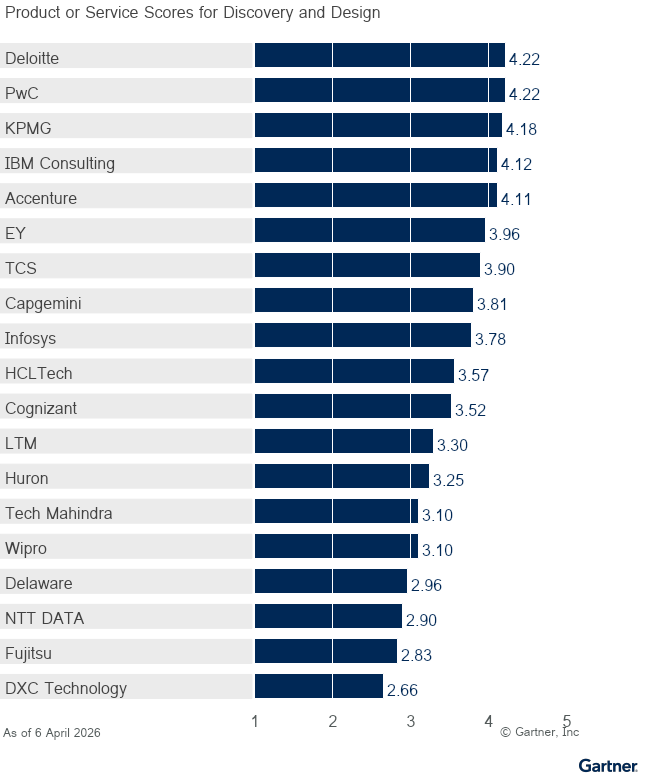
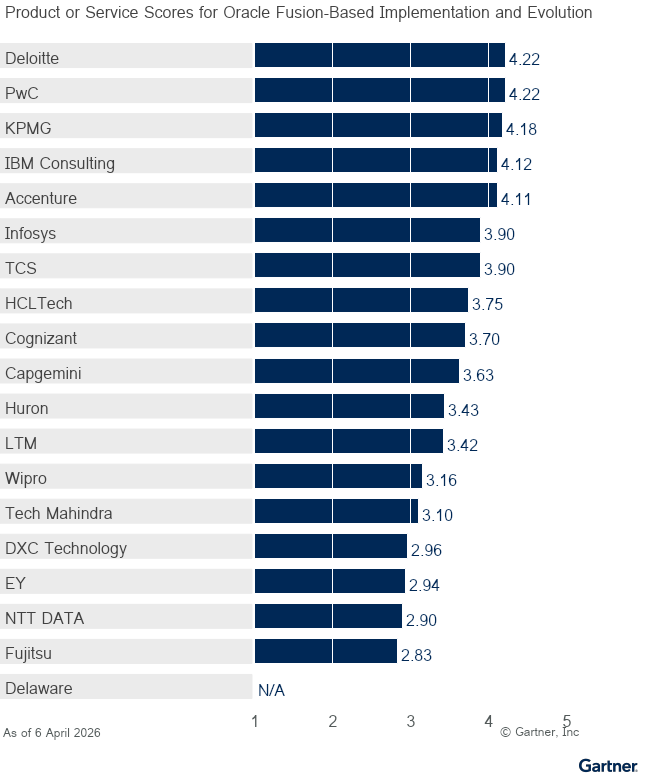
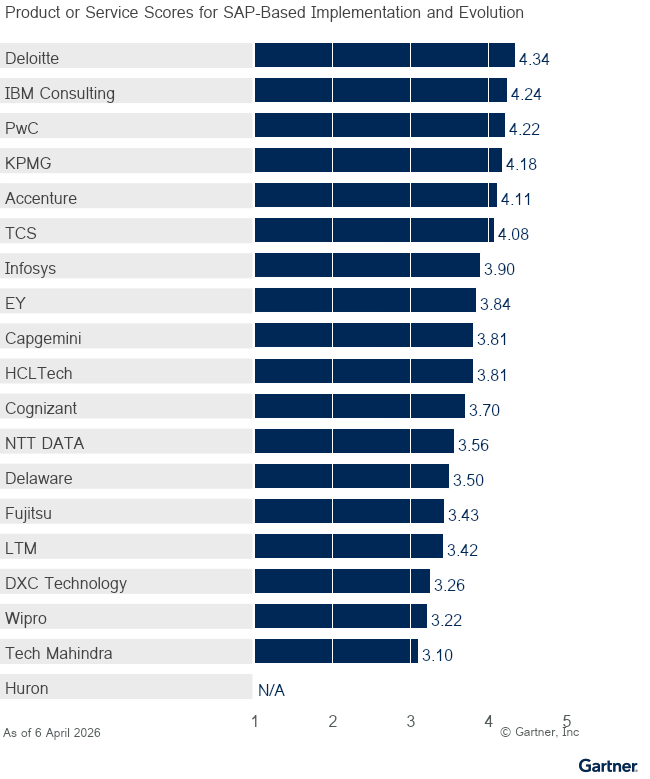
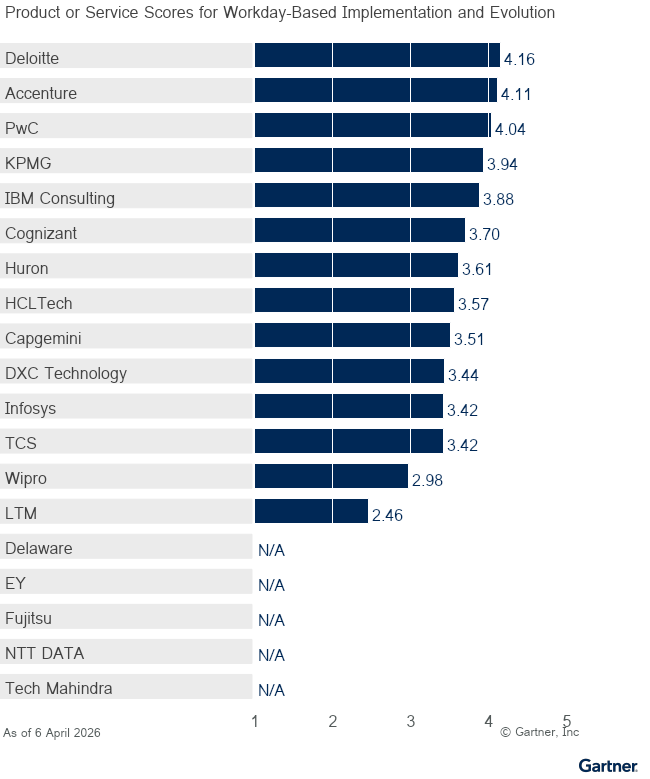
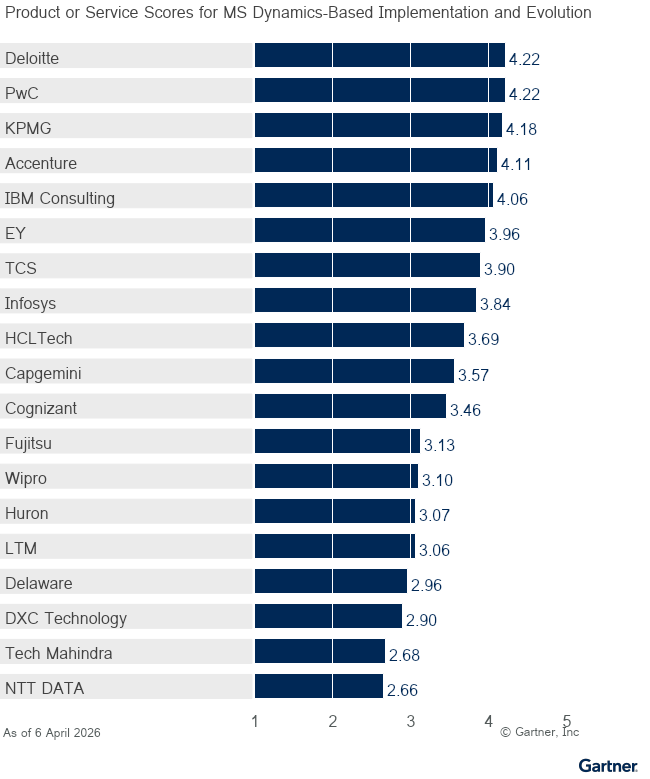
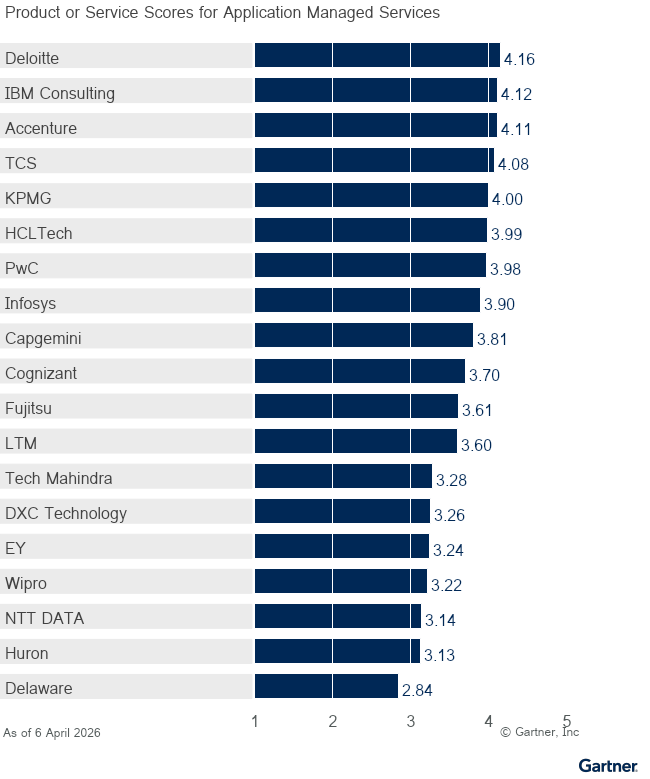
Vendors
Accenture
See verified user reviews and ratings for Accenture on Peer Insights.
Accenture operates globally across 120 countries and is a credible partner for large-scale ERP transformation. AI is the centerpiece of Accenture’s Cloud ERP strategy, supported by a $3 billion data and AI investment. The company is shifting to agentic AI, deploying hierarchies of Utility, Super and Orchestrator agents to automate end-to-end enterprise workflows.
Accenture provides integrated offerings that span strategy, consulting, technology and operations. Its cloud ERP services are an ideal fit for large global enterprises seeking complex, accelerated transformations driven by composable architectures and pervasive AI. Through these capabilities, Accenture helps clients build robust digital cores by deeply integrating cloud applications, data-driven AI and autonomous business processes. Top primary verticals include banking, healthcare and manufacturing.
A key differentiator for Accenture is its “Total Enterprise Reinvention” strategy, integrating proprietary platforms like “GenWizard” and “myWizard” to automate the software delivery life cycle across all phases. This is supported by its “Method One” methodology and bolstered by strategic acquisitions, such as Systema for manufacturing and Rangr Data for supply chain analytics, to drive data-led, autonomous enterprise operations.
The following sections are presented in order of use case.
Financial transformation: Accenture’s financial management capabilities excel at creating a “just-in-time” approach to cash flow and automating the accounting close. Using tools like SAP Signavio and its proprietary Spend Analyzer, it enables massive labor-hour reductions and predictive financial accuracy.
Supply chain expertise and manufacturing expertise: Accenture demonstrates good capabilities in building automated supply chain networks. By deploying AI-driven inventory algorithms and digital twins, the firm creates highly effective, data-driven supply chain control towers. Through its specialized “Industry X” services, Accenture digitizes engineering and manufacturing, directly connecting demand to production by utilizing advanced robotics, Internet of Things (IoT) tracking systems, and manufacturing execution system (MES) solutions.
Application managed services: Accenture’s modern AMS strongly differentiates itself by embedding GenAI into managed services to simplify IT complexity, with proprietary assets like GenWizard and myWizard to automate the software delivery life cycle.
Accenture declined requests for supplemental information. Gartner’s analysis is therefore based on other credible sources.
Capgemini
See verified user reviews and ratings for Capgemini on Peer Insights.
Capgemini is a global technology and consulting company. The geographic distribution of its cloud ERP resources is heavily weighted toward offshore delivery centers, with a majority in Asia/Pacific, where most resources are based in India and serve clients through its Global Delivery Center. Capgemini’s top primary verticals are manufacturing and natural resources, consumer products and retail, and energy and utilities.
Capgemini’s Enterprise Core strategy is a key differentiator, comprising its Digital Acceleration Navigator platform to standardize delivery tools across all phases, and its Data First approach (bolstered by the acquisition of Syniti) to prioritize data quality and governance in transformations.
The following sections are presented in order of use case.
SAP Cloud ERP expertise: Capgemini’s strongest capability is large-scale SAP transformations. It leverages its clean-core guardrails to maintain standard codebases while innovating on the SAP Business Technology Platform (BTP). It uses its RAISE for SAP AI cockpit to accelerate Move-to-RISE projects, reinforced by deep industry-specific assets. For example, AutoPath for automotive and LifeSciencePath for pharmaceuticals both use preconfigured solutions to accelerate time to value for complex industry mandates.
Oracle Fusion Cloud expertise: Capgemini’s Oracle practice is strong in Asia/Pacific, which saw 48% headcount growth in 2025. It utilizes its “Rapid” series of accelerators (e.g., Rapid Finance, Rapid Supply Chain) to expedite Oracle Cloud implementations. Capgemini creates value by bundling Oracle SaaS with Oracle Cloud Infrastructure (OCI) services, providing a unified approach to infrastructure and application modernization.
Microsoft Dynamics 365 expertise: Capgemini effectively targets two-tier ERP, specifically combining SAP for headquarters with Microsoft Dynamics 365 for subsidiaries. It supports this with specific connectors and governance models to ensure master data consistency between the Tier 1 and Tier 2 layers. Capgemini has secured a significant investment from Microsoft to further develop this footprint.
Workday HCM: Capgemini’s Workday offering relies more on “consultant expertise” and specific industry tenants rather than the extensive proprietary asset libraries or “accelerators” seen in its other technology lines. Capgemini has limited Workday clients in regions outside North America and Western Europe, suggesting a selective, high-touch approach to this market rather than a high-volume play.
Application managed services: Capgemini offers a robust “agentic AI-powered” AMS model. By utilizing its AI-powered Application Development and Maintenance Services (AI-powered ADM) platform, agents are able to autonomously execute AMS services, including resolving incidents and performing root cause analysis. Capgemini focuses on outcome-based commercial models that link fees to operational KPIs. This “Zero Touch” operations strategy is designed to reduce ticket volumes by up to 30%, making Capgemini a strong fit for clients seeking to modernize ongoing operations and reduce technical debt.
Cognizant
See verified user reviews and ratings for Cognizant on Peer Insights.
Cognizant is a global IT services provider. Across all cloud ERP practices, Cognizant operates a right-shored global delivery model, typically using 25% onshore resources in aggregate, complemented by scaled offshore and “nearshore” capabilities across Oracle, SAP, Workday and Microsoft practices. Cognizant’s top primary verticals for this service are manufacturing and logistics, life sciences and healthcare, and retail and consumer goods.
A key differentiator for Cognizant is its “AI builder” strategy, which employs a “three-vector approach” to modernize cloud ERP environments. This strategy is underpinned by the Neuro AI Enterprise Core platform, which integrates proprietary AI and GenAI tools to standardize code remediation, orchestrate multiagent workflows and drive automation across all transformation phases.
The following sections are presented in order of use case.
Oracle Fusion technology expertise: This is a primary strength for Cognizant, which operates as a Top 5 Global Strategic Service Partner. Cognizant utilizes its Ora0 GenAI-powered platform to accelerate engineering productivity and streamline delivery. Key assets include Cognizant Telco in a Box and HealthCare in a Box, which provide preconfigured industry processes to accelerate time to value. For the midmarket, Cognizant offers a rapid implementation for a fixed fee to enable predictable deployment timelines.
SAP Cloud technology expertise: Cognizant acts as a RISE with SAP Validated Partner, emphasizing a Clean Core philosophy while utilizing industry-specific accelerators like MfgXpress, ChemXpress and Utility4U. A standout capability is the Brownfield Conversion Express, which utilizes GenAI for code remediation and automated data validation, reportedly reducing S/4HANA Cloud migration timelines by up to 30%.
Workday technology expertise: Strengthened by the acquisition of OneSource Virtual’s professional services arm, Cognizant’s Workday practice serves both large and midsize enterprises. It differentiates by addressing platform functionality gaps through proprietary tools like the Cognizant Employee Relations app and the Veteran Benefit App listed on the Workday Marketplace.
Microsoft technology expertise: Bolstered by the acquisition of 3Cloud in January 2026, Cognizant integrates Dynamics 365 Finance with the broader Azure and Power Platform ecosystem. Although the practice holds fewer certifications relative to other platforms, it targets specific verticals with sustainability-focused industry solutions.
Application managed services: Cognizant’s AMS offering differentiates through a “zero-maintenance” strategy driven by its AppLens platform. This AI-based tool orchestrates real-time monitoring, patch insights and technical debt management, integrating Ticket Synthesizer and Smart Knowledge Search to automate incident detection and resolution.
Delaware
See verified user reviews and ratings for Delaware on Peer Insights.
Delaware is a global IT and professional services company. The geographic distribution of its cloud ERP resources is heavily weighted toward Western Europe and Asia/Pacific. It has 57% in Western Europe, 21% in Asia/Pacific (excluding Japan), 10% in North America, 9% in Latin America, 2% in the Middle East and Africa, and 1% in Eastern Europe. Delaware’s top primary verticals for this service are manufacturing and natural resources, power and utilities, and retail.
Delaware is a global IT and professional services company. The geographic distribution of its cloud ERP resources is heavily weighted toward Western Europe and Asia/Pacific. It has 57% in Western Europe, 21% in Asia/Pacific (excluding Japan), 10% in North America, 9% in Latin America, 2% in the Middle East and Africa, and 1% in Eastern Europe. Delaware’s top primary verticals for this service are manufacturing and natural resources, power and utilities, and retail.
A key differentiator for Delaware is its on-site focused delivery methodology and cross-ecosystem strategy. This is bolstered by deep industry-specific intellectual property (IP), such as its co-developed SAP DM4Mill solution, which standardizes complex delivery tools and prioritizes rapid digital transformation.
The following sections are presented in order of use case.
Manufacturing products transformation: Delaware demonstrates industry-leading capabilities in this use case, driven by its proprietary DM4Mill IP, co-developed with SAP. It excels in modernizing shop-floor operations with SAP Digital Manufacturing, deploying GenAI for anomaly detection and hands-free production order management. Delaware’s innovation effectively eliminates spreadsheet-based tracking and supports customized shop-floor incentive programs to drive operational efficiency.
Supply chain management transformation: Delaware provides robust support for SCM, spanning advanced planning, warehousing and execution. Utilizing SAP S/4HANA, Extended Warehouse Management (EWM) and Integrated Business Planning (IBP), Delaware manages complex logistics and end-to-end product traceability. Its approach leverages ML forecasting and embedded AI for scenario modeling.
Financial management transformation: Delaware’s financial management solution centers on integrating core SAP and Microsoft Dynamics 365 Finance platforms. It utilizes AI-enabled finance agents and analytic insights to accelerate financial close, forecasting and variance analysis. Delaware uniquely orchestrates cross-ecosystem value by utilizing proprietary Microsoft Copilot-to-SAP connectors, enabling natural language operational insights and complex multi-GAAP reporting.
Application managed services: Delaware’s AMS solution is positioned to provide continuous hybrid support by balancing local proximity with offshore delivery. Utilizing a global AMS platform, Xurrent, Delaware assigns “customer-dedicated teams” of six to eight specialists backed by specialized “performance squads” for proactive monitoring and complex issue resolution. To further enhance efficiency, Delaware deploys Knowly, an AI tool that reduces ticket resolution time by supplying agents with explicit, source-backed guidance.
Deloitte
See verified user reviews and ratings for Deloitte on Peer Insights.
Deloitte is a global professional services organization. The geographic distribution of its cloud ERP resources leverages a robust global delivery model. Gartner estimates that its staff is located in Asia/Pacific (excluding Japan), North America and Western Europe. Deloitte’s top primary verticals for cloud ERP are retail; manufacturing and natural resources; and communications, media and services.
A key differentiator for Deloitte is its robust Multi-Disciplinary Model (MDM), offering full life cycle services from discovery and strategy to implementation and ongoing operations (Advise-Implement-Operate). It shows particular strength in handling large-scale, multidomain enterprise transformations, and is a strong fit for innovative midmarket organizations and global large enterprises.
Across all use cases, Deloitte applies a common set of cross-platform differentiators, including Deloitte Ascend, Zora AI, Vision to Value and IndustryAdvantage.
SAP technology-related services: Deloitte’s execution is differentiated by its proprietary Deloitte Ascend platform and Zora AI agents, which automate approximately 30% of configuration, data migration, coding and testing tasks to accelerate time to value. Notably, it won the 2025 SAP Pinnacle Awards for Delivery Quality and RISE with SAP Methodology.
Oracle Fusion technology-related services: Deloitte offers a comprehensive range of services for Oracle Cloud ERP, heavily supported by a portfolio of over 200 Oracle-specific prebuilt solutions mapped across seven industries.
Microsoft Dynamics technology-related services: Deloitte accelerates scalable, modular rollouts using its proprietary AI-enabled Deloitte Ascend platform, industry-specific accelerators and the Dynamics 365 Value Added Model (VAM) for workflow and data management automation. Deloitte uses the broader Microsoft Power Platform to extend Dynamics 365 functionality without relying on heavy custom code.
Workday technology-related services: Deloitte delivers end-to-end Workday transformations across finance and human capital management (HCM) through its Advise-Implement-Operate model. Deloitte is Workday’s 2025 Global Partner of the Year, leading major global implementations and accelerating value with industry accelerators, AI innovation and Operate services for continuous optimization.
Application managed services: Deloitte’s AMS offerings emphasize continuous modernization over traditional break/fix support, anchored by its Operate to Transform methodology. It integrates its Vision to Value for Operate (V2V4O) framework to ensure post-go-live activities are prioritized by their impact on business value. Furthermore, Deloitte reduces manual effort by utilizing its SimplrOps acquisition and Ascend for Operate platforms to automate SaaS release readiness, testing and incident resolution.
Discovery and design: Deloitte utilizes immersive “Visioning Labs” to rapidly align stakeholders on target outcomes, surface early constraints, and produce actionable mobilization paths and board-ready value cases. It accelerates requirements gathering through its proprietary “Enterprise Consciousness” application, an end-to-end digital design tool that preloads industry-specific user stories, validates them during client workshops and serves as an automated requirement traceability matrix.
DXC Technology
See verified user reviews and ratings for DXC Technology on Peer Insights.
DXC Technology is an IT and professional services company that provides a broad range of cloud ERP solutions globally. The geographic distribution of its cloud ERP resources is heavily weighted toward offshore delivery centers, with 62% in Asia/Pacific (excluding Japan), 13% in Western Europe and 9% in North America. DXC’s top primary verticals for this service are government, manufacturing and natural resources, and retail.
A key differentiator for DXC is its “Xponential” blueprint, which promotes human-AI collaboration to embed agentic AI and automation across the entire delivery life cycle. DXC is a good fit for large enterprises, particularly in the manufacturing and public sectors, and shows particular strength in SAP and Oracle transformations. Workday services are an area of lesser focus for DXC, representing its lowest-rated capability among the evaluated use cases.
The following sections are presented in order of use case.
SAP technology-related: DXC holds a massive footprint in SAP services with a balanced offering of solution modernization (brownfield, 41%; “greenfield” transformation, 53%; hybrid, 6%). It relies on its proprietary Fast RISE and Fast HYBRID shell conversion methodologies to accelerate S/4HANA Cloud migrations, applying clean core principles by moving custom logic to the SAP Business Technology Platform (BTP).
Oracle Fusion technology-related: DXC is proficient in migrating legacy Oracle e-Business Suite environments to Oracle Fusion Cloud. It uses AI accelerators, such as the DXC Payables Agentic AI Solution, to automate complex source-to-pay processes. DXC demonstrates unique strength in public sector compliance, offering a bring-your-own-key (BYOK) data sovereignty solution deployed natively on Oracle’s EU sovereign cloud. While highly capable, 90% of its Oracle implementations remain brownfield.
Microsoft technology-related: Benefiting from a 30-year strategic partnership with Microsoft, DXC delivers Dynamics 365 solutions integrated tightly with the broader Microsoft ecosystem, including Azure and Power Platform. DXC utilizes AI-enabled product design and enterprise digital twins to optimize supply chain and shop-floor operations for industrial clients. With 95% of its Microsoft projects categorized as hybrid, its focus remains primarily on coexisting legacy and cloud architectures.
Application managed services: DXC provides ongoing operations and continuous improvement through its AMS, which is grounded on industry best practices and further accelerated with a Service Automation framework and ConvergeAI toolsets that can be adapted to the customer’s technology landscape. To ensure consistency of AMS delivery in highly variable technology landscapes, DXC applies its business outcome service delivery model to align its services and teams to the business value streams unique to each customer.
EY
See verified user reviews and ratings for EY on Peer Insights.
EY serves clients globally across more than 150 countries, transitioning organizations from legacy systems of record to AI-centric, autonomous systems of action.
EY’s Cloud ERP capabilities strongly emphasize human-centric design, clean-core architectures and agile DevOps methodologies. It is an excellent fit for enterprises seeking transformation-led engagements that align technical upgrades tightly with overarching business value, compliance mandates and outcome-based pricing models. EY’s top primary verticals for cloud ERP services are life sciences, power and utilities, and consumer products and retail.
A key differentiator for EY is its unified “All in” strategy. It combines the EY Fabric platform, a standardized global technology backbone for data and solution delivery, and the Transformation EQ discipline, which prioritizes human-centric design, leadership alignment and change management throughout its transformations.
Financial transformation: EY transforms finance functions through its “rapid foundation methodology,” specifically designed for leaders struggling with fragmented data and manual processes. By integrating Microsoft Dynamics 365 Finance and utilizing AI for financial planning and analysis (FP&A), it automates up to 45% of data cleaning and reconciliation time.
HR and payroll expertise: EY employs its rapid HR/payroll assessment methodology and dedicated innovation labs to co-build modern operating models.
Supply chain and manufacturing: To combat global volatility, EY shifts linear value chains into digitally interconnected ecosystems using EY Supply Chain Intelligence Platform (SCIP). This platform is a unified data, analytics and AI framework that supports end-to-end supply chain transformation across strategy, planning, operations and execution. In manufacturing, it deploys its EY Smart Factory solutions to optimize production lines via the industrial metaverse, utilizing digital twins and AI-driven predictive maintenance.
AI and data management: EY has invested over $1 billion annually to institutionalize AI across its ERP engagements and technology platforms (including a $1.4 billion commitment to EY.ai). Using the EY.ai Agentic Platform, developed with Microsoft and NVIDIA, and the EY AI Agent Studio, EY deploys AI agents to design and execute autonomous, multistep workflows for complex enterprise functions such as tax, risk, finance, audit and supply chain. The EY.ai Enterprise Process Flow captures business intent in an AI-native format to drive automation, analysis and content creation, and to maintain a single source of truth throughout the ERP life cycle.
Application managed services: EY’s AMS provides global application outsourcing driven by AI-optimized delivery, predicting system issues proactively to ensure high reliability. It also empowers internal “citizen developers” through tailored, low-code solution models.
EY declined requests for supplemental information. Gartner’s analysis is therefore based on other credible sources.
Fujitsu
See verified user reviews and ratings for Fujitsu on Peer Insights.
Fujitsu is a global IT services and technology company with a dominant market share in Japan, rapidly transitioning from a traditional hardware-centric firm to a software-led, agile transformation partner. Its top primary verticals for cloud ERP services are manufacturing, retail, healthcare and life sciences, and the public sector.
A key differentiator for Fujitsu is its Fujitsu Uvance business model, which uniquely links cloud ERP implementations directly to its societal and environmental Sustainability Transformation (SX) outcomes. This strategy integrates the Uvance Wayfinders consulting practice to engage executive leadership on initial transformation roadmaps. It is further bolstered by the Fujitsu Kozuchi AI platform which deploys multi-AI agent systems and small language models (SLMs) to automate complex operational decisions. This is augmented by the Fujitsu Data Intelligence PaaS (DI PaaS) and its quantum-inspired “Digital Annealer,” which solves high-complexity problems.
HR transformation: Fujitsu approaches HR and payroll transformations through its strategic Work Life Shift horizontal, focusing heavily on integrating AI-enabled experiences into HCM workflows. A standout capability is Fujitsu’s development of seamless, bidirectional integration tools, such as the SHAPEiN solution, which is specifically designed to bridge Workday and SAP Payroll systems, ensuring smooth data flow between disparate HR and financial platforms.
Supply chain expertise and manufacturing expertise: Leveraging over 40 years of manufacturing heritage, Fujitsu excels at digitally connecting engineering chain management SCM. The firm integrates core business processes with structured data management tools like SAP product life cycle management (PLM) and MES. To optimize supply chains, Fujitsu deploys advanced research assets, including all-photonics networks and digital twins, which use AI to identify structural supply chain issues and analyze material sourcing risks.
Application managed services: Fujitsu’s AMS utilizes an Intelligent Application Managed Services model. The vendor invests in AI to enable proactive fault detection and continuous performance data analysis. Instead of simply applying tactical, short-term fixes to IT problems, Fujitsu’s “Sense and Respond” approach eliminates wasted effort by targeting and resolving the root causes of recurring issues, driving continuous process improvement through automation.
Fujitsu declined requests for supplemental information. Gartner’s analysis is therefore based on other credible sources.
HCLTech
See verified user reviews and ratings for HCLTech on Peer Insights.
HCLTech is a global technology and consulting provider with a strong delivery presence in India and complementary nearshore centers in Europe. Its cloud ERP resources are primarily offshore-weighted, supporting large-scale global programs across SAP, Oracle and Microsoft ecosystems. HCLTech’s cloud ERP services are most commonly delivered to clients in banking and investment services, manufacturing and natural resources, and healthcare and life sciences.
A key differentiator for HCLTech is its AI-first life cycle strategy, supported by the proprietary AI Force platform, which embeds generative and agentic AI across discovery, implementation and application managed services. Its portfolio emphasizes standardized delivery, automation and governance.
The following sections are presented in order of use case.
SAP technology-related: HCLTech provides comprehensive services for SAP Cloud technology, managing large-scale “Clean Core” conversions, “greenfield” S/4HANA Cloud implementations, and industry-specific deployments. It utilizes the RISE Migration Factory alongside the SAP Business Technology Platform (BTP) for extensions. Automation and orchestration tools such as AI Force for SAP and the PowerALM toolset further accelerate deployment timelines and reduce migration risks.
Oracle Fusion technology-related: HCLTech offers extensive enterprise application hosting and transformation services for leading Oracle Cloud ERP, EPM, SCM and HCM platforms. Its approach emphasizes phased coexistence strategies, utilizing custom GenAI and managed integration services. HCLTech leverages the Oracle AI Agent Studio to build custom AI agents that automate financial reconciliations, detect supply chain anomalies and translate natural language into complex measure expressions.
Microsoft technology-related: HCLTech’s Microsoft Dynamics 365 capability utilizes “Copilot-ready” templates and industry accelerators, such as PowerFinance and PowerManufacturing, to compress design-to-go-live timelines. With a focus on rapid deployments, it utilizes its “GET FIT” approach to localize global template rollouts.
Application managed services: HCLTech’s AMS solution is positioned as an evergreen, AI-enabled run model, focusing on continuous improvement and business value realization rather than traditional break-fix support. HCLTech deploys over 50 production-ready Agentic AI bots to enable self-healing operations, such as automated IDoc and batch-job reprocessing. Its focus is centered on predictive incident management utilizing proprietary application management frameworks.
Discovery and design: Innovation and evidence-based blueprinting are central to HCLTech’s discovery and design offering. HCLTech utilizes its “Elevate Vision-to-Value Assessment” framework and process mining tools like Signavio to define precise fit-to-standard roadmaps. Its GenAI-enabled workshops, data and integration blueprinting, and AI opportunity mapping ensure that transformations are anchored to measurable KPIs.
Huron
See verified user reviews and ratings for Huron on Peer Insights.
Huron is a global professional services firm with a cloud ERP practice heavily centered in North America. Its cloud ERP services primarily support regulated industries, with strongest concentration in healthcare, higher education and utilities.
A key differentiator for Huron is its advisory-led future of function methodology, which integrates operating model redesign, change management and technology alignment early in ERP engagements. Oracle Fusion and Workday represent the core platforms in Huron’s Cloud ERP portfolio, while SAP services are a comparatively smaller area of focus.
The following sections are presented in order of use case.
Discovery and design: Huron provides technology-agnostic ERP discovery and design services that emphasize business outcomes over generic system selection. Utilizing its proprietary complexity value stream mapping and AI-enabled diagnostics, Huron integrates operating model definition, data strategy and change impact analysis into its early engagements, which frequently leads to further implementation work.
Oracle Fusion technology-related: This is Huron’s largest use case, accounting for 55% of its cloud ERP revenue and supported by 998 specialists, including 11 Oracle ACEs. Huron delivers end-to-end Oracle Cloud transformations with deep expertise in financials, supply chain and HCM. It heavily leverages AI-enabled accelerators, such as automated testing and its proprietary Conversion Automation Tool (CAT), which materially reduces manual reconciliation workloads. Huron differentiates itself with over 20 industry-specific accelerators per major vertical. Notable examples are its HEAT solution for energy and utilities, and its active deployments within the Oracle AI Agent Studio.
Workday technology-related: Representing 35% of its practice revenue and supported by 616 certified professionals, Huron is a highly recognized partner in the Workday ecosystem. It provides comprehensive FM and HCM services. Huron excels in addressing industry-specific functional gaps through proprietary “Built on Workday” applications, and leveraging Workday Prism Analytics for clients in complex environments. Its capabilities include parallel payroll testing engines and advanced healthcare clinical supply chain models.
Application managed services: Huron’s AMS offering makes up 5% of its cloud ERP revenue and shifts support from reactive issue resolution to proactive, predictive operations. Supported by global follow-the-sun delivery centers, Huron uses AI-driven release impact analysis, automated regression testing and proprietary tools to help clients navigate continuous cloud update cycles.
IBM Consulting
See verified user reviews and ratings for IBM Consulting on Peer Insights.
IBM Consulting is a global technology and consulting organization delivering cloud ERP services as part of large-scale enterprise transformation programs. The geographic distribution of its cloud ERP resources is heavily weighted toward offshore delivery centers, particularly in Asia/Pacific. IBM’s Cloud ERP services are most frequently delivered in the manufacturing and natural resources, consumer products and retail, government, and oil and gas sectors.
A key differentiator for IBM Consulting is the systematic embedding of AI and automation across the ERP delivery life cycle, supported by its IBM Consulting Advantage Intelligent Delivery Suite and “client zero” internal experience. IBM demonstrates particular strength in SAP and Oracle programs, while Microsoft Dynamics and Workday services represent smaller portions of its cloud ERP portfolio.
The following sections are presented in order of use case.
SAP technology services: IBM provides extensive end-to-end SAP cloud services, supporting RISE with SAP, public cloud journeys, and complex greenfield, brownfield and hybrid migrations. It utilizes deep industry expertise through its SAP IMPACT solutions, which deliver preconfigured, industry-tailored processes to lower transformation risk. IBM manages complex deployments by heavily embedding AI and agentic capabilities into its Intelligent Delivery Suite.
Oracle Fusion technology services: With over 10,000 Oracle Cloud consultants and 13,250 certifications, IBM has strong capabilities in Oracle-specific delivery. It supports more than 600 active Oracle Cloud customers through 15 dedicated delivery centers. IBM’s approach emphasizes the Cloud Augmented Resilient Enterprise (CARE) platform to integrate industry models and prebuilt controls, alongside its Business Maturity Index (BMI) to benchmark financial performance and identify operational gaps.
Discovery and design: IBM actively engages clients in co-creating optimal solutions through its IBM Garage methodology, which limits digital transformation risk via structured, agile innovation. It utilizes its Rapid Discovery offering to help clients build structured business cases, secure executive alignment, and develop clear implementation roadmaps.
Application managed services: IBM’s AMS solution operates an AI-led, “journey-to-ticketless” AMS model utilizing AIOps 2.0 and the IBM Consulting Application Management Suite (ICAMS). Its approach emphasizes predictive issue detection, automated impact analysis, code reverse engineering and self-healing workflows. IBM offers subscription-based and outcome-linked pricing for these services, tying fees directly to measurable operational KPIs such as backlog reduction, productivity gains and SLA adherence.
Infosys
See verified user reviews and ratings for Infosys on Peer Insights.
Infosys is a global IT and professional services company with a large-scale cloud ERP practice supported by offshore delivery centers. Its cloud ERP resources are primarily in Asia/Pacific, with regional delivery presence in North America and Europe. Infosys’ cloud ERP services most commonly support clients in manufacturing and natural resources; communications, media and services; and retail.
A key differentiator for Infosys is its use of the Topaz Fabric and AI First Implementation Workbench to standardize and automate activities across the ERP life cycle. Its cloud ERP portfolio spans SAP, Oracle, Microsoft Dynamics and Workday, and emphasizes automation, fit-to-standard adoption and application managed services.
The following sections are presented in order of use case.
Discovery and design: Infosys provides comprehensive ERP-enabled advisory services, emphasizing an AI-first business transformation model. Its AI-driven platforms, like Services.ai and the Infosys Value Management (IVM) framework, accelerate fit-gap analysis and requirement gathering timelines by 30% to 40%.
Oracle Fusion technology-related: Infosys demonstrates robust capabilities in Oracle ecosystems, managing large-scale global rollouts and complex public sector transformations, while leveraging its AI-first Implementation Workbench and 18 prebuilt industry solutions. Infosys is a launch partner for the Oracle Fusion Application AI Agent Marketplace, embedding enterprise-grade agentic AI to drive autonomous operations in HR and finance.
SAP technology-related: Backed by over 19,300 dedicated SAP FTEs and 14,000 certifications, Infosys uses its Catalyst 2.0 framework, with over 100 preconfigured industry solutions to accelerate S/4HANA implementations. Its strategy relies heavily on SAP BTP to build side-by-side innovations, maintaining a clean core while integrating GenAI code fixes to automate brownfield migrations.
Microsoft technology-related: Infosys’ Microsoft “Inner Circle” status and “Frontier Firm” recognition drive ERP modernizations using Dynamics 365. For midmarket clients, Infosys deploys its “ERP-in-a-Box” solution, achieving a 30% reduction in timelines across implementation phases while embedding Microsoft Copilot and AI agents for finance and supply chain automation.
Workday technology-related: Infosys’ Workday capability is limited in scale compared to its other practices, representing its lowest-rated capability. Despite its smaller footprint, it maintains an exclusive global strategic partnership and utilizes its Workday AI-First Workbench to automate test scenarios and fit-gap analyses. It focuses on integrating agentic solutions via Flowise and Workday Extend to address HR and payroll transformations.
Application managed services: Representing 15% of its cloud ERP portfolio, Infosys deploys the Topaz Fabric to embed autonomous “true agents” that handle cognitive tasks like predictive telemetry, automated root-cause analysis, and incident remediation. This proactive, AIOps-driven approach significantly reduces the mean time to resolve (MTTR) by up to 40% and shifts the focus from mere operational maintenance to continuous value realization.
KPMG
See verified user reviews and ratings for KPMG on Peer Insights.
KPMG is a global multidisciplinary firm providing consulting, tax and audit services. Its cloud ERP resources are primarily in North America (53%), with 23% in Asia/Pacific (excluding Japan), 21% in Western Europe and 3% in Latin America. KPMG’s top verticals for this service are government, healthcare and life sciences, and banking and investment services.
KPMG has a strategic focus on orchestrating end-to-end business value. rather than just technology implementation. Its proprietary Velocity platform embeds agentic AI and preconfigured target operating models directly into the delivery life cycle. KPMG shows particular strength in strategic upstream engagements (discovery and design) and complex FM transformations. It focuses less on traditional, stand-alone AMS, which represents only 2% of its cloud ERP deals.
The following sections are presented in order of use case.
Discovery and design: KPMG excels in this use case. Its proprietary transformation platform, Velocity, works alongside industry-specific process blueprints called Value Stream Atlases to help clients assess potential business benefits before technology deployment. KPMG engineers end-to-end value streams that integrate both human and agentic AI workers. KPMG leverages its collaborative innovation hubs and GenAI-driven value assessments to co-create business cases and transformation roadmaps, particularly for complex, multipillar global transformations.
Oracle Fusion technology-related: KPMG differentiates its Oracle delivery by deploying custom, purpose-built AI agents hosted on OCI to automate routine implementation tasks and improve operational efficiency without customizing the core ERP. It combines its Velocity methodology with deep industry accelerators, particularly in healthcare and life sciences (2,796 accelerators) and financial services (2,330 accelerators).
SAP technology-related: As an early access partner for SAP Joule for Consultants and an SAP Global Strategic Service Partner (GSSP), KPMG accelerates project execution and quality. Its SAP capabilities are particularly strong in government and financial services, with over 3,200 accelerators for the public sector. KPMG also emphasizes its proprietary legacy modernization tool, KPMG Blaze, which automatically extracts business logic to derisk transitions to SAP S/4HANA.
Microsoft technology-related: KPMG’s Microsoft practice is highly integrated with Azure and Copilot capabilities. As an early access partner for Microsoft’s Model Context Protocol (MCP), KPMG developed advanced agentic solutions, such as the KPMG GRNI (Goods Received Not Invoiced) Agent available via Microsoft Azure Marketplace.
Workday technology-related: KPMG focuses on outcome-driven Workday deployments, leveraging its KPMG Velocity preconfigured tenants. It exhibits strong capabilities in HR, payroll and finance transformations, employing its Mystro platform and AI Workforce assessments to manage the impact of AI across the enterprise. KPMG holds deep industry alignment for Workday in sectors like higher education, healthcare and financial services.
LTM
See verified user reviews and ratings for LTM on Peer Insights.
LTM, earlier known as LTIMindtree, is a global technology consulting and digital solutions company headquartered in Mumbai, India. The geographic distribution of its cloud ERP resources is heavily weighted toward offshore delivery centers, with 73.4% in Asia/Pacific (excluding Japan), 14.5% in North America and 6.4% in Western Europe. LTM’s top primary verticals for this service are manufacturing and natural resources, banking and investment services, and healthcare and life sciences.
A key differentiator for LTM is its “timeless enterprise” strategy, which integrates the BlueVerse AI ecosystem to standardize generative and agentic AI tools across all delivery phases. Also, its AgileSpeed ERP methodology prioritizes process simplification and composable architecture in transformations.
The following sections are presented in order of use case.
SAP technology-related services: LTM demonstrates strength in SAP S/4HANA migrations and platform foundations, supported by its status as an SAP Global Strategic Services Partner. It excels in complex manufacturing and engineer-to-order processes, leveraging co-innovated industry solution extensions available on the SAP Store. Its AgileSpeed ERP methodology and AI-powered data mapping frameworks enable rapid, fit-to-standard deployments.
Oracle Fusion technology-related services: LTM is highly proficient in Oracle Cloud ERP and SCM implementations, frequently utilizing its Enclose AI platform for industry-aligned configurations and its reimagination studio for business process modeling. LTM has a proven track record of deploying Oracle Cloud for complex supply chain and digital warehouse operations, resulting in improved warehouse throughput and inventory accuracy.
Application managed services: LTM offers a mature, automated AMS model, processing significant operational volume through its IntelOps and agentic AI-driven self-healing capabilities. By deploying proprietary tools like QPatch Analyzer for quarterly update impact analysis and Active Cost Control dashboards for Oracle SaaS and OCI consumption governance, LTM effectively reduces total cost of ownership and standard ticket volumes.
Microsoft technology-related services: LTM utilizes specialized industry templates for Microsoft Dynamics 365 Finance & Operations, targeting the manufacturing, retail and healthcare sectors. Through AI-infused accelerators and the integration of Microsoft Copilot for demand planning, LTM accelerates time to value for midsize and large enterprises. Nevertheless, its Microsoft Dynamics practice is significantly smaller in scale compared to its SAP and Oracle practices, potentially limiting its capacity to manage massive, concurrent global transformations exclusively on the Microsoft stack.
NTT DATA
See verified user reviews and ratings for NTT DATA on Peer Insights.
NTT DATA is an IT and professional services company. Gartner estimates the client breakdown for cloud ERP services by region is Western Europe, 45%; Japan, 14%; North America, 11%; Asia/Pacific, 11%; Middle East and Africa, 10%; and Latin America, 8%.
A key differentiator for NTT DATA is its agentic AI strategy, which leverages its proprietary aXet platform to automate delivery life cycles from discovery to operations. NTT DATA shows particular strength in SAP S/4HANA transformations, which is highlighted as its most proficient use case, underpinned by deep vertical expertise in manufacturing and automotive. Workday services are an area of lesser focus for NTT DATA, representing its lowest-rated capability among the evaluated use cases due to limited organic resources and heavy reliance on partners.
The following sections are presented in order of use case.
SAP S/4HANA services: NTT DATA provides support for SAP transformations, utilizing the Natuvion Data Conversion Suite to facilitate complex “carve-outs” and selective data transitions. With a footprint of over 21,000 SAP-focused FTEs and more than 6,000 certifications, the vendor offers a “zero-cost move program” to accelerate S/4HANA adoption. Its capabilities support both greenfield and brownfield migrations, demonstrated by large-scale engagements.
Application managed services: NTT DATA offers a “smart desk” approach utilizing proprietary AI bots, such as Pippa (password resets) and Apollo (service desk integration), to automate incident resolution. It structures services into an “AMS tracks” solution framework to streamline service consumption into eight distinct categories. The vendor reports 100% achievement in value creation and innovation KPIs year-to-date and offers a premium Cloud Concierge service for strategic accounts to bridge gaps in standard hyperscaler support models.
Microsoft and Oracle services: NTT DATA offers consulting and implementation for Microsoft Dynamics 365 and Oracle Cloud, leveraging a hybrid waterfall-agile methodology. While its Oracle practice and Microsoft practice are significantly smaller than its SAP footprint, NTT DATA was named Microsoft’s 2025 Global System Integrator Growth Champion Partner of the Year and utilizes global shoring centers to balance cost and expertise.
Innovation and modernization: Innovation is central to NTT DATA’s cloud ERP offering, with investments in agentic AI and over 50 autonomous agents to drive process automation and code remediation. Its proprietary aXet platform integrates these agents to reduce delivery timelines. The vendor also delivers industry-specific intellectual property, such as Life Sciences Accelerated for validation compliance and the unified factory namespace to facilitate IT/OT convergence in manufacturing environments.
PwC
See verified user reviews and ratings for PwC on Peer Insights.
PwC is a global services provider. The geographic distribution of its cloud ERP resources reflects a balanced global delivery model, with 36% in Asia/Pacific, 32% in North America and 14% in Western Europe. PwC’s top primary verticals for this service are healthcare and life sciences, banking and investment services, and manufacturing and natural resources.
A key differentiator for PwC is its outcome-led Agent Powered Performance strategy and platform. The platform delivers continuous business value across enterprise processes, leveraging AI on top of a clean digital core. PwC integrates the Concourse platform to standardize AI-enabled delivery tools across all phases, and the PwC Delivery Methodology, bolstered by the acquisition of Kunai.
The following sections are presented in order of use case.
Discovery and design: PwC’s “Phase 0 Reimagined” framework uses GenAI-assisted intake and microvertical model systems to rapidly analyze RFP data, pinpoint capability gaps and prevalidate pain points. This value engineering approach sequences measurable “value drops,” compressing discovery timelines. However, its strict adherence to “fit-to-standard” industry blueprints may restrict clients needing heavy customization.
SAP Cloud technology: SAP is PwC’s largest segment, representing 29% of PwC’s cloud ERP services business. PwC differentiates through 21 Industry Edge microvertical models that accelerate “fit to standard” adoption while strictly maintaining a clean digital core. Its Concourse platform embeds custom GenAI assets to automatically generate test scripts, functional specifications and compliant ABAP code.
Oracle Fusion technology: Representing 20% of PwC’s cloud ERP services business, PwC maintains 18 Oracle microvertical models. A differentiator is its contractual integration of Oracle Customer Success Services, ensuring dedicated account managers and direct escalation to product development. PwC effectively orchestrates its Agent Powered Performance framework on OCI.
Workday technology: Accounting for 7% of PwC’s Cloud ERP Services business, PwC utilizes five industry models. It is a major innovator in the “Built on Workday” ecosystem, delivering customized apps for complex extensions without creating technical debt. PwC’s proprietary agentic Training Needs Assessments automatically translate Workday configurations into highly accurate, role-based training curricula.
Microsoft Dynamics 365: Though smaller at 3.5%, this agile PwC’s cloud ERP services business uses seven industry models. PwC tightly weaves Microsoft’s AI stack, including Azure OpenAI and Copilots, into the D365 ecosystem. Deployments are accelerated using the AI-driven “Intelligent Data Modernizer” to automate data deduplication and mapping during legacy migrations.
Application managed services: Post-go-live, PwC replaces traditional break-fix AMS with Application Evolution Managed Services. Using its Outcomes Hub and a governed AI-agent stack, it manages SaaS release cadences, automates regression testing and drives ticket deflection. This “run-optimize-innovate” model aligns perfectly with clients seeking continuous business value.
TCS
See verified user reviews and ratings for TCS on Peer Insights.
TCS (Tata Consultancy Services) is a global IT services and consulting company. Its cloud ERP resources are primarily in offshore delivery centers, with 49% in Asia/Pacific (excluding Japan), 26% in North America and 17% in Western Europe. TCS’s top primary verticals for this service are manufacturing and natural resources, healthcare and life sciences, and retail.
TCS’s AI-first delivery approach strategically shifts from traditional automation to an agentic workforce governed by its proprietary AI autonomy framework. TCS offers full life cycle services from business-led strategy to ongoing autonomous operations. It heavily utilizes proprietary IP like TCS Crystallus and the TCS Enterprise Navigator framework.
TCS shows particular strength in handling complex, massive-scale SAP and Oracle transformations for global enterprise clients. While TCS maintains capabilities in Workday and Microsoft Dynamics 365, the majority of its ERP resources are concentrated on its largest enterprise platform partners.
The following sections are presented in order of use case.
Discovery and design: TCS employs a consulting-first approach to architect future-ready digital foundations. Its proprietary profiling tools like TCS Flash and ACE+ map out value-driven transformation roadmaps and baseline economics. Through its global network of TCS Pace Ports (co-innovation hubs), clients actively participate in “show and convince” workshops, validating complex workflows through model office prototypes before committing to full-scale implementations.
Application managed services: Building on its established Machine First Delivery Model, TCS excels in AMS by deeply infusing GenAI and agentic AI into its service delivery. Guided by its Autonomous Global Business Services (GBS) vision and its AI autonomy framework, TCS transitions clients from reactive IT support to self-healing, predictive operations, using tools such as Digitate ignio, sGuide and DOME (Dynamically Orchestrated Mission for Enterprise AI).
SAP technology services: A core strength of TCS is its rigorous adherence to a clean core and fit-to-standard methodology, strategically utilizing SAP BTP for sanctioned extensibility rather than in-core modifications. TCS accelerates deployment through proprietary assets like the TCS ConvertCore utility for migrations and TCS Crystallus. It differentiates its ongoing operations and testing through AI-infused platforms like iR2D to automate the software development life cycle and its Autonomous GBS model.
Oracle technology services: TCS drives rapid, clean-Slate implementations and digital decoupling by leveraging proprietary assets such as the TCS AI WisdomNext platform deployed directly on OCI for secure GenAI orchestration. TCS excels in managing large-scale modernization programs from legacy environments (such as Oracle EBS) to Oracle Fusion Cloud, integrating modules across ERP, HCM, SCM and EPM while modernizing user experiences with Oracle’s Redwood UX.
Tech Mahindra
See verified user reviews and ratings for Tech Mahindra on Peer Insights.
Tech Mahindra is a global technology and consulting company. The geographic distribution of its cloud ERP resources is heavily weighted toward offshore delivery centers, with approximately 61% in Asia/Pacific (excluding Japan), 24% in North America and 6% in Western Europe. Tech Mahindra’s top primary verticals for this service are manufacturing and natural resources, retail, and transportation.
Tech Mahindra’s AI-augmented modernization strategy integrates the “TechM Orion” platform to orchestrate GenAI and agentic AI workflows across all transformation phases and the “ADMS.NXT” framework to prioritize predictive analytics. Tech Mahindra shows particular strength in handling AMS and platform-specific transformations for SAP and Oracle, while Workday services are of lesser focus.
The following sections are presented in order of use case.
Application managed services: Tech Mahindra offers comprehensive zero-touch AMS operations, shifting the traditional engagement model from reactive ticket resolution to proactive incident prediction and continuous value realization. Utilizing the ADMS.NXT framework and the Ops amplifAIer 4.0 agent-based platform, the vendor achieves 50% to 60% automation at Level 1 support. It relies heavily on GenAI-assisted defect triage, self-healing scripts and automated root-cause analysis to improve system stability and reduce run costs.
SAP technology-related: Tech Mahindra’s SAP execution focuses on rapid, clean-core deployments through the RiseNXT packaged move for RISE with SAP. By integrating SAP Joule with its TechM Orion platform, it accelerates blueprint-to-build times and reduces rework cycles. Tech Mahindra supports midmarket and large enterprises with robust industry accelerators, such as AutoSHIFT for automotive clients and PharmaChain for life sciences, delivering tailored business capabilities with minimal customization.
Oracle Fusion technology-related: Tech Mahindra provides end-to-end Oracle Cloud ERP services across SaaS and PaaS platforms. The vendor utilizes its RACE 2.0 data conversion automation and TurningEdge suite to migrate complex workloads from legacy Oracle EBS environments to the cloud. It differentiates itself through verticalized Oracle solutions, including TelecomXPress for communications clients and PACE for the aviation industry.
Microsoft technology-related: Tech Mahindra brings deep expertise in Microsoft Dynamics 365 by utilizing Microsoft 365 Copilot and AI Builder to enhance developer productivity and capture requirements. It also deploys specialized accelerators like Subscribe.Nxt to enable subscription-based business models for manufacturing and utilities clients.
Discovery and design: Tech Mahindra utilizes a highly structured approach to discovery and design, aiming to lock scope and deployment models early to prevent later change orders. Its Epselon tool and industry models, it conducts upfront custom code impact analysis and cloud process benchmarking.
Wipro
See verified user reviews and ratings for Wipro on Peer Insights.
Wipro is a global technology services and consulting company. Its cloud ERP resources are primarily in offshore delivery centers, accounting for 70% of its delivery mix, with 30% onshore/on-site. Around 60% of its resources are located in Asia/Pacific (excluding Japan), 17% in North America, 12% in Western Europe and 10% in Latin America, Middle East and Africa, and Eastern Europe. Wipro’s top primary verticals for this service are manufacturing and natural resources, power and utilities, and oil and gas.
Wipro’s aggressive “AI-first” strategy, unified under the Wipro Intelligence umbrella, integrates agentic AI across the ERP life cycle to unlock measurable business value. Wipro leans heavily on its robust consulting expertise, using its “Vision to Value” business transformation life cycle to guide clients seamlessly from upfront strategy to ongoing operations.
The following sections are presented in order of use case.
Application managed services: Wipro excels in AMS, driven by its SPRINT NextGen AMS framework and the proprietary WINGS platform. WINGS acts as an autonomous operations control tower, using agentic AI to provide predictive observability, automated incident triage and proactive problem management. Wipro can thus shift AMS from a traditional reactive, ticket-centric model to a zero-disruption, outcome-centric operation that continuously self-funds innovation.
Oracle Fusion technology expertise: Wipro distinguishes itself in Oracle transformation by using proprietary automation tools that deliver measurable speed and quality advantages. Its QuMiC platform streamlines complex data migrations, cutting timelines by 30% and minimizing business disruption. The WiSTA framework further accelerates value realization by reducing testing cycles by 30%, enabling faster, lower-risk go-lives. To address unique industry requirements, Wipro uses specialized accelerators that drive rapid compliance, process optimization and sector-specific innovation.
SAP Cloud technology expertise: Bolstered by the acquisition of Rizing, Wipro possesses deep domain depth in SAP transformations. Wipro aggressively targets complex legacy environments using its ABAP Deconstructor to enable clean-core strategies and modular architectures. Additionally, Wipro’s power-of-three partnership approach (Wipro, SAP and hyperscalers) provides unique commercial incentives to reduce migration costs.
Microsoft technology expertise: Wipro excels in accelerated Dynamics 365 deployments, specifically for mergers, acquisitions and carve-outs, utilizing its proprietary Digital Enterprise RapidStart (DERS) framework. DERS employs a focused two-week assessment to clarify scope and derisk timelines, relying on an out-of-the-box-first approach to minimize reliance on transition service agreements.
Discovery and design: Wipro demonstrates a mature front-end consulting capability, anchored by its Digital Navigator Advisory and eSymphony frameworks. Utilizing over 140 prebuilt industry questionnaires, Wipro rapidly assesses organizational readiness, identifies process gaps using process mining and maps business KPIs directly to technical deployment architectures.
Context
This Critical Capabilities research is a companion note to the Magic Quadrant for Cloud ERP Services. It focuses on six critical capabilities for success across six use cases:
- Discovery and design
- Microsoft Dynamics-based implementation and evolution
- Oracle Fusion-based implementation and evolution
- SAP-based implementation and evolution
- Workday-based implementation and evolution
- Application managed services
This Critical Capabilities research addresses the cloud ERP services capabilities of vendors that meet Gartner’s criteria for inclusion. The evaluation of providers in this Critical Capabilities research is based on factors determined by Gartner as being relevant to the market for cloud ERP services. This Critical Capabilities research is a point-in-time analysis, evaluating 19 providers, with all the vendor profiles reflecting their status as of March 2026. Quantitative data collected was for a 12-month period ending September 2025.
When considering a cloud ERP service, clients are advised not to simply choose service vendors in the Leaders quadrant of the companion Magic Quadrant. A vendor might appear in a particular quadrant based on Gartner’s extensive analysis across the full-service life cycle in many industries and other criteria. However, for any given deal, a client company’s selection criteria will be narrower and more specific. Consequently, vendors in the Challengers, Visionaries or Niche Players quadrants might prove to be more appropriate for the engagement.
Because the inclusion criteria in this research results from the analysis of a subset of providers in the cloud ERP services market, clients should not disqualify any potential competitors simply because they do not appear in this Critical Capabilities report. Other IT services vendors not evaluated in this research might present better alternatives for your business requirements. A Gartner analyst can help with a shortlist of the most suitable candidates based on client requirements.
Use this Critical Capabilities research to inform your shortlist and evaluation of providers. However, do not discount a provider simply because of its use-case placement, or because it does not appear in this research.
Market Definition
Gartner defines cloud ERP services as services provided by third-party systems integrators to assess needs, implement solutions and evolve platforms that are transforming their back-office systems via the implementation of cloud-based ERP solutions. A cloud ERP solution is a set of applications (SaaS) that are sold/marketed as integrated products to support organizations. These integrated products include financial management (FM) functionality, human capital management (HCM), supply chain management (SCM) and other administrative ERP functionality.
The third-party ERP services used by clients include:
- Technology-agnostic assessment of client needs
- Creation of the technology options, roadmap and business case for the move to cloud ERP
- Decision support to help the client select the best-fit cloud ERP technology and the associated components that will deliver the desired business outcomes
- Implementation and change management for the chosen cloud ERP solution
- Continuing evolution and support of the cloud ERP platform components implemented
Mandatory Features
The mandatory service provider competencies for this market include:
- Ability to provide services on the cloud ERP solutions (SaaS and associated PaaS) and to support clients across all phases of assessment, implementation and ongoing managed services of cloud ERP platforms. (Note: This excludes IaaS based solutions where noncloud ERP products are hosted on a cloud platform.)
- Ability to provide business consultancy; data transformation capabilities and tools; and change management within the enterprise executing the transformation.
- Domain expertise on the business requirements delivered by the cloud ERP components as well as industry expertise for the client engagements.
Common Features
The common features for this market include:
- Ability to take accountability and contract for the outcomes expected
- Ability to provide ongoing evolution with a modern/remote support model
- Ability to support enterprises through the quarterly or biannual updates from the software provider
- Ability to provide expertise and vision related to the future capabilities that are needed and added to the cloud ERP product over time, plus work with the SaaS provider to get the client priorities addressed
- Expertise in Microsoft (Dynamics 365), Oracle cloud ERP Fusion, Oracle NetSuite, SAP cloud ERP products, Workday and/or other vendor products that provide cloud ERP solutions. Capabilities in more than one of these technologies is mandatory, but it is not required to be expert in all those quoted.
- Ability to support enterprises of varying sizes and across multiple geographies. Many providers will offer multigeography and service all sizes of organizations, but some will target a particular region or size of enterprise.
Product/Service Class Definition
Gartner defines cloud ERP services as services provided by third-party SIs to assess needs, implement solutions and evolve platforms that are transforming their back-office systems via the implementation of cloud-based ERP solutions. These integrated products include FMS functionality, SCM, sourcing and procurement, manufacturing products, HCM, and other administrative ERP.
This Critical Capabilities research evaluates the worldwide capabilities of vendors, including their ability to:
- Provide services on cloud ERP solutions and to support clients across all phases of assessment, implementation and ongoing managed services of cloud ERP platforms
- Provide business consultancy, data transformation capabilities and tools, and change management within the enterprise executing the transformation
- Provide domain expertise on the business requirements delivered by the cloud ERP components, as well as industry expertise
- Support enterprises of varying size and across multiple geographies
- Take accountability and contract for the outcomes expected
- Provide ongoing evolution with a modern/remote support model
- Support enterprises through the quarterly or biannual updates from the software provider
- Provide expertise and vision related to the future capabilities that are needed and added to the cloud ERP product over time
- Provide expertise in Microsoft Dynamics 365, Oracle Fusion Cloud ERP, NetSuite, SAP Cloud ERP products, Workday, Infor and/or other vendor products that provide cloud ERP
A more detailed analysis of the included vendors’ capabilities, with scoring based on use cases, is available in the Magic Quadrant for Cloud ERP Services.
Critical Capabilities Definition
Finance Management Transformation
Reshaping finance functions by changing processes, systems, and organizational structure to better align with business goals. This goes beyond a simple system upgrade to include optimizing people, processes and technology for greater efficiency, accuracy and strategic value.
This critical capability covers the core functional areas of:
- General ledger
- Accounts payable
- Accounts receivable
- Subscription billing and revenue recognition
- Fixed assets
- Treasury and cash management
- Financial reporting and analytics
- Financial planning and analysis
- Financial accounting hub
- Project accounting
HR and Payroll Transformation
Reshaping HR functions by changing processes, systems and organizational structure to better align with business goals. This goes beyond a simple system upgrade to include optimizing people, processes and technology for greater efficiency, accuracy and strategic value.
This includes the core functional areas of:
- Administrative HR
- Talent management
- Workforce management
- Employee experience and engagement management
- Integrated HR service management
Supply Chain Transformation
Reshaping SCM functions by changing processes, systems, and organizational structure to better align with business goals. This goes beyond a simple system upgrade to include optimizing people, processes and technology for greater efficiency, accuracy and strategic value.
This critical capability covers the core functional areas of:
- Warehouse management
- Logistics management
- Transportation management
- Supply chain planning
- Supply fulfillment
Sourcing/Procurement Transformation
Reshaping the procurement functions by changing processes, systems and organizational structure to better align with business goals. This goes beyond a simple system upgrade to include optimizing people, processes and technology for greater efficiency, accuracy, and strategic value.
Main features include:
- E-sourcing
- Contract management
- E-purchasing
- Accounts payable invoice automation
- Supplier engagement and collaboration
- Procurement of services
Manufacturing Transformation
Reshaping manufacturing functions by changing processes, systems and organizational structure to better align with business goals. This goes beyond a simple system upgrade to include optimizing people, processes and technology for greater efficiency, accuracy and strategic value.
Core functional areas:
- Smart factory and IoT integration
- Advanced production planning and scheduling
- Shop floor automation and real-time visibility
- Quality management and predictive analytics
- Asset and maintenance management
- Product life cycle management
- Sustainability and traceability
- Integration with supply chain and engineering systems
Change Management Capabilities
Implementation of cloud ERP is a business transformation and not just a technical migration. The critical path for the organization is usually change management. The service providers that can support this will be the most successful.
Discovery and Design
Engagements focused on understanding the current business processes, gap analysis and strategic objectives, followed by defining comprehensive documentation that forms a detailed blueprint for the entire project.
Microsoft Dynamics 365 Expertise
Implementation (technical migration plus change management) and ongoing support for Microsoft Dynamics 365 products.
Oracle Fusion Cloud Expertise
Implementation (technical migration plus change management) and ongoing support for Oracle Fusion Cloud products.
SAP Cloud ERP Expertise
Implementation (technical migration plus change management) and ongoing support for SAP Cloud products (e.g., S/4HANA Public Edition, SuccessFactors and Concur).
Workday ERP Expertise
Implementation (technical migration plus change management) and ongoing support for Workday products.
Application Managed Services
Ongoing postimplementation services beyond hypercare and optimization for cloud ERP environments. This includes application monitoring, incident management, release/change management, user support, performance tuning and continuous improvement to ensure the ERP system evolves with business needs.
Use Cases
Discovery and Design
Engagements focused on understanding current business processes, gap analysis and strategic objectives, then defining thorough documentation that forms a project blueprint.
Oracle Fusion-Based Implementation and Evolution
Implementation (technical migration plus change management) and ongoing support ofOracle Fusion Cloud products.
SAP-Based Implementation and Evolution
Implementation (technical migration plus change management) and ongoing support of SAP cloud products (e.g., S/4HANA Public Edition, SuccessFactors and Concur).
Workday-Based Implementation and Evolution
Implementation (technical migration plus change management) and ongoing support forWorkday products.
MS Dynamics-Based Implementation and Evolution
Implementing (technical migration plus change management) and ongoing support based on Microsoft Dynamics 365 products.
Application Managed Services
Ongoing postimplementation services beyond hypercare and optimization for cloud ERP environments.
This includes application monitoring, incident management, release/change management, user support, performance tuning and continuous improvement to ensure the ERP system evolves with business needs.
Inclusion Criteria
The criteria for inclusion of service providers in this Critical Capabilities research are based on a combination of quantitative and qualitative measures.
Quantitative Criteria
Service vendors included in this Critical Capabilities must satisfy ALL four of the following quantitative criteria:
- Is able to provide cloud ERP services for at least two relevant ERP technology products for the following software vendors (Microsoft, Oracle, SAP and Workday).
- Delivers cloud ERP services to current active clients in a minimum of two of five geographies (North America, EMEA, Asia/Pacific, Japan and Latin America), not exceeding 75% of the vendor’s headquartered region.
- Is able to provide AMS for cloud ERP services for at least two relevant ERP technology products for the following software vendors (Microsoft, Oracle, SAP and Workday).
- Has a minimum of $300 million annual worldwide revenue (USD) in total implementation and AMS (across all cloud ERP software products covered) during the period of September 2024 through September 2025 for cloud ERP services.
Qualitative Criteria
- Overall market interest in and visibility of the service vendor as determined by serious consideration for selection from enterprise clients and Gartner analysis of internal and external search patterns.
- Gartner analysts’ interactions with enterprise buyers, which reveal interest in specific cloud ERP service vendors.
- Demonstrated capability to consistently invest in tools, automation, methodology, frameworks and processes as well as investing in resource development to deliver services in this market.
Weighting for Critical Capabilities in Use Cases
| Critical Capabilities | Discovery and Design | Oracle Fusion-Based Implementation and Evolution | SAP-Based Implementation and Evolution | Workday-Based Implementation and Evolution | MS Dynamics-Based Implementation and Evolution | Application Managed Services |
|---|---|---|---|---|---|---|
Finance Management Transformation | 5% | 5% | 5% | 5% | 5% | 5% |
HR and Payroll Transformation | 5% | 5% | 5% | 5% | 5% | 5% |
Supply Chain Transformation | 5% | 5% | 5% | 5% | 5% | 5% |
Sourcing/Procurement Transformation | 5% | 5% | 5% | 5% | 5% | 5% |
Manufacturing Transformation | 5% | 5% | 5% | 5% | 5% | 5% |
Change Management Capabilities | 15% | 15% | 15% | 15% | 15% | 15% |
Discovery and Design | 60% | 0% | 0% | 0% | 0% | 0% |
Oracle Fusion Cloud Expertise | 0% | 60% | 0% | 0% | 0% | 0% |
SAP Cloud ERP Expertise | 0% | 0% | 60% | 0% | 0% | 0% |
Workday ERP Expertise | 0% | 0% | 0% | 60% | 0% | 0% |
Microsoft Dynamics 365 Expertise | 0% | 0% | 0% | 0% | 60% | 0% |
Application Managed Services | 0% | 0% | 0% | 0% | 0% | 60% |
As of 1 March 2026 | ||||||
Source: Gartner (May 2026)
This methodology requires analysts to identify the critical capabilities for a class of products/services. Each capability is then weighted in terms of its relative importance for specific product/service use cases.
Critical Capabilities Rating
Each of the products/services that meet our inclusion criteria has been evaluated on the critical capabilities on a scale from 1.0 to 5.0.
Product/Service Rating on Critical Capabilities
| Critical Capabilities | Accenture | Capgemini | Cognizant | Delaware | Deloitte | DXC Technology | EY | Fujitsu | HCLTech | Huron | IBM Consulting | Infosys | KPMG | LTM | NTT DATA | PwC | TCS | Tech Mahindra | Wipro |
|---|---|---|---|---|---|---|---|---|---|---|---|---|---|---|---|---|---|---|---|
Finance Management Transformation | 4.2 | 3.8 | 3.8 | 3.2 | 4.4 | 3.3 | 4.3 | 3.8 | 3.9 | 3.5 | 4.2 | 4.0 | 4.0 | 3.7 | 3.3 | 4.2 | 4.0 | 2.9 | 3.3 |
HR and Payroll Transformation | 4.2 | 3.5 | 3.5 | 3.0 | 4.3 | 2.7 | 3.5 | 3.5 | 3.5 | 3.5 | 3.8 | 3.8 | 4.0 | 3.0 | 2.9 | 4.2 | 3.5 | 2.4 | 3.0 |
Supply Chain Transformation | 4.0 | 3.8 | 3.8 | 3.2 | 4.1 | 3.0 | 3.5 | 3.8 | 3.9 | 3.5 | 4.2 | 4.0 | 3.9 | 3.2 | 3.4 | 4.2 | 4.0 | 3.2 | 3.3 |
Sourcing/Procurement Transformation | 4.0 | 3.7 | 3.7 | 3.0 | 3.8 | 3.0 | 3.5 | 3.2 | 3.7 | 3.2 | 4.0 | 4.0 | 4.0 | 3.0 | 2.9 | 4.2 | 4.0 | 3.0 | 3.0 |
Manufacturing Transformation | 4.2 | 3.7 | 3.7 | 3.3 | 4.1 | 3.0 | 3.5 | 3.3 | 3.9 | 3.2 | 4.4 | 3.7 | 4.0 | 3.5 | 3.4 | 4.2 | 4.2 | 3.4 | 3.2 |
Change Management Capabilities | 4.5 | 4.0 | 3.3 | 2.9 | 4.0 | 2.7 | 3.5 | 3.0 | 3.5 | 3.2 | 3.8 | 3.5 | 4.4 | 3.3 | 2.8 | 3.9 | 3.4 | 2.9 | 2.6 |
Discovery and Design | 4.0 | 3.8 | 3.5 | 2.9 | 4.3 | 2.5 | 4.2 | 2.5 | 3.5 | 3.2 | 4.2 | 3.8 | 4.2 | 3.3 | 2.8 | 4.3 | 4.0 | 3.2 | 3.2 |
Oracle Fusion Cloud Expertise | 4.0 | 3.5 | 3.8 | 1.0 | 4.3 | 3.0 | 2.5 | 2.5 | 3.8 | 3.5 | 4.2 | 4.0 | 4.2 | 3.5 | 2.8 | 4.3 | 4.0 | 3.2 | 3.3 |
SAP Cloud ERP Expertise | 4.0 | 3.8 | 3.8 | 3.8 | 4.5 | 3.5 | 4.0 | 3.5 | 3.9 | 1.0 | 4.4 | 4.0 | 4.2 | 3.5 | 3.9 | 4.3 | 4.3 | 3.2 | 3.4 |
Workday ERP Expertise | 4.0 | 3.3 | 3.8 | 1.0 | 4.2 | 3.8 | 1.0 | 1.0 | 3.5 | 3.8 | 3.8 | 3.2 | 3.8 | 1.9 | 1.0 | 4.0 | 3.2 | 1.0 | 3.0 |
Microsoft Dynamics 365 Expertise | 4.0 | 3.4 | 3.4 | 2.9 | 4.3 | 2.9 | 4.2 | 3.0 | 3.7 | 2.9 | 4.1 | 3.9 | 4.2 | 2.9 | 2.4 | 4.3 | 4.0 | 2.5 | 3.2 |
Application Managed Services | 4.0 | 3.8 | 3.8 | 2.7 | 4.2 | 3.5 | 3.0 | 3.8 | 4.2 | 3.0 | 4.2 | 4.0 | 3.9 | 3.8 | 3.2 | 3.9 | 4.3 | 3.5 | 3.4 |
As of 1 March 2026 | |||||||||||||||||||
Source: Gartner (May 2026)
Table 3 shows the product/service scores for each use case. The scores, which are generated by multiplying the use-case weightings by the product/service ratings, summarize how well the critical capabilities are met for each use case.
Product Score in Use Cases
| Use Cases | Accenture | Capgemini | Cognizant | Delaware | Deloitte | DXC Technology | EY | Fujitsu | HCLTech | Huron | IBM Consulting | Infosys | KPMG | LTM | NTT DATA | PwC | TCS | Tech Mahindra | Wipro |
|---|---|---|---|---|---|---|---|---|---|---|---|---|---|---|---|---|---|---|---|
Discovery and Design | 4.11 | 3.81 | 3.52 | 2.96 | 4.22 | 2.66 | 3.96 | 2.83 | 3.57 | 3.25 | 4.12 | 3.78 | 4.18 | 3.30 | 2.90 | 4.22 | 3.90 | 3.10 | 3.10 |
Oracle Fusion-Based Implementation and Evolution | 4.11 | 3.63 | 3.70 | N/A | 4.22 | 2.96 | 2.94 | 2.83 | 3.75 | 3.43 | 4.12 | 3.90 | 4.18 | 3.42 | 2.90 | 4.22 | 3.90 | 3.10 | 3.16 |
SAP-Based Implementation and Evolution | 4.11 | 3.81 | 3.70 | 3.50 | 4.34 | 3.26 | 3.84 | 3.43 | 3.81 | N/A | 4.24 | 3.90 | 4.18 | 3.42 | 3.56 | 4.22 | 4.08 | 3.10 | 3.22 |
Workday-Based Implementation and Evolution | 4.11 | 3.51 | 3.70 | N/A | 4.16 | 3.44 | N/A | N/A | 3.57 | 3.61 | 3.88 | 3.42 | 3.94 | 2.46 | N/A | 4.04 | 3.42 | N/A | 2.98 |
MS Dynamics-Based Implementation and Evolution | 4.11 | 3.57 | 3.46 | 2.96 | 4.22 | 2.90 | 3.96 | 3.13 | 3.69 | 3.07 | 4.06 | 3.84 | 4.18 | 3.06 | 2.66 | 4.22 | 3.90 | 2.68 | 3.10 |
Application Managed Services | 4.11 | 3.81 | 3.70 | 2.84 | 4.16 | 3.26 | 3.24 | 3.61 | 3.99 | 3.13 | 4.12 | 3.90 | 4.00 | 3.60 | 3.14 | 3.98 | 4.08 | 3.28 | 3.22 |
As of 1 March 2026 | |||||||||||||||||||
Source: Gartner (May 2026)
To determine an overall score for each product/service in the use cases, multiply the ratings in Table 2 by the weightings shown in Table 1.
Acronym Key and Glossary Terms
| FMS | Financial management systems |
| SCM | Supply chain management |
| HCM | Human capital management |
Evaluation in this Critical Capabilities is informed by:
- Gartner client interactions — Gartner inquiries between user organization clients and SPVM analysts on service providers relating to cloud ERP services during a period of 12 months (January 2025 through December 2025).
- Primary research — A detailed collection of data points via the Gartner vendor portal from over 200 participating service providers.
- Primary research — A 90-minute vendor briefing from each participating service provider addressing capability proof points of each evaluation criterion.
- Primary research — Feedback from over 200 reference responses across the 19 participant vendors.
- Secondary research — Press releases and publicly available information, including company websites and financial reports.
- Other Gartner analysts — Peer review by more than 20 Gartner analysts, whose views and comments were considered; this research was reviewed at internal research community sessions.
Note 2: Size Definitions
The size definitions for this market are based on the number of aggregated resources used to provide cloud ERP services:
- Small: 2,000 or fewer
- Medium: 2,001 to 10,000
- Large: 10,001 to 20,000
- Very Large: 20,001 to 60,000
- Extra Large: More than 60,000
Critical Capabilities Methodology
This methodology requires analysts to identify the critical capabilities for a class of products or services. Each capability is then weighted in terms of its relative importance for specific product or service use cases. Next, products/services are rated in terms of how well they achieve each of the critical capabilities. A score that summarizes how well they meet the critical capabilities for each use case is then calculated for each product/service.
"Critical capabilities" are attributes that differentiate products/services in a class in terms of their quality and performance. Gartner recommends that users consider the set of critical capabilities as some of the most important criteria for acquisition decisions.
In defining the product/service category for evaluation, the analyst first identifies the leading uses for the products/services in this market. What needs are end-users looking to fulfill, when considering products/services in this market? Use cases should match common client deployment scenarios. These distinct client scenarios define the Use Cases.
The analyst then identifies the critical capabilities. These capabilities are generalized groups of features commonly required by this class of products/services. Each capability is assigned a level of importance in fulfilling that particular need; some sets of features are more important than others, depending on the use case being evaluated.
Each vendor’s product or service is evaluated in terms of how well it delivers each capability, on a five-point scale. These ratings are displayed side-by-side for all vendors, allowing easy comparisons between the different sets of features.
Ratings and summary scores range from 1.0 to 5.0:
1 = Poor or Absent: most or all defined requirements for a capability are not achieved
2 = Fair: some requirements are not achieved
3 = Good: meets requirements
4 = Excellent: meets or exceeds some requirements
5 = Outstanding: significantly exceeds requirements
To determine an overall score for each product in the use cases, the product ratings are multiplied by the weightings to come up with the product score in use cases.
The critical capabilities Gartner has selected do not represent all capabilities for any product; therefore, may not represent those most important for a specific use situation or business objective. Clients should use a critical capabilities analysis as one of several sources of input about a product before making a product/service decision.